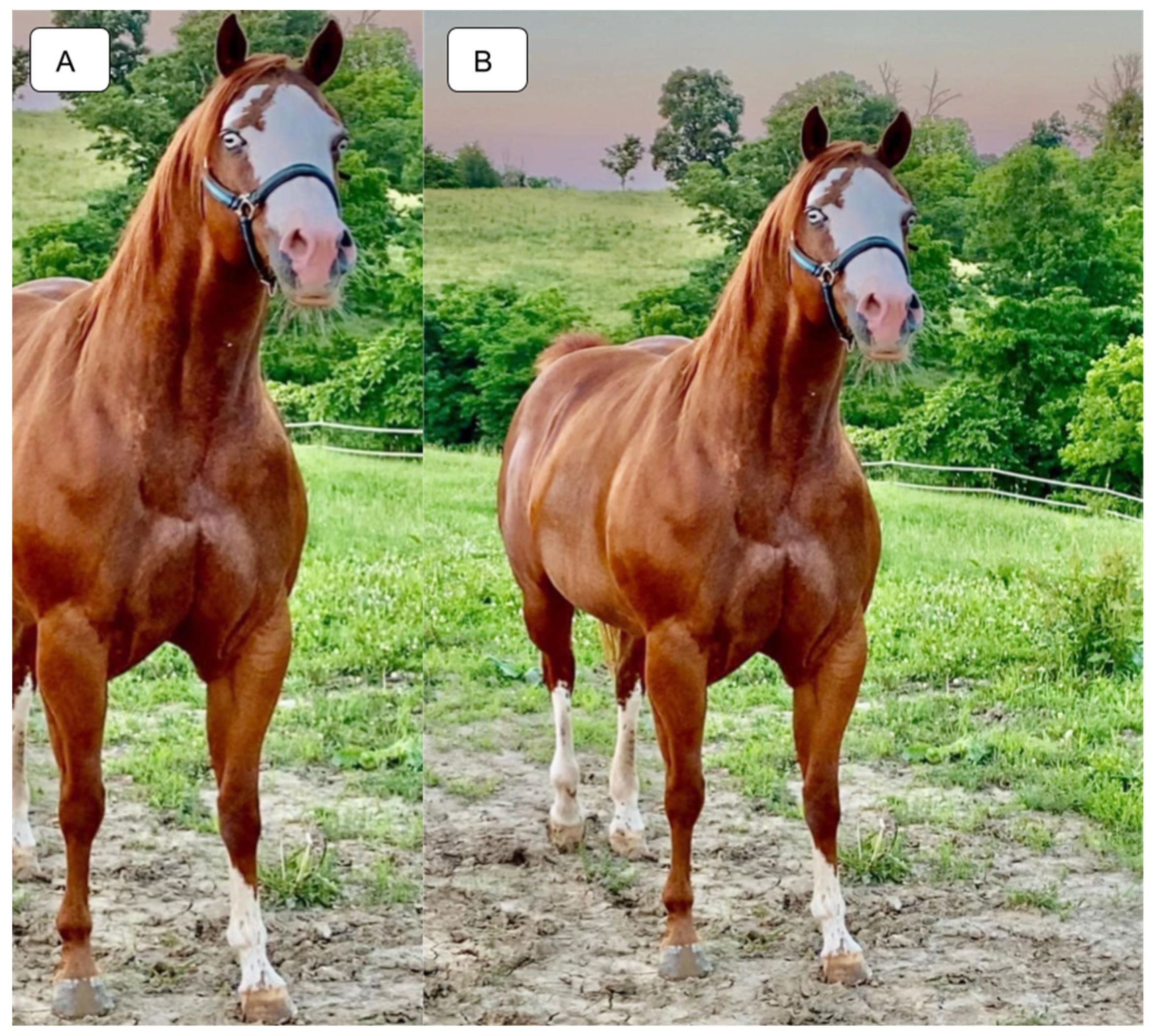
Population Analysis Identifies 15 Multi-Variant Dominant White Haplotypes in Horses
by
 , , and
Aiden McFadden
1,*,
Micaela Vierra
1,
Holly Robilliard
1,
Katie Martin
1,
Samantha A. Brooks
2 ,
,
Robin E. Everts
1 and
and
Christa Lafayette
1 
1
Etalon Inc., Menlo Park, CA 94025, USA
2
Department of Animal Sciences, UF Genetics Institute, University of Florida, Gainesville, FL 32611, USA
*
Author to whom correspondence should be addressed.
Animals 2024, 14(3), 517; https://doi.org/10.3390/ani14030517
Submission received: 4 December 2023
/
Revised: 26 January 2024
/
Accepted: 4 February 2024
/
Published: 5 February 2024
(This article belongs to the Special Issue Advances in Equine Genetics and Breeding)
Simple Summary
Mutations in the KIT gene cause many different types of white spotting in the coats of domestic horses, similar to other mammals. Although there are 36 different alleles responsible for causing different phenotypes, there have been no comprehensive observations performed on horses with haplotypes of two or more KIT variants. Because some KIT alleles are likely lethal in the homozygous state, some believe that it is impossible for a horse to carry three or more white spotting alleles. Here, we identify 15 unique haplotypes with two or more mutant KIT alleles and present data on a subset of their phenotypes. Identifying haplotypes helps to better understand the mechanisms responsible for white spotting in horses and allows for better control of breeding practices. We sought to prove that horses can carry more than two functionally annotated KIT variants and document any differences in white spotting compared to horses with only a single variant.
Abstract
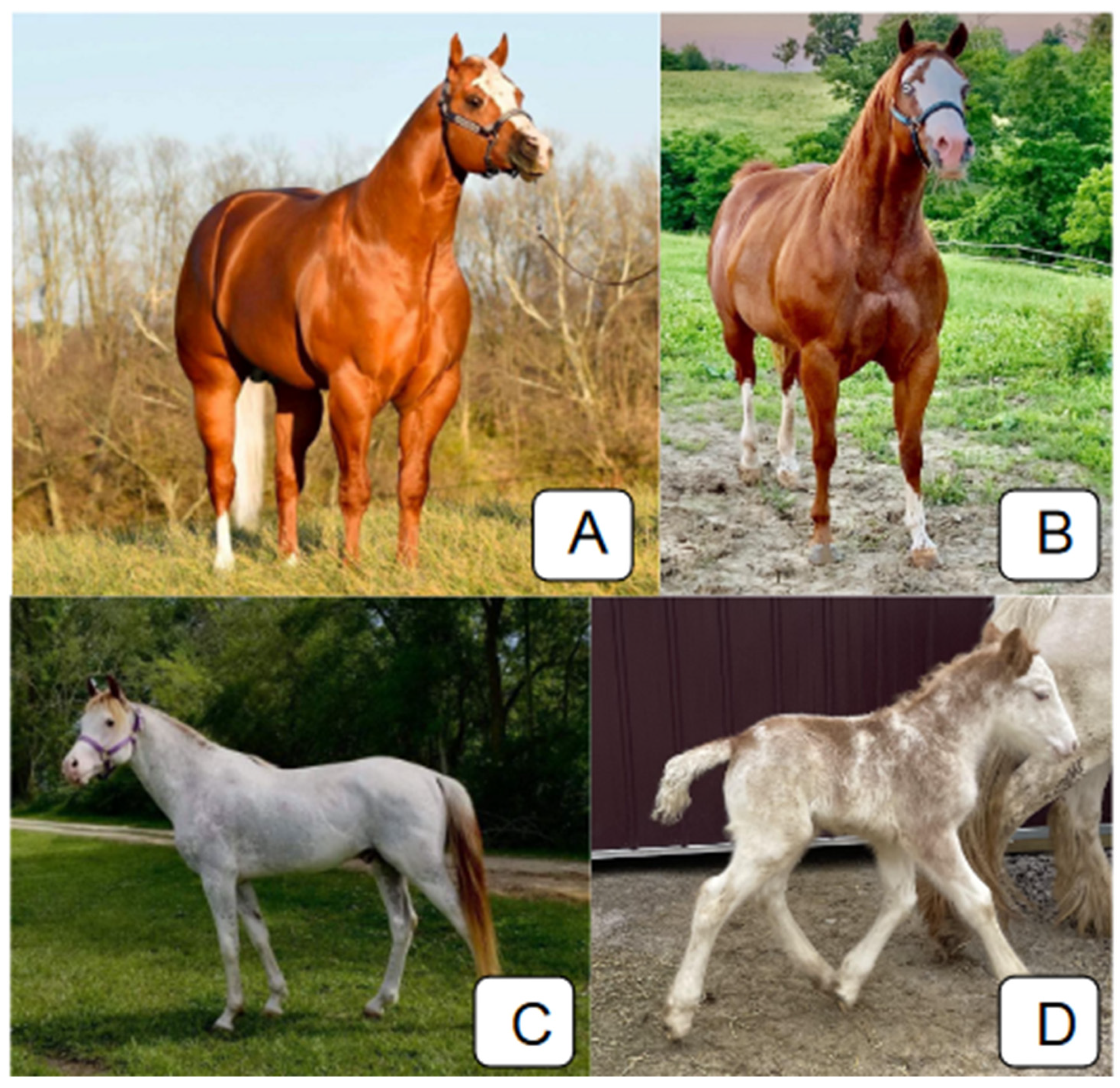
The influence of a horse’s appearance on health, sentimental and monetary value has driven the desire to understand the etiology of coat color. White markings on the coat define inclusion for multiple horse breeds, but they may disqualify a horse from registration in other breeds. In domesticated horses (Equus caballus), 35 KIT alleles are associated with or cause depigmentation and white spotting. It is a common misconception among the general public that a horse can possess only two KIT variants. To correct this misconception, we used BEAGLE 5.4-phased NGS data to identify 15 haplotypes possessing two or more KIT variants previously associated with depigmentation phenotypes. We sourced photos for 161 horses comprising 12 compound genotypes with three or more KIT variants and employed a standardized method to grade depigmentation, yielding average white scores for each unique compound genotype. We found that 7 of the 12 multi-variant haplotypes resulted in significantly more depigmentation relative to the single-variant haplotypes (ANOVA). It is clear horses can possess more than two KIT variants, and future work aims to document phenotypic variations for each compound genotype.
Keywords:
depigmentation; KIT; Dominant White; horse; white spotting