The Role of Dietary Fatty Acids in Modulating Blue Crab (Callinectes sapidus) Physiology, Reproduction, and Quality Traits in Captivity
by
 , , , , , and
Federico Conti
1,† ,
,
Lina Fernanda Pulido-Rodriguez
2,†,
Giulia Chemello
1,
Nico Cattaneo
1,*,
Mattia Resente
1,
Giuliana Parisi
2,
Ike Olivotto
1,* and
Matteo Zarantoniello
1 1
Department of Life and Environmental Sciences, Università Politecnica delle Marche, 60131 Ancona, Italy
2
Department of Agriculture, Food, Environment and Forestry, University of Florence, 50144 Firenze, Italy
*
Authors to whom correspondence should be addressed.
†
These authors contributed equally to this work.
Animals 2024, 14(22), 3304; https://doi.org/10.3390/ani14223304
Submission received: 14 October 2024
/
Revised: 14 November 2024
/
Accepted: 15 November 2024
/
Published: 17 November 2024
(This article belongs to the Section Animal Reproduction)
Simple Summary
The rapid expansion of blue crab in the Mediterranean Sea represents a severe threat for both human activities and biodiversity. It is a highly invasive species, with high fecundity, and able to tolerate a wide range of temperatures and salinities as well as to afflict the trophic net of local benthic ecosystems at multiple levels. Despite being omnivorous, the progressively lower prey abundance and variability can lead to a consequent lack of crucial dietary nutrients (mainly lipids) that may alter the population dynamics over time. The present study compared the effects on blue crabs of two distinct diets (a marine and a terrestrial one) with different fatty acid profiles over a 60-day feeding trial. The results highlighted how both males and females were able to face the dietary lack of crucial nutrients by preferentially investing them in reproductive performances at the expense of growth.
Abstract
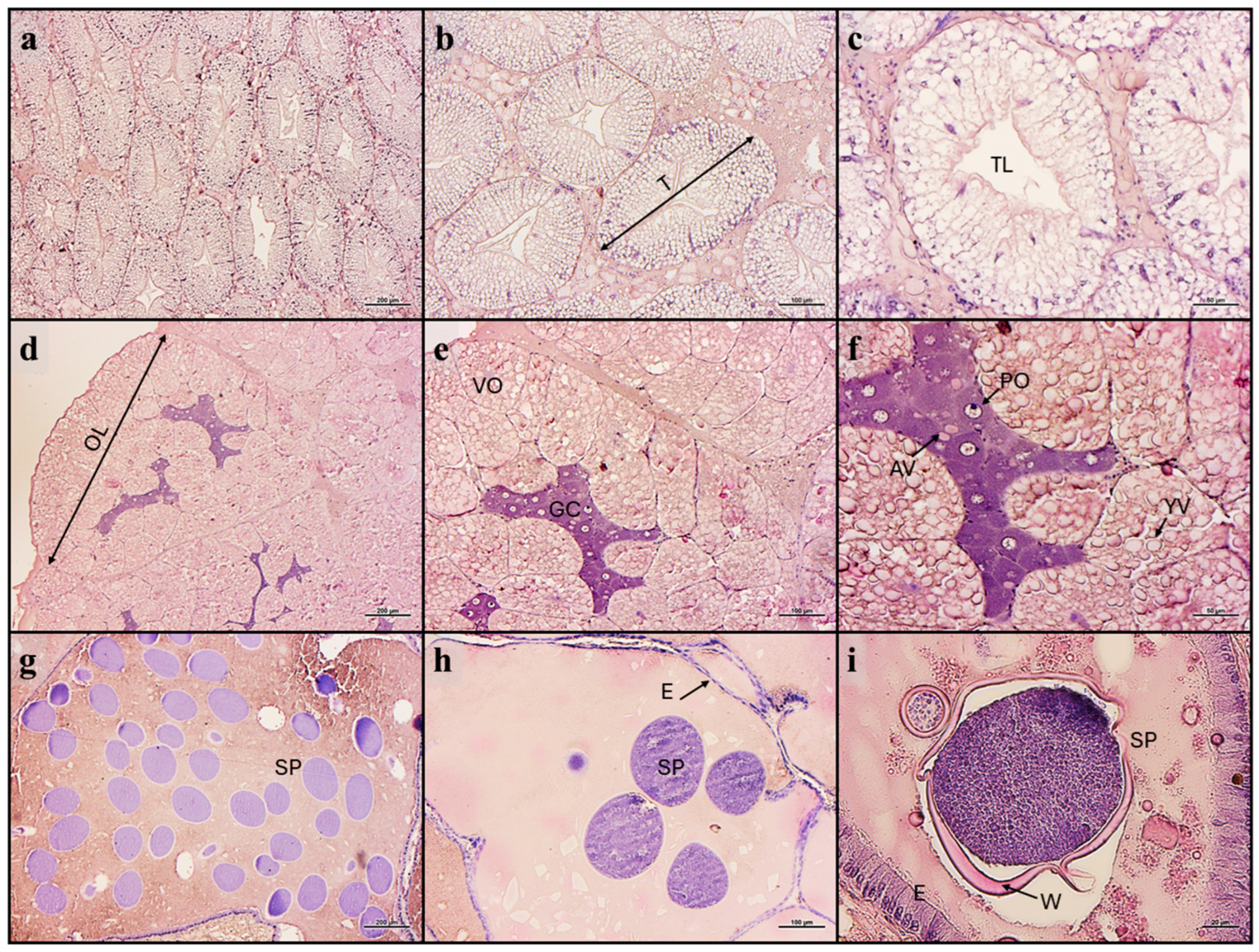
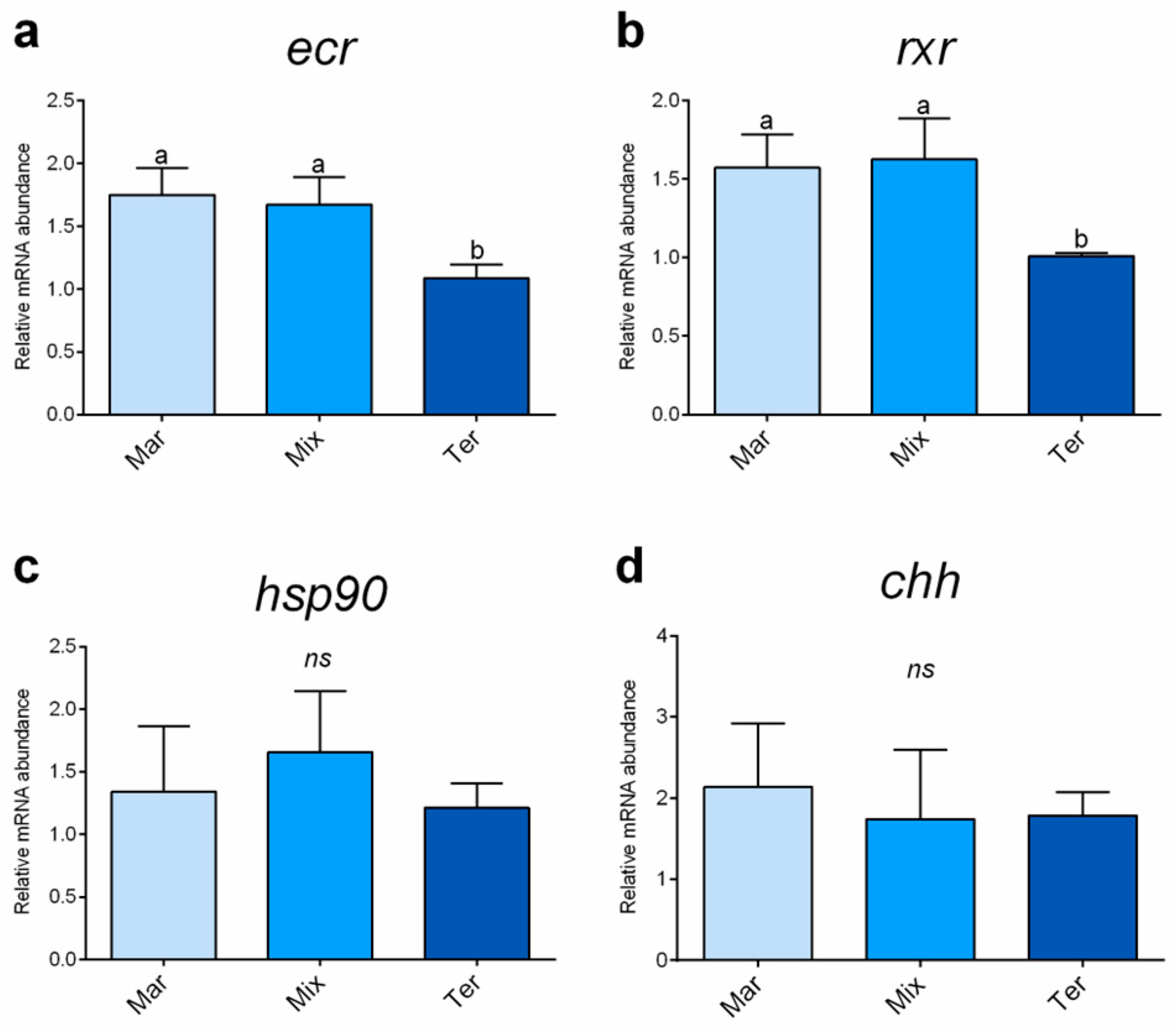
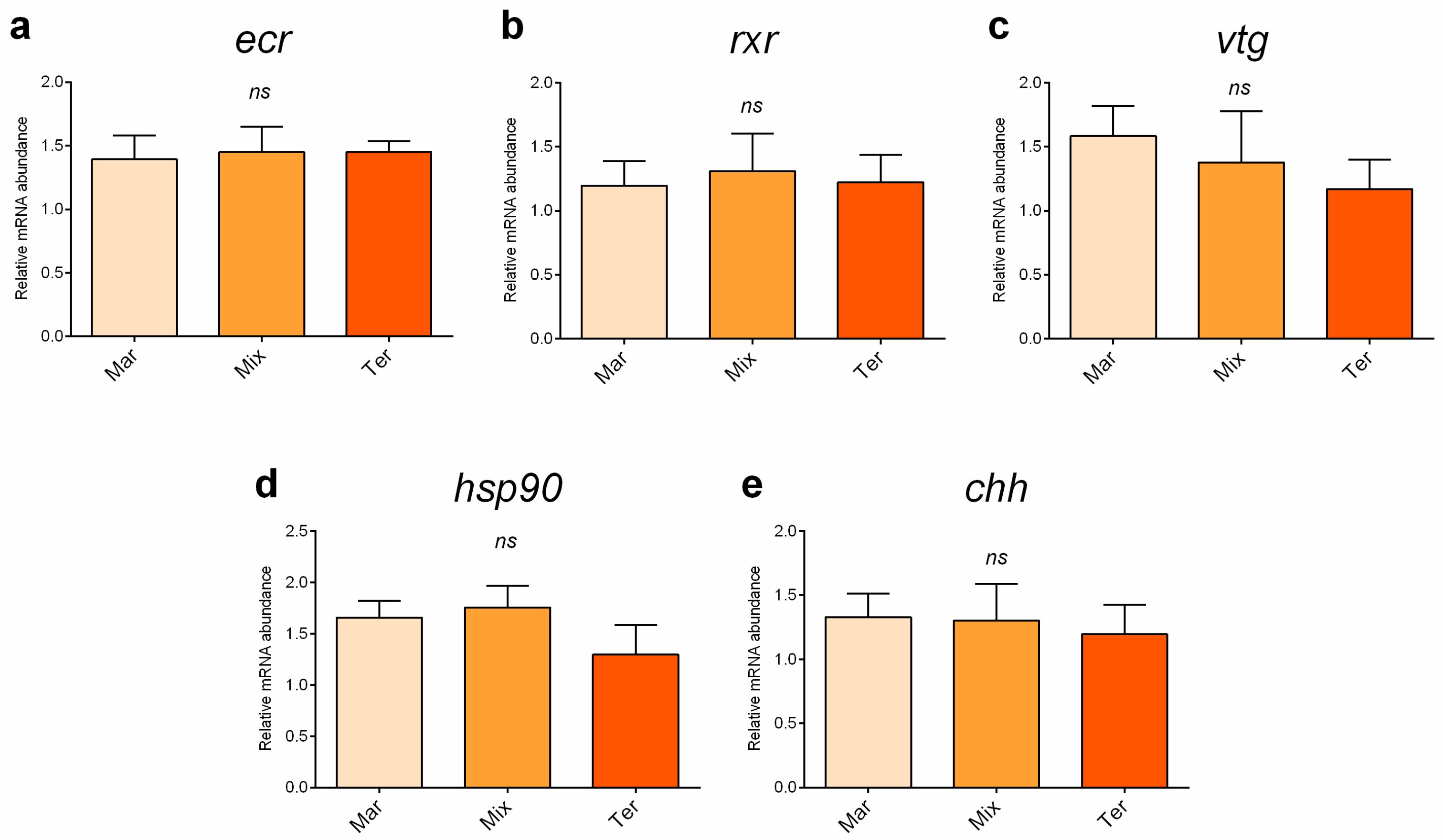
The invasive blue crab is challenging the Mediterranean basin, progressively declining local populations. This reflects a lower prey availability and suitability of dietary nutrients (mainly n-3 polyunsaturated fatty acids, PUFA). The present study aimed to challenge blue crab males and females with a feed source low in n-3 PUFA with respect to one showing a proper fatty acid profile and to investigate the responses in terms of growth, welfare, lipid characterization of target tissues, and reproductive status. Blue crabs were divided into three groups as follows: (i) Marine: crabs fed sardinella (Sardinella aurita) fillet for 60 days; (ii) Mix: crabs fed bovine heart for the first 40 days and sardinella fillet for the following 20 days; and (iii) Terrestrial: crabs fed bovine heart for 60 days. The diet did not alter the health status but reflected the fatty acid profile of muscle and ovary of the blue crabs. In each group, males and females showed a proper hepatopancreas structure, with comparable levels of lipid reserves. This properly supported gonad maturation in both sexes. However, males and females from the group fed the terrestrial diet were characterized by reduced body weight, revealing that blue crabs prioritize reproductive investment rather than growth by directing crucial nutrients to reproductive organs when a suboptimal diet is available.
Keywords:
growth performance; PUFA; hepatopancreas; animal welfare