SNP-Based and Kmer-Based eQTL Analysis Using Transcriptome Data
Simple Summary
Abstract
1. Introduction
2. Materials and Methods
2.1. Stage of Identifying SNPs’ Consistency Using DNA/RNA
2.1.1. Identification of Variants via RNA Sequencing
2.1.2. Identification of Variants via Whole-Genome Sequencing
2.1.3. Comparison of Variants Identified via RNA-seq and WGS
2.2. Stage of eQTL Analysis Using RNA-seq Data
2.2.1. RNA Sequencing Data and Variant Calls
2.2.2. Phenotypes and Covariates
2.2.3. Genotypes and Constructing Kinship Matrices
2.2.4. Association Analysis and Annotation of Kmers
2.2.5. Validation Analysis
3. Results
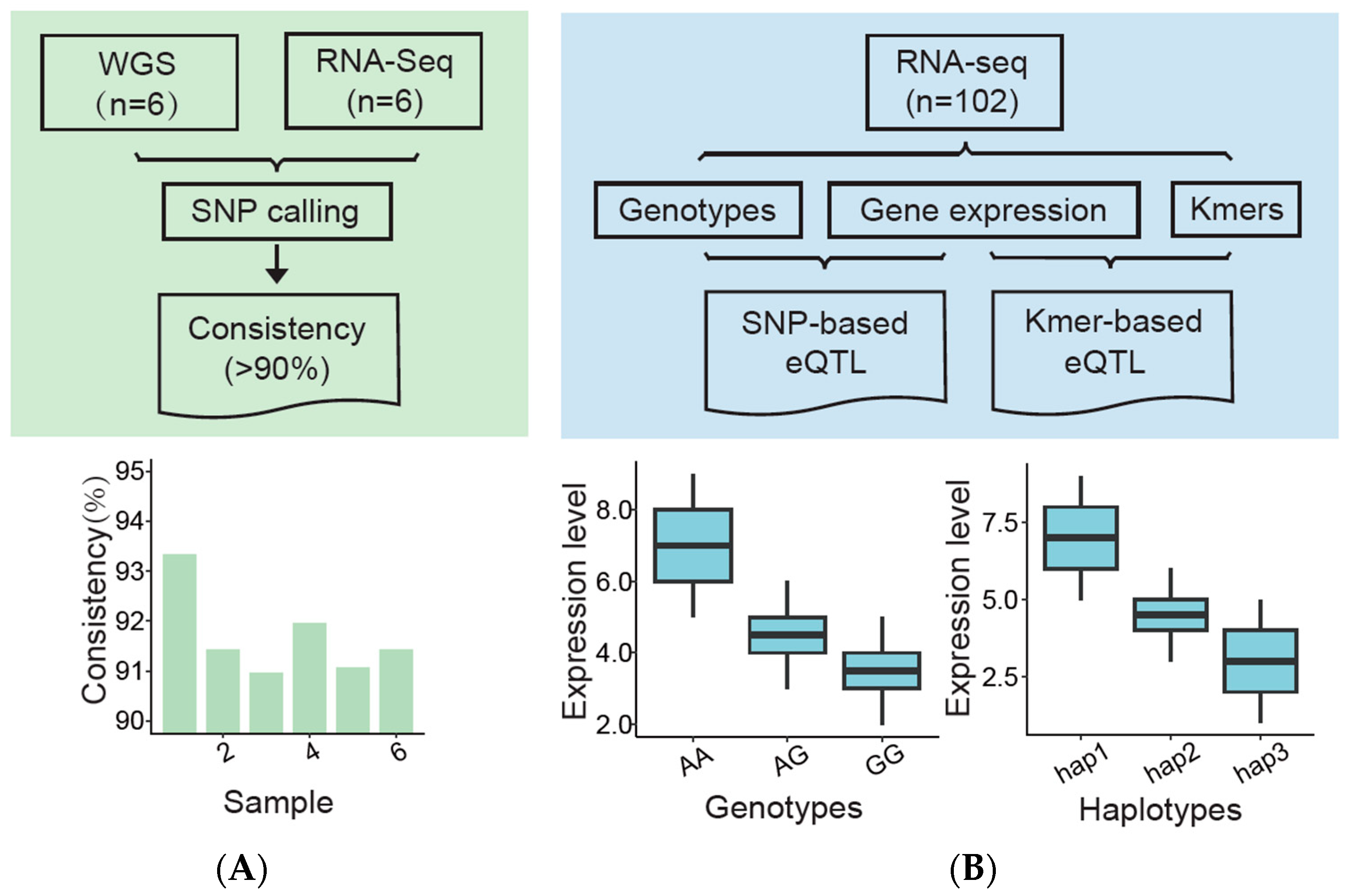
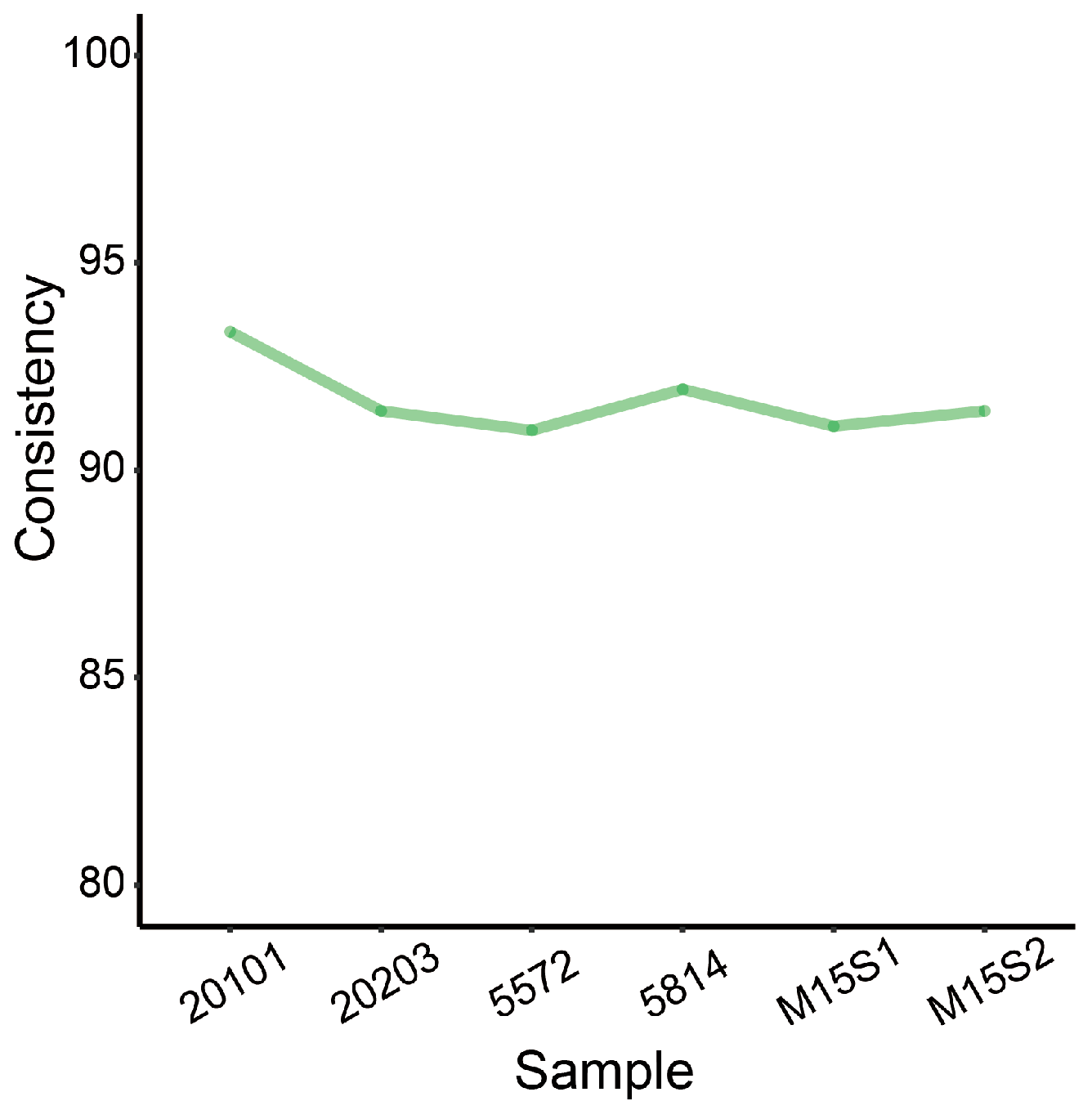
3.1. Consistency of SNPs Identified by WGS and RNA-seq
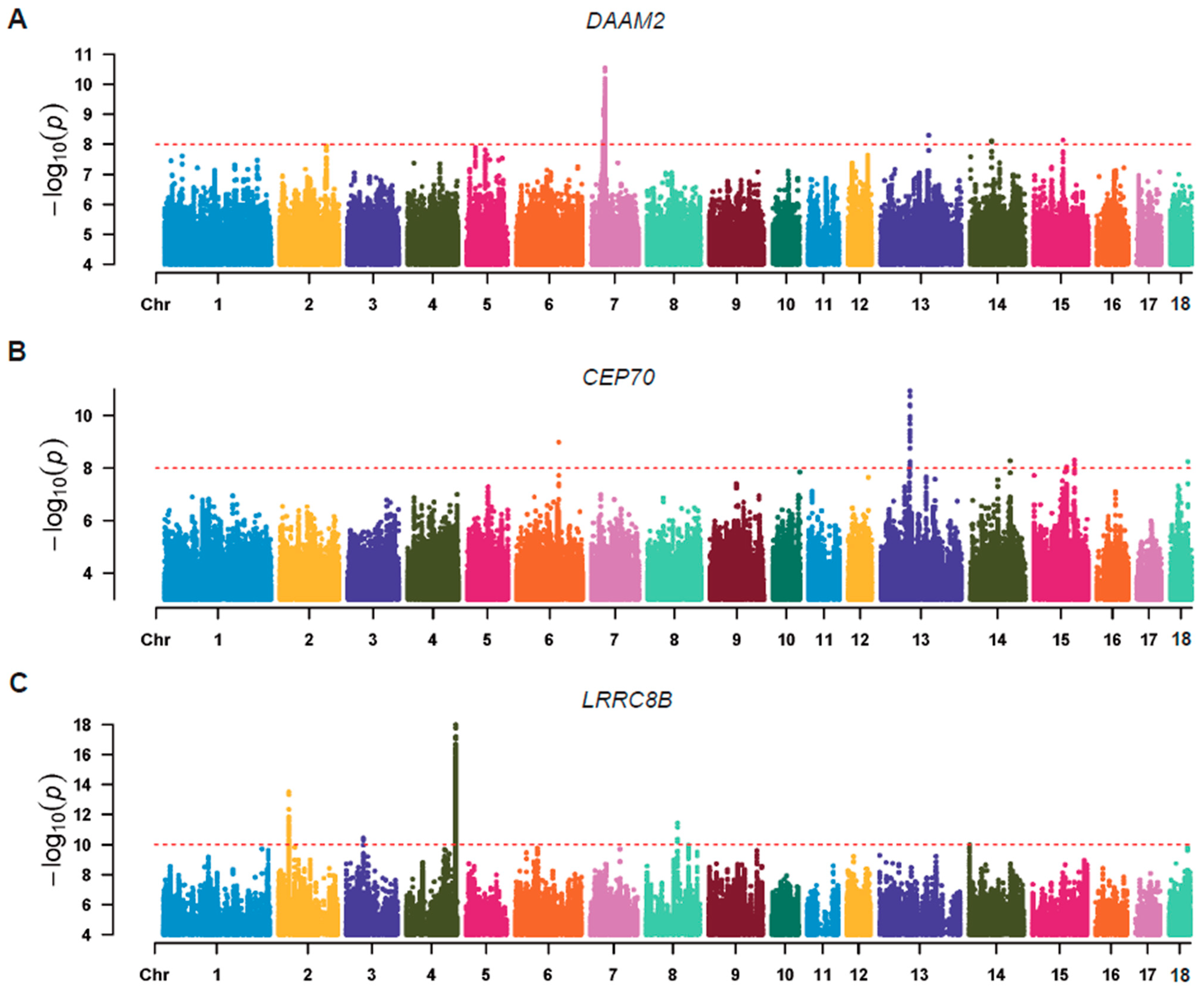
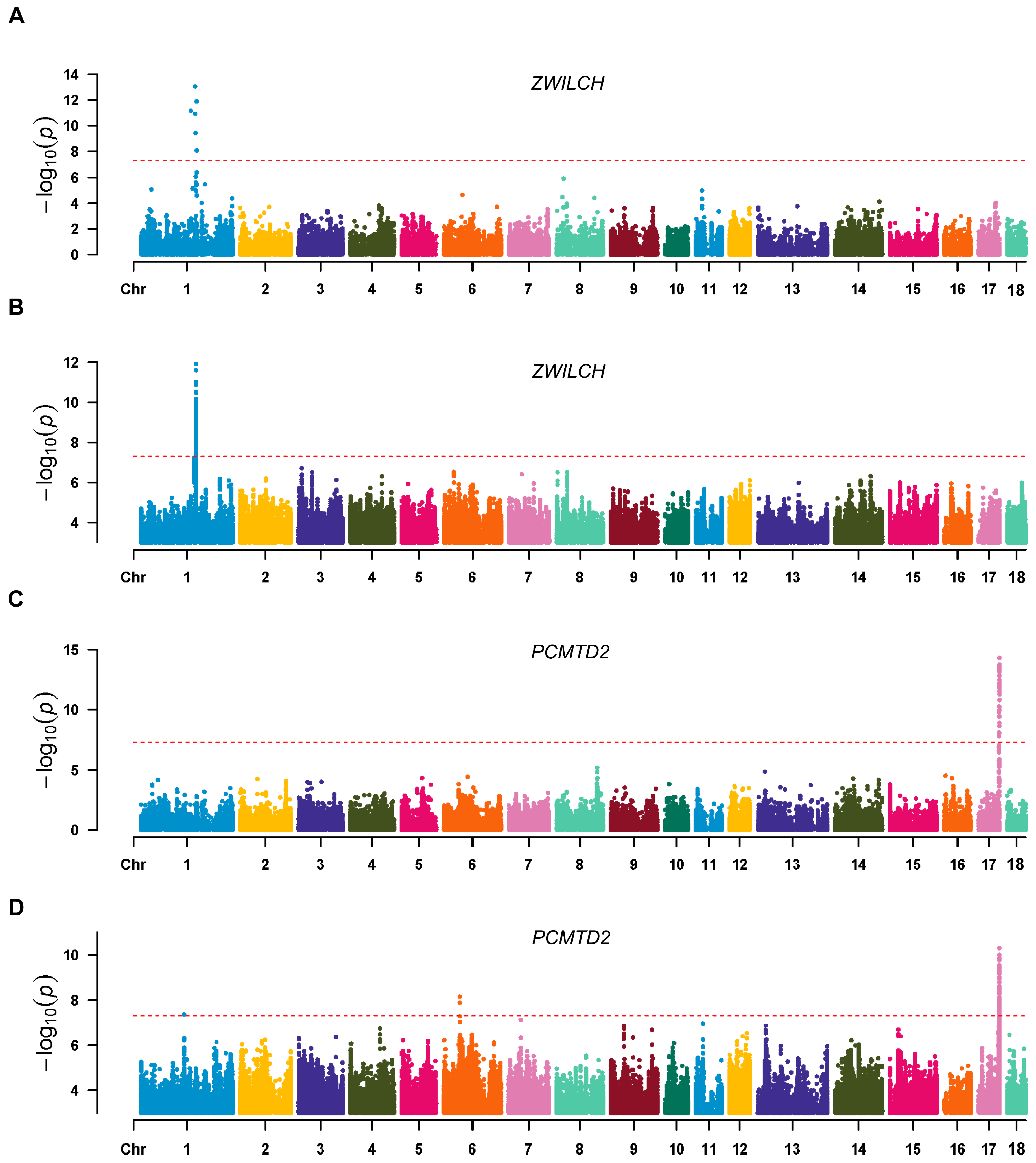
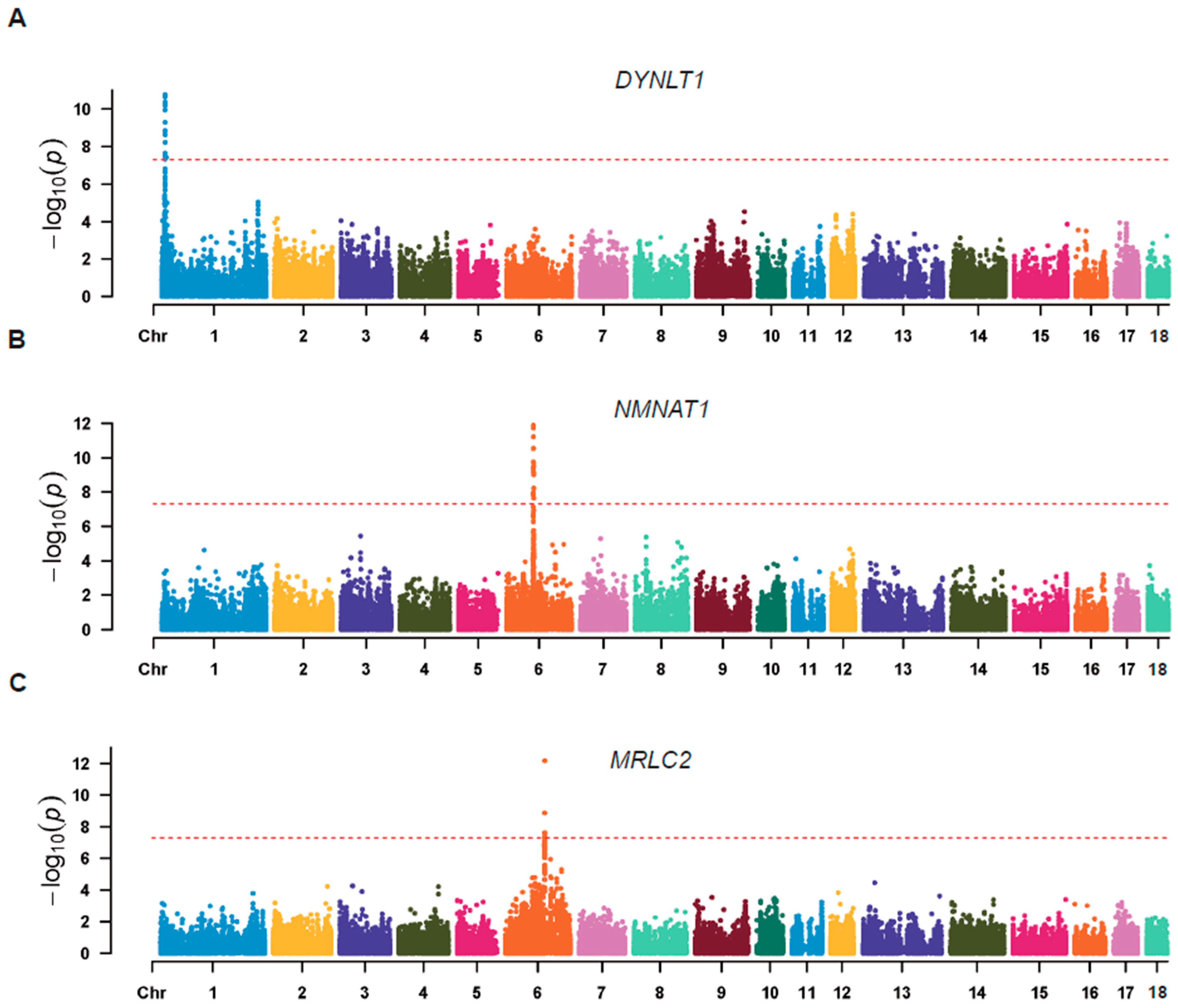
3.2. SNP-Based eQTL Analysis Using Transcriptome Data
3.3. Kmer-Based eQTL Analysis Using Transcriptome Data
3.4. Comparison of SNP-Based and Kmer-Based eQTL Analyses
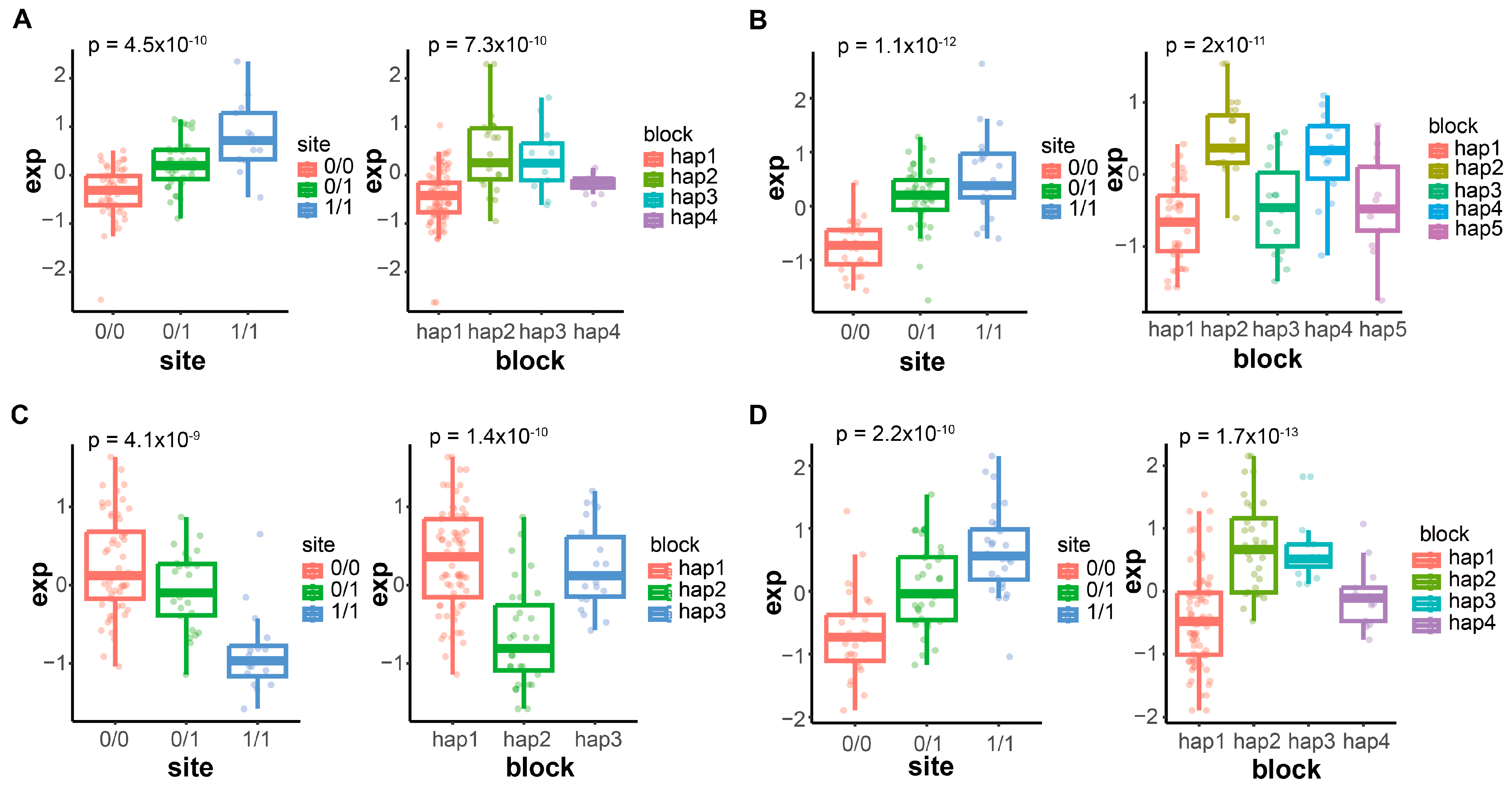
3.5. Validation Analysis of Haplotype Blocks
4. Discussion
5. Conclusions
Supplementary Materials
Author Contributions
Funding
Institutional Review Board Statement
Informed Consent Statement
Data Availability Statement
Conflicts of Interest
References
- Andrade, A.C.B.; Viana, J.M.S.; Pereira, H.D.; Pinto, V.B.; Fonseca e Silva, F. Linkage disequilibrium and haplotype block patterns in popcorn populations. PLoS ONE 2019, 14, e0219417. [Google Scholar] [CrossRef] [Scilit] [PubMed]
- Visscher, P.M.; Wray, N.R.; Zhang, Q.; Sklar, P.; McCarthy, M.I.; Brown, M.A.; Yang, J. 10 years of GWAS discovery: Biology, function, and translation. Am. J. Hum. Genet. 2017, 101, 5–22. [Google Scholar] [CrossRef] [Scilit] [PubMed]
- Nica, A.C.; Dermitzakis, E.T. Expression quantitative trait loci: Present and future. Philos. Trans. R. Soc. B Biol. Sci. 2013, 368, 20120362. [Google Scholar] [CrossRef] [Scilit] [PubMed]
- Sajuthi, S.P.; Sharma, N.K.; Chou, J.W.; Palmer, N.D.; McWilliams, D.R.; Beal, J.; Comeau, M.E.; Ma, L.; Calles-Escandon, J.; Demons, J. Mapping adipose and muscle tissue expression quantitative trait loci in African Americans to identify genes for type 2 diabetes and obesity. Hum. Genet. 2016, 135, 869–880. [Google Scholar] [CrossRef] [Scilit]
- Qiu, C.; Huang, S.; Park, J.; Park, Y.; Ko, Y.-A.; Seasock, M.J.; Bryer, J.S.; Xu, X.-X.; Song, W.-C.; Palmer, M. Renal compartment–specific genetic variation analyses identify new pathways in chronic kidney disease. Nat. Med. 2018, 24, 1721–1731. [Google Scholar] [CrossRef] [Scilit]
- Yin, X.; Bose, D.; Kwon, A.; Hanks, S.C.; Jackson, A.U.; Stringham, H.M.; Welch, R.; Oravilahti, A.; Silva, L.F.; Locke, A.E. Integrating transcriptomics, metabolomics, and GWAS helps reveal molecular mechanisms for metabolite levels and disease risk. Am. J. Hum. Genet. 2022, 109, 1727–1741. [Google Scholar] [CrossRef] [Scilit]
- Velez-Irizarry, D.; Casiro, S.; Daza, K.R.; Bates, R.O.; Raney, N.E.; Steibel, J.P.; Ernst, C.W. Genetic control of longissimus dorsi muscle gene expression variation and joint analysis with phenotypic quantitative trait loci in pigs. BMC Genom. 2019, 20, 3. [Google Scholar] [CrossRef] [Scilit]
- Yuan, Z.; Sunduimijid, B.; Xiang, R.; Behrendt, R.; Knight, M.I.; Mason, B.A.; Reich, C.M.; Prowse-Wilkins, C.; Vander Jagt, C.J.; Chamberlain, A.J. Expression quantitative trait loci in sheep liver and muscle contribute to variations in meat traits. Genet. Sel. Evol. 2021, 53, 8. [Google Scholar] [CrossRef] [Scilit]
- Cai, W.; Hu, J.; Zhang, Y.; Guo, Z.; Zhou, Z.; Hou, S. Cis-eQTLs in seven duck tissues identify novel candidate genes for growth and carcass traits. BMC Genom. 2024, 25, 429. [Google Scholar] [CrossRef] [Scilit]
- Sun, G.; Mural, R.V.; Turkus, J.D.; Schnable, J.C. Quantitative resistance loci to southern rust mapped in a temperate maize diversity panel. Phytopathology 2022, 112, 579–587. [Google Scholar] [CrossRef] [Scilit]
- Zhang, Y.; Wang, M.; Li, Z.; Yang, X.; Li, K.; Xie, A.; Dong, F.; Wang, S.; Yan, J.; Liu, J. An overview of detecting gene-trait associations by integrating GWAS summary statistics and eQTLs. Sci. China Life Sci. 2024, 67, 1133–1154. [Google Scholar] [CrossRef] [Scilit] [PubMed]
- Joehanes, R.; Zhang, X.; Huan, T.; Yao, C.; Ying, S.-X.; Nguyen, Q.T.; Demirkale, C.Y.; Feolo, M.L.; Sharopova, N.R.; Sturcke, A. Integrated genome-wide analysis of expression quantitative trait loci aids interpretation of genomic association studies. Genome Biol. 2017, 18, 16. [Google Scholar] [CrossRef] [Scilit]
- Yengo, L.; Vedantam, S.; Marouli, E.; Sidorenko, J.; Bartell, E.; Sakaue, S.; Graff, M.; Eliasen, A.U.; Jiang, Y.; Raghavan, S. A saturated map of common genetic variants associated with human height. Nature 2022, 610, 704–712. [Google Scholar] [CrossRef] [Scilit] [PubMed]
- Karikari, B.; Lemay, M.-A.; Belzile, F. k-mer-based genome-wide association studies in plants: Advances, challenges, and perspectives. Genes 2023, 14, 1439. [Google Scholar] [CrossRef] [Scilit]
- Voichek, Y.; Weigel, D. Identifying genetic variants underlying phenotypic variation in plants without complete genomes. Nat. Genet. 2020, 52, 534–540. [Google Scholar] [CrossRef] [Scilit]
- Rahman, A.; Hallgrímsdóttir, I.; Eisen, M.; Pachter, L. Association mapping from sequencing reads using k-mers. Elife 2018, 7, e32920. [Google Scholar] [CrossRef] [Scilit] [PubMed]
- Lemay, M.A.; De Ronne, M.; Bélanger, R.; Belzile, F. k-mer-based GWAS enhances the discovery of causal variants and candidate genes in soybean. Plant Genome 2023, 16, e20374. [Google Scholar] [CrossRef] [Scilit]
- Chen, S.; Zhou, Y.; Chen, Y.; Gu, J. fastp: An ultra-fast all-in-one FASTQ preprocessor. Bioinformatics 2018, 34, i884–i890. [Google Scholar] [CrossRef] [Scilit]
- Dobin, A.; Davis, C.A.; Schlesinger, F.; Drenkow, J.; Zaleski, C.; Jha, S.; Batut, P.; Chaisson, M.; Gingeras, T.R. STAR: Ultrafast universal RNA-seq aligner. Bioinformatics 2013, 29, 15–21. [Google Scholar] [CrossRef] [Scilit]
- Li, H.; Handsaker, B.; Wysoker, A.; Fennell, T.; Ruan, J.; Homer, N.; Marth, G.; Abecasis, G.; Durbin, R.; Subgroup, G.P.D.P. The sequence alignment/map format and SAMtools. Bioinformatics 2009, 25, 2078–2079. [Google Scholar] [CrossRef] [Scilit]
- Tarasov, A.; Vilella, A.J.; Cuppen, E.; Nijman, I.J.; Prins, P. Sambamba: Fast processing of NGS alignment formats. Bioinformatics 2015, 31, 2032–2034. [Google Scholar] [CrossRef] [Scilit] [PubMed]
- McKenna, A.; Hanna, M.; Banks, E.; Sivachenko, A.; Cibulskis, K.; Kernytsky, A.; Garimella, K.; Altshuler, D.; Gabriel, S.; Daly, M. The Genome Analysis Toolkit: A MapReduce framework for analyzing next-generation DNA sequencing data. Genome Res. 2010, 20, 1297–1303. [Google Scholar] [CrossRef] [Scilit] [PubMed]
- Li, H. Aligning sequence reads, clone sequences and assembly contigs with BWA-MEM. arXiv 2013, arXiv:1303.3997. [Google Scholar]
- Danecek, P.; Bonfield, J.K.; Liddle, J.; Marshall, J.; Ohan, V.; Pollard, M.O.; Whitwham, A.; Keane, T.; McCarthy, S.A.; Davies, R.M. Twelve years of SAMtools and BCFtools. Gigascience 2021, 10, giab008. [Google Scholar] [CrossRef] [Scilit]
- Kim, D.; Paggi, J.M.; Park, C.; Bennett, C.; Salzberg, S.L. Graph-based genome alignment and genotyping with HISAT2 and HISAT-genotype. Nat. Biotechnol. 2019, 37, 907–915. [Google Scholar] [CrossRef] [Scilit]
- Pertea, M.; Pertea, G.M.; Antonescu, C.M.; Chang, T.-C.; Mendell, J.T.; Salzberg, S.L. StringTie enables improved reconstruction of a transcriptome from RNA-seq reads. Nat. Biotechnol. 2015, 33, 290–295. [Google Scholar] [CrossRef] [Scilit] [PubMed]
- McCaw, Z.R.; Lane, J.M.; Saxena, R.; Redline, S.; Lin, X. Operating characteristics of the rank-based inverse normal transformation for quantitative trait analysis in genome-wide association studies. Biometrics 2020, 76, 1262–1272. [Google Scholar] [CrossRef] [Scilit] [PubMed]
- Eggertsson, H.P.; Jonsson, H.; Kristmundsdottir, S.; Hjartarson, E.; Kehr, B.; Masson, G.; Zink, F.; Hjorleifsson, K.E.; Jonasdottir, A.; Jonasdottir, A. Graphtyper enables population-scale genotyping using pangenome graphs. Nat. Genet. 2017, 49, 1654–1660. [Google Scholar] [CrossRef] [Scilit]
- Purcell, S.; Neale, B.; Todd-Brown, K.; Thomas, L.; Ferreira, M.A.; Bender, D.; Maller, J.; Sklar, P.; De Bakker, P.I.; Daly, M.J. PLINK: A tool set for whole-genome association and population-based linkage analyses. Am. J. Hum. Genet. 2007, 81, 559–575. [Google Scholar] [CrossRef] [Scilit]
- Zhou, X.; Stephens, M. Genome-wide efficient mixed-model analysis for association studies. Nat. Genet. 2012, 44, 821–824. [Google Scholar] [CrossRef] [Scilit]
- Kokot, M.; Długosz, M.; Deorowicz, S. KMC 3: Counting and manipulating k-mer statistics. Bioinformatics 2017, 33, 2759–2761. [Google Scholar] [CrossRef] [Scilit] [PubMed]
- Langmead, B.; Salzberg, S.L. Fast gapped-read alignment with Bowtie 2. Nat. Methods 2012, 9, 357–359. [Google Scholar] [CrossRef] [Scilit] [PubMed]
- Hofmeister, R.J.; Ribeiro, D.M.; Rubinacci, S.; Delaneau, O. Accurate rare variant phasing of whole-genome and whole-exome sequencing data in the UK Biobank. Nat. Genet. 2023, 55, 1243–1249. [Google Scholar] [CrossRef] [Scilit] [PubMed]
- Li, H. Tabix: Fast retrieval of sequence features from generic TAB-delimited files. Bioinformatics 2011, 27, 718–719. [Google Scholar] [CrossRef] [Scilit] [PubMed]
- Cai, W.; Zhang, Y.; Chang, T.; Wang, Z.; Zhu, B.; Chen, Y.; Gao, X.; Xu, L.; Zhang, L.; Gao, H. The eQTL colocalization and transcriptome-wide association study identify potentially causal genes responsible for economic traits in Simmental beef cattle. J. Anim. Sci. Biotechnol. 2023, 14, 78. [Google Scholar] [CrossRef] [Scilit]
- Consortium, G.P. A map of human genome variation from population scale sequencing. Nature 2010, 467, 1061. [Google Scholar] [CrossRef] [Scilit]
- Abdellaoui, A.; Yengo, L.; Verweij, K.J.; Visscher, P.M. 15 years of GWAS discovery: Realizing the promise. Am. J. Hum. Genet. 2023, 110, 179–194. [Google Scholar] [CrossRef] [Scilit] [PubMed]
- Sun, W.; Hu, Y. eQTL mapping using RNA-seq data. Stat. Biosci. 2013, 5, 198–219. [Google Scholar] [CrossRef] [Scilit]
- Hu, Y.-J.; Sun, W.; Tzeng, J.-Y.; Perou, C.M. Proper use of allele-specific expression improves statistical power for cis-eQTL mapping with RNA-seq data. J. Am. Stat. Assoc. 2015, 110, 962–974. [Google Scholar] [CrossRef] [Scilit]
- Karim, M.; Iqbal, T.; Nawaz, A.; Yaku, K.; Nakagawa, T. Deletion of Nmnat1 in Skeletal Muscle Leads to the Reduction of NAD+ Levels but Has No Impact on Skeletal Muscle Morphology and Fiber Types. J. Nutr. Sci. Vitaminol. 2023, 69, 184–189. [Google Scholar] [CrossRef] [Scilit]
- Kapitansky, O.; Gozes, I. ADNP differentially interact with genes/proteins in correlation with aging: A novel marker for muscle aging. Geroscience 2019, 41, 321–340. [Google Scholar] [CrossRef] [Scilit] [PubMed]
- Mori, V.; Amici, A.; Mazzola, F.; Di Stefano, M.; Conforti, L.; Magni, G.; Ruggieri, S.; Raffaelli, N.; Orsomando, G. Metabolic profiling of alternative NAD biosynthetic routes in mouse tissues. PLoS ONE 2014, 9, e113939. [Google Scholar] [CrossRef] [Scilit] [PubMed]
- Xu, H.; Xu, G.; Wan, L.; Ma, J. Molecular cloning and functional analysis of MRLC2 in Tianfu, Boer, and Chengdu Ma goats. Genet. Mol. Res. 2013, 12, 3510–3520. [Google Scholar] [CrossRef] [Scilit]
- Xie, H.T.; Lei, M.G.; Xiong, Y.Z.; Deng, C.Y.; Jiang, S.W.; Zuo, B.; Li, F.E.; Xu, D.Q.; Wang, T. Molecular cloning and functional analysis of MRLC2 differential expressed in Meishan× Yorkshire F1 crossbreeds and their parents, Meishan pigs. Acta Biochim. Et Biophys. Sin. 2006, 38, 788–794. [Google Scholar] [CrossRef] [Scilit]
- Ajima, R.; Bisson, J.A.; Helt, J.-C.; Nakaya, M.-A.; Habas, R.; Tessarollo, L.; He, X.; Morrisey, E.E.; Yamaguchi, T.P.; Cohen, E.D. DAAM1 and DAAM2 are co-required for myocardial maturation and sarcomere assembly. Dev. Biol. 2015, 408, 126–139. [Google Scholar] [CrossRef] [Scilit]
- Mezzacappa, C.; Komiya, Y.; Habas, R. Reversion induced LIM domain protein (RIL) is a Daam1-interacting protein and regulator of the actin cytoskeleton during non-canonical Wnt signaling. Dev. Biol. 2024, 515, 46–58. [Google Scholar] [CrossRef] [Scilit] [PubMed]
- Zhang, J.; Toremurat, Z.; Liang, Y.; Cheng, J.; Sun, Z.; Huang, Y.; Liu, J.; Chaogetu, B.; Ren, G.; Chen, H. Study on the association between LRRC8B gene InDel and sheep body conformation traits. Genes 2023, 14, 356. [Google Scholar] [CrossRef] [Scilit]
- Ghosh, A.; Khandelwal, N.; Kumar, A.; Bera, A.K. Leucine-rich repeat-containing 8B protein is associated with the endoplasmic reticulum Ca2+ leak in HEK293 cells. J. Cell Sci. 2017, 130, 3818–3828. [Google Scholar] [CrossRef] [Scilit] [PubMed]
- Gabriel, S.B.; Schaffner, S.F.; Nguyen, H.; Moore, J.M.; Roy, J.; Blumenstiel, B.; Higgins, J.; DeFelice, M.; Lochner, A.; Faggart, M. The structure of haplotype blocks in the human genome. Science 2002, 296, 2225–2229. [Google Scholar] [CrossRef] [Scilit] [PubMed]
- Oyelami, F.O.; Zhao, Q.; Xu, Z.; Zhang, Z.; Sun, H.; Zhang, Z.; Ma, P.; Wang, Q.; Pan, Y. Haplotype block analysis reveals candidate genes and QTLs for meat quality and disease resistance in Chinese Jiangquhai pig breed. Front. Genet. 2020, 11, 752. [Google Scholar] [CrossRef] [Scilit]
- Barendse, W. Haplotype analysis improved evidence for candidate genes for intramuscular fat percentage from a genome wide association study of cattle. PLoS ONE 2011, 6, e29601. [Google Scholar] [CrossRef] [Scilit] [PubMed]


Disclaimer/Publisher’s Note: The statements, opinions and data contained in all publications are solely those of the individual author(s) and contributor(s) and not of MDPI and/or the editor(s). MDPI and/or the editor(s) disclaim responsibility for any injury to people or property resulting from any ideas, methods, instructions or products referred to in the content. |
© 2024 by the authors. Licensee MDPI, Basel, Switzerland. This article is an open access article distributed under the terms and conditions of the Creative Commons Attribution (CC BY) license (https://creativecommons.org/licenses/by/4.0/).
Share and Cite
Ge, M.; Li, C.; Zhang, Z. SNP-Based and Kmer-Based eQTL Analysis Using Transcriptome Data. Animals 2024, 14, 2941. https://doi.org/10.3390/ani14202941
Ge M, Li C, Zhang Z. SNP-Based and Kmer-Based eQTL Analysis Using Transcriptome Data. Animals. 2024; 14(20):2941. https://doi.org/10.3390/ani14202941
Chicago/Turabian StyleGe, Mei, Chenyu Li, and Zhiyan Zhang. 2024. "SNP-Based and Kmer-Based eQTL Analysis Using Transcriptome Data" Animals 14, no. 20: 2941. https://doi.org/10.3390/ani14202941
APA StyleGe, M., Li, C., & Zhang, Z. (2024). SNP-Based and Kmer-Based eQTL Analysis Using Transcriptome Data. Animals, 14(20), 2941. https://doi.org/10.3390/ani14202941