You are currently viewing a new version of our website. To view the old version click .
Animals
  • Article
  • Open Access

18 May 2024

Rearing Management and Its Impact on Caseous Lymphadenitis in Sheep

,
,
,
,
,
and
1
Namur Research Institute for Life Sciences, University of Namur, 5000 Namur, Belgium
2
Animal Production Unit, Regional Center Agricultural Research of Settat, National Institute for Agricultural Research (INRA), Avenue Ennasr, P.O. Box 415, Rabat Principal, Rabat 10090, Morocco
3
Department of Veterinary Management of Animal Resources, FARAH Centre, Faculty of Veterinary Medicine, University of Liege, 4000 Liège, Belgium
4
Regional Center of Agricultural Research of Tangier, National Institute for Agricultural Research (INRA), Avenue Ennasr, P.O. Box 415, Rabat Principal, Rabat 10090, Morocco
This article belongs to the Topic Animal Diseases in Agricultural Production Systems: Their Veterinary, Zoonotic, and One Health Importance, 2nd Edition

Simple Summary

Caseous lymphadenitis is one of the main infectious problems affecting sheep rearing areas worldwide. In Morocco, sheep farming constitutes an important socioeconomic activity and is considered to be a source of income for the local rural population. However, breeders are facing considerable economic losses due to caseous lymphadenitis. This negative impact is mainly due to the low prices and limited saleability of sheep with superficial abscesses, particularly for religious celebrations. In the present study, investigations were realised at the flock and slaughterhouse levels to determine the prevalence and risk factors implicated in caseous lymphadenitis. As a result, the form of rearing management adopted was found to impact the dissemination of caseous lymphadenitis. In conclusion, improvement of ventilation in sheep barns and implementation of periodic control of abscess cases, including their treatment with adequate procedures, are a must.

Abstract

Two surveys were conducted to assess the prevalence and risk factors of ovine caseous lymphadenitis (CL) and explore the association between its superficial and visceral forms in Sardi sheep in Settat province, Morocco. A total of 1521 sheep, including 318 lambs < 6 months, 572 young sheep aged 6–24 months, and 631 adult sheep > 24 months, were examined from 57 flocks. Superficial CL prevalence levels were as follows: 69/318 in lambs, 292/572 in young sheep, and 114/631 in adult sheep. Additionally, 2124 sheep, including 1813 young and 311 adult sheep, were inspected in slaughterhouses ante- and post-mortem. Among all infected animals, the prevalence of visceral abscesses was notably higher in adult sheep (83%, OR = 9.8, 95% CI = 5.5–17.2) compared to young sheep (35%). Data on flock size, sex, age, body condition score, rearing methods, and hygienic measures were collected. Suspected CL cases were confirmed using quadruplex-PCR. Poor barn ventilation, lack of abscess control, and younger age were identified as key risk factors for CL. Additionally, a high percentage (89%) of animals with thoracic abscesses did not display superficial lesions. While age and abscess control have been reported in previous studies, barn ventilation appears to be a new, but important, risk factor. In conclusion, the identified risk factors in Settat province are linked to breeding management practices. Implementing regular abscess control measures and improving barn ventilation are essential for CL prevention.

1. Introduction

Sheep play a pivotal role as a primary source of meat and milk globally [1]. By 2022, the worldwide sheep population had reached 1.3 billion individuals [2]. In Morocco, sheep farming stands as a vital socioeconomic pursuit, constituting a primary income source for local rural communities, with an estimated sheep population of approximately 21.8 million [2]. Among these, the Sardi breed emerges as one of the most prominent indigenous varieties, boasting a population estimated at 2.5 million individuals [3]. This breed holds significant cultural and religious significance and is often preferred for ceremonial occasions. However, breeders face substantial economic losses attributable to caseous lymphadenitis (CL), a contagious disease. The adverse effects of CL are primarily attributed to the reduced market value and limited saleability of sheep exhibiting superficial abscesses, which are particularly undesirable for religious observances that mandate healthy animals. Moreover, CL detrimentally impacts leather and wool production, along with reproductive efficiency [4,5]. Additionally, contaminated carcasses and trimmed sections yield lower meat quantities, contributing to economic losses [6].
Caseous lymphadenitis primarily afflicts small ruminants, although cases have been reported in various mammalian species, including camelids, horses, and cattle [7,8]. Furthermore, owing to its zoonotic potential, CL poses risks to individuals in close contact with infected animals, such as farmers, veterinarians, and shearers [9,10,11]. Clinically, it manifests as suppurative necrotic inflammation of organs and lymph nodes, caused by the facultative intracellular bacterium Corynebacterium pseudotuberculosis, formerly known as Corynebacterium ovis, Preisz-Nocard bacillus, and Preisz-Guinard bacillus [12]. Initially isolated and described by Nocard in 1888 from a cow afflicted with ulcerative lymphangitis, CL presents in two distinct clinical forms. The superficial form targets peripheral lymph nodes, including the parotid, retropharyngeal, submandibular, popliteal, prefemoral, and prescapular lymph nodes, while the second form affects mediastinal and bronchial lymph nodes, as well as visceral organs such as the lungs, spleen, kidneys, and liver [13]. After an incubation period spanning 15 to 180 days, the infection progresses to pyogranulomatous lesions [4,14], which subsequently enlarge and encapsulate with fibrous tissue [11]. Currently, no effective treatment exists for CL, as antibiotherapies often fail due to the bacterium’s intracellular nature and the formation of fibrous capsules encasing the lesions [15,16]. Consequently, preventive measures remain the most viable option for curtailing and preventing its spread.
The risk factors associated with caseous lymphadenitis (CL) vary depending on the sheep breeding management system, which differs from region to region. For example, in Dakahlia Governorate, Egypt, housing systems lacking hygienic measures and the practice of cohabiting infected sheep with healthy ones have been identified as the primary risk factors for CL infection [17]. Similarly, semi-extensive and intensive rearing systems, along with the absence of individual animal identification and participation in animal exhibitions, have been cited as risk factors for CL in Brazil [18]. Furthermore, the age of animals and their poor body condition score have also been linked to CL prevalence in numerous countries [18,19,20,21].
In Morocco, sheep breeding practices are characterized by extensive rearing systems grounded in traditional knowledge. In Settat province, there exists an underestimation of the visceral form of CL, with many farmers believing that only the superficial form prevails. However, it is likely that the proportion of animals with internal abscesses is higher than those exhibiting superficial ones [22]. Hence, it is imperative to ascertain the levels of prevalence of both the superficial and visceral CL forms, along with their respective specific risk factors in this region, in order to devise an effective preventive strategy. Thus, the objectives of the present study are twofold: firstly, to determine the prevalence and risk factors of superficial CL at the flock level, and secondly, to investigate the association between superficial and visceral forms of CL at the slaughterhouse level in Settat province, Morocco.

2. Materials and Methods

2.1. Study Area and Rearing Systems

The present study was conducted in the Beni-Meskine area, situated within the district of El Borouj (32°30′14.3″ N–7°11′21.0″ W), located in the Casablanca–Settat region in the heart of Morocco. This region experiences an arid climate, characterized by hot summers. During August, temperatures can exceed 40 °C, while January sees lows of around 5 °C. Breeding practices in this area are delineated by two distinct systems, as elucidated by El Amiri et al. [3]. The semi-extensive system involves hoggets and ewes of all ages, managed outdoors for grazing. From January to April, these animals are relatively well-fed, with adjustments made outside this period based on their physiological states (pregnant, lactating, or maintenance), albeit without consideration of their specific nutritional requirements. Conversely, the intensive system pertains to the rams and hoggets, primarily males, designated for ceremonial sacrifice. These sheep are withdrawn from pasture and confined indoors for fattening over a duration of two to three months prior to the ceremony. Alfalfa hay and barley grains constitute the primary feed components in this scenario, supplemented occasionally with lentil straw, carob, sugar beet pods (Jelfa), sunflower cake, and commercial compound feed.

2.2. Study Design

Two complementary surveys were realised. Survey 1, targeting superficial CL, was conducted between August 2019 and February 2020 on 1521 animals belonging to 57 flocks. In each flock, a random 20% sample of the animals was examined clinically to detect superficial CL abscesses. Clinical data and information about flock management were collected. Survey 2, targeting superficial and visceral CL forms, was conducted between August and November 2021 on 2124 sheep which underwent ante- and post-mortem ex-amination with detection of superficial and visceral CL abscesses in four slaughterhouses in Settat province.

2.3. Data Collection

2.3.1. At Farm Level

A total of 57 flocks were investigated, encompassing 1521 sheep (1062 males and 459 females) out of a total population of 7605. Flock sizes ranged from 25 to 315 heads, with a median of 105.
Information regarding flock size, rearing methods, and the implementation of hygienic measures was collected and summarized in Table 1. The rearing system employed in the two- or three-month period preceding the flock investigation was documented for each animal. Additionally, the density of animals was calculated by determining the head-to-square meter ratio within the barn’s area. Barn ventilation was categorized into four levels based on the presence of openings and their surface area: Level 1 denoted barns without a roof, providing maximum ventilation; Level 2 referred to barns with wide bilateral openings for ample ventilation; Level 3 indicated barns with wide unilateral openings for moderate ventilation; and Level 4 represented barns with poor ventilation due to limited unilateral openings. Furthermore, the presence of objects within the barns that could potentially cause injuries to sheep (such as traumatizing feeders, drinkers, fences, and thorny plants) was documented.
Table 1. Description of explanatory variables screened in Survey 1.
Information regarding hygienic measures within livestock buildings was collected, including the frequency of cleaning (ranging from twice a week to daily) and disinfecting (ranging from monthly to never). The types of disinfectants used and the practice of providing crawlspace were also noted. Additionally, the application of hygienic measures concerning CL cases was recorded, encompassing periodic abscess control, including the detection and treatment of abscesses before spontaneous rupture (classified as non-controlled, irregularly controlled, or regularly controlled), the type of treatment used for abscess cases (such as bleach, bleach combined with antibiotics, cade oil, or no treatment), the practice of isolating CL cases, and the destruction of pus.
A systematic approach was employed to investigate 20% of each flock, in which every fifth sheep undergoing clinical inspection was selected for examination. The clinical assessment encompassed several parameters: age determination via inspection of teeth (categorized as lamb: younger than 6 months, young: aged from 6 to 24 months, and adult: older than 24 months), sex determination, assessment of body condition score (ranging from 1 to 5), and detection of superficial abscesses. Age estimation of animals relied on the examination of their incisor teeth, considering the transition from temporary to permanent teeth, as previously described by EL Khalil et al. [23].
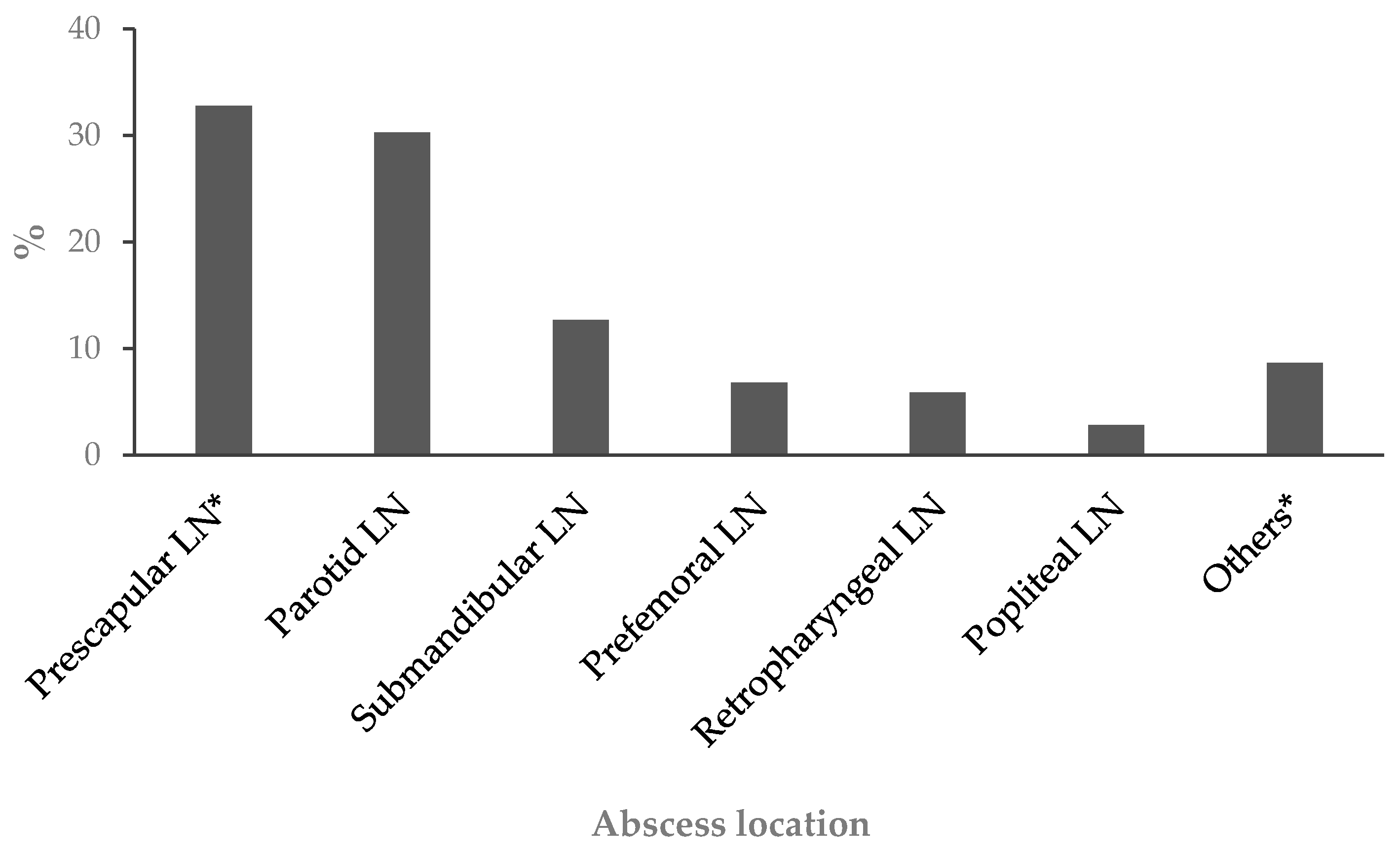
The detection of abscesses was conducted through palpation of external lymph nodes, including the parotid, submandibular, retropharyngeal, prescapular, prefemoral, and popliteal nodes, as well as the testicles and scrotum in rams and the mammary gland in ewes. Additionally, subcutaneous abscesses were identified (refer to Figure 1). Information regarding the presence of single or multiple palpable abscesses, each with a diameter of at least 2 cm, along with their respective locations, was recorded.
Figure 1. Distribution of abscess locations in superficial clinical CL cases found in sheep from the 57 visited flocks. * LN: Lymph node. Others: Popliteal lymph nodes, superficial inguinal, neck, testicles and scrotum.

2.3.2. At Slaughterhouse Level

At the four slaughterhouses, a total of 2124 sheep underwent inspection, comprising 1813 young sheep aged between 6 to 24 months and 311 adult sheep older than 24 months. Among them, the majority were females (n = 2046), while 78 were males. For the survey, visits were made to the provincial abattoir of Settat twice a week, and three slaughterhouses situated in rural areas (Dar Chafii, Guisser, and Bou’Ali Nouaja) were visited weekly on different days. All selected sheep destined for slaughter underwent both ante- and post-mortem examination. Information regarding sex, age, and body condition score was recorded. Superficial abscesses were located on the body surface/skin, the head region, and superficial lymph nodes, while visceral abscesses were detected within internal lymph nodes or viscera. Descriptive data regarding all abscesses and their locations were documented. Out of the 2124 inspected animals, 423 were confirmed as CL cases, including 177 animals with exclusively visceral abscesses (116 exclusively thoracic and 61 exclusively abdominal abscesses), 225 animals with exclusively superficial abscesses, and 21 sheep with both superficial and visceral abscesses.

2.4. Sample Collection

Abscess material was collected from sheep exhibiting superficially enlarged abscesses across the 37 flocks. Additionally, in slaughterhouses, pus samples were obtained from all cases displaying either superficial abscesses and/or internal infected lymph nodes and viscera (totalling n = 497). Confirmation of Corynebacterium pseudotuberculosis in cases collected from slaughterhouses was established by identifying the bacterium in at least one superficial or one visceral abscess from an infected animal presenting with a CL form. Pus sampling was conducted aseptically from the periphery of drained abscesses using a single sterile swab. These samples were then transported at +4 °C in test tubes containing AMIES transport medium (Invasive Sterile Collection Swab, Yangzhou, China) for subsequent analysis. In the case of infected lymph nodes collected from slaughterhouses, they were initially immersed in a sodium hypochlorite solution to disinfect their surfaces. Subsequently, they were transported at +4 °C to the laboratory, where pus sampling was performed once the samples reached the facility.

2.5. Bacteriological and Molecular Diagnosis

The bacterium C. pseudotuberculosis was isolated using 5% defibrinated blood agar cultures and incubated at 37 °C for 48–72 h. Colonies resembling C. pseudotuberculosis were subjected to catalase and CAMP tests, as well as Gram staining for further analysis. Subsequently, confirmation of the colonies was carried out using quadruplex-PCR, a specific PCR method enabling both detection and typing of the C. pseudotuberculosis biovar, as described by Almeida et al., with minor modifications [24]. The quadruplex-PCR utilized primers targeting 16S rRNA, rpoB, and pld genes, as previously described in studies [25,26,27], along with primers targeting the nitrate reductase gene narG, as described by Almeida et al. [24]. In brief, the quadruplex PCR was conducted directly using a suspension of bacteria in a final volume of 50 µL, comprising 1× GoTaq® reaction buffer (1.5 mM MgCl2) (Promega, Madison, WI, USA), 200 µM of each of the deoxynucleoside triphosphates dATP, dCTP, dGTP, and dTTP, 1.25 U of DNA Taq polymerase (Promega, Madison, WI, USA), and 0.2 µM of each primer. Amplification was carried out in a thermal cycler (PTC-100, MJ Research, Waltham, MA, USA). The amplified products were then subjected to electrophoresis in a 0.8% agarose gel prepared in 1× Tris-Acetate-EDTA buffer (40 mM Tris Base, 20 mM acetate, and 1 mM EDTA, pH 8.6), stained with Midori Green Advanced DNA Stain (NIPPON Genetics EUROPE, Duren, Germany), and visualized under UV illumination.

2.6. Statistical Analysis

In Survey 1, prevalence data of caseous lymphadenitis were analysed using univariable robust logistic models for all explanatory variables. The flock was considered a cluster variable to ensure the robustness of the analysis. The tested variables included sex, age categories, body score, flock size, ventilation in the building, animal density in the sheepfold, presence of traumatic equipment (drinkers, feeders, or fences), presence of thorny plants in the livestock building, isolation of diseased animals, frequency of cleaning and disinfection of livestock buildings, products used in disinfection of barns, crawlspace practice, periodic control of abscesses, treatment of abscesses, and destruction of abscess content. All of these explanatory variables, except flock size and density, were categorical. Subsequently, explanatory variables demonstrating a significant outcome were subjected to stepwise (non-robust) removal multivariable logistic regression. Two-by-two interactions between the remaining explanatory variables were tested. Finally, significant variables from the non-robust multivariable model were utilized in the final robust multivariable logistic regression.
In Survey 2, abscesses localized in the lung, mediastinal and bronchial lymph nodes, and heart were grouped together as thoracic abscesses. Similarly, abscesses in the liver and intestines were pooled as abdominal abscesses. The presence or absence of abscesses in three body regions (superficial, thoracic, and abdominal) in young and adult sheep was analysed in a robust logistic model, with animals as clusters. Additionally, the interaction between age group and abscess location was tested. The prevalence of visceral abscesses in young and adult sheep was analysed using logistic regression. Furthermore, the proportion of infected animals with superficial or visceral abscesses was evaluated in a data subset (excluding non-infected animals) through two separate logistic regressions, with the presence of superficial or visceral abscesses as response variables and age groups as explanatory variables. Additionally, the correlation between superficial and thoracic abscesses was examined using logistic regression of superficial abscesses in a data subset containing only animals with thoracic abscesses, with age classes as explanatory variables. Finally, ordered logistic regressions were separately employed for young and older animals to assess the relationship between body score and caseous lymphadenitis abscesses. Body score was considered as a response variable, while the presence of thoracic, abdominal, and superficial abscesses served as explanatory variables.
Stata 11 software (StataCorp, 2012) was utilized for statistical analyses, with a p-value < 0.01 considered to be significant.

3. Results

3.1. Prevalence and Risk Factors of CL Superficial Form

Clinical cases of caseous lymphadenitis (CL) were identified in the majority of the studied flocks (95%), with a mean clinical prevalence of 34.6% (ranging from 2.5% to 100%) and an overall individual prevalence of 31.1% (calculated based on the 1521 examined sheep). The univariable analysis revealed high prevalence levels associated with many factors, all of which were considered in the subsequent multivariable analysis (refer to Table 2). Only variables demonstrating significant associations with CL occurrence were included in the multivariable analysis.
Table 2. Univariable analysis models with variables collected in Survey 1, carried out at the farm level.
The density of animals and daily cleaning of barns exhibited weak correlations with CL prevalence (p = 0.028) and were consequently excluded from the subsequent multivariable model.
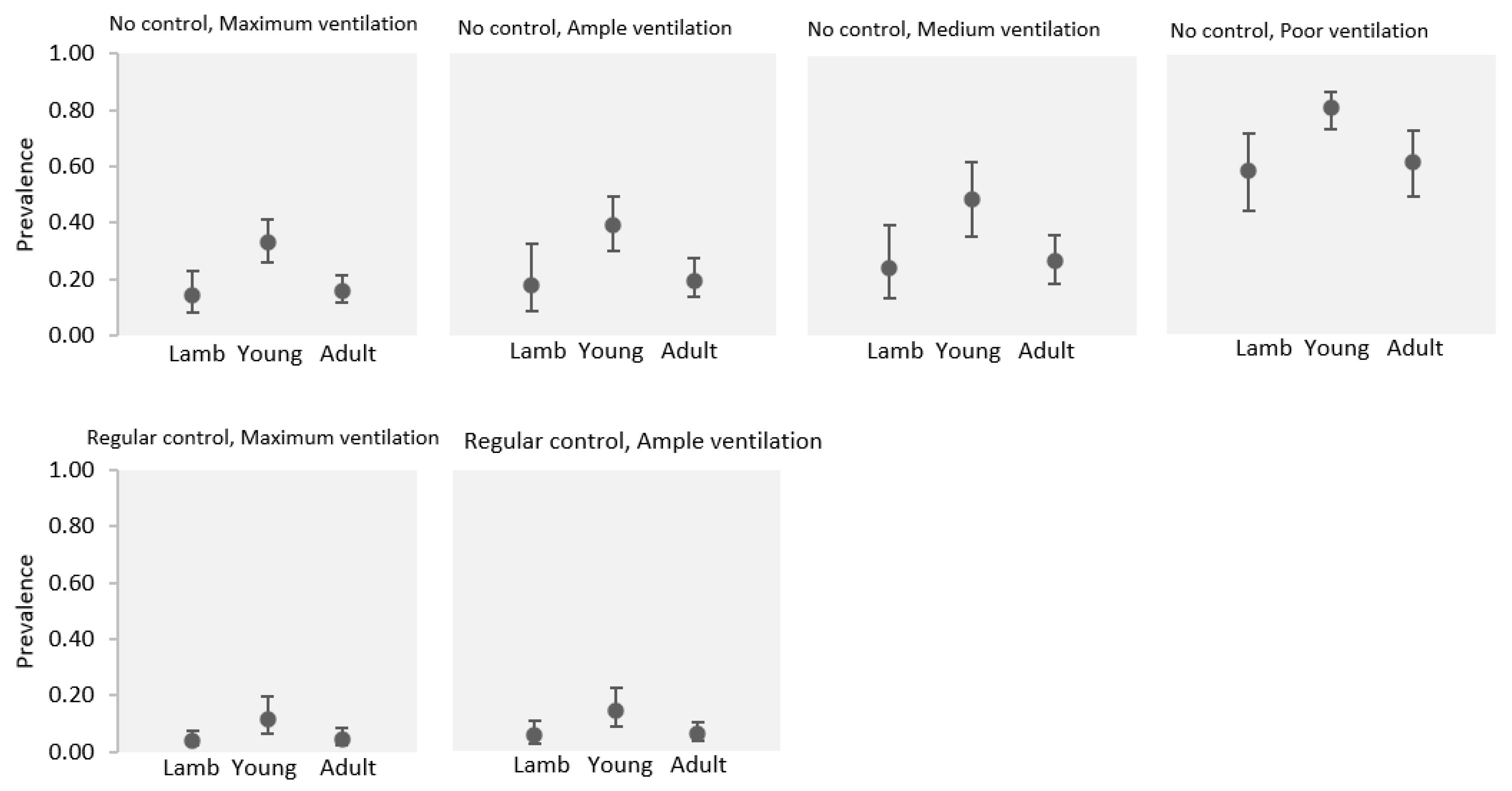
Following the stepwise selection of significant estimators, the final model comprised animals’ age, ventilation of barns, and the practice of abscess control, all of which were deemed significant variables (p < 0.001) (see Table 3). Notably, young sheep exhibited a higher prevalence compared to both lambs and adult sheep. Regarding barn ventilation, CL prevalence was higher in environments characterized by poor ventilation compared to those with maximum, ample, or medium ventilation. In terms of abscess control, animals subject to regular abscess control exhibited a significantly lower prevalence of CL compared to those reared without a regular form of abscess control or those reared without any form of abscess control (Figure 2).
Table 3. Final model of multivariable analysis of risk factors of CL in animals investigated at the flock level.
Figure 2. Clinical prevalence of superficial caseous lymphadenitis by age, considering ventilation in sheepfold and control of abscess cases. Error bars indicate 95% confidence intervals. Lambs: <6 months, Young: 6 to 24 months, Adult: > 24 months. “No control” includes non-regular control (sporadic control); “regular control” includes periodic detection and treatment of abscesses before their spontaneous rupture. Four ventilation levels in barns were categorised: maximum ventilation, in barns without a roof; ample ventilation, in barns with wide bilateral openings; medium ventilation, in barns with wide unilateral openings; and poor ventilation, in barns with reduced unilateral openings.

3.2. Association between Visceral and Superficial Forms of Caseous Lymphadenitis

The presence of C. pseudotuberculosis was confirmed in all clinical cases identified in slaughterhouses through quadruplex-PCR. Among all infected animals, the prevalence of visceral abscesses was notably higher in adult sheep (83%, OR = 9.8, 95% CI = 5.5–17.2) compared to young sheep (35%). In terms of the association between superficial and thoracic abscesses, out of 132 sheep with thoracic abscesses (65 young and 66 adult sheep), only 11% (n = 15) were affected by both types of abscesses, with no significant differences observed between young (12%) and adult animals (11%; OR = 0.9, 95% CI = 0.3–2.5, p = 0.784). This suggests that approximately 89% of sheep with thoracic abscesses did not exhibit any superficial lesions.
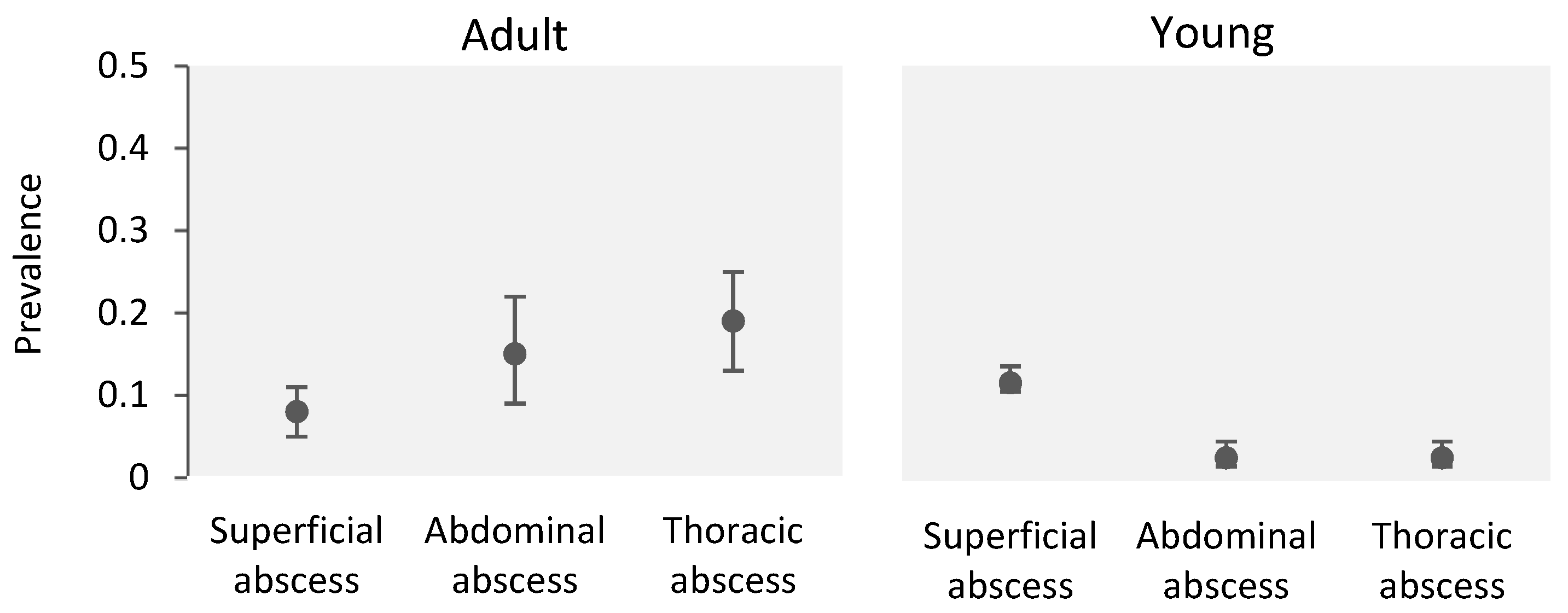
Figure 3 illustrates the prevalence levels of superficial, abdominal, and thoracic abscesses in adult and young sheep. Regarding the association between abscess location and animals’ age in adult sheep, the prevalence of the superficial form was significantly lower (8%, OR = 0.1, 95% CI = 0.06–0.25, p = 0.0001) compared to the prevalence of abdominal abscesses (15%). However, no significant difference was observed between the prevalence levels of thoracic (19%, OR = 1.2, 95% CI = 0.6–2.7, p = 0.569) and abdominal (15%) abscesses.
Figure 3. Proportion of adult and young animals with different abscess locations according to animals’ age. Error bars indicate 95% confidence intervals. Superficial abscess: parotid, retropharyngeal, submandibular, prescapular, prefemoral, and popliteal infected lymph nodes and superficial abscesses located in the inguinal, neck, testicle, and scrotum areas; Abdominal abscess: abscesses located in liver and intestines; Thoracic abscess: lung, mediastinal, and bronchial lymph nodes and heart-localized abscesses.
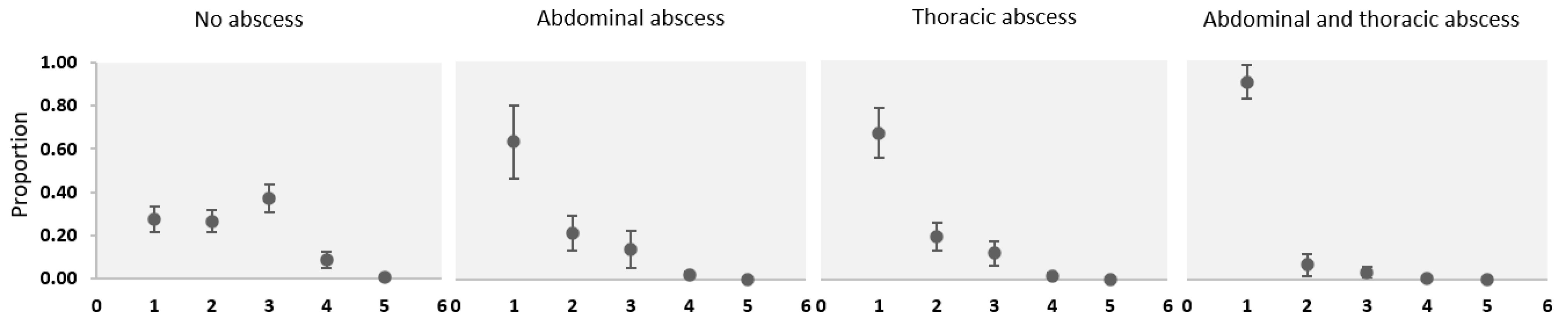
Additionally, Figure 4 shows a significant association between body score and presence of the visceral form observed in adult sheep. Body score was significantly associated with thoracic (OR = 0.2, 95% CI = 0.1–0.3, p = 0.0001) and abdominal abscesses (OR = 0.2, 95% CI = 0.1–0.4, p = 0.0001). No significant effect on body score was found in animals with the superficial form of LC (OR = 1.2, 95% CI = 0.6–2.6, p = 0.624).
Figure 4. Body score distribution as a function of abscess location in adult sheep. Body scores range from 1 (very thin) to 5 (very fat). Error bars indicate 95% confidence intervals. Abdominal abscess: liver- and intestines-located abscesses; Thoracic abscess: lung, mediastinal, and bronchial lymph nodes and heart-localized abscesses; superficial abscesses have no significant effect (p = 0.62; data not displayed).

4. Discussion

Caseous lymphadenitis (CL) stands as a significant challenge for sheep breeding worldwide, inflicting considerable economic losses. This adverse impact primarily stems from the diminished prices and restricted marketability of sheep with superficial abscesses, alongside the loss of body weight associated with the visceral form. Additional losses emanate from the partial trimming, or the total rejection of carcasses manifesting severe infection and declared unfit for human consumption. In carcasses with minor infection, a removal of the impacted tissues is performed to prevent carcass contamination [4,12]. Our findings underscored that nearly all visited flocks (95%) exhibited clinical cases of superficial CL. This result resonates with the findings of Kichou et al. in the Eastern region of Morocco, where 106 out of 107 flocks were clinically affected [28]. However, the overall individual clinical prevalence of CL (31.1%) observed in our study slightly surpassed the previously reported figure of 28%. Furthermore, the prevalence we uncovered is markedly higher than those documented in sheep from Egypt (19.23% and 3.71%) and Iraq (0.94%) [17,29,30].
Our results pinpointed that the most significant risk factors for the spread of CL were barns with poor ventilation, the absence of abscess control practices, and the age of the animals (with young ones being the most affected among those examined).
Concerning barn conditions, it became evident that poor ventilation was closely linked to the highest CL risk. This association may be attributed to local breeding practices grounded in the belief that reducing barn openings accelerates the fattening process, particularly for animals housed indoors. However, adequate ventilation is a critical requirement in designing a suitable shed [31]. Effective ventilation facilitates proper air circulation, thereby minimizing contamination via aerosols. Additionally, lower survival rates of C. pseudotuberculosis have been associated with rapid humidity reduction [32]. It is noteworthy that ample openings in barns allow abundant sunlight entry, exposing bacteria present in the soil to external environmental conditions. Indeed, several studies have demonstrated that decreased biofilm formation by C. pseudotuberculosis correlates with exposure to thermal stress and ultraviolet radiation [33,34]. In traditional rearing management, where animals spend most of their day outdoors under the sun, this exposure could provide some level of protection against CL infection.
Another noteworthy factor highlighted in Survey 1 was the efficacy of abscess control in reducing the risk of superficial CL. Flocks where breeders promptly detected and treated abscess cases before spontaneous rupture experienced a decrease in superficial CL incidence. This proactive approach to identifying infected sheep and administering treatment helps prevent naive animals from coming into contact with bacteria-containing pus [35]. Spontaneous abscess ruptures, if not adequately disinfected, pose a significant risk of contaminating other animals. Furthermore, abscess material can contaminate the barn environment, soil, and equipment [36]. Given that C. pseudotuberculosis biovar Ovis can survive for extended periods (ranging from 80 to 210 days) in the presence of organic materials, it can infect other sheep through skin lesions [34,37,38]. Deficiencies in preventive hygienic measures for CL, such as a lack of isolation measures for infected animals, have also been reported as risk factors for CL [28].
Regarding the age of sheep within flocks, young animals aged between 6 to 24 months exhibited a high prevalence of superficial CL. Contamination among young sheep is facilitated by the immaturity of their immune systems [4]. Additionally, this category of sheep often undergoes fattening periods during which they are housed indoors for extended durations, typically two to three months, or longer in some cases. Indeed, intensive sheep farming systems, characterized by high density and poor ventilation, have been associated with elevated CL prevalence in countries like the Netherlands and Ireland [39,40]. However, in the Eastern region of Morocco, no discernible difference in CL prevalence related to age categories (young, less than one year; and adult sheep, more than two years) at the farm level was observed due to the repeated exposure of adult sheep to the infection [28]. Other studies have reported that animals aged between 2 and 3 years are at high risk of CL due to wool shearing, which is not practiced in younger animals [21].
Surprisingly, at slaughterhouses, a remarkably high percentage (89%) of animals with thoracic abscesses did not exhibit any superficial lesions, whether in young or adult sheep. This suggests that CL prevalence based solely on clinical signs, as assessed in Survey 1, is likely significantly underestimated. Moreover, adult sheep demonstrated a heightened risk of thoracic and abdominal CL abscesses compared to superficial ones. This could be attributed to a higher culling rate among young animals presenting superficial lesions, thereby retaining animals with healthy skin for reproduction on farms, unaware of the internal lesions. The elevated prevalence of the thoracic form, encompassing lung parenchyma and mediastinal lymph nodes, implies an increased transmission risk through aerosols [35]. When abscesses manifest in mediastinal lymph nodes, sheep may disseminate infectious agents following fistulation to the bronchi, leading to aerosol transmission to other sheep [6,35]. A previous study reported a high prevalence of CL among animals aged more than four years in the Eastern region of Morocco [28]. However, Khanamir et al. observed the highest CL prevalence in sheep and goats older than one year in Iraq [29].
Survey 2 also underscored that thoracic and abdominal abscesses in adult sheep were associated with poor body condition scores. Similarly, body weight loss was linked to the CL-visceral form in infected goats [19,41,42]. This could be attributed to reduced appetite and compromised nutrient digestion and absorption [42]. Furthermore, the visceral form of CL might be associated with chronic wasting syndrome or “thin ewe syndrome” [43]. It has been suggested that the visceral form of CL could either be a significant contributing factor to thin ewe syndrome or a consequence of this syndrome [43]. Moreover, it is recommended to include CL in the differential diagnosis of emaciated ewes [44]. Thus, poor body condition should be factored into CL clinical diagnosis, particularly in adult sheep.
One limitation of the present study was the disparity in the age and sex distribution of the studied sheep samples between flocks and slaughterhouses, due to the differences in the animals undergoing our investigations. Indeed, there was a higher proportion of young sheep and females found in slaughterhouses compared to flocks. Young Sardi females older than six months are primarily designated for slaughter. Conversely, Sardi males are seldom slaughtered for regular meat consumption, as they are reserved for religious celebrations, which explains the limited number of males found in our slaughterhouse sample (n = 78).
We encourage the dissemination of the current results as an update for educational programs of future veterinarians and technicians. Additionally, sensitizing workshops about the current findings have been realised for breeders in the studied area, although a wider diffusion is necessary to combat the spread of misinformation. Modern communication tools such as Facebook, Instagram, Twitter, and others could be helpful in sharing the important findings with an expanded audience of veterinarians, technicians, and breeders. A recent study about the usage of Instagram as a social media platform for teaching and engagement in the field of dairy cow nutrition and management showed inspiring outcomes [45]. Given the poor literacy of the rural population, reels and videos may be particularly useful for sheep-breeders’ sensitization to our findings.

5. Conclusions

The risk factors implicated in CL within Settat province are closely tied to deficiencies in breeding management rooted in local practices. Key factors include poor barn ventilation, lack of CL case control, absence of quarantine measures, and the age group of 6 to 24 months. Additionally, findings from the slaughterhouse survey indicate that sheep over 24 months exhibit a higher prevalence of thoracic and abdominal CL abscesses compared to superficial ones. A low body score strongly correlates with the presence of visceral forms of CL.
Currently, there is no control program for CL prevention implemented in Settat province, Morocco. Any future program aimed at preventing this disease in sheep, particularly in the studied region, should prioritize the improvement of ventilation in sheep barns and instituting regular control measures for abscess cases, including proper treatment procedures, with a focus on young sheep less than 24 months old. Furthermore, poor body condition should be taken into account in the clinical diagnosis of CL in adult sheep.

Author Contributions

Conceptualization, N.E.K., N.K., T.M., B.E.A., J.-F.C., M.R. and M.C.; Investigation, N.E.K. and B.E.A.; Statistical software, T.M.; Formal Analysis, T.M., N.E.K. and N.K.; Data Curation, N.E.K., N.K. and T.M.; Writing—Original Draft, N.E.K.; Review and Editing, N.K., B.E.A., T.M., M.C., J.-F.C. and M.R.; Supervision, N.K.; Project Administration, M.C., N.K. and M.R. All authors have read and agreed to the published version of the manuscript.

Funding

This study was funded by Académie de Recherche et d’Enseignement Supérieur, Commission de la Coopération au Développement (ARES CCD), Brussels, Belgium.

Institutional Review Board Statement

The study was approved by the Local Ethics Committee of the National Institute for Agricultural Research (INRA), Morocco. The approval number is 89INRA/CRRAT of 24 July 2019.

Data Availability Statement

The original contributions presented in the study are included in the article, further inquiries can be directed to the corresponding author/s.

Acknowledgments

The authors thank all breeders who participated in this investigation for their collaboration. The authors thank the Académie de Recherche et d’Enseignement Supérieur (ARES) for funding this work. Also, we are grateful to Jalal Kassout for language improvement of this paper and Abdellatif Rahim for his valuable contribution to the field work.

Conflicts of Interest

The authors declare no conflicts of interest.

References

  1. Ritchie, H.; Rosado, P.; Roser, M. Meat and Dairy Production. Our World in Data. 2024. Available online: https://ourworldindata.org/meat-production (accessed on 6 March 2024).
  2. FAOSTAT. Available online: https://www.fao.org/faostat/en/#data/QCL (accessed on 6 March 2024).
  3. El Amiri, B.; Sibaoueih, M.; Harrak, H. Vers La Labellisation de La Race Ovine Sardi à Travers l’évaluation Du Savoir-Faire Local En Pratique d’élevage et La Caractérisation Des Carcasses et Des Viandes. FRIMED AJ–Al Awamia 2022, 134, 76–94. [Google Scholar]
  4. Williamson, L.H. Caseous Lymphadenitis in Small Ruminants. Vet. Clin. N. Am. Food Anim. Pract. 2001, 17, 359–371. [Google Scholar] [CrossRef] [PubMed]
  5. Windsor, P.A.; Bush, R.D. Caseous Lymphadenitis: Present and near Forgotten from Persistent Vaccination? Small Rumin. Res. 2016, 142, 6–10. [Google Scholar] [CrossRef]
  6. Windsor, P.A. Managing Control Programs for Ovine Caseous Lymphadenitis and Paratuberculosis in Australia, and the Need for Persistent Vaccination. Vet. Med. Res. Rep. 2014, 5, 11–22. [Google Scholar] [CrossRef] [PubMed][Green Version]
  7. Zidan, K.H.; Mazloum, K.; Saran, M.A.; Hatem, M.E. Abscesses in Dromedary Camels, Sheep and Goats Etiology and Pathology. In Proceedings of the 1st International Scientific Conference of Pathology Department, Faculty of Veterinary Medicine, Cairo University, Cairo, Egypt, 25–27 April 2013; pp. 47–59. [Google Scholar]
  8. Akgül, Ö.; Arslan, L.; Akgül, Y.; Ekici, T.P. Corynebacterium Pseuduberculosis Infection in Holstein Dairy Cattle in Van Province. Int. J. Curr. Res. 2017, 9, 63267–63270. [Google Scholar]
  9. Mills, A.E.; Mitchellt, R.D.; Limt, E.K. Corynebacterium Pseudotuberculosis Is a Cause of Human Necrotising Granulomatous Lymphadenitis. Pathology 1997, 29, 231–233. [Google Scholar] [CrossRef] [PubMed]
  10. Peel, M.M.; Palmer, G.G.; Stacpoole, A.M.; Kerr, T.G. Human Lymphadenitis Due to Corynebacterium Pseudotuberculosis: Report of Ten Cases from Australia and Review. CID 1997, 24, 185–191. [Google Scholar] [CrossRef]
  11. Fontaine, M.C.; Baird, G.J. Caseous Lymphadenitis. Small Rumin. Res. 2008, 76, 42–48. [Google Scholar] [CrossRef]
  12. Osman, A.Y.; Nordin, M.L.; Kadir, A.A.; Saharee, A.A. The Epidemiology and Pathophysiology of Caseous Lymphadenitis: A Review. J. Vet. Med. Res. 2018, 5, 1129. [Google Scholar]
  13. Scott, P.R. Sheep Medicine. In Caseous Lymphadenitis (Chapter 11); Taylor&Francis: Abingdon, UK, 2015; pp. 291–292. ISBN 978-1-4987-0015-3. [Google Scholar]
  14. Barral, T.D.; Mariutti, R.B.; Arni, R.K.; Santos, A.J.; Loureiro, D.; Sokolonski, A.R.; Azevedo, V.; Borsuk, S.; Meyer, R.; Portela, R.D. A Panel of Recombinant Proteins for the Serodiagnosis of Caseous Lymphadenitis in Goats and Sheep. Microb. Biotechnol. 2019, 12, 1313–1323. [Google Scholar] [CrossRef]
  15. Washburn, K.E.; Bissett, W.T.; Fajt, V.R.; Libal, M.C.; Fosgate, G.T.; Miga, J.A.; Rockey, K.M. Comparison of Three Treatment Regimens for Sheep and Goats with Caseous Lymphadenitis. J. Am. Vet. Med. Assoc. 2009, 234, 1162–1166. [Google Scholar] [CrossRef] [PubMed]
  16. Aftabuzzaman, M.; Cho, Y. Recent Perspectives on Caseous Lymphadenitis Caused by Corynebacterium Pseudotuberculosis in Goats-A Review. Korean J. Vet. Serv. 2021, 44, 61–71. [Google Scholar] [CrossRef]
  17. Selim, A.M.; Atwa, S.M.; El Gedawy, A.A.; Younis, E.E. Epidemiological, Bacteriological and Molecular Studies on Caseous Lymphadenitis in Sheep of Dakhlia, Egypt. Anim. Biotechnol. 2021, 33, 1655–1660. [Google Scholar] [CrossRef]
  18. Guimarães, A.S.; Seyffert, N.; Bastos, B.L.; Portela, R.W.D.; Meyer, R.; Carmo, F.B.; Cruz, J.C.M.; McCulloch, J.A.; Lage, A.P.; Heinemann, M.B.; et al. Caseous Lymphadenitis in Sheep Flocks of the State of Minas Gerais, Brazil: Prevalence and Management Surveys. Small Rumin. Res. 2009, 87, 86–91. [Google Scholar] [CrossRef]
  19. Zeru, F.; Kahsay, A.G. Caseous Lymphadenitis in Goats from Borena Range Land South Ethiopia Slaughtered at Luna Export Abattoir. J. Vet. Med. Anim. Health 2014, 6, 168–173. [Google Scholar] [CrossRef]
  20. Abebe, D.; Tessema, T.S. Determination of Corynebacterium Pseudotuberculosis Prevalence and Antimicrobial Susceptibility Pattern of Isolates from Lymph Nodes of Sheep and Goats at an Organic Export Abattoir, Modjo, Ethiopia. Lett. Appl. Microbiol. 2015, 61, 469–476. [Google Scholar] [CrossRef]
  21. Selim, A.M.; Atwa, S.M.; Abdullah, A.; Gedawy, E.; Hegazy, Y.M. Risk Factors Associated with the Seroprevalence of Caseous Lymphadenitis in Sheep. Comp. Clin. Path. 2021, 30, 285–291. [Google Scholar] [CrossRef]
  22. Costa, L.; Maldonado, A.; Huerta, B.; Almeida, A. Optimization of a Conventional PCR Assay for the Identification of Corynebacterium Pseudotuberculosis from Pyogenic Lesions. J. Vet. Sci. Anim. Husb. 2019, 7, 201. [Google Scholar]
  23. EL khalil, K.; Allai, L.; Fatet, A.; Benmoula, A.; Hamidallah, N.; Badi, A.; Moussafir, Z.; Ibnelbachyr, M.; El Amiri, B. Morphometry and Depth of Inseminating Catheter Penetration in Prolific and Non- Prolific Ewes at Different Ages: A Post Mortem Study. Anim. Reprod. Sci. 2018, 196, 43–47. [Google Scholar] [CrossRef]
  24. Almeida, S.; Dorneles, E.M.S.; Carlos, D.; Abreu, V.; Sousa, C.; Alves, J.; Carneiro, A.; Bagano, P.; Spier, S.; Barh, D.; et al. Quadruplex PCR Assay for Identification of Corynebacterium Pseudotuberculosis Differentiating Biovar Ovis and Equi. BMC Vet. Res. 2017, 13, 8. [Google Scholar] [CrossRef]
  25. Pacheco, L.G.C.; Pena, R.R.; Castro, T.L.P.; Dorella, F.A.; Bahia, R.C.; Carminati, R.; Frota, M.N.L.; Oliveira, S.C.; Meyer, R.; Alves, F.S.; et al. Multiplex PCR Assay for Identification of Corynebacterium Pseudotuberculosis from Pure Cultures and for Rapid Detection of This Pathogen in Clinical Samples. J. Med. Microbiol. 2007, 56, 480–486. [Google Scholar] [CrossRef] [PubMed]
  26. de S. Guimarães, A.; Dorneles, E.M.S.; Andrade, G.I.; Lage, A.P.; Miyoshi, A.; Azevedo, V.; Gouveia, A.M.G.; Heinemann, M.B. Molecular Characterization of Corynebacterium Pseudotuberculosis Isolates Using ERIC-PCR. Vet. Microbiol. 2011, 153, 299–306. [Google Scholar] [CrossRef] [PubMed]
  27. Dorneles, E.M.S.; Santana, J.A.; Ribeiro, D.; Dorella, F.A.; Guimarães, A.S. Evaluation of ERIC-PCR as Genotyping Method for Corynebacterium Pseudotuberculosis Isolates. PLoS ONE 2014, 9, 98758. [Google Scholar] [CrossRef] [PubMed]
  28. Kichou, F.; Mechaal, A.; Bouslikhane, M.; Kadiri, A.; Zro, K.; Berrada, J. Facteurs de Risque et Caractéristiques Cliniques et Lésionnelles de La Lymphadénite Caséeuse Ou Maladie Des Abcès Chez Les Ovins Au Maroc. Rev. Elev. Med. Vet. Pays Trop. 2016, 69, 79. [Google Scholar] [CrossRef][Green Version]
  29. Khanamir, R.A.; Issa, N.A.; Abdulrahman, R.F. First Study on Molecular Epidemiology of Caseous Lymphadenitis in Slaughtered Sheep and Goats in Duhok Province, Iraq. Open Vet. J. 2023, 13, 588–598. [Google Scholar] [CrossRef] [PubMed]
  30. Al-Gaabary, M.H.; Osman, S.A.; Oreiby, A.F. Caseous Lymphadenitis in Sheep and Goats: Clinical, Epidemiological and Preventive Studies. Small Rumin. Res. 2009, 87, 116–121. [Google Scholar] [CrossRef]
  31. Wadhwani, K.N.; Modi, R.J.; Islam, M.M.; Patel, Y.G. Role of Housing in Welfare of Small Ruminants. Indian J. Anim. Prod. Mgmt. 2016, 32, 130–139. [Google Scholar]
  32. Augustine, J.; Renshaw, H. Survival of Corynebacterium Pseudotuberculosis in Axenic Purulent Exudate on Common Barnyard Fomites. Am. J. Vet. Res. 1986, 47, 713–715. [Google Scholar]
  33. Ferreira, A.S.; Silva, I.N.; Oliveira, V.H.; Becker, J.D.; Givskov, M.; Ryan, R.P.; Fernandes, F.; Moreira, L.M. Comparative Transcriptomic Analysis of the Burkholderia Cepacia Tyrosine Kinase bceF Mutant Reveals a Role in Tolerance to Stress, Biofilm Formation, and Virulence. Appl. Environ. Microbiol. 2013, 79, 3009–3020. [Google Scholar] [CrossRef]
  34. Sá, M.C.A.; Oliveira, S.A.S.; Dantas Jr, E.M.; Gouveia, G.V.; Gouveia, J.J.S.; Veschi, J.L.A.; Costa, M.M.; Sá, M.C.A.; Oliveira, S.A.S.; Dantas Jr, E.M.; et al. Resistance of Corynebacterium Pseudotuberculosis in the Brazilian Semiarid Environment. Pesq. Vet. Bras. 2018, 38, 1091–1096. [Google Scholar] [CrossRef]
  35. Windsor, P.A. Control of Caseous Lymphadenitis. Vet. Clin. N. Am. Food Anim. Pract. 2011, 27, 193–202. [Google Scholar] [CrossRef] [PubMed]
  36. Spier, S.J.; Toth, B.; Edman, J.; Quave, A.; Habasha, F.; Garrick, M.; Byrne, B.A. Survival of Corynebacterium Pseudotuberculosis Biovar Equi in Soil. Vet. Rec. 2012, 170, 100543. [Google Scholar] [CrossRef] [PubMed]
  37. Alvarez, L.; William, A.; Castro, I.; Valenzuela, F.; Belchior, S.E. Survival Capacity of Corynebacterium Pseudotuberculosis Biovar Ovis in Different Soil Types from Chubut, Argentine Patagonia. Rev. Argent. Microbiol. 2017, 49, 105–109. [Google Scholar] [CrossRef] [PubMed]
  38. Domenis, L.; Spedicato, R.; Pepe, E.; Orusa, R.; Robetto, S. Caseous Lymphadenitis Caused by Corynebacterium Pseudotuberculosis in Alpine Chamois (Rupicapra r. Rupicapra): A Review of 98 Cases. J. Comp. Pathol. 2018, 161, 11–19. [Google Scholar] [CrossRef] [PubMed]
  39. Malone, F.E.; Fee, S.A.; Kamp, E.M.; King, D.C.; Baird, G.J.; O’Reilly, K.M.; Murdock, F.E. A Serological Investigation of Caseous Lymphadenitis in Four Flocks of Sheep. Ir. Vet. J. 2006, 59, 19–21. [Google Scholar] [CrossRef] [PubMed]
  40. Stapleton, S.; Bradshaw, B.; O’Kennedy, R. Development of a Surface Plasmon Resonance-Based Assay for the Detection of Corynebacterium Pseudotuberculosis Infection in Sheep. Anal. Chim. Acta 2009, 651, 98–104. [Google Scholar] [CrossRef] [PubMed]
  41. Ibtisam, B.; Azzam, M. Some Clinicopathological and Pathological Studies of C. Ovis Infection in Sheep. Egypt. J. Comp. Pathol. Clin. Pathol. 2008, 21, 327–343. [Google Scholar]
  42. Odhah, M.N.; Abdullah Jesse, F.F.; Teik Chung, E.L.; Mahmood, Z.; Haron, A.W.; Mohd Lila, M.A.; Zamri-Saad, M. Clinico-Pathological Responses and PCR Detection of Corynebacterium Pseudotuberculosis and Its Immunogenic Mycolic Acid Extract in the Vital Organs of Goats. Microb. Pathog. 2019, 135, 103628. [Google Scholar] [CrossRef] [PubMed]
  43. Renshaw, H.W.; Graff, V.P.; Gates, N.L. Visceral Caseous Lymphadenitis in Thin Ewe Syndrome: Isolation of Corynebacterium, Staphylococcus, and Moraxella Spp. from Internal Abscesses in Emaciated Ewes. Am. J. Vet. Res. 1979, 40, 1110–1114. [Google Scholar]
  44. Ruiz, H.; Ferrer, L.M.; Ramos, J.J.; Baselga, C.; Alzuguren, O.; Tejedor, M.T.; de Miguel, R.; Lacasta, D. The Relevance of Caseous Lymphadenitis as a Cause of Culling in Adult Sheep. Animals 2020, 10, 1962. [Google Scholar] [CrossRef]
  45. Muca, E.; Buonaiuto, G.; Lamanna, M.; Silvestrelli, S.; Ghiaccio, F.; Federiconi, A.; De Matos Vettori, J.; Colleluori, R.; Fusaro, I.; Raspa, F.; et al. Reaching a Wider Audience: Instagram’s Role in Dairy Cow Nutrition Education and Engagement. Animals 2023, 13, 3503. [Google Scholar] [CrossRef] [PubMed]
Disclaimer/Publisher’s Note: The statements, opinions and data contained in all publications are solely those of the individual author(s) and contributor(s) and not of MDPI and/or the editor(s). MDPI and/or the editor(s) disclaim responsibility for any injury to people or property resulting from any ideas, methods, instructions or products referred to in the content.

Article Metrics

Citations

Article Access Statistics

Multiple requests from the same IP address are counted as one view.