Sequence Order in the Range 1 to 19 by Chimpanzees on a Touchscreen Task: Processing Two-Digit Arabic Numerals


1
Institute for Advanced Study, Kyoto University, Kyoto 606-8506, Japan
2
Division of Humanity and Social Sciences, California Institute of Technology, Pasadena, CA 91125, USA
3
Department of Pedagogy, Chubu Gakuin University, Gifu 504-8037, Japan
4
College of Life Science, Northwest University, Xi’an 710069, China
*
Author to whom correspondence should be addressed.
Animals 2023, 13(5), 774; https://doi.org/10.3390/ani13050774
Submission received: 9 December 2022
/
Revised: 14 February 2023
/
Accepted: 15 February 2023
/
Published: 21 February 2023
(This article belongs to the Special Issue Recent Advances in Animal Cognition and Ethology)
Simple Summary
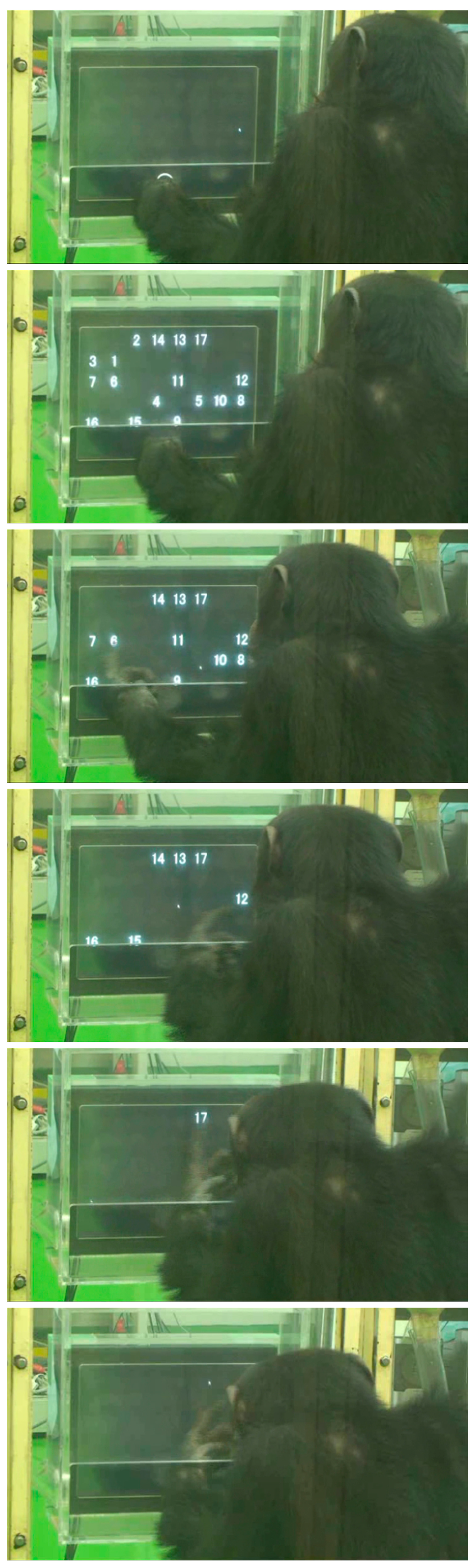
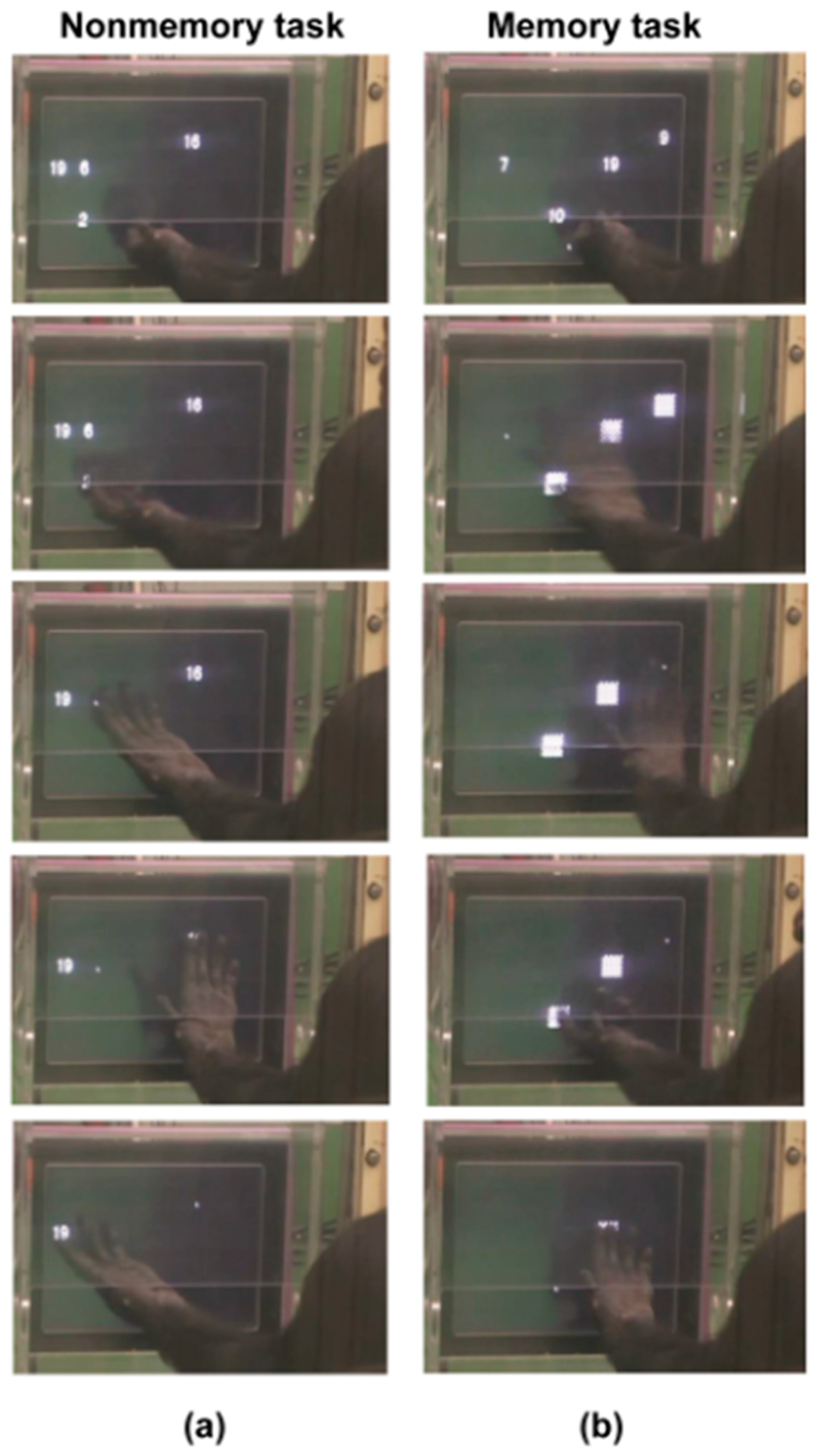
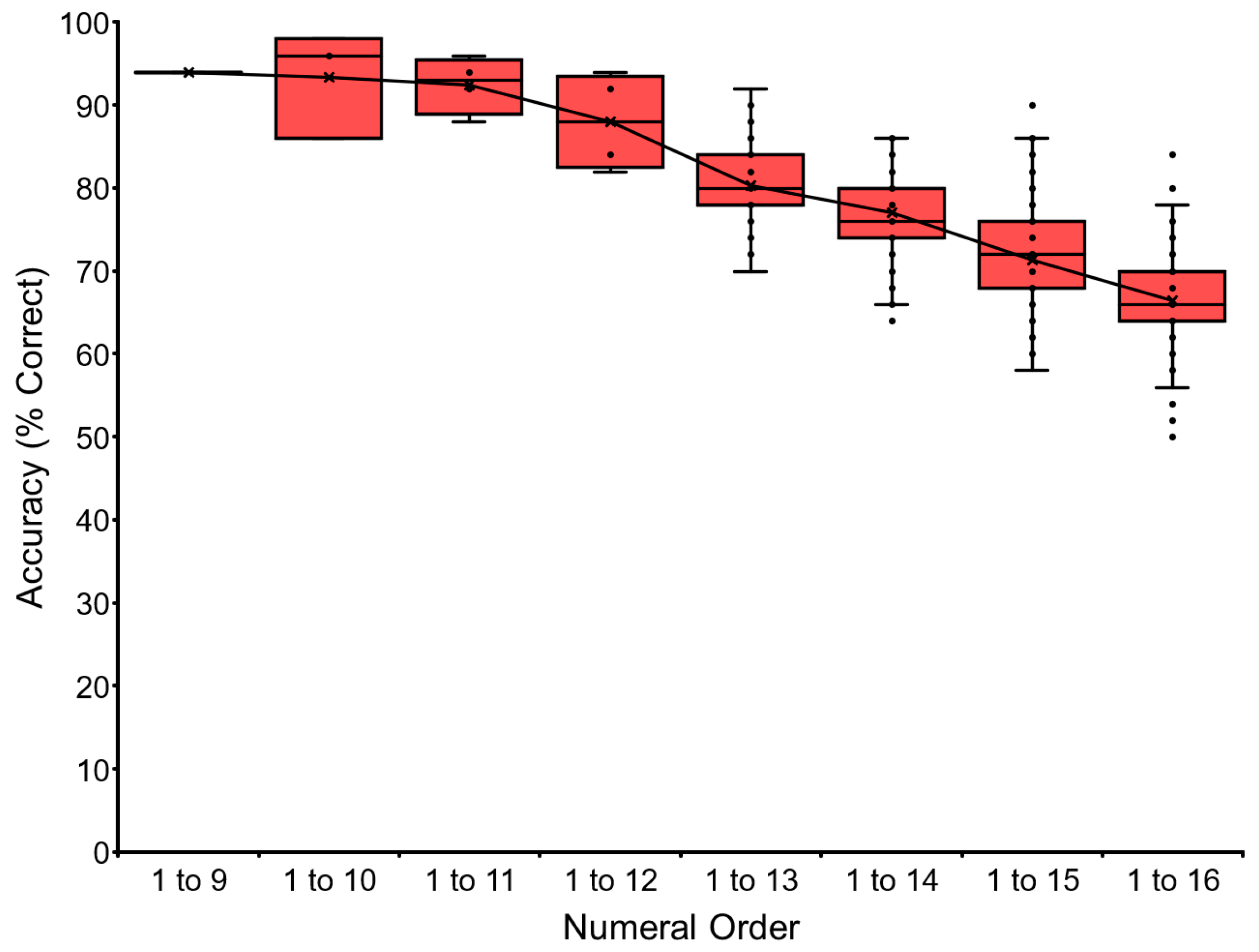
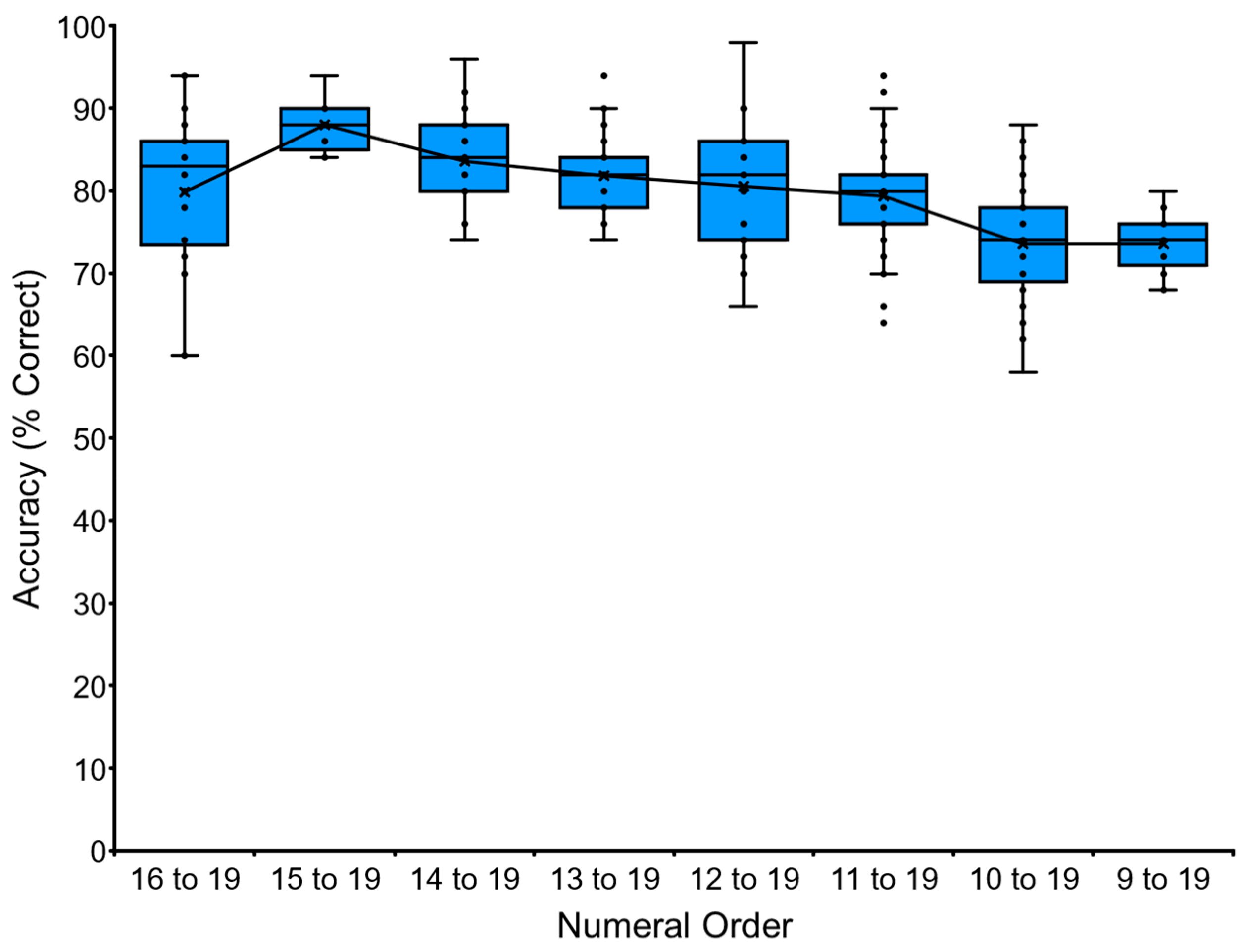
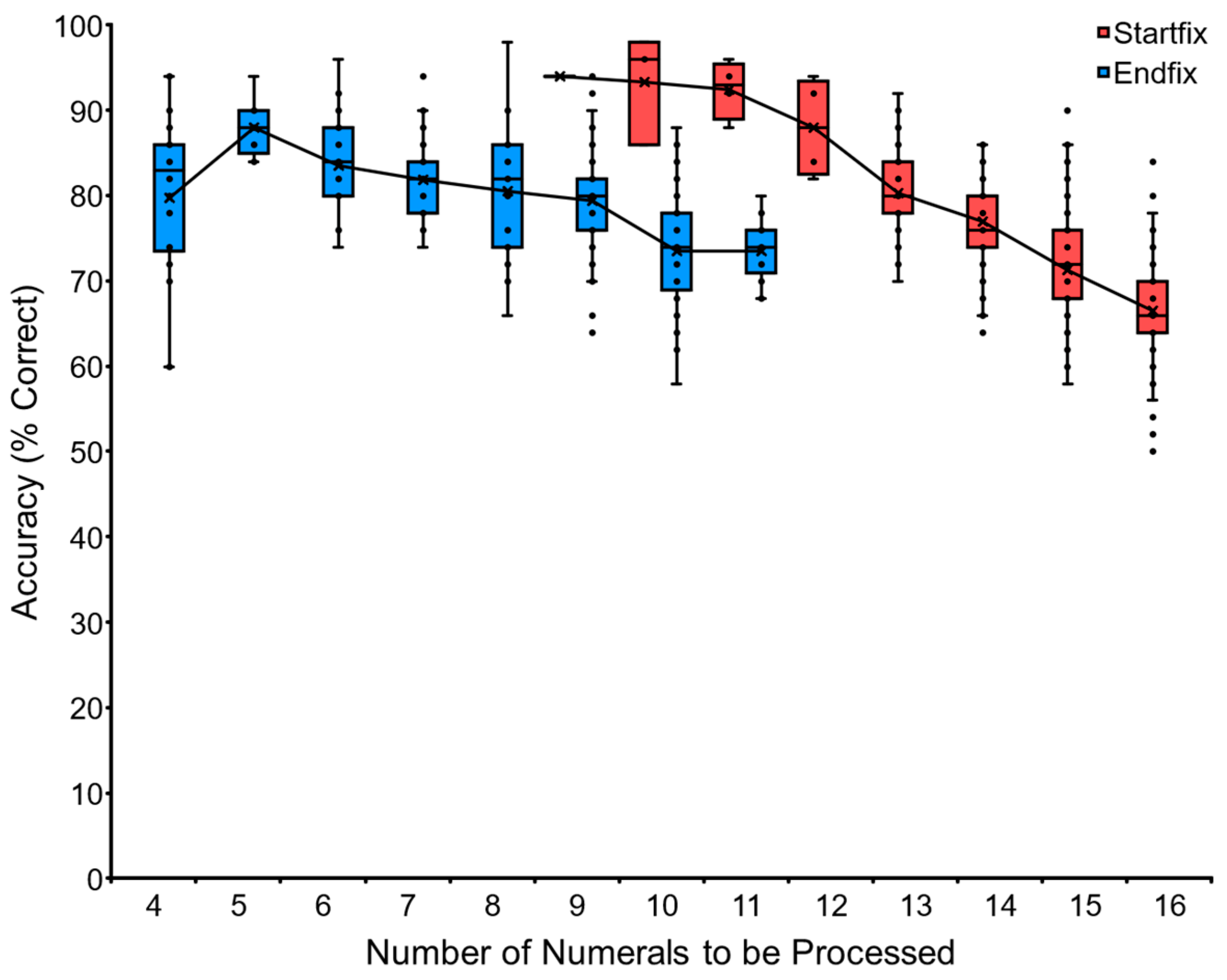
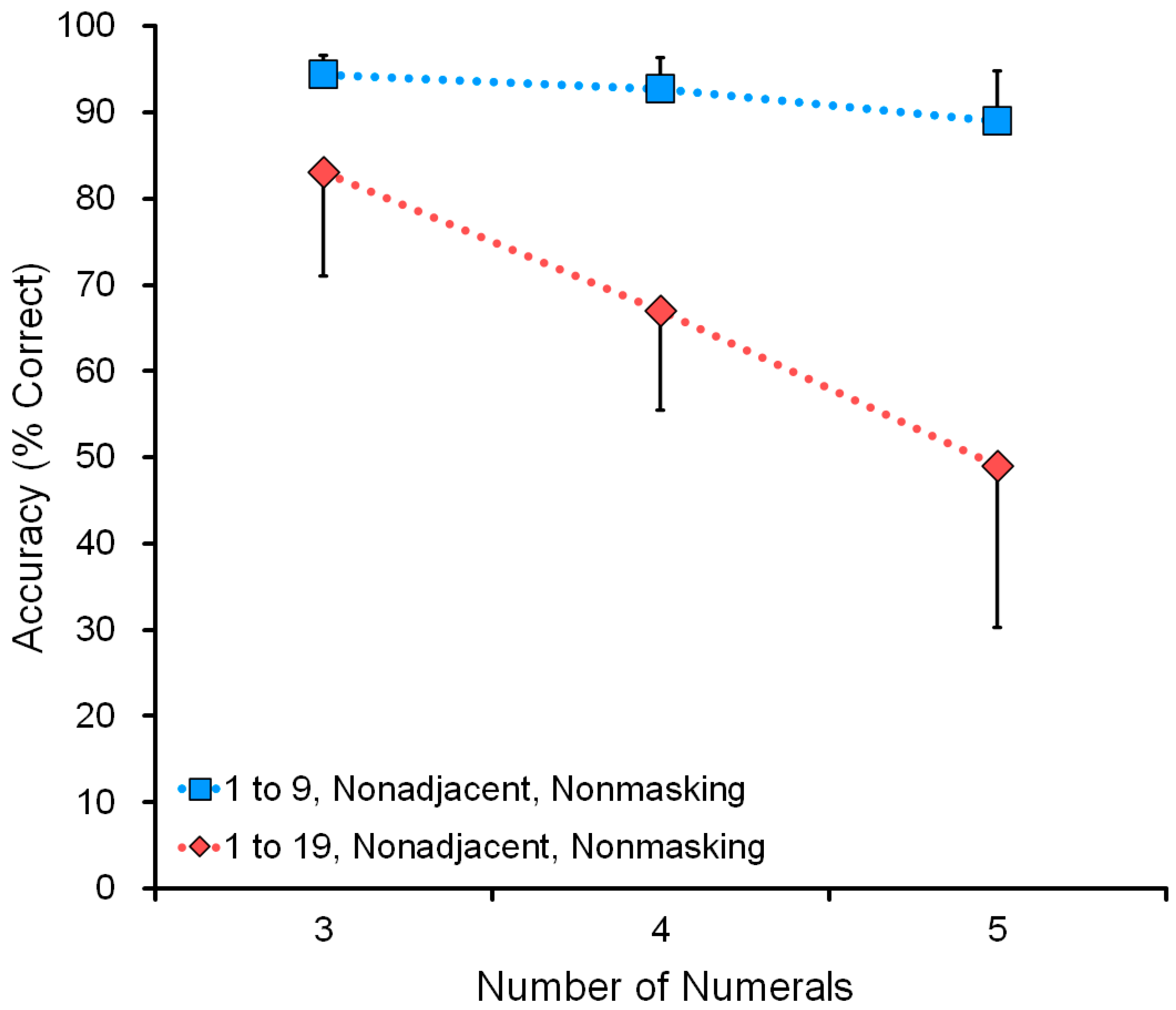
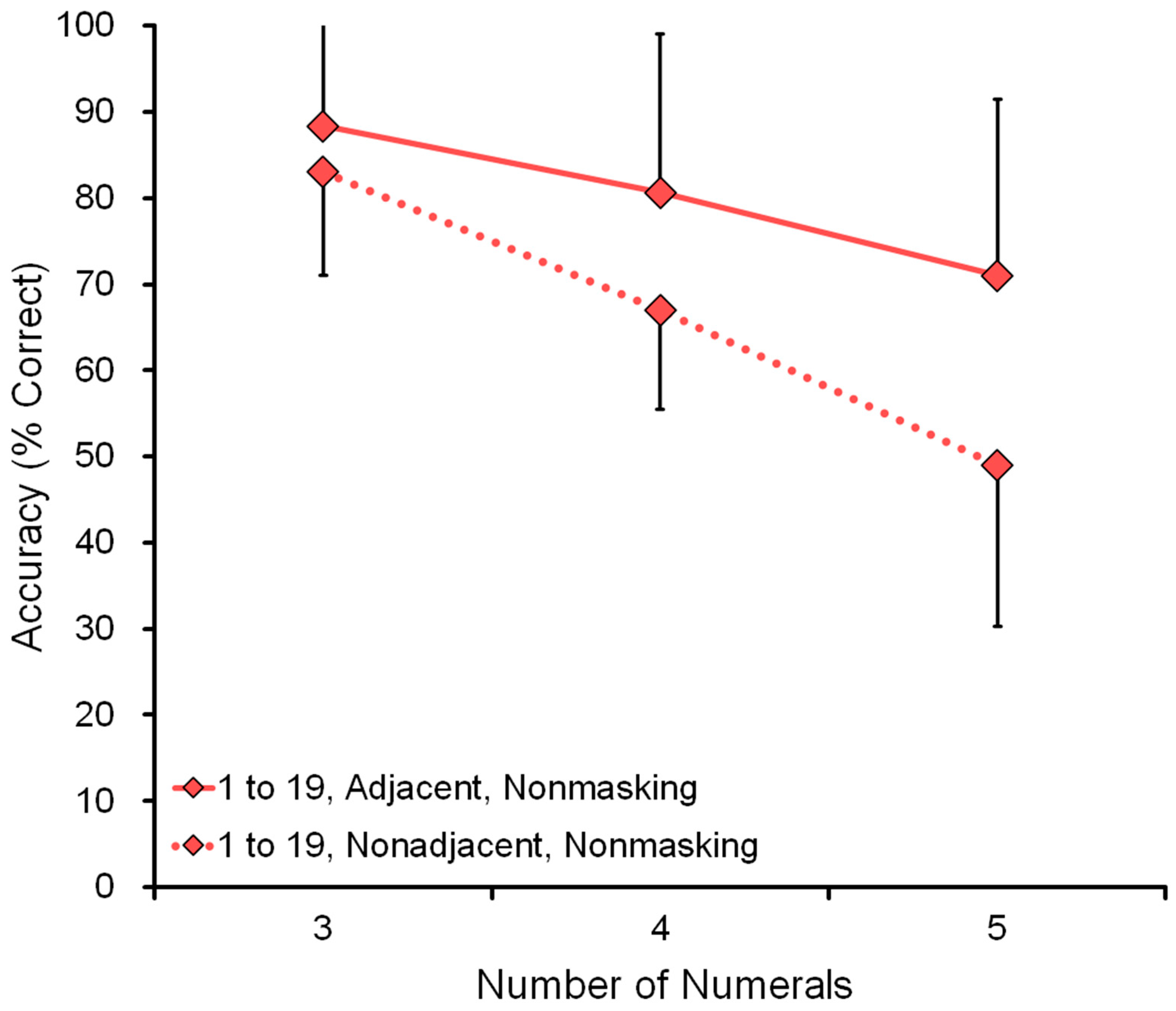
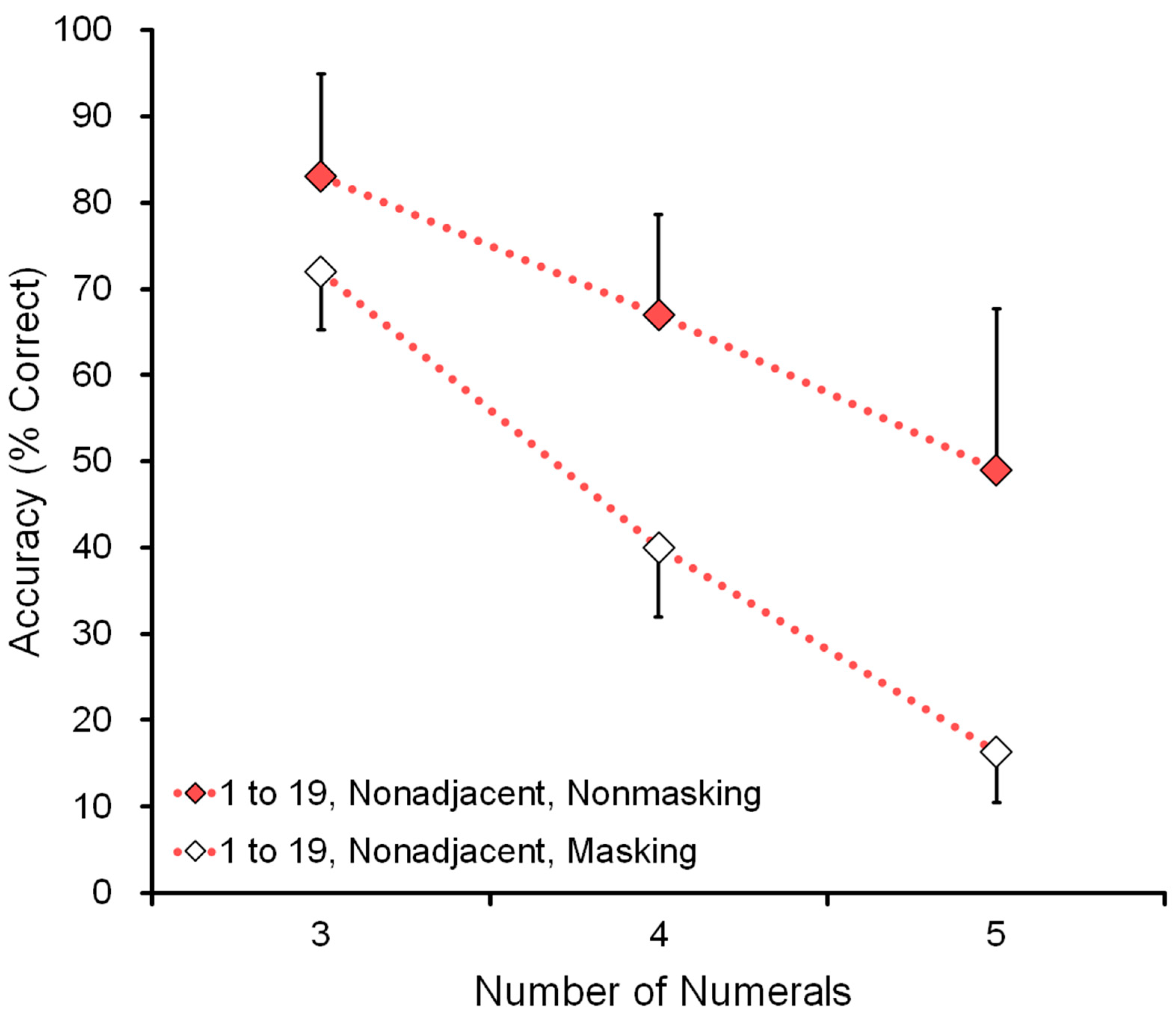
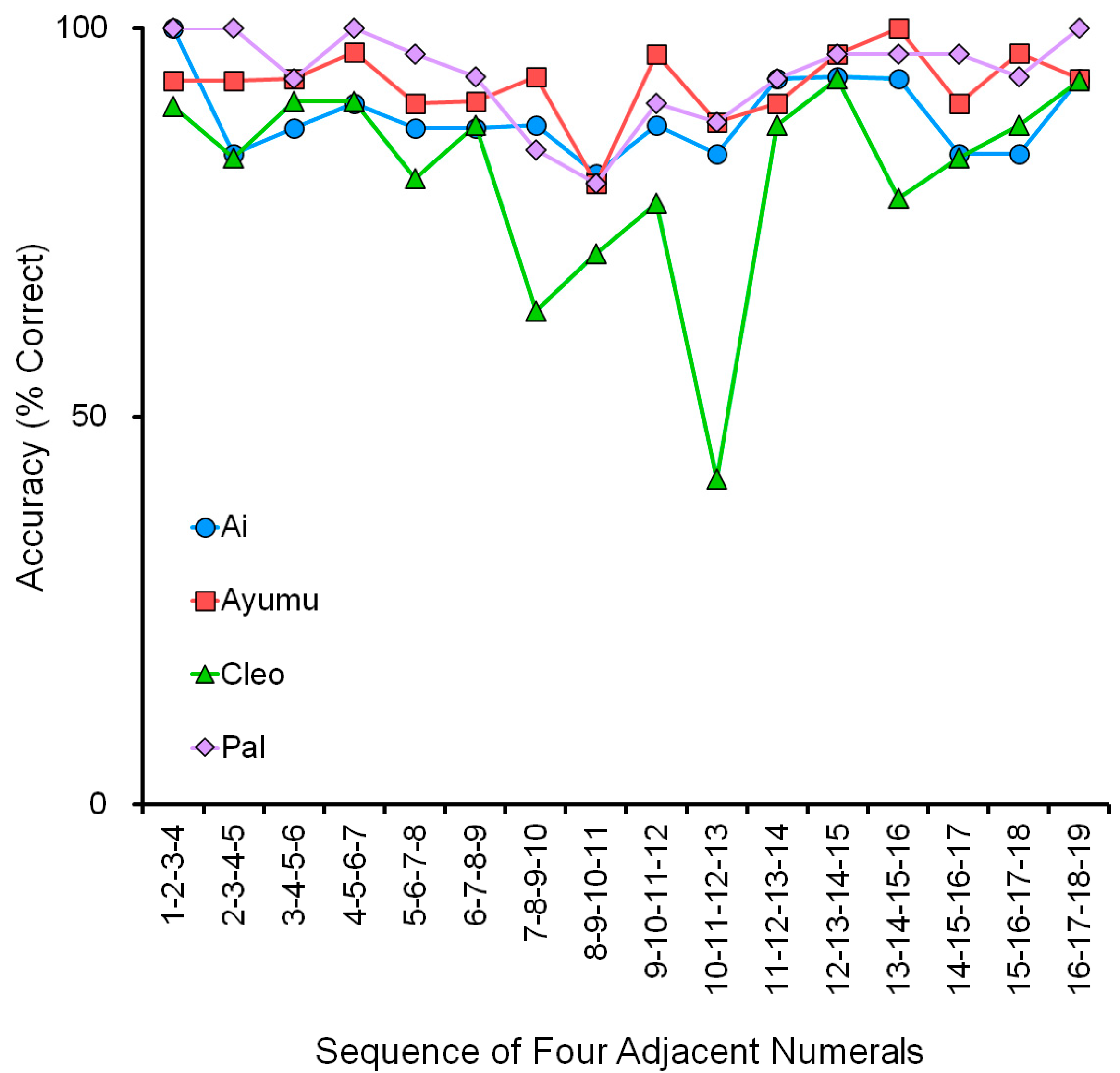
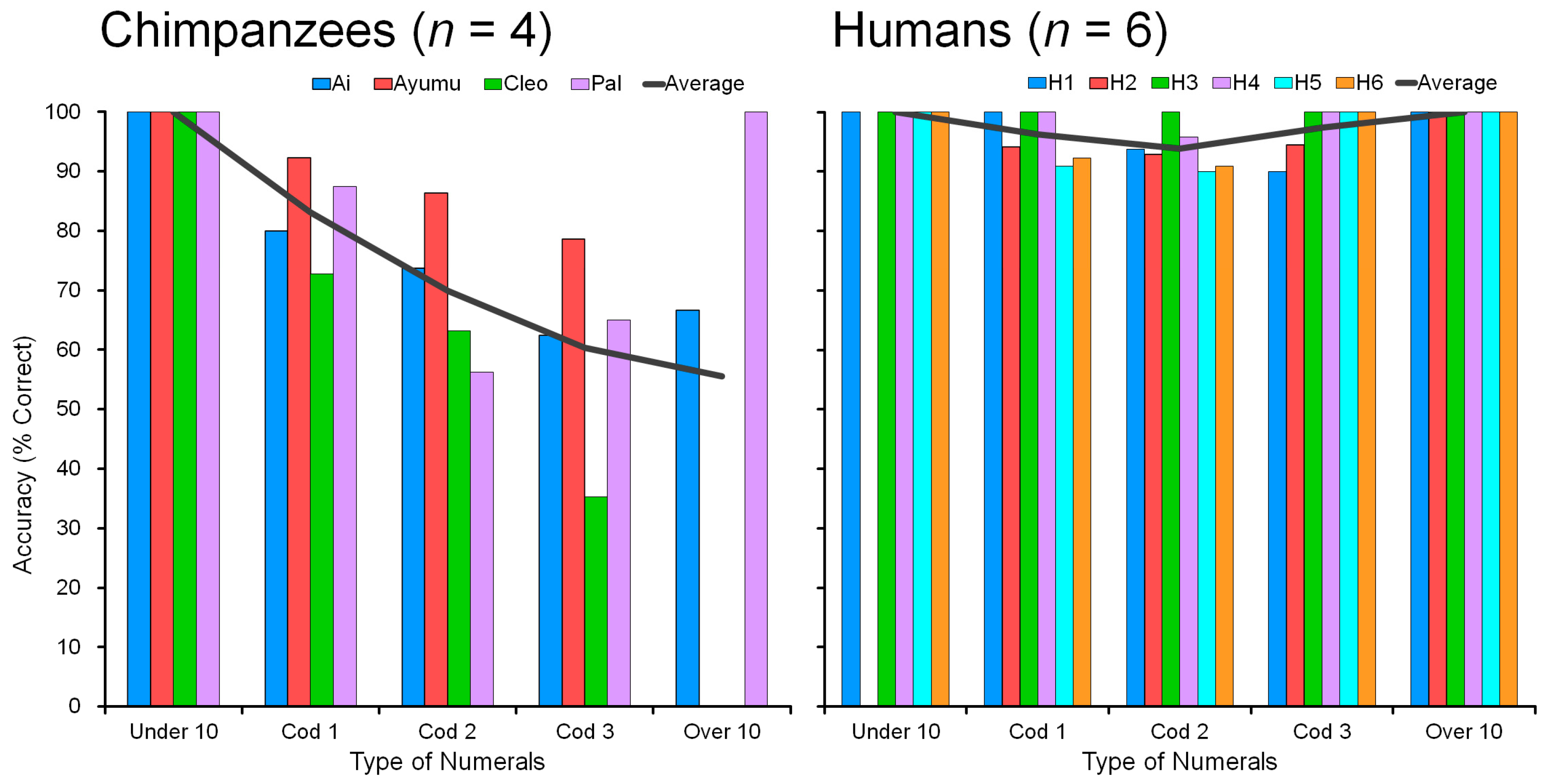
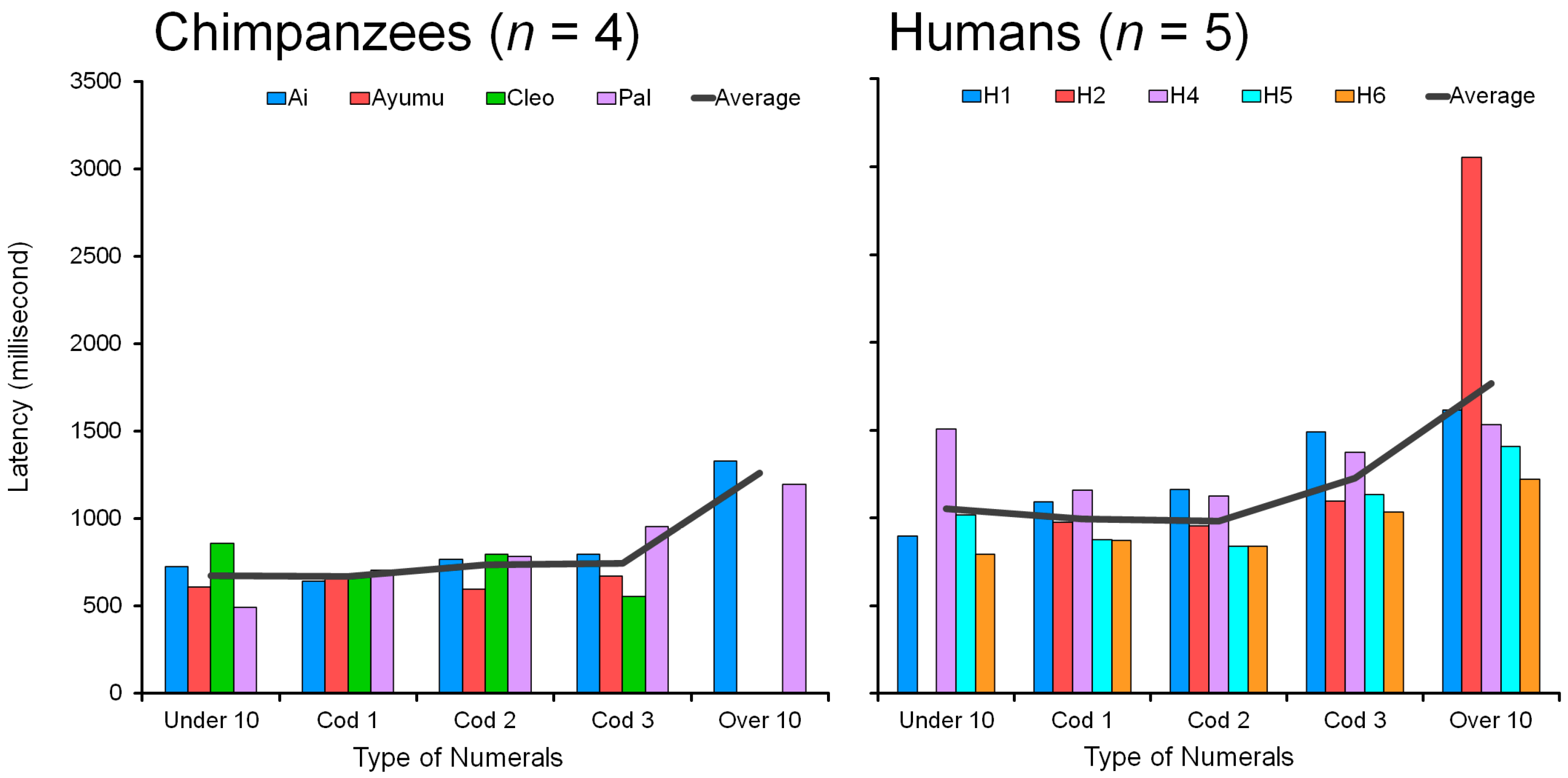
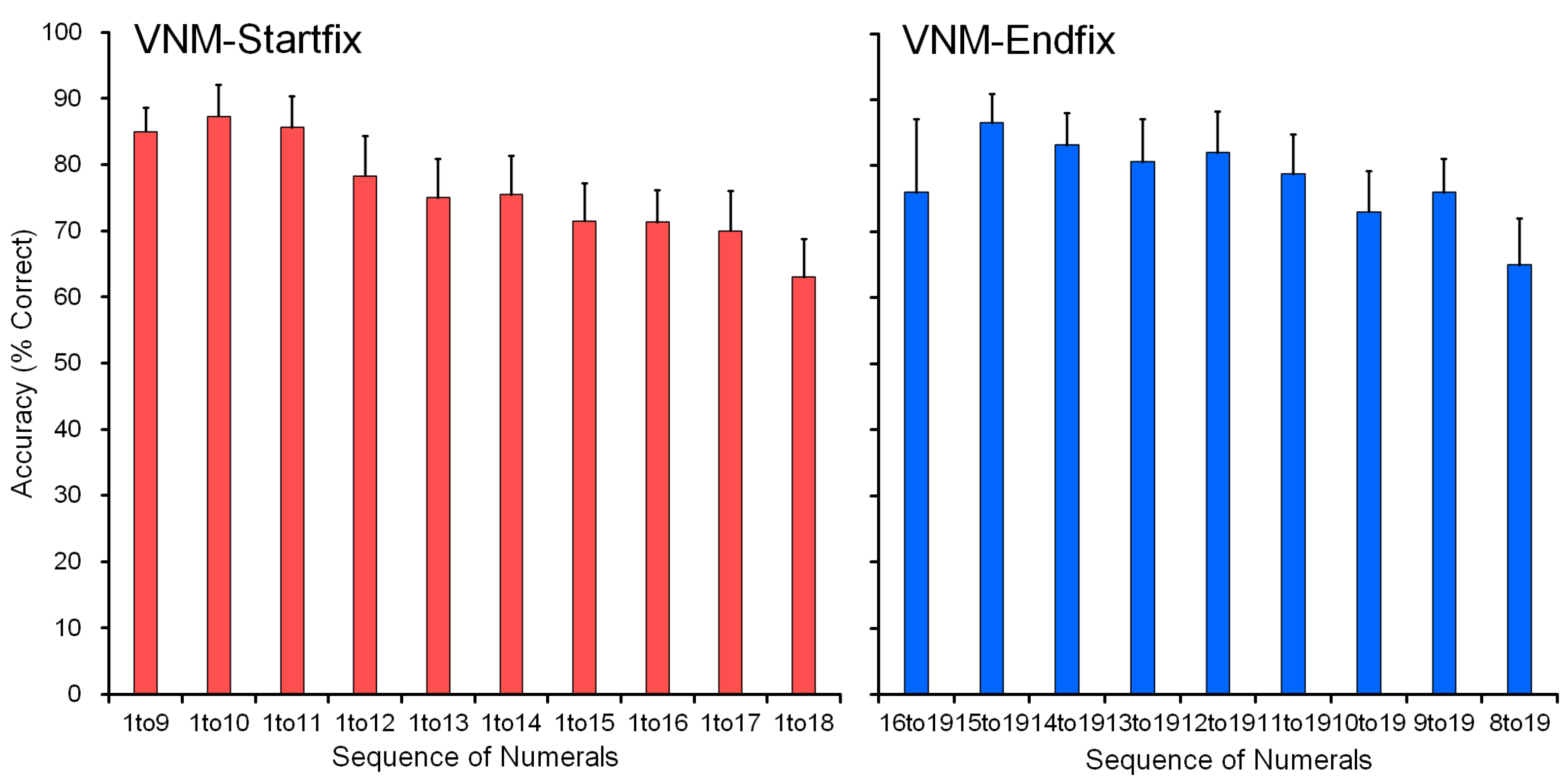
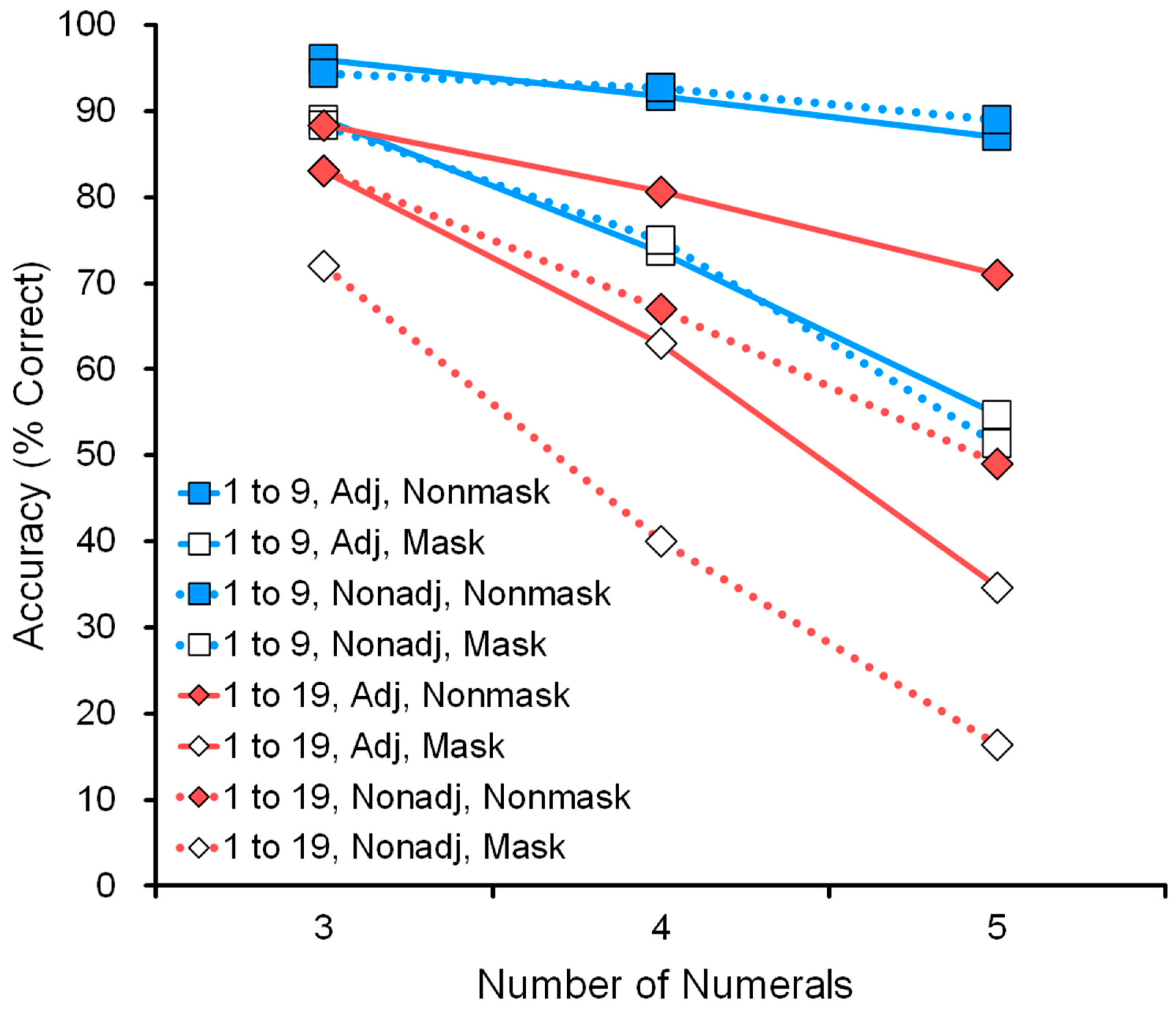
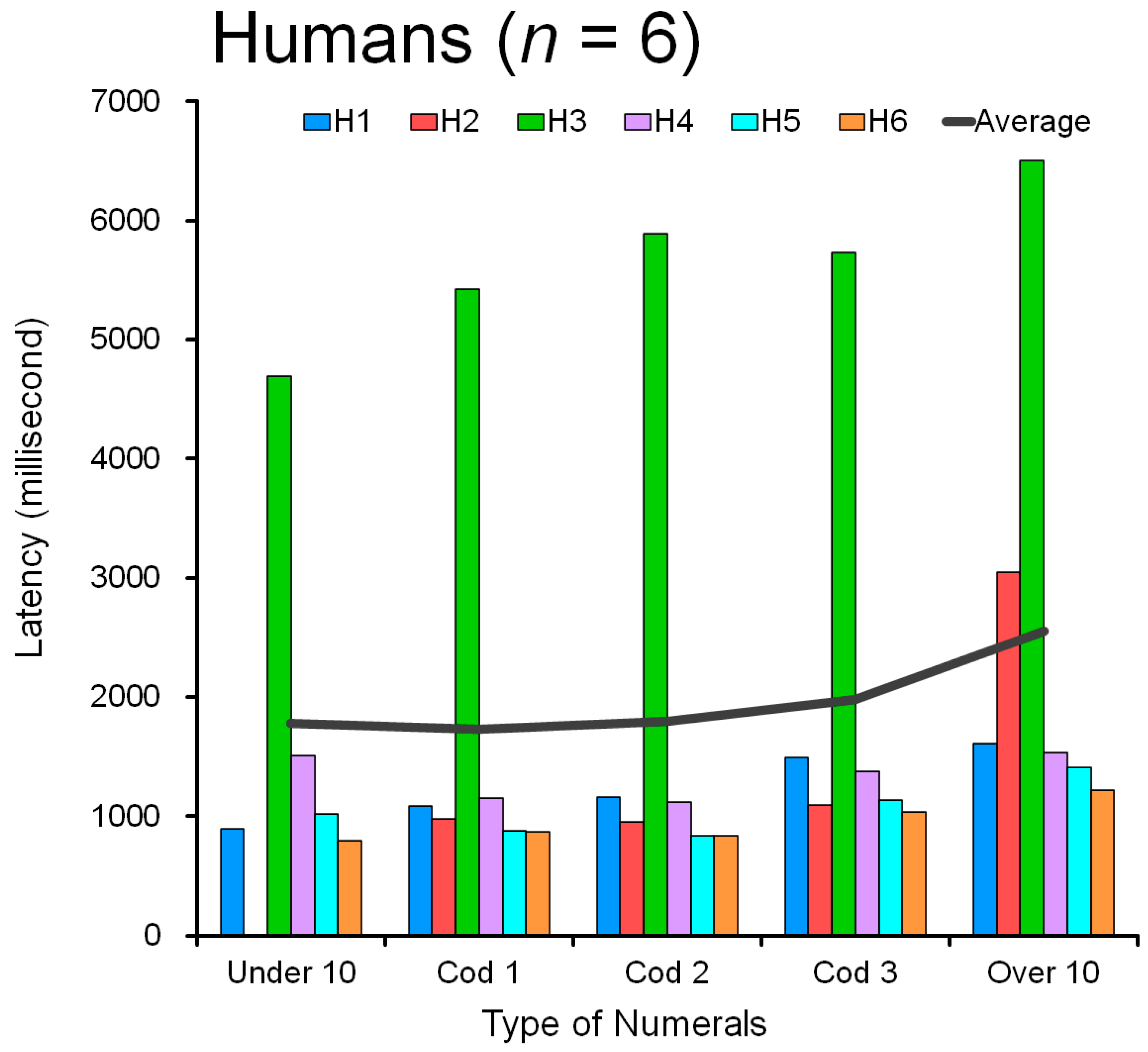
This study aimed to teach the numerical sequence from 1 to 19 in the decimal system to six chimpanzees. The participants were three mother–child pairs. The original goal for chimpanzees was to touch the numerals on the display from 1 to 19, in this order. The baseline daily training was twofold: touching the adjacent numerals from 1 to X and X to 19 in ascending order. In two separate ways, chimpanzees succeeded at touching adjacent numerals in the range 1 to 19. Systematic tests assessed four factors: range (1 to 9 vs. 1 to 19), adjacency (adjacent vs. nonadjacent numerals), number of stimuli used (three, four, and five), and memory load (nonmemory vs. a memory task called the “masking task”). All four factors were important. A further test directly compared the performance of chimpanzees with that of human participants using the same apparatus and procedure. Both accuracy and response latency showed that processing two-digit numerals was more difficult than one-digit numerals in both species. A chimpanzee named Pal perfectly mastered the order of two-digit numerals just like humans. The difference between the two species was discussed in terms of species-specific global–local information processing.
Abstract
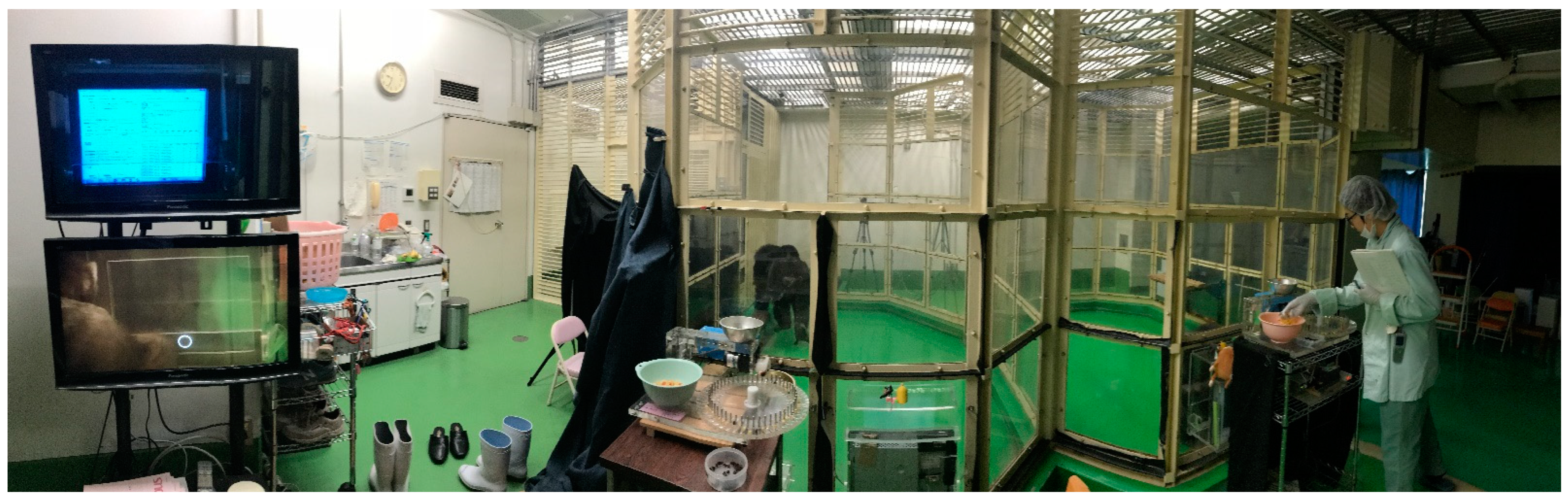
The sequence of Arabic numerals from 1 to 19 was taught to six chimpanzees, three pairs of mother and child. Each chimpanzee participant sat facing a touchscreen on which the numerals appeared in random positions within an imaginary 5-by-8 matrix. They had to touch the numerals in ascending order. Baseline training involved touching the adjacent numerals from 1 to X or from the numeral X to 19. Systematic tests revealed the following results: (1) The range 1 to 9 was easier than 1 to 19. (2) Adjacent numerals were easier than nonadjacent ones. (3) The “masking” (memory task) caused deterioration of performance. All these factors depended on the number of numerals simultaneously presented on the screen. A chimpanzee named Pal mastered the skill of ordering two-digit numerals with 100% accuracy. Human participants were tested in the same experiment with the same procedure. Both species showed relative difficulty in handling two-digit numerals. Global–local information processing is known to be different between humans and other primates. The assessment of chimpanzee performance and comparison with humans were discussed in terms of the possible difference in the global–local dual information processing of two-digit numerals.