Influence of Storage Packaging Type on the Microbiological and Sensory Quality of Free-Range Table Eggs


 , ,
, ,
Simple Summary
Abstract
1. Introduction
2. Materials and Methods
2.1. Egg Samples
2.2. Microbiological Analysis
2.3. Sensory Evaluation
2.4. Technological Properties of Egg White
2.5. Statistical Analysis
3. Results and Discussion
4. Conclusions
Author Contributions
Funding
Institutional Review Board Statement
Informed Consent Statement
Data Availability Statement
Conflicts of Interest
References
- Sanlier, N.; Üstün, D. Egg consumption and health effects: A narrative review. J. Food Sci. 2021, 86, 4250–4261. [Google Scholar] [CrossRef] [Scilit] [PubMed]
- Réhault-Godbert, S.; Guyot, N.; Nys, Y. The Golden Egg: Nutritional Value, Bioactivities, and Emerging Benefits for Human Health. Nutrients 2019, 11, 684. [Google Scholar] [CrossRef] [Scilit] [PubMed]
- Miranda, J.M.; Anton, X.; Redondo-Valbuena, C.; Roca-Saavedra, P.; Rodriguez, J.A.; Lamas, A.; Franco, C.M.; Cepeda, A. Egg and egg-derived foods: Effects on human health and use as functional foods. Nutrients 2015, 7, 706–729. [Google Scholar] [CrossRef] [Scilit] [PubMed]
- Pires, P.G.S.; Bavaresco, C.; Prato, B.S.; Wirth, M.L.; Moraes, P.O. The relationship between egg quality and hen housing systems—A systematic review. Livest. Sci. 2021, 250, 104597. [Google Scholar] [CrossRef] [Scilit]
- Gautron, J.; Réhault-Godbert, S.; Van de Braak, T.G.H.; Dunn, I.C. Review: What are the challenges facing the table egg industry in the next decades and what can be done to address them? Animal 2021, 15, 100282. [Google Scholar] [CrossRef] [Scilit]
- Tian, L.; Hu, S.; Jia, J.; Tan, W.; Yang, L.; Zhang, Q. Effects of short-term fermentation with lactic acid bacteria on the characterization, rheological and emulsifying properties of egg yolk. Food Chem. 2021, 341, 128163. [Google Scholar] [CrossRef] [Scilit]
- Park, J.H.; Kang, M.S.; Park, K.M.; Lee, H.Y.; Ok, G.S.; Koo, M.S.; Hong, S.I.; Kim, H.J. A dynamic predictive model for the growth of Salmonella spp. and Staphylococcus aureus in fresh egg yolk and scenario-based risk estimation. Food Control 2020, 118, 107421. [Google Scholar] [CrossRef] [Scilit]
- Wilson, P.B. Recent advances in avian egg science: A review. Poult. Sci. 2017, 96, 3747–3754. [Google Scholar] [CrossRef] [Scilit]
- Englmaierova, M.; Tumova, E.; Charvatova, V.; Skrivan, M. Effects of laying hens housing system on laying performance, egg quality characteristics, and egg microbial contamination. Czech J. Anim. Sci. 2014, 59, 345–352. [Google Scholar] [CrossRef] [Scilit]
- Samiullah, S.; Roberts, J.R.; Chousalkar, K.K. Effect of production system and flock age on egg quality and total bacterial load in commercial laying hens. J. Appl. Poult. Res. 2014, 23, 59–70. [Google Scholar] [CrossRef] [Scilit]
- Tomczyk, Ł.; Szablewski, T.; Stuper-Szablewska, K.; Nowaczewski, S.; Cegielska-Radziejewska, R. The influence of the conditions of acquisition and storage of table eggs on changes in their quality and the presence of mycobiota and Fusarium mycotoxins. Poult. Sci. 2019, 98, 2964–2971. [Google Scholar] [CrossRef] [Scilit]
- Tomczyk, L.; Stępień, L.; Urbaniak, M.; Szablewski, T.; Cegielska-Radziejewska, R.; Stuper-Szablewska, K. Characterisation of the mycobiota on the shell surface of table eggs acquired from different egg-laying hen breeding systems. Toxins 2018, 10, 293. [Google Scholar] [CrossRef] [Scilit]
- Rodriguez-Navarro, A.B.; Dominguez-Gasca, N.; Munoz, A.; Ortega-Huertas, M. Change in the chicken eggshell cuticle with hen age and egg freshness. Poult. Sci. 2013, 92, 3026–3035. [Google Scholar] [CrossRef] [Scilit] [PubMed]
- Guillier, L.; Thébault, A.; Fravalo, P.; Mughini-Gras, L.; Jourdan-Da Silva, N.; David, J.; Kooh, P.; Cadavez, V.; Gonzales-Barron, U. Risk factors for sporadic salmonellosis: A systematic review and meta-analysis. Microb. Risk Anal. 2021, 17, 100138. [Google Scholar] [CrossRef] [Scilit]
- Mughini-Gras, L.; Enserink, R.; Friesema, I.; Heck, M.; van Duynhoven, Y.; van Pelt, W. Risk Factors for Human Salmonellosis Originating from Pigs, Cattle, Chickens and Egg Laying Hens: A Combined Case-Control and Source Attribution Analysis. PLoS ONE 2014, 9, e87933. [Google Scholar]
- Gast, R.K.; Regmi, P.; Guraya, R.; Jones, D.R.; Anderson, K.E.; Karcher, D.M. Contamination of eggs by Salmonella Enteritidis in experimentally infected laying hens of four commercial genetic lines in conventional cages and enriched colony housing. Poult. Sci. 2019, 98, 5023–5027. [Google Scholar] [CrossRef] [Scilit]
- McWhorter, A.R.; Chousalkar, K.K. Salmonella on Australian cage egg farms: Observations from hatching to end of lay. Food Microbiol. 2020, 87, 103384. [Google Scholar] [CrossRef] [Scilit]
- Sharaf Eddin, A.; Ibrahim, S.A.; Tahergorabim, R. Egg quality and safety with an overview of edible coating application for egg preservation. Food Chem. 2019, 296, 29–39. [Google Scholar] [CrossRef] [Scilit] [PubMed]
- Rzedzicki, J.; Stępień-Pyśniak, D. Antimicrobial defence mechanisms of chicken eggs and possibilities for their use in protecting human and animal health. Ann. UMCS Lub. Med. Vet. 2009, 64, 1–8. [Google Scholar] [CrossRef] [Scilit]
- Chen, X.; Li, X.; Guo, Y.; Li, W.; Song, J.; Xu, G.; Yang, N.; Zheng, J. Impact of cuticle quality and eggshell thickness on egg antibacterial efficiency. Poult. Sci. 2019, 98, 940–948. [Google Scholar] [CrossRef] [Scilit]
- Rehault-Godbert, S.; Baron, F.; Mignon-Grasteau, S.; Labas, V.; Gautier, M.; Hincke, M.T.; Nys, Y. Effect of Temperature and Time of Storage on Protein Stability and Anti-Salmonella Activity of Egg White. J. Food Prot. 2010, 73, 1604–1612. [Google Scholar] [CrossRef] [Scilit] [PubMed]
- Berardinelli, A.; Ragni, L.; Giunchi, A.; Gradari, P.; Guarnieri, A. Physical-mechanical modifications of eggs for food-processing during storage. Poult. Sci. 2008, 87, 2117–2125. [Google Scholar] [CrossRef] [Scilit] [PubMed]
- Samli, H.E.; Agma, A.; Senkoylu, N. Effects of storage time and temperature on egg quality in old laying hens. J. Appl. Poult. Res. 2005, 14, 548–553. [Google Scholar] [CrossRef] [Scilit]
- Silversides, F.G.; Budgell, K. The relationships among measures of egg albumen height, pH, and whipping volume. Poult. Sci. 2004, 83, 1619–1623. [Google Scholar] [CrossRef] [Scilit] [PubMed]
- Gao, D.; Qiu, N.; Liu, Y.; Ma, M. Comparative proteome analysis of egg yolk plasma proteins during storage. J. Sci. Food Agric. 2017, 97, 2392–2400. [Google Scholar] [CrossRef] [Scilit] [PubMed]
- Qiu, N.; Ma, M.; Zhao, L.; Liu, W.; Li, Y.; Mine, Y. Comparative proteomic analysis of egg white proteins under various storage temperatures. J. Agric. Food Chem. 2012, 60, 7746–7753. [Google Scholar] [CrossRef] [Scilit] [PubMed]
- ITAVI. Situation du Marché des Oeufs et des Ovoproduits Édition Mars. 2021. Available online: https://www.itavi.asso.fr/publications/note-de-conjoncture-poules-pondeuses-mars-2021/download (accessed on 2 May 2023).
- Gautron, J.; Dombre, C.; Nau, F.; Feidt, C.; Guillier, L. Review: Production factors affecting the quality of chicken table eggs and egg products in Europe. Animal 2022, 16, 100425. [Google Scholar] [CrossRef] [Scilit]
- Meilgaard, M.C.; Civille, G.V.; Carr, B.T. Sensory Evaluation Techniques, 4th ed.; CRC Press: Boca Raton, FL, USA; Taylor and Francis Group: New York, NY, USA, 2007. [Google Scholar] [CrossRef] [Scilit]
- Margeta, P.; Kralik, G.; Grčević, M.; Hanžek, D.; Kralik, Z. Importance of sensory evaluation in assessment of egg quality. Poljoprivreda 2019, 25, 56–63. [Google Scholar] [CrossRef] [Scilit]
- Terčič, D.; Žlender, B.; Holcman, A. External, internal and sensory qualities of table eggs as influenced by two different production systems. Agro-Knowl. J. 2012, 13, 555–562. [Google Scholar] [CrossRef] [Scilit]
- Guo, D.; Pan, Q.; Huang, Q.; Yi, Y.; Wang, H.; Xu, W. The Quality Analysis and Deterioration Mechanism of Liquid Egg White during Storage. Appl. Sci. 2022, 12, 2500. [Google Scholar] [CrossRef] [Scilit]
- Alshaikhi, A.M.; Abdullatif, A.A.; Badwi, M.A.; Alsobayel, A.A. Effects of storage period, marketing channels and season on internal and external quality of commercial table eggs marketed in Riyadh City (Saudi Arabia). Braz. J. Poult. Sci. 2021, 23, 1–10. [Google Scholar] [CrossRef] [Scilit]
- Attia, Y.A.; Al-Harthi, M.A.; AL-Sagan, A.A.; Hussein, E.O.; Alhotan, R.A.; Suliman, G.M.; Abdulsalam, N.M.; Olal, M.J. Responses of egg quality sustainability, sensory attributes and lipid profile of eggs and blood to different dietary oil supplementations and storage conditions. Ital. J. Anim. Sci. 2022, 21, 1160–1169. [Google Scholar] [CrossRef] [Scilit]
- Lomakina, K.; Míková, K. A study of the factors affecting the foaming properties of egg white—A review. Czech J. Food Sci. 2006, 24, 110–118. [Google Scholar] [CrossRef] [Scilit]
- Abu-Ghoush, M.; Herald, T.J.; Aramouni, F.M. Comparative study of egg white protein and egg alternatives used in an angel food cake system. J. Food Process. Preserv. 2010, 34, 411–425. [Google Scholar] [CrossRef] [Scilit]
- Balerin, C.; Aymard, P.; Ducept, F.; Vaslin, S.; Cuvelier, G. Effect of formulation and processing factors on the properties of liquid food foams. J. Food Eng. 2007, 78, 802–809. [Google Scholar] [CrossRef] [Scilit]
- Curschellas, C.; Keller, R.; Berger, R.; Rietzler, U.; Fell, D.; Butt, H.J.; Limbach, H.J. Scanning force microscopy as a tool to investigate the properties of polyglycerol ester foams. J. Colloid Interface Sci. 2012, 374, 164–175. [Google Scholar] [CrossRef] [Scilit]
- Li, X.; Li, J.; Chang, C.; Wang, C.; Zhang, M.; Su, Y.; Yang, Y. Foaming characterization of fresh egg white proteins as a function of different proportions of egg yolk fractions. Food Hydrocoll. 2019, 90, 118–125. [Google Scholar] [CrossRef] [Scilit]
- Huang, T.; Tu, Z.; Shangguan, X.; Wang, H.; Sha, X.; Bansal, N. Rheological behavior, emulsifying properties and structural characterization of phosphorylated fish gelatin. Food Chem. 2018, 246, 428–436. [Google Scholar] [CrossRef] [Scilit]
- Peishan, L.; Li, P.; Zhuo, S.; Meihu, M.; Yongguo, J.; Long, S. Effect of microwave-assisted phosphorylation modification on the structural and foaming properties of egg white powder. LWT 2018, 97, 151–156. [Google Scholar] [CrossRef] [Scilit]
- Foegeding, E.A.; Luck, P.J.; Davis, J.P. Factors determining the physical properties of protein foams. Food Hydrocoll. 2006, 20, 284–292. [Google Scholar] [CrossRef] [Scilit]
- Sokołowicz, Z.; Dykiel, M.; Augustyńska-Prejsnar, A.; Krawczyk, J. The effect of storage duration on some quality traits and composition of eggs from different housing systems. Ann. Anim. Sci. 2021, 1, 459–475. [Google Scholar] [CrossRef] [Scilit]
- Kačániová, M.; Klūga, A.; Kántor, A.; Medo, J.; Žiarovská, J.; Puchalski, C.; Terentjeva, M. Comparison of MALDI-TOF MS Biotyper and 16S rDNA sequencing for the identification of Pseudomonas species isolated from fish. Microb. Pathog. 2019, 132, 313–318. [Google Scholar] [CrossRef] [Scilit] [PubMed]
- Ferreira, M.; Benringer, R.; Jost, R. Instrumental method for characterizing protein foams. J. Food Sci. 1995, 60, 90–93. [Google Scholar] [CrossRef] [Scilit]
- StatSoft Electronic Statistics Textbook; Data Analysis Software System; Version 13.3; StatSoft Inc.: Kraków, Poland, 2018.
- Drabik, K.; Próchniak, T.; Spustek, D.; Wengerska, K.; Batkowska, J. The Impact of Package Type and Temperature on the Changes in Quality and Fatty Acids Profile of Table Eggs during Their Storage. Foods 2021, 10, 2047. [Google Scholar] [CrossRef] [Scilit] [PubMed]
- Chousalkar, K.K.; Khan, S.; McWhorter, A.R. Microbial quality, safety and storage of eggs. Curr. Opin. Food Sci. 2021, 38, 91–95. [Google Scholar] [CrossRef] [Scilit]
- De Reu, K.; Messens, W.; Heyndrickx, M.; Rodenburg, T.B.; Uyttendaele, M.; Herman, L. Bacterial contamination of table eggs and the influence of housing systems. World’s Poult. Sci. J. 2008, 64, 5–19. [Google Scholar] [CrossRef] [Scilit]
- Aygun, A. The Eggshell Microbial Activity. In Egg Innovations and Strategies for Improvements; Hester, P.Y., Ed.; Academic Press: Cambridge, MA, USA, 2017; pp. 135–144. [Google Scholar] [CrossRef] [Scilit]
- Barrow, P.A.; Lovell, M.A. Experimental infection of egg-laying hens with Salmonella enteritidisphage type 4. Avian Pathol. 1991, 20, 335–348. [Google Scholar] [CrossRef] [Scilit]
- Humphrey, T.J. Contamination of egg shell and contents with Salmonella enteritidis: A review. Int. J. Food Microbiol. 1994, 21, 31–40. [Google Scholar] [CrossRef] [Scilit]
- Oliveira, W.K.; Ávila, H.L.; Tadra, M.Z.; Cardoso, R.L.; Fadel-Pichet, C.M.T.; de Souza, E.M.; de Oliveira Pedrosa, F.; Faoro, H. High Genomic Identity between Clinical and Environmental Strains of Herbaspirillum frisingense Suggests Pre-Adaptation to Different Hosts and Intrinsic Resistance to Multiple Drugs. Antibiotics 2021, 10, 1409. [Google Scholar] [CrossRef] [Scilit]
- Baldani, I.; Baldani, V.L.D.; Seldin, L.; Dobereiner, J. Characterization of Herbaspirillurn Seropedicae Gen. Nov. Sp. Nov. a Root-Associated Nitrogen-Fixing Bacterium. Int. J. Syst. Evol. Microbiol. 1986, 36, 86–93. [Google Scholar] [CrossRef] [Scilit]
- Obradovic, A.; Jones, B.J.; Minsavage, V.G.; Dickstein, R.E.; Momol, M.T. A Leaf Spot and Blight of Greenhouse Tomato Seedlings Incited by a Herbaspirillum sp. Plant Dis. 2007, 91, 886–890. [Google Scholar] [CrossRef] [Scilit] [PubMed]
- Dobritsa, P.A.; Reddy, M.C.S.; Samadpour, M. Reclassification of Herbaspirillum Putei as a Later Heterotypic Synonym of Herbaspirillum Huttiense, With the Description of H. Huttiense subsp. Huttiense subsp. Nov. and H. Huttiense subsp. Putei subsp. Nov., Comb. Nov., and Description of Herbaspirillum Aquaticum sp. Nov. Int. J. Syst. Evol. Microbiol. 2010, 60, 1418–1426. [Google Scholar] [CrossRef] [Scilit] [PubMed]
- Liu, C.; Kwon, M.J.; Kim, M.; Byun, J.H.; Yong, D.; Lee, K. Septicemia Caused by Herbaspirillum huttiense Secondary to Pneumonia. Ann. Lab. Med. 2019, 39, 340–342. [Google Scholar] [CrossRef] [Scilit] [PubMed]
- Gulati, A.; Sood, S.; Rahi, P.; Thakur, R.; Chauhan, S.; Chawla, I. Diversity Analysis of Diazotrophic Bacteria Associated with the Roots of Tea. J. Microbiol. Biotechnol. 2011, 21, 545–555. [Google Scholar] [CrossRef] [Scilit] [PubMed]
- De Souza, V.; Piro, V.C.; Faoro, H.; Tadra-Sfeir, M.Z.; Chicora, V.K.; Guizelini, D.; Weiss, V.; Vialle, R.A.; Monteiro, R.A.; Steffens, M.B.R.; et al. Draft Genome Sequence of Herbaspirillum huttiense subsp. Putei IAM 15032, a Strain Isolated from Well Water. Genome Announc. 2013, 1, e002521. [Google Scholar] [CrossRef] [Scilit]
- Tayeb, L.A.; Lefevre, M.; Passet, V.; Diancourt, L.; Brisse, S.; Grimont, P.A.D. Grimont Comparative Phylogenies of Burkholderia, Ralstonia, Comamonas, Brevundimonas and Related Organisms Derived From Rpob, gyrB and Rrs Gene Sequences. Res. Microbiol. 2008, 159, 169–177. [Google Scholar] [CrossRef] [Scilit]
- Straub, D.; Yang, H.; Liu, Y.; Tsap, T.; Ludewig, U. Root ethylene signalling is involved in Miscanthus sinensis growth promotion by the bacterial endophyte Herbaspirillum frisingense GSF30(T). J. Exp. Bot. 2013, 64, 4603–4615. [Google Scholar] [CrossRef] [Scilit]
- Pondit, A.; Haque, Z.F.; Sabuj, A.A.M.; Khan, M.S.R.; Saha, S. Characterization of Staphylococcus aureus isolated from chicken and quail eggshell. J. Adv. Vet. Anim. Res. 2018, 5, 466–471. [Google Scholar] [CrossRef] [Scilit]
- Al-Natour, M.Q.; Alaboudi, A.R.; Al-Hatamelh, N.A.; Osaili, T.M. Escherichia coli O157:H7 facilitates the penetration of Staphylococcus aureus into table eggs. J. Food Sci. 2012, 77, 29–34. [Google Scholar] [CrossRef] [Scilit]
- Benrabia, I.; Hamdi, T.M.; Shehata, A.A.; Neubauer, H.; Wareth, G. Methicillin-Resistant Staphylococcus aureus (MRSA) in Poultry Species in Algeria: Long-Term Study on Prevalence and Antimicrobial Resistance. Vet. Sci. 2020, 7, 54. [Google Scholar] [CrossRef] [Scilit]
- Qian, C.; Castaneda-Gulla, K.; Sattlegger, E.; Mutukumira, A.N. Enterotoxigenicity and genetic relatedness of Staphylococcus aureus in a commercial poultry plant and poultry farm. Int. J. Food Microbiol. 2022, 363, 109454. [Google Scholar] [CrossRef] [Scilit]
- Adesiyun, A.; Offiah, N.; Seepersadsingh, N.; Rodrigo, S.; Lashley, V.; Musai, L. Frequency and antimicrobial resistance of enteric bacteria with spoilage potential isolated from table eggs. Food Res. Int. 2006, 39, 212–219. [Google Scholar] [CrossRef] [Scilit]
- Elisha, I.L.; Jambalang, A.R.; Botha, F.S.; Buys, E.M.; McGaw, L.J.; Eloff, J.N. Potency and selectivity indices of acetone leaf extracts of nine selected South African trees against six opportunistic Enterobacteriaceae isolates from commercial chicken eggs. BMC Complement. Altern. Med. 2017, 17, 90. [Google Scholar] [CrossRef] [Scilit]
- Sabarinath, A.; Guillaume, V.; Guillaume, B.; Mathew, V.; DeAllie, C.; Sharma, R.N. Bacterial contamination of commercial chicken eggs in Grenada, West Indies. West Indian Vet. J. 2009, 9, 4–7. [Google Scholar]
- Musgrove, M.T.; Northcutt, J.K.; Jones, D.R.; Cox, N.A.; Harrison, M.A. Enterobacteriaceae and related organisms isolated from shell eggs collected during commercial processing. Poult. Sci. 2008, 87, 1211–1218. [Google Scholar] [CrossRef] [Scilit]
- De Oliveira-Garcia, D.; Dall’Agnol, M.; Rosales, M.; Azzuz, A.C.G.S.; Alcántara, N.; Martinez, M.B.; Girón, J.A. Fimbriae and adherence of Stenotrophomonas maltophilia to epithelial cells and to abiotic surfaces. Cell. Microbiol. 2003, 5, 625–636. [Google Scholar] [CrossRef] [Scilit] [PubMed]
- Fang, T.; Huang, L. Growth and survival kinetics of Listeria monocytogenes in cooked egg whites. Food Control 2014, 36, 191–198. [Google Scholar] [CrossRef] [Scilit]
- Ahmad, S.; Haq, A.U.; Yousaf, M.; Kamran, Z.; Rehman, A.U.; Sohail, M.U.; Samad, H.A. Effect of canola oil and vitamin a on egg characteristics and egg cholesterol in laying hens during hot summer months. Pak. Vet. J. 2013, 33, 346–349. [Google Scholar]
- Fraeye, I.; Bruneel, C.; Lemahieu, C.; Buyse, J.; Muylaert, K.; Foubert, I. Dietary enrichment of eggs with omega-3 fatty acids: A review. Food Res. Int. 2012, 48, 961–969. [Google Scholar] [CrossRef] [Scilit]
- Aguinaga Bósquez, J.P.; Kovacs, Z.; Gillay, Z.; Bázár, G.; Palkó, C.; Hingyi, H.; Csavajda, É.; Üveges, M.; Jókainé Szatura, Z.; Barbulescu, I.D.; et al. Evaluating the Effect of a Brewery By-Product as Feed Supplementation on the Quality of Eggs by Means of a Human Panel and E-Tongue and E-Nose Analysis. Chemosensors 2021, 9, 213. [Google Scholar] [CrossRef] [Scilit]
- Alleoni, A.C.C.; Antunes, A.J. Internal quality of eggs coated with whey protein concentrate. Sci. Agric. 2004, 61, 276–280. [Google Scholar] [CrossRef] [Scilit]
- Davis, J.P.; Foegeding, E.A. Foaming and interfacial properties of polymerized whey protein isolate. J. Food Sci. 2004, 69, 404–410. [Google Scholar] [CrossRef] [Scilit]



| Storage Times (Days) | Kind of Package | p-Value for Main Effects | ||||
|---|---|---|---|---|---|---|
| Cardboard Box | Plastic Box | |||||
| 5 °C | 22 °C | 5 °C | 22 °C | |||
| TCB Egg shell (log cfu/mL) | P T S P×T P×S T×S P×T×S | 0.53 0.09 0.000 0.041 0.79 0.25 0.040 | ||||
| 0 | x 1.78 | x 1.80 | x 1.75 | x 1.76 | ||
| 14 | x 1.43 a | x 1.86 a | x 1.82 a | x 2.13 b | ||
| 28 | y 2.55 | y 2.63 | y 2.40 a | y 2.76 b | ||
| CB Internal egg content (log cfu/mL) | P T S P×T P×S T×S P×T×S | 0.010 0.26 0.005 0.10 0.16 0.53 0.45 | ||||
| 0 | x 0.00 | x 0.00 | x 0.00 | x 0.00 | ||
| 14 | y 1.59 a | y 1.92 a | y 2.11 | y 2.35 b | ||
| 28 | y 1.60 | 1.73 | y 2.04 | y 2.49 | ||
| CB Egg shell (log cfu/mL) | P T S P×T P×S T×S P×T×S | 0.17 0.51 0.000 0.000 0.21 0.22 0.000 | ||||
| 0 | x 0.00 | x 0.00 | x 0.00 | x 0.00 | ||
| 14 | 0.52 | x 1.12 | x 0.52 | x 1.00 | ||
| 28 | y 1.37 ac | y 2.15 b | y 1.22 ac | y 1.94 bc | ||
| CB Internal egg content (log cfu/mL) | P T S P×T P×S T×S P×T×S | 0.014 0.037 0.018 0.33 0.09 0.13 0.68 | ||||
| 0 | 0.00 | x 0.00 | 0.00 | x 0.00 | ||
| 14 | 0.00 a | y 1.37 a | 0.00 a | y 1.78 ac | ||
| 28 | 0.52 ac | y 1.00 a | 1.64 c | y 1.80 b | ||
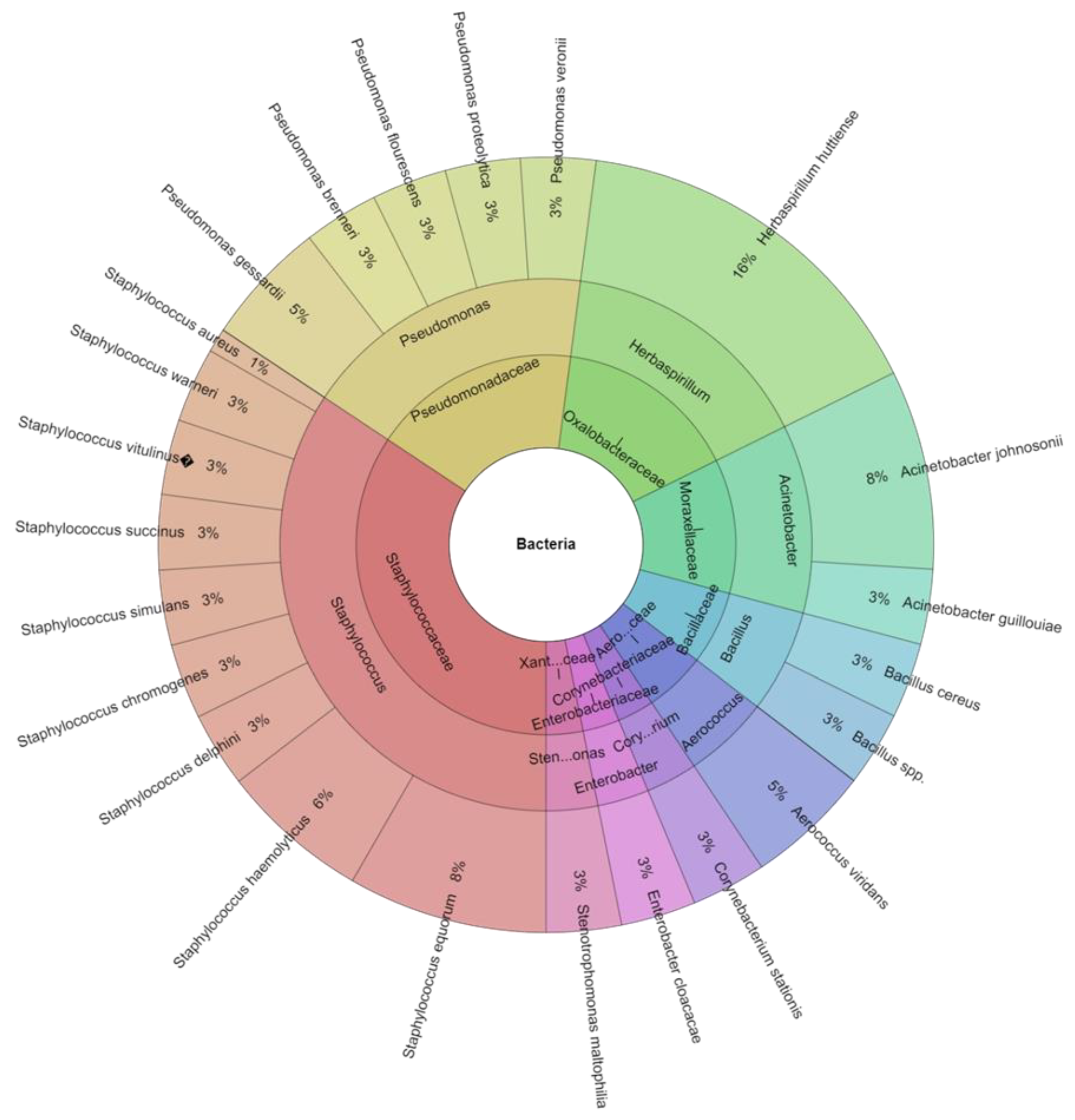
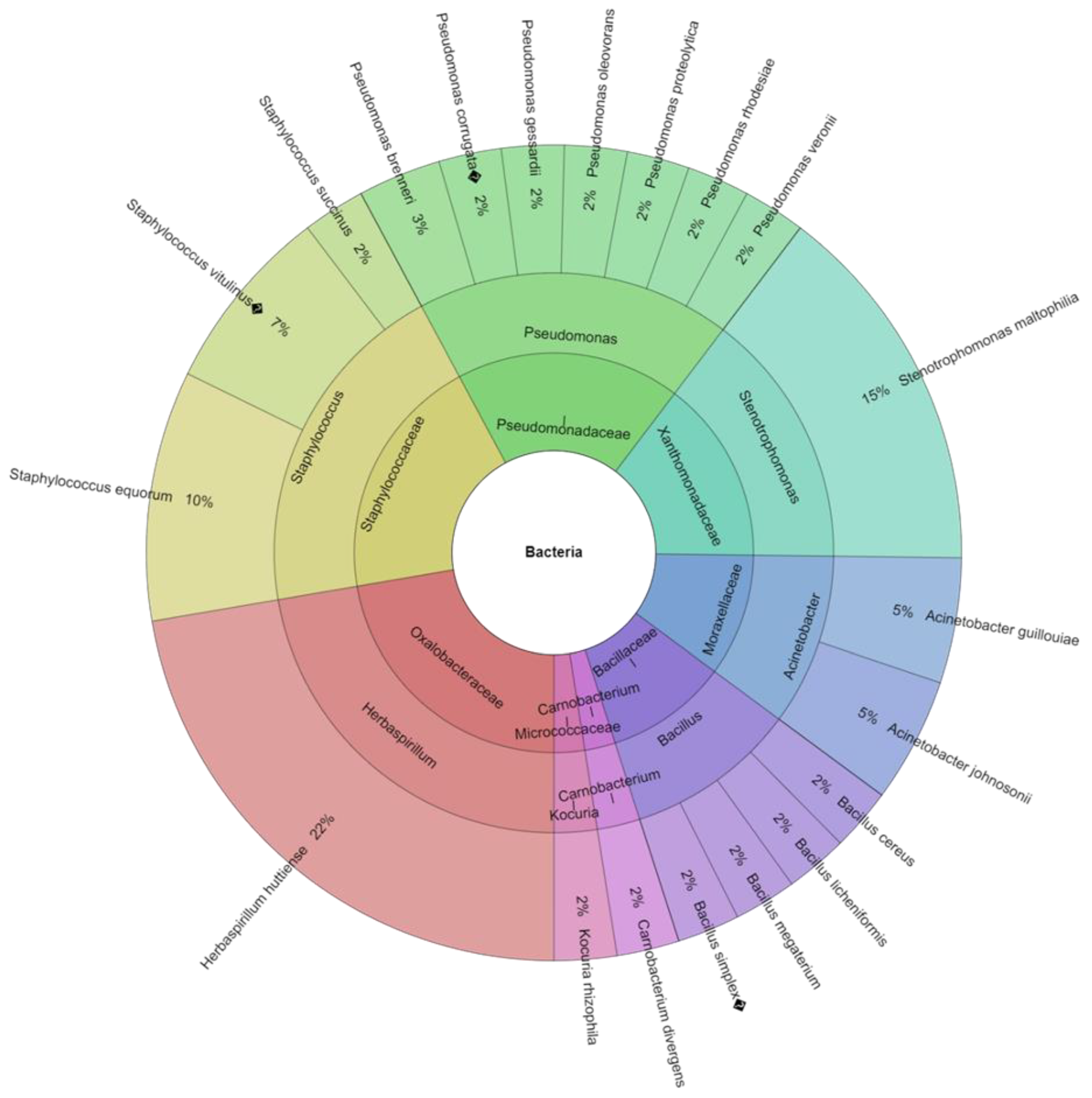
| Bacterial Species | Cardboard Box | Plastic Box | Total | ||||
|---|---|---|---|---|---|---|---|
| 0 Day | 14th Day | 28th Day | 0 Day | 14th Day | 28th Day | ||
| Acinetobacter guillouiae | 3 | 3 | 3 | 9 | |||
| Acinetobacter johnosonii | 5 | 3 | 3 | 3 | 14 | ||
| Aerococcus viridans | 5 | 5 | |||||
| Bacillus cereus | 3 | 3 | 6 | ||||
| Bacillus licheniformis | 3 | 3 | |||||
| Bacillus megaterium | 3 | 3 | |||||
| Bacillus simplex | 3 | 3 | |||||
| Bacillus spp. | 3 | 3 | |||||
| Carnobacterium divergens | 3 | 3 | |||||
| Corynebacterium stationis | 3 | 3 | |||||
| Enterobacter cloacacae | 3 | 3 | |||||
| Herbaspirillum huttiense | 5 | 10 | 2 | 10 | 15 | 42 | |
| Kocuria rhizophila | 3 | 3 | |||||
| Pseudomonas brenneri | 3 | 4 | 7 | ||||
| Pseudomonas corrugata | 3 | 3 | |||||
| Pseudomonas flourescens | 3 | 3 | |||||
| Pseudomonas gessardii | 5 | 3 | 8 | ||||
| Pseudomonas oleovorans | 3 | 3 | |||||
| Pseudomonas proteolytica | 3 | 3 | 6 | ||||
| Pseudomonas rhodesiae | 3 | 3 | |||||
| Pseudomonas veronii | 3 | 3 | 6 | ||||
| Staphylococcus aureus | 1 | 1 | |||||
| Staphylococcus delphini | 3 | 3 | |||||
| Staphylococcus equorum | 5 | 3 | 2 | 5 | 5 | 20 | |
| Staphylococcus haemolyticus | 3 | 3 | 6 | ||||
| Staphylococcus chromogenes | 3 | 3 | |||||
| Staphylococcus simulans | 3 | 3 | |||||
| Staphylococcus succinus | 3 | 3 | 6 | ||||
| Staphylococcus vitulinus | 3 | 3 | 3 | 3 | 12 | ||
| Staphylococcus warneri | 3 | 3 | |||||
| Stenotrophomonas maltophilia | 3 | 3 | 10 | 5 | 21 | ||
| Total | 38 | 39 | 19 | 25 | 62 | 34 | 217 |
| Trait | Time | Kind of Package | p-Value for Main Effects | ||||
|---|---|---|---|---|---|---|---|
| Cardboard Box | Plastic Box | ||||||
| 5 °C | 22 °C | 5 °C | 22 °C | ||||
| overall appearance | 1 | x 7.93 ± 0.96 | x 7.93 ± 0.96 | x 7.93 ± 0.96 | x 7.93 ± 0.96 | P T S P×T P×S T×S P×T×S | 0.21 0.06 0.000 0.51 0.61 0.39 0.81 |
| 14 | x 8.27 ± 0.79 a | x 8.00 ± 0.84 | x 8.13 ± 1.06 | 7.40 ± 1.12 b | |||
| 28 | y 7.20 ± 1.08 | y 6.93 ± 1.16 | y 7.06 ± 1.17 | y 6.67 ± 0.98 | |||
| 1–28 | 7.80 ± 1.03 | 7.62 ± 1.09 | 7.71 ± 1.14 | 7.33 ± 1.13 | |||
| yolk colour | 1 | 8.13 ± 0.99 | x 8.13 ± 0.99 | x 8.13 ± 0.99 | x 8.13 ± 0.99 | P T S P×T P×S T×S P×T×S | 0.49 0.007 0.000 1.00 0.87 0.16 0.41 |
| 14 | 8.07 ± 0.88 | x 7.67 ± 1.05 | x 8.20 ± 0.86 a | 7.27 ± 1.39 b | |||
| 28 | 7.67 ± 0.89 | y 6.73 ± 1.16 | y 7.20 ± 1.08 | y 6.80 ± 1.61 | |||
| 1–28 | 7.96 ± 0.93 a | 7.51 ± 1.19 | 7.84 ± 1.06 | 7.40 ± 1.44 b | |||
| smell | 1 | 8.13 ± 0.99 | x 8.13 ± 0.99 | 8.13 ± 0.99 | x 8.13 ± 0.99 | P T S P×T P×S T×S P×T×S | 0.93 0.000 0.000 0.59 0.69 0.017 0.98 |
| 14 | x 8.53 ± 0.63 a | x 7.80 ± 1.15 bc | x 8.53 ± 0.74 ab | 7.47 ± 1.19 c | |||
| 28 | y 7.60 ± 1.05 a | y 6.80 ± 1.16 b | y 7.80 ± 0.56 a | y 6.87 ± 0.99 b | |||
| 1–28 | 8.09 ± 0.97 a | 7.58 ± 1.22 b | 8.16 ± 0.82 a | 7.49 ± 1.16 b | |||
| taste | 1 | 7.80 ± 1.21 | x 7.80 ± 1.21 | 7.80 ± 1.21 | 7.80 ± 1.21 | P T S P×T P×S T×S P×T×S | 0.85 0.05 0.005 0.67 0.96 0.40 0.93 |
| 14 | 8.00 ± 1.25 | 7.67 ± 0.89 | 8.07 ± 0.16 | 7.40 ± 1.40 | |||
| 28 | 7.40 ± 1.55 | y 6.93 ± 1.16 | 7.47 ± 1.12 | 6.87 ± 1.00 | |||
| 1–28 | 7.73 ± 1.34 | 7.47 ± 1.14 | 7.78 ± 1.16 | 7.36 ± 1.25 | |||
| texture | 1 | x 7.80 ± 1.20 | x 7.80 ± 1.20 | x 7.80 ± 1.20 | x 7.80 ± 1.20 | P T S P×T P×S T×S P×T×S | 0.09 0.002 0.000 0.67 0.39 0.039 0.47 |
| 14 | y 8.74 ± 0.60 a | x 7.87 ± 0.99 b | x 8.33 ± 0.97 ab | 7.20 ± 1.02 c | |||
| 28 | x 7.40 ± 1.12 | y 6.60 ± 1.12 | y 6.80 ± 1.15 | y 6.67 ± 0.82 | |||
| 1–28 | 7.98 ± 0.14 a | 7.42 ± 1.23 b | 7.64 ± 0.26 | 7.22 ± 1.10 b | |||
| Trait | Time | Kind of Package | p-Value for Main Effects | ||||
|---|---|---|---|---|---|---|---|
| Cardboard Box | Plastic Box | ||||||
| 5 °C | 22 °C | 5 °C | 22 °C | ||||
| Foaming capacity (%) | 1 | x 516.00 ± 36.27 | x 516.00 ± 36.27 | x 516.00 ± 36.27 | x 516.00 ± 36.27 | P T S P×T P×S T×S P×T×S | 0.36 0.06 0.000 0.34 0.76 0.035 0.78 |
| 14 | x 523.00 ± 35.06 a | 497.50 ± 30.39 | x 519.50 ± 24.55 a | y 480.50 ± 25.76 b | |||
| 28 | y 470.50 ± 25.32 | y 480.00 ± 37.19 | y 474.50 ± 23.15 | y 465.50 ± 27.43 | |||
| 1–28 | 503.17 ± 39.36 | 497.83 ± 36.71 | 503.33 ± 34.55 | 487.00 ± 36.43 | |||
| Foam stability (%) | 1 | x 95.41 ± 2.29 | x 95.41 ± 2.29 | x 95.41 ± 2.29 | x 95.41 ± 2.29 | P T S P×T P×S T×S P×T×S | 0.56 0.039 0.000 0.42 0.15 0.32 0.56 |
| 14 | x 93.88 ± 3.05 a | y 92.57 ± 2.34 | y 92.29 ± 2.05 | y 91.04 ± 2.35 b | |||
| 28 | y 90.79 ± 3.36 | z 87.91 ± 3.57 | y 90.38 ± 3.24 | y 89.76 ± 2.13 | |||
| 1–28 | 93.36 ± 3.44 | 91.96 ± 4.15 | 92.69 ± 3.26 | 92.07 ± 3.28 | |||
Disclaimer/Publisher’s Note: The statements, opinions and data contained in all publications are solely those of the individual author(s) and contributor(s) and not of MDPI and/or the editor(s). MDPI and/or the editor(s) disclaim responsibility for any injury to people or property resulting from any ideas, methods, instructions or products referred to in the content. |
© 2023 by the authors. Licensee MDPI, Basel, Switzerland. This article is an open access article distributed under the terms and conditions of the Creative Commons Attribution (CC BY) license (https://creativecommons.org/licenses/by/4.0/).
Share and Cite
Sokołowicz, Z.; Kačániová, M.; Dykiel, M.; Augustyńska-Prejsnar, A.; Topczewska, J. Influence of Storage Packaging Type on the Microbiological and Sensory Quality of Free-Range Table Eggs. Animals 2023, 13, 1899. https://doi.org/10.3390/ani13121899
Sokołowicz Z, Kačániová M, Dykiel M, Augustyńska-Prejsnar A, Topczewska J. Influence of Storage Packaging Type on the Microbiological and Sensory Quality of Free-Range Table Eggs. Animals. 2023; 13(12):1899. https://doi.org/10.3390/ani13121899
Chicago/Turabian StyleSokołowicz, Zofia, Miroslava Kačániová, Magdalena Dykiel, Anna Augustyńska-Prejsnar, and Jadwiga Topczewska. 2023. "Influence of Storage Packaging Type on the Microbiological and Sensory Quality of Free-Range Table Eggs" Animals 13, no. 12: 1899. https://doi.org/10.3390/ani13121899
APA StyleSokołowicz, Z., Kačániová, M., Dykiel, M., Augustyńska-Prejsnar, A., & Topczewska, J. (2023). Influence of Storage Packaging Type on the Microbiological and Sensory Quality of Free-Range Table Eggs. Animals, 13(12), 1899. https://doi.org/10.3390/ani13121899