Camera Trap Methods and Drone Thermal Surveillance Provide Reliable, Comparable Density Estimates of Large, Free-Ranging Ungulates
by
 ,
,
Robert W. Baldwin
1,
Jared T. Beaver
1,2,3,*,
Max Messinger
1,2,
Jeffrey Muday
1,
Matt Windsor
4,
Gregory D. Larsen
1,2,
Miles R. Silman
1,2 and
T. Michael Anderson
1,2 1
Department of Biology, Wake Forest University, Winston-Salem, NC 27109, USA
2
Wake Forest University Center for Energy, Environment, and Sustainability, Wake Forest University, Winston-Salem, NC 27109, USA
3
Department of Animal and Range Sciences, Montana State University, Bozeman, MT 59717, USA
4
Pilot Mountain State Park, North Carolina State Parks, 1792 Pilot Knob Park Rd, Pinnacle, NC 27043, USA
*
Author to whom correspondence should be addressed.
Animals 2023, 13(11), 1884; https://doi.org/10.3390/ani13111884
Submission received: 20 April 2023
/
Revised: 28 May 2023
/
Accepted: 2 June 2023
/
Published: 5 June 2023
(This article belongs to the Topic Ecology, Management and Conservation of Vertebrates)
Simple Summary
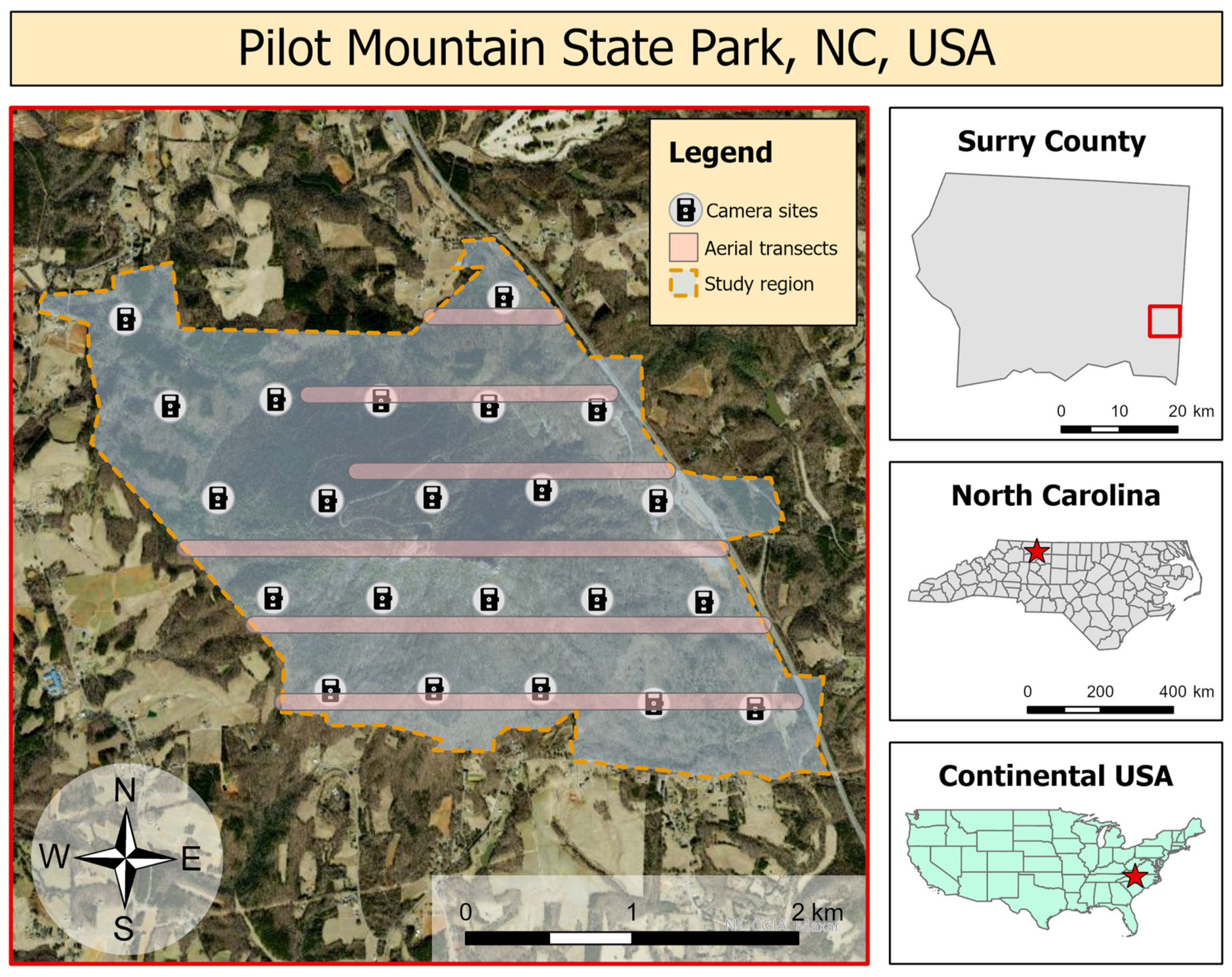
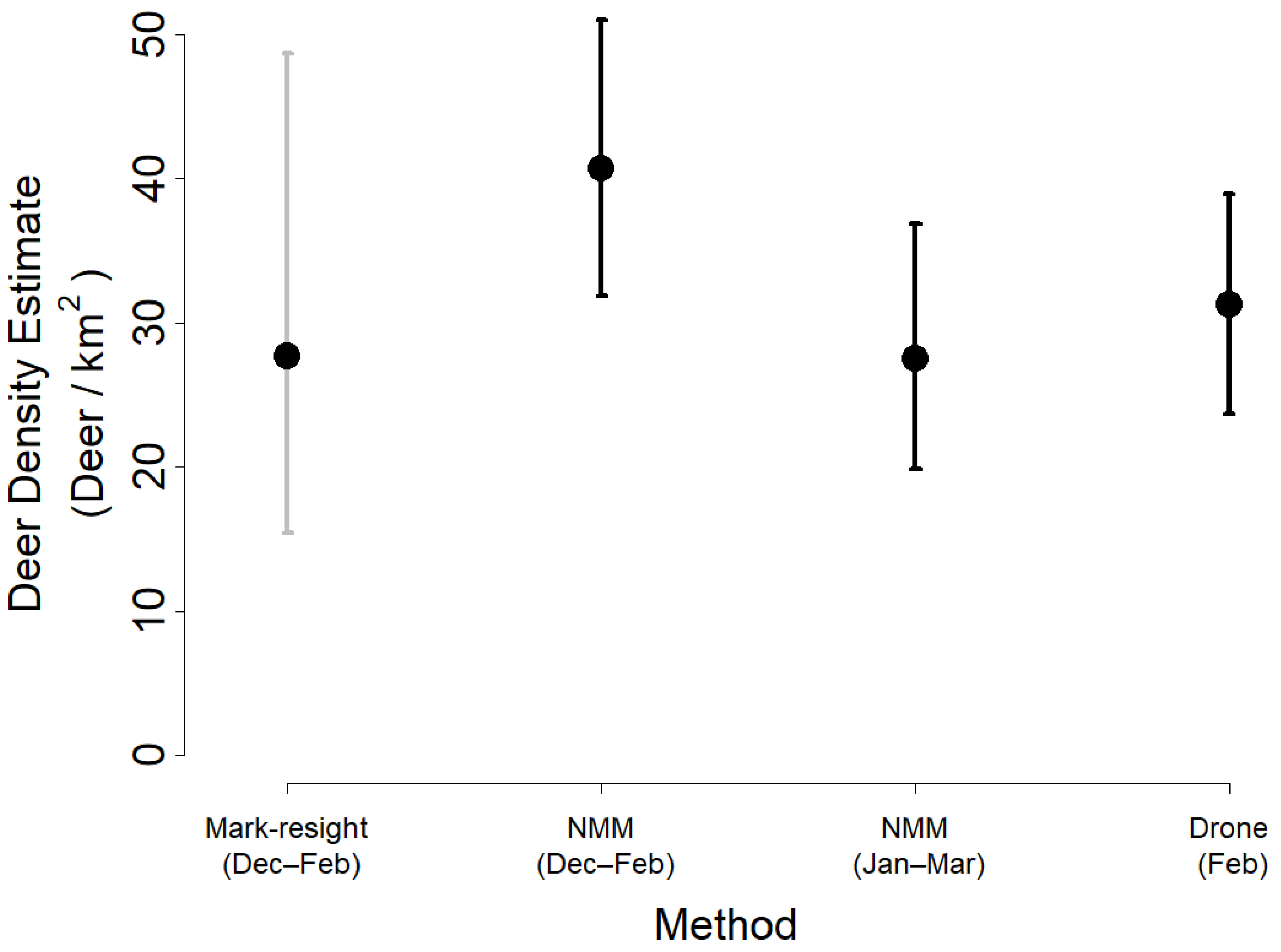
Wildlife researchers and managers can choose from several techniques to estimate the number of animals in a population. Camera traps and drones are increasingly common and cost-effective options that can estimate the number and density of wildlife. We compared three simple methods that are used to estimate the number and density of deer in Pilot Mountain State Park: (1) mark–resighting and (2) N-mixture modeling, both using camera trap data, and (3) extrapolating transect counts from thermal videos collected from an aerial drone. We found that all three methods provided similar estimates of the population’s density, with complementary strengths and weaknesses: drone surveys collected data quickly and precisely, mark–resight ratios provided estimates of different demographic groups, and N-mixture modeling revealed changes in density across different habitat qualities and seasons.
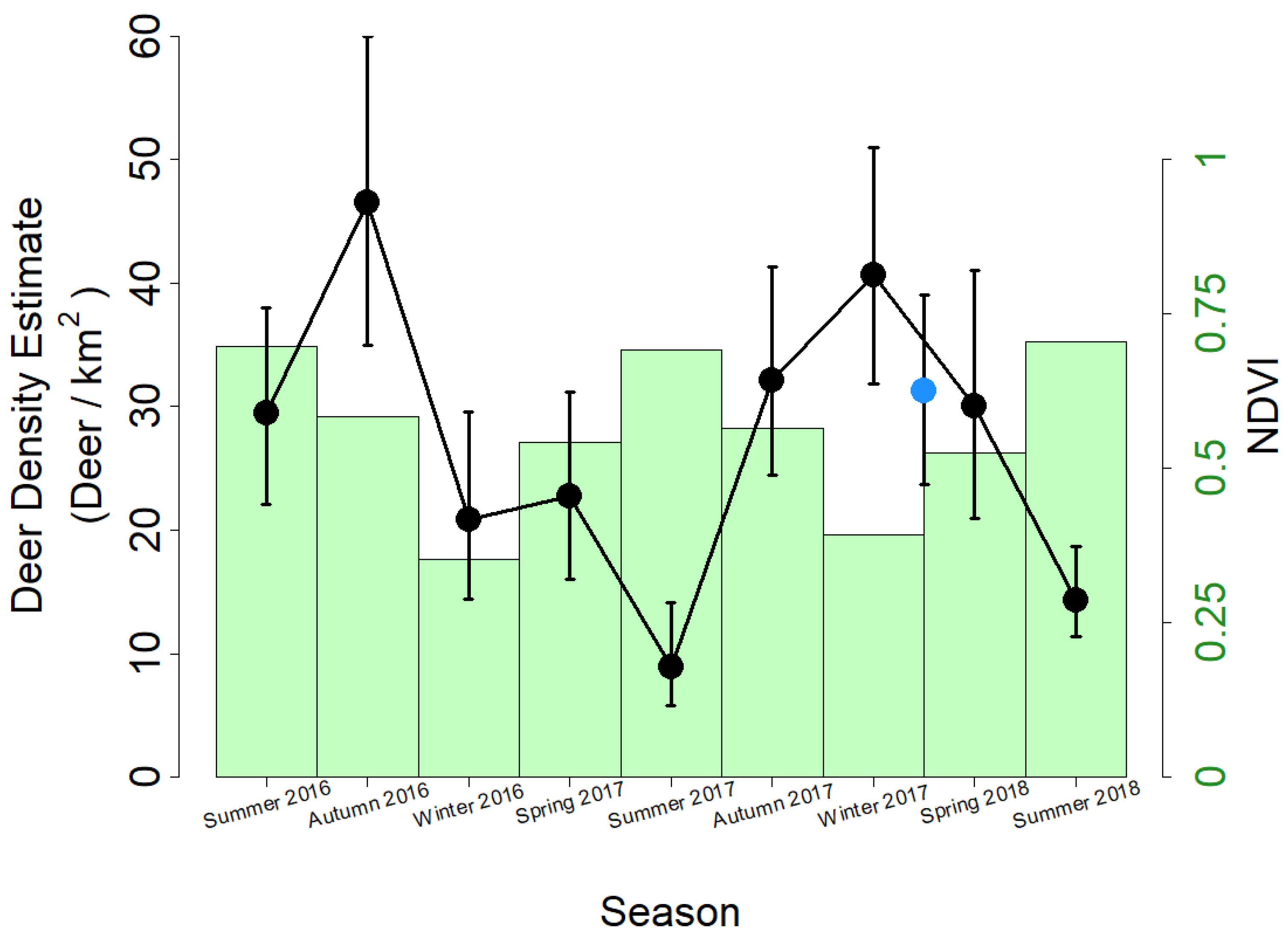
Abstract
Camera traps and drone surveys both leverage advancing technologies to study dynamic wildlife populations with little disturbance. Both techniques entail strengths and weaknesses, and common camera trap methods can be confounded by unrealistic assumptions and prerequisite conditions. We compared three methods to estimate the population density of white-tailed deer (Odocoileus virgnianus) in a section of Pilot Mountain State Park, NC, USA: (1) camera trapping using mark–resight ratios or (2) N-mixture modeling and (3) aerial thermal videography from a drone platform. All three methods yielded similar density estimates, suggesting that they converged on an accurate estimate. We also included environmental covariates in the N-mixture modeling to explore spatial habitat use, and we fit models for each season to understand temporal changes in population density. Deer occurred in greater densities on warmer, south-facing slopes in the autumn and winter and on cooler north-facing slopes and in areas with flatter terrain in the summer. Seasonal density estimates over two years suggested an annual cycle of higher densities in autumn and winter than in summer, indicating that the region may function as a refuge during the hunting season.