Differences in Fatty Acid Profile and Physical-Chemical Composition of Slavonska slanina—Dry Cured Smoked Bacon Produced from Black Slavonian Pig and Modern Pigs
by
 , and
, and
Katarina Latin
1, 
Krešimir Mastanjević
2,* ,
,
Nikola Raguž
3,
Mateja Bulaić
4,
Ras Lužaić
3,
Marija Heffer
5 and
and
Boris Lukić
3 1
Black Slavonian Pig Breeders Association “Fajferica”, Vladimira Nazora 1, 31400 Đakovo, Croatia
2
Faculty of Food Technology Osijek, Josip Juraj Strossmayer University of Osijek, F. Kuhača 20, 31000 Osijek, Croatia
3
Department for Animal Production and Biotechnology, Faculty of Agrobiotechnical Sciences Osijek, Josip Juraj Strossmayer University of Osijek, Vladimira Preloga 1, 31000 Osijek, Croatia
4
Inspecto d.o.o., Vukovarska Cesta 239b, 31000 Osijek, Croatia
5
Department of Medical Biology and Genetics, Faculty of Medicine, Josip Juraj Strossmayer University of Osijek, Josipa Huttlera 4, 31000 Osijek, Croatia
*
Author to whom correspondence should be addressed.
Animals 2022, 12(7), 924; https://doi.org/10.3390/ani12070924
Submission received: 15 March 2022
/
Revised: 1 April 2022
/
Accepted: 1 April 2022
/
Published: 4 April 2022
(This article belongs to the Special Issue Impact of Genetic and Feeding Effects on Carcass Traits and Meat Quality of Pigs)
Simple Summary
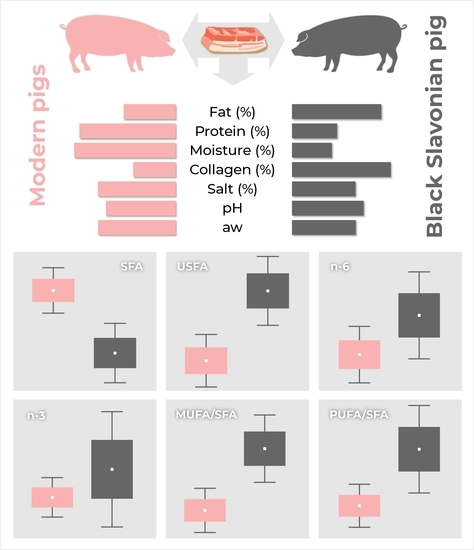
Research on the products of local pig breeds is quite challenging as the populations are small, breeders are less educated and it is often difficult to design systematic research in various and usually different breeding conditions, compared to commercial breeds. In this study, we have analysed dry cured bacons, produced from the local Black Slavonian and modern breeds on the small home-made scale, and compared their physico-chemical properties and fatty acid profiles. Results have showed significant differences in chemical composition and fatty acid profiles between analysed pig breeds.
Abstract
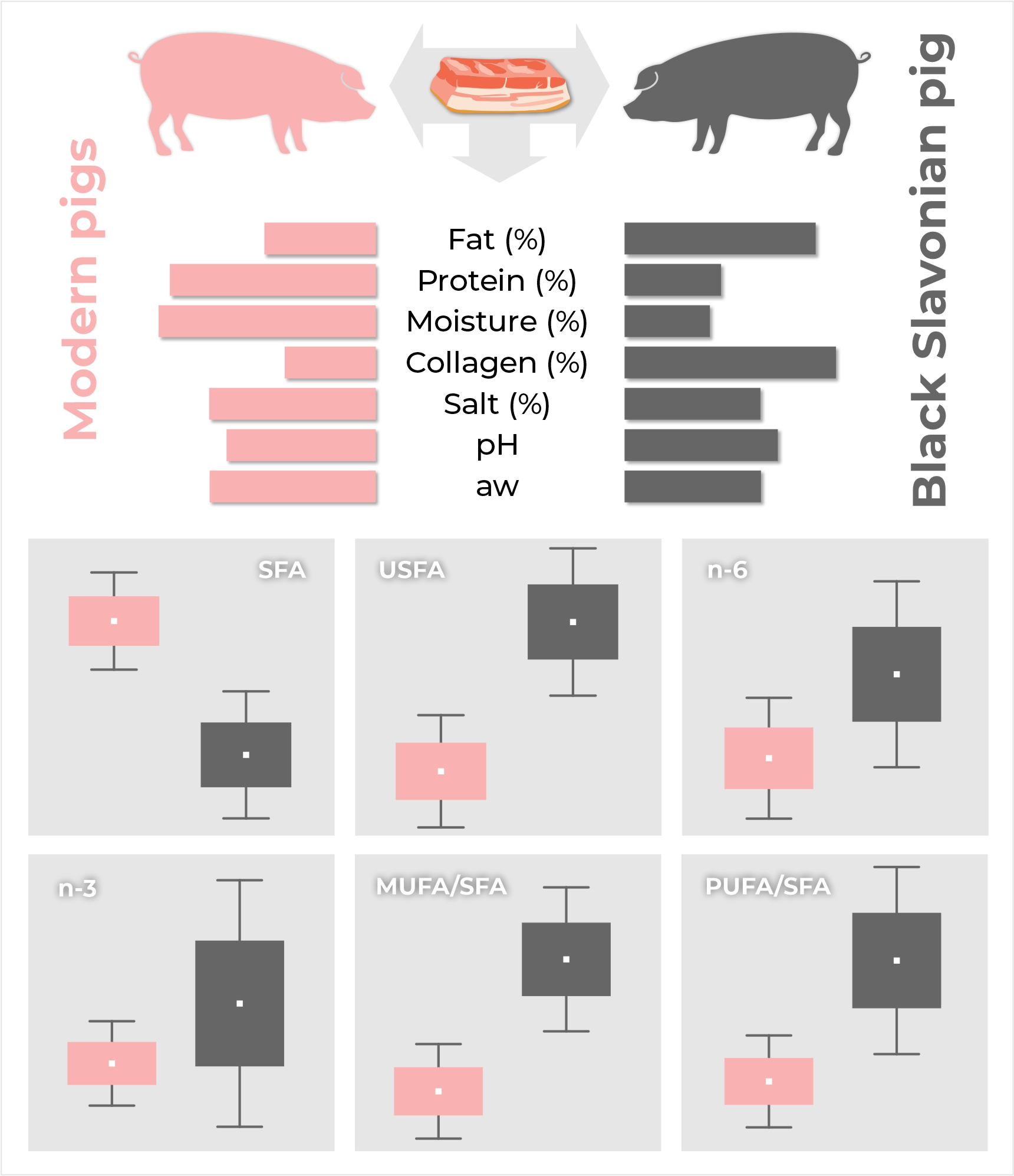
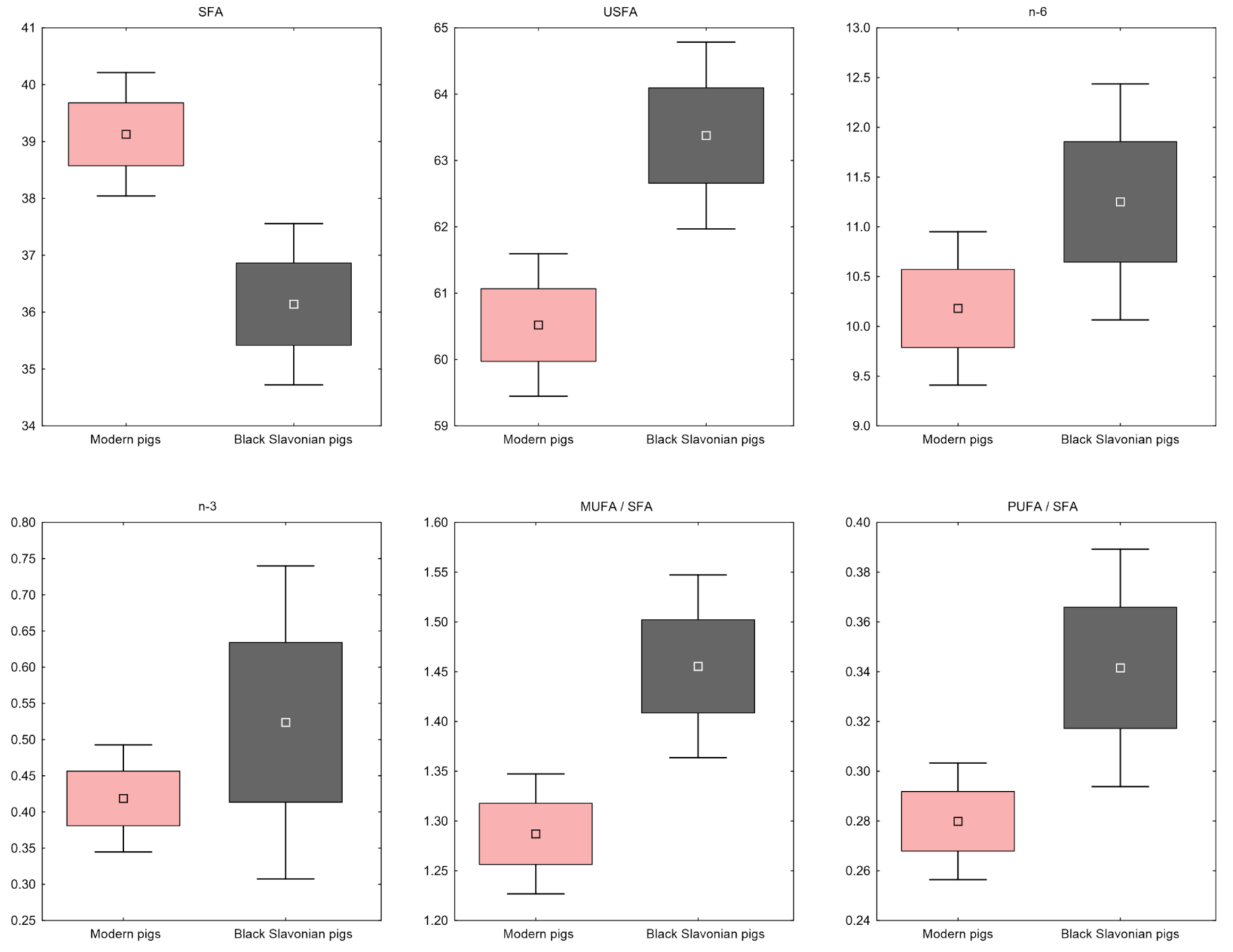
The objective of this study was to compare the psysico-chemical composition and fatty acid (FFA) profile of traditional dry cured bacon Slavonska slanina, produced from the authentic Black Slavonian Pig (BP) and modern pigs (MP), using traditional homemade principles. The samples of Slavonska slanina produced from BP had a significantly (p < 0.05) higher fat content (78.32%) than the samples produced from MP (46.47%), while the samples produced from MP showed significantly higher (p < 0.05) protein and moisture content. The samples produced from BP also showed lower aw and salt content but higher pH. Determination of fatty acid composition was performed at the end of the production process. The composition of fatty acids with respect to the groups of saturated (SFA), monounsaturated (MUFA) and polyunsaturated (PUFA) fatty acids was determined, as well as the ratios n-6/n-3 and PUFA/SFA. The results of fatty acid composition determination of Slavonska slanina produced from BP and MP show that oleic acid (C18: 1n9) is the most dominant fatty acid from the MUFA group (47.02 and 46.25%), the most common SFA acid was palmitic acid (C16: 0) (23.44 and 24.96%), and PUFA linoleic acid (C18: 2n-6c) (10.76 and 9.74%). The genotype had a significant (p < 0.05) effect on the SFA and USFA composition of Slavonska slanina. The ratios PUFA/SFA (0.34–0.28) and n-6/n-3 (31.84–27.34) for samples of Slavonska slanina produced from BP and MP are in concordance with previously published data for different dry cured meat products, and do not comply with the nutritionally recommended values of international health organizations (PUFA/SFA > 0.4 and n-6/n-3 < 4).