Effects of Feeding 5-Aminolevulinic Acid on Iron Status in Weaned Rats from the Female Rats during Gestation and Lactation



1
Shandong Provincial Key Laboratory of Animal Biotechnology and Disease Control and Prevention, College of Animal Science and Veterinary Medicine, Shandong Agricultural University, Daizong Street 61#, Tai’an 271018, China
2
Department of Immunology, School of Basic Medical Sciences, Fudan University, Shanghai 200032, China
3
College of Animal Science and Technology, Qingdao Agricultural University, Qingdao 266109, China
*
Authors to whom correspondence should be addressed.
Animals 2022, 12(20), 2869; https://doi.org/10.3390/ani12202869
Submission received: 23 September 2022
/
Revised: 7 October 2022
/
Accepted: 17 October 2022
/
Published: 21 October 2022
(This article belongs to the Section Animal Reproduction)
Simple Summary
In order to develop novel iron supplementation methods for piglets, this study employed female Sprague–Dawley (SD) rats as a model to investigate the effects of 5-aminolevulinic acid (5-ALA) on iron status in weaned rats. The results indicated that fed 5-ALA diets to female rats could improve the blood parameters of weaned rats, increase the concentration of Hepcidin in the liver and serum, and promote the expression of iron-related genes in the liver, suggesting that 5-ALA may be an excellent functional additive to improve the iron status of animals. Nevertheless, these effects still need to be further validated in piglets.
Abstract
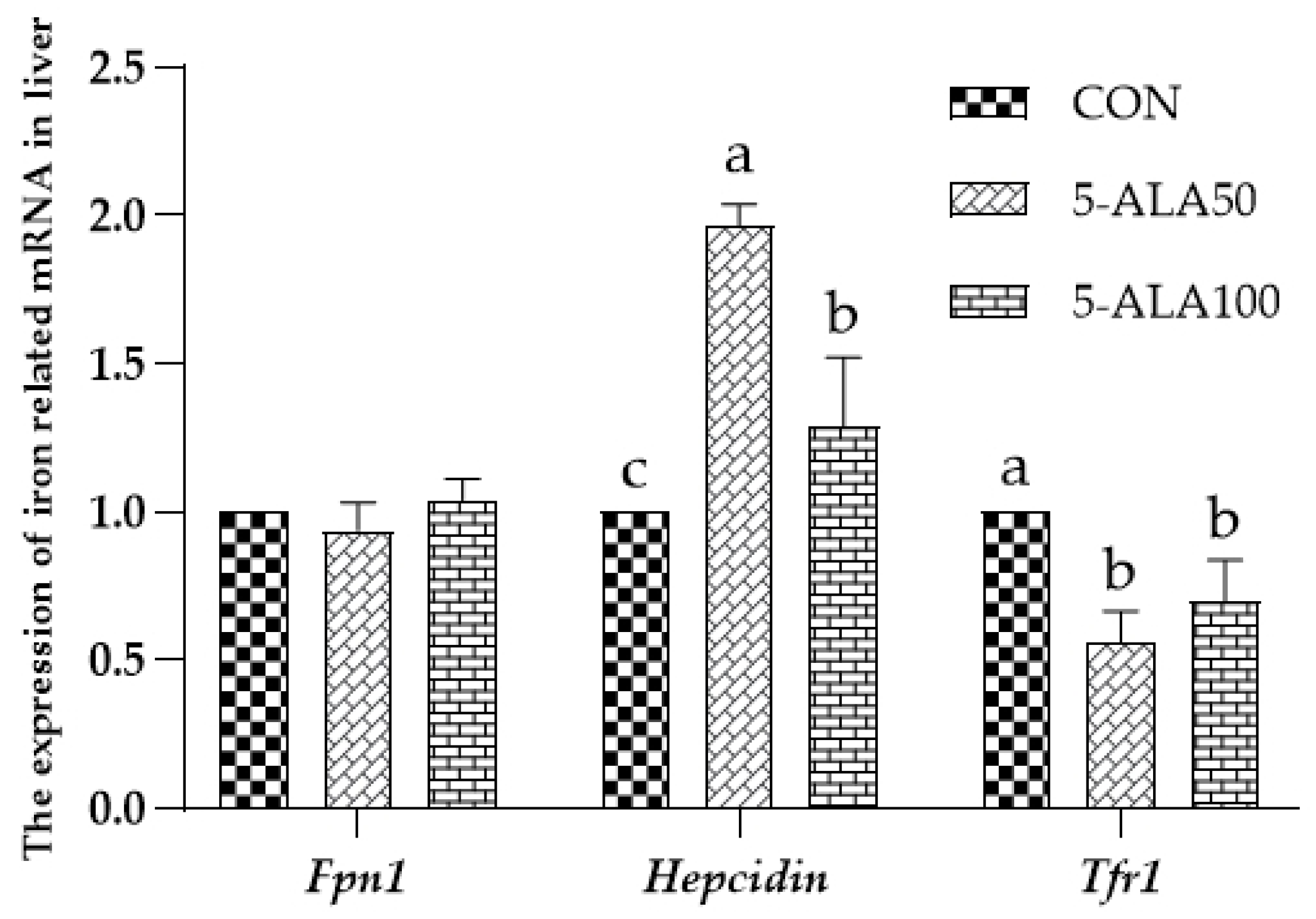
Using female Sprague–Dawley (SD) rats as a model, the current study aimed to investigate whether feeding 5-aminolevulinic acid (5-ALA) to female SD rats during gestation and lactation can affect the iron status of weaned rats and provide new ideas for the iron supplementation of piglets. A total of 27 pregnant SD rats were randomly assigned to three treatments in nine replicates, with one rat per litter. Dietary treatments were basal diet (CON), CON + 50 mg/kg 5-ALA (5-ALA50), and CON + 100 mg/kg 5-ALA (5-ALA100). After parturition, ten pups in each litter (a total of 270) were selected for continued feeding by their corresponding mother, and the pregnant rats were fed diets containing 5-ALA (0, 50 and 100 mg/kg diet) until the newborn pups were weaned at 21 days. The results showed that the number of red blood cells (RBCs) in weaned rats in the 5-ALA100 group was significantly higher (p < 0.05) than that in the CON or 5-ALA50 group. The diet with 5-ALA significantly increased (p < 0.05) the hemoglobin (HGB) concentration, hematocrit (HCT) level, serum iron (SI) content, and transferrin saturation (TSAT) level in the blood of weaned rats, as well as the concentration of Hepcidin in the liver and serum of weaned rats and the expression of Hepcidin mRNA in the liver of weaned rats, with the 5-ALA100 group having the highest (p < 0.05) HGB concentration in the weaned rats, and the 5-ALA50 group having the highest (p < 0.05) Hepcidin concentration in serum and in the expression of Hepcidin mRNA in the liver of weaned rats. The other indicators between the 5-ALA groups had no effects. However, the level of total iron binding capacity (TIBC) was significantly decreased (p < 0.05) in the 5-ALA50 group. Moreover, the iron content in the liver of weaned rats fed with 5-ALA showed an upward trend (p = 0.085). In addition, feeding a 5-ALA-supplemented diet could also significantly reduce (p < 0.05) the expression of TfR1 mRNA in the liver of weaning rats (p < 0.05), and the expression of Tfr1 was not affected between 5-ALA groups. In conclusion, dietary supplementation with 5-ALA could improve the blood parameters, increase the concentration of Hepcidin in the liver and serum, and affect the expression of iron-related genes in the liver of weaned rats. Moreover, it is appropriate to add 50 mg/kg 5-ALA to the diet under this condition.
Keywords:
5-aminolevulinic acid; iron status; weaned rats; female rats