Medical Management versus PACK-CXL in Dogs with Infectious Keratitis: A Randomized Controlled Trial Protocol


1
Ophthalmology Section, Equine Department, Vetsuisse Faculty, University of Zurich, CH-8057 Zurich, Switzerland
2
Section of Epidemiology, Vetsuisse Faculty, University of Zurich, CH-8057 Zurich, Switzerland
3
ELZA Institute, CH-8953 Dietikon, Switzerland
*
Authors to whom correspondence should be addressed.
Animals 2022, 12(20), 2862; https://doi.org/10.3390/ani12202862
Submission received: 20 September 2022
/
Revised: 12 October 2022
/
Accepted: 16 October 2022
/
Published: 20 October 2022
(This article belongs to the Section Veterinary Clinical Studies)
Simple Summary
Infected corneal ulcers are a common and painful disease, usually caused by bacteria in dogs. Short-nosed dog breeds are predisposed to corneal ulcers. Treatment aims to eliminate bacteria, stop the enzymatic tissue melting process in the cornea, and allow for normal healing to resume. Success of treatment largely depends on the effectivity of the applied medications, possibly including antibiotics. In the context of globally growing antibiotic resistance, non-antibiotic-based treatment alternatives are desirable. Photoactivated Chromophore for Keratitis-Corneal Cross-linking (PACK-CXL) reduces enzymatic tissue melting and damages multiple targets within microorganisms, resulting in corneal stabilization and non-antibiotic-based elimination of bacteria. A confirmatory clinical study providing unbiased evidence of PACK-CXL effectiveness in dogs is currently lacking. We therefore aim to conduct such a study and determine whether PACK-CXL is a viable alternative to conventional state-of-the-art medical therapy for corneal ulcer treatment in dogs. Here we present the randomized controlled clinical trial study protocol. Registering trials favors sound statistical analysis and prevents publication bias. The trial results will be published after successful trial conclusion.
Abstract
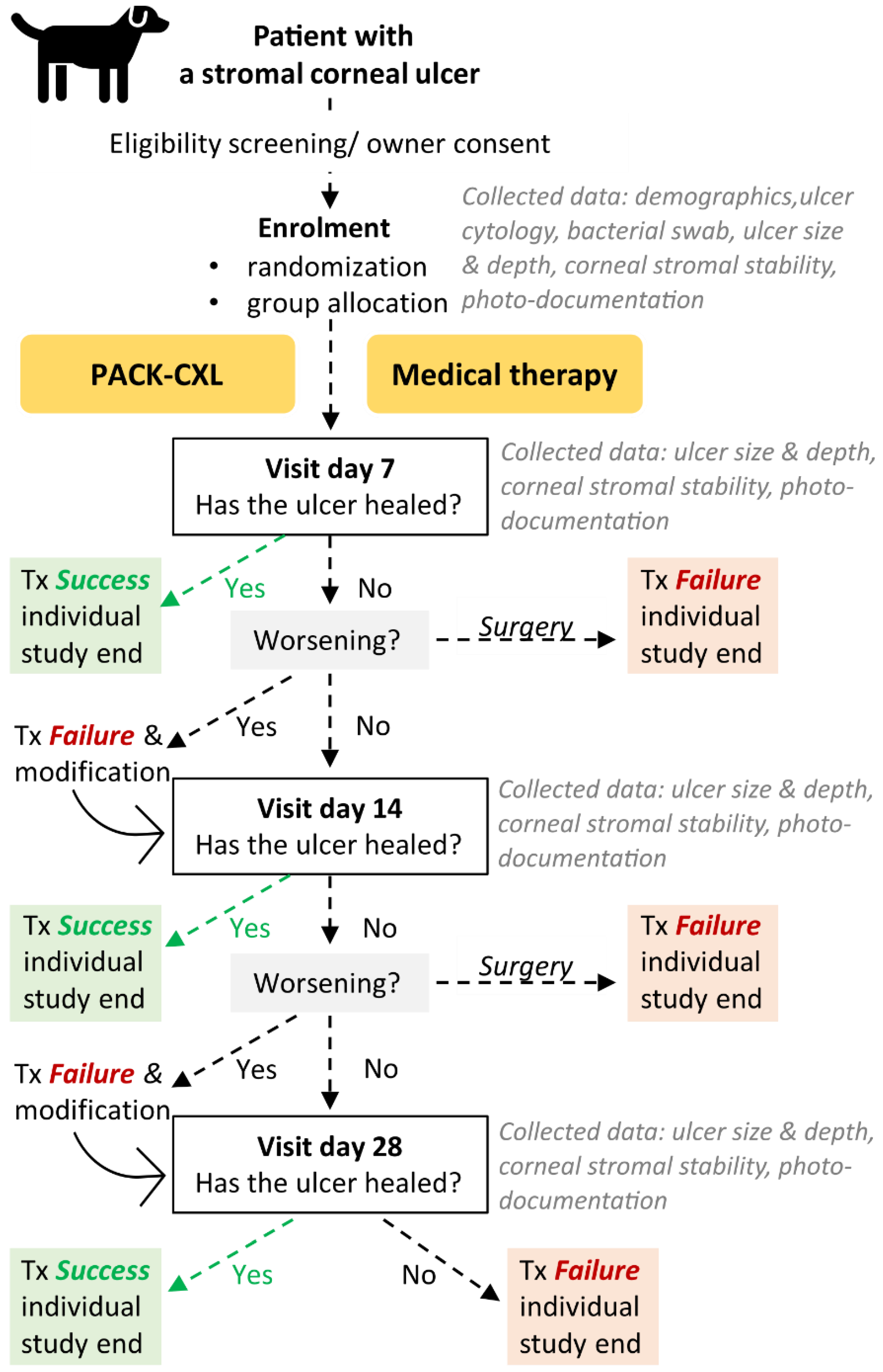
Infectious keratitis is a common and painful disease, usually caused by bacteria in dogs. Brachycephalic breeds are at increased risk. Despite medical therapy, enzymatic corneal melting can lead to ulcer perforation and globe loss. Treatment alternatives are needed due to an increase in antibiotic resistance and growing popularity of brachycephalic dogs. Photoactivated Chromophore for Keratitis-Corneal Cross-linking (PACK-CXL) reduces enzymatic collagenolysis and damages multiple targets within microorganisms, resulting in corneal tissue stabilization and elimination of bacteria, irrespective of their antibiotic resistance status. A randomized controlled trial providing evidence of PACK-CXL effectiveness in dogs is lacking. We aim to determine whether PACK-CXL is a viable alternative to conventional medical therapy for canine infectious keratitis. Two hundred-and-seventy client-owned dogs with presumed infectious keratitis will be allocated to two equally sized treatment groups (PACK-CXL or medical therapy) in a masked, randomized, controlled, multicenter trial in eleven clinics. The primary outcome measure is treatment success defined as complete epithelial closure within 28 days. The sample size is based on a group sequential design with two interim analyses, which will be overseen by a Data Safety and Monitoring Board. Ethical approvals have been obtained. The study protocol is preregistered at preclinicaltrials.eu. Publishing trial protocols improves study reproducibility and reduces publication bias.
Keywords:
corneal ulcer; block sequential design; canine