


Using Artificial Intelligence to Analyze Non-Human Drawings: A First Step with Orangutan Productions




Simple Summary
Abstract
1. Introduction
2. Materials and Methods
2.1. Dataset
2.2. Convolutional Neural Network (CNN)
2.3. Activations Classification
2.4. Gram Matrices Classification
3. Results
3.1. Classification through Transfer Learning
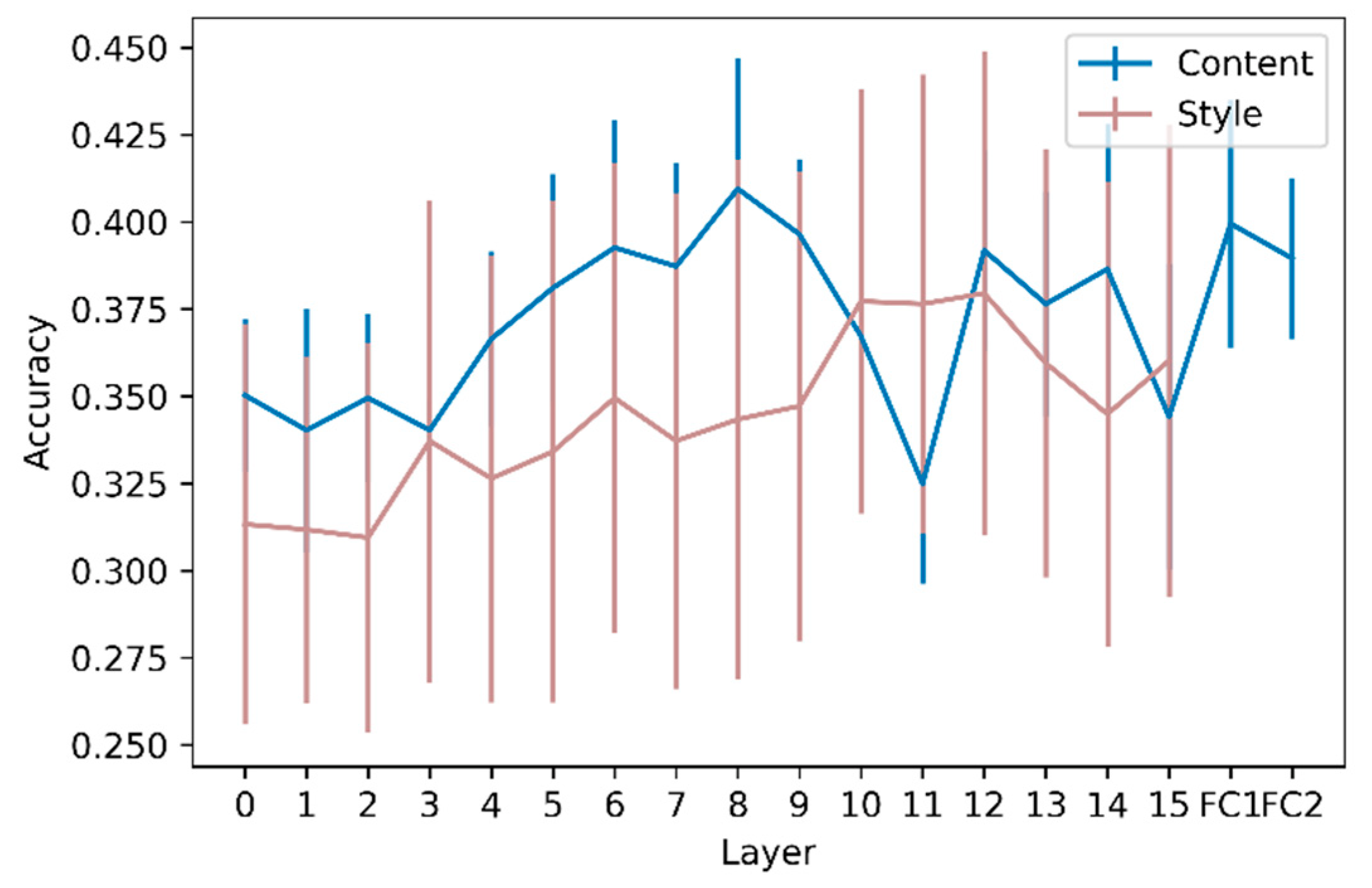
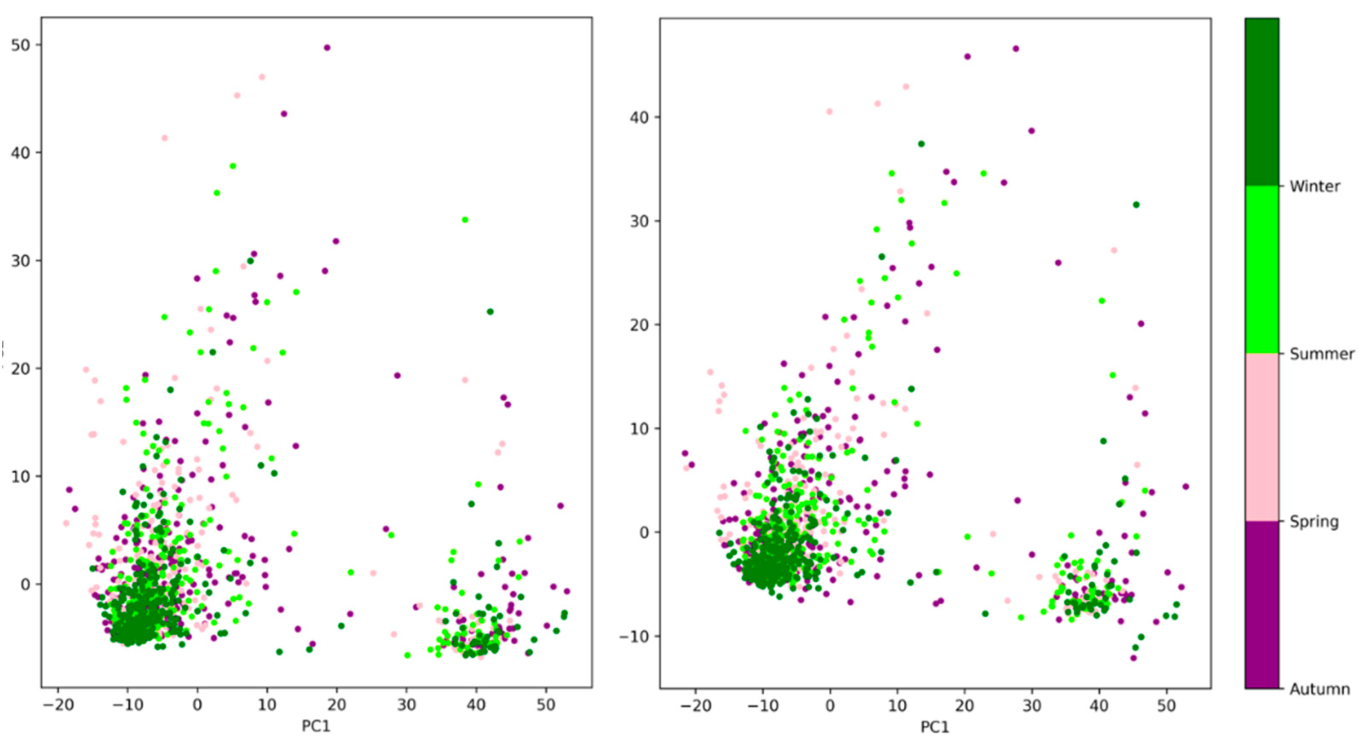
3.2. Layer-Wise Activation-Based and Gram Matrix-Based Classifications
4. Discussion
5. Conclusions
Author Contributions
Funding
Institutional Review Board Statement
Informed Consent Statement
Data Availability Statement
Acknowledgments
Conflicts of Interest
References
- Quaglia, R.; Longobardi, C.; Iotti, N.O. Reconsidering the Scribbling Stage of Drawing: A New Perspective on Toddlers’ Representational Processes. Front. Psychol. 2015, 6, 1227. [Google Scholar]
- Martinet, L.; Sueur, C.; Hirata, S.; Hosselet, J.; Matsuzawa, T.; Pelé, M. New Indices to Characterize Drawing Behavior in Humans (Homo Sapiens) and Chimpanzees (Pan Troglodytes). Sci. Rep. 2021, 11, 3860. [Google Scholar] [CrossRef] [Scilit] [PubMed]
- Pelé, M.; Thomas, G.; Liénard, A.; Eguchi, N.; Shimada, M.; Sueur, C. I Wanna Draw like You: Inter-and Intra-Individual Differences in Orang-Utan Drawings. Animals 2021, 11, 3202. [Google Scholar] [CrossRef] [Scilit] [PubMed]
- Hanazuka, Y.; Kurotori, H.; Shimizu, M.; Midorikawa, A. The Effects of the Environment on the Drawings of an Extraordinarily Productive Orangutan (Pongo pygmaeus) Artist. Front. Psychol. 2019, 10, 2050. [Google Scholar] [CrossRef] [Scilit]
- Kellogg, R. Analyzing Children’s Art; National Press Books: Palo Alto, CA, USA, 1969. [Google Scholar]
- Jacob, G.; Pramod, R.T.; Katti, H.; Arun, S.P. Qualitative Similarities and Differences in Visual Object Representations between Brains and Deep Networks. Nat. Commun. 2021, 12, 1872. [Google Scholar] [CrossRef] [Scilit]
- Kuzovkin, I.; Vicente, R.; Petton, M.; Lachaux, J.-P.; Baciu, M.; Kahane, P.; Rheims, S.; Vidal, J.R.; Aru, J. Activations of Deep Convolutional Neural Networks Are Aligned with Gamma Band Activity of Human Visual Cortex. Commun. Biol. 2018, 1, 107. [Google Scholar] [CrossRef] [Scilit]
- Buetti-Dinh, A.; Galli, V.; Bellenberg, S.; Ilie, O.; Herold, M.; Christel, S.; Boretska, M.; Pivkin, I.V.; Wilmes, P.; Sand, W.; et al. Deep Neural Networks Outperform Human Expert’s Capacity in Characterizing Bioleaching Bacterial Biofilm Composition. Biotechnol. Rep. 2019, 22, e00321. [Google Scholar] [CrossRef] [Scilit]
- Zhou, W.; Yang, Y.; Yu, C.; Liu, J.; Duan, X.; Weng, Z.; Chen, D.; Liang, Q.; Fang, Q.; Zhou, J.; et al. Ensembled Deep Learning Model Outperforms Human Experts in Diagnosing Biliary Atresia from Sonographic Gallbladder Images. Nat. Commun. 2021, 12, 1259. [Google Scholar] [CrossRef] [Scilit]
- Selvaraju, R.R.; Das, A.; Vedantam, R.; Cogswell, M.; Parikh, D.; Batra, D. Grad-CAM: Why Did You Say That? arXiv 2017, arXiv:1611.07450. [Google Scholar]
- Beltzung, B.; Pelé, M.; Renoult, J.; Sueur, C. Artificial Intelligence for Studying Drawing Behavior: A Review. 2022; under review.
- Wu, X.; Qi, Y.; Liu, J.; Yang, J. Sketchsegnet: A Rnn Model for Labeling Sketch Strokes. In Proceedings of the 2018 IEEE 28th International Workshop on Machine Learning for Signal Processing (MLSP), Aalborg, Denmark, 17–20 September 2018; pp. 1–6. [Google Scholar]
- Zhang, H.; Liu, S.; Zhang, C.; Ren, W.; Wang, R.; Cao, X. Sketchnet: Sketch Classification with Web Images. In Proceedings of the IEEE Conference on Computer Vision and Pattern Recognition, Las Vegas, NV, USA, 27–30 June 2016; pp. 1105–1113. [Google Scholar]
- Lefson, J. Pigcasso Dataset. Available online: pigcasso.org (accessed on 10 October 2022).
- Pockets Warhol Dataset. Available online: pocketswarhol.blogspot.com (accessed on 10 October 2022).
- Hussain, M.; Bird, J.J.; Faria, D.R. A Study on CNN Transfer Learning for Image Classification. In Proceedings of the Advances in Computational Intelligence Systems; Lotfi, A., Bouchachia, H., Gegov, A., Langensiepen, C., McGinnity, M., Eds.; Springer International Publishing: Cham, Switzerland, 2019; pp. 191–202. [Google Scholar]
- Mukherjee, K.; Rogers, T.T. Finding Meaning in Simple Sketches: How Do Humans and Deep Networks Compare? J. Vis. 2020, 20, 1026. [Google Scholar] [CrossRef] [Scilit]
- Theodorus, A.; Nauta, M.; Seifert, C. Evaluating CNN Interpretability on Sketch Classification. In Proceedings of the Twelfth International Conference on Machine Vision (ICMV 2019), Amsterdam, The Netherlands, 16–18 November 2019; Volume 11433, pp. 475–482. [Google Scholar]
- Qin, Z.; Yu, F.; Liu, C.; Chen, X. How Convolutional Neural Network See the World—A Survey of Convolutional Neural Network Visualization Methods. arXiv 2018, arXiv:1804.11191. [Google Scholar] [CrossRef] [Scilit]
- Hulse, S.V.; Renoult, J.P.; Mendelson, T.C. Using Deep Neural Networks to Model Similarity between Visual Patterns: Application to Fish Sexual Signals. Ecol. Inform. 2022, 67, 101486. [Google Scholar] [CrossRef]
- Deng, J.; Dong, W.; Socher, R.; Li, L.-J.; Li, K.; Li, F.-F. Imagenet: A Large-Scale Hierarchical Image Database. In Proceedings of the 2009 IEEE Conference on Computer Vision and Pattern Recognition (CVPR), Miami, FL, USA, 20–25 June 2009; pp. 248–255. [Google Scholar]
- Dietterich, T.G. Approximate Statistical Tests for Comparing Supervised Classification Learning Algorithms. Neural Comput. 1998, 10, 1895–1923. [Google Scholar] [CrossRef] [Scilit]
- Gatys, L.; Ecker, A.S.; Bethge, M. Texture Synthesis Using Convolutional Neural Networks. In Proceedings of the Advances in Neural Information Processing Systems, Montreal, QC, Canada, 7–12 December 2015; Curran Associates, Inc.: Red Hook, NY, USA, 2015; Volume 28. [Google Scholar]
- Bai, R.; Guo, X. Automatic Orientation Detection of Abstract Painting. Knowl.-Based Syst. 2021, 227, 107240. [Google Scholar] [CrossRef] [Scilit]
- Lecoutre, A.; Negrevergne, B.; Yger, F. Recognizing Art Style Automatically in Painting with Deep Learning. In Proceedings of the Ninth Asian Conference on Machine Learning, Seoul, Korea, 15–17 November 2017; pp. 327–342. [Google Scholar]
- Papandreou, M. Communicating and Thinking Through Drawing Activity in Early Childhood. J. Res. Child. Educ. 2014, 28, 85–100. [Google Scholar] [CrossRef] [Scilit]
- Smith, J.J. Human–Animal Relationships in Zoo-Housed Orangutans (P. Abelii) and Gorillas (G. g. Gorilla): The Effects of Familiarity. Am. J. Primatol. 2014, 76, 942–955. [Google Scholar] [CrossRef] [Scilit]
- Koda, N.; Machida, S.; Goto, S.; Nakamichi, M.; Itoigawa, N.; Minami, T. Cardiac and Behavioral Responses to Humans in an Adult Female Japanese Monkey (Macaca Fuscata). Anthrozoös 1998, 11, 74–78. [Google Scholar] [CrossRef] [Scilit]
- Cambridge Dictionary. Available online: dictionary.cambridge.org (accessed on 10 October 2022).
- Iigaya, K.; Yi, S.; Wahle, I.A.; Tanwisuth, K.; O’Doherty, J.P. Aesthetic Preference for Art Can Be Predicted from a Mixture of Low- and High-Level Visual Features. Nat. Hum. Behav. 2021, 5, 743–755. [Google Scholar] [CrossRef] [Scilit]
- Sklansky, J. Image Segmentation and Feature Extraction. IEEE Trans. Syst. Man Cybern. 1978, 8, 237–247. [Google Scholar] [CrossRef] [Scilit]
- Gatys, L.A.; Ecker, A.S.; Bethge, M. Image Style Transfer Using Convolutional Neural Networks. In Proceedings of the IEEE Conference on Computer Vision and Pattern Recognition, Las Vegas, NV, USA, 27–30 June 2016; pp. 2414–2423. [Google Scholar]
- Cavazos, J.G.; Phillips, P.J.; Castillo, C.D.; O’Toole, A.J. Accuracy Comparison Across Face Recognition Algorithms: Where Are We on Measuring Race Bias? IEEE Trans. Biom. Behav. Identity Sci. 2021, 3, 101–111. [Google Scholar] [CrossRef] [Scilit] [PubMed]
- Zhang, R.; Isola, P.; Efros, A.A.; Shechtman, E.; Wang, O. The Unreasonable Effectiveness of Deep Features as a Perceptual Metric. In Proceedings of the 2018 IEEE/CVF Conference on Computer Vision and Pattern Recognition, Salt Lake City, UT, USA, 18–22 June 2018; pp. 586–595. [Google Scholar]
- Pelé, M. Au Bout d’un Crayon, Un Singe. In Mondes Animaux-Mondes Artistes; Renoue, M., Pelé, M., Baratay, É., Eds.; Presses Universitaires de Valenciennes: Valenciennes, France, 2022; in press. [Google Scholar]
- Nagel, T. What Is It like to Be a Bat? Philos. Rev. 1974, 83, 435–450. [Google Scholar] [CrossRef] [Scilit]
Publisher’s Note: MDPI stays neutral with regard to jurisdictional claims in published maps and institutional affiliations. |
© 2022 by the authors. Licensee MDPI, Basel, Switzerland. This article is an open access article distributed under the terms and conditions of the Creative Commons Attribution (CC BY) license (https://creativecommons.org/licenses/by/4.0/).
Share and Cite
Beltzung, B.; Pelé, M.; Renoult, J.P.; Shimada, M.; Sueur, C. Using Artificial Intelligence to Analyze Non-Human Drawings: A First Step with Orangutan Productions. Animals 2022, 12, 2761. https://doi.org/10.3390/ani12202761
Beltzung B, Pelé M, Renoult JP, Shimada M, Sueur C. Using Artificial Intelligence to Analyze Non-Human Drawings: A First Step with Orangutan Productions. Animals. 2022; 12(20):2761. https://doi.org/10.3390/ani12202761
Chicago/Turabian StyleBeltzung, Benjamin, Marie Pelé, Julien P. Renoult, Masaki Shimada, and Cédric Sueur. 2022. "Using Artificial Intelligence to Analyze Non-Human Drawings: A First Step with Orangutan Productions" Animals 12, no. 20: 2761. https://doi.org/10.3390/ani12202761
APA StyleBeltzung, B., Pelé, M., Renoult, J. P., Shimada, M., & Sueur, C. (2022). Using Artificial Intelligence to Analyze Non-Human Drawings: A First Step with Orangutan Productions. Animals, 12(20), 2761. https://doi.org/10.3390/ani12202761

