Comparison of Two Different Feather Sampling Methods to Measure Corticosterone in Wild Greater Flamingos (Phoenicopterus roseus) and Wild Mallards (Anas platyrhynchos)
by
 , , , , , , and
Marielu Voit
1,* ,
,
Katrin Baumgartner
2,
Lorenzo von Fersen
2,
Roswitha Merle
3,
Lukas Reese
4,
Mechthild Wiegard
1,
Hermann Will
2,
Oriol Tallo-Parra
5,
Annaïs Carbajal
5,
Manel Lopez-Bejar
5,6 and
and
Christa Thöne-Reineke
1 1
Institute for Animal Welfare, Animal Behavior and Laboratory Animal Science, Freie Universität Berlin, Königsweg 67, 14163 Berlin, Germany
2
Zoo Nuremberg, Am Tiergarten 30, 90480 Nuremberg, Germany
3
Institute for Veterinary Epidemiology and Biostatistics, Freie Universität Berlin, Königsweg 67, 14163 Berlin, Germany
4
Zoologischer Stadtgarten Karlsruhe, Ettlinger Straße 6, 76137 Karlsruhe, Germany
5
Veterinary Faculty, Universitat Autònoma de Barcelona, Campus UAB, 08193 Bellaterra, Spain
6
College of Veterinary Medicine, Western University of Health Sciences, Pomona, CA 91766, USA
*
Author to whom correspondence should be addressed.
Animals 2021, 11(10), 2796; https://doi.org/10.3390/ani11102796
Submission received: 28 August 2021
/
Revised: 21 September 2021
/
Accepted: 22 September 2021
/
Published: 25 September 2021
(This article belongs to the Section Birds)
Simple Summary
The common standard sampling method to determine corticosterone in feathers (CORTf) is to pluck them from the bird’s skin. This procedure is considered to be painful, and the animals have to be caught and fixated firmly. Therefore, an animal experiment approval is required according to European and German legislation. In this study, we compared two methods: plucking vs. cutting feathers. The aim was to confirm the validation of an alternative less-invasive sampling technique. The specimens of this project were wild adult Mallards (Germany) and wild 1st-calender-year juvenile Greater Flamingos (Spain). In summary, there were no significant differences between the methods in terms of corticosterone results for both species. Additionally, no differences were found in CORTf between females and males of both species. In conclusion, these findings underline the suitability of cutting feathers as a sampling method for the determination of CORTf levels.
Abstract
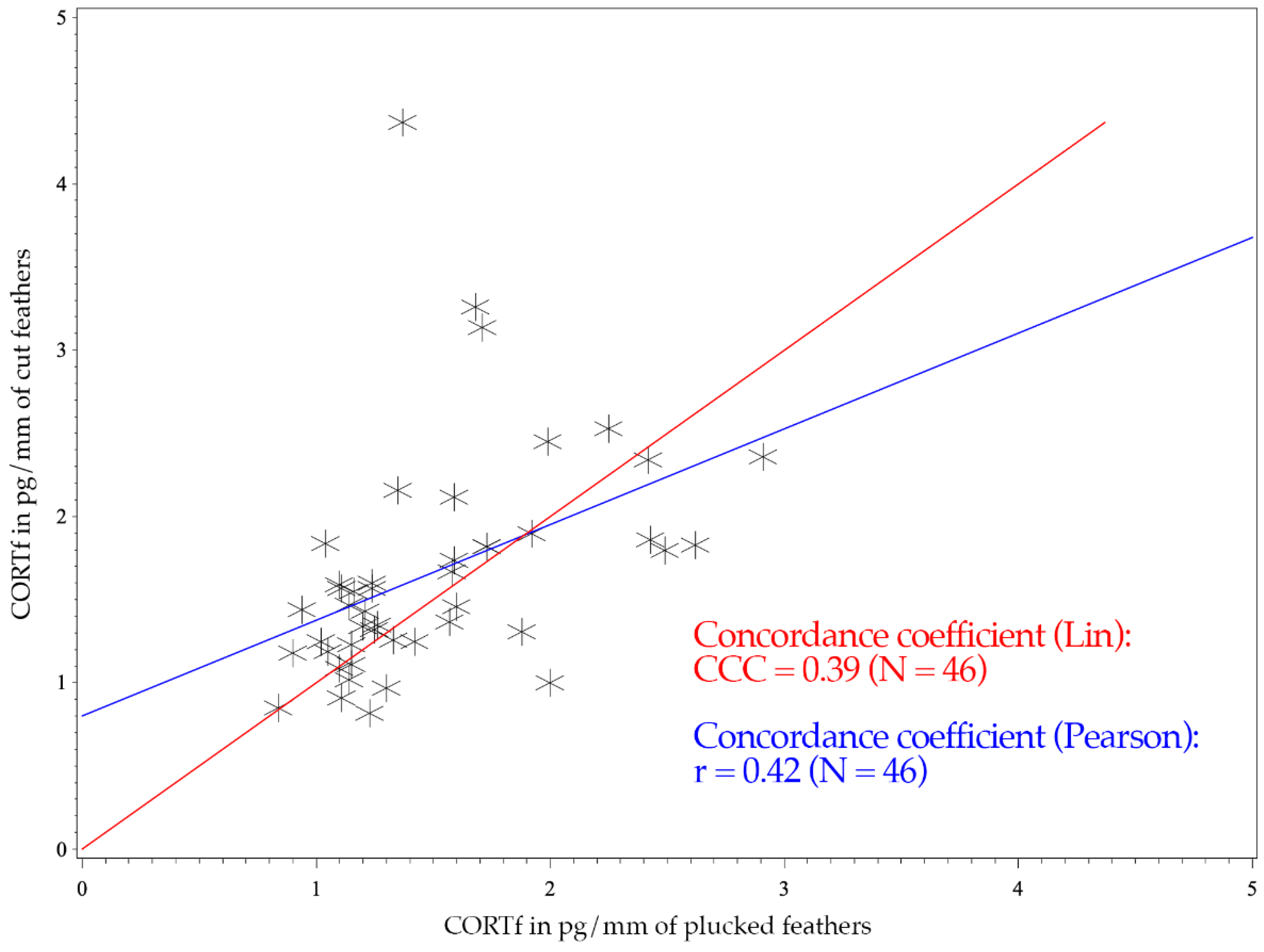
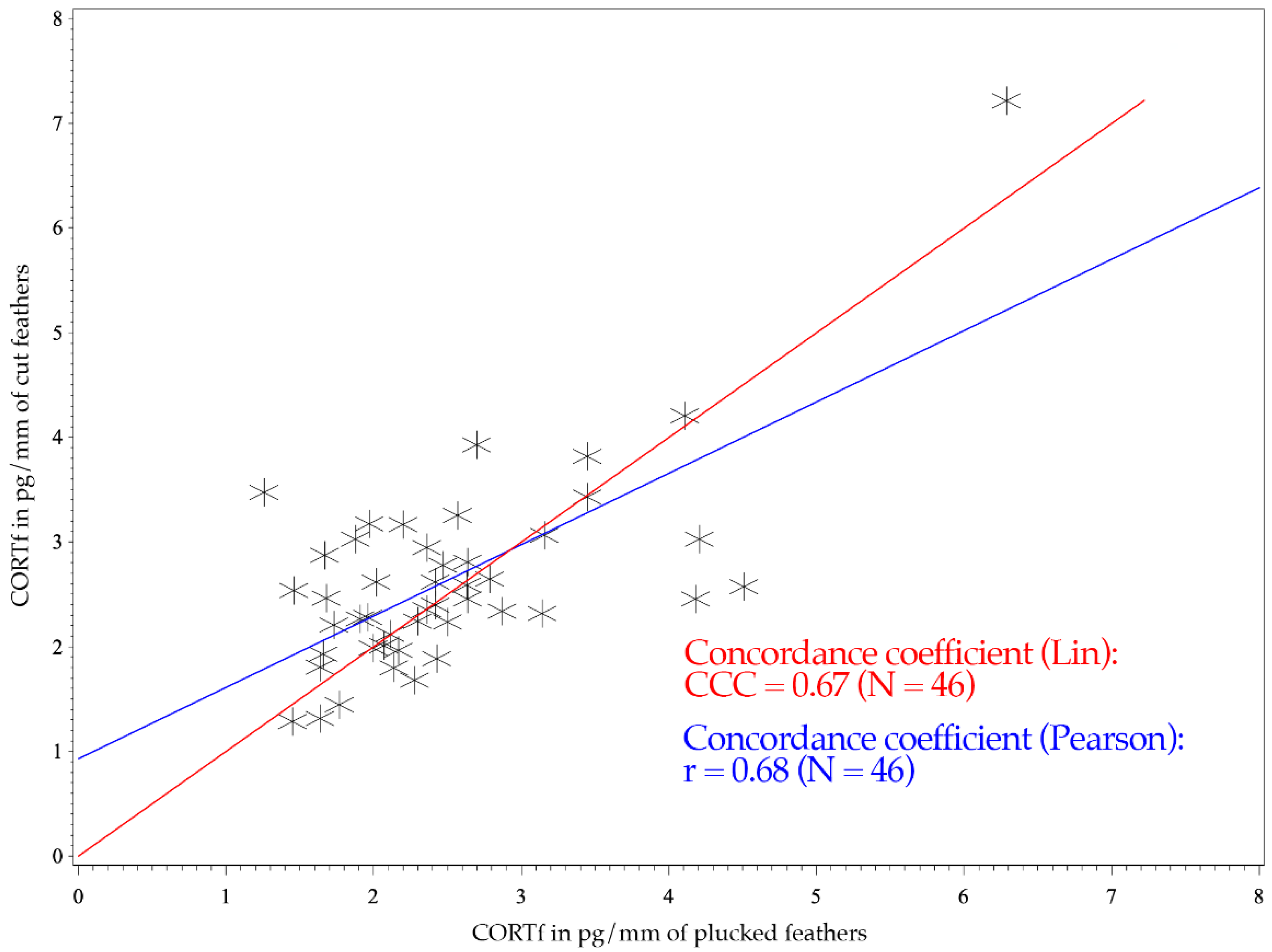
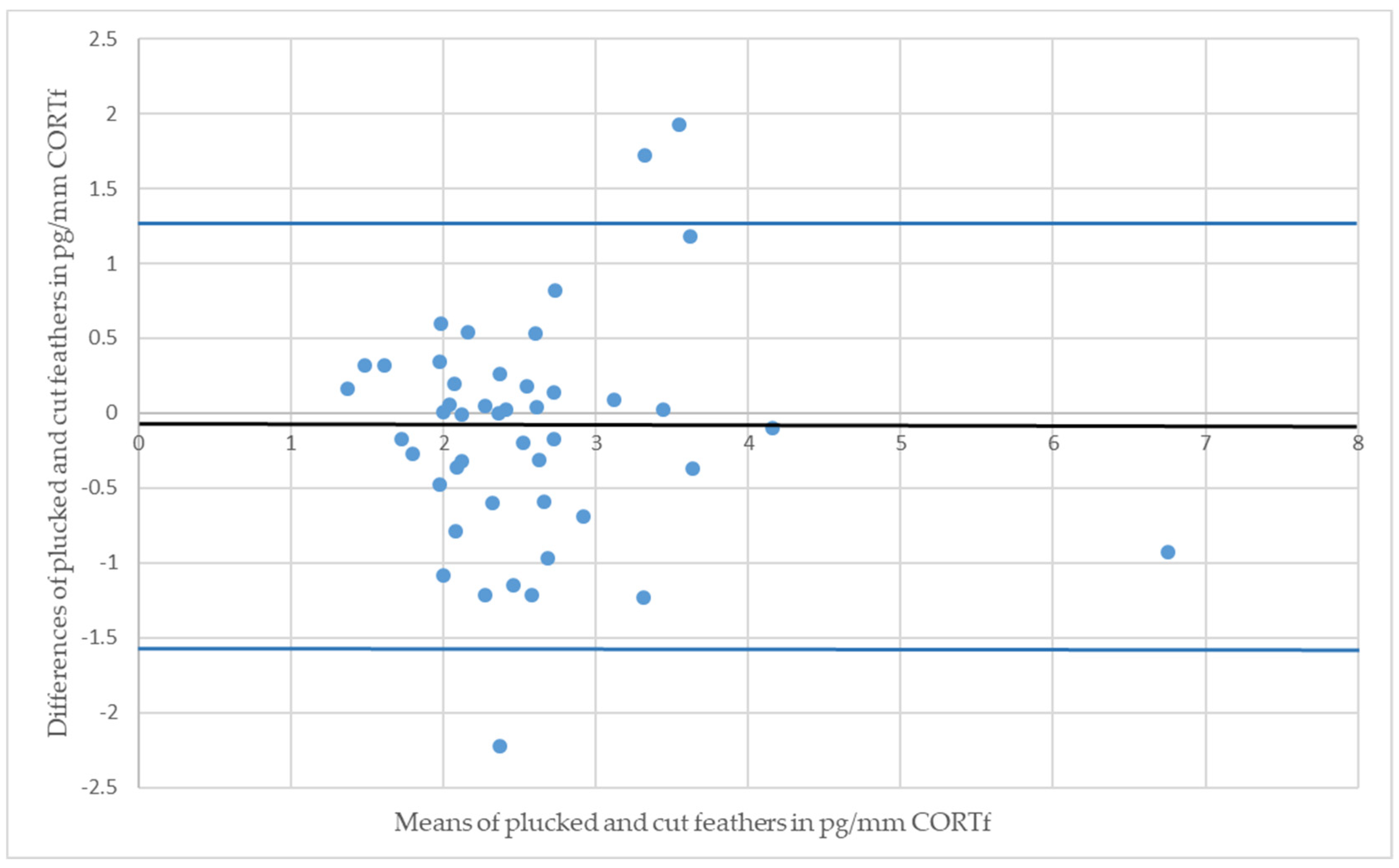
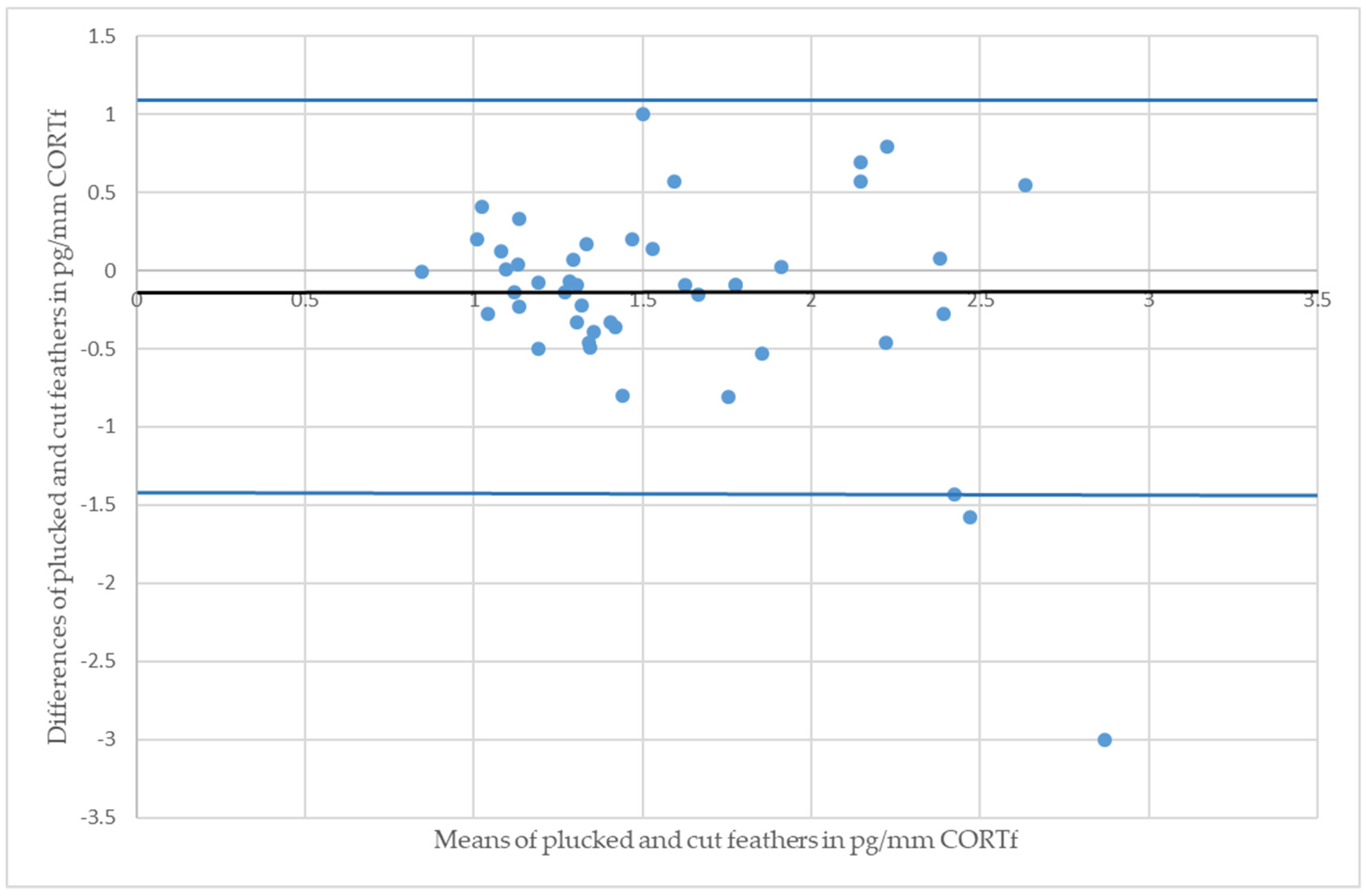
This research project had the aim to validate the possible alternative and less-painful sampling method of cutting feathers close to the skin instead of plucking them for subsequent feather corticosterone analysis, confirming recently-published results for other species in captivity. Analyzing CORTf is often used in animal welfare studies in combination with behavioral monitoring. The background of this idea was to act in the sense of animal welfare and reduce the burden of animal studies according to the 3-R-Principle (Replacement, Reduction, and Refinement) by refining procedures. To confirm the hypothesis that the sampling method itself has no influence on CORTf levels measured, plucked and cut samples of the respective bird were collected. Birds of two wild species were used: the Mallard (Anas platyrhynchos) and the Greater Flamingo (Phoenicopterus roseus). The CORTf was measured by using an enzyme-linked immunosorbent assay (ELISA). The determined values were inspected for their mean values, standard deviation (SD), and average differences. Afterwards, the CORTf levels of both species were compared, according to the sampling method, with the concordance correlation coefficient (CCC). In the Bland-Altman (BA) plot the differences of the methods were displayed against the mean values. Additionally, sex, as a possible factor influencing CORTf, was analyzed using the Mann-Whitney U test. The values of CCC showed poor agreement in the comparability of the two methods, whereas the concordance of the BA plot was decent. The average differences between the methods were marginal for both species (Mallards: −0.16 pg/mm, Flamingos −0.13 pg/mm). In summary, all anomalies or differences between the methods were negligible. Therefore, the alternative sampling method seems to be as suitable as the common standard method. No significant difference was found between females and males. Nevertheless, our results suggest that CORTf should not be interpreted in just considering the values themselves, but the results they should be analyzed in the context of a wider set of parameters. Hence, further studies are encouraged to create a larger data pool.