

Mortality Causes in Free-Ranging Eurasian Brown Bears (Ursus arctos arctos) in Spain 1998–2018

 , ,
, ,
Simple Summary
Abstract
1. Introduction
2. Materials and Methods
2.1. Study Area
2.2. Data Collection
2.3. Diagnostic Procedures
3. Results
3.1. Classification of Causes of Death
3.2. Description of Causes of Death
3.3. Infectious Diseases
3.4. Exertional (Degenerative) Myopathy
3.5. Strychnine Poisoning
3.6. Neoplasia
3.7. Mushroom Poisoning
4. Discussion
5. Conclusions
Author Contributions
Funding
Acknowledgments
Conflicts of Interest
References
- Naves, J.; Wiegand, T.; Fernández, A.; Stephan, T. Riesgo de Extinción del Oso Pardo Cantábrico; Fundación Oso de Asturias: Oviedo, Spain, 1999. [Google Scholar]
- González, E.G.; Blanco, J.C.; Ballesteros, F.; Alcaraz, L.; Palomero, G.; Doadrio, I. Genetic and demographic recovery of an isolated population of brown bear Ursus arctos L., 1758. Peer J. 2016, 4, 1928. [Google Scholar] [CrossRef]
- McLellan, B.N.; Proctor, M.F.; Huber, D.; Michel, S.; (IUCN SSC Bear Specialist Group). Brown bear (Ursus arctos) isolated populations (Supplementary Material to Ursus arctos arctos Redlisting account). In The IUCN Red List of Threatened Species; IUCN: Gland, Switzerland, 2016. [Google Scholar]
- Benn, B. Grizzly Bear Mortality in the Central Rockies Ecosystem, Canada. Master’s. Thesis, University of Calgary, Calgary, AL, Canada, 1998. [Google Scholar]
- Mörner, T.; Eriksson, H.; Bröjer, C.; Nilsson, K.; Uhlhorn, H.; Ågren, E.; Segerstad, C.H.A.; Jansson, D.S.; Gavier-Widén, D. Diseases and mortality in free-ranging brown bear (Ursus arctos), gray wolf (Canis lupus), and wolverine (Gulo gulo) in Sweden. J. Wildl. Dis. 2005, 41, 298–303. [Google Scholar] [CrossRef] [PubMed]
- Ninyerola, M.; Pons, X.; Roure, J.M. Atlas Climático Digital de la Península Ibérica. Metolodología y Aplicaciones en Bioclimatología y Geobotánica, 1st ed.; Universidad Autónoma de Barcelona: Bellaterra, Spain, 2005. [Google Scholar]
- Balseiro, A.; Oleaga, Á.; Polledo, L.; Aduriz, G.; Atxaerandio, R.; Kortabarria, N.; Marín, J.F.G. Clostridium sordellii in a Brown Bear (Ursus arctos) from Spain. J. Wildl. Dis. 2013, 49, 1047–1051. [Google Scholar] [CrossRef] [PubMed]
- Marín, J.F.G.; Royo, L.J.; Oleaga, Á.; Gayo, E.; Alarcia, O.; Pinto, D.; Martínez, I.Z.; González, P.; Balsera, R.; Marcos, J.L.; et al. Canine adenovirus type 1 (CAdV-1) in free-ranging European brown bear (Ursus arctos arctos): A threat for Cantabrian population? Transbound. Emerg. Dis. 2018, 65, 2049–2056. [Google Scholar] [CrossRef] [PubMed]
- Balseiro, A.; Royo, L.J.; Gayo, E.; Marín, J.F.G. Cholangiocarcinoma in a Free-Ranging Eurasian Brown Bear (Ursus arctos arctos) from Northern Spain. J. Wildl. Dis. 2020, 56, 251. [Google Scholar] [CrossRef] [PubMed]
- Klevezal, G.A. Recording Structures of Mammals. Determination of Age and Reconstruction of Life History; AA Balkema Publishers: Rotterdam, The Netherlands, 1996. [Google Scholar]
- Barszcz, K.; Przespolewska, H.; Olbrych, K.; Czopowicz, M.; Klećkowska-Nawrot, J.; Goździewska-Harłajczuk, K.; Kupczyńska, M. The morphology of the adrenal gland in the European bison (Bison bonasus). BMC Veter- Res. 2016, 12, 1–11. [Google Scholar] [CrossRef] [PubMed]
- Sommer, S. The importance of immune gene variability (MHC) in evolutionary ecology and conservation. Front. Zool. 2005, 2, 16. [Google Scholar] [CrossRef] [PubMed]
- Swenson, J.E.; Taberlet, P.; Bellemain, E. Genetics and conservation of European brown bears Ursus arctos. Mammal Rev. 2011, 41, 87–98. [Google Scholar] [CrossRef]
- Naves, J.; Fernández-Gil, A.; García-Marín, F.; Delibes, M. Brown bear death related to capture myopathy and Clostridum chauvoei toxaemia (Somiedo Natural Park, Spain). In Proceedings of the 12th International Conference on Bear Research and Management, International Association for Bear Research and Management, Poiana Brasov, Brasov, Romania, 1999; p. 35. [Google Scholar]
- Cattet, M.R.L.; Stenhouse, G.; Bollinger, T. Exertional Myopathy in a Grizzly Bear (Ursus arctos) Captured by Leghold Snare. J. Wildl. Dis. 2008, 44, 973–978. [Google Scholar] [CrossRef] [PubMed]
- Kreeger, T.J.; White, P.J.; Seal, U.S.; Tester, J.R. Pathological Responses of Red Foxes to Foothold Traps. J. Wildl. Manag. 1990, 54, 147. [Google Scholar] [CrossRef]
- Hewitt, D.G. Biology and Management of White-tailed Deer; CRC Press: London, UK, 2011; p. 65. [Google Scholar]
- Kyritsi, E.M.; Sertedaki, A.; Charmandari, E.; Chrousos, G.P. Familial or sporadic adrenal hypoplasia syndromes. In Endotext; New, M., Perreault, L., Purnell, J., Rebar, R., Singer, F., Trence, D.L., Vinik, A., Wilson, D.P., Eds.; MDText.com: South Dartmouth, MA, USA, 2018. [Google Scholar]
- Palomero, G.; Blanco, J.C.; Ballesteros, F.; García-Serrano, A.; Herrero, J.; Nores, C. Record de osas con crías en el occidente cantábrico. Quercus 2011, 301, 20–25. [Google Scholar]
- Groff, C. Large Carnivores Report 2018. Available online: https://grandicarnivori.provincia.tn.it/content/download/14454/250967/file/Rapporto%20Grandi%20carnivori_2018_ENG.pdf (accessed on 24 June 2020).
- Chapron, G.; Quenette, P.-Y.; Legendre, S.; Clobert, J. Which future for the French Pyrenean brown bear (Ursus arctos) population? An approach using stage-structured deterministic and stochastic models. C. R. Biol. 2003, 326, 174–182. [Google Scholar] [CrossRef]
- Reljić, S.; Jerina, K.; Nilsen, E.B.; Huber, D.; Kusak, J.; Jonozovič, M.; Linnell, J.D.C. Challenges for transboundary management of a European brown bear population. Glob. Ecol. Conserv. 2018, 16, e00488. [Google Scholar] [CrossRef]
- Krofel, M.; Jonozovič, M.; Jerina, K. Demography and mortality patterns of removed brown bears in a heavily exploited population. Ursus 2012, 23, 91–103. [Google Scholar] [CrossRef]
- Ueckermann, E. Erhebung über die Wildverluste durch den Straßenverkehr und die Verkehrsunfälle durch Wild. Eur. J. Wildl. Res. 1964, 10, 142–168. [Google Scholar] [CrossRef]
- Frković, A.R.; Ruff, L.; Cicnjak, L.; Huber, D. Brown bear mortality in Gorski kotar, Yugoslavia. Int. Conf. Bear Res. Manag. 1987, 7, 87–92. [Google Scholar]
- Kaczensky, P.; Knauer, F.; Huber, T.; Jonosovic, M.; Adamic, M. The Ljubljana-Postojna highway—A deadly barrier for brown bears in Slovenia? J. Wildl. Res. 1996, 1, 263–267. [Google Scholar]
- Huber, D.; Kusak, J.; Frkovic, A. Traffic kills of brown bears in Gorski Kotar, Croatia. Ursus 1998, 10, 167–171. [Google Scholar]
- Kusak, J.; Huber, Đ.; Frković, A. The effects of traffic on large carnivore populations in Croatia. Bios. Conserv. 2000, 3, 35–39. [Google Scholar]
- Seiler, A.; Helldin, J.O.; Seiler, C. Road mortality in Swedish mammals: Results of a drivers’ questionnaire. Wildl. Boil. 2004, 10, 225–233. [Google Scholar] [CrossRef]
- Morales, M. Primer oso Muerto en un atropello en España. 2008. Available online: https://elpais.com/sociedad/2008/10/28/actualidad/1225148405_850215.html (accessed on 22 December 2019).
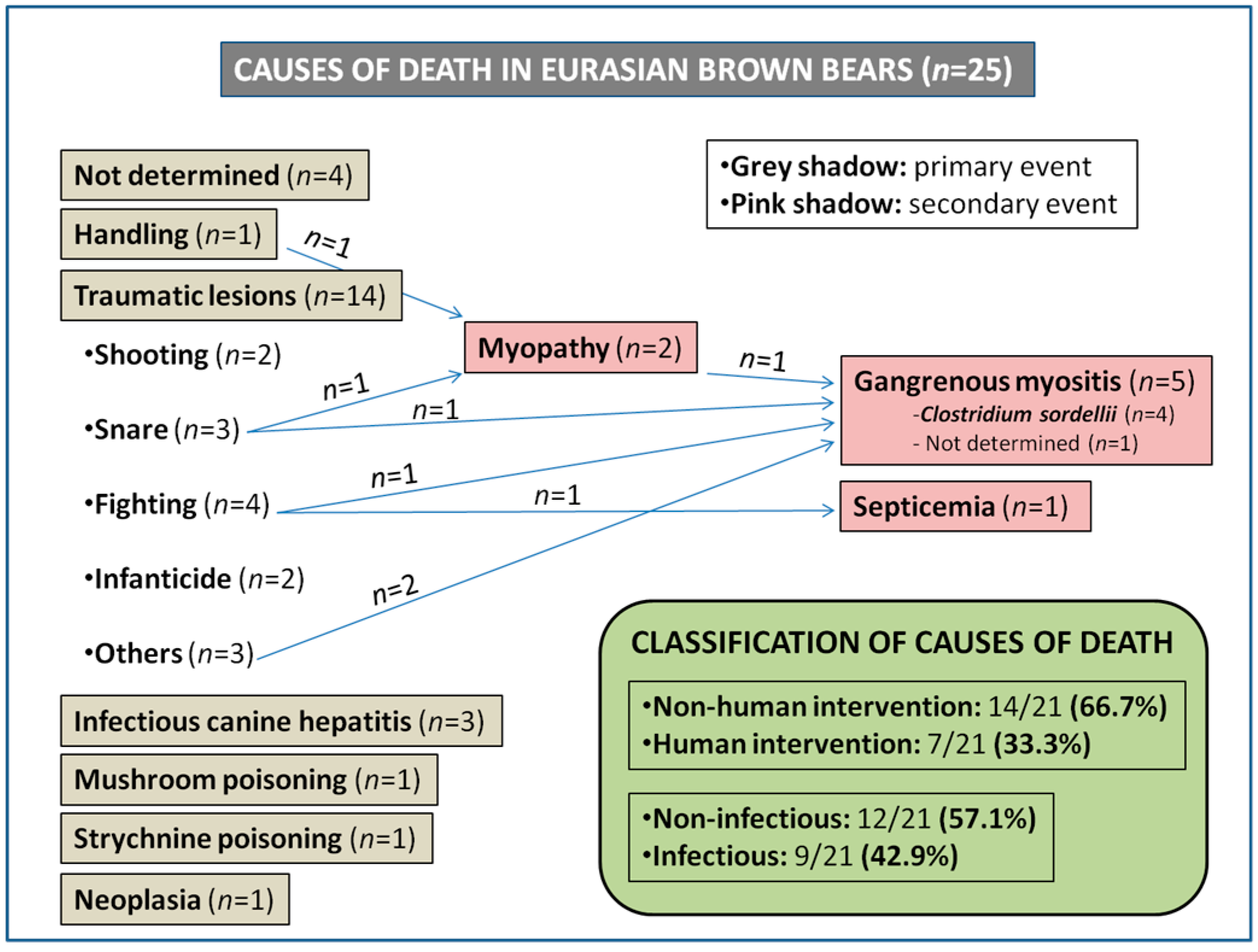
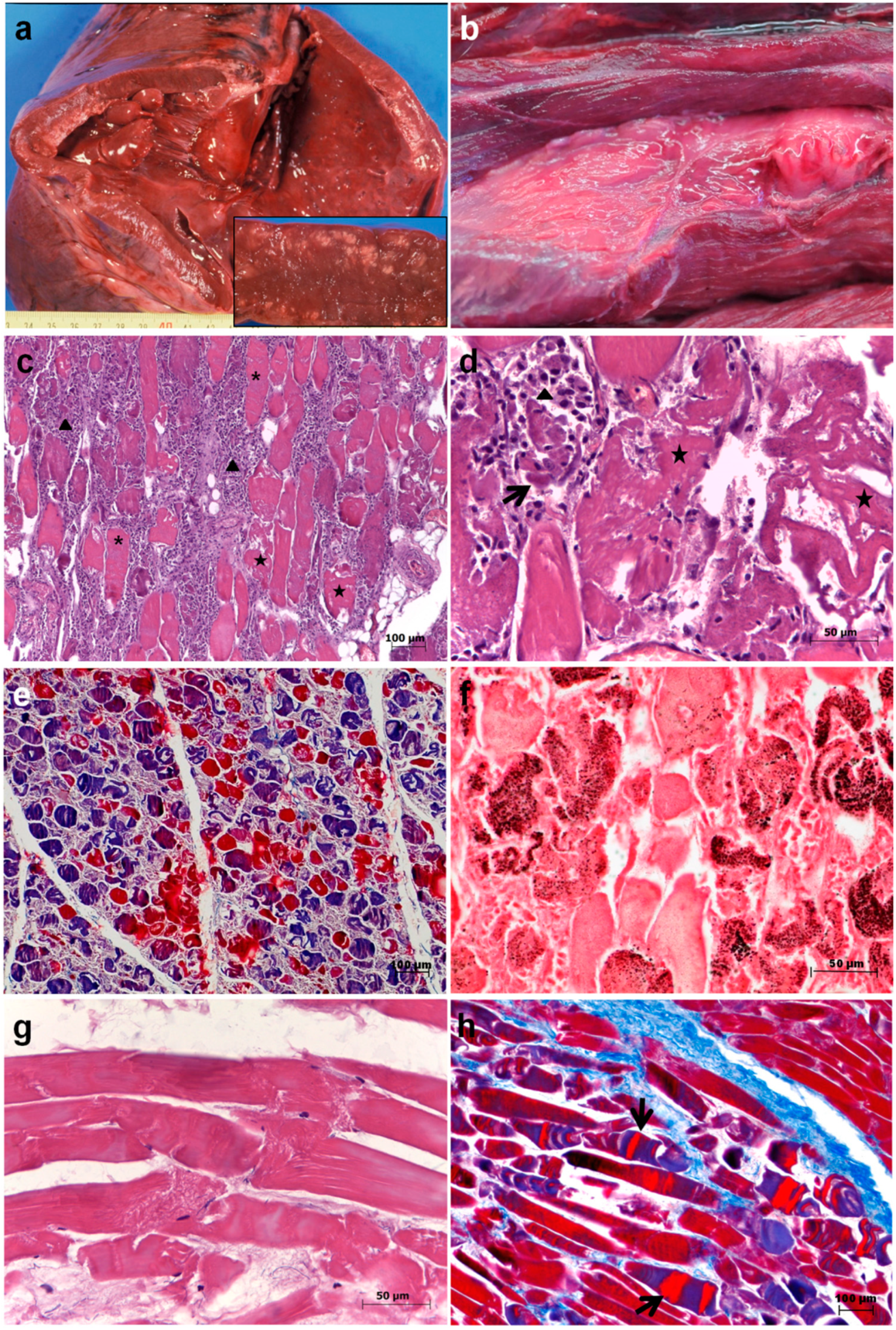

| Bear | Date | Age | Sex | Cause of Death | Classification of Death |
|---|---|---|---|---|---|
| 1 | 8/May/1998 | 7 years | Male | Snare/exertional myopathy/gangrenous myositis (Clostridium sordellii and C. bifermentans) | H/I |
| 2 | 12/June/1998 | Cub | Female | Infanticide | NH/NI |
| 3 | 10/June/2000 | Adult | n.d. | n.d. | – |
| 4 | 6/June/2005 | Subadult | Male | n.d. | – |
| 5 | 26/September/2005 | Adult | Male | Shooting | H/NI |
| 6 | 19/November/2005 | Adult | n.d. | Poisoning: strychnine | H/NI |
| 7 | 14/June/2008 | Cub (1 year) | Male | Infanticide | NH/NI |
| 8 | 27/August/2012 | Adult | Male | Snare/gangrenous myositis (Clostridium sordellii) * | H/I |
| 9 | 29/October/2012 | Cub (9 months) | Female | Died after handling and transport/exertional myopathy | H/NI |
| 10 | 12/June/2014 | 3 years | Male | Fighting/gangrenous myositis (Clostridium sordellii and C. septicum) | NH/I |
| 11 | 15/June/2014 | 5 years | Male | Infectious disease: CAdV-1 ** | NH/I |
| 12 | 12/December/2014 | 9 years | Male | Fighting/septicemia | NH/I |
| 13 | 29/April/2015 | 20 years | Female | Neoplasia: cholangiocarcinoma *** | NH/NI |
| 14 | 23/May/2015 | Cub (4 months) | Male | Infectious disease: CAdV-1 ** | NH/I |
| 15 | 16/October/2015 | Adult | Male | Traumatic lesions/gangrenous myositis | NH/I |
| 16 | 5/March/2016 | Adult | Male | Traumatic lesions due to fall | NH/NI |
| 17 | 8/October/2016 | Subadult | Male | Shooting | H/NI |
| 18 | 27/November/2016 | 6 years | Female | Snare/strangled | H/NI |
| 19 | 7/January/2017 | 6 years | Male | Mushroom poisoning; hepatic an renal necrosis | NH/NI |
| 20 | 3/April/2017 | Cub (3 months) | Female | Infectious disease: CAdV-1 ** | NH/I |
| 21 | 21/April/2017 | 19 years | Male | Fighting and cliff fall | NH/NI |
| 22 | 21/April/2017 | 20 years | Male | Fighting and cliff fall | NH/NI |
| 23 | 29/September/2018 | 4 years | Female | Traumatic lesions/gangrenous myositis (Clostridium sordellii) | NH/I |
| 24 | 27/October/2018 | 5 years | n.d. | n.d. | – |
| 25 | 08/November/2018 | 7 years | Male | n.d. | – |
© 2020 by the authors. Licensee MDPI, Basel, Switzerland. This article is an open access article distributed under the terms and conditions of the Creative Commons Attribution (CC BY) license (http://creativecommons.org/licenses/by/4.0/).
Share and Cite
Balseiro, A.; Royo, L.J.; Gayo, E.; Balsera, R.; Alarcia, O.; García Marín, J.F. Mortality Causes in Free-Ranging Eurasian Brown Bears (Ursus arctos arctos) in Spain 1998–2018. Animals 2020, 10, 1538. https://doi.org/10.3390/ani10091538
Balseiro A, Royo LJ, Gayo E, Balsera R, Alarcia O, García Marín JF. Mortality Causes in Free-Ranging Eurasian Brown Bears (Ursus arctos arctos) in Spain 1998–2018. Animals. 2020; 10(9):1538. https://doi.org/10.3390/ani10091538
Chicago/Turabian StyleBalseiro, Ana, Luis J. Royo, Elena Gayo, Ramón Balsera, Olga Alarcia, and Juan F. García Marín. 2020. "Mortality Causes in Free-Ranging Eurasian Brown Bears (Ursus arctos arctos) in Spain 1998–2018" Animals 10, no. 9: 1538. https://doi.org/10.3390/ani10091538
APA StyleBalseiro, A., Royo, L. J., Gayo, E., Balsera, R., Alarcia, O., & García Marín, J. F. (2020). Mortality Causes in Free-Ranging Eurasian Brown Bears (Ursus arctos arctos) in Spain 1998–2018. Animals, 10(9), 1538. https://doi.org/10.3390/ani10091538

