Comparison of In Vivo and In Vitro Digestibility in Donkeys


 ,
,  , , ,
, , ,  ,
, 
Simple Summary
Abstract
1. Introduction
2. Materials and Methods
2.1. Animals and Diets
2.2. In Vivo Digestibility
2.3. In Vitro Digestibility
2.4. Statistical Analysis
3. Results
3.1. Diet Characteristics and Dry Matter Intake
3.2. Effect of Diet on Dry Matter and Neutral Detergent Fiber Digestibility
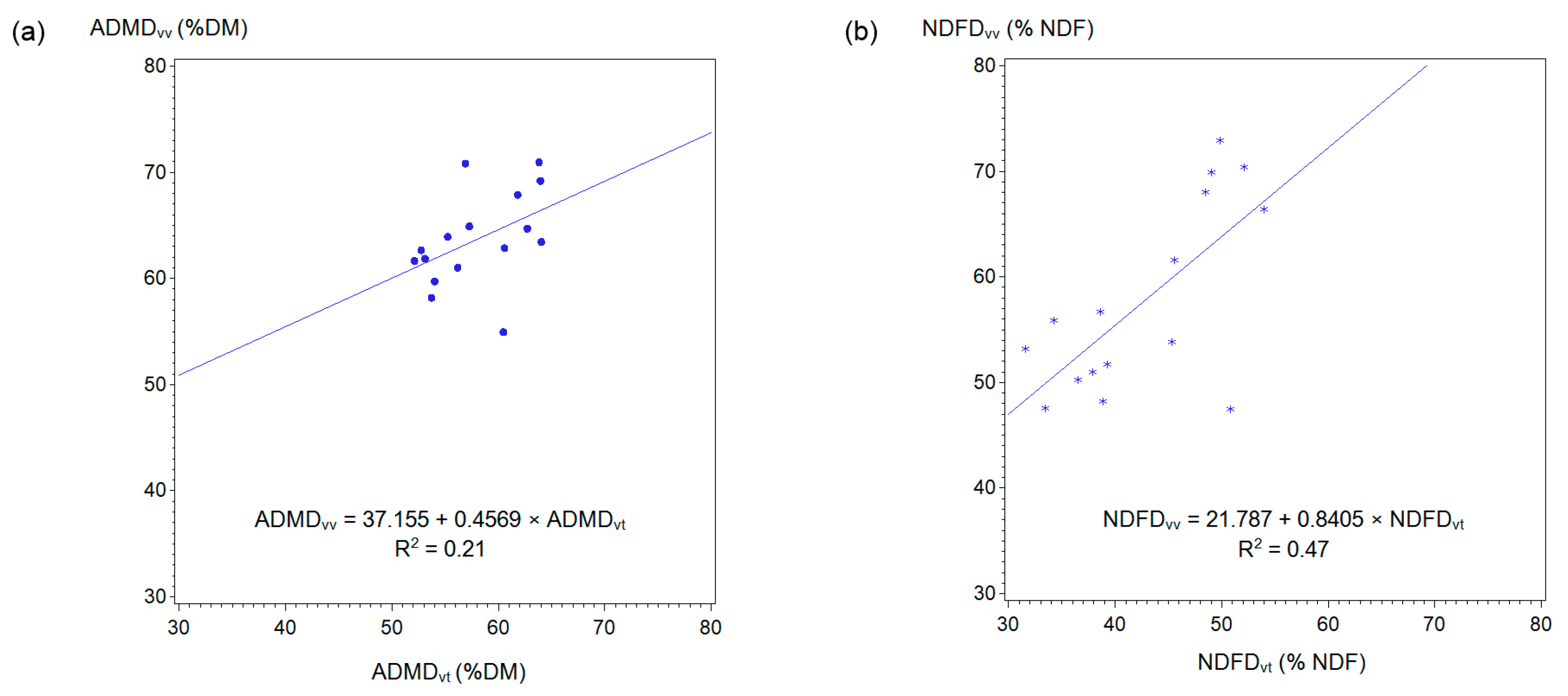
3.3. Comparison between In Vivo and In Vitro Digestibility
4. Discussions
4.1. Dry Matter Intake
4.2. Effect of Diet on Dry Matter and Neutral Detergent Fiber Digestibility
4.3. Comparison between In Vivo and In Vitro Digestibility
5. Conclusions
Author Contributions
Funding
Acknowledgments
Conflicts of Interest
References
- Martin-Rosset, W. Donkey nutrition and feeding: Nutrient requirements and recommended allowances—A review and prospect. J. Equine Vet. Sci. 2018, 65, 75–85. [Google Scholar] [CrossRef]
- Polidori, P.; Vincenzetti, S. Farm management and feeding strategies for donkey milk production. In Agricultural Research Updates; Gorawala, P., Mandhatri, S., Eds.; Nova Science Publishers, Inc.: Hauppauge, NY, USA, 2017; Volume 14, pp. 93–109. [Google Scholar]
- Smith, D.G.; Burden, F.A. Practical donkey and mule nutrition. In Equine Applied and Clinical Nutrition; Geor, R., Coenen, M., Harris, P., Eds.; Sauders: Philadelphia, PA, USA, 2013; pp. 304–316. [Google Scholar]
- Cuddeford, D.; Pearson, R.A.; Archibald, R.F.; Muirhead, R.H. Digestibility and gastrointestinal transit time of diets containing different proportions of alfalfa and oat straw given to Thoroughbreds, Shetland ponies, Highland ponies and donkeys. Anim. Sci. 1995, 61, 407–417. [Google Scholar] [CrossRef]
- Pearson, R.; Merrit, J.B. Intake, digestion and gastrointestinal transit time in resting donkeys and ponies and exercised donkeys given ad libitum hay and straw diets. Equine Vet. J. 1991, 23, 339–343. [Google Scholar] [CrossRef] [PubMed]
- Wilson, R.T. The donkey. In An Introduction to Animal Husbandry in the Tropics; Payne, W.J.A., Ed.; Longman: Harlow, UK, 1990; pp. 581–603. [Google Scholar]
- Edwards, J.E.; Shetty, S.A.; van den Berg, P.; Burden, F.; van Doorn, D.A.; Pellikaan, W.F.; Dijkstra, J.; Smidt, H. Multi-kingdom characterization of the core equine fecal microbiota based on multiple equine (sub)species. Anim. Microbiome 2020, 2, 6. [Google Scholar] [CrossRef]
- Edwards, J.E.; Schennink, A.; Burden, F.; Long, S.; van Doorn, D.A.; Pellikaan, W.F.; Dijkstra, J.; Saccenti, E.; Smidt, H. Domesticated equine species and their derived hybrids differ in their fecal microbiota. Anim. Microbiome 2020, 2, 8. [Google Scholar] [CrossRef]
- Liu, G.; Bou, G.; Su, S.; Xing, J.; Qu, H.; Zhang, X.; Wang, X.; Zhao, Y.; Dugarjaviin, M. Microbial diversity within the digestive tract contents of Dezhou donkeys. PLoS ONE 2019, 14, e0226186. [Google Scholar] [CrossRef]
- Pearson, R.A.; Archibald, R.F.; Muirhead, R.H. The effect of forage quality and level of feeding on digestibility and gastrointestinal transit time of oat straw and alfalfa given to ponies and donkeys. Br. J. Nutr. 2001, 8, 599–606. [Google Scholar] [CrossRef]
- Carretero-Roque, L.; Colunga, B.; Smith, D.G.; Gonzales-Ronquillo, M.; Solis-Mendez, A.; Castelan-Ortega, O. Digestible energy requirements of mexican donkeys fed oat straw and maize stover. Trop. Anim. Health Prod. 2005, 37, 123–142. [Google Scholar] [CrossRef]
- Pearson, R.A.; Archibald, R.F.; Muirhead, R.H. A comparison of the effect of forage type and level of feeding on the digestibility and gastrointestinal mean retention time of dry forages given to cattle, sheep, ponies and donkeys. Brit. J. Nutr. 2006, 95, 88–98. [Google Scholar] [CrossRef]
- Gatta, D.; Casini, L.; Magni, L.; Liponi, G.B. Apparent digestibility of three diets in the Amiata breed donkey during lactation. Ital. J. Anim. Sci. 2009, 8, 706–708. [Google Scholar] [CrossRef][Green Version]
- Liu, L.L.; Zhou, X.L.; Yang, H.J. Effect of dietary forage: Concentrate ration on pre-caecal and total digestive tract digestibility of diverse feedstuffs in donkeys as measured by the mobile nylon bag technique. Animals 2020, 10, 1070. [Google Scholar] [CrossRef] [PubMed]
- Kidane, N.F.; Stuth, J.W.; Tolleson, D.R. Predicting diet quality of donkeys via fecal-NIRS calibrations. Rangel. Ecol. Manag. 2008, 61, 232–239. [Google Scholar] [CrossRef]
- Wood, S.J. Some Factors Affecting the Digestible Energy, Requirements and Dry Matter Intake of Mature Donkeys and Comparison with Normal Husbandry Practices. Ph.D. Thesis, University of Edinburgh, Edinburgh, Scotland, 2010. [Google Scholar]
- Ankom Technology. Method for Determining Neutral Cellulase plus Gamanase (NCGD). Available online: www.ankom.com/sites/default/files/document-files/NCGD%20Procedure.pdf (accessed on 16 July 2018).
- Tassone, S.; Renna, M.; Barbera, S.; Valle, E.; Fortina, R. In vitro digestibility measurement of feedstuffs in donkeys using the DaisyII incubator. J. Equine Vet. Sci. 2019, 75, 122–126. [Google Scholar] [CrossRef]
- Leng, J.; Walton, G.; Swann, J.; Dardby, A.; La Ragione, R.; Proudmann, C. “Bowel on the Bench”: Proof of concept of a three-stage, In Vitro fermentation model of the equine large intestine. Appl. Environ. Microbiol. 2019, 86, e02093. [Google Scholar] [CrossRef] [PubMed]
- Earing, J.E.; Cassill, B.D.; Hayes, S.H.; Vanzant, E.S.; Lawrence, L.M. Comparison of in vitro digestibility estimates using the DaisyII incubator with in vivo digestibility estimates in horses. J. Anim. Sci. 2010, 88, 3954–3963. [Google Scholar] [CrossRef] [PubMed]
- AOAC International. Official Methods of Analysis of AOAC International, 17th ed.; AOAC International: Gaithersburg, MD, USA, 2000. [Google Scholar]
- AOAC International. Official Methods of Analysis of AOAC International, 17th ed.; 2nd revision; AOAC International: Gaithersburg, MD, USA, 2003. [Google Scholar]
- Fortina, R.; Gasmi-Boubaker, A.; Lussiana, C.; Malfatto, V.; Tassone, S.; Renna, M. Nutritive value and energy content of the straw of selected Vicia L. taxa from Tunisia. Ital. J. Anim. Sci. 2015, 14, 280–284. [Google Scholar] [CrossRef]
- Mertens, D.R. Gravimetric determination of amylase-treated neutral detergent fiber in feeds using refluxing in beakers or crucibles: Collaborative study. J. AOAC Int. 2002, 85, 1217–1240. [Google Scholar]
- Van Soest, P.J.; Robertson, J.B.; Lewis, B.A. Methods for dietary fiber, neutral detergent fiber, and nonstarch polysaccharides in relation to animal nutrition. J. Dairy Sci. 1991, 74, 3583–3597. [Google Scholar] [CrossRef]
- Lattimer, J.M.; Cooper, S.R.; Freeman, D.W.; Lalman, D.L. Effect of yeast culture on in vitro fermentation of a high-concentrate or high-fiber diet using equine fecal inoculum in a Daisy II incubator. J. Anim. Sci. 2007, 85, 2484–2491. [Google Scholar] [CrossRef]
- Ankom Technology. In Vitro True Digestibility Using the DaisyII Incubator. Available online: www.ankom.com/sites/default/files/document-files/Method_3_Invitro_D200_D200I.pdf (accessed on 21 December 2018).
- Holden, L.A. Comparison of methods of in vitro dry matter digestibility for ten feeds. J. Dairy Sci. 1999, 82, 1791–1794. [Google Scholar] [CrossRef]
- The SAS System for Windows; Release 9.4; SAS Institute Inc.: Cary, NC, USA, 2020.
- Raspa, F.; Cavallarin, L.; McLean, A.K.; Bergero, D.; Valle, E. A review of the appropriate nutrition welfare criteria of dairy donkeys: Nutritional requirements, farm management requirements and animal-based indicators. Animals 2019, 9, 315. [Google Scholar] [CrossRef] [PubMed]
- Burden, F.; Thiemann, A. Donkeys are different. J. Equine Vet. Sci. 2015, 35, 376–382. [Google Scholar] [CrossRef]
- Smith, D.G.; Pearson, R.A. A review of the factors affecting the survival of donkeys in semi-arid regions of sub-Saharian Africa. Trop. Anim. Health Prod. 2005, 37, 1–19. [Google Scholar] [CrossRef] [PubMed]
- Agbagla-Dohnani, A.; Cornu, A.; Nozière, P.; Besle, J.-M.; Dulphy, J.P.; Doreau, M.; Grenet, E. Microbial degradation of rice and barley straws in the sheep rumen and the donkey caecum. J. Sci. Food Agric. 2003, 83, 383–394. [Google Scholar] [CrossRef]
- Izraely, H.; Choshniak, I.; Stevens, C.E.; Demment, M.W.; Shkolnik, A. Factors determining the digestive efficiency of the domesticated donkey (Equus asinus asinus). Q. J. Exp. Physiol. 1989, 74, 1–6. [Google Scholar] [CrossRef] [PubMed]
- Palmgren Karlsson, C.; Lindberg, J.E.; Rundgren, M. Associative effects on total tract digestibility in horses fed different rations of grass hay and whole oats. Livest. Prod. Sci. 2000, 65, 143–153. [Google Scholar] [CrossRef]
- Peiretti, P.G.; Miraglia, N.; Meineri, G.; Costantini, M.; Bergero, D. Digeribilità in vivo di orzi schiacciati e fioccati in razioni per cavalli. Ippologia 2009, 3, 17–21. [Google Scholar]
- De Marco, M.; Peiretti, P.G.; Miraglia, N.; Bergero, D. Apparent digestibility of broken rice in horses using in vivo and in vitro methods. Animal 2014, 8, 245–249. [Google Scholar] [CrossRef]
- Clarke, L.L.; Roberts, M.C.; Argenzio, R.A. Feeding and digestive problems in horses. Physiologic responses to a concentrated meal. Vet. Clin. North Am. Equine Pract. 1990, 6, 433–450. [Google Scholar] [CrossRef]
- de Fombelle, A.; Julliand, V.; Drogoul, C.; Jacotot, E. Feeding and microbial disorders in horses: 1-effects of an abrupt incorporation of two levels of barley in a hay diet on microbial profile and activities. J. Equine Vet. Sci. 2001, 21, 439–445. [Google Scholar] [CrossRef]
- Philippeau, C.; Sadet-Bourgeteau, S.; Varloud, M.; Julliand, V. Impact of barley form on equine total tract fibre digestibility and colonic microbiota. Animal 2015, 9, 1943–1948. [Google Scholar] [CrossRef] [PubMed]
- Tassone, S.; Fortina, R.; Peiretti, P.G. In Vitro Techniques Using the DaisyII Incubator for the Assessment of Digestibility: A Review. Animals 2020, 10, 775. [Google Scholar] [CrossRef] [PubMed]
- Wilman, D.; Adesogan, A. A comparison of filter bag methods with conventional tube methods of determining the in vitro digestibility of forages. Anim. Feed Sci. Technol. 2000, 84, 33–47. [Google Scholar] [CrossRef]


| Item | H1 | H1B | H2 | H2B | SEM | p |
|---|---|---|---|---|---|---|
| DM (g/100 g as fed) | 89.9 | 89.7 | 89.9 | 89.5 | 0.8 | 0.899 |
| Ash | 6.4 c | 6.1 c | 9.1 a | 8.0 b | 0.2 | <0.001 |
| CP | 8.5 d | 9.7 c | 18.6 a | 17.5 b | 0.1 | <0.001 |
| EE | 1.3 b | 1.5 b | 2.3 a | 2.1 a | <0.1 | <0.001 |
| NDF | 59.4 a | 54.2 c | 58.2 b | 49.8 d | 0.2 | <0.001 |
| ADF | 36.6 a | 29.7 c | 33.3 b | 27.3 d | <0.1 | <0.001 |
| ADL | 4.4 a | 2.4 b | 4.2 a | 2.1 b | 0.2 | <0.001 |
| NFC | 24.4 b | 28.5 a | 11.8 d | 22.6 c | 0.4 | <0.001 |
| Diets | ADMDvv (% DM) | ADMDvt (% DM) | t | p | NDFDvv (% NDF) | NDFDvt (% NDF) | t | p |
|---|---|---|---|---|---|---|---|---|
| H1 | 60.4 b | 53.3 c | 6.34 | <0.001 | 51.7 b | 38.3 c | 8.14 | <0.001 |
| H1B | 63.1 a,b | 55.4 c | 5.47 | <0.001 | 51.9 b | 34.3 d | 8.91 | <0.001 |
| H2 | 64.6 a | 60.5 b | 2.36 | 0.022 | 64.3 a | 51.7 a | 4.75 | <0.001 |
| H2B | 66.6 a | 63.1 a | 2.19 | 0.033 | 63.3 a | 47.1 b | 6.21 | <0.001 |
| SEM | 5.514 | 4.527 | 7.409 | 7.809 |
Publisher’s Note: MDPI stays neutral with regard to jurisdictional claims in published maps and institutional affiliations. |
© 2020 by the authors. Licensee MDPI, Basel, Switzerland. This article is an open access article distributed under the terms and conditions of the Creative Commons Attribution (CC BY) license (http://creativecommons.org/licenses/by/4.0/).
Share and Cite
Tassone, S.; Fortina, R.; Valle, E.; Cavallarin, L.; Raspa, F.; Boggero, S.; Bergero, D.; Giammarino, M.; Renna, M. Comparison of In Vivo and In Vitro Digestibility in Donkeys. Animals 2020, 10, 2100. https://doi.org/10.3390/ani10112100
Tassone S, Fortina R, Valle E, Cavallarin L, Raspa F, Boggero S, Bergero D, Giammarino M, Renna M. Comparison of In Vivo and In Vitro Digestibility in Donkeys. Animals. 2020; 10(11):2100. https://doi.org/10.3390/ani10112100
Chicago/Turabian StyleTassone, Sonia, Riccardo Fortina, Emanuela Valle, Laura Cavallarin, Federica Raspa, Silvia Boggero, Domenico Bergero, Mauro Giammarino, and Manuela Renna. 2020. "Comparison of In Vivo and In Vitro Digestibility in Donkeys" Animals 10, no. 11: 2100. https://doi.org/10.3390/ani10112100
APA StyleTassone, S., Fortina, R., Valle, E., Cavallarin, L., Raspa, F., Boggero, S., Bergero, D., Giammarino, M., & Renna, M. (2020). Comparison of In Vivo and In Vitro Digestibility in Donkeys. Animals, 10(11), 2100. https://doi.org/10.3390/ani10112100