Review

Combating Parasitic Nematode Infections, Newly Discovered Antinematode Compounds from Marine Epiphytic Bacteria


1
Centre for Marine Science and Innovation, School of Biological, Earth and Environmental Sciences, UNSW, Sydney, NSW 2052, Australia
2
School of Industrial Technology, Universiti Sains Malaysia, USM, 11800 Penang, Malaysia
*
Author to whom correspondence should be addressed.
Microorganisms 2020, 8(12), 1963; https://doi.org/10.3390/microorganisms8121963

Submission received: 4 November 2020 / Revised: 8 December 2020 / Accepted: 8 December 2020 / Published: 11 December 2020
(This article belongs to the Special Issue Microbial Secondary Metabolites and Biotechnology)

Abstract

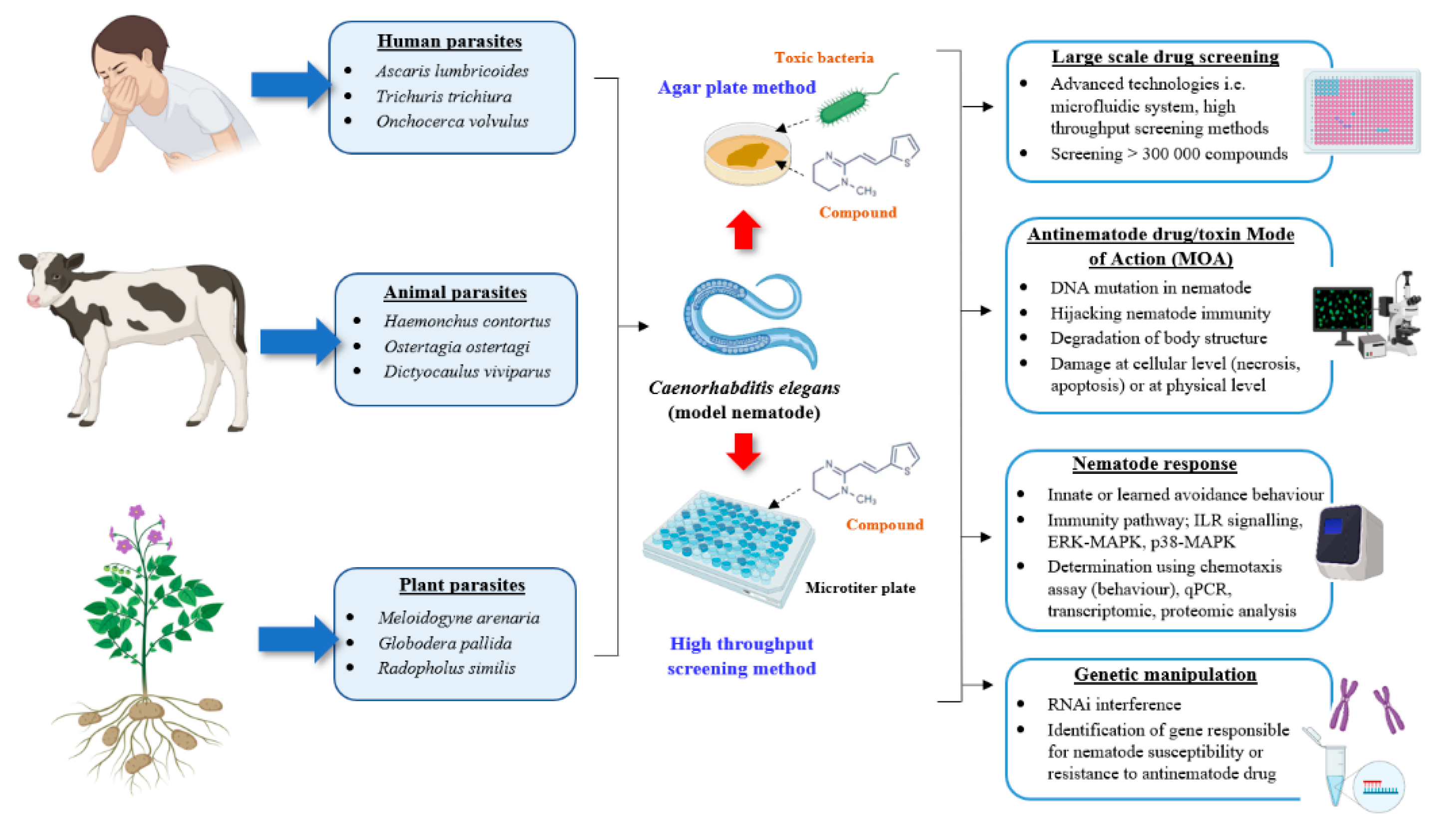
Parasitic nematode infections cause debilitating diseases and impede economic productivity. Antinematode chemotherapies are fundamental to modern medicine and are also important for industries including agriculture, aquaculture and animal health. However, the lack of suitable treatments for some diseases and the rise of nematode resistance to many available therapies necessitates the discovery and development of new drugs. Here, marine epiphytic bacteria represent a promising repository of newly discovered antinematode compounds. Epiphytic bacteria are ubiquitous on marine surfaces where they are under constant pressure of grazing by bacterivorous predators (e.g., protozoans and nematodes). Studies have shown that these bacteria have developed defense strategies to prevent grazers by producing toxic bioactive compounds. Although several active metabolites against nematodes have been identified from marine bacteria, drug discovery from marine microorganisms remains underexplored. In this review, we aim to provide further insight into the need and potential for marine epiphytic bacteria to become a new source of antinematode drugs. We discuss current and emerging strategies, including culture-independent high throughput screening and the utilization of Caenorhabditis elegans as a model target organism, which will be required to advance antinematode drug discovery and development from marine microbial sources.
Keywords: antinematode compound; anthelminthic drugs; marine epiphytic bacteria; marine biofilm; marine environment; parasitic nematode; Caenorhabditis elegans antinematode compound; anthelminthic drugs; marine epiphytic bacteria; marine biofilm; marine environment; parasitic nematode; Caenorhabditis elegans