Review

Epstein–Barr Virus Reactivation-Induced Immunoglobulin Production: Significance on Autoimmunity


1
Division of Pharmacology Faculty of Medicine, Tottori University, 86 Nishi-Cho, Yonago 683-8503, Japan
2
Department of Pathology, Faculty of Medicine, Tottori University, 86 Nishi-Cho, Yonago 683-8503, Japan
*
Author to whom correspondence should be addressed.
Microorganisms 2020, 8(12), 1875; https://doi.org/10.3390/microorganisms8121875

Submission received: 30 September 2020 / Revised: 17 November 2020 / Accepted: 25 November 2020 / Published: 27 November 2020
(This article belongs to the Special Issue Epstein–Barr Virus Infection and Associated Diseases)

Abstract

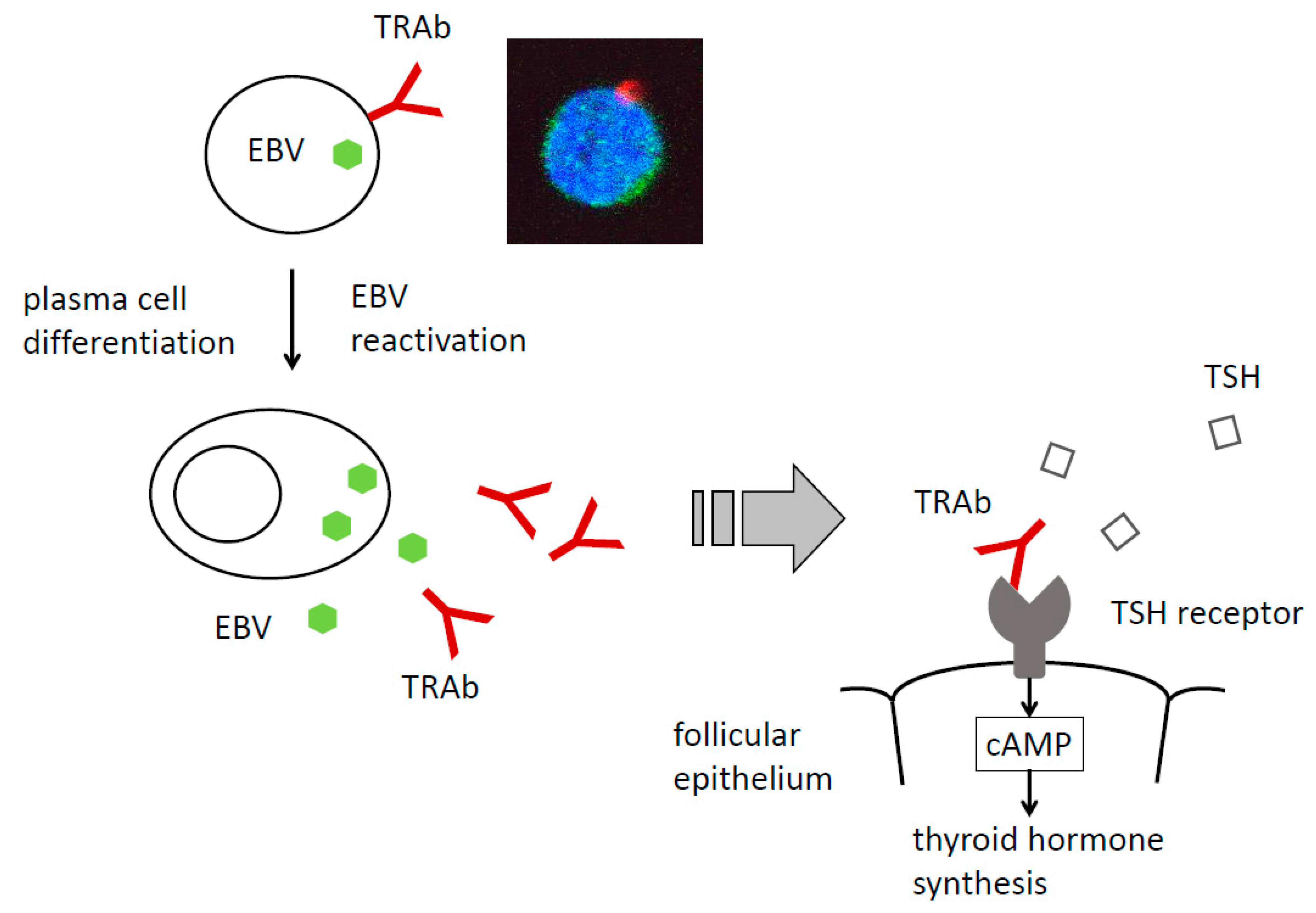



Epstein–Barr virus (EBV) mainly persists in B cells, which differentiate into antibody-producing cells, and thus, EBV has been implicated in autoimmune diseases. We aimed to describe the EBV reactivation and its relevance to autoimmune disease, focusing on Graves’ disease, which is an autoimmune hyperthyroidism caused by thyrotropin receptor antibodies. Circulating autoreactive B cells that have evaded from the selection have difficulties differentiating to produce antibodies. However, once EBV infects such B cells and reactivates, the B cells may become plasma cells and produce autoantibody. We herein proposed an EBV reactivation-induced Ig production system, which is a distinct pathway from the antibody production system through germinal centers and bone marrow and has the following characteristics: 1. IgM dominance, 2. ubiquitous Ig production, and 3. the rescue of autoreactive B cells, which skews Ig production toward autoantigens. IgM autoantibodies induced by EBV reactivation may activate the classical complement pathway and injure healthy tissue, which supply autoantigens for the production of affinity-matured IgG autoantibodies. Antibodies induced by EBV reactivation may play important roles in the development and exacerbation of autoimmune diseases.
Keywords: Epstein-Barr virus (EBV); reactivation; autoimmune disease; Graves’ disease; thyrotropin receptor antibody (TRAb); IgM; complement Epstein-Barr virus (EBV); reactivation; autoimmune disease; Graves’ disease; thyrotropin receptor antibody (TRAb); IgM; complement