Multidrug-Resistant Bloodstream Infections Before and After COVID-19: A Temporal Assessment of Outcomes and Resistance Across Two Eras in a Non-COVID Intensive Care Unit—The MATURATE ICU Study

 , and
, and
Abstract
1. Introduction
2. Materials and Methods
2.1. Study Design
2.2. Study Sample
2.3. Definitions
2.4. Data Collection
2.5. Pathogen Identification
2.6. Statistical Analysis
2.7. Ethics
3. Results
3.1. Sample Characteristics

| Era | |||
|---|---|---|---|
| Pre COVID-19 (2017–2020), n = 74 | Post COVID-19 (2022–2025), n = 72 | p | |
| Epidemiology | |||
| Age, years | 62.5 (53.2–74.8) | 50 (38.5–64.5) | <0.001 |
| BMI, kg/m2 | 26.8 (24.6–29.4) | 26.9 (24.2–31) | 0.875 |
| Male sex, n (%) | 45 (60.81%) | 43 (59.72%) | 1 |
| Smoking exposure, pack-years | 0 (0–40) | 0 (0–45) | 0.942 |
| Surgery (any time), n (%) | 25 (33.78%) | 32 (44.44%) | 0.250 |
| CCI | 4 (2–5.75) | 1 (0–4) | <0.001 |
| Hospital-acquired infection, n (%) | 31 (41.89%) | 15 (20.83%) | 0.010 |
| Invasive airway support (intubation and/or tracheostomy), n (%) | 55 (74.32%) | 56 (77.78%) | 0.768 |
| Diagnosis (source of infection) | |||
| UTI, n (%) | 4 (5.41%) | 2 (2.78%) | 0.681 |
| RTI, n (%) | 25 (33.78%) | 17 (23.61%) | 0.240 |
| CVC-related, n (%) | 5 (6.76%) | 0 | 0.058 |
| Hepatobiliary, n (%) | 3 (4.05%) | 2 (2.78%) | 1 |
| CNS, n (%) | 6 (8.11%) | 6 (8.33%) | 1 |
| GI, n (%) | 9 (12.16%) | 9 (12.50%) | 1 |
| Endocarditis, n (%) | 1 (1.35%) | 0 | 1 |
| Soft tissue, n (%) | 5 (6.76%) | 4 (5.56%) | 1 |
| Trauma, n (%) | 13 (17.57%) | 19 (26.39%) | 0.276 |
| Osteomyelitis, n (%) | 1 (1.35%) | 0 | 1 |
| Severity indices | |||
| SOFA score | 10 (8–13) | 7 (5–11) | <0.001 |
| SIRS criteria | 3 (2–3) | 2 (1–3) | 0.023 |
| APACHE II score | 25 (20.2–30) | 18 (14–21) | <0.001 |
| Laboratory values | |||
| WBC, /mm3 | 12,895 (8375–18,145) | 12,305 (8255–17,192) | 0.920 |
| Neutrophils, % | 84 (76.6–90.9) | 81.2 (73.8–89.9) | 0.210 |
| Lymphocytes, % | 7.55 (4.6–11.9) | 9.3 (5.7–13.4) | 0.195 |
| Hemoglobin, g/dL | 9.2 (8.33–10.1) | 9.65 (8.7–10.9) | 0.100 |
| Platelets, /mm3 | 208,006 (106,750–255,750) | 275,250 (188,250–356,000) | <0.001 |
| INR | 1.17 (1.09–1.31) | 1.16 (1.07–1.28) | 0.241 |
| Creatinine, mg/dL | 1.05 (0.7–2.18) | 0.65 (0.575–0.9) | <0.001 |
| Urea, mg/dL | 86.5 (46.5–136) | 41 (29.8–68.5) | <0.001 |
| Total bilirubin, mg/dL | 0.745 (0.51–1.55) | 0.75 (0.41–1.11) | 0.451 |
| AST (SGOT), IU/L | 43 (29–99.2) | 39.5 (28–74.2) | 0.512 |
| ALT (SGPT), IU/L | 30 (19–76.8) | 48 (29.5–89) | 0.019 |
| Albumin, g/dL | 2.6 (2.3–3) | 3.2 (2.77–3.5) | <0.001 |
| Total protein, g/dL | 5.2 (4.6–5.8) | 5.7 (5–6.2) | 0.003 |
| CRP, mg/dL | 9.81 (4.49–16.2) | 7.88 (4.43–16.3) | 0.668 |
3.2. BSI Characteristics
3.3. Pathogen-Related Characteristics
3.4. Complications and Outcomes
3.5. Competing-Risk and Survival Analyses
3.6. Multivariable Cause-Specific Cox
3.7. 28-Day ICU Mortality—Logistic Regression Analysis
4. Discussion
5. Conclusions
Supplementary Materials
Author Contributions
Funding
Institutional Review Board Statement
Informed Consent Statement
Data Availability Statement
Conflicts of Interest
Abbreviations
| Abbreviation | Full Term |
| A. baumannii | Acinetobacter baumannii |
| ACS | Acute Coronary Syndrome |
| AKI | Acute Kidney Injury |
| ALT | Alanine Aminotransferase |
| AMR | Antimicrobial Resistance |
| APACHE II | Acute Physiology and Chronic Health Evaluation II |
| ARDS | Acute Respiratory Distress Syndrome |
| AST | Aspartate Aminotransferase |
| BMI | Body Mass Index |
| BSI | Bloodstream Infection |
| C. auris | Candida auris |
| C. parapsilosis | Candida parapsilosis |
| CCI | Charlson Comorbidity Index |
| CDC | Centers for Disease Control and Prevention |
| CI | Confidence Interval |
| CIF | Cumulative Incidence Function |
| CLABSI | Central Line-Associated Bloodstream Infection |
| CNS | Central Nervous System |
| COVID-19 | Coronavirus Disease 2019 |
| CPE | Carbapenemase-Producing Enterobacterales |
| CRAB | Carbapenem-Resistant Acinetobacter baumannii |
| CRBSI | Catheter-Related Bloodstream Infection |
| CRP | C-Reactive Protein |
| CRE | Carbapenem-Resistant Enterobacterales |
| CRO | Carbapenem-Resistant Organisms |
| CVC | Central Venous Catheter |
| DIC | Disseminated Intravascular Coagulation |
| ECMO | Extracorporeal membrane oxygenation |
| E. faecium | Enterococcus faecium |
| ESBL | Extended-Spectrum β-Lactamase |
| EUCAST | European Committee on Antimicrobial Susceptibility Testing |
| ESCMID | European Society of Clinical Microbiology and Infectious Diseases |
| GI | Gastrointestinal |
| HABSI | Hospital-Acquired Bloodstream Infection |
| HAI | Healthcare-Associated Infection |
| HR | Hazard Ratio |
| ICU | Intensive Care Unit |
| IDSA | Infectious Diseases Society of America |
| INR | International Normalized Ratio |
| IPC | Infection Prevention and Control |
| IQR | Interquartile Range |
| IRB | Institutional Review Board |
| K. pneumoniae | Klebsiella pneumoniae |
| KPC | Klebsiella pneumoniae Carbapenemase |
| MDR | Multidrug-Resistant |
| MIC | Minimum Inhibitory Concentration |
| MI | Myocardial Infarction |
| MR-CNS | Methicillin-Resistant Coagulase-Negative Staphylococci |
| MRSA | Methicillin-Resistant Staphylococcus aureus |
| NDM | New Delhi Metallo-β-Lactamase |
| NE | Not Estimable |
| OR | Odds Ratio |
| P. aeruginosa | Pseudomonas aeruginosa |
| PDR | Pandrug-Resistant |
| PICC | Peripherally Inserted Central Catheter |
| RTI | Respiratory Tract Infection |
| SARS-CoV-2 | Severe Acute Respiratory Syndrome Coronavirus 2 |
| sHR | Subdistribution Hazard Ratio |
| SIRS | Systemic Inflammatory Response Syndrome |
| SOFA | Sequential Organ Failure Assessment |
| UTI | Urinary Tract Infection |
| VRE | Vancomycin-Resistant Enterococcus |
| WBC | White Blood Cell |
| WHONET | World Health Organization Network for Surveillance of Antimicrobial Resistance |
| XDR | Extensively Drug-Resistant |
References
- Naghavi, M.; Vollset, S.E.; Ikuta, K.S.; Swetschinski, L.R.; Gray, A.P.; Wool, E.E.; Robles Aguilar, G.; Mestrovic, T.; Smith, G.; Han, C.; et al. Global burden of bacterial antimicrobial resistance 1990–2021: A systematic analysis with forecasts to 2050. Lancet 2024, 404, 1199–1226. [Google Scholar] [CrossRef] [Scilit] [PubMed]
- Barišić, V.; Kovačević, T.; Travar, M.; Golić Jelić, A.; Kovačević, P.; Vučićević, K.; Milaković, D.; Škrbić, R. The Impact of the COVID-19 Pandemic on Antimicrobial Resistance Trends in a Tertiary Care Teaching Hospital: A Ten-Year Surveillance Study. Antibiotics 2025, 14, 1179. [Google Scholar] [CrossRef] [Scilit] [PubMed]
- Neri, J.E.C.; Monteiro, J.; Rodrigues, L.L.M.; Sobrinho, E.B.; Monte, C.G.; Boulhosa, A.C.P.; Ferreira, R.C.A.; Sousa, R.C.M. Antimicrobial resistance before and after the COVID-19 pandemic in Northern Brazil. Antimicrob. Steward. Healthc. Epidemiol. 2026, 6, e102. [Google Scholar] [CrossRef] [Scilit] [PubMed]
- Micheli, G.; Sangiorgi, F.; Catania, F.; Chiuchiarelli, M.; Frondizi, F.; Taddei, E.; Murri, R. The Hidden Cost of COVID-19: Focus on Antimicrobial Resistance in Bloodstream Infections. Microorganisms 2023, 11, 1299. [Google Scholar] [CrossRef] [Scilit] [PubMed]
- Ntziora, F.; Giannitsioti, E. Bloodstream infections in the era of the COVID-19 pandemic: Changing epidemiology of antimicrobial resistance in the intensive care unit. J. Intensive Med. 2024, 4, 269–280. [Google Scholar] [CrossRef] [Scilit] [PubMed]
- Mateescu, D.M.; Ilie, A.C.; Cotet, I.; Guse, C.; Muresan, C.O.; Pah, A.M.; Badalica-Petrescu, M.; Iurciuc, S.; Craciun, M.L.; Avram, A.; et al. Global Burden of Bloodstream Infections in COVID-19: Prevalence, Antimicrobial Resistance, and Mortality Risk. Viruses 2025, 17, 1353. [Google Scholar] [CrossRef] [Scilit] [PubMed]
- Liu, Y.; Song, H.; Wu, Y.; Liu, L.; Li, N.; Zhang, M.; Li, Y.; Meng, X. Influence of COVID-19 pandemic on the distribution and drug resistance of pathogens in patients with bloodstream infection. Front. Public Health 2025, 13, 1607801. [Google Scholar] [CrossRef] [Scilit] [PubMed]
- Sakagianni, A.; Koufopoulou, C.; Koufopoulos, P.; Feretzakis, G.; Koumaki, V. The Impact of COVID-19 on the Epidemiology of Carbapenem Resistance. Antibiotics 2025, 14, 916. [Google Scholar] [CrossRef] [Scilit] [PubMed]
- Centers for Disease Control and Prevention. Antimicrobial Resistance Threats in the United States, 2021–2022. 16 July 2024. Available online: https://www.cdc.gov/antimicrobial-resistance/data-research/threats/update-2022.html (accessed on 4 July 2026).
- Petrakis, V.; Panopoulou, M.; Rafailidis, P.; Lemonakis, N.; Lazaridis, G.; Terzi, I.; Papazoglou, D.; Panagopoulos, P. The Impact of the COVID-19 Pandemic on Antimicrobial Resistance and Management of Bloodstream Infections. Pathogens 2023, 12, 780. [Google Scholar] [CrossRef] [Scilit] [PubMed]
- Palaiopanos, K.; Krystallaki, D.; Mellou, K.; Kotoulas, P.; Kavakioti, C.A.; Vorre, S.; Vertsioti, G.; Gkova, M.; Maragkos, A.; Tryfinopoulou, K.; et al. Healthcare-associated infections and antimicrobial use in acute care hospitals in Greece, 2022; results of the third point prevalence survey. Antimicrob. Resist. Infect. Control 2024, 13, 11. [Google Scholar] [CrossRef] [Scilit] [PubMed]
- Eryılmaz Eren, E.; Iosifidis, E.; Sav, H.; Celik, I.; Mouloudi, E.; Pyrpasopoulou, A.; Zarras, C.; Roilides, E. Candidemia Epidemiology and Antifungal Resistance in Critically-ill Patients During and After COVID-19 Pandemic: Comparison Between Two Hospitals in Greece and Türkiye. Mycopathologia 2026, 191, 62. [Google Scholar] [CrossRef] [Scilit] [PubMed]
- Ioannou, P.; Astrinaki, E.; Vitsaxaki, E.; Bolikas, E.; Christofaki, D.; Salvaraki, A.; Lagoudaki, E.; Ioannidou, E.; Karakonstantis, S.; Saplamidou, S.; et al. A Point Prevalence Survey of Healthcare-Associated Infections and Antimicrobial Use in Public Acute Care Hospitals in Crete, Greece. Antibiotics 2022, 11, 1258. [Google Scholar] [CrossRef] [Scilit] [PubMed]
- Koumaki, V.; Voudanta, E.; Michelaki, A.; Orfanidou, M.; Vagiakou, E.; Vrioni, G.; Tsakris, A. Epidemiological Trends of Carbapenemase-Producing Pseudomonas aeruginosa in a Tertiary Care Hospital in Athens, Greece, During 2020–2023. Antibiotics 2025, 14, 898. [Google Scholar] [CrossRef] [Scilit] [PubMed]
- Mylona, E.; Kostourou, S.; Giankoula, D.; Kolokotroni, C.; Tsilikis, P.; Koudoumnakis, N.; Papagianni, M.; Kounatidis, D.; Vallianou, N.; Perivolioti, E.; et al. A Seven-Year Study of Carbapenem-Resistant Klebsiella pneumoniae Bloodstream Infections in a Tertiary Hospital in Greece: A Shift Toward Metallo-β-Lactamase and Dual Carbapenemase Strains. Antibiotics 2026, 15, 491. [Google Scholar] [CrossRef] [Scilit] [PubMed]
- Keskin Sarıtaş, Ç.; Özsüt, H.; Benli, A.; Başaran, S. Differences between COVID-19 and non-COVID-19 patients’ bloodstream infections: A single-center retrospective study. J. Infect. Dev. Ctries. 2025, 19, 1015–1023. [Google Scholar] [CrossRef] [Scilit] [PubMed]
- Piantoni, A.; Houard, M.; Piga, G.; Zebian, G.; Ruffier des Aimes, S.; Holik, B.; Wallet, F.; Rouzé, A.; Kreitmann, L.; Loiez, C.; et al. Relationship between COVID-19 and ICU-Acquired Bloodstream Infections Related to Multidrug-Resistant Bacteria. Antibiotics 2023, 12, 1105. [Google Scholar] [CrossRef] [Scilit] [PubMed]
- Giacobbe, D.R.; Battaglini, D.; Ball, L.; Brunetti, I.; Bruzzone, B.; Codda, G.; Crea, F.; De Maria, A.; Dentone, C.; Di Biagio, A.; et al. Bloodstream infections in critically ill patients with COVID-19. Eur. J. Clin. Invest. 2020, 50, e13319. [Google Scholar] [CrossRef] [Scilit] [PubMed]
- Bongiovanni, M.; Barda, B. Pseudomonas aeruginosa Bloodstream Infections in SARS-CoV-2 Infected Patients: A Systematic Review. J. Clin. Med. 2023, 12, 2252. [Google Scholar] [CrossRef] [Scilit] [PubMed]
- Wilson Dib, R.; Spallone, A.; Khawaja, F.; Feldman, A.; Cantu, S.; Chemaly, R.F. The impact of the COVID-19 pandemic on hospital-acquired infections at a comprehensive cancer center. Am. J. Infect. Control 2023, 51, 1302–1308. [Google Scholar] [CrossRef] [Scilit] [PubMed]
- Peake, S.L.; Freund, Y.; Azoulay, E.; De Pascale, G.; Gong, M.N.; Rochwerg, B.; Hashmi, M.; Schorr, C.A.; Mohr, N.M.; Doi, K.; et al. Surviving Sepsis Campaign: International Guidelines for Management of Sepsis and Septic Shock 2026. Crit. Care Med. 2026, 54, 725–812. [Google Scholar] [CrossRef] [Scilit] [PubMed]
- Unic-Stojanovic, D.; Kangrga, N.; Cirkovic, I.; Malesevic, I.; Djokovic Mrdakovic, I.; Petrovic, J.; Bojic, M. Sepsis Diagnosis in the Intensive Care Unit: A Comparative Study of Rapid Molecular Diagnostics and Conventional Blood Cultures. Biomedicines 2026, 14, 479. [Google Scholar] [CrossRef] [Scilit] [PubMed]
- Wang, Y.; Lindsley, K.; Bleak, T.C.; Jiudice, S.; Uyei, J.; Gu, Y.; Wang, Y.; Timbrook, T.T.; Balada-Llasat, J.-M. Performance of molecular tests for diagnosis of bloodstream infections in the clinical setting: A systematic literature review and meta-analysis. Clin. Microbiol. Infect. 2025, 31, 360–372. [Google Scholar] [CrossRef] [Scilit] [PubMed]
- Tamma, P.D.; Heil, E.L.; Justo, J.A.; Mathers, A.J.; Satlin, M.J.; Bonomo, R.A. Infectious Diseases Society of America 2024 Guidance on the Treatment of Antimicrobial-Resistant Gram-Negative Infections. Clin. Infect. Dis. 2024, ciae403. [Google Scholar] [CrossRef] [Scilit] [PubMed]
- Paul, M.; Carrara, E.; Retamar, P.; Tängdén, T.; Bitterman, R.; Bonomo, R.A.; de Waele, J.; Daikos, G.L.; Akova, M.; Harbarth, S.; et al. European Society of Clinical Microbiology and Infectious Diseases (ESCMID) guidelines for the treatment of infections caused by multidrug-resistant Gram-negative bacilli (endorsed by European society of intensive care medicine). Clin. Microbiol. Infect. 2022, 28, 521–547. [Google Scholar] [CrossRef] [Scilit] [PubMed]
- Tamma, P.D.; Bonomo, R.A.; Heil, E.L.; Justo, J.A.; Satlin, M.J.; Mathers, A.J. Infectious Diseases Society of America 2026 Guidance on the Treatment of Antimicrobial-Resistant Gram-Negative Infections. Clin. Infect. Dis. 2026, ciag481. [Google Scholar] [CrossRef] [Scilit] [PubMed]
- Papamichalis, P.; Oikonomou, K.G.; Xanthoudaki, M.; Valsamaki, A.; Skoura, A.L.; Papathanasiou, S.K.; Chovas, A. Extracorporeal organ support for critically ill patients: Overcoming the past, achieving the maximum at present, and redefining the future. World J. Crit. Care Med. 2024, 13, 92458. [Google Scholar] [CrossRef] [Scilit] [PubMed]
- Qadir, N.; Sahetya, S.; Munshi, L.; Summers, C.; Abrams, D.; Beitler, J.; Bellani, G.; Brower, R.G.; Burry, L.; Chen, J.T.; et al. An Update on Management of Adult Patients with Acute Respiratory Distress Syndrome: An Official American Thoracic Society Clinical Practice Guideline. Am. J. Respir. Crit. Care Med. 2024, 209, 24–36. [Google Scholar] [CrossRef] [Scilit] [PubMed]
- Kołodziejczak, M.M.; Sierakowska, K.; Tkachenko, Y.; Kowalski, P. Artificial Intelligence in the Intensive Care Unit: Present and Future in the COVID-19 Era. J. Pers. Med. 2023, 13, 891. [Google Scholar] [CrossRef] [Scilit] [PubMed]
- Magiorakos, A.P.; Srinivasan, A.; Carey, R.B.; Carmeli, Y.; Falagas, M.E.; Giske, C.G.; Harbarth, S.; Hindler, J.F.; Kahlmeter, G.; Olsson-Liljequist, B.; et al. Multidrug-resistant, extensively drug-resistant and pandrug-resistant bacteria: An international expert proposal for interim standard definitions for acquired resistance. Clin. Microbiol. Infect. 2012, 18, 268–281. [Google Scholar] [CrossRef] [Scilit] [PubMed]
- Arendrup, M.C.; Patterson, T.F. Multidrug-Resistant Candida: Epidemiology, Molecular Mechanisms, and Treatment. J. Infect. Dis. 2017, 216, S445–S451. [Google Scholar] [CrossRef] [Scilit] [PubMed]
- Hellenic Society for Infectious Diseases. Recommendations for the Diagnosis and Treatment of Intravascular Catheter-Related Infections. 2025. Available online: https://www.loimoxeis.gr (accessed on 5 September 2026).
- Charlson, M.E.; Pompei, P.; Ales, K.L.; MacKenzie, C.R. A new method of classifying prognostic comorbidity in longitudinal studies: Development and validation. J. Chronic. Dis. 1987, 40, 373–383. [Google Scholar] [CrossRef] [Scilit] [PubMed]
- Vincent, J.L.; Moreno, R.; Takala, J.; Willatts, S.; De Mendonça, A.; Bruining, H.; Reinhart, C.K.; Suter, P.M.; Thijs, L.G. The SOFA (Sepsis-related Organ Failure Assessment) score to describe organ dysfunction/failure. On behalf of the Working Group on Sepsis-Related Problems of the European Society of Intensive Care Medicine. Intensive Care Med. 1996, 22, 707–710. [Google Scholar] [PubMed]
- Wagner, D.P.; Draper, E.A. Acute physiology and chronic health evaluation (APACHE II) and Medicare reimbursement. Health Care Financ. Rev. 1984, 1984, 91–105. [Google Scholar]
- Al-Hasan, M.N.; Baddour, L.M. Resilience of the Pitt Bacteremia Score: 3 Decades and Counting. Clin. Infect. Dis. 2020, 70, 1834–1836, Erratum in Clin Infect Dis. 2019, 69, 2238. https://doi.org/10.1093/cid/ciz1041. [Google Scholar] [CrossRef] [Scilit] [PubMed]
- Baddam, S.; Burns, B. Systemic Inflammatory Response Syndrome. In StatPearls; StatPearls LLC.: Treasure Island, FL, USA, 2026. [Google Scholar]
- The European Committee on Antimicrobial Susceptibility Testing (EUCAST). Breakpoint Tables for Interpretation of MICs and Zone Diameters, Version 16.0. 2026. Available online: https://www.eucast.org/bacteria/clinical-breakpoints-and-interpretation/clinical-breakpoint-tables/ (accessed on 5 September 2026).
- Iglesias, R.; Badia, J.M.; Vela, E.; Yébenes, J.C. Baseline morbidity and chronic medications as determinants of sepsis outcomes: Focus on statins, corticosteroids, and NSAIDs in a population-based cohort of 59,578 patients. Front. Pharmacol. 2025, 16, 1727662. [Google Scholar] [CrossRef] [Scilit] [PubMed]
- Luo, H.; Yang, X.; Chen, K.; Lan, S.; Liao, G.; Xu, J. Blood creatinine and urea nitrogen at ICU admission and the risk of in-hospital death and 1-year mortality in patients with intracranial hemorrhage. Front. Cardiovasc. Med. 2022, 9, 967614. [Google Scholar] [CrossRef] [Scilit] [PubMed]
- Perel, N.; Taha, L.; Farkash, R.; Steinmetz, Y.; Shaheen, F.; Levi, N.; Dadon, Z.; Karameh, H.; Karmi, M.; Maller, T.; et al. Level of Hypoalbuminemia as a Prognostic Factor in Patients admitted to a Tertiary Care Intensive Coronary Care Unit. Cardiol. Cardiovasc. Med. 2022, 6, 536–541. [Google Scholar] [CrossRef] [Scilit] [PubMed]
- Wang, L.N.; He, D.K.; Shao, Y.R.; Lv, J.; Wang, P.F.; Ge, Y.; Yan, W. Early platelet level reduction as a prognostic factor in intensive care unit patients with severe aspiration pneumonia. Front. Physiol. 2023, 14, 1064699. [Google Scholar] [CrossRef] [Scilit] [PubMed]
- Brinkman, S.; de Keizer, N.F.; de Lange, D.W.; Dongelmans, D.A.; Termorshuizen, F.; van Bussel, B.C.T. Strain on Scarce Intensive Care Beds Drives Reduced Patient Volumes, Patient Selection, and Worse Outcome: A National Cohort Study. Crit. Care Med. 2024, 52, 574–585. [Google Scholar] [CrossRef] [Scilit] [PubMed]
- Gristina, G.R.; Piccinni, M. COVID-19 pandemic in ICU. Limited resources for many patients: Approaches and criteria for triaging. Minerva Anestesiol. 2021, 87, 1367–1379. [Google Scholar] [CrossRef] [Scilit] [PubMed]
- Leclerc, T.; Donat, N.; Donat, A.; Pasquier, P.; Libert, N.; Schaeffer, E.; D’Aranda, E.; Cotte, J.; Fontaine, B.; Perrigault, P.F.; et al. Prioritisation of ICU treatments for critically ill patients in a COVID-19 pandemic with scarce resources. Anaesth. Crit. Care Pain. Med. 2020, 39, 333–339. [Google Scholar] [CrossRef] [Scilit] [PubMed]
- Baltali, S.; Firat, A. The impact of COVID-19 pandemic on the indications of non-COVID-19 obstetric and gynecological admissions to the intensive care unit (ICU) and its overall consequences. Sci. Rep. 2023, 13, 20272. [Google Scholar] [CrossRef] [Scilit] [PubMed]
- Watanabe, S.; Shin, J.H.; Okuno, T.; Morishita, T.; Takada, D.; Kunisawa, S.; Imanaka, Y. Medium-term impacts of the waves of the COVID-19 epidemic on treatments for non-COVID-19 patients in intensive care units: A retrospective cohort study in Japan. PLoS ONE 2022, 17, e0273952. [Google Scholar] [CrossRef] [Scilit] [PubMed]
- Moin, E.E.; Seewald, N.J.; Halpern, S.D. Use of Life Support and Outcomes Among Patients Admitted to Intensive Care Units. JAMA 2025, 333, 1793–1803. [Google Scholar] [CrossRef] [Scilit] [PubMed]
- Diekema, D.J.; Hsueh, P.R.; Mendes, R.E.; Pfaller, M.A.; Rolston, K.V.; Sader, H.S.; Jones, R.N. The Microbiology of Bloodstream Infection: 20-Year Trends from the SENTRY Antimicrobial Surveillance Program. Antimicrob. Agents Chemother. 2019, 63, e00355-00319. [Google Scholar] [CrossRef] [Scilit] [PubMed]
- Abdelaziz Abdelmoneim, S.; Mohamed Ghazy, R.; Anwar Sultan, E.; Hassaan, M.A.; Anwar Mahgoub, M. Antimicrobial resistance burden pre and post-COVID-19 pandemic with mapping the multidrug resistance in Egypt: A comparative cross-sectional study. Sci. Rep. 2024, 14, 7176. [Google Scholar] [CrossRef] [Scilit] [PubMed]
- Polemis, M.; Tryfinopoulou, K.; Giakkoupi, P.; Vatopoulos, A. Eight-year trends in the relative isolation frequency and antimicrobial susceptibility among bloodstream isolates from Greek hospitals: Data from the Greek Electronic System for the Surveillance of Antimicrobial Resistance-WHONET-Greece, 2010 to 2017. Euro Surveill. 2020, 25, 1900516. [Google Scholar] [CrossRef] [Scilit] [PubMed]
- Kypraiou, D.; Sourris, A.; Astrinaki, E.; Vitsaxaki, E.; Saplamidou, S.; Vakonaki, M.; Tryfinopoulou, K.; Chamilos, G.; Ioannou, P.; Kofteridis, D. Temporal Trends and Mortality of Vancomycin-Resistant Enterococcus Bacteremia-A Six-Year Retrospective Cohort Study in a Tertiary Hospital in Greece. Pathogens 2026, 15, 467. [Google Scholar] [CrossRef] [Scilit] [PubMed]
- Koumaki, V.; Voudanta, E.; Michelaki, A.; Orfanidou, M.; Vagiakou, E.; Vrioni, G.; Tsakris, A. Changing Epidemiology of Carbapenemases Among Carbapenem-Resistant Enterobacterales in a Greek Tertiary Care Hospital in Athens, 2020 to 2023. Antibiotics 2025, 14, 239. [Google Scholar] [CrossRef] [Scilit] [PubMed]
- Vincent, J.-L.; Rello, J.; Marshall, J.; Silva, E.; Anzueto, A.; Martin, C.D.; Moreno, R.; Lipman, J.; Gomersall, C.; Sakr, Y.; et al. International Study of the Prevalence and Outcomes of Infection in Intensive Care Units. JAMA 2009, 302, 2323–2329. [Google Scholar] [CrossRef] [Scilit] [PubMed]
- Petit, H.; de Tymowski, C.; Dudoignon, E.; Liberge, M.; Donay, J.-L.; Chaussard, M.; Coutrot, M.; Cupaciu, A.; Guillemet, L.; Deniau, B.; et al. Epidemiology and Outcomes of Bloodstream Infections in Patients in a Burns Intensive Care Unit: An 8-Year Retrospective Study. Open Forum Infect. Dis. 2025, 12, ofaf151. [Google Scholar] [CrossRef] [Scilit] [PubMed]
- Otto, M. Staphylococcus epidermidis—the ‘accidental’ pathogen. Nat. Rev. Microbiol. 2009, 7, 555–567. [Google Scholar] [CrossRef] [Scilit] [PubMed]
- Gowardman, J.R.; Robertson, I.K.; Parkes, S.; Rickard, C.M. Influence of insertion site on central venous catheter colonization and bloodstream infection rates. Intensive Care Med. 2008, 34, 1038–1045. [Google Scholar] [CrossRef] [Scilit] [PubMed]
- Cosme, V.; Massart, N.; Reizine, F.; Machut, A.; Vacheron, C.H.; Savey, A.; Friggeri, A.; Lepape, A. Central venous catheter-related infection: Does insertion site still matter? A French multicentric cohort study. Intensive Care Med. 2024, 50, 1830–1840. [Google Scholar] [CrossRef] [Scilit] [PubMed]
- He, X.; Li, C.; Wang, Z.; Yang, M.; Zhou, T.; Gu, Y.; Zhang, Y.; Wang, W.; Hu, Y. The risk of central line-associated bloodstream infection between internal jugular and subclavian sites in critically ill patients: A multicenter cohort study. BMC Infect. Dis. 2026, 26, 612. [Google Scholar] [CrossRef] [Scilit] [PubMed]
- Centers for Disease Control and Prevention. 2024 National and State Healthcare-Associated Infections Progress Report. Available online: https://www.cdc.gov/healthcare-associated-infections/php/data/progress-report.html (accessed on 20 July 2026).
- Conroy, O.D.; Mazzella, A.; Choi, H.; Elmes, J.; Wilson, M.; Chudasama, D.Y.; Gerver, S.M.; Mihalkova, M.; Rhodes, A.; Wilson, A.P.R.; et al. Bloodstream Infections in Critical Care Units in England, April 2017 to March 2023: Results from the First Six Years of a National Surveillance Programme. Microorganisms 2025, 13, 183. [Google Scholar] [CrossRef] [Scilit] [PubMed]
- European Centre for Disease Prevention and Control. Proposal for EU Guidance on the Establishment and Implementation of Infection Prevention and Control Programmes in Healthcare. Available online: https://www.ecdc.europa.eu/en/publications-data/proposal-eu-guidance-infection-prevention-and-control (accessed on 19 July 2026).
- World Health Organization. Global Report on Infection Prevention and Control 2024. Available online: https://www.who.int/publications/i/item/9789240103986?utm_source (accessed on 24 July 2026).
- Schinas, G.; Skintzi, K.; De Lastic, A.L.; Rodi, M.; Gogos, C.; Mouzaki, A.; Akinosoglou, K. Patterns, Cost, and Immunological Response of MDR vs. Non MDR-Bacteremia: A Prospective Cohort Study. Pathogens 2023, 12, 1044. [Google Scholar] [CrossRef] [Scilit] [PubMed]
- Lye, D.C.; Earnest, A.; Ling, M.L.; Lee, T.E.; Yong, H.C.; Fisher, D.A.; Krishnan, P.; Hsu, L.Y. The impact of multidrug resistance in healthcare-associated and nosocomial Gram-negative bacteraemia on mortality and length of stay: Cohort study. Clin. Microbiol. Infect. 2012, 18, 502–508. [Google Scholar] [CrossRef] [Scilit] [PubMed]
- Wang, W.; Jiang, T.; Zhang, W.; Li, C.; Chen, J.; Xiang, D.; Cao, K.; Qi, L.W.; Li, P.; Zhu, W.; et al. Predictors of mortality in bloodstream infections caused by multidrug-resistant gram-negative bacteria: 4 years of collection. Am. J. Infect. Control 2017, 45, 59–64. [Google Scholar] [CrossRef] [Scilit] [PubMed]
- Kudo, D.; Kushimoto, S.; Miyagawa, N.; Sato, T.; Hasegawa, M.; Ito, F.; Yamanouchi, S.; Honda, H.; Andoh, K.; Furukawa, H.; et al. The impact of organ dysfunctions on mortality in patients with severe sepsis: A multicenter prospective observational study. J. Crit. Care 2018, 45, 178–183. [Google Scholar] [CrossRef] [Scilit] [PubMed]
- Holmes, C.L.; Albin, O.R.; Mobley, H.L.T.; Bachman, M.A. Bloodstream infections: Mechanisms of pathogenesis and opportunities for intervention. Nat. Rev. Microbiol. 2025, 23, 210–224. [Google Scholar] [CrossRef] [Scilit] [PubMed]
- Harbarth, S.; Ferrière, K.; Hugonnet, S.; Ricou, B.; Suter, P.; Pittet, D. Epidemiology and Prognostic Determinants of Bloodstream Infections in Surgical Intensive Care. Arch. Surg. 2002, 137, 1353–1359. [Google Scholar] [CrossRef] [Scilit] [PubMed]
- Zahar, J.R.; Timsit, J.F.; Garrouste-Orgeas, M.; Français, A.; Vesin, A.; Descorps-Declere, A.; Dubois, Y.; Souweine, B.; Haouache, H.; Goldgran-Toledano, D.; et al. Outcomes in severe sepsis and patients with septic shock: Pathogen species and infection sites are not associated with mortality. Crit. Care Med. 2011, 39, 1886–1895. [Google Scholar] [CrossRef] [Scilit] [PubMed]
- Kumar, A.; Kumar, A.; Tyagi, A.; Singh, R.; Charaya, M.U. A review of bloodstream infections−pathogens, pathogenesis, diagnostic strategies, treatment methods−challenges and future aspects. Eur. J. Clin. Microbiol. Infect. Dis. 2026, 1-49. [Google Scholar] [CrossRef] [Scilit] [PubMed]
- Vonineng, N.; Sutherasan, Y.; Bruminhent, J. Clinical characteristics, risk factors and outcome of critically ill immunocompromised patients with bloodstream infections and sepsis. PLoS ONE 2025, 20, e0332807. [Google Scholar] [CrossRef] [Scilit] [PubMed]
- Nagendra, D.; Eshwara, V.K.; Chaudhuri, S.; Shanbhag, V.; Srinivas, T. Predictors of mortality in sepsis patients with Acinetobacter baumannii and Klebsiella pneumoniae bacteremia. Clin. Epidemiol. Glob. Health 2025, 34, 102090. [Google Scholar] [CrossRef] [Scilit]
- Haldane, V.; De Foo, C.; Abdalla, S.M.; Jung, A.-S.; Tan, M.; Wu, S.; Chua, A.; Verma, M.; Shrestha, P.; Singh, S.; et al. Health systems resilience in managing the COVID-19 pandemic: Lessons from 28 countries. Nat. Med. 2021, 27, 964–980. [Google Scholar] [CrossRef] [Scilit] [PubMed]
- Ravaghi, H.; Khalil, M.; Al-Badri, J.; Naidoo, A.V.; Ardalan, A.; Khankeh, H. Role of hospitals in recovery from COVID-19: Reflections from hospital managers and frontliners in the Eastern Mediterranean Region on strengthening hospital resilience. Front. Public Health 2022, 10, 1073809. [Google Scholar] [CrossRef] [Scilit] [PubMed]
- Behrens, D.A.; Rauner, M.S.; Sommersguter-Reichmann, M. Why Resilience in Health Care Systems is More than Coping with Disasters: Implications for Health Care Policy. Schmalenbach Z. Betriebswirtsch Forsch. 2022, 74, 465–495. [Google Scholar] [CrossRef] [Scilit] [PubMed]
- Goniewicz, K.; Khorram-Manesh, A. Transformative Resilience in European Health Governance After COVID-19: A Policy Analysis. Healthcare 2026, 14, 569. [Google Scholar] [CrossRef] [Scilit] [PubMed]

| Era | |||
|---|---|---|---|
| Pre COVID-19 (2017–2020), n = 74 | Post COVID-19 (2022–2025), n = 72 | p | |
| Pitt bacteremia score | 8 (6–8.75) | 6 (6–8) | 0.001 |
| Days from hospital admission to first positive culture | 14 (6–27) | 14 (8–19) | 0.669 |
| Days from ICU admission to first positive culture | 6 (1–15) | 10 (3.75–14.2) | 0.185 |
| First positive blood culture ≥ 2 days after ICU admission, n (%) | 50 (67.6%) | 59 (81.9%) | 0.071 |
| Days in ICU from first positive culture | 18 (10.2–31.8) | 29 (17.2–51.2) | 0.003 |
| Days from positive culture to start of active antibiotic | 2 (0–3.5) | 1 (0–3) | 0.300 |
| CVC site | 0.006 | ||
| Jugular, n (%) | 56 (75.68%) | 52 (72.22%) | |
| Femoral, n (%) | 1 (1.35%) | 7 (9.72%) | |
| Subclavian, n (%) | 15 (20.27%) | 5 (6.94%) | |
| PICC, n (%) | 1 (1.35%) | 5 (6.94%) | |
| No CVC, n (%) | 1 (1.35%) | 3 (4.17%) | |
| Era | |||
|---|---|---|---|
| Pre COVID-19 (2017–2020), n = 74 | Post COVID-19 (2022–2025), n = 72 | p | |
| Polymicrobial infection, n (%) | 40 (54.05%) | 49 (68.06%) | 0.117 |
| Pathogen category | 0.867 | ||
| Gram (+), n (%) | 43 (58.11%) | 44 (61.11%) | |
| Gram (−), n (%) | 30 (40.54%) | 27 (37.50%) | |
| Fungi, n (%) | 1 (1.35%) | 1 (1.39%) | |
| Primary pathogen identified | 0.198 | ||
| S. epidermidis, n (%) | 31 (41.9%) | 25 (34.7%) | |
| K. pneumoniae, n (%) | 19 (25.7%) | 11 (15.3%) | |
| A. baumannii, n (%) | 10 (13.5%) | 14 (19.4%) | |
| S. hominis, n (%) | 5 (6.8%) | 10 (13.9%) | |
| E. faecium, n (%) | 1 (1.4%) | 3 (4.2%) | |
| S. haemolyticus, n (%) | 3 (4.1%) | 1 (1.4%) | |
| S. capitis, n (%) | 0 (0.0%) | 3 (4.2%) | |
| Others, n (%) | 5 (6.8%) | 5 (6.9%) | |
| Extensively Drug-Resistant (XDR) | 0.876 | ||
| Yes, n (%) | 17 (22.97%) | 15 (20.83%) | |
| No, n (%) | 55 (74.32%) | 56 (77.78%) | |
| Not applicable, n (%) | 2 (2.70%) | 1 (1.39%) | |
| Bacterial resistance mechanisms | |||
| CRAB, n/N (%) | 8/10 (80.0%) | 11/14 (78.6%) | 1.000 |
| ESBL, n/N (%) | 18/18 (100%) | 12/13 (92.3%) | 0.655 |
| CRE, n/N (%) | 14/15 (93.3%) | 9/11 (81.8%) | 0.711 |
| MR-CNS, n/N (%) | 38/39 (97.4%) | 37/37 (100%) | 0.615 |
| VRE, n/N (%) | 1/1 (100%) | 3/3 (100%) | 1.000 |
| Fungal resistant phenotype | |||
| Azole resistance, n/N (%) | 1/1 (100%) | 0/1 (0%) | 1.000 |
| Echinocandin resistance, n/N (%) | 1/1 (100%) | 1/1 (100%) | 1.000 |
| Amphotericin B resistance, n/N (%) | 0/1 (0%) | 0/1 (0%) | 1.000 |
| Era | |||
|---|---|---|---|
| Pre COVID-19 (2017–2020), n = 74 | Post COVID-19 (2022–2025), n = 72 | p | |
| New organ dysfunction during ICU stay, n (%) | 66 (89.19%) | 39 (54.17%) | <0.001 |
| ARDS, n (%) | 15 (20.27%) | 12 (16.67%) | 0.728 |
| AKI, n (%) | 51 (68.92%) | 21 (29.17%) | <0.001 |
| DIC, n (%) | 3 (4.05%) | 5 (6.94%) | 0.490 |
| Septic shock, n (%) | 50 (67.57%) | 29 (40.28%) | 0.001 |
| ACS/MI, n (%) | 1 (1.35%) | 7 (9.72%) | 0.032 |
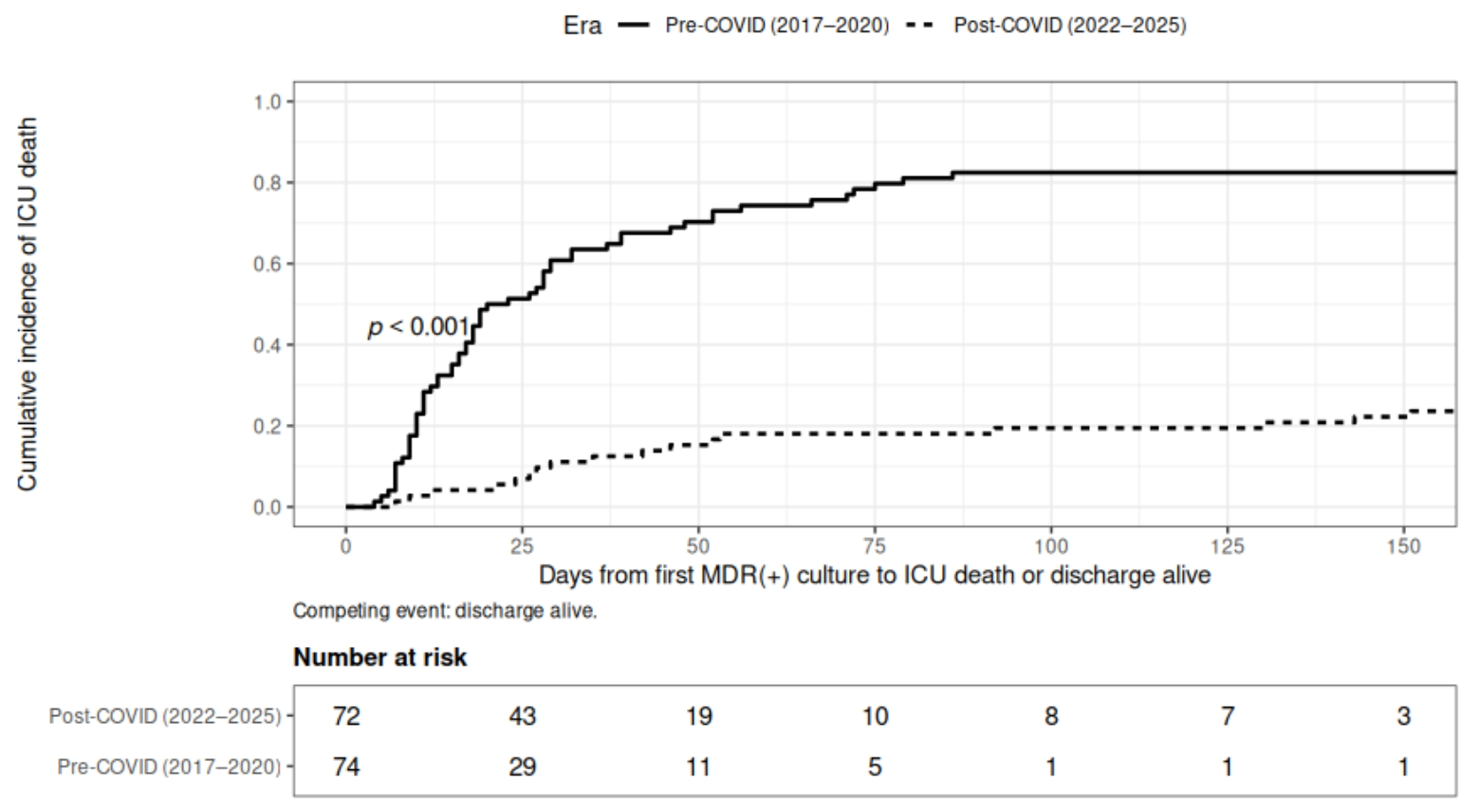
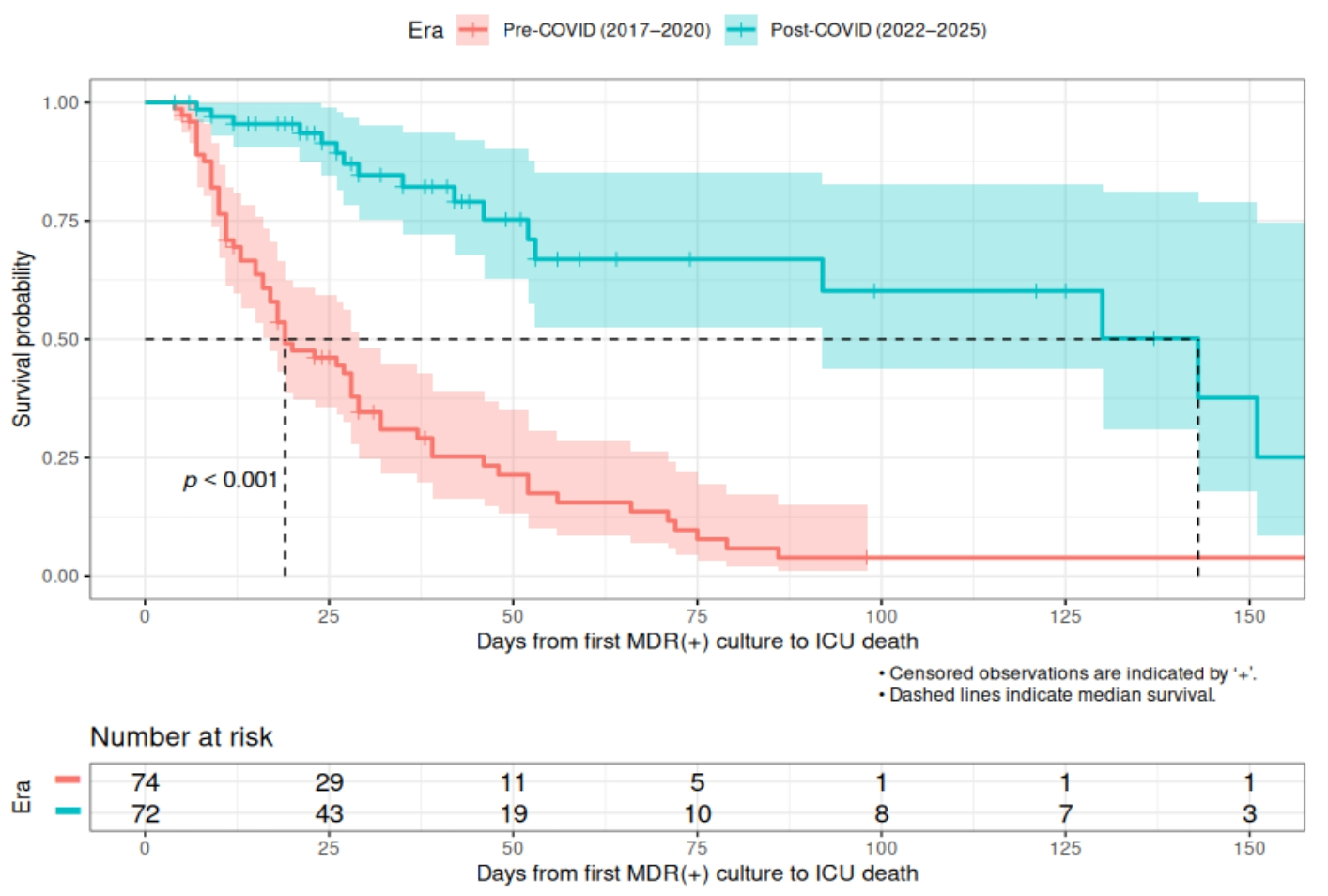
| Mortality, n (%) | 62 (83.78%) | 18 (25.00%) | <0.001 |
| ICU length of stay, days | 31 (17–50) | 44 (23–57.5) | 0.012 |
| Days from start of active therapy to first negative culture, days | 4 (2.25–7) | 4 (2–7) | 0.643 |
| Covariate | sHR | 95% CI | p-Value |
|---|---|---|---|
| Era (Post-COVID vs. Pre-COVID) | 0.20 | 0.11–0.35 | <0.001 |
| Age (per 1-year increase) | 1.00 | 0.98–1.02 | 0.91 |
| CCI (per 1-point increase) | 1.09 | 0.96–1.24 | 0.16 |
| SOFA score (per 1-point increase) | 1.12 | 1.04–1.20 | 0.0015 |
| Variable | Unadjusted | Adjusted | ||||
|---|---|---|---|---|---|---|
| Odds Ratio | 95% Confidence Interval | p-Value | Odds Ratio | 95% Confidence Interval | p-Value | |
| Era (Post vs. Pre) | 0.08 | 0.03–0.18 | <0.001 | 0.11 | 0.04–0.28 | <0.001 |
| Age | 1.03 | 1.01–1.05 | 0.009 | 0.98 | 0.95–1.02 | 0.284 |
| CCI | 1.32 | 1.15–1.54 | <0.001 | 1.31 | 1.04–1.69 | 0.027 |
| SOFA score | 1.27 | 1.14–1.42 | <0.001 | 1.22 | 1.07–1.40 | 0.003 |
Disclaimer/Publisher’s Note: The statements, opinions and data contained in all publications are solely those of the individual author(s) and contributor(s) and not of MDPI and/or the editor(s). MDPI and/or the editor(s) disclaim responsibility for any injury to people or property resulting from any ideas, methods, instructions or products referred to in the content. |
© 2026 by the authors. Licensee MDPI, Basel, Switzerland. This article is an open access article distributed under the terms and conditions of the Creative Commons Attribution (CC BY) license.
Share and Cite
Kefala, S.; Fligou, F.; Chandroulis, I.; Amerali, M.; Tsoupra, S.; Zarkadi, E.; Polyzou, E.; Pnevmatikou, P.; Kolonitsiou, F.; Akinosoglou, K. Multidrug-Resistant Bloodstream Infections Before and After COVID-19: A Temporal Assessment of Outcomes and Resistance Across Two Eras in a Non-COVID Intensive Care Unit—The MATURATE ICU Study. Microorganisms 2026, 14, 2098. https://doi.org/10.3390/microorganisms14092098
Kefala S, Fligou F, Chandroulis I, Amerali M, Tsoupra S, Zarkadi E, Polyzou E, Pnevmatikou P, Kolonitsiou F, Akinosoglou K. Multidrug-Resistant Bloodstream Infections Before and After COVID-19: A Temporal Assessment of Outcomes and Resistance Across Two Eras in a Non-COVID Intensive Care Unit—The MATURATE ICU Study. Microorganisms. 2026; 14(9):2098. https://doi.org/10.3390/microorganisms14092098
Chicago/Turabian StyleKefala, Sotiria, Foteini Fligou, Ioannis Chandroulis, Marina Amerali, Stamatia Tsoupra, Eirini Zarkadi, Eleni Polyzou, Panagiota Pnevmatikou, Fevronia Kolonitsiou, and Karolina Akinosoglou. 2026. "Multidrug-Resistant Bloodstream Infections Before and After COVID-19: A Temporal Assessment of Outcomes and Resistance Across Two Eras in a Non-COVID Intensive Care Unit—The MATURATE ICU Study" Microorganisms 14, no. 9: 2098. https://doi.org/10.3390/microorganisms14092098
APA StyleKefala, S., Fligou, F., Chandroulis, I., Amerali, M., Tsoupra, S., Zarkadi, E., Polyzou, E., Pnevmatikou, P., Kolonitsiou, F., & Akinosoglou, K. (2026). Multidrug-Resistant Bloodstream Infections Before and After COVID-19: A Temporal Assessment of Outcomes and Resistance Across Two Eras in a Non-COVID Intensive Care Unit—The MATURATE ICU Study. Microorganisms, 14(9), 2098. https://doi.org/10.3390/microorganisms14092098