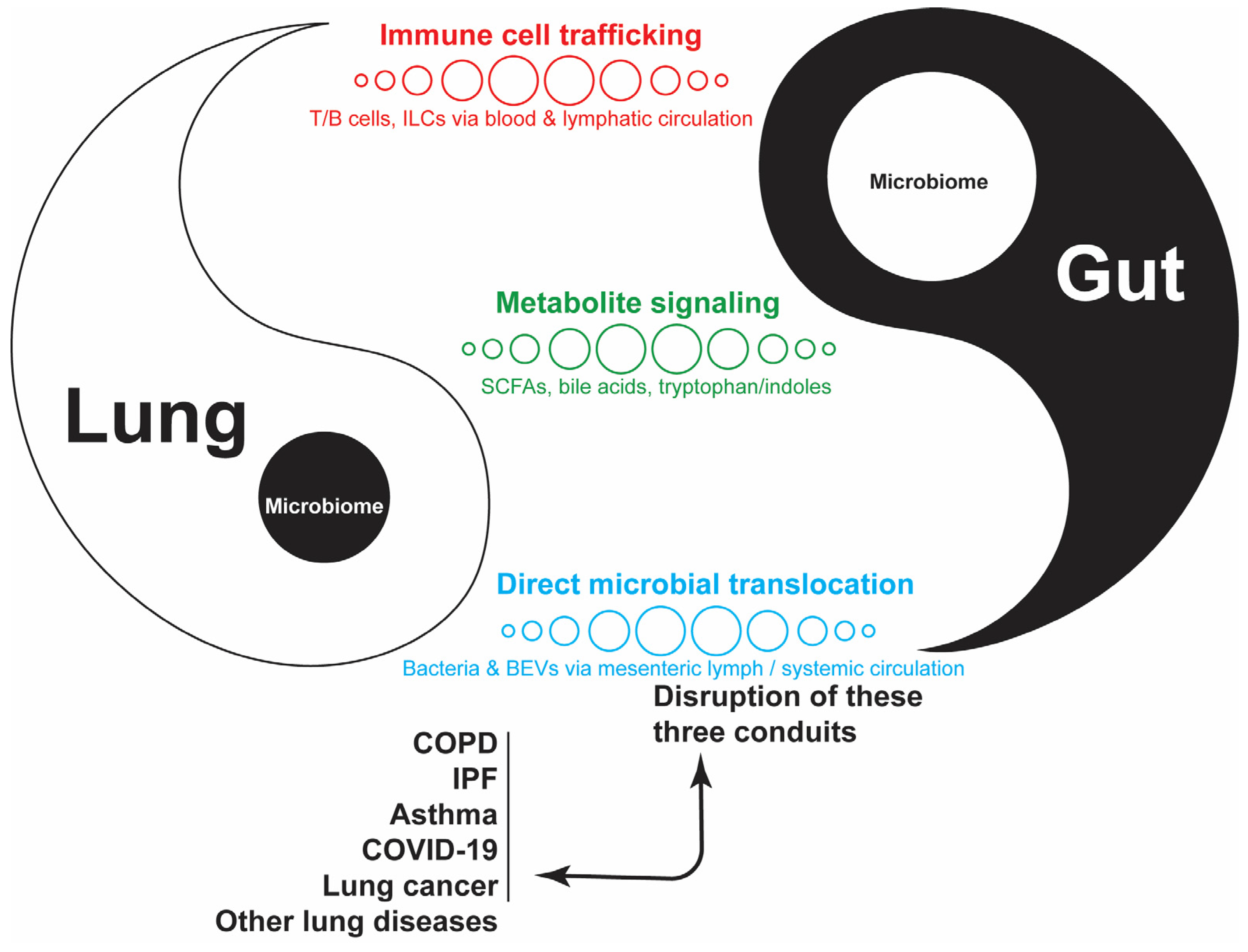
The Gut–Lung Microbiome Axis in Alveolar Stem Cell Regeneration and Lung Repair



Abstract
1. Introduction
2. Gut Microbiome
3. Lung Microbiome
4. Crosstalk Between the Gut and the Lung System

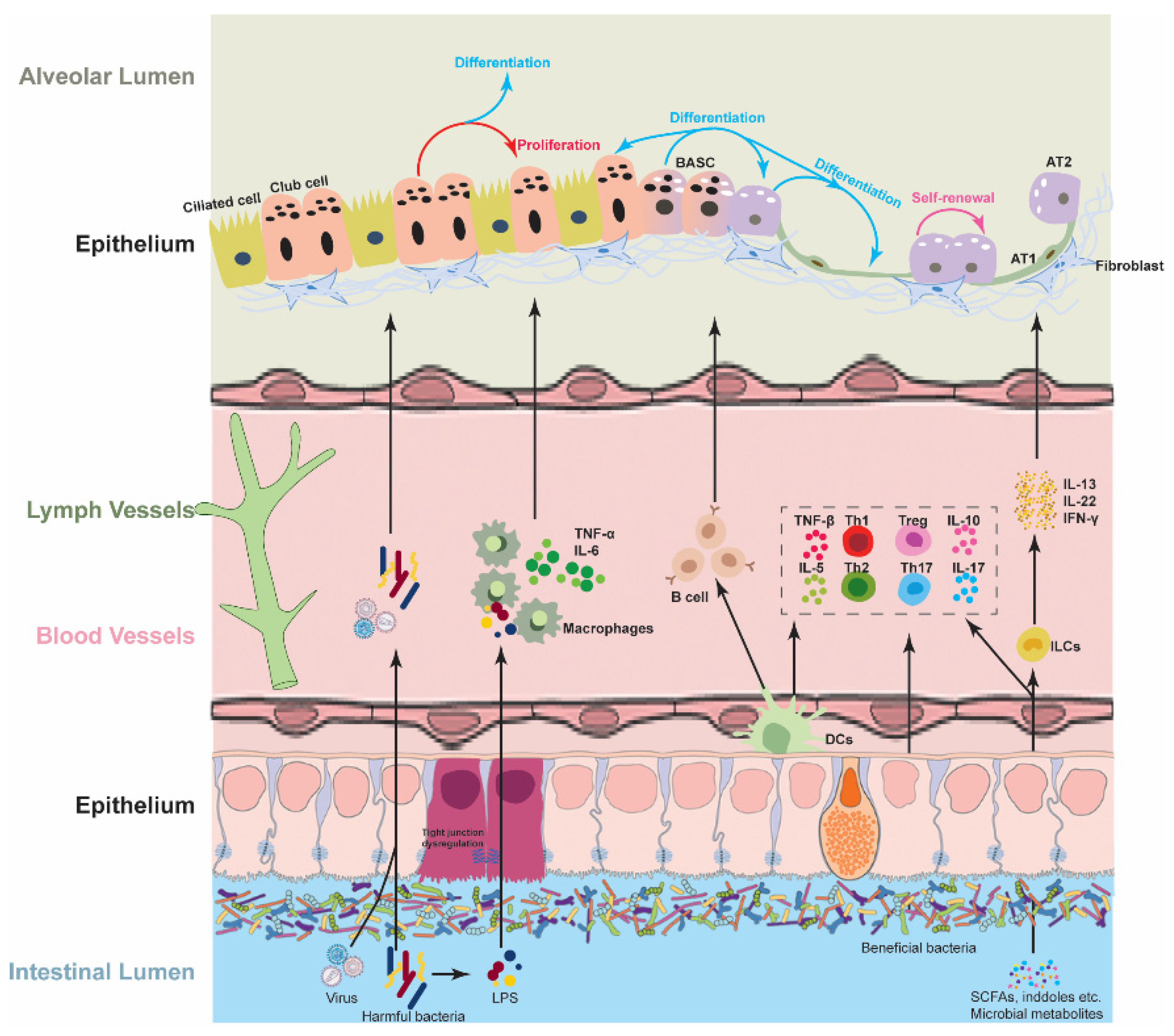
4.1. Immune-Related Interactions
4.1.1. Immune Cells
4.1.2. Immune Cytokines and Chemokines
4.2. Microbial Products
4.2.1. Short-Chain Fatty Acids (SCFAs)
4.2.2. Bile Acids and Tryptophan Metabolites
4.2.3. Bacterial Extracellular Vesicles
4.3. Direct Microbial Transportation
5. Contributions of the Microbial Gut–Lung Axis to Lung Damage and Regeneration
5.1. COVID-19
5.2. Chronic Obstructive Pulmonary Disease (COPD)
5.3. Asthma
5.4. Idiopathic Pulmonary Fibrosis (IPF)
5.5. Lung Cancer
6. Conclusions and Future Directions
Author Contributions
Funding
Institutional Review Board Statement
Informed Consent Statement
Data Availability Statement
Conflicts of Interest
References
- Charlson, E.S.; Chen, J.; Custers-Allen, R.; Bittinger, K.; Li, H.; Sinha, R.; Hwang, J.; Bushman, F.D.; Collman, R.G. Disordered microbial communities in the upper respiratory tract of cigarette smokers. PLoS ONE 2010, 5, e15216. [Google Scholar] [CrossRef] [Scilit] [PubMed]
- Li, R.; Li, J.; Zhou, X. Lung microbiome: New insights into the pathogenesis of respiratory diseases. Signal Transduct. Target. Ther. 2024, 9, 19. [Google Scholar] [CrossRef] [Scilit] [PubMed]
- Zhang, J.; Xia, Y.; Sun, J. Breast and gut microbiome in health and cancer. Genes Dis. 2020, 8, 581–589. [Google Scholar] [CrossRef] [Scilit] [PubMed]
- Hooper, L.V.; Wong, M.H.; Thelin, A.; Hansson, L.; Falk, P.G.; Gordon, J.I. Molecular analysis of commensal host-microbial relationships in the intestine. Science 2001, 291, 881–884. [Google Scholar] [CrossRef] [Scilit] [PubMed]
- Johnson, J.S.; Spakowicz, D.J.; Hong, B.Y.; Petersen, L.M.; Demkowicz, P.; Chen, L.; Leopold, S.R.; Hanson, B.M.; Agresta, H.O.; Gerstein, M.; et al. Evaluation of 16S rRNA gene sequencing for species and strain-level microbiome analysis. Nat. Commun. 2019, 10, 5029. [Google Scholar] [CrossRef] [Scilit] [PubMed]
- Toma, I.; Siegel, M.O.; Keiser, J.; Yakovleva, A.; Kim, A.; Davenport, L.; Devaney, J.; Hoffman, E.P.; Alsubail, R.; Crandall, K.A.; et al. Single-molecule long-read 16S sequencing to characterize the lung microbiome from mechanically ventilated patients with suspected pneumonia. J. Clin. Microbiol. 2014, 52, 3913–3921. [Google Scholar] [CrossRef] [Scilit] [PubMed]
- Dickson, R.P.; Erb-Downward, J.R.; Freeman, C.M.; McCloskey, L.; Beck, J.M.; Huffnagle, G.B.; Curtis, J.L. Spatial Variation in the Healthy Human Lung Microbiome and the Adapted Island Model of Lung Biogeography. Ann. Am. Thorac. Soc. 2015, 12, 821–830. [Google Scholar] [CrossRef] [Scilit] [PubMed]
- Yu, G.; Gail, M.H.; Consonni, D.; Carugno, M.; Humphrys, M.; Pesatori, A.C.; Caporaso, N.E.; Goedert, J.J.; Ravel, J.; Landi, M.T. Characterizing human lung tissue microbiota and its relationship to epidemiological and clinical features. Genome Biol. 2016, 17, 163. [Google Scholar] [CrossRef] [Scilit] [PubMed]
- Wang, Z.; Yang, Y.; Yan, Z.; Liu, H.; Chen, B.; Liang, Z.; Wang, F.; Miller, B.E.; Tal-Singer, R.; Yi, X.; et al. Multi-omic meta-analysis identifies functional signatures of airway microbiome in chronic obstructive pulmonary disease. ISME J. 2020, 14, 2748–2765. [Google Scholar] [CrossRef] [Scilit] [PubMed]
- Wang, Z.; Locantore, N.; Haldar, K.; Ramsheh, M.Y.; Beech, A.S.; Ma, W.; Brown, J.R.; Tal-Singer, R.; Barer, M.R.; Bafadhel, M.; et al. Inflammatory Endotype-associated Airway Microbiome in Chronic Obstructive Pulmonary Disease Clinical Stability and Exacerbations: A Multicohort Longitudinal Analysis. Am. J. Respir. Crit. Care Med. 2021, 203, 1488–1502. [Google Scholar] [CrossRef] [Scilit] [PubMed]
- Einarsson, G.G.; Comer, D.M.; McIlreavey, L.; Parkhill, J.; Ennis, M.; Tunney, M.M.; Elborn, J.S. Community dynamics and the lower airway microbiota in stable chronic obstructive pulmonary disease, smokers and healthy non-smokers. Thorax 2016, 71, 795–803. [Google Scholar] [CrossRef] [Scilit] [PubMed]
- Yun, Y.; Srinivas, G.; Kuenzel, S.; Linnenbrink, M.; Alnahas, S.; Bruce, K.D.; Steinhoff, U.; Baines, J.F.; Schaible, U.E. Environmentally determined differences in the murine lung microbiota and their relation to alveolar architecture. PLoS ONE 2014, 9, e113466. [Google Scholar] [CrossRef] [Scilit] [PubMed]
- Bezerra, F.S.; Lanzetti, M.; Nesi, R.T.; Nagato, A.C.; Silva, C.P.E.; Kennedy-Feitosa, E.; Melo, A.C.; Cattani-Cavalieri, I.; Porto, L.C.; Valenca, S.S. Oxidative Stress and Inflammation in Acute and Chronic Lung Injuries. Antioxidants 2023, 12, 548. [Google Scholar] [CrossRef] [Scilit] [PubMed]
- Tripathy, A.; Gelincik, G.C.; Pardo-Saganta, A. Mechanisms of lung regeneration and repair. Curr. Opin. Genet. Dev. 2026, 98, 102463. [Google Scholar] [CrossRef] [Scilit] [PubMed]
- Abdelwahab, E.M.M.; Rapp, J.; Feller, D.; Csongei, V.; Pal, S.; Bartis, D.; Thickett, D.R.; Pongracz, J.E. Wnt signaling regulates trans-differentiation of stem cell like type 2 alveolar epithelial cells to type 1 epithelial cells. Respir. Res. 2019, 20, 204. [Google Scholar] [CrossRef] [Scilit] [PubMed]
- Brechbuhl, H.M.; Ghosh, M.; Smith, M.K.; Smith, R.W.; Li, B.; Hicks, D.A.; Cole, B.B.; Reynolds, P.R.; Reynolds, S.D. β-catenin dosage is a critical determinant of tracheal basal cell fate determination. Am. J. Pathol. 2011, 179, 367–379. [Google Scholar] [CrossRef] [Scilit] [PubMed]
- Hu, Y.; Ng-Blichfeldt, J.P.; Ota, C.; Ciminieri, C.; Ren, W.; Hiemstra, P.S.; Stolk, J.; Gosens, R.; Königshoff, M. Wnt/β-catenin signaling is critical for regenerative potential of distal lung epithelial progenitor cells in homeostasis and emphysema. Stem Cells 2020, 38, 1467–1478. [Google Scholar] [CrossRef] [Scilit]
- Choi, J.; Jang, Y.J.; Dabrowska, C.; Iich, E.; Evans, K.V.; Hall, H.; Janes, S.M.; Simons, B.D.; Koo, B.K.; Kim, J.; et al. Release of Notch activity coordinated by IL-1β signalling confers differentiation plasticity of airway progenitors via Fosl2 during alveolar regeneration. Nat. Cell Biol. 2021, 23, 953–966. [Google Scholar] [CrossRef] [Scilit] [PubMed]
- Finn, J.; Sottoriva, K.; Pajcini, K.V.; Kitajewski, J.K.; Chen, C.; Zhang, W.; Malik, A.B.; Liu, Y. Dlk1-Mediated Temporal Regulation of Notch Signaling Is Required for Differentiation of Alveolar Type II to Type I Cells during Repair. Cell Rep. 2019, 26, 2942–2954.e5. [Google Scholar] [CrossRef] [Scilit] [PubMed]
- Hicks-Berthet, J.; Ning, B.; Federico, A.; Tilston-Lunel, A.; Matschulat, A.; Ai, X.; Lenburg, M.E.; Beane, J.; Monti, S.; Varelas, X. Yap/Taz inhibit goblet cell fate to maintain lung epithelial homeostasis. Cell Rep. 2021, 36, 109347. [Google Scholar] [CrossRef] [Scilit] [PubMed]
- Liu, Z.; Wu, H.; Jiang, K.; Wang, Y.; Zhang, W.; Chu, Q.; Li, J.; Huang, H.; Cai, T.; Ji, H.; et al. MAPK-Mediated YAP Activation Controls Mechanical-Tension-Induced Pulmonary Alveolar Regeneration. Cell Rep. 2016, 16, 1810–1819. [Google Scholar] [CrossRef] [Scilit] [PubMed]
- Chen, Q.; Rehman, J.; Chan, M.; Fu, P.; Dudek, S.M.; Natarajan, V.; Malik, A.B.; Liu, Y. Angiocrine Sphingosine-1-Phosphate Activation of S1PR2-YAP Signaling Axis in Alveolar Type II Cells Is Essential for Lung Repair. Cell Rep. 2020, 31, 107828. [Google Scholar] [CrossRef] [Scilit] [PubMed]
- Wang, J.; Chao, J. Alveolar Epithelial Cell Dysfunction in Acute Respiratory Distress Syndrome: Mechanistic Insights and Targeted Interventions. Biomedicines 2025, 13, 2299. [Google Scholar] [CrossRef] [Scilit] [PubMed]
- Angeles-Lopez, Q.D.; Rodriguez-Lopez, J.; Agudelo Garcia, P.; Calyeca, J.; Álvarez, D.; Bueno, M.; Tu, L.N.; Salazar-Terreros, M.; Vanegas-Avendaño, N.; Krull, J.E.; et al. Regulation of lung progenitor plasticity and repair by fatty acid oxidation. JCI Insight 2025, 10, e165837. [Google Scholar] [CrossRef] [Scilit] [PubMed]
- Dora, D.; Szőcs, E.; Soós, Á.; Halasy, V.; Somodi, C.; Mihucz, A.; Rostás, M.; Mógor, F.; Lohinai, Z.; Nagy, N. From bench to bedside: An interdisciplinary journey through the gut-lung axis with insights into lung cancer and immunotherapy. Front. Immunol. 2024, 15, 1434804. [Google Scholar] [CrossRef] [Scilit] [PubMed]
- Wang, L.; Cai, Y.; Garssen, J.; Henricks, P.A.J.; Folkerts, G.; Braber, S. The Bidirectional Gut-Lung Axis in Chronic Obstructive Pulmonary Disease. Am. J. Respir. Crit. Care Med. 2023, 207, 1145–1160. [Google Scholar] [CrossRef] [Scilit] [PubMed]
- Yang, Z.; Mao, W.; Wang, J.; Yin, L. The gut-lung axis in asthma: Microbiota-driven mechanisms and therapeutic perspectives. Front. Microbiol. 2025, 16, 1680521. [Google Scholar] [CrossRef] [Scilit] [PubMed]
- Ziaka, M.; Exadaktylos, A. Gut-derived immune cells and the gut-lung axis in ARDS. Crit. Care 2024, 28, 220. [Google Scholar] [CrossRef] [Scilit] [PubMed]
- Yang, J.; Wang, J.; Li, J.; Yang, S. Lung-gut axis, intestinal microbiota, and pulmonary fibrosis: Mechanisms and therapeutic potential. Front. Microbiol. 2025, 16, 1711299. [Google Scholar] [CrossRef] [Scilit] [PubMed]
- Sender, R.; Fuchs, S.; Milo, R. Revised Estimates for the Number of Human and Bacteria Cells in the Body. PLoS Biol. 2016, 14, e1002533. [Google Scholar] [CrossRef] [Scilit] [PubMed]
- Almeida, A.; Mitchell, A.L.; Boland, M.; Forster, S.C.; Gloor, G.B.; Tarkowska, A.; Lawley, T.D.; Finn, R.D. A new genomic blueprint of the human gut microbiota. Nature 2019, 568, 499–504. [Google Scholar] [CrossRef] [Scilit] [PubMed]
- Sun, J.; Dudeja, P.K. Mechanisms Underlying Host-Microbiome Interactions in Pathophysiology of Human Diseases; Springer: Boston, MA, USA, 2018. [Google Scholar]
- Sun, J.; Chang, E.B. Exploring gut microbes in human health and disease: Pushing the envelope. Genes Dis. 2014, 1, 132–139. [Google Scholar] [CrossRef] [Scilit] [PubMed]
- Kuziel, G.A.; Rakoff-Nahoum, S. The gut microbiome. Curr. Biol. 2022, 32, R257–R264. [Google Scholar] [CrossRef] [Scilit] [PubMed]
- Wu, S.; Yi, J.; Zhang, Y.G.; Zhou, J.; Sun, J. Leaky intestine and impaired microbiome in an amyotrophic lateral sclerosis mouse model. Physiol. Rep. 2015, 3, e12356. [Google Scholar] [CrossRef] [Scilit] [PubMed]
- Herdewyn, S.; Cirillo, C.; Van Den Bosch, L.; Robberecht, W.; Vanden Berghe, P.; Van Damme, P. Prevention of intestinal obstruction reveals progressive neurodegeneration in mutant TDP-43 (A315T) mice. Mol. Neurodegener. 2014, 9, 24. [Google Scholar] [CrossRef] [Scilit] [PubMed]
- Rowin, J.; Xia, Y.; Jung, B.; Sun, J. Gut inflammation and dysbiosis in human motor neuron disease. Physiol. Rep. 2017, 5, e13443. [Google Scholar] [CrossRef] [Scilit] [PubMed]
- Hilty, M.; Burke, C.; Pedro, H.; Cardenas, P.; Bush, A.; Bossley, C.; Davies, J.; Ervine, A.; Poulter, L.; Pachter, L.; et al. Disordered microbial communities in asthmatic airways. PLoS ONE 2010, 5, e8578. [Google Scholar] [CrossRef] [Scilit] [PubMed]
- Druszczynska, M.; Sadowska, B.; Kulesza, J.; Gąsienica-Gliwa, N.; Kulesza, E.; Fol, M. The Intriguing Connection Between the Gut and Lung Microbiomes. Pathogens 2024, 13, 1005. [Google Scholar] [CrossRef] [Scilit] [PubMed]
- Kelly, B.J.; Imai, I.; Bittinger, K.; Laughlin, A.; Fuchs, B.D.; Bushman, F.D.; Collman, R.G. Composition and dynamics of the respiratory tract microbiome in intubated patients. Microbiome 2016, 4, 7. [Google Scholar] [CrossRef] [Scilit] [PubMed]
- Yagi, K.; Huffnagle, G.B.; Lukacs, N.W.; Asai, N. The Lung Microbiome during Health and Disease. Int. J. Mol. Sci. 2021, 22, 10872. [Google Scholar] [CrossRef] [Scilit] [PubMed]
- Natalini, J.G.; Singh, S.; Segal, L.N. The dynamic lung microbiome in health and disease. Nat. Rev. Microbiol. 2023, 21, 222–235. [Google Scholar] [CrossRef] [Scilit] [PubMed]
- Bosch, A.A.; Levin, E.; van Houten, M.A.; Hasrat, R.; Kalkman, G.; Biesbroek, G.; de Steenhuijsen Piters, W.A.A.; de Groot, P.C.M.; Pernet, P.; Keijser, B.J.F.; et al. Development of Upper Respiratory Tract Microbiota in Infancy is Affected by Mode of Delivery. eBioMedicine 2016, 9, 336–345. [Google Scholar] [CrossRef] [Scilit] [PubMed]
- Stearns, J.C.; Davidson, C.J.; McKeon, S.; Whelan, F.J.; Fontes, M.E.; Schryvers, A.B.; Bowdish, D.M.; Kellner, J.D.; Surette, M.G. Culture and molecular-based profiles show shifts in bacterial communities of the upper respiratory tract that occur with age. ISME J. 2015, 9, 1246–1259, Correction in ISME J. 2015, 9, 1268. [Google Scholar] [CrossRef] [Scilit] [PubMed]
- Zhao, L.; Luo, J.L.; Ali, M.K.; Spiekerkoetter, E.; Nicolls, M.R. The Human Respiratory Microbiome: Current Understandings and Future Directions. Am. J. Respir. Cell Mol. Biol. 2023, 68, 245–255. [Google Scholar] [CrossRef] [Scilit] [PubMed]
- Tong, X.; Su, F.; Xu, X.; Xu, H.; Yang, T.; Xu, Q.; Dai, H.; Huang, K.; Zou, L.; Zhang, W.; et al. Alterations to the Lung Microbiome in Idiopathic Pulmonary Fibrosis Patients. Front. Cell. Infect. Microbiol. 2019, 9, 149. [Google Scholar] [CrossRef] [Scilit] [PubMed]
- Huffnagle, G.B.; Dickson, R.P.; Lukacs, N.W. The respiratory tract microbiome and lung inflammation: A two-way street. Mucosal Immunol. 2017, 10, 299–306. [Google Scholar] [CrossRef] [Scilit] [PubMed]
- Dickson, R.P.; Erb-Downward, J.R.; Huffnagle, G.B. The role of the bacterial microbiome in lung disease. Expert Rev. Respir. Med. 2013, 7, 245–257. [Google Scholar] [CrossRef] [Scilit] [PubMed]
- Günther, A.; Siebert, C.; Schmidt, R.; Ziegler, S.; Grimminger, F.; Yabut, M.; Temmesfeld, B.; Walmrath, D.; Morr, H.; Seeger, W. Surfactant alterations in severe pneumonia, acute respiratory distress syndrome, and cardiogenic lung edema. Am. J. Respir. Crit. Care Med. 1996, 153, 176–184. [Google Scholar] [CrossRef] [Scilit] [PubMed]
- Panzer, A.R.; Lynch, S.V.; Langelier, C.; Christie, J.D.; McCauley, K.; Nelson, M.; Cheung, C.K.; Benowitz, N.L.; Cohen, M.J.; Calfee, C.S. Lung Microbiota Is Related to Smoking Status and to Development of Acute Respiratory Distress Syndrome in Critically Ill Trauma Patients. Am. J. Respir. Crit. Care Med. 2018, 197, 621–631. [Google Scholar] [CrossRef] [Scilit] [PubMed]
- Dickson, R.P.; Singer, B.H.; Newstead, M.W.; Falkowski, N.R.; Erb-Downward, J.R.; Standiford, T.J.; Huffnagle, G.B. Enrichment of the lung microbiome with gut bacteria in sepsis and the acute respiratory distress syndrome. Nat. Microbiol. 2016, 1, 16113. [Google Scholar] [CrossRef] [Scilit] [PubMed]
- Morrisey, E.E.; Rustgi, A.K. The Lung and Esophagus: Developmental and Regenerative Overlap. Trends Cell Biol. 2018, 28, 738–748. [Google Scholar] [CrossRef] [Scilit] [PubMed]
- Park, J.; Kim, M.; Kang, S.G.; Jannasch, A.H.; Cooper, B.; Patterson, J.; Kim, C.H. Short-chain fatty acids induce both effector and regulatory T cells by suppression of histone deacetylases and regulation of the mTOR-S6K pathway. Mucosal Immunol. 2015, 8, 80–93. [Google Scholar] [CrossRef] [Scilit] [PubMed]
- Verma, A.; Bhagchandani, T.; Rai, A.; Nikita; Sardarni, U.K.; Bhavesh, N.S.; Gulati, S.; Malik, R.; Tandon, R. Short-Chain Fatty Acid (SCFA) as a Connecting Link between Microbiota and Gut-Lung Axis-A Potential Therapeutic Intervention to Improve Lung Health. ACS Omega 2024, 9, 14648–14671. [Google Scholar] [CrossRef] [Scilit] [PubMed]
- Sivaprakasam, S.; Prasad, P.D.; Singh, N. Benefits of short-chain fatty acids and their receptors in inflammation and carcinogenesis. Pharmacol. Ther. 2016, 164, 144–151. [Google Scholar] [CrossRef] [Scilit] [PubMed]
- Rutting, S.; Xenaki, D.; Malouf, M.; Horvat, J.C.; Wood, L.G.; Hansbro, P.M.; Oliver, B.G. Short-chain fatty acids increase TNFα-induced inflammation in primary human lung mesenchymal cells through the activation of p38 MAPK. Am. J. Physiol.-Lung Cell. Mol. Physiol. 2019, 316, L157–L174. [Google Scholar] [CrossRef] [Scilit] [PubMed]
- Trompette, A.; Gollwitzer, E.S.; Yadava, K.; Sichelstiel, A.K.; Sprenger, N.; Ngom-Bru, C.; anchard, C.; Junt, T.; Nicod, L.P.; Harris, N.L.; et al. Gut microbiota metabolism of dietary fiber influences allergic airway disease and hematopoiesis. Nat. Med. 2014, 20, 159–166. [Google Scholar] [CrossRef] [Scilit] [PubMed]
- Fleishman, J.S.; Kumar, S. Bile acid metabolism and signaling in health and disease: Molecular mechanisms and therapeutic targets. Signal Transduct. Target. Ther. 2024, 9, 97. [Google Scholar] [CrossRef] [Scilit] [PubMed]
- Comeglio, P.; Morelli, A.; Adorini, L.; Maggi, M.; Vignozzi, L. Beneficial effects of bile acid receptor agonists in pulmonary disease models. Expert Opin. Investig. Drugs 2017, 26, 1215–1228. [Google Scholar] [CrossRef] [Scilit] [PubMed]
- Chen, B.; Cai, H.R.; Xue, S.; You, W.J.; Liu, B.; Jiang, H.D. Bile acids induce activation of alveolar epithelial cells and lung fibroblasts through farnesoid X receptor-dependent and independent pathways. Respirology 2016, 21, 1075–1080. [Google Scholar] [CrossRef] [Scilit] [PubMed]
- Dong, F.; Perdew, G.H. The aryl hydrocarbon receptor as a mediator of host-microbiota interplay. Gut Microbes 2020, 12, 1859812. [Google Scholar] [CrossRef] [Scilit] [PubMed]
- Vyhlídalová, B.; Krasulová, K.; Pečinková, P.; Marcalíková, A.; Vrzal, R.; Zemánková, L.; Vančo, J.; Trávníček, Z.; Vondráček, J.; Karasová, M.; et al. Gut Microbial Catabolites of Tryptophan Are Ligands and Agonists of the Aryl Hydrocarbon Receptor: A Detailed Characterization. Int. J. Mol. Sci. 2020, 21, 2614. [Google Scholar] [CrossRef] [Scilit] [PubMed]
- Tsay, T.B.; Chen, P.H.; Chen, L.W. Aryl hydrocarbon receptor ligands enhance lung immunity through intestinal IKKβ pathways. J. Transl. Med. 2019, 17, 304. [Google Scholar] [CrossRef] [Scilit] [PubMed]
- Borghi, M.; Puccetti, M.; Pariano, M.; Renga, G.; Stincardini, C.; Ricci, M.; Giovagnoli, S.; Costantini, C.; Romani, L. Tryptophan as a Central Hub for Host/Microbial Symbiosis. Int. J. Tryptophan Res. 2020, 13, 1178646920919755. [Google Scholar] [CrossRef] [Scilit] [PubMed]
- Zelante, T.; Iannitti, R.G.; Cunha, C.; De Luca, A.; Giovannini, G.; Pieraccini, G.; Zecchi, R.; D'Angelo, C.; Massi-Benedetti, C.; Fallarino, F.; et al. Tryptophan catabolites from microbiota engage aryl hydrocarbon receptor and balance mucosal reactivity via interleukin-22. Immunity 2013, 39, 372–385. [Google Scholar] [CrossRef] [Scilit] [PubMed]
- Hou, S.; Yue, Q.; Hou, X.; Wu, Q. Targeting the Aryl Hydrocarbon Receptor: The Potential of Indole Compounds in the Treatment of Cystic Fibrosis. Int. J. Mol. Sci. 2025, 26, 9876. [Google Scholar] [CrossRef] [Scilit] [PubMed]
- Puccetti, M.; Pariano, M.; Renga, G.; Santarelli, I.; D’Onofrio, F.; Bellet, M.M.; Stincardini, C.; Bartoli, A.; Costantini, C.; Romani, L.; et al. Targeted Drug Delivery Technologies Potentiate the Overall Therapeutic Efficacy of an Indole Derivative in a Mouse Cystic Fibrosis Setting. Cells 2021, 10, 1601. [Google Scholar] [CrossRef] [Scilit] [PubMed]
- Wang, P.; Tao, W.; Li, Q.; Ma, W.; Jia, W.; Kang, Y. Indole-3-Aldehyde alleviates lung inflammation in COPD through activating Aryl Hydrocarbon Receptor to inhibit HDACs/NF-κB/NLRP3 signaling pathways. J. Mol. Med. 2025, 103, 157–174. [Google Scholar] [CrossRef] [Scilit] [PubMed]
- Zimmerman, E.; Sturrock, A.; Reilly, C.A.; Burrell-Gerbers, K.L.; Warren, K.; Mir-Kasimov, M.; hang, M.A.; Pierce, M.S.; Helms, M.N.; Paine, R., 3rd. Aryl Hydrocarbon Receptor Activation in Pulmonary Alveolar Epithelial Cells Limits Inflammation and Preserves Lung Epithelial Cell Integrity. J. Immunol. 2024, 213, 600–611. [Google Scholar] [CrossRef] [Scilit] [PubMed]
- Preet, R.; Islam, M.A.; Shim, J.; Rajendran, G.; Mitra, A.; Vishwakarma, V.; Kutz, C.; Choudhury, S.; Pathak, H.; Dai, Q.; et al. Gut commensal Bifidobacterium-derived extracellular vesicles modulate the therapeutic effects of anti-PD-1 in lung cancer. Nat. Commun. 2025, 16, 3500. [Google Scholar] [CrossRef] [Scilit] [PubMed]
- Jang, J.Y.; Seo, J.H.; Choi, J.J.; Ryu, H.J.; Yun, H.; Ha, D.M.; Yang, J. Insight into microbial extracellular vesicles as key communication materials and their clinical implications for lung cancer (Review). Int. J. Mol. Med. 2025, 56, 119. [Google Scholar] [CrossRef] [Scilit] [PubMed]
- Melo-Marques, I.; Cardoso, S.M.; Empadinhas, N. Bacterial extracellular vesicles at the interface of gut microbiota and immunity. Gut Microbes 2024, 16, 2396494. [Google Scholar] [CrossRef] [Scilit] [PubMed]
- Liu, Q.; Tian, X.; Maruyama, D.; Arjomandi, M.; Prakash, A. Lung immune tone via gut-lung axis: Gut-derived LPS and short-chain fatty acids’ immunometabolic regulation of lung IL-1β, FFAR2, and FFAR3 expression. Am. J. Physiol.-Lung Cell. Mol. Physiol. 2021, 321, L65–L78. [Google Scholar] [CrossRef] [Scilit] [PubMed]
- Tang, J.; Xu, L.; Zeng, Y.; Gong, F. Effect of gut microbiota on LPS-induced acute lung injury by regulating the TLR4/NF-kB signaling pathway. Int. Immunopharmacol. 2021, 91, 107272. [Google Scholar] [CrossRef] [Scilit] [PubMed]
- Eladham, M.W.; Sharif-Askari, N.S.; Sekar, P.; Mdkhana, B.; Selvakumar, B.; Al-Sheakly, B.K.S.; Sharif-Askari, F.S.; Hachim, I.; Halwani, R. The role of gut leakage and immune cell miss-homing on gut dysbiosis-induced lung inflammation in a DSS mice model. PLoS ONE 2025, 20, e0324230. [Google Scholar] [CrossRef] [Scilit] [PubMed]
- Domscheit, H.; Hegeman, M.A.; Carvalho, N.; Spieth, P.M. Molecular Dynamics of Lipopolysaccharide-Induced Lung Injury in Rodents. Front. Physiol. 2020, 11, 36. [Google Scholar] [CrossRef] [Scilit] [PubMed]
- Liu, T.Y.; Zhao, L.L.; Chen, S.B.; Hou, B.C.; Huang, J.; Hong, X.; Qing, L.; Fang, Y.; Tao, Z. Polygonatum sibiricum polysaccharides prevent LPS-induced acute lung injury by inhibiting inflammation via the TLR4/Myd88/NF-κB pathway. Exp. Ther. Med. 2020, 20, 3733–3739. [Google Scholar] [CrossRef] [Scilit] [PubMed]
- Notz, Q.; Schmalzing, M.; Wedekink, F.; Schlesinger, T.; Gernert, M.; Herrmann, J.; Sorger, L.; Weismann, D.; Schmid, B.; Sitter, M.; et al. Pro- and Anti-Inflammatory Responses in Severe COVID-19-Induced Acute Respiratory Distress Syndrome-An Observational Pilot Study. Front. Immunol. 2020, 11, 581338. [Google Scholar] [CrossRef] [Scilit] [PubMed]
- Headland, S.E.; Dengler, H.S.; Xu, D.; Teng, G.; Everett, C.; Ratsimandresy, R.A.; Yan, D.; Kang, J.; Ganeshan, K.; Nazarova, E.V.; et al. Oncostatin M expression induced by bacterial triggers drives airway inflammatory and mucus secretion in severe asthma. Sci. Transl. Med. 2022, 14, eabf8188. [Google Scholar] [CrossRef] [Scilit] [PubMed]
- Kiyono, H.; Kweon, M.N.; Hiroi, T.; Takahashi, I. The mucosal immune system: From specialized immune defense to inflammation and allergy. Acta Odontol. Scand. 2001, 59, 145–153. [Google Scholar] [CrossRef] [Scilit] [PubMed]
- Du, B.; Fu, Y.; Han, Y.; Sun, Q.; Xu, J.; Yang, Y.; Rong, R. The lung-gut crosstalk in respiratory and inflammatory bowel disease. Front. Cell. Infect. Microbiol. 2023, 13, 1218565. [Google Scholar] [CrossRef] [Scilit] [PubMed]
- Johansson-Lindbom, B.; Svensson, M.; Wurbel, M.A.; Malissen, B.; Márquez, G.; Agace, W. Selective generation of gut tropic T cells in gut-associated lymphoid tissue (GALT): Requirement for GALT dendritic cells and adjuvant. J. Exp. Med. 2003, 198, 963–969. [Google Scholar] [CrossRef] [Scilit] [PubMed]
- Mora, J.R.; Bono, M.R.; Manjunath, N.; Weninger, W.; Cavanagh, L.L.; Rosemblatt, M.; Von Andrian, U.H. Selective imprinting of gut-homing T cells by Peyer’s patch dendritic cells. Nature 2003, 424, 88–93. [Google Scholar] [CrossRef] [Scilit] [PubMed]
- Mörbe, U.M.; Jørgensen, P.B.; Fenton, T.M.; von Burg, N.; Riis, L.B.; Spencer, J.; Agace, W.W. Human gut-associated lymphoid tissues (GALT); diversity, structure, and function. Mucosal Immunol. 2021, 14, 793–802. [Google Scholar] [CrossRef] [Scilit] [PubMed]
- Pietrzak, B.; Tomela, K.; Olejnik-Schmidt, A.; Mackiewicz, A.; Schmidt, M. Secretory IgA in Intestinal Mucosal Secretions as an Adaptive Barrier against Microbial Cells. Int. J. Mol. Sci. 2020, 21, 9254. [Google Scholar] [CrossRef] [Scilit] [PubMed]
- Wang, X.; Zhang, J.; Wu, Y.; Xu, Y.; Zheng, J. SIgA in various pulmonary diseases. Eur. J. Med. Res. 2023, 28, 299. [Google Scholar] [CrossRef] [Scilit] [PubMed]
- Liu, J.; Hong, W.; Sun, Z.; Zhang, S.; Xue, C.; Dong, N. The gut-lung axis: Effects and mechanisms of gut microbiota on pulmonary diseases. Front. Immunol. 2025, 16, 1693964. [Google Scholar] [CrossRef] [Scilit] [PubMed]
- Vieira, R.S.; Castoldi, A.; Basso, P.J.; Hiyane, M.I.; Câmara, N.O.S.; Almeida, R.R. Butyrate Attenuates Lung Inflammation by Negatively Modulating Th9 Cells. Front. Immunol. 2019, 10, 67. [Google Scholar] [CrossRef] [Scilit] [PubMed]
- Can, U.I.; Stenske, S.E.; Rosenbaum, M.D.; Reinhardt, R.L. Rapid group-2 innate lymphoid cell mobilization from the intestine aids in early lung defense and repair. Cell Rep. 2025, 44, 115868. [Google Scholar] [CrossRef] [Scilit] [PubMed]
- Chen, Y.; Ji, X.; Qiu, J.; Qiu, J. The context-dependent role of group 2 innate lymphoid cells in lung diseases. Acta Biochim Biophys. Sin. 2026, 58, 120–136. [Google Scholar] [CrossRef] [Scilit] [PubMed]
- Kim, Y.C.; Sohn, K.H.; Kang, H.R. Gut microbiota dysbiosis and its impact on asthma and other lung diseases: Potential therapeutic approaches. Korean J. Intern. Med. 2024, 39, 746–758. [Google Scholar] [CrossRef] [Scilit] [PubMed]
- Li, Q.; Song, X.C.; Li, K.; Wang, J. Gut-lung immunometabolic crosstalk in sepsis: From microbiota to respiratory failure. Front. Med. 2025, 12, 1685044. [Google Scholar] [CrossRef] [Scilit] [PubMed]
- Stevens, J.; Steinmeyer, S.; Bonfield, M.; Peterson, L.; Wang, T.; Gray, J.; Lewkowich, I.; Xu, Y.; Du, Y.; Guo, M.; et al. The balance between protective and pathogenic immune responses to pneumonia in the neonatal lung is enforced by gut microbiota. Sci. Transl. Med. 2022, 14, eabl3981. [Google Scholar] [CrossRef] [Scilit] [PubMed]
- Zheng, H.; Yang, J.; Deng, Y.; Zhang, B.; Bai, F.; Chen, Y.; Lu, Y.; Lian, B.; Huang, J.; Yang, Y.; et al. Kadsua coccinea Extract Alleviates Rheumatoid Arthritis via TNF-α Suppression and Gut Microbiota Modulation. J. Inflamm. Res. 2026, 19, 557108. [Google Scholar] [CrossRef] [Scilit] [PubMed]
- Hernández, P.P.; Mahlakoiv, T.; Yang, I.; Schwierzeck, V.; Nguyen, N.; Guendel, F.; Gronke, K.; Ryffel, B.; Hoelscher, C.; Dumoutier, L.; et al. Interferon-λ and interleukin 22 act synergistically for the induction of interferon-stimulated genes and control of rotavirus infection. Nat. Immunol. 2015, 16, 698–707. [Google Scholar] [CrossRef] [Scilit] [PubMed]
- Muñoz, M.; Eidenschenk, C.; Ota, N.; Wong, K.; Lohmann, U.; Kühl, A.A.; Wang, X.; Manzanillo, P.; Li, Y.; Rutz, S.; et al. Interleukin-22 induces interleukin-18 expression from epithelial cells during intestinal infection. Immunity 2015, 42, 321–331. [Google Scholar] [CrossRef] [Scilit] [PubMed]
- Zhou, W.; Sonnenberg, G.F. Activation and Suppression of Group 3 Innate Lymphoid Cells in the Gut. Trends Immunol. 2020, 41, 721–733. [Google Scholar] [CrossRef] [Scilit] [PubMed]
- Zhou, X.; Liao, Y. Gut-Lung Crosstalk in Sepsis-Induced Acute Lung Injury. Front. Microbiol. 2021, 12, 779620. [Google Scholar] [CrossRef] [Scilit] [PubMed]
- Cardinale, V.; Capurso, G.; Ianiro, G.; Gasbarrini, A.; Arcidiacono, P.G.; Alvaro, D. Intestinal permeability changes with bacterial translocation as key events modulating systemic host immune response to SARS-CoV-2: A working hypothesis. Dig. Liver Dis. 2020, 52, 1383–1389. [Google Scholar] [CrossRef] [Scilit] [PubMed]
- Dong, Y.; He, L.; Zhu, Z.; Yang, F.; Ma, Q.; Zhang, Y.; Zhang, X.; Liu, X. The mechanism of gut-lung axis in pulmonary fibrosis. Front Cell. Infect. Microbiol. 2024, 14, 1258246. [Google Scholar] [CrossRef] [Scilit] [PubMed]
- Ding, N.; Xiao, H.; Zhen, L.; Li, H.; Zhang, Z.; Ge, J.; Jia, H. Systemic cytokines inhibition with Imp7 siRNA nanoparticle ameliorates gut injury in a mouse model of ventilator-induced lung injury. Biomed. Pharmacother. 2023, 165, 115237. [Google Scholar] [CrossRef] [Scilit] [PubMed]
- Richards, L.B.; Li, M.; Folkerts, G.; Henricks, P.A.; Garssen, J.; van Esch, B.C. Butyrate and Propionate Restore the Cytokine and House Dust Mite Compromised Barrier Function of Human Bronchial Airway Epithelial Cells. Int. J. Mol. Sci. 2020, 22, 65. [Google Scholar] [CrossRef] [Scilit] [PubMed]
- Topping, D.L.; Clifton, P.M. Short-chain fatty acids and human colonic function: Roles of resistant starch and nonstarch polysaccharides. Physiol. Rev. 2001, 81, 1031–1064. [Google Scholar] [CrossRef] [Scilit] [PubMed]
- Xie, L.; Wang, L.; Liao, Y.; Yao, M.; Mai, T.; Fan, R.; Han, Y.; Zhou, G. Therapeutic potential of short-chain fatty acids for acute lung injury: A systematic review and meta-analysis of preclinical animal studies. Front. Nutr. 2025, 11, 1528200. [Google Scholar] [CrossRef] [Scilit] [PubMed]
- Arpaia, N.; Campbell, C.; Fan, X.; Dikiy, S.; van der Veeken, J.; DeRoos, P.; Liu, H.; Cross, J.R.; Pfeffer, K.; Coffer, P.J.; et al. Metabolites produced by commensal bacteria promote peripheral regulatory T-cell generation. Nature 2013, 504, 451–455. [Google Scholar] [CrossRef] [Scilit] [PubMed]
- Furusawa, Y.; Obata, Y.; Fukuda, S.; Endo, T.A.; Nakato, G.; Takahashi, D.; Nakanishi, Y.; Uetake, C.; Kato, K.; Kato, T.; et al. Commensal microbe-derived butyrate induces the differentiation of colonic regulatory T cells. Nature 2013, 504, 446–450, Erratum in Nature 2014, 506, 254. [Google Scholar] [CrossRef] [Scilit] [PubMed]
- Jain, H.; Kumar, A.; Almousa, S.; Mishra, S.; Langsten, K.L.; Kim, S.; Sharma, M.; Su, Y.; Singh, S.; Kerr, B.A.; et al. Characterisation of LPS+ bacterial extracellular vesicles along the gut-hepatic portal vein-liver axis. J. Extracell. Vesicles 2024, 13, e12474. [Google Scholar] [CrossRef] [Scilit] [PubMed]
- Wang, Y.; Luo, X.; Xiang, X.; Hao, C.; Ma, D. Roles of bacterial extracellular vesicles in systemic diseases. Front. Microbiol. 2023, 14, 1258860. [Google Scholar] [CrossRef] [Scilit] [PubMed]
- Zhang, B.; Liu, M.; Jiang, L.; Chen, Z.; Tian, W.; Li, K.; Yu, B.; Zhang, W.; Li, S.; Zhou, Y.; et al. Bacterial Extracellular Vesicles: Emerging Regulators in the Gut-Organ Axis and Prospective Biomedical Applications. Curr. Microbiol. 2025, 82, 486. [Google Scholar] [CrossRef] [Scilit] [PubMed]
- Kumar, P.S. From focal sepsis to periodontal medicine: A century of exploring the role of the oral microbiome in systemic disease. J. Physiol. 2017, 595, 465–476. [Google Scholar] [CrossRef] [Scilit] [PubMed]
- Mammen, M.J.; Scannapieco, F.A.; Sethi, S. Oral-lung microbiome interactions in lung diseases. Periodontology 2000 2020, 83, 234–241. [Google Scholar] [CrossRef] [Scilit] [PubMed]
- Liu, X.; Shi, F.; Zeng, J.; Bi, J.; Mo, C.; Chai, Y.; Wu, B.; Xu, S. Oral microbiota and respiratory diseases: Advances and perspectives. Clin. Microbiol. Rev. 2025, 38, e0015024. [Google Scholar] [CrossRef] [Scilit] [PubMed]
- Man, W.H.; de Steenhuijsen Piters, W.A.A.; Bogaert, D. The microbiota of the respiratory tract: Gatekeeper to respiratory health. Nat. Rev. Microbiol. 2017, 15, 259–270. [Google Scholar] [CrossRef] [Scilit] [PubMed]
- Zhao, L.; Cho, W.C.; Nicolls, M.R. Colorectal Cancer-Associated Microbiome Patterns and Signatures. Front. Genet. 2021, 12, 787176. [Google Scholar] [CrossRef] [Scilit] [PubMed]
- Zhang, J.; Garrett, S.; Sun, J. Gastrointestinal symptoms, pathophysiology, and treatment in COVID-19. Genes Dis. 2021, 8, 385–400. [Google Scholar] [CrossRef] [Scilit] [PubMed]
- Ma, Y.; Yang, X.; Chatterjee, V.; Wu, M.H.; Yuan, S.Y. The Gut-Lung Axis in Systemic Inflammation. Role of Mesenteric Lymph as a Conduit. Am. J. Respir. Cell Mol. Biol. 2021, 64, 19–28. [Google Scholar] [CrossRef] [Scilit] [PubMed]
- Magnotti, L.J.; Upperman, J.S.; Xu, D.Z.; Lu, Q.; Deitch, E.A. Gut-derived mesenteric lymph but not portal blood increases endothelial cell permeability and promotes lung injury after hemorrhagic shock. Ann. Surg. 1998, 228, 518–527. [Google Scholar] [CrossRef] [Scilit] [PubMed]
- Russell, P.S.; Nachkebia, S.; Maldonado-Zimbron, V.E.; Chuklin, S.; Gimel’farb, G.; Hong, J.; Martin, N.D.; Itkin, M.; Phillips, A.R.; Windsor, J.A. Therapeutic thoracic duct drainage: A systematic review of the Eastern European experience and future potential. Lymphology 2022, 55, 86–109. [Google Scholar] [CrossRef] [Scilit] [PubMed]
- Dayal, S.D.; Hauser, C.J.; Feketeova, E.; Fekete, Z.; Adams, J.M.; Lu, Q.; Xu, D.Z.; Zaets, S.; Deitch, E.A. Shock mesenteric lymph-induced rat polymorphonuclear neutrophil activation and endothelial cell injury is mediated by aqueous factors. J. Trauma Acute Care Surg. 2002, 52, 1048–1055; discussion 55. [Google Scholar] [CrossRef] [Scilit] [PubMed]
- Liu, Y.; Chen, C.; Sun, Q.; Sun, H.; Liu, N.; Liu, Q.; Ma, J.; Wang, P.; Hu, C.; Wu, J.; et al. Mesenteric Lymph Duct Drainage Attenuates Lung Inflammatory Injury and Inhibits Endothelial Cell Apoptosis in Septic Rats. BioMed Res. Int. 2020, 2020, 3049302. [Google Scholar] [CrossRef] [Scilit] [PubMed]
- Lv, K.; Liang, Q. Macrophages in sepsis-induced acute lung injury: Exosomal modulation and therapeutic potential. Front. Immunol. 2025, 15, 1518008. [Google Scholar] [CrossRef] [Scilit] [PubMed]
- Reino, D.C.; Pisarenko, V.; Palange, D.; Doucet, D.; Bonitz, R.P.; Lu, Q.; Colorado, I.; Sheth, S.U.; Chandler, B.; Kannan, K.B.; et al. Trauma hemorrhagic shock-induced lung injury involves a gut-lymph-induced TLR4 pathway in mice. PLoS ONE 2011, 6, e14829. [Google Scholar] [CrossRef] [Scilit] [PubMed]
- Tang, Y.; Kong, J.; Zhou, B.; Wang, X.; Liu, X.; Wang, Y.; Zhu, S. Mesenteric Lymph Duct Ligation Alleviates Acute Lung Injury Caused by Severe Acute Pancreatitis Through Inhibition of High Mobility Group Box 1-Induced Inflammation in Rats. Dig. Dis. Sci. 2021, 66, 4344–4353. [Google Scholar] [CrossRef] [Scilit] [PubMed]
- Zhang, W.; Jin, C.; Zhang, S.; Wu, L.; Li, B.; Shi, M. Gut lymph purification alleviates acute lung injury induced by intestinal ischemia-reperfusion in rats by removing danger-associated molecular patterns from gut lymph. Heliyon 2024, 10, e25711. [Google Scholar] [CrossRef] [Scilit] [PubMed]
- Basil, M.C.; Alysandratos, K.D.; Kotton, D.N.; Morrisey, E.E. Lung repair and regeneration: Advanced models and insights into human disease. Cell Stem Cell 2024, 31, 439–454. [Google Scholar] [CrossRef] [Scilit] [PubMed]
- Konkimalla, A.; Tata, A.; Tata, P.R. Lung Regeneration: Cells, Models, and Mechanisms. Cold Spring Harb. Perspect. Biol. 2022, 14, a040873. [Google Scholar] [CrossRef] [Scilit] [PubMed]
- Parekh, K.R.; Nawroth, J.; Pai, A.; Busch, S.M.; Senger, C.N.; Ryan, A.L. Stem cells and lung regeneration. Am. J. Physiol.-Cell Physiol. 2020, 319, C675–C693. [Google Scholar] [CrossRef] [Scilit] [PubMed]
- Zhang, J.; Liu, Y. Epithelial stem cells and niches in lung alveolar regeneration and diseases. Chin. Med. J. Pulm. Crit. Care Med. 2024, 2, 17–26. [Google Scholar] [CrossRef] [Scilit] [PubMed]
- Sun, X.; Perl, A.K.; Li, R.; Bell, S.M.; Sajti, E.; Kalinichenko, V.V.; Kalin, T.V.; Misra, R.S.; Deshmukh, H.; Clair, G.; et al. A census of the lung: CellCards from LungMAP. Dev. Cell 2022, 57, 112–145.e2. [Google Scholar] [CrossRef] [Scilit] [PubMed]
- Dobbs, L.; Johnson, M.; Vanderbilt, J.; Allen, L.; Gonzalez, R. The great big alveolar TI cell: Evolving concepts and paradigms. Cell. Physiol. Biochem. 2010, 25, 55–62. [Google Scholar] [CrossRef] [Scilit] [PubMed]
- Barkauskas, C.E.; Cronce, M.J.; Rackley, C.R.; Bowie, E.J.; Keene, D.R.; Stripp, B.R.; Randell, S.H.; Noble, P.W.; Hogan, B.L. Type 2 alveolar cells are stem cells in adult lung. J. Clin. Investig. 2013, 123, 3025–3036. [Google Scholar] [CrossRef] [Scilit] [PubMed]
- Quaderi, S.A.; Hurst, J.R. The unmet global burden of COPD. Glob. Health Epidemiol. Genom. 2018, 3, e4. [Google Scholar] [CrossRef] [Scilit] [PubMed]
- Kitsios, G.D.; Yang, H.; Yang, L.; Qin, S.; Fitch, A.; Wang, X.H.; Fair, K.; Evankovich, J.; Bain, W.; Shah, F.; et al. Respiratory Tract Dysbiosis Is Associated with Worse Outcomes in Mechanically Ventilated Patients. Am. J. Respir. Crit. Care Med. 2020, 202, 1666–1677. [Google Scholar] [CrossRef] [Scilit] [PubMed]
- Kyo, M.; Nishioka, K.; Nakaya, T.; Kida, Y.; Tanabe, Y.; Ohshimo, S.; Shime, N. Unique patterns of lower respiratory tract microbiota are associated with inflammation and hospital mortality in acute respiratory distress syndrome. Respir. Res. 2019, 20, 246. [Google Scholar] [CrossRef] [Scilit] [PubMed]
- Peukert, K.; Fox, M.; Schulz, S.; Feuerborn, C.; Frede, S.; Putensen, C.; Wrigge, H.; Kümmerer, B.M.; David, S.; Seeliger, B.; et al. Inhibition of Caspase-1 with Tetracycline Ameliorates Acute Lung Injury. Am. J. Respir. Crit. Care Med. 2021, 204, 53–63. [Google Scholar] [CrossRef] [Scilit] [PubMed]
- Ashley, S.L.; Sjoding, M.W.; Popova, A.P.; Cui, T.X.; Hoostal, M.J.; Schmidt, T.M.; Branton, W.R.; Dieterle, M.G.; Falkowski, N.R.; Baker, J.M.; et al. Lung and gut microbiota are altered by hyperoxia and contribute to oxygen-induced lung injury in mice. Sci. Transl. Med. 2020, 12, eaau9959. [Google Scholar] [CrossRef] [Scilit] [PubMed]
- Katsura, H.; Kobayashi, Y.; Tata, P.R.; Hogan, B.L.M. IL-1 and TNFα Contribute to the Inflammatory Niche to Enhance Alveolar Regeneration. Stem Cell Rep. 2019, 12, 657–666. [Google Scholar] [CrossRef] [Scilit] [PubMed]
- Chen, J.; Wu, H.; Yu, Y.; Tang, N. Pulmonary alveolar regeneration in adult COVID-19 patients. Cell Res. 2020, 30, 708–710. [Google Scholar] [CrossRef] [Scilit] [PubMed]
- Fang, Y.; Liu, H.; Huang, H.; Li, H.; Saqi, A.; Qiang, L.; Que, J. Distinct stem/progenitor cells proliferate to regenerate the trachea, intrapulmonary airways and alveoli in COVID-19 patients. Cell Res. 2020, 30, 705–707. [Google Scholar] [CrossRef] [Scilit] [PubMed]
- Zhao, Z.; Zhao, Y.; Zhou, Y.; Wang, X.; Zhang, T.; Zuo, W. Single-cell analysis identified lung progenitor cells in COVID-19 patients. Cell Prolif. 2020, 53, e12931. [Google Scholar] [CrossRef] [Scilit] [PubMed]
- Yang, Y.; Huang, W.; Fan, Y.; Chen, G.Q. Gastrointestinal Microenvironment and the Gut-Lung Axis in the Immune Responses of Severe COVID-19. Front. Mol. Biosci. 2021, 8, 647508. [Google Scholar] [CrossRef] [Scilit] [PubMed]
- Abadi, M.S.S.; Khodashahi, R.; Aliakbarian, M.; Beiraghdar, F.; Arjmand, M.-H. The association between the gut microbiome and covid-19 severity: The potential role of tmao produced by the gut microbiome. Arch. Clin. Infect. Dis. 2024, 18, e140346. [Google Scholar] [CrossRef] [Scilit]
- D’Ettorre, G.; Ceccarelli, G.; Marazzato, M.; Campagna, G.; Pinacchio, C.; Alessandri, F.; Ruberto, F.; Rossi, G.; Celani, L.; Scagnolari, C.; et al. Challenges in the Management of SARS-CoV2 Infection: The Role of Oral Bacteriotherapy as Complementary Therapeutic Strategy to Avoid the Progression of COVID-19. Front. Med. 2020, 7, 389. [Google Scholar] [CrossRef] [Scilit] [PubMed]
- Sauler, M.; McDonough, J.E.; Adams, T.S.; Kothapalli, N.; Barnthaler, T.; Werder, R.B.; Schupp, J.C.; Nouws, J.; Robertson, M.J.; Coarfa, C.; et al. Characterization of the COPD alveolar niche using single-cell RNA sequencing. Nat. Commun. 2022, 13, 494. [Google Scholar] [CrossRef] [Scilit] [PubMed]
- Lai, H.C.; Lin, T.L.; Chen, T.W.; Kuo, Y.L.; Chang, C.J.; Wu, T.R.; Shu, C.C.; Tsai, Y.H.; Swift, S.; Lu, C.C. Gut microbiota modulates COPD pathogenesis: Role of anti-inflammatory Parabacteroides goldsteinii lipopolysaccharide. Gut 2022, 71, 309–321. [Google Scholar] [CrossRef] [Scilit] [PubMed]
- Hao, D.; Liu, Y.; Li, L.; Stripp, B.R.; Chen, H. Immunological and regenerative properties of lung stem cells. Physiol. Rev. 2026, 106, 485–527. [Google Scholar] [CrossRef] [Scilit] [PubMed]
- Kalucka, J.; Bierhansl, L.; Conchinha, N.V.; Missiaen, R.; Elia, I.; Brüning, U.; Scheinok, S.; Treps, L.; Cantelmo, A.R.; Dubois, C.; et al. Quiescent Endothelial Cells Upregulate Fatty Acid β-Oxidation for Vasculoprotection via Redox Homeostasis. Cell Metab. 2018, 28, 881–894.e13. [Google Scholar] [CrossRef] [Scilit] [PubMed]
- Sublette, M.G.; Cross, T.W.L.; Korcarz, C.E.; Hansen, K.M.; Murga-Garrido, S.M.; Hazen, S.L.; Wang, Z.; Oguss, M.K.; Rey, F.E.; Stein, J.H. Effects of Smoking and Smoking Cessation on the Intestinal Microbiota. J. Clin. Med. 2020, 9, 2963. [Google Scholar] [CrossRef] [Scilit] [PubMed]
- Fujimura, K.E.; Sitarik, A.R.; Havstad, S.; Lin, D.L.; Levan, S.; Fadrosh, D.; Panzer, A.R.; LaMere, B.; Rackaityte, E.; Lukacs, N.W.; et al. Neonatal gut microbiota associates with childhood multisensitized atopy and T cell differentiation. Nat. Med. 2016, 22, 1187–1191. [Google Scholar] [CrossRef] [Scilit] [PubMed]
- Li, Y.N.; Huang, F.; Liu, L.; Qiao, H.M.; Li, Y.; Cheng, H.J. Effect of oral feeding with Clostridium leptum on regulatory T-cell responses and allergic airway inflammation in mice. Ann. Allergy Asthma Immunol. 2012, 109, 201–207. [Google Scholar] [CrossRef] [Scilit] [PubMed]
- Duerr, J.; Leitz, D.H.W.; Szczygiel, M.; Dvornikov, D.; Fraumann, S.G.; Kreutz, C.; Zadora, P.K.; Seyhan Agircan, A.; Konietzke, P.; Engelmann, T.A.; et al. Conditional deletion of Nedd4-2 in lung epithelial cells causes progressive pulmonary fibrosis in adult mice. Nat. Commun. 2020, 11, 2012. [Google Scholar] [CrossRef] [Scilit] [PubMed]
- Guillamat-Prats, R.; Gay-Jordi, G.; Xaubet, A.; Peinado, V.I.; Serrano-Mollar, A. Alveolar type II cell transplantation restores pulmonary surfactant protein levels in lung fibrosis. J. Heart Lung Transplant. 2014, 33, 758–765. [Google Scholar] [CrossRef] [Scilit] [PubMed]
- Alvarez-Palomo, B.; Sanchez-Lopez, L.I.; Moodley, Y.; Edel, M.J.; Serrano-Mollar, A. Induced pluripotent stem cell-derived lung alveolar epithelial type II cells reduce damage in bleomycin-induced lung fibrosis. Stem Cell Res. Ther. 2020, 11, 213. [Google Scholar] [CrossRef] [Scilit] [PubMed]
- Chioma, O.S.; Mallott, E.K.; Chapman, A.; Van Amburg, J.C.; Wu, H.; Shah-Gandhi, B.; Dey, N.; Kirkland, M.E.; Blanca Piazuelo, M.; Johnson, J.; et al. Gut microbiota modulates lung fibrosis severity following acute lung injury in mice. Commun. Biol. 2022, 5, 1401. [Google Scholar] [CrossRef] [Scilit] [PubMed]
- England, F.J.; Bordeu, I.; Ng, M.E.; Bang, J.; Kim, B.; Choi, J.; Cardoso, E.C.; Koo, B.K.; Simons, B.D.; Lee, J.H. Sustained NF-κB activation allows mutant alveolar stem cells to co-opt a regeneration program for tumor initiation. Cell Stem Cell 2025, 32, 375–390.e9. [Google Scholar] [CrossRef] [Scilit] [PubMed]
- Ma, Y.; Chen, H.; Li, H.; Zheng, M.; Zuo, X.; Wang, W.; Wang, S.; Lu, Y.; Wang, J.; Li, Y.; et al. Intratumor microbiome-derived butyrate promotes lung cancer metastasis. Cell Rep. Med. 2024, 5, 101488. [Google Scholar] [CrossRef] [Scilit] [PubMed]
- Rahal, Z.; Liu, Y.; Peng, F.; Yang, S.; Jamal, M.A.; Sharma, M.; Moreno, H.; Damania, A.V.; Wong, M.C.; Ross, M.C.; et al. Inflammation Mediated by Gut Microbiome Alterations Promotes Lung Cancer Development and an Immunosuppressed Tumor Microenvironment. Cancer Immunol. Res. 2024, 12, 1736–1752. [Google Scholar] [CrossRef] [Scilit] [PubMed]
- Kotton, D.N.; Morrisey, E.E. Lung regeneration: Mechanisms, applications and emerging stem cell populations. Nat. Med. 2014, 20, 822–832. [Google Scholar] [CrossRef] [Scilit] [PubMed]
- Hagan, A.S.; Williams, S.; Mathison, C.J.N.; Yan, S.; Nguyen, B.; Federe, G.C.; Kuzu, G.; Siefert, J.C.; Hampton, J.; Chichkov, V.; et al. Triggering AHR resolves TGF-β1 induced fibroblast activation and promotes AT1 cell regeneration in alveolar organoids. Commun. Biol. 2025, 8, 1025. [Google Scholar] [CrossRef] [Scilit] [PubMed]
- Singh, T.; Padubidri, J.R.; Shetty, P.H.; Manoj, M.A.; Mary, T.; Pallempati, B.T. The top 50 most-cited articles about COVID-19 and the complications of COVID-19: A bibliometric analysis. F1000Research 2024, 13, 105. [Google Scholar] [CrossRef] [Scilit] [PubMed]
- Edwinson, A.; Yang, L.; Chen, J.; Grover, M. Colonic expression of Ace2, the SARS-CoV-2 entry receptor, is suppressed by commensal human microbiota. Gut Microbes 2021, 13, 1984105. [Google Scholar] [CrossRef] [Scilit] [PubMed]
- Gupta, S.K.; Srivastava, M.; Minocha, R.; Akash, A.; Dangwal, S.; Dandekar, T. Alveolar Regeneration in COVID-19 Patients: A Network Perspective. Int. J. Mol. Sci. 2021, 22, 11279. [Google Scholar] [CrossRef] [Scilit] [PubMed]
- Thompson, B.T.; Chambers, R.C.; Liu, K.D. Acute Respiratory Distress Syndrome. N. Engl. J. Med. 2017, 377, 562–572. [Google Scholar] [CrossRef] [Scilit] [PubMed]
- Carcaterra, M.; Caruso, C. Alveolar epithelial cell type II as main target of SARS-CoV-2 virus and COVID-19 development via NF-Kb pathway deregulation: A physio-pathological theory. Med. Hypotheses 2021, 146, 110412. [Google Scholar] [CrossRef] [Scilit] [PubMed]
- Chu, H.; Chan, J.F.W.; Wang, Y.; Yuen, T.T.T.; Chai, Y.; Hou, Y.; Hou, Y.; Shuai, H.; Yang, D.; Hu, B.; et al. Comparative Replication and Immune Activation Profiles of SARS-CoV-2 and SARS-CoV in Human Lungs: An Ex Vivo Study with Implications for the Pathogenesis of COVID-19. Clin. Infect. Dis. 2020, 71, 1400–1409. [Google Scholar] [CrossRef] [Scilit] [PubMed]
- Hou, Y.J.; Okuda, K.; Edwards, C.E.; Martinez, D.R.; Asakura, T.; Dinnon, K.H., 3rd; Kato, T.; Lee, R.E.; Yount, B.L.; Mascenik, T.M.; et al. SARS-CoV-2 Reverse Genetics Reveals a Variable Infection Gradient in the Respiratory Tract. Cell 2020, 182, 429–446.e14. [Google Scholar] [CrossRef] [Scilit] [PubMed]
- Kapellos, T.S.; Conlon, T.M.; Yildirim, A.Ö.; Lehmann, M. The impact of the immune system on lung injury and regeneration in COPD. Eur. Respir. J. 2023, 62, 2300589. [Google Scholar] [CrossRef] [Scilit] [PubMed]
- Stolz, D.; Mkorombindo, T.; Schumann, D.M.; Agusti, A.; Ash, S.Y.; Bafadhel, M.; Bai, C.; Chalmers, J.D.; Criner, G.J.; Dharmage, S.C.; et al. Towards the elimination of chronic obstructive pulmonary disease: A Lancet Commission. Lancet 2022, 400, 921–972. [Google Scholar] [CrossRef] [Scilit] [PubMed]
- Madapoosi, S.S.; Cruickshank-Quinn, C.; Opron, K.; Erb-Downward, J.R.; Begley, L.A.; Li, G.; Barjaktarevic, I.; Barr, R.G.; Comellas, A.P.; Couper, D.J.; et al. Lung Microbiota and Metabolites Collectively Associate with Clinical Outcomes in Milder Stage Chronic Obstructive Pulmonary Disease. Am. J. Respir. Crit. Care Med. 2022, 206, 427–439, Erratum in Am. J. Respir. Crit. Care Med. 2024, 210, 852. [Google Scholar] [CrossRef] [Scilit] [PubMed]
- Liu, Y.; Teo, S.M.; Méric, G.; Tang, H.H.F.; Zhu, Q.; Sanders, J.G.; Vázquez-Baeza, Y.; Verspoor, K.; Vartiainen, V.A.; Jousilahti, P.; et al. The gut microbiome is a significant risk factor for future chronic lung disease. J. Allergy Clin. Immunol. 2023, 151, 943–952. [Google Scholar] [CrossRef] [Scilit] [PubMed]
- Comini, L.; Pasini, E.; Porta, R.; Olivares, A.; Testa, C.; Scalvini, S.; Vitacca, M. Dysbiosis and leaky gut in hyper-inflated COPD patients: Have smoking and exercise training any role? Respir. Med. Res. 2023, 83, 100995. [Google Scholar] [CrossRef] [Scilit] [PubMed]
- Matera, M.G.; Page, C.; Cazzola, M. Sarcopenia as a treatable trait in COPD: From mechanisms to management. Respir. Med. 2025, 248, 108401. [Google Scholar] [CrossRef] [Scilit] [PubMed]
- Liu, X.; Zhang, X.; Yao, C.; Liang, J.; Noble, P.W.; Jiang, D. Transcriptomics Analysis Identifies the Decline in the Alveolar Type II Stem Cell Niche in Aged Human Lungs. Am. J. Respir. Cell Mol. Biol. 2024, 71, 229–241. [Google Scholar] [CrossRef] [Scilit] [PubMed]
- Cottage, C.T.; Peterson, N.; Kearley, J.; Berlin, A.; Xiong, X.; Huntley, A.; Zhao, W.; Brown, C.; Migneault, A.; Zerrouki, K.; et al. Targeting p16-induced senescence prevents cigarette smoke-induced emphysema by promoting IGF1/Akt1 signaling in mice. Commun. Biol. 2019, 2, 307. [Google Scholar] [CrossRef] [Scilit] [PubMed]
- Corrêa, R.O.; Castro, P.R.; Moser, R.; Ferreira, C.M.; Quesniaux, V.F.J.; Vinolo, M.A.R.; Ryffel, B. Butyrate: Connecting the gut-lung axis to the management of pulmonary disorders. Front. Nutr. 2022, 9, 1011732. [Google Scholar] [CrossRef] [Scilit] [PubMed]
- Aegerter, H.; Lambrecht, B.N. The Pathology of Asthma: What Is Obstructing Our View? Annu. Rev. Pathol. Mech. Dis. 2023, 18, 387–409. [Google Scholar] [CrossRef] [Scilit] [PubMed]
- Pavord, I.D.; Beasley, R.; Agusti, A.; Anderson, G.P.; Bel, E.; Brusselle, G.; Cullinan, P.; Custovic, A.; Ducharme, F.M.; Fahy, J.V.; et al. After asthma: Redefining airways diseases. Lancet 2018, 391, 350–400. [Google Scholar] [CrossRef] [Scilit] [PubMed]
- Manti, S.; Magri, P.; De Silvestri, A.; De Filippo, M.; Votto, M.; Marseglia, G.L.; Licari, A. Epidemiology of severe asthma in children: A systematic review and meta-analysis. Eur. Respir. Rev. 2024, 33, 240095. [Google Scholar] [CrossRef] [Scilit]
- Pate, C.A.; Zahran, H.S. The Status of Asthma in the United States. Prev. Chronic Dis. 2024, 21, E53. [Google Scholar] [CrossRef] [Scilit] [PubMed]
- To, T.; Stanojevic, S.; Moores, G.; Gershon, A.S.; Bateman, E.D.; Cruz, A.A.; Boulet, L.P. Global asthma prevalence in adults: Findings from the cross-sectional world health survey. BMC Public Health 2012, 12, 204, Correction in BMC Public Health 2021, 21, 1809. [Google Scholar] [CrossRef] [Scilit] [PubMed]
- Cha, J.; Choi, S. Gene-Smoking Interaction Analysis for the Identification of Novel Asthma-Associated Genetic Factors. Int. J. Mol. Sci. 2023, 24, 12266. [Google Scholar] [CrossRef] [Scilit] [PubMed]
- Savin, I.A.; Zenkova, M.A.; Sen’kova, A.V. Bronchial Asthma, Airway Remodeling and Lung Fibrosis as Successive Steps of One Process. Int. J. Mol. Sci. 2023, 24, 16042. [Google Scholar] [CrossRef] [Scilit] [PubMed]
- Alvarez, C.A.; Qian, E.; Glendenning, L.M.; Reynero, K.M.; Kukan, E.N.; Cobb, B.A. Acute and chronic lung inflammation drives changes in epithelial glycans. Front. Immunol. 2023, 14, 1167908. [Google Scholar] [CrossRef] [Scilit] [PubMed]
- Wieczfinska, J.; Pawliczak, R. Anti-fibrotic effect of ciglitazone in HRV-induced airway remodelling cell model. J. Cell. Mol. Med. 2023, 27, 1867–1879. [Google Scholar] [CrossRef] [Scilit] [PubMed]
- Cardenas, P.A.; Cooper, P.J.; Cox, M.J.; Chico, M.; Arias, C.; Moffatt, M.F.; Cookson, W.O. Upper airways microbiota in antibiotic-naïve wheezing and healthy infants from the tropics of rural Ecuador. PLoS ONE 2012, 7, e46803. [Google Scholar] [CrossRef] [Scilit] [PubMed]
- Huang, Y.J.; Marsland, B.J.; Bunyavanich, S.; O’Mahony, L.; Leung, D.Y.; Muraro, A.; Fleisher, T.A. The microbiome in allergic disease: Current understanding and future opportunities-2017 PRACTALL document of the American Academy of Allergy, Asthma & Immunology and the European Academy of Allergy and Clinical Immunology. J. Allergy Clin. Immunol. 2017, 139, 1099–1110. [Google Scholar] [CrossRef] [Scilit] [PubMed]
- Johansson, M.A.; Sjögren, Y.M.; Persson, J.O.; Nilsson, C.; Sverremark-Ekström, E. Early colonization with a group of Lactobacilli decreases the risk for allergy at five years of age despite allergic heredity. PLoS ONE 2011, 6, e23031. [Google Scholar] [CrossRef] [Scilit] [PubMed]
- Durack, J.; Lynch, S.V.; Nariya, S.; Bhakta, N.R.; Beigelman, A.; Castro, M.; Dyer, A.M.; Israel, E.; Kraft, M.; Martin, R.J.; et al. Features of the bronchial bacterial microbiome associated with atopy, asthma, and responsiveness to inhaled corticosteroid treatment. J. Allergy Clin. Immunol. 2017, 140, 63–75. [Google Scholar] [CrossRef] [Scilit] [PubMed]
- Ruan, Y.; Yuan, P.P.; Li, P.Y.; Chen, Y.; Fu, Y.; Gao, L.Y.; Wei, Y.X.; Zheng, Y.J.; Li, S.F.; Feng, W.S.; et al. Tingli Dazao Xiefei Decoction ameliorates asthma in vivo and in vitro from lung to intestine by modifying NO-CO metabolic disorder mediated inflammation, immune imbalance, cellular barrier damage, oxidative stress and intestinal bacterial disorders. J. Ethnopharmacol. 2023, 313, 116503. [Google Scholar] [CrossRef] [Scilit] [PubMed]
- Campbell, C.D.; Gleeson, M.; Sulaiman, I. The role of the respiratory microbiome in asthma. Front. Allergy 2023, 4, 1120999. [Google Scholar] [CrossRef] [Scilit] [PubMed]
- Moss, B.J.; Ryter, S.W.; Rosas, I.O. Pathogenic Mechanisms Underlying Idiopathic Pulmonary Fibrosis. Annu. Rev. Pathol. Mech. Dis. 2022, 17, 515–546. [Google Scholar] [CrossRef] [Scilit] [PubMed]
- Koudstaal, T.; Wijsenbeek, M.S. Idiopathic pulmonary fibrosis. Presse Med. 2023, 52, 104166. [Google Scholar] [CrossRef] [Scilit] [PubMed]
- Mei, Q.; Liu, Z.; Zuo, H.; Yang, Z.; Qu, J. Idiopathic Pulmonary Fibrosis: An Update on Pathogenesis. Front. Pharmacol. 2021, 12, 797292. [Google Scholar] [CrossRef] [Scilit] [PubMed]
- Shi, H.; Zhao, T.; Geng, R.; Sun, L.; Fan, H. The associations between gut microbiota and chronic respiratory diseases: A Mendelian randomization study. Front. Microbiol. 2023, 14, 1200937. [Google Scholar] [CrossRef] [Scilit] [PubMed]
- Göktürk, K.; Tülek, B.; Kanat, F.; Maçin, S.; Arslan, U.; Shahbazova, M.; Göktürk, Ö. Gut microbiota profiles of patients with idiopathic pulmonary fibrosis. Exp. Lung Res. 2024, 50, 278–289. [Google Scholar] [CrossRef] [Scilit] [PubMed]
- Mercader-Barceló, J.; Truyols-Vives, J.; Río, C.; López-Safont, N.; Sala-Llinàs, E.; Chaplin, A. Insights into the Role of Bioactive Food Ingredients and the Microbiome in Idiopathic Pulmonary Fibrosis. Int. J. Mol. Sci. 2020, 21, 6051. [Google Scholar] [CrossRef] [Scilit] [PubMed]
- Han, M.K.; Zhou, Y.; Murray, S.; Tayob, N.; Noth, I.; Lama, V.N.; Moore, B.B.; White, E.S.; Flaherty, K.R.; Huffnagle, G.B.; et al. Lung microbiome and disease progression in idiopathic pulmonary fibrosis: An analysis of the COMET study. Lancet Respir. Med. 2014, 2, 548–556. [Google Scholar] [CrossRef] [Scilit] [PubMed]
- O’Dwyer, D.N.; Ashley, S.L.; Gurczynski, S.J.; Xia, M.; Wilke, C.; Falkowski, N.R.; Norman, K.C.; Arnold, K.B.; Huffnagle, G.B.; Salisbury, M.L.; et al. Lung Microbiota Contribute to Pulmonary Inflammation and Disease Progression in Pulmonary Fibrosis. Am. J. Respir. Crit. Care Med. 2019, 199, 1127–1138. [Google Scholar] [CrossRef] [Scilit] [PubMed]
- Molyneaux, P.L.; Cox, M.J.; Willis-Owen, S.A.G.; Mallia, P.; Russell, K.E.; Russell, A.M.; Murphy, E.; Johnston, S.L.; Schwartz, D.A.; Wells, A.U.; et al. The role of bacteria in the pathogenesis and progression of idiopathic pulmonary fibrosis. Am. J. Respir. Crit. Care Med. 2014, 190, 906–913. [Google Scholar] [CrossRef] [Scilit] [PubMed]
- Bai, L.; Bernard, K.; Tang, X.; Hu, M.; Horowitz, J.C.; Thannickal, V.J.; Sanders, Y.Y. Glutaminolysis Epigenetically Regulates Antiapoptotic Gene Expression in Idiopathic Pulmonary Fibrosis Fibroblasts. Am. J. Respir. Cell Mol. Biol. 2019, 60, 49–57. [Google Scholar] [CrossRef] [Scilit] [PubMed]
- Chen, B.; You, W.J.; Liu, X.Q.; Xue, S.; Qin, H.; Jiang, H.D. Chronic microaspiration of bile acids induces lung fibrosis through multiple mechanisms in rats. Clin. Sci. 2017, 131, 951–963. [Google Scholar] [CrossRef] [Scilit] [PubMed]
- Fang, L.; Chen, H.; Kong, R.; Que, J. Endogenous tryptophan metabolite 5-Methoxytryptophan inhibits pulmonary fibrosis by downregulating the TGF-β/SMAD3 and PI3K/AKT signaling pathway. Life Sci. 2020, 260, 118399. [Google Scholar] [CrossRef] [Scilit] [PubMed]
- Li, J.M.; Yang, D.C.; Oldham, J.; Linderholm, A.; Zhang, J.; Liu, J.; Kenyon, N.J.; Chen, C.H. Therapeutic targeting of argininosuccinate synthase 1 (ASS1)-deficient pulmonary fibrosis. Mol. Ther. 2021, 29, 1487–1500. [Google Scholar] [CrossRef] [Scilit] [PubMed]
- Bing, P.; Zhou, W.; Tan, S. Study on the Mechanism of Astragalus Polysaccharide in Treating Pulmonary Fibrosis Based on “Drug-Target-Pathway” Network. Front. Pharmacol. 2022, 13, 865065. [Google Scholar] [CrossRef] [Scilit] [PubMed]
- Zhu, X.; Huo, Q.; Jin, L.; Du, J.; Yu, J.; Wang, H.; Wu, N.; Li, Y.; Rui, Y.; Zhao, C.; et al. PARP1 stabilizes FOXN3 to suppress pulmonary fibrosis through p38-related feedback regulation. Sci. Adv. 2026, 12, eady1681. [Google Scholar] [CrossRef] [Scilit] [PubMed]
- Ng, B.; Huang, K.Y.; Pua, C.J.; Viswanathan, S.; Lim, W.W.; Kuthubudeen, F.F.; Liu, Y.N.; Hii, A.A.; George, B.L.; Widjaja, A.A.; et al. Interleukin-11 causes alveolar type 2 cell dysfunction and prevents alveolar regeneration. Nat. Commun. 2024, 15, 8530. [Google Scholar] [CrossRef] [Scilit] [PubMed]
- Seasock, M.J.; Shafiquzzaman, M.; Ruiz-Echartea, M.E.; Kanchi, R.S.; Tran, B.T.; Simon, L.M.; Meyer, M.D.; Erice, P.A.; Lotlikar, S.L.; Wenlock, S.C.; et al. Let-7 restrains an epigenetic circuit in AT2 cells to prevent fibrogenic intermediates in pulmonary fibrosis. Nat. Commun. 2025, 16, 4353. [Google Scholar] [CrossRef] [Scilit] [PubMed]
- Kratzer, T.B.; Bandi, P.; Freedman, N.D.; Smith, R.A.; Travis, W.D.; Jemal, A.; Siegel, R.L. Lung cancer statistics, 2023. Cancer 2024, 130, 1330–1348. [Google Scholar] [CrossRef] [Scilit] [PubMed]
- Leiter, A.; Veluswamy, R.R.; Wisnivesky, J.P. The global burden of lung cancer: Current status and future trends. Nat. Rev. Clin. Oncol. 2023, 20, 624–639. [Google Scholar] [CrossRef] [Scilit] [PubMed]
- Yin, X.; Li, Y.; Wang, H.; Jia, T.; Wang, E.; Luo, Y.; Wei, Y.; Qin, Z.; Ma, X. Small cell lung cancer transformation: From pathogenesis to treatment. Semin. Cancer Biol. 2022, 86, 595–606. [Google Scholar] [CrossRef] [Scilit] [PubMed]
- Smolarz, B.; Łukasiewicz, H.; Samulak, D.; Piekarska, E.; Kołaciński, R.; Romanowicz, H. Lung Cancer-Epidemiology, Pathogenesis, Treatment and Molecular Aspect (Review of Literature). Int. J. Mol. Sci. 2025, 26, 2049. [Google Scholar] [CrossRef] [Scilit] [PubMed]
- Chen, T.; Ashwood, L.M.; Kondrashova, O.; Strasser, A.; Kelly, G.; Sutherland, K.D. Breathing new insights into the role of mutant p53 in lung cancer. Oncogene 2025, 44, 115–129. [Google Scholar] [CrossRef] [Scilit] [PubMed]
- Liu, H.X.; Tao, L.L.; Zhang, J.; Zhu, Y.G.; Zheng, Y.; Liu, D.; Zhou, M.; Ke, H.; Shi, M.M.; Qu, J.M. Difference of lower airway microbiome in bilateral protected specimen brush between lung cancer patients with unilateral lobar masses and control subjects. Int. J. Cancer 2018, 142, 769–778. [Google Scholar] [CrossRef] [Scilit] [PubMed]
- Boesten, R.J.; Schuren, F.H.J.; Willemsen, L.E.M.; Vriesema, A.; Knol, J.; De Vos, W.M. Bifidobacterium breve—HT-29 cell line interaction: Modulation of TNF-α induced gene expression. Benef. Microbes 2011, 2, 115–128. [Google Scholar] [CrossRef] [Scilit] [PubMed]
- Zheng, Y.; Fang, Z.; Xue, Y.; Zhang, J.; Zhu, J.; Gao, R.; Yao, S.; Ye, Y.; Wang, S.; Lin, C.; et al. Specific gut microbiome signature predicts the early-stage lung cancer. Gut Microbes 2020, 11, 1030–1042. [Google Scholar] [CrossRef] [Scilit] [PubMed]
- Chen, Y.; Toth, R.; Chocarro, S.; Weichenhan, D.; Hey, J.; Lutsik, P.; Sawall, S.; Stathopoulos, G.T.; Plass, C.; Sotillo, R. Club cells employ regeneration mechanisms during lung tumorigenesis. Nat. Commun. 2022, 13, 4557. [Google Scholar] [CrossRef] [Scilit] [PubMed]
- Kim, C.F.B.; Jackson, E.L.; Woolfenden, A.E.; Lawrence, S.; Babar, I.; Vogel, S.; Crowley, D.; Bronson, R.T.; Jacks, T. Identification of bronchioalveolar stem cells in normal lung and lung cancer. Cell 2005, 121, 823–835. [Google Scholar] [CrossRef] [Scilit] [PubMed]
- Li, J.; Dang, S.M.; Schurmann, P.; Dost, A.F.M.; Moye, A.L.; Paschini, M.; Bhetariya, P.J.; Bronson, R.; Sui, S.J.H.; Kim, C.F. Organoid modeling reveals the tumorigenic potential of the alveolar progenitor cell state. Res. Sq. 2023. [Google Scholar] [CrossRef] [Scilit] [PubMed]
- Zhang, C.; Li, H.; Xu, M.; Pu, C.; Zhu, Y.; Du, L.; Luo, J.Q.; He, Q.; Huang, S.; Yang, Y. Remodeling the gut ecosystem and its mechanism: Natural products in the treatment of ulcerative colitis via regulating gut microbiota and metabolites. Int. Immunopharmacol. 2026, 174, 116378. [Google Scholar] [CrossRef] [Scilit] [PubMed]
- Yuan, H.; Wang, W.; Ma, J.; Li, H.; Reis, R.L.; Chen, Y.; Xu, X.; Yuan, Y.; Li, Y.; Yan, L.; et al. Inhalable PD-L1-engineered hybrid cellular vesicles suppress excessive neutrophil activation and restore mitochondrial homeostasis to alleviate ischemia-reperfusion lung injury and pneumonia. Bioact. Mater. 2026, 62, 319–341. [Google Scholar] [CrossRef] [Scilit] [PubMed]
- Vannan, A.; Lyu, R.; Williams, A.L.; Negretti, N.M.; Mee, E.D.; Hirsh, J.; Hirsh, S.; Hadad, N.; Nichols, D.S.; Calvi, C.L.; et al. Spatial transcriptomics identifies molecular niche dysregulation associated with distal lung remodeling in pulmonary fibrosis. Nat. Genet. 2025, 57, 647–658. [Google Scholar] [CrossRef] [Scilit] [PubMed]
- Lötstedt, B.; Stražar, M.; Xavier, R.; Regev, A.; Vickovic, S. Spatial host-microbiome sequencing reveals niches in the mouse gut. Nat. Biotechnol. 2024, 42, 1394–1403. [Google Scholar] [CrossRef] [Scilit] [PubMed]
- Sun, Q.; Gao, J.; Zhao, X.; Wang, T.; Pan, W.; Yu, J. The gut-lung axis in severe pneumonia-related lung injury: Mechanisms and therapeutic strategies. Front. Immunol. 2025, 16, 1700534. [Google Scholar] [CrossRef] [Scilit] [PubMed]

| Signal/Metabolite Class | Microbial Source | Representative Molecules | Receptor/Target | Downstream Pathway | Reported Effect on AT2/Progenitor Regeneration | Disease Context | Therapeutic Implications | References |
|---|---|---|---|---|---|---|---|---|
| SCFAs (physiologic) | Fiber-fermenting Firmicutes (e.g., Faecalibacterium, Roseburia) and Bacteroidetes | Acetate, propionate, butyrate | GPR41/FFAR3, GPR43/FFAR2, GPR109A/HCAR2 | GPCR (Gi-protein) signaling, leading to cAMP/PKA modulation; butyrate additionally acts as an HDAC inhibitor (histone hyperacetylation) | Anti-inflammatory GPCR signaling; butyrate (HDAC inhibitor) linked to pro-regenerative AT2 gene expression; acetate restores fatty-acid oxidation/acetyl-CoA needed for AT2 regeneration | Acute lung injury, asthma, COPD | Dietary fiber/prebiotic supplementation; SCFA-producing probiotic consortia; direct butyrate/propionate supplementation | [24,53,54,55] |
| SCFAs (supraphysiologic) | Same fiber-fermenting taxa as above, at excessive local concentration | Butyrate, propionate (10–25 mM) | FFAR3/p38 MAPK | FFAR3-p38 MAPK, resulting in NF-κB-mediated IL-6/CXCL8 induction | Paradoxically pro-inflammatory: potentiates TNF-α-induced IL-6/CXCL8 in lung fibroblasts & airway smooth muscle | In vitro human lung fibroblasts/ASM | Highlights need for concentration-controlled, targeted delivery rather than bulk SCFA supplementation | [56] |
| Propionate (systemic) | Propionate-producing Bacteroidetes and Negativicutes | Propionate | Not receptor-specific (bone marrow DC precursor effect) | Reprogramming of DC hematopoiesis (receptor-independent mechanism reported) | Skews dendritic-cell hematopoiesis toward a non-allergic phenotype | Allergic airway models | Maternal/early-life propionate supplementation to modulate offspring allergic-airway risk | [57] |
| Secondary bile acids (systemic) | Clostridium scindens and related 7α-dehydroxylating Firmicutes | Deoxycholic acid (DCA), lithocholic acid (LCA) | FXR, TGR5 | FXR/TGR5, leading to NF-κB inhibition and anti-fibrotic gene programs | Anti-inflammatory, anti-fibrotic; reduced vascular remodeling | Pulmonary hypertension, pulmonary fibrosis (experimental) | FXR/TGR5 agonists as candidate anti-fibrotic/anti-remodeling agents in pulmonary hypertension and IPF | [58,59] |
| Bile acids (local/microaspiration) | Same colonic bile-acid-modifying bacteria; reaches lung via reflux/aspiration rather than circulation | LCA, DCA, chenodeoxycholic acid (CDCA) | FXR-dependent & independent pathways | FXR-dependent and -independent epithelial injury/EMT signaling | Alveolar epithelial injury, epithelial–mesenchymal transition, fibroblast activation | IPF (in vitro/ex vivo) | Reflux/aspiration prevention (e.g., post-lung-transplant management) rather than direct bile acid modulation | [60] |
| Tryptophan/indole metabolites | Lactobacillus spp. and other tryptophan-metabolizing commensals | Indole-3-aldehyde and related AhR ligands | Aryl hydrocarbon receptor (AhR) | AhR, leading to HDAC5/6–NF-κB–NLRP3 inhibition; IL-22 induction | Barrier integrity, IL-22 production, antimicrobial defense; HDAC5/6-NF-κB-NLRP3 inhibition reduces inflammation; preserves alveolar epithelial identity and limits TGF-β-driven epithelial-to-mesenchymal transition during injury | COPD, cystic fibrosis, Pseudomonas lung infection, ARDS | AhR-ligand-producing probiotics; dietary tryptophan/indole supplementation | [61,62,63,64,65,66,67,68,69] |
| Bacterial extracellular vesicles (BEVs) | Bifidobacterium and other commensal/probiotic species | Commensal/probiotic BEVs (e.g., Bifidobacterium) | Not fully characterized | Implicated in CD8+ T-cell priming and PD-1 pathway modulation | Increased CD8 T-cell infiltration, enhanced anti-PD-1 efficacy; tolerogenic lung immune landscape | Lung tumors, infection resistance | BEV-based immunotherapy adjuncts; engineered BEV delivery platforms | [70,71,72] |
| LPS/PAMPs (via BEVs or direct translocation) | Gram-negative Enterobacteriaceae and other gut pathobionts | Lipopolysaccharide (Gram-negative bacterial wall) | TLR4/MyD88/NF-κB | TLR4/MyD88, resulting in NF-κB-driven pro-inflammatory transcription | Pro-inflammatory; drives ARDS/severe COVID-19 pathology; OSM induction in severe asthma | ARDS, severe COVID-19, severe asthma | TLR4 antagonists; gut barrier reinforcement to limit LPS translocation | [27,73,74,75,76,77,78,79] |
| Disease | Model/System | Key Finding Relevant to Progenitor/AT2 Regeneration | References |
|---|---|---|---|
| COVID-19/ARDS | Human patients; ex vivo lung tissue | Lung microbial burden and TNF-α/IL-1β linked to AT2 proliferation/differentiation; AT2, Krt5+ basal, and Tm4sf1+ progenitors mobilize in damaged epithelium | [133,134,135,136,137,138,139,140] |
| COVID-19 | Human patients (GI-symptom cohort) | Gut-derived TMAO implicated in vascular inflammation/endothelial damage affecting regeneration; probiotic treatment improves recovery | [141,142,143] |
| COPD | Human COPD cohort | AT2 subpopulation with abnormal metabolism/reduced stress tolerance identified as crucial to COPD; direct gut-microbiome-to-AT2 link remains unestablished | [144] |
| Mouse (cigarette smoke + antibiotics/microbiome transplant) | Antibiotic-driven gut microbiota shifts alter macrophage/Th17 cytokine profiles implicated in alveolar regeneration | [145,146] | |
| Human/animal (cigarette smoke exposure) | Cigarette smoke depletes gut Bacteroidetes (an acetate source); acetate implicated in lung capillary endothelial metabolic health | [147,148] | |
| Asthma | Human early-life cohorts | Reduced Akkermansia, Bifidobacterium, Faecalibacterium in early life associated with asthma risk (largely correlative) | [91,149] |
| Mouse (oral Clostridium leptum) | Increased Treg numbers and IL-10/TGF-β1 in the lung; negatively regulate asthma | [150] | |
| IPF | Mouse (Nedd4-2 knockout in AT2 cells) | AT2-specific gene knockout produces IPF-like chronic lung disease, establishing AT2 dysfunction as causal | [151] |
| Mouse/iPSC-derived AT2 models | AT2 or iPSC-derived AT2 cell transplantation reverses lung fibrosis | [152,153] | |
| Human/mouse | Gut microbiota alterations shift CD4+IL-6+/IL-17A+ T-cell proportions, activating the IL-6/STAT3/IL-17A fibrotic pathway | [154] | |
| Lung cancer | Mouse (KrasG12D) | Mutant AT2 cells co-opt a regeneration program for tumorigenesis via Il1r1/NF-κB (pathological, mechanistically distinct from reparative regeneration) | [155] |
| Mouse (intratumoral Roseburia) | Butyrate-producing bacteria promote metastasis via H19/MMP15 upregulation and M2 macrophage polarization | [156] | |
| Mouse (Lcn2 knockout) | Gut Alistipes expansion drives systemic inflammation and immunosuppression, augmenting tumor growth via an IL-6-dependent mechanism | [157] |
Disclaimer/Publisher’s Note: The statements, opinions and data contained in all publications are solely those of the individual author(s) and contributor(s) and not of MDPI and/or the editor(s). MDPI and/or the editor(s) disclaim responsibility for any injury to people or property resulting from any ideas, methods, instructions or products referred to in the content. |
© 2026 by the authors. Licensee MDPI, Basel, Switzerland. This article is an open access article distributed under the terms and conditions of the Creative Commons Attribution (CC BY) license.
Share and Cite
Liu, A.; Ran, D.; Shen, Z.; Rojba, M.; Zhang, J. The Gut–Lung Microbiome Axis in Alveolar Stem Cell Regeneration and Lung Repair. Microorganisms 2026, 14, 1572. https://doi.org/10.3390/microorganisms14071572
Liu A, Ran D, Shen Z, Rojba M, Zhang J. The Gut–Lung Microbiome Axis in Alveolar Stem Cell Regeneration and Lung Repair. Microorganisms. 2026; 14(7):1572. https://doi.org/10.3390/microorganisms14071572
Chicago/Turabian StyleLiu, Aotong, Di Ran, Zekun Shen, Muhamed Rojba, and Jilei Zhang. 2026. "The Gut–Lung Microbiome Axis in Alveolar Stem Cell Regeneration and Lung Repair" Microorganisms 14, no. 7: 1572. https://doi.org/10.3390/microorganisms14071572
APA StyleLiu, A., Ran, D., Shen, Z., Rojba, M., & Zhang, J. (2026). The Gut–Lung Microbiome Axis in Alveolar Stem Cell Regeneration and Lung Repair. Microorganisms, 14(7), 1572. https://doi.org/10.3390/microorganisms14071572