The Co-Evolutionary Arms Race Between Salmonella and the NLRC4 Inflammasome: Immune Recognition and Evasion Strategies

 , , and
Abstract
1. Introduction
2. Architecture and Activation Mechanisms of the NLRC4 Inflammasome
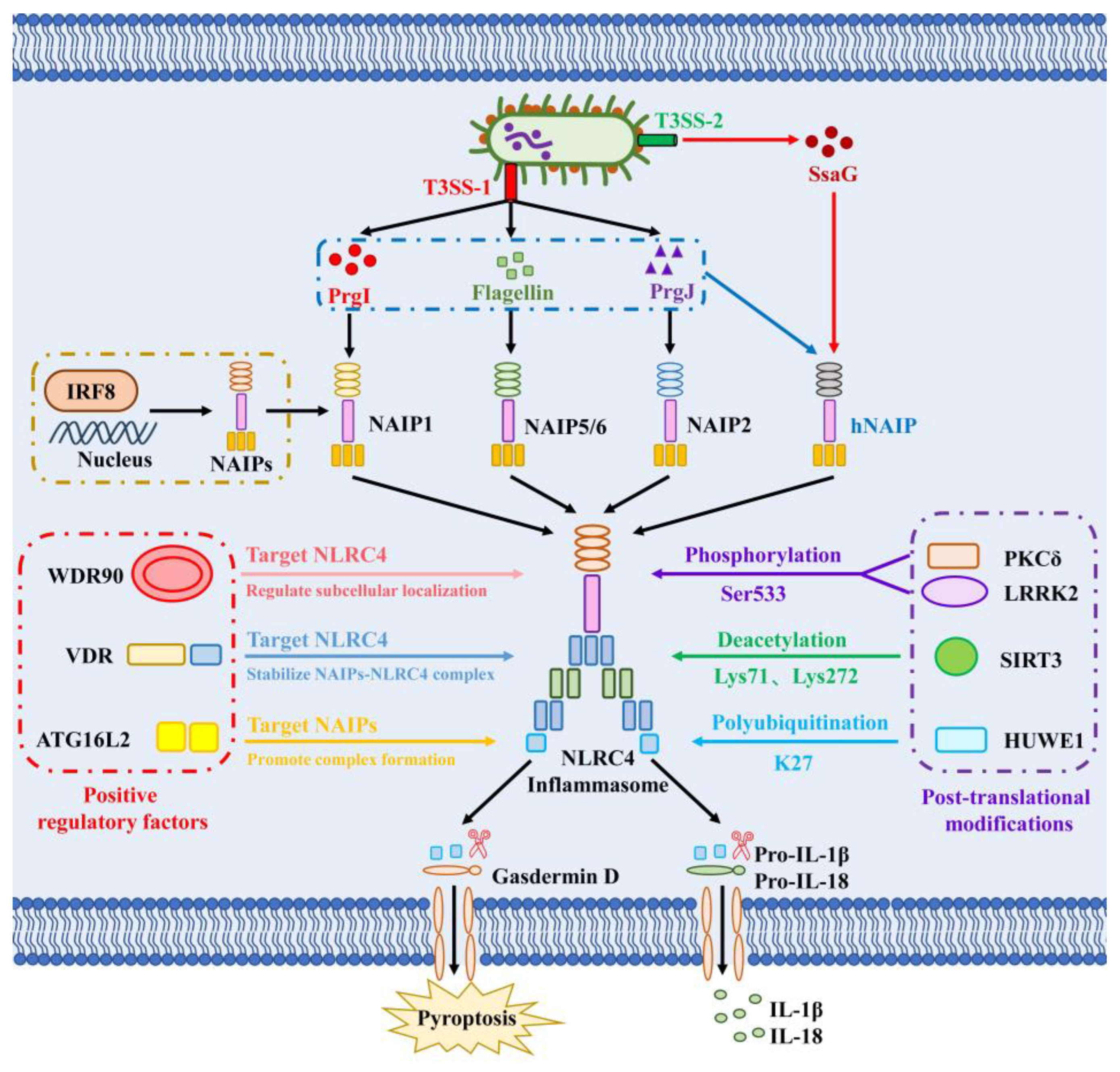
2.1. Structural Composition and Interspecies Diversity of NAIP/NLRC4
2.2. Assembly and Downstream Effector Functions of the NLRC4 Inflammasome
2.3. Post-Translational Regulation of NLRC4 Activation
3. Mechanisms of NLRC4 Inflammasome-Mediated Salmonella Recognition and Clearance
3.1. Molecular Basis of Salmonella Ligand Recognition
3.2. Positive Regulatory Network of the NLRC4 Inflammasome
3.3. Cell-Type-Specific Functions and Immune Crosstalk
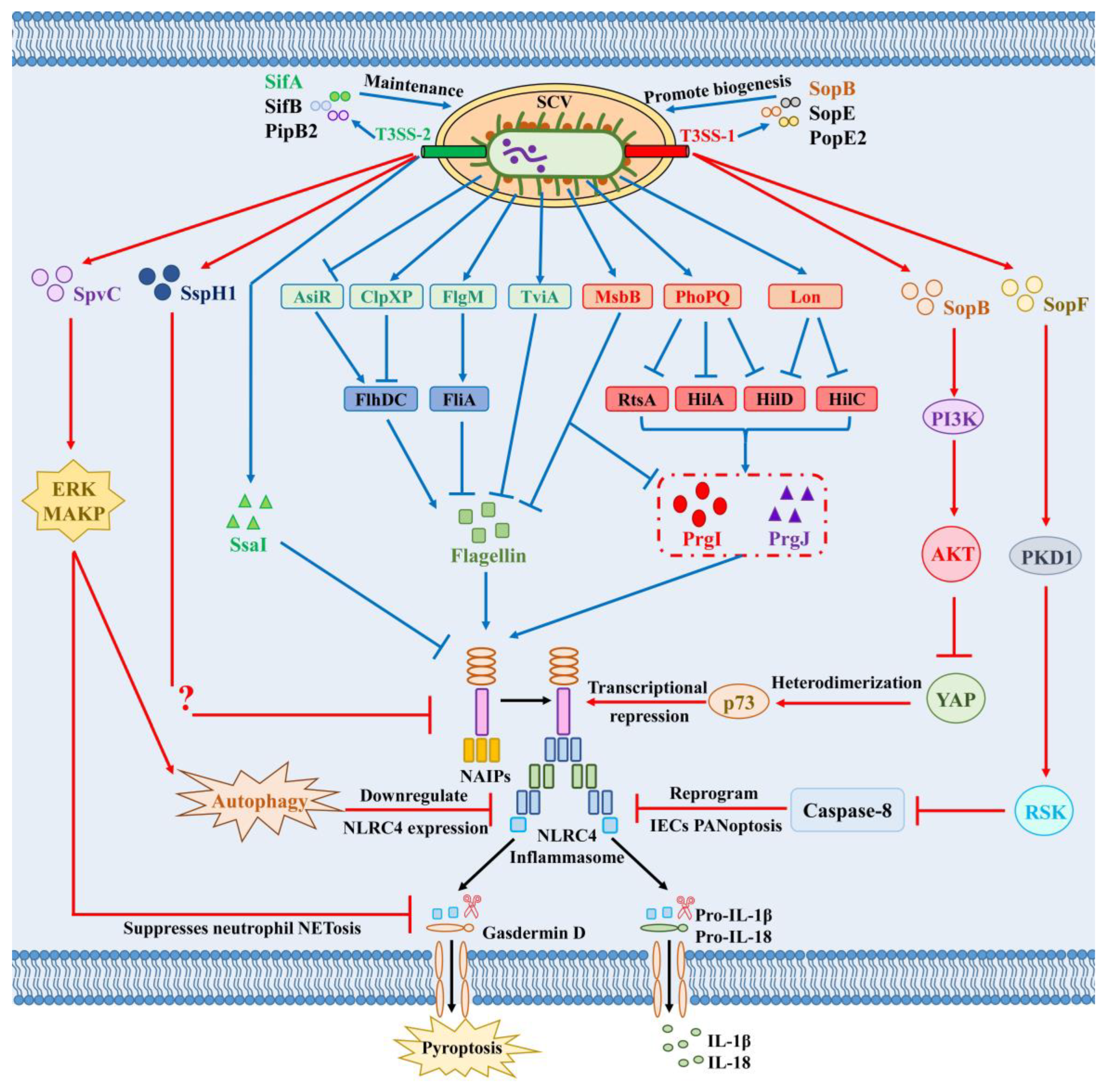
4. Molecular Strategies for Salmonella Evasion of NLRC4 Inflammasome Recognition and Activation
4.1. Indirect Immune Evasion: Avoiding NLRC4 Recognition
4.1.1. Spatial Sequestration Within SCVs
4.1.2. Transcriptional Silencing of Immunogenic Ligands
4.1.3. Structural Modification of T3SS Apparatus
4.2. Direct Immune Evasion: Active Inhibition of NLRC4 Signaling
4.2.1. Transcriptional Repression of NLRC4 via Host Signaling Manipulation
4.2.2. Effector-Mediated Interference with Inflammasome Signaling and Pyroptosis
5. Conclusions
Author Contributions
Funding
Institutional Review Board Statement
Informed Consent Statement
Data Availability Statement
Conflicts of Interest
Abbreviations
| iNTS | Invasive non-typhoidal Salmonella |
| WHO | World Health Organization |
| NLRC4 | NLR family CARD-containing protein 4 |
| NAIP | NLR family apoptosis inhibitory protein |
| T3SS | Type III secretion system |
| SPI-1 | Salmonella pathogenicity island-1 |
| SPI-2 | Salmonella pathogenicity island-2 |
| SCV | Salmonella-containing vacuole |
| PRR | Pattern recognition receptor |
| PAMP | Pathogen-associated molecular pattern |
| NLR | NOD-like receptor |
| DAMP | Danger-associated molecular pattern |
| IPAF | ICE-protease activating factor |
| CARD | Caspase activation and recruitment domain |
| NACHT | Nucleotide-binding and oligomerization domain |
| LRR | Leucine-rich repeat |
| BIR | Baculoviral inhibitor of apoptosis protein repeat |
| ASC | Apoptosis-associated speck-like protein containing a CARD |
| PYD | Pyrin domain |
| GSDMD | Gasdermin D |
| GSDMD-NT | GSDMD N-terminal pore-forming domain |
| IL-1β | Interleukin-1β |
| IL-18 | Interleukin-18 |
| PKCδ | Protein kinase Cδ |
| LRRK2 | Leucine-rich repeat kinase 2 |
| SIRT3 | Sirtuin 3 |
| HUWE1 | E3 ubiquitin ligase HUWE1 |
| TRIM29 | Tripartite motif containing 29 |
| HERC2 | E3 ubiquitin ligase HERC2 |
| WDR90 | WD repeat-containing protein 90 |
| VDR | Vitamin D receptor |
| ATG16L2 | Autophagy related 16 like 2 |
| IRF8 | Interferon regulatory factor 8 |
| IECs | Intestinal epithelial cells |
| DCs | Dendritic cells |
| PI3K | Phosphoinositide 3-kinase |
| PIP3 | Phosphatidylinositol 3,4,5-trisphosphate |
| Akt | Protein kinase B |
| YAP | Yes-associated protein |
| PDK1 | 3-phosphoinositide-dependent protein kinase 1 |
| RSK | Ribosomal S6 kinase |
| Tsr | Chemotaxis receptor Tsr |
| ERK | Extracellular regulated protein kinases |
| MAPK | Mitogen-activated protein kinase |
| NETosis | Neutrophil extracellular trap formation |
| LPS | Lipopolysaccharide |
| OMVs | Outer membrane vesicles |
References
- Muralidhar, N.; Watts, D.J.; Kamath, S. Salmonella Infections. Pediatr. Rev. 2025, 46, 62–64. [Google Scholar] [CrossRef] [PubMed]
- Wang, Y.; Xu, X.; Jia, S.; Qu, M.; Pei, Y.; Qiu, S.; Zhang, J.; Liu, Y.; Ma, S.; Lyu, N.; et al. A global atlas and drivers of antimicrobial resistance in Salmonella during 1900–2023. Nat. Commun. 2025, 16, 4611. [Google Scholar] [CrossRef] [PubMed]
- Meng, Z.; Song, T.; Chen, J.; Zhang, X.; Zhao, X.; Ling, J.; Wen, H.; Qiu, Y.; Tian, X.; Wu, J.; et al. Global Burden and Trends of Invasive Non-Typhoidal Salmonella Infection from 1990 to 2021. Foodborne Pathog. Dis. 2025, 15353141251398051. [Google Scholar] [CrossRef] [PubMed]
- Ajmera, A.; Shabbir, N. Salmonella. In StatPearls; StatPearls Publishing LLC: Treasure Island, FL, USA, 2026. [Google Scholar]
- Gao, Z.; Lu, C.; Shen, Y. Trimethylamine activates the Type III Secretion System of Salmonella to enhance host cell invasion. Microb. Pathog. 2026, 214, 108424. [Google Scholar] [CrossRef] [PubMed]
- Wang, T.; Zhu, L.; Guo, E.; Wu, C.; Schueder, F.; Lara-Tejero, M.; Galan, J.E. Oligomeric assembly of the gatekeeper InvE orchestrates hierarchical type III protein secretion in Salmonella Typhimurium. Proc. Natl. Acad. Sci. USA 2026, 123, e2530441123, Erratum in Proc. Natl. Acad. Sci. USA 2026, 123, e2608202123. [Google Scholar] [CrossRef] [PubMed]
- Tang, J.; Gu, Y.; Wang, X.; Luo, Y.; Zhang, F.; Zheng, J.; Wang, Y.; Shen, X.; Xu, L. Salmonella T3SS-elicited inflammatory innate immune response inhibits type I IFN response in macrophages. Vet. Microbiol. 2024, 289, 109970. [Google Scholar] [CrossRef] [PubMed]
- Gul, E.; Huuskonen, J.; Abi Younes, A.; Maurer, L.; Enz, U.; Zimmermann, J.; Sellin, M.E.; Bakkeren, E.; Hardt, W.D. Salmonella T3SS-2 virulence enhances gut-luminal colonization by enabling chemotaxis-dependent exploitation of intestinal inflammation. Cell Rep. 2024, 43, 113925. [Google Scholar] [CrossRef] [PubMed]
- Talukder, A.; Rahman, M.M.; Rahi, M.S.; Pountney, D.L.; Wei, M.Q. Flagellins as Vaccine Adjuvants and Cancer Immunotherapy: Recent Advances and Future Prospects. Immunology 2025, 176, 277–303. [Google Scholar] [CrossRef] [PubMed]
- Akira, S.; Uematsu, S.; Takeuchi, O. Pathogen recognition and innate immunity. Cell 2006, 124, 783–801. [Google Scholar] [CrossRef] [PubMed]
- Kienes, I.; Johnston, E.L.; Bitto, N.J.; Kaparakis-Liaskos, M.; Kufer, T.A. Bacterial subversion of NLR-mediated immune responses. Front. Immunol. 2022, 13, 930882. [Google Scholar] [CrossRef] [PubMed]
- Wu, D.; Fan, X.; Ji, Z.; Jiang, X.; Wang, S.; Ren, Y.; Li, C.; Chang, Y.; Liu, F. Dihydromyricetin ameliorates Salmonella enteritidis-induced pyroptosis and intestinal damage in chickens via modulating NLRP3 inflammasome. J. Ethnopharmacol. 2026, 362, 121382. [Google Scholar] [CrossRef] [PubMed]
- Liu, D.; Zhou, C.; Wang, X.; Luo, Z.; Xu, R.; Huo, S.; Guo, L.; Luo, X.; Yang, S.; Click, A.; et al. Nucleotide metabolic rewiring enables NLRP3 inflammasome hyperactivation in obesity. Science 2026, 391, eadq9006. [Google Scholar] [CrossRef] [PubMed]
- Bauer, R.; Rauch, I. The NAIP/NLRC4 inflammasome in infection and pathology. Mol. Asp. Med. 2020, 76, 100863. [Google Scholar] [CrossRef] [PubMed]
- Barnett, K.C.; Li, S.; Liang, K.; Ting, J.P. A 360 degrees view of the inflammasome: Mechanisms of activation, cell death, and diseases. Cell 2023, 186, 2288–2312. [Google Scholar] [CrossRef] [PubMed]
- Tan, K.; Rodriguez-Fernandez, M.M.; Keuler, T.; Hansen, F.K.; Gutschow, M.; Weindl, G.; Marco-Contelles, J. Crosstalk between NLRP3 Signaling and Histone Deacetylases in Inflammasome-Driven Diseases. J. Med. Chem. 2026, 69, 102–120. [Google Scholar] [CrossRef] [PubMed]
- Turcotte, E.A.; Kim, K.; Eislmayr, K.D.; Goers, L.; Mitchell, P.S.; Lesser, C.F.; Vance, R.E. Shigella OspF blocks rapid p38-dependent priming of the NAIP-NLRC4 inflammasome. Proc. Natl. Acad. Sci. USA 2026, 123, e2510950123. [Google Scholar] [CrossRef] [PubMed]
- Pandey, A.; Li, Z.; Gautam, M.; Ghosh, A.; Man, S.M. Molecular mechanisms of emerging inflammasome complexes and their activation and signaling in inflammation and pyroptosis. Immunol. Rev. 2025, 329, e13406. [Google Scholar] [CrossRef] [PubMed]
- Bernard, E.M.; Broz, P. Activation and manipulation of inflammasomes and pyroptosis during bacterial infections. Biochem. J. 2022, 479, 867–882. [Google Scholar] [CrossRef] [PubMed]
- Miao, E.A.; Mao, D.P.; Yudkovsky, N.; Bonneau, R.; Lorang, C.G.; Warren, S.E.; Leaf, I.A.; Aderem, A. Innate immune detection of the type III secretion apparatus through the NLRC4 inflammasome. Proc. Natl. Acad. Sci. USA 2010, 107, 3076–3080. [Google Scholar] [CrossRef] [PubMed]
- Zhao, Y.; Shao, F. The NAIP-NLRC4 inflammasome in innate immune detection of bacterial flagellin and type III secretion apparatus. Immunol. Rev. 2015, 265, 85–102. [Google Scholar] [CrossRef] [PubMed]
- Matico, R.E.; Yu, X.; Miller, R.; Somani, S.; Ricketts, M.D.; Kumar, N.; Steele, R.A.; Medley, Q.; Berger, S.; Faustin, B.; et al. Structural basis of the human NAIP/NLRC4 inflammasome assembly and pathogen sensing. Nat. Struct. Mol. Biol. 2024, 31, 82–91. [Google Scholar] [CrossRef] [PubMed]
- Zhao, Y.; Yang, J.; Shi, J.; Gong, Y.N.; Lu, Q.; Xu, H.; Liu, L.; Shao, F. The NLRC4 inflammasome receptors for bacterial flagellin and type III secretion apparatus. Nature 2011, 477, 596–600. [Google Scholar] [CrossRef] [PubMed]
- Zhao, Y.; Zhu, H.; Li, J.; Xu, H.; Sun, L. T3SS translocon induces pyroptosis by direct interaction with NLRC4/NAIP inflammasome. eLife 2025, 13, 100820. [Google Scholar] [CrossRef] [PubMed]
- Grayczyk, J.P.; Liu, L.; Egan, M.S.; Aunins, E.; Wynosky-Dolfi, M.A.; Canna, S.W.; Minn, A.J.; Shin, S.; Brodsky, I.E. TLR priming licenses NAIP inflammasome activation by immunoevasive ligands. Proc. Natl. Acad. Sci. USA 2024, 121, e2412700121. [Google Scholar] [CrossRef] [PubMed]
- Reyes Ruiz, V.M.; Ramirez, J.; Naseer, N.; Palacio, N.M.; Siddarthan, I.J.; Yan, B.M.; Boyer, M.A.; Pensinger, D.A.; Sauer, J.D.; Shin, S. Broad detection of bacterial type III secretion system and flagellin proteins by the human NAIP/NLRC4 inflammasome. Proc. Natl. Acad. Sci. USA 2017, 114, 13242–13247. [Google Scholar] [CrossRef] [PubMed]
- Sellin, M.E.; Muller, A.A.; Felmy, B.; Dolowschiak, T.; Diard, M.; Tardivel, A.; Maslowski, K.M.; Hardt, W.D. Epithelium-intrinsic NAIP/NLRC4 inflammasome drives infected enterocyte expulsion to restrict Salmonella replication in the intestinal mucosa. Cell Host Microbe 2014, 16, 237–248. [Google Scholar] [CrossRef] [PubMed]
- Lopez-Yglesias, A.H.; Lu, C.C.; Lai, M.A.; Quarles, E.K.; Zhao, X.; Hajjar, A.M.; Smith, K.D. FlgM is required to evade NLRC4-mediated host protection against flagellated Salmonella. Infect. Immun. 2023, 91, e0025523. [Google Scholar] [CrossRef] [PubMed]
- Hausmann, A.; Bock, D.; Geiser, P.; Berthold, D.L.; Fattinger, S.A.; Furter, M.; Bouman, J.A.; Barthel-Scherrer, M.; Lang, C.M.; Bakkeren, E.; et al. Intestinal epithelial NAIP/NLRC4 restricts systemic dissemination of the adapted pathogen Salmonella Typhimurium due to site-specific bacterial PAMP expression. Mucosal Immunol. 2020, 13, 530–544. [Google Scholar] [CrossRef] [PubMed]
- Kaneko, S.; Hatano, M.; Shimbo, A.; Miyaoka, F.; Irabu, H.; Akutsu, Y.; Hayashi, Y.; Mizuta, M.; Nakagishi, Y.; Akamine, K.; et al. Serum Cytokine Profiling Differentiates Underlying Diseases in Cytokine Storm Syndrome. Arthritis Rheumatol. 2026, 78, 463–474. [Google Scholar] [CrossRef] [PubMed]
- Zhou, L.; Li, Y.; Gao, S.; Yuan, H.; Zuo, L.; Wu, C.; Huang, R.; Wu, S. Salmonella spvC Gene Inhibits Autophagy of Host Cells and Suppresses NLRP3 as Well as NLRC4. Front. Immunol. 2021, 12, 639019. [Google Scholar] [CrossRef] [PubMed]
- He, Y.; Ding, D.; Guo, J.; Sun, H.; Yang, J. Activation and regulation of NAIP/NLRC4 and NLRP3 inflammasomes during Salmonella infection: Mechanisms and therapeutic implications. Mol. Biol. Rep. 2025, 53, 21. [Google Scholar] [CrossRef] [PubMed]
- Miao, E.A.; Rajan, J.V. Salmonella and Caspase-1: A complex Interplay of Detection and Evasion. Front. Microbiol. 2011, 2, 85. [Google Scholar] [CrossRef] [PubMed]
- Duncan, J.A.; Canna, S.W. The NLRC4 Inflammasome. Immunol. Rev. 2018, 281, 115–123. [Google Scholar] [CrossRef] [PubMed]
- Vance, R.E. The NAIP/NLRC4 inflammasomes. Curr. Opin. Immunol. 2015, 32, 84–89. [Google Scholar] [CrossRef] [PubMed]
- Paidimuddala, B.; Cao, J.; Nash, G.; Xie, Q.; Wu, H.; Zhang, L. Mechanism of NAIP-NLRC4 inflammasome activation revealed by cryo-EM structure of unliganded NAIP5. Nat. Struct. Mol. Biol. 2023, 30, 159–166, Erratum in Nat. Struct. Mol. Biol. 2023, 30, 233. [Google Scholar] [CrossRef] [PubMed]
- Kofoed, E.M.; Vance, R.E. Innate immune recognition of bacterial ligands by NAIPs determines inflammasome specificity. Nature 2011, 477, 592–595. [Google Scholar] [CrossRef] [PubMed]
- Yang, J.; Zhao, Y.; Shi, J.; Shao, F. Human NAIP and mouse NAIP1 recognize bacterial type III secretion needle protein for inflammasome activation. Proc. Natl. Acad. Sci. USA 2013, 110, 14408–14413. [Google Scholar] [CrossRef] [PubMed]
- Hu, Z.; Chai, J. Structural Mechanisms in NLR Inflammasome Assembly and Signaling. Curr. Top. Microbiol. Immunol. 2016, 397, 23–42. [Google Scholar] [CrossRef] [PubMed]
- Mariathasan, S.; Newton, K.; Monack, D.M.; Vucic, D.; French, D.M.; Lee, W.P.; Roose-Girma, M.; Erickson, S.; Dixit, V.M. Differential activation of the inflammasome by caspase-1 adaptors ASC and Ipaf. Nature 2004, 430, 213–218. [Google Scholar] [CrossRef] [PubMed]
- Deloer, S.; Fuss, I.; Gough, P.; Debebe, A.; Picker, M.; Devita, R.J.; Peter, I.; Strober, W. LRRK2-mediated NLRC4 phosphorylation differentially regulates IL-1beta/IL-18 secretion. Front. Immunol. 2025, 16, 1675137. [Google Scholar] [CrossRef] [PubMed]
- Dubey, S.R.; Turnbull, C.; Pandey, A.; Zhao, A.; Kurera, M.; Al-Zidan, R.; Shen, C.; Gautam, M.; Mahajan, S.; Jadhav, P.S.; et al. Molecular mechanisms and regulation of inflammasome activation and signaling: Sensing of pathogens and damage molecular patterns. Cell. Mol. Immunol. 2025, 22, 1313–1344. [Google Scholar] [CrossRef] [PubMed]
- Fernandes-Alnemri, T.; Wu, J.; Yu, J.W.; Datta, P.; Miller, B.; Jankowski, W.; Rosenberg, S.; Zhang, J.; Alnemri, E.S. The pyroptosome: A supramolecular assembly of ASC dimers mediating inflammatory cell death via caspase-1 activation. Cell Death Differ. 2007, 14, 1590–1604. [Google Scholar] [CrossRef] [PubMed]
- Boegli, A.; Bernard, E.M.; Lacante, L.; Majeux, G.; Hartenian, E.; Mack, V.; Broz, P. The NLRP6 inflammasome is activated by sterile or pathogen-induced endolysosomal damage. EMBO J. 2026, 45, 30–63. [Google Scholar] [CrossRef] [PubMed]
- Rathinam, V.A.; Fitzgerald, K.A. Inflammasome Complexes: Emerging Mechanisms and Effector Functions. Cell 2016, 165, 792–800. [Google Scholar] [CrossRef] [PubMed]
- Liu, X.; Zhang, Z.; Ruan, J.; Pan, Y.; Magupalli, V.G.; Wu, H.; Lieberman, J. Inflammasome-activated gasdermin D causes pyroptosis by forming membrane pores. Nature 2016, 535, 153–158. [Google Scholar] [CrossRef] [PubMed]
- Miao, R.; Jiang, C.; Chang, W.Y.; Zhang, H.; An, J.; Ho, F.; Chen, P.; Zhang, H.; Junqueira, C.; Amgalan, D.; et al. Gasdermin D permeabilization of mitochondrial inner and outer membranes accelerates and enhances pyroptosis. Immunity 2023, 56, 2523–2541 e2528. [Google Scholar] [CrossRef] [PubMed]
- Sun, J.; Yang, J.; Tao, J.; Yang, Y.; Wang, R.; Zhang, H.; Liu, W.; Zhao, S.; Shao, R.; He, Y.; et al. Delaying pyroptosis with an AI-screened gasdermin D pore blocker mitigates inflammatory response. Nat. Immunol. 2025, 26, 1660–1672. [Google Scholar] [CrossRef] [PubMed]
- Schiffelers, L.D.J.; Tesfamariam, Y.M.; Jenster, L.M.; Diehl, S.; Binder, S.C.; Normann, S.; Mayr, J.; Pritzl, S.; Hagelauer, E.; Kopp, A.; et al. Antagonistic nanobodies implicate mechanism of GSDMD pore formation and potential therapeutic application. Nat. Commun. 2024, 15, 8266. [Google Scholar] [CrossRef] [PubMed]
- Dinarello, C.A. Interleukin-1 in the pathogenesis and treatment of inflammatory diseases. Blood 2011, 117, 3720–3732. [Google Scholar] [CrossRef] [PubMed]
- Bergsbaken, T.; Fink, S.L.; Cookson, B.T. Pyroptosis: Host cell death and inflammation. Nat. Rev. Microbiol. 2009, 7, 99–109. [Google Scholar] [CrossRef] [PubMed]
- Qu, Y.; Misaghi, S.; Izrael-Tomasevic, A.; Newton, K.; Gilmour, L.L.; Lamkanfi, M.; Louie, S.; Kayagaki, N.; Liu, J.; Komuves, L.; et al. Phosphorylation of NLRC4 is critical for inflammasome activation. Nature 2012, 490, 539–542. [Google Scholar] [CrossRef] [PubMed]
- Wang, Y.; Zhang, T.; Gou, X.; Yuan, W.; He, S.; Zhang, S.; Chen, Z.; Xu, G.; Wu, D.; Xu, Y. Rottlerin inhibits PKCdelta to attenuate pulmonary fibrosis by suppressing NLRC4/ASC-mediated pyroptosis. Phytomedicine 2025, 146, 157154. [Google Scholar] [CrossRef] [PubMed]
- Hartlova, A.; Herbst, S.; Peltier, J.; Rodgers, A.; Bilkei-Gorzo, O.; Fearns, A.; Dill, B.D.; Lee, H.; Flynn, R.; Cowley, S.A.; et al. LRRK2 is a negative regulator of Mycobacterium tuberculosis phagosome maturation in macrophages. EMBO J. 2018, 37, EMBJ201798694. [Google Scholar] [CrossRef] [PubMed]
- Liu, W.; Liu, X.; Li, Y.; Zhao, J.; Liu, Z.; Hu, Z.; Wang, Y.; Yao, Y.; Miller, A.W.; Su, B.; et al. LRRK2 promotes the activation of NLRC4 inflammasome during Salmonella Typhimurium infection. J. Exp. Med. 2017, 214, 3051–3066. [Google Scholar] [CrossRef] [PubMed]
- Gardet, A.; Benita, Y.; Li, C.; Sands, B.E.; Ballester, I.; Stevens, C.; Korzenik, J.R.; Rioux, J.D.; Daly, M.J.; Xavier, R.J.; et al. LRRK2 is involved in the IFN-gamma response and host response to pathogens. J. Immunol. 2010, 185, 5577–5585. [Google Scholar] [CrossRef] [PubMed]
- Guan, C.; Huang, X.; Yue, J.; Xiang, H.; Shaheen, S.; Jiang, Z.; Tao, Y.; Tu, J.; Liu, Z.; Yao, Y.; et al. SIRT3-mediated deacetylation of NLRC4 promotes inflammasome activation. Theranostics 2021, 11, 3981–3995. [Google Scholar] [CrossRef] [PubMed]
- Guo, Y.; Li, L.; Xu, T.; Guo, X.; Wang, C.; Li, Y.; Yang, Y.; Yang, D.; Sun, B.; Zhao, X.; et al. HUWE1 mediates inflammasome activation and promotes host defense against bacterial infection. J. Clin. Investig. 2020, 130, 6301–6316. [Google Scholar] [CrossRef] [PubMed]
- Deng, Y.; Li, Z.; Sun, X.; Ma, N.; Song, L.; Chen, D.; Gao, F. TRIM29 (Tripartite Motif Containing 29) Alleviates NLRC4 (NLR Family CARD Domain Containing Protein 4) Inflammasome Related Cerebral Injury via Promoting Proteasomal Degradation of NLRC4 in Ischemic Stroke. Stroke 2023, 54, 1377–1389. [Google Scholar] [CrossRef] [PubMed]
- Wang, L.Q.; Zheng, Y.Y.; Zhou, H.J.; Zhang, X.X.; Wu, P.; Zhu, S.M. LncRNA-Fendrr protects against the ubiquitination and degradation of NLRC4 protein through HERC2 to regulate the pyroptosis of microglia. Mol. Med. 2021, 27, 39. [Google Scholar] [CrossRef] [PubMed]
- Clare, B. Inflammasome activation by Salmonella. Curr. Opin. Microbiol. 2021, 64, 27–32. [Google Scholar] [CrossRef] [PubMed]
- Miao, E.A.; Alpuche-Aranda, C.M.; Dors, M.; Clark, A.E.; Bader, M.W.; Miller, S.I.; Aderem, A. Cytoplasmic flagellin activates caspase-1 and secretion of interleukin 1beta via Ipaf. Nat. Immunol. 2006, 7, 569–575. [Google Scholar] [CrossRef] [PubMed]
- Winter, S.E.; Winter, M.G.; Atluri, V.; Poon, V.; Romao, E.L.; Tsolis, R.M.; Baumler, A.J. The flagellar regulator TviA reduces pyroptosis by Salmonella enterica serovar Typhi. Infect. Immun. 2015, 83, 1546–1555. [Google Scholar] [CrossRef] [PubMed]
- Halff, E.F.; Diebolder, C.A.; Versteeg, M.; Schouten, A.; Brondijk, T.H.; Huizinga, E.G. Formation and structure of a NAIP5-NLRC4 inflammasome induced by direct interactions with conserved N- and C-terminal regions of flagellin. J. Biol. Chem. 2012, 287, 38460–38472. [Google Scholar] [CrossRef] [PubMed]
- Paidimuddala, B.; Cao, J.; Zhang, L. Structural basis for flagellin-induced NAIP5 activation. Sci. Adv. 2023, 9, eadi8539. [Google Scholar] [CrossRef] [PubMed]
- Matusiak, M.; Van Opdenbosch, N.; Vande Walle, L.; Sirard, J.C.; Kanneganti, T.D.; Lamkanfi, M. Flagellin-induced NLRC4 phosphorylation primes the inflammasome for activation by NAIP5. Proc. Natl. Acad. Sci. USA 2015, 112, 1541–1546. [Google Scholar] [CrossRef] [PubMed]
- Lightfield, K.L.; Persson, J.; Brubaker, S.W.; Witte, C.E.; von Moltke, J.; Dunipace, E.A.; Henry, T.; Sun, Y.H.; Cado, D.; Dietrich, W.F.; et al. Critical function for Naip5 in inflammasome activation by a conserved carboxy-terminal domain of flagellin. Nat. Immunol. 2008, 9, 1171–1178. [Google Scholar] [CrossRef] [PubMed]
- Egan, M.S.; Zhang, J.; Shin, S. Human and mouse NAIP/NLRC4 inflammasome responses to bacterial infection. Curr. Opin. Microbiol. 2023, 73, 102298. [Google Scholar] [CrossRef] [PubMed]
- Yang, J.; Hwang, I.; Lee, E.; Shin, S.J.; Lee, E.J.; Rhee, J.H.; Yu, J.W. Bacterial Outer Membrane Vesicle-Mediated Cytosolic Delivery of Flagellin Triggers Host NLRC4 Canonical Inflammasome Signaling. Front. Immunol. 2020, 11, 581165. [Google Scholar] [CrossRef] [PubMed]
- Lightfield, K.L.; Persson, J.; Trinidad, N.J.; Brubaker, S.W.; Kofoed, E.M.; Sauer, J.D.; Dunipace, E.A.; Warren, S.E.; Miao, E.A.; Vance, R.E. Differential requirements for NAIP5 in activation of the NLRC4 inflammasome. Infect. Immun. 2011, 79, 1606–1614. [Google Scholar] [CrossRef] [PubMed]
- Zhao, Y.; Shi, J.; Shi, X.; Wang, Y.; Wang, F.; Shao, F. Genetic functions of the NAIP family of inflammasome receptors for bacterial ligands in mice. J. Exp. Med. 2016, 213, 647–656. [Google Scholar] [CrossRef] [PubMed]
- Broz, P.; Newton, K.; Lamkanfi, M.; Mariathasan, S.; Dixit, V.M.; Monack, D.M. Redundant roles for inflammasome receptors NLRP3 and NLRC4 in host defense against Salmonella. J. Exp. Med. 2010, 207, 1745–1755. [Google Scholar] [CrossRef] [PubMed]
- Sanowar, S.; Singh, P.; Pfuetzner, R.A.; Andre, I.; Zheng, H.; Spreter, T.; Strynadka, N.C.; Gonen, T.; Baker, D.; Goodlett, D.R.; et al. Interactions of the transmembrane polymeric rings of the Salmonella enterica serovar Typhimurium type III secretion system. mBio 2010, 1, e00158-10. [Google Scholar] [CrossRef] [PubMed]
- Li, X.; Ding, Y.; Sun, Y.; Gu, Y.; Feng, W.; Jia, Y.; Chen, H.; Chen, S. Functional regulation and cross-talk of type III and type VI secretion systems in Salmonella. Virulence 2026, 17, 2645873. [Google Scholar] [CrossRef] [PubMed]
- Hu, Z.; Zhou, Q.; Zhang, C.; Fan, S.; Cheng, W.; Zhao, Y.; Shao, F.; Wang, H.W.; Sui, S.F.; Chai, J. Structural and biochemical basis for induced self-propagation of NLRC4. Science 2015, 350, 399–404. [Google Scholar] [CrossRef] [PubMed]
- Rayamajhi, M.; Zak, D.E.; Chavarria-Smith, J.; Vance, R.E.; Miao, E.A. Cutting edge: Mouse NAIP1 detects the type III secretion system needle protein. J. Immunol. 2013, 191, 3986–3989. [Google Scholar] [CrossRef] [PubMed]
- Zhong, D.; Lefebre, M.; Kaur, K.; McDowell, M.A.; Gdowski, C.; Jo, S.; Wang, Y.; Benedict, S.H.; Lea, S.M.; Galan, J.E.; et al. The Salmonella type III secretion system inner rod protein PrgJ is partially folded. J. Biol. Chem. 2012, 287, 25303–25311. [Google Scholar] [CrossRef] [PubMed]
- Valera-Perez, A.; Tyrkalska, S.D.; Viana, C.; Rojas-Fernandez, A.; Pelegrin, P.; Garcia-Moreno, D.; Perez-Oliva, A.B.; Mulero, V. WDR90 is a new component of the NLRC4 inflammasome involved in Salmonella Typhimurium resistance. Dev. Comp. Immunol. 2019, 100, 103428. [Google Scholar] [CrossRef] [PubMed]
- Chen, X.; Zhang, Z.; Sun, N.; Li, J.; Ma, Z.; Rao, Z.; Sun, X.; Zeng, Q.; Wu, Y.; Li, J.; et al. Vitamin D receptor enhances NLRC4 inflammasome activation by promoting NAIPs-NLRC4 association. EMBO Rep. 2022, 23, e54611. [Google Scholar] [CrossRef] [PubMed]
- Wen, Z.; Yuan, T.; Liu, J.; Wang, D.; Ni, J.; Yan, X.; Tang, J.; Tang, J.; Wu, X.; Wang, Z. Atg16l2 augments Nlrc4 inflammasome activation by facilitating NAIPs-NLRC4 association. Eur. J. Immunol. 2024, 54, e2451078. [Google Scholar] [CrossRef] [PubMed]
- Karki, R.; Lee, E.; Place, D.; Samir, P.; Mavuluri, J.; Sharma, B.R.; Balakrishnan, A.; Malireddi, R.K.S.; Geiger, R.; Zhu, Q.; et al. IRF8 Regulates Transcription of Naips for NLRC4 Inflammasome Activation. Cell 2018, 173, 920–933 e913. [Google Scholar] [CrossRef] [PubMed]
- Lee, E.; Karki, R.; Kanneganti, T.D. The NLRC4 inflammasome requires IRF8-dependent production of NAIPs. Cell Stress 2018, 2, 144–146. [Google Scholar] [CrossRef] [PubMed]
- Naseer, N.; Zhang, J.; Bauer, R.; Constant, D.A.; Nice, T.J.; Brodsky, I.E.; Rauch, I.; Shin, S. Salmonella enterica Serovar Typhimurium Induces NAIP/NLRC4- and NLRP3/ASC-Independent, Caspase-4-Dependent Inflammasome Activation in Human Intestinal Epithelial Cells. Infect. Immun. 2022, 90, e0066321. [Google Scholar] [CrossRef] [PubMed]
- Jorgensen, I.; Miao, E.A. Pyroptotic cell death defends against intracellular pathogens. Immunol. Rev. 2015, 265, 130–142. [Google Scholar] [CrossRef] [PubMed]
- Keestra-Gounder, A.M.; Tsolis, R.M.; Baumler, A.J. Now you see me, now you don’t: The interaction of Salmonella with innate immune receptors. Nat. Rev. Microbiol. 2015, 13, 206–216. [Google Scholar] [CrossRef] [PubMed]
- Chen, K.W.; Gross, C.J.; Sotomayor, F.V.; Stacey, K.J.; Tschopp, J.; Sweet, M.J.; Schroder, K. The neutrophil NLRC4 inflammasome selectively promotes IL-1beta maturation without pyroptosis during acute Salmonella challenge. Cell Rep. 2014, 8, 570–582. [Google Scholar] [CrossRef] [PubMed]
- Kupz, A.; Guarda, G.; Gebhardt, T.; Sander, L.E.; Short, K.R.; Diavatopoulos, D.A.; Wijburg, O.L.; Cao, H.; Waithman, J.C.; Chen, W.; et al. NLRC4 inflammasomes in dendritic cells regulate noncognate effector function by memory CD8(+) T cells. Nat. Immunol. 2012, 13, 162–169. [Google Scholar] [CrossRef] [PubMed]
- Martynova, E.; Rizvanov, A.; Urbanowicz, R.A.; Khaiboullina, S. Inflammasome Contribution to the Activation of Th1, Th2, and Th17 Immune Responses. Front. Microbiol. 2022, 13, 851835. [Google Scholar] [CrossRef] [PubMed]
- Naseer, N.; Egan, M.S.; Reyes Ruiz, V.M.; Scott, W.P.; Hunter, E.N.; Demissie, T.; Rauch, I.; Brodsky, I.E.; Shin, S. Human NAIP/NLRC4 and NLRP3 inflammasomes detect Salmonella type III secretion system activities to restrict intracellular bacterial replication. PLoS Pathog. 2022, 18, e1009718. [Google Scholar] [CrossRef] [PubMed]
- Sanos, S.L.; Kassub, R.; Testori, M.; Geiger, M.; Patzold, J.; Giessel, R.; Knallinger, J.; Bathke, B.; Grabnitz, F.; Brinkmann, K.; et al. NLRC4 Inflammasome-Driven Immunogenicity of a Recombinant MVA Mucosal Vaccine Encoding Flagellin. Front. Immunol. 2017, 8, 1988. [Google Scholar] [CrossRef] [PubMed]
- Cui, X.; Wang, Y.; Liu, J.; Liu, Z.; Zhao, M.; Yu, W.; Zhu, M.; Xu, H.; Lu, B.; Peng, D.; et al. Dietary limonin alleviates Salmonella Typhimurium-induced colitis via dual targeting virulence SopB and SopE2 and inhibiting RAC1/CDC42/Arp2/3 pathway and regulating gut microbiota. Food Funct. 2025, 16, 1041–1059. [Google Scholar] [CrossRef] [PubMed]
- Mallo, G.V.; Espina, M.; Smith, A.C.; Terebiznik, M.R.; Aleman, A.; Finlay, B.B.; Rameh, L.E.; Grinstein, S.; Brumell, J.H. SopB promotes phosphatidylinositol 3-phosphate formation on Salmonella vacuoles by recruiting Rab5 and Vps34. J. Cell Biol. 2008, 182, 741–752. [Google Scholar] [CrossRef] [PubMed]
- Szeto, J.; Namolovan, A.; Osborne, S.E.; Coombes, B.K.; Brumell, J.H. Salmonella-containing vacuoles display centrifugal movement associated with cell-to-cell transfer in epithelial cells. Infect. Immun. 2009, 77, 996–1007. [Google Scholar] [CrossRef] [PubMed]
- Chandrasekhar, H.; Mohapatra, G.; Kajal, K.; Singh, M.; Walia, K.; Rana, S.; Kaur, N.; Sharma, S.; Tuli, A.; Das, P.; et al. SifA SUMOylation governs Salmonella Typhimurium intracellular survival via modulation of lysosomal function. PLoS Pathog. 2023, 19, e1011686. [Google Scholar] [CrossRef] [PubMed]
- Patel, S.; Wall, D.M.; Castillo, A.; McCormick, B.A. Caspase-3 cleavage of Salmonella type III secreted effector protein SifA is required for localization of functional domains and bacterial dissemination. Gut Microbes 2019, 10, 172–187. [Google Scholar] [CrossRef] [PubMed]
- Ramsden, A.E.; Mota, L.J.; Munter, S.; Shorte, S.L.; Holden, D.W. The SPI-2 type III secretion system restricts motility of Salmonella-containing vacuoles. Cell Microbiol. 2007, 9, 2517–2529. [Google Scholar] [CrossRef] [PubMed]
- Freeman, J.A.; Ohl, M.E.; Miller, S.I. The Salmonella enterica serovar typhimurium translocated effectors SseJ and SifB are targeted to the Salmonella-containing vacuole. Infect. Immun. 2003, 71, 418–427. [Google Scholar] [CrossRef] [PubMed]
- Knodler, L.A.; Vallance, B.A.; Hensel, M.; Jackel, D.; Finlay, B.B.; Steele-Mortimer, O. Salmonella type III effectors PipB and PipB2 are targeted to detergent-resistant microdomains on internal host cell membranes. Mol. Microbiol. 2003, 49, 685–704. [Google Scholar] [CrossRef] [PubMed]
- Palmer, A.D.; Kim, K.; Slauch, J.M. PhoP-Mediated Repression of the SPI1 Type 3 Secretion System in Salmonella enterica Serovar Typhimurium. J. Bacteriol. 2019, 201, 10–1128. [Google Scholar] [CrossRef] [PubMed]
- Bijlsma, J.J.; Groisman, E.A. The PhoP/PhoQ system controls the intramacrophage type three secretion system of Salmonella enterica. Mol. Microbiol. 2005, 57, 85–96. [Google Scholar] [CrossRef] [PubMed]
- Takaya, A.; Kubota, Y.; Isogai, E.; Yamamoto, T. Degradation of the HilC and HilD regulator proteins by ATP-dependent Lon protease leads to downregulation of Salmonella pathogenicity island 1 gene expression. Mol. Microbiol. 2005, 55, 839–852. [Google Scholar] [CrossRef] [PubMed]
- Cummings, L.A.; Wilkerson, W.D.; Bergsbaken, T.; Cookson, B.T. In vivo, fliC expression by Salmonella enterica serovar Typhimurium is heterogeneous, regulated by ClpX, and anatomically restricted. Mol. Microbiol. 2006, 61, 795–809. [Google Scholar] [CrossRef] [PubMed]
- Tomoyasu, T.; Takaya, A.; Isogai, E.; Yamamoto, T. Turnover of FlhD and FlhC, master regulator proteins for Salmonella flagellum biogenesis, by the ATP-dependent ClpXP protease. Mol. Microbiol. 2003, 48, 443–452. [Google Scholar] [CrossRef] [PubMed]
- Sporing, I.; Felgner, S.; Preusse, M.; Eckweiler, D.; Rohde, M.; Haussler, S.; Weiss, S.; Erhardt, M. Regulation of Flagellum Biosynthesis in Response to Cell Envelope Stress in Salmonella enterica Serovar Typhimurium. mBio 2018, 9, e00736-17. [Google Scholar] [CrossRef] [PubMed]
- Ma, S.; Jiang, L.; Wang, J.; Liu, X.; Li, W.; Ma, S.; Feng, L. Downregulation of a novel flagellar synthesis regulator AsiR promotes intracellular replication and systemic pathogenicity of Salmonella typhimurium. Virulence 2021, 12, 298–311. [Google Scholar] [CrossRef] [PubMed]
- Miao, E.A.; Leaf, I.A.; Treuting, P.M.; Mao, D.P.; Dors, M.; Sarkar, A.; Warren, S.E.; Wewers, M.D.; Aderem, A. Caspase-1-induced pyroptosis is an innate immune effector mechanism against intracellular bacteria. Nat. Immunol. 2010, 11, 1136–1142. [Google Scholar] [CrossRef] [PubMed]
- Garcia-Gil, A.; Galan-Enriquez, C.S.; Perez-Lopez, A.; Nava, P.; Alpuche-Aranda, C.; Ortiz-Navarrete, V. SopB activates the Akt-YAP pathway to promote Salmonella survival within B cells. Virulence 2018, 9, 1390–1402. [Google Scholar] [CrossRef] [PubMed]
- Hu, G.Q.; Song, P.X.; Chen, W.; Qi, S.; Yu, S.X.; Du, C.T.; Deng, X.M.; Ouyang, H.S.; Yang, Y.J. Cirtical role for Salmonella effector SopB in regulating inflammasome activation. Mol. Immunol. 2017, 90, 280–286, Erratum in Mol. Immunol. 2019, 105, 283. [Google Scholar] [CrossRef] [PubMed]
- Yuan, H.; Zhou, L.; Chen, Y.; You, J.; Hu, H.; Li, Y.; Huang, R.; Wu, S. Salmonella effector SopF regulates PANoptosis of intestinal epithelial cells to aggravate systemic infection. Gut Microbes 2023, 15, 2180315. [Google Scholar] [CrossRef] [PubMed]
- Zhou, L.; Li, Y.; You, J.; Wu, C.; Zuo, L.; Chen, Y.; Kang, L.; Zhou, Z.; Huang, R.; Wu, S. Salmonella spvC gene suppresses macrophage/neutrophil antibacterial defense mediated by gasdermin D. Inflamm. Res. 2024, 73, 19–33. [Google Scholar] [CrossRef] [PubMed]
- Bierschenk, D.; Monteleone, M.; Moghaddas, F.; Baker, P.J.; Masters, S.L.; Boucher, D.; Schroder, K. The Salmonella pathogenicity island-2 subverts human NLRP3 and NLRC4 inflammasome responses. J. Leukoc. Biol. 2019, 105, 401–410. [Google Scholar] [CrossRef] [PubMed]
- Beuzon, C.R.; Meresse, S.; Unsworth, K.E.; Ruiz-Albert, J.; Garvis, S.; Waterman, S.R.; Ryder, T.A.; Boucrot, E.; Holden, D.W. Salmonella maintains the integrity of its intracellular vacuole through the action of SifA. EMBO J. 2000, 19, 3235–3249, Erratum in EMBO J. 2000, 19, 4191. [Google Scholar] [CrossRef] [PubMed]
- Aachoui, Y.; Leaf, I.A.; Hagar, J.A.; Fontana, M.F.; Campos, C.G.; Zak, D.E.; Tan, M.H.; Cotter, P.A.; Vance, R.E.; Aderem, A.; et al. Caspase-11 protects against bacteria that escape the vacuole. Science 2013, 339, 975–978. [Google Scholar] [CrossRef] [PubMed]
- Meunier, E.; Dick, M.S.; Dreier, R.F.; Schurmann, N.; Kenzelmann Broz, D.; Warming, S.; Roose-Girma, M.; Bumann, D.; Kayagaki, N.; Takeda, K.; et al. Caspase-11 activation requires lysis of pathogen-containing vacuoles by IFN-induced GTPases. Nature 2014, 509, 366–370. [Google Scholar] [CrossRef] [PubMed]
- Gram, A.M.; Wright, J.A.; Pickering, R.J.; Lam, N.L.; Booty, L.M.; Webster, S.J.; Bryant, C.E. Salmonella Flagellin Activates NAIP/NLRC4 and Canonical NLRP3 Inflammasomes in Human Macrophages. J. Immunol. 2021, 206, 631–640. [Google Scholar] [CrossRef] [PubMed]
- Rauch, I.; Deets, K.A.; Ji, D.X.; von Moltke, J.; Tenthorey, J.L.; Lee, A.Y.; Philip, N.H.; Ayres, J.S.; Brodsky, I.E.; Gronert, K.; et al. NAIP-NLRC4 Inflammasomes Coordinate Intestinal Epithelial Cell Expulsion with Eicosanoid and IL-18 Release via Activation of Caspase-1 and -8. Immunity 2017, 46, 649–659. [Google Scholar] [CrossRef] [PubMed]
- Adams, P.; Fowler, R.; Kinsella, N.; Howell, G.; Farris, M.; Coote, P.; O’Connor, C.D. Proteomic detection of PhoPQ- and acid-mediated repression of Salmonella motility. Proteomics 2001, 1, 597–607. [Google Scholar] [CrossRef]
- Cameron, E.A.; Gruber, C.C.; Ritchie, J.M.; Waldor, M.K.; Sperandio, V. The QseG Lipoprotein Impacts the Virulence of Enterohemorrhagic Escherichia coli and Citrobacter rodentium and Regulates Flagellar Phase Variation in Salmonella enterica Serovar Typhimurium. Infect. Immun. 2018, 86, e00936-17. [Google Scholar] [CrossRef] [PubMed]
- Akhade, A.S.; Atif, S.M.; Lakshmi, B.S.; Dikshit, N.; Hughes, K.T.; Qadri, A.; Subramanian, N. Type 1 interferon-dependent repression of NLRC4 and iPLA2 licenses down-regulation of Salmonella flagellin inside macrophages. Proc. Natl. Acad. Sci. USA 2020, 117, 29811–29822. [Google Scholar] [CrossRef] [PubMed]
- Yang, L.; Chai, Z.; Qi, J.; Zhang, Y.; Zhou, Y.; Li, Z.; Wei, Y. Deficiency in the msbB Gene Reduced the Salmonella Typhimurium Virulence Through Mechanisms Beyond LPS Modification. Microorganisms 2025, 13, 2510. [Google Scholar] [CrossRef] [PubMed]
- Poyraz, O.; Schmidt, H.; Seidel, K.; Delissen, F.; Ader, C.; Tenenboim, H.; Goosmann, C.; Laube, B.; Thunemann, A.F.; Zychlinsky, A.; et al. Protein refolding is required for assembly of the type three secretion needle. Nat. Struct. Mol. Biol. 2010, 17, 788–792. [Google Scholar] [CrossRef] [PubMed]
- Bawn, M.; Alikhan, N.F.; Thilliez, G.; Kirkwood, M.; Wheeler, N.E.; Petrovska, L.; Dallman, T.J.; Adriaenssens, E.M.; Hall, N.; Kingsley, R.A. Evolution of Salmonella enterica serotype Typhimurium driven by anthropogenic selection and niche adaptation. PLoS Genet. 2020, 16, e1008850. [Google Scholar] [CrossRef] [PubMed]
- Cherry, J.L. Selection-Driven Gene Inactivation in Salmonella. Genome Biol. Evol. 2020, 12, 18–34. [Google Scholar] [CrossRef] [PubMed]


| Category | Key Bacterial Factor | Specific Strategy | Host Target | Reference |
|---|---|---|---|---|
| Indirect evasion | SifA, SifB, SopB | Spatial sequestration in SCVs | Physical isolation (no direct target) | [91,92,93,94,95,96,97,98] |
| PhoPQ system, Lon protease | Transcriptional silencing of T3SS-1 ligands | PrgI/PrgJ | [99,100,101] | |
| FlgM, ClpXP, AsiR, TviA | Transcriptional silencing of flagellin | FliC/FljB | [28,63,102,103,104,105] | |
| T3SS-2 encoded SsaI | T3SS structural epitope modification | NAIP ligand recognition domain | [20,106] | |
| Direct evasion | SopB | Transcriptional repression of NLRC4 | Nlrc4 transcription (via PI3K-Akt-YAP axis) | [107,108] |
| SopF | Inhibition of pyroptosis execution | Caspase-8/GSDMD | [109] | |
| SpvC | Inhibition of inflammasome signaling and GSDMD activation | ERK MAPK pathway/Autophagy/GSDMD | [31,110] | |
| SspH1 (T3SS-2 effector) | Mucosal immune suppression (target undefined) | NLRC4 signaling components (putative) | [8,111] |
Disclaimer/Publisher’s Note: The statements, opinions and data contained in all publications are solely those of the individual author(s) and contributor(s) and not of MDPI and/or the editor(s). MDPI and/or the editor(s) disclaim responsibility for any injury to people or property resulting from any ideas, methods, instructions or products referred to in the content. |
© 2026 by the authors. Licensee MDPI, Basel, Switzerland. This article is an open access article distributed under the terms and conditions of the Creative Commons Attribution (CC BY) license.
Share and Cite
Guo, Y.; Chen, R.; Qian, Y.; Xu, Y.; Yin, C.; Jiao, X.; Pan, Z. The Co-Evolutionary Arms Race Between Salmonella and the NLRC4 Inflammasome: Immune Recognition and Evasion Strategies. Microorganisms 2026, 14, 1500. https://doi.org/10.3390/microorganisms14071500
Guo Y, Chen R, Qian Y, Xu Y, Yin C, Jiao X, Pan Z. The Co-Evolutionary Arms Race Between Salmonella and the NLRC4 Inflammasome: Immune Recognition and Evasion Strategies. Microorganisms. 2026; 14(7):1500. https://doi.org/10.3390/microorganisms14071500
Chicago/Turabian StyleGuo, Yaxin, Ruohan Chen, Yan Qian, Ying Xu, Chao Yin, Xinan Jiao, and Zhiming Pan. 2026. "The Co-Evolutionary Arms Race Between Salmonella and the NLRC4 Inflammasome: Immune Recognition and Evasion Strategies" Microorganisms 14, no. 7: 1500. https://doi.org/10.3390/microorganisms14071500
APA StyleGuo, Y., Chen, R., Qian, Y., Xu, Y., Yin, C., Jiao, X., & Pan, Z. (2026). The Co-Evolutionary Arms Race Between Salmonella and the NLRC4 Inflammasome: Immune Recognition and Evasion Strategies. Microorganisms, 14(7), 1500. https://doi.org/10.3390/microorganisms14071500