Article

Methane Production on Mars-Relevant Clay Minerals and Simulant Regolith

1
US Naval Research Laboratory, 4555 Overlook Ave SW, Washington, DC 20375, USA
2
Arkansas Center for Space and Planetary Science, University of Arkansas, 332 N. Arkansas Ave, Fayetteville, AR 72701, USA
3
Department of Biological Sciences, University of Arkansas, Science and Engineering Room 601, Fayetteville, AR 72701, USA
*
Authors to whom correspondence should be addressed.
Microorganisms 2026, 14(7), 1496; https://doi.org/10.3390/microorganisms14071496
Submission received: 5 May 2026 / Revised: 29 June 2026 / Accepted: 5 July 2026 / Published: 8 July 2026
(This article belongs to the Section Environmental Microbiology)

Abstract

Over the course of Martian history, the presence of atmospheric carbon dioxide and potential subsurface molecular hydrogen (H2), in addition to potential surface and subsurface liquid water, suggests that the Martian subsurface, at minimum, may once have been habitable, particularly to autotrophic chemosynthetic microorganisms. In addition, the widespread nature of clays and other minerals on Mars could have provided sufficient nutrients to support microbial life. Here we tested four methanogenic species (Methanosarcina barkeri, Methanobacterium formicicum, Methanothermobacter wolfeii, and Methanococcus maripaludis) in the presence of illite, nontronite, and Mojave Mars Simulant (MMS), in their standard growth medium. We aimed to determine whether the presence of certain Mars simulants inhibited, promoted, or had no effect on methane (CH4) production by these microorganisms. The same methanogens were also tested in the presence of montmorillonite, H2, sodium sulfide (Na2S), and bicarbonate buffer to determine if this clay could support biotic CH4 production. Three of the four methanogens tested (M. barkeri, M. formicicum, and M. wolfeii) were capable of CH4 production in the presence of both clay minerals and MMS, as well as in cultures containing only 10% (w/v) montmorillonite, H2, Na2S, and bicarbonate buffer. Conversely, M. maripaludis, a halophile, showed the greatest sensitivity of the four methanogens tested; however, the presence of 5% (w/v) montmorillonite enabled greater CH4 production under certain circumstances compared to cultures containing the organism’s standard growth medium alone. Overall, these results suggest that the presence of clay minerals on Mars does not preclude the survivability and growth of methanogens in a potential subsurface habitat. In fact, these geological components may provide sufficient nutrients to support microbial growth and survivability.

1. Introduction

Continued exploration of the Martian surface, near-subsurface, and atmosphere have served to provide increasing amounts of evidence that Mars may once have been habitable, or may even still be habitable today, at least to microbial life. Reports of methane (CH4) in the Martian atmosphere [1,2,3,4,5,6,7,8,9,10,11,12] would seem to support this possibility. However, it should be noted that non-detections of CH4 have also been reported [13,14,15,16,17,18,19,20]. Still, it is hard not to consider methanogenesis as a possible metabolism on early or extant Mars [21,22,23,24,25,26,27,28,29,30,31,32,33,34,35,36,37,38], considering carbon dioxide (CO2) in the atmosphere, and likely, subsurface sources of molecular hydrogen (H2) [25,26,37,39,40,41,42,43,44,45,46]. The further evidence of organic carbon [47,48,49,50,51] and the widespread nature of clays [52,53,54], such as nontronite [55,56,57,58,59] and montmorillonite [60,61,62,63,64,65,66,67,68,69,70,71,72], on the planet have bolstered the idea that Mars may once have hosted microbial life.
Nontronite and montmorillonite are iron (Fe)- and aluminum (Al)-containing, respectively, dioctahedral smectites, types of phyllosilicates, formed through interaction with liquid water [69,73]. On Earth, Al- and Fe-containing smectites are often created through the alteration of basalt in environments with high water/rock ratios and thus, are typically found in marine and lacustrine environments [69]. The presence of these clays on Mars is considered to have required a volume of water seven times larger than that currently held in the Martian polar caps [74]. In addition, water adsorbed to these clays is considered to be an amount comparable to that of Earth, given Mars’ smaller size [75]. The clays, and the water they may once have held or may still hold, is important to understanding the current and past habitability of Mars [69,76], considering that water is a necessity for all life on Earth as we know it [77,78,79].
On Earth, microorganisms and clay minerals are ubiquitous across the globe and interactions between the two affect both the biosphere and the geosphere. One particular aspect of clays that forms the basis of the experiments conducted here is the cycling of numerous elements, including Al, silicon (Si), magnesium (Mg), Fe, phosphorus (P), sulfur (S), carbon (C), and nitrogen (N), through interactions between clays and microorganisms [80,81]. With smectites, in particular, such as nontronite and montmorillonite, interlayers are occupied by cations, usually K+, Na+, Ca2+, NH4+, or H3O+. The octahedral cation is typically Al3+, Fe3+, Mg2+, or Fe2+, but can also be less frequent elements such as lithium (Li), manganese (Mn), zinc (Zn), chromium (Cr), or titanium (Ti) [69]. In these clays, high Fe content can create unique redox conditions that microorganisms, including methanogens, can utilize as electron acceptors (e.g., Fe3+; see Fisk and Giovannoni [77], Zhang et al. [82], Zhang et al. [83]). In addition, the changing oxidation state of Fe in the soil can increase the bioavailability of other nutrients such as K+, Ca2+, Cu2+, Zn2+, and NH4+ [80]. On Earth, the dissolution of smectites is typically controlled by bacterial metabolism under acidic conditions [80], which could be relevant to certain environments on Mars [69,84,85,86,87,88,89]. This dissolution releases Fe, Al, and Si, as well as Na+ and Ca2+, which can serve as nutrients and promote microbial absorption to the clay minerals themselves [80].
With respect to Martian habitability, evidence for a warm and wet Mars, particularly during the Noachian and early Hesperian epochs, has been provided by explanations related to the chemical weathering of clays by acidic liquids at the surface of the planet. Using experimental modeling, Qin et al. [89] suggested that the compositional stratigraphy of Mawrth Vallis, where Fe/Mg-rich clays (e.g., nontronite) underlie Al-rich clays (e.g., kaolinite, montmorillonite), can be explained by the gradual dissolution of nontronite through the hydrolysis and leaching of Si, resulting in enrichment of Fe3+ and Al3+, and the formation of kaolinite (i.e., ferrallitization). Similarly, Ye and Michalski [90] also concluded that precipitation-driven weathering occurred on Mars from the early Noachian through the late Hesperian, which could have served as a source of vital nutrients for any extant microorganisms over geological timescales. Additionally, to explain this same compositional stratigraphy on Mars (i.e., Al-rich clays overlying Fe/Mg-rich clays), Liu et al. [91] suggested that the early Martian atmosphere was largely reducing, consisting of CH4 and H2, which enabled leaching of Fe, while Klidaras et al. [92] also contended that surface weathering and subsequent mineral leaching occurred on a warm and wet early Mars. Thus, the Noachian and Hesperian periods, generally considered to have featured long-lived habitable surface environments with temperate conditions, may have enabled microbial life to arise and flourish on the planet [76,93].
Illites are potassium micas that have also been detected on Mars [65,94] and illitization (i.e., the transition of smectite to illite) can be facilitated through microbial reduction of Fe3+ to Fe2+ [69,95], although this process is reversible (see Li et al. [80] for a comprehensive review of microbe–clay interactions). Illitization can also occur abiotically, typically through diagenesis (the conversion of sediment to sedimentary rock), which is dependent on both time and depth (i.e., burial) [94,96]. On Mars, the dominance of basalt suggests that illite was formed either through diagenesis or hydrothermal activity; however, illite is less widespread or common than either montmorillonite or nontronite, and cannot be distinguished from muscovite, another potassium mica, through spectral data alone [65,94]. In terms of the potential availability of nutrients for microbial growth and maintenance, illite (and muscovite) typically contain Al in the octahedral and tetrahedral layers, with K occupying the interlayer [67]. In contrast to smectites, illites have non-expandable basal spacing, a property which affects swelling capacity (for example, the amount of water in the interlayer), as well as molecule adsorption, including CH4 [80,97]. The basal spacing of illites is ca. 10 Å and lower, which could correspond to Martian data indicating similar basal spacing [95], although most interpretations believe basal spacings of 10 Å and lower to be due to collapsed smectites (due to dehydration) [56,98,99,100]. Ultimately, the widespread presence of these clays on Mars indicates significant aqueous alteration and serves to promote the habitability of clay-rich environments on the planet [52,53,54,58,59,61,62,64,65,67,68,69,70,71].
The multiple detections of CH4 in the Martian atmosphere from Earth-based telescopes [4,11,12], Martian orbiters [5,6,7,8,9], and Martian landers [1,2,3,10] all provide convincing evidence for extinct or extant methanogenesis on the planet. On Earth, over 80% of atmospheric CH4 results from the biosphere [101], including CH4 produced by the metabolism of microorganisms from the domain Archaea, known as methanogens. Certain methanogens are capable of using CO2 as a carbon source and H2 as an energy source to produce CH4 [102]. Methanogens have been considered model microorganisms for past or present life on Mars for over 20 years [23,25,103,104,105,106]. While today there are many (potentially) biocidal or inhibitory factors that would affect the ability of life to survive and thrive on the surface of the planet, such as radiation [107,108] or the lack of stable liquid water [109], among others [110,111,112], the non-photosynthetic nature of methanogens enables them to potentially persist in a subsurface habitat [22,24,25,26,28,29,33,36,102,113,114,115,116,117,118,119,120]. Additionally, their ability to use inorganic carbon (i.e., CO2) for their metabolism removes the constraint that the presence of other forms of life is necessary for their survival.
Research over the past 22 years has focused on various environmental and/or physiological conditions that any extant methanogens on Mars may endure, such as desiccation [106], clays and Martian regolith simulants [105,121,122,123,124], perchlorates [125,126,127], carbonates [128,129], radiation [130,131], low temperatures [103,132,133], low pressures [115,116,120], high pressures [117,118], or combinations of these conditions [104,134,135,136,137,138,139,140]. While many of these factors have been tested individually, overall results indicate that these factors may not prohibit the past or present existence of microbial life on Mars [141], and that particular niches with increased habitability, such as the subsurface [22,24,25,26,28,29,33,45,77,113,114,119,120,142,143,144,145,146,147,148], may provide sufficient conditions for microbial life to develop and perhaps, still exist, on the planet.
Here we tested the ability of four methanogenic species to grow in the presence of two common clays found on Mars, nontronite and illite, and the Martian regolith simulant, Mojave Mars Simulant (MMS) [149], in their respective growth media. For simplicity, henceforth, the clays and MMS will be referred to as Mars simulants. We aimed to determine if any of these Mars simulants were inhibitory, had no effect, or were possibly stimulatory to growth, as measured by CH4 production. Previous research has determined that these same methanogens are capable of growth in the presence of the Martian regolith simulant, JSC Mars-1 [105,122,123], the igneous rock, basalt [124], and the clay, montmorillonite [122,123].
Another major goal of these experiments was to determine if these same methanogens could derive their nutrient requirements (other than water, CO2, H2, and Na2S) from montmorillonite. Both Chastain and Kral [123] and Sinha and Kral [122] previously determined that montmorillonite could support the growth of Methanosarcina barkeri, Methanobacterium formicicum, and Methanothermobacter wolfeii when cells were washed to remove the residual growth medium prior to inoculation. However, these experiments included only a single washing of cells, resulting in concern that carry-over of residual nutrients from the original growth media might have allowed for growth of the methanogens. Here we report on CH4 production following two additional transfers in order to rule out this possibility. Lastly, an experiment was performed assessing the growth medium for the halophile, Methanococcus maripaludis, and whether montmorillonite could provide sufficient nutrients in place of certain medium components.

2. Materials and Methods

2.1. Cultures and Growth Media

Methanogens were initially obtained from the Oregon Collection of Methanogens (OCM, Portland State University, Portland, OR, USA) or the American Type Culture Collection (ATCC, Manassas, VA, USA). Each methanogen was grown in its own anaerobic medium and at its own growth temperature: Methanosarcina barkeri (OCM 38, ATCC 43569), 37 °C, MS medium (yeast extract, trypticase peptone, mercaptoethanesulfonic acid, potassium phosphate, ammonium chloride, magnesium chloride, calcium chloride, and additional trace minerals) [106,150]; Methanobacterium formicicum (OCM 55, ATCC 33274), 37 °C, MS medium supplemented with sodium formate (designated MSF medium) [150]; Methanothermobacter wolfeii (OCM 36, ATCC 43096), 55 °C, MM medium (a minimal medium containing the same components as MS medium except yeast extract, trypticase peptone, and mercaptoethanesulfonic acid) [106,151]; and Methanococcus maripaludis (OCM 151, ATCC 43000), 22 °C, MSH medium (MS medium containing additional sodium chloride, magnesium chloride, and potassium chloride) [152]. All media were created in bicarbonate buffers (4 g/L sodium hydroxide (NaOH) saturated with CO2). These media and temperatures were used for growth of the organisms and are not meant to mimic available nutrients or environmental conditions on Mars. Growth was measured by increases in CH4 production over time via gas chromatography (GC, CP-4900, Varian Micro Gas Chromatograph, Palo Alto, CA, USA) [153]. Specifically, for all experiments described here, individual 3 mL syringes were used to remove 1 mL headspace from each tube, which was subsequently injected into the GC to determine CH4 concentration.
Typically, CH4 concentrations of 0.1% or higher increasing with time [123] are considered to be an indication of growth. For clarity, here we acknowledge that while methanogens are obligate CH4-producers, the production of which constitutes the energy-yielding step in methanogenesis [102,154], CH4 measurements provided without additional biomass data may be indicative solely of maintenance metabolism and not cell division [155]. However, we also argue that any active metabolism, whether representative of cell division or maintenance metabolism, remains highly relevant to (potential) subsurface life on both Earth and Mars, with specific respect to ultra-slow-growing microorganisms termed aeonophiles [38,156]. In particular, Lloyd and Steen [156] define aeonophiles as a unique class of extremophiles that persist in a metabolically active maintenance state for years or longer. These organisms typically inhabit the terrestrial deep subsurface and could represent potential subsurface life on Mars [38,156].

2.2. Mars Simulants

Three clays were used in the experiments described here that are akin to those commonly identified on the surface of Mars. Nontronite, an Fe-smectite (NAu-1, Uley Mine, Uley, Australia; [157,158]), and illite, an Al-phyllosilicate (IMt-1/2, Silver Hill, MT, USA), were obtained from the Clay Minerals Society Source Clays Repository (Chantilly, VA, USA). Montmorillonite, an Al-smectite, was obtained from Ward’s Science (Rochester, NY, USA) with the clay itself originating from Clay Spur, WY, USA. Mojave Mars Simulant (MMS) [149] is a basaltic Martian simulant regolith selected for the similarity of its chemical and physical characteristics to those measured by various Martian rovers. General chemical compositions for the Mars simulants are given in Table 1.

2.3. Experimental Procedures

2.3.1. Methane Production in the Presence of Illite, Nontronite, or Mojave Mars Simulant in Standard Growth Media

Growth experiments in the presence of illite were performed with the addition of either 1% (w/v) or 2% (w/v) illite clay to each methanogen’s respective anaerobic growth medium (see Section 2.1 Cultures and Growth Media). More specifically, growth media were prepared in flasks and transferred to a Coy anaerobic chamber (90:10 CO2:H2; Coy Laboratory Products Inc., Grass Lake Charter Township, MI, USA) to deoxygenate for 24–36 h. Either 0.1 g illite [1% (w/v)] or 0.2 g illite [2% (w/v)] were added to each of five Balch tubes (internal volume ca. 25 mL), after which 10 mL growth medium was distributed to each tube for each organism (n = 3–5; Table 2). This resulted in ca. 15 mL available headspace within each tube (see Appendix A for further calculations). The tubes were capped with butyl rubber stoppers and aluminum crimps and autoclaved (121 °C, 15 psi, 30 min). Afterward, ca. 0.125 mL 2.5% Na2S were added to each tube to remove residual oxygen. Each tube was inoculated with 0.5 mL of culture containing the respective methanogen, pressurized with 2 bar H2 gas, and kept at the organisms’ standard growth temperature. Tubes were monitored for CH4 production (measured via GC) over 29–31 days. Positive control tubes containing solely 10 mL growth medium without illite (n = 3–5) were also monitored for CH4 production over time (Table 2).
Experimental procedures for the nontronite and MMS experiments were identical to those for the illite experiments except for the amount of nontronite or MMS and medium in each tube. For the nontronite experiments, three sets of tubes were inoculated: 0 g nontronite in 10 mL medium (n = 3; positive control tubes), 1 g nontronite in 9 mL medium (11.1% (w/v), n = 3) or 2.5 g nontronite in 7.5 mL medium (33.3% (w/v), n = 3). Methane production was monitored via GC over 35 days (Table 2). For the MMS experiments, tubes contained 10 g MMS and 10 mL medium (100% (w/v), n = 3). Positive control tubes contained solely 10 mL medium (no MMS, n = 2). Tubes were monitored for CH4 production over 140 days (Table 2). Because the MMS tubes contained greater amounts of clay simulant (10 g) and liquid media (10 mL) than the other experiments conducted here, it is possible that the remaining headspace in the Balch tubes was less than that for the other experiments. In all other experiments described here, the headspace volume was ca. 15 mL; in the MMS experiments, the available headspace volume was likely closer to ca. 10 mL, which would result in fewer total moles of CH4 produced (see Appendix A for calculations). However, since we are most interested in increases in CH4 concentrations over time, whether portrayed as % headspace or as moles CH4, we have not performed these calculations for the data shown here (except for data provided in Table S1).

2.3.2. Methane Production with Montmorillonite as the Sole Nutrient Source

Experimental procedures for the montmorillonite experiments were conducted to remove any residual growth media from the inoculated tubes, forcing the methanogens to obtain any necessary nutrients from the clay mineral itself. Cells grown in their respective anaerobic growth media were centrifuged at 5000 rpm for 15 min, the supernatant was discarded, and the pellet was resuspended in sterile bicarbonate buffer. This wash procedure was repeated two more times to rid the cells of any nutrients contained in their original respective growth medium [160]. Next, 0.5 mL aliquots of washed cells were added to Balch tubes (ca. 25 mL internal volume) containing sterile montmorillonite (1 g) and 10 mL bicarbonate buffer (10% (w/v), n = 3 for each organism), leaving ca. 15 mL headspace volume (see Appendix A for calculations). Next, each tube was pressurized with 2 bar H2 gas. The tubes were monitored for CH4 production over time for six weeks. In order to ensure that no residual nutrients remained in the experimental tubes following inoculation, two transfer sets were also created: at six-week intervals, a new set of tubes containing 1 g montmorillonite and 10 mL bicarbonate buffer were inoculated with 0.5 mL culture (i.e., cells in buffer with 1 g montmorillonite) from the corresponding tube in the previous set. This resulted in three transfers over 18 weeks. For clarity, Set A was inoculated with 0.5 mL washed cells and CH4 was measured for six weeks. At six weeks, 0.5 mL culture from Tube 1 from Set A were used to inoculate Tube 1 from Set B. Both Sets A and B were monitored for CH4 production for an additional six weeks. At six weeks from the time that Set B was inoculated, 0.5 mL culture from Tube 1 from Set B were used to inoculate Tube 1 from Set C and Sets A, B, and C were monitored for CH4 production for an additional 16 weeks (Table 3). At the creation of the new set (i.e., Set B or Set C), tubes within the previous set (i.e., Set A or Set B) were re-pressurized with H2. Specifically, this occurred after 42 days’, 84 days’, and 144 days’ incubation for Set A, after 42 days’ and 102 days’ incubation for Set B, and after 60 days’ incubation for Set C.

2.3.3. Minimal Medium Requirements for Methanococcus maripaludis

Following from the inability of M. maripaludis to grow in cultures containing montmorillonite as the sole nutrient source (Table 3), a separate experiment was conducted to determine the minimal medium requirements for this organism and whether montmorillonite could serve as a replacement for any necessary medium components. Thus, seven variations of MSH medium with montmorillonite (Table 4) were tested to determine which medium components are vital to the growth of M. maripaludis and whether montmorillonite could provide certain necessary nutrients. Experimental procedures were identical to those performed for the illite, nontronite, and MMS experiments, except that tubes contained 0.5 g montmorillonite and 10 mL of each medium variation (5% (w/v), n = 3, Table 4). Three tubes, used as positive controls, contained MSH medium and no montmorillonite. All tubes were incubated at room temperature (ca. 22 °C) for three weeks and periodically monitored for CH4 production via GC.

2.4. Statistical Analysis

All data are represented as mean ± standard deviation. The number of biological replicates for each condition and each experiment are provided in Table 2. All statistical analyses were conducted in R (v4.2.2). One-way ANOVAs were performed with Tukey’s HSD post hoc test with a 95% family-wise confidence level for multiple comparisons. Computed p-values below 0.1 were considered statistically significant (ns: not significant, .: p < 0.1, *: p < 0.05, **: p < 0.01, ***: p < 0.001).

3. Results

3.1. Methane Production in the Presence of Illite, Nontronite, and Mojave Mars Simulant

When grown in the presence of 2% (w/v) illite, CH4 production reached a higher concentration after 8 days’ incubation for M. wolfeii than within control tubes (p < 0.01), although final CH4 concentrations after 32 days’ growth were not significantly different from cultures grown in the absence of illite (p > 0.1, Figure 1A). Methane production was similar between M. wolfeii cultures grown in the presence of 1% (w/v) illite or without illite (control samples); however, statistical analysis could not be completed due to differences in time point (Figure 1A). Methane concentrations reached a maximum of 29.6 ± 2.8% headspace after 29 days for M. wolfeii grown with 1% (w/v) illite and a maximum of 24.9 ± 0.6% headspace after 16 days with 2% (w/v) illite. M. wolfeii cultures grown in their standard growth medium (MM medium) without clay minerals reached a maximum CH4 concentration of 22.5 ± 1.0% headspace after 24 days’ incubation (Figure 1A, Table 2). M. formicicum showed enhanced growth (higher CH4 production) in the presence of the clay mineral than in standard anaerobic growth medium (Figure 1C, Table 2). More specifically, M. formicicum cultures reached a maximum CH4 concentration of 24.6 ± 5.2% headspace after 16 days in the presence of 1% (w/v) illite (p < 0.001, compared to control cultures) and 26.7 ± 2.6% headspace after 16 days in the presence of 2% (w/v) illite (p < 0.001, compared to control cultures). In comparison, cultures of M. formicicum grown in MSF medium without clay minerals reached a CH4 concentration of 7.4 ± 0.5% headspace after 31 days’ incubation (Figure 1C). For M. barkeri, CH4 production was not affected by the presence of illite with maximum CH4 concentrations ca. 1% headspace after 31 days’ incubation amongst all conditions with no statistically significant differences seen (p > 0.1, Figure 1D, Table 2). When grown with 1% (w/v) illite, M. maripaludis showed CH4 production similar to the control tubes (ca. 13% headspace after 32 days’ incubation, p > 0.1); however, 2% (w/v) illite proved inhibitory as no CH4 production occurred in these cultures (p < 0.01, Figure 1B, Table 2).
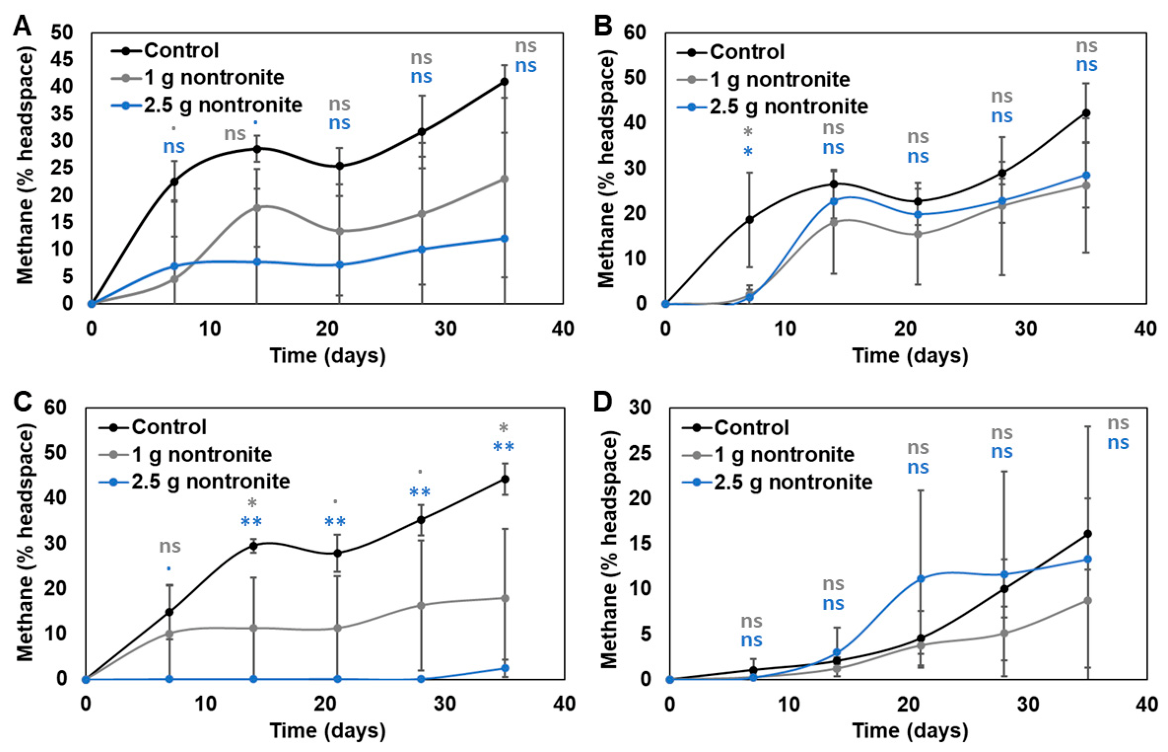
In the nontronite experiments, all four methanogens were capable of CH4 production in cultures containing up to 2.5 g nontronite [33.3% (w/v)], although CH4 production was greatly delayed and reduced for M. formicicum at this concentration (Figure 2C). After 35 days, CH4 concentrations reached 2.4 ± 2.9% headspace for M. formicicum grown in the presence of 2.5 g nontronite whereas cultures grown in MSF medium without clay minerals reached a maximum concentration of 44.3 ± 3.4% headspace CH4 (p < 0.01, Figure 2C, Table 2). Methane production was also significantly lower in cultures containing 1 g [11.1% (w/v)] nontronite (compared to control cultures) over the course of the experiment (p < 0.1, Figure 2C). Similar to M. formicicum, CH4 production decreased for cultures of M. wolfeii with increasing nontronite concentration: CH4 reached concentrations of 41.0 ± 3.0% headspace for cultures without nontronite, 23.0 ± 18.1% headspace for cultures grown with 1 g nontronite, and 12.1 ± 19.4% headspace for cultures grown with 2.5 g nontronite; however, these differences were not statistically significant after 20 days’ incubation (p > 0.1, Figure 2A, Table 2). For M. maripaludis, CH4 production was similar between experimental tubes containing either 1 g or 2.5 g nontronite (ca. 26–28% headspace), but was higher for cultures grown without clay minerals (42.3 ± 6.6% headspace), although these differences were not significant after 14 days’ incubation (p > 0.1, Figure 2B, Table 2). Methane production was not significantly different amongst any of the conditions at any of the time points for M. barkeri (p > 0.1, Figure 2D, Table 2). Notably, CH4 production amongst replicates for the same organism and same conditions varied greatly, resulting in large error bars (Figure 2).
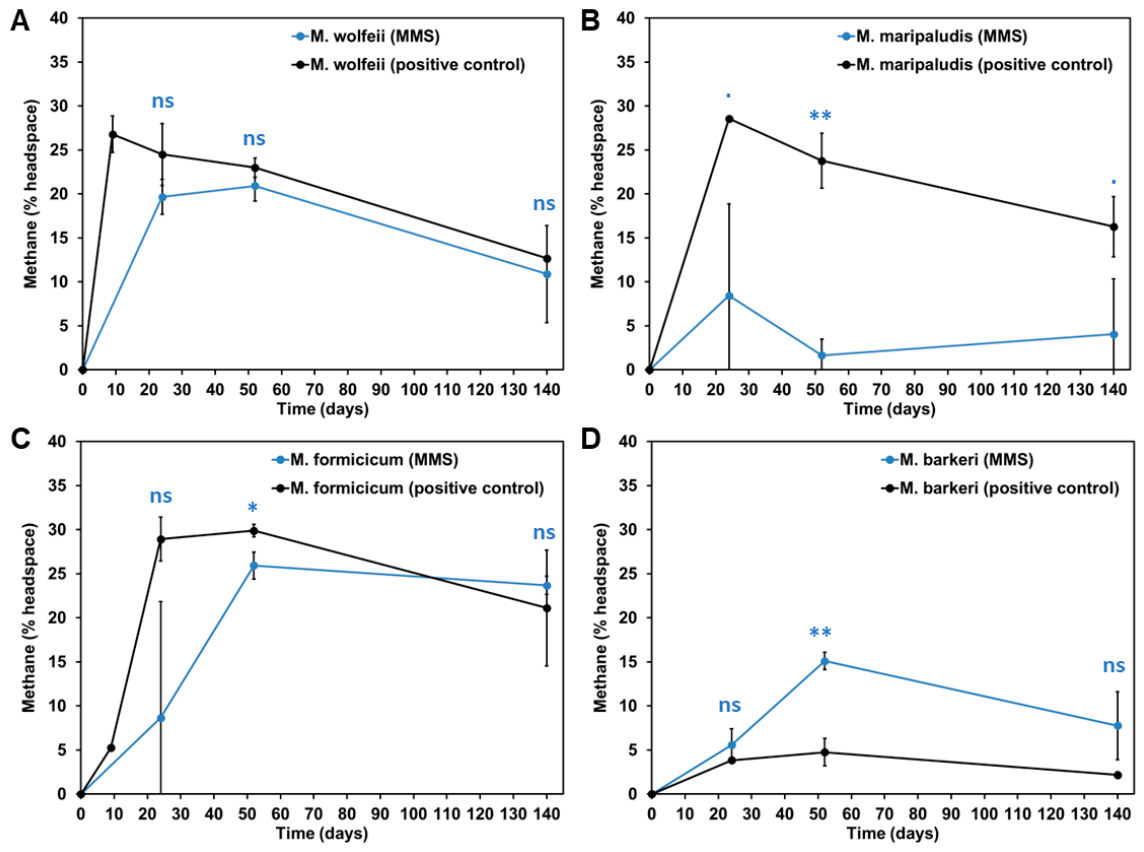
For M. wolfeii and M. formicicum, growth was similar in both the presence and absence of MMS, but with slightly higher CH4 production in tubes without MMS (Figure 3A,C, Table 2). For M. wolfeii, CH4 concentration peaked at 26.8 ± 2.1% headspace after 9 days’ incubation at 55 °C in cultures without MMS, while CH4 concentration reached 20.9 ± 1.7% headspace in cultures containing MMS after 52 days’ incubation; however, there were no statistically significant differences in CH4 concentration at 24, 52, or 140 days’ incubation (p > 0.1, Figure 3A, Table 2). Maximum CH4 concentrations for M. formicicum were higher in cultures without MMS (reaching 29.9 ± 0.7% headspace after 52 days’ incubation at 37 °C), while cultures containing MMS reached 25.9 ± 1.5% headspace after 52 days’ incubation (p > 0.05, Figure 3C, Table 2). M. maripaludis was the only organism where the presence of MMS significantly hindered CH4 production by the organism (compared to growth in standard medium). Methane production peaked at 8.4 ± 10.4% headspace after 24 days’ incubation at 22 °C for M. maripaludis cultures containing MMS, but CH4 concentrations between the three biological replicates were considerably different (20.3% vs. 4.2% vs. 0.8% headspace). In cultures without MMS, M. maripaludis produced 28.6 ± 0.2% headspace CH4 after 24 days’ incubation (p < 0.1, Figure 3B, Table 2). In contrast to the other three organisms, M. barkeri was the only methanogen that produced greater amounts of CH4 in the presence of MMS than in the absence of MMS. Methane production by M. barkeri peaked at 15.1 ± 1.0% headspace in cultures containing MMS after 52 days’ incubation, whereas cultures without MMS reached only 4.8 ± 1.6% headspace CH4 in the same amount of time (p < 0.01, Figure 3D, Table 2). However, it is important to note that there were no statistically significant differences in CH4 concentration between the M. barkeri cultures containing MMS and the cultures without MMS at either the 24-day or 140-day time points (p > 0.1, Figure 3D).

3.2. Methane Production with Montmorillonite as the Sole Nutrient Source

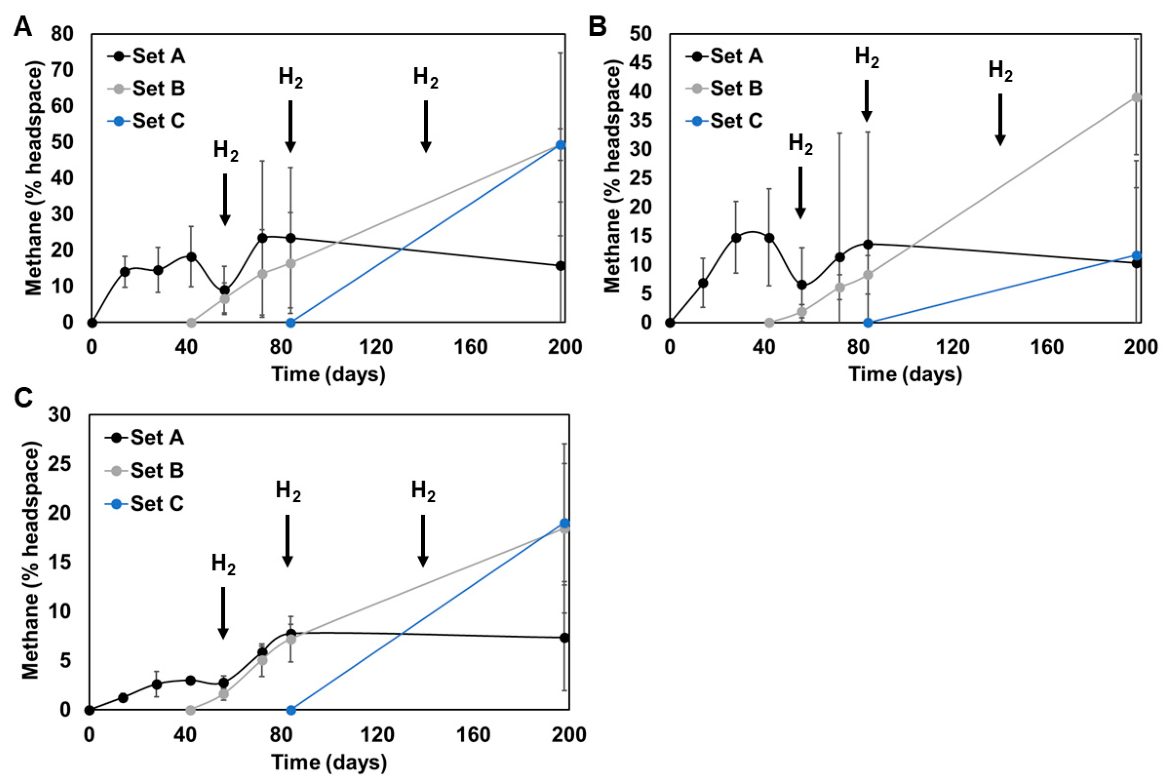
In the montmorillonite experiments, each of the four methanogens was grown in bicarbonate buffer containing H2, Na2S, and 10% (w/v) montmorillonite (n = 3, Table 3). After six weeks, 0.5 mL culture was used to inoculate another tube containing 10% (w/v) montmorillonite in bicarbonate buffer. In addition, all tubes (from all sets) were pressurized with 2 bar H2 at 0, 42, 84, and 144 days. This pressurization at 42 days likely results in the decrease in CH4 as a percentage of the headspace (seen in Figure 4A–C). Data indicate that each of three methanogens (M. wolfeii, M. formicicum, and M. barkeri) were capable of CH4 production in tubes containing solely bicarbonate buffer, montmorillonite, Na2S, and H2 gas (Figure 4, Table 3). In contrast, M. maripaludis was incapable of any CH4 production. For M. wolfeii and M. barkeri, cultures in Set A reached maximum CH4 concentrations after 84 days’ incubation (23.5 ± 19.4% headspace and 7.8 ± 1.0% headspace, respectively; Figure 4A,C, Table 3). M. formicicum cultures in Set A reached a maximum CH4 concentration of 14.8 ± 4.0% headspace after 42 days’ incubation (Figure 4B, Table 3). For Set B cultures, CH4 production reached higher concentrations than Set A cultures for each methanogen after 156 days’ incubation: 49.3 ± 24.3% headspace (M. wolfeii), 18.5 ± 8.6% headspace (M. barkeri), and 39.1 ± 10.1% headspace (M. formicicum; Figure 4, Table 3). Methane concentrations were only measured once after 114 days’ incubation for Set C cultures. After 114 days’ incubation, CH4 concentrations for M. wolfeii and M. barkeri for Set C were similar to the concentrations reached for Set B (49.3 ± 4.4% headspace and 19.0 ± 6.0% headspace, respectively; Figure 4A,C, Table 3). Set C cultures for M. formicicum measured 11.7 ± 11.7% headspace after 114 days’ incubation (Figure 4B, Table 3).

3.3. Minimal Medium Requirements for Methanococcus maripaludis

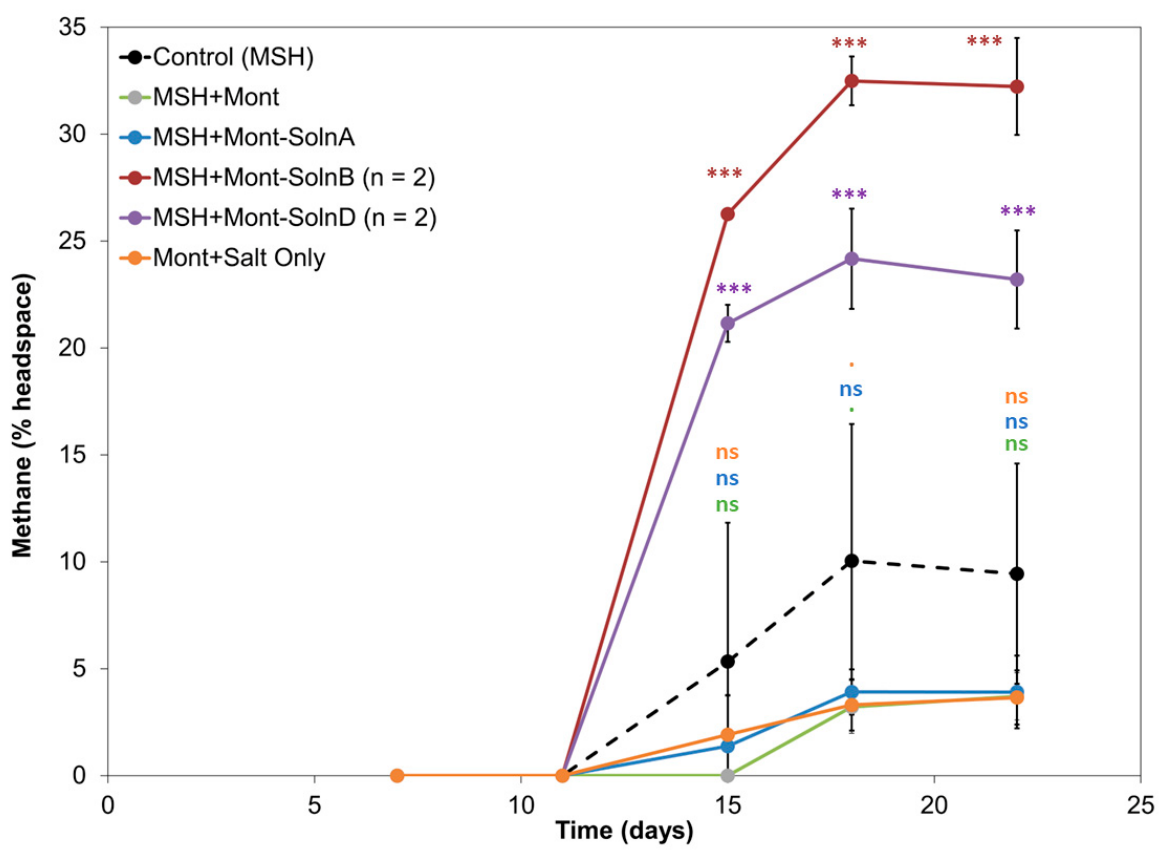
The highest CH4 concentration by M. maripaludis was achieved after 18 days’ incubation at 22 °C (23.9 ± 14.8% headspace) in cultures containing MSH medium with 0.5 g montmorillonite but without Solution B (200 g/L K2PO4·3H2O; p < 0.001 (compared to control tubes), Table 4, Figure 5). Cultures containing MSH medium and 0.5 g montmorillonite, but without Solution D (trace minerals; Table 4), achieved an average maximum CH4 concentration of 19.5 ± 8.3% headspace, also after 18 days’ incubation (p < 0.001, Table 4, Figure 5). Methane production in MSH medium alone (control samples) also peaked at 18 days’ incubation, reaching 9.4 ± 5.2% headspace. Methane production in the cultures containing MSH with 0.5 g montmorillonite without Solution A or solely 0.5 g montmorillonite and the salt solution (per L, 1.475 g NaCl, 0.085 g MgCl2, and 0.025 g KCl; Table 4) reached similar CH4 concentrations near 3–4% headspace after 18–22 days’ incubation and were not significantly different from the CH4 concentration in the control tubes (p > 0.1, Figure 5). Cultures grown in solutions consisting of MSH medium with 0.5 g montmorillonite but without the salt solution and solely bicarbonate buffer with 0.5 g montmorillonite failed to produce any CH4.

4. Discussion

Here we tested the ability of four methanogens, often used to represent potential model organisms for life on Mars, to grow in the presence of two clay minerals (illite or nontronite) and one Martian simulant regolith (MMS) in their standard growth media. The aim was to determine if the presence of the Mars simulant would inhibit, enhance, or have no effect on CH4 production. Additionally, we tested the ability of these four methanogens to produce CH4 using nutrients available solely within the clay mineral montmorillonite, without the addition of salts or trace minerals to the bicarbonate buffer. The goal of this experiment was to determine if a Mars simulant contains the necessary nutrients to support methanogen growth given the availability of H2 and CO2 as energy and carbon sources, respectively. Overall, the results shown here indicate that each of the four methanogens was capable of growth in the presence of multiple Mars simulants, albeit in their standard methanogenic growth medium. When solely provided with H2, CO2 (in the form of bicarbonate buffer), Na2S, and montmorillonite, only three of the four methanogens (M. formicicum, M. barkeri, M. wolfeii) were capable of growth. In all, aside from a few select cases (i.e., M. maripaludis grown in the presence of 2% (w/v) illite or M. maripaludis grown in bicarbonate buffer containing 10% (w/v) montmorillonite), none of the Mars simulants proved completely biocidal to the methanogens tested, with enhanced CH4 production seen in certain instances. While CH4 production varied amongst the four species and the Mars simulants tested, variation in CH4 concentrations is not unusual, even amongst individual replicates [132,133]. The ability of these methanogens to metabolize in the presence of these Mars simulants adds further support to the possibility that methanogens may have existed or may still exist in a Martian subsurface environment.
M. maripaludis was the methanogen that was most sensitive to the addition of Mars simulant to the growth medium or buffer, with all replicates failing to grow in cultures containing the organism’s standard growth medium (MSH medium) with 2% (w/v) illite (Figure 1B) or in bicarbonate buffer containing 10% (w/v) montmorillonite (Table 3). Methane production by M. maripaludis was also more greatly affected by the presence of MMS than for either M. wolfeii or M. formicicum, which also saw decreases in CH4 production in cultures containing MMS (Figure 3). The increased sensitivity of M. maripaludis to the presence of Mars simulants may be due to its halophilic nature. M. maripaludis was originally isolated from salt marsh sediment and found to require at least 5 mM Mg for growth [161]. Jones et al. [161] also discovered that neither sodium (Na) nor calcium (Ca) could substitute for this Mg requirement. Compared to the other methanogens tested here, the cell wall of M. maripaludis is a single, electron-dense, proteinaceous S-layer, lacking peptidoglycan molecules, which easily lyses [161,162] and likely contributes to the sensitivity seen here. In contrast, M. barkeri is considered to have a relatively thick and rigid cell wall [163], but also tends to form aggregates in culture, which may aid in survival [164,165,166]. Similarly, M. formicicum and M. wolfeii are described as having thick and rigid cell walls containing pseudomurein [167,168,169], also contributing to their robustness. Lastly, the genome for M. wolfeii encodes for a relatively large number of glycosyltransferases, which aid in the maintenance of cell integrity and stability, and are believed to contribute to the organism’s ability to adapt to harsh environments [170].
Previous studies have also looked at the ability of methanogens to produce CH4 in the presence of Mars simulants including nontronite, illite, montmorillonite, and MMS [82,83,122,123]. In experiments with Methanosarcina mazei, Zhang et al. [82] assessed both CH4 production and Fe reduction in the presence of either nontronite or illite. The authors discovered that CH4 production on these clays after 20 days’ incubation at 37 °C was typically less than one-third the amount produced in cultures without clays (ca. 0.0015 mmol CH4 vs. ca. 0.0055 mmol CH4) and that CH4 inhibition was directly correlated with the extent of bioreduction [82]. Importantly, however, and in contrast to the experiments conducted here, 0.5% (v/v) methanol was added to the cultures as a carbon source with the reduction of Fe3+ coupled to the oxidation of methanol [82]. Similarly, Zhang et al. [83] measured both CH4 production and Fe reduction by Methanothermobacter thermautotrophicus in cultures containing either 5 g/L [0.5% (w/v)] montmorillonite or nontronite. With either clay, Zhang et al. [83] found CH4 production by M. thermautotrophicus to be significant (ca. 0.12–0.16 mmol after 40 days’ incubation at 65 °C). In comparison to the experiments conducted here, after 35 days’ incubation in cultures containing 11.1% (w/v) nontronite, M. barkeri produced 8.8 ± 7.4% headspace CH4, M. wolfeii produced 23.0 ± 18.1% headspace CH4, and M. formicicum produced 17.9 ± 15.3% headspace CH4 (Figure 2, Table 2), equating to ca. 0.052 mmol, 0.13 mmol, and 0.11 mmol CH4, respectively (see Appendix A for calculations). Methane production was similar for M. wolfeii and M. formicicum, compared to M. thermautotrophicus, despite differences in experimental methodology including the final clay concentration in the medium and how the clay was provided to the methanogens.
All four methanogens proved capable of producing CH4 in the presence of up to 33.3% (w/v) nontronite (Figure 2), which may not be surprising considering that nontronite is an iron (Fe) smectite, and Fe is critical for methanogenesis (as Fe/Fe or Ni/Fe clusters used by hydrogenases [102]). The lowest amount of CH4 produced in the presence of 33.3% (w/v) nontronite in the experiments conducted here was by M. formicicum (Figure 2C) and averaged 2.4 ± 1.9% headspace after 35 days’ incubation at 37 °C. This is equivalent to 0.014 mmol CH4 (see Appendix A for calculations), about ten times lower than the CH4 produced by M. thermautotrophicus with 0.5% (w/v) nontronite [83]. However, the greatest amount of CH4 produced in the presence of 33.3% (w/v) nontronite averaged 28.5 ± 7.2% headspace, which is equivalent to ca. 0.18 mmol, and was produced by M. maripaludis after 35 days’ incubation at 22 °C (Figure 2B). As mentioned above, the discrepancy between the amount of CH4 produced between the two studies likely relates to the concentration of clays within the tubes [i.e., 11–33% (w/v) vs. 0.5% (w/v)] and the mechanism of integration (e.g., creating a slurry). Additionally, the lower CH4 concentrations in cultures containing nontronite may be due to Fe reduction by the methanogen as suggested by Zhang et al. [83]. While direct comparison is difficult due to differences in experimental conditions (i.e., the methanogens used, the optimal growth temperatures, specific medium components, how the clay minerals were added to the medium, etc.), both data provided here and data from Zhang et al. [83] indicate that certain methanogens are capable of growth (CH4 production) in the presence of nontronite. Surprisingly, the greatest CH4 concentrations in the presence of nontronite were produced by cultures of M. maripaludis, which showed the highest sensitivity (inhibition of CH4 production) to the other Mars simulants tested.
Significant differences are seen in both CH4 concentration and time to maximum CH4 concentration amongst the three methanogens and three Mars simulants tested here and between the experiments conducted by Sinha and Kral [122], including amongst control tubes (Table S1). For control cultures, as well as samples containing montmorillonite, CH4 concentrations were much higher and achieved much more quickly in experiments conducted by Sinha and Kral [122] (Table S1). However, variation amongst experimental procedures could explain the differences in observed CH4 production. For example, Sinha and Kral [122] measured CH4 production from serum bottles containing 3 g Mars simulant and 60 mL [5% (w/v)] bicarbonate buffer (leaving ca. 90 mL headspace). Here, experiments took place in Balch tubes (ca. 25 mL total volume) and contained variable amounts of Mars simulant and medium. Incubation temperatures and amount of H2 provided (i.e., 2 bar) were the same. However, taking into account available headspace volume and converting to mmol CH4 (see Appendix A), CH4 production by M. formicicum was 7.8–11.4x greater in control samples as measured by Sinha and Kral [122] compared to experiments performed here (Table S1).
One major factor that might be attributable to the differences in CH4 production is that in neither study (Sinha and Kral [122] nor here) were inocula standardized to cell number. In Sinha and Kral [122], an unspecified volume of washed cells were resuspended in 15 mL bicarbonate buffer, and 1 mL of resuspended cells was used to inoculate each serum bottle. In contrast, the experiments conducted here typically used 0.5 mL culture as inocula (the montmorillonite experiment used 0.5 mL washed cells as the initial inoculum; Table S1). Further, for the nontronite and MMS experiments, the concentration of the Mars simulant were much higher in the experiments conducted here than in Sinha and Kral [122], which could affect CH4 production, although, ultimately, this does not explain the differences in CH4 concentration between the controls.
Chastain and Kral [123] looked at the ability of one methanogen, M. wolfeii, to utilize montmorillonite as a nutrient source without a reducing or buffering agent in the medium: the bicarbonate buffer was replaced with the liquid fraction of a 1% montmorillonite/deionized water suspension and no Na2S was added to the medium. The authors found that, compared to buffered and reduced cultures, cultures containing solely H2, CO2, montmorillonite, and the liquid fraction of a montmorillonite-in-water suspension resulted in CH4 production that was much slower and reached much lower concentrations (buffered/reduced: 26.2 ± 7.9% headspace CH4 after 21 days’ incubation vs. non-buffered/reduced: 10.2 ± 0.5% headspace CH4 after 96 days’ incubation) [123]. The authors attributed the lower CH4 concentration to ‘simple metabolism’ (non-dividing, non-growing cells), compared to conventional microbial growth (i.e., increasing cell number) [123]. Despite differences in CH4 production amongst these various studies, which could be attributable to differences in cell number in the inocula as discussed above, active metabolism by methanogens, as measured by CH4 production, is possible using some Mars simulants, such as montmorillonite, as nutrient sources, where these clays are enabling maintenance metabolism or allowing for cell division.
One factor not investigated in this study nor others mentioned here [82,83,122,123] is how the grain size, available pore space, or method of integration (of the clay mineral and the medium) affects CH4 production or bioreduction. For example, Zhang et al. [83] first separated the 0.02–0.5 µm fraction from each clay and then created individual slurries with final concentrations of 5 g/L [0.5% (w/v)]. These slurries were added to the methanogenic growth medium and supplemented with additional Al to promote illite formation [83]. In contrast, here, 1 g nontronite was added to tubes containing 9 mL medium, or 2.5 g nontronite was added to tubes containing 7.5 mL medium, resulting in much higher concentrations [11.1% and 33.3% (w/v)], although the static incubation of these cultures and the limited dispersal mechanism (i.e., no mixing of the clay and medium) may have reduced any negative impact that the presence of the clay may have had on the methanogens. More specifically, the slurry produced by Zhang et al. [83] likely resulted in more clay substrate being made available to the methanogenic population, which could either be beneficial in providing a substrate for metabolism (and/or bioreduction) and/or could have inhibited CH4 production. While bioreduction was not measured here, results from Zhang et al. [82] and Zhang et al. [83] suggest that the intricacies of microbial metabolism (methanogenesis) and Fe reduction may serve to complicate the assessment of CH4 production in the presence of Fe-containing Mars simulants. The correlation between inhibition of CH4 production and Fe reduction could also explain the inhibition of CH4 production for certain methanogens as seen in many of the experiments conducted here; additional experiments would be necessary to confirm this but could be an interesting avenue for future experiments.
It is important to note that Cervini-Silva et al. [171] conducted abiotic experiments in which they reacted nontronite with bicarbonate buffer and measured subsequent CH4 production. The highest CH4 concentration reached was 2040 ppbv (ca. 1.3 nmol CH4; see Appendix A for calculations) after 60 days’ incubation at 25 °C. However, the authors also performed scanning electron microscopy (SEM) and noted the presence of hollow vesicles within the nontronite and attributed these to evidence of Fe2+-oxidizing bacteria, as well as to evidence of gas trapping [171], which suggests that the experiments may not have been truly abiotic. On the other hand, the presence of hollow vesicles could also be indicative of abiotic mineralogical processes [172]. Regardless, the CH4 concentration measured by Cervini-Silva et al. [171] (ca. 1.3 nmol CH4) is well below that which we reliably consider to be the result of biotic methane production (i.e., ca. 0.1% headspace or ca. 0.61 µmol CH4; see Appendix A, Chastain and Kral [123]). Thus, we can confidently attribute the CH4 production shown in Figure 2 to methanogenesis and not to the reaction between nontronite and bicarbonate in the tubes.
Differences in experimental procedures limit the ability to directly compare the extent of the effects that these Mars simulants have on CH4 production by methanogens. However, data provided here serve to confirm that while CH4 production may be reduced in the presence of Mars simulants, these components are not completely inhibitory or biocidal for certain methanogens. Furthermore, as evidenced by both the montmorillonite experiments and the ‘minimal medium requirements’ experiment conducted here, Mars simulants may be capable of providing certain nutrients to support or enhance microbial growth. For example, CH4 production was higher for M. barkeri in standard methanogenic growth medium in the presence of MMS than without (after 52 days’ growth, p < 0.01, Figure 3). In addition, CH4 production was significantly higher (p < 0.001) for M. maripaludis cultures containing standard methanogenic growth medium without 200 g/L K2PO4·3H2O (Solution B) or without trace minerals (Solution D), but with 0.5 g montmorillonite (Table 4, Figure 5). With evidence for a warm and wet early Mars provided by surface weathering of clays under acidic conditions [89,90,92], leached minerals could have provided sufficient nutrients for microbial life on the planet and could potentially explain certain results seen here. While elemental concentrations within leachates were not measured here, the availability of certain minerals leached from the clays over time could explain the increased CH4 production by M. barkeri in the presence of MMS, if the methanogen was limited for a particular trace mineral within its growth medium that was available within the Mars simulant. Similarly, for M. maripaludis in cultures containing montmorillonite but without K2PO4 or trace minerals, the organism likely was capable of utilizing trace minerals available directly from the montmorillonite itself. For example, in an earlier work, Altheide et al. [86] conducted acidic weathering reactions using both nontronite and montmorillonite and measured elemental concentrations within the resultant leachate. For nontronite, the authors discovered that, generally, elemental concentration within the leachate significantly increased with decreasing pH of the initial solution. In particular, elemental concentrations of Ti, Fe, Ca, K, Al, Mg, and Na all increased from concentrations below 1 mg/L to values ranging from 63 mg/L (K) to over 18,600 mg/L (Fe). Similarly, for montmorillonite, while only leachate from weathering reactions using a solution with pH 0 was tested, concentrations of Ti, Fe, Ca, K, Al, and Mg also increased, though concentrations were much lower than those for nontronite (ca. 17–1330 mg/L) and no Na was present (<0.01 mg/L) [86]. Importantly, however, media used here were not expected to be acidic with typical pH measurements (in the absence of Mars simulants) near 6.6–7.0 [151,152,173].
Future studies could further explore optimal and minimal medium requirements through additional experiments with and without various concentrations of salts, trace minerals, and other medium components. The use of standard inocula, either through cell counts, optical density values, or dry cell weight (DCW) measurements would better enable comparison to previous experiments. It would also serve future studies to include cell counts or DCW, of both inocula and samples taken during the length of the experiment, which could delineate between maintenance metabolism and cell division. For experiments utilizing Mars simulants as nutrient sources, experiments should include elemental measurements within the simulants themselves as well as the leachates, as previously performed under abiotic conditions by Altheide et al. [86]. Additional data such as gene expression, as collected for M. barkeri by Harris et al. [126] and Harris and Schuerger [120], would also be extremely informative regarding stress tolerances and metabolism, but were outside the scope of the studies conducted here. Ultimately, the data shown here provide support for the possibility of past or present microbial life on Mars.

5. Conclusions

While these experiments did not aim to replicate current or past conditions on Mars, the ability of these four methanogens to grow in the presence of multiple Mars simulants suggests that certain components within Martian regolith are not inherently biocidal, albeit, given the presence of abundant carbon (i.e., CO2) and energy (i.e., H2) sources, as well as additional nutrients, liquid water, and satisfactory growth temperatures. Furthermore, the ability of M. wolfeii, M. barkeri, and M. formicicum to produce CH4 in cultures containing solely bicarbonate buffer, H2 gas, Na2S, and montmorillonite, indicates that Martian regolith, potentially, could have provided vital nutrients, likely present as interlayer cations, such as K+, Na+, and Ca2+, for past life or could potentially currently support extant microbial metabolism(s) in the Martian subsurface; although, additional experiments reflecting past or present Martian subsurface pressures and temperatures, as well as realistic water activity regimes, are required to support this statement. It is also important to note that while methanogens are obligate CH4 producers, increasing CH4 concentrations over time may only be indicative of maintenance metabolism and not correspond to dividing cells. However, we argue that active metabolism, with specific respect to aeonophiles, remains relevant to both terrestrial and Martian deep subsurface microbial communities, if present.
Overall, there were varied results among replicates and across species and Mars simulants; however, the actual CH4 concentrations are less important than the fact that CH4 was or was not produced. Future experiments including analyses such as cell counts or biomass measurements in terms of DCW may better enable more accurate comparisons against previous studies. In the context of microbial–clay interactions, measuring the concentration of elements in solution or the cation exchange capacity of the Mars simulants over time would further inform the effect of these simulants on microbial metabolism. Additionally, the potential for bioreduction of Mars simulants, while also inhibiting CH4 production, poses a unique opportunity to further explore the possibility of the existence of methanogenic Archaea on Fe-rich Mars. While much more labor- and analysis-intensive, transcriptomics and/or proteomics approaches have been useful in more recent methanogen studies and could also help to elucidate metabolic effects of the Mars simulants.

Supplementary Materials

The following supporting information can be downloaded at https://www.mdpi.com/article/10.3390/microorganisms14071496/s1, Table S1: Maximum methane concentrations (% headspace) for Methanothermobacter wolfeii, Methanosarcina barkeri, and Methanobacterium formicicum grown on Mars simulants.

Author Contributions

Conceptualization, R.L.M. and T.A.K.; methodology, R.L.M. and T.A.K.; formal analysis, R.L.M., W.H.W., J.W., R.P. and C.K.; investigation, R.L.M., W.H.W., J.W., R.P. and C.K.; resources, T.A.K.; data curation, R.L.M.; writing—original draft preparation, R.L.M.; writing—review and editing, R.L.M. and T.A.K.; supervision, T.A.K.; funding acquisition, T.A.K. All authors have read and agreed to the published version of the manuscript.

Funding

This research was funded by the NASA Astrobiology: Exobiology and Evolutionary Biology Program, grant #NNX12AD90G.

Institutional Review Board Statement

Not applicable.

Informed Consent Statement

Not applicable.

Data Availability Statement

Data available upon request.

Acknowledgments

The authors thank Megan Pitz for her assistance with statistical analysis.

Conflicts of Interest

The authors declare no conflicts of interest.

Abbreviations

The following abbreviations are used in this manuscript:
AlAluminum
ATCCAmerican Type Culture Collection
CCarbon
CaCalcium
CH4Methane
CO2Carbon dioxide
CrChromium
CuCopper
FeIron
H2Hydrogen
H3O+Hydronium
KPotassium
LiLithium
MgMagnesium
MnManganese
MMSMojave Mars Simulant
NNitrogen
NaSodium
NaOHSodium hydroxide
Na2SSodium sulfide
NH4Ammonium chloride
OCMOregon Collection of Methanogens
PPhosphorus
SSulfur
SEMScanning electron microscopy
SiSilicon
TiTitanium
ZnZinc

Appendix A

Appendix A.1. Calculations Converting Methane from % Headspace to mol

For comparison to methane (CH4) production measured in millimoles (mmol) by Zhang et al. [82] and Zhang et al. [83], we have converted our headspace CH4 data to moles (mol) using the ideal gas law (A1) and the following conditions:
n   ( m o l e s   C H 4 ) = P V R T
where P = pressure = 1 atm, V = the CH4 percentage of the total internal headspace volume of the culture tube, T = temperature, and R is the ideal gas constant (0.0821 L-atm/mol-K). The total internal headspace volume of the culture tube is estimated to be 0.015 L given that the Balch tubes used in all experiments conducted here have a total internal volume of 0.025 L and are filled with ca. 0.01 L medium (except the Mojave Mars Simulant (MMS) experiment; see below). Additionally, although all CH4 measurements were taken at room temperature (22 °C), the tubes were incubated at the organisms’ respective ideal growth temperatures (22 °C, 37 °C, or 55 °C). These incubation temperatures were used to calculate moles CH4 so as not to artificially inflate any concentrations. Thus, for moles CH4 calculations for M. maripaludis and M. wolfeii, temperatures of 295 K (22 °C) and 328 K (55 °C), respectively, were used. For M. barkeri and M. formicicum, a temperature of 310 K (37 °C) was used. For example, for a % headspace concentration of 8.8% CH4 produced by M. barkeri at 37 °C, V = 0.088 × 0.015 L = 0.00132 L and T = 310 K, equating to 0.052 mmol CH4. For comparison, using a temperature of 22 °C (295 K) equates to a CH4 concentration of 0.055 mmol.
When available headspace volume is reduced, for example, in the MMS experiments compared to the other experiments performed here, the resultant moles CH4 will also be fewer. More specifically, as noted above and in the Materials and Methods, the available headspace within the Balch tubes used for most of the experiments conducted here was ca. 15 mL. However, the MMS experiment contained significantly more Mars simulant than the other experiments, leaving a total available headspace ca. 10 mL. When converting to moles CH4 using Equation (A1), the reduced volume will correspond to fewer moles CH4. In particular, for a % headspace concentration of 30% by M. formicicum (incubation temperature: 310 K) with a total available headspace volume of 15 mL (0.015 L), Equation (A1) gives the CH4 concentration as 177 mmol CH4. For the same % headspace concentration (30%) but with a reduced headspace volume (0.01 L), Equation (A1) gives the CH4 concentration as 118 mmol CH4.
Chastain and Kral [123] measured 0.14 ± 0.05% headspace CH4 from Methanothermobacter wolfeii cultures containing carbon dioxide (CO2), 1 g montmorillonite, and 6 mL buffer (derived from montmorillonite and deionized water), but without an energy source [i.e., hydrogen (H2)]. The authors thus considered headspace concentrations greater than 0.1% to be the result of methanogenesis. Using Equation (A1), this value corresponds to 0.61 µmol CH4 in the experiments performed here, which we also consider to be the lower limit to attribute increases in CH4 concentration to active CH4 production by methanogens. However, as mentioned within the Materials and Methods section, we recognize that, without additional biomass data, we cannot ascertain whether this CH4 production corresponds to cell division or simply to maintenance metabolism. Although, we do argue that active metabolism, regardless of cell division, remains relevant to both terrestrial and Martian subsurface habitats [38,156].

Appendix A.2. Calculations Converting Methane from ppbv to mol

Cervini-Silva et al. [171] conducted abiotic experiments in which they reacted nontronite with bicarbonate buffer and measured subsequent CH4 production. The highest CH4 concentration reached was 2040 ppbv after 60 days’ incubation at 25 °C. These experiments were conducted in 25 mL bottles and contained 100 mg nontronite in 10 mL 1 mM sodium bicarbonate (NaHCO3) with a nitrogen (N2) headspace. Assuming 0.015 L total headspace within the bottles, the total amount of N2 can be found using Equation (A1): with V = 0.015 L, P = 1 atm and T = 298 K, the total number of moles N2 in the headspace of the bottles is 0.61 mmol. The concentration of CH4 measured by Cervini-Silva et al. [160] (2040 ppbv CH4) equates to a 2.04 × 10⁻⁶ mole fraction. This equates to a CH4 concentration of 1.3 nmol, which is significantly lower than the value of 0.61 µmol CH4 that we attribute to active methanogenesis.

References

  1. Webster, C.R.; Mahaffy, P.R.; Atreya, S.K.; Flesch, G.J.; Mischna, M.A.; Meslin, P.-Y.; Farley, K.A.; Conrad, P.G.; Christensen, L.E.; Pavlov, A.A. Mars methane detection and variability at Gale crater. Science 2015, 347, 415–417. [Google Scholar] [CrossRef] [PubMed]
  2. Webster, C.R.; Mahaffy, P.R.; Atreya, S.K.; Moores, J.E.; Flesch, G.J.; Malespin, C.; McKay, C.P.; Martinez, G.; Smith, C.L.; Martin-Torres, J. Background levels of methane in Mars’ atmosphere show strong seasonal variations. Science 2018, 360, 1093–1096. [Google Scholar] [CrossRef] [PubMed]
  3. Webster, C.R.; Mahaffy, P.R.; Pla-Garcia, J.; Rafkin, S.C.; Moores, J.E.; Atreya, S.K.; Flesch, G.J.; Malespin, C.A.; Teinturier, S.M.; Kalucha, H. Day-night differences in Mars methane suggest nighttime containment at Gale crater. Astron. Astrophys. 2021, 650, A166. [Google Scholar] [CrossRef]
  4. Mumma, M.J.; Villanueva, G.L.; Novak, R.E.; Hewagama, T.; Bonev, B.P.; DiSanti, M.A.; Mandell, A.M.; Smith, M.D. Strong release of methane on Mars in northern summer 2003. Science 2009, 323, 1041–1045. [Google Scholar] [CrossRef] [PubMed]
  5. Formisano, V.; Atreya, S.; Encrenaz, T.; Ignatiev, N.; Giuranna, M. Detection of methane in the atmosphere of Mars. Science 2004, 306, 1758–1761. [Google Scholar] [CrossRef] [PubMed]
  6. Geminale, A.; Formisano, V.; Giuranna, M. Methane in Martian atmosphere: Average spatial, diurnal, and seasonal behaviour. Planet. Space Sci. 2008, 56, 1194–1203. [Google Scholar] [CrossRef]
  7. Geminale, A.; Formisano, V.; Sindoni, G. Mapping methane in Martian atmosphere with PFS-MEX data. Planet. Space Sci. 2011, 59, 137–148. [Google Scholar] [CrossRef]
  8. Giuranna, M.; Viscardy, S.; Daerden, F.; Neary, L.; Etiope, G.; Oehler, D.; Formisano, V.; Aronica, A.; Wolkenberg, P.; Aoki, S. Independent confirmation of a methane spike on Mars and a source region east of Gale Crater. Nat. Geosci. 2019, 12, 326–332. [Google Scholar] [CrossRef]
  9. Fonti, S.; Marzo, G.A. Mapping the methane on Mars. Astron. Astrophys. 2010, 512, A51. [Google Scholar] [CrossRef]
  10. House, C.H.; Wong, G.M.; Webster, C.R.; Flesch, G.J.; Franz, H.B.; Stern, J.C.; Pavlov, A.; Atreya, S.K.; Eigenbrode, J.L.; Gilbert, A. Depleted carbon isotope compositions observed at Gale crater, Mars. Proc. Natl. Acad. Sci. USA 2022, 119, e2115651119. [Google Scholar] [CrossRef] [PubMed]
  11. Krasnopolsky, V.; Bjoraker, G.; Mumma, M.; Jennings, D. High-resolution spectroscopy of Mars at 3.7 and 8 μm: A sensitive search for H2O2, H2CO, HCl, and CH4, and detection of HDO. J. Geophys. Res. Planets 1997, 102, 6525–6534. [Google Scholar] [CrossRef]
  12. Krasnopolsky, V.A.; Maillard, J.P.; Owen, T.C. Detection of methane in the martian atmosphere: Evidence for life? Icarus 2004, 172, 537–547. [Google Scholar] [CrossRef]
  13. Montmessin, F.; Korablev, O.; Trokhimovskiy, A.; Lefèvre, F.; Fedorova, A.; Baggio, L.; Irbah, A.; Lacombe, G.; Olsen, K.; Braude, A. A stringent upper limit of 20 pptv for methane on Mars and constraints on its dispersion outside Gale crater. Astron. Astrophys. 2021, 650, A140. [Google Scholar] [CrossRef]
  14. Aoki, S.; Richter, M.; DeWitt, C.; Boogert, A.; Encrenaz, T.; Sagawa, H.; Nakagawa, H.; Vandaele, A.; Giuranna, M.; Greathouse, T. Stringent upper limit of CH4 on Mars based on SOFIA/EXES observations. Astron. Astrophys. 2018, 610, A78. [Google Scholar] [CrossRef]
  15. Webster, C.R.; Mahaffy, P.R.; Atreya, S.K.; Flesch, G.J.; Farley, K.A.; Team, M.S.; Kemppinen, O.; Bridges, N.; Johnson, J.R.; Minitti, M. Low upper limit to methane abundance on Mars. Science 2013, 342, 355–357. [Google Scholar] [CrossRef] [PubMed]
  16. Fonti, S.; Mancarella, F.; Liuzzi, G.; Roush, T.; Frouard, M.C.; Murphy, J.; Blanco, A. Revisiting the identification of methane on Mars using TES data. Astron. Astrophys. 2015, 581, A136. [Google Scholar] [CrossRef]
  17. Gillen, E.; Rimmer, P.B.; Catling, D.C. Statistical analysis of Curiosity data shows no evidence for a strong seasonal cycle of Martian methane. Icarus 2020, 336, 113407. [Google Scholar] [CrossRef]
  18. Knutsen, E.W.; Villanueva, G.L.; Liuzzi, G.; Crismani, M.M.; Mumma, M.J.; Smith, M.D.; Vandaele, A.C.; Aoki, S.; Thomas, I.R.; Daerden, F. Comprehensive investigation of Mars methane and organics with ExoMars/NOMAD. Icarus 2021, 357, 114266. [Google Scholar] [CrossRef]
  19. Villanueva, G.; Mumma, M.; Novak, R.; Radeva, Y.; Käufl, H.; Smette, A.; Tokunaga, A.; Khayat, A.; Encrenaz, T.; Hartogh, P. A sensitive search for organics (CH4, CH3OH, H2CO, C2H6, C2H2, C2H4), hydroperoxyl (HO2), nitrogen compounds (N2O, NH3, HCN) and chlorine species (HCl, CH3Cl) on Mars using ground-based high-resolution infrared spectroscopy. Icarus 2013, 223, 11–27. [Google Scholar] [CrossRef]
  20. Krasnopolsky, V.A. Search for methane and upper limits to ethane and SO2 on Mars. Icarus 2012, 217, 144–152. [Google Scholar] [CrossRef]
  21. Sauterey, B.; Charnay, B.; Affholder, A.; Mazevet, S.; Ferrière, R. Early Mars habitability and global cooling by H2-based methanogens. Nat. Astron. 2022, 6, 1263–1271. [Google Scholar] [CrossRef]
  22. Butturini, A.; Benaiges-Fernandez, R.; Fors, O.; García-Castellanos, D. Potential Habitability of Present-Day Martian Subsurface for Earth-Like Methanogens. Astrobiology 2025, 25, 253–268. [Google Scholar] [CrossRef] [PubMed]
  23. Paulchamy, C.; Vakkattuthundi Premji, S.; Shanmugam, S. Methanogens and what they tell us about how life might survive on Mars. Crit. Rev. Biochem. Mol. Biol. 2024, 59, 337–362. [Google Scholar] [CrossRef] [PubMed]
  24. Ferry, J.G. The chemical biology of methanogenesis. Planet. Space Sci. 2010, 58, 1775–1783. [Google Scholar] [CrossRef]
  25. Chapelle, F.H.; O’Neill, K.; Bradley, P.M.; Methé, B.A.; Ciufo, S.A.; Knobel, L.L.; Lovley, D.R. A hydrogen-based subsurface microbial community dominated by methanogens. Nature 2002, 415, 312–315. [Google Scholar] [CrossRef] [PubMed]
  26. Boston, P.J.; Ivanov, M.V.; McKay, C.P. On the possibility of chemosynthetic ecosystems in subsurface habitats on Mars. Icarus 1992, 95, 300–308. [Google Scholar] [CrossRef] [PubMed]
  27. Kral, T.A.; Brink, K.M.; Miller, S.L.; McKay, C.P. Hydrogen consumption by methanogens on the early Earth. Orig. Life Evol. Biosph. 1998, 28, 311–319. [Google Scholar] [CrossRef] [PubMed]
  28. Max, M.D.; Clifford, S.M. The state, potential distribution, and biological implications of methane in the Martian crust. J. Geophys. Res. Planets 2000, 105, 4165–4171. [Google Scholar] [CrossRef]
  29. Blamey, N.J.; Parnell, J.; McMahon, S.; Mark, D.F.; Tomkinson, T.; Lee, M.; Shivak, J.; Izawa, M.R.; Banerjee, N.R.; Flemming, R.L. Evidence for methane in Martian meteorites. Nat. Commun. 2015, 6, 7399. [Google Scholar] [CrossRef] [PubMed]
  30. Crawford, R.L.; Newcombe, D.A. The potential for extant life in the soils of Mars. In Microbiology of Extreme Soils; Springer: Berlin/Heidelberg, Germany, 2008; pp. 225–243. [Google Scholar]
  31. Nixon, S.; Cousins, C.R.; Cockell, C. Plausible microbial metabolisms on Mars. Astron. Geophys. 2013, 54, 1.13–1.16. [Google Scholar] [CrossRef]
  32. Rucker, H.R.; Ely, T.D.; LaRowe, D.E.; Giovannelli, D.; Price, R.E. Quantifying the bioavailable energy in an ancient hydrothermal vent on Mars and a modern Earth-based analog. Astrobiology 2023, 23, 431–445. [Google Scholar] [CrossRef] [PubMed]
  33. Shock, E.L. High-temperature life without photosynthesis as a model for Mars. J. Geophys. Res. Planets 1997, 102, 23687–23694. [Google Scholar] [CrossRef] [PubMed]
  34. Ivanov, M.; Lein, A.Y. Biogeochemical evidence of microbial activity on Mars. Adv. Space Res. 1995, 15, 215–221. [Google Scholar] [CrossRef] [PubMed]
  35. Taubner, R.-S.; Schleper, C.; Firneis, M.G.; Rittmann, S.K.-M. Assessing the ecophysiology of methanogens in the context of recent astrobiological and planetological studies. Life 2015, 5, 1652–1686. [Google Scholar] [CrossRef] [PubMed]
  36. Ortiz, J.P.; Rajaram, H.; Stauffer, P.H.; Harp, D.R.; Wiens, R.C.; Lewis, K. Barometric pumping through fractured rock: A mechanism for venting deep methane to Mars’ atmosphere. Geophys. Res. Lett. 2022, 49, e2022GL098946. [Google Scholar] [CrossRef]
  37. Hart, R.; Cardace, D. Mineral Indicators of Geologically Recent Past Habitability on Mars. Life 2023, 13, 2349. [Google Scholar] [CrossRef] [PubMed]
  38. Nisson, D.M.; Mickol, R.L.; Robinson, A.; Lloyd, K. Life Detection in the Martian Subsurface: Advancements in Microbial Metabolic Research Under Martian Laboratory and Field Analog Conditions since Viking. Astrobiology 2026. [Google Scholar] [CrossRef] [PubMed]
  39. Onstott, T.C.; McGown, D.; Kessler, J.; Lollar, B.S.; Lehmann, K.; Clifford, S. Martian CH4: Sources, flux, and detection. Astrobiology 2006, 6, 377–395. [Google Scholar] [CrossRef] [PubMed]
  40. Sherwood Lollar, B.; Voglesonger, K.; Lin, L.-H.; Lacrampe-Couloume, G.; Telling, J.; Abrajano, T.; Onstott, T.C.; Pratt, L. Hydrogeologic controls on episodic H2 release from Precambrian fractured rocks—Energy for deep subsurface life on Earth and Mars. Astrobiology 2007, 7, 971–986. [Google Scholar] [CrossRef] [PubMed]
  41. Ehlmann, B.; Mustard, J.; Murchie, S.L. Geologic setting of serpentine deposits on Mars. Geophys. Res. Lett. 2010, 37, L06201. [Google Scholar] [CrossRef]
  42. McMahon, S.; Parnell, J.; Blamey, N.J. Evidence for seismogenic hydrogen gas, a potential microbial energy source on Earth and Mars. Astrobiology 2016, 16, 690–702. [Google Scholar] [CrossRef] [PubMed]
  43. Dzaugis, M.; Spivack, A.J.; D’Hondt, S. Radiolytic H2 production in martian environments. Astrobiology 2018, 18, 1137–1146. [Google Scholar] [CrossRef] [PubMed]
  44. Sholes, S.F.; Krissansen-Totton, J.; Catling, D.C. A maximum subsurface biomass on Mars from untapped free energy: CO and H2 as potential antibiosignatures. Astrobiology 2019, 19, 655–668. [Google Scholar] [CrossRef] [PubMed]
  45. Atri, D. Investigating the biological potential of galactic cosmic ray-induced radiation-driven chemical disequilibrium in the Martian subsurface environment. Sci. Rep. 2020, 10, 11646. [Google Scholar] [CrossRef] [PubMed]
  46. Tarnas, J.; Mustard, J.; Lollar, B.S.; Bramble, M.; Cannon, K.; Palumbo, A.; Plesa, A.-C. Radiolytic H2 production on Noachian Mars: Implications for habitability and atmospheric warming. Earth Planet. Sci. Lett. 2018, 502, 133–145, Corrigendum in Earth Planet. Sci. Lett. 2020, 530, 115983. https://doi.org/10.1016/j.epsl.2019.115983. [Google Scholar] [CrossRef]
  47. Steele, A.; McCubbin, F.; Fries, M.; Kater, L.; Boctor, N.; Fogel, M.; Conrad, P.; Glamoclija, M.; Spencer, M.; Morrow, A. A reduced organic carbon component in martian basalts. Science 2012, 337, 212–215. [Google Scholar] [CrossRef] [PubMed]
  48. Freissinet, C.; Glavin, D.; Mahaffy, P.R.; Miller, K.; Eigenbrode, J.; Summons, R.; Brunner, A.; Buch, A.; Szopa, C.; Archer, P., Jr. Organic molecules in the Sheepbed Mudstone, Gale Crater, Mars. J. Geophys. Res. Planets 2015, 120, 495–514. [Google Scholar] [CrossRef] [PubMed]
  49. Eigenbrode, J.L.; Summons, R.E.; Steele, A.; Freissinet, C.; Millan, M.; Navarro-González, R.; Sutter, B.; McAdam, A.C.; Franz, H.B.; Glavin, D.P. Organic matter preserved in 3-billion-year-old mudstones at Gale crater, Mars. Science 2018, 360, 1096–1101. [Google Scholar] [CrossRef] [PubMed]
  50. Stern, J.C.; Malespin, C.A.; Eigenbrode, J.L.; Webster, C.R.; Flesch, G.; Franz, H.B.; Graham, H.V.; House, C.H.; Sutter, B.; Archer, P.D., Jr. Organic carbon concentrations in 3.5-billion-year-old lacustrine mudstones of Mars. Proc. Natl. Acad. Sci. USA 2022, 119, e2201139119. [Google Scholar] [CrossRef] [PubMed]
  51. Ansari, A.H. Detection of organic matter on Mars, results from various Mars missions, challenges, and future strategy: A review. Front. Astron. Space Sci. 2023, 10, 1075052. [Google Scholar] [CrossRef]
  52. Bibring, J.-P.; Langevin, Y.; Mustard, J.F.; Poulet, F.; Arvidson, R.; Gendrin, A.; Gondet, B.; Mangold, N.; Pinet, P.; Forget, F. Global mineralogical and aqueous Mars history derived from OMEGA/Mars Express data. Science 2006, 312, 400–404. [Google Scholar] [CrossRef] [PubMed]
  53. Carter, J.; Loizeau, D.; Mangold, N.; Poulet, F.; Bibring, J.-P. Widespread surface weathering on early Mars: A case for a warmer and wetter climate. Icarus 2015, 248, 373–382. [Google Scholar] [CrossRef]
  54. Zhong, J.Q.; Fiore, S.; Chen, X.X.; Zhou, C.H. Enigmatic Issues and Widening Implications of Research on Martian Clay Minerals. ACS Earth Space Chem. 2022, 6, 2118–2141. [Google Scholar] [CrossRef]
  55. Milliken, R.; Grotzinger, J.; Thomson, B. Paleoclimate of Mars as captured by the stratigraphic record in Gale Crater. Geophys. Res. Lett. 2010, 37, L04201. [Google Scholar] [CrossRef]
  56. Rampe, E.B.; Blake, D.F.; Bristow, T.; Ming, D.W.; Vaniman, D.; Morris, R.; Achilles, C.; Chipera, S.; Morrison, S.; Tu, V. Mineralogy and geochemistry of sedimentary rocks and eolian sediments in Gale crater, Mars: A review after six Earth years of exploration with Curiosity. Geochemistry 2020, 80, 125605, Corrigendum in Geochemistry 2020, 80, 125665. https://doi.org/10.1016/j.chemer.2020.125605. [Google Scholar] [CrossRef]
  57. Brossier, J.; Altieri, F.; De Sanctis, M.C.; Frigeri, A.; Ferrari, M.; De Angelis, S.; Apuzzo, A.; Costa, N. Constraining the spectral behavior of the clay-bearing outcrops in Oxia Planum, the landing site for ExoMars “Rosalind Franklin” rover. Icarus 2022, 386, 115114. [Google Scholar] [CrossRef]
  58. Brossier, J.; Altieri, F.; De Sanctis, M.C.; Frigeri, A.; Ferrari, M.; De Angelis, S.; Apuzzo, A. Spectral Analysis of Clay-bearing Outcrops in Northern Xanthe Terra, Mars: Comparison with Oxia Planum, the Landing Site for the ExoMars Rover Mission. Planet. Sci. J. 2023, 4, 27. [Google Scholar] [CrossRef]
  59. Rudolph, A.; Horgan, B.; Johnson, J.; Bennett, K.; Haber, J.; Bell, J.F., III; Fox, V.; Jacob, S.; Maurice, S.; Rampe, E. The distribution of clay minerals and their impact on diagenesis in Glen Torridon, Gale crater, Mars. J. Geophys. Res. Planets 2022, 127, e2021JE007098. [Google Scholar] [CrossRef]
  60. Poulet, F.; Bibring, J.-P.; Mustard, J.; Gendrin, A.; Mangold, N.; Langevin, Y.; Arvidson, R.; Gondet, B.; Gomez, C. Phyllosilicates on Mars and implications for early Martian climate. Nature 2005, 438, 623–627. [Google Scholar] [CrossRef] [PubMed]
  61. Poulet, F.; Mangold, N.; Loizeau, D.; Bibring, J.-P.; Langevin, Y.; Michalski, J.; Gondet, B. Abundance of minerals in the phyllosilicate-rich units on Mars. Astron. Astrophys. 2008, 487, L41–L44. [Google Scholar] [CrossRef]
  62. Clark, B.; Arvidson, R.E.; Gellert, R.; Morris, R.V.; Ming, D.W.; Richter, L.; Ruff, S.W.; Michalski, J.R.; Farrand, W.H.; Yen, A. Evidence for montmorillonite or its compositional equivalent in Columbia Hills, Mars. J. Geophys. Res. Planets 2007, 112, E06S01. [Google Scholar] [CrossRef]
  63. Bishop, J.; Lane, M.; Dyar, M.; Brown, A. Reflectance and emission spectroscopy study of four groups of phyllosilicates: Smectites, kaolinite-serpentines, chlorites and micas. Clay Miner. 2008, 43, 35–54. [Google Scholar] [CrossRef]
  64. Bishop, J.L.; Dobrea, E.Z.N.; McKeown, N.K.; Parente, M.; Ehlmann, B.L.; Michalski, J.R.; Milliken, R.E.; Poulet, F.; Swayze, G.A.; Mustard, J.F. Phyllosilicate diversity and past aqueous activity revealed at Mawrth Vallis, Mars. Science 2008, 321, 830–833. [Google Scholar] [CrossRef] [PubMed]
  65. Mustard, J.F.; Murchie, S.L.; Pelkey, S.; Ehlmann, B.; Milliken, R.; Grant, J.A.; Bibring, J.-P.; Poulet, F.; Bishop, J.; Dobrea, E.N. Hydrated silicate minerals on Mars observed by the Mars Reconnaissance Orbiter CRISM instrument. Nature 2008, 454, 305–309. [Google Scholar] [CrossRef] [PubMed]
  66. Wray, J.; Ehlmann, B.; Squyres, S.; Mustard, J.; Kirk, R.L. Compositional stratigraphy of clay-bearing layered deposits at Mawrth Vallis, Mars. Geophys. Res. Lett. 2008, 35, L12202. [Google Scholar] [CrossRef]
  67. Murchie, S.L.; Mustard, J.F.; Ehlmann, B.L.; Milliken, R.E.; Bishop, J.L.; McKeown, N.K.; Noe Dobrea, E.Z.; Seelos, F.P.; Buczkowski, D.L.; Wiseman, S.M. A synthesis of Martian aqueous mineralogy after 1 Mars year of observations from the Mars Reconnaissance Orbiter. J. Geophys. Res. Planets 2009, 114, E00D06. [Google Scholar] [CrossRef]
  68. Ehlmann, B.L.; Mustard, J.F.; Murchie, S.L.; Bibring, J.-P.; Meunier, A.; Fraeman, A.A.; Langevin, Y. Subsurface water and clay mineral formation during the early history of Mars. Nature 2011, 479, 53–60. [Google Scholar] [CrossRef] [PubMed]
  69. Bishop, J.L.; Loizeau, D.; McKeown, N.K.; Saper, L.; Dyar, M.D.; Des Marais, D.J.; Parente, M.; Murchie, S.L. What the ancient phyllosilicates at Mawrth Vallis can tell us about possible habitability on early Mars. Planet. Space Sci. 2013, 86, 130–149. [Google Scholar] [CrossRef]
  70. Du, P.; Yuan, P.; Liu, J.; Ye, B. Clay minerals on Mars: An up-to-date review with future perspectives. Earth-Sci. Rev. 2023, 243, 104491. [Google Scholar] [CrossRef]
  71. Brossier, J.; Altieri, F.; De Sanctis, M.C.; Frigeri, A.; Ferrari, M.; De Angelis, S.; Bruschini, E. Clay mineralogy in west Chryse Planitia, Mars: Comparison with present and future landing sites. Planet. Space Sci. 2024, 247, 105924. [Google Scholar] [CrossRef]
  72. Royer, C.; Poulet, F.; Wiens, R.; Montmessin, F.; Beck, P.; Beyssac, O.; Clavé, E.; Dehouck, E.; Fouchet, T.; Johnson, J.; et al. The mineralogical composition of Jezero Crater Western Fan: Multigaussian modeling of Perseverance/SuperCam near-infrared observations and overview of major units. Icarus 2025, 434, 116538. [Google Scholar] [CrossRef]
  73. Tu, V.M.; Rampe, E.B.; Bristow, T.F.; Thorpe, M.T.; Clark, J.V.; Castle, N.; Fraeman, A.A.; Edgar, L.A.; McAdam, A.; Bedford, C. A review of the phyllosilicates in Gale Crater as detected by the CheMin instrument on the Mars Science Laboratory, Curiosity rover. Minerals 2021, 11, 847. [Google Scholar] [CrossRef]
  74. Wernicke, L.J.; Jakosky, B.M. Martian hydrated minerals: A significant water sink. J. Geophys. Res. Planets 2021, 126, e2019JE006351. [Google Scholar] [CrossRef]
  75. Jakosky, B.M.; Hallis, L.J. Fate of an earth-like water inventory on Mars. J. Geophys. Res. Planets 2024, 129, e2023JE008159. [Google Scholar] [CrossRef]
  76. Grotzinger, J.P.; Sumner, D.Y.; Kah, L.; Stack, K.; Gupta, S.; Edgar, L.; Rubin, D.; Lewis, K.; Schieber, J.; Mangold, N. A habitable fluvio-lacustrine environment at Yellowknife Bay, Gale Crater, Mars. Science 2014, 343, 1242777. [Google Scholar] [CrossRef] [PubMed]
  77. Fisk, M.R.; Giovannoni, S.J. Sources of nutrients and energy for a deep biosphere on Mars. J. Geophys. Res. Planets 1999, 104, 11805–11815. [Google Scholar] [CrossRef]
  78. Grant, W. Life at low water activity. Philos. Trans. R. Soc. Lond. B Biol. Sci. 2004, 359, 1249–1267. [Google Scholar] [CrossRef] [PubMed]
  79. Tosca, N.J.; Knoll, A.H.; McLennan, S.M. Water activity and the challenge for life on early Mars. Science 2008, 320, 1204–1207. [Google Scholar] [CrossRef] [PubMed]
  80. Li, G.L.; Zhou, C.H.; Fiore, S.; Yu, W.H. Interactions between microorganisms and clay minerals: New insights and broader applications. Appl. Clay Sci. 2019, 177, 91–113. [Google Scholar] [CrossRef]
  81. Carson, J.K.; Campbell, L.; Rooney, D.; Clipson, N.; Gleeson, D.B. Minerals in soil select distinct bacterial communities in their microhabitats. FEMS Microbiol. Ecol. 2009, 67, 381–388. [Google Scholar] [CrossRef] [PubMed]
  82. Zhang, J.; Dong, H.; Liu, D.; Fischer, T.B.; Wang, S.; Huang, L. Microbial reduction of Fe (III) in illite–smectite minerals by methanogen Methanosarcina mazei. Chem. Geol. 2012, 292, 35–44. [Google Scholar] [CrossRef]
  83. Zhang, J.; Dong, H.; Liu, D.; Agrawal, A. Microbial reduction of Fe (III) in smectite minerals by thermophilic methanogen Methanothermobacter thermautotrophicus. Geochim. Cosmochim. Acta 2013, 106, 203–215. [Google Scholar] [CrossRef]
  84. Hurowitz, J.A.; McLennan, S.M.; Tosca, N.J.; Arvidson, R.E.; Michalski, J.R.; Ming, D.W.; Schröder, C.; Squyres, S.W. In situ and experimental evidence for acidic weathering of rocks and soils on Mars. J. Geophys. Res. Planets 2006, 111, E02S19. [Google Scholar] [CrossRef]
  85. Hurowitz, J.A.; McLennan, S.M. A ∼3.5 Ga record of water-limited, acidic weathering conditions on Mars. Earth Planet. Sci. Lett. 2007, 260, 432–443. [Google Scholar] [CrossRef]
  86. Altheide, T.S.; Chevrier, V.F.; Dobrea, E.N. Mineralogical characterization of acid weathered phyllosilicates with implications for secondary Martian deposits. Geochim. Cosmochim. Acta 2010, 74, 6232–6248. [Google Scholar] [CrossRef]
  87. Peretyazhko, T.; Niles, P.; Sutter, B.; Morris, R.; Agresti, D.; Le, L.; Ming, D. Smectite formation in the presence of sulfuric acid: Implications for acidic smectite formation on early Mars. Geochim. Cosmochim. Acta 2018, 220, 248–260. [Google Scholar] [CrossRef] [PubMed]
  88. Peretyazhko, T.; Sutter, B.; Morris, R.; Agresti, D.; Le, L.; Ming, D. Fe/Mg smectite formation under acidic conditions on early Mars. Geochim. Cosmochim. Acta 2016, 173, 37–49. [Google Scholar] [CrossRef]
  89. Qin, X.; Liu, J.; Tan, W.; He, H.; Michalski, J.; Sun, Y.; Li, S.; Ye, B.; Yang, Y.; Li, Y. Experimental transformation of nontronite to kaolinite: Implication for ferrallitization of Fe/Mg-rich clays in compositional stratigraphy on Mars. Icarus 2024, 413, 116016. [Google Scholar] [CrossRef]
  90. Ye, B.; Michalski, J.R. Chemical weathering over hundreds of millions of years of greenhouse conditions on Mars. Commun. Earth Environ. 2022, 3, 266. [Google Scholar] [CrossRef]
  91. Liu, J.; Michalski, J.; Tan, W.; He, H.; Ye, B.; Xiao, L. Anoxic chemical weathering under a reducing greenhouse on early Mars. Nat. Astron. 2021, 5, 503–509. [Google Scholar] [CrossRef]
  92. Klidaras, A.; Navarre, R.; Horgan, B.; Farrand, W.H.; Broz, A.; Goudge, T.A.; Moore, R. Topography and mineralogy of clay deposits signify an epoch of warm and humid climate on early Mars. Geology 2025, 53, 409–414. [Google Scholar] [CrossRef]
  93. Saumya, T.; Wray, J.J. The interplay between magmatic and sedimentary processes on Noachian Mars and its implications for habitability. Front. Astron. Space Sci. 2026, 13, 1695941. [Google Scholar] [CrossRef]
  94. Ehlmann, B.L.; Mustard, J.F.; Swayze, G.A.; Clark, R.N.; Bishop, J.L.; Poulet, F.; Des Marais, D.J.; Roach, L.H.; Milliken, R.E.; Wray, J.J. Identification of hydrated silicate minerals on Mars using MRO-CRISM: Geologic context near Nili Fossae and implications for aqueous alteration. J. Geophys. Res. Planets 2009, 114, E00D08. [Google Scholar] [CrossRef]
  95. Losa-Adams, E.; Gil-Lozano, C.; Fairén, A.G.; Bishop, J.L.; Rampe, E.B.; Gago-Duport, L. Long-lasting habitable periods in Gale crater constrained by glauconitic clays. Nat. Astron. 2021, 5, 936–942. [Google Scholar] [CrossRef] [PubMed]
  96. Hower, J.; Eslinger, E.V.; Hower, M.E.; Perry, E.A. Mechanism of burial metamorphism of argillaceous sediment: 1. Mineralogical and chemical evidence. Geol. Soc. Am. Bull. 1976, 87, 725–737. [Google Scholar] [CrossRef]
  97. Liu, D.; Yuan, P.; Liu, H.; Li, T.; Tan, D.; Yuan, W.; He, H. High-pressure adsorption of methane on montmorillonite, kaolinite and illite. Appl. Clay Sci. 2013, 85, 25–30. [Google Scholar] [CrossRef]
  98. Vaniman, D.T.; Bish, D.; Ming, D.; Bristow, T.; Morris, R.; Blake, D.; Chipera, S.; Morrison, S.; Treiman, A.; Rampe, E. Mineralogy of a mudstone at Yellowknife Bay, Gale crater, Mars. Science 2014, 343, 1243480. [Google Scholar] [CrossRef] [PubMed]
  99. Rampe, E.; Ming, D.; Blake, D.; Bristow, T.; Chipera, S.; Grotzinger, J.; Morris, R.; Morrison, S.; Vaniman, D.; Yen, A. Mineralogy of an ancient lacustrine mudstone succession from the Murray formation, Gale crater, Mars. Earth Planet. Sci. Lett. 2017, 471, 172–185. [Google Scholar] [CrossRef]
  100. Bristow, T.F.; Rampe, E.B.; Achilles, C.N.; Blake, D.F.; Chipera, S.J.; Craig, P.; Crisp, J.A.; Des Marais, D.J.; Downs, R.T.; Gellert, R. Clay mineral diversity and abundance in sedimentary rocks of Gale crater, Mars. Sci. Adv. 2018, 4, eaar3330. [Google Scholar] [CrossRef] [PubMed]
  101. Etiope, G.; Klusman, R.W. Geologic emissions of methane to the atmosphere. Chemosphere 2002, 49, 777–789. [Google Scholar] [CrossRef] [PubMed]
  102. Buan, N.R. Methanogens: Pushing the boundaries of biology. Emerg. Top. Life Sci. 2018, 2, 629–646. [Google Scholar] [CrossRef] [PubMed]
  103. Reid, I.; Sparks, W.; Lubow, S.; McGrath, M.; Livio, M.; Valenti, J.; Sowers, K.; Shukla, H.; MacAuley, S.; Miller, T. Terrestrial models for extraterrestrial life: Methanogens and halophiles at Martian temperatures. Int. J. Astrobiol. 2006, 5, 89–97. [Google Scholar] [CrossRef]
  104. Morozova, D.; Wagner, D. Stress response of methanogenic archaea from Siberian permafrost compared with methanogens from nonpermafrost habitats. FEMS Microbiol. Ecol. 2007, 61, 16–25. [Google Scholar] [CrossRef] [PubMed]
  105. Kral, T.A.; Bekkum, C.R.; McKay, C.P. Growth of methanogens on a Mars soil simulant. Orig. Life Evol. Biosph. 2004, 34, 615–626. [Google Scholar] [CrossRef] [PubMed]
  106. Kendrick, M.G.; Kral, T.A. Survival of methanogens during desiccation: Implications for life on Mars. Astrobiology 2006, 6, 546–551. [Google Scholar] [CrossRef] [PubMed]
  107. Cockell, C.S.; Catling, D.C.; Davis, W.L.; Snook, K.; Kepner, R.L.; Lee, P.; McKay, C.P. The ultraviolet environment of Mars: Biological implications past, present, and future. Icarus 2000, 146, 343–359. [Google Scholar] [CrossRef] [PubMed]
  108. Hassler, D.M.; Zeitlin, C.; Wimmer-Schweingruber, R.F.; Ehresmann, B.; Rafkin, S.; Eigenbrode, J.L.; Brinza, D.E.; Weigle, G.; Böttcher, S.; Böhm, E. Mars’ surface radiation environment measured with the Mars Science Laboratory’s Curiosity rover. Science 2014, 343, 1244797. [Google Scholar] [CrossRef] [PubMed]
  109. Martín-Torres, F.J.; Zorzano, M.-P.; Valentín-Serrano, P.; Harri, A.-M.; Genzer, M.; Kemppinen, O.; Rivera-Valentin, E.G.; Jun, I.; Wray, J.; Bo Madsen, M. Transient liquid water and water activity at Gale crater on Mars. Nat. Geosci. 2015, 8, 357–361. [Google Scholar] [CrossRef]
  110. Clark, B.C. Surviving the limits to life at the surface of Mars. J. Geophys. Res. Planets 1998, 103, 28545–28555. [Google Scholar] [CrossRef]
  111. Stoker, C.R.; Zent, A.; Catling, D.C.; Douglas, S.; Marshall, J.R.; Archer, D., Jr.; Clark, B.; Kounaves, S.P.; Lemmon, M.T.; Quinn, R. Habitability of the Phoenix landing site. J. Geophys. Res. Planets 2010, 115, E00E20. [Google Scholar] [CrossRef]
  112. Schuerger, A.C.; Golden, D.; Ming, D.W. Biotoxicity of Mars soils: 1. Dry deposition of analog soils on microbial colonies and survival under Martian conditions. Planet. Space Sci. 2012, 72, 91–101. [Google Scholar] [CrossRef]
  113. Atreya, S.K.; Mahaffy, P.R.; Wong, A.-S. Methane and related trace species on Mars: Origin, loss, implications for life, and habitability. Planet. Space Sci. 2007, 55, 358–369. [Google Scholar] [CrossRef]
  114. Atreya, S.K.; Witasse, O.; Chevrier, V.F.; Forget, F.; Mahaffy, P.R.; Buford Price, P.; Webster, C.R.; Zurek, R.W. Methane on Mars: Current observations, interpretation, and future plans. Planet. Space Sci. 2011, 59, 133. [Google Scholar] [CrossRef]
  115. Mickol, R.; Kral, T. Low pressure tolerance by methanogens in an aqueous environment: Implications for subsurface life on Mars. Orig. Life Evol. Biosph. 2017, 47, 511–532. [Google Scholar] [CrossRef] [PubMed]
  116. Mickol, R.L.; Kral, T.A. Low pressure microenvironments: Methane production at 50 mbar and 100 mbar by methanogens. Planet. Space Sci. 2018, 153, 79–88. [Google Scholar] [CrossRef]
  117. Sinha, N.; Nepal, S.; Kral, T.; Kumar, P. Survivability and growth kinetics of methanogenic archaea at various pHs and pressures: Implications for deep subsurface life on Mars. Planet. Space Sci. 2017, 136, 15–24. [Google Scholar] [CrossRef]
  118. Sinha, N.; Nepal, S.; Kral, T.; Kumar, P. Effects of temperatures and high pressures on the growth and survivability of methanogens and stable carbon isotope fractionation: Implications for deep subsurface life on Mars. Int. J. Astrobiol. 2021, 20, 179–185. [Google Scholar] [CrossRef]
  119. Checinska Sielaff, A.; Smith, S.A. Habitability of Mars: How welcoming are the surface and subsurface to life on the red planet? Geosciences 2019, 9, 361. [Google Scholar] [CrossRef]
  120. Harris, R.L.; Schuerger, A.C. Hydrogenotrophic methanogenesis at 7–12 mbar by Methanosarcina barkeri under simulated Martian atmospheric conditions. Sci. Rep. 2025, 15, 2880. [Google Scholar] [CrossRef] [PubMed]
  121. Schirmack, J.; Alawi, M.; Wagner, D. Influence of Martian regolith analogs on the activity and growth of methanogenic archaea, with special regard to long-term desiccation. Front. Microbiol. 2015, 6, 210. [Google Scholar] [CrossRef] [PubMed]
  122. Sinha, N.; Kral, T.A. Stable carbon isotope fractionation by methanogens growing on different Mars regolith analogs. Planet. Space Sci. 2015, 112, 35–41. [Google Scholar] [CrossRef]
  123. Chastain, B.K.; Kral, T.A. Approaching Mars-like geochemical conditions in the laboratory: Omission of artificial buffers and reductants in a study of biogenic methane production on a smectite clay. Astrobiology 2010, 10, 889–897. [Google Scholar] [CrossRef] [PubMed]
  124. Kozup, H.A.; Kral, T. Methane production on rock and soil substrates by methanogens: Implications for life on Mars. In Proceedings of the Bioastronomy 2007: Molecules, Microbes and Extraterrestrial Life ASP Conference Series; Astronomical Society of the Pacific: San Francisco, CA, USA, 2009; Volume 420, pp. 137–146. [Google Scholar]
  125. Shcherbakova, V.; Oshurkova, V.; Yoshimura, Y. The effects of perchlorates on the permafrost methanogens: Implication for autotrophic life on Mars. Microorganisms 2015, 3, 518–534. [Google Scholar] [CrossRef] [PubMed]
  126. Harris, R.L.; Schuerger, A.C.; Wang, W.; Tamama, Y.; Garvin, Z.K.; Onstott, T.C. Transcriptional response to prolonged perchlorate exposure in the methanogen Methanosarcina barkeri and implications for Martian habitability. Sci. Rep. 2021, 11, 12336. [Google Scholar] [CrossRef] [PubMed]
  127. Kral, T.A.; Goodhart, T.H.; Harpool, J.D.; Hearnsberger, C.E.; McCracken, G.L.; McSpadden, S.W. Sensitivity and adaptability of methanogens to perchlorates: Implications for life on Mars. Planet. Space Sci. 2016, 120, 87–95. [Google Scholar] [CrossRef]
  128. Kral, T.A.; Birch, W.; Lavender, L.E.; Virden, B.T. Potential use of highly insoluble carbonates as carbon sources by methanogens in the subsurface of Mars. Planet. Space Sci. 2014, 101, 181–185. [Google Scholar] [CrossRef]
  129. Wormald, R.M.; Hopwood, J.; Humphreys, P.N.; Mayes, W.; Gomes, H.I.; Rout, S.P. Methanogenesis from mineral carbonates, a potential indicator for life on Mars. Geosciences 2022, 12, 138. [Google Scholar] [CrossRef]
  130. Sinha, N.; Kral, T.A. Effect of UVC radiation on hydrated and desiccated cultures of slightly halophilic and non-halophilic methanogenic archaea: Implications for life on Mars. Microorganisms 2018, 6, 43. [Google Scholar] [CrossRef] [PubMed]
  131. Morozova, D.; Moeller, R.; Rettberg, P.; Wagner, D. Enhanced radiation resistance of Methanosarcina soligelidi SMA-21, a new methanogenic archaeon isolated from a Siberian permafrost-affected soil in direct comparison to Methanosarcina barkeri. Astrobiology 2015, 15, 951–960. [Google Scholar] [CrossRef] [PubMed]
  132. Mickol, R.; Takagi, Y.; Kral, T. Survival of non-psychrophilic methanogens exposed to Martian diurnal and 48-h temperature cycles. Planet. Space Sci. 2018, 157, 63–71. [Google Scholar] [CrossRef]
  133. Mickol, R.L.; Laird, S.K.; Kral, T.A. Non-psychrophilic methanogens capable of growth following long-term extreme temperature changes, with application to Mars. Microorganisms 2018, 6, 34. [Google Scholar] [CrossRef] [PubMed]
  134. Maus, D.; Heinz, J.; Schirmack, J.; Airo, A.; Kounaves, S.P.; Wagner, D.; Schulze-Makuch, D. Methanogenic archaea can produce methane in deliquescence-driven Mars analog environments. Sci. Rep. 2020, 10, 6. [Google Scholar] [CrossRef] [PubMed]
  135. Serrano, P.; Alawi, M.; de Vera, J.-P.; Wagner, D. Response of methanogenic archaea from Siberian permafrost and non-permafrost environments to simulated Mars-like desiccation and the presence of perchlorate. Astrobiology 2019, 19, 197–208. [Google Scholar] [CrossRef] [PubMed]
  136. Kral, T.A.; Altheide, T.S.; Lueders, A.E.; Schuerger, A.C. Low pressure and desiccation effects on methanogens: Implications for life on Mars. Planet. Space Sci. 2011, 59, 264–270. [Google Scholar] [CrossRef]
  137. Kral, T.A.; Altheide, S.T. Methanogen survival following exposure to desiccation, low pressure and Martian regolith analogs. Planet. Space Sci. 2013, 89, 167–171. [Google Scholar] [CrossRef]
  138. Morozova, D.; Möhlmann, D.; Wagner, D. Survival of methanogenic archaea from Siberian permafrost under simulated Martian thermal conditions. Orig. Life Evol. Biosph. 2007, 37, 189–200. [Google Scholar] [CrossRef] [PubMed]
  139. Schirmack, J.; Böhm, M.; Brauer, C.; Löhmannsröben, H.-G.; de Vera, J.-P.; Möhlmann, D.; Wagner, D. Laser spectroscopic real time measurements of methanogenic activity under simulated Martian subsurface analog conditions. Planet. Space Sci. 2014, 98, 198–204. [Google Scholar] [CrossRef]
  140. Johnson, A.P.; Pratt, L.M.; Vishnivetskaya, T.; Pfiffner, S.; Bryan, R.A.; Dadachova, E.; Whyte, L.; Radtke, K.; Chan, E.; Tronick, S. Extended survival of several organisms and amino acids under simulated Martian surface conditions. Icarus 2011, 211, 1162–1178. [Google Scholar] [CrossRef]
  141. Hallsworth, J.E. Mars’ surface is not universally biocidal. Environ. Microbiol. 2021, 23, 3345–3350. [Google Scholar] [CrossRef] [PubMed]
  142. Carrier, B.L.; Beaty, D.W.; Meyer, M.A.; Blank, J.; Chou, L.; DasSarma, S.; Des Marais, D.; Eigenbrode, J.; Grefenstette, N.; Lanza, N. Mars extant life: What’s next? Conference report. Astrobiology 2020, 20, 785–814. [Google Scholar] [CrossRef] [PubMed]
  143. Stamenković, V.; Beegle, L.; Zacny, K.; Arumugam, D.; Baglioni, P.; Barba, N.; Baross, J.; Bell, M.; Bhartia, R.; Blank, J. The next frontier for planetary and human exploration. Nat. Astron. 2019, 3, 116–120. [Google Scholar] [CrossRef]
  144. Tarnas, J.D.; Mustard, J.F.; Sherwood Lollar, B.; Stamenković, V.; Cannon, K.; Lorand, J.-P.; Onstott, T.C.; Michalski, J.; Warr, O.; Palumbo, A. Earth-like habitable environments in the subsurface of Mars. Astrobiology 2021, 21, 741–756. [Google Scholar] [CrossRef] [PubMed]
  145. Ulrich, M.; Wagner, D.; Hauber, E.; de Vera, J.-P.; Schirrmeister, L. Habitable periglacial landscapes in Martian mid-latitudes. Icarus 2012, 219, 345–357. [Google Scholar] [CrossRef]
  146. Weiss, B.P.; Yung, Y.L.; Nealson, K.H. Atmospheric energy for subsurface life on Mars? Proc. Natl. Acad. Sci. USA 2000, 97, 1395–1399. [Google Scholar] [CrossRef] [PubMed]
  147. Michalski, J.R.; Cuadros, J.; Niles, P.B.; Parnell, J.; Deanne Rogers, A.; Wright, S.P. Groundwater activity on Mars and implications for a deep biosphere. Nat. Geosci. 2013, 6, 133–138. [Google Scholar] [CrossRef]
  148. Michalski, J.R.; Onstott, T.C.; Mojzsis, S.J.; Mustard, J.; Chan, Q.H.; Niles, P.B.; Johnson, S.S. The Martian subsurface as a potential window into the origin of life. Nat. Geosci. 2018, 11, 21–26. [Google Scholar] [CrossRef]
  149. Peters, G.H.; Abbey, W.; Bearman, G.H.; Mungas, G.S.; Smith, J.A.; Anderson, R.C.; Douglas, S.; Beegle, L.W. Mojave Mars simulant—Characterization of a new geologic Mars analog. Icarus 2008, 197, 470–479. [Google Scholar] [CrossRef]
  150. Boone, D.R.; Johnson, R.L.; Liu, Y. Diffusion of the interspecies electron carriers H2 and formate in methanogenic ecosystems and its implications in the measurement of Km for H2 or formate uptake. Appl. Environ. Microbiol. 1989, 55, 1735–1741. [Google Scholar] [CrossRef] [PubMed]
  151. Xun, L.; Boone, D.R.; Mah, R.A. Control of the life cycle of Methanosarcina mazei S-6 by manipulation of growth conditions. Appl. Environ. Microbiol. 1988, 54, 2064–2068. [Google Scholar] [CrossRef] [PubMed]
  152. Ni, S.; Boone, D.R. Isolation and characterization of a dimethyl sulfide-degrading methanogen, Methanolobus siciliae HI350, from an oil well, characterization of M. siciliae T4/MT, and emendation of M. siciliae. Int. J. Syst. Evol. Microbiol. 1991, 41, 410–416. [Google Scholar] [CrossRef] [PubMed]
  153. Sowers, K.; Noll, K. Techniques for Anaerobic Growth; Cold Spring Harbor Laboratory Press: Cold Spring Harbor, NY, USA, 1995; Volume 2, pp. 15–48. [Google Scholar]
  154. Mand, T.D.; Metcalf, W.W. Energy conservation and hydrogenase function in methanogenic archaea, in particular the genus Methanosarcina. Microbiol. Mol. Biol. Rev. 2019, 83, 10–1128. [Google Scholar] [CrossRef] [PubMed]
  155. van Bodegom, P. Microbial maintenance: A critical review on its quantification. Microb. Ecol. 2007, 53, 513–523. [Google Scholar] [CrossRef] [PubMed]
  156. Lloyd, K.G.; Steen, A.D. Defining ultra-slow-growing extremophilic microorganisms as aeonophiles. Nat. Microbiol. 2025, 10, 1555–1557. [Google Scholar] [CrossRef] [PubMed]
  157. Keeling, J.L.; Raven, M.D.; Gates, W.P. Geology and characterization of two hydrothermal nontronites from weathered metamorphic rocks at the Uley graphite mine, South Australia. Clays Clay Miner. 2000, 48, 537–548. [Google Scholar] [CrossRef]
  158. Gates, W.P.; Slade, P.G.; Manceau, A.; Lanson, B. Site occupancies by iron in nontronites. Clays Clay Miner. 2002, 50, 223–239. [Google Scholar] [CrossRef]
  159. van Olphen, H.; Fripiar, J. Data Handbook for Clay Materials and Other Non-Metallic Minerals, 1st ed.; Pergamon Press: Oxford, UK, 1979; p. 346. [Google Scholar]
  160. McAllister, S.A.; Kral, T.A. Methane production by methanogens following an aerobic washing procedure: Simplifying methods for manipulation. Astrobiology 2006, 6, 819–823. [Google Scholar] [CrossRef] [PubMed]
  161. Jones, W.J.; Paynter, M.; Gupta, R. Characterization of Methanococcus maripaludis sp. nov., a new methanogen isolated from salt marsh sediment. Arch. Microbiol. 1983, 135, 91–97. [Google Scholar] [CrossRef]
  162. Goyal, N.; Zhou, Z.; Karimi, I.A. Metabolic processes of Methanococcus maripaludis and potential applications. Microb. Cell Fact. 2016, 15, 107. [Google Scholar] [CrossRef] [PubMed]
  163. Kandler, O.; Hippe, H. Lack of peptidoglycan in the cell walls of Methanosarcina barkeri. Arch. Microbiol. 1977, 113, 57–60. [Google Scholar] [CrossRef] [PubMed]
  164. Davis, R.P.; Harris, J.E. Spontaneous protoplast formation by Methanosarcina barkeri. Microbiology 1985, 131, 1481–1486. [Google Scholar] [CrossRef]
  165. Maestrojuán, G.M.; Boone, D.R. Characterization of Methanosarcina barkeri MST and 227, Methanosarcina mazei S-6T, and Methanosarcina vacuolata Z-761T. Int. J. Syst. Evol. Microbiol. 1991, 41, 267–274. [Google Scholar] [CrossRef]
  166. Milkevych, V.; Donose, B.; Juste-Poinapen, N.; Batstone, D.J. Mechanical and cell-to-cell adhesive properties of aggregated Methanosarcina. Colloids Surf. B Biointerfaces 2015, 126, 303–312. [Google Scholar] [CrossRef] [PubMed]
  167. Kandler, O.; König, H. Chemical composition of the peptidoglycan-free cell walls of methanogenic bacteria. Arch. Microbiol. 1978, 118, 141–152. [Google Scholar] [CrossRef] [PubMed]
  168. Wasserfallen, A.; Nölling, J.; Pfister, P.; Reeve, J.; Conway de Macario, E. Phylogenetic analysis of 18 thermophilic Methanobacterium isolates supports the proposals to create a new genus, Methanothermobacter gen. nov., and to reclassify several isolates in three species, Methanothermobacter thermautotrophicus comb. nov., Methanothermobacter wolfeii comb. nov., and Methanothermobacter marburgensis sp. nov. Int. J. Syst. Evol. Microbiol. 2000, 50, 43–53. [Google Scholar] [CrossRef] [PubMed]
  169. Bush, J.W. Enzymatic lysis of the pseudomurein-containing methanogen Methanobacterium formicicum. J. Bacteriol. 1985, 163, 27–36. [Google Scholar] [CrossRef] [PubMed]
  170. Hassa, J.; Wibberg, D.; Maus, I.; Pühler, A.; Schlüter, A. Genome analyses and genome-centered metatranscriptomics of Methanothermobacter wolfeii strain SIV6, isolated from a thermophilic production-scale biogas fermenter. Microorganisms 2019, 8, 13. [Google Scholar] [CrossRef] [PubMed]
  171. Cervini-Silva, J.; Ruiz, G.; Hernández, J.M.; Hernández, S.; Palacios, E.; Gil, P.M.; Ufer, K.; Cruz, R.J.R.; Orta, M.; Kaufhold, S. Methane production and carbon assimilation in nontronite at 25 °C. Appl. Clay Sci. 2019, 174, 29–37. [Google Scholar] [CrossRef]
  172. McMahon, S. Earth’s earliest and deepest purported fossils may be iron-mineralized chemical gardens. Proc. R. Soc. B Biol. Sci. 2019, 286, 20192410. [Google Scholar]
  173. Ormond, D.R.; Kral, T.A. Washing methanogenic cells with the liquid fraction from a Mars soil simulant and water mixture. J. Microbiol. Methods 2006, 67, 603–605. [Google Scholar] [CrossRef] [PubMed]
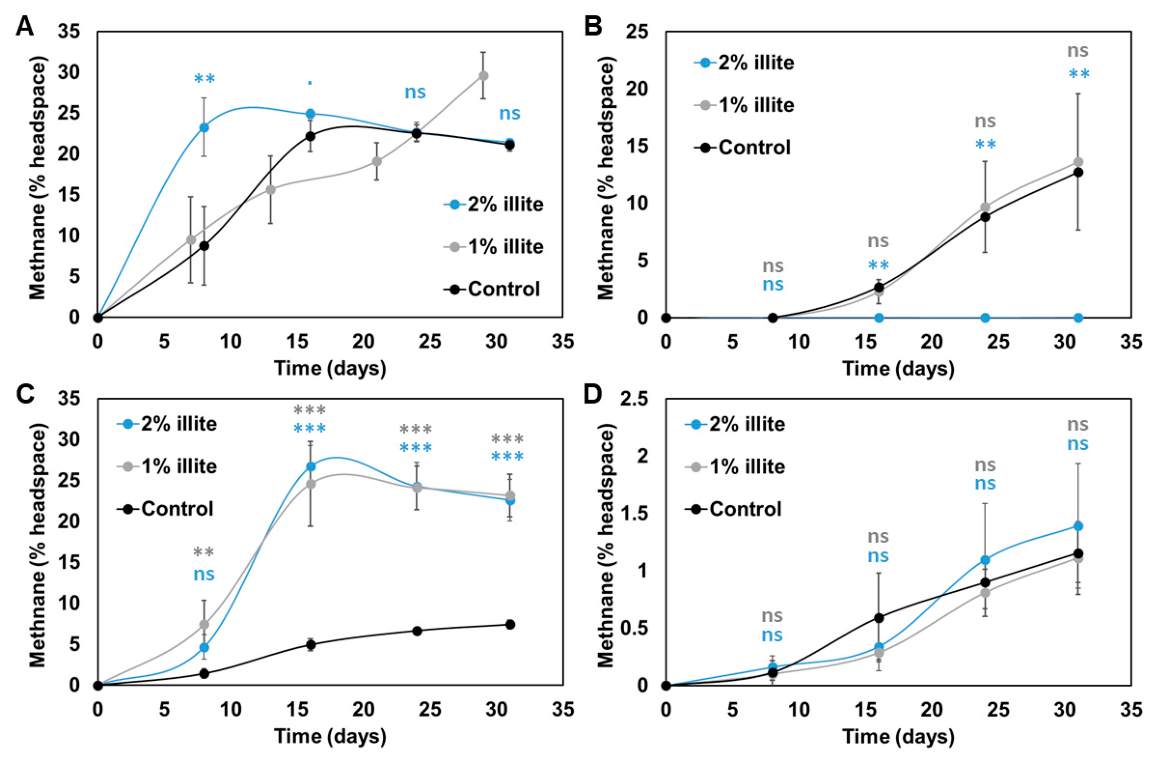
Figure 1. Methane production (% headspace) over time for four methanogens grown in their respective anaerobic growth medium with either 0% (control), 1% (w/v), or 2% (w/v) illite clay: (A) Methanothermobacter wolfeii (55 °C, MM medium); (B) Methanococcus maripaludis (22 °C, MSH medium); (C) Methanobacterium formicicum (37 °C, MSF medium); and (D) Methanosarcina barkeri (37 °C, MS medium). Data are the average of 3–5 replicates (Table 2). Error bars represent ± one standard deviation. Statistical differences revealed by ANOVA are presented compared to the control condition (ns: not significant, .: p < 0.1, **: p < 0.01, ***: p < 0.001).
Microorganisms 14 01496 g001
Figure 2. Methane production (% headspace) over time for four methanogens grown in their respective anaerobic growth medium with either 1 g (in 9 mL medium) or 2.5 g (in 7.5 mL medium) nontronite clay: (A) Methanothermobacter wolfeii (55 °C, MM medium); (B) Methanococcus maripaludis (22 °C, MSH medium); (C) Methanobacterium formicicum (37 °C, MSF medium); and (D) Methanosarcina barkeri (37 °C, MS medium). Control tubes contain only 10 mL medium. Data are the average of three biological replicates (Table 2). Error bars represent ± one standard deviation. Statistical differences revealed by ANOVA are presented compared to the control condition (ns: not significant, .: p < 0.1, *: p < 0.05, **: p < 0.01).
Microorganisms 14 01496 g002
Figure 3. Methane production (% headspace) over time for four methanogens grown in their respective anaerobic growth medium with either 0% (positive control) or 100% (w/v) [10 g/10 mL] Mojave Mars Simulant (MMS) Martian regolith simulant: (A) Methanothermobacter wolfeii (55 °C, MM medium); (B) Methanococcus maripaludis (22 °C, MSH medium); (C) Methanobacterium formicicum (37 °C, MSF medium); and (D) Methanosarcina barkeri (37 °C, MS medium). Data are the average of either two (positive controls) or three (experimental tubes) biological replicates (Table 2). Error bars represent ± one standard deviation. Statistical differences revealed by ANOVA are presented compared to the control condition (ns: not significant, .: p < 0.1, *: p < 0.05, **: p < 0.01).
Microorganisms 14 01496 g003
Figure 4. Methane production (% headspace) over time for three methanogens grown in 10 mL bicarbonate buffer with 1 g montmorillonite clay [10% (w/v)] and subject to two subsequent transfers to new tubes containing 1 g montmorillonite clay and 10 mL bicarbonate buffer: (A) Methanothermobacter wolfeii (55 °C); (B) Methanobacterium formicicum (37 °C); and (C) Methanosarcina barkeri (37 °C). Initial inocula consisted of 0.5 mL washed cells (Set A). Each tube in the subsequent sets (Set B, Set C) was inoculated with 0.5 mL culture from the corresponding tube in the preceding set (i.e., Tube B1 was inoculated with 0.5 mL culture from Tube A1). All tubes were pressurized with 2 bar H2 (arrows) on days 0, 42, 84, and 144 (Set A), days 42, 84, and 144 (Set B), or days 84 and 144 (Set C). Data are the average of three biological replicates (Table 3). Error bars represent ± one standard deviation.
Microorganisms 14 01496 g004
Figure 5. Methane production (% headspace) over time for Methanococcus maripaludis grown in eight variations of MSH medium at room temperature (ca. 22 °C). Conditions labeled “Mont” contain 0.5 g montmorillonite. Components of Solutions A, B, and D (SolnA, SolnB, SolnD, respectively) and the salt solution (“Salt”) are given in Table 4. Data are not shown for conditions under which no methane was produced by any replicates (MSH + Mont-Salt [MSH medium containing 0.5 g montmorillonite and no salt solution] and Buffer + Mont [bicarbonate buffer containing 0.5 g montmorillonite only]). Control tubes (black dashed line) refer to cultures of M. maripaludis grown in standard MSH medium. Data are the average of three biological replicates unless otherwise indicated. Error bars represent ± one standard deviation. Statistical differences revealed by ANOVA are presented compared to the control condition (ns: not significant, .: p < 0.1, ***: p < 0.001).
Microorganisms 14 01496 g005
Table 1. Mars simulant physical and chemical data 1.
ClayNontronite 2, 3Illite 2, 3Montmorillonite 2, 3, 4Mojave Mars Simulant 5
TypeIron smectiteAluminum
phyllosilicate
Aluminum
smectite
Martian regolith
simulant
IdentifierNAu-1IMt-1/2SWy-1/2/3MMS
OriginUley, AustraliaSilver Hill, MT, USACrook County, WY, USAMojave Desert, CA, USA
SiO253.3349.362.949.4
Fe2O334.197.323.3510.87
Al2O310.2224.2519.617.1
CaO3.470.431.6810.45
MgO0.272.563.056.08
Na2O0.0801.533.28
K2O0.037.830.530.48
TiO2 0.550.0901.09
P2O5 0.080.0490.17
MnO 0.030.0060.17
FeO 0.550.32
F 0.111
S 0.05
SO3 0.10
Cr2O3 0.05
1 Chemical compositions are given in percent (%). 2 Data from van Olphen and Fripiar [159] and available from clays.org/sourceclays_data/. 3 Data is unofficial and is meant to be used as a guideline and not as an analytical certification. 4 Chemical composition not available from Ward’s Science. Example chemical components for montmorillonite sourced from Crook County, WY, USA given from 2. 5 General chemical composition from Peters et al. [149].
Table 2. Experimental conditions and maximum methane concentrations produced by Methanobacterium formicicum, Methanosarcina barkeri, Methanothermobacter wolfeii, and Methanococcus maripaludis grown in the presence of Mars simulants in standard methanogenic growth media.
ExperimentOrganismClay
Concentration (% w/v)
Clay Concentration
(g Added/mL
Culture)
Number of ReplicatesTotal Length of Incubation (Days)Length of
Incubation to Maximum
Methane
Concentration (Days)
Maximum Methane Concentration
(% Headspace)
IlliteM. formicicum00/10431317.4 ± 0.5
10.1/1041624.6 ± 5.2
20.2/10326.7 ± 2.6
IlliteM. barkeri00/10531311.2 ± 0.3
10.1/1041.1 ± 0.3
20.2/1051.4 ± 0.5
IlliteM. wolfeii00/104312422.5 ± 1.0
10.1/103292929.6 ± 2.8
20.2/103311624.9 ± 0.6
IlliteM. maripaludis00/104313112.7 ± 3.2
10.1/10513.6 ± 6.0
20.2/1040
NontroniteM. formicicum00/103353544.3 ± 3.4
11.11/917.9 ± 15.3
33.32.5/7.52.4 ± 1.9
NontroniteM. barkeri00/103353516.1 ± 3.9
11.11/98.8 ± 7.4
33.32.5/7.513.3 ± 14.7
NontroniteM. wolfeii00/103353541.0 ± 3.0
11.11/923.0 ± 18.1
33.32.5/7.512.1 ± 19.4
NontroniteM. maripaludis00/103353542.3 ± 6.6
11.11/926.3 ± 14.8
33.32.5/7.528.5 ± 7.2
Mojave Mars SimulantM. formicicum00/1021405229.9 ± 0.7
10010/10325.9 ± 1.5
Mojave Mars SimulantM. barkeri00/102140524.8 ± 1.6
10010/10315.1 ± 1.0
Mojave Mars SimulantM. wolfeii00/102140926.8 ± 2.1
10010/1035220.9 ± 1.7
Mojave Mars SimulantM. maripaludis00/1021402428.6 ± 0.2
10010/1038.4 ± 10.4
Table 3. Experimental conditions and maximum methane concentrations produced by Methanobacterium formicicum, Methanosarcina barkeri, Methanothermobacter wolfeii, and Methanococcus maripaludis grown in bicarbonate buffer containing molecular hydrogen, sodium sulfide, and montmorillonite.
ExperimentOrganismClay
Concentration (% w/v)
Clay
Concentration (g Added/mL Buffer)
Number of ReplicatesTotal Length of Incubation (Days)Length of
Incubation to Maximum
Methane
Concentration (Days)
Maximum
Methane
Concentration (% Headspace)
MontmorilloniteM. formicicum10 (Set A)1/1031984214.8 ± 4.0
10 (Set B)15615639.1 ± 10.1
10 (Set C)11411411.7 ± 11.7
MontmorilloniteM. barkeri10 (Set A)1/103198847.8 ± 1.0
10 (Set B)15615618.5 ± 8.6
10 (Set C)11411419.0 ± 6.0
MontmorilloniteM. wolfeii10 (Set A)1/1031988423.5 ± 19.4
10 (Set B)15615649.3 ± 25.3
10 (Set C)11411449.3 ± 4.4
MontmorilloniteM. maripaludis10 (Set A)1/1031981980
10 (Set B)1561560
10 (Set C)1141140
Table 4. Components for eight variations of MSH medium with and without montmorillonite.
Per 100 mLControl (MSH
Medium)
Mont 1 + SaltMSH + Mont-SolnAMSH + Mont-SolnBMSH + Mont-SolnDMSH + Mont-SaltMont + Buffer 2 OnlyMont + MSH
0.5 g montmorillonite (per 10 mL)-- 3X 4XXXXXX
Solution A 5, 500 µLX----XXX--X
Solution B 6, 100 µLX--X--XX--X
Solution C 7, 100 µLX--XXXX--X
Solution D 8, 50 µLX--XX--X--X
0.1 g yeast extractX--XXXX--X
0.1 g trypticase peptoneX--XXXX--X
0.025 g mercaptoethane sulfonic acidX--XXXX--X
1.475 g NaClXXXXX----X
0.085 g MgCl2XXXXX----X
0.025 g KClXXXXX----X
Buffer 5XXXXXXXX
1 Mont = montmorillonite. 2 Bicarbonate buffer: 4 g/L NaOH saturated with CO2. 3 “--” denotes that this ingredient is absent from the medium. 4 “X” denotes that this ingredient is present in the medium. 5 Solution A, per L: 100 g NH4Cl, 100 g MgCl2·6H2O, 40 g CaCl2·2H2O. 6 Solution B, per L: 200 g K2PO4·3H2O. 7 Solution C, per L: 0.5 g resazurin. 8 Solution D, per L: 500 mg Na2-EDTA·2H2O, 150 mg CoCl2·6H2O, 100 mg MnCl2·4H2O, 100 mg FeSO4·7H2O, 100 mg ZnCl2, 40 mg AlCl3·6H2O, 30 mg Na2WO4·2H2O, 20 mg CuCl2·2H2O, 20 mg NiSO4·6H2O, 10 mg H2SeO3, 10 mg H3BO3, 10 mg Na2MoO4·2H2O.
Disclaimer/Publisher’s Note: The statements, opinions and data contained in all publications are solely those of the individual author(s) and contributor(s) and not of MDPI and/or the editor(s). MDPI and/or the editor(s) disclaim responsibility for any injury to people or property resulting from any ideas, methods, instructions or products referred to in the content.