Article

Dung-Induced Soil Microbial Community Coalescence Driven by Different Dung Sources: Impacts on Community Shifts and Assembly Mechanisms in Grassland Soils


1
School of Water Resources and Environment, China University of Geosciences (Beijing), Beijing 100083, China
2
College of Resources and Environment, University of Chinese Academy of Sciences, Beijing 100049, China
3
RCEES-IMCAS-UCAS Joint-Lab of Microbial Technology for Environmental Science, Beijing 100085, China
*
Author to whom correspondence should be addressed.
Microorganisms 2026, 14(7), 1493; https://doi.org/10.3390/microorganisms14071493 (registering DOI)
Submission received: 9 May 2026 / Revised: 23 June 2026 / Accepted: 6 July 2026 / Published: 8 July 2026
(This article belongs to the Special Issue Microbial Diversity and Ecology in Different Environments)

Abstract

The overall influences of grazing practice on soil microbial community shifts have received considerable attention, but how dung-induced community coalescence affects soil microbial diversity, structure, interaction and the underlying assembly mechanism remains unclear. To address this, we investigated soil microbial community alterations in response to dung deposition, which included three different dung sources in a single grassland. The results indicated that dung deposition by different livestock species had varying impacts on soil microbial community diversity and structure, with cattle dung associated with the largest observed shifts in soil microbial diversity and community structure in this study. The structure of the soil microbial community was strongly associated with multiple edaphic properties (e.g., pH and nutrient content), but these correlations were reshaped by dung deposition in a dung-source-dependent manner. In addition, dung deposition consistently reduced the complexity and robustness of the co-occurrence network across different dung sources, and the strongest alterations in the network were found in shallow soils (0–20 cm). Null model analysis suggests that dung deposition improved the proportional contribution of the stochastic process in bacterial and fungal communities and conversely increased the deterministic process in the archaeal community, implying distinct assembly mechanisms of those microbial domains to the disturbance induced by dung deposition. These results highlight the source effect of dung deposition on the diversity and structure of soil microbial communities, as well as the domain-dependence of dung deposition on the assembly mechanism. The findings suggest that multispecies grazing is associated with distinct dung-induced microbial community shifts, highlighting the need for future research that explicitly incorporates dung source as a variable in grassland soil microbial assessments.

1. Introduction

Grassland ecosystems cover an area of 52.5 million km2 globally, providing multiple ecosystem services, such as carbon storage, climate mitigation and pollination [1,2,3]. However, anthropogenic activities and associated habitat destruction are increasingly impairing ecosystem functions and altering resource availability and cycling [4]. The impact of biodiversity change on ecosystem functioning has spurred extensive research examining the effects of land-use intensification on grassland ecosystem biodiversity and community structure [5,6,7]. This concern is particularly acute for soil biodiversity, which remains largely invisible and understudied despite its essential roles in ecosystem functioning. As anthropogenic pressures intensify, soil microbial diversity may be lost before adequate characterization—a phenomenon emblematic of the ongoing biodiversity crisis [8]. As the most extensive land-use practice, grazing and associated deposition of livestock dung are considered major drivers of biotic and abiotic changes in native grasslands, often influencing soil properties and diversity patterns. For instance, a global synthesis of grazing experiments from natural grasslands suggested that the effects of grazing on biodiversity depended on climate types (dry and wet areas) and grazing patterns (i.e., grazing intensity, livestock type, and grazing season) [9]. Understanding the impacts of grazing on grassland biodiversity and structural shifts is critical for predicting community development trajectories and understanding associated shifts in ecosystem functions (e.g., grassland productivity and carbon sequestration) in response to multiple grazing patterns.
Dung deposition represents a key mechanism by which grazing influences grassland biodiversity, and it can mediate community structure through directly altering ecosystem nutrient inputs and local soil properties [10]. Although the influences of grazing practices on biotic communities have been well-documented [11,12,13,14], particularly regarding aboveground vegetation (e.g., species diversity and productivity) [15,16,17], how these communities respond to dung deposition—as a process separate from grazing per se—remains largely unexplored. Dung deposition not only adds nutrients but also introduces alien microorganisms, potentially triggering a community coalescence between dung-derived and soil-resident microbes [18]. Such community coalescence induced by dung deposition will regulate population dynamics (including recruitment, growth and mortality) and species interactions, ultimately mediating profound changes in both below- and aboveground community structure as well as grassland ecosystem functioning [19,20,21].
The outcomes of dung-induced community coalescence may theoretically depend on dung source, coalescence frequency, biotic interactions, and soil abiotic factors [21,22,23,24]. However, most previous studies have used a single dung source or compared dung from different management histories/sites [21,25]. Consequently, the differential effects associated with various dung sources (including microbial taxa as well as physicochemical properties) on soil microbial community structure and their underlying mechanisms remain largely unexplored. The changes in microbial diversity, community structure, and interspecies interactions induced by community coalescence determine their functional capacity (e.g., greenhouse gas emissions, nutrient cycling, plant protection) [21,26,27]. Nevertheless, unravelling the microbial assembly mechanism during dung-induced coalescence is essential for predicting soil community responses. Two primary processes—deterministic and stochastic—jointly govern community assembly, but their contributions vary with environmental drivers [28,29,30]. Although knowledge of soil microbial assembly under various anthropogenic activities is growing [31,32], how dung deposition influences the balance between deterministic and stochastic processes, and how these processes structure microbial communities, remains unknown. Furthermore, dung deposition occurs on the soil surface, yet most studies have focused on shallow soil layers. Whether the effects of dung-induced coalescence penetrate deeper soil horizons and whether microbial responses differ among soil depths have rarely been examined.
To address these gaps, we conducted a comparative study in the Xilingol steppe, a geographical region in central-east Inner Mongolia, China. This site features multiple livestock types (Ujimqin sheep, Luxi cattle, and Arabian horses) that graze together under consistent grazing practices, local geology, and climate. Adjacent soils without dung deposition served as controls. We evaluated soil microbial communities (bacteria, fungi, archaea) from seven depths (0–100 mm). We hypothesized that: (i) dung deposition-induced community coalescence will alter soil microbial community structure, but the responses will differ among dung sources and soil depths, and (ii) dung deposition will decrease the complexity of co-occurrence patterns, and this effect will vary substantially among dung sources. We also quantified the assembly mechanisms (deterministic vs. stochastic) for each microbial domain. The findings are expected to enhance mechanistic understanding of dung-driven community coalescence and to provide a microbial ecological perspective that may serve as a reference for future hypothesis-driven management studies.

2. Materials and Methods

2.1. Study Area, Sample Collection and Edaphic Analysis

This study was conducted in the Xilingol steppe grassland (44°01′ N, 116°24′ E) of central-east Inner Mongolia, China. The region has a mean annual temperature of 5.1 °C and precipitation of 195 mm. The study area is characterized by flat and open terrain at an elevation of approximately 1100 m. The zonal soil of the region—i.e., soils whose development is determined primarily by climate and vegetation—is classified as calcareous chestnut soil (Calcic Kastanozem), a sandy loam developed on Quaternary loess parent material. This soil type is further divided into two subtypes: typical chestnut soil and dark chestnut soil. In contrast, intrazonal saline–alkali soils occur in some low-lying areas, where local topographic conditions override the zonal climatic signal. Given the deep groundwater table (>30 m), soil moisture is dependent on precipitation. The dominant plant species herein are Leymus chinensis, Agropyron cristatum, and Stipa grandis. The study site has been under long-term grazing by three livestock species (Ujimqin sheep, Luxi cattle, and Arabian horses) with a consistent grazing practice, ensuring comparable background conditions for investigating dung deposition effects. The soil samples covered by livestock dung (with dung retention time of ~40 days) and adjacent uncovered soils were collected from seven different depths (three replicate plots for each depth) with a steel probe, composed of surface soil samples (0–5 cm below ground), shallow-soil samples (5–10 cm and 10–20 cm), intermediate-depth soil samples (20–30 cm, 30–50 cm, and 50–70 cm), and deep-soil samples (70–100 cm). Fresh dung and air-dried dung pats were also aseptically collected for each livestock species. All samples were labelled and transferred to the laboratory in a dry ice box.
The edaphic properties of the samples were measured as described by Zhao et al. (2021) [33]. Soil total carbon and total nitrogen were measured on a Vario EL III Elemental Analyzer (Elementar, Hanau, Germany), while soil total phosphorus was measured by a US-VIS spectrophotometer (AA3, SEAL analytical, Norderstedt, Germany). The concentrations of nitrate and ammonium nitrogen were determined by extraction with 2M KCl, followed by analysis on a continuous-flow ion auto-analyzer (SEAL Analytical GmbH, Norderstedt, Germany). Soil pH was measured by a pH meter (Starter 3100, Ohaus Instruments, Changzhou, China) with a 1:5 soil–water ratio (ISO 10390:2021 [34]). Soil moisture was gravimetrically measured by drying the soil samples at 105 °C to a constant weight. The soil C:N ratio was calculated from the measured contents of soil total carbon and total nitrogen.

2.2. DNA Extraction, PCR and High-Throughput Sequencing

Genomic DNA was extracted with a MoBio PowerSoil kit (MoBio Laboratories, Carlsbad, CA, USA) following the manufacturer’s instructions. Prior to downstream analysis, a composite DNA sample for each depth was generated by pooling the triplicate extracts in the same amounts. Primers targeting the bacterial 16S rRNA gene (338F: 5′-ACTCCTACGGGAGGCAGCAG-3′ and 806R 5′-GGACTACHVGGGTWTCTAAT-3′) and those targeting the archaeal 16S rRNA gene (524F-10-ext: 5′-TGYCAGCCGCCGCGGTAA-3′ and arch958R: 5′-YCCGGCGTTGAVTCCAATT-3′) were used to construct prokaryotic amplicon libraries [35,36]. Primers targeting the fungal ITS region (ITS1F: 5′-CTTGGTCATTTAGAGGAAGTAA-3′ and ITS2R: 5′-GCTGCGTTCTTCATCGATGC-3′) were used to create fungal libraries [37]. Each DNA sample was amplified in three replicates, including a negative control with 1 μL of sterile water to monitor potential PCR reagent contamination. The PCR amplification was conducted under the following conditions: initial denaturation at 95 °C for 3 min; execution of 35 cycles of PCR (95 °C for 30 s, 55 °C for 30 s, 72 °C for 45 s); and ending with a final extension at 72 °C for 10 min. The amplicons from three independent reactions per sample were pooled for library construction to mitigate the effects of potential early-cycle PCR errors. The final PCR products were sent for sequencing on the Illumina MiSeq PE300 platform at Majorbio Bio-pharm Technology Co., Ltd. (Shanghai, China).

2.3. Sequence Data Analysis

Prior to analysis, raw sequences were quality-filtered using Trimmomatic to remove low-quality reads (score < 30) and those containing ambiguous bases (“N”) [38] to minimize the impacts of random sequencing errors. The remaining sequences were further processed to discard reads with primer or barcode sequences, those shorter than 200 bp or longer than 550 bp, and identified chimeras. Subsequently, the high-quality sequences were trimmed and taxonomically classified against the Silva database using the RDP classifier [39]. Finally, operational taxonomic units (OTUs) were clustered at a 97% similarity threshold with USEARCH [40].

2.4. Bioinformatic and Statistical Analysis

We normalized all samples to an equal sequencing depth via random subsampling to enable unbiased comparisons of microbial diversity. Subsequently, the bacterial, fungal, and archaeal libraries contained 17,247, 40,388, and 33,105 high-quality sequences per sample, respectively. The alpha diversity of soil bacterial, fungal and archaeal communities was assessed. For each community, we calculated the observed number of OTUs, Chao 1 richness estimator, phylogenetic diversity, and Shannon, Simpson and ACE indexes using Mothur [41]. The microbial community composition in different dung-covered soils and uncovered soils, together with corresponding livestock dung, was visualized using an average relative abundance. The dissimilarity in soil microbial community structure among the dung-covered and uncovered soils was analyzed by principal coordinates analysis (PCoA), and the significance of community structure among them was assessed using permutational multivariate analysis of variance (PERMANOVA) and multiple response permutation procedure (MRPP).
A network analysis was conducted to reveal the impacts of dung deposition on the soil microbial co-occurrence patterns. Only representative OTUs (>ten sequences within each dung-covered or uncovered soil) were used to conduct the following analysis. We defined a robust co-occurrence relationship as one with a Spearman’s correlation coefficient ρ > 0.6 and a statistically significant p < 0.001. We calculated eight network indexes to describe the topological features of these networks, including average path length, average clustering coefficient, average degree, network density, positive co-occurrence percentage, modularity, and total nodes and links. We quantified network robustness as the decline rate of natural connectivity during simulated node removal [42]. Network visualization was conducted using the Gephi (v0.11.2) platform [43]. Correlations between microbial community profiles and environmental factors were determined by Pearson’s correlation test and Mantel analysis, and the results were visualized using ggcor (v0.9.8.1) in R (v4.0.3).
The assembly mechanisms of the soil microbial community were assessed using a null model approach following Stegen et al. (2013) [44]. Pairwise comparisons were grouped by dung source. Specifically, separate null model analyses were conducted for four groups: (i) uncovered soils, (ii) sheep dung-covered soils, (iii) cattle dung-covered soils, and (iv) horse dung-covered soils. Within each group, pairwise comparisons were made across all seven depth layers (0–5, 5–10, 10–20, 20–30, 30–50, 50–70, and 70–100 cm). The β-mean nearest taxon distance (β-MNTD) between soil samples and its null distribution was calculated in R using the comdistnt function (picante package). The deviation between observed and null expectations was quantified by calculating the β-nearest taxon index (β-NTI). We also calculated the Raup–Crick metric based on Bray–Curtis dissimilarity (RCBray) to compare the observed community dissimilarity against a null model. RCBray was interpreted jointly with βNTI to evaluate the community assembly process [45]. Based on established thresholds, pairwise community comparisons were categorized according to their β-NTI and RCBray values: heterogeneous selection was inferred when β-NTI > 2, whereas homogeneous selection was indicated by β-NTI < −2. For comparisons where |β-NTI| < 2, dispersal limitation was assigned if RCBray > 0.95, and homogenizing dispersal was assigned if RCBray < −0.95. Finally, pairwise comparisons exhibiting |β-NTI| < 2 and |RCBray| < 0.95 were attributed predominantly to undominated, which is also described as a ‘drift’ assembly process.

3. Results

3.1. Shifts in Soil Microbial Community Diversity and Structure Induced by Dung Deposition

Through the current sequencing efforts, the rarefied sequences were clustered into 4532 bacterial, 2889 fungal and 150 archaeal OTUs at 97% identity thresholds. Alpha diversity showed distinct responses to dung deposition depending on dung source, with the most pronounced shifts observed in cattle dung-covered soils (Table 1). To be specific, the α-diversity index of bacterial communities, such as the richness index (observed number of OTUs, Chao 1 and ACE estimator) and diversity index (Shannon, Simpson and phylogenetic diversity indexes), exhibited no significant variation among the dung-covered and uncovered soils. Fungal communities exhibited significant increases in the Chao 1 estimator and ACE index in sheep dung-covered soils but significant decreases in the Shannon and Simpson indexes in cattle and horse dung-covered soils. Archaeal communities showed the most significant differences in cattle dung-covered soils, where richness estimators (observed number of OTUs and Chao 1) and diversity indexes (ACE and PD) were significantly decreased compared to uncovered soils.
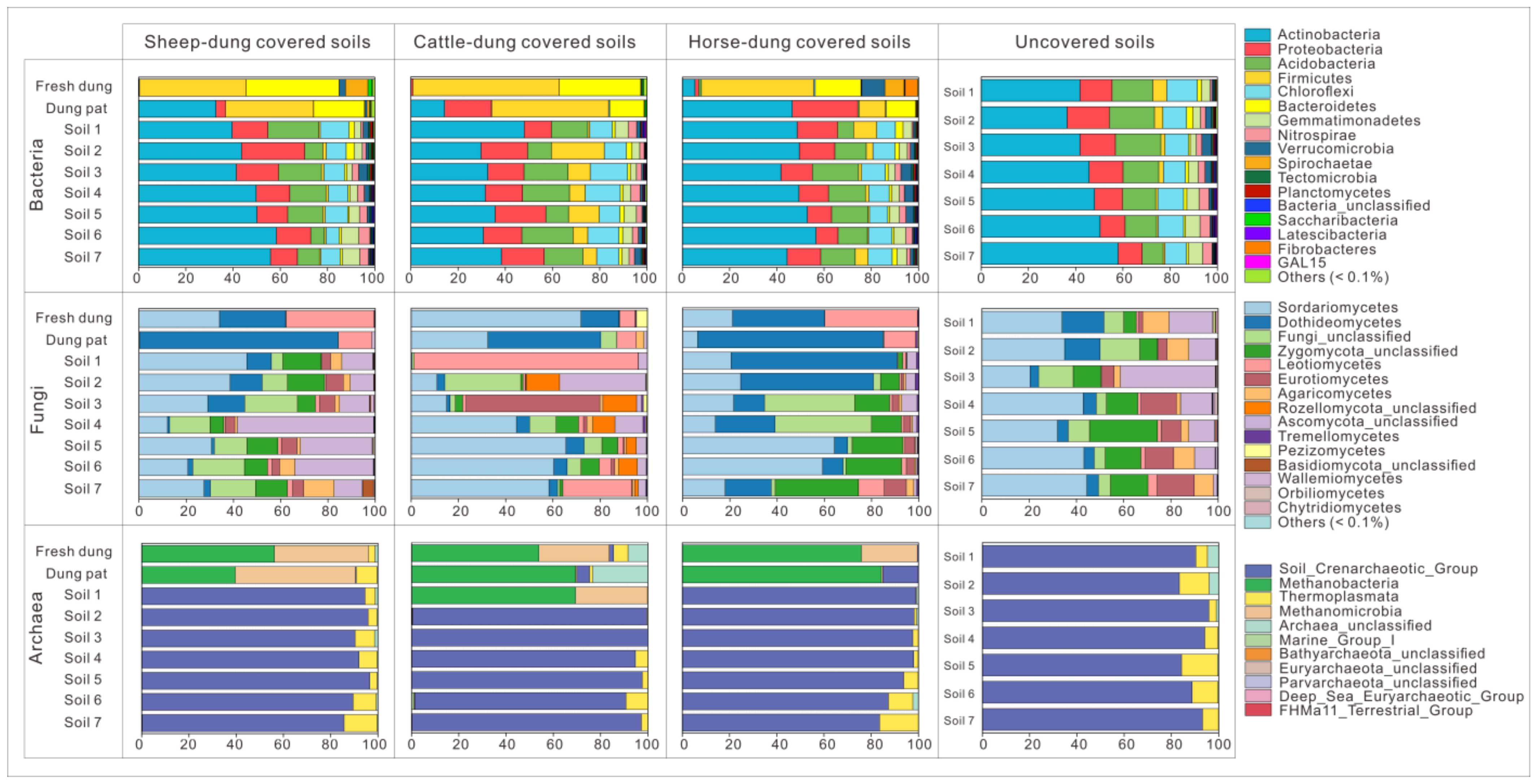
The composition of the microbial community in dung-covered soils was distinct from fresh dung or dung pats at the phylum or class level (Figure 1). In the fresh dung of livestock and dung pats, prokaryotic communities were dominantly composed of the bacterial phyla Firmicutes and Bacteroidetes, as well as methanogenic groups, including Methanobacteria and Methanomicrobia, while fungal communities were predominated by the classes Sordariomycetes, Leotiomycetes and Dothideomycetes. The soil bacterial community was dominated by the phylum Actinobacteria (45% on average), followed by Proteobacteria (15%), Acidobacteria (15%) and Chloroflexi (10%), while the soil fungal and archaeal communities were dominated by the class Sordariomycetes (33%) and the Soil Crenarchaeotic Group (90%), respectively. Venn diagram analysis revealed that 27%, 43%, and 49% of the soil microbial genera in sheep, cattle, and horse dung-covered soils, respectively, were also present in fresh dung or dung pats (Supplementary Figure S1). Among these dung–soil co-occurring genera, only 46 bacterial, 25 fungal, and three archaeal genera were absent from control (uncovered) soils (Supplementary Figure S2).
PCoA analysis was utilized to depict the shifts in soil microbial community structure among different dung-covered soils (Supplementary Figure S3). The dissimilarity tests based on Bray–Curtis distances showed that cattle dung deposition-induced community coalescence tended to be associated with significant structural changes in all three microbial domains (Table 2). In contrast, horse dung deposition only altered the structure of soil fungal communities (PERMANOVA, p = 0.005; MRPP, p = 0.001), and sheep dung deposition did not significantly affect any of the three microbial domains (PERMANOVA and MRPP, p > 0.05). When we analyzed the data by soil depth, we found that dung deposition-induced community coalescence resulted in larger structural shifts in deeper soils than in shallow soils (Supplementary Figure S4 and Table S1).

3.2. Correlation Between Edaphic Properties and Soil Microbial Community Structure

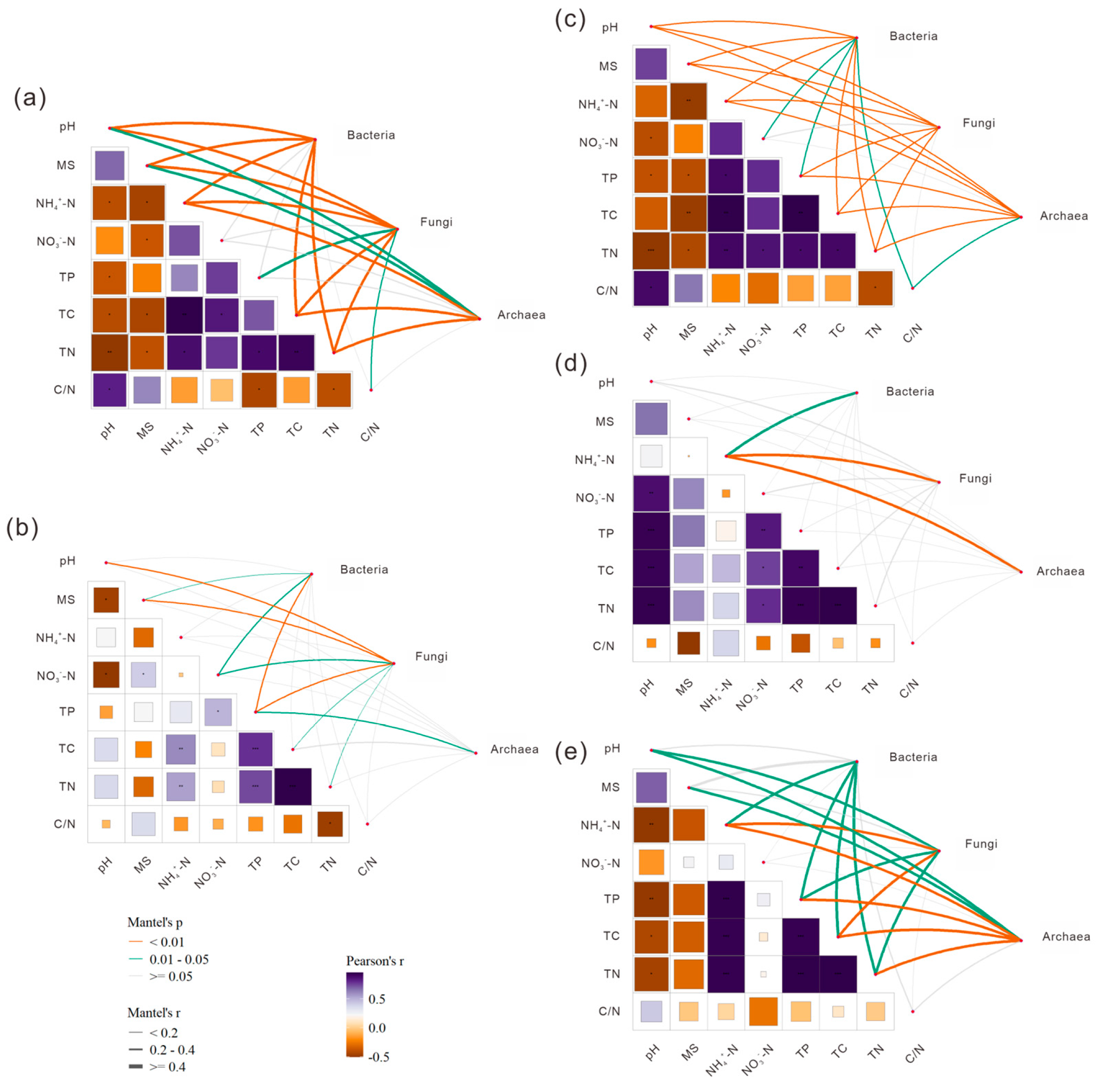
Overall, several edaphic properties contributed to explaining the variation in soil microbial community structure in both dung-covered and uncovered soils, but community coalescence induced by dung deposition generally weakened these associations (Figure 2a,b). However, when we separated dung-covered soils by livestock species, clear differences emerged between them (Figure 2c–e). For sheep dung-covered soils, dung deposition exerted limited effects on the relationship between soil microbial communities and edaphic properties. In contrast, cattle and horse dung deposition weakened the relationships between the variation in soil microbiota and edaphic properties to different degrees. Notably, in cattle dung-covered soils, only soil NH4+-N remained closely correlated with microbial community variation.

3.3. Shifts in Soil Microbial Co-Occurrence Patterns Driven by Dung Deposition

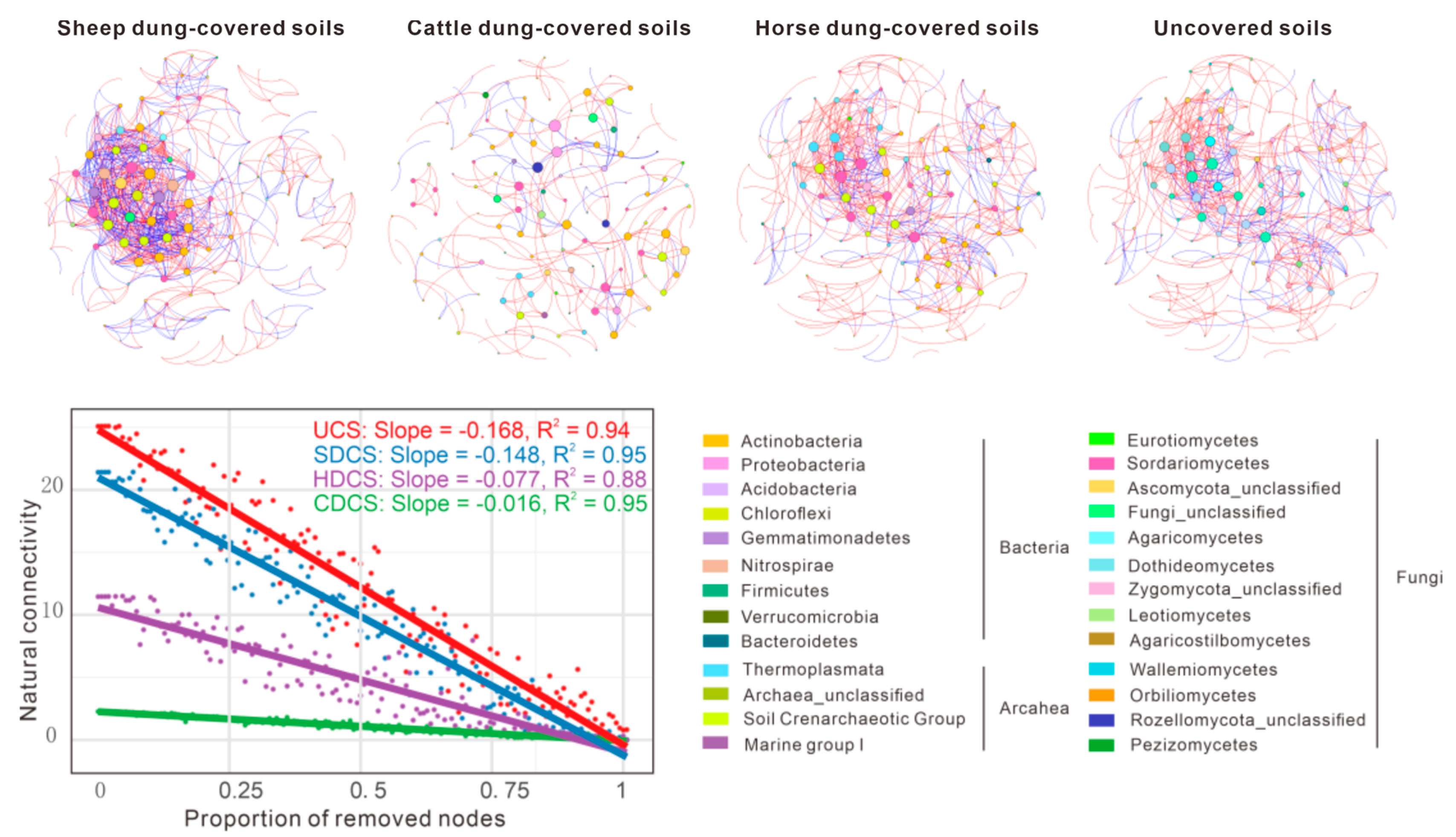
To elucidate microbial co-occurrence patterns, we constructed co-occurrence networks for four categories, including sheep dung-covered soils, cattle dung-covered soils, horse dung-covered soils and uncovered soils, resulting in 157, 151, 152 and 167 nodes, respectively (Figure 3). In all four networks, the majority of the connections were affiliated with the bacterial phylum Actinobacteria (18–23%), the fungal class Sordariomycetes (16–21%) and the archaeal class Soil Crenarchaeotic Group (10–11%), but the networks exhibited distinct topological properties. Compared with uncovered soils, networks of dung-covered soils had fewer nodes, fewer edges, and lower density, indicating reduced topological complexity. They also exhibited lower clustering coefficients but higher average path lengths, suggesting weaker and less efficient co-occurrence patterns. In particular, cattle dung-covered soils presented the lowest average degree but the highest average path length and modularity, indicating a weakened microbial co-occurrence pattern with a highly modular structure (Table 3). Moreover, the network robustness of dung-covered soils was lower than that of uncovered soils based on the correlations between microbial natural connectivity and proportion of removed nodes (Figure 3).
To assess the impact of dung deposition-induced community coalescence on microbial interactions from different soil depths, we split the dataset of microbial communities in dung-covered soils and constructed microbial community networks for shallow soils (0–20 cm) and deep soils (20–100 cm). The shallow-soil network exhibited lower complexity (average degree) and lower robustness than the deep-soil network. Additionally, the shallow-soil network had a predominance of positive co-occurrence (91%) and higher modularity, indicating highly cooperative microbial interactions and strong modularization in shallow soils (Supplementary Figure S5 and Table S2).

3.4. Community Assembly of Soil Microbial Communities

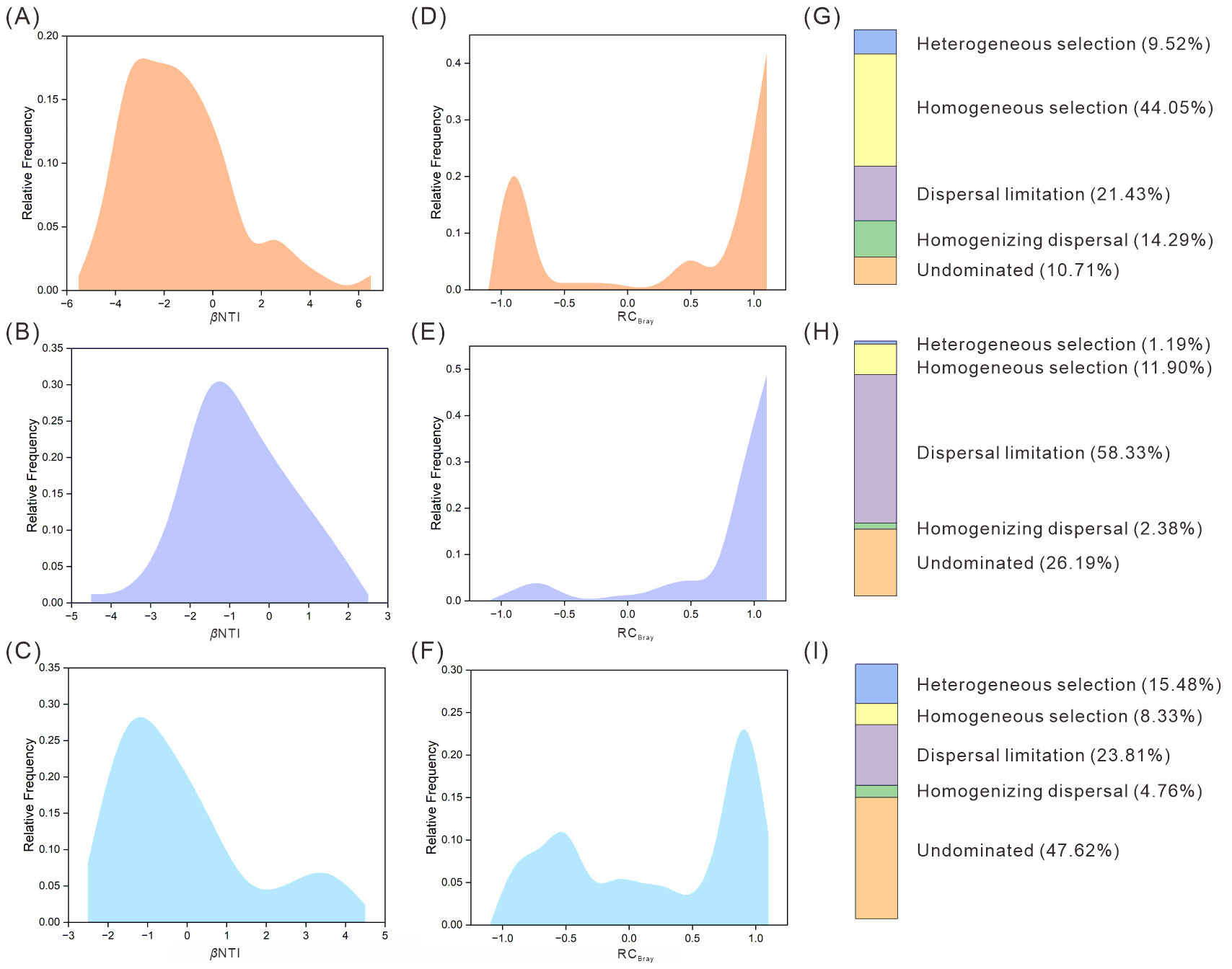
To determine the dominant process governing soil microbiota assembly, βNTI and RCBray were calculated for both dung-covered and uncovered soils. As shown in Figure 4, the bacterial phylogenetic turnover differed significantly from the null model in half of the soil pairs (βNTI < −2 in 44.05% of cases; βNTI > 2 in 9.52%). Among the remaining pairs, nearly one-third showed higher taxonomic turnover than expected by chance (RCBray > 0.95). These results indicate that homogeneous selection dominated bacterial assembly in most soil pairs, whereas dispersal limitation contributed notably to taxonomic turnover in others. Conversely, fungal communities for most soil pairs (87%) did not vary significantly from the null model (|βNTI| < 2). Of these, 67% exhibited higher taxonomic turnover, while 30% showed no significant variations, implying that dispersal limitation and drift tend to be the primary drivers of fungal assembly. For archaea, phylogenetic turnover did not differ significantly from the null model in 76.19% of soil pairs. Among these, nearly 62.5% also showed no significant difference from the null model, indicating that stochastic processes, particularly drift, dominate archaeal phylogenetic turnover.
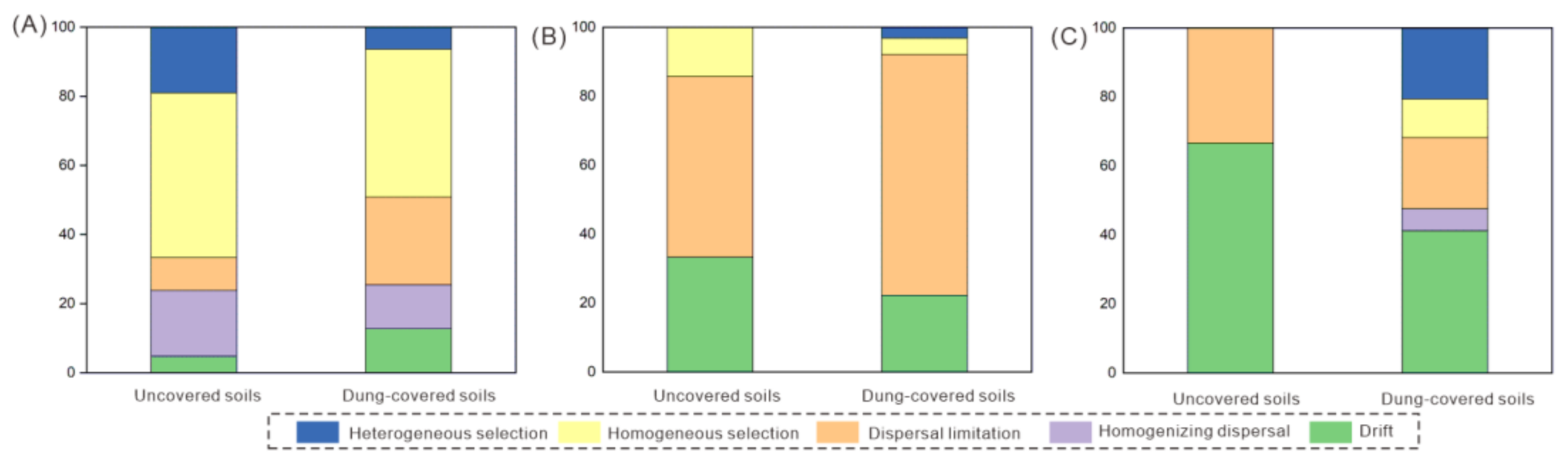
The effect of dung deposition on assembly processes varied among microbial domains (Figure 5). For bacteria, deterministic processes accounted for 67% of the assembly in uncovered soils, but dung deposition decreased the proportion of deterministic processes while increasing the proportions of dispersal limitation and drift. For fungi, uncovered soils were dominated by stochastic processes (85%), and dung deposition further increased the proportion of stochastic processes at the expense of deterministic processes (specifically homogeneous selection). For archaea, uncovered soils were entirely governed by stochastic processes; however, dung deposition decreased the proportion of dispersal limitation and drift and increased the proportion of deterministic processes (heterogeneous and homogeneous selection).

4. Discussion

The consequences of grazing on soil microbial diversity and community structure are well documented [46,47]. However, most studies focused on the overall impacts of grazing practice, whereas the specific ecological impacts of dung deposition-induced community coalescence have received limited attention. The objective of this study was to examine how dung deposition alters soil microbial diversity, community structure, and co-occurrence patterns across different dung sources and soil depths and to elucidate the underlying assembly mechanisms. Consistent with our first hypothesis, dung deposition exerted divergent effects on soil microbial α-diversity depending on dung source and microbial domain (Table 1). The observed changes in microbial diversity reflect the offset between decreasing and increasing impacts of community coalescence induced by dung deposition on soil microbial diversity. Specifically, dung deposition enriches the soil microbial community by introducing dung-derived microorganisms, which may increase microbial diversity [10,19,48]. In addition, short-term dung deposition provides immediate fertility benefits—primarily through increased availability of organic carbon, nitrogen, and phosphorus—thereby promoting the rapid proliferation of copiotrophic microorganisms adapted to nutrient-rich environments. In contrast, a selective pressure through altered edaphic properties and antibiotic agents leads to the loss of some native species [49,50]. Notably, fungal and archaeal communities showed greater sensitivity to dung deposition than bacteria, though the direction and magnitude of these changes varied with dung sources. We attribute this difference to growth characteristics and adaptive mechanisms: dung deposition altered oxygen availability and moisture levels in underlying soil, and the growth of fungal hyphae and the anaerobic preference of methanogens enabled them to respond rapidly to such changes [51,52]. These findings suggest that soil fungal and archaeal community diversity may serve as more sensitive indicators than bacteria for evaluating the impact of dung-induced community coalescence on soil microbial α-diversity. Notably, several microbial taxa were exclusively detected in dung-covered soils but were completely absent from control soils, providing strong evidence for the direct introduction of livestock gut microbiomes via dung deposition. For example, the cellulolytic bacterium Ruminiclostridium [53,54], the archaeal lineage Methanobacteriaceae [55] and the coprophilous fungus Strattonia [56] are well-documented members of the ruminant gut or dung microbiota. The presence of these taxa in dung-covered soils and their absence in control soils confirm that they are not native to the soil environment but are instead allochthonous microorganisms imported via dung deposition.
Dung-induced community coalescence also altered soil microbial community structure, with the strongest effects observed for cattle dung. The variations in microbial community diversity and structure among dung-covered soils could be attributed to the differences in dung characteristics among livestock species (such as moisture and nutrient composition) as well as the altered edaphic properties caused by dung deposition [22,57]. Moreover, cattle deposit dung in large amounts in a few patches, whereas sheep and horses produce small pellets that are widely distributed. Such variations in the pattern of dung deposition might strengthen the differences in soil microbial community structure among livestock species [58]. A particularly novel finding emerged from the depth analysis: the differences in microbial community structure between dung-covered and dung-free soils were more pronounced in deeper layers (>20 cm) than in shallow soils. This suggests that grazing practices may increase the resistance of soil microbial communities to dung deposition in shallow soil layers. For instance, priority effects (leading to invasion resistance of the soil community) or long-term environmental exposure may confer greater invasion resistance to surface soil communities [18,59], but further experimental tests are still required to confirm this speculation.
The soil microbial community structures showed a strong correlation with edaphic properties in uncovered soils, but the correlation shifted in magnitude and direction under different types of dung deposition—consistent with the general finding that soil microbial community structure is jointly shaped by edaphic properties, land use, and geographical distance [60,61]. For sheep dung-covered soils, the correlations remained largely unchanged—consistent with the absence of significant structural shifts. In contrast, for cattle and horse dung-covered soils, microbial community structure became decoupled from edaphic properties and appeared more closely associated with other factors, such as biotic interactions among soil microorganisms [62,63]. This decoupling implies that dung deposition can override environmental filtering in certain contexts, shifting the primary drivers of community variation.
Microbial co-occurrence patterns have been reported to be sensitive to anthropogenic disturbances and environmental conditions [64,65]. The co-occurrence network analysis confirmed that community coalescence induced by dung deposition consistently reduced the complexity and robustness of the network of soil microorganisms. The results were consistent with previous studies, which suggested microbial interactions might be strongly impaired in copiotrophic environments [66,67], i.e., accelerated nutrient input caused by dung deposition in this case. We further found a higher positive association in shallow soils than in deep soils, indicating that soil microbes may adapt to dung deposition via cooperative interactions. This pattern supports the stress gradient hypothesis, where microorganisms can regulate co-occurrence patterns by decreasing negative co-occurrence associations (e.g., competition) and increasing positive ones (e.g., cooperation) as one of the effective survival strategies under stress [68,69]. Notably, cattle and horse dung-covered soils exhibited increased positive associations and modularity, indicating enhanced positive co-occurrence associations and a highly modular structure that may facilitate adaptation to habitat heterogeneity induced by dung deposition [70,71]. Since the findings could imply the adaptability and survival strategies of soil microbiota when dung-induced community coalescence occurs, we proposed that soil microorganisms enable adaptation to the alterations in environmental conditions caused by dung deposition by regulating their co-occurrence patterns [69,70] as a strategy in the Xilingol grassland steppe.
Turning to assembly mechanisms, we observed contrasting patterns among microbial domains. In general, deterministic processes dominated bacterial assembly (53.7%), contrasting with the strong stochastic influence on fungal (86.9%) and archaeal (76.2%) communities. As shown in numerous previous studies, the relatively weak deterministic (i.e., heterogeneous and homogeneous selection) effect on fungal and archaeal communities may be attributed to their high adaptability to survive in varied environments [72,73]. Importantly, dung deposition altered the balance of assembly processes in domain-specific ways. Dung-induced community coalescence increased the relative contribution of the stochastic process to bacterial and fungal communities but increased the deterministic process of the archaeal community. Previous studies have reported that stochasticity might be increased under low ecological pressure, which dampens the influence of environmental filtering [74,75]. The contrasting pattern of microbial assembly among microbial domains may be attributed to their divergent strategies in response to dung deposition. For instance, the majority of bacterial and fungal communities in dung-covered soils are likely adapted to the altered environment (e.g., enhanced nutrient input) resulting from dung deposition. Research has demonstrated that bacteria primarily utilize organic acids and carbohydrates, while fungi are primarily involved in the metabolism of recalcitrant soil carbon (such as residual cellulose and lignin in livestock dung) [76]. However, environmental changes caused by dung deposition might have a negative effect on the survival of the archaeal community. As reported in previous work, the Soil Crenarchaeotic Group (the predominant archaeal class in soils here) was widely distributed in the soil environment and sensitive to soil pH [77,78]; therefore, dung deposition emerged to trigger environmental filtering of soil archaeal communities. Overall, the results demonstrate that dung-induced community coalescence does not uniformly affect assembly processes but rather reconfigures them according to the ecological traits of each microbial domain.

5. Conclusions

In conclusion, this study demonstrates that dung deposition significantly reshapes grassland soil microbial communities through community coalescence, with effects that vary by dung source, soil depth, and microbial domain. The results showed that the effects of dung deposition varied among livestock species, though these differences are inherently confounded with physical and chemical dung properties. Cattle dung was associated with the largest observed shifts in soil microbial diversity and exerted stronger effects on soil microbial community structure in all three microbial domains. Further analysis revealed that the microbial community structure in deep soils was more susceptible to the influence of dung deposition than in shallow soils, suggesting a possible higher resistance of shallow-soil microbial communities, though this interpretation remains speculative. Moreover, community coalescence induced by dung deposition led to a less complex and robust microbial co-occurrence network across all dung-covered soils, suggesting a more sensitive response of microbial network attributes than community structure. Based on the ecological process that governs community assembly, we uncovered a contrasting turnover pattern in response to dung deposition among three microbial domains. We found that within the same metacommunity, dung deposition increased the proportion of the stochastic process for the soil bacterial and fungal communities but increased the deterministic process for the archaeal community. These findings advance our knowledge of how dung deposition shifts microbial community structure and interactions, thereby uncovering the distinct ecological processes that assemble soil microbiota in different microbial domains. Further experimental tests are still required to expand our observations to other grassland types and also to dive deep into their impact on grassland functioning.

Supplementary Materials

The following supporting information can be downloaded at https://www.mdpi.com/article/10.3390/microorganisms14071493/s1, Table S1: Dissimilarity test based on permutational multivariate analysis of variance (PERMANOVA) and multiple-response permutation procedure (MRPP) between different dung-covered and uncovered soil across different depths. SDCS, sheep dung-covered soils; CDCS, cattle dung-covered soils; HDCS, horse dung-covered soils; UCS, uncovered soils. Table S2: Topological features of microbial networks in dung-covered soils across different depths. Figure S1: Venn diagram showing numbers of shared and unique microbial genera between different habitats in sheep dung-covered soils (a), cattle dung-covered soils (b) and horse dung-covered soils (c) and the microbial composition by three major domains. Figure S2: Heatmap showing the co-occurring genera detected in both dung and dung-covered soil samples but absent from uncovered (control) soils, for (a) bacterial, (b) fungal, and (c) archaeal communities. Abundance values are log2-transformed. Figure S3: PCoA ordination based on Bray-Curtis dissimilarity for bacteria (A), fungi (B) and archaea (C). Symbols with red down triangles indicate soils from sheep dung-covered soils, green squares indicate cattle dung-covered soils, blue circles indicate soils from horse dung-covered soils, and grey up triangles indicate uncovered soils. Figure S4: PCoA ordination based on Bray-Curtis dissimilarity for bacteria (A,B), fungi (C,D) and archaea (E,F) across different soil depth. The left panels (A,C,E) represent shallow soils and right panels (B,D,F) represent deep soils. Symbols with red down triangles indicate soils from sheep dung-covered soils, green squares indicate cattle dung-covered soils, blue circles indicate soils from horse dung-covered soils, and grey up triangles indicate uncovered soils. Figure S5: Co-occurrence patterns of dung-covered soil microbiota in the shallow (0–20 cm) and deep (20–100 cm) soils. (a) Nodes indicate taxonomic affiliations at the OTU level. The size of each node is proportional to the number of degrees and the colours of nodes represent different taxonomic information (phylum level for bacteria and class level for fungi/archaea). Links between the nodes indicate a significant correlation between those OTUs (p < 0.001), and links with red and blue lines in the network represent positive and negative correlations, respectively. (b) Changes in natural connectivity in response to node removal from the networks. Red circles represent microbes in shallow soils and blue circles represents microbes in deep soils.

Author Contributions

Conceptualization, J.Y. and Z.Y.; methodology, J.Y.; software, Q.Z.; validation, J.Y. and Q.Z.; formal analysis, J.Y.; investigation, J.Y.; resources, J.Y.; data curation, J.Y. and Q.Z.; writing—original draft preparation, J.Y.; writing—review and editing, B.W., F.N. and Z.Y.; visualization, Z.Y.; supervision, Z.Y.; project administration, Z.Y.; funding acquisition, J.Y. and Z.Y. All authors have read and agreed to the published version of the manuscript.

Funding

This work was supported by Fundamental Research Funds for the Central Universities (2-9-2024-033), the National Key Research and Development Program of China (Number 2016YFC0503601), and the China Postdoctoral Science Foundation (Number 2023M733462).

Institutional Review Board Statement

Not applicable.

Informed Consent Statement

Not applicable.

Data Availability Statement

The sequence data obtained in this study were deposited in the NCBI Short Read Archive (SRA) under the Bioproject accession number PRJNA392724, with Biosample numbers SAMN07305413–SAMN07305415.

Acknowledgments

The authors have reviewed and edited the output and take full responsibility for the content of this publication.

Conflicts of Interest

The authors declare no conflicts of interest.

References

  1. Bai, Y.; Cotrufo, M.F. Grassland soil carbon sequestration: Current understanding, challenges, and solutions. Science 2022, 377, 603–608. [Google Scholar] [CrossRef] [PubMed]
  2. White, R.P.; Murray, S.; Rohweder, M. Pilot Analysis of Global Ecosystems: Grassland Ecosystems; World Resources Institute: Washington, DC, USA, 2000. [Google Scholar]
  3. Bengtsson, J.; Bullock, J.M.; Egoh, B.; Everson, C.; Everson, T.; O’Connor, T.; O’Farrell, P.J.; Smith, H.G.; Lindborg, R. Grasslands-more important for ecosystem services than you might think. Ecosphere 2019, 10, e02582. [Google Scholar]
  4. Solomon, D.; Lehmann, J.; Kinyangi, J.; Amelung, W.; Lobe, I.; Pell, A.; Riha, S.; Ngoze, S.; Verchot, L.; Mbugua, D.; et al. Long-term impacts of anthropogenic perturbations on dynamics and speciation of organic carbon in tropical forest and subtropical grassland ecosystems. Glob. Change Biol. 2007, 13, 511–530. [Google Scholar]
  5. Balvanera, P.; Pfisterer, A.B.; Buchmann, N.; He, J.S.; Nakashizuka, T.; Raffaelli, D.; Schmid, B. Quantifying the evidence for biodiversity effects on ecosystem functioning and services. Ecol. Lett. 2006, 9, 1146–1156. [Google Scholar] [CrossRef] [PubMed]
  6. Li, Y.; Schuldt, A.; Ebeling, A.; Eisenhauer, N.; Huang, Y.; Albert, G.; Albracht, C.; Amyntas, A.; Bonkowski, M.; Bruelheide, H.; et al. Plant diversity enhances ecosystem multifunctionality via multitrophic diversity. Nat. Ecol. Evol. 2024, 8, 2037–2047. [Google Scholar] [CrossRef] [PubMed]
  7. Su, H.; Wang, Z.; Ma, L.; Qin, R.; Chang, T.; Zhang, Z.; Yao, J.; Li, X.; Li, S.; Hu, X.; et al. Multitrophic Diversity of the Biotic Community Drives Ecosystem Multifunctionality in Alpine Grasslands. Ecol. Evol. 2024, 14, e70511. [Google Scholar] [CrossRef] [PubMed]
  8. Khomutova, T.E.; Demkin, V.A. Assessment of the Microbial Biomass Using the Content of Phospholipids in Soils of the Dry Steppe. Eurasian Soil Sci. 2011, 44, 686–692. [Google Scholar] [CrossRef]
  9. Cao, F.; Li, W.; Jiang, Y.; Gan, X.; Zhao, C.; Ma, J. Effects of grazing on grassland biomass and biodiversity: A global synthesis. Field Crops Res. 2024, 306, 109204. [Google Scholar]
  10. Aarons, S.R.; O’Connor, C.R.; Hosseini, H.M.; Gourley, C.J.P. Dung pads increase pasture production, soil nutrients and microbial biomass carbon in grazed dairy systems. Nutr. Cycl. Agroecosyst. 2009, 84, 81–92. [Google Scholar]
  11. Kou, X.; Mou, X.; Xu, W.; Xi, S.; Yu, Y. Yak and Tibetan sheep dung increase the proportional biomass of grasses and alleviate soil nitrogen limitation in degraded Tibetan alpine grassland. Catena 2024, 240, 108007. [Google Scholar] [CrossRef]
  12. Guevara-Torres, D.R.; Facelli, J.M. Choose Local: Dung Addition from Native Herbivores Can Produce Substantial Positive Effects on the Growth of Native Grasses Compared to Livestock Dung. J. Soil Sci. Plant Nutr. 2023, 23, 4647–4655. [Google Scholar] [CrossRef]
  13. Zhao, Y.Y.; Sun, Z.K.; Zhou, C.Y.; Ding, Y.; Zhang, Y.R.; Liu, Y.N.; Liu, L. Livestock grazing increases soil bacterial alpha-diversity and reduces microbial network complexity in a typical steppe. Agric. Ecosyst. Environ. 2025, 392, 109753. [Google Scholar] [CrossRef]
  14. Jing, L.H.; Li, T.; Mipam, T.D.; Jiang, A.; Liu, J.Q.; Hu, Q.J.; Tian, L.M. Effects of Grazing Intensity on Soil Bacterial and Fungal Community Structure in Grasslands. Land Degrad. Dev. 2025, 36, 3817–3826. [Google Scholar] [CrossRef]
  15. Zhang, F.; Li, S.Y.; Zheng, J.H.; Zhang, B.; Wang, J.; Qiao, J.R.; Xing, J.Q.; Wang, Z.W.; Li, Z.G.; Han, G.D.; et al. Dominant grasses buffer the fluctuation of plant productivity to long-term grazing pressure in a desert steppe grassland. Agric. For. Meteorol. 2025, 363, 110420. [Google Scholar] [CrossRef]
  16. Zeng, G.Y.; Ye, M.; Li, M.M.; Chen, W.L.; He, Q.Z.; Pan, X.T.; Zhang, X.; Che, J.; Qian, J.R.; Lv, Y.X. The Influence of Three-Year Grazing on Plant Community Dynamics and Productivity in Habahe, China. Agronomy 2024, 14, 1855. [Google Scholar] [CrossRef]
  17. Hou, J.; Liu, J.; Liu, Z.Y.; Tang, Y.M.; Liu, C.; Sun, X.K.; Wang, K.M.; Zhang, H.M.; Li, S.Y.; Wang, L.; et al. Moderate grazing strengthens the responses of plant diversity and ANPP to climatic factors in semi-arid grasslands. Agric. Ecosyst. Environ. 2026, 397, 110068. [Google Scholar]
  18. Rillig, M.C.; Antonovics, J.; Caruso, T.; Lehmann, A.; Powell, J.R.; Veresoglou, S.D.; Verbruggen, E. Interchange of entire communities: Microbial community coalescence. Trends Ecol. Evol. 2015, 30, 470–476. [Google Scholar] [CrossRef] [PubMed]
  19. Zhang, Z.; Jing, X.; Kolb, S.; Jiao, Y. Herbivore Dung inputs mainly drive copiotrophic bacterial contributions to soil nutrient pool turnover in alpine grasslands. Biol. Fert. Soils 2025. [Google Scholar] [CrossRef]
  20. Li, D.; Xu, H.; Li, Y.; Xu, J.; Zhang, M.; Wu, J. Sheep dung addition and reseeding promote ecosystem multifunctionality by mediating soil microbial network complexity in a subtropical grassland. Appl. Soil Ecol. 2025, 211, 106157. [Google Scholar] [CrossRef]
  21. Liu, D.; Wang, Z.; Liu, K.; Zhang, S.; Yang, F.; Li, J.; Liu, F.; Bao, D.; Che, R. Dung-soil microbial community coalescence can exert dual effects on alpine grasslands through changing soil microbiomes. J. Soils Sediments 2024, 24, 874–887. [Google Scholar]
  22. Li, J.; Chen, Q.; Li, H.; Li, S.; Liu, Y.; Yang, L.; Han, X. Impacts of different sources of animal manures on dissemination of human pathogenic bacteria in agricultural soils. Environ. Pollut. 2020, 266, 115399. [Google Scholar] [CrossRef] [PubMed]
  23. Billet, L.; Pesce, S.; Martin-Laurent, F.; Devers-Lamrani, M. Experimental Evidence for Manure-Borne Bacteria Invasion in Soil During a Coalescent Event: Influence of the Antibiotic Sulfamethazine. Microb. Ecol. 2023, 85, 1463–1472. [Google Scholar] [PubMed]
  24. Li, C.; Li, X.; Romdhane, S.; Cheng, Y.; Li, G.; Cao, R.; Li, P.; Xu, J.; Zhao, Y.; Yang, Y.; et al. Deciphering the biotic and abiotic drivers of coalescence asymmetry between soil and manure microbiomes. Sci. Total Environ. 2024, 916, 170180. [Google Scholar] [CrossRef] [PubMed]
  25. Lobo, J.M.; Triado-Margarit, X.; Casamayor, E.O.; Cortez, V.; Sánchez-Piñero, F.; Verdú, J.R. Short-term microbial dynamics and changes in greenhouse gas emissions in cattle dung treated with ivermectin. Appl. Soil Ecol. 2026, 218, 106704. [Google Scholar]
  26. Qiao, Y.Z.; Wang, T.T.; Huang, Q.W.; Guo, H.Y.; Zhang, H.; Xu, Q.C.; Shen, Q.R.; Ling, N. Core species impact plant health by enhancing soil microbial cooperation and network complexity during community coalescence. Soil Biol. Biochem. 2024, 188, 109231. [Google Scholar]
  27. Rillig, M.C.; Lehmann, A.; Aguilar-Trigueros, C.A.; Antonovics, J.; Caruso, T.; Hempel, S.; Lehmann, J.; Valyi, K.; Verbruggen, E.; Veresoglou, S.D.; et al. Soil microbes and community coalescence. Pedobiologia 2016, 59, 37–40. [Google Scholar] [CrossRef]
  28. Wang, J.J.; Shen, J.; Wu, Y.C.; Tu, C.; Soininen, J.; Stegen, J.C.; He, J.Z.; Liu, X.Q.; Zhang, L.; Zhang, E.L. Phylogenetic beta diversity in bacterial assemblages across ecosystems: Deterministic versus stochastic processes. ISME J. 2013, 7, 1310–1321. [Google Scholar] [CrossRef] [PubMed]
  29. Fan, K.K.; Weisenhorn, P.; Gilbert, J.A.; Shi, Y.; Bai, Y.; Chu, H.Y. Soil pH correlates with the co-occurrence and assemblage process of diazotrophic communities in rhizosphere and bulk soils of wheat fields. Soil Biol. Biochem. 2018, 121, 185–192. [Google Scholar]
  30. Powell, J.R.; Karunaratne, S.; Campbell, C.D.; Yao, H.Y.; Robinson, L.; Singh, B.K. Deterministic processes vary during community assembly for ecologically dissimilar taxa. Nat. Commun. 2015, 6, 8444. [Google Scholar] [CrossRef] [PubMed]
  31. Huang, J.Q.; Qi, Y.J.; Chen, D.; Liu, J.G.; Li, L.; Zhang, W.J.; Liu, X.L.; Li, W.W.; Mao, Z.C. Land use types and soil pH co-mediate bacterial community assembly processes: Application of the neutral community model and null model to determine stochastic and deterministic processes in a subtropical basin, China. Ecol. Indic. 2025, 175, 113561. [Google Scholar]
  32. Ma, X.D.; Qu, H.T.; Liao, S.M.; Dai, Y.; Ji, Y.; Li, J.P.; Chao, L.M.; Liu, H.J.; Bao, Y.Y. Changes in assembly processes and differential responses of soil microbial communities during mining disturbance in mining reclamation and surrounding grassland. Catena 2023, 231, 107332. [Google Scholar] [CrossRef]
  33. Zhao, Q.Z.; Wang, Y.F.; Ayele, G.; Xu, Z.H.; Yu, Z.S. Only mass migration of fungi runs through the biotopes of soil, phyllosphere, and feces. J. Soil Sediments 2021, 21, 1151–1164. [Google Scholar] [CrossRef]
  34. ISO 10390:2021; Soil, Treated Biowaste and Sludge–Determination of pH. International Organization for Standardization: Geneva, Switzerland, 2021.
  35. Mori, H.; Maruyama, F.; Kato, H.; Toyoda, A.; Dozono, A.; Ohtsubo, Y.; Nagata, Y.; Fujiyama, A.; Tsuda, M.; Kurokawa, K. Design and Experimental Application of a Novel Non-Degenerate Universal Primer Set that Amplifies Prokaryotic 16S rRNA Genes with a Low Possibility to Amplify Eukaryotic rRNA Genes. DNA Res. 2014, 21, 217–227. [Google Scholar] [PubMed]
  36. Pires, A.C.C.; Cleary, D.F.R.; Almeida, A.; Cunha, Å.; Dealtry, S.; Mendonça-Hagler, L.C.S.; Smalla, K.; Gomes, N.C.M. Denaturing Gradient Gel Electrophoresis and Barcoded Pyrosequencing Reveal Unprecedented Archaeal Diversity in Mangrove Sediment and Rhizosphere Samples. Appl. Environ. Microbiol. 2012, 78, 5520–5528. [Google Scholar] [CrossRef] [PubMed]
  37. Bokulich, N.A.; Mills, D.A. Improved Selection of Internal Transcribed Spacer-Specific Primers Enables Quantitative, Ultra-High-Throughput Profiling of Fungal Communities. Appl. Environ. Microbiol. 2013, 79, 2519–2526. [Google Scholar] [PubMed]
  38. Bolger, A.M.; Lohse, M.; Usadel, B. Trimmomatic: A flexible trimmer for Illumina sequence data. Bioinformatics 2014, 30, 2114–2120. [Google Scholar] [CrossRef] [PubMed]
  39. Wang, Q.; Garrity, G.M.; Tiedje, J.M.; Cole, J.R. Naive Bayesian classifier for rapid assignment of rRNA sequences into the new bacterial taxonomy. Appl. Environ. Microbiol. 2007, 73, 5261–5267. [Google Scholar] [PubMed]
  40. Edgar, R.C. Search and clustering orders of magnitude faster than BLAST. Bioinformatics 2010, 26, 2460–2461. [Google Scholar] [CrossRef] [PubMed]
  41. Schloss, P.D.; Westcott, S.L.; Ryabin, T.; Hall, J.R.; Hartmann, M.; Hollister, E.B.; Lesniewski, R.A.; Oakley, B.B.; Parks, D.H.; Robinson, C.J.; et al. Introducing mothur: Open-Source, Platform-Independent, Community-Supported Software for Describing and Comparing Microbial Communities. Appl. Environ. Microbiol. 2009, 75, 7537–7541. [Google Scholar] [CrossRef] [PubMed]
  42. Yuan, M.M.; Guo, X.; Wu, L.; Zhang, Y.; Zhou, J. Climate warming enhances microbial network complexity and stability. Nat. Clim. Change 2021, 11, 343–348. [Google Scholar] [CrossRef]
  43. Bastian, M.; Heymann, S.; Jacomy, M. Gephi: An Open Source Software for Exploring and Manipulating Networks. In Proceedings of the International AAAI Conference on Web and Social Media, San Jose, CA, USA, 17–20 May 2009. [Google Scholar]
  44. Stegen, J.C.; Lin, X.; Fredrickson, J.K.; Chen, X.; Konopka, A. Quantifying community assembly processes and identifying features that impose them. ISME J. 2013, 7, 2069–2079. [Google Scholar] [CrossRef] [PubMed]
  45. Stegen, J.C.; Xueju, L.; Fredrickson, J.K.; Konopka, A.E. Estimating and mapping ecological processes influencing microbial community assembly. Front. Microbiol. 2015, 6, 370. [Google Scholar] [CrossRef] [PubMed]
  46. Bardgett, R.D.; Jones, A.C.; Jones, D.L.; Kemmitt, S.J.; Cook, R.; Hobbs, P.J. Soil microbial community patterns related to the history and intensity of grazing in sub-montane ecosystems. Soil Biol. Biochem. 2001, 33, 1653–1664. [Google Scholar] [CrossRef]
  47. Huhe; Chen, X.; Hou, F.; Wu, Y.; Cheng, Y. Bacterial and Fungal Community Structures in Loess Plateau Grasslands with Different Grazing Intensities. Front. Microbiol. 2017, 8, 606. [Google Scholar] [CrossRef] [PubMed]
  48. Zhang, Z.; Dong, X.; Tang, J.; Zhang, S.; Rinnan, R.; Jiao, Y. Grassland litter decomposition is accelerated by herbivore dung deposition via changes in bacterial communities. Agric. Ecosyst. Environ. 2025, 385, 109557. [Google Scholar] [CrossRef]
  49. Binh, C.T.T.; Heuer, H.; Kaupenjohann, M.; Smalla, K. Piggery manure used for soil fertilization is a reservoir for transferable antibiotic resistance plasmids. FEMS Microbiol. Ecol. 2008, 66, 25–37. [Google Scholar] [CrossRef] [PubMed]
  50. Chen, Q.-L.; An, X.-L.; Li, H.; Zhu, Y.-G.; Su, J.-Q.; Cui, L. Do manure-borne or indigenous soil microorganisms influence the spread of antibiotic resistance genes in manured soil? Soil Biol. Biochem. 2017, 114, 229–237. [Google Scholar] [CrossRef]
  51. Hoehler, T.; Gunsalus, R.P.; Mcinerney, M.J. Environmental Constraints that Limit Methanogenesis; Springer: Berlin/Heidelberg, Germany, 2019. [Google Scholar]
  52. Naranjo-Ortiz, M.A.; Gabaldón, T. Fungal evolution: Major ecological adaptations and evolutionary transitions. Biol. Rev. 2019, 94, 1443–1476. [Google Scholar] [CrossRef] [PubMed]
  53. Li, A.Y.; Yang, Y.; Qin, S.K.; Lv, S.J.; Jin, T.H.; Li, K.; Han, Z.Q.; Li, Y.Z. Microbiome analysis reveals gut microbiota alteration of early-weaned Yimeng black goats with the effect of milk replacer and age. Microb. Cell Fact. 2021, 20, 78. [Google Scholar] [CrossRef] [PubMed]
  54. Ren, Z.X.; You, W.X.; Wu, S.S.; Poetsch, A.; Xu, C.G. Secretomic analyses of Ruminiclostridium papyrosolvens reveal its enzymatic basis for lignocellulose degradation. Biotechnol. Biofuels 2019, 12, 183. [Google Scholar] [CrossRef] [PubMed]
  55. Mi, J.D.; Jing, X.P.; Ma, C.X.; Shi, F.Y.; Cao, Z.; Yang, X.; Yang, Y.W.; Kakade, A.; Wang, W.W.; Long, R.J. A metagenomic catalogue of the ruminant gut archaeome. Nat. Commun. 2024, 15, 9609. [Google Scholar] [CrossRef] [PubMed]
  56. Abdullah, S.K.; Al-Saadoon, A.H.; Guarro, J. New and interesting coprophilous ascomycetes from Iraq. Nova Hedwig. 1999, 69, 211–216. [Google Scholar] [CrossRef]
  57. Howe, J.A.; Mcdonald, M.D.; Burke, J.; Robertson, I.; Coker, H.; Gentry, T.J.; Lewis, K.L. Influence of fertilizer and manure inputs on soil health: A review. Soil Secur. 2024, 16, 100155. [Google Scholar] [CrossRef]
  58. Liu, C.; Wang, L.; Song, X.; Chang, Q.; Frank, D.A.; Wang, D.; Li, J.; Lin, H.; Du, F. Towards a mechanistic understanding of the effect that different species of large grazers have on grassland soil N availability. J. Ecol. 2017, 106, 357–366. [Google Scholar] [CrossRef]
  59. Tucker, C.M.; Fukami, T. Environmental variability counteracts priority effects to facilitate species coexistence: Evidence from nectar microbes. Proc. R. Soc. B Biol. Sci. 2014, 281, 20132637. [Google Scholar] [CrossRef]
  60. Plassart, P.; Prévost-Bouré, N.C.; Uroz, S.; Dequiedt, S.; Stone, D.; Creamer, R.; Griffiths, R.I.; Bailey, M.J.; Ranjard, L.; Lemanceau, P. Soil parameters, land use, and geographical distance drive soil bacterial communities along a European transect. Sci. Rep. 2019, 9, 605. [Google Scholar] [CrossRef] [PubMed]
  61. Thomson, B.C.; Tisserant, E.; Plassart, P.; Uroz, S.; Griffiths, R.I.; Hannula, S.E.; Buée, M.; Mougel, C.; Ranjard, L.; Van Veen, J.A.; et al. Soil conditions and land use intensification effects on soil microbial communities across a range of European field sites. Soil Biol. Biochem. 2015, 88, 403–413. [Google Scholar] [CrossRef]
  62. Gencel, M.; Cofino, G.M.; Hui, C.; Sahaf, Z.; Gauthier, L.; Matta, C.; Gagné-Leroux, D.; Tsang, D.K.L.; Philpott, D.P.; Ramathan, S.; et al. Quantifying the intra- and inter-species community interactions in microbiomes by dynamic covariance mapping. Nat. Commun. 2025, 16, 6314. [Google Scholar] [CrossRef] [PubMed]
  63. Pawlowska, T.E. Symbioses between fungi and bacteria: From mechanisms to impacts on biodiversity. Curr. Opin. Microbiol. 2024, 80, 102496. [Google Scholar] [CrossRef] [PubMed]
  64. Hang, G.; Zhou, C.Y.; Zuo, S.N.; Liu, L.; Huang, D. Moderate grazing drives contrasting microbial network reorganization and functional shifts in desert and meadow steppes of Inner Mongolia. Glob. Ecol. Conserv. 2025, 64, e03956. [Google Scholar] [CrossRef]
  65. Marcos, M.S.; Bertiller, M.B.; Olivera, N.L. Microbial community composition and network analyses in arid soils of the Patagonian Monte under grazing disturbance reveal an important response of the community to soil particle size. Appl. Soil Ecol. 2019, 138, 223–232. [Google Scholar] [CrossRef]
  66. Wang, C.; Shi, Z.Y.; Li, A.G.; Geng, T.Y.; Liu, L.L.; Liu, W.X. Long-term nitrogen input reduces soil bacterial network complexity by shifts in life history strategy in temperate grassland. iMeta 2024, 3, e194. [Google Scholar] [PubMed]
  67. Wang, H.; He, X.; Zhang, Z.F.; Li, M.G.; Zhang, Q.; Zhu, H.Y.; Xu, S.T.; Yang, P.W. Eight years of manure fertilization favor copiotrophic traits in paddy soil microbiomes. Eur. J. Soil Biol. 2021, 106, 103352. [Google Scholar] [CrossRef]
  68. Hammarlund, S.P.; Harcombe, W.R. Refining the stress gradient hypothesis in a microbial community. Proc. Natl. Acad. Sci. USA 2019, 116, 15760–15762. [Google Scholar] [CrossRef] [PubMed]
  69. Hernandez, D.J.; David, A.S.; Menges, E.S.; Searcy, C.A.; Afkhami, M.E. Environmental stress destabilizes microbial networks. ISME J. 2021, 15, 1722–1734. [Google Scholar] [CrossRef] [PubMed]
  70. Hu, Y.G.; Liu, W.J.; Chang, J.C.; Fan, Y.X.; Hou, S.P.; Zhang, Z.H.; Su, X.; Bahram, M.; Wang, S.P. Grazing exclusion-induced alterations of soil microbial biogeographic pattern and co-occurrence network across a Tibetan elevation gradient. Agric. Ecosyst. Environ. 2024, 376, 109231. [Google Scholar]
  71. Marcos, M.S.; Carrera, A.L.; Bertiller, M.B.; Olivera, N.L. Grazing enhanced spatial heterogeneity of soil dehydrogenase activity in arid shrublands of Patagonia, Argentina. J. Soils Sediments 2020, 20, 883–888. [Google Scholar]
  72. Yang, J.; Yu, Z.S.; Wang, B.B.; Ndayisenga, F. Gut region induces gastrointestinal microbiota community shift in Ujimqin sheep (Ovis aries): From a multi-domain perspective. Environ. Microbiol. 2021, 23, 7603–7616. [Google Scholar] [PubMed]
  73. Cui, M.M.; Bao, B.Q.; Wu, Y.P.; Hui, N.; Li, M.H.; Wan, S.Q.; Han, S.J.; Ren, F.R.; Zheng, J.Q. Light grazing alleviates aeolian erosion-deposition effects on microbial communities in a semi-arid grassland. Ecol. Process. 2024, 13, 31. [Google Scholar]
  74. Zhou, Z.C.; Gan, Z.T.; Shangguan, Z.P.; Dong, Z.B. Effects of grazing on soil physical properties and soil erodibility in semiarid grassland of the Northern Loess Plateau (China). Catena 2010, 82, 87–91. [Google Scholar] [CrossRef]
  75. Chen, X.D.; Li, H.; Condron, L.M.; Dunfield, K.E.; Wakelin, S.A.; Mitter, E.K.; Jiang, N. Long-term afforestation enhances stochastic processes of bacterial community assembly in a temperate grassland. Geoderma 2023, 430, 116317. [Google Scholar]
  76. Barnard, R.L.; Osborne, C.A.; Firestone, M.K. Responses of soil bacterial and fungal communities to extreme desiccation and rewetting. ISME J. 2013, 7, 2229–2241. [Google Scholar] [CrossRef] [PubMed]
  77. Lehtovirta, L.E.; Prosser, J.I.; Nicol, G.W. Soil pH regulates the abundance and diversity of Group 1.1c Crenarchaeota. FEMS Microbiol. Ecol. 2009, 70, 367–376. [Google Scholar] [CrossRef] [PubMed]
  78. Oline, D.K.; Schmidt, S.K.; Grant, M.C. Biogeography and landscape-scale diversity of the dominant crenarchaeota of soil. Microb. Ecol. 2006, 52, 480–490. [Google Scholar] [CrossRef] [PubMed]
Figure 1. Overview of the microbial taxonomic information of fresh dung, air-dried dung pats and dung-covered soils. Bacterial communities were visualized at the phylum level, while fungal and archaeal communities were visualized at the class level. Soil 1: soils collected from 0–5 cm; Soil 2: 5–10 cm; Soil 3: 10–15 cm; Soil 4: 15–20 cm; Soil 5: 20–30 cm; Soil 6: 30–50 cm; Soil 7: 50–70 cm.
Microorganisms 14 01493 g001
Figure 2. The relationships between soil microbial community and edaphic properties for uncovered (a) and dung-covered soils (b). Panels (ce) represent the correlations between the soil microbial community and edaphic properties for sheep, cattle and horse dung-covered soils, respectively. MS: soil moisture; TP, total phosphorus content; TC, total carbon content; TN: total nitrogen content; C/N: the ratio of total carbon and nitrogen. * p < 0.05, ** p < 0.01, *** p < 0.001.
Microorganisms 14 01493 g002
Figure 3. The co-occurrence networks of soil microbial communities and the relationship between natural connectivity and the proportion of removed nodes in the networks. Nodes in the upper panels indicate taxonomic affiliations at the OTU level. The size of each node is proportional to the number of degrees, and the color of each node represents different taxonomic information. Links between nodes indicate significant correlations between those OTUs, and links with red and blue lines in the network represent positive and negative correlations, respectively. SDCSs, sheep dung-covered soils; CDCSs, cattle dung-covered soils; HDCSs, horse dung-covered soils; UCSs, uncovered soil.
Microorganisms 14 01493 g003
Figure 4. The distribution of β-NTI (panels (AC) represent bacteria, fungi, and archaea, respectively) and RCBray (panels (DF) represent bacteria, fungi, and archaea, respectively), and the relative contribution of the ecological processes in governing the community assembly of bacteria (G), fungi (H), and archaea (I) for soil microbial communities.
Microorganisms 14 01493 g004
Figure 5. The distribution of the ecological processes that govern community assembly of soil bacteria (A), fungi (B), and archaea (C) between dung-covered soils and uncovered soils.
Microorganisms 14 01493 g005
Table 1. Comparison of alpha diversity indexes of microbial communities in different dung-covered and uncovered soils. The values in the table represent mean ± standard error. Values with different letters in the same column indicate significant differences between dung-covered soils and uncovered soils.
SamplesSobsChao1ACEShannonSimpsonPD
BacteriaUncovered soils 1617.00 ± 77.08 a2130.74 ± 89.48 a2128.55 ± 96.22 a6.15 ± 0.08 a0.9942 ± 0.0006 a120.39 ± 4.69 a
Sheep dung-covered soils1629.29 ± 85.27 a2135.09 ± 116.70 a2141.86 ± 111.20 a6.10 ± 0.10 a0.9935 ± 0.0008 a119.22 ± 5.21 a
Cattle dung-covered soils1716.71 ± 54.95 a2219.60 ± 83.51 a2221.53 ± 88.36 a6.19 ± 0.06 a0.9914 ± 0.0024 a129.21 ± 3.89 a
Horse dung-covered soils1627.14 ± 74.76 a2161.09 ± 83.30 a2164.50 ± 84.59 a6.10 ± 0.08 a0.9936 ± 0.0005 a114.41 ± 3.95 a
FungiUncovered soils 538.00 ± 50.93 a642.11 ± 64.53 a639.07 ± 64.64 a3.98 ± 0.12 a0.94 ± 0.01 a121.89 ± 7.93 a
Sheep dung-covered soils609.00 ± 46.04 a773.53 ± 74.55 b762.85 ± 61.87 b3.88 ± 0.22 a0.93 ± 0.02 a129.13 ± 6.50 a
Cattle dung-covered soils452.57 ± 68.05 a528.64 ± 71.63 a532.51 ± 70.81 a2.77 ± 0.49 b0.74 ± 0.11 a115.47 ± 16.19 a
Horse dung-covered soils508.00 ± 22.27 a621.65 ± 38.98 a626.08 ± 38.03 a3.14 ± 0.09 b0.85 ± 0.01 b106.71 ± 3.40 a
ArchaeaUncovered soils 61.14 ± 3.18 a65.72 ± 4.14 a66.61 ± 4.25 a2.68 ± 0.06 a0.8934 ± 0.0085 a6.58 ± 1.17 a
Sheep dung-covered soils65.00 ± 3.22 a74.98 ± 6.05 a74.73 ± 5.20 b2.66 ± 0.04 a0.8928 ± 0.0049 a8.13 ± 1.28 a
Cattle dung-covered soils44.29 ± 6.38 b46.83 ± 6.96 b47.08 ± 6.53 b2.40 ± 0.15 a0.8686 ± 0.0217 a2.43 ± 0.44 b
Horse dung-covered soils55.71 ± 2.52 b61.49 ± 2.05 a60.86 ± 1.88 a2.61 ± 0.07 a0.8868 ± 0.0102 a4.94 ± 0.62 a
Table 2. Dissimilarity test based on permutational multivariate analysis of variance (PERMANOVA) and multiple response permutation procedure (MRPP) between different dung-covered and uncovered soils. SDCSs, sheep dung-covered soils; CDCSs, cattle dung-covered soils; HDCSs, horse dung-covered soils; UCSs, uncovered soils.
PERMANOVAMRPP
Pseudo FPAP
Bacteria
SDCSs, CDCSs, HDCSs and UCSs2.25690.010.06920.007
SDCSs and UCSs0.51970.704−0.02360.749
CDCSs and UCSs3.30550.0130.08440.025
HDCSs and UCSs1.32170.2120.02030.203
Fungi
SDCSs, CDCSs, HDCSs and UCSs3.64850.0010.13450.001
SDCSs and UCSs1.72930.1130.03500.075
CDCSs and UCSs4.18930.0010.11320.001
HDCSs and UCSs3.57080.0050.09640.001
Archaea
SDCSs, CDCSs, HDCSs and UCSs1.67950.0520.06610.024
SDCSs and UCSs0.44030.622−0.02870.691
CDCSs and UCSs2.35390.0240.10160.004
HDCSs and UCSs0.97990.3940.00480.330
Table 3. Topological features of microbial networks across different dung-covered and uncovered soils.
Topological PropertiesSheep Dung-Covered SoilsCattle Dung-Covered SoilsHorse Dung-Covered SoilsUncovered Soils
Number of original OTUs874861845863
Total nodes157151152167
Total links803240555949
Average path length4.3237.1045.4743.877
Average clustering coefficient0.6150.5740.5660.617
Average degree10.2293.1797.30311.365
Density0.0660.0210.0480.068
Positive co-occurrence (percentage)53%71%72%59%
Modularity0.450.8480.650.404
Disclaimer/Publisher’s Note: The statements, opinions and data contained in all publications are solely those of the individual author(s) and contributor(s) and not of MDPI and/or the editor(s). MDPI and/or the editor(s) disclaim responsibility for any injury to people or property resulting from any ideas, methods, instructions or products referred to in the content.