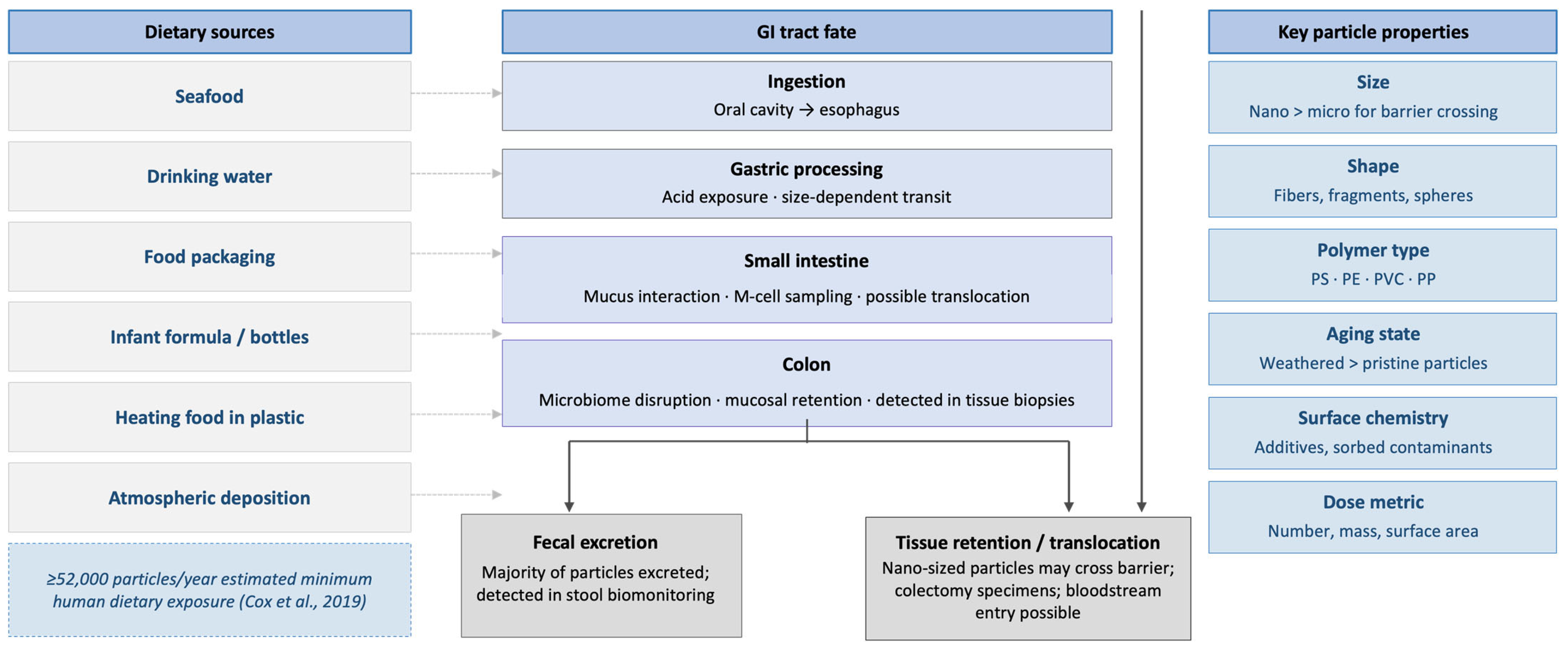
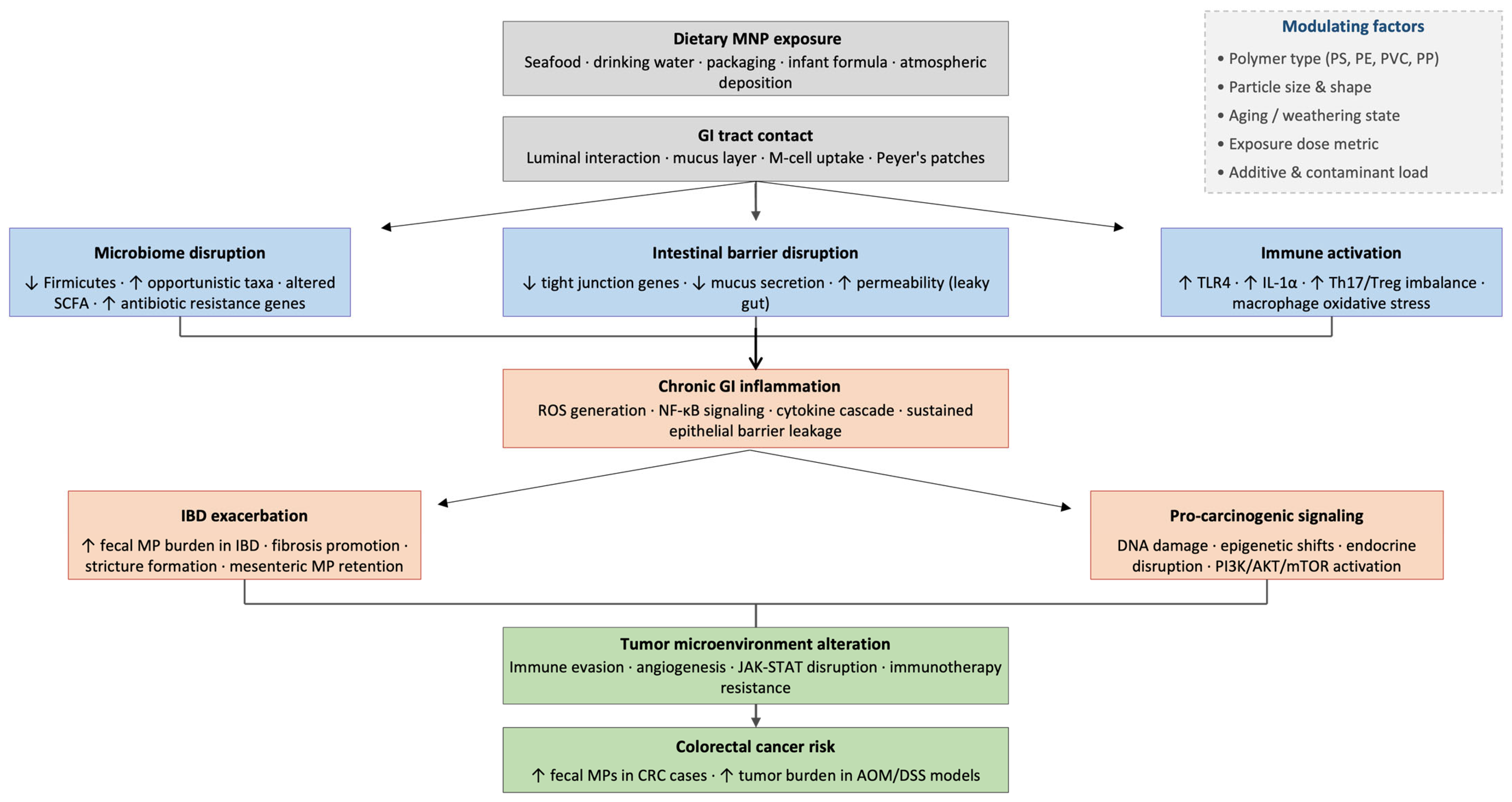
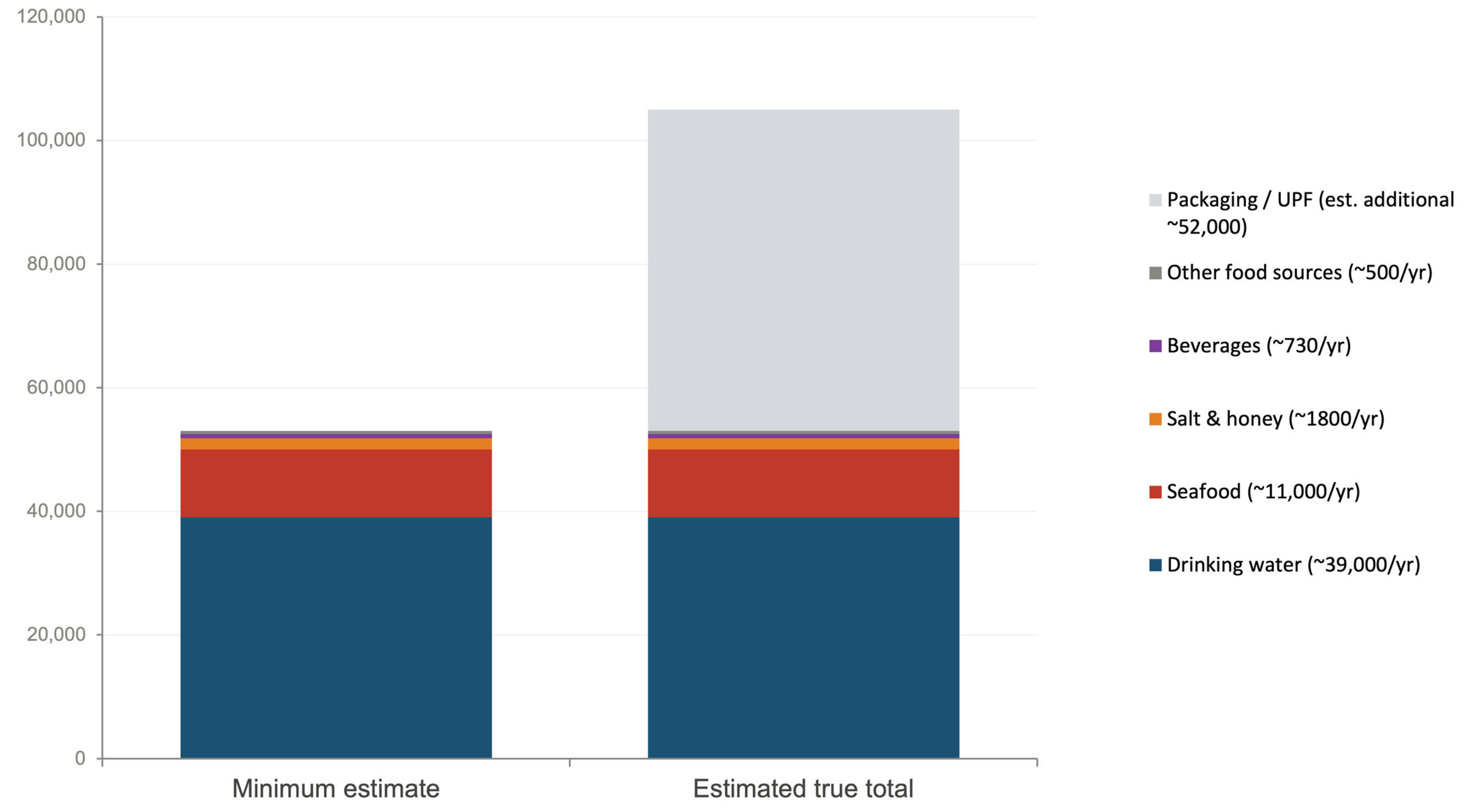
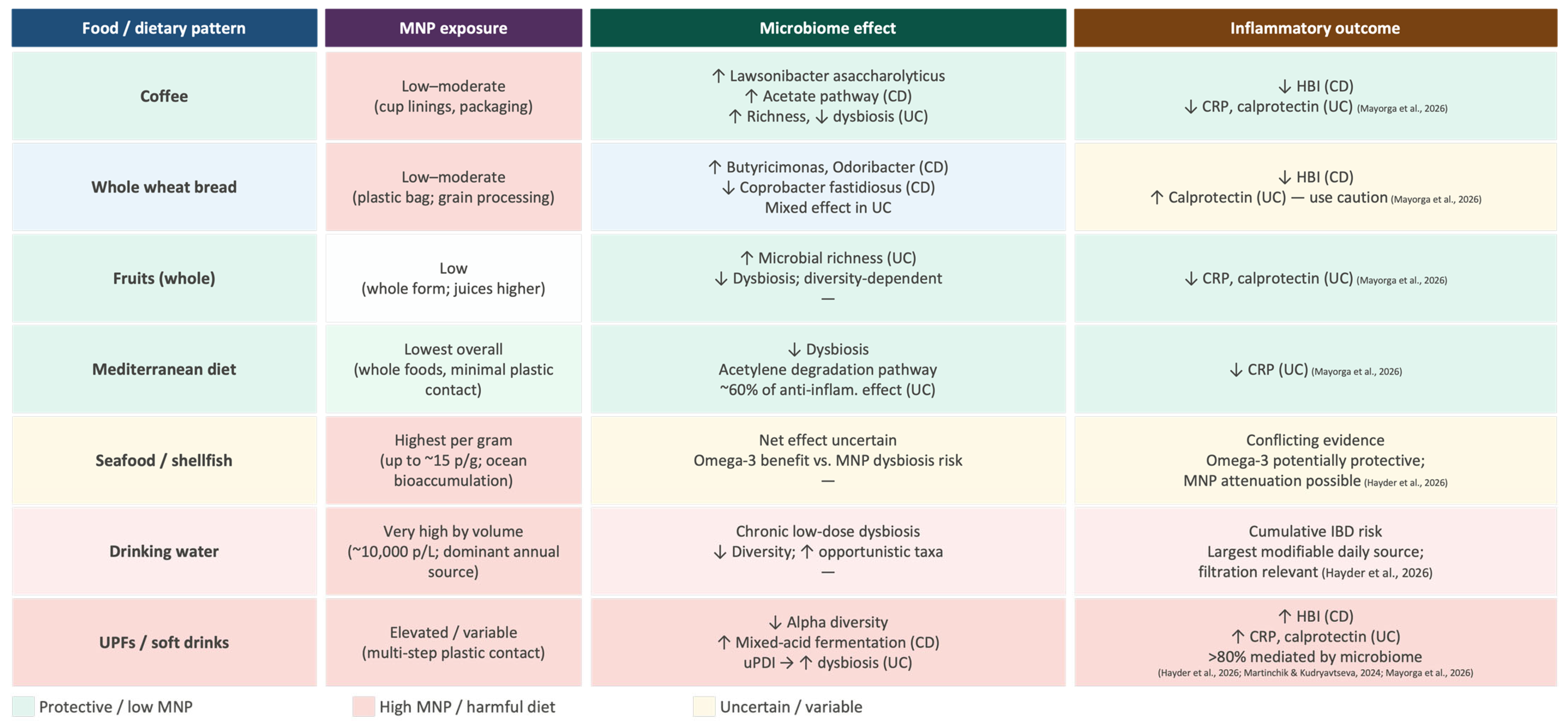
Dietary Intake of Micro- and Nanoplastics: Potential Adverse GI Effects on Microbiome, Inflammation, and Neoplasia

 , and
, and
Abstract
1. Introduction
Literature Search Strategy
2. Dietary MNP: Sources, Characteristics, and Gastrointestinal Effects
2.1. Dietary Sources and Exposure Pathways
2.2. Physicochemical Properties
2.3. Gastrointestinal Transit, Retention, and Uptake
3. Impact of MNPs on Gut Microbiome
4. Microplastics, Intestinal Barrier Dysfunction, Immune Activation, and Chronic Inflammation
4.1. Epithelial Barrier and Mucus Layer Disruption
4.2. Innate and Adaptive Immune Activation
4.3. Translational Relevance to Chronic Inflammatory Disease
5. Microplastics, Dysbiosis, and Gastrointestinal Neoplasia
5.1. Mechanistic Links Between Microplastics and Carcinogenesis
5.2. Emerging Human Evidence
5.3. Preclinical and Mechanistic Evidence
6. Vulnerable Populations and Disease Contexts
6.1. Early Life
6.2. Inflammatory Bowel Disease
6.3. Dietary Pattern Interactions
7. Methodological Challenges and Knowledge Gaps
8. Future Directions and Translational Implications
9. Conclusions
Author Contributions
Funding
Institutional Review Board Statement
Informed Consent Statement
Data Availability Statement
Conflicts of Interest
References
- Vethaak, A.D.; Legler, J. Microplastics and human health. Science 2021, 371, 672–674. [Google Scholar] [CrossRef]
- Vitali, C.; Peters, R.J.B.; Janssen, H.-G.; Nielen, M.W.F. Microplastics and nanoplastics in food, water, and beverages; part I. Occurrence. TrAC Trends Anal. Chem. 2023, 159, 116670. [Google Scholar] [CrossRef]
- Cox, K.D.; Covernton, G.A.; Davies, H.L.; Dower, J.F.; Juanes, F.; Dudas, S.E. Human consumption of microplastics. Environ. Sci. Technol. 2019, 53, 7068–7074. [Google Scholar] [CrossRef]
- Toussaint, B.; Raffael, B.; Angers-Loustau, A.; Gilliland, D.; Kestens, V.; Petrillo, M.; Rio-Echevarria, I.M.; Van den Eede, G. Review of micro- and nanoplastic contamination in the food chain. Food Addit. Contam. Part A Chem. Anal. Control Expo. Risk Assess. 2019, 36, 639–673. [Google Scholar] [CrossRef]
- Schwabl, P.; Köppel, S.; Königshofer, P.; Bucsics, T.; Trauner, M.; Reiberger, T.; Liebmann, B. Detection of various microplastics in human stool: A prospective case series. Ann. Intern. Med. 2019, 171, 453–457. [Google Scholar] [CrossRef] [PubMed]
- World Health Organization. Microplastics in Drinking-Water; World Health Organization: Geneva, Switzerland, 2019; Available online: https://www.who.int/publications/i/item/9789241516198 (accessed on 21 March 2026).
- Li, D.; Shi, Y.; Yang, L.; Xiao, L.; Kehoe, D.K.; Gun’ko, Y.K.; Boland, J.J.; Wang, J.J. Microplastic release from the degradation of polypropylene feeding bottles during infant formula preparation. Nat. Food 2020, 1, 746–754. [Google Scholar] [CrossRef] [PubMed]
- Campanale, C.; Massarelli, C.; Savino, I.; Locaputo, V.; Uricchio, V.F. A detailed review study on potential effects of microplastics and additives of concern on human health. Int. J. Environ. Res. Public Health 2020, 17, 1212. [Google Scholar] [CrossRef]
- Koelmans, A.A.; Besseling, E.; Shim, W.J. Nanoplastics in the aquatic environment: Critical review of occurrence, fate, and effects. Water Res. 2019, 155, 410–422. [Google Scholar] [CrossRef] [PubMed]
- Ivleva, N.P. Chemical analysis of microplastics and nanoplastics: Challenges, advanced methods, and perspectives. Chem. Rev. 2021, 121, 11886–11936. [Google Scholar] [CrossRef]
- Mishra, S.K.; Sanyal, T.; Kundu, P.; Kumar, R.; Ghosh, D.; Chakrabarti, G.; Sikdar, N.; Bhattacharya, S.; Paul, S.; Das, A. Microplastics as emerging carcinogens: From environmental pollutants to oncogenic drivers. Mol. Cancer 2025, 24, 248. [Google Scholar] [CrossRef]
- Hirt, N.; Body-Malapel, M. Immunotoxicity and intestinal effects of nano- and microplastics: A review of the literature. Part. Fibre Toxicol. 2020, 17, 57. [Google Scholar] [CrossRef]
- Chen, C.Y.; Kamineni, V.N.; Lin, Z. A physiologically based toxicokinetic model for microplastics and nanoplastics in mice after oral exposure and its implications for human dietary exposure assessment. J. Hazard. Mater. 2024, 480, 135922. [Google Scholar] [CrossRef]
- Ibrahim, Y.S.; Tuan Anuar, S.; Azmi, A.A.; Wan Mohd Khalik, W.M.A.; Lehata, S.; Hamzah, S.R.; Ismail, D.; Ma, Z.F.; Dzulkarnaen, A.; Zakaria, Z.; et al. Detection of microplastics in human colectomy specimens. JGH Open 2021, 5, 116–121. [Google Scholar] [CrossRef]
- Deng, Y.; Zhang, Y.; Lemos, B.; Ren, H. Tissue accumulation of microplastics in mice and biomarker responses suggest widespread health risks of exposure. Sci. Rep. 2017, 7, 46687. [Google Scholar] [CrossRef] [PubMed]
- Lu, L.; Wan, Z.; Luo, T.; Fu, Z.; Jin, Y. Polystyrene microplastics induce gut microbiota dysbiosis and hepatic lipid metabolism disorder in mice. Sci. Total Environ. 2018, 631–632, 449–458. [Google Scholar] [CrossRef]
- Biragyn, A.; Ferrucci, L. Gut dysbiosis: A potential link between increased cancer risk in ageing and inflammaging. Lancet Oncol. 2018, 19, e295–e304. [Google Scholar] [CrossRef] [PubMed]
- Nissen, L.; Spisni, E.; Spigarelli, R.; Casciano, F.; Valerii, M.C.; Fabbri, E.; Fabbri, D.; Zulfiqar, H.; Coralli, I.; Gianotti, A. Single exposure of food-derived polyethylene and polystyrene microplastics profoundly affects gut microbiome in an in vitro colon model. Environ. Int. 2024, 190, 108884. [Google Scholar] [CrossRef] [PubMed]
- Adhikari, M.; Biswas, C.; Bera, R.; Pramanick, K. Polystyrene microplastics-induced gut microbiota dysbiosis with altered short chain fatty acid is associated with reproductive physiology and endocrine disorder in female zebrafish. J. Hazard. Mater. 2025, 500, 140468. [Google Scholar] [CrossRef]
- Chambers, E.S.; Preston, T.; Frost, G.; Morrison, D.J. Role of gut microbiota-generated short-chain fatty acids in metabolic and cardiovascular health. Curr. Nutr. Rep. 2018, 7, 198–206. [Google Scholar] [CrossRef]
- Gao, B.; Shi, X.; Li, S.; Xu, W.; Gao, N.; Shan, J.; Shen, W. Size-dependent effects of polystyrene microplastics on gut metagenome and antibiotic resistance in C57BL/6 mice. Ecotoxicol. Environ. Saf. 2023, 254, 114737. [Google Scholar] [CrossRef]
- Gao, B.; Shi, X.; Zhao, M.; Ren, F.; Xu, W.; Gao, N.; Shan, J.; Shen, W. Mixture effects of polystyrene microplastics on the gut microbiota in C57BL/6 mice. ACS Omega 2025, 10, 7597–7608. [Google Scholar] [CrossRef]
- Liu, X.; Cai, H.; Zhao, L.; Ke, D.; Xu, X.; Li, J.; Yu, J.; Shen, Y.; Zhu, L.; Jin, Y.; et al. Microplastic-associated gut microbial profile and antibiotic resistance in preschool children: A multicentre cross-sectional study in China. EBioMedicine 2026, 125, 106177. [Google Scholar] [CrossRef]
- Wen, J.; Sun, H.; Yang, B.; Song, E.; Song, Y.; Jiang, G. Environmentally relevant concentrations of microplastic exposure cause cholestasis and bile acid metabolism dysregulation through a gut-liver loop in mice. Environ. Sci. Technol. 2024, 58, 1832–1841. [Google Scholar] [CrossRef]
- Yan, Z.; Liu, Y.; Zhang, T.; Zhang, F.; Ren, H.; Zhang, Y. Analysis of microplastics in human feces reveals a correlation between fecal microplastics and inflammatory bowel disease status. Environ. Sci. Technol. 2022, 56, 414–421. [Google Scholar] [CrossRef]
- Li, B.; Ding, Y.; Cheng, X.; Sheng, D.; Xu, Z.; Rong, Q.; Wu, Y.; Zhao, H.; Ji, X.; Zhang, Y. Polyethylene microplastics affect the distribution of gut microbiota and inflammation development in mice. Chemosphere 2020, 244, 125492. [Google Scholar] [CrossRef] [PubMed]
- Xu, J.; Qu, J.; Jin, H.; Mao, W. Associations between microplastics in human feces and colorectal cancer risk. J. Hazard. Mater. 2025, 495, 139099. [Google Scholar] [CrossRef] [PubMed]
- Tian, S.; Li, R.; Li, J.; Zou, J. Polystyrene nanoplastics promote colitis-associated cancer by disrupting lipid metabolism and inducing DNA damage. Environ. Int. 2025, 195, 109258. [Google Scholar] [CrossRef] [PubMed]
- Jiang, Z.; Liu, Y.; Zhang, P.; Fei, J.; Wang, K.; Li, Y.; Zhang, X.; Cai, C.; Chen, Y.; Peng, Y.; et al. Tumour-infiltrating microplastics disrupt the JAK-STAT-microbiota axis to promote immunotherapy resistance in colorectal cancer. Mol. Cancer 2026, 25, 73. [Google Scholar] [CrossRef] [PubMed]
- Wu, F.; Wu, F.; Liu, X.; Xie, W.; Liang, Y.; Ye, Y.; Xiao, X.; Sun, K.; Bai, L.; Liu, S.; et al. Microplastic accumulation in fibrotic intestinal tissue and mesenteric adipose tissue in Crohn’s disease patients. Environ. Res. 2025, 271, 121077. [Google Scholar] [CrossRef] [PubMed]
- Neurath, M.F.; Artis, D.; Becker, C. The intestinal barrier: A pivotal role in health, inflammation, and cancer. Lancet Gastroenterol. Hepatol. 2025, 10, 573–592. [Google Scholar] [CrossRef]
- Chen, X.; Zhuang, J.; Chen, Q.; Xu, L.; Yue, X.; Qiao, D. Polyvinyl chloride microplastics induced gut barrier dysfunction, microbiota dysbiosis and metabolism disorder in adult mice. Ecotoxicol. Environ. Saf. 2022, 241, 113809. [Google Scholar] [CrossRef]
- Su, Q.L.; Wu, J.; Tan, S.W.; Guo, X.Y.; Zou, D.Z.; Kang, K. The impact of microplastics polystyrene on the microscopic structure of mouse intestine, tight junction genes and gut microbiota. PLoS ONE 2024, 19, e0304686. [Google Scholar] [CrossRef] [PubMed]
- Koelmans, A.A.; Redondo-Hasselerharm, P.E.; Mohamed Nor, N.H.; de Ruijter, V.N.; Mintenig, S.M.; Kooi, M. Risk assessment of microplastic particles. Nat. Rev. Mater. 2022, 7, 138–152. [Google Scholar] [CrossRef]
- Cui, Y.; Wu, Y.; Shi, P.; Ni, Y.; Zeng, H.; Zhang, Z.; Zhao, C.; Sun, W.; Yi, Q. Mitigating microplastic-induced organ damage: Mechanistic insights from the microplastic-macrophage axes. Redox Biol. 2025, 84, 103688. [Google Scholar] [CrossRef] [PubMed]
- Park, E.J.; Han, J.S.; Park, E.J.; Seong, E.; Lee, G.H.; Kim, D.W.; Son, H.-Y.; Han, H.-Y.; Lee, B.-S. Repeated-oral dose toxicity of polyethylene microplastics and the possible implications on reproduction and development of the next generation. Toxicol. Lett. 2020, 324, 75–85. [Google Scholar] [CrossRef]
- Schwabe, R.F.; Jobin, C. The microbiome and cancer. Nat. Rev. Cancer 2013, 13, 800–812. [Google Scholar] [CrossRef]
- Kumar, N.; Lamba, M.; Pachar, A.K.; Yadav, S.; Acharya, A. Microplastics—A growing concern as carcinogens in cancer etiology: Emphasis on biochemical and molecular mechanisms. Cell Biochem. Biophys. 2024, 82, 3109–3121. [Google Scholar] [CrossRef]
- Cheng, Y.; Yang, Y.; Bai, L.; Cui, J. Microplastics: An often-overlooked issue in the transition from chronic inflammation to cancer. J. Transl. Med. 2024, 22, 959. [Google Scholar] [CrossRef]
- Roman, J.; Gondko, D.; Dębiec, P.; Pietrzak, N. The hidden health crisis: Microplastics and their medical consequences. J. Educ. Health Sport 2024, 72, 51690. [Google Scholar] [CrossRef]
- Andonotopo, W.; Bachnas, M.A.; Dewantiningrum, J.; Pramono, M.B.A.; Sanjaya, I.N.H.; Stanojevic, M.; Kurjak, A. Microplastics in the perinatal period: Emerging evidence on maternal exposure, placental transfer, and fetal health outcomes. Sarvodaya Int. J. Med. 2025, 1, 82–94. [Google Scholar] [CrossRef]
- Kim, Y.; Park, S.Y.; Jo, A.; Ahn, S.; Kwon, J.; Jung, E.-M.; Kim, H.-S.; Jeong, S.; Lee, K.E.; Oh, C.-K.; et al. Long-term low-dose exposure to polystyrene nanoplastics induces morphological and transcriptional reprogramming to enhance metastatic potential of colorectal cancer cells. Toxicology 2026, 520, 154356. [Google Scholar] [CrossRef] [PubMed]
- Zolotova, N.; Kirillova, M.; Dzhalilova, D.; Tsvetkov, I.; Fokichev, N.; Makarova, O. Microplastics’ impact on the development of AOM/DSS-induced colitis-associated colorectal cancer in mice. Int. J. Mol. Sci. 2025, 26, 11511. [Google Scholar] [CrossRef] [PubMed]
- Ke, D.; Zheng, J.; Liu, X.; Xu, X.; Zhao, L.; Gu, Y.; Yang, R.; Liu, S.; Yang, S.; Du, J.; et al. Occurrence of microplastics and disturbance of gut microbiota: A pilot study of preschool children in Xiamen, China. EBioMedicine 2023, 97, 104828. [Google Scholar] [CrossRef] [PubMed]
- Bhatt, A.H.; Nimbalkar, S.M.; Patel, D.V.; Pujara, R.K. Microplastic exposure during perinatal period: Impacts on neonatal immune and metabolic programming—A scoping review. J. Perinatol. 2026; in press. [CrossRef]
- Dzierżyński, E.; Gawlik, P.J.; Puźniak, D.; Flieger, W.; Jóźwik, K.; Teresiński, G.; Forma, A.; Wdowiak, P.; Baj, J.; Flieger, J. Microplastics in the human body: Exposure, detection, and risk of carcinogenesis: A state-of-the-art review. Cancers 2024, 16, 3703. [Google Scholar] [CrossRef]
- Hayder, M.; Laan, M.M.; van Wezel, A.P. Exposure to microplastics from food: Comparative analysis of food types and quantification techniques. J. Hazard. Mater. 2026, 501, 140657. [Google Scholar] [CrossRef]
- Martinchik, A.N.; Kudryavtseva, K.V. Contamination of food and beverages with microplastic particles. Vopr. Pitan. 2024, 93, 49–56. [Google Scholar] [CrossRef]
- Mayorga, L.; Noguera Segura, A.; Campderros, L.; Pons-Tarin, M.; Soler, Z.; Vega-Abellaneda, S.; Serrano-Gomez, G.; Herrera-deGuise, C.; Robles-Alonso, V.; Borruel, N.; et al. Distinct microbial mediators link diet to inflammation in Crohn’s disease and ulcerative colitis. Gut 2026. epub ahead of print. [Google Scholar] [CrossRef]
- Ruggero, F.; Gori, R.; Lubello, C. Methodologies for microplastics recovery and identification in heterogeneous solid matrices: A review. J. Polym. Environ. 2020, 28, 739–748. [Google Scholar] [CrossRef]
- Luo, T.; Wang, D.; Zhao, Y.; Li, X.; Yang, G.; Jin, Y. Polystyrene microplastics exacerbate experimental colitis in mice tightly associated with the occurrence of hepatic inflammation. Sci. Total Environ. 2022, 844, 156884. [Google Scholar] [CrossRef]
- Shao, K.; Zou, R.; Zhang, Z.; Mandemaker, L.D.B.; Timbie, S.; Smith, R.D., Jr.; Durkin, A.M.; Dusza, H.M.; Meirer, F.; Weckhuysen, B.M.; et al. Advancements in Assays for Micro- and Nanoplastic Detection: Paving the Way for Biomonitoring and Exposomics Studies. Annu. Rev. Pharmacol. Toxicol. 2025, 65, 567–585. [Google Scholar] [CrossRef]
- Bredeck, G.; Halamoda-Kenzaoui, B.; Bogni, A.; Lipsa, D.; Bremer-Hoffmann, S. Tiered testing of micro- and nanoplastics using intestinal in vitro models to support hazard assessments. Environ. Int. 2022, 158, 106921. [Google Scholar] [CrossRef]
- Geyer, R.; Jambeck, J.R.; Law, K.L. Production, use, and fate of all plastics ever made. Sci. Adv. 2017, 3, e1700782. [Google Scholar] [CrossRef]



| Author (Year) | Study Design | MNP Exposure | Key Findings | Limitations |
|---|---|---|---|---|
| Schwabl et al. [5] | Prospective case series | Human stool analysis | Detected up to 9 MP polymer types in human stool; first large human biomonitoring study; median 20 MP/10 g stool | No matched controls; no disease correlation |
| Lu et al. [16] | Animal model (mouse) | Polystyrene MPs, varying sizes | Gut microbiome dysbiosis with ↓ Firmicutes and ↓ α-Proteobacteria; reduced diversity by RNA sequencing of cecum | Animal model; pristine particles only |
| Nissen et al. [18] | In vitro colon model | PE and PS microplastics | ↑ Enterobacteriaceae, Desulfovibrio, Clostridium; ↓ beneficial flora after single exposure | In vitro; single acute exposure |
| Yan et al. [25] | Human cross-sectional | Fecal MP quantification | ↑ fecal MP burden in IBD vs. controls; burden correlated with disease severity | Cross-sectional; directionality unclear |
| Li et al. [26] | Animal model (mouse) | Polyethylene MPs | ↑ intestinal inflammation; ↑ TLR4, AP-1, IRF5; ↑ serum IL-1α; altered CD4+ Th17/Treg proportions | Single polymer; high dose |
| Ibrahim et al. [14] | Human tissue analysis | Colectomy specimens | Microplastics detected and characterized in human colon tissue; supports tissue-level exposure | Small N; contamination control challenges |
| Xu et al. [27] | Case-control study | Laser IR imaging of fecal MPs | ↑ median fecal MP in CRC cases vs. controls; dose-response in adjusted models | Single-center; confounding by diet difficult to exclude |
| Liu et al. [23] | Multicenter cross-sectional | Fecal MP; metagenome sequencing | MP exposure linked to altered microbiome composition and ↑ antibiotic resistance gene activity in preschool children | Cross-sectional; causal inference limited |
| Tian et al. [28] | Animal model (AOM/DSS) | Polystyrene nanoplastics | ↑ colitis-associated cancer progression; lipid metabolism disruption; oxidative stress/DNA damage; PI3K/AKT/mTOR activation | Animal model; may not reflect human exposures |
| Jiang et al. [29] | Preclinical/translational | Tumor-infiltrating MPs from CRC patients | MPs disrupt JAK-STAT-microbiota axis; promote immunotherapy resistance in CRC models; clinically salient hypothesis | Mechanistic study; human causality unproven |
| Wen et al. [24] | Animal model (mouse) | Environmentally relevant MP concentrations | Cholestasis; impaired bile acid synthesis; altered bile acid efflux genes; abnormal bile acid concentrations in stool | Animal model; bile acid human relevance unclear |
| Wu et al. [30] | Human tissue (Crohn’s disease) | Surgical specimens + mesenteric fat | MPs detected in fibrotic intestinal tissue and adjacent mesenteric adipose; correlation with fibrosis severity | Small cohort; contamination control needed |
Disclaimer/Publisher’s Note: The statements, opinions and data contained in all publications are solely those of the individual author(s) and contributor(s) and not of MDPI and/or the editor(s). MDPI and/or the editor(s) disclaim responsibility for any injury to people or property resulting from any ideas, methods, instructions or products referred to in the content. |
© 2026 by the authors. Licensee MDPI, Basel, Switzerland. This article is an open access article distributed under the terms and conditions of the Creative Commons Attribution (CC BY) license.
Share and Cite
Saadeh, M.; Hong, G.; Rabeeah, S.; Dutta, P.; Oldfield, E.C., IV; Johnson, D.A. Dietary Intake of Micro- and Nanoplastics: Potential Adverse GI Effects on Microbiome, Inflammation, and Neoplasia. Microorganisms 2026, 14, 1309. https://doi.org/10.3390/microorganisms14061309
Saadeh M, Hong G, Rabeeah S, Dutta P, Oldfield EC IV, Johnson DA. Dietary Intake of Micro- and Nanoplastics: Potential Adverse GI Effects on Microbiome, Inflammation, and Neoplasia. Microorganisms. 2026; 14(6):1309. https://doi.org/10.3390/microorganisms14061309
Chicago/Turabian StyleSaadeh, Michael, Gordon Hong, Sana Rabeeah, Priyata Dutta, Edward C. Oldfield, IV, and David A. Johnson. 2026. "Dietary Intake of Micro- and Nanoplastics: Potential Adverse GI Effects on Microbiome, Inflammation, and Neoplasia" Microorganisms 14, no. 6: 1309. https://doi.org/10.3390/microorganisms14061309
APA StyleSaadeh, M., Hong, G., Rabeeah, S., Dutta, P., Oldfield, E. C., IV, & Johnson, D. A. (2026). Dietary Intake of Micro- and Nanoplastics: Potential Adverse GI Effects on Microbiome, Inflammation, and Neoplasia. Microorganisms, 14(6), 1309. https://doi.org/10.3390/microorganisms14061309