1. Introduction
Bad breath has recently become a problem in social life. It is known as halitosis, oral malodor, or fetor oris [
1]. Among these terms, “halitosis” is used professionally in dentistry. Temporary halitosis emanates from the digestive tract after consumption of certain foods or drinks [
2]. Persistent halitosis, however, mainly occurs due to metabolites known as volatile sulfur compounds (VSCs) produced by Gram-negative anaerobic bacteria in the oral cavity [
3]. These VSCs include hydrogen sulfide (H
2S), methyl mercaptan (CH
3SH), and dimethyl sulfide (CH
3SCH
3), and their levels are used as an indicator of halitosis [
1].
Gram-negative anaerobes related to halitosis include
Porphyromonas gingivalis,
Tannerella forsythia, and
Treponema denticola [
3]. These bacteria, classified as the red complex, are known to cause periodontitis. They are asaccharolytic microbes. Another characteristic of these bacteria is that they are benzoyl-DL-arginine-naphthylamide (BANA)-positive, meaning that they exhibit a high level of proteolytic activity through a trypsin-like enzyme [
3,
4]. Specificially,
P. gingivalis has L-methionine-α-deamino-γ-mercaptomethane-lyase (encoded by
mgl gene), which can produce a large amount of methyl mercaptan (CH
3SH) from methionine and cysteine and is more frequently detected in halitosis patients [
5].
Ligilactobacillus salivarius, formerly named
Lactobacillus salivarius, was initially introduced by Rogosa in 1953 [
6]. This bacterium is considered a safe strain by the European Food Safety Authority (EFSA) and the United States Food and Drug Administration (FDA) [
7,
8]. Therefore, many subtypes have been used as probiotics. This probiotic bacterium is known to produce antibacterial peptides called bacteriocins which serve as tools for competing against other bacteria in the environment [
9]. The bacteriocins of
L. salivarius are classified as class II non-lanthionine-containing peptides; representative examples include Abp118,
salivaricin T,
salivaricin L and
salivaricin P [
10]. In addition,
L. salivarius produces active metabolites, such as exopolysaccharides, organic acids, and short-chain fatty acids [
6], which have been proven to have anti-inflammatory, antioxidant and immune regulating properties [
11,
12,
13]. Research has shown that
L. salivarius may have potential beneficial effects on human health.
Halitosis is a common problem that can be caused by periodontitis, poor oral hygiene, or tongue debris [
14]. Ultimately, halitosis is attributed to dysbiosis of the oral microbiome and an increasing proportion of periodontopathogens. In particular,
P. gingivalis is recognized as the primary causative bacterium for this condition [
15]. Various efforts have recently been undertaken to utilize probiotics to address the conditions that lead to halitosis, and their effectiveness has been assessed through clinical trials. However, the specific mechanisms by which they exert their effects on halitosis have not been clearly elucidated.
While probiotics have recently emerged as a potential intervention for halitosis, their efficacy remains strain-specific due to variations in microbial metabolism and metabolite production. Consequently, the inhibitory impact of probiotics on halitosis is not uniform. Therefore, the present study aims to elucidate the specific mechanisms by which L. salivarius WB21 inhibits P. gingivalis activity as it relates to halitosis.
2. Materials and Methods
2.1. Bacterial Strain and Culture Condition
Ligilactobacillus salivarius WB21 was maintained in Man, Rogosa and Sharpe (MRS) broth (BD Biosciences, Franklin Lakes, NJ, USA) at 37 °C under aerobic condition. The strain, deposited at the National Institute of Technology and Evaluation (Japan) under the accession number FERM BP-7792, was provided by Ju Yeong NS Co., Ltd. (Seoul, Republic of Korea). In order to investigate antimicrobial activity and neutralizing efficacy, the WB21 strain was cultivated into tryptic soy broth (TSB) (BD biosciences). Porphyromonas gingivalis ATCC 33277 was used to generate volatile sulfur compounds (VSCs); this was cultured using TSB supplemented with hemin (1 μg/mL; Sigma-Aldrich Co., St Louis, MO, USA) and vitamin K (0.2 μg/mL; Sigma-Aldrich) at 37 °C under anaerobic condition (5% H2, 10% CO2, and 85% N2).
2.2. Antibacterial Activity
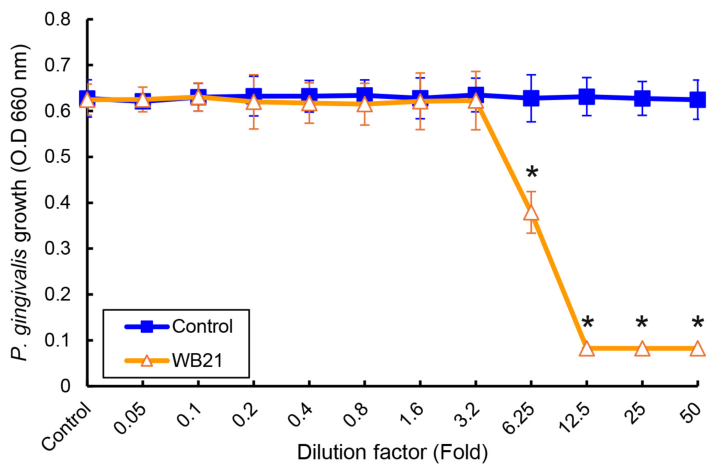
To evaluate bacteriocin production by L. salivarius, the susceptibility of P. gingivalis to conditioned media derived from L. salivarius was assessed. A susceptibility assay was carried out according to Clinical Laboratory Standard Institute (CLSI) guidelines. First, spent culture medium (SCM) of L. salivarius was collected using a polyvinylidene fluoride (PVDF) filter (0.22 μm pore size). The cultured P. gingivalis was counted using a bacterial counting chamber (Marienfeld Superior, Lauda-Königshofen, Germany) and adjusted to 1.5 × 10⁷ cells/mL with fresh TSB medium. Next, 180 μL of TSB was dispensed into rows B through G of a 96-well plate well (SPL Life sciences, Pocheon, Republic of Korea). The prepared SCM (180 μL) was added to the first column of rows C, E, and G, followed by 2-fold serial dilution up to the 11th column. The adjusted P. gingivalis suspension (20 μL) was then inoculated into the prepared 96-well plate. The plate was incubated at 37 °C under anaerobic condition for 36 h, and bacterial growth was measured by optical density at a wavelength of 660 nm using a microplate reader (BioTek, Winooski, VT, USA).
2.3. Co-Cultivation
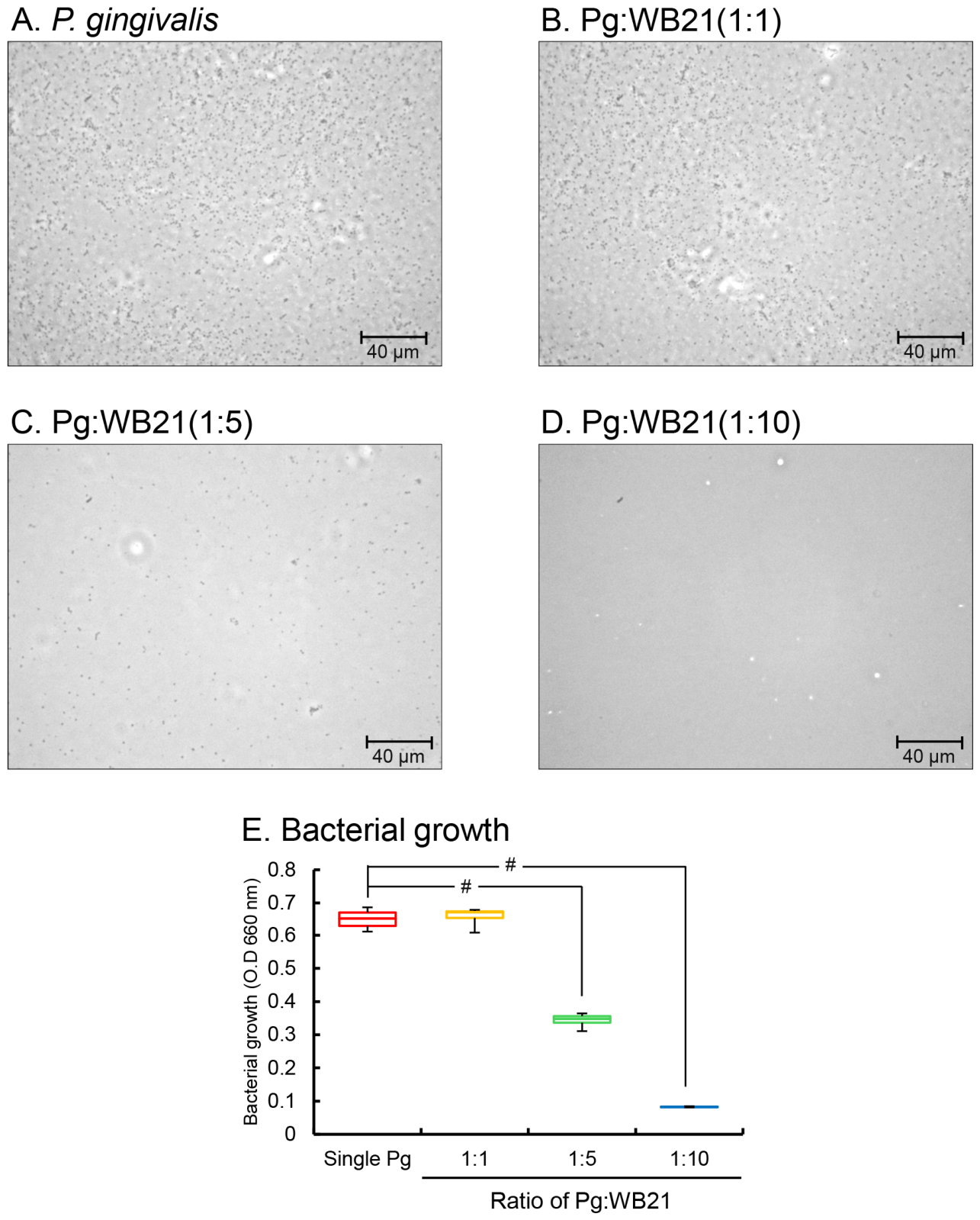
To investigate the co-existence characteristics of P. gingivalis and L. salivarius WB21 in the oral cavity, the WB 21 strain was co-cultured with P. gingivalis using cell culture inserts (SPL life Sciences, Pocheon, Republic of Korea). The cultured P. gingivalis and L. salivarius WB21 were counted using a bacterial counting chamber (Marienfeld Superior) and adjusted to 1.0 × 10⁷ and 1.0 × 10⁸ cells/mL, respectively. The P. gingivalis suspension was inoculated into the upper chamber (inside) while the L. salivarius suspension was inoculated into the lower well (outside) of the insert at volumes 1, 5, and 10 times that of P. gingivalis, in line with the manufacturer’s recommended volumes. The plate was incubated at 37 °C under anaerobic atmosphere for 36 h. Growth of P. gingivalis was then measured by optical density at a wavelength of 660 nm using a spectrophotometer (BioTek).
2.4. Measurement of VSCs
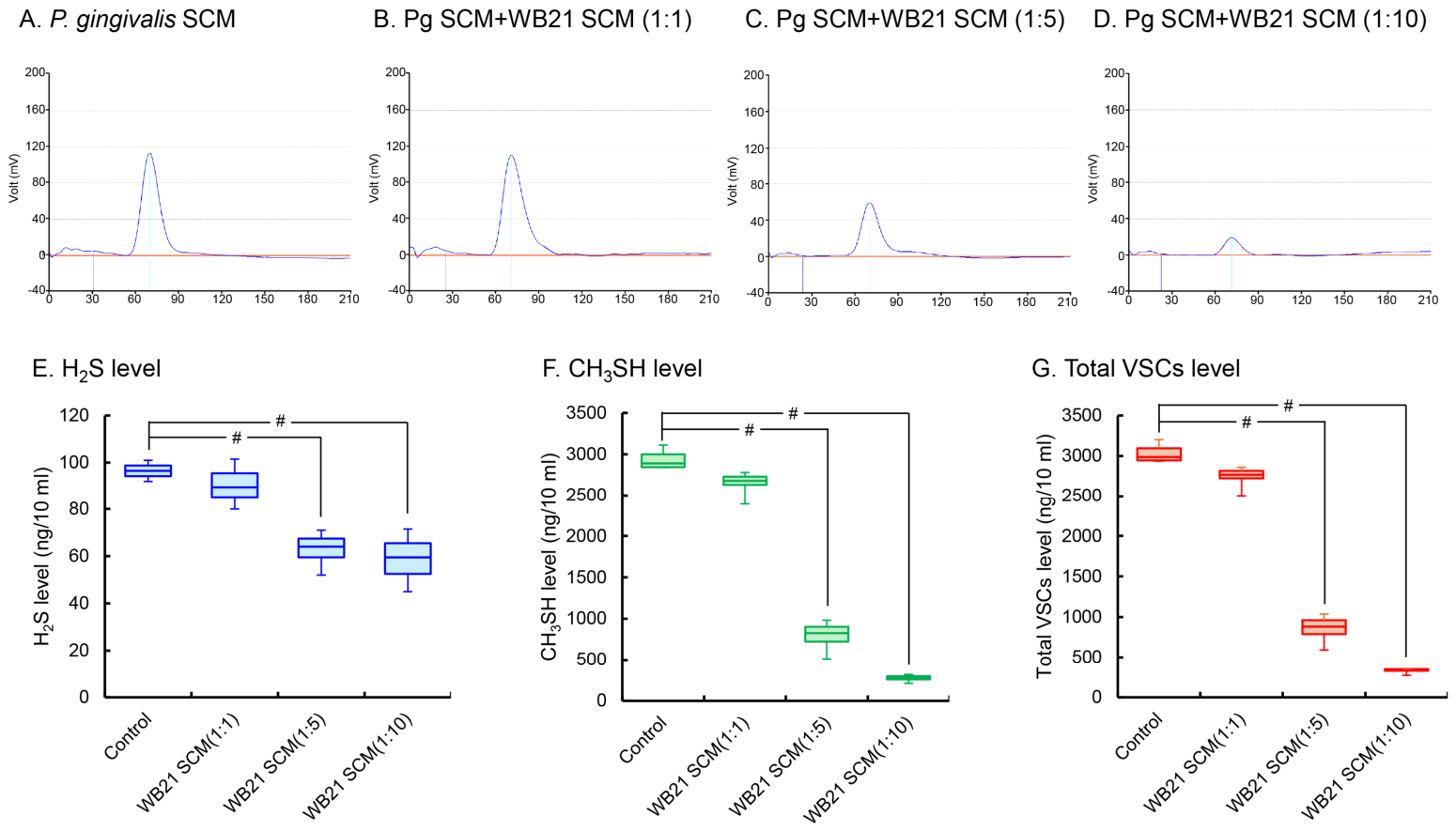
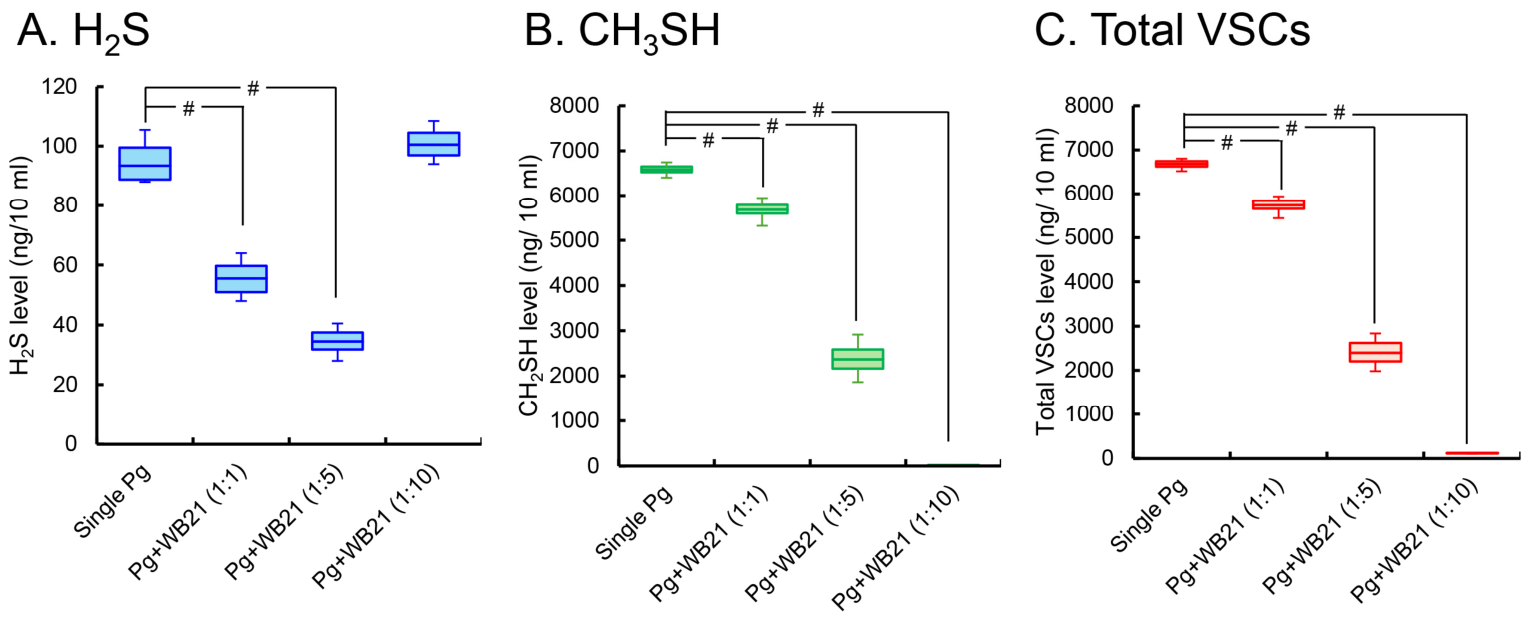
The SCMs of P. gingivalis and L. salivarius were collected. The P. gingivalis SCM was dispensed into a 50 mL conical tube, to which various volumes of L. salivarius SCM were added. The P. gingivalis SCM alone (as a control) and the resulting mixtures were mixed using a rotator (IKA, Staufen, Germany) for 1 min. Subsequently, headspace gas was collected using a 1 mL syringe (BD biosciences, Franklin Lakes, NJ, USA) from just above the medium surface. VSC levels were measured using an Oral ChromaTM gas chromatograph (FIS Inc., Itami Hyogo, Japan). In a separate experiment, suspensions of P. gingivalis from either single cultures or co-cultures with the WB21 strain were transferred into 50 mL conical tubes. The tubes were rotated on a rotator, and headspace gas was immediately collected using a 1 mL syringe above the suspension surface. The VSCs were measured using the Oral ChromaTM gas chromatograph.
2.5. Methyl Mercaptan Assay
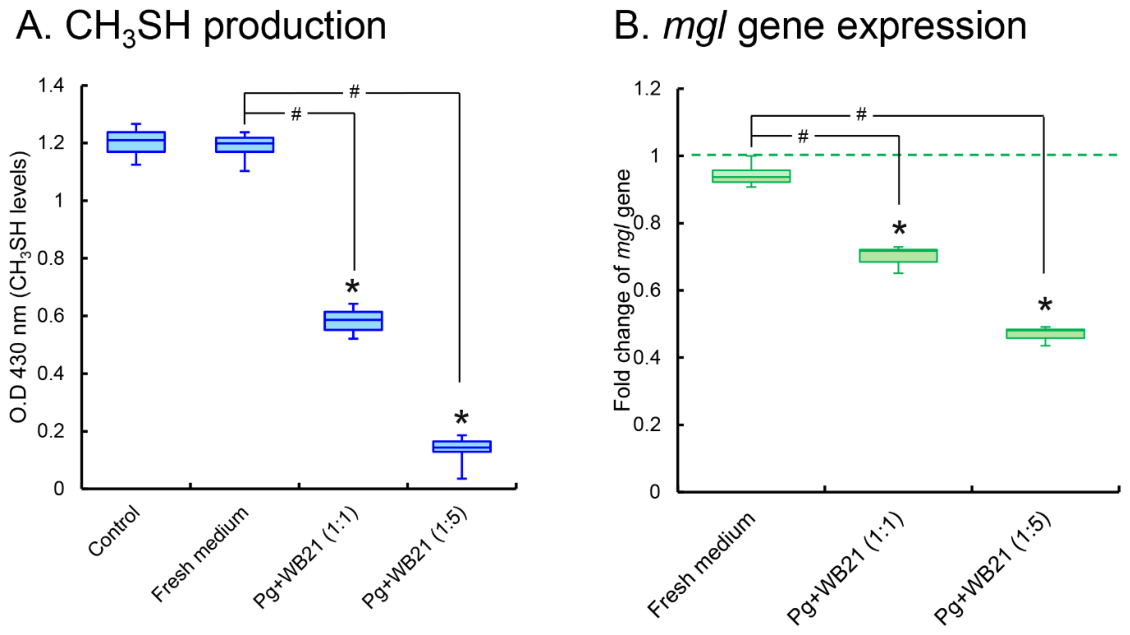
The production of methyl mercaptan (CH3SH) from P. gingivalis was measured using 5,5′-dithiobis (2-nitrobenzoic acid) (DTNB; Sigma-Aldrich Co., St Louis, MO, USA). Briefly, P. gingivalis was either single- or co-cultured with L. salivarius WB21 in cell culture inserts for 36 h. Afterwards, 50 μL of P. gingivalis suspension was transferred into the wells in 96-well plate. Then, 50 μL each of L-methionine (0.6%, w/v) and DTNB (0.06%, w/v) was added to each well. The plate was incubated for 10 h. Production of methyl mercaptan was then measured at a wavelength of 430 nm using a spectrophotometer.
2.6. Analysis of Mgl Gene Expression
The effects of L. salivarius WB21 on expression of methionine gamma-lyase (mgl), an enzyme associated with VSC production in P. gingivalis, were investigated at the transcript level. P. gingivalis and L. salivarius WB21 were co-cultivated in cell culture inserts at ratios of 1:1 and 1:5 for 10 h using the aforementioned co-cultivation method. P. gingivalis was collected by centrifugation at 5000× g at 4 °C, and total RNA was immediately extracted using TRIzolTM reagent (Invitrogen, Waltham, MA, USA). cDNA was synthesized from 1 μg of total RNA using Maxine RT-premix with Random primer (iNtRON, Seongnam, Republic of Korea). cDNAs were mixed with 10 μL of TB green Premix Ex Taq (Takara Co., Kyoto, Japan) and 0.4 μM of each primer pair in a final volume of 20 μL. Quantitative PCR was performed for 40 cycles (95 °C for 15 s, 60 °C for 15 s, and 72 °C for 33 s) using an ABI 7500 Real-time PCR system (Applied Biosystems, Foster City, CA, USA). The specificity of the PCR products was verified by melting curve analysis. 16S rRNA was used as a housekeeping gene to normalize expression levels and to quantify changes in mgl expression between single- and co-cultured P. gingivalis. The primer sequences for Real-Time PCR were as follows: forward 5′-TTC CGA GCT TCC CCC AAT AC-3′ and reverse 5′-ATG AGG GTT TCC GTA TCG CC-3′ for the mgl gene; forward 5′-TGT AGA TGA CTG ATG GTG AAA ACC-3′ and reverse 5′-TTT AGA GAT TCG CAT CCG GT-3′ for the 16S rRNA gene.
2.7. Statistical Analysis
Experiments were performed in triplicate. Statistical analysis was conducted using IBM SPSS statistics (version 23; IBM, Armonk, NY, USA). Data were assessed for normal distribution using the Kolmogorov–Smirnov test. As the data were not normally distributed, data from the different groups were analyzed by using the non-parametric Kruskal–Wallis test and post hoc analysis. Comparison of differences between individual groups was carried out using the Mann–Whitney U test. Differences with a p-value of less than 0.05 were considered statistically significant.
4. Discussion
Halitosis increasingly disrupts daily life. This has led to exploration of various therapeutic approaches; these include the use of probiotics, which have recently emerged. Because different probiotic bacteria have distinct metabolic processes and produce different metabolites, their inhibitory effects on halitosis may also vary. In the present study, the inhibitory effects of L. salivarius WB21 on factors related to halitosis were examined.
It is known that halitosis is caused by periodontitis-related bacteria [
16] which increase production of volatile sulfur compounds (VSCs). Therefore, the antibacterial activity of
L. salivarius WB21 against
P. gingivalis was evaluated, and the SCM of
L. salivarius WB21 was found to inhibit growth of
P. gingivalis. Furthermore, in co-culture, growth of
P. gingivalis was significantly inhibited by
L. salivarius WB21. These results suggest that oral administration of
L. salivarius WB21 could limit
P. gingivalis colonization, potentially reducing VSC concentrations and mitigating halitosis. Additionally, beyond
P. gingivalis,
L. salivarius WB21 has been shown to demonstrate antibacterial activity against other key periodontal pathogens, including
Tannerella forsythia and
Treponema denticola [
17].
Next, the effects of
L. salivarius WB21 on emission of VSCs were examined using SCMs. When the SCMs of
L. salivarius and
P. gingivalis were mixed in various ratios, gaseous VSCs decreased in a dose-dependent manner relative to the quantity of
L. salivarius SCM. Furthermore, in the co-culture system,
L. salivarius WB21 suppressed VSC production of
P. gingivalis even at ratios that did not inhibit the growth of
P. gingivalis.
P. gingivalis is an asaccharolytic bacterium that metabolizes peptides exclusively to obtain energy [
18]. Consequently, to digest these peptides, it secretes enzymes which in turn produce VSCs. Although some probiotics have been reported to bind to VSCs in the bodies of bacteria and inhibit their emission,
L. salivarius WB21 did not show such an effect [
1]. This was confirmed by mixing the SCM of
P. gingivalis with varying concentrations of whole
L. salivarius WB21 cells and incubating the mixture for 5 min. When gaseous VSCs were measured using gas chromatography, no significant differences were observed across all groups.
Finally, we evaluated whether
L. salivarius WB21 only inhibits the emission of VSCs in a suspension or it suppresses VSCs production by inhibiting the enzymes secreted by
P. gingivalis. L.
salivarius WB21 was found to reduce methyl mercaptan levels in the
P. gingivalis SCM and decrease the expression of the
mgl gene. The reduction in methyl mercaptan levels in the SCM suggests that
L. salivarius WB21 decreases the level of VSC-producing enzymes in
P. gingivalis, thereby not only inhibiting VSC emission but also reducing VSC production. L-methionine-α-deamino-γ-mercaptomethane-lyase (METase), which is encoded by the
mgl gene, produces methyl mercaptan (CH
3SH), ammonia, and α-ketobytyrate from methionine and cysteine [
5]. The correlation between
mgl expression and CH
3SH production has been reported in previous studies where a decrease in
mgl expression resulted in the inhibition of CH
3SH production [
5,
19].
One of the most important health-related attributes of probiotics is the production of antimicrobial substances, and extensive research is focused on the properties of bacteriocins. Bacteriocins produced by lactic acid bacteria are categorized based on the presence of lanthionine into lanthionine-containing bacteriocins (LCBs) and non-lanthionine-containing bacteriocins (NLCBs) [
20]. The bacteriocin produced by
L. salivarius is an NLCB, as it is a bacterium that produces bacteriocin without lanthionine. LCB-producing bacteria such as
L. plantarum,
L. casei, and
L. delbrueckii possess cystathionine γ-lyase, which is encoded by the
metC gene [
21]. This enzyme produces VSCs from methionine; however,
L. salivarius lacks the
metC gene and therefore does not produce VSCs.
In conclusion, L. salivarius WB21 exhibits potent antimicrobial activity against P. gingivalis through the production of non-lanthionine-containing bacteriocins. Furthermore, L. salivarius WB21 was shown to reduce both emission and production of VSCs by P. gingivalis. These findings suggest that L. salivarius WB21 may effectively inhibit colonization by periodontopathogens in the oral cavity while suppressing the synthesis and release of VSCs. Consequently, the application of L. salivarius WB21 may be effective in treating halitosis.