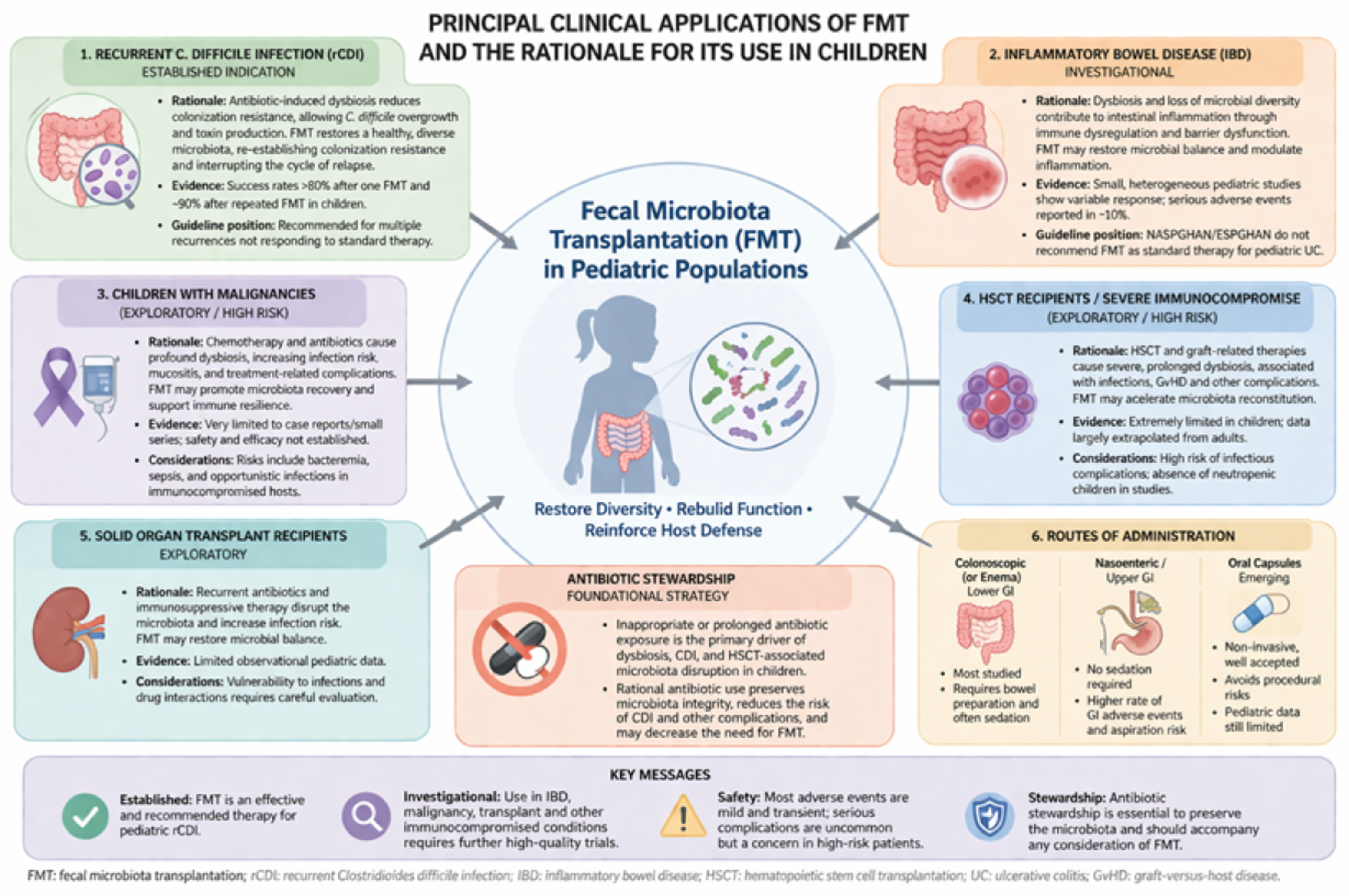
Restoring Microbial Balance: Clinical Applications, Challenges, and Future Directions of Fecal Microbiota Transplantation in Pediatric Disorders

 ,
, 
Abstract
1. Introduction
2. Methods
3. Clinical Applications of Fecal Microbiota Transplantation in Pediatric Disorders
3.1. Clostridioides Difficile Infection
3.2. Recurrent Clostridioides Difficile Infection
3.3. Children with Malignancies and Transplant Recipients
3.4. Inflammatory Bowel Disease
3.5. Constipation and Irritable Bowel Syndrome
3.6. Allergic Colitis
3.7. Multi-Drug Resistant Organisms Decolonization
3.8. Neurodevelopmental Disorders
4. Clinical Implications, Safety Considerations, and Future Directions of Fecal Microbiota Transplantation in Pediatric Practice
5. Conclusions
Author Contributions
Funding
Institutional Review Board Statement
Informed Consent Statement
Data Availability Statement
Conflicts of Interest
References
- Huang, B.; An, H.; Qiu, Y.; Ye, T.; Huang, Y.; Zheng, M.; Shi, D.; Su, Y.; Wang, R. Comparative Effectiveness and Safety of Fecal Microbiota Transplantation in Ulcerative Colitis: An Updated Systematic Review and Meta-Analysis. Adv. Ther. 2026, 43, 2645–2667. [Google Scholar] [CrossRef] [Scilit]
- Zhang, S.; Li, P.; Dai, M.; Wu, X.; Lu, C.; Lu, G.; Ren, Q.; Wang, X.; Si, Y.; Chang, L.; et al. Washed Microbiota Transplantation as a Rescue Therapy for Refractory Unidentified Pathogen Intestinal Infections: Findings From a National Multi-Centre, Real-World Study. Microb. Biotechnol. 2026, 19, e70335. [Google Scholar] [CrossRef] [Scilit] [PubMed]
- Kerff, F.; Mühlematter, C.; Adamov, A.; Fast, D.; Plüss, S.; Zimmermann, P.; Kurth, S.; Bokulich, N.A. The gut microbiota and sleep in infants: A focus on diurnal rhythmicity patterns. Gut Microbes Rep. 2026, 3, 2649096. [Google Scholar] [CrossRef] [Scilit]
- Lee, Y.K.; Mazmanian, S.K. Has the microbiota played a critical role in the evolution of the adaptive immune system? Science 2010, 330, 1768–1773. [Google Scholar] [CrossRef] [Scilit] [PubMed]
- Yao, C.; You, L.; Li, J.; E, J.; Wang, J. Types and characteristics of shared microbiota within families of ethnic minorities in Inner Mongolia. Microbiol. Spectr. 2026, 14, e0070625. [Google Scholar] [CrossRef] [Scilit]
- Frati, F.; Salvatori, C.; Incorvaia, C.; Bellucci, A.; Di Cara, G.; Marcucci, F.; Esposito, S. The Role of the Microbiome in Asthma: The Gut-Lung Axis. Int. J. Mol. Sci. 2018, 20, 123. [Google Scholar] [CrossRef] [Scilit]
- Liu, J.; Wang, M.; Chen, W.; Ma, J.; Peng, Y.; Zhang, M.; Wang, C.; Yan, G.; Lu, G. Altered Gut Microbiota Taxonomic Compositions of Patients With Sepsis in a Pediatric Intensive Care Unit. Front. Pediatr. 2021, 9, 645060. [Google Scholar] [CrossRef] [Scilit]
- Miller, W.D.; Keskey, R.; Alverdy, J.C. Sepsis and the Microbiome: A Vicious Cycle. J. Infect. Dis. 2021, 223, S264–S269. [Google Scholar] [CrossRef] [Scilit]
- Dominguez-Bello, M.G.; Costello, E.K.; Contreras, M.; Magris, M.; Hidalgo, G.; Fierer, N.; Knight, R. Delivery mode shapes the acquisition and structure of the initial microbiota across multiple body habitats in newborns. Proc. Natl. Acad. Sci. USA 2010, 107, 11971–11975. [Google Scholar] [CrossRef] [Scilit]
- Putignani, L.; Del Chierico, F.; Petrucca, A.; Vernocchi, P.; Dallapiccola, B. The human gut microbiota: A dynamic interplay with the host from birth to senescence settled during childhood. Pediatr. Res. 2014, 76, 2–10. [Google Scholar] [CrossRef] [Scilit] [PubMed]
- Costello, E.K.; Lauber, C.L.; Hamady, M.; Fierer, N.; Gordon, J.I.; Knight, R. Bacterial community variation in human body habitats across space and time. Science 2009, 326, 1694–1697. [Google Scholar] [CrossRef] [Scilit]
- Brusaferro, A.; Cavalli, E.; Farinelli, E.; Cozzali, R.; Principi, N.; Esposito, S. Gut dysbiosis and paediatric Crohn’s disease. J. Infect. 2019, 78, 1–7. [Google Scholar] [CrossRef] [Scilit]
- Kennedy, M.S.; Chang, E.B. From gut dysbiosis to eubiosis: Understanding microbiome recovery as an ecological process. Gut Microbes 2026, 18, 2649448. [Google Scholar] [CrossRef] [Scilit]
- Ishikawa, R.; Nakamura, M.; Sakurai, A.; Nakayama-Imaohji, H.; Kuwahara, T.; Ichimura-Shimizu, M.; Shishibori, M.; Kataoka, K. Influences of ampicillin exposure in early life on the murine gut microbiota and steatotic liver disease associated with western diet. J. Med. Investig. 2026, 73, 186–207. [Google Scholar] [CrossRef] [Scilit] [PubMed]
- Yu, J.; Liu, X. Gut microbiota and sepsis: Mechanisms, clinical correlations, and therapeutic prospects. Front. Med. 2026, 13, 1793041. [Google Scholar] [CrossRef] [Scilit] [PubMed]
- Hu, Y.; Li, Y.; Zhang, Q.; Tan, Q.; Liu, H.; Yang, Y.; Jin, C.; Zhang, W.; Jia, J.; Wang, J. The AMP-antibiotic-microbiota triad in IBD: A mechanistic framework for dysregulated antimicrobial defense. Front. Immunol. 2026, 17, 1779550. [Google Scholar] [CrossRef] [Scilit]
- Oliva-Hemker, M.; Kahn, S.A.; Steinbach, W.J.; SECTION ON GASTROENTEROLOY, HEPATOLOGY, AND NUTRITION; COMMITTEE ON INFECTIOUS DISEASES. Fecal Microbiota Transplantation: Information for the Pediatrician. Pediatrics 2023, 152, e2023062922. [Google Scholar] [CrossRef] [Scilit]
- Hoffmann, D.E.; Palumbo, F.B.; Ravel, J.; Rowthorn, V.; von Rosenvinge, E. A proposed definition of microbiota transplantation for regulatory purposes. Gut Microbes 2017, 8, 208–213. [Google Scholar] [CrossRef] [Scilit]
- Cammarota, G.; Ianiro, G.; Tilg, H.; Rajilić-Stojanović, M.; Kump, P.; Satokari, R.; Sokol, H.; Arkkila, P.; Pintus, C.; Hart, A.; et al. European consensus conference on fecal microbiota transplantation in clinical practice. Gut 2017, 66, 569–580. [Google Scholar] [CrossRef] [Scilit] [PubMed]
- Allegretti, J.R.; Kassam, Z.; Osman, M.; Budree, S.; Fischer, M.; Kelly, C.R. The 5D framework: A clinical primer for fecal microbiota transplantation to treat Clostridium difficile infection. Gastrointest. Endosc. 2018, 87, 18–29. [Google Scholar] [CrossRef] [Scilit]
- Bieganska, E.A.; Kosinski, P.; Wolski, M. Possible Applications of Fecal Microbiota Transplantation in the Pediatric Population: A Systematic Review. Biomedicines 2025, 13, 1393. [Google Scholar] [CrossRef] [Scilit] [PubMed]
- Allegretti, J.R.; Mullish, B.H.; Kelly, C.; Fischer, M. The evolution of the use of faecal microbiota transplantation and emerging therapeutic indications. Lancet 2019, 394, 420–431. [Google Scholar] [CrossRef] [Scilit]
- Hourigan, S.K.; Oliva-Hemker, M. Fecal microbiota transplantation in children: A brief review. Pediatr. Res. 2016, 80, 2–6. [Google Scholar] [CrossRef] [Scilit]
- Wang, S.; Xu, M.; Wang, W.; Cao, X.; Piao, M.; Khan, S.; Yan, F.; Cao, H.; Wang, B. Systematic Review: Adverse Events of Fecal Microbiota Transplantation. PLoS ONE 2016, 11, e0161174. [Google Scholar] [CrossRef] [Scilit] [PubMed]
- Bautista, J.; López-Cortés, A. Biohacking the human gut microbiome for precision health and therapeutic innovation. Front. Microbiol. 2026, 17, 1776983. [Google Scholar] [CrossRef] [Scilit]
- Foppa, C.; Rizkala, T.; Repici, A.; Hassan, C.; Spinelli, A. Microbiota and IBD: Current knowledge and future perspectives. Dig. Liver Dis. 2024, 56, 911–922. [Google Scholar] [CrossRef] [Scilit]
- Taghizadeh Ghassab, F.; Shamlou Mahmoudi, F.; Taheri Tinjani, R.; Emami Meibodi, A.; Zali, M.R.; Yadegar, A. Probiotics and the microbiota-gut-brain axis in neurodegeneration: Beneficial effects and mechanistic insights. Life Sci. 2024, 350, 122748. [Google Scholar] [CrossRef] [Scilit]
- Kim, J.; Smathers, S.A.; Prasad, P.; Leckerman, K.H.; Coffin, S.; Zaoutis, T. Epidemiological features of Clostridium difficile-associated disease among inpatients at children’s hospitals in the United States, 2001–2006. Pediatrics 2008, 122, 1266–1270. [Google Scholar] [CrossRef] [Scilit] [PubMed]
- Leffler, D.A.; Lamont, J.T. Clostridium difficile Infection. N. Engl. J. Med. 2015, 373, 286–288. [Google Scholar] [CrossRef] [Scilit]
- Chen, B.; Avinashi, V.; Dobson, S. Fecal microbiota transplantation for recurrent Clostridium difficile infection in children. J. Infect. 2017, 74, S120–S127. [Google Scholar] [CrossRef] [Scilit]
- Pépin, J.; Valiquette, L.; Cossette, B. Mortality attributable to nosocomial Clostridium difficile-associated disease during an epidemic caused by a hypervirulent strain in Quebec. Can. Med. Assoc. J. 2005, 173, 1037–1042. [Google Scholar] [CrossRef] [Scilit]
- Pechal, A.; Lin, K.; Allen, S.; Reveles, K. National age group trends in Clostridium difficile infection incidence and health outcomes in United States Community Hospitals. BMC Infect. Dis. 2016, 16, 682. [Google Scholar] [CrossRef] [Scilit] [PubMed]
- Khanna, S.; Baddour, L.M.; Huskins, W.C.; Kammer, P.P.; Faubion, W.A.; Zinsmeister, A.R.; Harmsen, W.S.; Pardi, D.S. The epidemiology of Clostridium difficile infection in children: A population-based study. Clin. Infect. Dis. 2013, 56, 1401–1406. [Google Scholar] [CrossRef] [Scilit]
- Campbell, C.T.; Poisson, M.O.; Hand, E.O. An Updated Review of Clostridium difficile Treatment in Pediatrics. J. Pediatr. Pharmacol. Ther. 2019, 24, 90–98. [Google Scholar] [CrossRef] [Scilit]
- Nicholson, M.R.; Osgood, C.L.; Acra, S.A.; Edwards, K.M. Clostridium difficile infection in the pediatric transplant patient. Pediatr. Transplant. 2015, 19, 792–798. [Google Scholar] [CrossRef] [Scilit]
- Reasoner, S.A.; Nicholson, M.R. Clostridioides difficile Infection in Pediatric Inflammatory Bowel Disease. Curr. Gastroenterol. Rep. 2023, 25, 316–322. [Google Scholar] [CrossRef] [Scilit]
- Tougas, S.R.; Lodha, N.; Vandermeer, B.; Lorenzetti, D.L.; Tarr, P.I.; Tarr, G.A.M.; Chui, L.; Vanderkooi, O.G.; Freedman, S.B. Prevalence of Detection of Clostridioides difficile Among Asymptomatic Children: A Systematic Review and Meta-analysis. JAMA Pediatr. 2021, 175, e212328. [Google Scholar] [CrossRef] [Scilit]
- Skinner, A.M.; Young Kim, D.; Cheknis, A.; Lin, M.; Hayden, M.K.; Moore, N.M.; Harrington, A.; Tesic, V.; Beavis, K.G.; Gerding, D.N.; et al. Molecular epidemiology and clinical differentiation between Clostridioides difficile infection and colonization across three chicago medical centers. Antimicrob. Steward. Healthc. Epidemiol. 2026, 6, e64. [Google Scholar] [CrossRef] [Scilit]
- Willis, D.N.; Dubberke, E.R.; Hayashi, R.J.; Tarr, P.I.; Haslam, D.B.; Hink, T.; Luo, J.; Tao, Y.; Padhye, A.; Hall, E.M.; et al. Clostridioides difficile Colonization and Infection in Pediatric Oncology and Stem Cell Transplant Patients. Open Forum Infect. Dis. 2026, 13, ofag149. [Google Scholar] [CrossRef] [Scilit] [PubMed]
- Rogalidou, M. Clostridioides difficile infection in pediatric inflammatory bowel disease: Current understanding and clinical challenges. Front. Pediatr. 2026, 13, 1753289. [Google Scholar] [CrossRef] [Scilit] [PubMed]
- Jangi, S.; Lamont, J.T. Asymptomatic colonization by Clostridium difficile in infants: Implications for disease in later life. J. Pediatr. Gastroenterol. Nutr. 2010, 51, 2–7. [Google Scholar] [CrossRef] [Scilit]
- Fu, Y.; Luo, Y.; Grinspan, A.M. Epidemiology of community-acquired and recurrent Clostridioides difficile infection. Ther. Adv. Gastroenterol. 2021, 14, 17562848211016248. [Google Scholar] [CrossRef] [Scilit] [PubMed]
- Crobach, M.J.T.; Vernon, J.J.; Loo, V.G.; Kong, L.Y.; Péchiné, S.; Wilcox, M.H.; Kuijper, E.J. Understanding Clostridium difficile Colonization. Clin. Microbiol. Rev. 2018, 31, e00021-17. [Google Scholar] [CrossRef] [Scilit]
- Vasilescu, I.M.; Chifiriuc, M.C.; Pircalabioru, G.G.; Filip, R.; Bolocan, A.; Lazăr, V.; Diţu, L.M.; Bleotu, C. Gut Dysbiosis and Clostridioides difficile Infection in Neonates and Adults. Front. Microbiol. 2022, 12, 651081. [Google Scholar] [CrossRef] [Scilit]
- Guarner, F.; Sanders, M.E.; Szajewska, H.; Cohen, H.M.; Eliakim, R.; Herrera-Deguise, C.; Karakan, T.; Merenstein, D.; Piscoya, A.M.; Ramakrishna, B.; et al. World Gastroenterology Organisation Global Guidelines: Probiotics and Prebiotics. J. Clin. Gastroenterol. 2024, 58, 533–553. [Google Scholar] [CrossRef] [Scilit] [PubMed]
- Lee, C.; Louie, T.; Bancke, L.; Guthmueller, B.; Harvey, A.; Feuerstadt, P.; Khanna, S.; Orenstein, R.; Dubberke, E.R. Safety of fecal microbiota, live-jslm (REBYOTA™) in individuals with recurrent Clostridioides difficile infection: Data from five prospective clinical trials. Ther. Adv. Gastroenterol. 2023, 16, 17562848231174277. [Google Scholar] [CrossRef] [Scilit]
- Wilson, M.; Golan, Y.; Nguyen, D.; Yazdani, M.; Amin, A.N. Correction: Budget Impact Analysis of Fecal Microbiota Spores, Live-brpk (Formerly SER-109) for Recurrent Clostridioides difficile Infection in the United States. Infect. Dis. Ther. 2025, 14, 1799–1813, Correction in Infect. Dis Ther. 2026, 15, 387. https://doi.org/10.1007/s40121-025-01266-4. [Google Scholar] [CrossRef] [Scilit] [PubMed]
- Borali, E.; De Giacomo, C. Clostridium difficile Infection in Children: A Review. J. Pediatr. Gastroenterol. Nutr. 2016, 63, e130–e140. [Google Scholar] [CrossRef] [Scilit]
- Maroo, S.; Lamont, J.T. Recurrent clostridium difficile. Gastroenterology 2006, 130, 1311–1316. [Google Scholar] [CrossRef] [Scilit]
- Davidovics, Z.H.; Michail, S.; Nicholson, M.R.; Kociolek, L.K.; Pai, N.; Hansen, R.; Schwerd, T.; Maspons, A.; Shamir, R.; Szajewska, H.; et al. Fecal Microbiota Transplantation for Recurrent Clostridium difficile Infection and Other Conditions in Children: A Joint Position Paper from the North American Society for Pediatric Gastroenterology, Hepatology, and Nutrition and the European Society for Pediatric Gastroenterology, Hepatology, and Nutrition. J. Pediatr. Gastroenterol. Nutr. 2019, 68, 130–143. [Google Scholar] [CrossRef] [Scilit]
- Samady, W.; Pong, A.; Fisher, E. Risk factors for the development of Clostridium difficile infection in hospitalized children. Curr. Opin. Pediatr. 2014, 26, 568–572. [Google Scholar] [CrossRef] [Scilit]
- Lauwers, E.; Sabino, J.; Hoffman, I.; van Hoeve, K. Faecal microbiota transplantation in children: A systematic review. Acta Paediatr. 2024, 113, 1991–2002. [Google Scholar] [CrossRef] [Scilit] [PubMed]
- Nicholson, M.R.; Mitchell, P.D.; Alexander, E.; Ballal, S.; Bartlett, M.; Becker, P.; Davidovics, Z.; Docktor, M.; Dole, M.; Felix, G.; et al. Efficacy of fecal microbiota transplantation for Clostridioides difficile infection in children and young adults: A multicenter cohort study. Clin. Gastroenterol. Hepatol. 2020, 18, 612–619.e1. [Google Scholar] [CrossRef] [Scilit] [PubMed]
- Bieganska, E.A.; Wolski, M.; Zarlenga, M.; Bilinski, J.; Kosinski, P. Fecal Microbiota Transplantation (FMT) as a Prophylaxis of Necrotizing Enterocolitis (NEC)-Protocol for a Safety Study. Pharmaceuticals 2026, 19, 437. [Google Scholar] [CrossRef] [Scilit]
- de Blank, P.; Zaoutis, T.; Fisher, B.; Troxel, A.; Kim, J.; Aplenc, R. Trends in Clostridium difficile infection and risk factors for hospital acquisition of Clostridium difficile among children with cancer. J. Pediatr. 2013, 163, 699–705.e1. [Google Scholar] [CrossRef] [Scilit]
- Masetti, R.; Muratore, E.; Leardini, D.; Zama, D.; Turroni, S.; Brigidi, P.; Esposito, S.; Pession, A. Gut microbiome in pediatric acute leukemia: From predisposition to cure. Blood Adv. 2021, 5, 4619–4629. [Google Scholar] [CrossRef] [Scilit]
- Vinay, D.S.; Ryan, E.P.; Pawelec, G.; Talib, W.H.; Stagg, J.; Elkord, E.; Lichtor, T.; Decker, W.K.; Whelan, R.L.; Kumara, H.M.C.S.; et al. Immune evasion in cancer: Mechanistic basis and therapeutic strategies. Semin. Cancer Biol. 2015, 35, S185–S198. [Google Scholar] [CrossRef] [Scilit]
- Bossù, G.; Di Sario, R.; Argentiero, A.; Esposito, S. Antimicrobial Prophylaxis and Modifications of the Gut Microbiota in Children with Cancer. Antibiotics 2021, 10, 152. [Google Scholar] [CrossRef] [Scilit]
- Sabus, A.; Merrow, M.; Heiden, A.; Boster, J.; Koo, J.; Franklin, A.R.K. Fecal Microbiota Transplantation for Treatment of Severe Clostridioides difficile Colitis in a Pediatric Patient with Non-Hodgkin Lymphoma. J. Pediatr. Hematol. 2021, 43, e897–e899. [Google Scholar] [CrossRef] [Scilit] [PubMed]
- Todor, S.B.; Ichim, C. Microbiome Modulation in Pediatric Leukemia: Impact on Graft-Versus-Host Disease and Treatment Outcomes: A Narrative Review. Children 2025, 12, 166. [Google Scholar] [CrossRef] [Scilit]
- Taur, Y.; Coyte, K.; Schluter, J.; Robilotti, E.; Figueroa, C.; Gjonbalaj, M.; Littmann, E.R.; Ling, L.; Miller, L.; Gyaltshen, Y.; et al. Reconstitution of the gut microbiota of antibiotic-treated patients by autologous fecal microbiota transplant. Sci. Transl. Med. 2018, 10, eaap9489. [Google Scholar] [CrossRef] [Scilit]
- Rodig, N.M.; Weatherly, M.; Kaplan, A.L.; Ballal, S.A.; Elisofon, S.A.; Daly, K.P.; Kahn, S.A. Fecal Microbiota Transplant in Pediatric Solid Organ Transplant Recipients. Transplantation 2023, 107, 2073–2077. [Google Scholar] [CrossRef] [Scilit]
- Mayer, E.F.; Maron, G.; Dallas, R.H.; Ferrolino, J.; Tang, L.; Sun, Y.; Danziger-Isakov, L.; Paulsen, G.C.; Fisher, B.T.; Vora, S.B.; et al. A multicenter study to define the epidemiology and outcomes of Clostridioides difficile infection in pediatric hematopoietic cell and solid organ transplant recipients. Am. J. Transplant. 2020, 20, 2133–2142. [Google Scholar] [CrossRef] [Scilit]
- Pant, C.; Deshpande, A.; Desai, M.; Jani, B.S.; Sferra, T.J.; Gilroy, R.; Olyaee, M. Outcomes of Clostridium difficile infection in pediatric solid organ transplant recipients. Transpl. Infect. Dis. 2016, 18, 31–36. [Google Scholar] [CrossRef] [Scilit]
- Kelly, C.R.; Ihunnah, C.; Fischer, M.; Khoruts, A.; Surawicz, C.; Afzali, A.; Aroniadis, O.; Barto, A.; Borody, T.; Giovanelli, A.; et al. Fecal microbiota transplant for treatment of Clostridium difficile infection in immunocompromised patients. Am. J. Gastroenterol. 2014, 109, 1065–1071. [Google Scholar] [CrossRef] [Scilit]
- Patel, P.; Robinson, P.D.; Fisher, B.T.; Phillips, R.; Morgan, J.E.; Lehrnbecher, T.; Kuczynski, S.; Koenig, C.; Haeusler, G.M.; Esbenshade, A.; et al. Guideline for the management of Clostridioides difficile infection in pediatric patients with cancer and hematopoietic cell transplantation recipients: 2024 update. eClinicalMedicine 2024, 72, 102604. [Google Scholar] [CrossRef] [Scilit]
- Chang, J.T. Pathophysiology of Inflammatory Bowel Diseases. N. Engl. J. Med. 2020, 383, 2652–2664. [Google Scholar] [CrossRef] [Scilit]
- Rosen, M.J.; Dhawan, A.; Saeed, S.A. Inflammatory Bowel Disease in Children and Adolescents. JAMA Pediatr. 2015, 169, 1053–1060. [Google Scholar] [CrossRef] [Scilit]
- Hazel, K.; O’Connor, A. Emerging treatments for inflammatory bowel disease. Ther. Adv. Chronic Dis. 2020, 11, 2040622319899297. [Google Scholar] [CrossRef] [Scilit]
- Gasparetto, M.; Guariso, G. Highlights in IBD Epidemiology and Its Natural History in the Paediatric Age. Gastroenterol. Res. Pract. 2013, 2013, 829040. [Google Scholar] [CrossRef] [Scilit]
- Lahoud, C.; Habib, T.; Kalta, D.; Dimachkie, R.; El Sayegh, S.; Deeb, L. Intestinal Microbiota and Fecal Transplantation in Patients with Inflammatory Bowel Disease and Clostridioides difficile: An Updated Literature Review. J. Clin. Med. 2025, 14, 5260. [Google Scholar] [CrossRef] [Scilit] [PubMed]
- Hsu, M.; Tun, K.M.; Batra, K.; Haque, L.; Vongsavath, T.; Hong, A.S. Safety and Efficacy of Fecal Microbiota Transplantation in Treatment of Inflammatory Bowel Disease in the Pediatric Population: A Systematic Review and Meta-Analysis. Microorganisms 2023, 11, 1272. [Google Scholar] [CrossRef] [Scilit] [PubMed]
- Malik, S.; Naqvi, S.A.A.; Shadali, A.H.; Khan, H.; Christof, M.; Niu, C.; Schwartz, D.A.; Adler, D.G. Fecal Microbiota Transplantation (FMT) and Clinical Outcomes Among Inflammatory Bowel Disease (IBD) Patients: An Umbrella Review. Dig. Dis. Sci. 2025, 70, 1873–1896. [Google Scholar] [CrossRef] [Scilit]
- Imdad, A.; Pandit, N.G.; Zaman, M.; Minkoff, N.Z.; Tanner-Smith, E.E.; Gomez-Duarte, O.G.; Acra, S.; Nicholson, M.R. Fecal transplantation for treatment of inflammatory bowel disease. Cochrane Database Syst. Rev. 2023, 4, CD012774. [Google Scholar] [CrossRef] [Scilit]
- Principi, N.; Cozzali, R.; Farinelli, E.; Brusaferro, A.; Esposito, S. Gut dysbiosis and irritable bowel syndrome: The potential role of probiotics. J. Infect. 2018, 76, 111–120. [Google Scholar] [CrossRef] [Scilit]
- Tian, H.; Ge, X.; Nie, Y.; Yang, L.; Ding, C.; McFarland, L.V.; Zhang, X. Fecal microbiota transplantation in patients with slow-transit constipation: A randomized, clinical trial. PLoS ONE 2017, 12, e0171308. [Google Scholar] [CrossRef] [Scilit]
- El-Salhy, M.; Hatlebakk, J.G.; Gilja, O.H.; Bråthen Kristoffersen, A.; Hausken, T. Efficacy of faecal microbiota transplantation for patients with irritable bowel syndrome in a randomized, double-blind, placebo-controlled study. Gut 2020, 69, 859–867. [Google Scholar] [CrossRef] [Scilit]
- Johnsen, P.H.; Hilpüsch, F.; Cavanagh, J.P.; Leikanger, I.S.; Kolstad, C.; Valle, P.C.; Goll, R.; Midtvedt, T.; Valen, R.; Jørgensen, S.B.; et al. Faecal microbiota transplantation versus placebo for moderate-to-severe irritable bowel syndrome: A double-blind, randomised, placebo-controlled trial. Lancet Gastroenterol. Hepatol. 2018, 3, 17–24. [Google Scholar] [CrossRef] [Scilit] [PubMed]
- Hartikainen, A.K.; Jalanka, J.; Lahtinen, P.; Ponsero, A.J.; Mertsalmi, T.; Finnegan, L.; Crispie, F.; Cotter, P.D.; Arkkila, P.; Satokari, R. Fecal microbiota transplantation influences microbiota without connection to symptom relief in irritable bowel syndrome patients. npj Biofilms Microbiomes 2024, 10, 73. [Google Scholar] [CrossRef] [Scilit]
- Lo, S.W.; Hung, T.H.; Lin, Y.T.; Lee, C.S.; Chen, C.Y.; Fang, C.J.; Lai, P.C. Clinical efficacy and safety of faecal microbiota transplantation in the treatment of irritable bowel syndrome: A systematic review, meta-analysis and trial sequential analysis. Eur. J. Med. Res. 2024, 29, 464. [Google Scholar] [CrossRef] [Scilit]
- Aumpan, N.; Chonprasertsuk, S.; Pornthisarn, B.; Siramolpiwat, S.; Bhanthumkomol, P.; Issariyakulkarn, N.; Gamnarai, P.; Bongkotvirawan, P.; Wongcha-um, A.; Mahachai, V.; et al. Efficacy of encapsulated fecal microbiota transplantation and FMT via rectal enema for irritable bowel syndrome: A double-blind, randomized, placebo-controlled trial. Front. Med. 2025, 12, 1648944. [Google Scholar] [CrossRef] [Scilit]
- Zeevenhooven, J.; de Bruijn, C.M.A.; Vlieger, A.M.; Nieuwdorp, M.; Benninga, M.A. Protocol for a pilot randomised, double-blind, placebo-controlled trial for assessing the feasibility and efficacy of faecal microbiota transplantation in adolescents with refractory irritable bowel syndrome (FAIS Trial). BMJ Paediatr. Open 2020, 4, e000689. [Google Scholar] [CrossRef] [Scilit]
- Mennini, M.; Fierro, V.; Di Nardo, G.; Pecora, V.; Fiocchi, A. Microbiota in non-IgE-mediated food allergy. Curr. Opin. Allergy Clin. Immunol. 2020, 20, 323–328. [Google Scholar] [CrossRef] [Scilit]
- Liu, S.X.; Li, Y.H.; Dai, W.K.; Li, X.S.; Qiu, C.Z.; Ruan, M.L.; Zou, B.; Dong, C.; Liu, Y.H.; He, J.Y.; et al. Fecal microbiota transplantation induces remission of infantile allergic colitis through gut microbiota re-establishment. World J. Gastroenterol. 2017, 23, 8570–8581. [Google Scholar] [CrossRef] [Scilit]
- Tan, J.; McKenzie, C.; Vuillermin, P.J.; Goverse, G.; Vinuesa, C.G.; Mebius, R.E.; Macia, L.; Mackay, C.R. Dietary fiber and bacterial SCFA enhance oral tolerance and protect against food allergy through diverse cellular pathways. Cell Rep. 2016, 15, 2809–2824. [Google Scholar] [CrossRef] [Scilit]
- Feehley, T.; Plunkett, C.H.; Bao, R.; Choi Hong, S.M.; Culleen, E.; Belda-Ferre, P.; Campbell, E.; Aitoro, R.; Nocerino, R.; Paparo, L.; et al. Healthy infants harbor intestinal bacteria that protect against food allergy. Nat. Med. 2019, 25, 448–453. [Google Scholar] [CrossRef] [Scilit]
- Dzidic, M.; Abrahamsson, T.R.; Artacho, A.; Björkstén, B.; Collado, M.C.; Mira, A.; Jenmalm, M.C. Aberrant IgA responses to the gut microbiota during infancy precede asthma and allergy development. J. Allergy Clin. Immunol. 2017, 139, 1017–1025.e14. [Google Scholar] [CrossRef] [Scilit] [PubMed]
- Bégin, P.; Nadeau, K.C. Epigenetic regulation of asthma and allergic disease. Allergy Asthma Clin. Immunol. 2014, 10, 27. [Google Scholar] [CrossRef] [Scilit] [PubMed]
- Merrick, B.; Prossomariti, D.; Allen, E.; Bisnauthsing, K.; Kertanegara, M.; Sergaki, C.; Le Guennec, A.D.; Delord, M.; Bell, J.T.; Conte, M.R.; et al. Faecal microbiota transplant to ERadicate gastrointestinal carriage of Antibiotic-Resistant Organisms (FERARO): A feasibility randomised controlled trial. J. Infect. 2025, 91, 106504, Erratum in J. Infect. 2025, 91, 106583. [Google Scholar] [CrossRef] [Scilit]
- Ding, W.; Cheng, Y.; Liu, X.; Zhu, Z.; Wu, L.; Gao, J.; Lei, W.; Li, Y.; Zhou, X.; Wu, J.; et al. Harnessing the human gut microbiota: An emerging frontier in combatting multidrug-resistant bacteria. Front. Immunol. 2025, 16, 1563450. [Google Scholar] [CrossRef] [Scilit] [PubMed]
- Dongre, D.S.; Saha, U.B.; Saroj, S.D. Exploring the role of gut microbiota in antibiotic resistance and prevention. Ann. Med. 2025, 57, 2478317. [Google Scholar] [CrossRef] [Scilit] [PubMed]
- Davido, B.; Merrick, B.; Kuijper, E.; Benech, N.; Biehl, L.M.; Corcione, S.; European Society of Clinical Microbiology and Infectious Diseases (ESCMID) Study Group for Host and Microbiota Interactions (ESGHAMI). How can the gut microbiome be targeted to fight multidrug-resistant organisms? Lancet Microbe 2025, 6, 101063. [Google Scholar] [CrossRef] [Scilit] [PubMed]
- Campos-Madueno, E.I.; Moradi, M.; Eddoubaji, Y.; Shahi, F.; Moradi, S.; Bernasconi, O.J.; Moser, A.I.; Endimiani, A. Intestinal colonization with multidrug-resistant Enterobacterales: Screening, epidemiology, clinical impact, and strategies to decolonize carriers. Eur. J. Clin. Microbiol. Infect. Dis. 2023, 42, 229–254. [Google Scholar] [CrossRef] [Scilit]
- Santacroce, L.; Di Domenico, M.; Montagnani, M.; Jirillo, E. Antibiotic Resistance and Microbiota Response. Curr. Pharm. Des. 2023, 29, 356–364. [Google Scholar] [CrossRef] [Scilit] [PubMed]
- Huttner, B.D.; de Lastours, V.; Wassenberg, M.; Maharshak, N.; Mauris, A.; Galperine, T.; Zanichelli, V.; Kapel, N.; Bellanger, A.; Olearo, F.; et al. A 5-day course of oral antibiotics followed by fecal transplantation to eradicate carriage of multidrug-resistant Enterobacteriaceae: A randomized clinical trial. Clin. Infect. Dis. 2019, 68, 1011–1018. [Google Scholar] [CrossRef] [Scilit]
- Brown, K.A.; Langford, B.; Schwartz, K.I.; Diong, C.; Garber, G.; Daneman, N. Antibiotic Prescribing Choices and Their Comparative C. Difficile Infection Risks: A Longitudinal Case-Cohort Study. Clin. Infect. Dis. 2021, 72, 836–866. [Google Scholar] [CrossRef] [Scilit]
- Bilinski, J.; Grzesiowski, P.; Sorensen, N.; Madry, K.; Muszynski, J.; Robak, K.; Wroblewska, M.; Dzieciatkowski, T.; Dulny, G.; Dwilewicz-Trojaczek, J.; et al. Fecal microbiota transplantation in patients with blood disorders inhibits gut colonization with antibiotic-resistant bacteria: Results of a prospective, single-center study. Clin. Infect. Dis. 2017, 65, 364–370. [Google Scholar] [CrossRef] [Scilit]
- Yadegar, A.; Bar-Yoseph, H.; Monaghan, T.R.; Pakpour, S.; Severino, A.; Kuijper, E.J.; Smits, W.K.; Terveer, E.M.; Neupane, S.; Nabavi-Rad, A.; et al. Fecal microbiota transplantation: Current challenges and future landscapes. Clin. Microbiol. Rev. 2024, 37, e0006022. [Google Scholar] [CrossRef] [Scilit]
- Sun, X.; Bai, X. Immune dysregulation in pediatric tic disorders: Mechanisms, biomarkers, and therapeutic frontiers. Front. Immunol. 2026, 17, 1708940. [Google Scholar] [CrossRef] [Scilit]
- Misra, J.; Bhargav Shreevatsa, K.S.; Ravi, K.; Abomughaid, M.M.; Lakhanpal, S.; Gupta, R.; Jha, N.K.; Kumar, N. Microbiota-driven neuroimmune mechanisms in brain disorders: Microglial activation, cytokine signaling, and translational implications. J. Neuroimmunol. 2026, 416, 578913. [Google Scholar] [CrossRef] [Scilit]
- Liu, G.; Chen, L.; Guan, M.; Xiao, N. Global trends and future perspectives in autism spectrum disorder and gut microbiota research: A comprehensive bibliometric analysis. Front. Neurosci. 2026, 20, 1607951. [Google Scholar] [CrossRef] [Scilit]
- Sivamaruthi, B.S.; Kesika, P.; Chaiyasut, C.; Ragu Varman, D. Gut dysbiosis in neurodevelopmental disorders: Linking microbiota signatures to cognitive rigidity in autism spectrum disorder. Front. Microbiol. 2026, 17, 1760635. [Google Scholar] [CrossRef] [Scilit]
- McElhanon, B.O.; McCracken, C.; Karpen, S.; Sharp, W.G. Gastrointestinal symptoms in autism spectrum disorder: A meta-analysis. Pediatrics 2014, 133, 872–883. [Google Scholar] [CrossRef] [Scilit]
- Kang, D.W.; Adams, J.B.; Gregory, A.C.; Borody, T.; Chittick, L.; Fasano, A.; Khoruts, A.; Geis, E.; Maldonado, J.; McDonough-Means, S.; et al. Microbiota transfer therapy alters gut ecosystem and improves gastrointestinal and autism symptoms. Microbiome 2017, 5, 10. [Google Scholar] [CrossRef] [Scilit]
- Dalile, B.; Van Oudenhove, L.; Vervliet, B.; Verbeke, K. The role of short-chain fatty acids in microbiota–gut–brain communication. Nat. Rev. Gastroenterol. Hepatol. 2019, 16, 461–478. [Google Scholar] [CrossRef] [Scilit] [PubMed]
- Varnas, D.; Kunevičius, A.; Burokas, A.; Urbonas, V. Fecal Microbiota Transplantation for Autism Spectrum Disorder in Children: Results from a Prospective Open-Label Controlled Fecal Microbiota Transplantation for Attention-Deficit/Hyperactivity Disorder: Mechanisms, Evidence, and Future Directions. Medicina 2025, 62, 65. [Google Scholar] [CrossRef] [Scilit] [PubMed]
- Kang, D.W.; Adams, J.B.; Coleman, D.M.; Pollard, E.L.; Maldonado, J.; McDonough-Means, S.; Caporaso, J.G.; Krajmalnik-Brown, R. Long-term benefit of microbiota transfer therapy on autism symptoms and gut microbiota. Sci. Rep. 2019, 9, 5821. [Google Scholar] [CrossRef] [Scilit]
- Tweedie-Cullen, R.Y.; Leong, K.; Wilson, B.C.; Derraik, J.G.B.; Albert, B.B.; Monk, R.; Vatanen, T.; Creagh, C.; Depczynski, M.; Edwards, T.; et al. Protocol for the Gut Bugs in Autism Trial: A double-blind randomised placebo-controlled trial of faecal microbiome transfer for the treatment of gastrointestinal symptoms in autistic adolescents and adults. BMJ Open 2024, 14, e074625. [Google Scholar] [CrossRef] [Scilit] [PubMed]
- Li, N.; Wang, Q.; Wang, Y.; Sun, A.; Lin, Y.; Jin, Y.; Li, X.; Wu, S.; Xie, Z.; Wang, B.; et al. Fecal microbiota transplantation from healthy donors improves symptoms in children with autism spectrum disorder: A randomized controlled trial. Engineering 2022, 22, 14–19. [Google Scholar] [CrossRef] [Scilit]
- Zhang, J.; Zhu, G.; Wan, L.; Liang, Y.; Liu, X.; Yan, H.; Zhang, B.; Yang, G. Fecal microbiota transplantation in children with autism spectrum disorder: A systematic review. Front. Psychiatry 2023, 14, 1123658. [Google Scholar] [CrossRef] [Scilit]
- Conti, M.V.; Santero, S.; Luzzi, A.; Cena, H. Exploring potential mechanisms for zinc deficiency to impact in autism spectrum disorder: A narrative review. Nutr. Res. Rev. 2024, 37, 287–295. [Google Scholar] [CrossRef] [Scilit] [PubMed]
- Morais, L.H.; Schreiber, H.L.; Mazmanian, S.K. The gut microbiota–brain axis in behaviour and brain disorders. Nat. Rev. Microbiol. 2021, 19, 241–255. [Google Scholar] [CrossRef] [Scilit] [PubMed]
- Lin, B.; Zhu, Z.; Yang, X.; Li, Z.; Zhou, H.; Luo, M.; Guan, J.; Zou, Y.; Chen, H.; Zhuang, Z.; et al. Protocol for the efficacy and safety of fecal microbiota transplantation in children with autism spectrum disorder: A prospective single-center, single-arm interventional study. Front. Pediatr. 2025, 13, 1660773. [Google Scholar] [CrossRef] [Scilit] [PubMed]


| Aspect | Key Findings | Reference |
|---|---|---|
| Incidence trend | Increasing over the last two decades in both hospital- and community-associated settings | [28,32,33,34] |
| High-risk pediatric populations | Oncology patients, transplant recipients, children with IBD, immunocompromised patients | [34,35,36] |
| Recurrence risk | Higher in children with chronic disease and immunosuppression | [34,35,36] |
| Healthcare vs. community | Predominantly healthcare-associated, but rising community-associated cases | [28,32,33,34] |
| Age-related features | High asymptomatic colonization in infancy; increased symptomatic disease in older children | [37] |
| Age Group | Colonization Rate | Clinical Manifestations | Pathophysiological Features |
|---|---|---|---|
| Neonates (0–1 week) | ~0% initially; increases by end of first week | Asymptomatic | Immature microbiota; limited toxin receptor expression |
| Infants (<12 months) | Up to 70% | Rarely symptomatic | Resistance to toxins A/B; protective microbiota |
| Toddlers (12–24 months) | Declining | Transition phase | Microbiota maturation |
| Older children | Low | Symptomatic Clostridiodes difficile infection, colitis | Adult-like microbiota; susceptibility to toxin injury |
| Microbial Feature | Change During CDI | Clinical Implication | References |
|---|---|---|---|
| Species richness | Decreased | Loss of colonization resistance | [43,44] |
| Firmicutes | Depleted | Reduced butyrate production | [44] |
| Bacteroidetes | Depleted | Impaired metabolic homeostasis | [7,8,44] |
| Actinobacteria | Reduced | Loss of protective taxa (e.g., Bifidobacterium) | [44] |
| Proteobacteria | Expanded | Pro-inflammatory milieu | [44] |
| Short-chain fatty acids | Reduced (especially butyrate) | Barrier dysfunction, immune dysregulation | [7,8,44] |
| Aspect | Description |
|---|---|
| Reasons for exclusion from trials | Risk of bacterial translocation and donor-derived infections |
| Differences compared to adults | Different chemotherapy regimens, antimicrobial exposure, and comorbidities |
| Theoretical benefits | Restoration of Bacteroidetes and Firmicutes; possible reduction in multidrug-resistant organisms |
| Current status of fecal microbiota transplantation | Experimental option after immunosuppression |
| Domain | Key Findings | Notes/Limitations | References |
|---|---|---|---|
| IBD epidemiology | ~25% of IBD diagnoses occur before age 20; incidence rising in pediatric populations | Chronic disease with long-term morbidity and extra-intestinal manifestations | [67,68,69,70] |
| Rationale for FMT | Targets intestinal dysbiosis by restoring microbial diversity and functional balance | Strong biological plausibility, but clinical translation remains uncertain | [12,17,50,72,74] |
| Overall evidence quality | Limited and heterogeneous, especially in pediatric cohorts | Small sample sizes, lack of controls, non-standardized protocols, short follow-up | [50,72,73,74] |
| FMT efficacy in UC | Higher remission rates with FMT vs. controls (37% vs. 18%) | Data largely driven by adult studies | [71,73,74] |
| FMT efficacy in CD | Inconsistent and weak evidence; outcomes range from remission to no benefit | Likely reflects disease-specific pathophysiology and microbial differences | [71,73,74] |
| Pediatric-specific outcomes | Short-term remission: 64.7%; clinical response: 58.8% at 1 month | Follow-up duration generally insufficient to assess durability | [72] |
| Safety in pediatric patients | Serious adverse events: 10%; overall adverse events: 29% (mostly mild, self-limited) | Safety concerns amplified by immune immaturity and immunosuppression | [2,72] |
| Umbrella review findings | Association with improved remission and response, especially in UC | Pediatric data underreported or embedded in mixed-age cohorts | [73] |
| Methodological variability | Donor selection, stool preparation, dosing, and administration routes vary widely | Limits reproducibility and cross-study comparisons | [17,18,23,50,72,73,74] |
| Guideline recommendations | FMT not recommended as standard therapy for pediatric UC | Restricted to refractory cases in specialized centers or clinical trials | [17,50,74] |
| Population/Indication | Adverse Events | Severity | Frequency | Notes | References |
|---|---|---|---|---|---|
| Recurrent CDI | Abdominal pain, diarrhea, bloating, fever | Mostly mild | Common | Best-studied indication | [17,23,24,50,52,53] |
| IBD (UC/CD) | GI symptoms, disease flare, fever | Mild–moderate; some severe | 29% overall AE; 10% serious | Higher risk due to inflammation | [24,72,73,74] |
| Oncology patients | GI symptoms; risk of bacteremia/sepsis | Potentially severe | Rare but unclear | Immunosuppression | [59,65,66] |
| HSCT recipients | Fever, infection risk | Moderate–severe potential | Limited data | High-risk population | [60,61,65,66] |
| Solid organ transplant | GI symptoms | Mostly mild | Unknown | Limited pediatric data | [62,63,64,65] |
| MDRO decolonization | GI symptoms, infection risk | Mild–moderate | Variable | Heterogeneous evidence | [89,90,91,92,93,94,95,96,97,98] |
| Neurodevelopmental disorders | GI symptoms | Mild | Common | Generally well tolerated | [104,107,108,109,110,111,112,113] |
| Allergic colitis | GI symptoms | Mild | Limited data | Mostly theoretical | [83,84,85,86,87,88] |
| Constipation/IBS | GI discomfort | Mild | Variable | Limited pediatric data | [75,76,77,78,79,80,81,82] |
Disclaimer/Publisher’s Note: The statements, opinions and data contained in all publications are solely those of the individual author(s) and contributor(s) and not of MDPI and/or the editor(s). MDPI and/or the editor(s) disclaim responsibility for any injury to people or property resulting from any ideas, methods, instructions or products referred to in the content. |
© 2026 by the authors. Licensee MDPI, Basel, Switzerland. This article is an open access article distributed under the terms and conditions of the Creative Commons Attribution (CC BY) license.
Share and Cite
Zambelli, G.; Masetti, M.; Rasmi, S.; Addati, I.; Bonacorsi, L.; Diona, S.; Esposito, S. Restoring Microbial Balance: Clinical Applications, Challenges, and Future Directions of Fecal Microbiota Transplantation in Pediatric Disorders. Microorganisms 2026, 14, 1241. https://doi.org/10.3390/microorganisms14061241
Zambelli G, Masetti M, Rasmi S, Addati I, Bonacorsi L, Diona S, Esposito S. Restoring Microbial Balance: Clinical Applications, Challenges, and Future Directions of Fecal Microbiota Transplantation in Pediatric Disorders. Microorganisms. 2026; 14(6):1241. https://doi.org/10.3390/microorganisms14061241
Chicago/Turabian StyleZambelli, Giulia, Marco Masetti, Sonia Rasmi, Irene Addati, Lorenzo Bonacorsi, Sonia Diona, and Susanna Esposito. 2026. "Restoring Microbial Balance: Clinical Applications, Challenges, and Future Directions of Fecal Microbiota Transplantation in Pediatric Disorders" Microorganisms 14, no. 6: 1241. https://doi.org/10.3390/microorganisms14061241
APA StyleZambelli, G., Masetti, M., Rasmi, S., Addati, I., Bonacorsi, L., Diona, S., & Esposito, S. (2026). Restoring Microbial Balance: Clinical Applications, Challenges, and Future Directions of Fecal Microbiota Transplantation in Pediatric Disorders. Microorganisms, 14(6), 1241. https://doi.org/10.3390/microorganisms14061241