Article

Design, Synthesis, and Antiviral Evaluation of Novel 3,4-Dihydropyrimidin-2(1H)-one Derivatives

1
College of Veterinary Medicine, Henan Agricultural University, Zhengzhou 450046, China
2
Key Laboratory of Animal Biochemistry and Nutrition, Ministry of Agriculture and Rural Affairs, Zhengzhou 450046, China
3
Key Laboratory of Animal Growth and Development of Henan Province, Henan Agricultural University, Zhengzhou 450046, China
4
College of Sciences, Henan Agricultural University, Zhengzhou 450046, China
5
College of Life Sciences, Henan University of Animal Husbandry and Economy, Zhengzhou 450046, China
*
Authors to whom correspondence should be addressed.
These authors contributed equally to this work.
Microorganisms 2026, 14(6), 1220; https://doi.org/10.3390/microorganisms14061220
Submission received: 23 April 2026 / Revised: 23 May 2026 / Accepted: 26 May 2026 / Published: 28 May 2026
(This article belongs to the Section Microbial Biotechnology)

Abstract

The 3,4-dihydropyrimidin-2(1H)-one (DHPM) scaffold possesses diverse biological activities and chemical tunability, allowing structural modifications to modulate antiviral, anticancer, and anti-inflammatory effects. In this study, a series of DHPM derivatives with varied substituents were designed and synthesized, and their structures were characterized by 1H NMR, 13C NMR and HRMS. Their antiviral activities against pseudorabies virus (PRV) and vesicular stomatitis virus (VSV) were evaluated. In vitro assays revealed that several compounds exhibited significant antiviral effects, with 4bf (SI = 243.08 against PRV), 4ce (SI = 196.4 against VSV), and 4be (SI = 124.2 against PRV; SI = 181.1 against VSV) showing the most potent activity. Further studies demonstrated effective inhibition of viral titers, and Western blot and qRT-PCR analyses confirmed downregulation of viral proteins and related genes. Cytotoxicity tests indicated that 4bf, 4ce, and 4be had CC50 values of 270.0, 147.1, and 190.9 μg/mL, respectively, suggesting favorable safety profiles. In vivo experiments showed that 4bf, without affecting normal growth, alleviated PRV-induced pulmonary inflammation and tissue damage, and improved survival in mice. Taken together, DHPM-based compounds demonstrate promising potential as candidate antiviral agents, warranting further development.

1. Introduction

Viral infections continue to pose a major threat to global public health and economic stability. Many viruses are highly transmissible and capable of rapid spread, often leading to severe disease or death and imposing substantial burdens on healthcare systems [1,2,3,4]. In addition, high mutation rates and strong viral adaptability facilitate immune evasion and reduce vaccine effectiveness, which complicates disease control and highlights the limitations of current prophylactic and therapeutic strategies [5,6]. Therefore, the development of small-molecule antiviral agents with broad-spectrum activity, diverse mechanisms of action, and flexible structural design remains an important research priority [7,8].
3,4-Dihydropyrimidin-2(1H)-one (DHPM) derivatives represent a class of heterocyclic compounds first synthesized through the multicomponent Biginelli reaction involving aldehydes, β-ketoesters, and urea, which was originally reported by Biginelli in 1893 [9]. The DHPM scaffold is structurally simple yet highly versatile with multiple points for substitution, enabling extensive chemical modification and optimization [10,11,12]. Owing to these features, DHPM derivatives have attracted considerable attention in medicinal chemistry and have been reported to exhibit a wide range of biological activities, including antiviral, antitumor, anti-inflammatory, and antimicrobial effects [13,14,15]. Their antiviral mechanisms may involve inhibition of viral enzymes or proteins [16], interference with virus–host receptor interactions [17,18,19], disruption of viral genome replication, and modulation of host antiviral signaling pathways.
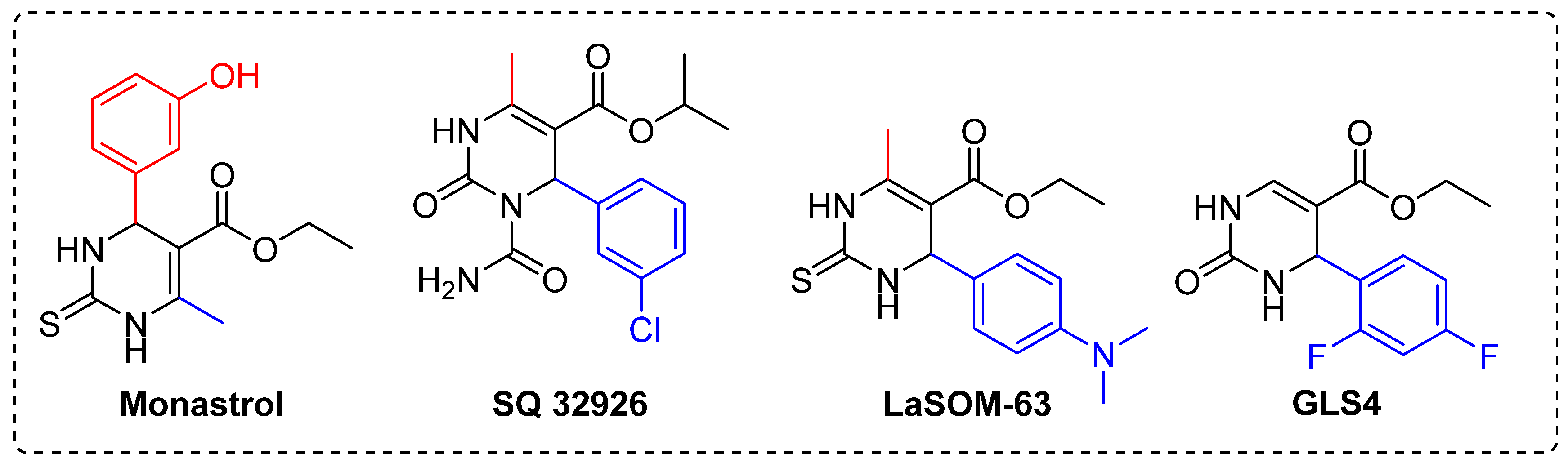
Several representative DHPM derivatives have demonstrated notable pharmacological activities [20]. For instance, Monastrol [21] is a well-known inhibitor of the mitotic kinesin Eg5 [22] and has been widely used as a tool compound for investigating cell division. SQ 32926 [23] functions as a calcium channel blocker with potential antihypertensive activity, whereas LaSOM-63 [24] has been reported to possess anti-inflammatory properties [25]. In addition, the antiviral candidate GLS4 acts as a capsid assembly modulator and exhibits potent inhibition of hepatitis B virus replication (Figure 1). These findings highlight the structural versatility and therapeutic potential of DHPM-based compounds, indicating that the DHPM scaffold represents an attractive platform for the development of novel bioactive molecules.
Compared with conventional antiviral agents such as the nucleoside analogues acyclovir and ribavirin, which mainly inhibit viral DNA [26] or RNA [19,27] synthesis, DHPM derivatives provide additional opportunities for multi-target interactions and structural optimization to improve antiviral activity and selectivity [13]. Although several studies have begun to explore the antiviral potential of DHPM analogues, systematic evaluations of their antiviral activity remain relatively limited [28]. In the present study, a series of DHPM derivatives were synthesized using a one-pot strategy in acetic acid, allowing condensation and cyclization to proceed simultaneously without isolation of intermediates. The resulting products were purified by water precipitation followed by methanol recrystallization. This synthetic approach shortens the reaction time, improves yields, and is consistent with green chemistry principles due to reduced solvent consumption and high atom economy [29].
To evaluate antiviral activity, pseudorabies virus (PRV) and vesicular stomatitis virus (VSV) were selected as in vitro infection models. PRV is a highly contagious alphaherpesvirus that infects swine and other mammals [30], causing substantial economic losses and posing potential zoonotic risks [31], while effective small-molecule antivirals remain limited. VSV, a negative-strand RNA virus, is widely used as a model for evaluating broad-spectrum antiviral activity [32,33]. We try to find different types of small-molecule antivirals [32,33,34]. Several synthesized DHPM derivatives significantly inhibited PRV and VSV replication, reduced viral protein expression, and exhibited low cytotoxicity in cell-based assays. Mechanistic investigations further suggest that these compounds may interfere with key steps of viral replication and potentially modulate host antiviral responses. These findings indicate that DHPM derivatives may serve as promising lead compounds for the development of broad-spectrum antiviral agents.

2. Materials and Methods

2.1. Chemicals and Instruments

All reagents and solvents were purchased from Shanghai Aladdin Biochemical Technology Co., Ltd. (Shanghai, China) and used as received unless otherwise noted.The target compounds were synthesized via a one-pot procedure and characterized by 1H and 13C NMR and high-resolution mass spectrometry. All NMR spectra were recorded in DMSO-d6 or CDCl3 as solvents. NMR data were obtained on a Bruker DPX-400 Spectrometer (Rheinstetten, Germany), with data processed by MestReNova 14.0.23239 (Santiago de Compostela, Spain) software. 1H NMR chemical shifts were referenced to tetramethylsilane (TMS) as the internal standard, and 13C NMR chemical shifts were referenced to the deuterated solvent signals. Coupling constants (J) are reported in Hz, and chemical shifts (δ) are given in ppm. Signal multiplicities are denoted as s (singlet), d (doublet), t (triplet), q (quartet), and m (multiplet). Unless otherwise specified, each signal corresponds to one proton or one carbon atom. Reaction progress was monitored by thin-layer chromatography (TLC) on plates precoated with fluorescent indicator, and spots were visualized under UV light at 254 and 365 nm.

2.2. Chemical Synthesis

Table 1 summarizes all 3,4-dihydropyrimidin-2(1H)-one (DHPM) derivatives (4) prepared in this study. The detailed synthetic procedures and experimental protocols are provided in Section 2.3.

2.3. General Procedure for the Synthesis of DHPM Derivatives 4aa4cm

The synthesis of all 3,4-dihydropyrimidin-2(1H)-one (DHPM) derivatives in this study are summarized in Table 1. Taking compound 4aa as an example, the synthetic procedure for this class of compounds is described as follows:
Table 1. Preparation for 3,4-dihydropyrimidin-2(1H)-one derivatives (4).
Microorganisms 14 01220 i001
Microorganisms 14 01220 i002
Acetic acid (10 mL) was introduced into a 50 mL round-bottom flask, followed by the sequential addition of urea (1a, 0.90 g, 15.0 mmol), benzaldehyde (3a, 1.01 mL, 1.06 g, 10.0 mmol), and anhydrous magnesium sulfate (0.36 g, 3.0 mmol). The mixture was stirred thoroughly, after which ethyl acetoacetate (2, 1.26 mL, 1.30 g, 10.0 mmol) was added dropwise. The reaction mixture was heated to 100 °C and maintained under continuous stirring for 6–8 h. Reaction progress was monitored by thin-layer chromatography (TLC) using dichloromethane/ethyl acetate (1:1, v/v) as the eluent. Upon completion, the mixture was allowed to cool to room temperature and then slowly poured into water, leading to the formation of a white precipitate. The resulting solid was collected, washed with water (2–3 times), and recrystallized from methanol to afford ethyl 6-methyl-2-oxo-4-phenyl-1,2,3,4-tetrahydropyrimidine-5-carboxylate (4aa) as a white solid (2.05 g, 7.85 mmol) in 78.8% yield based on benzaldehyde.
Ethyl 6-methyl-2-oxo-4-phenyl-1,2,3,4-tetrahydropyrimidine-5-carboxylate (4aa): white solid; 78.8% yield. 1H NMR (400 MHz, DMSO-d6) δ 9.19 (s), 7.75 (s), 7.32 (dd, J = 7.9, 6.7 Hz, 2H), 7.28–7.14 (m, 3H), 5.14 (s), 3.98 (q, J = 7.0 Hz, 2H), 2.24 (s, 3H), 1.09 (t, J = 7.1 Hz, 3H). 13C NMR (101 MHz, DMSO-d6) δ 165.36, 152.16, 148.41, 144.89, 128.43 (2C), 127.30, 126.27 (2C), 99.26, 59.22, 53.97, 17.81, 14.11. HRMS (ESl): caled for C14H16N2O3[M+H]+: 261.1234, found: 261.1204.
Ethyl 4-(3,4-dihydroxyphenyl)-1,6-dimethyl-2-oxo-1,2,3,4-tetrahydropyrimidine-5-carboxylate (4ab): yellowish-brown solid; 48.2% yield. 1H NMR (400 MHz, DMSO-d6) δ 9.09 (s), 8.87 (s), 8.78 (s), 7.59 (s), 6.63 (d, J = 8.2 Hz, 2H), 6.49 (dd, J = 8.1, 2.2 Hz, 1H), 4.97 (d, J = 3.4 Hz, 1H), 3.98 (q, J = 7.1 Hz, 2H), 2.22 (s, 3H), 1.11 (t, J = 7.1 Hz, 3H). 13C NMR (101 MHz, DMSO-d6) δ 165.33, 152.09, 147.37, 144.81, 144.34, 135.85, 117.00, 115.02, 113.55, 99.69, 58.97, 53.35, 17.60, 13.98. HRMS (ESl): caled for C14H16N2O5[M+Na]+: 315.0951, found: 315.0915.
Ethyl 4-(4-hydroxy-3-methoxyphenyl)-6-methyl-2-oxo-1,2,3,4-tetrahydropyrimidine-5-carboxylate (4ac): white solid; 49.6% yield. 1H NMR (400 MHz, DMSO-d6) δ 9.12 (s), 8.91 (s), 7.63 (s), 6.79 (d, J = 2.0 Hz, 1H), 6.70 (d, J = 8.1 Hz, 1H), 6.60 (dd, J = 8.2, 2.0 Hz, 1H), 5.05 (d, J = 3.2 Hz, 1H), 3.99 (q, J = 7.1 Hz, 2H), 3.72 (s, 3H), 2.23 (s, 3H), 1.11 (t, J = 7.1 Hz, 3H).13C NMR (101 MHz, DMSO-d6) δ 165.08, 151.88, 147.54, 146.86, 145.39, 135.54, 117.89, 114.88, 110.45, 99.15, 58.76, 55.15, 53.16, 17.37, 13.78. HRMS (ESl): caled for C15H18N2O5[M+H]+: 307.1288, found: 307.1254.
Ethyl 4-(3-methoxyphenyl)-6-methyl-2-oxo-1,2,3,4-tetrahydropyrimidine-5-carboxylate (4ad): white solid; 53.7% yield. 1H NMR (400 MHz, DMSO-d6) δ 9.20 (s), 7.73 (dd, J = 3.5, 1.9 Hz, 1H), 7.24 (t, J = 7.9 Hz, 1H), 6.82 (d, J = 8.1 Hz, 2H), 6.78 (t, J = 2.0 Hz, 1H), 5.12 (d, J = 3.3 Hz, 1H), 4.00 (q, J = 7.1 Hz, 2H), 3.72 (s, 3H), 2.24 (d, J = 1.6 Hz, 3H), 1.11 (t, J = 7.1 Hz, 3H).13C NMR (101 MHz, DMSO-d6) δ 165.38, 159.23, 152.26, 148.49, 146.37, 129.60, 118.27, 112.43, 112.15, 99.16, 59.26, 54.99, 53.76, 17.80, 14.15. HRMS (ESl): caled for C15H18N2O4[M+H]+: 291.1339, found: 291.1304.
Ethyl 4-(4-methoxyphenyl)-6-methyl-2-oxo-1,2,3,4-tetrahydropyrimidine-5-carboxylate (4ae): white solid; 76.5% yield.1H NMR (400 MHz, DMSO-d6) δ 9.16 (s), 7.70–7.64 (m), 7.14 (d, J = 8.7 Hz, 2H), 6.87 (d, J = 8.7 Hz, 2H), 5.09 (d, J = 3.3 Hz, 1H), 3.97 (q, J = 7.1 Hz, 2H), 3.71 (s, 3H), 2.24 (s, 3H), 1.10 (t, J = 7.1 Hz, 3H).13C NMR (101 MHz, DMSO-d6) δ 165.41, 158.47, 152.20, 148.06, 137.08, 127.43 (2C), 113.73 (2C), 99.58, 59.19, 55.08, 53.36, 17.79, 14.14. HRMS (ESl): caled for C15H18N2O4[M+H]+: 291.1339, found: 291.1306.
Ethyl 4-(2,3-dimethoxyphenyl)-6-methyl-2-oxo-1,2,3,4-tetrahydropyrimidine-5-carboxylate (4af): white solid; 64.2% yield. 1H NMR (400 MHz, DMSO-d6) δ 9.15 (s), 7.37 (t, J = 2.6 Hz, 1H), 7.03–6.90 (m, 2H), 6.73 (dd, J = 7.6, 1.7 Hz, 1H)Hz, 1H), 5.46 (d, J = 3.1 Hz, 1H)Hz, 1H), 3.92 (q, J = 7.1 Hz, 2H), 3.79 (s, 3H), 3.76 (s, 3H), 2.27 (s, 3H), 1.03 (t, J = 7.1 Hz, 3H).13C NMR (101 MHz, DMSO-d6) δ 165.36, 152.48, 151.91, 148.54, 146.09, 137.48, 123.76, 119.55, 112.11, 98.20, 60.13, 59.06, 55.70, 49.54, 17.88, 14.10. HRMS (ESl): caled for C16H20N2O5[M+H]+: 321.1445, found: 321.1406.
Ethyl 4-(3,4-dimethoxyphenyl)-6-methyl-2-oxo-1,2,3,4-tetrahydropyrimidine-5-carboxylate (4ag): white solid; 76.5% yield. 1H NMR (400 MHz, DMSO-d6) δ 9.15 (s), 7.67 (dd, J = 3.4, 2.0 Hz, 1H), 6.89 (d, J = 8.3 Hz, 1H), 6.84 (d, J = 2.1 Hz, 1H), 6.72 (dd, J = 8.3, 2.1 Hz, 1H), 5.10 (d, J = 3.3 Hz, 1H), 4.00 (q, J = 7.1 Hz, 2H), 3.71 (s, 6H), 2.24 (s, 3H), 1.12 (t, J = 7.1 Hz, 3H).13C NMR (101 MHz, DMSO-d6 δ) 165.43, 152.25, 148.47, 148.16, 148.04, 137.35, 117.89, 111.74, 110.45, 99.36, 59.18, 55.53, 55.41, 53.46, 17.76, 14.17. HRMS (ESl): caled for C16H20N2O5[M+H]+: 321.1445, found: 321.1408.
Ethyl 4-(2,5-difluorophenyl)-6-methyl-2-oxo-1,2,3,4-tetrahydropyrimidine-5-carboxylate (4ah): white solid; 45.2% yield. 1H NMR (400 MHz, DMSO-d6) δ 9.32 (s), 7.76 (t, J = 2.5 Hz, 1H), 7.28–7.17 (m), 7.20–7.10 (m), 7.06–6.97 (m), 5.40 (d, J = 3.0 Hz, 1H), 3.93 (q, J = 7.1 Hz, 2H), 2.27 (s, 3H), 1.03 (t, J = 7.1 Hz, 3H).13C NMR (101 MHz, DMSO-d6) δ 164.91, 158.09 (d, J = 239.5 Hz, 1C), 154.42 (d, J = 230.0 Hz, 1C), 151.38, 149.53, 133.54 (dd, J = 16.5, 6.2 Hz, 1C), 117.20 (dd, J = 25.3, 8.5 Hz, 1C), 115.85 (dd, J = 24.1, 8.8 Hz, 1C), 115.05 (dd, J = 24.2, 4.6 Hz, 1C), 114.90, 96.77, 59.21, 49.04, 17.80, 13.91. HRMS (ESl): caled for C14H14F2N2O3[M+Na]+: 319.0865, found: 319.0836.
Ethyl 4-(3-chlorophenyl)-6-methyl-2-oxo-1,2,3,4-tetrahydropyrimidine-5-carboxylate (4ai): white solid; 58.8% yield. 1H NMR (400 MHz, DMSO-d6) δ 9.29 (s), 7.81 (d, J = 2.8 Hz, 2H), 7.37 (t, J = 7.7 Hz, 3H), 7.35–7.28 (m, 2H), 7.25 (d, J = 1.9 Hz, 2H), 7.20 (dd, J = 7.5, 1.6 Hz, 2H), 5.16 (d, J = 3.4 Hz, 2H), 4.08–3.91 (m, 2H), 2.26 (s, 3H), 1.09 (t, J = 7.1 Hz, 3H).13C NMR (101 MHz, DMSO-d6) δ 165.21, 151.98, 149.03, 147.29, 132.95, 130.54, 127.30, 126.29, 124.95, 98.63, 59.35, 53.66, 17.87, 14.08. HRMS (ESl): caled for C14H15ClN2O3[M+H]+: 295.0844, found: 295.0816.
Ethyl 4-(4-chlorophenyl)-6-methyl-2-oxo-1,2,3,4-tetrahydropyrimidine-5-carboxylate (4aj): white solid; 81.6% yield. 1H NMR (400 MHz, DMSO-d6) δ 9.27 (d, J = 2.1 Hz, 1H), 7.80 (dd, J = 3.5, 2.0 Hz, 1H), 7.39 (d, J = 8.4 Hz, 2H), 7.25 (d, J = 8.5 Hz, 2H), 5.15 (d, J = 3.3 Hz, 1H), 3.98 (q, J = 7.1 Hz, 2H), 2.26 (s, 3H), 1.08 (t, J = 7.1 Hz, 3H).13C NMR (101 MHz, DMSO-d6) δ 165.27, 152.05, 148.80, 143.86, 131.87, 128.46 (2C), 128.26 (2C), 98.89, 59.33, 53.50, 17.88, 14.11. HRMS (ESl): caled for C14H15ClN2O3[M+H]+: 295.0844, found: 295.0817.
Ethyl 4-(4-hydroxy-3,5-dimethoxyphenyl)-6-methyl-2-oxo-1,2,3,4-tetrahydropyrimidine-5-carboxylate (4ak): white solid; 40.1% yield.1H NMR (400 MHz, DMSO-d6) δ 9.14 (s), 8.33 (s), 7.66 (s), 6.48 (s, 2H), 5.07 (d, J = 3.3 Hz, 1H), 4.01 (q, J = 7.0 Hz, 2H), 3.70 (s, 6H), 2.24 (s, 3H), 1.13 (t, J = 7.1 Hz, 3H).13C NMR (101 MHz, DMSO-d6) δ 165.92, 152.71, 148.48 (2C), 148.22, 135.47, 104.22 (2C), 99.82, 59.61, 56.41 (2C), 54.23, 18.18, 14.64. HRMS (ESl): caled for C16H20N2O6[M+Na]+: 359.1214, found: 359.1178.
Ethyl 4-(4-bromophenyl)-6-methyl-2-oxo-1,2,3,4-tetrahydropyrimidine-5-carboxylate (4al): white solid; 62.7% yield. 1H NMR (400 MHz, DMSO-d6) δ 9.24 (d, J = 2.0 Hz, 1H), 7.77 (dd, J = 3.5, 2.0 Hz, 1H), 7.53 (d, J = 8.4 Hz, 2H), 7.19 (d, J = 8.4 Hz, 2H), 5.12 (d, J = 3.3 Hz, 1H), 3.98 (q, J = 7.1 Hz, 2H), 2.24 (s, 3H), 1.09 (t, J = 7.1 Hz, 3H).13C NMR (101 MHz, DMSO-d6) δ 165.20, 151.93, 148.75, 144.21, 131.33 (2C), 128.56 (2C), 120.31, 98.75, 59.27, 53.48, 17.81, 14.08. HRMS (ESl): caled for C14H15BrN2O3[M+Na]+: 361.0158, found: 361.0123.
Ethyl 4-(3,5-dibromo-4-hydroxyphenyl)-6-methyl-2-oxo-1,2,3,4-tetrahydropyrimidine-5-carboxylate (4am): off-white solid; 83.3% yield.1H NMR (400 MHz, DMSO-d6) δ 9.96 (s), 9.28 (d, J = 2.0 Hz, 1H), 7.76 (dd, J = 3.3, 1.9 Hz,), 7.33 (s, 2H), 5.07 (d, J = 3.4 Hz, 1H), 4.10–3.90 (m, 2H), 2.25 (s, 3H), 1.11 (t, J = 7.1 Hz, 3H).13C NMR (101 MHz, DMSO-d6) δ 165.18, 151.86, 149.97, 149.01, 139.24, 130.15 (2C), 111.85 (2C), 98.57, 59.41, 52.80, 17.91, 14.12. HRMS (ESl): caled for C14H14Br2N2O4[M+Na]+: 456.9192, found: 456.9147.
Ethyl 1,6-dimethyl-2-oxo-4-phenyl-1,2,3,4-tetrahydropyrimidine-5-carboxylate (4ba): white solid; 46.6% yield.1H NMR (400 MHz, DMSO-d6) δ 7.99 (d, J = 3.9 Hz, 1H), 7.33 (dd, J = 8.0, 6.7 Hz, 2H), 7.29–7.20 (m, 3H), 5.18 (d, J = 3.8 Hz, 1H), 4.04 (q, J = 7.1 Hz, 2H), 3.11 (s, 3H), 1.13 (t, J = 7.1 Hz, 3H).13C NMR (101 MHz, DMSO-d6) δ 165.62, 153.12, 150.60, 144.11, 128.49 (2C), 127.35, 126.08 (2C), 102.48, 59.56, 52.44, 29.74, 16.06, 14.08. HRMS (ESl): caled for C15H18N2O3[M+H]+: 275.1390, found: 275.1362.
Ethyl 4-(3,4-dihydroxyphenyl)-1,6-dimethyl-2-oxo-1,2,3,4-tetrahydropyrimidine-5-carboxylate (4bb): yellowish-brown solid; 61.4% yield. 1H NMR (400 MHz, DMSO-d6) δ 8.86 (s), 8.79 (s), 7.81 (d, J = 3.8 Hz, 1H), 6.67–6.58 (m, 2H), 6.46 (dd, J = 8.1, 2.2 Hz, 1H), 4.99 (d, J = 3.7 Hz, 1H), 4.03 (q, J = 7.1 Hz, 2H), 3.09 (s, 3H), 2.45 (s, 3H), 1.14 (t, J = 7.1 Hz, 3H).13C NMR (101 MHz, DMSO-d6) δ 165.78, 153.22, 149.62, 145.02, 144.55, 135.22, 116.87, 115.29, 113.62, 103.23, 59.50, 51.97, 29.72, 16.07, 14.14. HRMS (ESl): caled for C15H18N2O5[M+Na]+: 329.1108, found: 329.1074.
Ethyl 4-(4-hydroxy-3-methoxyphenyl)-1,6-dimethyl-2-oxo-1,2,3,4-tetrahydropyrimidine-5-carboxylate (4bc): white solid; 34.1% yield. 1H NMR (400 MHz, DMSO-d6) δ 8.93 (s), 7.86 (d, J = 3.8 Hz, 1H), 6.77 (d, J = 2.0 Hz, 1H), 6.70 (d, J = 8.1 Hz, 1H), 6.59 (dd, J = 8.1, 2.0 Hz, 1H), 5.07 (d, J = 3.7 Hz, 1H), 4.04 (q, J = 7.1 Hz, 2H), 3.72 (s, 3H), 3.09 (s, 3H), 2.47 (s, 3H), 1.13 (t, J = 7.1 Hz, 3H).13C NMR (101 MHz, DMSO-d6) δ 165.75, 153.28, 150.10, 147.36, 145.86, 135.12, 118.12, 115.32, 110.56, 102.93, 59.52, 55.53, 52.08, 29.68, 16.04, 14.17. HRMS (ESl): caled for C16H20N2O5[M+H]+: 321.1445, found: 321.1412.
Ethyl 4-(3-methoxyphenyl)-1,6-dimethyl-2-oxo-1,2,3,4-tetrahydropyrimidine-5-carboxylate (4bd): white solid; 61.5% yield. 1H NMR (400 MHz, DMSO-d6) δ 7.96 (d, J = 3.9 Hz, 1H), 7.23 (t, J = 7.9 Hz, 1H), 6.85–6.75 (m, 2H), 6.75 (d, J = 2.2 Hz, 1H), 5.13 (d, J = 3.8 Hz, 1H), 4.04 (q, J = 7.2 Hz, 2H), 3.72 (s, 3H), 3.09 (s, 3H), 2.48 (s, 3H), 1.13 (t, J = 7.1 Hz, 3H).13C NMR (101 MHz, DMSO-d6) δ 165.62, 159.26, 153.20, 150.67, 145.59, 129.65, 118.05, 112.20, 112.14, 102.38, 59.59, 54.96, 52.18, 29.73, 16.04, 14.12. HRMS (ESl): caled for C16H20N2O4[M+H]+: 305.1496, found: 305.1465.
Ethyl 4-(4-methoxyphenyl)-1,6-dimethyl-2-oxo-1,2,3,4-tetrahydropyrimidine-5-carboxylate (4be): white solid; 46.0% yield. 1H NMR (400 MHz, DMSO-d6) δ 7.91 (d, J = 3.8 Hz, 1H), 7.13 (d, J = 8.7 Hz, 2H), 6.87 (d, J = 8.7 Hz, 2H), 5.10 (d, J = 3.7 Hz, 1H), 4.02 (q, J = 7.1 Hz, 2H), 3.71 (s, 3H), 3.09 (s, 3H), 2.48 (s, 3H), 1.12 (t, J = 7.1 Hz, 3H).13C NMR (101 MHz, DMSO-d6) δ 165.65, 158.50, 153.13, 150.27, 136.21, 127.26 (2C), 113.78 (2C), 102.79, 59.52, 55.06, 51.82, 29.71, 16.04, 14.11. HRMS (ESl): caled for C16H20N2O4[M+H]+: 305.1496, found: 305.1465.
Ethyl 4-(2,3-dimethoxyphenyl)-1,6-dimethyl-2-oxo-1,2,3,4-tetrahydropyrimidine-5-carboxylate (4bf): white solid; 52.9% yield.1H NMR (400 MHz, DMSO-d6) δ 7.59 (d, J = 3.7 Hz, 1H), 7.03–6.90 (m, 2H), 6.72 (dd, J = 7.3, 2.0 Hz, 1H), 5.47 (d, J = 3.6 Hz, 1H), 3.97 (q, J = 7.1 Hz, 2H), 3.79 (s, 3H), 3.75 (s, 3H), 3.13 (s, 3H), 1.06 (t, J = 7.1 Hz, 3H).13C NMR (101 MHz, DMSO-d6) δ 165.65, 152.83, 152.51, 150.37, 146.18, 136.67, 123.75, 119.32, 112.26, 101.59, 60.20, 59.42, 55.68, 48.35, 29.65, 16.16, 14.05. HRMS (ESl): caled for C17H22N2O5[M+H]+: 335.1601, found: 335.1566.
Ethyl 4-(3,4-dimethoxyphenyl)-1,6-dimethyl-2-oxo-1,2,3,4-tetrahydropyrimidine-5-carboxylate (4bg): white solid; 35.6% yield.1H NMR (400 MHz, DMSO-d6) δ 7.90 (d, J = 3.8 Hz, 1H), 6.87 (d, J = 8.3 Hz, 1H), 6.81 (d, J = 2.1 Hz, 1H), 6.70 (dd, J = 8.3, 2.1 Hz, 1H), 5.10 (d, J = 3.8 Hz, 1H), 4.04 (q, J = 7.0 Hz, 2H), 3.71 (s, 6H), 3.09 (s, 3H), 2.48 (s, 3H), 1.14 (t, J = 7.1 Hz, 3H).13C NMR (101 MHz, DMSO-d6) δ 165.66, 153.24, 150.32, 148.54, 148.06, 136.47, 117.65, 111.69, 110.11, 102.70, 59.51, 55.50, 55.37, 51.89, 29.66, 16.00, 14.14. HRMS (ESl): caled for C17H22N2O5[M+H]+: 335.1601, found: 335.1566.
Ethyl 4-(2,5-difluorophenyl)-1,6-dimethyl-2-oxo-1,2,3,4-tetrahydropyrimidine-5-carboxylate (4bh): yellow solid; 59.6% yield.1H NMR (400 MHz, DMSO-d6) δ 7.99 (d, J = 3.6 Hz, 1H), 7.26–7.19 (m), 7.18–7.11 (m), 7.08–6.99 (m), 5.44 (d, J = 3.5 Hz, 1H), 3.96 (q, J = 7.1 Hz, 2H), 3.15 (s, 3H), 2.53 (s, 3H), 1.05 (t, J = 7.1 Hz, 3H).13C NMR (101 MHz, DMSO-d6) δ 165.16, 155.59 (dd, J = 242.6, 2.2 Hz, 1C), 132.90 (dd, J = 16.8, 6.2 Hz, 1C), 152.33, 151.80, 132.90 (dd, J = 16.8, 6.2 Hz, 1C), 117.36, 117.19 (dd, J = 25.4, 8.6 Hz, 1C), 115.98 (dd, J = 24.1, 8.8 Hz, 1C), 114.83 (dd, J = 24.1, 4.6 Hz, 1C), 99.93, 59.54, 47.49, 47.46, 29.66, 16.07, 13.84. HRMS (ESl): caled for C15H16F2N2O3[M+H]+: 311.1202, found: 311.1171.
Ethyl 4-(3-chlorophenyl)-1,6-dimethyl-2-oxo-1,2,3,4-tetrahydropyrimidine-5-carboxylate (4bi): white solid; 40.2% yield.1H NMR (400 MHz, DMSO-d6) δ 8.05 (d, J = 3.9 Hz, 1H), 7.33 (m, 2H), 7.26 (d, J = 2.0 Hz, 1H), 7.20 (dd, J = 7.5, 1.7 Hz, 1H), 5.19 (d, J = 3.7 Hz, 1H), 4.04 (q, J = 7.1 Hz, 2H), 3.11 (s, 3H), 1.11 (t, J = 7.1 Hz, 3H).13C NMR (101 MHz, DMSO-d6) δ 165.46, 152.91, 151.30, 146.57, 133.08, 130.52, 127.35, 126.19, 124.76, 101.71, 59.65, 52.15, 29.77, 16.09, 14.04. HRMS (ESl): caled for C15H17ClN2O3[M+H]+: 309.1000, found: 309.0970.
Ethyl 4-(4-chlorophenyl)-1,6-dimethyl-2-oxo-1,2,3,4-tetrahydropyrimidine-5-carboxylate (4bj): white solid; 42.2% yield.1H NMR (400 MHz, DMSO-d6) δ 8.03 (d, J = 3.9 Hz, 1H), 7.39 (d, J = 8.5 Hz, 2H), 7.25 (d, J = 8.5 Hz, 2H), 5.17 (d, J = 3.8 Hz, 1H), 4.03 (q, J = 7.1 Hz, 2H), 3.11 (s, 3H), 1.12 (t, J = 7.1 Hz, 3H).13C NMR (101 MHz, DMSO-d6) δ 165.48, 152.93, 151.05, 143.06, 131.93, 128.48 (2C), 128.06 (2C), 101.98, 59.63, 51.92, 29.77, 16.07, 14.07. HRMS (ESl): caled for C15H17ClN2O3[M+H]+: 309.1000, found: 309.0969.
Ethyl 4-(4-hydroxy-3,5-dimethoxyphenyl)-1,6-dimethyl-2-oxo-1,2,3,4-tetrahydropyrimidine-5-carboxylate (4bk): white solid; 50.5% yield. 1H NMR (400 MHz, DMSO-d6) δ 8.34 (s), 7.88 (s), 6.44 (s, 2H), 5.07 (s), 4.05 (q, J = 7.1 Hz, 2H), 3.69 (s, 6H), 3.10 (s, 3H), 2.47 (s, 3H), 1.15 (t, J = 7.1 Hz, 3H).13C NMR (101 MHz, DMSO-d6) δ 165.73, 153.36, 150.20, 147.83 (2C), 134.97, 134.17, 103.47 (2C), 102.88, 59.53, 55.95 (2C), 52.22, 29.65, 16.01, 14.20. HRMS (ESl): caled for C17H22N2O6[M+H]+: 351.1551, found: 351.1515.
Ethyl 4-(4-bromophenyl)-1,6-dimethyl-2-oxo-1,2,3,4-tetrahydropyrimidine-5-carboxylate (4bl): white solid; 35.5% yield. 1H NMR (400 MHz, DMSO-d6) δ 8.00 (d, J = 3.9 Hz, 1H), 7.52 (d, J = 8.4 Hz, 2H), 7.17 (d, J = 8.5 Hz, 2H), 5.14 (d, J = 3.8 Hz, 1H), 4.03 (q, J = 7.1 Hz, 2H), 3.09 (s, 3H), 2.49 (s, 3H), 1.11 (t, J = 7.1 Hz, 3H).13C NMR (101 MHz, DMSO-d6 δ 165.43, 152.87, 151.01, 143.42, 131.36 (2C), 128.37 (2C), 120.40, 101.89, 59.59, 51.91, 29.74, 16.05, 14.05. HRMS (ESl): caled for C15H17BrN2O3[M+Na]+: 375.0315, found: 375.0278.
Ethyl 1-benzyl-6-methyl-2-oxo-4-phenyl-1,2,3,4-tetrahydropyrimidine-5-carboxylate (4ca). White solid; yield 43.0%; 1H NMR (400 MHz, DMSO-d6) δ 8.17 (d, J = 3.6 Hz, 1H), 7.37–7.20 (m, 8H), 7.08 (d, J = 6.6 Hz, 2H), 5.26 (d, J = 3.6 Hz, 1H), 5.11 (d, J = 16.8 Hz, 1H), 4.85 (d, J = 16.9 Hz, 1H), 4.02 (q, J = 7.1 Hz, 2H), 2.37 (s, 3H), 1.09 (t, J = 7.2 Hz, 3H).13C NMR (101 MHz, DMSO-d6) δ 165.61, 153.08, 149.46, 143.95, 138.69, 128.50, 128.43 (2C), 127.44, 126.87 (2C), 126.22 (2C), 126.17 (2C), 103.56, 59.72, 52.53, 44.91, 16.00, 14.02. HRMS (ESl): caled for C21H22N2O3[M+H]+: 351.1703, found: 351.1667.
Ethyl 1-benzyl-4-(3,4-dihydroxyphenyl)-6-methyl-2-oxo-1,2,3,4-tetrahydropyrimidine-5-carboxylate (4cb). Yellow solid; yield 45.0%;1H NMR (400 MHz, DMSO-d6) δ 8.90 (s), 8.85 (s), 8.00 (d, J = 3.6 Hz, 1H), 7.36–7.17 (m, 3H), 7.08 (d, J = 6.7 Hz, 2H), 6.73–6.60 (m, 2H), 6.49 (dd, J = 8.1, 2.1 Hz, 1H), 5.19–5.01 (m, 2H), 4.84 (d, J = 16.9 Hz, 1H), 4.02 (q, J = 7.1 Hz, 2H), 2.31 (s, 3H), 1.12 (t, J = 7.1 Hz, 3H).13C NMR (101 MHz, DMSO-d6) δ 165.81, 153.18, 148.55, 145.07, 144.61, 138.83, 135.04, 128.51 (2C), 126.79, 126.07 (2C), 116.94, 115.29, 113.86, 104.16, 59.67, 52.03, 44.92, 15.96, 14.10. HRMS (ESl): caled for C15H17BrN2O3[M+Na]+: 405.1421, found: 405.1380.
Ethyl 1-benzyl-4-(4-hydroxy-3-methoxyphenyl)-6-methyl-2-oxo-1,2,3,4-tetrahydropyrimidine-5-carboxylate (4cc). White solid; yield 61.3%;1H NMR (400 MHz, DMSO-d6) δ 8.98 (s), 8.04 (d, J = 3.6 Hz, 1H), 7.31–7.22 (m, 3H), 7.10 (d, J = 7.3 Hz, 2H), 6.80 (d, J = 2.1 Hz, 1H), 6.72 (d, J = 8.1 Hz, 1H), 6.62 (dd, J = 8.1, 2.0 Hz, 1H), 5.17 (d, J = 3.5 Hz, 1H), 5.12 (d, J = 16.7 Hz, 1H), 4.82 (d, J = 16.8 Hz, 1H), 4.03 (q, J = 7.1 Hz, 2H), 3.69 (s, 3H), 2.36 (s, 3H), 1.11 (t, J = 7.1 Hz, 3H).13C NMR (101 MHz, DMSO-d6) δ 165.78, 153.12, 148.86, 147.43, 145.96, 138.83, 135.00, 128.52 (2C), 126.88, 126.18 (2C), 118.45, 115.25, 110.65, 103.79, 59.68, 55.54, 52.32, 44.85, 16.01, 14.11. HRMS (ESl): caled for C22H24N2O5[M+H]+: 397.1758, found: 397.1717.
Ethyl 1-benzyl-4-(3-methoxyphenyl)-6-methyl-2-oxo-1,2,3,4-tetrahydropyrimidine-5-carboxylate (4cd). White solid; yield 47.8%; 1H NMR (400 MHz, DMSO-d6) δ 8.15 (d, J = 3.7 Hz, 1H), 7.31–7.20 (m, 4H), 7.07 (d, J = 6.9 Hz, 2H), 6.88–6.78 (m, 3H), 5.23 (d, J = 3.6 Hz, 1H), 5.11 (d, J = 16.8 Hz, 1H), 4.83 (d, J = 16.8 Hz, 1H), 4.04 (q, J = 7.1 Hz, 2H), 3.71 (s, 3H), 2.36 (s, 3H), 1.11 (t, J = 7.1 Hz, 3H).13C NMR (101 MHz, DMSO-d6) δ 165.62, 159.33, 153.13, 149.52, 145.48, 138.69, 129.60, 128.50 (2C), 126.85, 126.11 (2C), 118.25, 112.40, 112.24, 103.39, 59.75, 54.99, 52.33, 44.88, 15.99, 14.06. HRMS (ESl): caled for C22H24N2O4[M+H]+: 381.1809, found: 381.1769.
Ethyl 1-benzyl-4-(4-methoxyphenyl)-6-methyl-2-oxo-1,2,3,4-tetrahydropyrimidine-5-carboxylate (4ce). White solid; yield 39.4%; 1H NMR (400 MHz, DMSO-d6) δ 8.09 (d, J = 3.6 Hz, 1H), 7.28 (d, J = 7.7 Hz, 2H), 7.25 (d, J = 1.3 Hz, 1H), 7.14 (d, J = 8.6 Hz, 2H), 7.07 (d, J = 6.9 Hz, 2H), 6.88 (d, J = 8.7 Hz, 2H), 5.18 (d, J = 3.6 Hz, 1H), 5.08 (d, J = 16.8 Hz, 1H), 4.84 (d, J = 16.8 Hz, 1H), 4.01 (q, J = 7.3 Hz, 2H), 3.73 (s, 3H), 2.35 (s, 3H), 1.10 (t, J = 7.1 Hz, 3H).13C NMR (101 MHz, DMSO-d6) δ 165.65, 158.57, 153.05, 149.11, 138.74, 136.02, 128.52 (2C), 127.41 (2C), 126.87, 126.15 (2C), 113.73 (2C), 103.80, 59.68, 55.12, 51.94, 44.88, 15.98, 14.06. HRMS (ESl): caled for C22H24N2O4[M+H]+: 381.1809, found: 381.1770.
Ethyl 1-benzyl-4-(2,3-dimethoxyphenyl)-6-methyl-2-oxo-1,2,3,4-tetrahydropyrimidine-5-carboxylate (4cf). Off-white solid; yield 45.8%;1H NMR (400 MHz, DMSO-d6) δ 7.73 (d, J = 3.4 Hz, 1H), 7.33 (d, J = 7.4 Hz, 2H), 7.25 (t, J = 7.3 Hz, 1H), 7.19 (d, J = 8.8 Hz, 2H), 6.97 (d, J = 3.9 Hz, 2H), 6.69 (d, J = 4.1 Hz, 1H), 5.53 (s), 5.08–4.84 (m, 2H), 4.03–3.84 (m, 2H), 3.80 (s, 3H), 3.74 (s, 3H), 2.36 (s, 3H), 1.03 (t, J = 7.1 Hz, 3H).13C NMR (101 MHz, DMSO-d6) δ 165.61, 152.71, 152.50, 149.01, 146.17, 138.93, 136.51, 128.52 (2C), 126.88, 126.29 (2C), 123.65, 119.36, 112.37, 102.35, 60.18, 59.53, 55.71, 48.64, 45.10, 16.08, 13.97. HRMS (ESl): caled for C23H26N2O5[M+Na]+: 433.1734, found: 433.1693.
Ethyl 1-benzyl-4-(3,4-dimethoxyphenyl)-6-methyl-2-oxo-1,2,3,4-tetrahydropyrimidine-5-carboxylate (4cg). White solid; yield 18.7%;1H NMR (400 MHz, DMSO-d6) δ 8.08 (d, J = 3.7 Hz, 1H), 7.26 (ddd, J = 14.4, 7.8, 6.1 Hz, 3H), 7.09 (d, J = 8.9 Hz, 2H), 6.89 (d, J = 8.3 Hz, 1H), 6.84 (d, J = 2.1 Hz, 1H), 6.73 (dd, J = 8.3, 2.1 Hz, 1H), 5.20 (d, J = 3.5 Hz, 1H), 5.11 (d, J = 16.8 Hz, 1H), 4.82 (d, J = 16.9 Hz, 1H), 4.03 (q, J = 7.1 Hz, 2H), 3.74 (s, 3H), 3.67 (s, 3H), 2.36 (s, 3H), 1.12 (t, J = 7.1 Hz, 3H).13C NMR (101 MHz, DMSO-d6) δ 165.67, 153.07, 149.10, 148.58, 148.16, 138.75, 136.37, 128.48 (2C), 126.84, 126.10 (2C), 118.03, 111.62, 110.20, 103.54, 59.66, 55.56, 55.37, 52.14, 44.81, 15.96, 14.08. HRMS (ESl): caled for C23H26N2O5[M+Na]+: 433.1734, found: 433.1693.
Ethyl 1-benzyl-4-(2,5-difluorophenyl)-6-methyl-2-oxo-1,2,3,4-tetrahydropyrimidine-5-carboxylate (4ch). White solid; yield 70.9%;1H NMR (400 MHz, DMSO-d6) δ 8.19 (d, J = 3.4 Hz, 1H), 7.34 (t, J = 7.5 Hz, 2H), 7.28–7.13 (m, 5H), 7.04–6.92 (m), 5.54 (d, J = 3.3 Hz, 1H), 5.19–4.83 (m, 2H), 3.95 (q, J = 7.1 Hz, 2H), 2.43 (s, 3H), 1.02 (t, J = 7.1 Hz, 3H).13C NMR (101 MHz, DMSO-d6) δ 165.10, 158.20 (dd, J = 240.9, 2.0 Hz, 1C), 155.62 (dd, J = 242.7, 2.2 Hz, 1C), 152.30, 150.54, 138.72, 132.80 (dd, J = 16.7, 6.2 Hz, 1C), 128.60 (2C), 127.00, 126.29 (2C), 117.28 (dd, J = 25.2, 8.7 Hz, 1C), 116.08 (dd, J = 24.1, 8.8 Hz, 1C), 114.85 (dd, J = 24.4, 4.5 Hz, 1C), 100.82, 59.69, 47.77, 47.74, 45.21, 16.04, 13.77. HRMS (ESl): caled for C21H20F2N2O3[M+H]+: 387.1515, found: 387.1476.
Ethyl 1-benzyl-4-(3-chlorophenyl)-6-methyl-2-oxo-1,2,3,4-tetrahydropyrimidine-5-carboxylate (4ci). White solid; yield 40.8%; 1H NMR (400 MHz, DMSO-d6) δ 8.24 (d, J = 3.7 Hz, 1H), 7.36 (d, J = 6.9 Hz, 2H), 7.28 (dd, J = 5.0, 2.6 Hz, 3H), 7.25–7.20 (m, 2H), 7.08 (d, J = 6.8 Hz, 2H), 5.27 (d, J = 3.6 Hz, 1H), 5.15 (d, J = 16.8 Hz, 1H), 4.83 (d, J = 16.8 Hz, 1H), 4.10–3.96 (m, 2H), 2.39 (s, 3H), 1.09 (t, J = 7.1 Hz, 3H).13C NMR (101 MHz, DMSO-d6) δ 165.41, 152.85, 150.12, 146.41, 138.58, 133.14, 130.48, 128.58 (2C), 127.46, 126.93 (2C), 126.16, 125.00, 102.81, 59.82, 52.20, 44.89, 16.05, 13.99. HRMS (ESl): caled for C21H21ClN2O3[M+Na]+: 407.1133, found: 407.1091.
Ethyl 1-benzyl-4-(4-chlorophenyl)-6-methyl-2-oxo-1,2,3,4-tetrahydropyrimidine-5-carboxylate (4cj). White solid; yield 53.3%; 1H NMR (400 MHz, DMSO-d6) δ 8.21 (d, J = 3.8 Hz, 1H), 7.40 (d, J = 8.4 Hz, 2H), 7.33–7.19 (m, 5H), 7.05 (d, J = 6.9 Hz, 2H), 5.23 (d, J = 3.7 Hz, 1H), 5.08 (d, J = 16.8 Hz, 1H), 4.85 (d, J = 16.8 Hz, 1H), 4.02 (q, J = 7.1 Hz, 2H), 2.37 (s, 3H), 1.09 (t, J = 7.1 Hz, 3H).13C NMR (101 MHz, DMSO-d6) δ 165.45, 152.88, 149.90, 142.91, 138.59, 132.00, 128.52 (2C), 128.42 (2C), 128.16 (2C), 126.91, 126.13, (2C) 103.10, 59.79, 51.94, 44.93, 16.02, 14.02. HRMS (ESl): caled for C21H21ClN2O3[M+Na]+: 407.1133, found: 407.1091.
Ethyl 1-benzyl-4-(3,5-dibromo-4-hydroxyphenyl)-6-methyl-2-oxo-1,2,3,4-tetrahydropyrimidine-5-carboxylate (4cm). Off-white solid; yield 40.1%; 1H NMR (400 MHz, DMSO-d6) δ 10.02 (s), 8.17 (d, J = 3.6 Hz, 1H), 7.37 (s, 2H), 7.31 (t, J = 7.4 Hz, 2H), 7.24 (t, J = 7.3 Hz, 1H), 7.09 (d, J = 6.9 Hz, 2H), 5.32–5.13 (m, 2H), 4.78 (d, J = 16.8 Hz, 1H), 4.12–3.94 (m, 2H), 2.39 (s, 3H), 1.10 (t, J = 7.1 Hz, 3H).13C NMR (101 MHz, DMSO-d6) δ 165.36, 152.65, 150.11, 150.07, 138.59, 138.30, 130.17 (2C), 128.73, (2C) 126.98, 126.10 (2C), 111.96 (2C), 102.61, 59.86, 51.43, 44.79, 16.10, 14.03. HRMS (ESl): caled for C21H20Br2N2O4[M+Na]+: 546.9662, found: 546.9611.

2.4. Biological Evaluation

2.4.1. Cell and Viruses

PK-15 cell line was purchased from the American Type Culture Collection (ATCC, Manassas, VA, USA). The porcine kidney epithelial cell line PK-15 was maintained in our laboratory and routinely cultured and passaged in DMEM supplemented with 10% fetal bovine serum. The pseudorabies virus strain PRV-QXX was kindly provided by Prof. Yongtao Li (College of Veterinary Medicine, Henan Agricultural University). The recombinant pseudorabies virus expressing green fluorescent protein (PRV-GFP) was generously provided by Prof. Hanzhong Wang (Wuhan Institute of Virology, Chinese Academy of Sciences). The recombinant vesicular stomatitis virus expressing green fluorescent protein (VSV-GFP) was preserved in our laboratory.

2.4.2. Cell Viability Assay

PK-15 cells were seeded in 96-well plates and cultured overnight. The medium was then replaced with fresh medium containing the indicated concentrations of the test compounds (0, 0.2, 0.6, 2, 6, 20, and 60 μg/mL), with an equivalent volume of DMSO used as the vehicle control. After 24 h of treatment, CCK-8 reagent (DingGuo, Beijing, China) was added to each well, followed by incubation at 37 °C for 2 h. Absorbance at 450 nm was measured using a VARIOSKAN FLASH microplate reader (Thermo Fisher Scientific, Waltham, MA, USA).

2.4.3. Flow Cytometry Assay

PK-15 cells were seeded in 24-well plates and cultured overnight. The cells were pretreated with medium containing the test compounds at 0, 0.2, 0.6, 2, 6, and 20 μg/mL for 6 h. Subsequently, cells were infected with PRV-GFP or VSV-GFP at an MOI of 0.01 for 1 h. After viral adsorption, the inoculum was removed and replaced with maintenance medium containing the corresponding concentrations of the compounds. Cells were further incubated for 24 h, harvested by trypsinization, and analyzed for GFP-positive cells by flow cytometry using a CytoFLEX instrument (BECKMAN COULTER, Miami, FL, USA). All data were analyzed using CytExpert 2.5.0.77 (Beckman Coulter, Miami, FL, USA).

2.4.4. RT-qPCR

PK-15 cells were seeded in 35 mm dishes and cultured overnight. The medium was replaced with medium containing 6 μg/mL of the compound for 6 h. The 4bf-pretreated group was then infected with PRV-QXX (MOI = 0.01), and the 4ce-pretreated group with VSV-GFP (MOI = 0.01). Cells were collected at 0, 2, 4, 6, 12, and 24 h post-infection. Total RNA was extracted using TRIzol Reagent (TaKaRa, Kyoto, Japan) and reverse-transcribed into cDNA with a PrimeScript RT Reagent Kit (TaKaRa, Kyoto, Japan) according to the manufacturer’s instructions. qRT-PCR was conducted in triplicate using SYBR Premix Ex Taq (TaKaRa, Kyoto, Japan). Relative gene expression was normalized to β-actin and calculated using the 2−ΔΔCt method. Primer sequences are listed in Table 2.

2.4.5. Western Blotting

Cells were washed twice with cold PBS on ice and lysed in RIPA buffer containing protease and phosphatase inhibitors.
(HY-K0010, HY-K0022; MedChemExpress, Monmouth Junction, NJ, USA). Lysates were centrifuged, and protein concentrations were determined using a BCA kit (BCA01, DingGuo, Beijing, China). Proteins were mixed with loading buffer, denatured at 99 °C, and separated by SDS-PAGE. After transfer to PVDF membranes (ISEQ00010, Millipore) and blocking with 5% nonfat milk (A600669, Sangon, Shanghai, China) for 1 h, membranes were incubated with primary antibodies (anti-PRV gB, anti-GFP, anti-β-actin) overnight at 4 °C, followed by HRP-conjugated secondary antibody for 1 h at room temperature, with washes after each step. Signals were visualized using Luminata Crescendo Western HRP Substrate (WBLUR0500, Millipore, Billerica, MA, USA) on a GE AI600 imaging system. All reagents and antibodies were stored at −20 °C.

2.4.6. TCID50 Assay

PK-15 cells were seeded in 96-well plates and cultured overnight. The virus was tenfold serially diluted from 10−1 to 10−12, with eight replicates per dilution. After 1 h adsorption at 37 °C with 5% CO2, the medium was replaced with maintenance medium. Cytopathic effects (CPE) were observed and recorded for 5 consecutive days, and the TCID50 was calculated using the Reed–Muench method.

2.4.7. Mouse Assay

All animal experimental protocols were approved by the Animal Care and Use Committee of Henan Agricultural University (HNND2025010811). Female 6-week-old Kunming mice were obtained from the Center of Experimental Animal of Zhengzhou University (Zhengzhou, China) and maintained under SPF conditions in accordance with the Guide for the Care and Use of Laboratory Animals and Henan Agricultural University ethical regulations. Mice were euthanized under isoflurane anesthesia followed by cervical dislocation.
For toxicity assessment, mice (n = 3 per group) received intraperitoneal injections of DMSO or compounds at 0, 5, 10, 15, 20, or 25 mg/kg (100 μL per dose) on days 1, 3, 5, 7, 9, and 11. Body weight and clinical signs were monitored daily. On day 12, mice were euthanized, and heart, liver, spleen, lung, kidney, and brain were collected and fixed in 4% PFA.
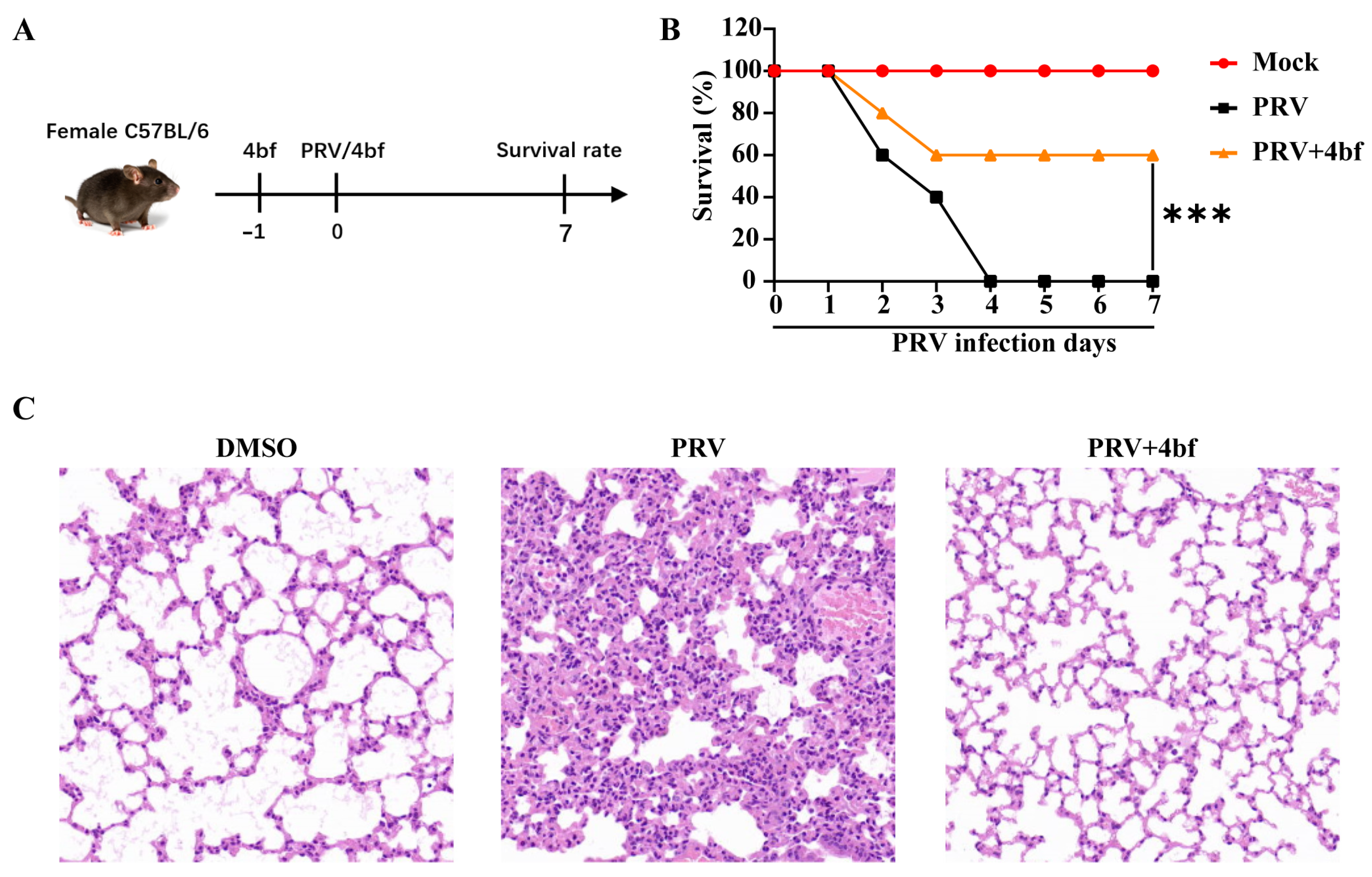
For antiviral evaluation, fifteen 6–8-week-old female SPF C57BL/6 mice were randomly assigned to Mock, PRV, or PRV + 4bf groups (n = 5 each). Mock mice received DMSO intraperitoneally on days −1 and 0. PRV mice were intranasally challenged with PRV-QXX (3 × 10³ TCID50/mouse) on day 0. PRV + 4cf mice received 20 mg/kg compound on day −1 and again with virus on day 0. Clinical signs were monitored daily, and lungs were collected in 4% PFA on day 7 post-infection.

2.4.8. Tissue Processing and H&E Staining

Mouse tissues were fixed in 4% paraformaldehyde and trimmed to approximately the size of a soybean, followed by overnight washing. Fixed tissues were dehydrated through a graded ethanol series (70–100%), cleared with xylene, and embedded in paraffin. Sections (4 μm thick) were deparaffinized, rehydrated through a graded ethanol series, stained with hematoxylin and eosin (HE), cleared again with xylene, and mounted for histological observation under a light microscope.

2.4.9. Statistical Analysis

All experiments were independently repeated at least three times. Statistical analyses were performed using GraphPad Prism 9.0. Comparisons between groups were conducted using unpaired t-tests. Differences were considered not significant (ns) or significant at * p < 0.05, ** p < 0.01, and *** p < 0.001. Graphs were prepared using GraphPad Prism 9, Microsoft Excel, and Adobe Illustrator.

3. Results

3.1. Chemistry

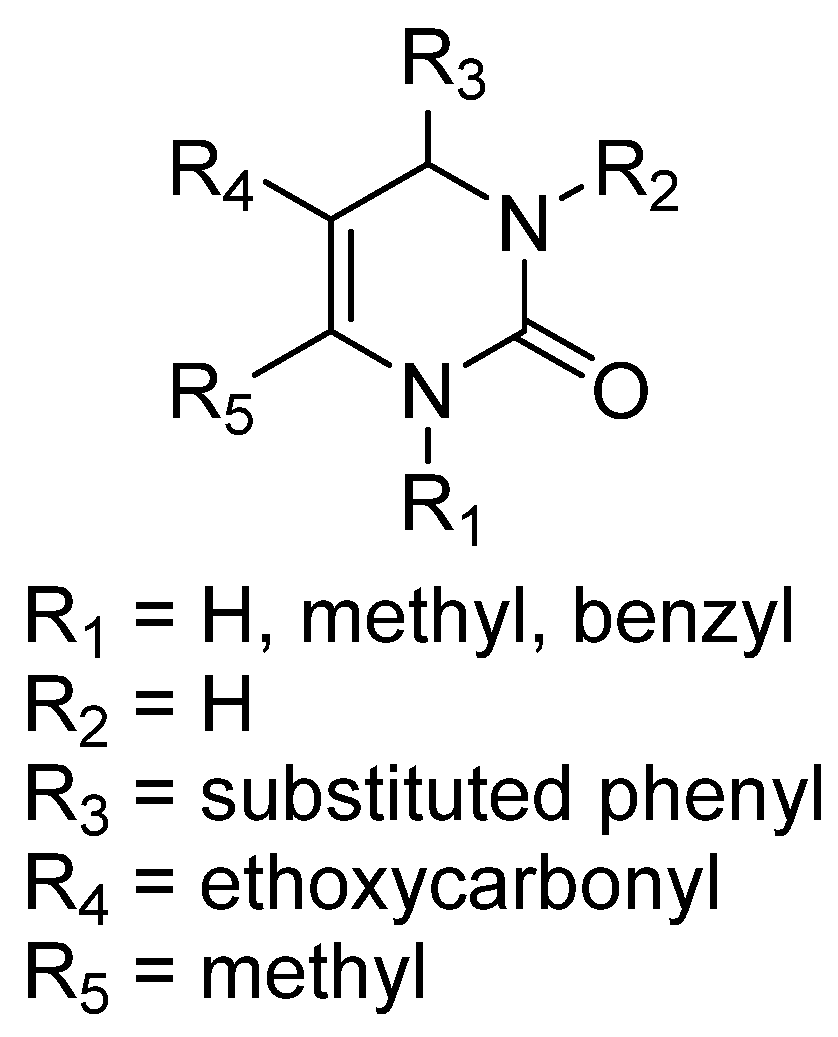
The design strategy of the target compounds is illustrated in Figure 2. Based on the 3,4-dihydropyrimidin-2(1H)-one core, structural modifications were introduced at three positions: R1, R3, and R4. R1 was varied by reacting different urea derivatives to obtain H, methyl, or benzyl substituents; R3 was modified using substituted benzaldehydes bearing electron-withdrawing or electron-donating groups (e.g., fluorine, chlorine, bromine, methyl, hydroxyl, or methoxy) to expand the aromatic moiety; R4 was introduced via reaction with β-keto esters of varying chain lengths. Considering that the alkoxy chain length has limited impact on biological activity, ethyl acetoacetate was employed as the common reaction substrate in all experiments.
The synthetic route and structures of synthesized compounds are presented in Table 1. Three urea derivatives (compound 1) were condensed with substituted benzaldehydes (compound 2) to afford imine intermediates, which subsequently underwent nucleophilic addition with ethyl acetoacetate (compound 3) in its enol form. By varying the starting materials, a series of 3,4-dihydropyrimidin-2(1H)-one derivatives bearing diverse substituents at R1, R3, and R4 was successfully obtained, providing a platform for further biological evaluation.

3.2. Biological Activity

3.2.1. Cell Viability

The cytotoxicity of the target compounds toward PK-15 cells was evaluated using the CCK-8 assay. PK-15 cells were seeded into 96-well plates and cultured overnight, followed by treatment with various concentrations of the compounds (0, 0.2, 0.6, 2, 6, 20, and 60 μg/mL) for 24 h, with DMSO serving as the vehicle control. After incubation with CCK-8 reagent for 2 h, absorbance was measured, and the half-maximal cytotoxic concentration (CC50) values were calculated.
The 3,4-dihydropyrimidin-2(1H)-one derivatives exhibited low cytotoxicity within the tested concentration range (0–60 μg/mL). Among them, compounds 4bd, 4bf, and 4ab displayed relatively lower cytotoxicity, with CC50 values of 280, 270.02, and 224.89 μg/mL, respectively, indicating favorable safety profiles in PK-15 cells (Table 3).

3.2.2. Antiviral Activity

The antiviral activities of the 3,4-dihydropyrimidin-2(1H)-one derivatives against PRV and VSV were determined by flow cytometry. PK-15 cells were pretreated with different concentrations of the compounds and then infected with PRV-GFP or VSV-GFP (MOI = 0.01) for 1 h. After adsorption, the medium was replaced with maintenance medium containing the corresponding compounds, and cells were incubated for an additional 24 h. Viral replication was quantified by flow cytometry, and IC50 values were calculated.
Within the concentration range of 0–20 μg/mL, several compounds showed inhibitory effects on viral replication. For PRV, the IC50 values of compounds 4ci, 4ad, and 4ch were 0.1749, 0.3351, and 0.5289 μg/mL, respectively. For VSV, the IC50 values of compounds 4al, 4ci, and 4cg were 0.41, 0.5925, and 4.6737 μg/mL, respectively (Table 3).

3.2.3. Selectivity Index

The selectivity index (SI = CC50/IC50) was calculated to further assess the antiviral activity of the 3,4-dihydropyrimidin-2(1H)-one derivatives by integrating cytotoxicity and inhibitory efficacy. The corresponding data are presented in Table 2.
In PRV-infected PK-15 cells, compounds 4aa, 4ad, and 4bf exhibited SI values of 124.7, 133.4, and 243.0, respectively. In VSV-infected PK-15 cells, compounds 4al, 4be, and 4ce showed SI values of 182.9, 181.1, and 196.4, respectively. Among these, 4bf displayed the highest SI against PRV, whereas 4ce showed the highest SI against VSV. Based on these results, compounds 4bf and 4ce were selected for further evaluation.

3.2.4. In Vitro Antiviral Study of Compounds 4bf and 4ce

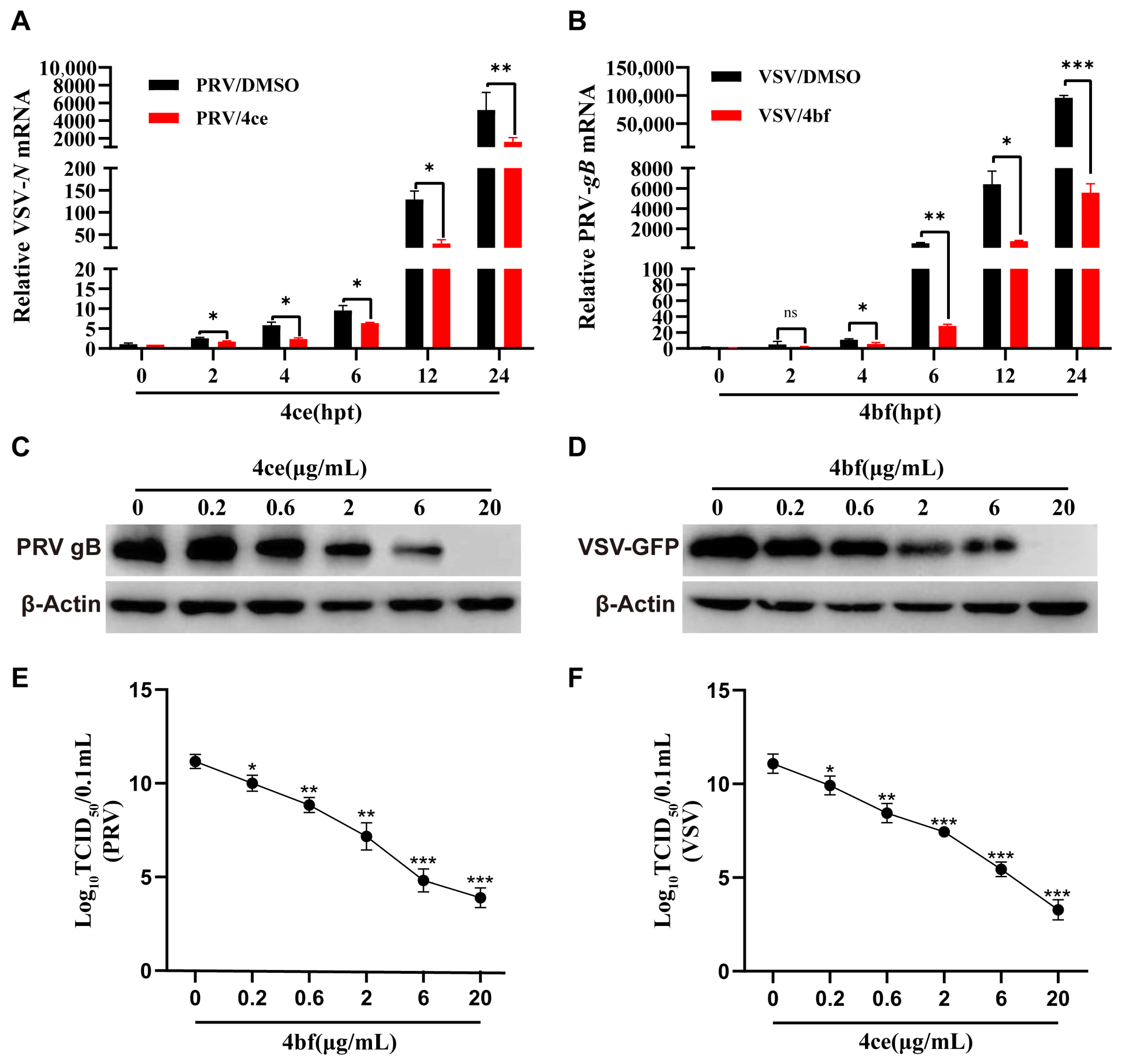
To assess antiviral activity at the transcriptional level, the mRNA levels of PRV-gB and VSV-N were measured by RT-qPCR. PK-15 cells were pretreated with 4bf or 4ce (6 μg/mL) and then infected with PRV-QXX or VSV-GFP (MOI = 0.01), respectively. The expression levels of PRV-gB and VSV-N in the control group increased over time, whereas treatment with 4bf markedly reduced PRV-gB mRNA levels and treatment with 4ce significantly decreased VSV-N mRNA levels (Figure 3). The effect of the compounds on progeny virus production was further evaluated using the TCID50 assay. Increasing concentrations of 4bf and 4ce resulted in a clear reduction in PRV and VSV titers, respectively (Figure 3). Viral protein expression was further analyzed by Western blot. The levels of PRV gB and VSV GFP proteins decreased with increasing concentrations of 4bf and 4ce (Figure 3). These results indicate that 4bf inhibits PRV replication, whereas 4ce suppresses VSV replication in vitro.

3.2.5. In Vivo Safety Evaluation and Antiviral Activity of Compound 4bf

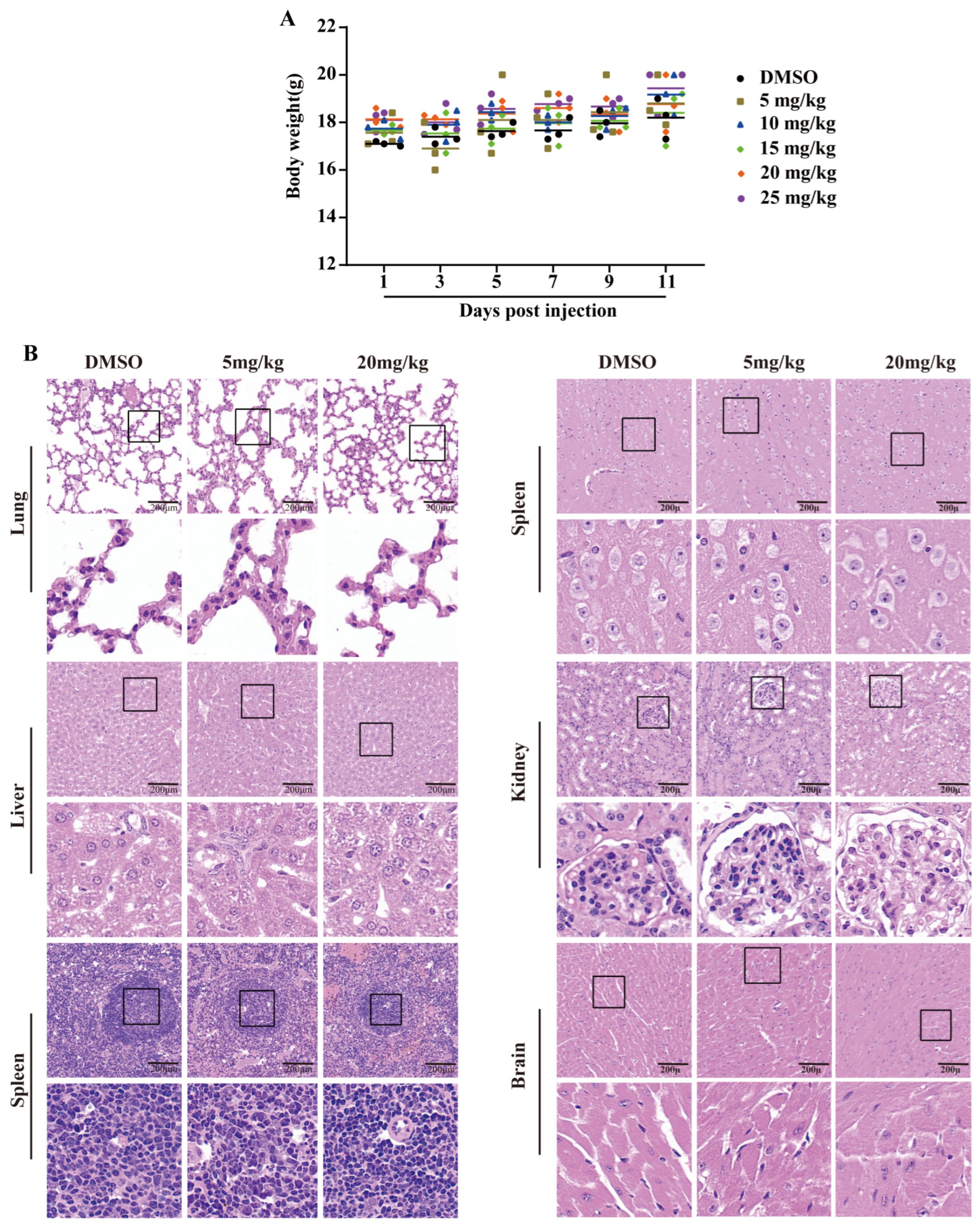
To assess the in vivo safety of 4bf, mice received intraperitoneal injections of 4bf at 0, 5, 10, 15, 20, or 25 mg/kg on days 1, 3, 5, 7, 9, and 11, and body weight was monitored (Figure 4). Body weight gradually increased over time in all groups, with no significant differences compared with the control group. Histological analysis of major organs was conducted using H&E staining. Mice were sacrificed on day 12, and heart, liver, spleen, lung, kidney, and brain tissues were collected (Figure 4). No obvious histopathological abnormalities or tissue damage were observed at doses of 5 mg/kg and 20 mg/kg.
The antiviral efficacy of 4bf against PRV infection was then evaluated. Mice received 20 mg/kg 4bf intraperitoneally, followed by intranasal infection with PRV-QXX (5 × 10³ TCID50 per mouse). Survival was monitored continuously (Figure 5). All the mice in the PRV group succumbed, whereas 60% of the mice in the PRV + 4bf group survived. Lung tissues were collected on day 7 post-infection for H&E staining (Figure 5). Compared with the DMSO group, mice treated with 4bf showed markedly reduced inflammatory cell infiltration and tissue damage.

4. Discussion

DHPM derivatives have been widely studied because of their diverse biological activities and modifiable scaffold. In this study, we synthesized a series of DHPM derivatives and evaluated their antiviral activity against PRV and VSV. Several compounds showed inhibitory effects on viral infection, among which 4bf, 4ce, and 4be displayed relatively high selectivity indices. These results indicate that modification of the DHPM scaffold can improve antiviral activity.
The preliminary structure–activity relationship showed that antiviral activity was affected by both the aromatic substituents and the N-substitution pattern of the DHPM scaffold. Methoxy-containing compounds showed relatively good activity, especially against VSV. For example, 4ae, 4be, and 4ce had high SI values against VSV, while 4bf showed the strongest activity against PRV. This suggests that methoxy substitution may be beneficial for antiviral activity. The N-substitution pattern also influenced antiviral potency and selectivity. Compound 4aa showed strong anti-PRV activity, whereas its N-methyl analogue 4ba showed markedly reduced activity, indicating that N-methylation is not always favorable. However, in some substituted aromatic systems, N-methyl or N-benzyl substitution improved antiviral activity, as observed for 4bf and 4ce. Halogenated compounds also showed different activity profiles against PRV and VSV. For example, the brominated compound 4al showed strong activity against VSV but weak activity against PRV, while some chlorinated compounds, such as 4ci and 4bi, showed improved activity against PRV or VSV. By contrast, compounds with multiple hydroxyl groups did not consistently show enhanced activity. These results indicate that methoxy substitution, halogen substitution, and suitable N-substitution are important factors affecting the antiviral activity of DHPM derivatives.
Further antiviral assays showed that the active compounds inhibited viral replication, reduced viral titers, and decreased viral protein expression and gene transcription. These results indicate that their antiviral effects are related to the inhibition of viral replication. Among these compounds, 4bf was further evaluated in vivo. Compound 4bf reduced PRV-induced pulmonary inflammation and tissue damage and improved the survival of infected mice, without obvious effects on normal growth. These results support the antiviral activity of 4bf both in vitro and in vivo.
This study also has some limitations. First, although the antiviral activity of these DHPM derivatives was demonstrated, their exact antiviral targets and molecular mechanisms were not investigated. Further studies are needed to determine whether these compounds directly act on viral components or regulate host antiviral responses. Second, this study mainly focused on the preliminary evaluation of this class of compounds, and known antiviral drugs were not included as reference controls. In future studies, appropriate reference antiviral agents will be included for direct comparison to further evaluate the antiviral potential of DHPM derivatives.

5. Conclusions

In conclusion, a series of 3,4-dihydropyrimidin-2(1H)-one derivatives were synthesized through a one-pot Biginelli reaction and characterized by 1H NMR, 13C NMR, and high-resolution mass spectrometry. Antiviral evaluation showed that several compounds inhibited PRV and VSV infection, among which 4bf, 4ce, and 4be showed the most promising activity. Further experiments showed that these compounds inhibited viral replication, reduced viral titers, and decreased viral protein and gene expression. In vivo, compound 4bf alleviated PRV-induced lung injury and improved the survival of infected mice. These results indicate that DHPM derivatives, especially compound 4bf, may serve as promising scaffolds for the development of antiviral agents.

Author Contributions

Conceptualization: C.Y., L.-J.S. and S.-L.M.; investigation (synthesis assay): C.Y., R.-H.L., B.D. and Z.-C.L.; investigation (biological assay): C.Y., P.-X.L., H.-Y.Y., H.L. and H.W.; writing—review & editing: C.Y., Y.-Y.W., H.-P.L. and L.-J.S.; supervision: L.-J.S. and M.-D.W. All authors have read and agreed to the published version of the manuscript.

Funding

This work was financially supported by Henan key research and development program (261111110600, 241111110300), National Natural Science Foundation of China (32402849), the Department of Henan Science and Technology (252102110035), the Doctoral Research Initiation Fund of Henan University of Animal Husbandry and Economy (2022HNUAHEDF033), and Key Research Projects of Higher Education Institutions in Henan Province (25A150025).

Institutional Review Board Statement

The study was approved by the Animal Care and Use Committee of Henan Agricultural University, Approval Code: HNND2025010811, Approval Date: 8 January 2025.

Informed Consent Statement

Not applicable.

Data Availability Statement

The original contributions presented in this study are included in the article. Further inquiries can be directed to the corresponding authors.

Conflicts of Interest

The authors declare no conflicts of interest.

References

  1. Dehove, A.; Commault, J.; Petitclerc, M.; Teissier, M.; Mace, J. Economic analysis and costing of animal health: A literature review of methods and importance. Rev. Sci. Tech. 2013, 31, 2146. [Google Scholar] [CrossRef]
  2. Morens, D.M.; Fauci, A.S. Emerging infectious diseases: Threats to human health and global stability. PLoS Pathog. 2013, 9, 1003467. [Google Scholar] [CrossRef]
  3. Irfan Khan, M.; Saleh, A.A.; Ali, R.; Jan, R.U.; Gu, J.; Ji, D. The evolving mpox threat (2022–2024): Clade dynamics, immune evasion, and escalating global health challenges. Front. Cell. Infect. Microbiol. 2026, 15, 1677762. [Google Scholar] [CrossRef] [PubMed]
  4. Odan, M.; Ishizuka, N.; Hiramatsu, Y.; Inagaki, M.; Hashizume, H.; Fujii, Y.; Mitsumori, S.; Morioka, Y.; Soga, M.; Deguchi, M.; et al. Discovery of S-444823, a potent CB1/CB2 dual agonist as an antipruritic agent. Bioorg. Med. Chem. Lett. 2012, 22, 2898–2901. [Google Scholar] [CrossRef] [PubMed]
  5. Duffy, S. Why are RNA virus mutation rates so damn high? PLoS Biol. 2018, 16, 3000003. [Google Scholar] [CrossRef] [PubMed]
  6. Bedford, T.; Riley, S.; Barr, I.G.; Broor, S.; Chadha, M.; Cox, N.J.; Daniels, R.S.; Gunasekaran, C.P.; Hurt, A.C.; Kelso, A.; et al. Global circulation patterns of seasonal influenza viruses vary with antigenic drift. Nature 2015, 523, 217–220. [Google Scholar] [CrossRef]
  7. De Clercq, E.; Li, G. Approved Antiviral Drugs over the Past 50 Years. Clin. Microbiol. Rev. 2016, 29, 695–747. [Google Scholar] [CrossRef]
  8. Chan, J.F.; Yuan, S.; Chu, H.; Sridhar, S.; Yuen, K.Y. COVID-19 drug discovery and treatment options. Nat. Rev. Microbiol. 2024, 22, 391–407. [Google Scholar] [CrossRef] [PubMed]
  9. Kappe, C.O. Recent advances in the Biginelli dihydropyrimidine synthesis. New tricks from an old dog. Acc. Chem. Res. 2000, 33, 879–888. [Google Scholar] [CrossRef]
  10. Mohammadi, B.; Behbahani, F.K. Recent developments in the synthesis and applications of dihydropyrimidin-2(1H)-ones and thiones. Mol. Divers. 2018, 22, 405–446. [Google Scholar] [CrossRef]
  11. Bosica, G.; Cachia, F.; De Nittis, R.; Mariotti, N. Efficient One-Pot Synthesis of 3,4-Dihydropyrimidin-2(1H)-ones via a Three-Component Biginelli Reaction. Molecules 2021, 26, 3753. [Google Scholar] [CrossRef]
  12. Yu, C.; Li, G.; Jiang, S.; Sun, F.; Wang, R.; Yu, X.; Yang, L. GALNTs in cancer: Driving tumor progression and opening a new therapeutic frontier. TransMed 2026, 1, 100011. [Google Scholar] [CrossRef]
  13. Matos, L.H.S.; Masson, F.T.; Simeoni, L.A.; Homem-de-Mello, M. Biological activity of dihydropyrimidinone (DHPM) derivatives: A systematic review. Eur. J. Med. Chem. 2018, 143, 1779–1789. [Google Scholar] [CrossRef]
  14. Parth; Kaur, H.; Persoons, L.; Andrei, G.; Singh, K. Quinoline-Dihydropyrimidin-2(1H)-one Hybrids: Synthesis, Biological Activity, and Mechanistic Studies. ChemMedChem 2022, 17, e202200031. [Google Scholar] [CrossRef]
  15. Kong, R.; Han, S.B.; Wei, J.Y.; Peng, X.C.; Xie, Z.B.; Gong, S.S.; Sun, Q. Highly Efficient Synthesis of Substituted 3,4-Dihydropyrimidin-2-(1H)-ones (DHPMs) Catalyzed by Hf(OTf)4: Mechanistic Insights into Reaction Pathways under Metal Lewis Acid Catalysis and Solvent-Free Conditions. Molecules 2019, 24, 364. [Google Scholar] [CrossRef]
  16. Ravera, M.; Moreno-Viguri, E.; Paucar, R.; Pérez-Silanes, S.; Gabano, E. Organometallic compounds in the discovery of new agents against kinetoplastid-caused diseases. Eur. J. Med. Chem. 2018, 155, 459–482. [Google Scholar] [CrossRef]
  17. Zheng, Y.; Li, S.; Song, K.; Ye, J.; Li, W.; Zhong, Y.; Feng, Z.; Liang, S.; Cai, Z.; Xu, K. A Broad Antiviral Strategy: Inhibitors of Human DHODH Pave the Way for Host-Targeting Antivirals against Emerging and Re-Emerging Viruses. Viruses 2022, 14, 928. [Google Scholar] [CrossRef] [PubMed]
  18. Hoffmann, H.H.; Kunz, A.; Simon, V.A.; Palese, P.; Shaw, M.L. Broad-spectrum antiviral that interferes with de novo pyrimidine biosynthesis. Proc. Natl. Acad. Sci. USA 2011, 108, 5777–5782. [Google Scholar] [CrossRef] [PubMed]
  19. Wang, Y.; Zheng, M.; Zhang, Y.; Xue, Y.; Long, S.; Wang, C.; Sun, Q.; Yan, J.; Shi, Y.; Yang, B.; et al. Single-Cell Transcriptomic Analysis of the Immune Response to COVID-19 and Tuberculosis Coinfection. Exploration 2025, 5, 22. [Google Scholar] [CrossRef] [PubMed]
  20. Bais, J.; Benedetti, F.; Berti, F.; Cerminara, I.; Drioli, S.; Funicello, M.; Regini, G.; Vidali, M.; Felluga, F. One Pot Synthesis of Micromolar BACE-1 Inhibitors Based on the Dihydropyrimidinone Scaffold and Their Thia and Imino Analogues. Molecules 2020, 25, 4152. [Google Scholar] [CrossRef]
  21. Mayer, T.U.; Kapoor, T.M.; Haggarty, S.J.; King, R.W.; Schreiber, S.L.; Mitchison, T.J. Small molecule inhibitor of mitotic spindle bipolarity identified in a phenotype-based screen. Science 1999, 286, 971–974. [Google Scholar] [CrossRef] [PubMed]
  22. Kapoor, T.M.; Mayer, T.U.; Coughlin, M.L.; Mitchison, T.J. Probing spindle assembly mechanisms with monastrol, a small molecule inhibitor of the mitotic kinesin, Eg5. J. Cell Biol. 2000, 150, 975–988. [Google Scholar] [CrossRef]
  23. Grover, G.J.; Dzwonczyk, S.; McMullen, D.M.; Normandin, D.E.; Parham, C.S.; Sleph, P.G.; Moreland, S. Pharmacologic profile of the dihydropyrimidine calcium channel blockers SQ 32,547 and SQ 32,926 [correction of SQ 32,946]. J. Cardiovasc. Pharmacol. 1995, 26, 289–294. [Google Scholar] [CrossRef]
  24. Figueiró, F.; Mendes, F.B.; Corbelini, P.F.; Janarelli, F.; Jandrey, E.H.; Russowsky, D.; Eifler-Lima, V.L.; Battastini, A.M. A monastrol-derived compound, LaSOM 63, inhibits ecto-5’nucleotidase/CD73 activity and induces apoptotic cell death of glioma cell lines. Anticancer Res. 2014, 34, 1837–1842. [Google Scholar]
  25. Liang, Q.; Gou, H.H.; Chen, L.P.; He, C.X.; Wu, C.J.; Peng, W. “Food & medicine homology” medicines and their formulas: A versatile approach for the management of lipid metabolic disorders related diseases. Food Med. Homol. 2026, 3, 9420130. [Google Scholar] [CrossRef]
  26. Hasegawa, T.; Ito, H.; Shoin, K.; Kogure, Y.; Kubota, T.; Yamamoto, S. Diagnosis of an “isodense” pituitary microadenoma by dynamic CT scanning. Case report. J. Neurosurg. 1984, 60, 424–427. [Google Scholar] [CrossRef]
  27. Graci, J.D.; Cameron, C.E. Mechanisms of action of ribavirin against distinct viruses. Rev. Med. Virol. 2006, 16, 37–48. [Google Scholar] [CrossRef] [PubMed]
  28. Kumarasamy, D.; Roy, B.G.; Rocha-Pereira, J.; Neyts, J.; Nanjappan, S.; Maity, S.; Mookerjee, M.; Naesens, L. Synthesis and in vitro antiviral evaluation of 4-substituted 3,4-dihydropyrimidinones. Bioorg. Med. Chem. Lett. 2017, 27, 139–142. [Google Scholar] [CrossRef]
  29. Sikic, K.; Carugo, O. Protein sequence redundancy reduction: Comparison of various method. Bioinformation 2010, 5, 234–239. [Google Scholar] [CrossRef] [PubMed]
  30. Pomeranz, L.E.; Reynolds, A.E.; Hengartner, C.J. Molecular biology of pseudorabies virus: Impact on neurovirology and veterinary medicine. Microbiol. Mol. Biol. Rev. 2005, 69, 462–500. [Google Scholar] [CrossRef]
  31. O’Brien, A.P.; Hurley, J.; Linsley, P.; McNeil, K.A.; Fletcher, R.; Aitken, J.R. Men’s Preconception Health: A Primary Health-Care Viewpoint. Am. J. Men’s Health 2018, 12, 1575–1581. [Google Scholar] [CrossRef] [PubMed]
  32. Fierro, B.; La Bua, V.; Oliveri, M.; Daniele, O.; Brighina, F. Prognostic value of somatosensory evoked potentials in stroke. Electromyogr. Clin. Neurophysiol. 1999, 39, 155–160. [Google Scholar]
  33. Goodship, T.H.; Liszewski, M.K.; Kemp, E.J.; Richards, A.; Atkinson, J.P. Mutations in CD46, a complement regulatory protein, predispose to atypical HUS. Trends Mol. Med. 2004, 10, 226–231. [Google Scholar] [CrossRef] [PubMed]
  34. Shao, M.; Zhang, X.; Sun, J.; Dong, H.; Han, X.; Yang, Q.; Chen, R.; Shen, L.; Xu, L.; Wang, L.; et al. Saikosaponin b1 Attenuates Liver Fibrosis by Blocking STAT3/Gli1 Interaction and Inducing Gli1 Degradation. Exploration 2025, 5, 70000. [Google Scholar] [CrossRef] [PubMed]
Figure 1. Representative biologically active DHPM derivatives.
Microorganisms 14 01220 g001
Figure 2. Design strategy of the target compounds.
Microorganisms 14 01220 g002
Figure 3. qRT-PCR, TCID50 assay, and Western blot analysis were performed to evaluate the antiviral activity of the compounds. (A,B) PK-15 cells were infected with PRV or VSV and treated with 4bf or 4ce (6 μg/mL), respectively. PRV-gB and VSV-N mRNA levels were measured by RT-qPCR. (C,D) Progeny virus titers were determined by the TCID50 assay. (E,F) PRV-gB and VSV-GFP protein levels were detected by Western blot, with β-actin as the loading control. * p < 0.05, ** p < 0.01, *** p < 0.001; ns, not significant.
Microorganisms 14 01220 g003
Figure 4. In vivo safety evaluation of 4bf in C57BL/6 mice. (A) C57BL/6 mice (n = 3 per group) were intraperitoneally administered 4bf at 0, 5, 10, 15, 20, or 25 mg/kg on days 1, 3, 5, 7, 9, and 11. Body weight was monitored throughout the experiment. No significant differences in body weight gain were observed among groups within the 0–25 mg/kg range. (B) On day 12, major organs (heart, liver, spleen, lung, kidney, and brain) were collected for H&E staining. No obvious histopathological alterations were observed in the 5 or 20 mg/kg groups compared with the DMSO control, indicating no apparent organ toxicity within the tested dose range.
Microorganisms 14 01220 g004
Figure 5. Protective effect of 4bf against PRV infection in mice. (A) Mice were intraperitoneally administered 4bf (20 mg/kg) and then infected with PRV-QXX (3 × 10³ TCID50 per mouse). Survival was monitored throughout the experiment. (B) The PRV + 4bf group showed a survival rate of 60%, whereas all mice in the PRV group died. (C) At day 7 post-infection, lung tissues were collected for H&E staining. Compared with the DMSO group, mice treated with 4bf showed reduced inflammatory cell infiltration and milder lung tissue damage. *** p < 0.001.
Microorganisms 14 01220 g005
Table 2. Primers used for gene cloning and RT-qPCR analysis.
NameSequence (5′-3′)
Q-Sus-β-actin-FCTGAACCCCAAAGCCAACCGT
Q-Sus-β-actin-RTTCTCCTTGATGTCCCGCACG
Q-Sus-PRV-gB-FGGCATCGCCAACTTCTTCC
Q-Sus-PRV-gB-RCCTCGTCCACGTCGTCCTC
Q-Sus-VSV-N-FTGATAGTACCGGAGGATTGACGAC
Q-Sus-VSV-N-RCCTTGCAGTGACATGACTGCTCTT
Table 3. CC50, IC50 and SI of compounds.
CompoundsCC50 (μg/mL)PRVVSV
IC50 (μg/mL)SIIC50 (μg/mL)SI
4aa67.370.54124.7316.094.18
4ab224.815.9714.085.1243.88
4ac75.351.9438.8010.497.18
4ad44.730.33133.48139.20.32
4ae182.810.4317.531.49122.2
4af67.3552.051.298.348.07
4ag165.818.898.7725.286.55
4ah85.1322.083.8564.381.32
4ai86.859.279.3633.462.59
4aj9012.866.9940.982.19
4ak177.617.2210.3110.2617.31
4al7511.176.710.41182.9
4am91.788.6810.564.9218.64
4ba65.5043.161.514.5714.31
4bb150.799.811.516.9621.64
4bc175.76.6126.5717.5210.02
4bd280.043.846.38>1000.09
4be190.91.53124.21.05181.1
4bf270.01.11243.04.1465.08
4bg81.1342.711.895940.13
4bh167.9>1001.59>1000.59
4bi94.1915.246.181.0787.70
4bj89.968.1511.0348.251.86
4bk68.3613.694.99>1000.66
4bl135.46.5020.829.6014.09
4ca68.262.9023.516.7810.06
4cb65.6312.395.291.5642.01
4cc31.100.8138.224.626.72
4cd9.360.9110.2311.380.82
4ce147.194.501.550.74196.4
4cf40.260.8646.460.6958.07
4cg74.6924.813.010.67110.8
4ch42.230.5279.844020.10
4ci18.960.17108.40.5932
4cj188.239.144.803.6851.05
4cm125.22.5648.751.5480.95
4aa67.370.54124.7316.094.18
4ab224.815.9714.085.1243.88
4ac75.351.9438.8010.497.18
4ad44.730.33133.48>1000.32
4ae182.810.4317.531.49122.2
4af67.3552.051.298.348.07
Disclaimer/Publisher’s Note: The statements, opinions and data contained in all publications are solely those of the individual author(s) and contributor(s) and not of MDPI and/or the editor(s). MDPI and/or the editor(s) disclaim responsibility for any injury to people or property resulting from any ideas, methods, instructions or products referred to in the content.