Cofactor Engineering Strategy of Food-Grade Microorganisms: Redox Homeostasis Regulation and Functional Components Biofortification

 , , and
Abstract
1. Introduction
- (1)
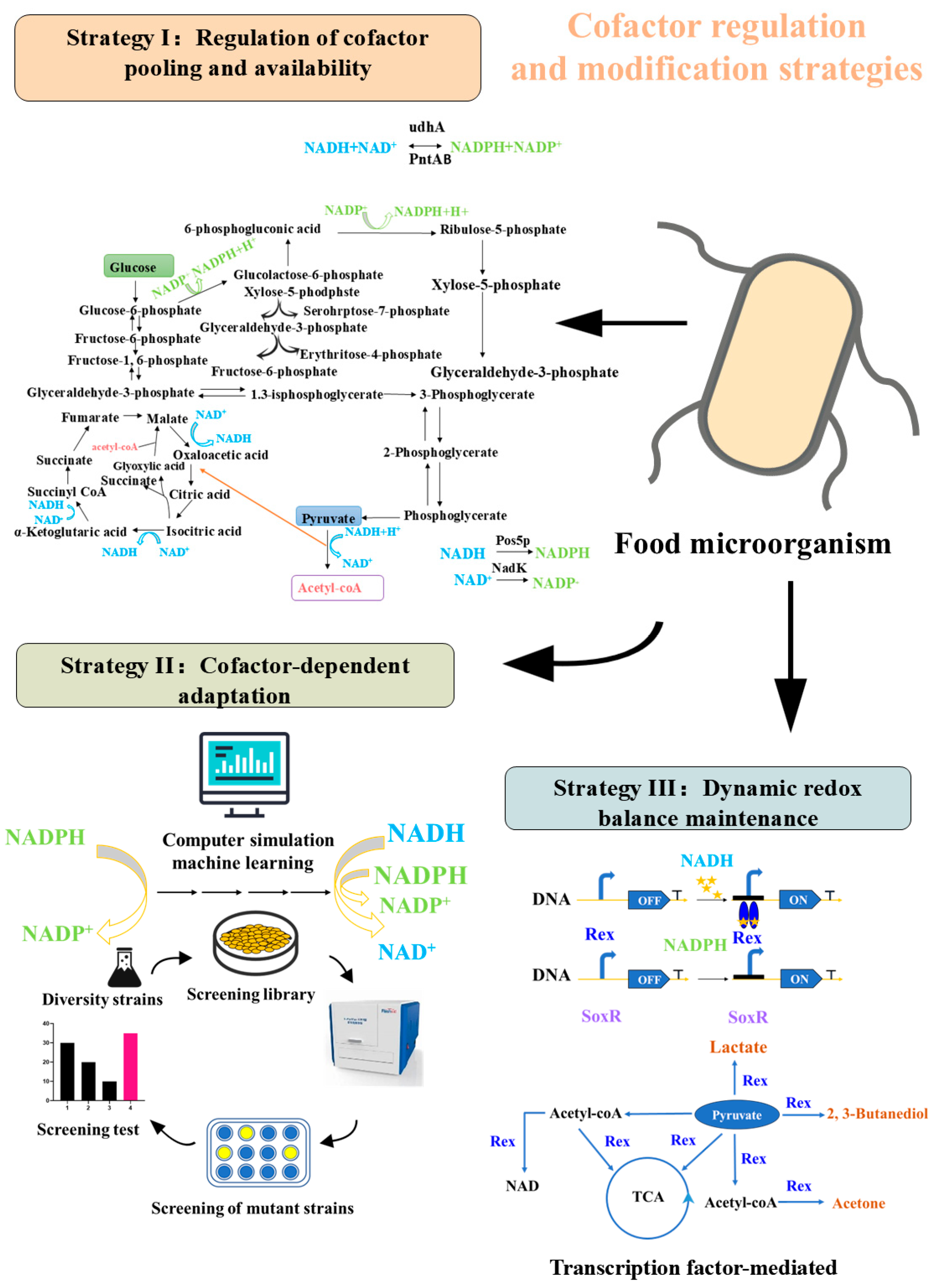
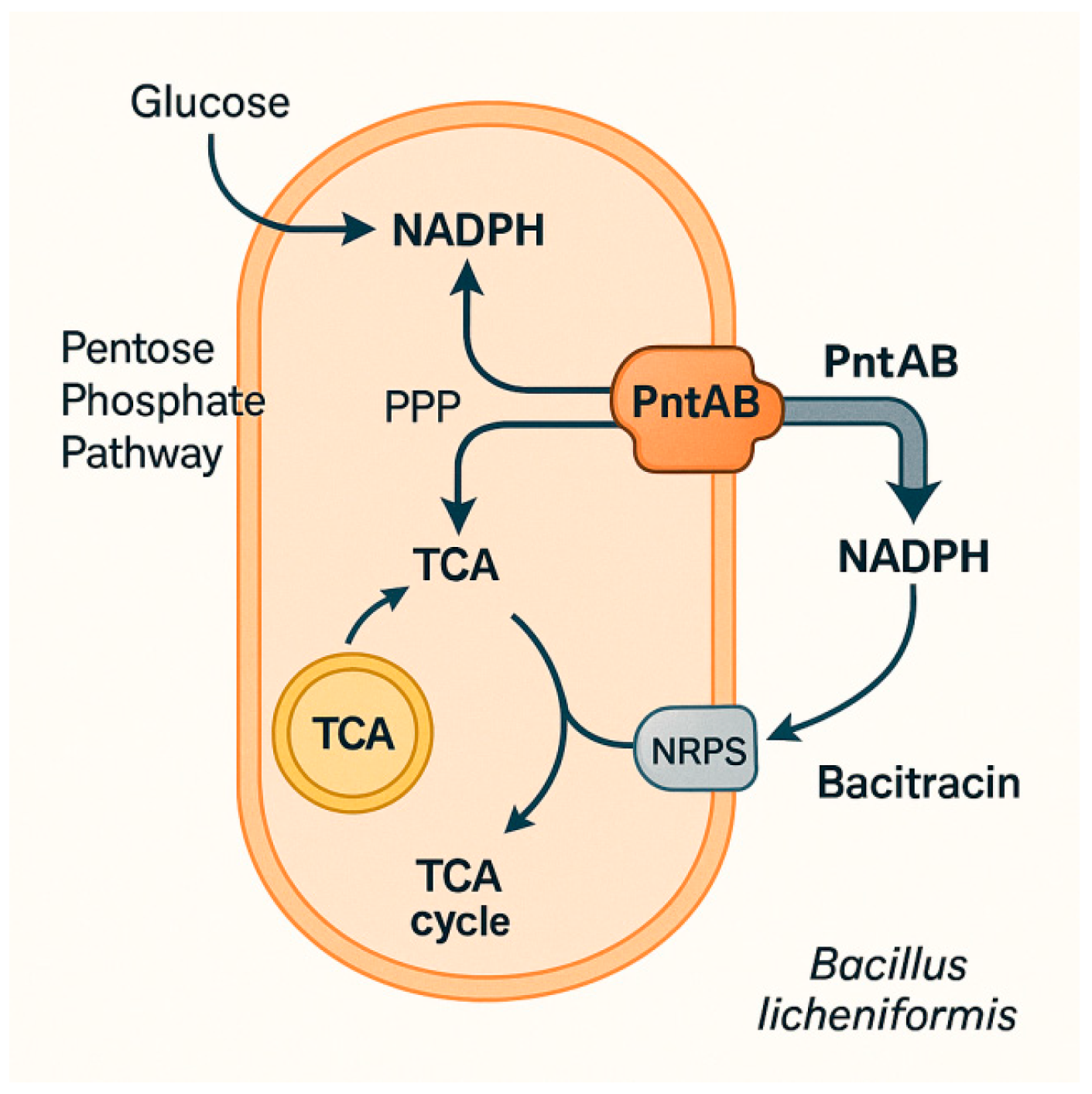
- Regulation of cofactor pooling and availability (Strategy I): Optimizing the biosynthetic efficiency of high-value food functional ingredients involves knocking out non-essential metabolic pathways and enhancing the pentose phosphate pathway (PPP) to increase NADPH supply. Additionally, pyridine nucleotide transhydrogenase (PNT) can be utilized to mediate the interconversion of NAD(P)H.
- (2)
- Cofactor-dependent changes in enzymes (Strategy II): Rational design of key enzymes in the synthetic pathway or the development of food-compatible cofactor analogs to precisely match the biosynthetic requirements of the target product.
- (3)
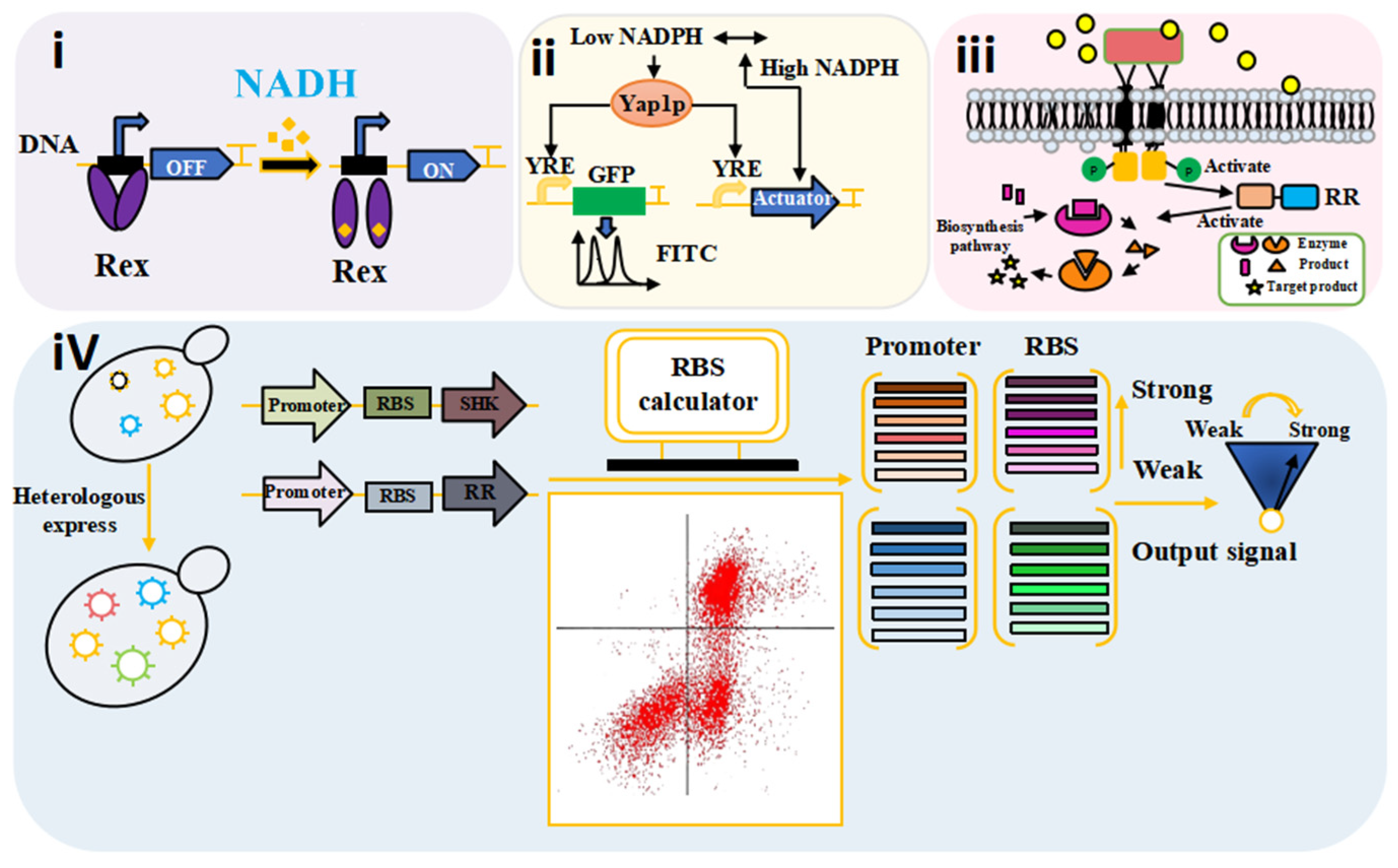
- Dynamic redox balance maintenance (Strategy III): Based on redox-responsive components, adaptive regulatory circuits are constructed for food microorganisms to achieve real-time maintenance of NAD(P)H homeostasis during fermentation, thus ensuring efficient synthesis of key substances.

2. Targeted Regulation of the Cofactor Pool
2.1. Competitive Pathways for Cofactor Knockout
2.2. Introduction of Cofactor Regeneration Reaction

| Enzymes | Host Bacteria | Cofactor | Target Products | Productivity | Reference |
|---|---|---|---|---|---|
| FDH | Lactiplantibacillus plantarum | NAD+/NADH | benzoic acid | Production increased by 130.0% | [9] |
| NOX | Lacticaseibacillus casei | NAD+/NADH | Exopolysaccharide | Production increased by 46.0% | [12] |
| - | NAD+/NADH | Shift in fermentation | Lactic acid fermentation to mixed acid fermentation | [11] | |
| G6PD | Saccharomyces boulardii | NADP+/NADPH | Antimicrobial peptides | Production increased by 28.30% | [13] |
| ME | - | NADP+/NADPH | - | Inhibition of lipid peroxidation in fermented sausages | [14] |
| GDH | - | NADP+/NADPH | - | Reducing the accumulation of off-flavors in fermented meat | [15] |
| ADH | Saccharomyces cerevisiae | NADP+/NADPH | limonene | - | [16] |
2.3. PNT Mediates the Conversion of NAD to NADP
3. Cofactor-Dependent Molecular Remodelling
3.1. Alternation of Cofactor Preference Through Enzyme Modification
3.2. Utilization of Artificial Cofactor Analogues
4. Dynamic Equilibrium of Cofactor Metabolic Networks
4.1. Fine-Tuning of Redox-Related Transcription Regulators
4.2. Gene-Encoded Biosensors Precisely Regulate Cofactors
5. Discussion and Conclusions
Author Contributions
Funding
Institutional Review Board Statement
Informed Consent Statement
Data Availability Statement
Conflicts of Interest
Abbreviations
| NAD | Nicotinamide adenine dinucleotide |
| NADP | Nicotinamide adenine dinucleotide phosphate |
| TCA | Tricarboxylic acid cycle |
| PPP | Pentose phosphate pathway |
| LDH | Lactate dehydrogenase |
| PNT | Pyridine nucleotide transhydrogenase |
| PDH | Pyruvate dehydrogenase |
| EPS | Exopolysaccharides |
| FDH | Formate dehydrogenase |
| NOX | NADH oxidase |
| G6PD | Glucose-6-phosphate dehydrogenase |
| ME | Malic enzyme |
| GDH | Glutamate dehydrogenase |
| ADH | Alcohol dehydrogenase |
| NFCD | Nicotinamide fluorocytidine dinucleotide |
| Rex | Redox-sensing transcriptional repressor |
| ndh | NADH dehydrogenase |
| DSG | Dose-sensitive gene |
| CSR-SALAD | Cofactor Specificity Reversal-Structural Analysis and Library Automated Design |
References
- Alegre, G.F.S.; Pastore, G.M. The emerging importance of NAD+ metabolome for nutrition and food sciences: A bibliometric analysis. Food Biosci. 2023, 56, 103126. [Google Scholar] [CrossRef]
- Chen, L.; Xing, X.; Zhang, P.; Chen, L.; Pei, H. Homeostatic regulation of NAD(H) and NADP(H) in cells. Genes Dis. 2024, 11, 101146. [Google Scholar] [CrossRef]
- Wang, S.; Jiang, W.; Jin, X.; Qi, Q.; Liang, Q. Genetically encoded ATP and NAD(P)H biosensors: Potential tools in metabolic engineering. Crit. Rev. Biotechnol. 2023, 43, 1211–1225. [Google Scholar] [CrossRef]
- Cui, Z.; Zheng, M.; Ding, M.; Dai, W.; Wang, Z.; Chen, T. Efficient production of acetoin from lactate by engineered Escherichia coli whole-cell biocatalyst. Appl. Microbiol. Biotechnol. 2023, 107, 3911–3924. [Google Scholar] [CrossRef] [PubMed]
- Dai, K.; Miao, Y.; Qu, C.; Wang, C.; Fu, H.; Wang, J. Adaptive laboratory evolution of Thermoanaerobacterium aotearoense for enhanced ethanol production from raw cassava starch. Renew. Energy 2024, 233, 121179. [Google Scholar] [CrossRef]
- Iorizzo, M.; Paventi, G.; Di Martino, C. Biosynthesis of gamma-aminobutyric acid (GABA) by Lactiplantibacillus plantarum in fermented food production. Curr. Issues Mol. Biol. 2023, 46, 200–220. [Google Scholar] [CrossRef] [PubMed]
- Sundararaman, A.; Halami, P.M. Genome editing of probiotic bacteria: Present status and future prospects. Biologia 2022, 77, 1831–1841. [Google Scholar] [CrossRef]
- Garrigues, C.; Goupil-Feuillerat, N.; Cocaign-Bousquet, M.; Renault, P.; Lindley, N.D.; Loubiere, P. Glucose metabolism and regulation of glycolysis in Lactococcus lactis strains with decreased lactate dehydrogenase activity. Metab. Eng. 2001, 3, 211–217. [Google Scholar] [CrossRef]
- Luo, Z.W.; Lee, S.Y. Metabolic engineering of Escherichia coli for the production of benzoic acid from glucose. Metab. Eng. 2020, 62, 298–311. [Google Scholar] [CrossRef]
- Gao, H.; Li, J.; Sivakumar, D.; Kim, T.S.; Patel, S.K.; Kalia, V.C.; Lee, J.K. NADH oxidase from Lactobacillus reuteri: A versatile enzyme for oxidized cofactor regeneration. Int. J. Biol. Macromol. 2019, 123, 629–636. [Google Scholar] [CrossRef]
- Yang, R.; Yang, C.; Ma, L.; Zhao, Y.; Guo, Z.; Niu, J.; Li, B. Identification of purine biosynthesis as an NADH-sensing pathway to mediate energy stress. Nat. Commun. 2022, 13, 7031. [Google Scholar] [CrossRef]
- Li, N.; Wang, Y.; Zhu, P.; Liu, Z.; Guo, B.; Ren, J. Improvement of exopolysaccharide production in Lactobacillus casei LC2W by overexpression of NADH oxidase gene. Microbiol. Res. 2015, 171, 73–77. [Google Scholar] [CrossRef]
- Pereira, P.R.; Freitas, C.S.; Paschoalin, V.M. Saccharomyces cerevisiae biomass as a source of next-generation food preservatives: Evaluating potential proteins as a source of antimicrobial peptides. Compr. Rev. Food Sci. Food Saf. 2021, 20, 4450–4479. [Google Scholar] [CrossRef]
- Feng, T.; Wang, J. Oxidative stress tolerance and antioxidant capacity of lactic acid bacteria as probiotic: A systematic review. Gut Microbes 2020, 12, 1801944. [Google Scholar] [CrossRef]
- Qiu, Y.; Liu, W.; Wu, M.; Bao, H.; Sun, X.; Dou, Q.; Shen, Y. Construction of an alternative NADPH regeneration pathway improves ethanol production in Saccharomyces cerevisiae with xylose metabolic pathway. Synth. Syst. Biotechnol. 2024, 9, 269–276. [Google Scholar] [CrossRef]
- Jiang, Z.; Xu, C.; Wang, L.; Hong, K.; Ma, C.; Lv, C. Potential enzymes involved in beer monoterpenoids transformation: Structures, functions and challenges. Crit. Rev. Food Sci. Nutr. 2023, 63, 2082–2092. [Google Scholar] [CrossRef] [PubMed]
- Huang, L.; Sui, L.; Yao, Y.; Ma, Y.; Zhou, J.; Zhang, B.; Zheng, Y. Enhancing D-pantothenate production in Escherichia coli through multiplex combinatorial strategies. Bioprocess Biosyst. Eng. 2025, 48, 247–260. [Google Scholar] [CrossRef]
- Zhu, S.; Cai, D.; Liu, Z.; Zhang, B.; Li, J.; Chen, S.; Ma, X. Enhancement of bacitracin production by NADPH generation via overexpressing glucose-6-phosphate dehydrogenase Zwf in Bacillus licheniformis. Appl. Biochem. Biotechnol. 2019, 187, 1502–1514. [Google Scholar] [CrossRef] [PubMed]
- Liu, S.; Skory, C.; Liang, X.; Mills, D.; Qureshi, N. Increased ethanol tolerance associated with the pntAB locus of Oenococcus oeni and Lactobacillus buchneri. J. Ind. Microbiol. Biotechnol. 2019, 46, 1547–1556. [Google Scholar] [CrossRef] [PubMed]
- Sun, Y.; Zhang, T.; Lu, B.; Li, X.; Jiang, L. Application of cofactors in the regulation of microbial metabolism: A state of the art review. Front. Microbiol. 2023, 14, 1145784. [Google Scholar] [CrossRef]
- Chen, R.; Gao, J.; Yu, W.; Chen, X.; Zhai, X.; Chen, Y.; Zhou, Y.J. Engineering cofactor supply and recycling to drive phenolic acid biosynthesis in yeast. Nat. Chem. Biol. 2022, 18, 520–529. [Google Scholar] [CrossRef] [PubMed]
- Movahedi, A.; Aghaei-Dargiri, S.; Li, H.; Zhuge, Q.; Sun, W. CRISPR variants for gene editing in plants: Biosafety risks and future directions. Int. J. Mol. Sci. 2023, 24, 16241. [Google Scholar] [CrossRef] [PubMed]
- King, E.; Maxel, S.; Li, H. Engineering natural and noncanonical nicotinamide cofactor-dependent enzymes: Design principles and technology development. Curr. Opin. Biotechnol. 2020, 66, 217–226. [Google Scholar] [CrossRef] [PubMed]
- Meng, H.; Liu, P.; Sun, H.; Cai, Z.; Zhou, J.; Lin, J.; Li, Y. Engineering a d-lactate dehydrogenase that can super-efficiently utilize NADPH and NADH as cofactors. Sci. Rep. 2016, 6, 24887. [Google Scholar] [CrossRef]
- Ji, D.; Wang, L.; Hou, S.; Liu, W.; Wang, J.; Wang, Q.; Zhao, Z.K. Creation of bioorthogonal redox systems depending on nicotinamide flucytosine dinucleotide. J. Am. Chem. Soc. 2011, 133, 20857–20862. [Google Scholar] [CrossRef]
- Knaus, T.; Paul, C.E.; Levy, C.W.; De Vries, S.; Mutti, F.G.; Hollmann, F.; Scrutton, N.S. Better than nature: Nicotinamide biomimetics that outperform natural coenzymes. J. Am. Chem. Soc. 2016, 138, 1033–1039. [Google Scholar] [CrossRef]
- Ding, N.; Yuan, Z.; Sun, L.; Yin, L. Dynamic and static regulation of nicotinamide adenine dinucleotide phosphate: Strategies, challenges, and future directions in metabolic engineering. Molecules 2024, 29, 3687. [Google Scholar] [CrossRef]
- Jeong, K.H.; Lee, H.J.; Park, Y.W.; Lee, J.Y. Structural basis of redox-sensing transcriptional repressor rex with cofactor NAD+ and operator DNA. Int. J. Mol. Sci. 2022, 23, 1578. [Google Scholar] [CrossRef]
- Bolbat, A.; Schultz, C. Recent developments of genetically encoded optical sensors for cell biology. Biol. Cell 2017, 109, 1–23. [Google Scholar] [CrossRef]
- Tribelli, P.M.; Lujan, A.M.; Pardo, A.; Ibarra, J.G.; Fernandez Do Porto, D.; Smania, A.; López, N.I. Core regulon of the global anaerobic regulator Anr targets central metabolism functions in Pseudomonas species. Sci. Rep. 2019, 9, 9065. [Google Scholar] [CrossRef]
- Durand, S.; Guillier, M. Transcriptional and post-transcriptional control of the nitrate respiration in bacteria. Front. Mol. Biosci. 2021, 8, 667758. [Google Scholar] [CrossRef]
- Reynolds, T.S.; Courtney, C.M.; Erickson, K.E.; Wolfe, L.M.; Chatterjee, A.; Nagpal, P.; Gill, R.T. ROS mediated selection for increased NADPH availability in Escherichia coli. Biotechnol. Bioeng. 2017, 114, 2685–2689. [Google Scholar] [CrossRef]
- Siedler, S.; Schendzielorz, G.; Binder, S.; Eggeling, L.; Bringer, S.; Bott, M. SoxR as a single-cell biosensor for NADPH-consuming enzymes in Escherichia coli. ACS Synth. Biol. 2014, 3, 41–47. [Google Scholar] [CrossRef] [PubMed]
- Zhang, J.; Sonnenschein, N.; Pihl, T.P.; Pedersen, K.R.; Jensen, M.K.; Keasling, J.D. Engineering an NADPH/NADP+ redox biosensor in yeast. ACS Synth. Biol. 2016, 5, 1546–1556. [Google Scholar] [CrossRef] [PubMed]
- Lovato, F.L.; Teixeira da Rocha, J.B.; Dalla Corte, C.L. Diphenyl diselenide protects against methylmercury-induced toxicity in Saccharomyces cerevisiae via the Yap1 transcription factor. Chem. Res. Toxicol. 2017, 30, 1134–1144. [Google Scholar] [CrossRef]
- Choi, J.E.; Heo, S.H.; Chung, W.H. Yap1-mediated Flr1 expression reveals crosstalk between oxidative stress signaling and caffeine resistance in Saccharomyces cerevisiae. Front. Microbiol. 2022, 13, 1026780. [Google Scholar] [CrossRef]
- Liu, C.G.; Li, K.; Li, K.Y.; Sakdaronnarong, C.; Mehmod, M.A.; Zhao, X.Q.; Bai, F.W. Intracellular redox perturbation in Saccharomyces cerevisiae improved furfural tolerance and enhanced cellulosic bioethanol production. Front. Bioeng. Biotechnol. 2020, 8, 615. [Google Scholar] [CrossRef] [PubMed]
- Borlinghaus, N.; Nestl, B.M. Switching the cofactor specificity of an imine reductase. ChemCatChem 2018, 10, 183–187. [Google Scholar] [CrossRef]
- Ma, W.; Li, F.; Li, L.; Li, B.; Niu, K.; Liu, Q.; Fang, X. Production of D-tagatose, bioethanol, and microbial protein from the dairy industry by-product whey powder using an integrated bioprocess. Biotechnol. J. 2024, 19, 2300415. [Google Scholar] [CrossRef]
- Xu, S.Y.; Zhou, L.; Xu, Y.; Hong, H.Y.; Dai, C.; Wang, Y.J.; Zheng, Y.G. Recent advances in structure-based enzyme engineering for functional reconstruction. Biotechnol. Bioeng. 2023, 120, 3427–3445. [Google Scholar] [CrossRef]
- Stratakis, N.; Anguita-Ruiz, A.; Fabbri, L.; Maitre, L.; González, J.R.; Andrusaityte, S.; Vrijheid, M. Multi-omics architecture of childhood obesity and metabolic dysfunction uncovers biological pathways and prenatal determinants. Nat. Commun. 2025, 16, 654. [Google Scholar] [CrossRef] [PubMed]
- Hong, Y.; Lertphadungkit, P.; Lv, Y.; Xu, P. Recent advances in microbial synthesis of polyphenols. Curr. Opin. Biotechnol. 2025, 93, 103308. [Google Scholar] [CrossRef] [PubMed]
- Wegner, S.A.; Barocio-Galindo, R.M.; Avalos, J.L. The bright frontiers of microbial metabolic optogenetics. Curr. Opin. Chem. Biol. 2022, 71, 102207. [Google Scholar] [CrossRef] [PubMed]
- Sharma, P.; Parakh, S.K.; Tsui, T.H.; Bano, A.; Singh, S.P.; Singh, V.P.; Tong, Y.W. Synergetic anaerobic digestion of food waste for enhanced production of biogas and value-added products: Strategies, challenges, and techno-economic analysis. Crit. Rev. Biotechnol. 2024, 44, 1040–1060. [Google Scholar] [CrossRef] [PubMed]
- Haryani, Y.; Halid, N.A.; Goh, S.G.; Nor-Khaizura, M.A.R.; Hatta, M.A.M.; Sabri, S.; Hasan, H. Efficient metabolic pathway modification in various strains of lactic acid bacteria using CRISPR/Cas9 system for elevated synthesis of antimicrobial compounds. J. Biotechnol. 2024, 395, 53–63. [Google Scholar] [CrossRef] [PubMed]
- Li, X.; Zhao, G.; Zheng, Y.; Wang, Y.; Bai, X.; Li, F.; Zhu, C. Effects of single fermentation of Lactobacillus sakei and compound fermentation with Staphylococcus carnosus on the metabolomics of beef sausages. Food Chem. 2025, 464, 141728. [Google Scholar] [CrossRef] [PubMed]


Disclaimer/Publisher’s Note: The statements, opinions and data contained in all publications are solely those of the individual author(s) and contributor(s) and not of MDPI and/or the editor(s). MDPI and/or the editor(s) disclaim responsibility for any injury to people or property resulting from any ideas, methods, instructions or products referred to in the content. |
© 2026 by the authors. Licensee MDPI, Basel, Switzerland. This article is an open access article distributed under the terms and conditions of the Creative Commons Attribution (CC BY) license.
Share and Cite
Zhang, D.; Wang, H.; Song, X.; Xia, Y.; Wang, G.; Xiong, Z.; Ai, L. Cofactor Engineering Strategy of Food-Grade Microorganisms: Redox Homeostasis Regulation and Functional Components Biofortification. Microorganisms 2026, 14, 992. https://doi.org/10.3390/microorganisms14050992
Zhang D, Wang H, Song X, Xia Y, Wang G, Xiong Z, Ai L. Cofactor Engineering Strategy of Food-Grade Microorganisms: Redox Homeostasis Regulation and Functional Components Biofortification. Microorganisms. 2026; 14(5):992. https://doi.org/10.3390/microorganisms14050992
Chicago/Turabian StyleZhang, Di, Haoran Wang, Xin Song, Yongjun Xia, Guangqiang Wang, Zhiqiang Xiong, and Lianzhong Ai. 2026. "Cofactor Engineering Strategy of Food-Grade Microorganisms: Redox Homeostasis Regulation and Functional Components Biofortification" Microorganisms 14, no. 5: 992. https://doi.org/10.3390/microorganisms14050992
APA StyleZhang, D., Wang, H., Song, X., Xia, Y., Wang, G., Xiong, Z., & Ai, L. (2026). Cofactor Engineering Strategy of Food-Grade Microorganisms: Redox Homeostasis Regulation and Functional Components Biofortification. Microorganisms, 14(5), 992. https://doi.org/10.3390/microorganisms14050992