Genome Sequence and Phylogenetic Analysis of the Sulfide-Oxidizing Heliobacterium “Heliomicrobium sulfidophilum” Strain BR4




Abstract
1. Introduction
2. Materials and Methods
2.1. DNA Extraction
2.2. Genome Sequencing
2.3. Genome Assembly and Annotation
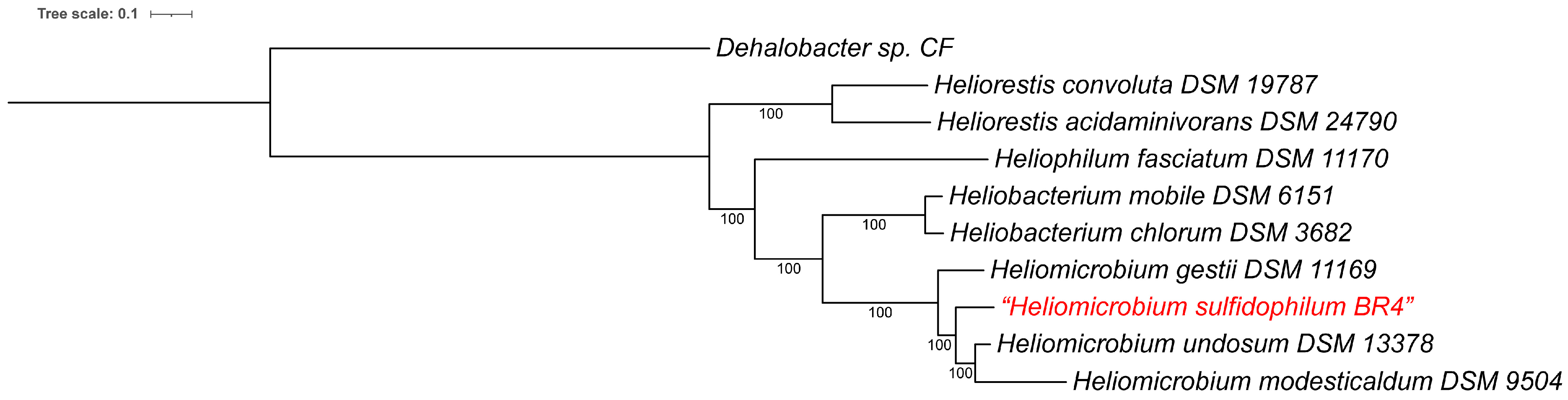
2.4. Phylogenetic Analysis
3. Results
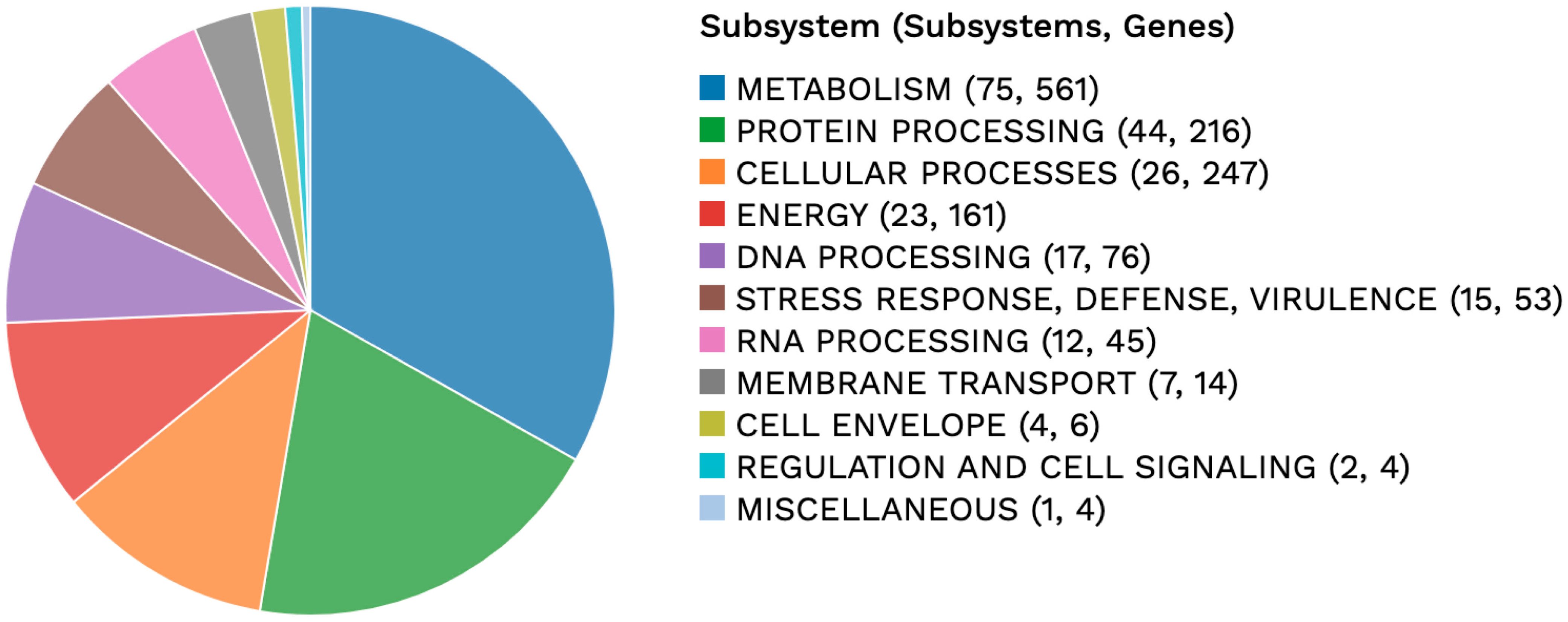
3.1. Genome Properties
3.2. Central Carbon Metabolism
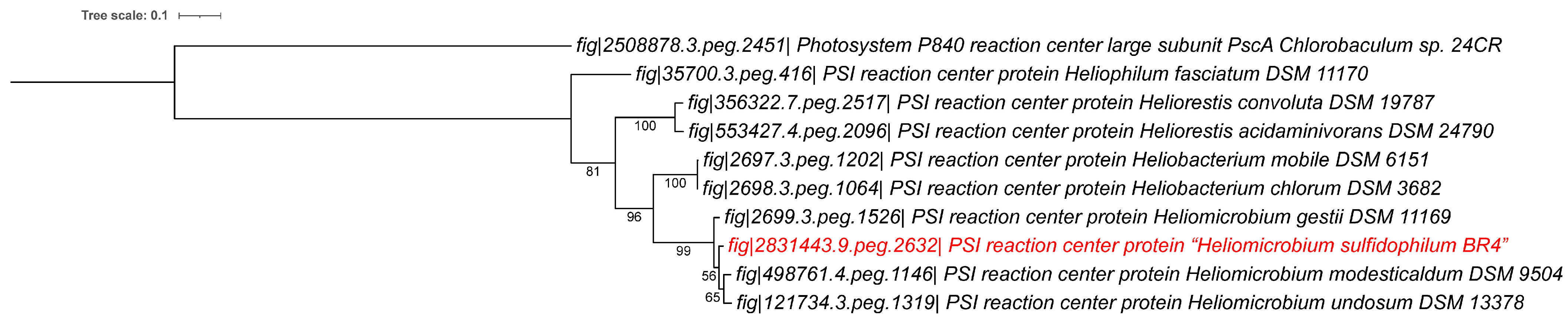
3.3. Photosynthetic Reaction Center and BchG Analysis
3.4. CooS Analysis
3.5. Nitrogen Metabolism: Nitrogen Fixation
3.6. Biotin Metabolism
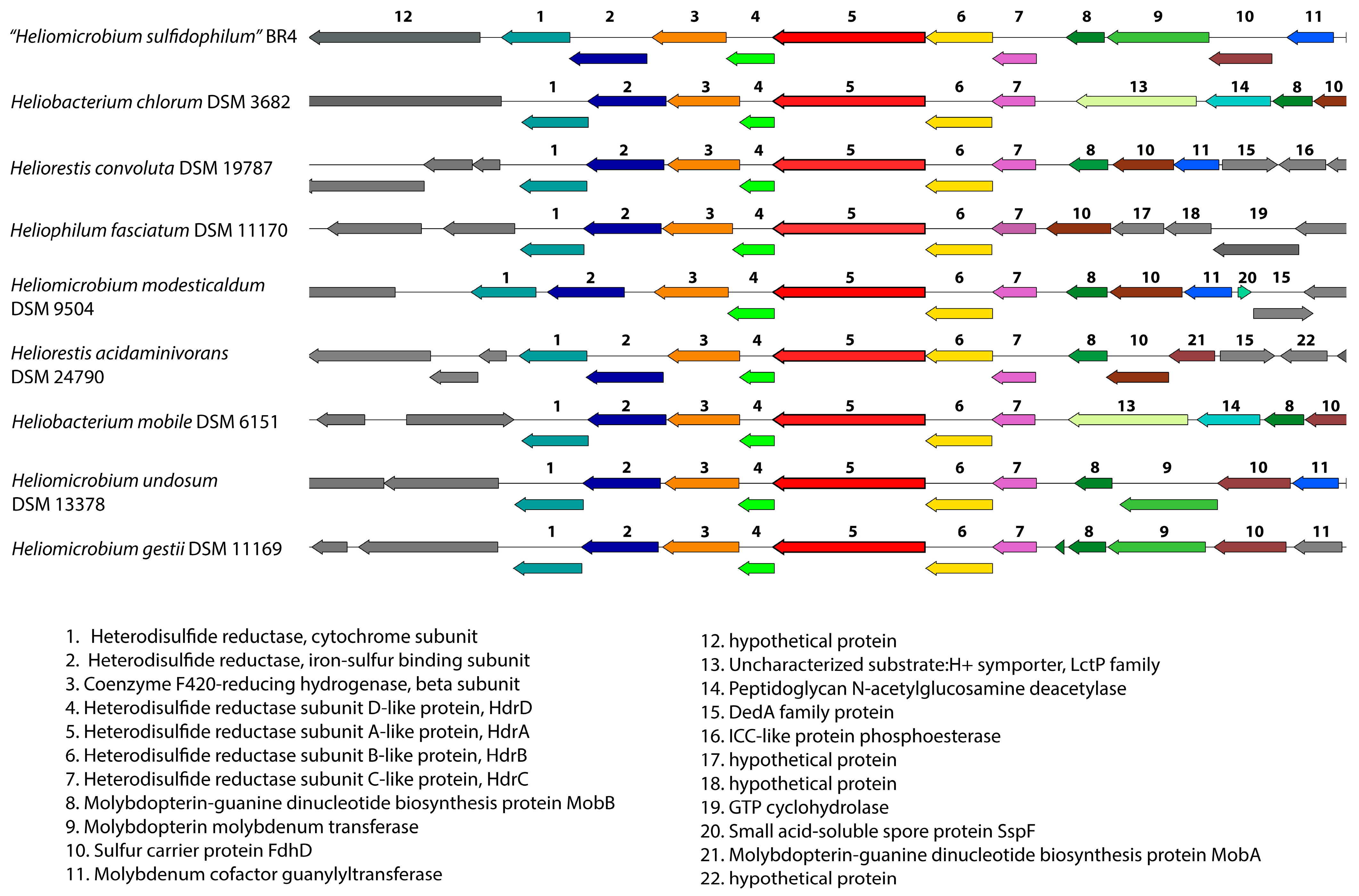
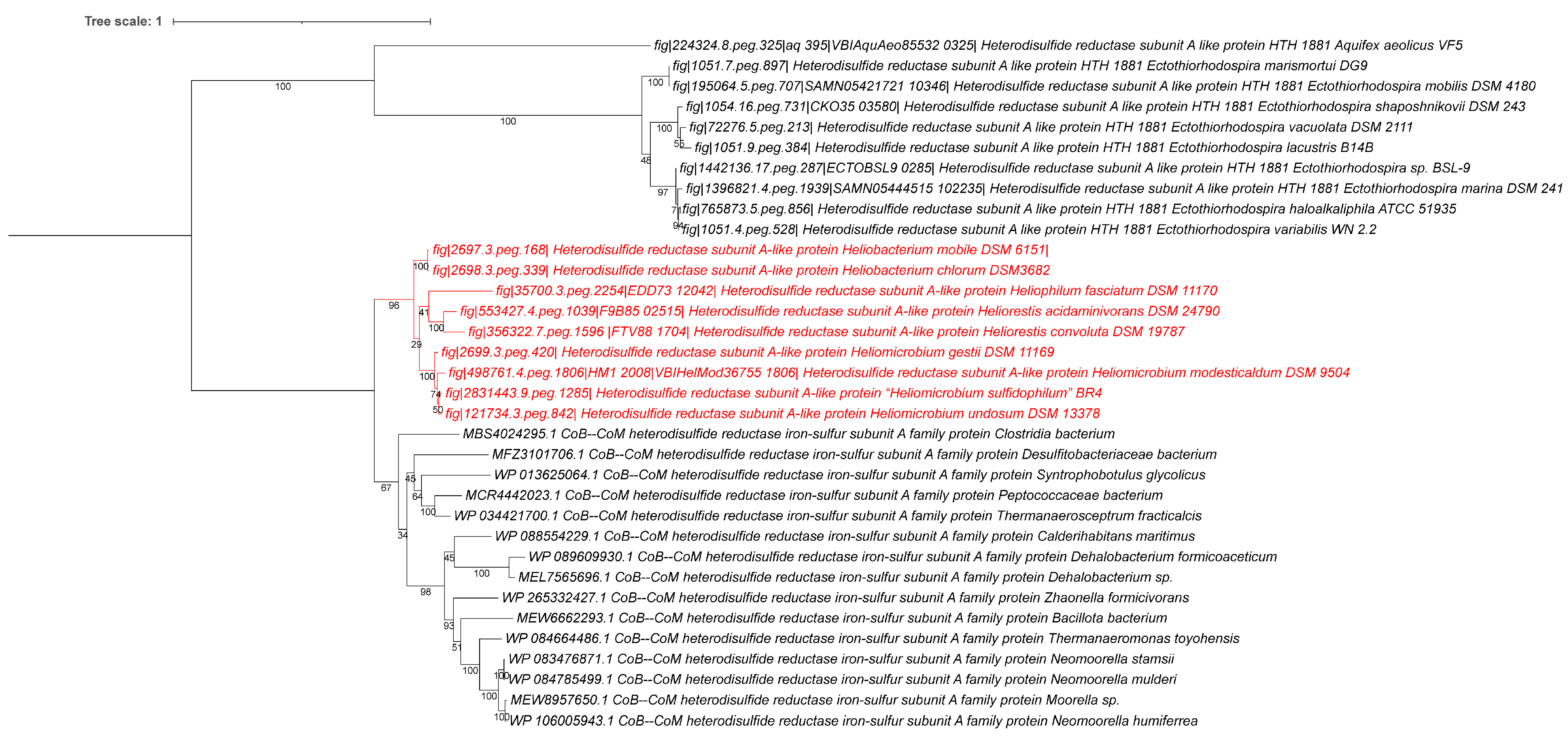
3.7. Sulfur Metabolism: Sulfide Oxidation
3.8. Phage Regions
4. Conclusions
5. Emended Description of “Heliomicrobium sulfidophilum” Kyndt et al. 2021
Supplementary Materials
Author Contributions
Funding
Data Availability Statement
Acknowledgments
Conflicts of Interest
Abbreviations
| Bchl | Bacteriochlorophyll |
| WGS | Whole genome sequence |
| ANI | Average nucleotide identity |
| ANIb | Bidirectional average nucleotide identity |
| dDDH | Digital DNA–DNA hybridization |
| PS | Photosynthetic system |
| SQR | Sulfide:quinone oxidoreductase |
| Hdr | Heterodisulfide reductase |
| CDS | Coding Sequence |
References
- Madigan, M.T.; Euzéby, J.P.; Asao, M. Proposal of Heliobacteriaceae fam. nov. Int. J. Syst. Evol. Microbiol. 2010, 60, 1709–1710. [Google Scholar] [CrossRef]
- LPSN. List of Prokaryotic Names with Standing in Nomenclature. Available online: https://lpsn.dsmz.de/family/heliobacteriaceae (accessed on 24 March 2026).
- Kyndt, J.A.; Salama, D.M.; Meyer, T.E.; Imhoff, J.F. Phylogenetic relationship of phototrophic heliobacteria and systematic reconsideration of species and genus assignments based on genome sequences of eight species. Int. J. Syst. Evol. Microbiol. 2021, 71, 4729. [Google Scholar] [CrossRef]
- Asao, M.; Madigan, M.T. Family IV Heliobacteriaceae Madigan 2001, 625. In Bergey’s Manual of Systematic Bacteriology (The Firmicutes), 2nd ed.; De Vos, P., Garrity, G.M., Jones, D., Krieg, N.R., Ludwig, W., Rainey, F.A., Schleifer, K.-H., Whitman, W.B., Eds.; Springer: New York, NY, USA, 2009; Volume 3, pp. 913–920. ISBN 978-0-387-95041-9. [Google Scholar]
- Asao, M.; Madigan, M.T. Taxonomy, phylogeny, and ecology of the heliobacteria. Photosynth. Res. 2010, 104, 103–111. [Google Scholar] [CrossRef]
- Kimble-Long, L.K.; Madigan, M.T. Molecular evidence that the capacity for endosporulation is universal among phototrophic heliobacteria. FEMS Microbiol. Lett. 2001, 199, 191–195. [Google Scholar] [CrossRef]
- Sattley, W.M.; Madigan, M.T. The Family Heliobacteriaceae. In The Prokaryotes—Firmicutes and Tenericutes; Rosenberg, E., DeLong, E.F., Lory, S., Stackebrandt, E., Thompson, F., Eds.; Springer: Berlin/Heidelberg, Germany, 2014; pp. 185–196. ISBN 978-3-642-30120-9. [Google Scholar]
- Starynin, D.A.; Gorlenko, V.M. Sulphide-oxidizing spore-forming heliobacteria isolated from a thermal sulphide spring. Microbiology 1993, 62, 343–347. [Google Scholar]
- Bryantseva, I.A.; Gorlenko, V.M.; Tourova, T.P.; Kuznetsov, B.B.; Lysenko, A.M.; Bykova, S.A.; Gal’chenko, V.F.; Mityushina, L.L.; Osipov, G.A. Heliobacterium sulfidophilum sp. nov. and Heliobacterium undosum sp. nov.: Sulfide-oxidizing heliobacteria from thermal sulfidic springs. Microbiology 2000, 69, 325–334. [Google Scholar] [CrossRef]
- Bryantseva, I.A.; Gorlenko, V.M.; Tourova, T.P.; Kuznetsov, B.B.; Lysenko, A.M.; Bykova, S.A.; Galchenko, V.F.; Mityushina, L.L.; Osipov, G.A. Validation of publication of new names and new combinations previously effectively published outside the IJSEM. Int. J. Syst. Evol. Microbiol. 2001, 51, 1–2. [Google Scholar] [CrossRef] [PubMed][Green Version]
- Status of strains that contravene Rules 27 (3) and 30 of the International Code of Nomenclature of Bacteria. Opinion 81. Int. J. Syst. Evol. Microbiol. 2008, 58, 1755–1763. [CrossRef]
- Sattley, W.M.; Madigan, M.T.; Swingley, W.D.; Cheung, P.C.; Clocksin, K.M.; Conrad, A.L.; Dejesa, L.C.; Honchak, B.M.; Jung, D.O.; Karbach, L.E.; et al. The genome of Heliobacterium modesticaldum, a phototrophic representative of the Firmicutes containing the simplest photosynthetic apparatus. J. Bacteriol. 2008, 190, 4687–4696. [Google Scholar] [CrossRef]
- Dewey, E.D.; Stokes, L.M.; Burchell, B.M.; Shaffer, K.N.; Huntington, A.M.; Baker, J.M.; Nadendla, S.; Giglio, M.G.; Bender, K.S.; Touchman, J.W.; et al. Analysis of the complete genome of the alkaliphilic and phototrophic firmicute Heliorestis convoluta strain HHT. Microorganisms 2020, 8, 313. [Google Scholar] [CrossRef] [PubMed]
- Bender, K.S.; Madigan, M.T.; Williamson, K.L.; Mayer, M.H.; Parenteau, M.N.; Jahnke, L.L.; Welander, P.V.; Sanguedolce, S.A.; Brown, A.C.; Sattley, W.M. Genomic features of the bundle-forming heliobacterium Heliophilum fasciatum. Microorganisms 2022, 10, 869. [Google Scholar] [CrossRef]
- Wattam, A.R.; Davis, J.J.; Assaf, R.; Boisvert, S.; Brettin, T.; Bun, C.; Conrad, N.; Dietrich, E.M.; Disz, T.; Gabbard, J.L.; et al. Improvements to PATRIC, the all-bacterial Bioinformatics Database and Analysis Resource Center. Nucleic. Acids Res. 2017, 45, D535–D542. [Google Scholar] [CrossRef] [PubMed]
- Wick, R.R.; Judd, L.M.; Gorrie, C.L.; Holt, K.E. Unicycler: Resolving bacterial genome assemblies from short and long sequencing reads. PLoS Comput. Biol. 2017, 13, e1005595. [Google Scholar] [CrossRef]
- Kolmogorov, M.; Yuan, J.; Lin, Y.; Pevzner, P.A. Assembly of long, error-prone reads using repeat graphs. Nat. Biotechnol. 2019, 37, 540–546. [Google Scholar] [CrossRef]
- Li, H. Minimap2: Pairwise alignment for nucleotide sequences. Bioinformatics 2018, 34, 3094–3100. [Google Scholar] [CrossRef]
- Parks, D.H.; Imelfort, M.; Skennerton, C.T.; Hugenholtz, P.; Tyson, G.W. CheckM: Assessing the quality of microbial genomes recovered from isolates, single cells, and metagenomes. Genome Res. 2015, 25, 1043–1055. [Google Scholar] [CrossRef] [PubMed]
- Camargo, A.P.; Roux, S.; Schulz, F.; Babinski, M.; Xu, Y.; Hu, B.; Chain, P.S.G.; Nayfach, S.; Kyrpides, N.C. Identification of mobile genetic elements with geNomad. Nat. Biotechnol. 2024, 42, 1303–1312. [Google Scholar] [CrossRef]
- Aziz, R.; Bartels, D.; Best, A.; DeJongh, M.; Disz, T.; Edwards, R.; Formsma, K.; Gerdes, S.; Glass, E.M.; Kubal, M.; et al. The RAST server: Rapid annotations using subsystems technology. BMC Genom. 2008, 9, 75. [Google Scholar] [CrossRef]
- Tang, S.; Gong, Y.; Edwards, E.A. Semi-automatic in silico gap closure enabled de novo assembly of two Dehalobacter genomes from metagenomic data. PLoS ONE 2012, 7, e52038. [Google Scholar] [CrossRef]
- Stamatakis, A.; Hoover, P.; Rougemont, J.J.S. A rapid bootstrap algorithm for the RAxML web servers. Syst. Biol. 2008, 57, 758–771. [Google Scholar] [CrossRef] [PubMed]
- Stamatakis, A. RAxML version 8: A tool for phylogenetic analysis and post-analysis of large phylogenies. Bioinformatics 2014, 30, 1312–1313. [Google Scholar] [CrossRef]
- Letunic, I.; Bork, P. Interactive Tree of Life (iTOL) v4: Recent updates and new developments. Nucleic Acids Res. 2019, 47, 256–259. [Google Scholar] [CrossRef] [PubMed]
- Richter, M.; Rosselló-Móra, R.; Glöckner, F.O.; Peplies, J.J. SpeciesWS: A web server for prokaryotic species circumscription based on pairwise genome comparison. Bioinformatics 2016, 32, 929–931. [Google Scholar] [CrossRef] [PubMed]
- Meier-Kolthoff, J.P.; Göker, M. TYGS is an automated high-throughput platform for state-of-the-art genome-based taxonomy. Nat. Commun. 2019, 10, 2182. [Google Scholar] [CrossRef]
- Madeira, F.; Madhusoodanan, N.; Lee, J.; Eusebi, A.; Niewielska, A.; Tivey, A.R.N.; Lopez, R.; Butcher, S. The EMBL-EBI Job Dispatcher sequence analysis tools framework in 2024. Nucleic Acids Res. 2024, 52, W521–W525. [Google Scholar] [CrossRef]
- Edgar, R.C. MUSCLE: Multiple sequence alignment with high accuracy and high throughput. Nucleic Acids Res. 2004, 32, 1792–1797. [Google Scholar] [CrossRef]
- Whelan, S.; Goldman, N. A general empirical model of protein evolution derived from multiple protein families using a maximum-likelihood approach. Mol. Biol. Evol. 2001, 18, 691–699. [Google Scholar] [CrossRef] [PubMed]
- Freed, S.; Robertson, S.; Meyer, T.; Kyndt, J. Draft whole-genome sequence of the green sulfur photosynthetic bacterium Chlorobaculum sp. strain 24CR, isolated from the Carmel river. Microbiol. Resour. Announc. 2019, 8, e00116-19. [Google Scholar] [CrossRef]
- Tamura, K.; Stecher, G.; Kumar, S. MEGA 11: Molecular Evolutionary Genetics Analysis Version 11. Mol. Biol. Evol. 2021, 38, 3022–3027. [Google Scholar] [CrossRef]
- Stecher, G.; Tamura, K.; Kumar, S. Molecular Evolutionary Genetics Analysis (MEGA) for macOS. Mol. Biol. Evol. 2020, 37, 1237–1239. [Google Scholar] [CrossRef]
- Overbeek, R.; Begley, T.; Butler, R.M.; Choudhuri, J.V.; Chuang, H.-Y.; Cohoon, M.; de Crécy-Lagard, V.; Diaz, N.; Disz, T.; Edwards, R.; et al. The subsystems approach to genome annotation and its use in the project to annotate 1000 genomes. Nucleic Acids Res. 2005, 33, 5691–5702. [Google Scholar] [CrossRef]
- Kimble, L.K.; Stevenson, A.K.; Madigan, M.T. Chemotrophic growth of heliobacteria in darkness. FEMS Microbiol. Lett. 1994, 115, 51–55. [Google Scholar] [CrossRef]
- Bryantseva, I.A.; Gorlenko, V.M.; Kompantseva, E.I.; Achenbach, L.A.; Madigan, M.T. Heliorestis daurensis, gen. nov. sp. nov., an alkaliphilic rod-to-coiled-shaped phototrophic heliobacterium from a Siberian soda lake. Arch. Microbiol. 1999, 172, 167–174. [Google Scholar] [CrossRef]
- Tang, K.H.; Yue, H.; Blankenship, R.E. Energy metabolism of Heliobacterium modesticaldum during phototrophic and chemotrophic growth. BMC Microbiol. 2010, 10, 150. [Google Scholar] [CrossRef]
- Tang, K.H.; Blankenship, R.E. Both forward and reverse TCA cycles operate in green sulfur bacteria. J. Biol. Chem. 2010, 285, 35848–35854. [Google Scholar] [CrossRef]
- Imhoff, J.F.; Kyndt, J.A. Photosynthesis has been established only once—evolution of photosynthetic reaction center proteins and bacteriochlorophyll biosynthesis. Curr. Issues Mol. Biol. 2026, 48, 306. [Google Scholar] [CrossRef] [PubMed]
- Tsukatani, Y.; Yamamoto, H.; Mizoguchi, T.; Fujita, Y.; Tamiaki, H. Completion of biosynthetic pathways for bacteriochlorophyll g in Heliobacterium modesticaldum: The C8-ethylidene group formation. Biochim. Biophys. Acta Bioenerg. 2013, 1827, 1200–1204. [Google Scholar] [CrossRef] [PubMed]
- Neerken, S.; Amesz, J. The antenna reaction center complex of heliobacteria: Composition, energy conversion and electron transfer. Biochim. Biophys. Acta Bioenerg. 2001, 1507, 278–290. [Google Scholar] [CrossRef] [PubMed][Green Version]
- Wang, L.; Zhang, L.; Liu, Z.; Zhao, D.; Liu, X.; Zhang, B.; Xie, J.; Hong, Y.; Li, P.; Chen, S.; et al. A minimal nitrogen fixation gene cluster from Paenibacillus sp. WLY78 enables expression of active nitrogenase in Escherichia coli. PLoS Genet. 2013, 9, e1003865, Erratum in PLoS Genet. 2013, 9. https://doi.org/10.1371/annotation/1e9bcb70-265a-4383-abf4-3466d144d56e. [Google Scholar] [CrossRef]
- Lin, S.; Cronan, J.E. The BioC O-methyltransferase catalyzes methyl esterification of malonyl-acyl carrier protein, an essential step in biotin synthesis. J. Biol. Chem. 2012, 287, 37010–37020. [Google Scholar] [CrossRef]
- Agarwal, V.; Lin, S.; Lukk, T.; Nair, S.K.; Cronan, J.E. Structure of the enzyme-acyl carrier protein (ACP) substrate gatekeeper complex required for biotin synthesis. Proc. Natl. Acad. Sci. USA. 2012, 109, 17406–17411. [Google Scholar] [CrossRef]
- Lyu, X.; Yu, H.; Lu, Y. Diversity and function of soluble heterodisulfide reductases in methane-metabolizing archaea. Microbiol. Spectr. 2025, 13, e03238-24. [Google Scholar] [CrossRef]
- Appel, L.; Willistein, M.; Dahl, C.; Ermler, U.; Boll, M. Functional diversity of prokaryotic HdrA(BC) modules: Role in flavin-based electron bifurcation processes and beyond. Biochim. Biophys. Acta Bioenerg. 2021, 1862, 148379. [Google Scholar] [CrossRef] [PubMed]
- Hedderich, R.; Klimmek, O.; Kroëger, A.; Dirmeier, R.; Keller, M.; Stetter, K.O. Anaerobic respiration with elemental sulfur and with disulfides. FEMS Microbiol. Rev. 1999, 22, 353–381. [Google Scholar] [CrossRef]
- Dahl, C. Sulfur Metabolism in Phototrophic Bacteria. In Modern Topics in the Phototrophic Prokaryotes; Hallenbeck, P.C., Ed.; Springer: Cham, Switzerland, 2017; pp. 27–66. [Google Scholar] [CrossRef]
- Sousa, F.M.; Pereira, J.G.; Marreiros, B.C.; Pereira, M.M. Taxonomic distribution, structure/function relationship and metabolic context of the two families of sulfide dehydrogenases: SQR and FCSD. Biochim. Biophys. Acta Bioenerg. 2018, 1859, 742–753. [Google Scholar] [CrossRef]
- Boughanemi, S.; Lyonnet, J.; Infossi, P.; Bauzan, M.; Kosta, A.; Lignon, S.; Giudici-Orticoni, M.-T.; Guiral, M. Microbial oxidative sulfur metabolism: Biochemical evidence of the membrane-bound heterodisulfide reductase-like complex of the bacterium Aquifex aeolicus. FEMS Microbiol. Lett. 2016, 363, fnw156. [Google Scholar] [CrossRef] [PubMed]
- Koch, T.; Dahl, C. A novel bacterial sulfur oxidation pathway provides a new link between the cycles of organic and inorganic sulfur compounds. ISME J. 2018, 12, 2479–2491. [Google Scholar] [CrossRef] [PubMed]



| Species | Genome Size | GC Content | Contigs | Coverage | N50 | CDS | tRNAs | ANIb (%) * | dDDH (%) * | Reference | Genbank Accession # |
|---|---|---|---|---|---|---|---|---|---|---|---|
| “Hmb. sulfidophilum” BR4T | 3.4 Mb | 57.2 | 5 | 228× | 2,286,869 | 3439 | 104 | − | − | this paper | JBVTZZ000000000 |
| Hmb. undosum DSM 13378T | 3.8 Mb | 57.1 | 71 | 59× | 176,377 | 3784 | 104 | 85.4 | 30.9 | [3] | WXEY00000000 |
| Hmb. gestii DSM 11169T | 3.7 Mb | 57.2 | 54 | 50× | 284,497 | 3593 | 90 | 82.7 | 27 | [3] | WXEX00000000 |
| Hmb. modesticaldum DSM 9504T | 3.1 Mb | 56 | 1 | NA | NA | 2701 | 109 | 85.5 | 31.1 | [12] | NC_010337 |
| Hbt. chlorum DSM 3682T | 4.1 Mb | 48.7 | 214 | 15× | 130,004 | 4379 | 153 | 71.8 | 19.8 | [3] | JACVHF000000000 |
| Hbt. mobile DSM 6151T | 4.1 Mb | 49.1 | 151 | 57× | 123,143 | 4179 | 154 | 71.8 | 19.8 | [3] | WNKU01000000 |
| Hrs. acidaminivorans DSM 24790T | 3.0 Mb | 41 | 44 | 36× | 281,451 | 2941 | 75 | 66.3 | 19.9 | [3] | WBXO01000000 |
| Hrs. convoluta DSM 19787T | 3.2 Mb | 43.1 | 1 | NA | NA | 2908 | 104 | 66.7 | 27.1 | [13] | NZ_CP045875 |
| Hph. fasciatum DSM 11170T | 3.1 Mb | 50.9 | 73 | NA | NA | 3111 | 90 | 68.6 | 20.9 | [3] | SLXT01000000 |
Disclaimer/Publisher’s Note: The statements, opinions and data contained in all publications are solely those of the individual author(s) and contributor(s) and not of MDPI and/or the editor(s). MDPI and/or the editor(s) disclaim responsibility for any injury to people or property resulting from any ideas, methods, instructions or products referred to in the content. |
© 2026 by the authors. Licensee MDPI, Basel, Switzerland. This article is an open access article distributed under the terms and conditions of the Creative Commons Attribution (CC BY) license.
Share and Cite
Kyndt, J.A.; Petrova, K.O.; Toshchakov, S.V.; Bryantseva, I.A. Genome Sequence and Phylogenetic Analysis of the Sulfide-Oxidizing Heliobacterium “Heliomicrobium sulfidophilum” Strain BR4. Microorganisms 2026, 14, 1160. https://doi.org/10.3390/microorganisms14051160
Kyndt JA, Petrova KO, Toshchakov SV, Bryantseva IA. Genome Sequence and Phylogenetic Analysis of the Sulfide-Oxidizing Heliobacterium “Heliomicrobium sulfidophilum” Strain BR4. Microorganisms. 2026; 14(5):1160. https://doi.org/10.3390/microorganisms14051160
Chicago/Turabian StyleKyndt, John A., Kristina O. Petrova, Stepan V. Toshchakov, and Irina A. Bryantseva. 2026. "Genome Sequence and Phylogenetic Analysis of the Sulfide-Oxidizing Heliobacterium “Heliomicrobium sulfidophilum” Strain BR4" Microorganisms 14, no. 5: 1160. https://doi.org/10.3390/microorganisms14051160
APA StyleKyndt, J. A., Petrova, K. O., Toshchakov, S. V., & Bryantseva, I. A. (2026). Genome Sequence and Phylogenetic Analysis of the Sulfide-Oxidizing Heliobacterium “Heliomicrobium sulfidophilum” Strain BR4. Microorganisms, 14(5), 1160. https://doi.org/10.3390/microorganisms14051160