Article

Carbapenem-Resistant Acinetobacter baumannii in Zagreb, Croatia, in Post-COVID-19 Pandemic Period: Resistance Trends and Mechanisms


1
Department of Medical Microbiology and Parasitology, University of Zagreb School of Medicine, 10000 Zagreb, Croatia
2
Clinical Department for Clinical Microbiology, Infection Control and Prevention, University Hospital Center Zagreb, University of Zagreb, 10000 Zagreb, Croatia
3
University of Zagreb School of Medicine, 10000 Zagreb, Croatia
4
Department of Anesthesiology and Intensive Care, University of Zagreb School of Medicine, University Hospital Centre Zagreb, 10000 Zagreb, Croatia
5
Department of Anesthesiology and Intensive Care, University of Zagreb School of Medicine, 10000 Zagreb, Croatia
6
Department of Anesthesiology, Intensive Medicine and Pain Management, University Hospital Centre Sestre Milosrdnice, 10000 Zagreb, Croatia
7
Institute for Medical Microbiology, Immunology and Hygiene, Faculty of Medicine and University Hospital Cologne, University of Cologne, 50923 Cologne, Germany
8
Diagnostic and Research Institute for Hygiene, Microbiology and Environmental Medicine, Medical University of Graz, 8010 Graz, Austria
9
German Center for Infection Research (DZIF), Partner Site Bonn-Cologne, 50931 Cologne, Germany
*
Author to whom correspondence should be addressed.
Microorganisms 2026, 14(5), 1123; https://doi.org/10.3390/microorganisms14051123
Submission received: 26 April 2026 / Revised: 8 May 2026 / Accepted: 9 May 2026 / Published: 15 May 2026

Abstract

During the COVID-19 pandemic carbapenem-resistant Acinetobacter baumannii (CRAB) were found to be the major pathogen associated with ventilator-associated pneumonia in mechanically ventilated patients. This prompted us to analyze the post-pandemic mechanisms of carbapenem resistance, antibiotic resistance trends, and molecular epidemiology of CRAB in Croatia. In total, 94 CRAB isolates from two hospital centers, including outpatient settings, were investigated. Antimicrobial susceptibility testing was performed by broth microdilution. PCR was used to detect genes encoding carbapenemases of group A, B and D and extended-spectrum β-lactamases (ESBL). Randomly selected isolates were subjected to whole resistome analysis by Inter-array CarbaResist Kit and whole-genome sequencing (WGS). Phylogenetic tree and sequence types (STs) were retrieved from WGS. Plasmid incompatibility groups were determined by PCR-based replicon typing (PBRT). All isolates were extensively drug resistant (XDR), showing resistance to ceftazidime, cefepime, piperacillin–tazobactam, imipenem, meropenem, gentamicin, amikacin and ciprofloxacin, and 13% (n = 12) were also resistant to colistin. The Hodge and CIM test exhibited poor sensitivity with only 32 and 30% of isolates being identified as carbapenemase producers, respectively. PCR identified blaOXA-23 as the dominant carbapenemase gene in both hospitals, found in 71% of the isolates (67/94). In an outpatient setting, blaOXA-24/40 was dominant. blaOXA-23 and blaOXA-72 were the only allelic variants. The Inter-array CarbaResist Kit and whole-genome sequencing (WGS) identified a variety of aminoglycoside (armA, ant(3″)-IIa, aph(3″)-Ib, aph(6)-Id) and sulphonamide resistance (sul1 and sul2) genes. The representative blaOXA-23-positive isolates belonged to ST2, while blaOXA-72-positive isolates were allocated to ST492. These data show that there are different populations of XDR A. baumannii between hospital and outpatients.

1. Introduction

Acinetobacter baumannii, an opportunistic pathogen belonging to the ESKAPE group, has emerged as a formidable agent of nosocomial infections worldwide [1,2].
As an opportunistic pathogen, it is associated with nosocomial infections, including ventilator-associated pneumonia (VAP), bloodstream infections (BSI), wound infections, and meningitis [2,3]. Its amazing capacity to acquire antibiotic resistance determinants from other Gram-negative bacteria has led to an extensively drug-resistant phenotype (XDR). Carbapenem resistance of this superbug is primarily due to the production of carbapenemases, mostly belonging to Ambler class D oxacillinases (OXA), also known as carbapenem hydrolyzing oxacillinases (CHDL). OXA-23-like, OXA-24/40-like and OXA-58-like are the most widespread CHDL’s in A. baumannii [4]. Other subgroups, OXA-143-like and OXA-235-like are rarer. Class B carbapenemases (NDM, VIM, IMP, SIM), zinc-dependent integron-borne metallo-β-lactamases (MBLs), are less common, while class A (KPC, GES) enzymes, widespread among Enterobacterales, are rare among A. baumannii [4]. Overproduction of chromosomal AmpC β-lactamase, loss of CarO porin and upregulation of efflux pumps are reported to contribute to carbapenem resistance [5]. Increased resistance to cephalosporins may also be due to the intrinsic cephalosporinase, or acquired extended-spectrum β-lactamases (ESBLs). ESBLs are class A β-lactamases, mostly plasmid-mediated enzymes that are able to hydrolyze third- and fourth-generation cephalosporins and monobactams. The ESBLs in A. baumannii include TEM, SHV, GES, PER and VEB [6]. Previous studies in Croatia have identified OXA-24/40-like as the dominant CHDL among carbapenem-resistant A. baumannii at the beginning of the third millennium, with OXA-72 as the only allelic variant [7,8], but later it was outnumbered by OXA-23-like, which is now the dominant CHDL in Croatia and elsewhere in Europe [9]. OXA-23 was found to be the most frequent CHDL in both a hospital setting [9] and nursing homes [10]. blaOXA-23 genes were found to be associated with the ISAba1 insertion sequence upstream of the gene. Molecular epidemiology analysis has revealed that the majority of Croatian isolates belonged to international clonal lineage (IC) 2 [7,8].
A. baumannii high-risk clones (International Clones (1–12) are globally disseminated multidrug-resistant lineages that cause severe nosocomial infections, with IC2 (ST2/Global Clone 2) being the most prevalent and dominant in intensive- care units (ICUs) worldwide. These clones, particularly ST2 and the emerging ST697, carry extensive resistance genes (blaOXA-23, armA) and pose a severe threat due to their rapid evolution, high virulence, and environmental persistence [11].
During the COVID-19 pandemic, carbapenem-resistant A. baumannii (CRAB) established itself as the most frequent pathogen associated with VAP in mechanically ventilated COVID-19 patients in Croatia [12,13] and other geographic regions, causing a poor outcome due to an XDR phenotype and limited therapeutic options. Furthermore, in the past, CRAB was confined to the hospital and nursing home niches, but lately, during routine diagnostics, we have observed CRAB increasingly in the outpatient setting. Thus, the aim of this study was to analyze and compare carbapenemases in CRAB isolated from the hospital and outpatient settings in Zagreb, Croatia, and to analyze their resistance trends post-COVID-19 pandemic. Moreover, the susceptibility to the novel last-line antimicrobial compounds such as cefiderocol was also investigated, and the clinical outcomes were investigated.

2. Materials and Methods

2.1. Bacterial Isolates and Patients

Consecutive non-duplicate (one per patient) A. baumannii isolates were collected from two hospital centers in Zagreb (University Hospital Centre Zagreb (UHCZ) and University Hospital Centre Sestre Milosrdnice (UHCSM)), including the outpatient setting belonging to UHCZ from 1 June 2022 to 3 July 2025. The isolates were identified to the species level using MALDI-TOF and confirmed as A. baumannii by PCR for blaOXA-51 genes. Patient data, including age, gender, type of infection, comorbidities, length of hospital stay and therapeutic outcome, were retrieved from the hospital internet system (bis) for hospitalized patients (n = 84). The Charlston comorbidity index (CCI) was calculated. A CCI value of 0 means that there are no comorbidities, 1–2 indicates low risk, 3–4 moderate risk, and >4 high risk.

2.2. Antimicrobial Susceptibility Testing and Phenotypic Tests for Detection of Extended-Spectrum β-Lactamases and Carbapenemases

The antimicrobial susceptibility test of A. baumannii isolates was investigated by Kirby–Bauer standard disk diffusion test (DDST) according to the European Committee on Antimicrobial Susceptibility testing (EUCAST) [14] for the following antibiotics: ceftazidime (30 μg) cefepime (30 μg), imipenem (10 μg), meropenem (10 μg), gentamicin (10 μg), amikacin (30 μg), ciprofloxacin (5 μg), levofloxacin (5 μg), sulphamethoxazole–trimethoprim (23.75 + 1.25 μg) and cefiderocol (30 μg). For piperacillin–tazobactam (110 μg) and ampicillin–sulbactam (30 μg) CLSI guidelines were used, as there are no breakpoints provided by EUCAST. The disks were purchased from Oxoid, Basingstoke, UK. The broth microdilution methods, in line with the Clinical and Laboratory Standard Institute (CLSI) [15], was applied to confirm resistance to ceftazidime, cefepime, imipenem, meropenem, gentamicin, amikacin and ciprofloxacin. The interpretive measures of the CLSI were followed to categorize Acinetobacter isolates as resistant, intermediate susceptible, or susceptible [15]. Colistin susceptibility testing was done by broth dilution method and interpreted according to EUCAST guidelines since there are no guidelines provided by CLSI [14]. A. baumannii ATCC 19606 was utilized as the standard quality control strain. MIC90 and MIC50 of the tested antimicrobials were determined as the lowest concentrations, which inhibit 90% and 50% of the tested isolates. The strains were defined as multidrug resistant (MDR), extensively drug resistant (XDR) or pandrug resistant (PDR), according to Magiorakos et al. [16]. MICs of imipenem and meropenem were tested also in the presence of cloxacillin to determine the effect of chromosomal AmpC overproduction on the carbapenem resistance [17].
The modified Hodge test (MHT) and modified CIM test were used to assess carbapenem hydrolysis. Two methods were applied due to low sensitivity of phenotypic tests in A. baumannii. MHT was performed according to the CLSI 2017 (M100-S31) document [18]. Overnight culture of the carbapenem-susceptible indicator strain Escherichia coli ATCC 25922 was inoculated on the surface of Mueller–Hinton agar (MHA) plates. After drying, an ertapenem disk (10 µg) was placed in the middle of the plate. Overnight A. baumannii cultures were streaked as a single line from the periphery of the disk to the edge of the plate. The positive result showed a clover-leaf-shaped zone of inhibition of E. coli ATCC 25922 growth along the test A. baumannii growth streak within the disk diffusion zone. The negative result showed no growth of E. coli ATCC 25922 along the test A. baumannii growth streak within the diffusion zone. Positive control strains producing various types of carbapenemases were from our own collection.
The mCIM and m/eCIM tests were performed according to the Clinical and Laboratory Standards Institute, 2021 guidelines [19]. The mCIM was performed for all the isolates, whereas the eCIM (in conjunction with mCIM) was performed on isolates that initially tested positive for carbapenemases in the mCIM test, as suggested by the CLSI. The interpretation of the test positivity was based on the inhibition zone of E. coli ATCC 25922 in mCIM and eCIM [19]. Briefly, 2 mL of brain–heart infusion (BHI) broth was poured into a test tube and vortexed. A 10 μL loopful of the sub-cultured growth of A. baumannii was inoculated into tubes. Further, a 10-μg ertapenem disk (Oxoid, Basingstoke, UK) was added to the suspension having the test isolate and incubated for 4 h at 35–37 °C. Just before the completion of 4 h incubation, 0.5 McFarland of E. coli ATCC 25922 was prepared and lawn cultured (by swabbing) on a MHA plate and left for 3–5 min to dry. Subsequently, the ertapenem disk was removed from the incubated test tube and placed on the MHA plate and kept in the incubator for 18–24 h [19]. The following interpretations were considered in the mCIM test: positive (6–15 mm inhibition zone), intermediate (16–18 mm), and negative (≥19 mm inhibition zone). The presence of small E. coli indicator strain colonies within the zone was considered positive [19]. For the eCIM experiment, two tubes (one for mCIM and the other for eCIM) containing 2 mL of BHI were prepared. A volume of 20 μL of 0.5 M EDTA was added into the second tube (for eCIM). Then, the procedure described above for the mCIM test was repeated with the test tubes. The interpretation of the test positivity was based on the zone of inhibition of E. coli ATCC 25922 in mCIM and eCIM plates. A ≥ 5 mm increase in zone diameter in the eCIM experiment as opposed to the respective mCIM plate indicated MBL production. A zone size ≤ 4 mm decrease (or no change in zone size) indicated a serine carbapenemase [19]. Known carbapenemase-producing A. baumannii organisms (OXA-23-like, OXA-40-like and OXA-58-like) were used as positive and negative controls.
Due to the very low sensitivity of the above methods, new modification of CIM, called simplified CIM or sCIM, was applied [20]. Briefly. E. coli ATCC 25922 was inoculated onto the MHA plate, following the routine disk diffusion procedure. Then, 1–3 overnight colonies of the test organisms were smeared onto an imipenem disk (10 µ) to allow one side of the disk to be evenly coated with the test bacteria; immediately afterward, the side of the disk having bacteria was placed on the MHA plate previously inoculated with E. coli. Plates were incubated at 35 °C for 16–18 h. The zone of inhibition around the disk shows a diameter of 6–20 mm or the satellite growth of indicator strain around the disk, indicated carbapenemase positivity; a zone of inhibition ≥ 26 mm was considered to be a negative result; a zone of inhibition of 23–25 mm was considered to be a carbapenemase-indeterminate result.
The ESBL phenotype was confirmed by means of the combined disk method, using antibiotic disks containing a combination of cephalosporin plus clavulanic acid, in conjunction with the corresponding cephalosporin disk alone, with the addition of cloxacillin in the medium (200 mg/L) to inhibit chromosomal AmpC β-lactamase, which can mask the synergistic effect with clavulanic acid. The following antibiotic disks were used: ceftazidime (30 μg), ceftazidime plus clavulanic acid (30/10 μg), ceftriaxone (30 μg), ceftriaxone plus clavulanic acid (30/10 μg) and cefotaxime (30 μg), and cefotaxime plus clavulanic acid (30/10 μg). Regardless of the zone diameters, an increase in zone diameter >5 mm for an antimicrobial agent tested in combination with clavulanic acid, in comparison with its zone size when tested alone, indicated probable ESBL [15].

2.3. Molecular Detection of Resistance Genes

Uniplex PCR was employed to detect genes encoding carbapenemases belonging to class A (blaKPC) [21] and class B MBLs genes (blaVIM, blaIMP, and blaNDM) [22,23,24]. Multiplex PCR was applied to identify class D β-lactamase genes (blaOXA-23, blaOXA-24/40, blaOXA-51, blaOXA-58, and blaOXA-143) [25,26]. The isolates positive for blaOXA-23-like and blaOXA-24-like genes in the multiplex assay were further analyzed using single primers for the respective genes. The genetic context of blaOXA-51 and blaOXA-23 genes was determined by PCR mapping with primers for ISAba1 combined with forward and reverse primers for blaOXA-51 or blaOXA-23 [27]. Under standard PCR conditions, amplification of different ESBL encoding genes, including PER [28], TEM [29], CTX-M [30] and SHV [31], were carried out according to the standard protocols.

2.4. Inter-Array Genotyping Kit CarbaResist

The genotyping of 10 randomly selected A. baumannii isolates (seven from UHCZ and three from UHCSM) was carried out with the microarray-based CarbaResist Genotyping Kit, in line with the manufacturer’s instructions, version 1012012100004 (INTER-ARRAY, fzmb GmbH, Bad Langensalza, Germany). Genomic DNA was extracted from monoclonal overnight cultures with the Qiagen DNeasy Blood and Tissue Kit. The unfragmented DNA was then amplified by one primer for each target sequence (antisense) and was internally labeled with biotin dUTP. The obtained ssDNA products were then transferred into the ArrayWells to perform the hybridization. The wells contained 230 probes for the distinct genes encoding the most relevant carbapenemases, ESBL and AmpC, aminoglycoside (aac(3″), aad1, aad1, aph, arm, rmt) and fluoroquinolone resistance (qnr A, B, C, S). The wells were washed to remove any unbound DNA, and horseradish peroxidase (HRP)-conjugated streptavidin was bound to all of the hybridized sections, resulting in dark spots on the chip due to an enzymatic reaction. The detection of these spots and data acquisition was carried out automatically by the INTER-VISION Reader.

2.5. Whole-Genome Sequencing (WGS)

Five representative isolates (three from UHCZ and two from UHCSM) had their genomes sequenced as previously described [32]. Briefly, isolates were grown overnight on blood agar plates and had their DNA isolated using the DNeasy UltraClean Microbial Kit (Qiagen, Hilden, Germany). Sequencing libraries were prepared with the NEB Next® Ultra™ II FS DNA Library Prep Kit for Illumina® (New England Biolabs, Frankfurt, Germany). The libraries were sequenced, 2 × 250 bp paired end, in an Illumina MiSeq. The resulting Fasta files were assembled using the SKESA assembler (Version 2.4.0) as part of the MBioSEQ Ridom Typer software (Ridom GmbH, Münster, Germany, version 10.5.5). Genotyping was performed by a core-genome MLST (cgMLST), based on a core genome of 2390 target alleles (core) and 1083 target alleles (accessory), and was used to determine clonality. The 7-loci MLST sequence types were extracted from the assembled genome using PubMLST [33]. Antimicrobial resistance genes were identified using NCBI AMRFinderPlus.
An additional five strains were genotyped by conventional multilocus sequence typing according to the Oxford scheme. Seven housekeeping genes (gltA, gyrB, gdhB, recA, cpn60, gpi, rpoD) were amplified and sequenced.

2.6. Conjugation

The conjugal transfer of meropenem resistance was carried out in mixed broth cultures at 35 °C. E. coli J65 resistant to sodium azide was used as the recipient [34]. Carbapenemase-producing transconjugants were selected on MacConkey agar containing meropenem (10 µg/L) and sodium azide (100 mg/L) to ensure that selected isolates were the recipient E. coli containing the transferred resistance gene. The frequency of conjugation was determined relative to the number of donor cells. The co-transfer of resistance to gentamicin, tetracycline, sulfamethoxazole–trimethoprim, chloramphenicol, and ciprofloxacin was determined in addition to β-lactam resistance transfer. Colonies growing on combined plates were subjected to identification by MALDI-TOF and, if confirmed to be E. coli, to antibiotic susceptibility testing and PCR for the detection carbapenemase-encoding genes.

2.7. Characterization of Plasmids

Plasmid incompatibility groups were determined by PCR-based replicon typing (PBRT) according to Bertini et al. [35]. Multiplex PCR was performed with primers specific for 18 incompatibility groups of plasmids found in A. baumannii.

3. Results

3.1. Bacterial Isolates and Patients

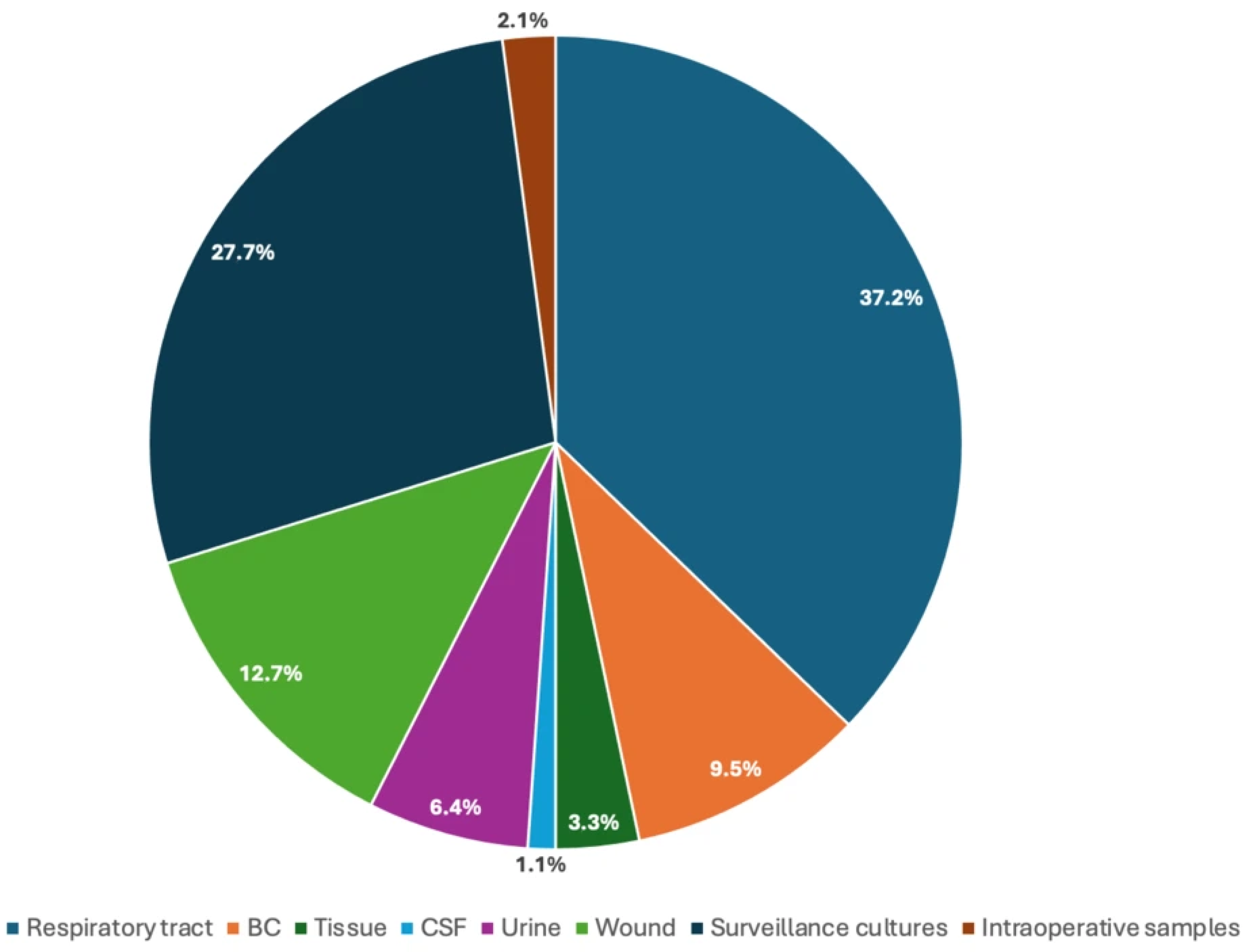
In total, 94 non-copy (one per patient) A. baumannii isolates were collected from two hospital centers: UHCZ surgical ICUs (38) and UHCSM surgical ICUs (46 isolates). In addition, 10 outpatient isolates were also collected at the UHCZ. The majority of isolates originated from the respiratory tract (37%), followed by surveillance cultures (29%) (Figure 1). There were 67 males (71%) and 27 females (29%) included in the study. The age range was 19 to 93 years, with a median value of 65. A total of 37% of patients had an infection, and the others were only colonized with CRAB. Out of 84 hospitalized patients, 42% died (n = 35). Pneumonia was diagnosed in 23 patients (24%) and wound infection in 14 patients (15%). Urinary tract infection (UTI) was diagnosed in five patients (5%), mostly in the outpatient setting, associated with urinary catheters (catheter-associated urinary tract infection (CAUTI)). Colistin and ampicillin–sulbactam were the antibiotics used to treat CRAB infections in both hospitals. In UHCZ, a combination of both antibiotics was administered, while in UHCSM, patients received either colistin alone or ampicillin–sulbactam in monotherapy. Ten patients succumbed to septic shock and multiorgan failure (MOF). The Charlston comorbidity index for survival prediction varied between 0 and 11, with a median value of 5. The length of hospital stay ranged from 8 to 529 days (median 34) and ICU stay from 0 to 529 days (median 25). A particularly long ICU stay was observed in a patient with burn infection caused by CRAB (529 days). Forty-two out of 84 hospitalized patients (49%) had a CCI above four, indicating high mortality risk. A favorable therapeutic outcome was recorded in 61% of the patients harboring the OXA-23-positive strain and 50% with the OXA-34/40-producing strain. On the other hand, the median hospital and ICU stay was longer in the OXA-23-positive group compared to OXA-24/40 carriers (38 vs. 20 days and 24 vs. 12 days, respectively).

3.2. Antimicrobial Susceptibility and Phenotypic Tests for β-Lactamases

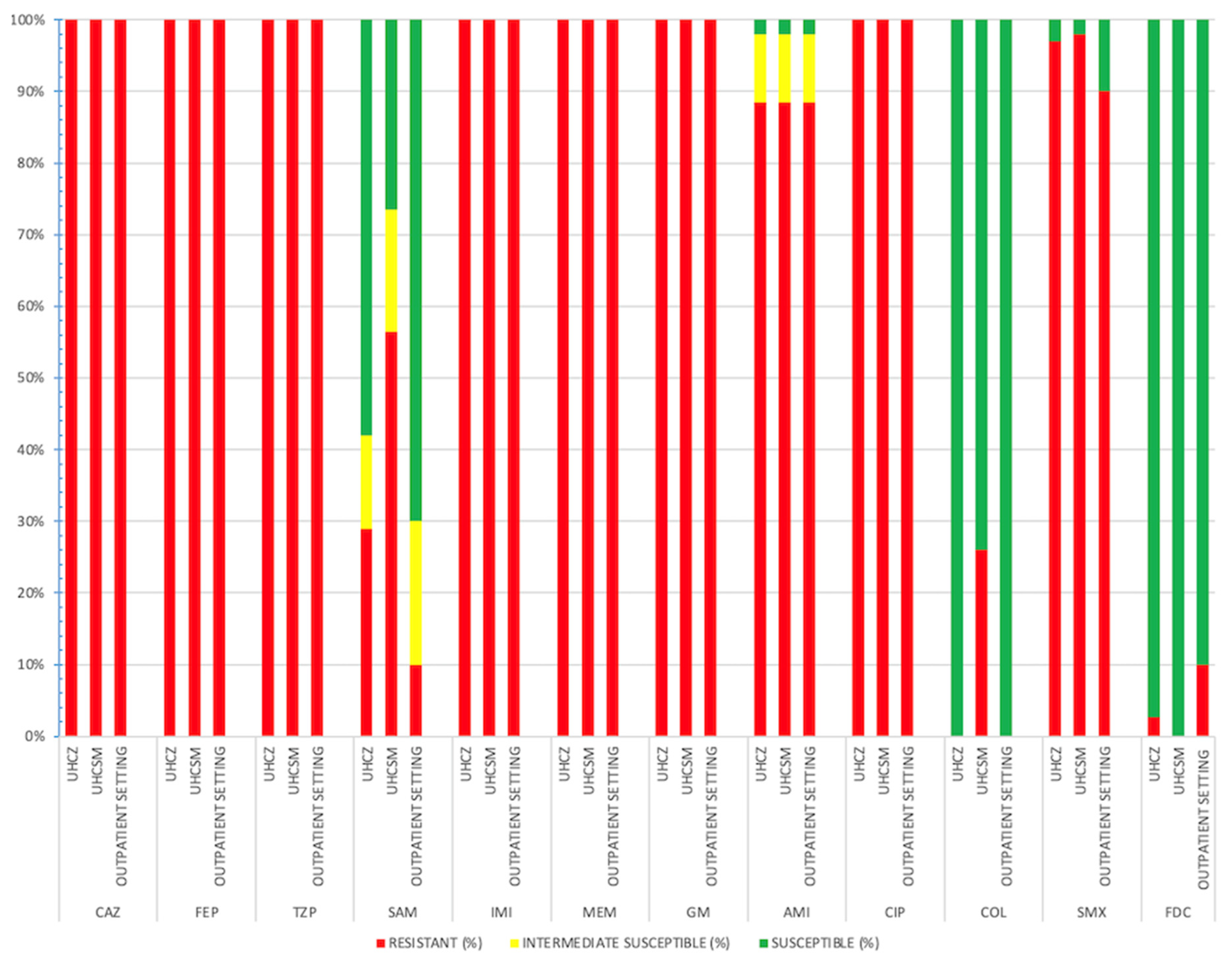
All isolates were resistant to ceftazidime, cefepime, piperacillin–tazobactam, imipenem, meropenem, gentamicin and ciprofloxacin (Table 1). A high resistance rate was observed for amikacin—88% (n = 83). The overall rate of resistance to ampicillin–sulbactam was 41% (n = 39), but it was much higher among hospital isolates, with a rate of 45% (n = 38) vs. 1% (n = 1) among community isolates (Figure 2). Colistin resistance reached 12.7% (n = 12) and was detected only in UHCSM. According to DDST, the resistance rate to sulphamethoxazole–trimethoprim reached 97% (n = 91) and to levofloxacin 100% (n = 94), whereas cefiderocol remained active against 98% (n = 92) of the isolates. All isolates were CRAB and categorized as XDR, as only colistin and cefiderocol demonstrated consistent activity against the majority of isolates. Cloxacillin did not lower the MICs of either imipenem or meropenem, indicating no effect of AmpC on carbapenem susceptibility.
The MHT and CIM test exhibited poor sensitivity, with only 32% and 30% of isolates being identified as carbapenemase producers, respectively. The isolates exhibited weak positivity in MHT with very slight indentation indicator of E. coli strain growth. eCIM tested negative in all isolates, indicating the lack of an MBL. The new modification of CIM sCIM did not increase sensitivity and yielded only 28% (n = 27) positive results. All isolates tested negative for an ESBL, as there was no significant difference in the zone diameter between disks supplemented with clavulanic acid and control disks without inhibitor (−1–3 mm).

3.3. Molecular Detection of Resistance Genes

PCR identified blaOXA-23-like as the dominant carbapenemase gene, with 71% of positive isolates (67/94). Moreover, it was the dominant gene in both hospitals (50%, n = 18 in UHCZ and 95%, n = 44 in UHSM), while in outpatient settings blaOXA-24/40-like outnumbered blaOXA-23-like genes (60%, n = 6). ISAba1 was detected upstream of blaOXA-23. No other acquired carbapenemase or ESBL genes were detected.

3.4. Inter-Array CarbaResist Kit Analysis

Out of ten analyzed isolates, there were five with OXA-40-like and OXA-23-like genes, respectively (Table 2). All except one isolate tested positive for armA genes encoding pan-aminoglycoside resistance, while aac(3′)Ia and aadA1aadA2 were found in two isolates, respectively. Six isolates possessed sul1 and three sul2 genes for sulphonamide resistance. None of the isolates harbored genes for acquired fluoroquinolone, trimethoprim and colistin resistance, as shown in Table 2.

3.5. WGS

Of five isolates subjected to WGS, two harbored blaOXA-23 and three blaOXA-72 genes belonging to blaOXA-24/40 group as shown in Table 3. Regarding to aminoglycoside resistance genes, except armA which was detected by CarbaResist Kit, additional ant(3″)-IIa aph(3″)-Ib aph(6)-Id genes which encode phosphorylases were found in all isolates as shown in Table 3. Sulphonamide resistance was mediated by sul1 and sul2 genes. There were no acquired fluoroquinolone resistance genes, but mutations in gyrA and parC genes were identified.

3.6. Transfer of Resistance Determinants

Attempts to transfer meropenem resistance via conjugation were not successful.

3.7. Plasmid Characterization

The plasmids from OXA-23-positive isolates belonged to Inc group 2 and 6, encoding aci2 and aci6 replicase genes, respectively.

3.8. Genotyping

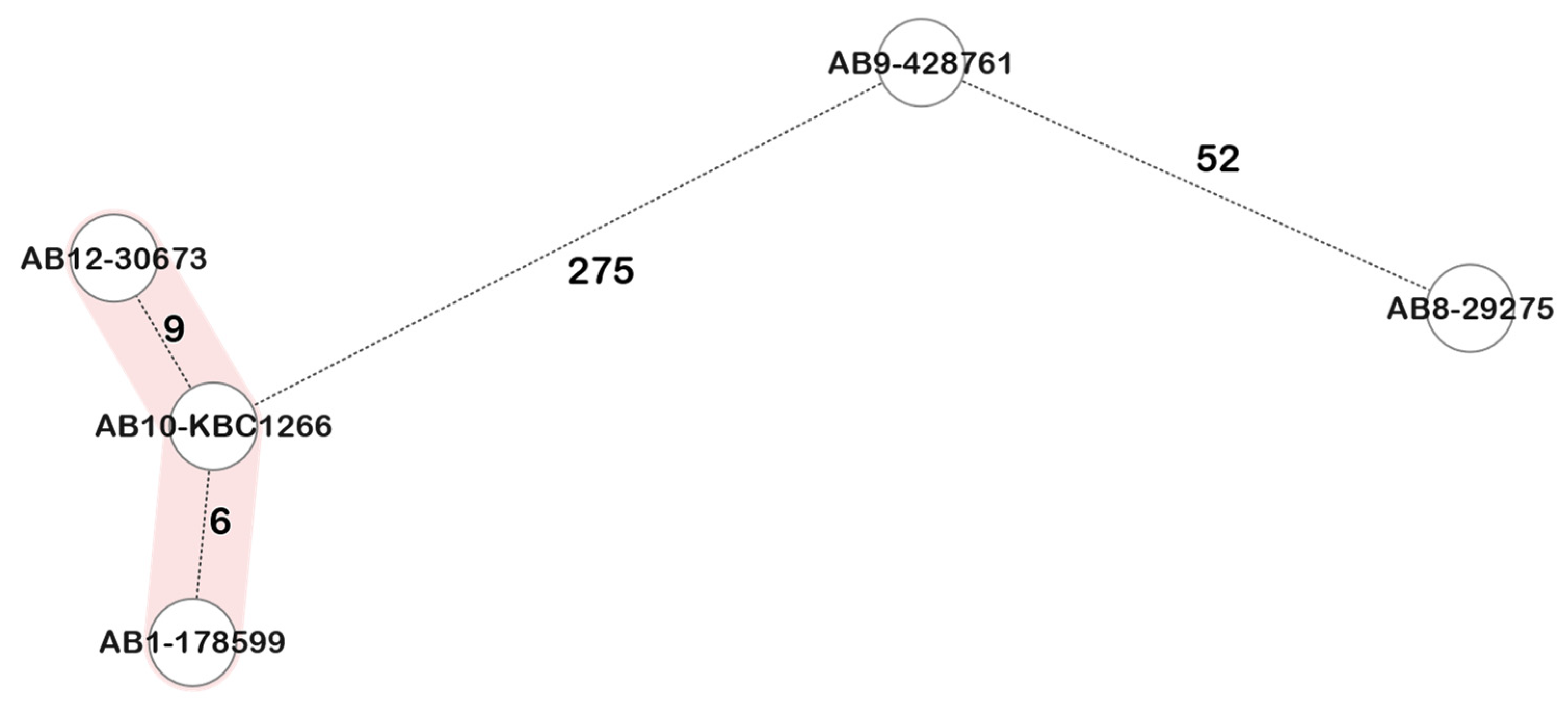
MLST retrieved from WGS revealed the existence of two clones among selected isolates: ST492 (a single-locus variant of ST2) carrying blaOXA-72 genes and ST2 harboring blaOXA-23 genes. ST2 and variants are also known as International 2. A phylogenetic tree of the five isolates demonstrated the existence of one transmission cluster containing three OXA-72 producing isolates (Figure 3). Two OXA-23-positive isolates did not cluster together and were considered singletons. MLST carried out on additional five strains identified ST208, an ST that corresponds to ST2 on the Pasteur scheme.

4. Discussion

In previous studies conducted during the COVID-19 pandemic, CRAB was mainly associated with VAP and BSI. However, in our present study there were also isolates obtained from wound infections (ischemic and diabetic ulcers), indicating lapses in hospital hygiene measures. Urinary isolates were linked to CAUTIs, attributable to biofilm production capacity. Infections caused by CRAB were associated with high mortality, reaching 42%, and prolonged hospital stay. The majority of patients had high CCI, indicating a lot of comorbidities, which is in line with the low virulence of A. baumannii, which, as a typical opportunistic pathogen, affects debilitated patients.
The study showed the switch from the predominance of OXA-24/40 in the pre-pandemic period [7,8] to the domination of OXA-23 after the pandemic. In the multicenter study carried out in the period from 2009 to 2011, there was an equal number of OXA-23-, OXA-24/40- and OXA-58-producing isolates [8]. However, in the present study, OXA-58 completely dissapeared, and we have the absolute predominance of OXA-23, which could be attributed to better hydrolysis capacity and a higher level of resistance on one side, plasmid location of blaOXA-23 enabling horizontal spread of the genes on the other side, or clonal expansion of OXA-23 strains. To answer this, typing of more isolates will be required. Interestingly, of the five isolates we sequenced, it was the OXA-72 isolates that showed the most clonality.
Croatia belongs to the countries with a very high rate of CRAB, reaching around 95% in practically all institutions [36], similar to the majority of Southeastern European countries like Bulgaria, Romania and Greece [37].
The studies carried out during the COVID-19 pandemic showed the dissemination of both OXA-23-like and OXA-24/40-like carbapenemases in hospitals providing care for COVID-19 patients in Zagreb [12,13]. It seems that OXA-23-like and OXA-24-like clones are endemic over the last decade in Balkan countries, including Croatia, Serbia and Bosnia and Herzegovina [38,39,40,41]. Among isolates positive for blaOXA-40-like genes, blaOXA-72 was, similarly as in the previous studies, the only allelic variant. It is hard to explain the long-lasting predominance of this specific allelic variant in Balkan countries.
ESBLs were not found, which is in line with the rare occurrence of these resistance determinant among this species. There are only sporadic reports, describing mostly SHV, CTX-M and PER variants outside Europe [42,43]. CTX-M-115 was associated with ST78 A baumannii with OXA-72 and was associated with Russia in 2012 and Moldova in 2023 [44].
Interestingly, MBLs were never found among CRAB from Croatia, although they are increasingly reported in developing countries [45,46,47], but only sporadically found in Europe, usually associated with imported cases [48,49] in addition to a focal point in Serbia [41].
Resistance to aminoglycosides was due to a combination of armA genes encoding 16S rRNA methylase and aph(3) and aph(6) genes generating aminoglycoside modifying phosphotransferases. Sul1 and sul2 genes mediated sulphonamide resistance. There were no acquired fluoroquinolone resistance genes, but quinolone resistance mutations of chromosomal gyrA and parC genes were found. Antibiotic resistance genes content was strikingly similar in all tested isolates.
The presence of CRAB in surveillance cultures like rectal swabs and upper respiratory tract swabs indicated colonization and presents a silent reservoir for endogenous infections and vertical transfer within the hospital and to the community setting.
The study found weak agreement between phenotypic tests and PCR. Poor performance of phenotypic tests could be due to low efficacy of CHDL in general. Low catalytic power demonstrated in low Vmax despite high Km is a possible explanation for the failure of phenotypic tests. Some studies found CARBA NP is a better indicator for carbapenemase production in A. baumannii than the MHT and mCIM/eCIM test. Some authors have suggested use of a modified CIM method with longer incubation time (6 h) [50] and the addition of Triton to increase the permeability of bacterial cells to release the carbapenemases [51]. However, this could cause loss of specificity due to spontaneous hydrolysis of carbapenems. Other studies have found higher sensitivity of MHT, ranging from 70 to 80% [52,53]. On the other hand, mCIM was confirmed to have very low sensitivity by other authors, with around 30–35% of PCR-positive isolates being recognized as carbapenemase-positive [51,52,53]. For that reason, a new modification called simple CIM (sCIM) was recently implemented, which has a sensitivity of 80% compared to PCR [54].
In contrast to Enterobacterales, identification of carbapenemase positivity and type of enzyme does not affect antibiotic choice and has no clinical relevance. Recently, a new immunochromatographic test has been developed to detect the most important carbapenemases in CRAB [55]. However, unlike the similar test for Enterobacterales, it is not widely used in routine diagnostics in Croatia. Molecular and phenotypic analysis has no clinical impact, unlike in Enterobacterales, because the therapy is always based on antibiograms. Molecular analysis is important for epidemiological reasons, to track the dynamic changes in antibiotic resistance traits. In Acinetobacter, the choice of antibiotic is not affected by the type of carbapenemase, as there are currently no inhibitors of Acinetobacter-associated carbapenemases.
Outside hospitals, CRAB was previously reported in a nursing home in Zagreb [10], and hospital-associated isolates have been found in wastewater treatment plants [56]. This study reports diffusion of CRAB into the community setting among patients not hospitalized within last three months.
Plasmids belonging to groups 2 and 6 were previously shown to carry blaOXA-23 and blaOXA-58 genes [34]. However, due to the failure of meropenem resistance transfer and lack of transconjugant strains, we could not prove the plasmid origin of blaOXA-23 genes. Plasmid analysis is an important tool to analyze molecular epidemiology of the isolates, as we can track the horizontal transmission of plasmids into different strains and lineages.
Our CRAB isolates showed considerable concurrent resistance to fluoroquinolones and aminoglycosides, limiting the therapeutic options. We demonstrated an increase in colistin and ampicillin–sulbactam resistance rates compared to our previous studies. Such isolates pose a serious therapeutic problem because of their XDR phenotype. Resistance to colistin found in the minority of the isolates as a last resort antibiotic for CRAB infections is worrisome. However, cefiderocol could be considered a promising therapeutic option for CRAB infections, particularly for those strains that are resistant to colistin and other agents. Sulbactam, either alone or in combination, is increasingly recognized as a valuable therapeutic option for CRAB infections. However, in our study high resistance rates were observed.
ST2 was previously identified in Croatia, also in conjunction with blaOXA-23 genes [8]. ST492, a single-locus variant of ST2, was reported among pediatric isolates in Croatia and positive for blaOXA-24-like [9] and recently in the neighboring country Serbia, also carrying the OXA-72-coding gene [41]. ST208 is reported in Croatia for the first time. In the past, OXA-23-positive organisms mainly belonged to widespread clone ST195 [57]. ST2, found among our OXA-23-positive isolates, belongs to, by far, the most common causes of CRAB outbreaks in intensive care units globally [11]. Similarly, as in other studies our OXA-23-positive organisms harbored the armA gene for pan-aminoglycoside resistance.
New molecular methods like WGS enable detection of the whole resistome. The test identified additional aminoglycoside resistance genes like ant(3′)-IIa aph(3″)-Ib aph(6)-Id, which encode phosphorylases responsible for modification of aminoglycosides, which were not found by the Inter-array CarbaResist Kit.
The limitation of the study is the fact that WGS was done on a limited number of isolates, and thus it was not possible to prove clonal spread within hospital units involved in the study. We did not measure the effect of porin loss or upregulation of efflux pumps on antibiotic resistance. Moreover, we could not determine the effect of carbapenem resistance on the outcome, mortality rate and duration of hospital stay because all isolates were CRAB and there were no susceptible isolates for comparison.
Earlier studies were focused on hospital isolates, and in this study, community-acquired isolates were included. However, although the patients were not hospitalized in the last three months, there is usually a link with the hospital, such as attending a day-care service or diagnostic visits.

5. Conclusions

CRAB belongs to the WHO critical group of pathogens with very limited therapeutic options. Its ability to rapidly acquire antibiotic resistance has made it a challenging “superbug” to treat. This bacterium has evolved to rapidly adapt and overcome the challenges posed by a wide range of antibiotics. The relentless rise of antibiotic resistance has precipitated a global health crisis, with CRAB emerging as a particularly formidable pathogen. Colistin and cefiderocol were the only antibiotics showing consistent activity against these isolates.
In conclusion, the study demonstrated dissemination of the same CRAB clones, before and during the COVID-19 pandemic, with similar phenotypes and resistance determinants. Given the XDR phenotype and the observed clinical impact, the problem demands immediate response, including CRAB surveillance, infection control measures and antibiotic stewardship.

Author Contributions

Conceptualization, B.B.; validation, B.B.; formal analysis, M.N., V.B., D.B.P., M.K., M.D., R.A.d.P., J.L., T.B. and B.B.; data curation: M.N., V.B., D.B.P., M.K., M.D., B.B., G.Z. and J.L. writing—original draft preparation, B.B., P.G.H. and A.G.; review and editing, P.G.H., A.G. and G.Z.; supervision. All authors have read and agreed to the published version of the manuscript.

Funding

This study was supported by a grant from the University of Zagreb School of Medicine (extended-spectrum β-lactamases, plasmid-mediated β-lactamases, and carbapenemases in Proteus mirabilis, grant number: 10106-24-1294).

Informed Consent Statement

This study was approved by the Ethical Committee of the University Hospital Centre Sestre Milosrdnice in Zagreb, and the certificate number is 251-29-11-23-07, class 003-06/23-03/005. Written consent was not necessary because the isolates were collected in the framework of routine laboratory diagnostics. This is a retrospective study.

Data Availability Statement

The original contributions presented in the study are included in the article. Further inquiries can be directed to the corresponding author. The data are not publicly available due to privacy and ethical restrictions. The raw sequencing reads generated in this project were submitted to the European Nucleotide Archive under the study accession number PRJEB112739.

Conflicts of Interest

The authors declare no conflicts of interest.

Abbreviations

CRAB—carbapenem-resistant Acinetobacter baumannii; ESBL—extended-spectrum β-lactamases, ESC—expanded-spectrum cephalosporins; CHDL—carbapenem-hydrolyzing class D oxacillinases; MIC—minimum inhibitory concentration; WGS—whole-genome sequencing, BSI—bloodstream infection; CLSI—Clinical Laboratory Standard Institution; EUCAST—European Committee for Antimicrobial Susceptibility Testing; MHA—Mueller–Hinton agar; OKNV—OXA-48, KPC, NDM, VIM; CAZ—ceftazidime; FEP—cefepime; CTX—cefotaxime; CRO—ceftriaxone; AMT—aztreonam; IMI—imipenem, MEM—meropenem; WHO—World Health Organization; ST—sequence type; ICU-intensive care unit.

References

  1. Peleg, A.Y.; Seifert, H.; Paterson, D.L. Acinetobacter baumannii: Emergence of a successful pathogen. Clin. Microbiol. Rev. 2008, 21, 538–582. [Google Scholar] [CrossRef] [PubMed]
  2. Wong, D.; Nielsen, T.B.; Bonomo, R.A.; Pantapalangkoor, P.; Luna, B.; Spellberg, B. Clinical and pathophysiological overview of Acinetobacter infections: A century of challenges. Clin. Microbiol. Rev. 2017, 30, 409–447. [Google Scholar] [CrossRef]
  3. Harding, C.M.; Hennon, S.W.; Feldman, M.F. Uncovering the mechanisms of Acinetobacter baumannii virulence. Nat. Rev. Microbiol. 2018, 16, 91–102. [Google Scholar] [CrossRef]
  4. Poirel, L.; Nordmann, P. Carbapenem resistance in Acinetobacter baumannii: Mechanisms and epidemiology. Clin. Microb. Infect. 2006, 12, 826–836. [Google Scholar] [CrossRef]
  5. Castanheira, M.; Mendes, R.E.; Gales, A.C. Global Epidemiology and Mechanisms of Resistance of Acinetobacter baumannii-calco-aceticus complex. Clin. Infect. Dis. 2023, 76, S166–S178. [Google Scholar] [CrossRef] [PubMed]
  6. Naas, T.; Namdari, F.; Réglier-Poupet, H.; Poyart, C.; Nordmann, P. Panresistant extended-spectrum β-lactamase SHV-5-producing Acinetobacter baumannii from New York City. J. Antimicrob. Chemother. 2007, 60, 1174–1176. [Google Scholar] [CrossRef][Green Version]
  7. Franolić-Kukina, I.; Bedenić, B.; Budimir, A.; Herljević, Z.; Vraneš, J.; Higgins, P. Clonal spread of carbapenem-resistant OXA-72 positive Acinetobacter baumannii in a Croatian university hospital. Int. J. Infect. Dis. 2011, 15, e706–e709. [Google Scholar] [CrossRef][Green Version]
  8. Vranić-Ladavac, M.; Bedenić, B.; Minandri, F.; Ištok, M.; Frančula-Zaninović, S.; Ladavac, R.; Visca, P. Carbapenem-resistance and acquired class D carbapenemases in Acinetobacter baumannii from Croatia 2009–2010. Eur. J. Clin. Microbiol. Infect. Dis. 2014, 33, 471–478. [Google Scholar] [CrossRef] [PubMed]
  9. Lukić-Grlić, A.; Kos, M.; Žižek, M.; Luxner, J.; Grisold, A.; Zarfel, G.; Bedenić, B. Emergence of Carbapenem-Hydrolyzing Oxacillinases in Acinetobacter baumannii in Children from Croatia. Chemotherapy 2019, 64, 167–172. [Google Scholar] [CrossRef]
  10. Bedenić, B.; Beader, N.; Godič-Torkar, K.; Vranić-Ladavac, M.; Luxner, J.; Veir, Z.; Grisold, A.J.; Zarfel, G. Nursing homas reservoir of carbapenem-resistant Acinetobacter baumannii. Microb. Drug Resist. 2015, 21, 270–278. [Google Scholar] [CrossRef]
  11. Shelenkov, A.; Akimkin, V.; Mikhaylova, Y. International Clones of High Risk of Acinetobacter baumannii-Definitions, History, Properties and Perspectives. Microorganisms 2023, 11, 2115. [Google Scholar] [CrossRef] [PubMed]
  12. Bedenić, B.; Bratić, V.; Mihaljević, S.; Lukić, A.; Vidović, K.; Reiner, K.; Schöenthaler, S.; Barišić, I.; Zarfel, G.; Grisold, A. Multidrug-Resistant Bacteria in a COVID-19 Hospital in Zagreb. Pathogens 2023, 12, 117. [Google Scholar] [CrossRef]
  13. Dobrović, K.; Škrobo, T.; Selec, K.; Jelić, M.; Čivljak, R.; Peršec, J.; Sakan, S.; Bušić, N.; Mihelčić, A.; Hleb, S.; et al. Healthcare-Associated Bloodstream Infections Due to Multidrug-Resistant Acinetobacter baumannii in COVID-19 Intensive Care Unit: A Single-Center Retrospective Study. Microorganisms 2023, 11, 774. [Google Scholar] [CrossRef] [PubMed]
  14. European Committee for Antimicrobial Susceptibility Testing. Breakpoint Tables for Interpretation of MICs and Zone Diameters. Version 12. 2022. Available online: http://www.eucast.org (accessed on 1 October 2024).
  15. Clinical Laboratory Standard Institution. Performance Standards for Antimicrobial Susceptibility Testing, 28th ed.; Approved Standard M100-S22; Clinicaland Laboratory Standards Institute: Wayne, PA, USA, 2018. [Google Scholar]
  16. Magiorakos, A.P.; Srinivasan, A.; Carey, R.B.; Carmeli, Y.; Falagas, M.E.; Giske, C.G.; Harbarth, S.; Hindler, J.F.; Kahlmeter, G.; Olsson-Liljequist, B.; et al. Multidrug-resistant, extensively drug-resistant and pandrug-resistant bacteria: Aninternational expert proposal for interim standard definitions for acquired resistance. Clin. Microbiol. Infect. 2002, 18, 268–281. [Google Scholar] [CrossRef]
  17. Pournaras, S.; Markogiannakis, A.; Ikonomidis, A.; Kondyli, L.; Bethimouti, K.; Maniatis, A.N. Outbreak of multiple clones of imipenem-resistant Acinetobacter baumannii isolates expressing OXA-58 carbapenemase in an intensive care unit. J. Antimicrob. Chemother. 2006, 57, 557–561. [Google Scholar] [CrossRef] [PubMed]
  18. CLSI M100-Ed31; Performance Standards for Antimicrobial Susceptibility Testing, M100 (27th ed.). Clinical and Laboratory Standards Institute: Wayne, PA, USA, 2017.
  19. CLSI M100-Ed31; Performance Standards for Antimicrobial Susceptibility Testing, M100 (31st ed.). Clinical and Laboratory Standards Institute: Wayne, PA, USA, 2021.
  20. Jing, X.; Zhou, H.; Min, X.; Zhang, X.; Yang, Q.; Du, S.; Li, Y.; Yu, F.; Jia, M.; Zhan, Y.; et al. The Simplified Carbapenem Inactivation Method (sCIM) for Simple and Accurate Detection of Carbapenemase-Producing Gram-Negative Bacilli. Front. Microbiol. 2018, 30, 2391. [Google Scholar] [CrossRef]
  21. Robledo, I.E.; Aquino, E.E.; Santé, M.I.; Santana, J.L.; Otero, D.M.; León, C.F.; Vázquez, G.J. Detection of KPC in Acinetobacter spp. in Puerto Rico. Antimicrob. Agents Chemother. 2010, 54, 1354–1357. [Google Scholar] [CrossRef]
  22. Cornaglia, G.; Riccio, M.L.; Mazzariol, A.; Lauretti, L.; Fontana, R.; Rossolini, G.M. Appearance of IMP-1 metallo-β-lactamase in Europe. Lancet 1999, 353, 899–900. [Google Scholar] [CrossRef]
  23. Giakkoupi, P.; Xanthaki, A.; Kanelopoulou, M.; Vlahaki, A.; Miriagou, V.; Kontou, S.; Papafraggas, E.; Malamou-Lada, H.; Tzouvelekis, L.S.; Legakis, N.J.; et al. VIM-1 metallo-β-lactamase-producing Klebsiella pneumoniae strains in Greek hospitals. J. Clin. Microbiol. 2003, 41, 3893–3896. [Google Scholar] [CrossRef]
  24. Mulvey, M.R.; Grant, J.M.; Plewes, K.; Roscoe, D.; Boyd, D.A. New Delhi metallo-β-lactamase in Klebsiella pneumoniae and Escherichia coli, Canada. Emerg. Infect. Dis. 2011, 17, 103–106. [Google Scholar] [CrossRef]
  25. Woodford, N.; Ellington, M.J.; Coelho, J.M.; Turton, J.F.; Ward, M.E.; Brown, S.; Amyes, S.G.; Livermore, D.M. Multiplex PCR for genes encoding prevalent OXA carbapenemases in Acinetobacter spp. Int. J. Antimicrob. Agents 2006, 27, 351–353. [Google Scholar] [CrossRef] [PubMed]
  26. Higgins, P.G.; Lehmann, M.; Seifert, H. Inclusion of OXA-143 primers in a multiplex polymerase chain reaction (PCR) for genes encoding prevalent OXA carbapenemases in Acinetobacter spp. Int. J. Antimicrob. Agents 2010, 35, 305. [Google Scholar] [CrossRef]
  27. Turton, J.F.; Ward, M.E.; Woodford, N.; Kaufman, M.E.; Pike, R.; Livermore, D.M.; Pitt, T.L. The role of ISAba1 in expression of OXA carbapenemase genes in Acinetobacter baumannii. FEMS Microbiol. Lett. 2006, 258, 72–77. [Google Scholar] [CrossRef]
  28. Pagani, L.; Migliavacca, R.; Pallecchi, L.; Matti, C.; Giacobone, E.; Amicosante, G.; Romero, E.; Rossolini, G.M. Emerging extended-spectrum beta-lactamases in Proteus mirabilis. J. Clin. Microbiol. 2002, 40, 1549–1552. [Google Scholar] [CrossRef] [PubMed]
  29. Arlet, G.; Brami, G.; Decre, D.; Flippo, A.; Gaillot, O.; Lagrange, P.H.; Philippon, A. Molecular Characterization by PCR Restriction Fragment Polymorphism of TEM βlactamases. FEMS Microbiol. Lett. 1995, 134, 203–208. [Google Scholar] [CrossRef]
  30. Woodford, N.; Ward, M.E.; Kaufmann, M.E.; Turton, J.; Fagan, E.J.; James, D.; Johnson, A.P.; Pike, R.; Warner, M.; Cheasty, T.; et al. Community and Hospital Spread of Escherichia coli Producing CTX-M Extended-spectrum β-lactamases in the UK. J. Antimicrob. Chemother. 2004, 54, 735–743. [Google Scholar] [CrossRef]
  31. Nüesch-Inderbinen, M.T.; Hächler, H.; Kayser, F.H. Detection of Genes Coding for Extended-spectrum SHV β-lactamases in Clinical Isolates by a Molecular Genetic Method, and Comparison with the E test. Eur. J. Clin. Microbiol. Infect. Dis. 1996, 15, 398–402. [Google Scholar] [CrossRef]
  32. Sánchez-Urtaza, S.; Alfonso-Alarcón, L.; Arazo Del Pino, R.; Burgwinkel, T.; Ocampo-Sosa, A.; Gonzalez, R.; Xanthopoulou, K.; Higgins, P.G.; Alkorta, I.; Gallego, L. Genomic characterization of multidrug-resistant clinical Acinetobacter baumannii isolates from a hospital in Paraguay. Front. Cell. Infect. Microbiol. 2025, 31, 1620479. [Google Scholar] [CrossRef]
  33. Higgins, P.G.; Prior, K.; Harmsen, D.; Seifert, H. Development and evaluation of a core genome multilocus typing scheme for whole-genome sequence-based typing of Acinetobacter baumannii. PLoS ONE 2017, 8, e0179228. [Google Scholar] [CrossRef]
  34. Elwell, L.P.; Falkow, S. The characterization of R plasmids and the detection ofplasmid-specified genes. In Antibiotics in Laboratory Medicine, 2nd ed.; Lorian, V., Ed.; Williams and Wilkins: Baltimore, MD, USA, 1986; pp. 683–721. [Google Scholar]
  35. Bertini, A.; Poirel, L.; Mugnier, P.; Villa, J.; Nordman, P.; Carattoli, A. Characterization and PCR-based replicon typing of resistance plasmids in Acinetobacter baumannii. Antimicrob. Agents Chemother. 2010, 54, 4168–4177. [Google Scholar] [CrossRef] [PubMed]
  36. Croatian Academy of Medical Sciences: Antibiotic resistance in Croatia. 2023. Available online: https://iskra.bfm.hr/wp-content/uploads/2025/01/Knjiga-2023-za-web.pdf (accessed on 1 December 2025).
  37. European Centre for Disease Prevention and Control. Antimicrobial Resistance Surveillance in Europe 2022–2020. Available online: https://www.cdc.europea.eu/en/publication-data/antimicrobial-resistance-surveillance-europe-2022-2020 (accessed on 5 January 2026).
  38. Goić-Barišić, I.; Musić, M.S.; Drčelić, M.; Tuncbilek, S.; Akca, G.; Jakovac, S.; Tonkić, M.; Hrenović, J. Molecular characterisation of colistin and carbapenem-resistant clinical isolates of Acinetobacter baumannii from Southeast Europe. J. Glob. Antimicrob. Resist. 2023, 33, 26–30. [Google Scholar] [CrossRef]
  39. Goic-Barisic, I.; Kovacic, A.; Medic, D.; Jakovac, S.; Petrovic, T.; Tonkic, M.; Novak, A.; Rubic, Z.; Radic, M.; Milosavljević, B.; et al. Endemicity of OXA-23 and OXA-72 in clinical isolates of Acinetobacter baumannii from three neighbouring countries in Southeast Europe. J. Appl. Genet. 2021, 62, 353–359. [Google Scholar] [CrossRef]
  40. Petrović, T.; Uzunović, S.; Barišić, I.; Luxner, J.; Grisold, A.; Zarfel, G.; Ibrahimagić, A.; Jakovac, S.; Slaćanac, D.; Bedenić, B. Arrival of carbapenem-hydrolyzing-oxacillinases in Acinetobacter baumannii in Bosnia and Herzegovina. Infect. Genet. Evol. 2018, 58, 192–198. [Google Scholar] [CrossRef]
  41. Luković, B.; Gajić, I.; Dimkić, I.; Kekić, D.; Zornić, S.; Pozder, T.; Opavski, N.; Kojić, M.; Ranin, L. The first nationwide, multicenter study of Acinetobacter baumannii recovered in Serbia. Emergence of OXA-72, OXA-23 and NDM-1. Antimicrob. Resist. Infect. Control 2020, 9, 101. [Google Scholar] [CrossRef] [PubMed]
  42. Sadeghi, H.; Bakht, M.; Khanjani, S.; Aslanimehr, M.; Nikkhahi, F.; Fardsanei, F.; Maleki, M.R.; Rahimi, S.; Gholamzadeh Khoei, S. Systematic review and meta-analysis on the prevalence of extended-spectrum β-lactamases-producing Acinetobacter baumannii in Iran: Evaluation of TEM, PER, SHV, CTX-M, VEB and GES. Microb. Pathog. 2025, 204, 107554. [Google Scholar] [CrossRef] [PubMed]
  43. Worku, S.; Abebe, T.; Seyoum, B.; Alemu, B.; Denkayehu, G.; Seyoum, T.; Alemayehu, D.H.; Abdissa, A.; Beyene, G.T.; Mihret, A.; et al. Molecular characterization of carbapenemase and extended spectrum β-lactamase producing Acinetobacter baumannii isolates causing surgical site infections in Ethiopia. BMC Infect. Dis. 2024, 30, 459. [Google Scholar] [CrossRef] [PubMed]
  44. Pfeifer, Y.; Hunfeld, K.P.; Borgmann, S.; Maneg, D.; Blobner, W.; Werner, G.; Higgins, P.G. Carbapenem-resistant Acinetobacter baumannii ST78 with OXA-72 carbapenemase and ESBL gene blaCTX-M-115. J. Antimicrob. Chemother. 2016, 71, 1426–1428. [Google Scholar] [CrossRef]
  45. Longjam, L.A.; Tsering, D.C.; Das, D. Molecular Characterization of Class A-ESBLs, Class B-MBLs, Class C-AmpC, and Class D-OXA Carbapenemases in MDR Acinetobacter baumannii Clinical Isolates in a Tertiary Care Hospital, West Bengal, India. Cureus 2023, 17, e43656. [Google Scholar] [CrossRef]
  46. Kigen, C.; Natasha, V.; Wachira, J.; Odoyo, E.; Wataka, A.; Ondolo, S.; Preston, L.; Luo, T.; Martin, M.J.; Sang, L.P.; et al. First report of New Delhi metallo-β-lactamase-6 (blaNDM-6) gene in Africa identified in a carbapenem-resistant Acinetobacter baumannii clinical isolate. Int. J. Infect. Dis. 2026, 162, 108176. [Google Scholar] [CrossRef]
  47. Dong, S.; Lou, J.; Mao, C.; Fang, Y.; Zhang, H. Phylogenomic analysis of OXA-23-positive and genetic context of rare NDM-1-producing carbapenem-resistant Acinetobacter baumannii isolates in a teaching hospital in China. Front. Microbiol. 2025, 6, 1575257. [Google Scholar] [CrossRef]
  48. Xanthopoulou, K.; Urrutikoetxea-Gutiérrez, M.; Vidal-Garcia, M.; Diaz de Tuesta Del Arco, J.L.; Sánchez-Urtaza, S.; Wille, J.; Seifert, H.; Higgins, P.G.; Gallego, L. First Report of New Delhi Metallo-β-Lactamase-6 (NDM-6) in a Clinical Acinetobacter baumannii Isolate From Northern Spain. Front. Microbiol. 2020, 10, 589253. [Google Scholar] [CrossRef]
  49. Pfeifer, Y.; Wilharm, G.; Zander, E.; Wichelhaus, T.A.; Göttig, S.; Hunfeld, K.P.; Seifert, H.; Witte, W.; Higgins, P.G. Molecular characterization of blaNDM-1 in an Acinetobacter baumannii strain isolated in Germany in 2007. J. Antimicrob. Chemother. 2011, 66, 1998–2001. [Google Scholar] [CrossRef] [PubMed]
  50. Mitteregger, D.; Wessely, J.; Barišić, I.; Bedenić, B.; Kosak, D.; Kundi, M. A Variant Carbapenem Inactivation Method (CIM) for Acinetobacter baumannii Group with Shortened Time-to-Result: rCIM-A. Pathogens 2022, 11, 482. [Google Scholar] [CrossRef] [PubMed]
  51. Liu, M.; Song, Q.; Wu, L.; Li, M.; Chen, Z.; Kang, M.; Xie, Y. Triton X-100 and Increased Volume of Test Bacteria in the Carbapenem Inactivation Method Enhanced the Detection of Carbapenemase-Producing Acinetobacter baumannii Complex Isolates. J. Clin. Microbiol. 2018, 56, e01982-17. [Google Scholar] [CrossRef]
  52. Al-Rashed, N.; Shahid, M.; Saeed, N.M.; Darwish, A.; Mol Joji, R.; Al-Mahmeed, A.; Bindayna, K.M. Comparative study of phenotypic-based detection assays for carbapenemases in Acinetobacter baumannii. Indian J. Med. Microbiol. 2024, 50, 100640. [Google Scholar] [CrossRef]
  53. Abouelfetouh, A.; Torky, A.S.; Aboulmagd, E. Phenotypic and genotypic characterization of carbapenem-resistant Acinetobacter baumannii isolates from Egypt. Antimicrob. Resist. Infect. Control 2019, 20, 185. [Google Scholar] [CrossRef] [PubMed]
  54. Khuntayaporn, P.; Thirapanmethee, K.; Kanathum, P.; Chitsombat, K.; Chomnawang, M.T. Comparative study of phenotypic-based detection assays for carbapenemase-producing Acinetobacter baumannii with a proposed algorithm in resource-limited settings. PLoS ONE 2021, 4, e0259686. [Google Scholar] [CrossRef]
  55. Mertins, S.; Higgins, P.G.; Thunissen, C.; Magein, H.; Gilleman, Q.; Mertens, P.; Rodríguez, M.G.; Maus, L.M.; Seifert, H.; Krönke, M.; et al. Development of an immunochromatographic lateral flow assay to rapidly detect OXA-23-, OXA-40-, OXA-58- and NDM-mediated carbapenem resistance determinants in Acinetobacter baumannii. J. Med. Microbiol. 2023, 72, 001681. [Google Scholar] [CrossRef]
  56. Higgins, P.G.; Hrenovic, J.; Seifert, H.; Dekic, S. Characterization of Acinetobacter baumannii from water and sludge line of secondary wastewater treatment plant. Water Res. 2018, 1, 261–267. [Google Scholar] [CrossRef]
  57. Bedenić, B.; Siroglavić, M.; Slade, M.; Šijak, D.; Dekić, S.; Musić, M.Š.; Godan-Hauptman, A.; Hrenović, J. Comparison of clinical and sewage isolates of Acinetobacter baumannii from two long-term care facilities in Zagreb; mechanisms and routes of spread. Arch. Microbiol. 2020, 202, 361–368. [Google Scholar] [CrossRef]
Figure 1. Distribution of the 94 isolates according to the specimen type. BC-blood culture; CSF-cerebrospina fluid.
Microorganisms 14 01123 g001
Figure 2. Antibiotic susceptibility of CRAB isolates according to the center: UHCZ with 38 isolates, UHCSM with 46 isolates and 10 from outpatient setting. LEGEND: Resistant, red; intermediate susceptible, yellow; susceptible, green. Abbreviations: CAZ—ceftazidime; FEP—cefepime; TZP—piperacillin–tazobactam; SAM—ampicillin–sulbactam; IMI—imipenem; MEM—meropenem; GM—gentamicin; AMI—amikacin; CIP—ciprofloxacin; COL—colistin; SMX—sulphamethoxazole–trimethoprim; FDC—cefiderocol; UHCZ—University Hospital Centre Zagreb; UHCSM—University Hospital Centre Sestre Milosrdnice.
Microorganisms 14 01123 g002
Figure 3. Minimum spanning tree of the 5 CRAB isolates using cgMLST based on 2390 target alleles. Isolate identifiers are shown in the nodes, and the number of different alleles is shown between the nodes. The transmission cluster 1 of the three OXA-72-producing isolates is illustrated by the shading around the nodes.
Microorganisms 14 01123 g003
Table 1. Minimum inhibitory concentrations (µg/mL) of various antibiotics against CRAB isolates.
AntibioticMIC RangeMIC50MIC90Number and % of Resistant Isolates
piperacillin–tazobactam32- ≥ 128128≥12894/94 (100%)
ampicillin–sulbactam4- ≥ 128128≥12839/94 (41%)
ceftazidime64- ≥ 128≥128≥12894/94 (100%)
cefepime32- ≥ 128≥128≥12894/94 (100%)
imipenem16- ≥ 128128≥12894/94 (100%)
meropenem32- ≥ 128≥128≥12894/94 (100%)
gentamicin32- ≥ 128≥128≥12894/94 (100%)
amikacin16- ≥ 128≥128≥12883/94 (88%)
ciprofloxacin8- ≥ 128≥128≥12894/94 (100%)
colistin1–1281812/94 (13%)
Table 2. Inter-array CarbaResist Kit analysis of selected 10 isolates and Oxford scheme sequence types (STs).
Isolate and Protocol NoRes. Phenotypeβ-LactamAminoglycosideSulphonamideST
AB1
178599
UHCZ—outpatient
TZP, CAZ, FEP,
IMI, MEM, GM, AMI, CIP
blaOXA-40-likearmAsul2ST208
AB2
370512
UHCSM
TZP, CAZ, FEP,
IMI, MEM, GM, AMI, CIP
blaOXA-23-likearmAsul1ST208
AB8
29275
UHCSM
TZP, CAZ, FEP,
IMI, MEM, GM, AMI, CIP
blaOXA-23-likearmAsul1ST208
AB9
428761
UHCZ
TZP, CAZ, FEP,
IMI, MEM, GM, AMI, CIP
blaOXA-23-likearmAsul1ST208
AB10
1266
UHCZ
TZP, CAZ, FEP,
IMI, MEM, GM, AMI, CIP
blaOXA-40-likearmAsul2ST208
AB11
11810
UHCZ
TZP, CAZ, FEP,
IMI, MEM, GM, AMI, CIP
blaOXA-40-likearmAsul2ST208
AB14
175936
UHCZ
TZP, CAZ, FEP,
IMI, MEM, GM, AMI, CIP
blaOXA-40-likeaac(3′)Ia
aadA1
aadA2
sul2 
AB23
UHCSM
TZP, CAZ, FEP,
IMI, MEM, GM, AMI, CIP
blaOXA-23-likearmA
aphA
  
AB25
UHCZ
TZP, CAZ, FEP,
IMI, MEM, GM, AMI, CIP
blaOXA-23-likearmA
aac(3’)Ia
aadA1
aadA2
sul1 
AB28
100320
UHCZ
TZP, CAZ, FEP,
IMI, MEM, GM, AMI, CIP
blaOXA-23-likearmAsul1ST208
Table 3. WGS of selected isolates showing resistance gene content, their Pasteur and Oxford MLST and cgMLST clustering; O—Oxford scheme, P—Pasteur scheme.
Isolate
Number
β-LactamAminoglycosideSulphonamideQuinoloneQuaternary AmmoniumSTCluster
AB1
178599
UHCZ—
outpatient
blaOXA-72
blaOXA-66 blaADC-30
armA ant(3″)-IIa aph(3″)-Ib aph(6)-Idsul2GyrA_S81L ParC_S84L ST492(P)
ST208 (O)
1
AB8
29275
UHCSM
blaOXA-23
blaOXA-66 blaADC-30
armA ant(3″)-IIa aph(3″)-Ib aph(6)-Idsul1GyrA_S81L ParC_S84LqacEdelta1ST2 (P)
ST195 (O)
S
AB9
428761
UHCZ
blaOXA-23
blaOXA-66 blaADC-30
armA ant(3″)-IIa aph(3″)-Ib aph(6)-Idsul1GyrA_S81L ParC_S84LqacEdelta1ST2 (P)
ST208 (O)
S
AB10
1266
UHCZ
blaOXA-72
blaOXA-66 blaADC-30
armA ant(3″)-IIa aph(3″)-Ib aph(6)-Idsul2GyrA_S81L ParC_S84L ST492 (P)
ST208 (O)
1
AB12
30673
UHCSM
blaOXA-72
blaOXA-66 blaADC-30
armA ant(3″)-IIa aph(3″)-Ib aph(6)-Idsul2GyrA_S81L ParC_S84L ST492 (P)
ST208 (O)
1
Disclaimer/Publisher’s Note: The statements, opinions and data contained in all publications are solely those of the individual author(s) and contributor(s) and not of MDPI and/or the editor(s). MDPI and/or the editor(s) disclaim responsibility for any injury to people or property resulting from any ideas, methods, instructions or products referred to in the content.