Correction

Correction: Arossa et al. Differential Responses to Heat Stress Between Freshly Isolated and Long-Term Cultured Symbiodinium. Microorganisms 2026, 14, 455


by
Silvia Arossa
1,2,*,
Shannon Grace Klein
1,
Jacqueline Victoria Alva Garcia
1,
Alexandra Steckbauer
1,
Naira Pluma
1,
Luca Genchi
1,3,
Sergey P. Laptenok
1,
Shiou-Han Hung
1,
Octavio R. Salazar
1,
Manuel Aranda
1,
Carlo Liberale
1,4 and
Carlos Manuel Duarte
1
1
Biological and Environmental Science and Engineering Division (BESE), King Abdullah University of Science and Technology (KAUST), Thuwal 23955-6900, Saudi Arabia
2
National Center for Wildlife (NCW), P.O. Box 61681, Riyadh 11575-4508, Saudi Arabia
3
Institut Fresnel, CNRS, Centrale Med, Aix-Marseille University, 13284 Marseille, France
4
Computer, Electrical and Mathematical Sciences and Engineering (CEMSE), King Abdullah University of Science and Technology (KAUST), Thuwal 23955-6900, Saudi Arabia
*
Author to whom correspondence should be addressed.
Microorganisms 2026, 14(5), 1078; https://doi.org/10.3390/microorganisms14051078
Submission received: 10 April 2026 / Accepted: 14 April 2026 / Published: 11 May 2026
(This article belongs to the Special Issue Coral Microbiome and Microbial Ecology)
In the original publication [1], there were mistakes in Figures 1–3 as published.
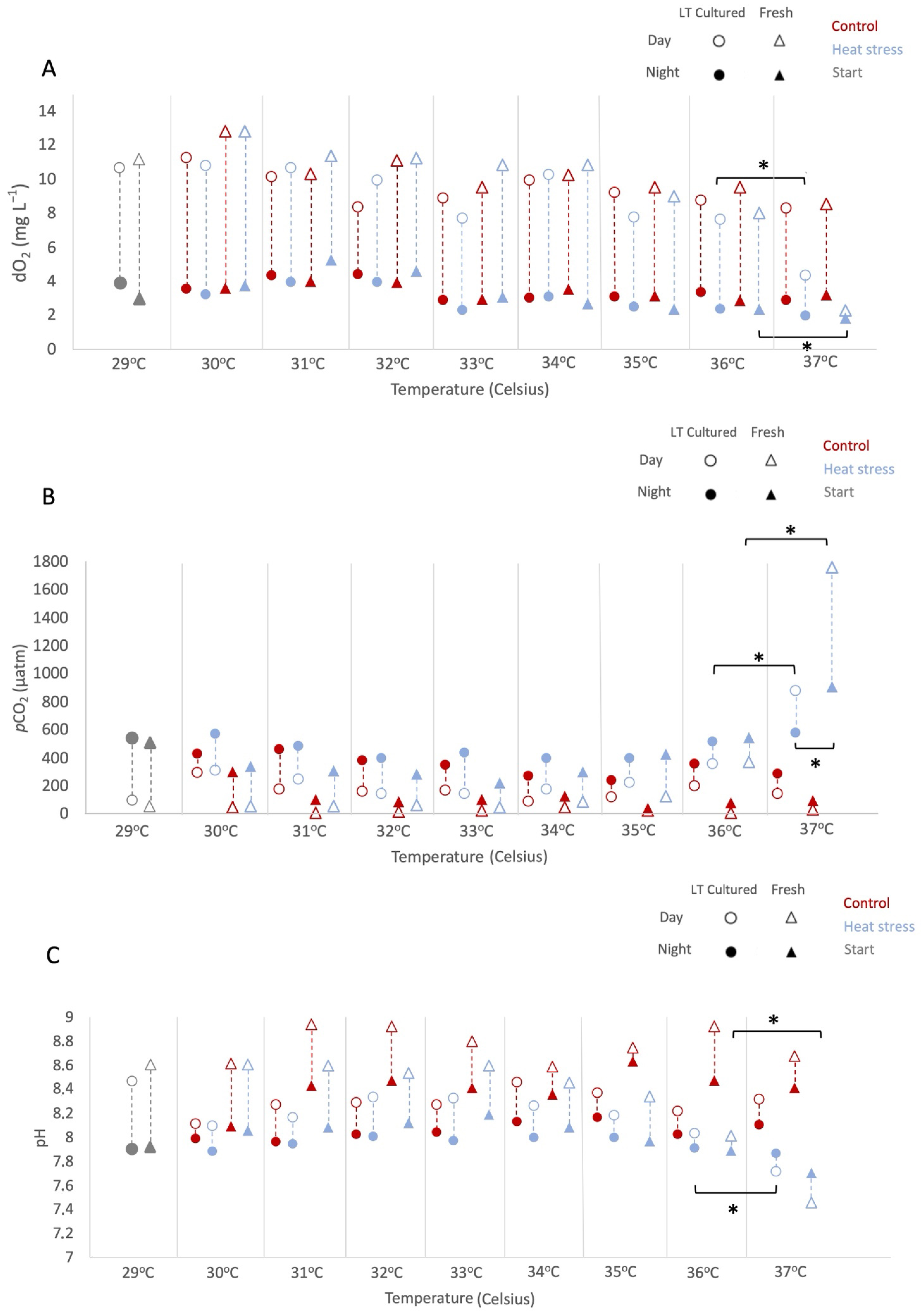
The y-axis label for Figure 1A should be dO2 (mg L−1). The y-axis label for Figure 1B should be pCO2 (µatm). The corrected Figure 1 and its legend appear below.
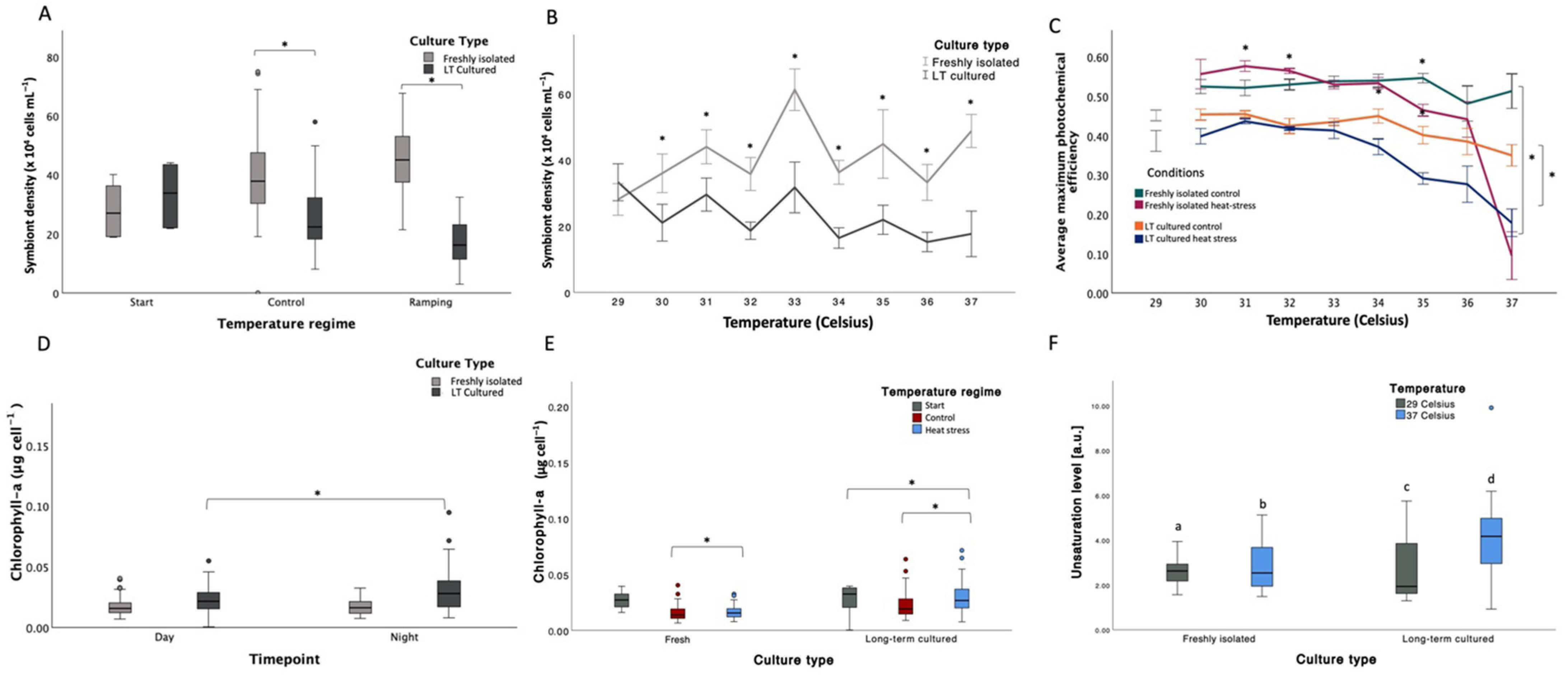
The x-axis label for Figure 2E should be “fresh” and “long-term cultured”. The color assignments in the figure legend were incorrect. The corrected Figure 2 and its legend appear below.
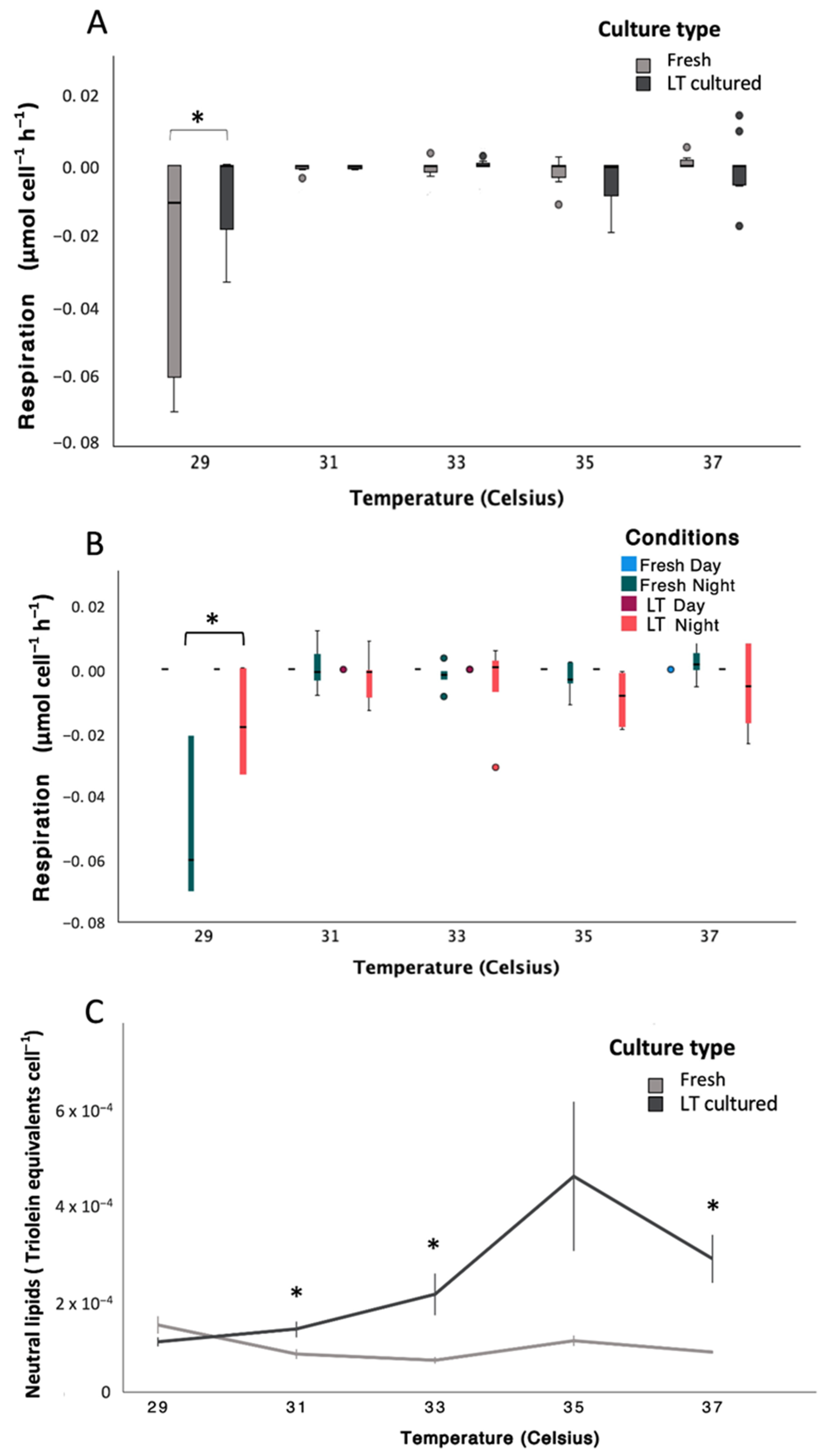
The labels for Figure 3B should be LT Day and LT Night. The color assignments in the figure legend were incorrect. The corrected Figure 3 and its legend appear below.
The authors state that the scientific conclusions are unaffected. This correction was approved by the Academic Editor. The original publication has also been updated.

Reference

  1. Arossa, S.; Klein, S.G.; Alva Garcia, J.V.; Steckbauer, A.; Pluma, N.; Genchi, L.; Laptenok, S.P.; Hung, S.-H.; Salazar, O.R.; Aranda, M.; et al. Differential Responses to Heat Stress Between Freshly Isolated and Long-Term Cultured Symbiodinium. Microorganisms 2026, 14, 455. [Google Scholar] [CrossRef] [PubMed]
Figure 1. Temporal variations in environmental parameters for “long-term cultured” and “freshly isolated” Symbiodinium cultures under thermal stress and control temperature. Temporal changes in (A) dissolved oxygen (mg L−1), (B) pCO2 (µatm), and (C) pH in Symbiodinium cultures. Day values are indicated by unfilled markers, while night values are shown with filled markers. Control samples (kept at 29 °C throughout) are denoted in red, ramping samples (subjected to +1 °C per day) in blue, and initial values in gray. Circles represent “long-term cultured” cultures; (“LT cultured” in the figure) triangles represent “freshly isolated” cultures (“fresh” in the figure). Error bars are not reported (see Supplementary Materials). Significant differences at p < 0.05 are represented as “*”. In all figures, the control group was maintained at a constant temperature of 29 °C throughout the entire experiment. However, on the x-axis, different temperatures are indicated to represent the conditions under which the ramping samples were exposed on specific days. This implies that the control group maintained a consistent temperature regardless of the temperature variations depicted on the x-axis for the ramping samples.
Microorganisms 14 01078 g001
Figure 2. Variations in productivity-related responses of Symbiodinium during a thermal stress experiment (non-transformed data). (A) Symbiont density (cells × 104 mL−1) plotted by temperature regime and culture type (“freshly isolated” in gray and “long-term cultured” in dark gray; see Table S23 for statistical details). (B) Symbiont density (cells × 104 mL−1) plotted by temperature and culture type (“freshly isolated” in gray and “long-term cultured” in black; see Table S24 for statistical details). (C) Average maximum photochemical efficiency (Fv/Fm) plotted by temperature and conditions (unlinked points with gray bars: start; dark green: “freshly isolated” control; purple: “freshly isolated” under heat stress; orange: “long-term cultured” control; dark blue: “long-term cultured” under heat stress). (D) Chlorophyll-a (µg cell−1) plotted by timepoint and culture type (“freshly isolated” in gray and “long-term cultured” in dark gray). (E) Chlorophyll-a (µg cell−1) plotted by culture type (“freshly isolated” and “long-term cultured”) and temperature regime (start in gray, control in red, heat stress in dark blue). (F) Unsaturation levels (a.u.) of thylakoid membrane lipids plotted by culture type (“freshly isolated” and “long-term cultured”) and temperature (29 °C in gray and 37 °C in blue). Different letters indicate significant pairwise differences (post hoc tests, p < 0.05). In all panels, whiskers indicate the full range (minimum to maximum), boxes represent the interquartile range, and the horizontal line indicates the median. Circles represent outliers. In all graphs, “long-term cultured” is abbreviated as “LT cultured” to shorten labels. Significant differences identified on transformed data are indicated by asterisks (*, p < 0.05); asterisks represent pairwise comparisons between culture types within temperature regimes (panel (A); Table S23) or at individual temperatures (panel (B); Table S24). In panels where responses are plotted against temperature, control cultures were maintained at a constant temperature of 29 °C throughout the experiment, and temperatures shown on the x-axis represent the conditions experienced by ramping samples on specific days; thus, control cultures remained at 29 °C despite the temperature values shown for ramping treatments.
Microorganisms 14 01078 g002
Figure 3. Variations in metabolic and energy storage responses of Symbiodinium during a thermal stress experiment (non-transformed data). (A) Respiration (µmol cell−1 h−1) plotted by temperature and culture type (“freshly isolated” in gray and “long-term cultured” in black; see Tables S35 and S36 for statistical details). (B) Respiration (µmol cell−1 h−1) plotted by temperature and conditions (“freshly isolated” day in light blue, “freshly isolated” night in dark green, “long-term cultured” day in dark red, and “long-term cultured” night in light red; see Tables S35 and S38 for statistical details). (C) Neutral lipid content (triolein equivalents cell−1) plotted by temperature and culture type (“freshly isolated” in gray and “long-term cultured” in black; see Tables S41 and S42 for statistical details). In all panels, whiskers indicate the full range (minimum to maximum), boxes represent the inter-quartile range, and the horizontal line indicates the median. Circles represent outliers. In all graphs, “long-term cultured” is abbreviated as “LT cultured” or “LT” to shorten labels. Significant differences identified on transformed data are indicated by asterisks (*, p < 0.05). In panels where responses are plotted against temperature, control cultures were maintained at a constant temperature of 29 °C throughout the experiment, and temperatures shown on the x-axis represent the conditions experienced by ramping samples on specific days; thus, control cultures remained at 29 °C despite the temperature values shown for ramping treatments.
Microorganisms 14 01078 g003
Disclaimer/Publisher’s Note: The statements, opinions and data contained in all publications are solely those of the individual author(s) and contributor(s) and not of MDPI and/or the editor(s). MDPI and/or the editor(s) disclaim responsibility for any injury to people or property resulting from any ideas, methods, instructions or products referred to in the content.