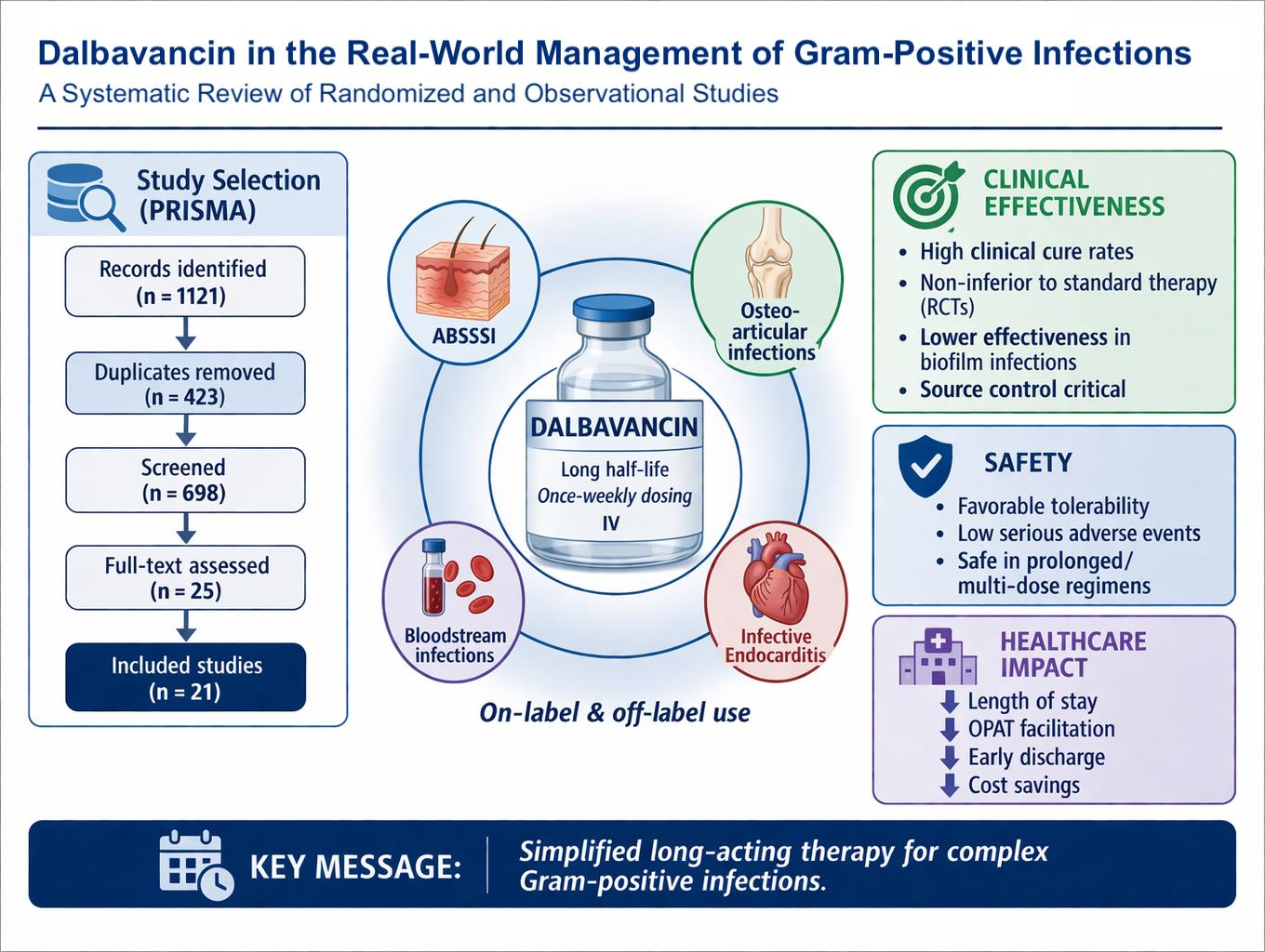
Dalbavancin in the Real-World Management of Gram-Positive Infections: A Systematic Review of Randomized and Observational Studies



Abstract
1. Introduction
2. Materials and Methods
2.1. Study Design and Registration
2.2. Search Strategy
2.3. Eligibility Criteria
- •
- Population: Adult patients (≥18 years) with confirmed or suspected Gram-positive infections.
- •
- Intervention: Dalbavancin, administered according to any approved or off-label dosing regimen.
- •
- Comparator: Standard intravenous antibiotics (e.g., vancomycin, daptomycin, or linezolid) or no comparator.
- •
- Outcomes: Clinical effectiveness and safety outcomes.
2.4. Study Selection and Data Extraction
2.5. Outcomes
2.6. Risk of Bias Assessment
2.7. Data Synthesis
3. Results
3.1. Randomized Studies
3.2. Skin and Soft Tissue Infections (ABSSSI)
3.3. Osteo-Articular Infections (Including Prosthetic Joint Infection)
3.4. Real-World Effectiveness Across Infection Types
3.5. Bloodstream Infections and IE
3.6. Study Quality
4. Discussion
5. Conclusions
Author Contributions
Funding
Institutional Review Board Statement
Informed Consent Statement
Data Availability Statement
Conflicts of Interest
References
- Jean, S.S.; Liu, I.M.; Hsieh, P.C.; Kuo, D.H.; Liu, Y.L.; Hsueh, P.R. Off-label use versus formal recommendations of conventional and novel antibiotics for the treatment of infections caused by multidrug-resistant bacteria. Int. J. Antimicrob. Agents 2023, 61, 106763. [Google Scholar] [CrossRef]
- Moffa, L.; Tana, C. Healthcare-Associated Infections (HAIs) in the Elderly: Molecular Mechanisms of Immunosenescence and Clinical, Nutritional and Therapeutic Implications. Int. J. Mol. Sci. 2025, 26, 9649. [Google Scholar] [CrossRef]
- Salvatore, D.; Moore, J.; Steuber, T.D. Long-acting lipoglycopeptides compared to standard-of-care for the treatment of complicated gram-positive infections: A systematic review and meta-analysis. Int. J. Antimicrob. Agents 2025, 66, 107581. [Google Scholar] [CrossRef]
- Childs-Kean, L.M.; Azimi, S.F.; Beieler, A.M.; Castellino, L.; Keller, S.C.; Pertzborn, M.; Yamshchikov, A.; Yoke, L.H.; Young, K.; Mahoney, M.V. A bundle of the top 10 OPAT publications in 2024. Antimicrob. Steward. Healthc. Epidemiol. 2026, 6, e20. [Google Scholar] [CrossRef]
- Moñino-Dominguez, L.; Aguado-Paredes, A.; Cordero-Ramos, J. Therapeutic drug monitoring of dalbavancin: A systematic review of strategies and clinical applications in the treatment of complex infections. Farm. Hosp. 2025, 49, T396–T406. [Google Scholar] [CrossRef] [PubMed]
- De Vito, A.; Fiore, V.; Colpani, A.; Zauli, B.; Fanelli, C.; Tiseo, G.; Occhineri, S.; Babudieri, S.; Falcone, M.; Madeddu, G. The current and future off-label uses of dalbavancin: A narrative review. Eur. Rev. Med. Pharmacol. Sci. 2023, 27, 1222–1238. [Google Scholar]
- Micheli, G.; Chiuchiarelli, M.; Taccari, F.; Fantoni, M. The role of long-acting antibiotics in the clinical practice: A narrative review. Infez. Med. 2023, 31, 449–465. [Google Scholar]
- Kufel, W.D.; Tudahl, K.; Hutson, P.; Mahapatra, R.; Rose, W.; Volk, C. Monthly dalbavancin dosing for suppressive therapy: A pharmacokinetic estimation analysis and case series. Antimicrob. Agents Chemother. 2026, 70, e0109225. [Google Scholar] [CrossRef]
- Tana, C.; Moffa, S.; Tana, M.; Ucciferri, C.; Moffa, L. Gut Microbiota, Mild Cognitive Impairment and Dementia: A Systematic Review. Neurol. Int. 2025, 17, 155. [Google Scholar] [CrossRef] [PubMed]
- Sterne, J.A.C.; Savović, J.; Page, M.J.; Elbers, R.G.; Blencowe, N.S.; Boutron, I.; Cates, C.J.; Cheng, H.Y.; Corbett, M.S.; Eldridge, S.M.; et al. Rob 2: A revised tool for assessing risk of bias in randomised trials. Br. Med. J. 2019, 366, L4898. [Google Scholar] [CrossRef] [PubMed]
- Rappo, U.; Puttagunta, S.; Shevchenko, V.; Shevchenko, A.; Jandourek, A.; Gonzalez, P.L.; Suen, A.; Mas Casullo, V.; Melnick, D.; Miceli, R.; et al. Dalbavancin for the Treatment of Osteomyelitis in Adult Patients: A Randomized Clinical Trial of Efficacy and Safety. Open Forum Infect. Dis. 2018, 6, ofy331. [Google Scholar] [CrossRef]
- Simon, S.; Frank, B.J.H.; Hartmann, S.; Hinterhuber, L.; Reitsamer, M.; Aichmair, A.; Dominkus, M.; Söderquist, B.; Hofstaetter, J.G. Dalbavancin in Gram-positive periprosthetic joint infections. J. Antimicrob. Chemother. 2022, 77, 2274–2277. [Google Scholar] [CrossRef]
- Tobudic, S.; Forstner, C.; Burgmann, H.; Lagler, H.; Steininger, C.; Traby, L.; Vossen, M.G.; Winkler, S.; Thalhammer, F. Real-world experience with dalbavancin therapy in gram-positive skin and soft tissue infection, bone and joint infection. Infection 2019, 47, 1013–1020, Erratum in Infection 2020, 48, 149. [Google Scholar] [CrossRef] [PubMed]
- Boucher, H.W.; Wilcox, M.; Talbot, G.H.; Puttagunta, S.; Das, A.F.; Dunne, M.W. Once-weekly dalbavancin versus daily conventional therapy for skin infection. N. Engl. J. Med. 2014, 370, 2169–2179. [Google Scholar] [CrossRef]
- McSorley, J.C.; Reyes, D.; Tonna, I.; Bateman, V. Experience with dalbavancin use in various gram-positive infections within Aberdeen Royal Infirmary OPAT service. Infection 2024, 52, 567–576. [Google Scholar] [CrossRef] [PubMed]
- McCarthy, M.W.; Keyloun, K.R.; Gillard, P.; Choi, J.J.; Pickell, N.; Copp, R.; Walsh, T.J. Dalbavancin Reduces Hospital Stay and Improves Productivity for Patients with Acute Bacterial Skin and Skin Structure Infections: The ENHANCE Trial. Infect. Dis. Ther. 2020, 9, 53–67. [Google Scholar] [CrossRef]
- Bai, F.; Mazzitelli, M.; Silvola, S.; Raumer, F.; Restelli, U.; Croce, D.; Marchetti, G.; Cattelan, A.M. Cost analysis of dalbavancin versus standard of care for the treatment of acute bacterial skin and skin structure infections (ABSSSIs) in two Italian hospitals. JAC Antimicrob. Resist. 2023, 5, dlad044. [Google Scholar] [CrossRef]
- Bai, F.; Aldieri, C.; Cattelan, A.; Raumer, F.; Di Meco, E.; Moioli, M.C.; Tordato, F.; Morelli, P.; Borghi, F.; Rizzi, M.; et al. Efficacy and safety of dalbavancin in the treatment of acute bacterial skin and skin structure infections (ABSSSIs) and other infections in a real-life setting: Data from an Italian observational multicentric study (DALBITA study). Expert. Rev. Anti-Infect. Ther. 2020, 18, 1271–1279. [Google Scholar] [CrossRef]
- Parruti, G.; Polilli, E.; Coladonato, S.; Rapacchiale, G.; Trave, F.; Mazzotta, E.; Bondanese, M.; Di Masi, F.; Recinelli, D.; Corridoni, S.; et al. Safety and Efficacy of Dalbavancin in Real Life: Retrospective Analysis of a Large Monocentric Case Series of Patients Treated for Skin/Soft Tissue and Other Difficult-to-Treat Infections. Antibiotics 2024, 13, 1063. [Google Scholar] [CrossRef] [PubMed]
- Rebold, N.; Alosaimy, S.; Pearson, J.C.; Dionne, B.; Taqi, A.; Lagnf, A.; Lucas, K.; Biagi, M.; Lombardo, N.; Eudy, J.; et al. Dalbavancin Sequential Therapy for Gram-Positive Bloodstream Infection: A Multicenter Observational Study. Infect. Dis. Ther. 2024, 13, 565–579. [Google Scholar] [CrossRef] [PubMed]
- Mairesse, R.; Gautie, L.; Merouani, M.; Bouige, A.; Fourcade, C.; Krin, G.; Marlin, P.; Giordano, G.; Baklouti, S.; Gandia, P.; et al. Dalbavancin for prosthetic joint infections: Empirical treatment. Infect. Dis. Now 2025, 55, 105035. [Google Scholar] [CrossRef] [PubMed]
- Arrieta-Loitegui, M.; Caro-Teller, J.M.; Ortiz-Pérez, S.; López-Medrano, F.; San Juan-Garrido, R.; Ferrari-Piquero, J.M. Effectiveness, safety and cost analysis of dalbavancin in clinical practice. Eur. J. Hosp. Pharm. 2022, 29, 55–58. [Google Scholar] [CrossRef]
- Hidalgo-Tenorio, C.; Vinuesa, D.; Plata, A.; Martin Dávila, P.; Iftimie, S.; Sequera, S.; Loeches, B.; Lopez-Cortés, L.E.; Fariñas, M.C.; Fernández-Roldan, C.; et al. DALBACEN cohort: Dalbavancin as consolidation therapy in patients with endocarditis and/or bloodstream infection produced by gram-positive cocci. Ann. Clin. Microbiol. Antimicrob. 2019, 18, 30. [Google Scholar] [CrossRef] [PubMed]
- Aparicio-Minguijón, E.; Boán, J.; Terrón, A.; Heredia, C.; Puente, C.; Pérez-Jacoiste Asín, A.; Orellana, M.Á.; Domínguez, L.; Caro, J.M.; López-Gude, M.J.; et al. Dalbavancin as sequential therapy in infective endocarditis: Real-life experience in elder and comorbid patients. Enferm. Infecc. Microbiol. Clin. (Engl. Ed.) 2025, 43, 86–92. [Google Scholar] [CrossRef]
- Hidalgo-Tenorio, C.; Sadyrbaeva-Dolgova, S.; Aparicio-Minguijón, E.; Alarcón, A.; Plata, A.; Martínez Marcos, F.J.; Álvarez-Álvarez, B.; Loeches, B.; Varisco, B.; Estévez, A.; et al. Real-world evidence of dalbavancin effectiveness as consolidation therapy in infective endocarditis due to Enterococcus spp. J. Microbiol. Immunol. Infect. 2025, 58, 429–436. [Google Scholar] [CrossRef]
- Hidalgo-Tenorio, C.; Sadyrbaeva-Dolgova, S.; Enríquez-Gómez, A.; Muñoz, P.; Plata-Ciezar, A.; Miró, J.M.; Alarcón, A.; Martínez-Marcos, F.J.; Loeches, B.; Escrihuela-Vidal, F.; et al. EN-DALBACEN 2.0 Cohort: Real-life study of dalbavancin as sequential/consolidation therapy in patients with infective endocarditis due to Gram-positive cocci. Int. J. Antimicrob. Agents 2023, 62, 106918. [Google Scholar] [CrossRef]
- Navarro-Jiménez, G.; Fuentes-Santos, C.; Moreno-Núñez, L.; Alfayate-García, J.; Campelo-Gutierrez, C.; Sanz-Márquez, S.; Pérez-Fernández, E.; Velasco-Arribas, M.; Hervás-Gómez, R.; Martín-Segarra, O.; et al. Experience in the use of dalbavancin in diabetic foot infection. Enferm. Infecc. Microbiol. Clin. (Engl. Ed.) 2022, 40, 296–301. [Google Scholar] [CrossRef] [PubMed]
- Brandariz-Núñez, D.; Luances-Rodríguez, A.; Feijoo-Vilanova, P.; Gutiérrez-Urbón, J.M.; Ramudo-Cela, L.; Martín-Herranz, M.I.; Margusino-Framiñán, L. Dalbavancin as consolidation therapy for infective endocarditis in patients with comorbidity. A real world experience. Rev. Esp. Quimioter. 2024, 37, 334–340. [Google Scholar] [CrossRef]
- Morata Ruiz, L.; Ruggieri, A.; Falcone, M.; Pasquau Liaño, J.; Gentile, I.; Salavert Lletí, M.; Moreno Núñez, L.; Cascio, A.; Tascini, C.; Loeches Yagüe, M.; et al. Dalbavancin real-life utilization among diabetic patients suffering from infections in Italy and Spain: The DALBADIA retrospective cohort study. J. Glob. Antimicrob. Resist. 2024, 36, 200–209. [Google Scholar] [CrossRef]
- Tordi, S.; Ricci, E.; Mezzadri, L.; Piconi, S.; Cicalini, S.; Cenderello, G.; Angioni, G.; Attala, L.; Maggi, P.; Madeddu, G.; et al. Clinical use of dalbavancin in the Italian SUSANA cohort (SUrveillance of SAfety and outcome of New Antibiotics). New Microbiol. 2025, 48, 35–45. [Google Scholar]
- Ciusa, G.; Pipitone, G.; Mancuso, A.; Agrenzano, S.; Imburgia, C.; Geraci, A.M.; D’Alcamo, A.; Moscarelli, L.; Cascio, A.; Iaria, C. One-Shot, One Opportunity: Retrospective Observational Study on Long-Acting Antibiotics for SSTIs in the Emergency Room-A Real-Life Experience. Pathogens 2025, 14, 781. [Google Scholar] [CrossRef] [PubMed]
- Moffa, L.; Tana, C.; Ucciferri, C.; Moffa, S.; Vecchiet, J.; Falasca, K. URO-RESIST: A Real-World Retrospective Study on Multidrug-Resistant Sepsis with Urinary Tract Infection, Clinical Predictors, Inflammatory Biomarkers, and Patient Outcomes. Antibiotics 2025, 14, 1036. [Google Scholar] [CrossRef] [PubMed]
- Tana, C.; Siniscalchi, C.; Cerundolo, N.; Meschi, T.; Martelletti, P.; Tana, M.; Moffa, L.; Wells-Gatnik, W.; Cipollone, F.; Giamberardino, M.A. Smart aging: Integrating AI into elderly healthcare. BMC Geriatr. 2025, 25, 1024. [Google Scholar] [CrossRef]
- Tana, C.; Soloperto, M.; Giuliano, G.; Erroi, G.; Di Maggio, A.; Tortorella, C.; Moffa, L. Artificial Intelligence for Predicting Lung Immune Responses to Viral Infections: From Mechanistic Insights to Clinical Applications. Viruses 2025, 17, 1482. [Google Scholar] [CrossRef] [PubMed]


| First Author, Year | Country | Study Design | Setting | Infection Type | Sample Size | Main Pathogen(s) | Dalbavancin Regimen | Comparator | Follow-Up |
|---|---|---|---|---|---|---|---|---|---|
| Rappo et al., 2019 [11] | Multicenter clinical trial/Ukraine | Randomized, open-label, comparator-controlled trial | Hospital-based | Osteomyelitis | Adults with first episode of osteomyelitis; n = 80 (DAL 70, SoC 10) | Staphylococcus aureus most common (60%) | 1500 mg IV on day 1 and day 8 | Standard of care (oral or IV antibiotics for 4–6 weeks) | Day 42, 6 months, 1 year |
| Simon et al., 2022 [12] | Multicenter database/Austria/Sweden | Retrospective propensity score-matched cohort | Orthopedic tertiary care centers | Periprosthetic joint infection (hip and knee) | n = 178 (DAL 89, SoC 89) | Staphylococcus epidermidis, S. aureus, Cutibacterium spp. | ≥ 2 doses dalbavancin (variable regimen) | Standard of care antibiotics | ≥ 1 year |
| Tobdic et al., 2019 [13] | Austria | Retrospective observational case series | Single tertiary care center | SSTI, osteomyelitis, spondylodiscitis, septic arthritis, PJI | n = 72 | S. aureus, S. epidermidis | Variable dalbavancin regimens | None | End of dalbavancin therapy |
| Boucher et al., 2014 [14] | Multinational | Phase 3 double-blind non-inferiority RCT (pooled DISCOVER 1 and 2) | Multicenter trial | ABSSSI | n = 1312 (DAL 659, SoC 653) | S. aureus and MRSA | IV dalbavancin on days 1 and 8 | IV vancomycin for ≥ 3 days with optional switch to oral linezolid | 48–72 h and end of therapy |
| James C McSorley et al., 2024 [15] | UK | Retrospective observational cohort | OPAT service/hospital-based real-world cohort | ABSSSI, bacteraemia, acute/chronic osteomyelitis, native joint septic arthritis, PJI | n = 102 | Staphylococcus aureus, epidermidis | IV dalbavancin on days 1 and 8 | None | End of treatment |
| McCarthy et al., 2020 [16] | USA | Single-center pre–post comparative study | Urban tertiary care hospital | ABSSSI | n = 91 (pre 48, post 43) | Staphylococcus aureus | Dalbavancin pathway in post-period | Usual care in pre-period | 44 days |
| Bai et al., 2023 [17] | Italy | Multicenter retrospective comparative study | 2 hospital-based centers | ABSSSI | n = 228 (DAL 102; SoC 126) | Staphylococcus aureus, S. epidermidis | Dalbavancin, first/second/later line; monotherapy or combination | Standard of care antibiotics | During treatment |
| Bai et al., 2020 [18] | Italy | Multicenter retrospective observational study | 11 hospital centers | ABSSSI (60.2%); other site infections (39.8%) | n = 206 | Staphylococcus aureus, S. epidermidis | ≥ 1 dose dalbavancin; often second-line or combination therapy | None | End of treatment |
| Parruti et al., 2024 [19] | Italy | Retrospective monocentric case series | Single-center real-world hospital cohort | ABSSSI (22%), bone/prosthetic infections (57%), cardiovascular infections (19%) | n = 100 | MSSA 30%, MRSA 5%, MR-CoNS 20%, Streptococcus spp. 8%, no isolate in 32 cases | Multiple dose dalbavancin regimes; mean of 5 infusions | None | 6 months |
| Rebold et al., 2024 [20] | USA | Multicenter retrospective observational cohort | 13-center hospital-based real-world study | Gram-positive bloodstream infection, including IE | n = 115 | Staphylococcus aureus (72%), coagulase-negative staphylococci (18%), Streptococcus spp. (16%) | Sequential dalbavancin therapy; most commonly single dose of 1500 mg | None | 90 days |
| Mairesse et al., 2025 [21] | France | Retrospective bicentric observational study | 2-center hospital-based cohort | Hip and knee prosthetic joint infection | n = 56 | Gram-positive cocci predominated; all Gram-positive isolates susceptible to dalbavancin | Dalbavancin in combination with piperacillin-tazobactam as empirical intra-operative treatment | None | 2 years |
| Arrieta-Loitegui et al., 2022 [22] | Spain | Retrospective observational single-center study | Tertiary hospital | Mixed Gram positive infections, off-label (catheter-related bacteremia and endocarditis) | n = 102 | Staphylococcus aureus, coagulase-negative staphylococci, Streptococcus spp. | Dalbavancin after prior antibiotic therapy | None | End of treatment and 3 months for infection-related readmission |
| Hidalgo-Tenorio et al., 2019 [23] | Spain | Multicenter retrospective observational cohort | Hospital-based multicenter cohort | Bloodstream infection and IE due to Gram-positive cocci | n = 83 | Staphylococcus aureus in BSI; coagulase-negative staphylococci in IE | Dalbavancin as consolidation therapy; at least 1 dose, regimen per clinical practice | None | In-hospital, 3 months, 1 year |
| Aparicio-Minguijón et al., 2025 [24] | Spain | Retrospective single-center observational cohort | Hospital-based real-world cohort | Definite IE due to Gram-positive bacteria | n = 61 | Staphylococcus aureus (26.3%), Enterococcus faecalis (21.3%) | Sequential dalbavancin therapy; most commonly 1500 mg every 14 days | None | 6 months |
| Hidalgo-Tenorio et al., 2025 [25] | Spain/France | Retrospective multicenter observational cohort | Multicenter hospital-based study | IE due to Enterococcus spp. | n = 98 | Enterococcus faecalis (86.7%), E. faecium (11.2%) | Dalbavancin consolidation therapy; median total dose of 2500 mg over 3.5 weeks | None | ≥12 months |
| Hidalgo-Tenorio et al., 2023 [26] | Spain | Retrospective multicenter observational cohort | Multicenter hospital-based study | IE due to Gram-positive cocci | n = 124 | CoNS (38.8%), Staphylococcus aureus (22.6%), Enterococcus faecalis (19.4%), Streptococcus spp. (9.7%) | Dalbavancin sequential/consolidation therapy | None | ≥12 months |
| Navarro-Jiménez et al., 2022 [27] | Spain | Retrospective descriptive single-center study | Multidisciplinary diabetic foot unit, second-level hospital | Diabetic foot infection with osteomyelitis | n = 23 | Staphylococcus aureus, Corynebacterium striatum | Prolonged weekly dalbavancin regimens; commonly 1000 mg then 500 mg weekly | None | 90 days after treatment |
| Brandariz-Núñez et al., 2024 [28] | Spain | Retrospective single-center observational cohort | Hospital-based real-world cohort | IE | n = 48 | Staphylococcus aureus (45.8%), Enterococcus spp. (31.3%) | Dalbavancin as consolidation therapy | None | End of treatment and 6 months |
| Morata Ruiz et al., 2024 (DALBADIA) [29] | Italy/Spain | Retrospective multicenter observational cohort | Multicenter real-world cohort | Mixed Gram-positive infections in diabetic patients (cellulitis, PJI, endocarditis, bacteraemia) | n = 97 | Staphylococcus aureus, Staphylococcus epidermidis, Enterococcus faecalis | Dalbavancin per clinical practice; one infusion in 34.8%, two infusions in 42.4% | None | End of observation |
| Tordi et al., 2025 (SUSANA cohort) [30] | Italy | Retrospective multicenter observational cohort | Multicenter real-world surveillance cohort | Mixed Gram-positive infections (on-label and off-label) | n = 281 | MRSA prominent in off-label targeted therapy; mixed pathogens | Dalbavancin per routine practice; on-label and off-label regimens | None | Not clearly specified in abstract |
| Ciusa et al., 2025 [31] | Italy | Retrospective observational cohort | Emergency room, tertiary care hospital | SSTIs | n = 19 | Staphylococcus aureus, Staphylococcus epidermidis, Enterococcus faecalis | Single-dose dalbavancin 1500 mg or oritavancin 1200 mg | None | 14 and 30 days |
| Study | Infection Type | Primary Effectiveness Outcome | Clinical Success/Cure | Relapse/Recurrence | Mortality | Main Findings |
|---|---|---|---|---|---|---|
| Rappo et al., 2019 [11] | Osteomyelitis | Clinical response at day 42 | 97% (65/67) DAL vs. 88% (7/8) SoC | Sustained response in DAL group at 6 months and 1 year (96%) | Not major outcome | Dalbavancin showed high cure rates and durable response |
| Simon et al., 2022 [12] | Periprosthetic joint infection (hip and knee) | Infection eradication/re-revision rates | 77.5% DAL vs. 74.2% SoC | Re-revision 14.6% DAL vs. 13.5% SoC | Not major outcome | Dalbavancin showed similar effectiveness to standard of care in PJI |
| Tobudic et al., 2019 [13] | Mixed Gram-positive infections | Clinical cure at the end of dalbavancin therapy | 64% achieved cure without additional antibiotics | Not reported | Not reported | Dalbavancin appeared most effective in acute SSTI, acute osteomyelitis, septic arthritis and spondylodiscitis; source control was critical in biofilm-associated infections |
| Boucher et al., 2014 [14] | ABSSSIs | Early clinical response at 48–72 h | 79.7% DAL vs. 79.8% vancomycin-linezolid; non-inferior | Not reported | Not reported | Dalbavancin was non-inferior to vancomycin-linezolid for ABSSSI |
| James C McSorley et al., 2024 [15] | Mixed Gram-positive infections | Cure at end of treatment | Overall cure achieved in 67%; ABSSSIs in 93%; bacteraemia in 100%; acute osteomyelitis in 90%; native joint septic arthritis in 75%; PJI in 33% | Suppressive success: chronic osteomyelitis 48% PJI 66% | Not reported as main outcome | Dalbavancin was effective in ABSSSI; poor source control was associated with worse outcomes in chronic bone/joint infections |
| McCarthy et al., 2019 [16] | ABSSSIs | Complete response during follow-up | 57% post-period vs. 50% pre-period | Not reported | Not reported as main outcome | Dalbavancin pathway achieved similar clinical response while reducing hospital stay |
| Bai et al., 2023 [17] | ABSSSIs | Comparative effectiveness in real-world practice | Dalbavancin associated with favorable effectiveness as first-line monotherapy | Not reported | Not reported | First-line dalbavancin monotherapy appeared efficacy for ABSSSI management |
| Bai et al., 2020 [18] | ABSSSIs and other site infections | Clinical cure at end of treatment | Overall, 82% achieved clinical cure; ABSSSI 85.5% vs. OTA 75% (NS) | Not reported | Not reported | High effectiveness across indications; similar efficacy in ABSSSIs and off-label infections |
| Parruti et al., 2024 [19] | Mixed Gram-positive infections | Clinical success at follow-up | 84% for registered indications; unregistered indications | Not reported | Not reported | Dalbavancin showed favorable effectiveness in label and off label infections; higher loading doses were associated with better outcomes |
| Rebold et al., 2024 [20] | Gram-positive bloodstream infection | Composite clinical failure at 90 days | Composite clinical failure in 12.2% | 90-day BSI recurrence 3.5% | 90-day mortality 7.0% | Dalbavancin appeared useful as sequential therapy in Gram-positive BSI, particularly to facilitate hospital discharge |
| Mairesse et al., 2025 [21] | Prosthetic joint infection | Absence of relapse during 2-year follow-up | Cure rate 91.5% | Treatment failure in 4 patients | Not reported as main outcome | Empirical dalbavancin-based combination therapy was associated with high 2-year cure rates in PJI |
| Arrieta-Loitegui et al., 2022 [22] | Mixed Gram-positive infections | Clinical and microbiological resolution plus no admission due to same infection within 3 months | 93.7% clinical and microbiological resolution | No infection-related admission within 3 months included in effectiveness definition | Not emphasized | Dalbavancin was effective in routine practice, particularly as an off-label discharge strategy |
| Hidalgo-Tenorio et al., 2019 [23] | BSI and IE | Clinical response during hospitalization, at 3 months and 1 year | IE effectiveness 96.7%; BSI clinical cure 100% during hospitalization and at 3 months | IE therapeutic failure in 2.9%; no BSI recurrence reported | IE: 8.8% mortality unrelated to IE; no BSI deaths reported | Dalbavancin was effective as consolidation therapy in clinically stabilized patients with IE and BSI |
| Aparicio-Minguijón et al., 2025 [24] | IE | Clinical cure at 6 months | 86.9% clinically cured | 1.6% relapse | 11.5% 6-month mortality; 1.6% IE-related death | Dalbavancin showed high effectiveness as sequential therapy in elderly and comorbid IE patients |
| Hidalgo-Tenorio et al., 2025 [25] | Enterococcal IE | Clinical cure at ≥12 months | 81.2% clinically cured | 8.2% relapse | 3.1% 1-year IE-related mortality | Dalbavancin appeared effective as consolidation therapy for enterococcal IE, particularly when combined with adequate source control/surgery |
| Hidalgo-Tenorio et al., 2023 [26] | IE | Effectiveness at 12 months | 95.9% effectiveness | 3.2% relapse | 0.8% IE-related death | Dalbavancin was highly effective as sequential/consolidation therapy in Gram-positive IE |
| Navarro-Jiménez et al., 2022 [27] | Diabetic foot infection/osteomyelitis | Cure at 90 days after treatment completion | 87% (20/23) | Not reported | Not reported | Dalbavancin showed high cure as part of multidisciplinary treatment for diabetic foot osteomyelitis |
| Brandariz-Núñez et al., 2024 [28] | Infective endocarditis | Effectiveness at the end of treatment and 6 months | 93.8% at the end of treatment; 77% at 6 months | 2 relapses at 6 months | 6 IE-related deaths and 4 unrelated deaths at 6 months | Dalbavancin was effective as consolidation therapy in elderly/comorbid IE patients, although effectiveness declined over follow-up due to relapse and mortality |
| Morata Ruiz et al., 2024 (DALBADIA) [29] | Mixed Gram-positive infections in diabetic patients | Clinical cure or improvement at end of observation | 91.9% clinically cured | Not reported | Not reported | Dalbavancin showed high rates of positive clinical response in diabetic patients across multiple infection types |
| Tordi et al., 2025 (SUSANA cohort) [30] | Mixed Gram-positive infections | Clinical cure or infection control | 82.7% on-label; 84% off-label | Not reported | Not reported | Dalbavancin showed comparable effectiveness in both approved and off-label indications |
| Ciusa et al., 2025 [31] | SSTIs | Clinical resolution at day 14 | 84% achieved clinical resolution at 14 days | 10% recurrence at 30 days | Not reported | Long-acting lipoglycopeptides appeared effective in ER-managed SSTIs and support early discharge |
| Study | Adverse Events | Serious Adverse Events | Discontinuation Due to AE | Specific Safety Notes | Safety Conclusion |
|---|---|---|---|---|---|
| Rappo et al., 2019 [11] | AEs reported in 10 dalbavancin-treated patients | Not emphasized as major issue | None | Dalbavancin was well tolerated | Favorable safety profile |
| Simon et al., 2022 [12] | Low rate of adverse events | Not detailed | None | Dalbavancin was well tolerated | Favorable safety profile |
| Tobudic et al., 2019 [13] | 4/72 (5%) AEs | Not emphasized | Not reported | Nausea, rash/exanthema, hyperglycemia | Favorable safety profile |
| Boucher et al., 2014 [14] | AEs less frequent with dalbavancin | Not reported | Not reported | Nausea, diarrhea, pruritus | Favorable safety profile compared with vancomycin-linezolid |
| James C McSorley et al., 2024 [15] | 14/102 AEs | Not reported | Not reported | Real-world tolerability acceptable | Dalbavancin was well tolerated |
| McCarthy et al., 2019 [16] | Possible dalbavancin-related AEs in 17% (7 patients) | Serious AEs: 7% post-period vs. 2% pre-period | Non reported | Few serious AEs overall | Acceptable safety |
| Bai et al., 2020 [18] | 11/206 (5.4%) non-serious AEs | Not reported | Not reported | No major safety concerns reported | Favorable safety profile in real-world use |
| Parruti et al., 2024 [19] | 2 mild skin rashes | Not reported | Not reported | No renal toxicity, neutropenia or thrombocytopenia observed during treatment or follow-up | Favorable safety profile in prolonged multi dose use |
| Mairesse et al., 2025 [21] | Few adverse events, mainly digestive (diarrhea, pain) | Not clearly reported | Not reported | Tolerability appeared favorable | Dalbavancin-based empirical therapy was generally well tolerated |
| Arrieta-Loitegui et al., 2022 [22] | One allergic reaction during infusion | Not otherwise | 1 patient did not complete infusion | Overall good tolerability | Favorable safety profile in real-world off-label use |
| Aparicio-Minguijón et al., 2025 [24] | AEs in 8.2% of patients | Only one event (1.6%) attributed to dalbavancin (infusion reaction) | Not clearly reported as discontinuation | Overall excellent tolerability | Favorable safety profile in elderly/comorbid IE patients |
| Hidalgo-Tenorio et al., 2025 [25] | Minimal adverse events reported | Severe AEs in 1% (acute tubular necrosis) | Not clearly reported | Overall good tolerability | Favorable safety profile in enterococcal IE consolidation therapy |
| Navarro-Jiménez et al., 2022 [27] | Mild side effects in 3 patients (nausea/GI discomfort) | None reported | Not reported | Good tolerability during prolonged treatment | Favorable safety profile |
| Brandariz-Núñez et al., 2024 [28] | Dalbavancin related AEs in 4.2% | Serious AEs in 2% | Not clearly reported | Few treatment-related adverse effects | Favorable safety profile |
| Tordi et al., 2025 (SUSANA cohort) [30] | Few AEs overall | One grade-3 AE in each cohort | Only 1 AE led to discontinuation | Good tolerability in both on-label and off-label use | Favorable safety profile |
| Study | Length of Stay Impact | Readmission | Economic Findings | Resource-Use Conclusion |
|---|---|---|---|---|
| James C McSorley et al., 2024 [15] | OPAT use implied avoidance of prolonged inpatient treatment | Not reported | Not reported | Dalbavancin supported outpatient management of deep-seated infections |
| McCarthy et al., 2019 [16] | Mean infection-related LOS reduction from 4.8 to 3.2 days | Not reported | Not reported | Dalbavancin reduced hospital stay and improved work productivity impairment |
| Bai et al., 2023 [17] | LOS reduction with dalbavancin (5.0 vs. 9.2 days) | Not reported | Lower mean direct medical costs with dalbavancin | Dalbavancin as first-line monotherapy reduced LOS and supported cost-saving ABSSSI management |
| Bai et al., 2020 [18] | Longer LOS in OTA vs. ABSSSI (13.5 vs. 3 days) | Not reported | Not reported | Dalbavancin used across settings; more complex infections required longer hospitalization |
| Rebold et al., 2024 [20] | Dalbavancin used to facilitate hospital discharge after median 10 days from index culture | Composite failure includes healthcare reutilization at 90 days | Not reported | Sequential dalbavancin may support earlier discharge in patients requiring prolonged parenteral therapy |
| Arrieta-Loitegui et al., 2022 [22] | Median reduction in LOS of 14 | No admission due to same infection within 3 months included in effectiveness outcome | Estimated saving of ~€4550 per patient | Dalbavancin facilitated early discharge and outpatient management |
| Hidalgo-Tenorio et al., 2019 [23] | Hospital stay reduction of 636 days for BSI and 557 days for IE | No BSI recurrence/readmission reported in follow-up | Estimated savings: €315,424.20 for BSI and €283,187.45 for IE | Dalbavancin consolidation therapy reduced hospital stay and appeared cost-effective |
| Aparicio-Minguijón et al., 2025 [24] | Total hospitalization reduction of 1090 days | Not specifically reported | Not directly reported | Dalbavancin allowed substantial reduction in in-hospital stay in sequential IE therapy |
| Hidalgo-Tenorio et al., 2025 [25] | Hospital stay reduction of 21 days (14–28) | Not specifically reported | Not directly reported | Dalbavancin facilitated discharge in 88.8% of patients and substantially reduced hospitalization |
| Brandariz-Núñez et al., 2024 [28] | Dalbavancin mainly used to facilitate OPAT (85.4%) | Not specifically reported | Not directly reported | Dalbavancin as consolidation therapy in comorbid IE patients |
| Ciusa et al., 2025 [31] | 74% discharged without hospital admission | No readmission reported | Not reported | ER use of long-acting lipoglycopeptides supported early discharge and reduced hospitalization burden |
| Study | Selection Bias | Deviations from Intended Interventions | Missing Outcome Data | Outcome Measurement | Overall |
|---|---|---|---|---|---|
| Boucher et al., 2014 [14] | Low | Low | Low | Low | Low risk |
| Rappo et al., 2019 [11] | Some concerns | Some concerns | Low | Some concerns | Some concerns |
| Simon et al., 2022 [12] | Low | Low | Low | Low | Moderate–high quality |
| Bai et al., 2023 [17] | Some concerns | Some concerns | Low | Low | Moderate quality |
| McCarthy et al., 2020 [16] | Some concerns | Some concerns | Some concerns | Low | Moderate–low quality |
| Tobdic et al., 2019 [13] | Some concerns | Some concerns | Some concerns | Some concerns | Moderate quality |
| McSorley et al., 2024 [15] | Some concerns | Some concerns | Some concerns | Some concerns | Moderate quality |
| Parruti et al., 2024 [19] | Some concerns | Some concerns | Low | Low | Moderate quality |
| Arrieta-Loitegui et al., 2020 [22] | Some concerns | Some concerns | Low | Low | Moderate quality |
| Hidalgo-Tenorio et al., 2019 (DALBACEN) [23] | Low | Low | Low | Low | Moderate–high quality |
| Aparicio-Minguijón et al., 2024 [24] | Some concerns | Some concerns | Low | Low | Moderate quality |
| Hidalgo-Tenorio et al., 2025 [25] | Low | Low | Low | Low | Moderate–high quality |
| Hidalgo-Tenorio et al., 2023 (EN-DALBACEN 2.0) [26] | Low | Low | Low | Low | Moderate–high quality |
| Brandariz-Núñez et al., 2024 [28] | Some concerns | Some concerns | Some concerns | Low | Moderate quality |
| Navarro-Jiménez et al., 2022 [27] | Some concerns | Some concerns | Some concerns | Low | Moderate quality |
| Morata Ruiz et al., 2024 (DALBADIA) [29] | Some concerns | Some concerns | Some concerns | Low | Moderate quality |
| Tordi et al., 2025 (SUSANA) [30] | Low | Low | Low | Low | Moderate–high quality |
| Ciusa et al., 2025 [31] | Some concerns | Some concerns | Some concerns | Some concerns | Moderate–low quality |
| Mairesse et al., 2025 [21] | Some concerns | Some concerns | Low | Low | Moderate quality |
| Rebold et al., 2024 [20] | Low | Low | Low | Low | Moderate–high quality |
| Bai et al., 2020 (DALBITA) [18] | Some concerns | Some concerns | Some concerns | Low | Moderate quality |
Disclaimer/Publisher’s Note: The statements, opinions and data contained in all publications are solely those of the individual author(s) and contributor(s) and not of MDPI and/or the editor(s). MDPI and/or the editor(s) disclaim responsibility for any injury to people or property resulting from any ideas, methods, instructions or products referred to in the content. |
© 2026 by the authors. Licensee MDPI, Basel, Switzerland. This article is an open access article distributed under the terms and conditions of the Creative Commons Attribution (CC BY) license.
Share and Cite
Tana, C.; Moffa, L.; Tana, M.; Moffa, S.; Ucciferri, C. Dalbavancin in the Real-World Management of Gram-Positive Infections: A Systematic Review of Randomized and Observational Studies. Microorganisms 2026, 14, 1071. https://doi.org/10.3390/microorganisms14051071
Tana C, Moffa L, Tana M, Moffa S, Ucciferri C. Dalbavancin in the Real-World Management of Gram-Positive Infections: A Systematic Review of Randomized and Observational Studies. Microorganisms. 2026; 14(5):1071. https://doi.org/10.3390/microorganisms14051071
Chicago/Turabian StyleTana, Claudio, Livia Moffa, Marco Tana, Samanta Moffa, and Claudio Ucciferri. 2026. "Dalbavancin in the Real-World Management of Gram-Positive Infections: A Systematic Review of Randomized and Observational Studies" Microorganisms 14, no. 5: 1071. https://doi.org/10.3390/microorganisms14051071
APA StyleTana, C., Moffa, L., Tana, M., Moffa, S., & Ucciferri, C. (2026). Dalbavancin in the Real-World Management of Gram-Positive Infections: A Systematic Review of Randomized and Observational Studies. Microorganisms, 14(5), 1071. https://doi.org/10.3390/microorganisms14051071