Article

Screening and Evaluation In Vitro of Bacillus-Based Probiotics for Feed Additives

1
College of Life Sciences, Fujian Agriculture and Forestry University, Fuzhou 350002, China
2
Fujian Engineering and Technology Research Center for Recycling Agriculture in Hilly Areas, Institute of Resources, Environment and Soil Fertilizer, Fujian Academy of Agricultural Sciences, Fuzhou 350003, China
3
College of Animal Science, Fujian Agriculture and Forestry University, Fuzhou 350002, China
*
Authors to whom correspondence should be addressed.
Microorganisms 2026, 14(4), 834; https://doi.org/10.3390/microorganisms14040834
Submission received: 20 January 2026 / Revised: 25 March 2026 / Accepted: 29 March 2026 / Published: 7 April 2026
(This article belongs to the Section Microbial Biotechnology)

Abstract

In the post-antibiotic era, the Bacillus-based direct-fed beneficial microorganisms are emerging as a cornerstone for sustainable animal farming. This study aimed to screen and evaluate Bacillus strains with probiotic potential for use as feed additives. A total of 394 Bacillus strains were initially screened based on their extracellular enzyme production (cellulase, protease, and amylase) and antibacterial activities against Escherichia coli, Staphylococcus aureus, and Salmonella enterica. Two strains, Bacillus velezensis FJAT-10508 and FJAT-13563, were selected and subsequently subjected to in vitro probiotic characterization, safety assessment, and whole-genome analysis. The results demonstrated that both strains exhibited α-hemolysis, acceptable antibiotic susceptibility profiles, absence of invasion and cytotoxicity effect on the Caco-2 cells, and no mobile virulence or antibiotic resistance genes, indicating their safety as probiotic candidates. High endospore-forming efficiencies (72.4–90.8%), strong auto-aggregation (74–85%) and co-aggregation abilities (52–82%) were observed. In addition, both strains showed considerable tolerance to simulated gastrointestinal conditions, with vegetative cell and endospore survival rates of 28.33–38.33% and 85–89.67% at pH 2.0, and 38.33–43.33% and 90.33–96.33% in 0.3% bile salts, respectively. Overall, B. velezensis FJAT-10508 and FJAT-13563 demonstrated robust in vitro probiotic properties, supporting their potential application as reliable Bacillus-based feed additives.

1. Introduction

In the livestock and poultry industry, antibiotics are not only extensively used to treat bacterial infections but also employed as non-therapeutic growth promoters to enhance the production efficiency of animals [1,2]. However, long-term and excessive use of antibiotics has resulted in significant issues, including antibiotic residue contamination of livestock products and the emergence of antimicrobial-resistant bacteria (ARB) [3]. Furthermore, the development and horizontal transfer of antibiotic-resistant genes (ARGs) among bacteria, the disruption of normal microbiota, and the corresponding decline in beneficial intestinal bacteria are all associated with the overuse of antibiotics [2,4]. These concerns have intensified global efforts to reduce antibiotic dependence in animal production systems. Therefore, identifying antibiotic alternatives that do not compromise animal production performance or escalate industry costs has become a critical challenge for sustainable animal farming. Currently, the most widely utilized antibiotic alternatives include enzymes, acidifiers, antimicrobial peptides, phages, probiotics, and plant extracts. Among these alternatives, probiotics administered in the form of live bacteria can directly colonize the intestine and rapidly exert beneficial effects through mechanisms such as ecological niche occupation, organic acid production, and antimicrobial substance synthesis [5,6].
The Food and Agriculture Organization of the United Nations/World Health Organization (FAO/WHO) defines probiotics as follows: “Probiotics are a category of live microorganisms. When an adequate number of these live bacteria reach the host’s intestines and successfully establish themselves, they can modify the balance of the host’s intestinal microbiota, thereby exerting a beneficial health effect on the host.” [7]. Therefore, direct-fed beneficial microorganisms are emerging as a cornerstone for sustainable animal farming in the post-antibiotic era [8]. Currently, the commonly used probiotics in feed and animal husbandry mainly originate from lactic acid bacteria, Bifidobacteria, and the Bacillus-like bacteria [9]. However, beneficial microorganisms such as lactic acid bacteria and Bifidobacteria generally exhibit limited tolerance to the high temperatures encountered during feed pelletization, resulting in reduced shelf-life and compromised efficacy in conventional animal production systems [10]. In contrast, Bacillus-like bacteria have attracted increasing attention due to their superior stability and functional versatility [11,12]. These bacteria can enhance animal growth performance, optimize feed utilization efficiency, exhibit antioxidant properties, and help maintain intestinal microbial balance [13,14]. Importantly, their endospore-forming capability confers resistance to harsh processing, storage conditions, and gastrointestinal transit [15,16]. For instance, Ramulken et al. [17] demonstrated that Bacillus endospores could retain approximately 90% viability during probiotic harvesting, with a potential shelf-life of up to five years. These attributes make Bacillus-like bacteria particularly suitable for modern feed industry applications. Among them, the species Bacillus velezensis, which is widely used a plant growth-promoting bacterium and biocontrol agent of plant pathogens, is now increasingly utilized as a direct-fed probiotic in animal feed [18,19].
Numerous studies have indicated that the Bacillus–like bacteria can secrete extracellular digestive enzymes, which can significantly increase the daily weight gain and growth rate of animals by improving the digestibility of feed [20,21,22]. Currently, the commonly used digestive enzymes on the market include cellulase, amylase, and protease. Cellulase breaks down the β-1, 4 glycosidic bonds in cellulose within the cell walls of grains, destroying their structure and releasing absorbable nutrients such as glucose, thereby enhancing the energy value of feed and the absorption and utilization rate of cellulose by animals [23]. The addition of protease can further enhance the utilization rate of protein, meeting the rapid growth demands of animals for amino acids [24]. Alpha-amylase can randomly cleave the α-1, 4 bonds in starch, rapidly reducing viscosity and generating maltodextrins, thereby increasing the metabolic energy of animals [25]. Thus, supplementing diets with selected enzymes can effectively counter the poor degradability of highly structured feed components, especially in monogastric animals [26]. By depolymerising non-starch polysaccharides, exogenous enzymes can lower digest viscosity and release low-molecular-weight carbohydrates, thereby improving nutrient utilization [27,28]. Bacillus spp. contribute to this process through the secretion of extracellular enzymes (such as cellulases, amylases, and proteases), which enhance the accessibility of otherwise refractory nutrients [20] and elevate the energy value of the diet, resulting in greater feed efficiency [29,30]. For example, Bacillus subtilis KT004404, capable of producing multiple enzymes, significantly improved feed conversion efficiency and weight gain in broilers [20].
Furthermore, Bacillus-like bacteria can modulate the intestinal environment, suppressing pathogenic microorganisms while promoting beneficial microbial populations [11,31,32,33]. These effects are mediated by the production of bioactive compounds, including bacteriocins, organic acids, and secondary metabolites, such as lipopeptides, which inhibit pathogens such as Escherichia coli (E. coli), Staphylococcus aureus (St. aureus), and Salmonella enterica (Sa. enterica) [34,35]. For example, oral administration of B. subtilis GX15 significantly alleviated clinical symptoms and reduced intestinal and hepatic tissue damage in *Salmonella*-infected mice [36].
In this study, the Bacillus-based probiotic candidates were screened from a repository of 394 isolates, according to their extracellular-enzyme-producing abilities and antibacterial activities against E. coli, St. aureus and Sa. enterica. Subsequently, their probiotic credentials and safety indices, including aggregation, sporulation efficiency, acid/bile-salt tolerance, antibiotic susceptibility, prediction of putative virulence factors and ARGs, and haemolytic potential, were systematically evaluated. Our work would thereby provide probiotic candidates for formulating Bacillus-based feed additives.

2. Materials and Methods

2.1. Strains and Growth Conditions

The 394 Bacillus strains (listed in Table S1) and the pathogen strains (E. coli ATCC 25922, St. aureus ATCC 25923, and Sa. enterica ATCC 14028) used in this study were all preserved in the Fujian Bacilli Resource Collection Center (FBRCC), Institute of Resources, Environment, and Soil Fertilization, Fujian Academy of Agricultural Sciences. The taxonomic identification of each Bacillus strain was conducted by FBRCC through 16S rRNA and gyrB sequence analyses. Unless otherwise stated, all reagents used in this study were purchased from China National Biotec Group Co., Ltd., Beijing, China.
The Bacillus and pathogenic strains were all cultured using Luria–Bertani (LB) media (10 g tryptone, 5 g yeast extract, 10 g NaCl per 1 L distilled water, pH 7.0). Briefly, each strain was initially streaked onto a LB agar plate and incubated at 37 °C for 24 h to obtain single colonies. A single colony was then inoculated into LB broth and cultured overnight (14–16 h) at 37 °C with shaking at 180 rpm.
To harvest endospores, a single colony of each Bacillus strain was inoculated into Schaeffer’s sporulation medium (SSM) [8 g nutrient broth, 0.12 g MgSO4, 1 g KCl, 0.5 mM NaOH, 1 mM Ca(NO3)2, 0.01 M MnCl2, and 1 M FeSO4 per 1 L distilled water, pH 7.0] [37] and cultured at 37 °C with shaking at 180 rpm for 48 h.

2.2. Screening of Extracellular Digestion Enzyme-Producing Bacillus Strains

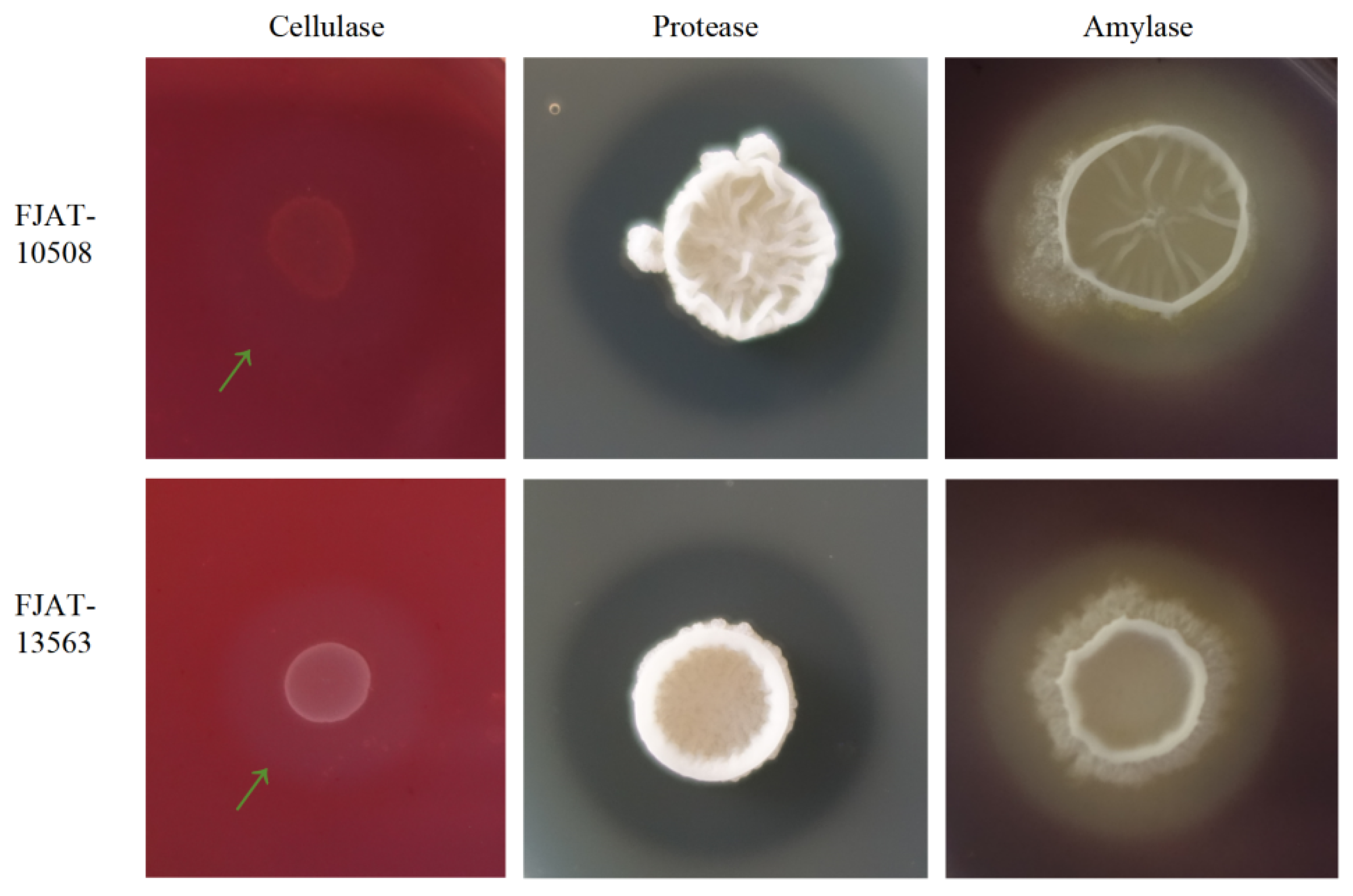
All the 394 Bacillus strains were initially assessed their extracellular cellulase-, amylase-, and protease-producing capabilities by using the transparent ring method. Firstly, each Bacillus strain was inoculated into 5 mL LB broth and grown overnight at 37 °C with shaking at 180 rpm. Each obtained culture was adjusted to 1.0 × 10⁸ CFU·mL−1 (OD600nm = 0.5). Subsequently, 2 μL cultures of each Bacillus strain were dropped onto the surface of the cellulose agar (10 g sodium carboxymethyl cellulose (CMC-Na), 5 g yeast extract, 5 g peptone, 5 g NaCl, 15 g agar per 1 L distilled water, pH 7.0), starch agar (3 g beef extract, 10 g peptone, 20 g soluble starch, 10 g agar per 1 L distilled water, pH 7.0), and skimmed milk agar (3 g beef extract, 10 g peptone, 50 g skimmed milk powder, and 10 g agar per 1 L distilled water, pH 7.0) plates (90 mm) with three replicates per strain alongside a blank control, respectively. These plates were incubated statically at 37 °C for two days to observe whether any hydrolysis rings had formed (iodine solution was added to visualize starch hydrolysis rings). Finally, the diameters of colonies (d) and hydrolysis rings (D) were measured with a digital caliper. The D/d ratio value was used to preliminarily estimate extracellular cellulose-, amylase-, and protease-producing activities of each Bacillus strain.

2.3. Screening of the Bacillus Strains with Antibacterial Activities Against Three Pathogens

The double-layer agar method was employed to preliminarily assess the antibacterial activity of each Bacillus strain against three common pathogens: E. coli, St. aureus, and Sa. enterica found in livestock and poultry. Firstly, each Bacillus strain and pathogenic strain was separately inoculated into 5 mL LB broth and grown overnight at 37 °C with shaking at 180 rpm. Semi-solid LB agar media containing 200 μL of pathogenic cultures (1.0 × 10⁸ CFU·mL−1) were poured onto the Petri plates (90 mm) coated with LB solid media. After solidification, 2 μL cultures (1.0 × 10⁸ CFU·mL−1) of each Bacillus strain were dropped onto the surface of the two-layer plates with three replicates per strain, and then co-cultivated at 37 °C for one or two days. The clear zone formed around the Bacillus colonies indicated the growth inhibition of the tested pathogen, and then the diameters (mm) of the inhibition zones were measured using a digital calliper to evaluate the inhibitory capacity of each Bacillus strain against different pathogenic bacteria.
Comprehensively considering the analysis results of extracellular-enzyme producing abilities and antibacterial activities against E. coli, St. aureus, and Sa. enterica, the strains FJAT-10508 and FJAT-13563 were ultimately selected for further studies.

2.4. Genome Sequencing and Analyses of FJAT-10508 and FJAT-13563

Genome sequencing, assembly, and annotation were all performed by Shanghai Majorbio Biopharmaceutical Technology Co., Ltd. (Shanghai, China) and genomic analyses were performed through the online tools of Majorbio Cloud Platform (https://www.majorbio.com/tools, accessed on 26 December 2025) [38]. Briefly, genomic DNA from FJAT-10508 and FJAT-13563 was separately extracted from overnight cultures grown at 37 °C in LB broth using the Promega Wizard Genomic DNA Purification Kit (Madison, WI, USA). The concentration, quality, and integrity of genomic DNA were determined using a Qubit Fluorometer and a NanoDrop spectrophotometer (Thermo Fisher Scientific, Waltham, MA, USA), respectively. For genome sequencing, PacBio RS II (Pacific Biosciences, Menlo Park, CA, USA) and Illumina NovaSeq X Plus (Illumina, San Diego, CA, USA) platforms were used. Hybrid reads were assembled de novo using Unicycler (SPAdes v 4.0.0). The gene prediction and functional annotation were performed with Glimmer, followed by BLAST searches against the NCBI Non-Redundant Protein Database (NR; https://ftp.ncbi.nlm.nih.gov/blast/db, accessed on 26 December 2025), Swiss-Prot (https://www.expasy.org/resources/uniprotkb-swiss-prot, 26 December 2025), Clusters of Orthologous Groups of proteins (COG; https://www.ncbi.nlm.nih.gov/research/cog-project/, accessed on 26 December 2025), Gene Ontology (GO; https://www.geneontology.org, accessed on 26 December 2025), and the Kyoto Encyclopedia of Genes and Genomes (KEGG; https://www.genome.jp/kegg/, accessed on 26 December 2025).
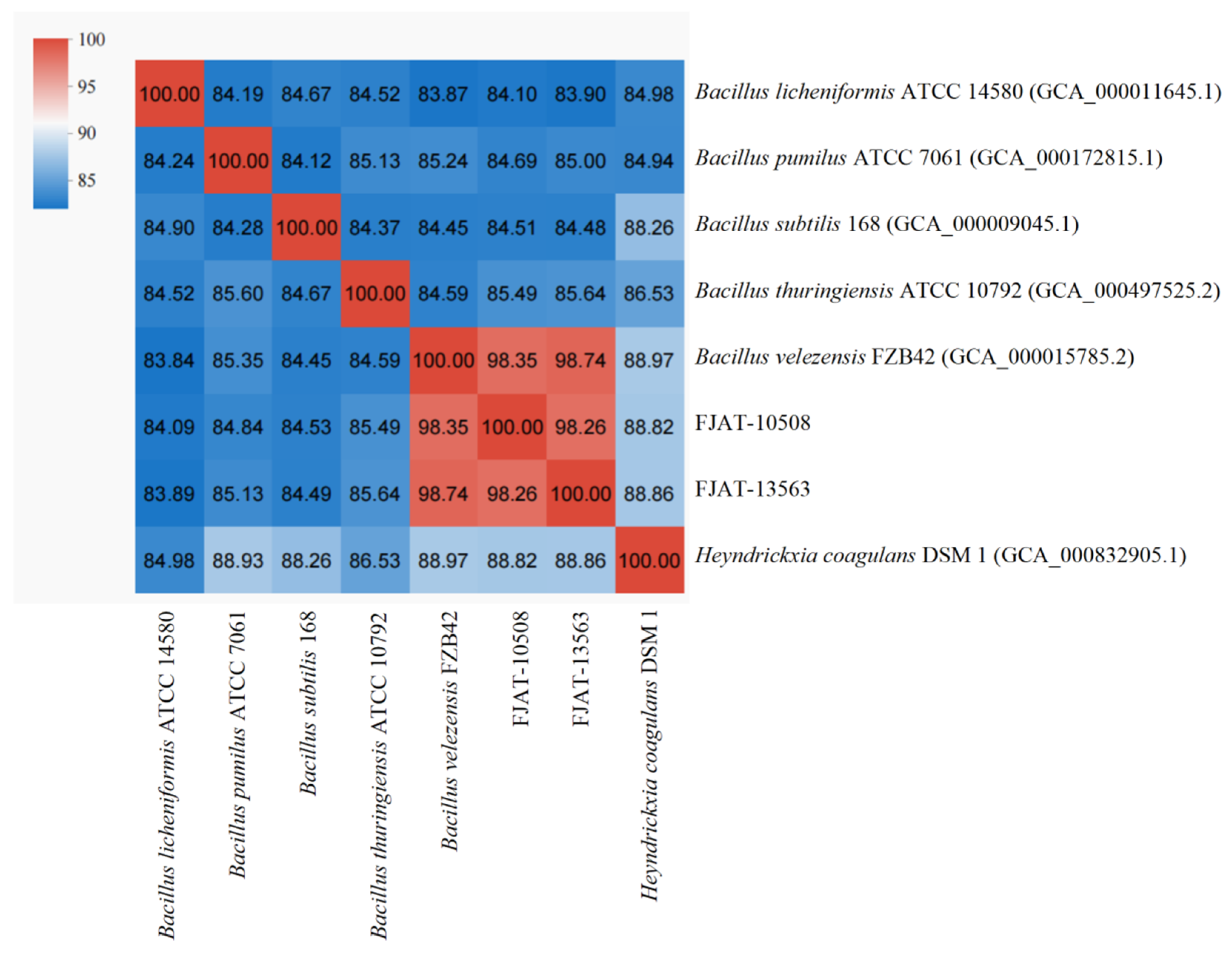
Putative virulence genes and AGRs were predicted by using the Virulence Factor Database (VFDB) [39] and the Comprehensive Antibiotic Resistance Database (CARD) [40], respectively. A pangenome analysis of 435 B. velezensis genomes (including all NCBI complete genomes and FJAT-10508 and FJAT-13563) was performed using PGAP2 (https://github.com/bucongfan/PGAP2, accessed on 26 December 2025) [41], and the putative virulence genes of FJAT-10508 and FJAT-13563 were mapped to pangenome categories, respectively. Mobilome (plasmids, prophages, insertion sequences, inverted repeat elements, and compositional outlier regions) annotation of the FJAT-10508 and FJAT-13563 genomes was performed by using the Mobilome Annotation Pipeline developed by EBI-Metagenomics (https://github.com/EBI-Metagenomics/mobilome-annotation-pipeline, accessed on 26 December 2025). Biosynthetic gene clusters (BGCs) potentially involved in antimicrobial metabolite production were searched using antiSMASH 7.0 [42]. The average nucleotide identity (ANI) values of strains FJAT-10508 and FJAT-13563 with phylogenetically related strains were calculated using the Ortho ANIu algorithm [43], with an ANI cut-off of 96% for species delineation [44].

2.5. Activity Determination of FJAT-10508 and FJAT-13563 Antibacterial Compounds Enriched by Acid Precipitation

Firstly, the cell-free supernatants of FJAT-10508 and FJAT-13563 were harvested from the cultures in LB broth at 25 °C with shaking at 180 rpm for 48 h by centrifugation (4000× g, 10 min, 4 °C) and adjusted to pH 2.0 with 3 M HCl to precipitate antibacterial compounds, respectively. After overnight storage at 4 °C, the precipitates were collected by centrifugation (10,000× g, 10 min, 4 °C), re-dissolved in phosphate-buffered saline solution (PBS, pH 6.8), lyophilized, and stored as a dry powder at –20 °C until required. Immediately prior to bioassays, the lyophilized powder was dissolved in sterile ddH2O to prepare a solution of the antibacterial compound at a final concentration of 30 mg·mL−1 for antibacterial activity testing.
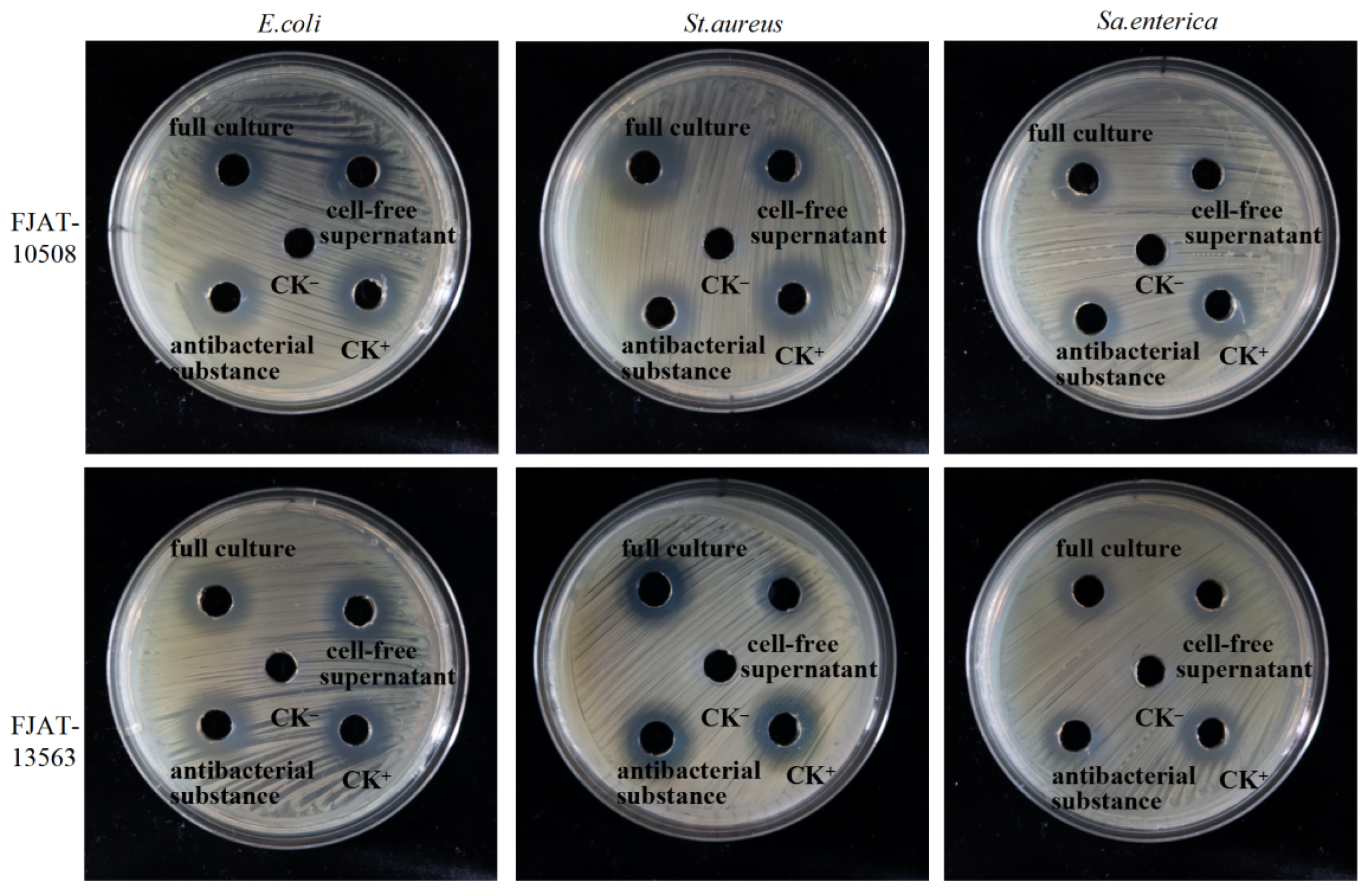
Antibacterial activities of the compounds enriched by acid precipitation from FJAT-10508 and FJAT-13563 against E. coli, St. aureus and Sa. enterica were evaluated using the agar-well diffusion method [45]. Briefly, 100 μL cultures (1 × 10⁸ CFU·mL−1) of E. coli, St. aureus and Sa. enterica at the mid-log phase were evenly spread onto the LB agar plates, respectively. After surface drying, 9 mm-diameter wells were aseptically punched into the agar, and then 100 µL of an antibacterial compound solution (30 mg·mL−1), cell-free supernatant, bacterial cell suspension, or whole culture broth was separately loaded into each 9 mm well. Fresh LB broth and streptomycin sulphate (200 µg·mL−1) were used as the negative and positive controls, respectively. The plates were incubated at 37 °C for 48 h, and the diameters of inhibition zones were measured using a digital caliper.

2.6. Determination of Aggregation Activities of FJAT-10508 and FJAT-13563

The autoaggregation and co-aggregation capabilities, phenotypic traits for the screening of potential probiotic strains related to the adherence capability to intestinal epithelial cells, were determined according to the procedure of Reuben et al. [46] with some minor modifications. Bacterial suspensions used in these assays were harvested at the stationary phase (after 24 h of incubation) and adjusted to approximately 1 × 10⁸ CFU·mL−1. In the autoaggregation assays, 4 mL of each vortexed Bacillus culture suspension (1 × 10⁸ CFU·mL−1) was statically incubated at 37 °C, the absorbance was separately measured by a spectrophotometer (BioTek Instruments, Inc., Winooski, VT, USA) at 0 h (initial optical density, ODi), and 3, 5 and 24 h (optical density at certain time, ODt). The autoaggregation percentage (%) was calculated as [1 − (ODt/ODi)] × 100. As for the co-aggregation assays, 2 mL of each Bacillus and pathogen culture suspensions were mixed, vortexed, and statically incubated at 37 °C for 3, 5 and 24 h, with 4 mL of each Bacillus or pathogen culture suspension alone as control treatment. At a certain time, the absorbance of each mixed suspension was measured at 600 nm (ODmix) and compared with those of the control treatments containing Bacillus (ODBacillus) and pathogen (ODpathogen) alone. The co-aggregation percentage was (%) was calculated as [1 − ODmix/(ODBacillus + ODpathogen)/2] × 100.

2.7. Invasion and Cytotoxicity Assays of FJAT-10508 and FJAT-13563 to Caco-2 Cells

Invasion and cytotoxicity effect to Caco-2 cells of FJAT-10508 and FJAT-13563 were evaluated according to the previously described methods [47,48] with some modifications. CACO-2 cells were cultured in RPMI-1640 medium supplemented with 10% fetal bovine serum (FBS; Gibco, Grand Island, NY, USA), and maintained at 37 °C in a humidified atmosphere containing 5% CO2. Upon reaching 80–90% confluence, the CACO-2 cells were detached using 0.25% trypsin-EDTA (Gibco).
For invasion assays, FJAT-10508 and FJAT-13563 were cultured in LB broth at 37 °C with shaking at 180 r·min−1 for 24 h. Subsequently, 100 μL of the CACO-2 cell suspension (5 × 10⁴ cell·mL−1) was mixed with 100 μL of FJAT-10508 or FJAT-13563 culture suspension (2.5 × 10⁵ CFU·mL−1), with a ratio of approximately 50:1 (bacteria: mammalian cells) for the multiplicity of infection (MOI), and loaded into 48-well plates. The mixture was incubated at 37 °C in a 5% CO2 atmosphere for 1 h. After incubation, non-invasive bacteria were removed by washing with PBS, and the Caco-2 cells were treated with 1 mL of gentamicin (100 mg·mL−1 in PBS) per well and incubated at 37 °C for another 1 h. The cells were then washed twice with PBS and lysed in 1 mL of sterile distilled water at 37 °C for 1 h to release the invading bacteria. After serial dilution, the samples were spread onto the LB plates for bacterial cell counting. Invasion ability was expressed as the percentage of bacteria recovered after gentamicin treatment relative to the total number of initial cells.
For cytotoxicity assays, CACO-2 cells were seeded into 96-well plates at a density of 5 × 10⁴ cell·mL−1 (200 μL per well) and incubated for 24 h. FJAT-10508 and FJAT-13563 were cultured in LB broth at 37 °C with shaking at 180 rpm for 18 h. Bacterial cultures were centrifuged at 3000× g for 10 min at 4 °C, and then filtered through a 0.22 μm filter membrane to obtain cell-free culture supernatants. For the experimental group, 100 μL of the cell-free culture supernatant was added to each well. For the negative control group, PBS was added instead of the bacterial supernatant. For the positive control group, 1% Triton X-100 was added to induce complete cell lysis. Blank controls contained only RPMI-1640 medium without cells. After co-incubation for 18 h at 37 °C, the supernatant was removed, and 10 μL of CCK-8 solution (1 mg·mL−1 in PBS) was added to each well, followed by incubation for an additional 1 h at 37 °C. The absorbance was measured at 450 nm using a microplate reader (BioTek Instruments, Inc., Winooski, VT, USA). Cell viability was calculated as: Cell viability (%) = (ODexperimental − ODblank)/(ODnegative − ODblank) × 100.

2.8. Detection of Endospore-Forming Efficiencies of FJAT-10508 and FJAT-13563

The strains FJAT-10508 and FJAT-13563 were separately inoculated into 5 mL of SSM broth and cultured at 37 °C with shaking at 180 rpm. The cultures were harvested at 24, 48, and 72 h, respectively. Each harvested culture was divided into two portions; one was heated at 80 °C for 20 min to kill the vegetative cells that did not form spores, and the other was not. Finally, the CFU value in each sample was determined using the plate colony-counting method. The endospore-forming efficiency (%) was calculated as CFUheated/CFUnon-heated × 100.

2.9. Simulated Gastrointestinal Tract Tolerance of FJAT-10508 and FJAT-13563

Tolerance of vegetative cells and endospores of FJAT-10508 and FJAT-13563 to simulated gastrointestinal conditions and bile salt was determined as described by Unban et al. [38] with some modifications. Firstly, the strains FJAT-10508 and FJAT-13563 were inoculated into 10 mL LB broth to prepare vegetative cells in the mid log-phase (37 °C, 180 rpm, 12–16 h), and SSM broth to harvest the mixture of vegetative cells and endospores (37 °C, 180 rpm, 48 h) and pure endospores by heating at 80 °C for 20 min, respectively. For artificial gastric and intestinal juices tolerance testing of vegetative cells, the cells were harvested by centrifugation (8000× g, 10 min, 4 °C), washed once, and resuspended in 5 mL of fresh LB acidified to pH 2.0 and supplemented with pepsin (1 mg·mL−1, Solarbio Co., Ltd., Beijing, China; 1:3000; Cat. No. P8390), and fresh LB and supplemented with 1 mg·mL−1 pancreatin (Solarbio Co., Ltd., Beijing, China; 1:250; Cat. No. T8150) and 0.3% (w/v) bile salts, respectively. For tolerance testing of pure endospores and mixture, each sample was centrifugated (8000× g, 10 min, 4 °C), washed once, and resuspended in 5 mL of saline solution (NaCl, 0.9%) adjusted to pH 2.0 and supplemented with 1 mg/mL of pepsin, or an isotonic buffer [Bott and Wilson salts: 1.24% K2HPO4, 0.76% H2PO4, 0.1% trisodium citrate, 0.6% (NH4)2SO4, pH 6.7] with 1 mg/mL of pancreatin and 0.3% bile salts. Each mixed sample was incubated at 37 °C with shaking at 120 rpm, and samples were collected after 30, 60 and 90 min for artificial gastric fluid tolerance and after 60 and 180 min for artificial intestinal fluid tolerance. The working concentration of each vegetative cell, mixture, and pure endospore sample was set as 1 × 10⁷ CFU·mL−1 (CFUinitial). At each time point, the viable CFU value (CFUviable) of each sample was determined using the plate colony-counting method. The survival rate (%) was calculated as logCFUviable/logCFUinitial × 100.

2.10. Antibiotic Sensitivity Test of FJAT-10508 and FJAT-13563

The strains FJAT-10508 and FJAT-13563 were evaluated their sensitivity to ampicillin (10 μg per disc), cefaclor (30 μg per disc), chloramphenicol (30 μg per disc), enrofloxacin (10 μg per disc), erythromycin (15 μg per disc), gentamicin (10 μg per disc), kanamycin (30 μg per disc), neomycin (30 μg per disc), polymyxin B (300 IU per disc), streptomycin (10 μg per disc), sulfamethoxazole (300 μg per disc), and tetracycline (30 μg per disc) (Hang Zhou Microbial Reagent Co., Ltd., Hangzhou, China). Briefly, 100 µL of FJAT-10508 and FJAT-13563 culture suspensions were poured onto LB agar plates, and the aforementioned commercial antibiotic disks were added to each plate (4 disks per plate). These plates were incubated in a dark incubator at 37 °C for 24–48 h. The zone of inhibition around each drug susceptibility disk was measured using a digital caliper, and the antibiotic susceptibility was interpreted according to CLSI M100-2025, Performance Standards for Antimicrobial Susceptibility Testing, 35th ed. CLSI, Wayne, PA, USA, 2025.
If the result of the susceptibility disc test was resistant (R) for one antibiotic, its minimum inhibitory concentration (MIC, the lowest concentration that inhibited ≥90% of visible growth compared with the drug-free control) was determined by the broth microdilution method following the CLSI guidelines. Briefly, the log–growth-phase cultures of FJAT-10508 and FJAT-13563 grown in Mueller–Hinton broth (MHB; Solarbio, Beijing, China) were adjusted to a concentration of approximately 5 × 10⁵ CFU·mL−1 to prepare the strain working solutions using fresh MHB. Each tested antibiotic underwent a two-fold serial dilution in MHB to yield a final concentration ranging from 0.25 to 16 µg·mL−1. Aliquots (100 µL) of each dilution were dispensed into 96-well polystyrene microtitre plates, followed by the addition of an equal volume of the strain working solution to achieve a final inoculum of approximately 2.5 × 10⁵ CFU·mL−1 per well (ODs). Negative control (the strain working solution and MHB were mixed at equal volume without any antibiotic, ODn) and blank controls (MHB broth alone, ODb) were dispensed in the plates. After sealing, the plates were incubated at 30 °C for 24 h, and the absorbance at 600 nm (OD600nm) was measured using a microplate reader (BioTek Instruments, Inc., Winooski, VT, USA). All assays were performed in triplicate. The inhibition rate (IA) was calculated as follows: IA (%) = [(ODn − ODb) − (ODs − ODb)]/(ODn − ODb) × 100.

2.11. Hemolysis Activity Assay of FJAT-10508 and FJAT-13563

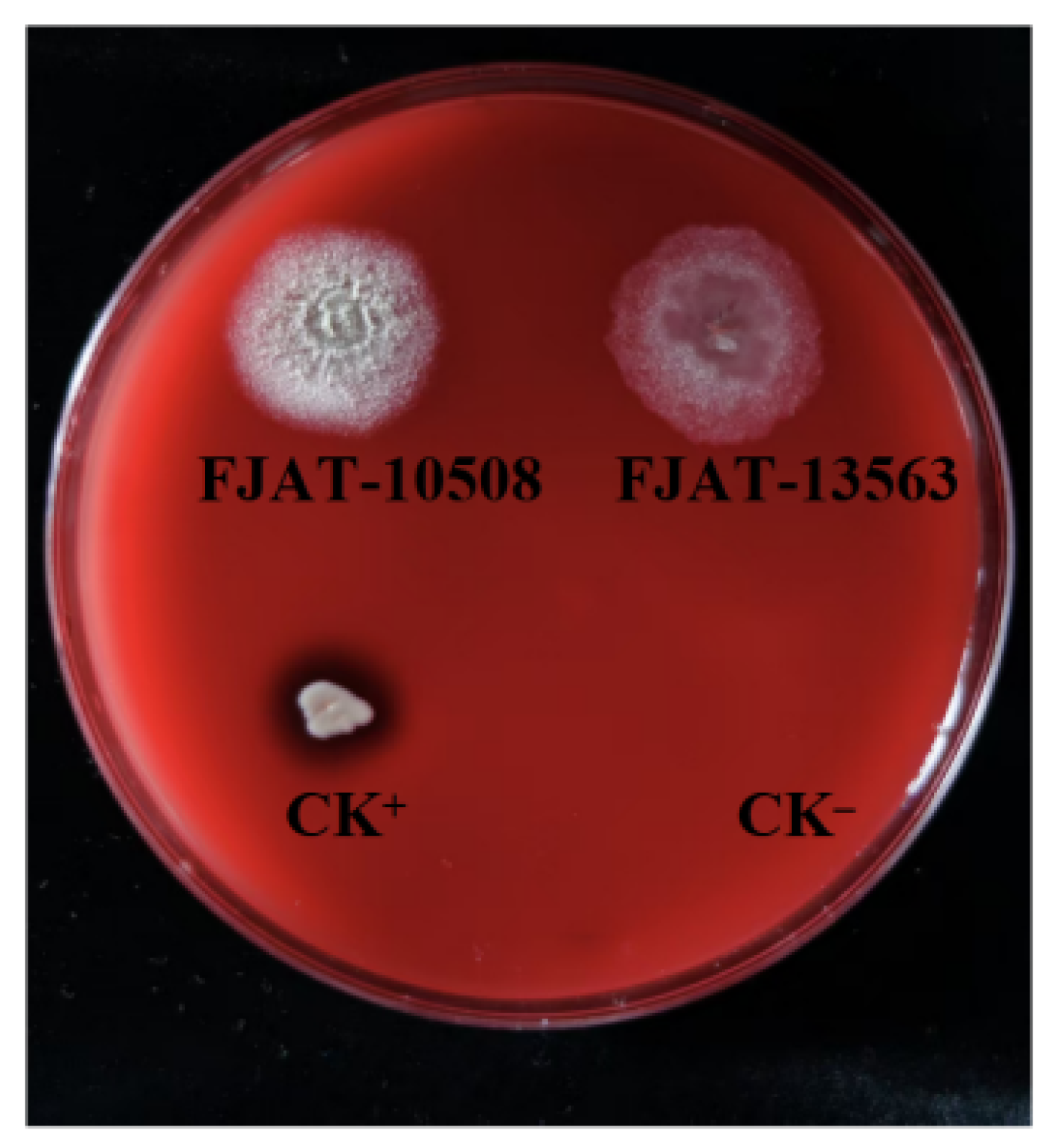
One microliter of a mid-log phase culture (1 × 10⁸ CFU·mL−1) of FJAT-10508 and FJAT-13563 was spotted onto Columbia blood agar (5% sheep blood per plate; Shanghai Shenqi Bio-technology Co., Ltd., Shanghai, China). St. aureus FJAT-2450 and fresh LB broth served as the positive and negative controls, respectively. Plates were incubated at 30 °C for 48 h to examine the presence of hemolysis zones surrounding the colonies. Hemolytic patterns were recorded as α-hemolysis (greenish zone), β-hemolysis (clear zone) or γ-hemolysis (no zone).

2.12. Statistical Analysis

All experiments were repeated three times. All data were presented as the mean ± standard error (SEM). Prior to parametric analysis, the normality of data distribution was assessed using the Shapiro–Wilk test. For data that followed a normal distribution, one-way ANOVA was performed using SPSS v21.05 (Hangzhou Ruifeng Information Technology Co., Ltd., Hangzhou, China) followed by Duncan’s multiple range test for post-hoc comparisons. For data that did not meet the normality assumption, the Kruskal–Wallis test was used instead, followed by Dunn’s test for multiple comparisons. Significant differences were determined at p ≤ 0.05.

3. Results

3.1. Extracellular-Enzyme-Producing Abilities of the 394 Bacillus Strains

To screen probiotic candidates for formulating Bacillus-based feed additives, the extracellular-enzyme-producing abilities of the 394 Bacillus strains were evaluated using the transparent ring method first. The results showed that 203, 305, and 158 Bacillus strains exhibited extracellular cellulase, protease, and amylase-producing abilities, with the average D/d ratio value ranges of 1.33–6.9, 1.09–3.5, and 1.12–2.45, respectively (Table S1). Moreover, 128 out of 394 Bacillus strains could produce all three extracellular digestion enzymes with varying degrees. Among these 128 strains, the comprehensive abilities of FJAT-10508 and FJAT-13563 were relatively remarkable, with the average D/d ratio values of 1.92 and 2.13 for cellulase, 1.5 and 1.91 for protease, and 1.75 and 1.56 for amylase, respectively (Figure 1).

3.2. Antibacterial Activities of the 394 Bacillus Strains Against E. coli, St. aureus and Sa. enterica

The antibacterial activities of the 394 Bacillus strains against three common pathogens in livestock and poultry were further evaluated by the double-layer agar method. The results indicated that 20, 7, and 5 Bacillus strains displayed antibacterial activities against E. coli, St. aureus and Sa. enterica under the conditions of this study, with the average diameters of inhibition zone ranging from 11.35 to 19.84 mm, 12.32 to 16.76 mm and 11.32 to 17.1 mm, respectively (Table S1). Fortunately, FJAT-10508 and FJAT-13563 were the only two strains that simultaneously exhibited inhibitory activity against three pathogens, with average inhibition zone diameters of 16.02 and 14.36 mm for E. coli, 16.76 and 13.96 mm for St. aureus, and 12.6 and 11.32 mm for Sa. enterica, respectively. Consequently, the strains FJAT-10508 and FJAT-13563 were selected to further evaluate probiotic properties in vitro, based on the comprehensive consideration of extracellular-enzyme producing abilities and antibacterial activities against E. coli, St. aureus and Sa. enterica.

3.3. Genomic Evaluation of the Strains FJAT-10508 and FJAT-13563

According to the guidelines of the European Food Safety Authority (EFSA), whole-genome evaluation for the strains FJAT-10508 and FJAT-13563 was performed, which mainly focused on taxonomic identification of the strains, prediction, and potential mobility assessment of putative virulence genes and AGRs, and identification of BGCs for antimicrobial metabolites. Generally, the results showed that the FJAT-10508 and FJAT-13563 genomes consisted of one circular chromosome of 3,929,792 bp and 4,080,379 bp, with the average G + C content of 46.5% and 46.35%, respectively (Figure S1). No plasmid was discovered in either genome. A total of 3529 and 3576 protein-coding genes were predicted in the FJAT-10508 and FJAT-13563 genomes, respectively. Genome sequences of the strains FJAT-10508 and FJAT-13563 were deposited in GenBank under the accession numbers PRJNA1397014 and PRJNA1397016, respectively.
Firstly, the strains FJAT-10508 and FJAT-13563 were further identified by whole-genome ANI analysis, although the taxonomic status had been validated previously by FBRCC using 16S rDNA and gyrB gene sequence analyses. The results showed that the ANI values of the strains FJAT-10508 and FJAT-13563 with the strain B. velezensis FZB42 were higher than 98.35%, exceeding the ANI cut-off value of 96% for species delineation, while those with the strains B. licheniformis ATCC 14580, B. pumilus ATCC 7061, B. subtilis 168, B. thuringiensis ATCC 10792 and Heyndrickxia coagulans (formerly Bacillus coagulans) DSM 1 were all lower than 88.9% (Figure 2). Therefore, both FJAT-10508 and FJAT-13563 were validated again as members of the Species B. velezensis.
Subsequently, the FJAT-10508 and FJAT-13563 genomes underwent searches against the databases VFDB and CARD to predict the putative virulence factor and ARG-related genes, respectively. A total of 226 and 231 putative virulence genes were predicted in the FJAT-10508 and FJAT-13563 genomes, respectively, which are mainly involved in adherence, effector delivery systems, exoenzymes, exotoxins, immune modulation, invasion, and stress survival (Table S2). The FJAT-10508 and FJAT-13563 genomes were predicted to hold 160 and 148 putative ARGs, which were related to 38 categories of antibiotics, such as aminoglycosides, cephalosporins, fluoroquinolones, glycopeptides, macrolides, phenicols, rifamycins, and tetracyclines (Table S3).
To evaluate the potential mobility of the putative virulence factors and AGRs, the FJAT-10508 and FJAT-13563 genomes were further annotated for the mobilome (plasmids, prophages, insertion sequences, inverted repeat elements, and compositional outlier regions) using the Mobilome Annotation Pipeline. The results showed that most of the predicted virulence genes and AGRs (343 out of 386 for FJAT-10508, 88.86%; 351 out of 379 for FJAT-13563, 92.61%) had no mobile genetic element within their flanking 100 bp regions (Table S4), implying that these putative virulence factors and ARGs were predominantly intrinsic to both genomes, but not mobile.
To evaluate whether the putative virulence genes are typical, low-risk housekeeping, or high-risk features, 435 B. velezensis genomes (including the FJAT-10508 and FJAT-13563 genomes) were used to perform a pangenome analysis using PGAP2, and the putative virulence genes of FJAT-10508 and FJAT-13563 were mapped to the pangenome categories, respectively. The results revealed that the Species B. velezensis exhibited an open pangenome with 27,791 total genes, and 84.04% cloud genes, 5.87% core genes, 5.18% shell genes, 3.43% soft core genes, and only 1.48% strict core genes (Table S5). The putative virulence genes annotated by VFDB of FJAT-10508 and FJAT-13563 exhibited the pangenome categories of 56.34% and 57.95% cloud genes, 16.9% and 17.33% core genes, 10.42% and 8.52% shell genes, 6.2% and 5.97% soft core genes, and 10.14% and 10.23% strict core genes, respectively (Figure S2).

3.4. Preliminary Evaluation of the Antibacterial Compounds from FJAT-10508 and FJAT-13563

The BGCs for the potentially antibacterial metabolites were searched in the FJAT-10508 and FJAT-13563 genomes by using antiSMASH 7.0. The results indicated that 12 and 13 BGCs were found in the FJAT-10508 and FJAT-13563 genomes, respectively, and these BGCs were mainly involved in biosynthesis of the antibacterial compounds bacillaene, bacillibactin, bacilysin, butirosin, difffcidin, fengycin, macrolactin, and surfactin (Figure S3). These results inferred that the lipopeptide-like secondary metabolites might be the main antibacterial constituents of FJAT-10508 and FJAT-13563. Accordingly, the potentially antibacterial compounds were extracted by acid precipitation from the cultures of the strains FJAT-10508 and FJAT-13563 and their antibacterial activity against E. coli, St. aureus and Sa. enterica were evaluated using the agar well diffusion method, respectively. As shown in Figure 3, activities of the potentially antibacterial compounds (30 mg·mL−1) could comparatively match those of their full cultures and cell-free supernatants of FJAT-10508 and FJAT-13563, except that the activity of the FJAT-10508 antibacterial compound against St. aureus was significantly lower than that of its full culture. Therefore, these results demonstrated that the compounds enriched by acid precipitation were one of the contributors to antibacterial activities of the strains FJAT-10508 and FJAT-13563 against E. coli, St. aureus, and Sa. enterica, although the chemical identity of antibacterial compounds needs to be further confirmed by LC-MS/MS with the corresponding standards in the future.

3.5. Endospore-Forming Efficiencies of the Strains FJAT-10508 and FJAT-13563

Endospore-forming efficiencies of FJAT-10508 and FJAT-13563 were detected at 24, 48 and 72 h, respectively. The results showed that endospore yields of FJAT-10508 and FJAT-13563 gradually increased with the extension of growth time, and they reached up to 72.41% and 90.83% after 72 h incubation, respectively (Table 1).

3.6. Acid and Bile Salt Tolerance of the Strains FJAT-10508 and FJAT-13563

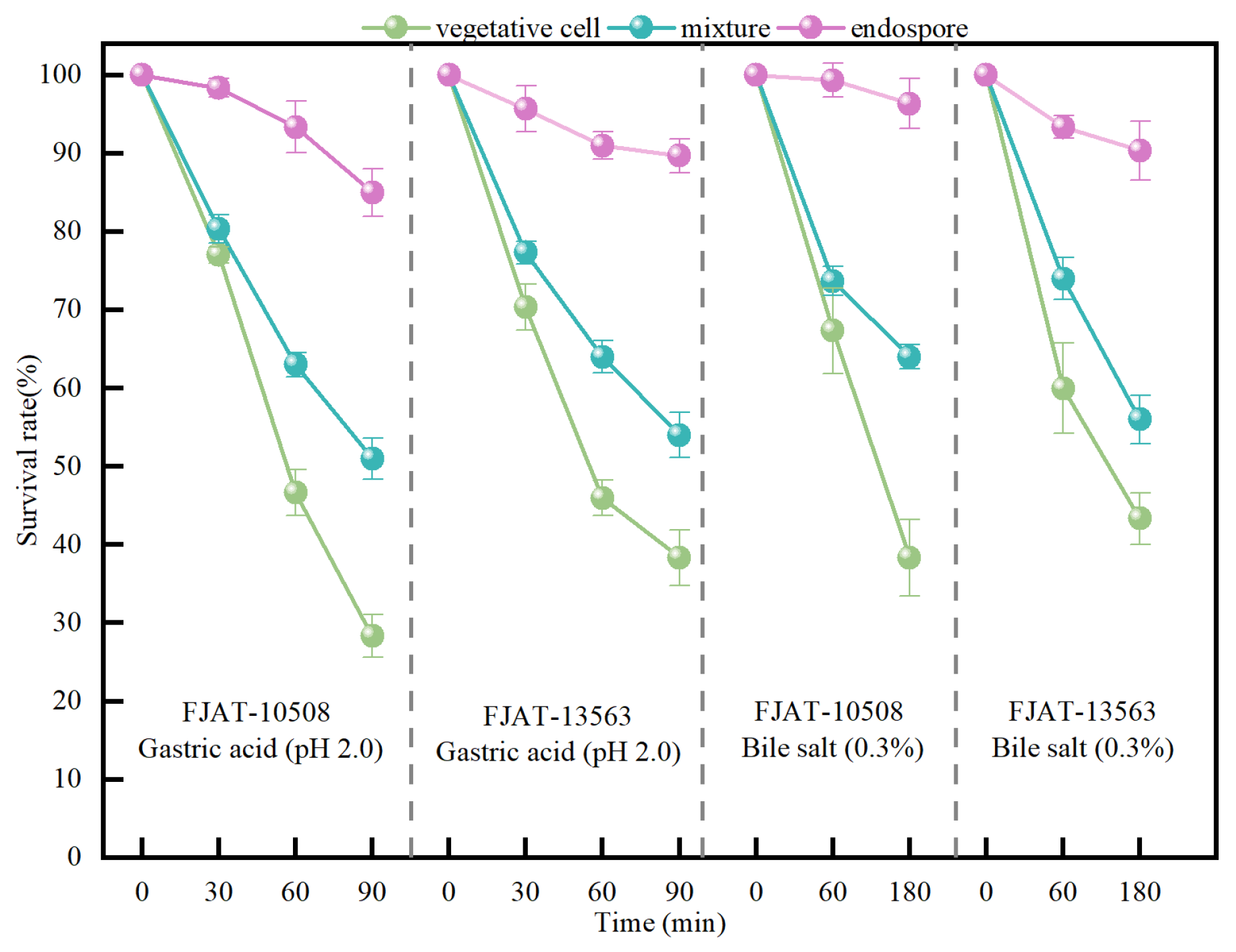
To evaluate gastrointestinal tract tolerance, the vegetative cells, a mixture of vegetative cells and endospores (the ratio of vegetative cell to endospore was approximately 1:1, according to the results of endospore-forming efficiency tests), and pure endospores of the strains FJAT-10508 and FJAT-13563 were challenged with low pH (pH 2.0) and pepsin in the simulated gastric fluid, and with 0.3% (w/v) bile salt and trypsin in the simulated intestinal fluid, respectively. After exposure to the simulated gastric fluid (pH 2.0) for 90 min, the vegetative cells, mixture, and pure endospores of FJAT-10508 and FJAT-13563 remained viable, with average CFU values of 0.28 × 10⁷ and 0.38 × 10⁷ CFU·mL−1, 0.51 × 10⁷ and 0.54 × 10⁷ CFU·mL−1, and 0.85 × 10⁷ and 0.9 × 10⁷ CFU·mL−1, corresponding to survival rates of 28.33% and 38.33%, 51% and 54%, and 85% and 89.67%, respectively. As for tolerance to 0.3% bile salts, FJAT-10508 and FJAT-13563 retained viable CFU averages of 0.38 × 10⁷ and 0.43 × 10⁷ CFU·mL−1, 0.64 × 10⁷ and 0.56 × 10⁷ CFU·mL−1, and 0.96 × 10⁷ and 0.9 × 10⁷ CFU·mL−1 after exposure to simulated intestinal fluid for 180 min, with survival rates of 38.33% and 43.33%, 64% and 56%, and 96.33% and 90.33%, respectively (Figure 4). These results indicated that the vegetative cells of FJAT-10508 and FJAT-13563 exhibited moderate tolerance to simulated gastrointestinal tract conditions, whereas their endospores demonstrated remarkably high tolerance to these stress environments.

3.7. AutoAggregation and Co-Aggregation Abilities of the Strains FJAT-10508 and FJAT-13563

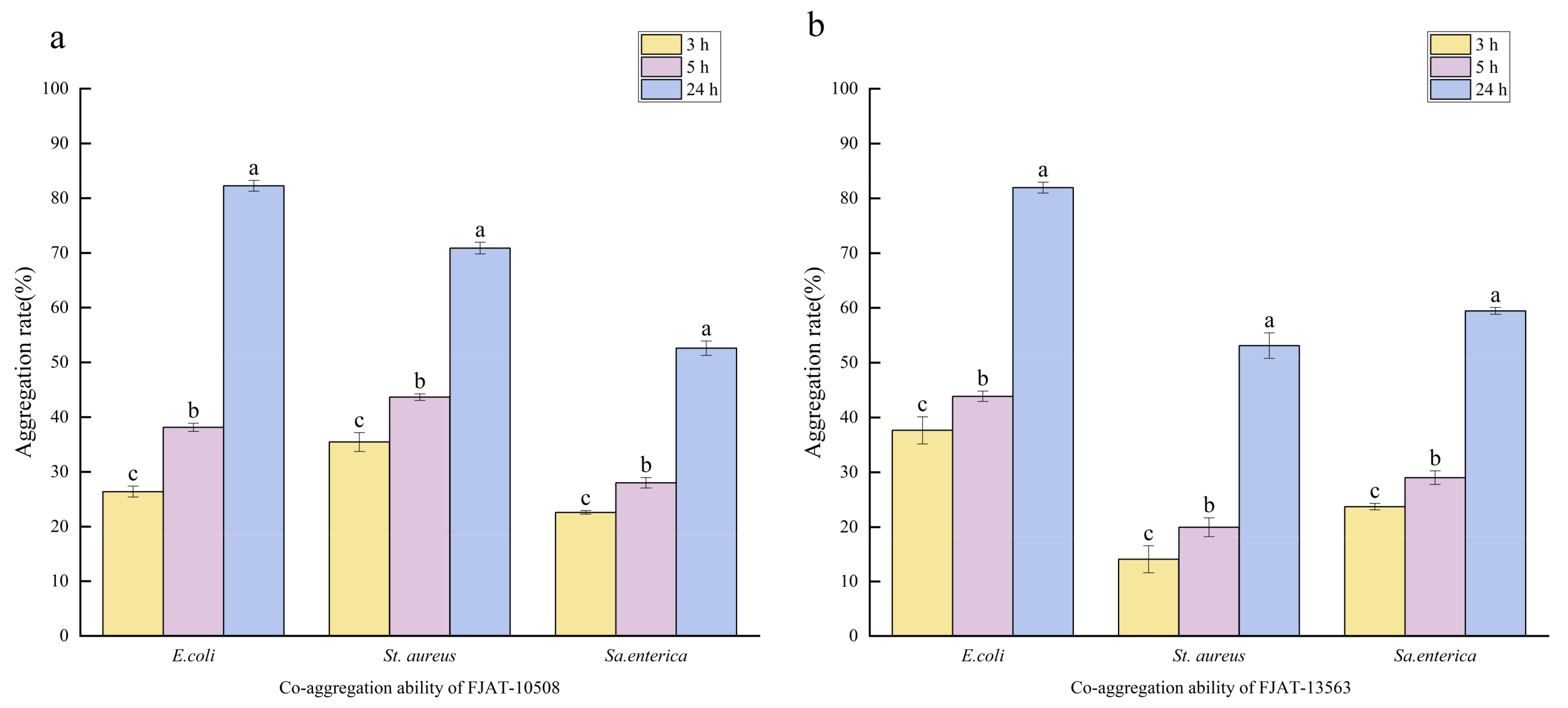
In autoaggregation assays, the strains FJAT-10508 and FJAT-13563 exhibited autoaggregation rates of 45.28% and 47.99%, respectively, after static incubation for 5 h. Moreover, the autoaggregation rates of FJAT-10508 and FJAT-13563 reached up to 73.62% and 84.93% at 24 h, respectively. The results of co-aggregation assays showed that FJAT-10508 and FJAT-13563 displayed the co-aggregation rates of 82.26% and 81.95%, 70.88% and 53.12%, and 52.60% and 59.45% with E. coli, St. aureus, and Sa. enterica at 24 h, respectively (Figure 5).

3.8. Invasion and Cytotoxicity of FJAT-10508 and FJAT-13563 to CACO-2 Cells

The invasion abilities of FJAT-10508 and FJAT-13563 to the CACO-2 cell monolayer were tested using a multiplicity of infection (MOI) of approximately 50:1 (bacteria: mammalian cells). The results showed that the invasion percentages of FJAT-10508 and FJAT-13563 into CACO-2 cells were 0.044 ± 0.008% and 0.037 ± 0.014%, respectively. Furthermore, the cytotoxic effects of the culture supernatants from FJAT-10508 and FJAT-13563 on CACO-2 cells were evaluated using the CCK-8 assay. Cells were treated with PBS (negative control), 1% Triton X-100 (positive control), or bacterial supernatant for 18 h, and cell viability was calculated relative to the PBS-treated control group. The results demonstrated that: (i) treatment with 1% Triton X-100 resulted in near-complete cell death, with a cell viability of 5.8% ± 0.5% (p < 0.001); (ii) the negative control (PBS) achieved a cell viability of 99.72 ± 0.91%; (iii) while treatment with FJAT-10508 and FJAT-13563 culture supernatant resulted in the cell viability of 198.71 ± 3.56% and 185.56 ± 4.05%, respectively (Table S6). These results indicated that both FJAT-10508 and FJAT-13563 exhibited no cytotoxic effect on the epithelial cell CACO-2 under the tested conditions.

3.9. Antibiotic Susceptibilities of the Strains FJAT-10508 and FJAT-13563

Susceptibilities of the strains FJAT-10508 and FJAT-13563 to twelve antibiotics were determined using the Kirby–Bauer disk diffusion method (Table 2). The results showed that the strains FJAT-10508 and FJAT-13563 exhibited high susceptibility (S) to nine and eight antibiotics, respectively, which included five of the six key antibiotics (chloramphenicol, erythromycin, gentamicin, kanamycin, tetracycline, and streptomycin) as recommended by the European Food Safety Authority (EFSA). However, both strains displayed phenotypic resistance (R) to ampicillin and streptomycin (Table 2).
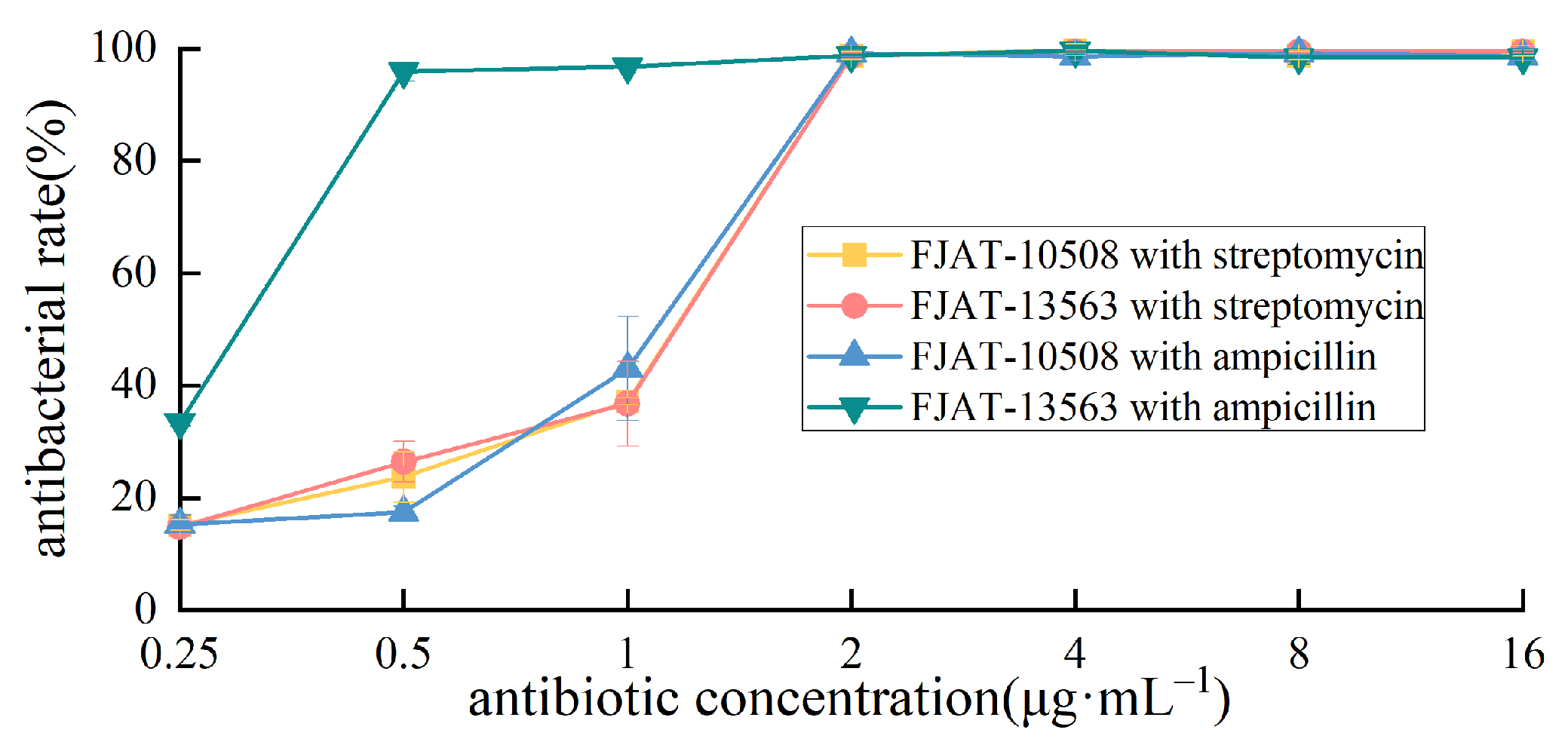
Accordingly, the minimum inhibitory concentrations (MICs) of ampicillin and streptomycin for strains FJAT-10508 and FJAT-13563 were further determined using the broth microdilution method outlined by CLSI. The results indicated that the MIC values of ampicillin and streptomycin were approximately 2 µg·mL−1 and 2 µg·mL−1 for FJAT-10508, and 0.5 µg·mL−1 and 2 µg·mL−1 for FJAT-13563, respectively (Figure 6). These MIC values for both strains were lower than the EFSA-recommended cut-off values of 4 µg·mL−1 for ampicillin and 8 µg·mL−1 for streptomycin. Collectively, these results indicate that both FJAT-10508 and FJAT-13563 meet the EFSA requirements for antibiotic susceptibility evaluation of probiotic candidates.

3.10. Hemolytic Activity of the Strains FJAT-10508 and FJAT-13563

The hemolytic activities of the strains FJAT-10508 and FJAT-13563 were assessed using 5% sheep blood agar. As shown in Figure 7, the positive control strain Staphylococcus aureus FJAT-2450 exhibited a clear hemolysis zone around the colony, indicating typical β-hemolysis associated with pathogenicity. The strains FJAT-10508 and FJAT-13563 were both α-hemolysis, being considered safe.

4. Discussions

The systematic isolation and screening of Bacillus strains that combine robust enzymatic activity with potent antibacterial ability against prevalent animal pathogens is a pivotal research priority for the development of highly effective feed probiotics [49]. In this study, a total of 394 Bacillus strains underwent the measurement of extracellular-enzyme producing abilities and antibacterial activities against E. coli, St. aureus and Sa. enterica by using the transparent ring method and the double-layer agar method, respectively. Our results indicated that these Bacillus strains exhibited good extracellular-enzyme-producing abilities, but relatively poor antibacterial activities against E. coli, St. aureus and Sa. enterica under the conditions of this study. There were 203, 305, and 158 Bacillus strains with producing abilities of extracellular cellulose (average D/d ratio value range of 1.33–6.9), protease (1.09–3.5) and amylase (1.12–2.45), but just 20, 7, and 5 Bacillus strains with antibacterial activities against E. coli (average inhibition zone diameter range of 11.35–19.84 mm), St. aureus (12.32–16.76 mm), and Sa. enterica (11.32–17.1 mm), respectively. In addition, 128 Bacillus strains could produce all three extracellular digestive enzymes, but only FJAT-10508 and FJAT-13563 exhibited simultaneously inhibitory activities against three pathogens. According to their comprehensive assessment of extracellular enzyme-producing abilities and antibacterial activities against E. coli, St. aureus, and Sa. enterica, the strains B. velezensis FJAT-10508 and FJAT-13563 were therefore selected to further evaluate systematically probiotic properties in vitro, which include endospore-forming efficiencies, antibiotic susceptibilities, hemolytic activities, prediction of putative virulence factors and ARGs, autoaggregation and co-aggregation abilities, and tolerance to bile salts and simulated gastrointestinal fluids.
A key technological advantage of Bacillus-based products is their endospore-forming ability, which confers high stability during long term storage and feed processing operations such as conditioning and pelleting [15]. Our results showed that endospore yields of B. velezensis FJAT-10508 and FJAT-13563 could reach up to 72.41% and 90.83% after 72 h incubation, respectively, being consistent with previous reports for other B. velezensis strains that more than 50% of sporulation rate could routinely achieve within 72 h [50,51]. These high-endospore titers of FJAT-10508 and FJAT-13563 would bring the potential for robust survival in adverse circumstances, such as the gastrointestinal environment and feed pelleting. Additionally, the results of our preliminary thermotolerance tests revealed that exposure to 80 °C for 20 min had no significantly deleterious effect on endospore viability of FJAT-10508 and FJAT-13563, and their endospores remained more than 30% of survival rates under another 5 min challenge at 100 °C, indicating satisfactory heat resistance.
Tolerance to gastric acidity and intestinal bile salts is a prerequisite for probiotic survival in the gastrointestinal tract of animals [52]. In this study, the vegetative cells, a mixture of vegetative cells and endospores at a ratio of approximately 1:1, and pure endospores of the strains FJAT-10508 and FJAT-13563 were used to comparatively assess their tolerance capacity to the simulated gastric fluid (pH 2.0 and pepsin) and simulated intestinal fluid (0.3% bile salt and trypsin), respectively. Our results demonstrated that the survival rates of FJAT-10508 and FJAT-13563 gradually increased from 28.33–38.33% for vegetative cells to 51–54% for mixture and to 85–89.67% for pure endospores under the stress of pH 2.0 for 90 min, and from 38.33–43.33% for vegetative cells to 56–64% for mixture and to 90.33–96.33% for pure endospores under the stress of 0.3% bile salt for 180 min, respectively. These results indicated that the endospores of FJAT-10508 and FJAT-13563 had significantly greater stress tolerance in gastrointestinal environments than their vegetative cells. At present, Bacillus-based probiotics are mainly formulated for delivery as endospores, but the ability of endospores to germinate in the gut remains debatable [53]. To optimize their application, cells should be delivered in their vegetative state, but the sensitivity of Bacillus vegetative cells to gastric acidity and intestinal bile salts likely prevents this. Therefore, exploring new formulations of Bacillus-based probiotics, such as mixtures of vegetative cells and endospores, is of great significance.
The capacity for autoaggregation and co-aggregation is considered a prerequisite for Bacillus spp. to colonize and competitively inhibit the adhesion of the corresponding pathogens to the gastrointestinal tract of host animals [54]. The results of autoaggregation assays demonstrated that the autoaggregation rates of the strains FJAT-10508 and FJAT-13563 could reach to 45.28% and 47.99% at 5 h, being very close to the autoaggregation threshold of 50% defined for highly adhesive isolates [55], and to 73.62% and 84.93% after static incubation for 24 h, respectively. Moreover, the results showed that both FJAT-10508 and FJAT-13563 also exhibited the remarkable co-aggregation capacities with E. coli (82.26% and 81.95%), St. aureus (70.88% and 53.12%), and Sa. enterica (52.60% and 59.45%) at 24 h, respectively, being consistent with the findings of Blibech et al. [56]. Notably, in addition to physical co-aggregation, both strains demonstrated strong antagonistic activity against these pathogens through the production of diffusible antimicrobial compounds (as evidenced by inhibition zone assays), suggesting a dual mechanism of action combining growth inhibition and co-aggregation. This combined effect of antimicrobial substance production and co-aggregation ability provides a competitive advantage to the Bacillus strains, enabling them not only to inhibit pathogens but also to physically eliminate them from the environment, thereby offering a dual-layer of protection [54]. Therefore, these results would confer FJAT-10508 and FJAT-13563 promising probiotic potentials.
Safety validation of probiotic candidates is an essential prerequisite for their commercial applications in animal farming. First of all, susceptibility to clinically relevant antimicrobials is a key concern, as the presence of acquired resistance determinants in ARB can promote horizontal gene transfer of ARGs to other microorganisms within the animal gut and husbandry environments [57]. Therefore, susceptibilities of the strains FJAT-10508 and FJAT-13563 to 12 antibiotics, which include the six key antibiotics (chloramphenicol, erythromycin, gentamicin, kanamycin, tetracycline, and streptomycin) as recommended by EFSA, were determined by the Kirby–Bauer disk diffusion method under the guidance of CLSI. The results demonstrated that the strains FJAT-10508 and FJAT-13563 were highly susceptible (S) and intermediately sensitive (I) to 9 and 1, and 8 and 2 antibiotics, respectively. However, the strains FJAT-10508 and FJAT-13563 exhibited resistance (R) to ampicillin and streptomycin. Accordingly, the MICs of ampicillin and streptomycin on the strains FJAT-10508 and FJAT-13563 were further determined according to the guidelines of CLSI. Fortunately, the results showed that the MIC values of ampicillin and streptomycin on both strains were ≤2 µg·mL−1, being lower than the relevant MIC cut-off values of 4 µg·mL−1 for ampicillin and 8 µg·mL−1 for streptomycin as recommended by EFSA. Taken together, both FJAT-10508 and FJAT-13563 could meet the requirements for antibiotic susceptibility testing of probiotic candidates. Meanwhile, putative ARGs and the mobile genetic elements flanking them in the FJAT-10508 and FJAT-13563 genomes were further predicted using the CARD and Mobilome Annotation Pipeline, respectively. The results showed that 160 and 148 putative ARG-related genes, which were associated with 38 categories of antibiotics (such as aminoglycoside, cephalosporin, fluoroquinolone, glycopeptide, macrolide, rifamycin, and tetracycline) were detected in the FJAT-10508 and FJAT-13563 genomes, respectively. Moreover, the FJAT-10508 and FJAT-13563 genomes could be identified as having only one kind of mobile genetic elements (compositional outlier region) around 24 and 15 putative ARGs in, respectively, without any common mobile genetic elements (such as plasmids, prophages, insertion sequences, inverted repeat elements).
On the other hand, the results of hemolytic activity tests using 5% sheep blood agar indicated that both FJAT-10508 and FJAT-13563 exhibited the phenotype of α-hemolysis, which is considered to be safe [58,59]. Moreover, the lack of the hemolysin-related genes, such as hblA, hblC, and hblD found in the highly pathogenic Bacillus cereus [60], was further confirmed by whole-genomic search. Meanwhile, putative virulence-related genes and the mobile genetic elements flanking them were predicted in the FJAT-10508 and FJAT-13563 genomes. The results showed that 226 and 231 putative virulence genes were predicted in the FJAT-10508 and FJAT-13563 genomes, respectively, which are mainly involved in the functions of adherence, effector delivery system, exoenzyme, exotoxin, immune modulation, invasion, and stress survival. Moreover, only 19 and 13 putative virulence genes in the FJAT-10508 and FJAT-13563 genomes were accompanied by a single mobile genetic element, the compositional outlier region, respectively, without any common mobile genetic elements. Importantly, a pangenome analysis of 435 B. velezensis genomes was performed to evaluate whether the putative virulence genes are typical, low-risk housekeeping genes, or high-risk features. The results demonstrated that the putative virulence genes via VFDB annotations of FJAT-10508 and FJAT-13563 exhibited the pangenome categories of 56.34% and 57.95% cloud genes, 16.9% and 17.33% core genes, 10.42% and 8.52% shell genes, 6.2% and 5.97% soft core genes, and 10.14% and 10.23% strict core genes, respectively. Furthermore, the potential high-risk virulence factors of FJAT-10508 and FJAT-13563, such as exoenzyme (66.7% cloud genes), adherence factors (64.3% cloud), motility (61.7% cloud), and effector delivery systems (59.3% cloud), were predominantly strain-specific and not conserved across the species B. velezensis, suggesting an absence of genomic hallmarks of pathogenic bacteria at the species-level. These results indicated that most of the predicted virulence genes from the FJAT-10508 and FJAT-13563 genomes were not conserved pathogenic determinants, but just bestowed strain-specific accessory functions. Consistent with these genomic findings, the CCK-8 cytotoxicity assay demonstrated that the culture supernatant of B. velezensis FJAT-10508 and FJAT-13563 did not exert cytotoxic effects on CACO-2 cells. Moreover, these findings aligned with previous safety evaluations of the species B. velezensis, as well as other Bacillus species, which have shown no cytotoxicity to intestinal epithelial cells [61]. According to Pournejati et al. [62], values exceeding 100% in CCK-8 assays should be interpreted as an absence of cytotoxicity rather than as a technical error, as such values may reflect the presence of growth-promoting metabolites in the test sample. Meanwhile, the results of the invasion assays indicated that both FJAT-10508 and FJAT-13563 were non-invasive and thus unable to cause invasive disease [63]. Taken together, these results suggested that the strains FJAT-10508 and FJAT-13563 had no appreciable threat for feed use in animal farming, although needing a key in vivo safety evaluation in the future.

5. Conclusions

In this study, the strains B. velezensis FJAT-10508 and FJAT-13563 were screened from 394 Bacillus strains based on their comprehensive performance in extracellular enzyme production and antibacterial activities against E. coli, St. aureus, and Sa. enterica. Moreover, the compounds enriched by acid precipitation were identified as one of the contributors for antibacterial activities of FJAT-10508 and FJAT-13563. According to in vitro probiotic potential assessments and whole-genome analyses, both FJAT-10508 and FJAT-13563 exhibited α-hemolysis, which is considered safe, lacked genomic hallmarks of pathogenic bacteria, and had no invasion or cytotoxicity effects on CACO-2 cells. In addition, they met the requirements of the antibiotic susceptibility tests recommended by EFSA for probiotic candidates and exhibited excellent endospore-forming efficiency, good autoaggregation and coaggregation abilities, and strong tolerance to simulated gastrointestinal tract environments. Therefore, the strains B. velezensis FJAT-10508 and FJAT-13563 demonstrated desirable in vitro probiotic properties. To accelerate their practical application, key aspects such as in vivo efficacy and safety, host response, and ecological impact in animal farming systems should be further evaluated through large-scale animal feeding trials in future studies.

Supplementary Materials

The following supporting information can be downloaded at: https://www.mdpi.com/article/10.3390/microorganisms14040834/s1, Supplementary Figure S1: Circular genomic map of the strains B. velezensis FJAT-10508 and FJAT-13563. Notes: The genome of the strain FJAT-57093 comprised a single circular chromosome of 3,452,556 bp, with an average G+C content of 46.49% and no detectable plasmid. A total of 3730 protein-coding genes were predicted. From outside to inside, the rings represent: Ring 1, Genome scale; Rings 2 and 3, CDS on the positive and negative strands colored by COG functional categories; Ring 4, rRNA and tRNA; Ring 5, ncRNA, prophage, genomic islands (GI), and insertion sequences (IS); Ring 6, GC content. Outward red peaks indicate regions where GC content is higher than the genomic average, with peak height reflecting the degree of deviation; inward blue peaks indicate regions where GC content is lower than the average; Ring 7: GC-skew calculated as (G−C)/(G+C), generally, positive skew (>0) corresponds to the leading strand, while negative skew (<0) corresponds to the lagging strand. Supplementary Figure S2: Mapping virulence genes of FJAT-10508 and FJAT-13563 to pangenome categories of the species B. velezensis. Notes: To evaluate whether the putative virulence factors are typical, low-risk housekeeping, or high-risk features, a pangenome analysis of 434 B. velezensis genomes (including all NCBI complete genomes and FJAT 57093) were performed using PGAP2 (https://github.com/bucongfan/PGAP2) (Bu et al., 2025 [41]) to map virulence genes of FJAT 57093 to pangenome categories. Supplementary Figure S3: Comparative atlas of the biosynthetic gene clusters for the potentially antibacterial metabolites in the strains FJAT-10508 and FJAT-13563. Notes: The BGCs for the potentially antibacterial metabolites were searched in the FJAT-10508 and FJAT-13563 genomes by using antiSMASH 7.0. Colored arrows represent the predicted genes and their transcriptional orientation; identical colors indicate the orthologous pairs. Cluster numbers are indicated below the respective regions. Gray arrows denote the strain-specific genes, and blank spaces indicate absent or rearranged segments. Table S1: Probiotic candidate screening of from 394 Bacillus-like strains based on their extracellular-enzyme production abilities and antibacterial activities against E. coli, St. aureus and Sa. enterica. Table S2: Putative virulence genes predicted in the FJAT-10508 and FJAT-13563 genomes. Table S3: Putative ARGs predicted in the FJAT-10508 and FJAT-13563 genomes. Table S4: Statistics of transferable elements carrying virulence and resistance genes in the FJAT-10508 and FJAT-13563 genomes. Table S5: Pangenome categories of the 435 B. elezensis genomes. Table S6: Cytotoxicity assays of the FJAT-10508 and FJAT-13563 culture supernatants to the Caco-2 cells.

Author Contributions

Conceptualization, Y.M., X.H. (Xiusheng Huang) and J.W.; Methodology, Y.M., X.H. (Xiusheng Huang) and J.W.; Software, Y.M. and X.L. (Xiaofang Lou); Validation, Y.C. and J.W.; Formal analysis, Y.M., X.L. (Xiaofang Lou), J.C. and X.H. (Xiaoyun Huang); Investigation, Y.M., J.C., X.H. (Xiaoyun Huang), Y.C., J.L., M.C. and X.L. (Xin Liu); Resources, X.H. (Xiusheng Huang) and J.W.; Data curation, Y.M. and X.L. (Xiaofang Lou); Writing—original draft, Y.C.; Writing—review & editing, J.W.; Visualization, Y.C. and X.L. (Xin Liu); Supervision, Q.H., X.H. (Xiusheng Huang) and J.W.; Project administration, Q.H., X.H. (Xiusheng Huang) and J.W.; Funding acquisition, X.H. (Xiusheng Huang) and J.W. All authors have read and agreed to the published version of the manuscript.

Funding

This research was funded by the Competitive Public-Interest Project of Fujian Provincial Science and Technology Program (2025R1067).

Institutional Review Board Statement

Not applicable.

Informed Consent Statement

Not applicable.

Data Availability Statement

The original contributions presented in this study are included in the article/Supplementary Material. Further inquiries can be directed to the corresponding authors.

Acknowledgments

The authors sincerely thank the anonymous reviewers for their valuable comments and suggestions that improved the quality of this paper.

Conflicts of Interest

The authors declare no conflicts of interest.

References

  1. Da, S.R.; Arenas, N.E.; Luiza, V.L.; Bermudez, J.; Clarke, S.E. Regulations on the use of antibiotics in livestock production in South America: A comparative literature analysis. Antibiotics 2023, 12, 1303. [Google Scholar] [CrossRef]
  2. Sung, J.Y.; Deng, Z.; Kim, S.W. Antibiotics and opportunities of their alternatives in pig production: Mechanisms through modulating intestinal microbiota on intestinal health and growth. Antibiotics 2025, 14, 301. [Google Scholar] [CrossRef] [PubMed]
  3. Aggarwal, R.; Mahajan, P.; Pandiya, S.; Bajaj, A.; Verma, S.K.; Yadav, P.; Kharat, A.S.; Khan, A.U.; Dua, M.; Johri, A.K. Antibiotic resistance: A global crisis, problems and solutions. Crit. Rev. Microbiol. 2024, 50, 896–921. [Google Scholar] [CrossRef] [PubMed]
  4. Rahman, A.U.; Valentino, V.; Sequino, G.; Ercolini, D.; De Filippis, F. Comparative analysis of antibiotic-administered vs. antibiotic-free farming in meat production: Implications for health, environment, and antibiotic resistance. Food Microbiol. 2026, 133, 104877. [Google Scholar] [CrossRef]
  5. Gelinas, A.; Sudan, S.; Patterson, R.; Li, J.L.; Huyben, D.; Barta, J.R.; Kiarie, E.G. Growth performance, organs weight, intestinal histomorphology, and oocyst shedding in broiler chickens offered novel single strain Bacillus subtilis isolated from camel dung and challenged with Eimeria. Poult. Sci. 2024, 103, 103519. [Google Scholar] [CrossRef] [PubMed]
  6. Muthamilselvan, T.; Kuo, T.F.; Wu, Y.C.; Yang, W.C. Herbal remedies for coccidiosis control: A review of plants, compounds, and anticoccidial actions. Evid.-Based Complement. Altern. Med. 2016, 2016, 2657981. [Google Scholar] [CrossRef]
  7. Hill, C.; Guarner, F.; Reid, G.; Gibson, G.R.; Merenstein, D.J.; Pot, B.; Morelli, L.; Canani, R.B.; Flint, H.J.; Salminen, S.; et al. Expert consensus document. The International Scientific Association for Probiotics and Prebiotics consensus statement on the scope and appropriate use of the term probiotic. Nat. Rev. Gastroenterol. Hepatol. 2014, 11, 506–514. [Google Scholar] [CrossRef]
  8. Han, D.A.; Ren, T.; Yang, Y.M.; Li, Z.Y.; Du, X.; Zhang, C.Y.; Pu, Q.Q.; He, L.; Zhao, K.W.; Guo, R.F.; et al. Application and substitution of antibiotics in animal feeding. Med. Weter 2024, 80, 5–11. [Google Scholar] [CrossRef]
  9. Al-Otaibi, A.M.; Abd El-Hack, M.E.; Dmour, S.M.; Alsowayeh, N.; Khafaga, A.F.; Ashour, E.A.; Nour-Eldeen, M.A.; Swiatkiewicz, S. A narrative review on the beneficial impacts of probiotics on poultry: An updated knowledge. Ann. Anim. Sci. 2023, 23, 405–418. [Google Scholar] [CrossRef]
  10. de Oliveira, F.J.; Duarte, L.; Bonfim, D.O.; Salgaco, M.K.; Mattoso, L.; Egea, M.B. Shaping the future of functional foods: Using 3D printing for the encapsulation and development of new probiotic foods. Probiot. Antimicrob. Proteins 2024, 17, 1295–1307. [Google Scholar] [CrossRef]
  11. Luise, D.; Bosi, P.; Raff, L.; Amatucci, L.; Virdis, S.; Trevisi, P. Bacillus spp. Probiotic strains as a potential tool for limiting the use of antibiotics, and improving the growth and health of pigs and chickens. Front. Microbiol. 2022, 13, 801827. [Google Scholar] [CrossRef] [PubMed]
  12. Phan, H.; Pham, H.; Ngo, L.; Tran, N.; Ho, D.; Nguyen, K.; Tran, L.; Nguyen, H. Isolation and selection of indigenous chicken-derived Bacillus subtilis strains as potential probiotic alternatives to antibiotics against Gram-negative enteropathogens. J. Adv. Vet. Anim. Res. 2025, 12, 53–63. [Google Scholar] [CrossRef] [PubMed]
  13. Qin, S.; Xiao, X.; Dai, Z.; Zhao, G.; Cui, Z.; Wu, Y.; Yang, C. Effects of Bacillus licheniformis on growth performance, immune and antioxidant functions, and intestinal microbiota of broilers. Poult. Sci. 2024, 103, 103210. [Google Scholar] [CrossRef] [PubMed]
  14. Sampath, V.; Duk, H.B.; Kibria, S.; Kim, I.H. Effect of low-nutrient-density diet with probiotic mixture (Bacillus subtilis ms1, B. licheniformis SF5-1, and Saccharomyces cerevisiae) supplementation on performance of weaner pigs. J. Anim. Physiol. Anim. Nutr. 2022, 106, 61–68. [Google Scholar] [CrossRef]
  15. Bernardeau, M.; Lehtinen, M.J.; Forssten, S.D.; Nurminen, P. Importance of the gastrointestinal life cycle of Bacillus for probiotic functionality. J. Food Sci. Technol. 2017, 54, 2570–2584. [Google Scholar] [CrossRef]
  16. Lu, S.; Na, K.; Li, Y.; Zhang, L.; Fang, Y.; Guo, X. Bacillus-derived probiotics: Metabolites and mechanisms involved in bacteria-host interactions. Crit. Rev. Food Sci. Nutr. 2024, 64, 1701–1714. [Google Scholar] [CrossRef]
  17. Ramlucken, U.; Lalloo, R.; Roets, Y.; Moonsamy, G.; van Rensburg, C.J.; Thantsha, M.S. Advantages of Bacillus-based probiotics in poultry production. Livest. Sci. 2020, 241, 104215. [Google Scholar] [CrossRef]
  18. Brutscher, L.M.; Gebrechristos, S.; Garvey, S.M.; Spears, J.L. Genetic and phenotypic characterization of Bacillus velezensis strain BV379 for human probiotic applications. Microorganisms 2024, 12, 436. [Google Scholar] [CrossRef]
  19. Khalid, F.; Khalid, A.; Fu, Y.; Hu, Q.; Zheng, Y.; Khan, S.; Wang, Z. Potential of Bacillus velezensis as a probiotic in animal feed: A review. J. Microbiol. 2021, 59, 627–633. [Google Scholar] [CrossRef]
  20. Javaid, A.; Younas, F.; Ullah, I.; Yasinzai, M. Impact of an indigenously produced multi-enzyme complex from Bacillus subtilis KT004404 on growth and blood parameters in broiler chicken. Public Libr. Sci. 2022, 17, e271445. [Google Scholar] [CrossRef]
  21. Nguyen, V.; Ndao, A.; Peterson, E.C.; Blais, J.F.; Adjallé, K. Bacillus species: Evolving roles in bio-based detergents. Processes 2025, 13, 1885. [Google Scholar] [CrossRef]
  22. Torres-Pitarch, A.; Gardiner, G.E.; Cormican, P.; Rea, M.; Crispie, F.; O’Doherty, J.; Cozannet, P.; Ryan, T.; Cullen, J.; Lawlor, P.G. Effect of cereal fermentation and carbohydrase supplementation on growth, nutrient digestibility and intestinal microbiota in liquid-fed grow-finishing pigs. Sci. Rep. 2020, 10, 13716. [Google Scholar] [CrossRef] [PubMed]
  23. Long, C.; Rösch, C.; de Vries, S.; Schols, H.; Venema, K. Cellulase and alkaline treatment improve intestinal microbial degradation of recalcitrant fibers of rapeseed meal in pigs. J. Agric. Food Chem. 2020, 68, 11011–11025, Erratum in J. Agric. Food Chem. 2020, 68, 15535. [Google Scholar] [CrossRef] [PubMed]
  24. Cho, H.M.; Hong, J.S.; Kim, Y.B.; Nawarathne, S.R.; Choi, I.; Yi, Y.J.; Wu, D.; Lee, H.; Han, S.E.; Nam, K.T.; et al. Responses in growth performance and nutrient digestibility to a multi-protease supplementation in amino acid-deficient broiler diets. J. Anim. Sci. Technol. 2020, 62, 840–853. [Google Scholar] [CrossRef] [PubMed]
  25. Bassi, L.S.; Hejdysz, M.; Pruszynska-Oszmalek, E.; Wolc, A.; Cowieson, A.J.; Sorbara, J.; Svihus, B.; Kaczmarek, S.A. The effect of amylase supplementation on individual variation, growth performance, and starch digestibility in broiler chickens. Poult. Sci. 2023, 102, 102563. [Google Scholar] [CrossRef]
  26. Sureshkumar, S.; Song, J.; Sampath, V.; Kim, I. Exogenous enzymes as zootechnical additives in monogastric animal feed: A review. Agriculture 2023, 13, 2195. [Google Scholar] [CrossRef]
  27. Hmani, H.; Daoud, L.; Jlidi, M.; Jalleli, K.; Ben Ali, M.; Hadj Brahim, A.; Bargui, M.; Dammak, A.; Ben Ali, M. A Bacillus subtilis strain as probiotic in poultry: Selection based on in vitro functional properties and enzymatic potentialities. J. Ind. Microbiol. Biotechnol. 2017, 44, 1157–1166. [Google Scholar] [CrossRef]
  28. Mathlouthi, N.; Saulnier, L.; Quemener, B.; Larbier, M. Xylanase, β-glucanase, and other side enzymatic activities have greater effects on the viscosity of several feedstuffs than xylanase and β-glucanase used alone or in combination. J. Agric. Food Chem. 2002, 50, 5121–5127. [Google Scholar] [CrossRef]
  29. Farhat-Khemakhem, A.; Blibech, M.; Boukhris, I.; Makni, M.; Chouayekh, H. Assessment of the potential of the multi-enzyme producer Bacillus amyloliquefaciens US573 as alternative feed additive. J. Sci. Food Agric. 2017, 98, 1208–1215. [Google Scholar] [CrossRef]
  30. Latif, A.; Shehzad, A.; Niazi, S.; Zahid, A.; Ashraf, W.; Iqbal, M.W.; Rehman, A.; Riaz, T.; Aadil, R.M.; Khan, I.M.; et al. Probiotics: Mechanism of action, health benefits and their application in food industries. Front. Microbiol. 2023, 14, 1216674, Erratum in Front. Microbiol. 2024, 15, 1378225. [Google Scholar] [CrossRef]
  31. Maione, A.; Imparato, M.; Buonanno, A.; Salvatore, M.M.; Carraturo, F.; de Alteriis, E.; Guida, M.; Galdiero, E. Evaluation of potential probiotic properties and in vivo safety of lactic acid bacteria and yeast strains isolated from traditional home-made kefir. Foods 2024, 13, 1013. [Google Scholar] [CrossRef]
  32. Roselli, M.; Pieper, R.; Rogel-Gaillard, C.; de Vries, H.; Bailey, M.; Smidt, H.; Lauridsen, C. Immunomodulating effects of probiotics for microbiota modulation, gut health and disease resistance in pigs. Anim. Feed Sci. Technol. 2017, 233, 104–119. [Google Scholar] [CrossRef]
  33. Wang, X.; Tsai, T.; Wei, X.; Zuo, B.; Davis, E.; Rehberger, T.; Hernandez, S.; Jochems, E.; Maxwell, C.V.; Zhao, J. Effect of lactylate and Bacillus subtilis on growth performance, peripheral blood cell profile, and gut microbiota of nursery pigs. Microorganisms 2021, 9, 803. [Google Scholar] [CrossRef] [PubMed]
  34. Song, M.; Tang, Q.; Ding, Y.; Tan, P.; Zhang, Y.; Wang, T.; Zhou, C.; Xu, S.; Lyu, M.; Bai, Y.; et al. Staphylococcus aureus and biofilms: Transmission, threats, and promising strategies in animal husbandry. J. Anim. Sci. Biotechnol. 2024, 15, 44. [Google Scholar] [CrossRef] [PubMed]
  35. Tran, C.; Cock, I.E.; Chen, X.; Feng, Y. Antimicrobial Bacillus: Metabolites and their mode of action. Antibiotics 2022, 11, 88. [Google Scholar] [CrossRef]
  36. Bai, H.L.; Liao, Y.Y.; Lu, J.S.; Pei, Z.; Yin, Y.Y.; Ma, C.X.; Chen, Z.W.; Li, C.T.; Li, J.; Gong, Y.; et al. In vitro antibacterial efficacy of a novel chicken-derived Bacillus subtilis GX15 strain and its protective mechanisms in mice challenged by Salmonella enterica serovar typhymurium. BMC Microbiol. 2025, 25, 380. [Google Scholar] [CrossRef]
  37. Schaeffer, P.; Millet, J.; Aubert, J.P. Catabolic repression of bacterial sporulation. Proc. Natl. Acad. Sci. USA 1965, 54, 704–711. [Google Scholar] [CrossRef]
  38. Unban, K.; Kochasee, P.; Shetty, K.; Khanongnuch, C. Tannin-tolerant and extracellular tannase producing Bacillus isolated from traditional fermented tea leaves and their probiotic functional properties. Foods 2020, 9, 490. [Google Scholar] [CrossRef]
  39. Liu, B.; Zheng, D.; Zhou, S.; Chen, L.; Yang, J. VFDB 2022: A general classification scheme for bacterial virulence factors. Nucleic Acids Res. 2022, 50, D912–D917. [Google Scholar] [CrossRef]
  40. Alcock, B.P.; Huynh, W.; Chalil, R.; Smith, K.W.; Raphenya, A.R.; Wlodarski, M.A.; Edalatmand, A.; Petkau, A.; Syed, S.A.; Tsang, K.K.; et al. CARD 2023: Expanded curation, support for machine learning, and resistome prediction at the Comprehensive Antibiotic Resistance Database. Nucleic Acids Res. 2023, 51, D690–D699. [Google Scholar] [CrossRef]
  41. Bu, C.; Zhang, H.; Zhang, F.; Liang, W.; Gao, H.; Zhao, J.; Lv, F.; Xue, R.; Liu, Q.; Zhang, Z.; et al. PGAP2: A comprehensive toolkit for prokaryotic pan-genome analysis based on fine-grained feature networks. Nat. Commun. 2025, 16, 9865. [Google Scholar] [CrossRef] [PubMed]
  42. Blin, K.; Shaw, S.; Augustijn, H.E.; Reitz, Z.L.; Biermann, F.; Alanjary, M.; Fetter, A.; Terlouw, B.R.; Metcalf, W.W.; Helfrich, E.J.N.; et al. antiSMASH 7.0: New and improved predictions for detection, regulation, chemical structures and visualisation. Nucleic Acids Res. 2023, 51, W46–W50. [Google Scholar] [CrossRef] [PubMed]
  43. Yoon, S.; Ha, S.; Lim, J.; Kwon, S.; Chun, J. A large-scale evaluation of algorithms to calculate average nucleotide identity. Antonie Leeuwenhoek 2017, 110, 1281–1286. [Google Scholar] [CrossRef] [PubMed]
  44. Kim, M.; Oh, H.; Park, S.; Chun, J. Towards a taxonomic coherence between average nucleotide identity and 16S rRNA gene sequence similarity for species demarcation of prokaryotes. Int. J. Syst. Evol. Microbiol. 2014, 64, 346–351, Erratum in Int. J. Syst. Evol. Microbiol. 2014, 64, 1825. [Google Scholar] [CrossRef]
  45. CLSI. Methods for Determining Bactericidal Activity of Antimicrobial Agents; Approved Guideline M26-Ed3; Clinical and Laboratory Standards Institute: Wayne, PA, USA, 2020; pp. 18–20. [Google Scholar]
  46. Reuben, R.C.; Roy, P.C.; Sarkar, S.L.; Rubayet, U.A.A.; Jahid, I.K. Characterization and evaluation of lactic acid bacteria from indigenous raw milk for potential probiotic properties. J. Dairy Sci. Biotechnol. 2020, 103, 1223–1237. [Google Scholar] [CrossRef]
  47. Rowan, N.J.; Deans, K.; Anderson, J.G.; Gemmell, C.G.; Hunter, I.S.; Chaithong, T. Putative virulence factor expression by clinical and food isolates of Bacillus spp. after growth in reconstituted infant milk formulae. Appl. Environ. Microbiol. 2001, 67, 3873–3881. [Google Scholar] [CrossRef]
  48. Mingmongkolchai, S.; Panbangred, W. In vitro evaluation of candidate Bacillus spp. for animal feed. J. Gen. Appl. Microbiol. 2017, 63, 147–156. [Google Scholar] [CrossRef]
  49. Łubkowska, B.; Jeżewska-Frąckowiak, J.; Sroczyński, M.; Dzitkowska-Zabielska, M.; Bojarczuk, A.; Skowron, P.M.; Cięszczyk, P. Analysis of industrial Bacillus species as potential probiotics for dietary supplements. Microorganisms 2023, 11, 488, Erratum in Microorganisms 2023, 11, 1716. [Google Scholar] [CrossRef]
  50. Russi, A.; Granada, C.E.; Schwambach, J. Optimization of Bacillus velezensis S26 sporulation for enhanced biocontrol of gray mold and anthracnose in postharvest strawberries. Postharvest Biol. Technol. 2024, 210, 112737. [Google Scholar] [CrossRef]
  51. Wang, Y.; Zhao, B.; Liu, Y.; Mao, L.; Zhang, X.; Meng, W.; Liu, K.; Chu, J. A novel trehalosamine isolated from Bacillus amyloliquefaciens and its antibacterial activities. AMB Express 2020, 10, 6. [Google Scholar] [CrossRef]
  52. Ogbuewu, I.P.; Mabelebele, M.; Sebola, N.A.; Mbajiorgu, C. Bacillus probiotics as alternatives to in-feed antibiotics and its influence on growth, serum chemistry, antioxidant status, intestinal histomorphology, and lesion scores in disease-challenged broiler chickens. Front. Vet. Sci. 2022, 9, 876725. [Google Scholar] [CrossRef]
  53. Wasuwanich, P.; Fan, G.; Burke, B.; Furst, A.L. Metal-phenolic networks as tuneable spore coat mimetics. J. Mater. Chem. B 2022, 10, 7600–7606. [Google Scholar] [CrossRef] [PubMed]
  54. Kuebutornye, F.; Lu, Y.; Abarike, E.D.; Wang, Z.; Li, Y.; Sakyi, M.E. In vitro assessment of the probiotic characteristics of three Bacillus species from the gut of Nile tilapia, Oreochromis niloticus. Probiot. Antimicrob. Proteins 2020, 12, 412–424. [Google Scholar] [CrossRef] [PubMed]
  55. Krausova, G.; Hyrslova, I.; Hynstova, I. In vitro evaluation of adhesion capacity, hydrophobicity, and auto-aggregation of newly isolated potential probiotic strains. Fermentation 2019, 5, 100. [Google Scholar] [CrossRef]
  56. Blibech, M.; Mouelhi, S.; Farhat-Khemakhem, A.; Boukhris, I.; El Ayeb, A.; Chouayekh, H. Selection of Bacillus subtilis US191 as a mannanase-producing probiotic candidate. Biotechnol. Appl. Biochem. 2019, 66, 858–869. [Google Scholar] [CrossRef]
  57. Dongre, D.S.; Saha, U.B.; Saroj, S.D. Exploring the role of gut microbiota in antibiotic resistance and prevention. Ann. Med. 2025, 57, 2478317. [Google Scholar] [CrossRef]
  58. Kang, M.; Yeu, J.; Hong, S. Safety evaluation of oral care probiotics Weissella cibaria CMU and CMS1 by phenotypic and genotypic analysis. Int. J. Mol. Sci. 2019, 20, 2693. [Google Scholar] [CrossRef]
  59. Amoah, K.; Dong, X.; Tan, B.; Zhang, S.; Kuebutornye, F.K.A.; Chi, S.; Yang, Q.; Liu, H.; Zhang, H.; Yang, Y. In vitro assessment of the safety and potential probiotic characteristics of three Bacillus strains isolated from the intestine of hybrid grouper (Epinephelus fuscoguttatus♀ × Epinephelus lanceolatus♂). Front. Vet. Sci. 2021, 8, 675962. [Google Scholar] [CrossRef]
  60. Xiao, Z.; Cheng, M.; Hu, X.; Xue, M.; Jiang, N.; Liu, W.; Fan, Y.; Meng, Y.; Xu, C.; Zhou, Y. Pathological changes of highly pathogenic Bacillus cereus on Pelodiscus sinensis. Vet. Q. 2023, 43, 1–10. [Google Scholar] [CrossRef]
  61. Hong, H.A.; Huang, J.M.; Khaneja, R.; Hiep, L.V.; Urdaci, M.C.; Cutting, S.M. The safety of Bacillus subtilis and Bacillus indicus as food probiotics. Appl. Environ. Microbiol. 2008, 105, 510–520. [Google Scholar] [CrossRef]
  62. Pournejati, R.; Karbalaei-Heidari, H.R. Optimization of fermentation conditions to enhance cytotoxic metabolites production by Bacillus velezensis strain RP137 from the Persian Gulf. Avicenna J. Med. Biotechnol. 2020, 12, 116–123. [Google Scholar]
  63. Wang, Z.; Xu, T.; Wang, J.; Sun, G.; Chen, Q.; Sun, H.; Shi, B. Probiotic potential of Bacillus velezensis MZ-09: Assessing characteristics and safety through in vitro and in vivo analyses. Microbiol. Res. 2025, 301, 128321. [Google Scholar] [CrossRef]
Figure 1. Extracellular enzyme-producing abilities of FJAT-10508 and FJAT-13563. Notes: The extracellular cellulose-, protease-, and amylase-producing capabilities were initially assessed by using the transparent ring method on the cellulose, skimmed milk, and starch agar plates (90 mm), respectively. The hydrolysis ring edge of cellulose was indicated by a green arrow. The diameters of colonies (d) and hydrolysis rings (D) were measured with a digital caliper. The D/d ratio value was used to preliminarily estimate the producing ability of each extracellular enzyme.
Microorganisms 14 00834 g001
Figure 2. Heatmap of the strains FJAT-10508 and FJAT-13563 with phylogenetically related Bacillus strains based on the ANI values. Notes: The heatmap analysis was performed using the online tool on the Majorbio Cloud Platform (https://www.majorbio.com/tools, accessed on 26 December 2025) [38]. The phylogenetically-related Bacillus strains and their genomes included Bacilluus licheniformis ATCC 14580 (GCA_000011645.1), B. pumilus ATCC 7061 (GCA_000172815.1), B. subtilis 168 (GCA 000009045.1), B. thuringiensis ATCC 10792 (GCA_000497525.2), B. velezensis FZB42 (GCA 000015785.2), and Heyndrickxia coagulans DSM 1 (GCA_000832905.1).
Microorganisms 14 00834 g002
Figure 3. Activity tests evaluation of the antibacterial compounds from FJAT-10508 and FJAT-13563. Notes: The potentially antibacterial compounds were extracted from culture supernatants of the strains FJAT-10508 and FJAT-13563 by the acid (pH 2.0 using 3 M HCl) precipitation method, respectively. Activities of the FJAT-10508 and FJAT-13563 antibacterial compounds against E. coli, St. aureus and Sa. enterica were evaluated using the agar well diffusion method, respectively. An amount of 100 µL of antibacterial compound solution (30 mg·mL−1), cell-free supernatant, or full culture was separately loaded in one 9 mm well. Fresh LB broth (CK) and streptomycin sulphate (CK+, 200 µg·mL−1) were used as the negative and positive controls, respectively.
Microorganisms 14 00834 g003
Figure 4. Acid and bile salt tolerance test of the vegetative cells and endospores of FJAT-10508 and FJAT-13563. Notes: For gastric and intestinal tolerance assays, the vegetative cells, mixture of vegetative cells and endospores, and pure endospores of the strains FJAT-10508 and FJAT-13563 were challenged with low pH (pH 2.0) and pepsin in the simulated gastric fluid for 30, 60, and 90 min, and 0.3% (w/v) bile salts and trypsin in the simulated intestinal fluid for 60 and 180 min, respectively. The working concentration of each vegetative cell, mixture, and pure endospore sample was set as 1 × 10⁷ CFU·mL−1 (CFUinitial). At each time point, the viable CFU value (CFUviable) of each sample was determined using the plate colony-counting method. The survival rate (%) was calculated as logCFUviable/logCFUinitial × 100. All treatments were performed in triplicate independent experiments.
Microorganisms 14 00834 g004
Figure 5. Co-aggregation ability test of the strains FJAT-10508 (a) and FJAT-13563 (b) with E. coli, St. aureus and Sa. enterica. Notes: For the co-aggregation assays, culture suspensions of each Bacillus and pathogen were mixed at a 1:1 (v/v) ratio, vortexed, and statically co-incubated at 37 °C for 3, 5 and 24 h, with 4 mL of each Bacillus or pathogen culture suspension alone as a control treatment. At a certain time, the OD600nm values were measured for the individual suspensions of each Bacillus (ODBacillus) and each pathogen (ODpathogen) before mixing, and for the mixture (ODmix). All experiments were conducted with three independent replicates, and the difference lowercase letters indicate a significant difference through the Duncan test (p < 0.05).
Microorganisms 14 00834 g005
Figure 6. MIC determination of streptomycin and ampicillin on the strains FJAT-10508 and FJAT-13563. Notes: MICs of streptomycin and ampicillin were determined according to “Performance Standards for Antimicrobial Susceptibility Testing, the 45th Edition” of the Clinical and Laboratory Standards Institute (CLSI). All experiments were conducted with three independent replicates.
Microorganisms 14 00834 g006
Figure 7. Hemolytic activity detection of the strains FJAT-10508 and FJAT-13563. Notes: The hemolytic activity of the strains FJAT-10508 and FJAT-13563 was evaluated using the Columbia blood agar plate, and St. aureus and fresh LB broth were used as positive (CK+) and negative (CK) controls, respectively.
Microorganisms 14 00834 g007
Table 1. Endospore-forming efficiencies of the strains FJAT-10508 and FJAT-13563 at different growth periods [log/(CFU mL−1)].
Strain 24 h 48 h 72 h
Total Viable CellsEndosporesYieldTotal Viable CellsEndosporesYieldTotal Viable CellsEndosporesYield
FJAT-105087.29 ± 0.05 b6.58 ± 0.16 b13.00%7.75 ± 0.02 b7.46 ± 0.04 b52.07%8.27 ± 0.10 a8.14 ± 0.05 a72.41%
FJAT-135637.99 ± 0.16 b7.10 ± 0.16 a13.10%8.58 ± 1.08 a8.30 ± 0.32 b52.49%8.56 ± 0.25 a8.52 ± 0.06 c90.83%
Notes: The cultures were harvested at 24 h, 48 h, and 72 h, and divided into two portions, respectively. One was heated at 80 °C for 20 min, the other was not. The endospore-forming efficiency (%) was calculated as CFUheated/CFUnon-heated × 100. Within each row, values with different lowercase letter are significantly different (p < 0.05).
Table 2. Antibiotic sensitivity test of the strains FJAT-10508 and FJAT-13563.
AntibioticContent per disc/μgJudgement Standard/mm 1FJAT-10508FJAT-13563
Drug Tolerance (R)Inhibition
(I)
High Sensitivity (S)Inhibition ZoneInhibition Zone
Diameter/mm 2SensitivityDiameter/mmSensitivity
Polymyxin B300≤88–11≥1213.61 ± 0.33S11.21 ± 0.01I
Sulfanilamide300≤1213–16≥1716.81 ± 5.95S15.28 ± 2.14I
Enrofloxacin10≤2223–27≥2825.73 ± 0.86S26.12 ± 1.24S
Chloramphenicol30≤1213–17≥1827.02 ± 0.68S23.6 ± 2.45S
Erythromycin15≤1314–22≥2327.45 ± 0.61S28.22 ± 3.49S
Ampicillin10≤1314–16≥179.81 ± 1.51R13.86 ± 0.05R
Gentamicin10≤1213–14≥1521.72 ± 0.51S17.2 ± 1.53S
Cefaclor30≤1415–17≥1838.11 ± 0.24S27.8 ± 6.99S
Tetracycline30≤1415–18≥1914.88 ± 0.44I22.73 ± 1.82S
Neomycin30≤1213–16≥1717.32 ± 3.87S17.6 ± 0.18S
Streptomycin10≤1112–14≥1511 ± 6.04R9.84 ± 0.62R
Kanamycin30≤1314–17≥1826.38 ± 1.42S23.14 ± 2.77S
Notes: 1 The breakpoint criteria in antibiotic susceptibility testing were defined according to “Performance Standards for Antimicrobial Susceptibility Testing, the 45th Edition” of the Clinical and Laboratory Standards Institute (CLSI). 2 All experiments were conducted with three independent replicates. Data were presented as the mean ± standard deviation.
Disclaimer/Publisher’s Note: The statements, opinions and data contained in all publications are solely those of the individual author(s) and contributor(s) and not of MDPI and/or the editor(s). MDPI and/or the editor(s) disclaim responsibility for any injury to people or property resulting from any ideas, methods, instructions or products referred to in the content.