The Trophic Cascade Effects of Marine Mesozooplankton: Theory, Dynamics, and Responses to Global Change
Abstract
1. Introduction
2. Theoretical Foundations and Mechanistic Drivers
2.1. From Linear Cascades to Network-Based Interactions
2.2. Selective Feeding: The Behavioral Engine of Cascades

| Selection Mechanism | Driver | Typical Prey Preference | Potential Cascade Effect |
|---|---|---|---|
| Size/Motility | Physical feeding structures, hydrodynamic detection | Larger, motile prey (ciliates, dinoflagellates) over small pico-phytoplankton | Suppression of microzooplankton, indirect enhancement of pico-phytoplankton biomass [31]. |
| Stoichiometric (Elemental) | Homeostatic maintenance of cellular N/P ratios | Prey with N/P ratios approximating the consumer’s physiological requirement (often N-rich prey) | Alters nutrient recycling patterns, favoring phytoplankton with complementary stoichiometric profiles [37]. |
| Nutritional (Biochemical) | Demand for essential fatty acids (e.g., DHA, EPA) and amino acids | Prey rich in high-quality lipids and proteins (e.g., certain dinoflagellate taxa) | Shifts prey community toward high-nutritional-quality taxa, potentially enhancing mesozooplankton fitness and secondary production [35]. |
| Toxin Avoidance | Detoxification costs, behavioral rejection of toxic taxa | Non-toxic over toxic phytoplankton (e.g., non-PSA-producing over PSA-producing dinoflagellates) | Decouples grazing pressure from phytoplankton biomass, potentially facilitating the proliferation of toxic HAB species [39]. |
2.3. Fundamental Concepts and Pathways
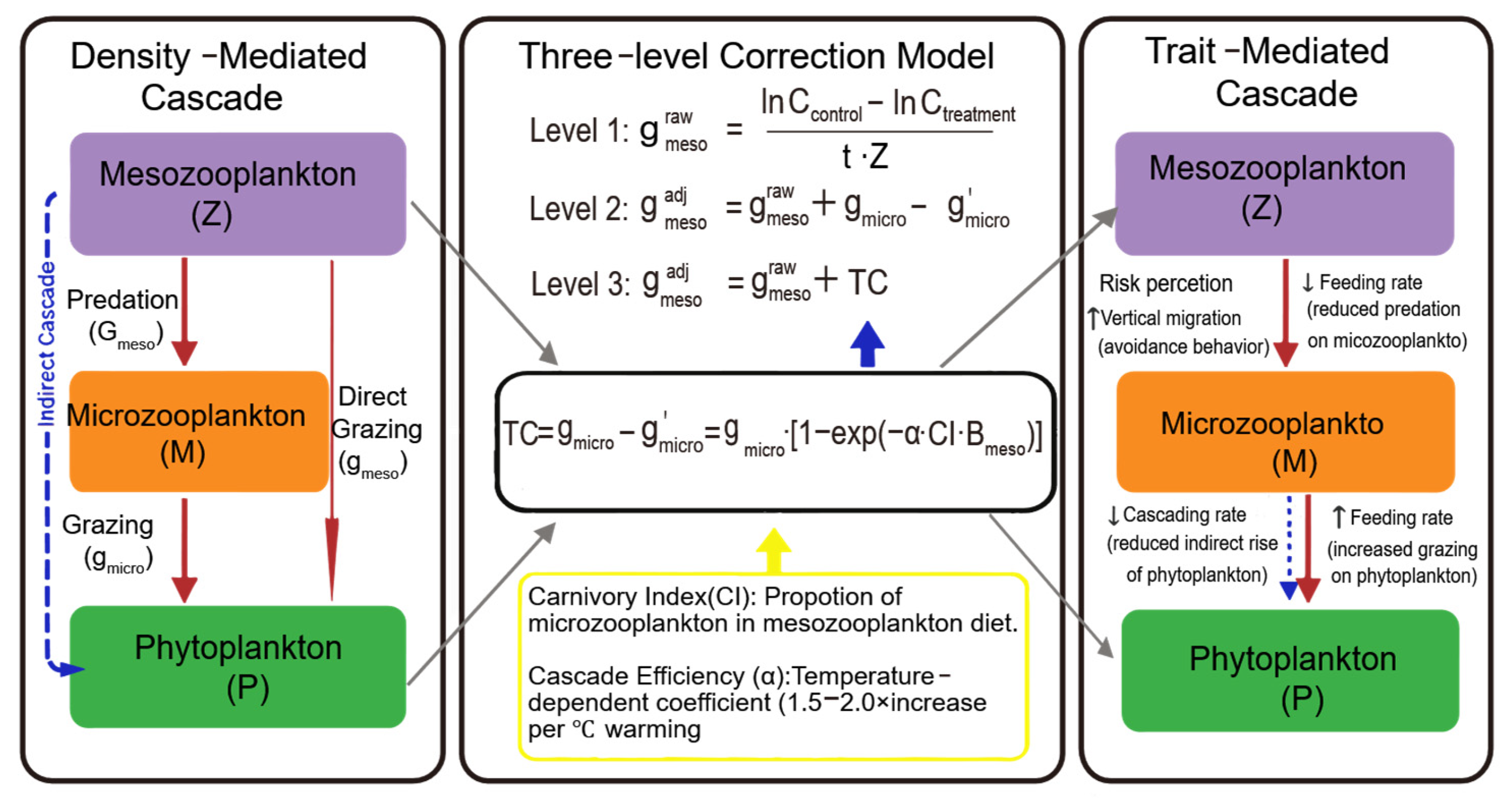
2.4. Three-Level Grazing Rate Correction Model
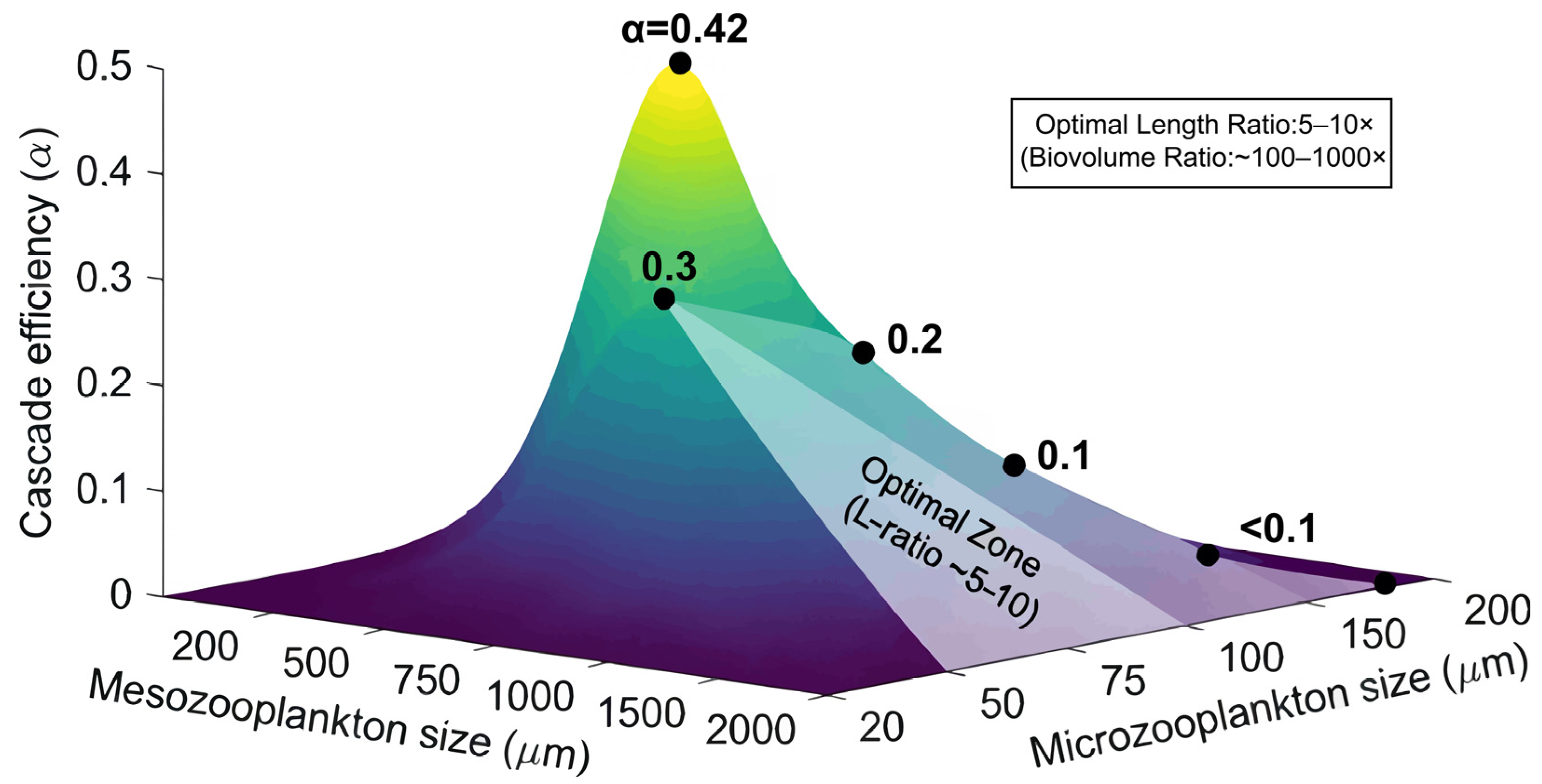
2.5. Quantification of Cascade Strength (CS)
2.6. NPMZ Model: Integrating Mesozooplankton-Microzooplankton-Phytoplankton Interactions
3. Dynamics and Manifestations of Trophic Cascades
3.1. Physical Forcing Mechanisms and Biotic Feedback Loops
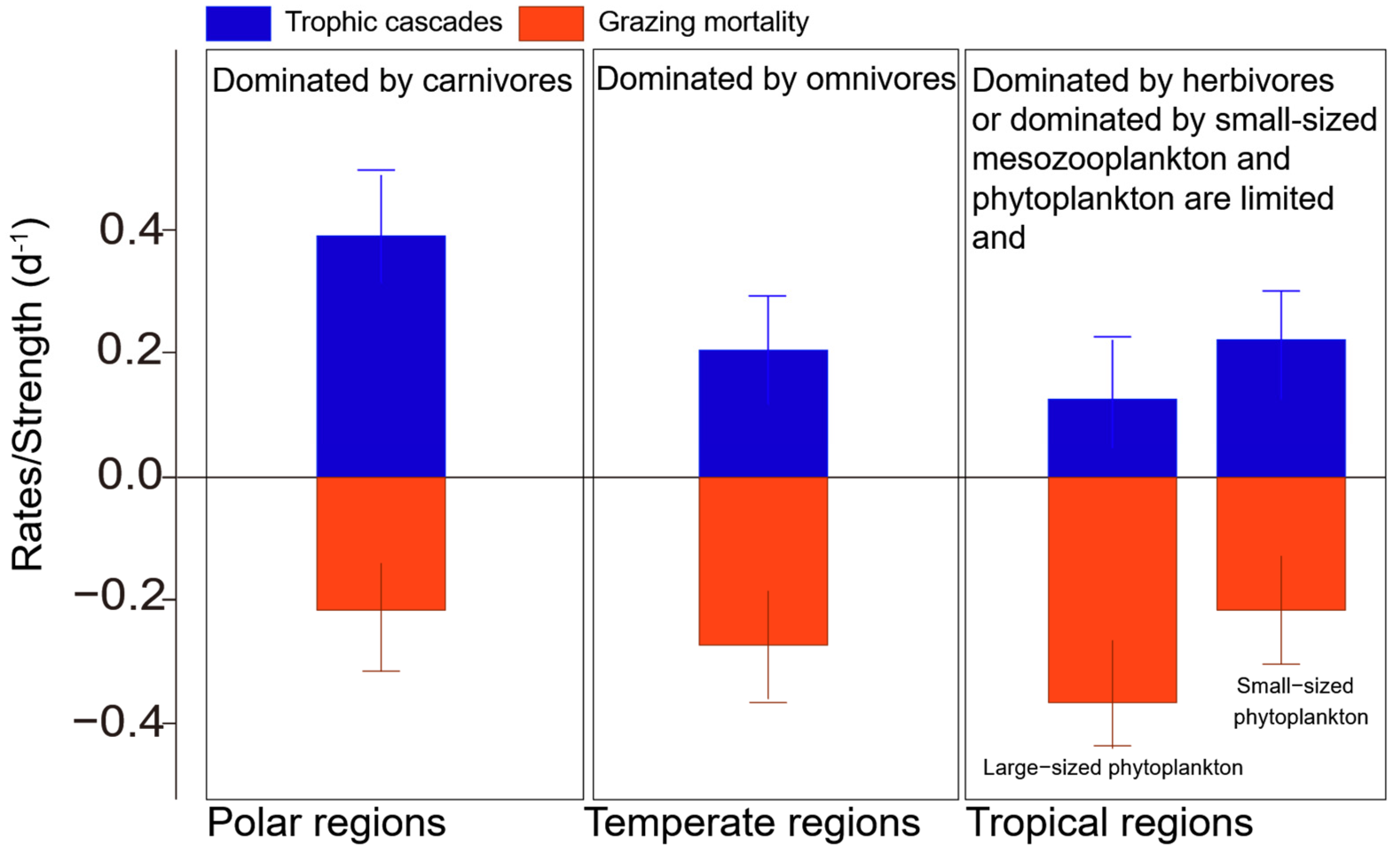
3.2. Spatiotemporal Heterogeneity
3.3. Temporal Dynamics of Trophic Cascades
3.4. Ecosystem-Level Consequences of MMTC
4. Impacts of Global Change on Mesozooplankton-Mediated Trophic Cascades
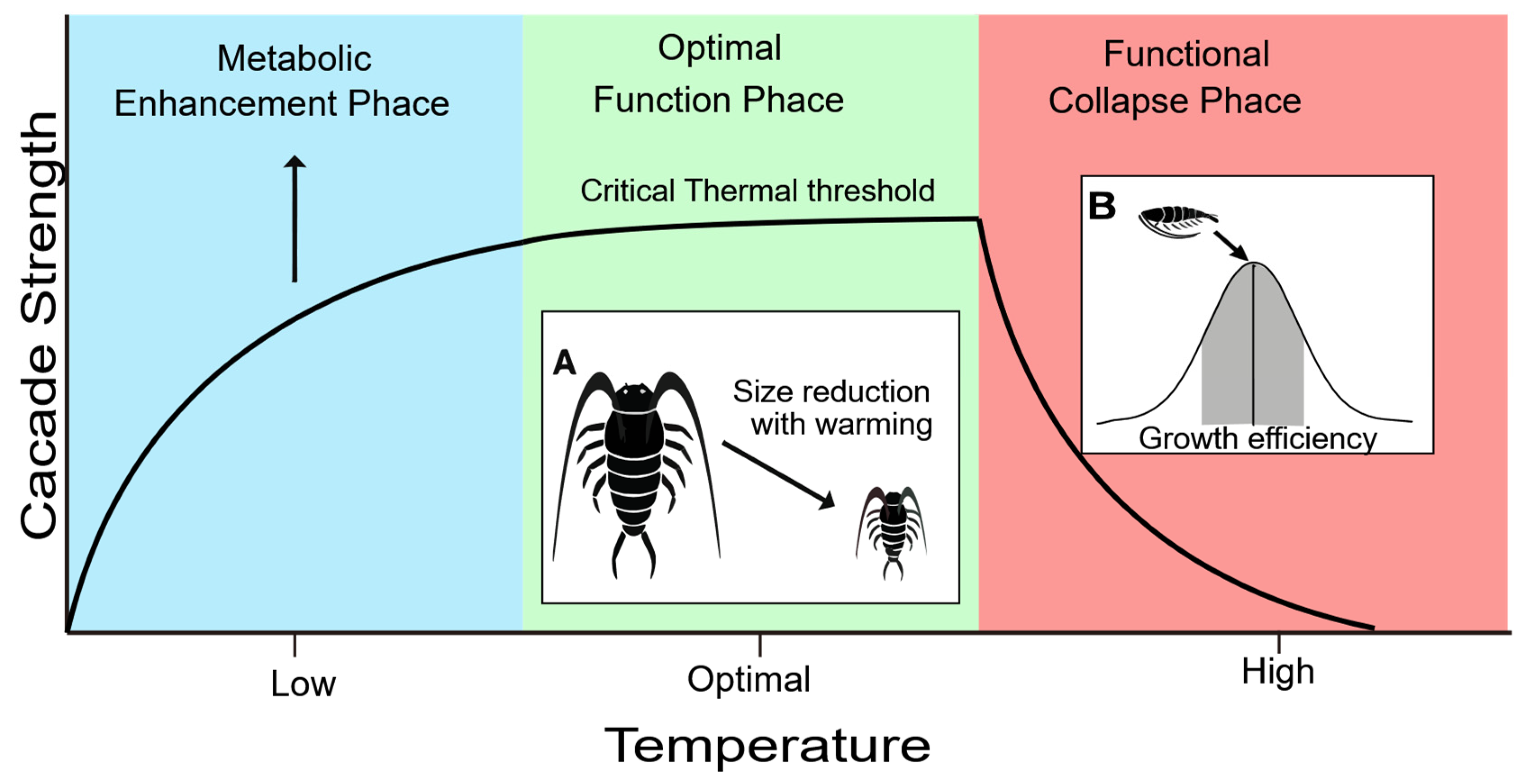
4.1. Ocean Warming
4.2. Ocean Acidification
4.3. Eutrophication and Hypoxia
4.4. Multi-Stressor Interactive Effects
5. Future Research Directions
5.1. Integrating Trait-Based Ecology and Mechanistic Modeling
5.2. Unraveling Cryptic Trophic Interactions
5.3. Multi–Stressor Experiments Across Temporal and Spatial Scales
5.4. Advancing Technological and Methodological Innovations
6. Conclusions
Funding
Institutional Review Board Statement
Informed Consent Statement
Data Availability Statement
Acknowledgments
Conflicts of Interest
References
- Pace, M.L.; Cole, J.J.; Carpenter, S.R.; Kitchell, J.F. Trophic cascades revealed in diverse ecosystems. Trends Ecol. Evol. 1999, 14, 483–488. [Google Scholar] [CrossRef] [PubMed]
- Piovia-Scott, J.; Yang, L.H.; Wright, A.N. Temporal variation in trophic cascades. Annu. Rev. Ecol. Evol. Syst. 2017, 48, 281–300. [Google Scholar] [CrossRef]
- Sommer, U. Trophic Cascades in Marine and Freshwater Plankton. Int. Rev. Hydrobiol. 2008, 93, 506–516. [Google Scholar] [CrossRef]
- Casini, M.; Lövgren, J.; Hjelm, J.; Cardinale, M.; Molinero, J.C.; Kornilovs, G. Multi-level trophic cascades in a heavily exploited open marine ecosystem. Proc. R. Soc. B Biol. Sci. 2008, 275, 1793–1801. [Google Scholar] [CrossRef]
- Eriksson, B.K.; Bergström, U.; Govers, L.L.; Eklöf, J.S. Trophic Cascades in Coastal Ecosystems. In Treatise on Estuarine and Coastal Science, 2nd ed.; Elsevier: Amsterdam, The Netherlands, 2024; pp. 5–49. [Google Scholar]
- Surma, S.; Pakhomov, E.A.; Pitcher, T.J. Trophic cascades and top-down control: Found at sea. Front. Ecol. Evol. 2025, 13, 1587171. [Google Scholar] [CrossRef]
- Calbet, A.; Landry, M.R. Mesozooplankton influences on the microbial food web: Direct and indirect trophic interactions in the oligotrophic open ocean. Limnol. Oceanogr. 1999, 44, 1370–1380. [Google Scholar] [CrossRef]
- Vanderploeg, H.A. Zooplankton particle selection and feeding mechanisms. In The Biology of Particles in Aquatic Systems, 2nd ed.; CRC Press: Boca Raton, FL, USA, 2020; pp. 205–234. [Google Scholar]
- Zöllner, E.; Hoppe, H.-G.; Sommer, U.; Jürgens, K. Effect of zooplankton-mediated trophic cascades on marine microbial food web components (bacteria, nanoflagellates, ciliates). Limnol. Oceanogr. 2009, 54, 262–275. [Google Scholar] [CrossRef]
- Hu, N.; Bourdeau, P.E.; Hollander, J. Responses of marine trophic levels to the combined effects of ocean acidification and warming. Nat. Commun. 2024, 15, 3400. [Google Scholar] [CrossRef]
- Murphy, G.E.P.; Romanuk, T.N.; Worm, B. Cascading effects of climate change on plankton community structure. Ecol. Evol. 2020, 10, 2170–2181. [Google Scholar] [CrossRef]
- Richon, C.; Wagner, C.; Sunderland, E.M.; Ayata, S.D.; Tagliabue, A. A global biogeography analysis reveals vulnerability of surface marine zooplankton to anthropogenic stressors. One Earth 2024, 7, 146–160. [Google Scholar] [CrossRef]
- Ullah, H.; Fordham, D.A.; Goldenberg, S.U.; Nagelkerken, I. Combining mesocosms with models reveals effects of global warming and ocean acidification on a temperate marine ecosystem. Ecol. Appl. 2024, 34, e2977. [Google Scholar] [CrossRef]
- Chen, M.; Si, Y.; Han, L.; Liu, X.; Huang, B.; Kang, C. Effect of prey selectivity and trophic cascades induced by mesozooplankton on the dynamics of phytoplankton. Mar. Ecol. Prog. Ser. 2021, 662, 35–51. [Google Scholar] [CrossRef]
- Nejstgaard, J.C.; Naustvoll, L.J.; Sazhin, A. Correcting for underestimation of microzooplankton grazing in bottle incubation experiments with mesozooplankton. Mar. Ecol. Prog. Ser. 2001, 221, 59–75. [Google Scholar] [CrossRef]
- Chen, M.; Liu, H.; Chen, B. Seasonal variability of mesozooplankton feeding rates on phytoplankton in subtropical coastal and estuarine waters. Front. Mar. Sci. 2017, 4, 186. [Google Scholar] [CrossRef]
- Chen, M.; Liu, H.; Li, H. Effect of mesozooplankton feeding selectivity on the dynamics of algae in the presence of intermediate grazers—A laboratory simulation. Mar. Ecol. Prog. Ser. 2013, 486, 47–58. [Google Scholar] [CrossRef][Green Version]
- Chen, M.; Liu, H.; Chen, B. Effects of dietary essential fatty acids on reproduction rates of a subtropical calanoid copepod, Acartia erythraea. Mar. Ecol. Prog. Ser. 2012, 455, 95–110. [Google Scholar] [CrossRef]
- Beauchesne, D.; Cazelles, K.; Daigle, R.M.; Gravel, D.; Archambault, P. Ecological interactions amplify cumulative effects in marine ecosystems. Sci. Adv. 2025, 11, eadp9315. [Google Scholar] [CrossRef]
- Zhu, K.; Zhang, H.; Zhang, P.; Wang, P.; Li, H.; Feng, M.; Wang, H.; Wang, H.; Zhang, M.; Xu, J. Interactive effects of warming and eutrophication on zooplankton could reverse the stoichiometric mismatch with phytoplankton. Water Biol. Secur. 2023, 2, 100205. [Google Scholar] [CrossRef]
- Deininger, A.; Faithfull, C.L.; Lange, K.; Bayer, T.; Vidussi, F.; Liess, A. Simulated terrestrial runoff triggered a phytoplankton succession and changed seston stoichiometry in coastal lagoon mesocosms. Mar. Environ. Res. 2016, 119, 40–50. [Google Scholar] [CrossRef]
- Oliveira, L.D.F.D.; Bode-Dalby, M.; Schukat, A.; Auel, H.; Hagen, W. Cascading effects of calanoid copepod functional groups on the biological carbon pump in the subtropical South Atlantic. Front. Mar. Sci. 2022, 9, 920483. [Google Scholar] [CrossRef]
- Wan, X.; Lu, X.; Zhu, L.; Feng, J. Relative prevalence of top-down versus bottom-up control in planktonic ecosystem under eutrophication and climate change: A comparative study of typical bay and estuary. Water Res. 2024, 255, 121487. [Google Scholar] [CrossRef]
- Dai, M.; Zhao, Y.; Chai, F.; Chen, M.; Chen, N.; Chen, Y.; Cheng, D.; Gan, J.; Guan, D.; Hong, Y.; et al. Persistent eutrophication and hypoxia in the coastal ocean. Camb. Prism. Coast. Futures 2023, 1, e19. [Google Scholar] [CrossRef]
- Xue, T.; Frenger, I.; Oschlies, A.; Stock, C.A.; Koeve, W.; John, J.G.; Prowe, A.F. Mixed layer depth promotes trophic amplification on a seasonal scale. Geophys. Res. Lett. 2022, 49, e2022GL098720. [Google Scholar] [CrossRef]
- Carpenter, S.R.; Kitchell, J.F.; Hodgson, J.R. Cascading trophic interactions and lake productivity. BioScience 1985, 35, 634–639. [Google Scholar] [CrossRef]
- Calbet, A.; Landry, M.R. Phytoplankton growth, microzooplankton grazing, and carbon cycling in marine systems. Limnol. Oceanogr. 2004, 49, 51–57. [Google Scholar] [CrossRef]
- Banse, K. Zooplankton: Pivotal role in the control of ocean production. ICES J. Mar. Sci. 1995, 52, 265–277. [Google Scholar] [CrossRef]
- Serandour, B.; Jan, K.M.; Novotny, A.; Winder, M. Opportunistic vs. selective feeding strategies of zooplankton under changing environmental conditions. J. Plankton Res. 2023, 45, 389–403, Erratum in J. Plankton Res. 2024, 2, 242. [Google Scholar] [CrossRef]
- Kleppel, G. On the diets of calanoid copepods. Mar. Ecol. Prog. Ser. 1993, 99, 183–195. [Google Scholar] [CrossRef]
- Paffenhöfer, G.A. On the ecology of marine cyclopoid copepods (Crustacea, Copepoda). J. Plankton Res. 1993, 15, 37–55. [Google Scholar] [CrossRef]
- Lombard, F.; Selander, E.; Kiorboe, T. Active prey rejection in the filter-feeding appendicularian Oikopleura dioica. Limnol. Oceanogr. 2011, 56, 1504–1512. [Google Scholar] [CrossRef]
- Giricheva, E.E. The influence of trophic interactions in the plankton community on its spatiotemporal dynamics. Math. Biol. Bioinform. 2019, 14, 393–405. [Google Scholar] [CrossRef]
- Basedow, S.; Tande, K.; Zhou, M. Biovolume spectrum theories applied: Spatial patterns of trophic levels within a mesozooplankton community at the polar front. J. Plankton Res. 2010, 32, 1105–1119. [Google Scholar] [CrossRef] [PubMed]
- Thomas, P.K.; Kunze, C.; Van de Waal, D.B.; Hillebrand, H.; Striebel, M. Elemental and biochemical nutrient limitation of zooplankton: A meta-analysis. Ecol. Lett. 2022, 25, 2776–2792. [Google Scholar] [CrossRef] [PubMed]
- Broglio, E.; Jónasdóttir, S.; Calbet, A.; Jakobsen, H.; Saiz, E. Effect of heterotrophic versus autotrophic food on feeding and reproduction of the calanoid copepod Acartia tonsa: Relationship with prey fatty acid composition. Aquat. Microb. Ecol. Int. J. 2003, 31, 267–278. [Google Scholar] [CrossRef]
- Bentley, K.M.; Pierson, J.J.; Glibert, P.M. Physiological responses of the copepods Acartia tonsa and Eurytemora carolleeae to changes in the nitrogen: Phosphorus quality of their food. Nitrogen 2021, 2, 62–85. [Google Scholar] [CrossRef]
- Kattner, G.; Hagen, W.; Lee, R.F.; Campbell, R.; Deibel, D.; Falk-Petersen, S.; Graeve, M.; Hansen, B.W.; Hirche, H.J.; Jónasdóttir, S.H.; et al. Perspectives on marine zooplankton lipids. Can. J. Fish. Aquat. Sci. 2007, 64, 1628–1639. [Google Scholar] [CrossRef]
- Sweat, L.H.; Alexander, H.; Phlips, E.J.; Johnson, K.B. Mesozooplankton community dynamics and grazing potential across algal bloom cycles in a subtropical estuary. Front. Mar. Sci. 2021, 8, 734270. [Google Scholar] [CrossRef]
- Liu, K.; Ng, H.Y.T.; Gao, Z.; Liu, H. Selective feeding of a mixotrophic dinoflagellate (Lepidodinium sp.) in response to experimental warming and inorganic nutrient imbalance. Front. Microbiol. 2022, 13, 805306. [Google Scholar] [CrossRef]
- Turner, J. The importance of small planktonic copepods and their roles in pelagic marine food webs. Zool. Stud. 2004, 43, 255–266. [Google Scholar]
- Paine, R.T. Food webs: Linkage, interaction strength and community infrastructure. J. Anim. Ecol. 1980, 49, 667–685. [Google Scholar] [CrossRef]
- Kiørboe, T.; Saiz, E.; Tiselius, P.; Andersen, K.H. Adaptive feeding behavior and functional responses in zooplankton. Limnol. Oceanogr. 2018, 63, 308–321, Erratum in Limnol. Oceanogr. 2018, 63, 1832. [Google Scholar] [CrossRef]
- MÖller, K.O.; St. John, M.; Temming, A.; Diekmann, R.; Peters, J.; Floeter, J.; Sell, A.F.; Herrmann, J.-P.; Gloe, D.; Schmidt, J.O.; et al. Predation risk triggers copepod small-scale behavior in the Baltic Sea. J. Plankton Res. 2020, 42, 702–713. [Google Scholar] [CrossRef] [PubMed]
- Frost, B.W. Effects of size and concentration of food particles on the feeding behavior of the marine planktonic copepod Calanus pacificus. Limnol. Oceanogr. 1972, 17, 80–88. [Google Scholar] [CrossRef]
- Calbet, A. Mesozooplankton grazing effect on primary production: A global comparative analysis in marine ecosystems. Limnol. Oceanogr. 2001, 46, 1824–1830. [Google Scholar] [CrossRef]
- Gifford, S.; Rollwagen-Bollens, G.; Bollens, S. Mesozooplankton omnivory in the upper San Francisco Estuary. Mar. Ecol. Prog. Ser. 2007, 348, 33–46. [Google Scholar] [CrossRef]
- Buitenhuis, E.; Le Quéré, C.; Aumont, O.; Beaugrand, G.; Bunker, A.; Hirst, A.; Ikeda, T.; O’Brien, T.; Piontkovski, S.; Sergey, S.; et al. Biogeochemical fluxes through mesozooplankton. Glob. Biogeochem. Cycles 2006, 20, 1–18. [Google Scholar] [CrossRef]
- Franks, P. New models for the exploration of biological processes at fronts. ICES J. Mar. Sci. 1997, 54, 161–167. [Google Scholar] [CrossRef]
- Mitra, A.; Flynn, K.J.; Fasham, M.J. Accounting for grazing dynamics in nitrogen-phytoplankton-zooplankton (NPZ) models. Limnol. Oceanogr. 2007, 52, 649–661. [Google Scholar] [CrossRef]
- Chen, M.; Liu, H. Experimental simulation of trophic interactions among omnivorous copepods, heterotrophic dinoflagellates and diatoms. J. Exp. Mar. Biol. Ecol. 2011, 403, 65–74. [Google Scholar] [CrossRef]
- Steinberg, D.; Landry, M. Zooplankton and the Ocean Carbon Cycle. Annu. Rev. Mar. Sci. 2017, 9, 413–444. [Google Scholar] [CrossRef]
- Acheampong, E.; Hense, I.; John, M.A.S. A model for the description of feeding regulation by mesozooplankton under different conditions of temperature and prey nutritional status. Ecol. Model. 2014, 272, 84–97. [Google Scholar] [CrossRef]
- Boersma, M.; Mathew, K.A.; Niehoff, B.; Schoo, K.L.; Franco-Santos, R.M.; Meunier, C.L. Temperature driven changes in the diet preference of omnivorous copepods: No more meat when it’s hot? Ecol. Lett. 2016, 19, 45–53. [Google Scholar] [CrossRef] [PubMed]
- O’Gorman, E.J.; Zhao, L.; Kordas, R.L.; Dudgeon, S.; Woodward, G. Warming indirectly simplifies food webs through effects on apex predators. Nat. Ecol. Evol. 2023, 7, 1983–1992. [Google Scholar] [CrossRef] [PubMed]
- Svensson, F.; Karlsson, E.; Gårdmark, A.; Olsson, J.; Adill, A.; Zie, J.; Snoeijs, P.; Eklöf, J.S. In situ warming strengthens trophic cascades in a coastal food web. Oikos 2017, 126, 1150–1161. [Google Scholar] [CrossRef]
- Thingstad, T.F. How trophic cascades and photic zone nutrient content interact to generate basin-scale differences in the microbial food web. ICES J. Mar. Sci. 2020, 77, 1639–1647. [Google Scholar] [CrossRef]
- Marrec, P.; Menden-Deuer, S. Changes in phytoplankton size–structure alter trophic transfer in a temperate, coastal planktonic food web. Limnol. Oceanogr. Lett. 2024, 9, 624–633. [Google Scholar] [CrossRef]
- Liu, H.; Zhu, M.; Guo, S.; Zhao, X.; Sun, X. Effects of an anticyclonic eddy on the distribution and community structure of zooplankton in the South China Sea northern slope. J. Mar. Syst. 2020, 205, 103311. [Google Scholar] [CrossRef]
- An, L.; Liu, X.; Xu, F.; Fan, X.; Wang, P.; Yin, W.; Huang, B. Different responses of plankton community to mesoscale eddies in the western equatorial Pacific Ocean. Deep Sea Res. Part I Oceanogr. Res. Pap. 2024, 203, 104219. [Google Scholar] [CrossRef]
- Wells, R.D.; Rooker, J.R.; Quigg, A.; Wissel, B. Influence of mesoscale oceanographic features on pelagic food webs in the Gulf of Mexico. Mar. Biol. 2017, 164, 92. [Google Scholar] [CrossRef]
- Gangrade, S.; Mangolte, I. Patchiness of plankton communities at fronts explained by Lagrangian history of upwelled water parcels. Limnol. Oceanogr. 2024, 69, 2123–2137. [Google Scholar] [CrossRef]
- Ayón Dejo, P.; Pinedo Arteaga, E.L.; Schukat, A.; Taucher, J.; Kiko, R.; Hauss, H.; Dorschner, S.; Hagen, W.; Segura-Noguera, M.; Lischka, S. Zooplankton community succession and trophic links during a mesocosm experiment in the coastal upwelling off Callao Bay (Peru). Biogeosciences 2023, 20, 945–969. [Google Scholar] [CrossRef]
- García-Seoane, R.; Viana, I.G.; Bode, A. Seasonal upwelling influence on trophic indices of mesozooplankton in a coastal food web estimated from δ15N in amino acids. Prog. Oceanogr. 2023, 219, 103149. [Google Scholar] [CrossRef]
- Rakowski, C.J.; Farrior, C.E.; Manning, S.R.; Leibold, M.A. Predator complementarity dampens variability of phytoplankton biomass in a diversity-stability trophic cascade. Ecology 2021, 102, e03534. [Google Scholar] [CrossRef] [PubMed]
- Roman, M.; Zhang, X.; McGilliard, C.; Boicourt, W. Seasonal and annual variability in the spatial patterns of plankton biomass in Chesapeake Bay. Limnol. Oceanogr. 2005, 50, 480–492. [Google Scholar] [CrossRef]
- Yang, E.J.; Lee, Y.; Lee, S. Trophic interactions of micro-and mesozooplankton in the Amundsen Sea polynya and adjacent sea ice zone during austral late summer. Prog. Oceanogr. 2019, 174, 117–130. [Google Scholar] [CrossRef]
- Kwiatkowski, L.; Aumont, O.; Bopp, L. Consistent trophic amplification of marine biomass declines under climate change. Glob. Change Biol. 2019, 25, 218–229. [Google Scholar] [CrossRef]
- Du, P.; Jiang, Z.B.; Zhu, Y.L.; Tang, Y.B.; Liao, Y.B.; Chen, Q.Z.; Zeng, J.N.; Shou, L. What Factors Control the Variations in Abundance, Biomass, and Size of Mesozooplankton in a Subtropical Eutrophic Bay? Estuaries Coasts 2020, 43, 2128–2140. [Google Scholar] [CrossRef]
- Landry, M.R.; Swalethorp, R. Mesozooplankton biomass, grazing and trophic structure in the bluefin tuna spawning area of the oceanic Gulf of Mexico. J. Plankton Res. 2021, 44, 677–691. [Google Scholar] [CrossRef]
- Stefanoudis, P.V.; Rivers, M.; Ford, H.; Yashayaev, I.M.; Rogers, A.D.; Woodall, L.C. Changes in zooplankton communities from epipelagic to lower mesopelagic waters. Mar. Environ. Res. 2019, 146, 1–11. [Google Scholar] [CrossRef]
- Ripple, W.J.; Estes, J.A.; Schmitz, O.J.; Constant, V.; Kaylor, M.J.; Lenz, A.; Motley, J.L.; Self, K.E.; Taylor, D.S.; Wolf, C. What is a trophic cascade? Trends Ecol. Evol. 2016, 31, 842–849. [Google Scholar] [CrossRef]
- Cabrerizo, M.J.; Happe, A.; Ahme, A.; John, U.; Olsson, M.; Striebel, M. Moderate and extreme warming under a varied resource supply alter the microzooplankton–phytoplankton coupling in North Sea coastal communities. Limnol. Oceanogr. 2024, 69, 2991–3002. [Google Scholar] [CrossRef]
- Chen, T.C.; Ho, P.C.; Gong, G.C.; Tsai, A.Y.; Hsieh, C.H. Finding Approaches to Exploring the Environmental Factors That Influence Copepod-Induced Trophic Cascades in the East China Sea. Diversity 2021, 13, 299. [Google Scholar] [CrossRef]
- Liu, B.; Chen, M.; Wang, C. The Dynamics of Trophic Cascades on Phytoplankton Induced by Mesozooplankton in Coastal Water, Daya Bay, Northern South China Sea. Microorganisms 2024, 12, 1982. [Google Scholar] [CrossRef] [PubMed]
- Zhang, H.; Zhang, P.; Wang, H.; García Molinos, J.; Hansson, L.; He, L.; Zhang, M.; Xu, J. Synergistic effects of warming and eutrophication alert zooplankton predator–prey interactions along the benthic-pelagic interface. Glob. Change Biol. 2021, 27, 5907–5919. [Google Scholar] [CrossRef]
- Kimmel, D.G.; Boicourt, W.C.; Pierson, J.J.; Roman, M.R.; Zhang, X. A comparison of the mesozooplankton response to hypoxia in Chesapeake Bay and the northern Gulf of Mexico using the biomass size spectrum. J. Exp. Mar. Biol. Ecol. 2009, 381, S65–S73. [Google Scholar] [CrossRef]
- Xu, Z.; Sun, Q.; Miao, Y.; Li, H.; Wang, B.; Jin, H.; Zhu, Z.; Chen, J. Ecosystem dynamics and hypoxia control in the East China Sea: A bottom-up and top-down perspective. Sci. Total Environ. 2024, 918, 170729. [Google Scholar] [CrossRef]
- Bernard, A.; Azémar, F.; Maris, T.; Meire, P.; Martínez, L.A.; Mouth, C.; Bou, E.; Tackx, M. Zooplankton community changes in a restoring estuary. Estuar. Coast. Shelf Sci. 2025, 324, 109450. [Google Scholar] [CrossRef]
- Horn, H.G.; van Rijswijk, P.; Soetaert, K.; van Oevelen, D. Drivers of spatial and temporal micro- and mesozooplankton dynamics in an estuary under strong anthropogenic influences (The Eastern Scheldt, Netherlands). J. Sea Res. 2023, 192, 102357. [Google Scholar] [CrossRef]
- Telesh, I.V. Plankton of the Baltic estuarine ecosystems with emphasis on Neva Estuary: A review of present knowledge and research perspectives. Mar. Pollut. Bull. 2004, 49, 206–219. [Google Scholar] [CrossRef]
- Landry, M.R.; Décima, M.; Stukel, M.R.; Gutiérrez-Rodríguez, A. Trophic flows to mesozooplankton support the conventional paradigm of pelagic food web structure in ocean ecosystems. ICES J. Mar. Sci. 2025, 82, fsae131. [Google Scholar] [CrossRef]
- Kobari, T.; Nakamura, R.; Unno, K.; Kitamura, M.; Tanabe, K.; Nagafuku, H.; Niibo, A.; Kawakami, H.; Matsumoto, K.; Honda, M.C. Seasonal variability in carbon demand and flux by mesozooplankton communities at subarctic and subtropical sites in the western North Pacific Ocean. J. Oceanogr. 2016, 72, 403–418. [Google Scholar] [CrossRef]
- Valencia, B.; Landry, M.R.; Décima, M.; Hannides, C.C.S. Environmental drivers of mesozooplankton biomass variability in the North Pacific Subtropical Gyre. J. Geophys. Res. Biogeosciences 2016, 121, 3131–3143. [Google Scholar] [CrossRef]
- Fernandez de Puelles, M.L.; Gazá, M.; Cabanellas-Reboredo, M.; O’Brien, T.D. Decadal Trends in the Zooplankton Community of the Western Mediterranean. Water 2023, 15, 4267. [Google Scholar] [CrossRef]
- Protopapa, M.; Zervoudaki, S.; Assimakopoulou, G.; Velaoras, D.; Koppelmann, R. Mesozooplankton community structure in the Eastern Mediterranean Sea. J. Mar. Syst. 2020, 211, 103401. [Google Scholar] [CrossRef]
- Spingys, C.P.; Williams, R.G.; Tuerena, R.E.; Naveira Garabato, A.; Vic, C.; Forryan, A.; Sharples, J. Observations of nutrient supply by mesoscale eddy stirring and small-scale turbulence in the oligotrophic North Atlantic. Glob. Biogeochem. Cycles 2021, 35, e2021GB007200. [Google Scholar] [CrossRef]
- Zhang, W.; Zhang, C.; Zheng, S.; Chen, Y.; Zhu, M.; Sun, X. Distribution of picophytoplankton in the northern slope of the South China Sea under environmental variation induced by a warm eddy. Mar. Pollut. Bull. 2023, 194, 115429. [Google Scholar] [CrossRef]
- Ottersen, G.; Constable, A.J.; Hollowed, A.B.; Holsman, K.K.; Melbourne-Thomas, J.; Muelbert, M.M.; Skern-Mauritzen, M. Climate change impacts on polar marine ecosystems: Toward robust approaches for managing risks and uncertainties. Front. Clim. 2022, 3, 733755. [Google Scholar] [CrossRef]
- Dietrich, K.S.; Santora, J.A.; Reiss, C.S. Winter and summer biogeography of macrozooplankton community structure in the northern Antarctic Peninsula ecosystem. Prog. Oceanogr. 2021, 196, 102610. [Google Scholar] [CrossRef]
- Rogers, A.D.; Frinault, B.A.V.; Barnes, D.K.A.; Bindoff, N.L.; Downie, R.; Ducklow, H.W.; Friedlaender, A.S.; Hart, T.; Hill, S.L.; Hofmann, E.E.; et al. Antarctic Futures: An Assessment of Climate-Driven Changes in Ecosystem Structure, Function, and Service Provisioning in the Southern Ocean. Annu. Rev. Mar. Sci. 2020, 12, 87–120. [Google Scholar] [CrossRef]
- Laverick, J.H.; Speirs, D.C.; Heath, M.R. Sea-Ice Retreat from the Northeast Greenland Continental Shelf Triggers a Marine Trophic Cascade. Glob. Change Biol. 2025, 31, e70189. [Google Scholar] [CrossRef]
- Gawinski, C.; Daase, M.; Primicerio, R.; Amargant-Arumí, M.; Müller, O.; Wold, A.; Ormańczyk, M.R.; Kwasniewski, S.; Svensen, C. Response of the copepod community to interannual differences in sea-ice cover and water masses in the northern Barents Sea. Front. Mar. Sci. 2024, 11, 1308542, Erratum in Front. Mar. Sci. 2024, 11, 1440395. [Google Scholar]
- Hibino, Y.; Matsuno, K.; Fujiwara, A.; Abe, Y.; Hosoda, N.; Itoh, M.; Yamaguchi, A. Effect of delayed sea ice retreat on zooplankton communities in the Pacific Arctic Ocean: A generalized dissimilarity modeling approach. Front. Mar. Sci. 2025, 12, 1484609. [Google Scholar] [CrossRef]
- Song, H.; Ji, R.; Jin, M.; Li, Y.; Feng, Z.; Varpe, Ø.; Davis, C.S. Strong and regionally distinct links between ice-retreat timing and phytoplankton production in the Arctic Ocean. Limnol. Oceanogr. 2021, 66, 2498–2508. [Google Scholar] [CrossRef]
- Krumhardt, K.M.; Long, M.C.; Sylvester, Z.T.; Petrik, C.M. Climate drivers of Southern Ocean phytoplankton community composition and potential impacts on higher trophic levels. Front. Mar. Sci. 2022, 9, 916140. [Google Scholar] [CrossRef]
- Marquis, E.; Niquil, N.; Vézina, A.F.; Petitgas, P.; Dupuy, C. Influence of planktonic foodweb structure on a system’s capacity to support pelagic production: An inverse analysis approach. ICES J. Mar. Sci. 2011, 68, 803–812. [Google Scholar] [CrossRef]
- Baiser, B.; Gravel, D.; Cirtwill, A.R.; Dunne, J.A.; Fahimipour, A.K.; Gilarranz, L.J.; Grochow, J.A.; Li, D.; Martinez, N.D.; McGrew, A.; et al. Ecogeographical rules and the macroecology of food webs. Glob. Ecol. Biogeogr. 2019, 28, 1204–1218. [Google Scholar] [CrossRef]
- Madin, E.M.; Madin, J.S.; Harmer, A.M.; Barrett, N.S.; Booth, D.J.; Caley, M.J.; Cheal, A.J.; Edgar, G.J.; Emslie, M.J.; Gaines, S.D.; et al. Latitude and protection affect decadal trends in reef trophic structure over a continental scale. Ecol. Evol. 2020, 10, 6954–6966. [Google Scholar] [CrossRef]
- Barth, A.; Johnson, R.; Stone, J. Size and transparency influence diel vertical migration patterns in copepods. Limnol. Oceanogr. 2023, 68, 2749–2758. [Google Scholar] [CrossRef]
- Samanta, S.; Chowdhury, T.; Chattopadhyay, J. Mathematical modeling of cascading migration in a tri-trophic food-chain system. J. Biol. Phys. 2013, 39, 469–487. [Google Scholar] [CrossRef]
- Kenitz, K.M.; Visser, A.W.; Mariani, P.; Andersen, K.H. Seasonal succession in zooplankton feeding traits reveals trophic trait coupling. Limnol. Oceanogr. 2017, 62, 1184–1197. [Google Scholar] [CrossRef]
- Garzke, J.; Connor, S.J.; Sommer, U.; O’Connor, M.I. Trophic interactions modify the temperature dependence of community biomass and ecosystem function. PLoS Biol. 2019, 17, e2006806. [Google Scholar] [CrossRef] [PubMed]
- Dalpadado, P.; Arrigo, K.R.; van Dijken, G.L.; Skjoldal, H.R.; Bagøien, E.; Dolgov, A.V.; Prokopchuk, I.P.; Sperfeld, E. Climate effects on temporal and spatial dynamics of phytoplankton and zooplankton in the Barents Sea. Prog. Oceanogr. 2020, 185, 102320. [Google Scholar] [CrossRef]
- Auger, P.A.; Ulses, C.; Estournel, C.; Stemmann, L.; Somot, S.; Diaz, F. Interannual control of plankton communities by deep winter mixing and prey/predator interactions in the NW Mediterranean: Results from a 30-year 3D modeling study. Prog. Oceanogr. 2014, 124, 12–27. [Google Scholar] [CrossRef]
- Negrete-García, G.; Luo, J.Y.; Long, M.C.; Lindsay, K.; Levy, M.; Barton, A.D. Plankton energy flows using a global size-structured and trait-based model. Prog. Oceanogr. 2022, 209, 102898. [Google Scholar] [CrossRef]
- Ward, B.A.; Dutkiewicz, S.; Jahn, O.; Follows, M.J. A size-structured food-web model for the global ocean. Limnol. Oceanogr. 2012, 57, 1877–1891. [Google Scholar] [CrossRef]
- Di Pane, J.; Bourdaud, P.; Horn, S.; Moreno, H.D.; Meunier, C.L. Global change alters coastal plankton food webs by promoting the microbial loop: An inverse modelling and network analysis approach on a mesocosm experiment. Sci. Total Environ. 2024, 921, 171272. [Google Scholar] [CrossRef]
- Schmid, M.S.; Sponaugle, S.; Thompson, A.W.; Sutherland, K.R.; Cowen, R.K. Drivers of plankton community structure in intermittent and continuous coastal upwelling systems–from microbes and microscale in-situ imaging to large scale patterns. Front. Mar. Sci. 2023, 10, 1166629. [Google Scholar] [CrossRef]
- Wu, L.; Lin, S.; Huang, L.; Lu, J.; Chen, W.; Guo, W.; Zhang, W.; Xiao, T.; Sun, J. Chain response of microbial loop to the decay of a diatom bloom in the East China Sea. Deep Sea Res. Part II Top. Stud. Oceanogr. 2016, 124, 109–116. [Google Scholar] [CrossRef]
- Cavan, E.L.; Henson, S.A.; Belcher, A.; Sanders, R. Role of zooplankton in determining the efficiency of the biological carbon pump. Biogeosciences 2017, 14, 177–186. [Google Scholar] [CrossRef]
- Costa, R.R.; Mendes, C.R.B.; Tavano, V.M.; Dotto, T.S.; Kerr, R.; Monteiro, T.; Odebrecht, C.; Secchi, E.R. Dynamics of an intense diatom bloom in the Northern Antarctic Peninsula, February 2016. Limnol. Oceanogr. 2020, 65, 2056–2075. [Google Scholar] [CrossRef]
- O’Daly, S.H.; Hennon, G.M.; Kelly, T.B.; Strom, S.L.; McDonnell, A.M. Strong and efficient summertime carbon export driven by aggregation processes in a subarctic coastal ecosystem. Limnol. Oceanogr. 2024, 69, 1187–1203. [Google Scholar] [CrossRef]
- Lai, Y.; Tan, Y.; Ke, Z.; Zhou, L.; Liu, J.; Zhang, H.; Wang, J.; Li, K.; Lian, X. Size-dependent zoogeographical distribution of gelatinous thaliaceans associated with current velocity and temperature. Sci. Total Environ. 2024, 920, 170943. [Google Scholar] [CrossRef] [PubMed]
- Lai, Y.; Liu, B.; Chen, M. Spatiotemporal Dynamics of Mesozooplankton Trophic Structure and Food Web Configuration in the Vicinity of Daya Bay Nuclear Power Plant. Microorganisms 2026, 14, 203. [Google Scholar] [CrossRef] [PubMed]
- Stock, C.A.; Dunne, J.P.; John, J.G. Global-scale carbon and energy flows through the marine planktonic food web: An analysis with a coupled physical–biological model. Prog. Oceanogr. 2014, 120, 1–28. [Google Scholar] [CrossRef]
- Grandremy, N.; Romagnan, J.B.; Dupuy, C.; Doray, M.; Huret, M.; Petitgas, P. Hydrology and small pelagic fish drive the spatio–temporal dynamics of springtime zooplankton assemblages over the Bay of Biscay continental shelf. Prog. Oceanogr. 2023, 210, 102949. [Google Scholar] [CrossRef]
- Engel, A.; Cisternas-Novoa, C.; Hauss, H.; Kiko, R.; Le Moigne, F.A. Hypoxia-tolerant zooplankton may reduce biological carbon pump efficiency in the Humboldt current system off Peru. Commun. Earth Environ. 2023, 4, 458. [Google Scholar] [CrossRef]
- Sun, D.; Chen, Y.; Feng, Y.; Liu, Z.; Peng, X.; Cai, Y.; Yu, P.; Wang, C. Seasonal variation in size diversity: Explaining the spatial mismatch between phytoplankton and mesozooplankton in fishing grounds of the East China Sea. Ecol. Indic. 2021, 131, 108201. [Google Scholar] [CrossRef]
- Wei, L.; Zhang, X.; Huang, G.; Li, J. Effects of limited dissolved oxygen supply on the growth and energy allocation of juvenile Chinese shrimp, Fenneropenaeus chinensis. J. World Aquac. Soc. 2009, 40, 483–492. [Google Scholar] [CrossRef]
- Ratnarajah, L.; Abu-Alhaija, R.; Atkinson, A.; Batten, S.; Bax, N.J.; Bernard, K.S.; Canonico, G.; Cornils, A.; Everett, J.D.; Grigoratou, M.; et al. Monitoring and modelling marine zooplankton in a changing climate. Nat. Commun. 2023, 14, 564. [Google Scholar] [CrossRef]
- de Juan, C.; Sotomayor-García, A.; Calbet, A.; Saiz, E. Acute and long-term warming effects on the functional response and reproductive efficiency of marine copepods. Limnol. Oceanogr. 2025, 70, 3898–3911. [Google Scholar] [CrossRef]
- He, H.; Li, Q.; Li, J.; Han, Y.; Cao, Y.; Liu, W.; Yu, J.; Li, K.; Liu, Z.; Jeppesen, E. Turning up the heat: Warming influences plankton biomass and spring phenology in subtropical waters characterized by extensive fish omnivory. Oecologia 2020, 194, 251–265. [Google Scholar] [CrossRef] [PubMed]
- Ilić, M.; Klintworth, S.; Jackson, M.C. Quality over quantity: Trophic cascades in a warming world. Funct. Ecol. 2021, 35, 818–820. [Google Scholar] [CrossRef]
- Trombetta, T.; Mostajir, B.; Courboulès, J.; Protopapa, M.; Mas, S.; Aberle, N.; Vidussi, F. Warming and trophic structure tightly control phytoplankton bloom amplitude, composition and succession. PLoS ONE 2024, 19, e0308505. [Google Scholar] [CrossRef] [PubMed]
- Damien, P.; Bianchi, D.; Kessouri, F.; McWilliams, J.C. Extremes and short-term fluctuations in coastal ocean acidification and hypoxia. J. Geophys. Res. Ocean. 2024, 129, e2024JC021197. [Google Scholar] [CrossRef]
- Wyeth, A.C.; Grünbaum, D.; Keister, J.E.; Crouser, D.; Roberts, P. In situ observations of zooplankton show changes in abundance and swimming speed in response to hypoxia and acidification. Limnol. Oceanogr. 2024, 69, 2307–2317. [Google Scholar] [CrossRef]
- Ershova, E.A.; Kosobokova, K.N.; Banas, N.S.; Ellingsen, I.; Niehoff, B.; Hildebrandt, N.; Hirche, H.J. Sea ice decline drives biogeographical shifts of key Calanus species in the central Arctic Ocean. Glob. Change Biol. 2021, 27, 2128–2143. [Google Scholar] [CrossRef]
- Krishna, S.; Lemmen, C.; Örey, S.; Rehren, J.; Pane, J.; Mathis, M.; Püts, M.; Hokamp, S.; Pradhan, H.; Hasenbein, M.; et al. Interactive effects of multiple stressors in coastal ecosystems. Front. Mar. Sci. 2025, 11, 1481734. [Google Scholar] [CrossRef]
- Di Matteo, L.; Benedetti, F.; Ayata, S.D.; Aumont, O. Including different mesozooplankton feeding strategies in a biogeochemical ocean model impacts global ocean biomass and carbon cycle. Biogeosciences 2025, 22, 7233–7268. [Google Scholar] [CrossRef]
- Pata, P.R.; Hunt, B.P.V. Harmonizing marine zooplankton trait data toward a mechanistic understanding of ecosystem functioning. Limnol. Oceanogr. 2023, 70, S8–S27. [Google Scholar] [CrossRef]
- Liu, K.; Xu, Z.; Liu, X.; Huang, B.; Liu, H.; Chen, B. Modelling global mesozooplankton biomass using machine learning. Prog. Oceanogr. 2024, 229, 103371. [Google Scholar] [CrossRef]
- Zhou, L.; Luo, M.; Hong, P.; Leroux, S.; Chen, F.; Wang, S. Energy transfer efficiency rather than productivity determines the strength of aquatic trophic cascades. Ecology 2025, 106, e4482. [Google Scholar] [CrossRef] [PubMed]
- Fernández-Urruzola, I.; Bode, A.; Loick-Wilde, N.; Schneider, W.; Lindsay, D.; Escribano, R. Trophic ecology of midwater zooplankton along a productivity gradient in the Southeast Pacific. Front. Mar. Sci. 2023, 10, 1057502. [Google Scholar] [CrossRef]
- Kobari, T.; Shinyashiki, M.; Saito, K.; Kume, G.; Ichinomiya, M.; Komorita, T.; Miyamoto, H.; Okazaki, Y.; Makino, F.; Fukuda, R.; et al. Trophic sources and pathways of mesozooplankton and fish larvae in the Kuroshio and its neighboring waters based on stable isotope ratios of carbon and nitrogen. Prog. Oceanogr. 2023, 210, 102952. [Google Scholar] [CrossRef]
- Bossier, S.; Nielsen, J.R.; Neuenfeldt, S. Exploring trophic interactions and cascades in the Baltic Sea using a complex end-to-end ecosystem model with extensive food web integration. Ecol. Model. 2020, 436, 109281. [Google Scholar] [CrossRef]
- Shea, C.H.; Wojtal, P.K.; Close, H.G.; Maas, A.E.; Stamieszkin, K.; Cope, J.S.; Steinberg, D.K.; Wallsgrove, N.; Popp, B.N. Small particles and heterotrophic protists support the mesopelagic zooplankton food web in the subarctic northeast Pacific Ocean. Limnol. Oceanogr. 2023, 68, 1949–1963. [Google Scholar] [CrossRef]
- Chen, M.; Kim, D.; Liu, H.; Kang, C. Variability in copepod trophic levels and feeding selectivity based on stable isotope analysis in Gwangyang Bay of the southern coast of the Korean Peninsula. Biogeosciences 2018, 15, 2055–2073. [Google Scholar] [CrossRef]
- Weber, S.C.; Loick-Wilde, N.; Montoya, J.P.; Bach, M.; Doan-Nhu, H.; Subramaniam, A.; Liskow, I.; Nguyen-Ngoc, L.; Wodarg, D.; Voss, M. Environmental regulation of the nitrogen supply, mean trophic position, and trophic enrichment of mesozooplankton in the Mekong River plume and southern South China Sea. J. Geophys. Res. Ocean. 2021, 126, e2020JC017110. [Google Scholar] [CrossRef]
- Prowe, A.F.; Su, B.; Nejstgaard, J.C.; Schartau, M. Food web structure and intraguild predation affect ecosystem functioning in an established plankton model. Limnol. Oceanogr. 2022, 67, 843–855. [Google Scholar] [CrossRef]
- Pree, B.; Larsen, A.; Egge, J.K.; Simonelli, P.; Madhusoodhanan, R.; Tsagaraki, T.M.; Våge, S.; Erga, S.R.; Bratbak, G.; Thingstad, T.F. Dampened copepod-mediated trophic cascades in a microzooplankton-dominated microbial food web: A mesocosm study. Limnol. Oceanogr. 2017, 62, 1031–1044. [Google Scholar] [CrossRef]
- Jiang, H.; Liu, D.; Ma, Y.; Su, B.; Liu, N.; Zhang, J.; He, J.; Qin, H.; Song, X.; Sun, S.; et al. Decadal response of mesozooplankton assemblages to nutrient load reductions in Laizhou Bay, China. Front. Mar. Sci. 2022, 9, 849739. [Google Scholar] [CrossRef]
- Li, X.; Xu, Z.; Zhang, S.; Gao, W.; Dong, Q.; Guo, F.; Zhu, Z.; Yang, W.; Yang, Z. Eutrophication-Driven Changes in Plankton Trophic Interactions: Insights from Trade-Offs in Functional Traits. Environ. Sci. Technol. 2024, 59, 744–755. [Google Scholar] [CrossRef]
- Novotny, A.; Zamora-Terol, S.; Winder, M. DNA metabarcoding reveals trophic niche diversity of micro and mesozooplankton species. Proc. R. Soc. B 2021, 288, 20210908. [Google Scholar] [CrossRef]



Disclaimer/Publisher’s Note: The statements, opinions and data contained in all publications are solely those of the individual author(s) and contributor(s) and not of MDPI and/or the editor(s). MDPI and/or the editor(s) disclaim responsibility for any injury to people or property resulting from any ideas, methods, instructions or products referred to in the content. |
© 2026 by the author. Licensee MDPI, Basel, Switzerland. This article is an open access article distributed under the terms and conditions of the Creative Commons Attribution (CC BY) license.
Share and Cite
Chen, M. The Trophic Cascade Effects of Marine Mesozooplankton: Theory, Dynamics, and Responses to Global Change. Microorganisms 2026, 14, 697. https://doi.org/10.3390/microorganisms14030697
Chen M. The Trophic Cascade Effects of Marine Mesozooplankton: Theory, Dynamics, and Responses to Global Change. Microorganisms. 2026; 14(3):697. https://doi.org/10.3390/microorganisms14030697
Chicago/Turabian StyleChen, Mianrun. 2026. "The Trophic Cascade Effects of Marine Mesozooplankton: Theory, Dynamics, and Responses to Global Change" Microorganisms 14, no. 3: 697. https://doi.org/10.3390/microorganisms14030697
APA StyleChen, M. (2026). The Trophic Cascade Effects of Marine Mesozooplankton: Theory, Dynamics, and Responses to Global Change. Microorganisms, 14(3), 697. https://doi.org/10.3390/microorganisms14030697