A New Challenge of Antibiotic-Resistant Bacteria: Carbapenem-Resistant Enterobacter cloacae Complex in a One Health Perspective

Abstract
1. Introduction
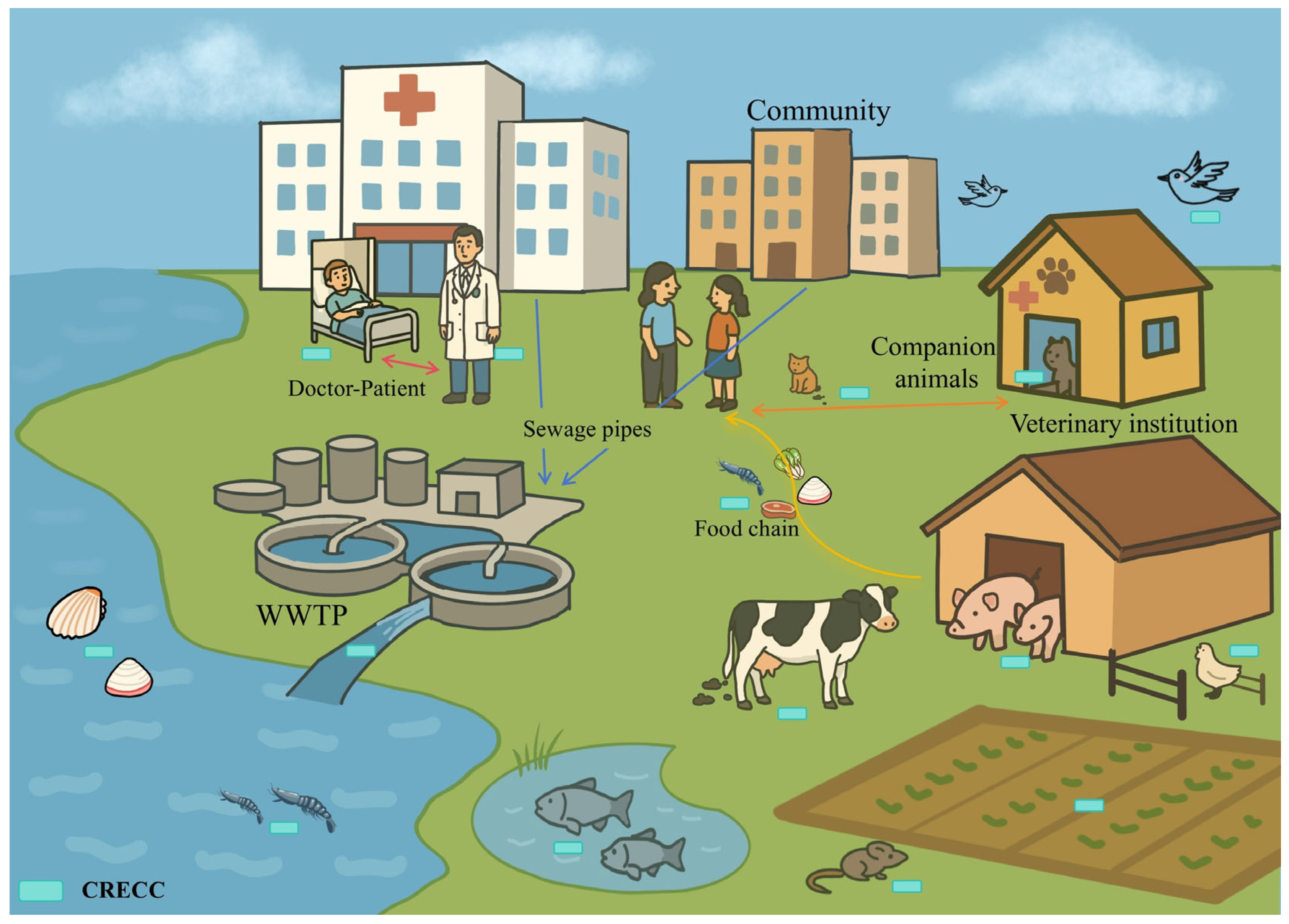
2. Occurrence and Ecological Distribution of CRECC
2.1. Epidemiological Characteristics of CRECC in Humans
2.2. Epidemiological Characteristics of CRECC in Animals
2.3. Prevalence Characteristics of CRECC in the Environment
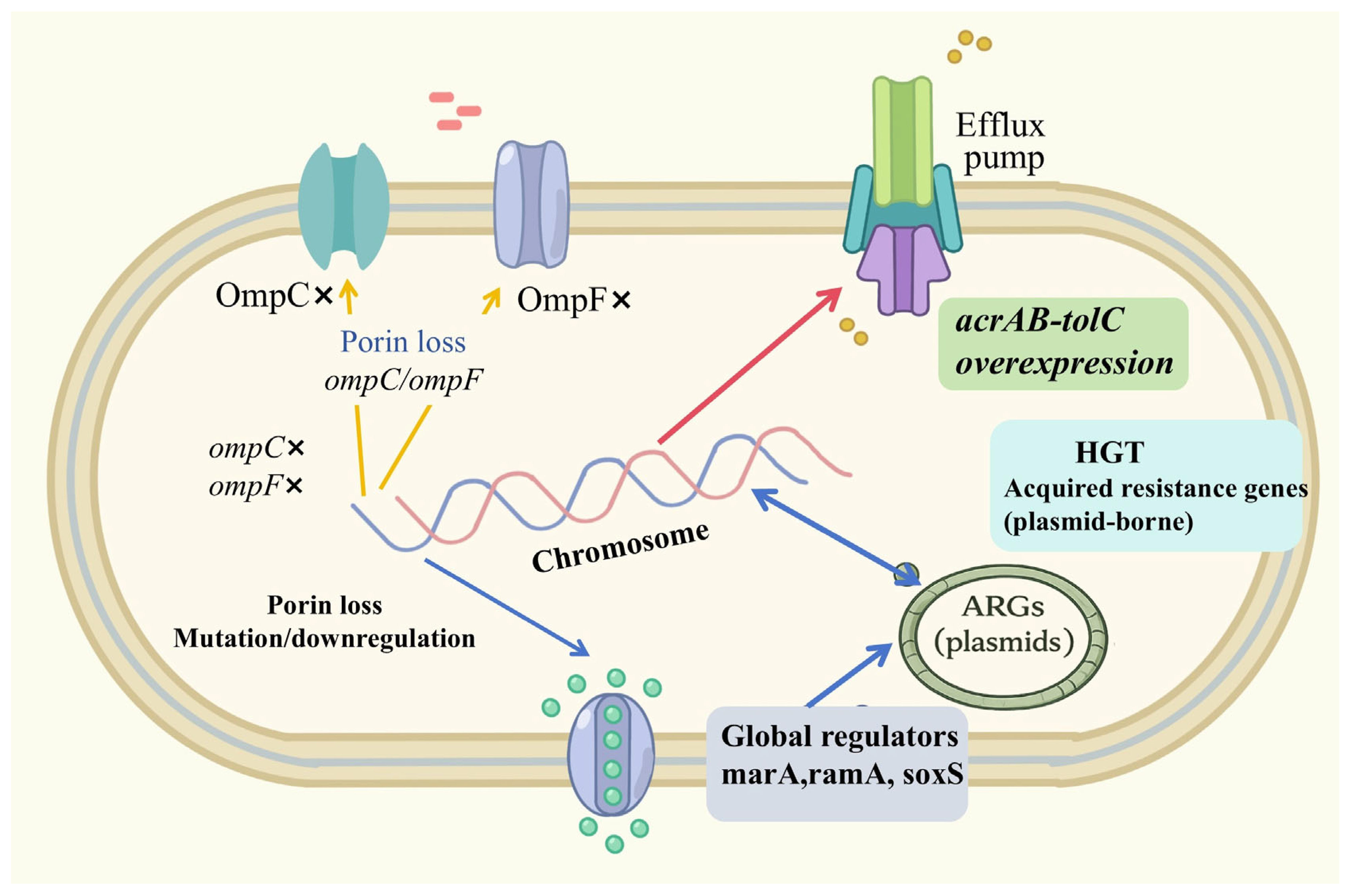
3. Mechanisms of Antibiotic Resistance in CRECC
3.1. The Emergence of Carbapenemase
3.2. Non-Enzymatic Resistance Mechanisms in CRECC
4. Evolutionary Dynamics and Interbacterial Interactions of CRECC
4.1. MGEs Facilitate the Dissemination of ARGs
4.2. Evolution of Antibiotic Resistance and Virulence in CRECC
4.3. Interactions with Other Bacteria
5. Future Outlook and Prevention Strategies
Author Contributions
Funding
Institutional Review Board Statement
Informed Consent Statement
Data Availability Statement
Conflicts of Interest
Abbreviations
| AOPs | Advanced oxidation processes |
| ARGs | Antibiotics resistance genes |
| CRE | Carbapenem-resistant Enterobacterales |
| CRECC | Carbapenem-resistant Enterobacter cloacae Complex |
| ECC | Enterobacter cloacae Complex |
| HGT | Horizontal gene transfer |
| ICEs | Integrating and conjugating elements |
| MGEs | Mobile genetic elements |
| MLST | Multilocus sequence typing |
| WGS | Whole-genome sequencing |
| WWTPs | Wastewater treatment plants |
References
- Davin-Regli, A.; Lavigne, J.P.; Pagès, J.M. Enterobacter spp.: Update on Taxonomy, Clinical Aspects, and Emerging Antimicrobial Resistance. Clin. Microbiol. Rev. 2019, 32, 10-1128. [Google Scholar] [CrossRef]
- Gou, J.J.; Liu, N.; Guo, L.H.; Xu, H.; Lv, T.; Yu, X.; Chen, Y.B.; Guo, X.B.; Rao, Y.T.; Zheng, B.W. Carbapenem-Resistant Enterobacter hormaechei ST1103 with IMP-26 Carbapenemase and ESBL Gene blaSHV-178. Infect. Drug Resist. 2020, 13, 597–605. [Google Scholar] [CrossRef] [PubMed]
- Mezzatesta, M.L.; Gona, F.; Stefani, S. Enterobacter cloacae complex: Clinical impact and emerging antibiotic resistance. Future Microbiol. 2012, 7, 887–902. [Google Scholar] [CrossRef]
- Chen, J.; Tian, S.; Nian, H.; Wang, R.; Li, F.; Jiang, N.; Chu, Y. Carbapenem-resistant Enterobacter cloacae complex in a tertiary Hospital in Northeast China, 2010–2019. BMC Infect. Dis. 2021, 21, 611. [Google Scholar] [CrossRef]
- Liu, S.; Huang, N.; Zhou, C.; Lin, Y.; Zhang, Y.; Wang, L.; Zheng, X.; Zhou, T.; Wang, Z. Molecular Mechanisms and Epidemiology of Carbapenem-Resistant Enterobacter cloacae Complex Isolated from Chinese Patients During 2004–2018. Infect. Drug Resist. 2021, 14, 3647–3658. [Google Scholar] [CrossRef] [PubMed]
- Li, Y.; Sun, Q.L.; Shen, Y.; Zhang, Y.; Yang, J.W.; Shu, L.B.; Zhou, H.W.; Wang, Y.; Wang, B.; Zhang, R.; et al. Rapid Increase in Prevalence of Carbapenem-Resistant Enterobacteriaceae (CRE) and Emergence of Colistin Resistance Gene mcr-1 in CRE in a Hospital in Henan, China. J. Clin. Microbiol. 2018, 56, 10.1128. [Google Scholar] [CrossRef] [PubMed]
- World Health Organization. WHO Bacterial Priority Pathogens List. Available online: https://www.who.int/publications/i/item/9789240093461 (accessed on 1 November 2025).
- Li, Y.; Ma, L.; Ding, X.; Zhang, R. Fecal carriage and genetic characteristics of carbapenem-resistant enterobacterales among adults from four provinces of China. Front. Epidemiol. 2023, 3, 1304324. [Google Scholar] [CrossRef]
- Li, X.; Wang, Q.; Huang, J.; Zhang, X.; Zhou, L.; Quan, J.; Wang, Z.; Zhou, H.; Li, R.; Tu, Y. Clonal outbreak of NDM-1-producing Enterobacter hormaechei belonging to high-risk international clone ST78 with the coexistence of tmexCD2-toprJ2 and mcr-9 in China. Int. J. Antimicrob. Agents 2023, 61, 106790. [Google Scholar] [CrossRef]
- Cai, S.; Quan, J.; Wang, Z.; Hu, H.; Han, X.; Jiang, Y.; Yang, Q.; Yu, Y.; Zhou, Z. High prevalence of carbapenem-resistant Enterobacter cloacae complex in a tertiary hospital over a decade. Microbiol. Spectr. 2024, 12, e0078024. [Google Scholar] [CrossRef]
- Dai, W.; Sun, S.; Yang, P.; Huang, S.; Zhang, X.; Zhang, L. Characterization of carbapenemases, extended spectrum β-lactamases and molecular epidemiology of carbapenem-non-susceptible Enterobacter cloacae in a Chinese hospital in Chongqing. Infect. Genet. Evol. 2013, 14, 1–7, Erratum in Infect. Genet. Evol. 2013, 18, 344. [Google Scholar] [CrossRef]
- Deshpande, L.M.; Jones, R.N.; Fritsche, T.R.; Sader, H.S. Occurrence and characterization of carbapenemase-producing Enterobacteriaceae: Report from the SENTRY Antimicrobial Surveillance Program (2000–2004). Microb. Drug Resist. 2006, 12, 223–230. [Google Scholar] [CrossRef]
- Edris, S.N.; Hamad, A.; Awad, D.A.B.; Sabeq, I.I. Prevalence, antibiotic resistance patterns, and biofilm formation ability of Enterobacterales recovered from food of animal origin in Egypt. Vet. World 2023, 16, 403–413. [Google Scholar] [CrossRef] [PubMed]
- Yan, Z.; Ju, X.; Zhang, Y.; Wu, Y.; Sun, Y.; Xiong, P.; Li, Y.; Li, R.; Zhang, R. Analysis of the transmission chain of carbapenem-resistant Enterobacter cloacae complex infections in clinical, intestinal and healthcare settings in Zhejiang province, China (2022–2023). Sci. Total Environ. 2024, 920, 170635. [Google Scholar] [CrossRef] [PubMed]
- Zhang, T.; Yang, Z.; Li, H.; Li, H.; Yang, Y.; Chen, T.; Zhou, S.; Shi, D.; Yang, D.; Li, J.; et al. Whole genome sequencing and phenotypic analysis of carbapenem- and polymyxin-resistant Enterobacter cloacae complex in natural water bodies. Front. Environ. Sci. Eng. 2025, 19, 129. [Google Scholar] [CrossRef]
- Börjesson, S.; Brouwer, M.S.M.; Östlund, E.; Eriksson, J.; Elving, J.; Karlsson Lindsjö, O.; Engblom, L.I. Detection of an IMI-2 carbapenemase-producing Enterobacter asburiae at a Swedish feed mill. Front. Microbiol. 2022, 13, 993454. [Google Scholar] [CrossRef]
- Puljko, A.; Babić, I.; Rozman, S.D.; Barišić, I.; Jelić, M.; Maravić, A.; Parać, M.; Petrić, I.; Udiković-Kolić, N. Treated municipal wastewater as a source of high-risk and emerging multidrug-resistant clones of E. coli and other Enterobacterales producing extended-spectrum β-lactamases. Environ. Res. 2024, 243, 117792. [Google Scholar] [CrossRef]
- Hernando-Amado, S.; Coque, T.M.; Baquero, F.; Martínez, J.L. Defining and combating antibiotic resistance from One Health and Global Health perspectives. Nat. Microbiol. 2019, 4, 1432–1442. [Google Scholar] [CrossRef] [PubMed]
- Han, M.; Liu, C.; Xie, H.; Zheng, J.; Zhang, Y.; Li, C.; Shen, H.; Cao, X. Genomic and clinical characteristics of carbapenem-resistant Enterobacter cloacae complex isolates collected in a Chinese tertiary hospital during 2013–2021. Front. Microbiol. 2023, 14, 1127948. [Google Scholar] [CrossRef]
- Annavajhala, M.K.; Gomez-Simmonds, A.; Uhlemann, A.C. Multidrug-Resistant Enterobacter cloacae Complex Emerging as a Global, Diversifying Threat. Front. Microbiol. 2019, 10, 44. [Google Scholar] [CrossRef]
- Diorio-Toth, L.; Wallace, M.A.; Farnsworth, C.W.; Wang, B.; Gul, D.; Kwon, J.H.; Andleeb, S.; Burnham, C.D.; Dantas, G. Intensive care unit sinks are persistently colonized with multidrug resistant bacteria and mobilizable, resistance-conferring plasmids. mSystems 2023, 8, e0020623. [Google Scholar] [CrossRef]
- Gomez-Simmonds, A.; Annavajhala, M.K.; Wang, Z.; Macesic, N.; Hu, Y.; Giddins, M.J.; O’Malley, A.; Toussaint, N.C.; Whittier, S.; Torres, V.J.; et al. Genomic and Geographic Context for the Evolution of High-Risk Carbapenem-Resistant Enterobacter cloacae Complex Clones ST171 and ST78. mBio 2018, 9, e00542-18. [Google Scholar] [CrossRef]
- Marimuthu, K.; Mo, Y.; Ling, M.L.; Hernandez-Koutoucheva, A.; Fenlon, S.N.; Bertrand, D.; Lye, D.C.; Ang, B.S.P.; Perencevich, E.; Ng, O.T.; et al. Household transmission of carbapenemase-producing Enterobacteriaceae: A prospective cohort study. J. Antimicrob. Chemother. 2021, 76, 1299–1302. [Google Scholar] [CrossRef]
- Pulss, S.; Stolle, I.; Stamm, I.; Leidner, U.; Heydel, C.; Semmler, T.; Prenger-Berninghoff, E.; Ewers, C. Multispecies and Clonal Dissemination of OXA-48 Carbapenemase in Enterobacteriaceae From Companion Animals in Germany, 2009–2016. Front. Microbiol. 2018, 9, 1265. [Google Scholar] [CrossRef]
- Daniels, J.B.; Chen, L.; Grooters, S.V.; Mollenkopf, D.F.; Mathys, D.A.; Pancholi, P.; Kreiswirth, B.N.; Wittum, T.E. Enterobacter cloacae Complex Sequence Type 171 Isolates Expressing KPC-4 Carbapenemase Recovered from Canine Patients in Ohio. Antimicrob. Agents Chemother. 2018, 62, 10.1128. [Google Scholar] [CrossRef]
- de Mendieta, J.M.; Argüello, A.; Menocal, M.A.; Rapoport, M.; Albornoz, E.; Más, J.; Corso, A.; Faccone, D. Emergence of NDM-producing Enterobacterales infections in companion animals from Argentina. BMC Vet. Res. 2024, 20, 174. [Google Scholar] [CrossRef]
- Donà, V.; Nordmann, P.; Kittl, S.; Schuller, S.; Bouvier, M.; Poirel, L.; Endimiani, A.; Perreten, V. Emergence of OXA-48-producing Enterobacter hormaechei in a Swiss companion animal clinic and their genetic relationship to clinical human isolates. J. Antimicrob. Chemother. 2023, 78, 2950–2960. [Google Scholar] [CrossRef]
- Ding, D.; Wang, B.; Zhang, X.; Zhang, J.; Zhang, H.; Liu, X.; Gao, Z.; Yu, Z. The spread of antibiotic resistance to humans and potential protection strategies. Ecotoxicol. Environ. Saf. 2023, 254, 114734. [Google Scholar] [CrossRef]
- European Food Safety Authority; European Centre for Disease Prevention and Control. The European Union summary report on antimicrobial resistance in zoonotic and indicator bacteria from humans, animals and food in 2022–2023. EFSA J. 2025, 23, e9237. [Google Scholar] [CrossRef] [PubMed]
- Sadek, M.; Nariya, H.; Shimamoto, T.; Kayama, S.; Yu, L.; Hisatsune, J.; Sugai, M.; Nordmann, P.; Poirel, L.; Shimamoto, T. First Genomic Characterization of blaVIM-1 and mcr-9-Coharbouring Enterobacter hormaechei Isolated from Food of Animal Origin. Pathogens 2020, 9, 687. [Google Scholar] [CrossRef] [PubMed]
- Sugawara, Y.; Hagiya, H.; Akeda, Y.; Aye, M.M.; Myo Win, H.P.; Sakamoto, N.; Shanmugakani, R.K.; Takeuchi, D.; Nishi, I.; Ueda, A.; et al. Dissemination of carbapenemase-producing Enterobacteriaceae harbouring blaNDM or blaIMI in local market foods of Yangon, Myanmar. Sci. Rep. 2019, 9, 14455. [Google Scholar] [CrossRef] [PubMed]
- Dwivedi, A.; Kumar, C.B.; Kumar, A.; Soni, M.; Sahu, V.; Awasthi, A.; Rathore, G. Detection of clinically relevant carbapenemase encoding genes in carbapenem-resistant Enterobacter cloacae complex and Klebsiella pneumoniae isolated from farmed freshwater fish. J. Appl. Microbiol. 2023, 134, lxad212. [Google Scholar] [CrossRef] [PubMed]
- Janecko, N.; Martz, S.L.; Avery, B.P.; Daignault, D.; Desruisseau, A.; Boyd, D.; Irwin, R.J.; Mulvey, M.R.; Reid-Smith, R.J. Carbapenem-Resistant Enterobacter spp. in Retail Seafood Imported from Southeast Asia to Canada. Emerg. Infect. Dis. 2016, 22, 1675–1677. [Google Scholar] [CrossRef]
- Nakayama, T.; Kasumi, Y.; Saito, M.; Ohata, N.; Yamaguchi, T.; Jinnai, M.; Kumeda, Y.; Hase, A. ESBL-Producing Enterobacter cloacae Complex and Klebsiella pneumoniae Harbouring blaCTX-M-15 and blaCTX-M-55 Potentially Risk the Worldwide Spread of ESBL-Producing Bacteria Through Contaminated Dried Fishery Products. Curr. Microbiol. 2025, 82, 593. [Google Scholar] [CrossRef] [PubMed]
- Desvars-Larrive, A.; Ruppitsch, W.; Lepuschitz, S.; Szostak, M.P.; Spergser, J.; Feßler, A.T.; Schwarz, S.; Monecke, S.; Ehricht, R.; Walzer, C.; et al. Urban brown rats (Rattus norvegicus) as possible source of multidrug-resistant Enterobacteriaceae and meticillin-resistant Staphylococcus spp., Vienna, Austria, 2016 and 2017. Euro Surveill. 2019, 24, 1900149. [Google Scholar] [CrossRef]
- Tresch, S.; Biggel, M.; Schnyder, M.; Nüesch-Inderbinen, M.; Stephan, R. Extended-spectrum ß-lactamase (ESBL)- and Carbapenemase-producing Enterobacterales Isolated from Fresh Herbs and Salads at Retail Level in Switzerland. J. Food Prot. 2024, 87, 100368. [Google Scholar] [CrossRef]
- Laborda, P.; Sanz-García, F.; Ochoa-Sánchez, L.E.; Gil-Gil, T.; Hernando-Amado, S.; Martínez, J.L. Wildlife and Antibiotic Resistance. Front. Cell. Infect. Microbiol. 2022, 12, 873989. [Google Scholar] [CrossRef]
- Liu, S.; Fang, R.; Zhang, Y.; Chen, L.; Huang, N.; Yu, K.; Zhou, C.; Cao, J.; Zhou, T. Characterization of resistance mechanisms of Enterobacter cloacae Complex co-resistant to carbapenem and colistin. BMC Microbiol. 2021, 21, 208. [Google Scholar] [CrossRef]
- Alvisi, G.; Curtoni, A.; Fonnesu, R.; Piazza, A.; Signoretto, C.; Piccinini, G.; Sassera, D.; Gaibani, P. Epidemiology and Genetic Traits of Carbapenemase-Producing Enterobacterales: A Global Threat to Human Health. Antibiotics 2025, 14, 141. [Google Scholar] [CrossRef]
- Mitra, S.; Naha, S.; Chakraborty, J.; De, S.; Kaur, H.; Majumdar, T.; Basu, S. Diversity of mobile genetic elements in carbapenem-resistant Enterobacterales isolated from the intensive care units of a tertiary care hospital in Northeast India. Front. Microbiol. 2025, 16, 1543427. [Google Scholar] [CrossRef]
- Qin, J.; Wang, Z.; Xu, H.; Li, Y.; Zhou, J.; Yaxier, N.; Wang, C.; Fu, P. IncX3 plasmid-mediated spread of blaNDM gene in Enterobacteriaceae among children in China. J. Glob. Antimicrob. Resist. 2024, 37, 199–207. [Google Scholar] [CrossRef] [PubMed]
- Hu, K.; Zhang, J.; Zou, J.; Zeng, L.; Li, J.; Wang, J.; Long, W.; Zhang, X. Molecular characterization of NDM-1-producing carbapenem-resistant E. cloacae complex from a tertiary hospital in Chongqing, China. Front. Cell. Infect. Microbiol. 2022, 12, 935165. [Google Scholar] [CrossRef]
- Martínez-Martínez, L.; González-López, J.J. Carbapenemases in Enterobacteriaceae: Types and molecular epidemiology. Enferm. Infecc. Microbiol. Clin. 2014, 32, 4–9. [Google Scholar] [CrossRef]
- Rasmussen, B.A.; Bush, K.; Keeney, D.; Yang, Y.; Hare, R.; O’Gara, C.; Medeiros, A.A. Characterization of IMI-1 beta-lactamase, a class A carbapenem-hydrolyzing enzyme from Enterobacter cloacae. Antimicrob. Agents Chemother. 1996, 40, 2080–2086. [Google Scholar] [CrossRef] [PubMed]
- Yan, J.J.; Ko, W.C.; Chuang, C.L.; Wu, J.J. Metallo-beta-lactamase-producing Enterobacteriaceae isolates in a university hospital in Taiwan: Prevalence of IMP-8 in Enterobacter cloacae and first identification of VIM-2 in Citrobacter freundii. J. Antimicrob. Chemother. 2002, 50, 503–511. [Google Scholar] [CrossRef] [PubMed]
- Aubron, C.; Poirel, L.; Ash, R.J.; Nordmann, P. Carbapenemase-producing Enterobacteriaceae, U.S. rivers. Emerg. Infect. Dis. 2005, 11, 260–264. [Google Scholar] [CrossRef]
- Jeong, S.H.; Lee, K.; Chong, Y.; Yum, J.H.; Lee, S.H.; Choi, H.J.; Kim, J.M.; Park, K.H.; Han, B.H.; Lee, S.W.; et al. Characterization of a new integron containing VIM-2, a metallo- beta-lactamase gene cassette, in a clinical isolate of Enterobacter cloacae. J. Antimicrob. Chemother. 2003, 51, 397–400. [Google Scholar] [CrossRef][Green Version]
- Bratu, S.; Landman, D.; Alam, M.; Tolentino, E.; Quale, J. Detection of KPC carbapenem-hydrolyzing enzymes in Enterobacter spp. from Brooklyn, New York. Antimicrob. Agents Chemother. 2005, 49, 776–778. [Google Scholar] [CrossRef] [PubMed][Green Version]
- Gacar, G.G.; Midilli, K.; Kolayli, F.; Ergen, K.; Gundes, S.; Hosoglu, S.; Karadenizli, A.; Vahaboglu, H. Genetic and enzymatic properties of metallo-beta-lactamase VIM-5 from a clinical isolate of Enterobacter cloacae. Antimicrob. Agents Chemother. 2005, 49, 4400–4403. [Google Scholar] [CrossRef]
- Luzzaro, F.; Docquier, J.D.; Colinon, C.; Endimiani, A.; Lombardi, G.; Amicosante, G.; Rossolini, G.M.; Toniolo, A. Emergence in Klebsiella pneumoniae and Enterobacter cloacae clinical isolates of the VIM-4 metallo-beta-lactamase encoded by a conjugative plasmid. Antimicrob. Agents Chemother. 2004, 48, 648–650. [Google Scholar] [CrossRef]
- Lee, M.F.; Peng, C.F.; Hsu, H.J.; Chen, Y.H. Molecular characterisation of the metallo-beta-lactamase genes in imipenem-resistant Gram-negative bacteria from a university hospital in southern Taiwan. Int. J. Antimicrob. Agents 2008, 32, 475–480. [Google Scholar] [CrossRef]
- Galani, I.; Souli, M.; Chryssouli, Z.; Orlandou, K.; Giamarellou, H. Characterization of a new integron containing blaVIM-1 and aac(6′)-IIc in an Enterobacter cloacae clinical isolate from Greece. J. Antimicrob. Chemother. 2005, 55, 634–638. [Google Scholar] [CrossRef][Green Version]
- Espedido, B.; Iredell, J.; Thomas, L.; Zelynski, A. Wide dissemination of a carbapenemase plasmid among gram-negative bacteria: Implications of the variable phenotype. J. Clin. Microbiol. 2005, 43, 4918–4919. [Google Scholar] [CrossRef][Green Version]
- Panopoulou, M.; Alepopoulou, E.; Ikonomidis, A.; Grapsa, A.; Paspalidou, E.; Kartali-Ktenidou, S. Emergence of VIM-12 in Enterobacter cloacae. J. Clin. Microbiol. 2010, 48, 3414–3415. [Google Scholar] [CrossRef]
- Mouftah, S.F.; Pál, T.; Darwish, D.; Ghazawi, A.; Villa, L.; Carattoli, A.; Sonnevend, Á. Epidemic IncX3 plasmids spreading carbapenemase genes in the United Arab Emirates and worldwide. Infect. Drug Resist. 2019, 12, 1729–1742. [Google Scholar] [CrossRef]
- Carrër, A.; Poirel, L.; Yilmaz, M.; Akan, O.A.; Feriha, C.; Cuzon, G.; Matar, G.; Honderlick, P.; Nordmann, P. Spread of OXA-48-encoding plasmid in Turkey and beyond. Antimicrob. Agents Chemother. 2010, 54, 1369–1373. [Google Scholar] [CrossRef]
- Matsumura, Y.; Peirano, G.; Motyl, M.R.; Adams, M.D.; Chen, L.; Kreiswirth, B.; DeVinney, R.; Pitout, J.D. Global Molecular Epidemiology of IMP-Producing Enterobacteriaceae. Antimicrob. Agents Chemother. 2017, 61, 10-1128. [Google Scholar] [CrossRef]
- Jin, C.; Zhang, J.; Wang, Q.; Chen, H.; Wang, X.; Zhang, Y.; Wang, H. Molecular Characterization of Carbapenem-Resistant Enterobacter cloacae in 11 Chinese Cities. Front. Microbiol. 2018, 9, 1597. [Google Scholar] [CrossRef]
- Che, J.; Wang, Z.; Song, Y.; Guan, H.; Yuan, M.; Chen, X.; Zhao, X.; Xiao, Y.; Zhang, Y.; Sha, D.; et al. Emergence of blaIMI-2- and blaIMI-16-Producing Enterobacter asburiae in the Aquaculture Environment of Jiangsu, China. Microbiol. Spectr. 2023, 11, e0285322. [Google Scholar] [CrossRef]
- Ye, K.; Zhang, Y.; Qiu, X.; Ye, L.; Yang, J.; Ma, Y. Surveillance and characterization of carbapenem-resistant Enterobacter cloacae complex from China, 2015–2018. BMC Microbiol. 2025, 25, 597. [Google Scholar] [CrossRef]
- Majewski, P.; Gutowska, A.; Sacha, P.; Schneiders, T.; Talalaj, M.; Majewska, P.; Zebrowska, A.; Ojdana, D.; Wieczorek, P.; Hauschild, T.; et al. Expression of AraC/XylS stress response regulators in two distinct carbapenem-resistant Enterobacter cloacae ST89 biotypes. J. Antimicrob. Chemother. 2020, 75, 1146–1150. [Google Scholar] [CrossRef] [PubMed]
- Zagui, G.S.; Moreira, N.C.; Santos, D.V.; Paschoalato, C.; Sierra, J.; Nadal, M.; Domingo, J.L.; Darini, A.L.C.; Andrade, L.N.; Segura-Muñoz, S.I. Multidrug-resistant Enterobacter spp. in wastewater and surface water: Molecular characterization of β-lactam resistance and metal tolerance genes. Environ. Res. 2023, 233, 116443. [Google Scholar] [CrossRef]
- Wu, J.; Liu, L.; Wang, J.; Wang, Y.; Li, X.; Wang, X.; Jiang, S.; Li, W.; Zhang, J.; Zhang, X. Transcriptomic analysis of induced resistance to polymyxin in carbapenem-resistant Enterobacter cloacae complex isolate carrying mcr-9. J. Glob. Antimicrob. Resist. 2024, 37, 225–232. [Google Scholar] [CrossRef]
- Misra, T.; Tare, M.; Jha, P.N. Insights Into the Dynamics and Composition of Biofilm Formed by Environmental Isolate of Enterobacter cloacae. Front. Microbiol. 2022, 13, 877060. [Google Scholar] [CrossRef]
- Jiang, S.; Wang, X.; Yu, H.; Zhang, J.; Wang, J.; Li, J.; Li, X.; Hu, K.; Gong, X.; Gou, X.; et al. Molecular antibiotic resistance mechanisms and co-transmission of the mcr-9 and metallo-β-lactamase genes in carbapenem-resistant Enterobacter cloacae complex. Front. Microbiol. 2022, 13, 1032833. [Google Scholar] [CrossRef]
- Hu, Y.; Gao, G.F.; Zhu, B. The antibiotic resistome: Gene flow in environments, animals and human beings. Front. Med. 2017, 11, 161–168. [Google Scholar] [CrossRef]
- Hu, J.; Li, J.; Liu, C.; Zhang, Y.; Xie, H.; Li, C.; Shen, H.; Cao, X. Molecular characteristics of global β-lactamase-producing Enterobacter cloacae by genomic analysis. BMC Microbiol. 2022, 22, 255. [Google Scholar] [CrossRef] [PubMed]
- Rezzoug, I.; Girlich, D.; Birer, A.; Bonnet, R.; Poiraud, J.; Bogaerts, P.; Emeraud, C.; Dortet, L. Emergence and Polyclonal Dissemination of blaNDM-7-Carrying InX3 Plasmid in Enterobacter cloacae Complex, France, 2021–2023. Emerg. Infect. Dis. 2025, 31, 1998–2002. [Google Scholar] [CrossRef]
- Zhang, D.; Li, S.; Zhang, X.; Zheng, S.; Zhou, D.; Hou, Q.; Li, G.; Han, H. Epidemiological and biological characteristics of IncR plasmids as multihost antibiotic resistance carriers. Front. Microbiol. 2025, 16, 1622352. [Google Scholar] [CrossRef]
- Shropshire, W.C.; Konovalova, A.; McDaneld, P.; Gohel, M.; Strope, B.; Sahasrabhojane, P.; Tran, C.N.; Greenberg, D.; Kim, J.; Zhan, X.; et al. Systematic Analysis of Mobile Genetic Elements Mediating β-Lactamase Gene Amplification in Noncarbapenemase-Producing Carbapenem-Resistant Enterobacterales Bloodstream Infections. mSystems 2022, 7, e0047622. [Google Scholar] [CrossRef] [PubMed]
- Partridge, S.R.; Kwong, S.M.; Firth, N.; Jensen, S.O. Mobile Genetic Elements Associated with Antimicrobial Resistance. Clin. Microbiol. Rev. 2018, 31, 10-1128. [Google Scholar] [CrossRef]
- Baquero, F.; Martínez, J.L.; Lanza, V.F.; Rodríguez-Beltrán, J.; Galán, J.C.; San Millán, A.; Cantón, R.; Coque, T.M. Evolutionary Pathways and Trajectories in Antibiotic Resistance. Clin. Microbiol. Rev. 2021, 34, e0005019. [Google Scholar] [CrossRef]
- Telke, A.A.; Olaitan, A.O.; Morand, S.; Rolain, J.M. soxRS induces colistin hetero-resistance in Enterobacter asburiae and Enterobacter cloacae by regulating the acrAB-tolC efflux pump. J. Antimicrob. Chemother. 2017, 72, 2715–2721. [Google Scholar] [CrossRef]
- Selvarajan, R.; Obize, C.; Sibanda, T.; Abia, A.L.K.; Long, H. Evolution and Emergence of Antibiotic Resistance in Given Ecosystems: Possible Strategies for Addressing the Challenge of Antibiotic Resistance. Antibiotics 2022, 12, 28. [Google Scholar] [CrossRef]
- Longhi, C.; Maurizi, L.; Conte, A.L.; Marazzato, M.; Comanducci, A.; Nicoletti, M.; Zagaglia, C. Extraintestinal Pathogenic Escherichia coli: Beta-Lactam Antibiotic and Heavy Metal Resistance. Antibiotics 2022, 11, 328. [Google Scholar] [CrossRef]
- Liu, Y.; Liu, L.; Wang, X.; Shao, M.; Wei, Z.; Wang, L.; Li, B.; Li, C.; Luo, X.; Li, F.; et al. Microplastics enhance the prevalence of antibiotic resistance genes in mariculture sediments by enriching host bacteria and promoting horizontal gene transfer. Eco Environ. Health 2025, 4, 100136. [Google Scholar] [CrossRef] [PubMed]
- Xu, J.; Liu, J.; Zhao, J.; Tian, T.; Wang, M.; Yuan, G.; Peng, Y.; Zhang, Y.; Li, Z.; Kan, B.; et al. Clonal and horizontal transmission of carbapenem-resistant Enterobacterales strains and genes via flies. Gut Pathog. 2024, 16, 70. [Google Scholar] [CrossRef]
- Oña, L.; Shreekar, S.K.; Kost, C. Disentangling microbial interaction networks. Trends Microbiol. 2025, 33, 619–634. [Google Scholar] [CrossRef]
- Cooper, R.M.; Tsimring, L.; Hasty, J. Inter-species population dynamics enhance microbial horizontal gene transfer and spread of antibiotic resistance. eLife 2017, 6, e25950. [Google Scholar] [CrossRef] [PubMed]
- Liu, J.; Gul Wazir, Z.; Hou, G.Q.; Wang, G.Z.; Rong, F.X.; Xu, Y.Z.; Liu, K.; Li, M.Y.; Liu, A.J.; Liu, H.L. The dependent correlation between soil multifunctionality and bacterial community across different farmland soils. Front. Microbiol. 2023, 14, 1144823. [Google Scholar] [CrossRef] [PubMed]
- De Wit, G.; Svet, L.; Lories, B.; Steenackers, H.P. Microbial Interspecies Interactions and Their Impact on the Emergence and Spread of Antimicrobial Resistance. Annu. Rev. Microbiol. 2022, 76, 179–192. [Google Scholar] [CrossRef]
- Kizny Gordon, A.E.; Mathers, A.J.; Cheong, E.Y.L.; Gottlieb, T.; Kotay, S.; Walker, A.S.; Peto, T.E.A.; Crook, D.W.; Stoesser, N. The Hospital Water Environment as a Reservoir for Carbapenem-Resistant Organisms Causing Hospital-Acquired Infections—A Systematic Review of the Literature. Clin. Infect. Dis. 2017, 64, 1435–1444, Erratum in Clin. Infect. Dis. 2017, 65, 1431–1433. [Google Scholar] [CrossRef] [PubMed]
- Klier, K.M.; Anantharaman, K. An updated view of metabolic handoffs in microbiomes. Trends Microbiol. 2025, 34, 98–112. [Google Scholar] [CrossRef] [PubMed]



| Year | CRECC | Types of Enzymes | Gene | Gene Location | Country | Author |
|---|---|---|---|---|---|---|
| 1984 | E. cloacae | A | blaIMI-1 | Chromosome | California, USA | BETH A. RASMUSSEN et al. [44] |
| 1999–2000 | E. cloacae | B | blaIMP-8 | Conjugative Plasmid | Taiwan, China | Jing-Jou Yan et al. [45] |
| 1999–2001 | E. asburiae | A | blaIMI-2 | Plasmid | USA | Cécile Aubron et al. [46] |
| 2000 | E. cloacae | B | blaVIM-2 | Chromosome | South Korea | Seok Hoon Jeong et al. [47] |
| 2000–2004 | E. cloacae | B | blaIMP-1 | - | Turkey | Lalitagauri M Deshpande et al. [12] |
| 2001–2003 | E. cloacae | A | blaKPC-2 | Conjugative Plasmid | New York, USA | Lalitagauri M Deshpande et al. [12] Simona Bratu et al. [48] |
| 2001–2003 | E. asburiae | A | blaKPC-3 | Conjugative Plasmid | New York, USA | Simona Bratu et al. [48] |
| Before 2002 | E. hormaechei | B | blaVIM-5 | Nonconjugative plasmid | Turkey | Gulcin G Gacar et al. [49] |
| May–June 2002 | E. cloacae | B | blaVIM-4 | Conjugative Plasmid | Italy | Francesco Luzzaro et al. [50] |
| 2002–2006 | E. cloacae | B | blaVIM-3 | Chromosome | Taiwan, China | Mei-Feng Lee et al. [51] |
| October 2003 | E. cloacae | B | blaVIM-1 | Chromosome | Greece | Irene Galani et al. [52] |
| Before September 2005 | E. cloacae | B | blaIMP-4 | Conjugative Plasmid | Australia | Björn Espedido et al. [53] |
| June 2007–October 2009 | E. cloacae | B | blaVIM-12 | Conjugative Plasmid | Greece | Maria Panopoulou et al. [54] |
| September 2009–February 2012 | E. cloacae | B | blaIMP-26 | Plasmid | Chongqing, China | Wei Dai et al. [11] |
| September 2009–February 2012 | E. cloacae | B | blaNDM-1 | Plasmid | Chongqing, China | Wei Dai et al. [11] |
| 2009–2014 | E. cloacae | B | blaNDM-4 | Plasmid | United Arab Emirates | Shaimaa F Mouftah et al. [55] |
| Before January 2010 | E. cloacae | D | blaOXA-48 | plasmid | Istanbul | Amélie Carrër et al. [56] |
| 2011 | E. cloacae | B | blaIMP-13 | plasmid | Spain | Yasufumi Matsumura et al. [57] |
| 2012 | E. cloacae | B | blaIMP-14 | plasmid | Thailand | Yasufumi Matsumura et al. [57] |
| November 2012–August 2016 | E. cloacae complex | B | blaNDM-5 | Conjugative Plasmid | China | Chunmei Jin et al. [58] |
| June 2019 | E. cloacae complex | A | blaIMI-16 | Plasmid | Jiangsu, China | Jie Che et al. [59] |
Disclaimer/Publisher’s Note: The statements, opinions and data contained in all publications are solely those of the individual author(s) and contributor(s) and not of MDPI and/or the editor(s). MDPI and/or the editor(s) disclaim responsibility for any injury to people or property resulting from any ideas, methods, instructions or products referred to in the content. |
© 2026 by the authors. Licensee MDPI, Basel, Switzerland. This article is an open access article distributed under the terms and conditions of the Creative Commons Attribution (CC BY) license.
Share and Cite
Wang, H.; Han, J.; Li, Y.; Ding, D.; Li, X. A New Challenge of Antibiotic-Resistant Bacteria: Carbapenem-Resistant Enterobacter cloacae Complex in a One Health Perspective. Microorganisms 2026, 14, 594. https://doi.org/10.3390/microorganisms14030594
Wang H, Han J, Li Y, Ding D, Li X. A New Challenge of Antibiotic-Resistant Bacteria: Carbapenem-Resistant Enterobacter cloacae Complex in a One Health Perspective. Microorganisms. 2026; 14(3):594. https://doi.org/10.3390/microorganisms14030594
Chicago/Turabian StyleWang, Huina, Jingyi Han, Yuhui Li, Dong Ding, and Xuewen Li. 2026. "A New Challenge of Antibiotic-Resistant Bacteria: Carbapenem-Resistant Enterobacter cloacae Complex in a One Health Perspective" Microorganisms 14, no. 3: 594. https://doi.org/10.3390/microorganisms14030594
APA StyleWang, H., Han, J., Li, Y., Ding, D., & Li, X. (2026). A New Challenge of Antibiotic-Resistant Bacteria: Carbapenem-Resistant Enterobacter cloacae Complex in a One Health Perspective. Microorganisms, 14(3), 594. https://doi.org/10.3390/microorganisms14030594