


Taxonomy and Phylogeny of Three New Euplotid Ciliates (Ciliophora, Euplotidae) Isolated from High Latitudes

 , and
, and
Abstract
1. Background
2. Materials and Methods
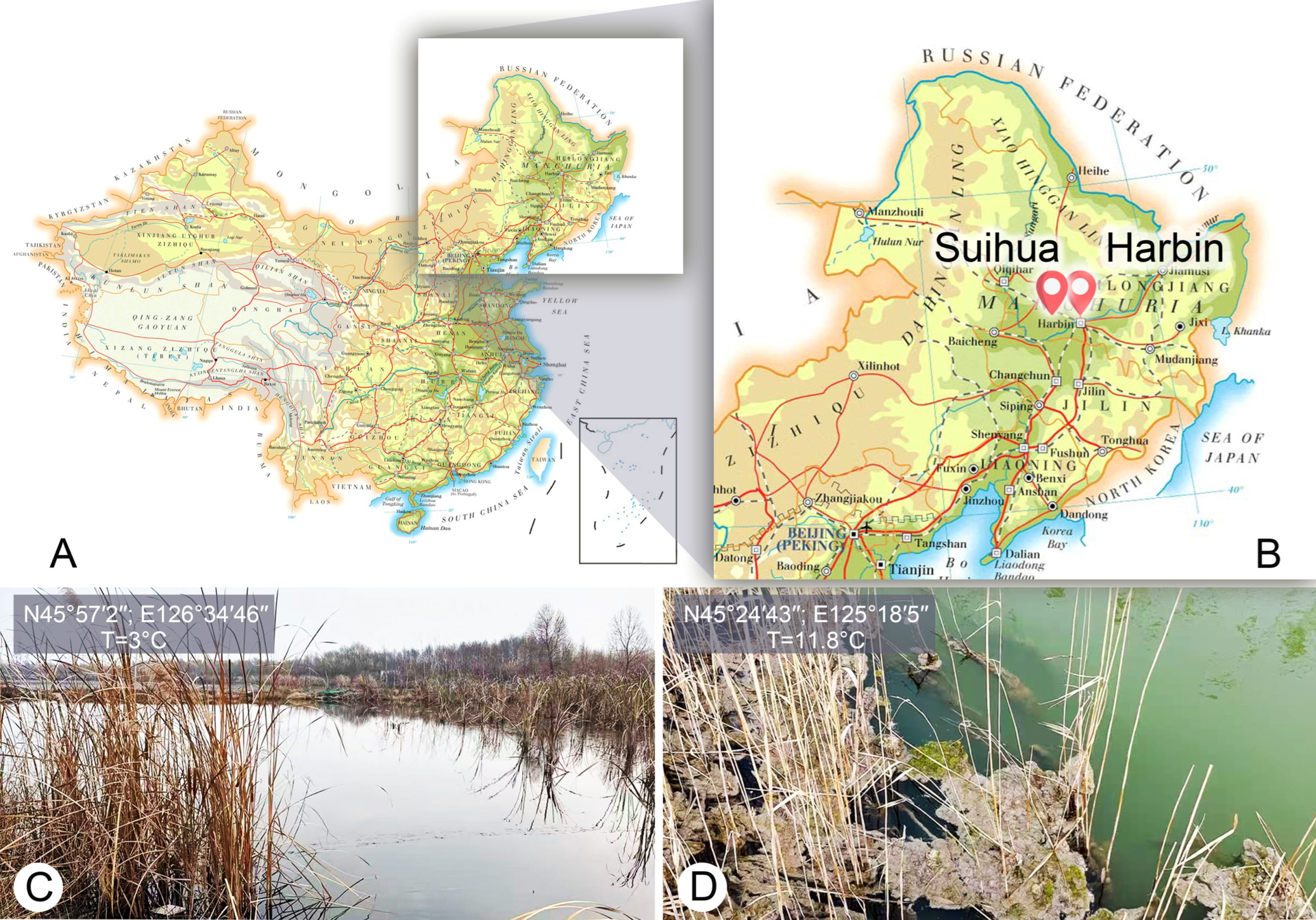
2.1. Sampling and Morphological Methods
2.2. DNA Extraction, PCR Amplification, and Gene Sequencing
2.3. Phylogenetic Analyses
3. Results
3.1. Euplotes aspergilliformis sp. nov. (Figure 2A–M, Table 1)
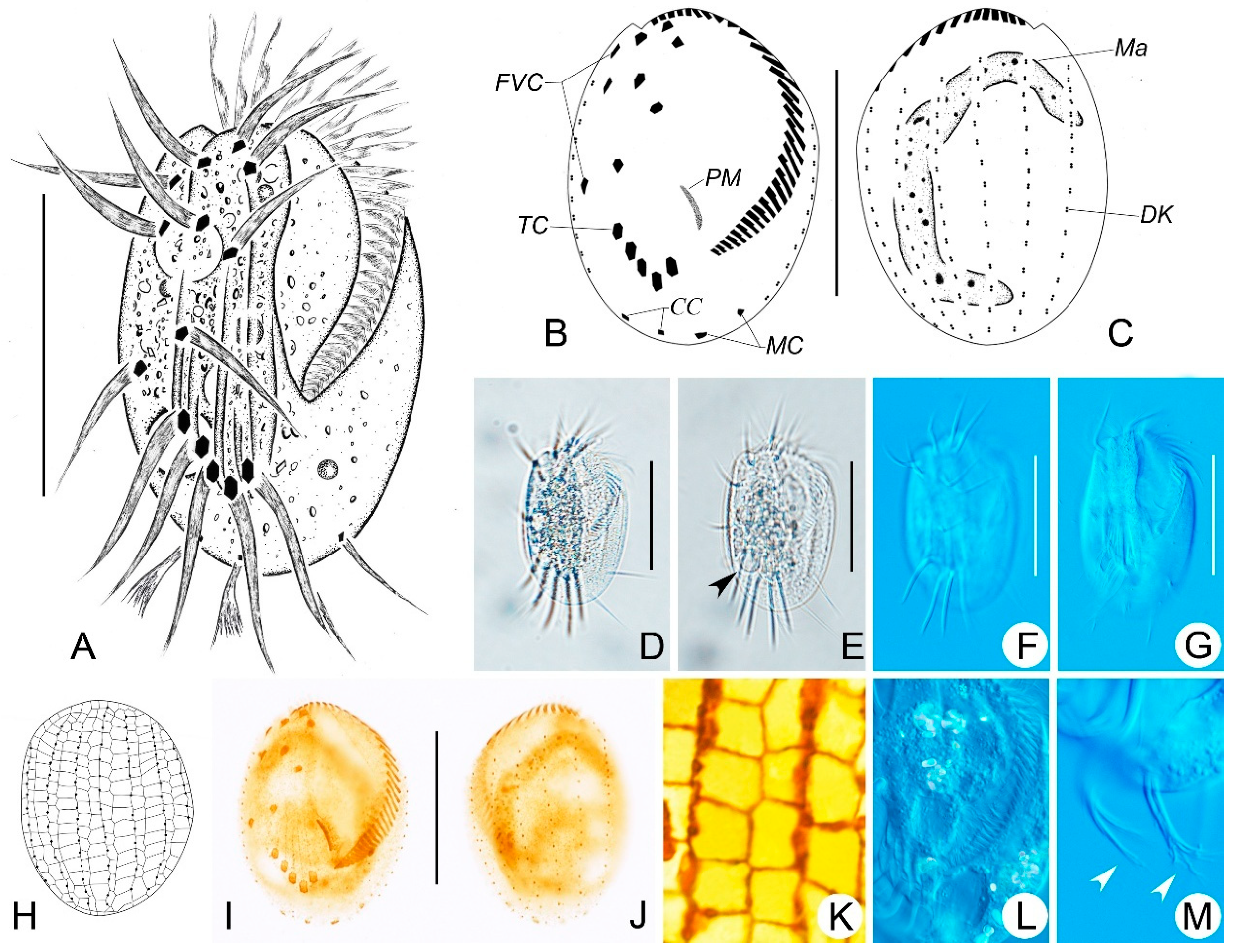

| Character | Species | Min | Max | Mean | Med | SD | CV | n |
|---|---|---|---|---|---|---|---|---|
| Body length in μm | asp | 63 | 81 | 69.7 | 68 | 5.9 | 8.5 | 19 |
| bor | 39 | 55 | 46.0 | 45 | 4.6 | 10.0 | 25 | |
| ver | 40 | 54 | 47.6 | 47.1 | 3.7 | 7.9 | 20 | |
| Body width in μm | asp | 42 | 59 | 50.0 | 50 | 5.1 | 10.2 | 19 |
| bor | 24 | 37 | 29.8 | 29 | 3.6 | 12.0 | 25 | |
| ver | 22 | 31 | 27.2 | 26.8 | 2.8 | 10.4 | 20 | |
| Length of AZM | asp | 44 | 52 | 47.2 | 47 | 2.0 | 4.2 | 19 |
| bor | 26 | 40 | 31.2 | 31 | 2.9 | 9.3 | 25 | |
| ver | 25 | 36 | 31.2 | 31.6 | 3.1 | 9.9 | 20 | |
| No. of AZM | asp | 32 | 37 | 33.8 | 34 | 1.2 | 3.6 | 19 |
| bor | 25 | 33 | 28.8 | 29 | 2.0 | 6.9 | 25 | |
| ver | 27 | 34 | 29.8 | 29 | 1.9 | 6.6 | 13 | |
| No. of FVC | asp | 9 | 9 | 9.0 | 9 | 0 | 0 | 19 |
| bor | 9 | 9 | 9.0 | 9 | 0 | 0 | 25 | |
| ver | 10 | 10 | 10.0 | 10.0 | 0 | 0 | 14 | |
| No. of TC | asp | 5 | 5 | 5.0 | 5 | 0 | 0 | 19 |
| bor | 5 | 5 | 5.0 | 5 | 0 | 0 | 25 | |
| ver | 5 | 5 | 5.0 | 5 | 0 | 0 | 15 | |
| No. of MC | asp | 2 | 2 | 2.0 | 2 | 0 | 0 | 19 |
| bor | 1 | 1 | 1.0 | 1 | 0 | 0 | 25 | |
| ver | 1 | 1 | 1.0 | 1.0 | 0 | 0 | 14 | |
| No. of CC | asp | 2 | 2 | 2.0 | 2 | 0 | 0 | 19 |
| bor | 2 | 2 | 2.0 | 2 | 0 | 0 | 25 | |
| ver | 2 | 2 | 2.0 | 2.0 | 0 | 0 | 14 | |
| No. of DK | asp | 8 | 8 | 8.0 | 8 | 0 | 0 | 19 |
| bor | 9 | 9 | 9.0 | 9 | 0 | 0 | 25 | |
| ver | 7 | 7 | 7.0 | 7.0 | 0 | 0 | 14 | |
| No. of dikinetids in mid-DK | asp | 13 | 17 | 14.9 | 15 | 1.1 | 7.7 | 19 |
| bor | 8 | 10 | 8.7 | 9 | 0 | 7.0 | 25 | |
| ver | 8 | 9 | 8.3 | 8 | 0.4 | 5.8 | 15 | |
| No. of dikinetids in left-DK | asp | 10 | 15 | 12.0 | 12 | 1.3 | 10.8 | 19 |
| bor | 4 | 6 | 4.8 | 5 | 0 | 12.5 | 25 | |
| ver | 6 | 10 | 8.2 | 8 | 0.9 | 11.6 | 15 | |
| No. of dikinetids in right-DK | asp | 10 | 14 | 12.3 | 12 | 1.1 | 9.0 | 19 |
| bor | 7 | 14 | 10.3 | 10 | 1.9 | 18.1 | 25 | |
| ver | 5 | 8 | 6.4 | 6 | 1.1 | 17.4 | 15 |
- Morphological Description:
3.2. Euplotes borealis sp. nov. (Figure 3A–M, Table 1)
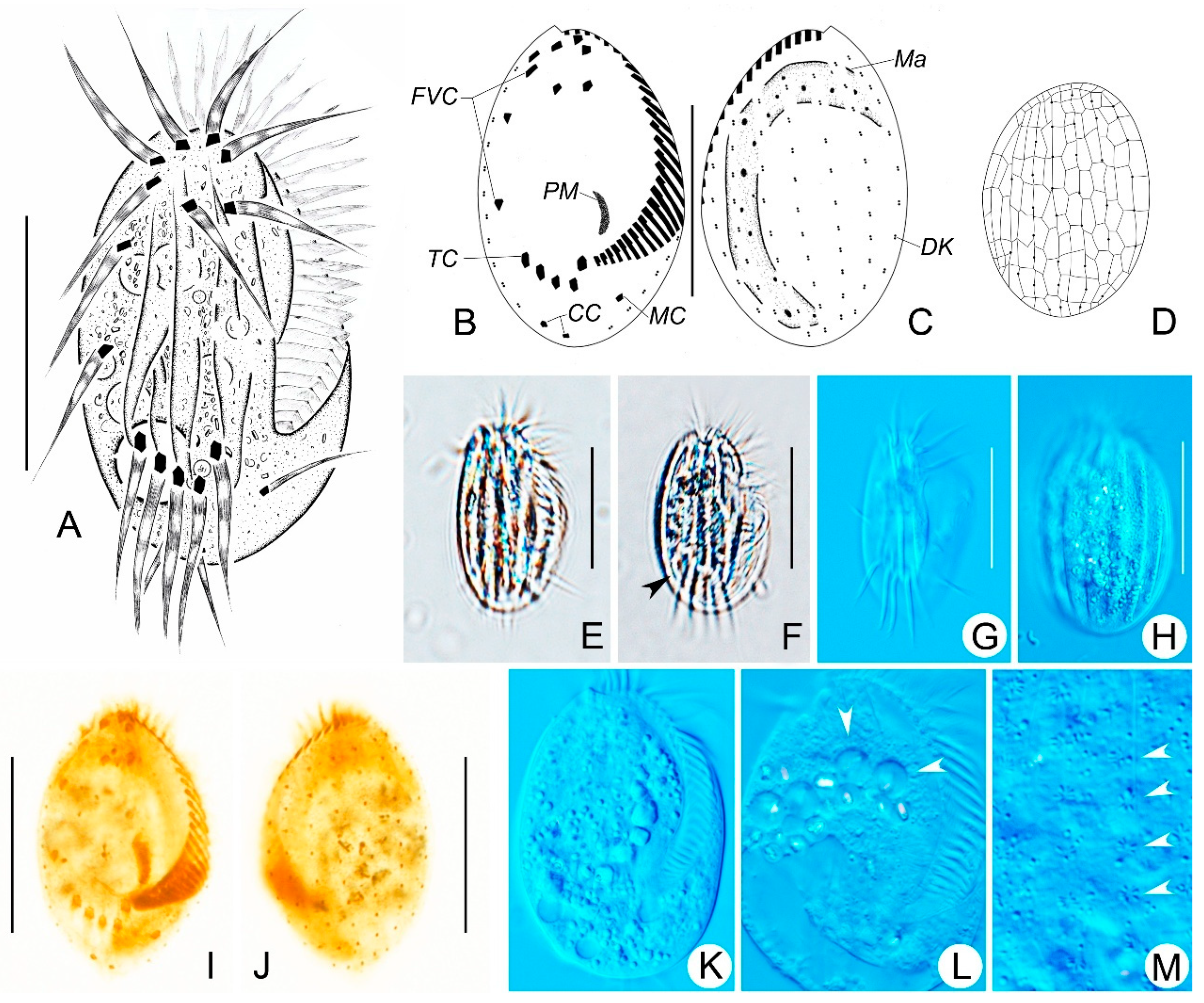
- Morphological Description:
3.3. Euplotes verebkovi sp. nov. (Figure 4A–D, Table 1)
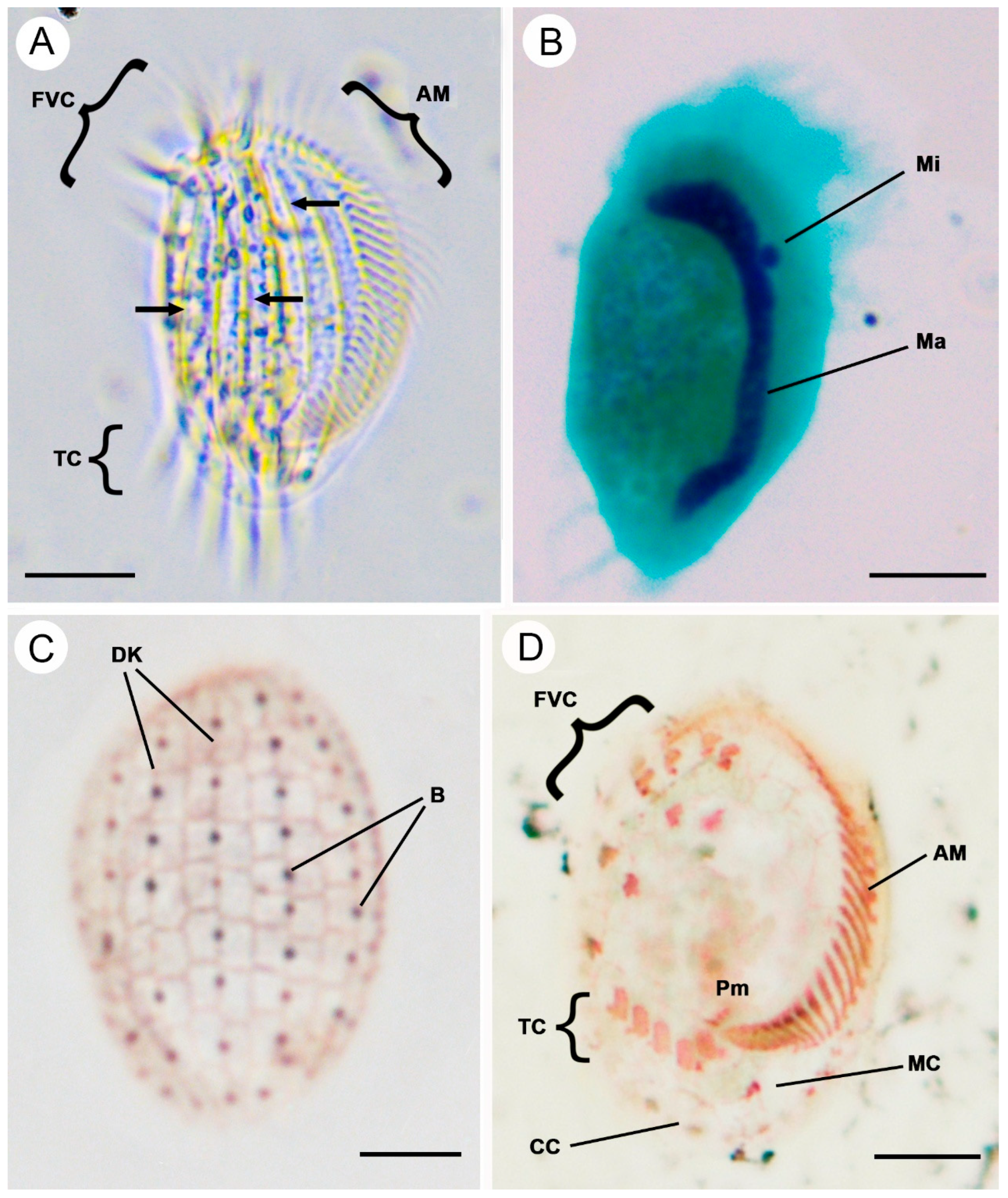
- Morphological Description:
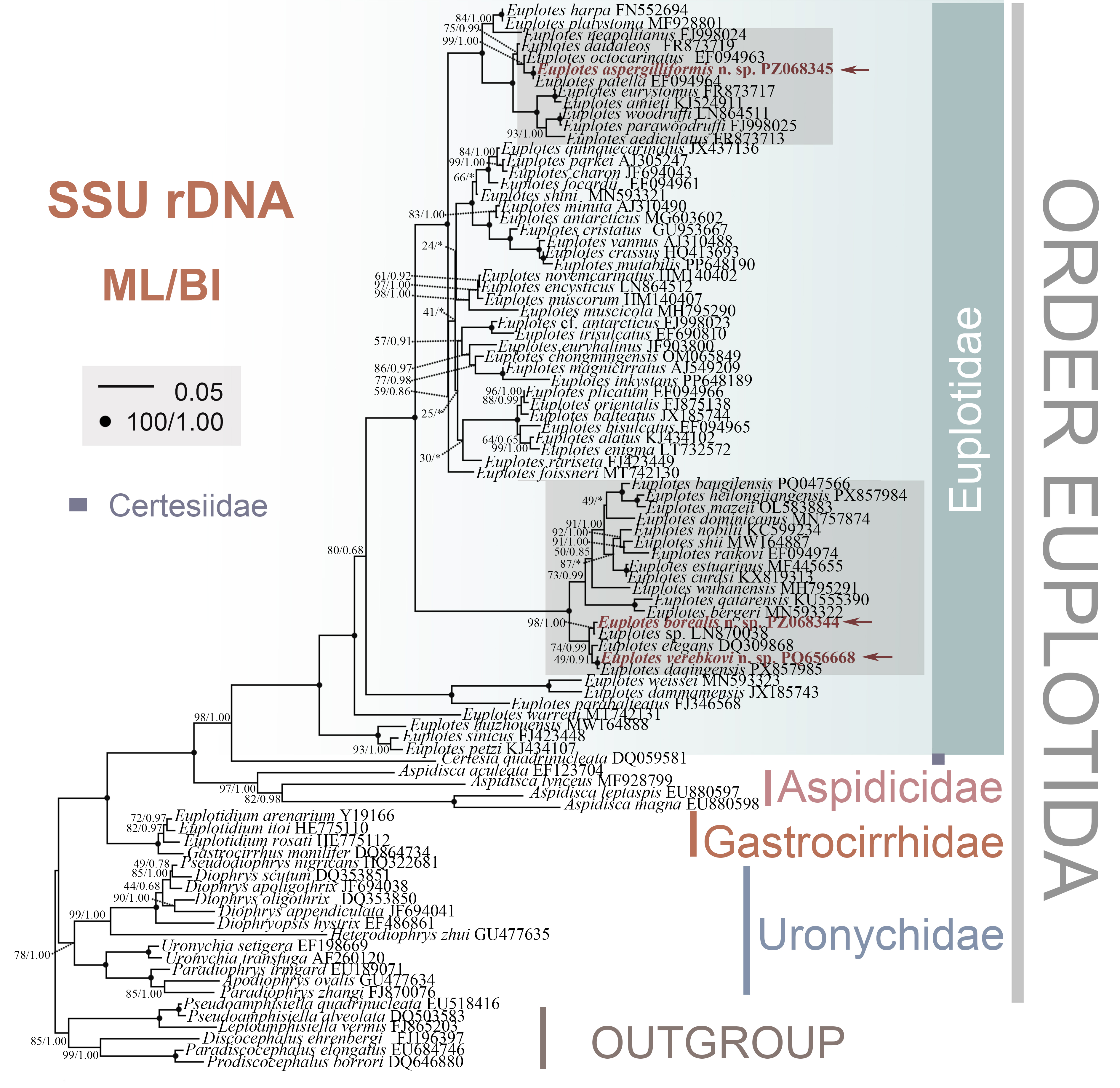
3.4. SSU rDNA Sequences and Phylogenetic Analyses
4. Discussion
4.1. Euplotes aspergilliformis sp. nov.
| Body Size | AZM, n | DK, n | Mid-DK, n | Ma | Isolation Location | Original Description | |
|---|---|---|---|---|---|---|---|
| E. aspergilliformis | 60–85 × 40–60 | 32–37 | 8 | 13–17 | C | FW, China | Present |
| E. amieti | 140–240 × 80–160 | 52–62 | 14 | 28 * | 3 | Cameroon | [46] |
| ca. 180 × ? | 13 | Chad | [47] | ||||
| 140–240 × ? | 52–62 | 14 | 26–31 | 3 | Cameroon | [48] | |
| ca. 169 × ? | 53–67 | 12–15 | 21–28 | 3 | Rwanda | [49] | |
| 130–200 × 70–100 | 60–65 | 12–14 | 18–26 | 3 | FW, China | [50] | |
| E. paramieti | 180–220 × 110–155 | 63–93 | 12–13 | 24–37 | 3 | FW, China | [15] |
| E. eurystomus | 105–160 × ? | 56 * | 8 | 32 * | 3 | FW | [57] |
| 121.5–135 × 73.5–85.5 | 48–52 | 8–9 | 28–31 | C | FW, USA | [58] | |
| 100–160 × 40–90 | 50–65 | 8–12 | 17–25 | 3 | FW | [11] | |
| 140–180 × 95–135 | 45–55 | 9–11 | 27 * | 3 | FW, USA | [59] | |
| 88–125 × 55–78 | 44–53 | 8–9 | 15–23 | C or 3 | FW, China | [52] | |
| 98–133 × 67.2–105 | 35–40 | 3 | Soil, Paithan | [53] | |||
| E. finki | 60 × 40 | 19–22 | 7 | 10 | C or J | Soil, Austria | [60] |
| E. woodruffi | 120–165 × 90 | T | [62] | ||||
| 128–150 × 75–95 | 51–58 | 9 | 24–30 | T | FW, USA | [59] | |
| 83–140 × 58–90 | 53–99 | 8–9 | 30 * | T | BW, Africa | [48] | |
| 130–160 × 90–110 | 57–64 | 10 | 23–28 | T | FW, China | [65] | |
| 110–200 × 70–130 | 76–85 | 9 | 28–35 | S | BW, USA | [65] | |
| 130–153 × 81–95 | ca. 60 | 10–11 | T | FW, China | [64] | ||
| 90–140 × 60–90 | 56–67 | 9 | 17–24 | T * | Marine, China | [66] | |
| 110–160 × 60–80 | 59–70 | 9–10 | 19–24 | T or Y | FW, China | [61] | |
| 100–1132 × 68–82 | 40–56 | 9–10 | 20–21 | T | FW, India | [22] | |
| E. aediculatus | 130.7–133.3 × 82.2–85.2 | C | BW or FW, USA | [62] | |||
| 40 | 8 | C | BW or FW | [67] | |||
| 105–122 × 65–77 | 43–51 | 8–9 | 18–26 | C | FW, USA | [59] | |
| 105–165 × 60–110 | 40–60 | 8–9 | 24 * | 3 | [69] | ||
| 120–130 × 80–85 | 40–50 | 8 | C | FW, China | [68] | ||
| 150–170 × 100–120 | 47–55 | 8 | 21–26 | C | FW, China | [70] | |
| 105–165 × 60–110 | 48–50 | 8 | 24–30 | FW, Slovakia | [71] | ||
| 107–119 × 72–82 | 42–46 | 8 | 18–24 | 3 | FW, India | [22] | |
| E. indica | 49–52 × 40–46 | 20–25 | 7 | 11–16 | C | FW, India | [22] |
4.2. Euplotes borealis sp. nov.
| Body Size | AZM, n | DK, n | Mid-DK, n | Ma | Isolation Location | Original | |
|---|---|---|---|---|---|---|---|
| E. borealis | 35–55 × 20–40 | 25–33 | 9 | 8–10 | C | FW, China | Present |
| E.mazeii | 40–55 × 25–35 | 18–26 | 7 | 6–9 | C | FW, China | [16] |
| E.dogieli | 65 ** × ? | 35–38 | 7 | 13 * | C * | Caspian Sea | [72] |
| E. bisulcatus | 80–90 * × ? | S * | Germany | [73] | |||
| 34–45 × 27–31 | 17 * | 8 | 5–7 | C * | Tidal marsh pond, USA | [74] | |
| E. affinis forma tricirratus | 45 × ? | FW | [73] | ||||
| E. affinis | 38 × 26 | 18–20 | 7 | Max 9 | 3 | FW, UK | [76] |
| E. foissneri | 46–58 × 32–40 | 28–32 | 8 | 12–16 | hook- to a horseshoe-shaped or 3 | BW in Chile | [19] |
| E. warreni | 34–45 × 25–30 | 23–25 | 6 | 9–11 | hook-shaped or C | Marine, Chile | [19] |
| E.nana | 25–30 × ? | 25 * | 8 * | 5 * | C | Mobile Bay, USA | [77] |
4.3. Euplotes verebkovi sp. nov.
4.4. Phylogenetic Analyses
5. Conclusions
Author Contributions
Funding
Institutional Review Board Statement
Informed Consent Statement
Data Availability Statement
Acknowledgments
Conflicts of Interest
References
- Song, W.; Wilbert, N.; Chen, Z.; Shi, X. Considerations on the systematic position of Uronychia and related euplotids based on the data of ontogeny and 18S rRNA gene sequence analyses, with morphogenetic redescription of Uronychia setigera Calkins, 1902 (Ciliophora: Euplotida). Acta Protozool. 2004, 43, 313–328. [Google Scholar]
- Shen, Z.; Yi, Z.; Warren, A. The morphology, ontogeny, and small subunit rRNA gene sequence analysis of Diophrys parappendiculata n. sp. (Protozoa, Ciliophora, Euplotida), a new marine ciliate from coastal waters of southern China. J. Eukaryot. Microbiol. 2011, 58, 242–248. [Google Scholar] [CrossRef]
- Shen, Z.; Huang, J.; Lin, X.; Yi, Z.; Li, J.; Song, W. Morphological and molecular characterization of Aspidisca hongkongensis spec. nov. (Ciliophora, Euplotida) from the South China Sea. Eur. J. Protistol. 2010, 46, 204–211. [Google Scholar] [CrossRef]
- Park, M.; Kim, S.; Min, G. First record of two Euplotes ciliates (Ciliophora: Spirotrichea: Euplotida) from Korea. Korean J. Syst. Zool. 2010, 26, 21–27. [Google Scholar] [CrossRef]
- Modeo, L.; Petroni, G.; Lobban, C.S.; Verni, F.; Vannini, C. Morphological, ultrastructural, and molecular characterization of Euplotidium rosati n. sp. (Ciliophora, Euplotida) from Guam. J. Eukaryot. Microbiol. 2013, 60, 25–36. [Google Scholar] [CrossRef] [PubMed]
- La Terza, A.; Papa, G.; Miceli, C.; Luporini, P. Divergence between two Antarctic species of the ciliate Euplotes, E. focardii and E. nobilii, in the expression of heat-shock protein 70 genes. Mol. Ecol. 2001, 10, 1061–1067. [Google Scholar] [CrossRef] [PubMed]
- Kwon, C.; Kang, Y.; Shin, M. Two newly recorded estuarine ciliates, Euplotes vannus and E. parawoodruffi (Ciliophora: Spirotrichea: Euplotida) from Korea. Korean J. Syst. Zool. 2007, 23, 229–235. [Google Scholar] [CrossRef]
- Kim, E.; Lee, W.J. Redescriptions of Euplotes encysticus and E. rariseta (Protist: Ciliophora: Euplotida). J. Species Res. 2019, 8, 128–135. [Google Scholar]
- Schwarz, M.V.J.; Zuendorf, A.; Stoeck, T. Morphology, ultrastructure, molecular phylogeny, and autecology of Euplotes elegans Kahl, 1932 (Hypotrichida; Euplotidae) isolated from the anoxic Mariager Fjord, Denmark. J. Eukaryot. Microbiol. 2007, 54, 125–136. [Google Scholar] [CrossRef]
- Di Giuseppe, G.; Erra, F.; Frontini, F.P.; Dini, F.; Vallesi, A.; Luporini, P. Improved description of the bipolar ciliate, Euplotes petzi, and definition of its basal position in the Euplotes phylogenetic tree. Eur. J. Protistol. 2014, 50, 402–411. [Google Scholar] [CrossRef]
- Curds, C.R. A Guide to the species of the genus Euplotes (Hypotrichida, Ciliatea). Bull. Br. Mus. (Nat. Hist.) Zool. 1975, 28, 3–61. [Google Scholar]
- Aliev, A.R. Morphology of new and poorly studied species of the genus Euplotes (Hypotrichida: Euplotidae) from natural water bodies of Azerbaijan. Zool. Zh. 1987, 66, 1781–1788. [Google Scholar]
- Song, W.; Warren, A.; Hu, X. Free-Living Ciliates in the Bohai and Yellow Seas, China; Science Press: Beijing, China, 2009. [Google Scholar]
- Méndez-Sánchez, D.; Mayén-Estrada, R.; Hu, X. Euplotes octocarinatus Carter, 1972 (Ciliophora, Spirotrichea, Euplotidae): Considerations on its morphology, phylogeny, and biogeography. Eur. J. Protistol. 2020, 74, 125667. [Google Scholar] [CrossRef]
- Han, K.; Pan, H.; Jiang, J. Taxonomy and SSU rRNA gene-based phylogeny of two new Euplotes species from China: E. chongmingensis n. sp. and E. paramieti n. sp. (Protista, Ciliophora). BMC Microbiol. 2022, 22, 133. [Google Scholar] [CrossRef] [PubMed]
- Lian, C.; Jiang, J.; Xi, M.; Dong, J.; Ma, H.; Al-Farraj, S.A.; Stoeck, T.; Wang, C.; Shao, C. Report and phylogeny of a novel Euplotes species from China: E. mazeii n. sp., and review of E. balteatus (Alveolata, Ciliophora). J. Ocean Univ. China 2023, 22, 831–841. [Google Scholar] [CrossRef]
- Liu, W.; Jiang, J.; Tan, Y.; Lin, X. Novel contributions to the taxonomy of the ciliates genus Euplotes (Ciliophora, Euplotida): Redescription of two poorly known species, with a brief note on the distributions of this genus in coastal waters of southern China. Front. Mar. Sci. 2020, 7, 1069. [Google Scholar] [CrossRef]
- Živaljić, S.; Scherwass, A.; Schoenle, A.; Hohlfeld, M.; Quintela-Alonso, P.; Nitsche, F.; Arndt, H. A barotolerant ciliate isolated from the abyssal deep sea of the North Atlantic: Euplotes dominicanus sp. n. (Ciliophora, Euplotia). Eur. J. Protistol. 2020, 73, 125664. [Google Scholar] [CrossRef]
- Valbonesi, A.; Di Giuseppe, G.; Vallesi, A.; Luporini, P. Two new species of Euplotes with cirrotype-9, Euplotes foissneri sp. nov. and Euplotes warreni sp. nov. (Ciliophora, Spirotrichea, Euplotida), from the coasts of Patagonia: Implications from their distant, early and late branching in the Euplotes phylogenetic tree. Int. J. Syst. Evol. Microbiol. 2021, 71, 004568. [Google Scholar] [CrossRef] [PubMed]
- Tribun, M. Morphology and systematic position of Euplotes manganari sp. n. (Ciliophora, Euplotida) isolated from the Sea of Marmara, Istanbul (Turkey). Protistology 2024, 18, 31–39. [Google Scholar] [CrossRef]
- Do, E.-H.; Kwon, H.-I.; Yeo, J.H.; Quintela-Alonso, P.; Jung, J.-H. Morphology and molecular phylogeny of Euplotes baugilensis n. sp. (Ciliophora, Spirotrichea), with an illustrated key to Euplotes species with reduced cirri. Eur. J. Protistol. 2024, 95, 126110. [Google Scholar] [CrossRef]
- Abraham, J.S.; Somasundaram, S.; Maurya, S.; Gupta, R.; Makhija, S.; Toteja, R. Characterization of Euplotes lynni nov. spec., E. indica nov. spec. and description of E. aediculatus and E. woodruffi (Ciliophora, Euplotidae) using an integrative approach. Eur. J. Protistol. 2021, 79, 125779. [Google Scholar] [CrossRef]
- Wang, Y.; Yan, Y.; Yi, Z.; Zhao, Y.; Zhang, Q.; Chi, Y.; Zhang, T.; Liu, W.; Liu, M.; Lu, B.; et al. Comprehensive phylogenomic analyses of ciliated protists with a revised classification of the phylum Ciliophora (Eukaryota, Alveolata). Sci. China Life Sci. 2026, 69, 1–20. [Google Scholar]
- Chi, Y.; Wei, F.; Tang, D.; Mu, C.; Ma, H.; Wang, Z.; Al-Rasheid, K.A.S.; Hines, H.N.; Chen, X. Exploring the biogeography, morphology, and phylogeny of the condylostomatid ciliates (Alveolata, Ciliophora, Heterotrichea), with establishment of four new Condylostoma species and a revision including redescriptions of five species found in China. Mar. Life Sci. Technol. 2024, 6, 365–404. [Google Scholar]
- Obert, T.; Zhang, T.; Rurik, I.; Vďačný, P. Rediscovery and morpho-molecular characterization of three astome ciliates, with new insights into eco-evolutionary associations of astomes with their annelid hosts. Mar. Life Sci. Technol. 2025, 7, 231–255. [Google Scholar]
- Ma, M.; Tang, D.; Song, W.; Li, L.; Dovgal, I.V.; Al-Rasheid, K.A.S.; Hines, H.N.; Yan, Y. Investigating the psammophilic karyorelictean ciliate families Kentrophoridae and Cryptopharyngidae (Protista, Ciliophora): Molecular phylogeny, geographic distributions and a brief revision including descriptions of a new genus, a new species and a new combination. Mar. Life Sci. Technol. 2024, 7, 23–49. [Google Scholar]
- Liu, M.; Jiang, L.; Zhang, Z.; Wei, F.; Ma, H.; Chen, Z.; Al-Rasheid, K.A.S.; Hines, H.N.; Wang, C. Linking multi-gene and morphological data in the subclass Scuticociliatia (Protista, Ciliophora) with establishment of the new family Homalogastridae fam. nov. Mar. Life Sci. Technol. 2024, 7, 1–22. [Google Scholar]
- Dobri, N.; Ngueng Oumarou, E.; Alimenti, C.; Vallesi, A. Polar and non-polar species of the protozoan ciliate Euplotes behave differently in response to environmental oxidative stress. Ital. J. Zool. 2014, 81, 409–414. [Google Scholar] [CrossRef]
- Valbonesi, A.; Luporini, P. Description of two new species of Euplotes and Euplotes rariseta from Antarctica. Polar Biol. 1990, 11, 47–53. [Google Scholar] [CrossRef]
- Wilbert, N.; Song, W. A further study on littoral ciliates (Protozoa, Ciliophora) near King George Island, Antarctica, with description of a new genus and seven new species. J. Nat. Hist. 2008, 42, 979–1012. [Google Scholar] [CrossRef]
- Petz, W.; Song, W.; Wilbert, N. Taxonomy and ecology of the ciliate fauna (protozoa, Ciliophora) in the endopagial and pelagial of the Weddell Sea, Antarctica. Stapfia 1995, 40, 79–83. [Google Scholar]
- Wilbert, N. Eine verbesserte Technik der Protargolimpragnation fur Ciliaten. Mikrokosmos 1975, 64, 171–179. [Google Scholar]
- Pan, X.; Bourland, W.A.; Song, W. Protargol synthesis: An in-house protocol. J. Eukaryot. Microbiol. 2013, 60, 609–614. [Google Scholar] [CrossRef]
- Foissner, W. An update of ‘basic light and scanning electron microscopic methods for taxonomic studies of ciliated protozoa’. Int. J. Syst. Evol. Microbiol. 2014, 64, 271–292. [Google Scholar] [CrossRef]
- Rosati, G.; Modeo, L.; Melai, M.; Petroni, G.; Verni, F. A multidisciplinary approach to describe protists: A morphological, ultrastructural, and molecular study on Peritromus kahli Villeneuve-Brachon, 1940 (Ciliophora, Heterotrichea). J. Eukaryot. Microbiol. 2004, 51, 49–59. [Google Scholar] [CrossRef]
- Medlin, L.; Elwood, H.J.; Stickel, S.; Sogin, M.L. The characterization of enzymatically amplified eukaryotic 16S-like rRNA-coding regions. Gene 1988, 71, 491–499. [Google Scholar] [CrossRef]
- Hall, T.A. BioEdit: A user-friendly biological sequence alignment editor and analysis program for Windows 95/98/NT. Nucleic Acids Symp. Ser. 1999, 41, 95–98. [Google Scholar]
- Stamatakis, A. RAxML version 8: A tool for phylogenetic analysis and post-analysis of large phylogenies. Bioinformatics 2014, 30, 1312–1313. [Google Scholar] [CrossRef]
- Miller, M.A.; Pfeiffer, W.; Schwartz, T. The CIPRES science gateway: Enabling high-impact science for phylogenetics researchers with limited resources. In Proceedings of the 1st Conference of the Extreme Science and Engineering Discovery Environment: Bridging from the Extreme to the Campus and Beyond, Chicago, IL, USA, 16–20 July 2012; pp. 1–8. [Google Scholar]
- Ronquist, F.; Teslenko, M.; van der Mark, P.; Ayres, D.L.; Darling, A.; Höhna, S.; Larget, B.; Liu, L.; Suchard, M.A.; Huelsenbeck, J.P. MrBayes 3.2: Efficient Bayesian phylogenetic inference and model choice across a large model space. Syst. Biol. 2012, 61, 539–542. [Google Scholar] [CrossRef] [PubMed]
- Nylander, J.A.A. MrModeltest v2. Program Distributed by the Author; Evolutionary Biology Centre, Uppsala University: Uppsala, Sweden, 2004. [Google Scholar]
- Kumar, S.; Stecher, G.; Li, M.; Knyaz, C.; Tamura, K. MEGA X: Molecular evolutionary genetics analysis across computing platforms. Mol. Biol. Evol. 2018, 35, 1547–1549. [Google Scholar] [CrossRef]
- Rajter, L.; Vd’ačný, P. Rapid radiation, gradual extinction and parallel evolution challenge generic classification of spathidiid ciliates (Protista, Ciliophora). Zool. Scr. 2016, 45, 200–223. [Google Scholar] [CrossRef]
- Hillis, D.M.; Bull, J.J. An empirical test of bootstrapping as a method for assessing confidence in phylogenetic analysis. Syst. Biol. 1993, 42, 182–192. [Google Scholar] [CrossRef]
- Alfaro, M.E.; Zoller, S.; Lutzoni, F. Bayes or bootstrap? A simulation study comparing the performance of Bayesian Markov chain Monte Carlo sampling and bootstrapping in assessing phylogenetic confidence. Mol. Biol. Evol. 2003, 20, 255–266. [Google Scholar] [CrossRef]
- Dragesco, J. Cilies libres du Cameroun. Ann. Fac. Univ. Cameroun 1970, 1–141. [Google Scholar]
- Dragesco, J. Ciliés libres de l’Ouganda. Ann. Fac. Sci. Univ. Féd. Cameroun 1972, 9, 87–126. [Google Scholar]
- Dragesco, J.; Dragesco-Kernéis, A. Ciliés libres de L’Afrique Intertropicale. Introduction à la Connaissance et à L’étude des Ciliés; Faune Tropicale: Les Mathes, France, 1986; pp. 1–559. [Google Scholar]
- Dragesco, J. Infaciliature et morphometrie de vingt espèces de ciliés hypotriches recoltès au Rwanda et Burundi, comprenant Kahliella quadrinucleata n. sp., Pleurotricha multinucleata n. sp. et Laurentiella bergeri n. sp. Trav. Mus. Nat. Hist. Nat. 2003, 45, 7–59. [Google Scholar]
- Liu, M.; Fan, Y.; Miao, M.; Hu, X.; Al-Rasheid, K.A.S.; Al-Farraj, S.A.; Ma, H. Morphological and morphogenetic redescriptions and SSU rRNA gene-based phylogeny of the poorly-known species Euplotes amieti Dragesco, 1970 (Ciliophora, Euplotida). Acta Protozool. 2015, 54, 171–182. [Google Scholar]
- Wrześniowski, A. Beobachtungen über Infusorien aus der Umgebung von Warschau. Z. Wiss. Zool. 1870, 20, 467–511. [Google Scholar]
- Ma, H.; Gong, J.; Wang, Y.; Hu, X.; Ma, H.; Song, W. Morphological studies on Euplotes eurystomus (Ciliophora, Hypotrichida) compared with its related species from freshwater biotopes. J. Zibo. Univ. 2000, 2, 75–77. [Google Scholar]
- Lokhande, S.; Nikam, S.; Sontakke, T.; Bandar, V.; Bansode, V. Morphological studies on soil protozoa Euplotes eurystomus from Godavari basin area at Paithan District. In Proceedings of the National Conference on Advances in Bioscience & Environmental Science: Present & Future (ABES), Jalgaon, India, 22–23 September 2015; p. 85. [Google Scholar]
- Wise, B.N. The morphogenetic cycle in Euplotes eurystomus and its bearing on problems of ciliate morphogenesis*. J. Protozool. 1965, 12, 626–648. [Google Scholar] [CrossRef]
- Ruffolo, J.J., Jr. Cortical morphogenesis during the cell division cycle in Euplotes: An integrated study using light optical, scanning electron and transnlission electron microscopy. J. Morphol. 1976, 148, 489–527. [Google Scholar] [CrossRef]
- Fokin, S.I.; Di Giuseppe, G.; Erra, F.; Dini, F. Euplotespora binucleata n. gen., n. sp. (Protozoa: Microsporidia), a parasite infecting the hypotrichous ciliate Euplotes woodruffi, with observations on microsporidian infections in Ciliophora. J. Eukaryot. Microbiol. 2008, 55, 214–228. [Google Scholar] [CrossRef]
- Tuffrau, M. Révision du genre Euplotes, fondée sur la comparaison des structures superficielles. Hydrobiologia 1960, 15, 1–77. [Google Scholar]
- Carter, H.P. Infraciliature of eleven species of the genus Euplotes. Trans. Amer. Micros. Soc. 1972, 91, 466–492. [Google Scholar]
- Hill, B.F.; Reilly, J.A. A comparative study of three fresh-water Euplotes species (Ciliophora, Hypotrichida). Trans. Am. Microsc. Soc. 1976, 95, 492–504. [Google Scholar] [CrossRef]
- Foissner, W. Ökologie and Taxonomie der Hypotrichida (Protozoa: Ciliophora) einiger österreichischer Böden. Arch. Protistenkd. 1982, 126, 19–143. [Google Scholar] [CrossRef]
- Dai, R.; Xu, K.; He, Y. Morphological, physiological, and molecular evidences suggest that Euplotes parawoodruffi is a junior synonym of Euplotes woodruffi (Ciliophora, Euplotida). J. Eukaryot. Microbiol. 2013, 60, 70–78. [Google Scholar] [CrossRef]
- Pierson, B.F. A comparative morphological study of several species of Euplotes closely related to Euplotes patella. J. Morphol. 1943, 72, 125–165. [Google Scholar] [CrossRef]
- Hosoi, M. Scanning electron microscopy of Euplotes woodruffi (Ciliata). Zool. Mag. Tokyo 1973, 82, 107–113. [Google Scholar]
- Shi, X.; Wang, H. Study on morphology in Euplotes woodruffi by using modified silver techniques. Acta Zool. Sin. 1989, 3, 247–253. [Google Scholar]
- Song, W.; Bradbury, P.C. Comparative studies on a new brachish water Euplotes, E. parawoodruffi n. sp., and a redescription of Euplotes woodruffi Gaw, 1939 (Ciliophora; Hypotrichida). Arch. Protistenkd. 1997, 148, 399–412. [Google Scholar] [CrossRef]
- Shen, Z.; Lin, X.; Li, J. Morphological redescription of a rare marine Euplotids, Euplotes parawoodruffi (Protozoa, Ciliophora, euplotida). Acta Zootaxon. Sin. 2008, 33, 335–339. [Google Scholar]
- Pierson, B.F.; Gierke, R.; Fisher, A.L. Clarification of the taxonomic identification of Euplotes eurystomus Kahl and E. aediculatus Pierson. Trans. Am. Microsc. Soc. 1968, 87, 306–316. [Google Scholar] [CrossRef]
- Pang, Y.; Wei, H. Studies on the morphology and morphogenesis in Euplotes aediculatus. J. East China Norm. Univ. (Nat. Sci.) 1999, 1, 103–109. [Google Scholar]
- Foissner, W.; Blatterer, H.; Berger, H.; Kohmann, F. Taxonomische und ökologische Revision der Ciliaten des Saprobiensystems. Band 1: Cyrtophorida, Oligotrichida, Hypotrichia, Colpodea.; Landesmtes für Wasserwirtschaft 1/91: Augsburg, Germany, 1991. [Google Scholar]
- Zhang, X.; Wang, Y.; Fan, Y.; Luo, X.; Hu, X.; Gao, F. Morphology, ontogeny and molecular phylogeny of Euplotes aediculatus Pierson, 1943 (Ciliophora, Euplotida). Biodivers. Sci. 2017, 25(5), 549–560. [Google Scholar]
- Tirjakova, E.; Botlikova, S.; Vďačný, P. Checklist and distribution of ciliates from the family Euplotidae Ehrenberg, 1838 (Protista: Ciliophora: Spirotrichea) in Slovakia, central Europe. Zootaxa 2015, 3920, 343–365. [Google Scholar] [CrossRef] [PubMed]
- Agamaliev, F.G. Faune des ciliés mésopsammiques de la côte ouest de la mer Caspienne. Cah. Biol. Mar. 1967, 8, 359–402. [Google Scholar]
- Kahl, A. Urtiere oder Protozoa I: Wimpertiere oder Ciliata (Infusoria) 3. Spirotricha; Friedrich, D., Ed.; Die Tierwelt Deutschlands: Harxheim, Germany, 1932; pp. 399–650. [Google Scholar]
- Borror, A.C. Systematics of Euplotes (Ciliophora, Hypotrichida); toward union of the old and the new. J. Protozool. 1968, 15, 802–808. [Google Scholar] [CrossRef]
- Dujardin, F. Histoire Naturelle des Zoophytes: Infusoires; Librairie Encyclopédique de Roret: Paris, France, 1841; p. 684. [Google Scholar]
- Curds, C.R. Descriptions of three species of Euplotes (Protozoa: Ciliatea). Bull. Br. Mus. Nat. His. (Zool.) 1974, 27, 113–125. [Google Scholar] [CrossRef]
- Jones, E.; Owen, G. New species of protozoa from Mobile Bay, Alabama. J. Mar. Sci. 1974, 2, 41–56. [Google Scholar]
- Fotedar, R.; Stoeck, T.; Filker, S.; Fell, J.W.; Agatha, S.; Al Marri, M.; Jiang, J. Description of the Halophile Euplotes qatarensis nov. spec. (Ciliophora, Spirotrichea, Euplotida) Isolated from the Hypersaline Khor Al-Adaid Lagoon in Qatar. J. Eukaryot. Microbiol. 2016, 63, 578–590. [Google Scholar] [CrossRef]
- Syberg-Olsen, M.; Irwin, N.; Vannini, C.; Erra, F.; Di Giuseppe, G.; Boscaro, V. Biogeography and character evolution of the ciliate genus Euplotes (Spirotrichea, Euplotia), with description of Euplotes curdsi sp. nov. PLoS ONE 2016, 11, e0165442. [Google Scholar] [CrossRef] [PubMed]
- Lian, C.; Liu, M.; Li, H.; Wang, L.; Pan, X. Taxonomy and phylogeny of three euplotid ciliates isolated from northeast of China: Euplotes heilongjiangensis n. sp., E. daqingensis n. sp., and E. cf. daidalos (Alveolata, Ciliophora, Euplotida). BMC Microbiol. 2026, in press. [Google Scholar] [CrossRef]
- Vallesi, A.; Giuseppe, G.D.; Dini, F.; Luporini, P. Pheromone evolution in the protozoan ciliate, Euplotes: The ability to synthesize diffusible forms is ancestral and secondarily lost. Mol. Phylogenet. Evol. 2008, 47, 439–442. [Google Scholar] [CrossRef]
- Zhao, Y.; Yi, Z.; Warren, A.; Song, W. Species delimitation for the molecular taxonomy and ecology of the widely distributed microbial eukaryote genus Euplotes (Alveolata, Ciliophora). Proc. R. Soc. B Biol. Sci. 2018, 285, 20172159, Correction in Proc. R. Soc. B Biol. Sci. 2018, 285, 20180266. [Google Scholar] [CrossRef]
- Boscaro, V.; Syberg-Olsen, M.J.; Irwin, N.A.T.; Del Campo, J.; Keeling, P.J. What can environmental sequences tell us about the distribution of low-rank taxa? The case of Euplotes (Ciliophora, Spirotrichea), including a description of Euplotes enigma sp. nov. J. Eukaryot. Microbiol. 2019, 66, 281–293. [Google Scholar] [CrossRef]
| Body Size, μm | AZM, n | DK, n | Mid-DK, n | FVC, n | Dorsal Silverline System | Dorsal Ridges, n | Isolation Location | Original Description | |
|---|---|---|---|---|---|---|---|---|---|
| E. verebkovi | 40–54 × 22–31 | 27–34 | 7 | 8–9 | 10 | double-eurystomus | 7 | FW, Russia | Present |
| E. elegans | 87–118 × 43–59 | 47–64 | 9–10 | 15–20 | 9 + 1 | double-eurystomus | 7–8 | Marine, Denmark | [9] |
| E. nobilii | 29–43 × 18–29 | 18–22 | 8 | 8–9 | 10 | double-patella | 6 | Marine, Ross Sea | [29] |
| E. qatarensis | 44–70 × 26–57 | 32–39 | 10 | 9–12 | 10 | double-eurystomus | 7 | Marine, Qatar | [78] |
| E. curdsi | 45–65 × ? | 25–34 | 6–7 | 10–12 | 10 | double-eurystomus | 5–6 | Marine, White and Mediterranean Sea | [79] |
| E. daqingensis | 32–45 × 19–29 | 22–27 | 8 | 8–12 | 9 | double-eurystomus | 5 | FW, China | [80] |
Disclaimer/Publisher’s Note: The statements, opinions and data contained in all publications are solely those of the individual author(s) and contributor(s) and not of MDPI and/or the editor(s). MDPI and/or the editor(s) disclaim responsibility for any injury to people or property resulting from any ideas, methods, instructions or products referred to in the content. |
© 2026 by the authors. Licensee MDPI, Basel, Switzerland. This article is an open access article distributed under the terms and conditions of the Creative Commons Attribution (CC BY) license.
Share and Cite
Li, H.; Tribun, M.; Wang, Y.; Wang, Y.; Li, S.; Lian, C.; Pan, X. Taxonomy and Phylogeny of Three New Euplotid Ciliates (Ciliophora, Euplotidae) Isolated from High Latitudes. Microorganisms 2026, 14, 563. https://doi.org/10.3390/microorganisms14030563
Li H, Tribun M, Wang Y, Wang Y, Li S, Lian C, Pan X. Taxonomy and Phylogeny of Three New Euplotid Ciliates (Ciliophora, Euplotidae) Isolated from High Latitudes. Microorganisms. 2026; 14(3):563. https://doi.org/10.3390/microorganisms14030563
Chicago/Turabian StyleLi, Huan, Mikhail Tribun, Yuxuan Wang, Yunhan Wang, Sitong Li, Chunyu Lian, and Xuming Pan. 2026. "Taxonomy and Phylogeny of Three New Euplotid Ciliates (Ciliophora, Euplotidae) Isolated from High Latitudes" Microorganisms 14, no. 3: 563. https://doi.org/10.3390/microorganisms14030563
APA StyleLi, H., Tribun, M., Wang, Y., Wang, Y., Li, S., Lian, C., & Pan, X. (2026). Taxonomy and Phylogeny of Three New Euplotid Ciliates (Ciliophora, Euplotidae) Isolated from High Latitudes. Microorganisms, 14(3), 563. https://doi.org/10.3390/microorganisms14030563

