Uncovering the Prokaryotic Diversity of Hypersaline Soils of Odiel Saltmarshes Natural Area Through Metagenome-Assembled Genomes

 , , , ,
  and
and
Abstract
1. Introduction
2. Materials and Methods
2.1. Metagenomic Data
2.2. MAGs Reconstruction and Classification
2.3. Phylotaxonomic Analysis
3. Results
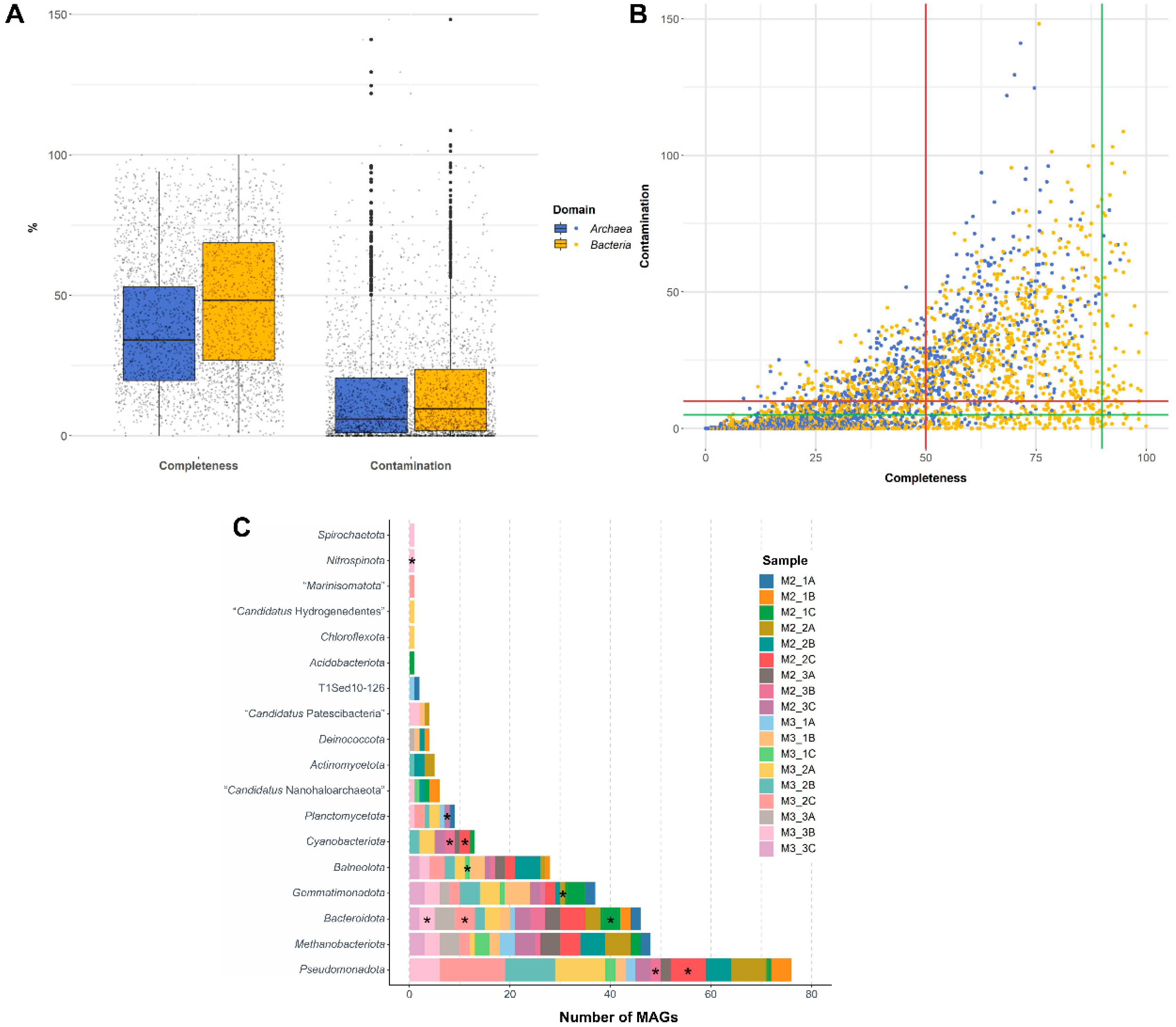
3.1. Reconstruction of Genomic Sequences
3.2. Taxonomic Assignment
3.2.1. Minor Phyla Represented Among the High and Medium Quality MAGs
3.2.2. The Balneolaceae Family as the Best Represented Among the MAGs
3.2.3. The Best Quality MAGs Constitute Uncultured Species
3.3. Phylogenomic Description of Novel Candidatus Taxa
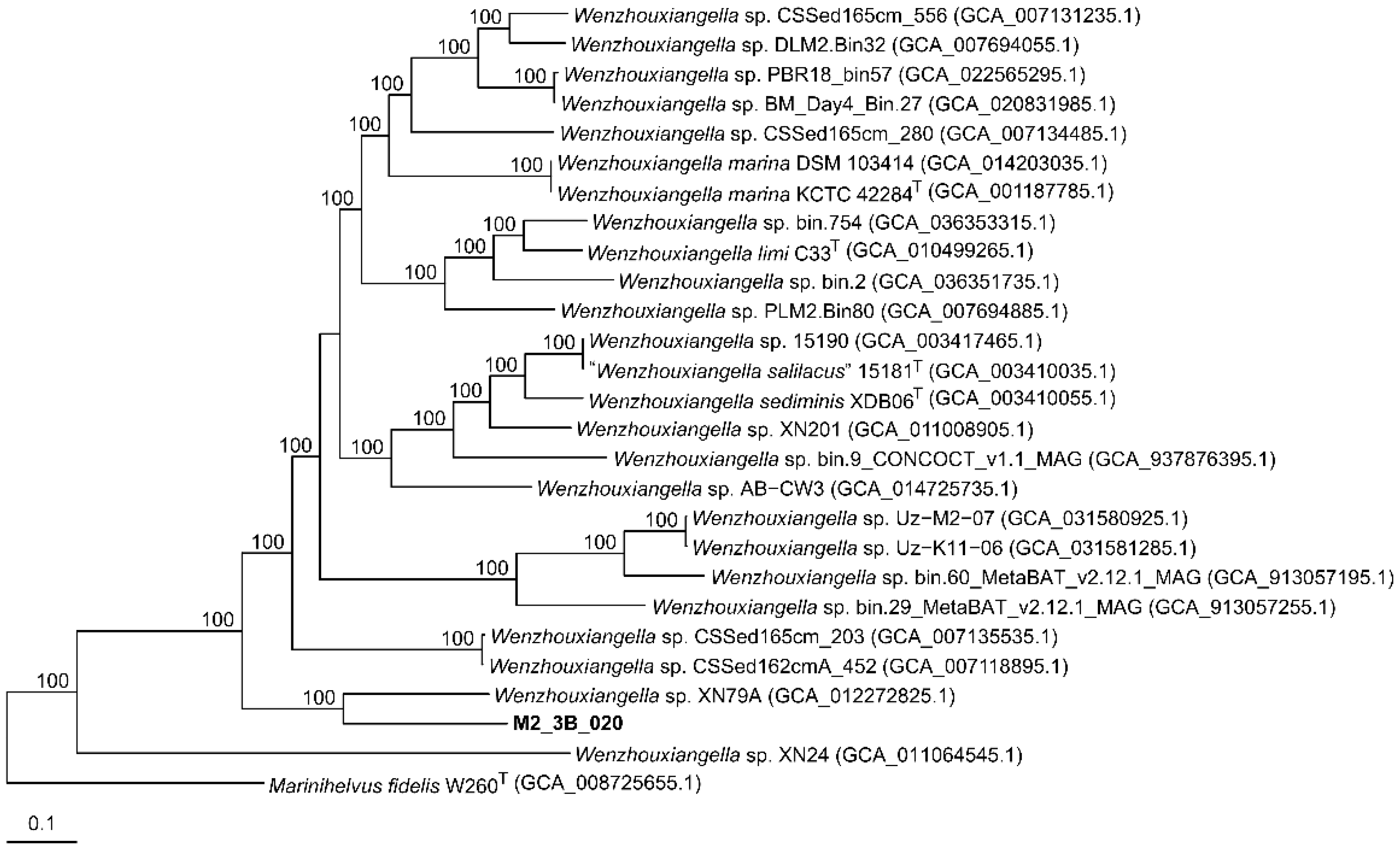
3.3.1. Uncovering a New Species Within the Genus Wenzhouxiangella
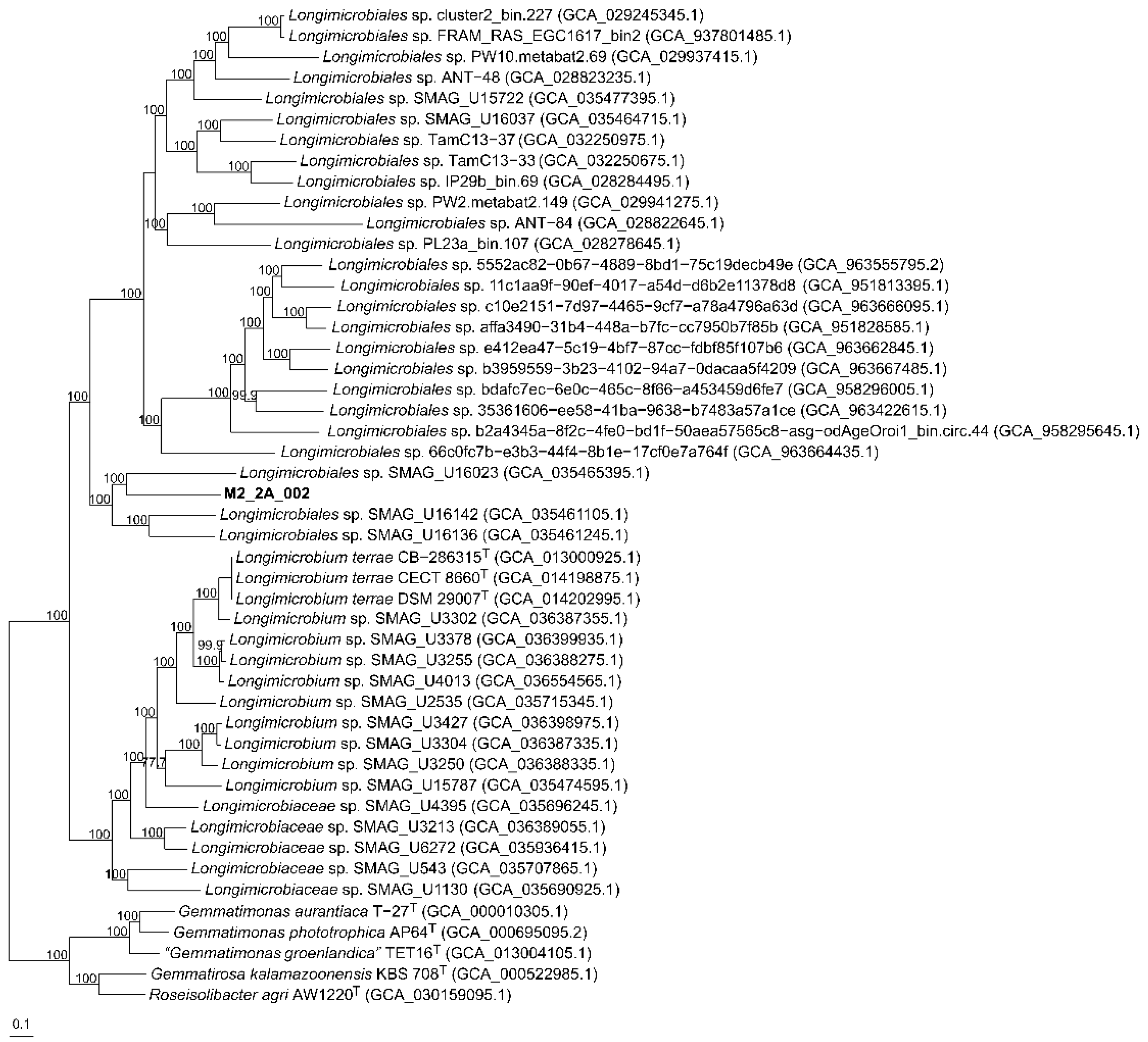
3.3.2. Uncultured Novel Genus Within the Abundant Phylum Gemmatimonadota
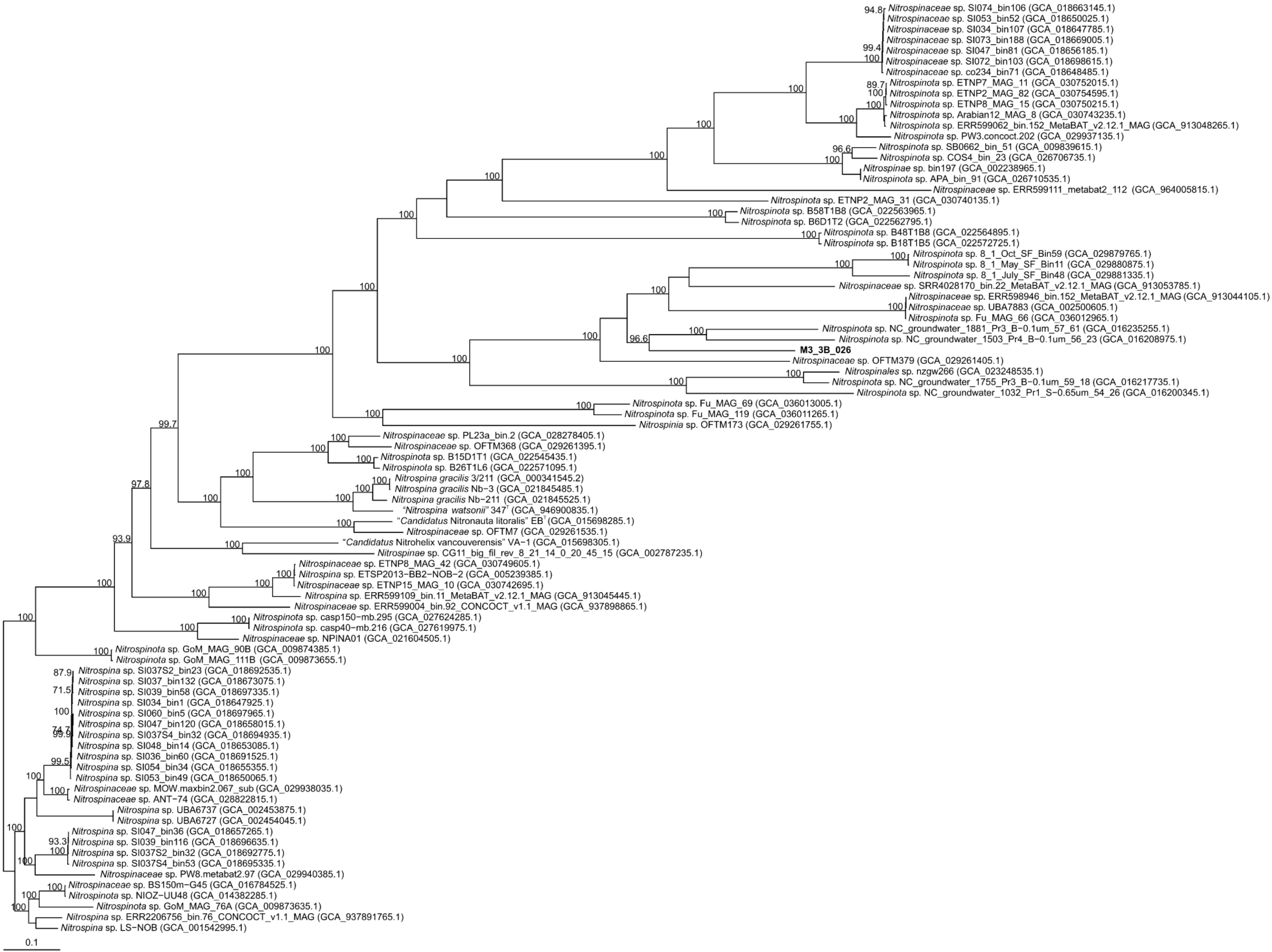
3.3.3. Novel Genus in Uncultured Lineage of Nitrospinota
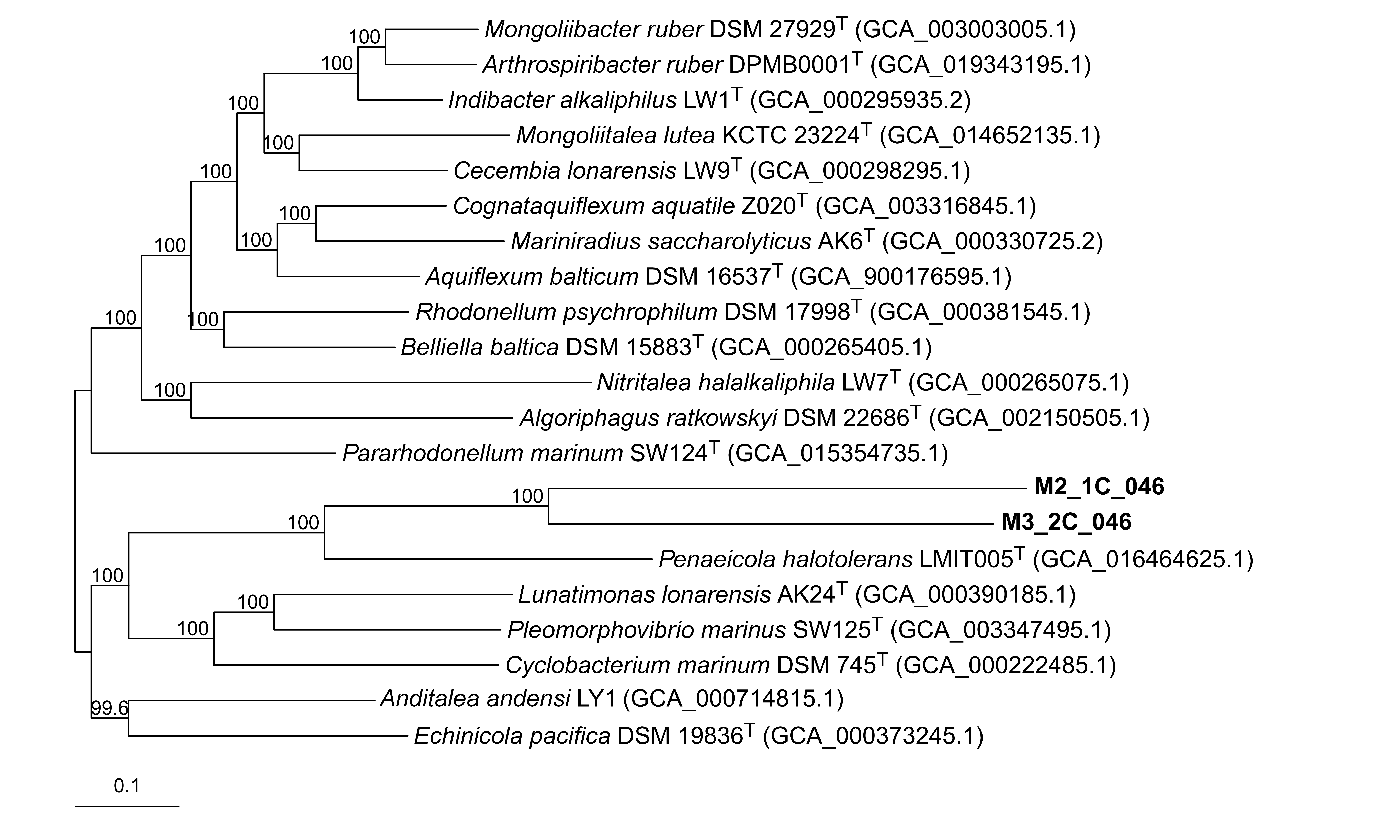
3.3.4. Identification of Two New Genera Within the Family Cyclobacteriaceae
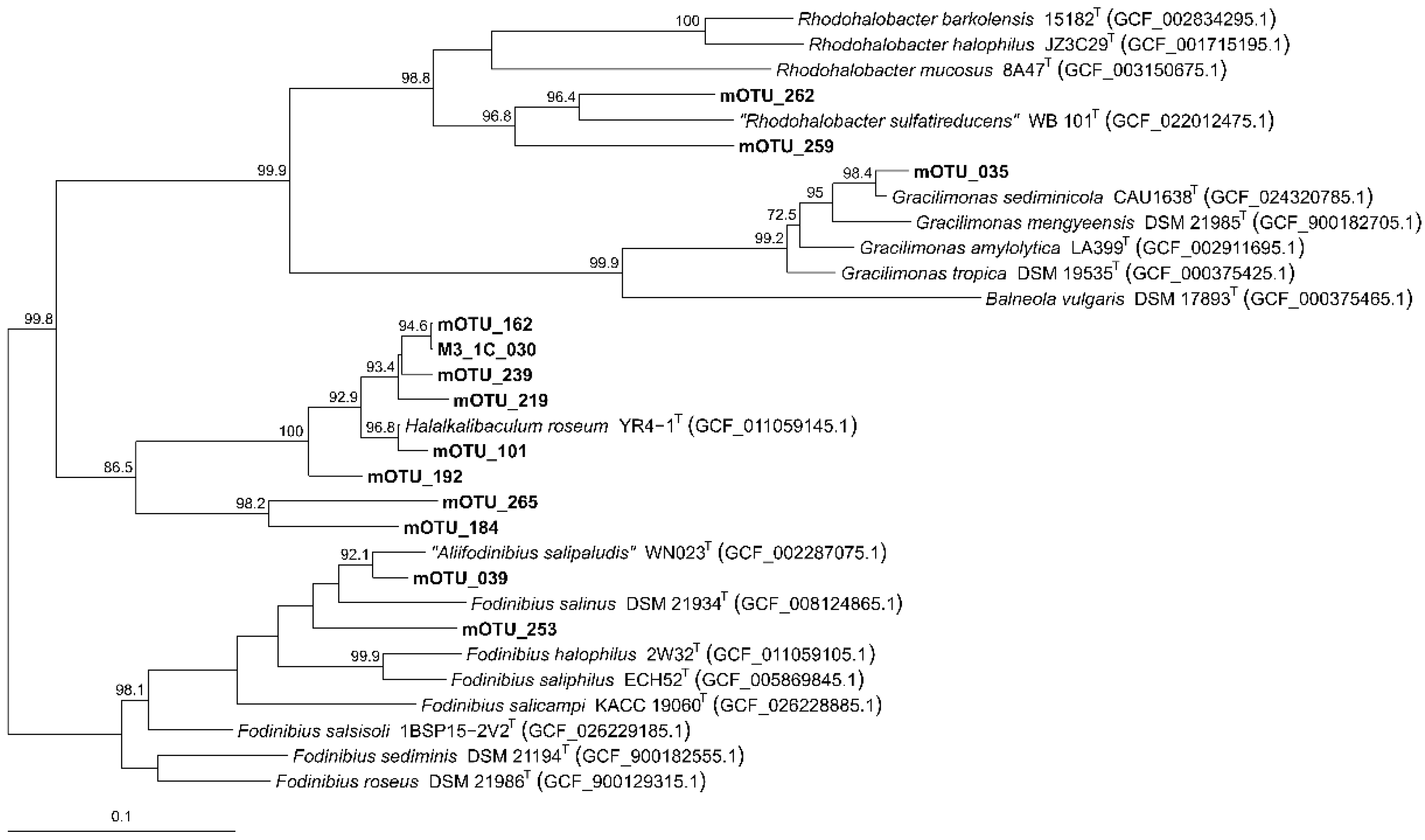
3.3.5. Uncovered Diversity of the Family Balneolaceae
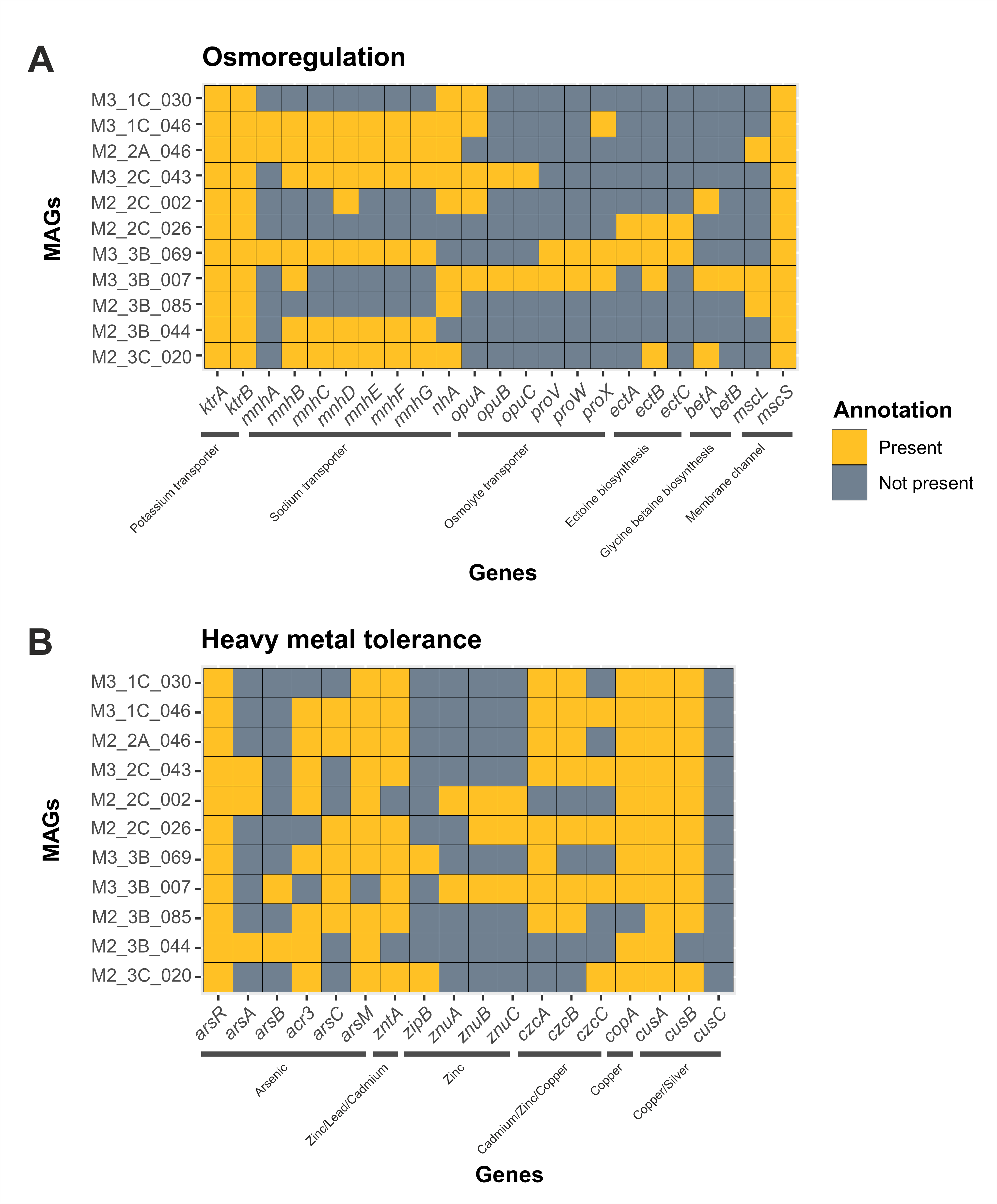
3.4. Strategies to Survive Extreme Conditions Coded in HQ MAG Sequences
3.4.1. Transporters and Biosynthesis Routes to Deal with Salinity
3.4.2. Extruding and Detoxification of Heavy Metals
3.5. A Glimpse into the Metabolic Activity of the Novel Candidatus Taxa
4. Conclusions
Supplementary Materials
Author Contributions
Funding
Institutional Review Board Statement
Informed Consent Statement
Data Availability Statement
Acknowledgments
Conflicts of Interest
Abbreviations
| AAI | Average Amino acid Identity |
| ANI | Average Nucleotide Identity |
| bp | Base pairs |
| Ca. | Candidatus |
| EC | Electrical conductivity |
| FPM | Features Per Million |
| GTDB | Genome Taxonomy Database |
| HQ | High quality |
| ICNP | International Code of Nomenclature of Prokaryotes |
| KEGG | Kyoto Encyclopedia of Genes and Genomes |
| KO | KEGG Orthology |
| LQ | Low quality |
| MAG | Metagenome-Assembled Genome |
| Mb | Megabases |
| MDPI | Multidisciplinary Digital Publishing Institute |
| MIMAG | Minimum Information about a Metagenome-Assembled Genome |
| mOTUs | metagenomic Operative Taxonomic Units |
| MQ | Medium quality |
| mS/cm | millisiemens per centimeter |
| OGRIs | Overall Genome Relatedness Indexes |
| orthoANI | Average Nucleotide Identity for orthologous sequences |
References
- Li, Y.Q.; Chai, Y.H.; Wang, X.S.; Huang, L.Y.; Luo, X.M.; Qiu, C.; Liu, Q.H.; Guan, X.Y. Bacterial community in saline farmland soil on the Tibetan plateau: Responding to salinization while resisting extreme environments. BMC Microbiol. 2021, 21, 119. [Google Scholar] [CrossRef]
- Yang, C.; Lv, D.; Jiang, S.; Lin, H.; Sun, J.; Li, K.; Sun, J. Soil salinity regulation of soil microbial carbon metabolic function in the Yellow River Delta, China. Sci. Total Environ. 2021, 790, 148258. [Google Scholar] [CrossRef]
- Vera-Gargallo, B.; Ventosa, A. Metagenomic insights into the phylogenetic and metabolic diversity of the prokaryotic community dwelling in hypersaline soils from the Odiel Saltmarshes (SW Spain). Genes 2018, 9, 152. [Google Scholar] [CrossRef] [PubMed]
- Quillaguamán, J.; Delgado, O.; Mattiasson, B.; Hatti-Kaul, R. Chromohalobacter sarecensis sp. nov., a psychrotolerant moderate halophile isolated from the saline Andean region of Bolivia. Int. J. Syst. Evol. Microbiol. 2004, 54, 1921–1926. [Google Scholar] [CrossRef]
- Xing, Y.-T.; Xu, L.; Wang, H.-T.; Huang, X.-X.; Wang, S.; Sun, J.-Q. Echinicola soli sp. nov., isolated from alkaline saline soil. Int. J. Syst. Evol. Microbiol. 2020, 70, 4139–4144. [Google Scholar] [CrossRef] [PubMed]
- Durán-Viseras, A.; Sánchez-Porro, C.; Ventosa, A. Genomic insights into new species of the genus Halomicroarcula reveals potential for new osmoadaptative strategies in halophilic archaea. Front. Microbiol. 2021, 12, 751746. [Google Scholar] [CrossRef] [PubMed]
- Straková, D.; Sánchez-Porro, C.; de la Haba, R.R.; Ventosa, A. Reclassification of Halomicroarcula saliterrae Straková et al. 2024 and Halomicroarcula onubensis Straková et al. 2024 into the genus Haloarcula, as Haloarcula saliterrae comb. nov. and Haloarcula onubensis comb. nov., respectively. Int. J. Syst. Evol. Microbiol. 2024, 74, 006510. [Google Scholar] [CrossRef]
- Straková, D.; Galisteo, C.; de la Haba, R.R.; Ventosa, A. Characterization of Haloarcula terrestris sp. nov. and reclassification of a Haloarcula species based on a taxogenomic approach. Int. J. Syst. Evol. Microbiol. 2023, 73, 006157. [Google Scholar] [CrossRef]
- Straková, D.; Sánchez-Porro, C.; de la Haba, R.R.; Ventosa, A. Decoding the genomic profile of the Halomicroarcula genus: Comparative analysis and characterization of two novel species. Microorganisms 2024, 12, 334. [Google Scholar] [CrossRef]
- Durán-Viseras, A.; Castro, D.J.; Reina, J.C.; Béjar, V.; Martínez-Checa, F. Taxogenomic and metabolic insights into Marinobacterium ramblicola sp. nov., a new slightly halophilic bacterium isolated from Rambla Salada, Murcia. Microorganisms 2021, 9, 1654. [Google Scholar] [CrossRef]
- Zhang, Y.Q.; Schumann, P.; Yu, L.Y.; Liu, H.Y.; Zhang, Y.Q.; Xu, L.H.; Stackebrandt, E.; Jiang, C.L.; Li, W.J. Zhihengliuella halotolerans gen. nov., sp. nov., a novel member of the family Micrococcaceae. Int. J. Syst. Evol. Microbiol. 2007, 57, 1018–1023. [Google Scholar] [CrossRef]
- Galisteo, C.; de la Haba, R.R.; Sánchez-Porro, C.; Ventosa, A. A step into the rare biosphere: Genomic features of the new genus Terrihalobacillus and the new species Aquibacillus salsiterrae from hypersaline soils. Front. Microbiol. 2023, 14, 1192059. [Google Scholar] [CrossRef]
- Galisteo, C.; de la Haba, R.R.; Ventosa, A.; Sánchez-Porro, C. The hypersaline soils of the Odiel Saltmarshes Natural Area as a source for uncovering a new taxon: Pseudidiomarina terrestris sp. nov. Microorganisms 2024, 12, 375. [Google Scholar] [CrossRef]
- Galisteo, C.; de la Haba, R.R.; Sánchez-Porro, C.; Ventosa, A. Biotin pathway in novel Fodinibius salsisoli sp. nov., isolated from hypersaline soils and reclassification of the genus Aliifodinibius as Fodinibius. Front. Microbiol. 2023, 13, 1101464. [Google Scholar] [CrossRef]
- Pascual, J.; García-López, M.; Bills, G.F.; Genilloud, O. Longimicrobium terrae gen. nov., sp. nov., an oligotrophic bacterium of the under-represented phylum Gemmatimonadetes isolated through a system of miniaturized diffusion chambers. Int. J. Syst. Evol. Microbiol. 2016, 66, 1976–1985. [Google Scholar] [CrossRef] [PubMed]
- Rath, K.M.; Maheshwari, A.; Rousk, J. Linking microbial community structure to trait distributions and functions using salinity as an environmental filter. mBio 2019, 10, e01607–e01619. [Google Scholar] [CrossRef]
- Vavourakis, C.D.; Andrei, A.S.; Mehrshad, M.; Ghai, R.; Sorokin, D.Y.; Muyzer, G. A metagenomics roadmap to the uncultured genome diversity in hypersaline soda lake sediments. Microbiome 2018, 6, 168. [Google Scholar] [CrossRef]
- Zeng, F.; Zhu, Y.; Zhang, D.; Zhao, Z.; Li, Q.; Ma, P.; Zhang, G.; Wang, Y.; Wu, S.; Guo, S.; et al. Metagenomic analysis of the soil microbial composition and salt tolerance mechanism in Yuncheng Salt Lake, Shanxi Province. Front. Microbiol. 2022, 13, 1004556. [Google Scholar] [CrossRef] [PubMed]
- Ramos-Tapia, I.; Nuñez, R.; Salinas, C.; Salinas, P.; Soto, J.; Paneque, M. Study of wetland soils of the Salar de Atacama with different azonal vegetative formations reveals changes in the microbiota associated with hygrophile plant type on the soil surface. Microbiol. Spectr. 2022, 10, e00533-22. [Google Scholar] [CrossRef] [PubMed]
- Parks, D.H.; Chuvochina, M.; Rinke, C.; Mussig, A.J.; Chaumeil, P.-A.; Hugenholtz, P. GTDB: An ongoing census of bacterial and archaeal diversity through a phylogenetically consistent, rank normalized and complete genome-based taxonomy. Nucleic Acids Res. 2021, 50, D785–D794. [Google Scholar] [CrossRef]
- Galisteo, C.; Puente-Sánchez, F.; de la Haba, R.R.; Bertilsson, S.; Sánchez-Porro, C.; Ventosa, A. Metagenomic insights into the prokaryotic communities of heavy metal-contaminated hypersaline soils. Sci. Total Environ. 2024, 951, 175497. [Google Scholar] [CrossRef] [PubMed]
- Vera-Gargallo, B.; Chowdhury, T.R.; Brown, J.; Fansler, S.J.; Durán-Viseras, A.; Sánchez-Porro, C.; Bailey, V.L.; Jansson, J.K.; Ventosa, A. Spatial distribution of prokaryotic communities in hypersaline soils. Sci. Rep. 2019, 9, 1769. [Google Scholar] [CrossRef] [PubMed]
- Vera-Gargallo, B.; Navarro-Sampedro, L.; Carballo, M.; Ventosa, A. Metagenome sequencing of prokaryotic microbiota from two hypersaline soils of the Odiel Salt Marshes in Huelva, Southwestern Spain. Genome Announc. 2018, 6, e00140-18. [Google Scholar] [CrossRef]
- Vera-Gargallo, B.V.; Hernández, M.; Dumont, M.G.; Ventosa, A. Thrive or survive: Prokaryotic life in hypersaline soils. Environ. Microbiome 2023, 18, 17, Erratum in Environ. Microbiome 2023, 18, 35. [Google Scholar] [CrossRef]
- Straková, D.; Sánchez-Porro, C.; de la Haba, R.R.; Ventosa, A. Strategies of environmental adaptation in the haloarchaeal genera Haloarcula and Natrinema. Microorganisms 2025, 13, 761. [Google Scholar] [CrossRef]
- Luque, C.J.; Castellanos, E.M.; Castillo, J.M.; González, M.; González Vilches, M.C.; Figueroa, M.E. Distribución de metales pesados en sedimentos de las marismas del Odiel (Huelva, SO. España). Cuaternario Geomorfol. 1998, 12, 77–85. [Google Scholar]
- Morillo, J.; Usero, J.; Gracia, I. Partitioning of metals in sediments from the Odiel River (Spain). Environ. Int. 2002, 28, 263–271. [Google Scholar] [CrossRef]
- Pérez-López, R.; Millán-Becerro, R.; Basallote, M.D.; Carrero, S.; Parviainen, A.; Freydier, R.; Macías, F.; Cánovas, C.R. Effects of estuarine water mixing on the mobility of trace elements in acid mine drainage leachates. Mar. Pollut. Bull. 2023, 187, 114491. [Google Scholar] [CrossRef]
- Sainz, A.; Grande, J.A.; De La Torre, M.L.; Sánchez-Rodas, D. Characterisation of sequential leachate discharges of mining waste rock dumps in the Tinto and Odiel rivers. J. Environ. Manag. 2002, 64, 345–353. [Google Scholar] [CrossRef]
- Sainz, A.; Grande, J.A.; de la Torre, M.L. Characterization of heavy metal discharge into the Ria of Huelva. Environ. Int. 2004, 30, 557–566. [Google Scholar] [CrossRef]
- Schmieder, R.; Edwards, R. Quality control and preprocessing of metagenomic datasets. Bioinformatics 2011, 27, 863–864. [Google Scholar] [CrossRef] [PubMed]
- Tamames, J.; Puente-Sánchez, F. SqueezeMeta, A highly portable, fully automatic metagenomic analysis pipeline. Front. Microbiol. 2019, 9, 3349. [Google Scholar] [CrossRef]
- Kang, D.D.; Froula, J.; Egan, R.; Wang, Z. MetaBAT, an efficient tool for accurately reconstructing single genomes from complex microbial communities. PeerJ. 2015, 3, e1165. [Google Scholar] [CrossRef] [PubMed]
- Wu, Y.-W.; Simmons, B.A.; Singer, S.W. MaxBin 2.0: An automated binning algorithm to recover genomes from multiple metagenomic datasets. Bioinformatics 2015, 32, 605–607. [Google Scholar] [CrossRef]
- Sieber, C.M.; Probst, A.J.; Sharrar, A.; Thomas, B.C.; Hess, M.; Tringe, S.G.; Banfield, J.F. Recovery of genomes from metagenomes via a dereplication, aggregation and scoring strategy. Nat. Microbiol. 2018, 3, 836–843. [Google Scholar] [CrossRef]
- Parks, D.H.; Imelfort, M.; Skennerton, C.T.; Hugenholtz, P.; Tyson, G.W. CheckM: Assessing the quality of microbial genomes recovered from isolates, single cells, and metagenomes. Genome Res. 2015, 25, 1043–1055. [Google Scholar] [CrossRef]
- Hyatt, D.; Chen, G.-L.; Locascio, P.F.; Land, M.L.; Larimer, F.W.; Hauser, L.J. Prodigal: Prokaryotic gene recognition and translation initiation site identification. BMC Bioinform. 2010, 11, 119. [Google Scholar] [CrossRef]
- Kanehisa, M.; Goto, S. KEGG: Kyoto Encyclopedia of Genes and Genomes. Nucleic Acids Res. 2000, 28, 27–30. [Google Scholar] [CrossRef] [PubMed]
- Buchfink, B.; Reuter, K.; Drost, H.-G. Sensitive protein alignments at tree-of-life scale using DIAMOND. Nat. Methods 2021, 18, 366–368. [Google Scholar] [CrossRef]
- Chaumeil, P.-A.; Mussig, A.J.; Hugenholtz, P.; Parks, D.H. GTDB-Tk: A toolkit to classify genomes with the Genome Taxonomy Database. Bioinformatics 2019, 36, 1925–1927. [Google Scholar] [CrossRef]
- Bowers, R.M.; Kyrpides, N.C.; Stepanauskas, R.; Harmon-Smith, M.; Doud, D.; Reddy, T.B.K.; Schulz, F.; Jarett, J.; Rivers, A.R.; Eloe-Fadrosh, E.A.; et al. Minimum information about a single amplified genome (MISAG) and a metagenome-assembled genome (MIMAG) of bacteria and archaea. Nat. Biotechnol. 2017, 35, 725–731. [Google Scholar] [CrossRef]
- Buck, M.; Mehrshad, M.; Bertilsson, S. mOTUpan: A robust Bayesian approach to leverage metagenome assembled genomes for core-genome estimation. NAR Genom. Bioinform. 2022, 4, lqac060. [Google Scholar] [CrossRef] [PubMed]
- Chun, J.; Oren, A.; Ventosa, A.; Christensen, H.; Arahal, D.R.; da Costa, M.S.; Rooney, A.P.; Yi, H.; Xu, X.W.; De Meyer, S.; et al. Proposed minimal standards for the use of genome data for the taxonomy of prokaryotes. Int. J. Syst. Evol. Microbiol. 2018, 68, 461–466. [Google Scholar] [CrossRef] [PubMed]
- Rodriguez-R, L.M.; Konstantinidis, K.T. The Enveomics collection: A toolbox for specialized analyses of microbial genomes and metagenomes. PeerJ Prepr. 2016, 4, e1900v1. [Google Scholar] [CrossRef]
- Lee, I.; Ouk Kim, Y.; Park, S.-C.; Chun, J. OrthoANI: An improved algorithm and software for calculating average nucleotide identity. Int. J. Syst. Evol. Microbiol. 2016, 66, 1100–1103. [Google Scholar] [CrossRef]
- Edgar, R.C. MUSCLE: Multiple sequence alignment with high accuracy and high throughput. Nucleic Acids Res. 2004, 32, 1792–1797. [Google Scholar] [CrossRef]
- Price, M.N.; Dehal, P.S.; Arkin, A.P. FastTree 2—Approximately maximum-likelihood trees for large alignments. PLoS ONE 2010, 5, e9490. [Google Scholar] [CrossRef]
- Jones, D.T.; Taylor, W.R.; Thornton, J.M. The rapid generation of mutation data matrices from protein sequences. Comp. Appl. Biosci. 1992, 8, 275–282. [Google Scholar] [CrossRef] [PubMed]
- Shimodaira, H.; Hasegawa, M. Multiple comparisons of log-likelihoods with applications to phylogenetic inference. Mol. Biol. Evol. 1999, 16, 1114. [Google Scholar] [CrossRef]
- Galisteo, C.; de la Haba, R.R. “gitana” (phyloGenetic Imaging Tool for Adjusting Nodes and other Arrangements), a tool for plotting phylogenetic trees into ready-to-publish figures. BMC Bioinform. 2025, 26, 154. [Google Scholar] [CrossRef]
- Pérez-Cobas, A.E.; Gomez-Valero, L.; Buchrieser, C. Metagenomic approaches in microbial ecology: An update on whole-genome and marker gene sequencing analyses. Microb. Genom. 2020, 6, mgen000409. [Google Scholar] [CrossRef] [PubMed]
- de León-Lorenzana, A.S.; Delgado-Balbuena, L.; Domínguez-Mendoza, C.; Navarro-Noya, Y.E.; Luna-Guido, M.; Dendooven, L. Reducing salinity by flooding an extremely alkaline and saline soil changes the bacterial community but its effect on the archaeal community is limited. Front. Microbiol. 2017, 8, 466. [Google Scholar] [CrossRef]
- Fariq, A.; Yasmin, A.; Blazier, J.C.; Jannat, S. Identification of bacterial communities in extreme sites of Pakistan using high throughput barcoded amplicon sequencing. Biodivers. Data J. 2021, 9, e68929. [Google Scholar] [CrossRef]
- Kimbrel, J.A.; Ballor, N.; Wu, Y.W.; David, M.M.; Hazen, T.C.; Simmons, B.A.; Singer, S.W.; Jansson, J.K. Microbial community structure and functional potential along a hypersaline gradient. Front. Microbiol. 2018, 9, 1492. [Google Scholar] [CrossRef]
- Wu, S.; Wang, J.; Wang, J.; Du, X.; Ran, Q.; Chen, Q.; Sheng, D.; Li, Y.Z. Halalkalibacterium roseum gen. nov., sp. nov., a new member of the family Balneolaceae isolated from soil. Int. J. Syst. Evol. Microbiol. 2022, 72, 005339, Corrigendum in Int. J. Syst. Evol. Microbiol. 2022, 72, 005451. https://doi.org/10.1099/ijsem.0.005451. [Google Scholar] [CrossRef] [PubMed]
- Goderska, K.; Juzwa, W.; Karpiński, T.M. Quantitative analysis of lactobionic acid in bioreactor cultures and selected biological activities. Molecules 2024, 29, 5400. [Google Scholar] [CrossRef]
- Djobo, O.; Sina, H.; Tagba, S.; Ahyi, V.; Savadogo, A.; Adjanohoun, A.; Rendueles, M.; Baba-Moussa, L. Bio-production of lactic and lactobionic acids using whey from the production of cow’s milk Wagashi cheese in Benin. Front. Nutr. 2022, 9, 1020934. [Google Scholar] [CrossRef]
- Oh, Y.R.; Jang, Y.A.; Lee, S.S.; Kim, J.H.; Hong, S.H.; Han, J.J.; Eom, G.T. Enhancement of lactobionic acid productivity by homologous expression of quinoprotein glucose dehydrogenase in Pseudomonas taetrolens. J. Agric. Food Chem. 2020, 68, 12336–12344. [Google Scholar] [CrossRef]
- Hossain, S.; Khetra, Y.; Dularia, C. Biosynthesis of lactobionic acid: A systematic review. Crit. Rev. Food Sci. Nutr. 2025, 65, 353–366. [Google Scholar] [CrossRef] [PubMed]
- León, M.J.; Fernández, A.B.; Ghai, R.; Sánchez-Porro, C.; Rodriguez-Valera, F.; Ventosa, A. From metagenomics to pure culture: Isolation and characterization of the moderately halophilic bacterium Spiribacter salinus gen. nov., sp. nov. Appl. Environ. Microbiol. 2014, 80, 3850–3857. [Google Scholar] [CrossRef] [PubMed]
- Parte, A.C.; Sardà Carbasse, J.; Meier-Kolthoff, J.P.; Reimer, L.C.; Göker, M. List of Prokaryotic names with Standing in Nomenclature (LPSN) moves to the DSMZ. Int. J. Syst. Evol. Microbiol. 2020, 70, 5607–5612. [Google Scholar] [CrossRef] [PubMed]
- Salwan, R.; Sharma, V. Genomics of prokaryotic extremophiles to unfold the mystery of survival in extreme environments. Microbiol. Res. 2022, 264, 127156. [Google Scholar] [CrossRef]
- Goris, J.; Konstantinidis, K.T.; Klappenbach, J.A.; Coenye, T.; Vandamme, P.; Tiedje, J.M. DNA-DNA hybridization values and their relationship to whole-genome sequence similarities. Int. J. Syst. Evol. Microbiol. 2007, 57, 81–91. [Google Scholar] [CrossRef]
- Richter, M.; Rosselló-Móra, R. Shifting the genomic gold standard for the prokaryotic species definition. Proc. Natl. Acad. Sci. USA 2009, 106, 19126–19131. [Google Scholar] [CrossRef]
- Chun, J.; Rainey, F.A. Integrating genomics into the taxonomy and systematics of the Bacteria and Archaea. Int. J. Syst. Evol. Microbiol. 2014, 64, 316–324. [Google Scholar] [CrossRef]
- Konstantinidis, K.T.; Tiedje, J.M. Prokaryotic taxonomy and phylogeny in the genomic era: Advancements and challenges ahead. Curr. Opin. Microbiol. 2007, 10, 504–509. [Google Scholar] [CrossRef]
- Konstantinidis, K.T.; Rosselló-Móra, R.; Amann, R. Uncultivated microbes in need of their own taxonomy. ISME J. 2017, 11, 2399–2406. [Google Scholar] [CrossRef]
- Barco, R.A.; Garrity, G.M.; Scott, J.J.; Amend, J.P.; Nealson, K.H.; Emerson, D. A genus definition for Bacteria and Archaea based on a standard genome relatedness index. mBio 2020, 11, e02475-19. [Google Scholar] [CrossRef]
- Watson, S.W.; Waterbury, J.B. Characteristics of two marine nitrite oxidizing bacteria, Nitrospina gracilis nov. gen. nov. sp. and Nitrococcus mobilis nov. gen. nov. sp. Arch. Mikrobiol. 1971, 77, 203–230. [Google Scholar] [CrossRef]
- Spieck, E.; Keuter, S.; Wenzel, T.; Bock, E.; Ludwig, W. Characterization of a new marine nitrite oxidizing bacterium, Nitrospina watsonii sp. nov., a member of the newly proposed phylum “Nitrospinae”. Syst. Appl. Microbiol. 2014, 37, 170–176. [Google Scholar] [CrossRef]
- Ngugi, D.K.; Blom, J.; Stepanauskas, R.; Stingl, U. Diversification and niche adaptations of Nitrospina-like bacteria in the polyextreme interfaces of Red Sea brines. ISME J. 2016, 10, 1383–1399. [Google Scholar] [CrossRef]
- Ito, M.; Guffanti, A.A.; Oudega, B.; Krulwich, T.A. mrp, a multigene, multifunctional locus in Bacillus subtilis with roles in resistance to cholate and to Na+ and in pH homeostasis. J. Bacteriol. 1999, 181, 2394–2402. [Google Scholar] [CrossRef]
- Ohyama, T.; Igarashi, K.; Kobayashi, H. Physiological role of the chaA gene in sodium and calcium circulations at a high pH in Escherichia coli. J. Bacteriol. 1994, 176, 4311–4315. [Google Scholar] [CrossRef] [PubMed]
- Blanco-Rivero, A.; Leganés, F.; Fernández-Valiente, E.; Calle, P.; Fernández-Piñas, F. mrpA, a gene with roles in resistance to Na+ and adaptation to alkaline pH in the cyanobacterium Anabaena sp. PCC7120. Microbiology 2005, 151, 1671–1682. [Google Scholar] [CrossRef]
- Patiño-Ruiz, M.; Ganea, C.; Călinescu, O. Prokaryotic Na+/H+ exchangers—Transport mechanism and essential residues. Int. J. Mol. Sci. 2022, 23, 9156. [Google Scholar] [CrossRef]
- Nakamura, T.; Yuda, R.; Unemoto, T.; Bakker, E.P. KtrAB, a new type of bacterial K+-uptake system from Vibrio alginolyticus. J. Bacteriol. 1998, 180, 3491–3494. [Google Scholar] [CrossRef]
- Tholema, N.; Bakker, E.P.; Suzuki, A.; Nakamura, T. Change to alanine of one out of four selectivity filter glycines in KtrB causes a two orders of magnitude decrease in the affinities for both K+ and Na+ of the Na+ dependent K+ uptake system KtrAB from Vibrio alginolyticus. FEBS Lett. 1999, 450, 217–220. [Google Scholar] [CrossRef]
- Hoffmann, T.; Bremer, E. Guardians in a stressful world: The Opu family of compatible solute transporters from Bacillus subtilis. Biol. Chem. 2017, 398, 193–214. [Google Scholar] [CrossRef] [PubMed]
- Teichmann, L.; Kümmel, H.; Warmbold, B.; Bremer, E. OpuF, a new Bacillus compatible solute ABC transporter with a substrate-binding protein fused to the transmembrane domain. Appl. Environ. Microbiol. 2018, 84, 01718. [Google Scholar] [CrossRef] [PubMed]
- Kappes, R.M.; Kempf, B.; Bremer, E. Three transport systems for the osmoprotectant glycine betaine operate in Bacillus subtilis: Characterization of OpuD. J. Bacteriol. 1996, 178, 5071–5079. [Google Scholar] [CrossRef]
- Gregory, G.J.; Boyd, E.F. Stressed out: Bacterial response to high salinity using compatible solute biosynthesis and uptake systems, lessons from Vibrionaceae. Comput. Struct. Biotechnol. J. 2021, 19, 1014–1027. [Google Scholar] [CrossRef]
- Zhu, Y.; Yoshinaga, M.; Zhao, F.; Rosen, B.P. Earth abides arsenic biotransformations. Annu. Rev. Earth Planet. Sci. 2014, 42, 443–467. [Google Scholar] [CrossRef]
- Beard, S.J.; Hashim, R.; Membrillo-Hernández, J.; Hughes, M.N.; Poole, R.K. Zinc(II) tolerance in Escherichia coli K-12: Evidence that the zntA gene (o732) encodes a cation transport ATPase. Mol. Microbiol. 1997, 25, 883–891. [Google Scholar] [CrossRef]
- Rensing, C.; Mitra, B.; Rosen, B.P. The zntA gene of Escherichia coli encodes a Zn(II)-translocating P-type ATPase. Proc. Natl. Acad. Sci. USA 1997, 94, 14326–14331. [Google Scholar] [CrossRef]
- Rensing, C.; Sun, Y.; Mitra, B.; Rosen, B.P. Pb(II)-translocating P-type ATPases. J. Biol. Chem. 1998, 273, 32614–32617. [Google Scholar] [CrossRef] [PubMed]
- Patzer, S.I.; Hantke, K. The ZnuABC high-affinity zinc uptake system and its regulator Zur in Escherichia coli. Mol. Microbiol. 1998, 28, 1199–1210. [Google Scholar] [CrossRef] [PubMed]
- Ducret, V.; Gonzalez, M.R.; Leoni, S.; Valentini, M.; Perron, K. The CzcCBA efflux system requires the CadA P-type ATPase for timely expression upon zinc excess in Pseudomonas aeruginosa. Front. Microbiol. 2020, 11, 911. [Google Scholar] [CrossRef]
- Diels, L.; Dong, Q.; van der Lelie, D.; Baeyens, W.; Mergeay, M. The czc operon of Alcaligenes eutrophus CH34: From resistance mechanism to the removal of heavy metals. J. Ind. Microbiol. 1995, 14, 142–153. [Google Scholar] [CrossRef]
- Legatzki, A.; Grass, G.; Anton, A.; Rensing, C.; Nies, D.H. Interplay of the Czc system and two P-type ATPases in conferring metal resistance to Ralstonia metallidurans. J. Bacteriol. 2003, 185, 4354–4361. [Google Scholar] [CrossRef]
- Yang, X.; Peng, W.; Wang, Y.; Yan, K.; Liu, Z.; Gao, T.; Yang, K.; Liu, W.; Guo, R.; Li, C.; et al. Mutations in troABCD against copper overload in a copA mutant of Streptococcus suis. Appl. Environ. Microbiol. 2023, 89, e0184122. [Google Scholar] [CrossRef]
- Bagai, I.; Liu, W.; Rensing, C.; Blackburn, N.J.; McEvoy, M.M. Substrate-linked conformational change in the periplasmic component of a Cu(I)/Ag(I) efflux system. J. Biol. Chem. 2007, 282, 35695–35702. [Google Scholar] [CrossRef]
- Chunyi, K.; Wei, S.; Mingken, W.; Chunyu, X.; Changxiu, L. Diversity, community structure, and abundance of nirS-type denitrifying bacteria on suspended particulate matter in coastal high-altitude aquaculture pond water. Sci. Rep. 2024, 14, 5594. [Google Scholar] [CrossRef]
- Kuypers, M.M.M.; Marchant, H.K.; Kartal, B. The microbial nitrogen-cycling network. Nat. Rev. Microbiol. 2018, 16, 263–276. [Google Scholar] [CrossRef]
- Zehr, J.P.; Kudela, R.M. Nitrogen cycle of the open ocean: From genes to ecosystems. Ann. Rev. Mar. Sci. 2011, 3, 197–225. [Google Scholar] [CrossRef] [PubMed]
- Throbäck, I.N.; Enwall, K.; Jarvis, Å.; Hallin, S. Reassessing PCR primers targeting nirS, nirK and nosZ genes for community surveys of denitrifying bacteria with DGGE. FEMS Microbiol. Ecol. 2004, 49, 401–417. [Google Scholar] [CrossRef]
- Pratscher, J.; Stichternoth, C.; Fichtl, K.; Schleifer, K.-H.; Braker, G. Application of recognition of individual genes-fluorescence in situ hybridization (RING-FISH) to detect nitrite reductase genes (nirK) of denitrifiers in pure cultures and environmental samples. Appl. Environ. Microbiol. 2009, 75, 802–810. [Google Scholar] [CrossRef] [PubMed]
- Braker, G.; Zhou, J.; Wu, L.; Devol, A.H.; Tiedje, J.M. Nitrite reductase genes (nirK and nirS) as functional markers to investigate diversity of denitrifying bacteria in Pacific Northwest marine sediment communities. Appl. Environ. Microbiol. 2000, 66, 2096–2104. [Google Scholar] [CrossRef]
- Zeng, Y.; Feng, F.; Medová, H.; Dean, J.; Koblížek, M. Functional type 2 photosynthetic reaction centers found in the rare bacterial phylum Gemmatimonadetes. Proc. Natl. Acad. Sci. USA 2014, 111, 7795–7800. [Google Scholar] [CrossRef] [PubMed]
- Jiang, M.; Cao, Y.; Guo, Z.-F.; Chen, M.; Chen, X.; Guo, Z. Menaquinone biosynthesis in Escherichia coli: Identification of 2-succinyl-5-enolpyruvyl-6-hydroxy-3-cyclohexene-1-carboxylate as a novel intermediate and re-evaluation of MenD activity. Biochemistry 2007, 46, 10979–10989. [Google Scholar] [CrossRef]
- Sirithanakorn, C.; Cronan, J.E. Biotin, a universal and essential cofactor: Synthesis, ligation and regulation. FEMS Microbiol. Rev. 2021, 45, fuab003. [Google Scholar] [CrossRef] [PubMed]
- Wei, W.; Guan, H.; Zhu, T.; Zhang, S.; Fan, C.; Ouyang, S.; Feng, Y. Molecular basis of BioJ, a unique gatekeeper in bacterial biotin synthesis. iScience 2019, 19, 796–808. [Google Scholar] [CrossRef] [PubMed]
- Feng, Y.; Napier, B.A.; Manandhar, M.; Henke, S.K.; Weiss, D.S.; Cronan, J.E. A Francisella virulence factor catalyses an essential reaction of biotin synthesis. Mol. Microbiol. 2014, 91, 300–314. [Google Scholar] [CrossRef] [PubMed]
- Rodionov, D.A.; Mironov, A.A.; Gelfand, M.S. Conservation of the biotin regulon and the BirA regulatory signal in Eubacteria and Archaea. Genome Res. 2002, 12, 1507–1516. [Google Scholar] [CrossRef]
- Shi, J.; Cao, X.; Chen, Y.; Cronan, J.E.; Guo, Z. An atypical α/β-hydrolase fold revealed in the crystal structure of pimeloyl-acyl carrier protein methyl esterase BioG from Haemophilus influenzae. Biochemistry 2016, 55, 6705–6717. [Google Scholar] [CrossRef]
- Shapiro, M.M.; Chakravartty, V.; Cronan, J.E. Remarkable diversity in the enzymes catalyzing the last step in synthesis of the pimelate moiety of biotin. PLoS ONE 2012, 7, e49440. [Google Scholar] [CrossRef]
- Bi, H.; Zhu, L.; Jia, J.; Cronan, J.E. A biotin biosynthesis gene restricted to Helicobacter. Sci. Rep. 2016, 6, 21162. [Google Scholar] [CrossRef]
- Kop, L.F.M.; Koch, H.; Jetten, M.S.M.; Daims, H.; Lücker, S. Metabolic and phylogenetic diversity in the phylum Nitrospinota revealed by comparative genome analyses. ISME Commun. 2024, 4, ycad017, Erratum in ISME Commun. 2025, 1, ycaf135. [Google Scholar] [CrossRef]
- Levipan, H.A.; Molina, V.; Fernandez, C. Nitrospina-like bacteria are the main drivers of nitrite oxidation in the seasonal upwelling area of the Eastern South Pacific (Central Chile ∼36°S). Environ. Microbiol. Rep. 2014, 6, 565–573. [Google Scholar] [CrossRef]
- Rani, S.; Koh, H.-W.; Rhee, S.-K.; Fujitani, H.; Park, S.-J. Detection and diversity of the nitrite oxidoreductase alpha subunit (nxrA) gene of Nitrospina in marine sediments. Microb. Ecol. 2017, 73, 111–122. [Google Scholar] [CrossRef] [PubMed]
- Elling, F.J.; Evans, T.W.; Nathan, V.; Hemingway, J.D.; Kharbush, J.J.; Bayer, B.; Spieck, E.; Husain, F.; Summons, R.E.; Pearson, A. Marine and terrestrial nitrifying bacteria are sources of diverse bacteriohopanepolyols. Geobiology 2022, 20, 399–420. [Google Scholar] [CrossRef] [PubMed]
- Dos Santos, P.C.; Fang, Z.; Mason, S.W.; Setubal, J.C.; Dixon, R. Distribution of nitrogen fixation and nitrogenase-like sequences amongst microbial genomes. BMC Genomics 2012, 13, 162. [Google Scholar] [CrossRef]
- Seefeldt, L.C.; Hoffman, B.M.; Dean, D.R. Mechanism of Mo-dependent nitrogenase. Annu. Rev. Biochem. 2009, 78, 701–722. [Google Scholar] [CrossRef]
- Pi, H.W.; Lin, J.J.; Chen, C.A.; Wang, P.H.; Chiang, Y.R.; Huang, C.C.; Young, C.C.; Li, W.H. Origin and evolution of nitrogen fixation in prokaryotes. Mol. Biol. Evol. 2022, 39, msac181. [Google Scholar] [CrossRef] [PubMed]



| Sample | Area | Coordinates | Year | EC (mS/cm) | No. Total Reads | Accession Number |
|---|---|---|---|---|---|---|
| M3_1A | 1 | 37°12′26.6″ N 6°57′52.5″ W | 2021 | 27.0 | 174,068,320 | SRS20604428 |
| M3_1B | 1 | 37°12′26.6″ N 6°57′52.5″ W | 2021 | 26.9 | 174,568,698 | SRS20617304 |
| M3_1C | 1 | 37°12′26.6″ N 6°57′52.5″ W | 2021 | 22.4 | 136,267,104 | SRS20617300 |
| M3_2A | 2 | 37°12′28.4″ N 6°57′27.9″ W | 2021 | 24.7 | 159,093,934 | SRS20617299 |
| M3_2B | 2 | 37°12′28.4″ N 6°57′27.9″ W | 2021 | 24.0 | 143,483,116 | SRS20604433 |
| M3_2C | 2 | 37°12′28.4″ N 6°57′27.9″ W | 2021 | 18.5 | 150,290,774 | SRS20617296 |
| M3_3A | 3 | 37°13′18.0″ N 6°57′44.8″ W | 2021 | 23.3 | 159,330,400 | SRS20617298 |
| M3_3B | 3 | 37°13′18.0″ N 6°57′44.8″ W | 2021 | 21.9 | 171,035,056 | SRS20604749 |
| M3_3C | 3 | 37°13′18.0″ N 6°57′44.8″ W | 2021 | 15.4 | 169,234,708 | SRS20604748 |
| M2_1A | 1 | 37°12′26.6″ N 6°57’52.5″ W | 2020 | 33.5 | 167,417,500 | SRS20604429 |
| M2_1B | 1 | 37°12′26.6″ N 6°57′52.5″ W | 2020 | 42.6 | 172,740,278 | SRS20617295 |
| M2_1C | 1 | 37°12′26.6″ N 6°57′52.5″ W | 2020 | 27.1 | 166,186,480 | SRS20617297 |
| M2_2A | 2 | 37°12′28.4″ N 6°57′27.9″ W | 2020 | 46.1 | 162,525,972 | SRS20617301 |
| M2_2B | 2 | 37°12′28.4″ N 6°57′27.9″ W | 2020 | 46.0 | 106,685,200 | SRS20604431 |
| M2_2C | 2 | 37°12′28.4″ N 6°57′27.9″ W | 2020 | 37.9 | 111,532,290 | SRS20604430 |
| M2_3A | 3 | 37°13′18.0″ N 6°57′44.8″ W | 2020 | 39.1 | 125,176,826 | SRS20617303 |
| M2_3B | 3 | 37°13′18.0″ N 6°57′44.8″ W | 2020 | 60.7 | 191,221,338 | SRS20617302 |
| M2_3C | 3 | 37°13′18.0″ N 6°57′44.8″ W | 2020 | 69.2 | 152,468,274 | SRS20604432 |
| Sample | HQ | MQ | LQ | Total |
|---|---|---|---|---|
| M3_1A | 0 | 8 | 203 | 288 |
| M3_1B | 0 | 16 | 208 | 307 |
| M3_1C | 1 | 7 | 205 | 295 |
| M3_2A | 0 | 27 | 153 | 289 |
| M3_2B | 0 | 22 | 107 | 212 |
| M3_2C | 1 | 26 | 125 | 222 |
| M3_3A | 0 | 11 | 175 | 259 |
| M3_3B | 2 | 21 | 172 | 303 |
| M3_3C | 0 | 10 | 167 | 263 |
| M2_1A | 0 | 8 | 241 | 353 |
| M2_1B | 0 | 10 | 180 | 277 |
| M2_1C | 1 | 13 | 144 | 246 |
| M2_2A | 1 | 19 | 155 | 258 |
| M2_2B | 0 | 20 | 136 | 226 |
| M2_2C | 2 | 20 | 153 | 256 |
| M2_3A | 0 | 12 | 148 | 243 |
| M2_3B | 2 | 8 | 126 | 216 |
| M2_3C | 1 | 15 | 121 | 205 |
| Total | 11 | 273 | 2919 | 4718 |
Disclaimer/Publisher’s Note: The statements, opinions and data contained in all publications are solely those of the individual author(s) and contributor(s) and not of MDPI and/or the editor(s). MDPI and/or the editor(s) disclaim responsibility for any injury to people or property resulting from any ideas, methods, instructions or products referred to in the content. |
© 2026 by the authors. Licensee MDPI, Basel, Switzerland. This article is an open access article distributed under the terms and conditions of the Creative Commons Attribution (CC BY) license.
Share and Cite
Galisteo, C.; Puente-Sánchez, F.; de la Haba, R.R.; Bertilsson, S.; Ventosa, A.; Sánchez-Porro, C. Uncovering the Prokaryotic Diversity of Hypersaline Soils of Odiel Saltmarshes Natural Area Through Metagenome-Assembled Genomes. Microorganisms 2026, 14, 489. https://doi.org/10.3390/microorganisms14020489
Galisteo C, Puente-Sánchez F, de la Haba RR, Bertilsson S, Ventosa A, Sánchez-Porro C. Uncovering the Prokaryotic Diversity of Hypersaline Soils of Odiel Saltmarshes Natural Area Through Metagenome-Assembled Genomes. Microorganisms. 2026; 14(2):489. https://doi.org/10.3390/microorganisms14020489
Chicago/Turabian StyleGalisteo, Cristina, Fernando Puente-Sánchez, Rafael R. de la Haba, Stefan Bertilsson, Antonio Ventosa, and Cristina Sánchez-Porro. 2026. "Uncovering the Prokaryotic Diversity of Hypersaline Soils of Odiel Saltmarshes Natural Area Through Metagenome-Assembled Genomes" Microorganisms 14, no. 2: 489. https://doi.org/10.3390/microorganisms14020489
APA StyleGalisteo, C., Puente-Sánchez, F., de la Haba, R. R., Bertilsson, S., Ventosa, A., & Sánchez-Porro, C. (2026). Uncovering the Prokaryotic Diversity of Hypersaline Soils of Odiel Saltmarshes Natural Area Through Metagenome-Assembled Genomes. Microorganisms, 14(2), 489. https://doi.org/10.3390/microorganisms14020489