Article

Synergistic Antimicrobial Activity of Juniperus excelsa Essential Oil and Streptococcus thermophilus Postbiotic in Inhibiting Foodborne Pathogens in Chicken Meat During Refrigerated Storage (4 °C)

1
General Directory of Meat and Milk Board, Adana Meat Directory, Adana 01330, Türkiye
2
Department of Food Hygiene and Technology, Faculty of Ceyhan Veterinary Medicine, Cukurova University, Adana 01250, Türkiye
3
Department of Microbiology, Faculty of Ceyhan Veterinary, Cukurova University, Adana 01250, Türkiye
4
Department of Seafood Processing Technology, Faculty of Fisheries, University of Cukurova, Adana 01250, Türkiye
*
Author to whom correspondence should be addressed.
Microorganisms 2026, 14(2), 399; https://doi.org/10.3390/microorganisms14020399
Submission received: 25 December 2025 / Revised: 27 January 2026 / Accepted: 5 February 2026 / Published: 7 February 2026
(This article belongs to the Special Issue Microbial Safety of Animal-Derived Foods)

Abstract

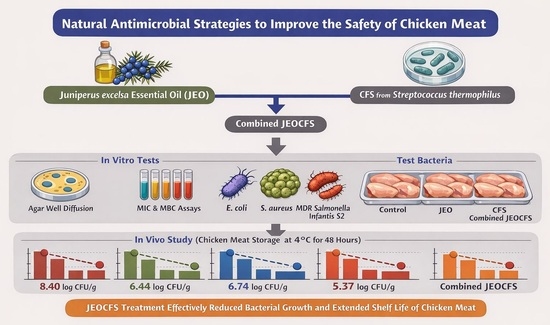
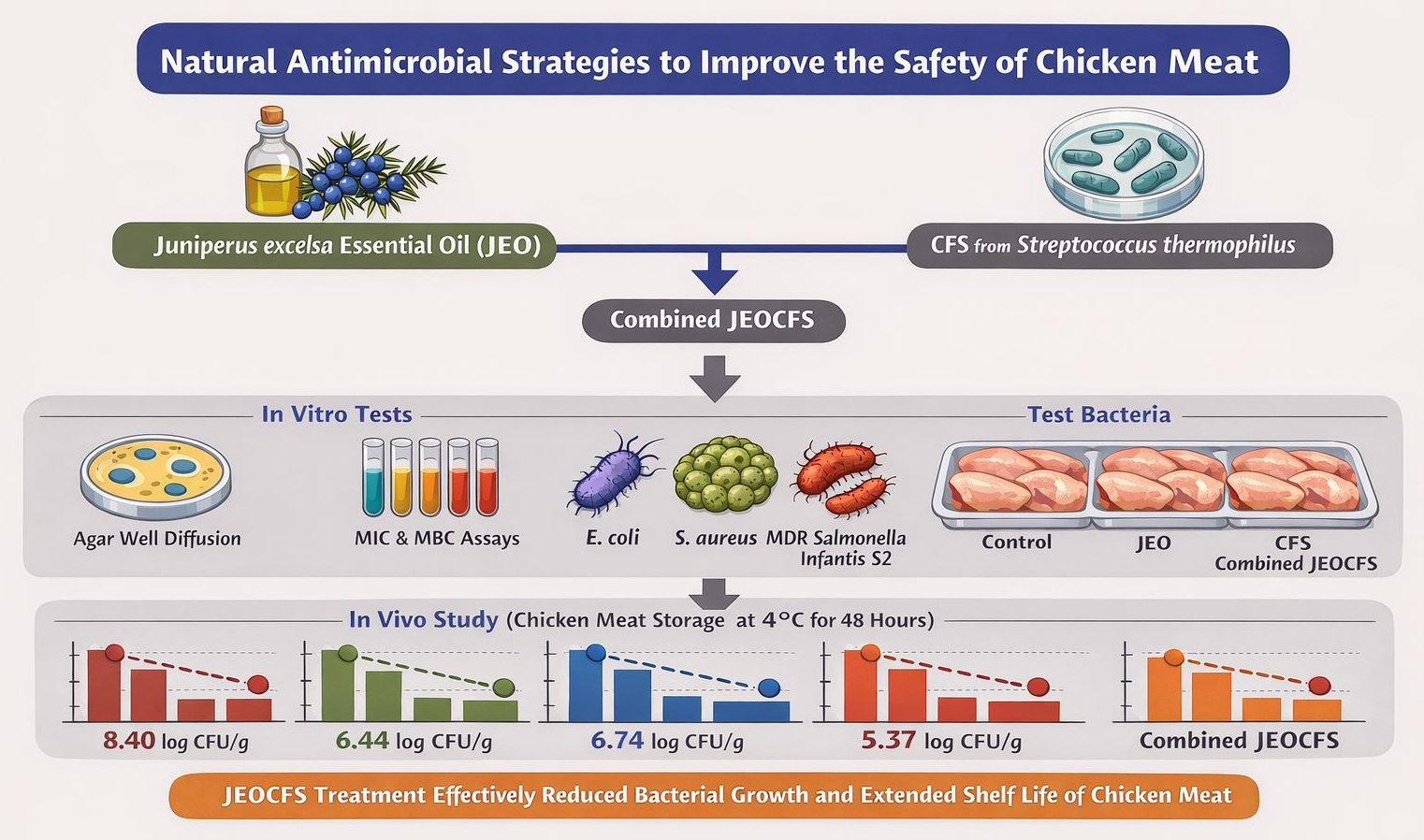
The objective of this study was to evaluate the individual and synergistic antimicrobial efficacy of Juniperus excelsa berry essential oil (JEO) and the cell-free supernatant (CFS) from Streptococcus thermophilus against Escherichia coli (ATCC 43888), Staphylococcus aureus (ATCC 25923), and multidrug-resistant Salmonella enterica serovar Infantis S2 isolated from chicken meat. In vitro antimicrobial effects were assessed using the agar well diffusion and microdilution methods (MIC and MBC assays). The in vivo antimicrobial effect of these natural bioactive substances in controlling microbial growth in chicken meat stored at 4 °C for 48 h was also evaluated. Bioactive components of JEO were determined via GC–MS, identifying alpha-pinene (84.56%) as the primary compound. In vitro assays revealed that JEO showed high antimicrobial activity against Gram-positive S. aureus with a zone diameter of 35.50 mm (p < 0.05). JEOCFS treatment, which is the combination of CFS and JEO, demonstrated a significant synergistic interaction against S. aureus, resulting in an MIC value of 25 mg/mL. CFS alone exerted a measurable inhibitory effect on S. aureus, with an MIC of 50 mg/mL, indicating its potential antimicrobial capability. Further evaluation of the in vivo antimicrobial efficacy using chicken meat stored at 4 °C revealed that the JEOCFS treatment significantly inhibited microbial growth (p < 0.05). After 48 h of storage under refrigerated conditions, the number of psychrophilic bacteria in the control group reached 8.40 log cfu/g, while it remained significantly lower at 6.44, 5.37, and 6.74 log cfu/g in the JEO, JEOCFS, and CFS treatments, respectively. These results indicate that the synergistic application of JEO and CFS effectively suppresses foodborne pathogens, particularly S. aureus, and extends the microbiological shelf life of refrigerated chicken meat.

Graphical Abstract

1. Introduction

Poultry products, especially chicken meat and eggs, are highly valued due to their nutritional content and significant impact on the food market [1,2]. Therefore, chicken meat is among the most widely consumed animal protein sources worldwide. It is considered a healthy and more economical alternative to red meat owing to its nutritional composition, high-quality protein content, and relatively low fat level [3,4]. Nevertheless, nutrients such as protein, free amino acids, lipids, and moisture in chicken meat provide an optimal environment for bacteria that grow and survive throughout processing, storage, and consumption [4,5]. They can be easily cross-contaminated with both pathogenic and spoilage microorganisms at various points along the food production chain, including slaughtering, processing, distribution, and handling [6,7]. Among these microorganisms, foodborne pathogens such as Escherichia coli O157:H7 and Salmonella spp.; Klebsiella pneumoniae and Campylobacter spp.; Listeria monocytogenes; and Staphylococcus aureus are particularly important, as they contribute not only to meat spoilage but also to serious foodborne illnesses and death [4,7,8]. Eating chicken that has been contaminated with these pathogens, especially if it is not cooked properly or processed correctly, poses a significant risk to public health [9]. Recently, campylobacteriosis and salmonellosis have been identified as the most frequently reported foodborne gastrointestinal infections in humans across Europe (European Food Safety Authority and European Centre for Disease Prevention and Control, 2022; EFSA, 2023) [10]. According to the World Health Organization (WHO, 2015), infections caused by foodborne pathogens have become a global public health concern and remain among the leading causes of mortality worldwide. Owing to its high water activity and low levels of endogenous enzymes, antioxidants, and antimicrobial compounds, chicken meat represents a highly perishable food matrix [11,12]. These oxidative processes, combined with microbial contamination, not only lead to toxic amino acid byproducts that reduce meat quality but also reduce the shelf life of chicken meat by approximately three days under ideal conditions [12,13,14]. Therefore, the meat industry has focused on developing strategies to maintain product freshness and extend shelf life [14]. To address these challenges, the meat industry has increasingly focused on developing preservation strategies aimed at maintaining product freshness and extending storage stability. Nevertheless, growing concerns regarding the emergence of antibiotic-resistant bacteria, the potential adverse effects of synthetic preservatives on food safety and human health, and the increasing demand for clean-label products have collectively driven interest toward natural antimicrobial alternatives [15]. In this regard, plant-derived bioactive compounds, particularly essential oils and postbiotics produced by lactic acid bacteria, such as cell-free supernatants (CFSs) and bioactive peptides, have gained recognition as promising biopreservative agents due to their safety, efficacy, and strong consumer acceptance [16,17].
CFSs produced by lactic acid bacteria (LAB) have recently attracted considerable attention as effective biopreservative agents owing to their wide spectrum of bioactive constituents. These compounds can be utilized in various forms, including cell-free supernatants, crude extracts, or partially purified fractions. The cell-free supernatant (CFS) of LAB contains a complex mixture of metabolites such as bacteriocins, bioactive peptides, enzymes, organic acids, short-chain fatty acids, teichoic acids, exopolysaccharides, and other structural derivatives of microbial cell walls, all of which contribute to its antimicrobial and preservative potential [18]. Among lactic acid bacteria (LAB), Streptococcus thermophilus is classified as a Generally Recognized as Safe (GRAS) and Qualified Presumption of Safety (QPS) species. It is extensively employed as a starter culture in the production of fermented dairy products due to its rapid acidification capacity and synergistic interactions with other LAB strains [19,20]. In addition to its well-established technological importance, S. thermophilus demonstrates several functional properties, including immunomodulatory, antibacterial, antioxidant, and anti-inflammatory activities. Moreover, it synthesizes various bioactive metabolites such as exopolysaccharides and thermophilins that contribute to improved product quality and exert inhibitory effects against foodborne pathogens, notably Listeria monocytogenes and Staphylococcus aureus [21,22,23,24]. Therefore, CFSs derived from S. thermophilus have attracted increasing interest as natural preservative agents in food systems, offering a safe and effective means of controlling microbial contamination while enhancing product quality and shelf life.
Juniperus spp., belonging to the Cupressaceae family, are characteristic components of the Mediterranean maquis ecosystem. Among these, Juniperus communis, J. oxycedrus, and J. excelsa are the most prevalent and have long been utilized in traditional medicine to treat a wide range inflammatory and infectious diseases [25]. Recently, increasing scientific interest has focused on Juniperus species due to their diverse phytochemical composition and broad spectrum of biological activities. Essential oils and extracts derived from these plants possess significant antioxidant, antibacterial, and anti-inflammatory activities, making them potential candidates for natural preservatives and bioactive agents for food quality and safety [26,27,28,29,30]. While other Juniperus species have been extensively documented in the literature, research on the bioactive potential of J. excelsa remains relatively limited. Therefore, this study specifically selected J. excelsa to address this knowledge gap. Our research focuses on evaluating the antimicrobial efficacy of J. excelsa both as an individual agent and through its synergistic interaction with lactic acid bacteria metabolites. It is hypothesized that the distinct phytochemical profile of J. excelsa not only provides potent standalone inhibition but also establishes an enhanced synergy with CFS from LAB strains. By distinguishing between these individual and combined effects, this study aims to position J. excelsa as a superior and versatile candidate for advanced bio-preservation strategies in poultry products. To develop a strong biological protection strategy for poultry meat, this study used a synergistic blend of JEO and S. thermophilus CFS targeting multiple physiological pathways in pathogens through the metabolic acidification of the CFS supernatant and the membrane-disrupting action of alpha-pinene. Therefore, the current study aimed to evaluate the in vitro antimicrobial potential of Juniperus excelsa essential oil (JEO) and cell-free supernatant (CFS) from S. thermophilus against foodborne pathogenic microorganisms, both individually and synergistically. Furthermore, we aimed to evaluate the in vivo antimicrobial effect of these natural bioactive substances in controlling microbial growth in chicken meat stored at 4 °C for 48 h.

2. Materials and Methods

2.1. Juniperus Berry Essential Oil and Bacterial Strains

Juniper berry essential oil (JEO), which is suitable for human consumption, was provided by BIOMESI company in Adana, Türkiye. Streptococcus thermophilus NCFB2392 was obtained from the laboratory stock culture of the Sütçü İmam University, Kahraman Maraş, Türkiye. In our previous study, the multidrug-resistant (MDR) Salmonella enterica serovar Infantis S2 strain, isolated from chicken meat and characterized by both phenotypic profiling and genomic validation [31], was obtained from laboratory stock cultures of the Department of Food Hygiene and Technology, Faculty of Veterinary Medicine, Cukurova University. This isolate was confirmed to exhibit multidrug resistance (MDR) based on antimicrobial susceptibility testing. Molecular screening further identified the presence of the blaTEM-1, aadA1, aphA1-IAB, and sul1 genes, which are associated with resistance to ampicillin, aminoglycosides, and trimethoprim–sulfamethoxazole, respectively. The other two pathogenic bacteria used in the present work, Escherichia coli (ATCC 43888) and S. aureus (ATCC 25923), were obtained from the American Type Culture Collection (ATCC) in Rockville, MD, USA.

2.2. Determination of Bioactive Compounds of the Juniper Berry Essential Oil

The bioactive components of juniper berry essential oil (JEO) were analyzed using gas chromatography–mass spectrometry (GC-MS) (Clarus 500, PerkinElmer, Waltham, MA, USA) equipped with a silica capillary SGE column (BPX5, 60 m × 0.25 mm i.d.; 0.25 µm film thickness; PerkinElmer, Shelton, CT, USA). The GC-MS analysis was performed as a qualitative and semi-quantitative chemical profiling of the essential oil using helium as the carrier gas and at a flow rate of 1.5 mL/min. The oven temperature was initially maintained at 60 °C for 10 min and then increased to 250 °C and maintained at this temperature for 10 min. A 1 μL sample was injected in split mode with the injector temperature set to 220 °C. MS spectra were recorded at 70 eV (m/z 35–425). The ion source and interface temperatures were set at 200 °C and 250 °C, respectively. The relative percentage of the volatile compound of sage oil was calculated from GC-FID peak areas, and compounds were identified by WILEY-MS libraries, or those reported in the literature were used.

2.3. Preparation of Cell-Free Supernatant from S. thermophilus

The cell-free supernatant (CFS) was prepared according the method described by Kuley et al. (2024) [24], with slight modifications. S. thermophilus was cultured in M17 medium (56156, Sigma-Aldrich Chemie GmbH, Steinheim, Germany) and incubated at 37 °C for 48 h. After incubation, the culture was transferred into Falcon tubes (15 mL) and centrifuged at 8000 rpm for 10 min at 4 °C using a centrifuge (Hettich 32R, Tuttlingen, Germany). CFS obtained from Streptococcus thermophilus was used in its unnaturalized (without pH adjustment) form to evaluate its total antimicrobial capacity. The collected supernatant was subsequently filtered and sterilized using a 0.2 μm pore-size membrane filter (Millipore) and stored at 4 °C until further analysis.

2.4. In Vitro Antimicrobial Activity

2.4.1. Agar Well Diffusion

The synergistic antimicrobial effects of JEO and CFS, both individually and in combination, against foodborne pathogens were compared using the agar well diffusion method described by Hwanhlem et al. [32]. Briefly, overnight incubated strains of S. aureus, E. coli, and the multidrug-resistant Salmonella enterica serovar Infantis S2 isolate were each adjusted to a concentration of 106 cfu/mL. Subsequently, each bacterial suspension was spread on Muller–Hinton Agar (MHA, Merck, Germany) plates. Using a sterile plastic cylinder, 5 mm diameter agar wells were created in the agar plate. Each well was filled with 100 µL of the different natural antimicrobial agents (CFS, JEO, and their combinations). Essential oils were emulsified in Tween 80 (0.1%, v/v). As a negative control, 100 µL of purified water, Tween 80, and Muller Hinton broth (MHB, Merck, Germany) was placed in the wells and allowed to diffuse for 30 min. The plates were then incubated at 37 °C for 24 h. After incubation, the inhibition zones around each well were measured and recorded.

2.4.2. Determination of MIC and MBC

The MIC values were determined using the Clinical and Laboratory Standards Institute’s (CLSI) methods (2008). CFS, JEO, and their combinations (1:1 v/v) were prepared as a stock solution (100 mg/mL), and 1 mL of this different antimicrobial agent was added into the first tube of a serial dilution series prepared with Mueller–Hinton Broth. For JEO solubilization, Tween 80 (0.1%, v/v) was used. Two-fold serial dilutions were performed to obtain final concentrations of 100, 50, 25, 12.5, 6.25, 3.12, 1.56, 0.78, 0.39, and 0.19 mg/mL. Subsequently, 1 mL of bacterial inoculum containing approximately 106 cfu/mL of each test bacteria was added to each tube. After incubation at 37 °C for 24 h, the MIC was recorded as the lowest concentration of the different antimicrobial agents that completely inhibited visible bacterial growth. Tubes containing MHB with bacterial suspension only served as positive controls, while tubes containing inoculum without MHB and Tween 80 were used as negative controls. To determine the MBC, 0.1 mL from each tube showing no visible growth in the MIC assay was spread onto Mueller–Hinton Agar (MHA) plates and incubated at 37 °C for 24 h.

2.5. In Vivo Antimicrobial Activity

2.5.1. Preparation of Chicken Sample

Fresh chicken breasts were purchased from a local supermarket in Adana, Türkiye, and transferred to the laboratory within 30 min under cold chain conditions. The samples were divided into four treatment groups. The control group (C) consisted of distilled water containing no bioactive compounds, while the two treatment groups contained either cell-free supernatant (CFS) or juniper essential oil (JEO) separately. To evaluate the potential synergistic effects, a fourth group was prepared by mixing CFS and JEO at an equal volume ratio (1:1 v/v). Both CFS and JEO were prepared as stock solutions in distilled water at a concentration of 100 mg/mL. Each chicken sample was placed in a sterile container, and the respective stock solution was added at a 5% (w/v) ratio. Then, each chicken sample was inoculated with S. aureus at a rate of 1% (108 cfu/mL). The mixtures were homogenized using a sterile spatula and stored at 4 °C for 48 h for further analysis. For every treatment group and storage day, all measurements were carried out in triplicate.

2.5.2. Total Viable Count

Microbiological analyses were performed in duplicate in all experimental and control groups. The total mesophilic and psychrophilic bacterial counts were carried out using the surface plating method described by ICMSF [33]. For each analysis, 10 g of chicken meat was aseptically transferred to 90 mL of Ringer’s solution and homogenized for 2 min using a stomacher (Masticator Nr S18/420, IUL Instruments, Barcelona, Spain). Then, 0.1 mL aliquots of each dilution were taken and spread on Plate Count Agar (Fluka 70152, Steinheim, Switzerland) in triplicate. To determine mesophilic bacterial counts, the plates were incubated at 30 °C for 48 h, and to determine psychrophilic viable bacterial counts, plates were incubated at 5 °C for 10 days.

2.5.3. Time-Killing Assay on S. aureus

The in vivo antibacterial activity of Juniperus excelsa essential oil (JEO) and cell-free supernatant (CFS) against Staphylococcus aureus was evaluated using time-kill tests at 0, 6, 24, and 48 h. For each test, 10 g of chicken meat from each chicken sample previously contaminated with 1% (108 cfu/mL) S. aureus and stored at 4 °C was aseptically transferred to 90 mL of Ringer’s solution and homogenized for 2 min using a stomacher (Masticator Nr S18/420, IUL Instruments, Barcelona, Spain). At each sampling interval, 0.1 mL of serially diluted homogenate was plated onto Baird-Parker Agar supplemented with Egg Yolk Telluride. Plates were incubated at 30 °C for 48 h. After incubation, S. aureus colonies were counted for the time-kill curve of the assay. The bactericidal and synergistic effects of the treatments were evaluated.

2.6. Statistical Analysis

All measurements were performed in triplicate for each treatment group and storage day. The obtained data were expressed as mean ± standard deviation (SD). Statistical analyses were conducted using SPSS software version 18.0 (SPSS Inc.; Chicago, IL, USA). One-way analysis of variance (ANOVA) and Duncan’s multiple range test were applied to determine significant differences among groups, and correlation variations were also evaluated where applicable. Statistical significance was considered at p < 0.05.

3. Results

3.1. Determination of Bioactive Compounds of the Juniper Berry Essential Oil

Determining the qualitative and quantitative bioactive compounds of juniper berry essential oils (JEOs) is crucial due to their antimicrobial potential. Changes in the chemical composition of JEOs will affect their biological activity. Table 1 displays the bioactive components of JEO, as determined by GC/MS. The main component detected in JEO was alpha-pinene, accounting for 84.56%, while other compounds were present at lower concentrations.

3.2. In Vitro Antimicrobial Activity

3.2.1. Agar Well Diffusion

The findings obtained by the well diffusion method against foodborne bacteria including S. aureus, E. coli, and S. Infantis S2 are presented in Table 2. JEO showed high antimicrobial activity against Gram-positive S. aureus and E. coli with zone diameters of 35.50 mm and 15.50 mm (p < 0.05), respectively. It was observed that CFS and JEOCFS did not show inhibitory effects on Gram-negative E. coli or MDR Salmonella Infantis isolates. However, JEOCFS, a combination of CFS and JOE, was found to have lower antimicrobial activity against the same bacteria with a zone diameter of 12 mm.

3.2.2. Determination of MIC and MBC

The individual and combined synergistic antimicrobial effects of CFS and JEO against selected foodborne pathogenic bacteria were determined based on the minimum inhibitory concentration (MIC) and minimum bactericidal concentration (MBC) values presented in Table 3. Among all the bacteria tested, S. aureus had the highest sensitivity compared to the other two bacteria, with MIC values of 12.5 mg/mL, due to the lower JEO concentration requirement. Bactericidal activity was also observed against S. aureus with an MBC value of 12.5 mg/mL for JEO. The bacteriostatic and bactericidal concentration of the individual and combined JEO and CFS was 100 mg/mL for E. coli and S. Infantis.

3.3. In Vivo Antimicrobial Activity

3.3.1. Total Viable Count (TVC)

The total aerobic mesophilic bacteria count results obtained to determine the antimicrobial activity of these natural bioactive substances in controlling microbial growth in chicken meat stored at 4 °C for 48 h are presented in Figure 1. At the beginning of storage (0 h), the initial bacterial load ranged between 5.4 and 6.5 log CFU/g across all groups, with no statistically significant difference among the treatments (p > 0.05). The control group showed a continuous and significant increase from 6.5 log CFU/g at 0 h to 9.9 log CFU/g at 48 h, exceeding the generally accepted microbial limit of 7 log CFU/g after 24 h of storage (p < 0.05). In contrast, the JEO- and CFS-treated groups exhibited slower bacterial growth, reaching 7.1 and 8.2 log CFU/g, respectively, at the end of storage.
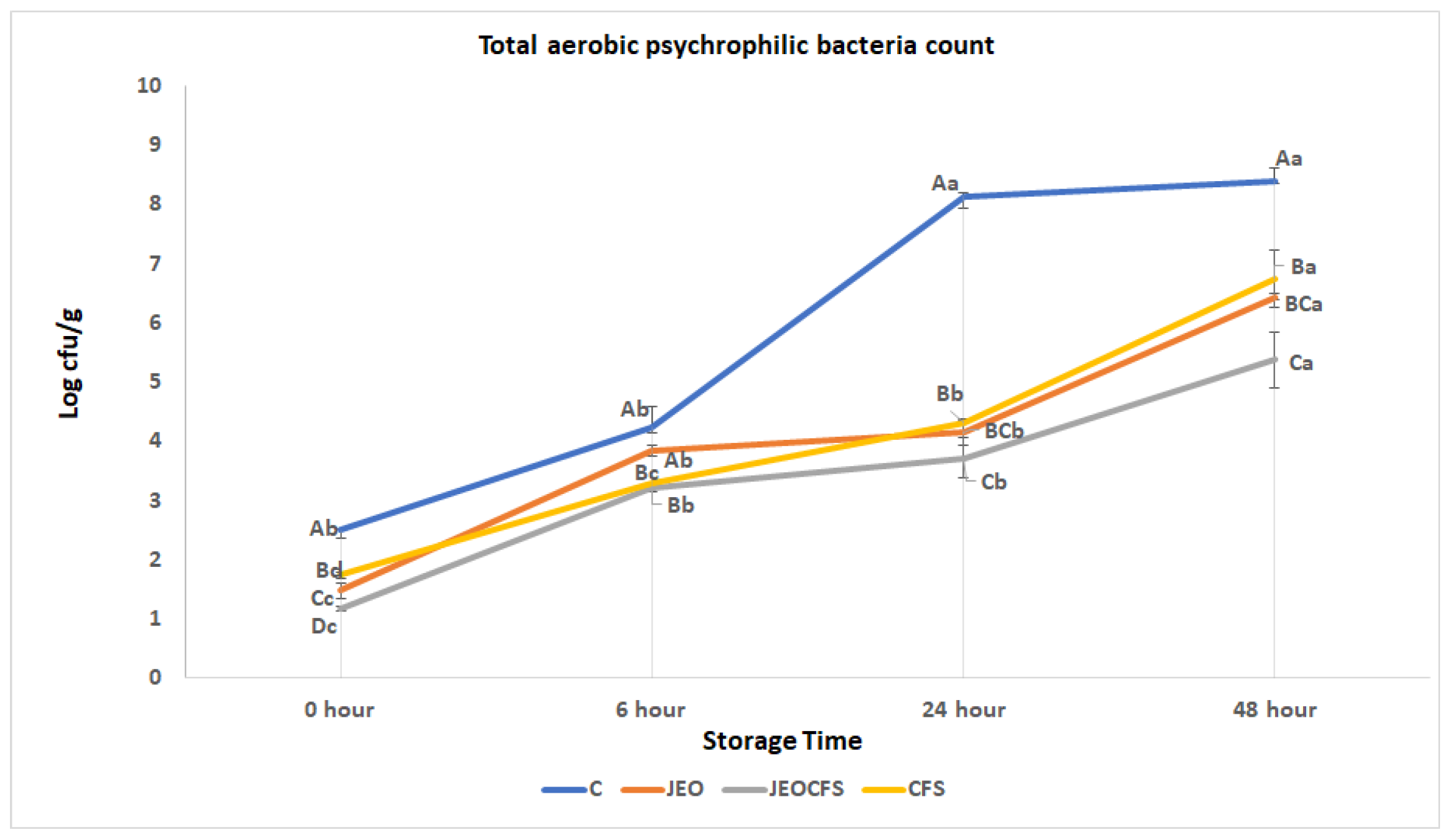
The results of total aerobic psychrophilic bacterial counts, used to evaluate the antibacterial efficacy of natural antimicrobial agents in controlling microbial growth in chicken meat stored at 4 °C for 48 h, are presented in Figure 2. At the beginning of storage, the total psychrophilic bacterial count in the control samples was 2.49 log CFU/g, whereas the initial counts in the JEO-, JEOCFS-, and CFS-treated groups were approximately 1.48, 1.18, and 1.74 log CFU/g, respectively. After 48 h of storage, the psychrophilic bacterial population in the control group increased significantly to 8.40 log CFU/g (p < 0.05). In contrast, the bacterial counts in the JEO, JEOCFS, and CFS groups remained significantly lower, reaching 6.44, 5.37, and 6.74 log CFU/g, respectively (p < 0.05).

3.3.2. Time-Killing Assay on S. aureus

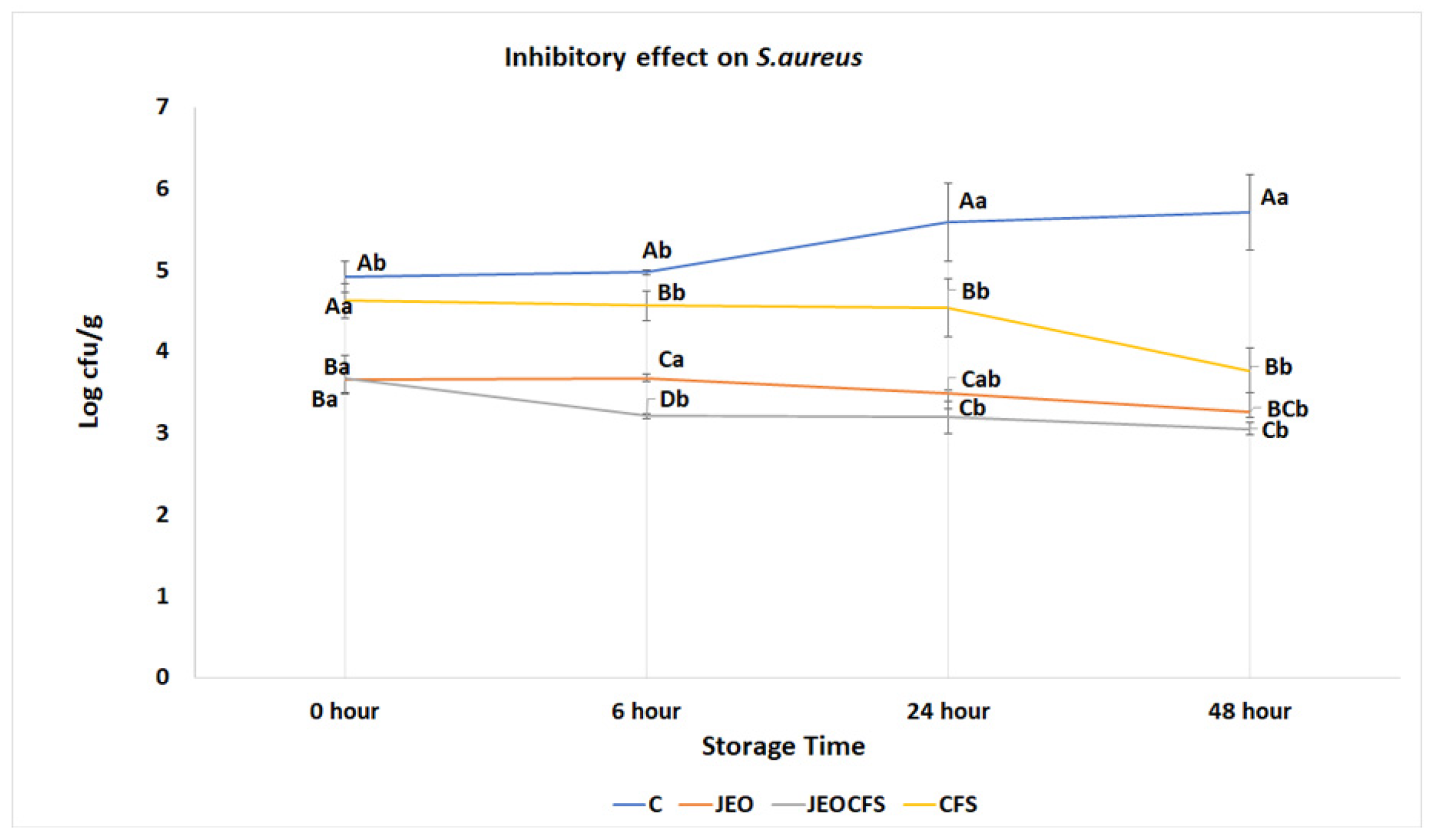
Changes in the viable count of Staphylococcus aureus during 48 h of storage at 4 °C are presented in Figure 3. In the control group, the initial bacterial load, which was 4.93 log cfu/g at 0 h, gradually increased throughout storage, reaching 5.59 log cfu/g at 24 h and 5.71 log cfu/g at 48 h. This represents a significant increase of approximately 1 log cfu/g (p < 0.05). In contrast, all treatments containing natural antimicrobial agents effectively suppressed S. aureus growth to varying degrees. Importantly, the combination of J. excelsa essential oil (JEO) and cell-free supernatant (CFS) from S. thermophilus (JEO + CFS) exhibited a significant inhibitory effect starting from the 6th hour of storage, maintaining bacterial populations below 3.06 log cfu/g at 48 h. In individual applications, both JEO and CFS limited bacterial growth compared to the control. However, compared to CFS, JEO achieved a greater reduction over time, reaching 3.26 log cfu/g.

4. Discussion

4.1. Determination of Bioactive Compounds of the Juniper Berry Essential Oil

Similar to our findings, Sela et al. [34] reported that the main bioactive compound in the essential oil obtained from Juniperus excelsa berry was α-pinene (70.81%), while the main bioactive compound in the essential oil obtained from its leaves was α-pinene (33.83%). Bioactive compounds with antimicrobial potential, such as benzene 1,2,4,5-tetramethyl and cyclopropane cyclopentane, were identified in J. excelsa extracts via gas chromatography–mass spectrometry (GC-MS) analysis [35]. A comprehensive biochemical profile including around 30 biochemical components has been documented in juniper berry essential oils, with monoterpenes identified as the predominant category (67.23–85.21%) [36]. The principal constituents also identified in these biochemical components were α-pinene (15.46–35.53%), sabinene (21.66–37.31%), β-myrcene (2.94–19.30%), and D-limonene (3.13–5.60%). Consistent with these findings, α-pinene (51.85%) and limonene (25.1%) were identified as the primary components of juniper berry essential oil, while various other compounds were also detected in lower concentrations [37].

4.2. In Vitro Antimicrobial Activity

4.2.1. Agar Well Diffusion

S. aureus was observed to be more resistant to CFSs. JEO was found to have statistically lower effects on Gram-negative E. coli and multidrug-resistant S. Infantis. In general, Gram-negative bacteria are less susceptible to antimicrobials due to the complex structure of their cell walls [38]; such a trend was observed in the present study. Bajac et al. [36] investigated the antibacterial effects of juniper berry (Juniperus communis L.) essential oil obtained by traditional hydro-distillation and microwave-assisted hydro-distillation (MWHD) methods on S. aureus, B. cereus, and K. pneumoniae. They showed that juniper berry essential oils obtained by hydro-distillation and different microwave conditions (MWHD 200 w, 400 w, 600 w, 600 w) exhibited inhibition diameters of 14.5, 16.0, 12.33, 11.5, and 11 mm on S. aureus bacteria, respectively. The antimicrobial efficacy of Juniperus excelsa extracts was demonstrated against standard bacterial strains, including Staphylococcus aureus (PTCC 1430), Bacillus cereus (PTCC 1431), Listeria monocytogenes (PTCC 1298), Escherichia coli (PTCC 1399), and Shigella dysenteriae (PTCC 1188), showing results parallel to our findings [35]. While these extracts exhibited significant activity against Gram-positive bacteria, no substantial inhibitory effect was observed against certain other Gram-positive and Gram-negative strains in that study. In our previous study, it was determined that CFS obtained from S. thermophilus showed inhibition zone values of 15.25, 7.33, 17.33, and 13.50 mm in Gram-negative Proteus mirabilis, Photobacterium damselae, Vibrio vulnificus, and Salmonella Paratyphi A, respectively, while the zone diameters in Gram-positive Enterococcus faecalis and S. aureus were 14.00 and 13.25 mm [24]. The antimicrobial potential of CFS derived from various lactic acid bacteria has been widely documented, supporting the inhibitory effects observed with S. thermophilus CFS in the present study. CFS obtained from Lactobacillus acidophilus, Pediococcus pentosaceus, and Lactiplantibacillus plantarum was found to exert a time-dependent inhibitory effect on the growth of pathogenic E. coli [39]. Similarly, significant antimicrobial activity against Micrococcus luteus, characterized by an inhibition zone of 13.5 mm, was reported for the CFS of Streptococcus macedonicus [40]. Furthermore, the potent bioactivity of CFS from Lactobacillus reuteri ATCC55730 and Lactobacillus plantarum FI8595 has been demonstrated against major foodborne pathogens, most notably S. aureus and Enterococcus faecalis [41]. Comprehensively, these findings reinforce the role of postbiotic metabolites as effective natural agents for controlling spoilage and pathogenic microorganisms in food systems.

4.2.2. Determination of MIC and MBC

S. aureus displayed lower MIC and MBC, in contrast to E. coli and S. infantis. Gram-negative bacteria have a much thinner peptidoglycan layer that is shielded by an outer membrane, limiting the permeability of antimicrobial agents, whereas Gram-positive bacteria have a thick and externally exposed layer [42]. This explains why Gram-positive S. aureus has lower bacteriostatic and bactericidal concentrations against these antimicrobial agents than Gram-negative Salmonella and E. coli. JEOCFS treatment, which is the combination of CFS and JEO, revealed a notable synergistic interaction against S. aureus. According to a recent study by Shahin et al. [43], J. excelsa essential oil was found to exhibit MIC values of 50.00 and 6.25 mg/mL against antibiotic-resistant E. coli CMUL 096 and Brucella melitensis CMUL 057, respectively. However, no measurable inhibitory activity was observed against E. coli CMUL 260, Salmonella spp. CMUL 216, Listeria monocytogenes AL 004, or Pseudomonas aeruginosa CMUL 122. Sela et al. [34] found that the essential oil from J. excelsa leaves has MIC values of 125 µL/mL against S. aureus, Streptococcus pyogenes, and Haemophilus influenzae. The MIC and MBC values of J. excelsa methanol and acetone extracts against S. aureus were found to be 125 mg/mL and 250 mg/mL, respectively [35]. The MIC values of both acetone and methanol extracts of Juniperus macropoda were reported to be in the range of 0.078–2.5 mg/mL (methanol) and 0.156–2.5 mg/mL (acetone) against four tested bacteria (Bacillus cereus BCS1, Streptococcus mutans MTCC 890, Pseudomonas putida d75, and Escherichia coli MTCC 443) and one fungus (Candida albicans MTCC 227) by Rana et al. [44]. Consistent with our results, Fotiadou et al. [45] reported that essential oils extracted from the cones of the studied Greek juniper species exhibited stronger antibacterial activity compared to those from the leaves, particularly against Gram-positive Staphylococcus and Streptococcus strains. Specifically, essential oils extracted from the cones of J. foetidissima, J. communis, and J. turbinata exhibited stronger activity. Furthermore, their findings also indicated that essential oils extracted from the cones exhibited better antifungal activity than those extracted from the leaves.
CFS alone exerted a measurable inhibitory effect on S. aures, with an MIC of 50 mg/mL, supporting its potential antimicrobial capability (Table 3). This inhibitory activity was largely attributed to organic acids (including lactic and acetic acids), long-chain fatty acids and their esters, and bioactive proteinaceous compounds in the CFS. The presence of these metabolites may explain the individual antimicrobial activity of CFS. The MIC value of all applied antimicrobial agents, including JEO, CFS, and JEOCFS, on Gram-negative E. coli and MDR Salmonella Infantis S2 was found to be 100 mg/mL. Their bacteriostatic activity concentration on the same two bacteria was also found to be 100 mg/mL. Consistent with this study, our previous study found that CFS obtained from Streptococcus thermophilus had MIC values ranging from 12.5 to 100 mg/mL on foodborne pathogenic bacteria, including Gram-negative Proteus mirabilis, Photobacterium damselae, Vibrio vulnificus, and Salmonella Paratyphi A and Gram-positive S. aureus and Enterococcus faecalis. The most sensitive bacteria were P. mirabilis and V. vulnificus, with MIC values of 25 and 12.5 mg/mL [24]. Kuley et al. [46] also reported that CFS obtained from L. plantarum exhibited an MIC of 50 mg/mL against fish spoilage bacteria in their study.

4.3. In Vivo Antimicrobial Activity

4.3.1. Total Viable Count

Total viable count (TVC) analysis was performed to determine the antimicrobial activity of natural bioactive substances such as JEO, CFS, and JEOCFS, which controlled microbial growth in chicken meat stored at 4 °C for 48 h. In this context, changes in total mesophilic and psychrophilic bacterial counts were examined in detail, and a microbial storage test was performed. TVC is considered a critical parameter in assessing the microbiological quality and acceptability of food products. For poultry meat, the upper microbiological limit maintaining freshness and good quality has been defined as 7 log CFU/g by the International Commission on Microbiological Specifications for Foods [33,47]. In several studies, this threshold has been used as a microbiological acceptability criterion, where reaching a total viable count of 7 log CFU/g is regarded as an indicator of spoilage [4,48]. During storage, a progressive increase in mesophilic and psychrophilic bacterial counts was observed in all groups; however, the rate of increase varied significantly depending on the treatment applied. Particularly, the combined JEOCFS treatment demonstrated the strongest antibacterial effect, maintaining the lowest mesophilic bacterial load (approximately 6.0 log CFU/g) throughout the 48 h period. Moreover, although the total aerobic psychrophilic bacterial counts in control samples exceeded the generally accepted microbiological limit of 7 log CFU/g after 24 h of storage, all treated samples remained below this threshold even after 48 h. The juniper essential oil’s alpha-terpineol and other minor chemicals, as well as the organic acids and other bioactive substances present in CFS, may be responsible for this inhibitory effect on bacterial growth. These findings indicate that the application of JEO and CFS, particularly in combination, significantly inhibited mesophilic and psychrophilic bacterial growth (p < 0.05) and effectively extended the microbiological shelf life of chicken meat during refrigerated storage.
Vasilijević et al. [49] reported that Juniperus communis and Satureja montana essential oils exhibited strong in vitro and in situ inhibitory activity against Listeria monocytogenes and common meat-associated bacteria. The observed MIC, ranging from 0.5% to 1%, and the synergistic interactions detected through checkerboard and time-kill assays demonstrated that the antimicrobial efficacy of essential oils can be significantly enhanced when used in combination. Furthermore, the reduction in microbial counts observed in red wine-marinated beef indicated that essential oil-based marinades could effectively suppress both pathogenic and spoilage bacteria during storage, thereby contributing to the extension of meat shelf life. In line with the findings of our study, these results further support the growing evidence that plant-derived bioactive compounds, particularly essential oils such as J. communis and S. montana, represent promising natural alternatives to synthetic preservatives for improving the microbiological safety and quality of meat products. Similarly, recent studies have highlighted the effectiveness of combining natural antimicrobial compounds with new preservation technologies to improve the microbial stability of poultry meat. In a study conducted by Fabio et al. [4], the synergistic use of supercritical carbon dioxide with essential oils and their main terpenes (limonene and linalool) effectively extended the shelf life of chicken breast meat. The combined treatments significantly reduced both Gram-positive (Listeria innocua, Enterococcus faecium) and Gram-negative bacteria (Escherichia coli, Pseudomonas fluorescens), achieving reductions of up to 3.18 log CFU/g, depending on the microorganism and compound used. Furthermore, in their study, the mesophilic bacterial load of processed samples remained below the critical threshold of 7 log CFU/g after 9 days of refrigerated storage, demonstrating extended microbial stability.
These findings support the growing evidence that natural bioactive molecules, particularly essential oil components, can exhibit potent synergistic antimicrobial effects when combined with other preservation technologies. Consistent with our study, the combined use of J. excelsa essential oil and Streptococcus thermophilus CFS demonstrated a similar synergistic pattern in suppressing microbial growth in chicken meat stored at 4 °C. This antimicrobial activity may be due to the combined presence of major and minor compounds such as alpha-pinene in juniper essential oil and organic acids and their esters in CFS. This finding further supports the potential of natural antimicrobials, either alone or in combination with improved processing methods, as promising alternatives to synthetic preservatives in the poultry industry.

4.3.2. Time-Killing Assay on S. aureus

Bacterial growth was restricted primarily by JEO, in comparison to the control group. These findings clearly demonstrate a synergistic interaction between JEO and CFS, which enhances antibacterial activity. The antibacterial mechanism is the juniper essential oil causing the irreversible damage to the cell wall and membrane, leading to the leakage of proteins [50]. The bacterial cell wall and cell membrane were also damaged by CFS obtained from LAB, which caused the bacteria to distort and dissolve [51]. These findings may explain why the antimicrobial effect is strong with both bioactive combinations.
Consumer meat consumption preferences are expected to change significantly, with chicken expected to overtake pork as the most widely consumed meat worldwide [50]. This is attributed to multiple interrelated factors, including climate change mitigation efforts, the adoption of more ethical livestock production systems, and the pursuit of sustainable economic growth [52]. Consequently, extending the shelf life and ensuring the microbial safety of poultry products have emerged as critical goals in the advancement of modern food technology. In this context, the current study investigated natural antimicrobial strategies as a sustainable and effective approach to improving the safety and quality of chicken meat. In the time-kill experiment reported by Vasilijević et al. [49], the essential oils of J. communis and S. montana, applied individually or in combination, exhibited varying degrees of bactericidal activity against Listeria monocytogenes ATCC19111. The bacterial load in the control group increased markedly from approximately 5.11 log CFU/mL at the beginning (0 h) to 9.19 log CFU/mL after 24 h of incubation, indicating active bacterial proliferation in the absence of treatment. In contrast, the bacterial counts were significantly reduced in the treated groups, reaching 6.42 log CFU/mL in the 0.094% J. communis treatment and 5.81 log CFU/mL in the S. montana treatment. This substantial reduction suggests a strong inhibitory effect of both essential oils, with S. montana showing slightly greater bactericidal activity under the tested conditions.

5. Conclusions

The present study demonstrated that JEO and the CFS of Streptococcus thermophilus, applied individually or in combination, exerted inhibitory effects against the bacterial strains evaluated under the experimental conditions of this study. This result is particularly significant given the growing global concern about MDR Salmonella strains, which pose a significant threat to public health throughout the food chain. In particular, the in vivo chicken meat model confirmed the effectiveness of these treatments in reducing the growth of Staphylococcus aureus during refrigerated storage. These findings indicate the potential of JEO and CFS as natural antimicrobial interventions for improving the microbiological quality of poultry products. The observed antimicrobial activity supports the potential of JEO and CFS derived from S. thermophilus as promising natural alternatives to synthetic preservatives. Furthermore, such natural antimicrobial strategies may contribute to sustainable food preservation approaches that maintain product safety and quality while reducing reliance on chemical additives. However, future research is required to perform multi-strain validation, elucidate the specific mechanisms of synergy, and evaluate the sensory profiles, nutritional stability, and textural impacts on treated chicken meat to ensure practical feasibility in the food industry.

Author Contributions

H.Y.—conceptualization, data curation, formal analysis, investigation, methodology, project administration, supervision, writing—original draft, writing—review and editing. N.G.—investigation, methodology, validation. T.G.G.—investigation, methodology, validation, re-view and editing. E.K.—methodology, data curation, review and editing. N.S.U.—methodology. All authors have read and agreed to the published version of the manuscript.

Funding

This research was financially supported by the Scientific Research Projects Unit of Adana Çukurova University, project numbers TSA-2024-1654 (ADEP) and TSA-2025-16734.

Institutional Review Board Statement

Not applicable.

Informed Consent Statement

Not applicable.

Data Availability Statement

The datasets used are available from the corresponding author upon reasonable request.

Acknowledgments

This research was financially supported by the Scientific Research Projects Unit of Adana Çukurova University, project numbers TSA-2024-1654 (ADEP) and TSA-2025-16734. The authors would like to thank the Scientific Research Projects Unit for their support.

Conflicts of Interest

The authors declare that this research was conducted in the absence of any commercial or financial relationships that could be construed as potential conflicts of interest.

References

  1. Cui, H.; Chen, X.; Aziz, T.; Mohamed, R.A.E.H.; Al-Asmari, F.; Alshammari, J.M.; Al-Joufi, F.A.; Shi, C.; Lin, L. Inactivation mechanisms of carvacrol on Salmonella typhimurium and its combined inhibitory effects with blue light-405 nm for chicken meat preservation. Int. J. Food Microbiol. 2025, 440, 111276. [Google Scholar] [CrossRef]
  2. Ma, M.; Zhao, J.; Yan, X.; Zeng, Z.; Wan, D.; Yu, P.; Xia, J.; Zhang, G.; Gong, D. Synergistic effects of monocaprin and carvacrol against Escherichia coli O157: H7 and Salmonella typhimurium in chicken meat preservation. Food Control 2022, 132, 108480. [Google Scholar] [CrossRef]
  3. Katiyo, W.; de Kock, H.L.; Coorey, R.; Buys, E.M. Sensory implications of chicken meat spoilage in relation to microbial and physicochemical characteristics during refrigerated storage. LWT 2020, 128, 109468. [Google Scholar] [CrossRef]
  4. Fabio, S.; Elisa, L.; Giulia, A.; Valerio, G.; Alessandro, Z.; Sara, S. Antimicrobial effect of essential oils and terpenes coupled with supercritical carbon dioxide for chicken meat preservation. LWT 2025, 215, 117270. [Google Scholar] [CrossRef]
  5. Roh, S.H.; Oh, Y.J.; Lee, S.Y.; Kang, J.H.; Min, S.C. Inactivation of Escherichia coli O157: H7, Salmonella, Listeria monocytogenes, and Tulane virus in processed chicken breast via atmospheric in-package cold plasma treatment. LWT 2020, 127, 109429. [Google Scholar] [CrossRef]
  6. Bantawa, K.; Rai, K.; Subba Limbu, D.; Khanal, H. Food-borne bacterial pathogens in marketed raw meat of Dharan, eastern Nepal. BMC Res. Notes 2018, 11, 618. [Google Scholar] [CrossRef]
  7. Yazgan, H.; Kuley, E.; Özogul, Y. Investigation of bioactive compounds and antimicrobial properties of aqueous garlic extracts on important food-borne zoonotic bacteria for food applications. Biomass Convers. Biorefin. 2024, 14, 16673–16680. [Google Scholar] [CrossRef]
  8. Li, S.; He, Y.; Mann, D.A.; Deng, X. Global spread of Salmonella Enteritidis via centralized sourcing and international trade of poultry breeding stocks. Nat. Commun. 2021, 12, 5109. [Google Scholar] [CrossRef]
  9. Duan, N.; Chang, B.; Zhang, H.; Wang, Z.; Wu, S. Salmonella typhimurium detection using a surface-enhanced Raman scattering-based aptasensor. Int. J. Food Microbiol. 2016, 218, 38–43. [Google Scholar] [CrossRef]
  10. EFSA; ECDC. The European Union one health 2022 zoonoses report. EFSA J. 2023, 21, e8442. [Google Scholar] [CrossRef] [PubMed]
  11. Awad, A.M.; Kumar, P.; Ismail-Fitry, M.R.; Jusoh, S.; Ab Aziz, M.F.; Sazili, A.Q. Overview of plant extracts as natural preservatives in meat. J. Food Process. Preserv. 2022, 46, e16796. [Google Scholar] [CrossRef]
  12. Zhu, Y.; Li, C.; Cui, H.; Lin, L. Plasma enhanced-nutmeg essential oil solid liposome treatment on the gelling and storage properties of pork meat batters. J. Food Eng. 2020, 266, 109696. [Google Scholar] [CrossRef]
  13. da N’obrega Santos, E.; Cesar de Albuquerque Sousa, T.; Cassiano de Santana Neto, D.; Brandão Grisi, C.V.; Cardoso da Silva Ferreira, V.; Pereira da Silva, F.A. Edible active film based on gelatin and malpighia emarginata waste extract to inhibit lipid and protein oxidation in beef patties. LWT 2022, 154, 112837. [Google Scholar] [CrossRef]
  14. Mehdizadeh, T.; Mojaddar Langroodi, A. Chitosan coatings incorporated with propolis extract and zataria multiflora boiss oil for active packaging of chicken breast meat. Int. J. Biol. Macromol. 2019, 141, 401–409. [Google Scholar] [CrossRef]
  15. Davidson, P.M.; Doan, C. Natamycin. In Antimicrobials in Food, 4th ed.; Michael Davidson, P., Matthew Taylor, T., David, J.R.D., Eds.; CRC Press: Boca Raton, FL, USA, 2020; pp. 339–356. [Google Scholar]
  16. Ramazanidoroh, F.; Hosseininezhad, M.; Shahrampour, D.; Wu, X. Edible packaging as a functional carrier of prebiotics, probiotics, and postbiotics to boost food safety, quality, and shelf life. Probiotics Antimicrob. Proteins 2024, 16, 1327–1347. [Google Scholar] [CrossRef]
  17. Sharma, H.; Fidan, H.; Özogul, F.; Rocha, J.M. Recent development in the preservation effect of lactic acid bacteria and essential oils on chicken and seafood products. Front. Microbiol. 2022, 13, 1092248. [Google Scholar] [CrossRef]
  18. Barros, C.P.; Guimarães, J.T.; Esmerino, E.A.; Duarte, M.C.K.; Silva, M.C.; Silva, R.; Ferreira, B.M.; Sant’aNa, A.S.; Freitas, M.Q.; Cruz, A.G. Paraprobiotics and postbiotics: Concepts and potential applications in dairy products. Curr. Opin. Food Sci. 2020, 32, 1–8. [Google Scholar] [CrossRef]
  19. Huang, Y.Y.; Lu, Y.H.; Liu, X.T.; Wu, W.T.; Li, W.Q.; Lai, S.Q.; Aadil, R.M.; Riaz Rajoka, M.S.; Wang, L.H.; Zeng, X.A. Metabolic properties, functional characteristics, and practical application of Streptococcus thermophilus. Food Rev. Int. 2023, 40, 792–813. [Google Scholar] [CrossRef]
  20. Martinović, A.; Cocuzzi, R.; Arioli, S.; Mora, D. Streptococcus thermophilus: To survive, or not to survive the gastrointestinal tract, that is the question! Nutrients 2020, 12, 2175. [Google Scholar] [CrossRef] [PubMed]
  21. Uriot, O.; Denis, S.; Junjua, M.; Roussel, Y.; Dary-Mourot, A.; Blanquet-Diot, S. Streptococcus thermophilus: From yogurt starter to a new promising probiotic candidate? J. Funct. Foods 2017, 37, 74–89. [Google Scholar] [CrossRef]
  22. Dargahi, N.; Johnson, J.C.; Apostolopoulos, V. Immune modulatory effects of probiotic Streptococcus thermophilus on human monocytes. Biologics 2021, 1, 396–415. [Google Scholar] [CrossRef]
  23. Xu, Y.Q.; Hu, J.S.; Liu, D.M.; Tang, J.; Liang, M.H.; Wu, J.J.; Xiong, J. Assessment of the safety and metabolism characteristics of Streptococcus thermophilus DMST-H2 based on complete genome and phenotype analysis. LWT 2023, 184, 114907. [Google Scholar] [CrossRef]
  24. Kuley, E.; Kazgan, N.; Sakarya, Y.; Balıkcı, E.; Ozogul, Y.; Yazgan, H.; Özyurt, G. Bioactivity of microencapsulated cell-free supernatant of Streptococcus thermophilus in combination with thyme extract on food-related bacteria. Foods 2024, 13, 329. [Google Scholar] [CrossRef]
  25. Karaman, I.; Şahin, F.; Güllüce, M.; Öǧütçü, H.; Şengül, M.; Adıgüzel, A. Antimicrobial activity of aqueous and methanol extracts of Juniperus oxycedrus L. J. Ethnopharmacol. 2003, 85, 231–235. [Google Scholar] [CrossRef]
  26. Elshafie, H.S.; Caputo, L.; De Martino, L.; Gruľová, D.; Zheljazkov, V.Z.; De Feo, V.; Camele, I. Biological investigations of essential oils extracted from three Juniperus species and evaluation of their antimicrobial, antioxidant and cytotoxic activities. J. Appl. Microbiol. 2020, 129, 1261–1271. [Google Scholar] [CrossRef]
  27. Maeh, R.K.; Jaaffar, A.I.; Al-Azawi, K.F. Preparation of Juniperus extract and detection of its antimicrobial and antioxidant activity. Iraqi J. Agric. Sci. 2019, 50, 1153. [Google Scholar] [CrossRef]
  28. Meringolo, L.; Bonesi, M.; Sicari, V.; Rovito, S.; Passalacqua, N.G.; Loizzo, M.R.; Tundis, R. Essential oils and extracts of Juniperus macrocarpa Sm. and Juniperus oxycedrus L.: Comparative phytochemical composition and anti-proliferative and antioxidant activities. Plants 2022, 11, 1025. [Google Scholar] [CrossRef]
  29. Miceli, N.; Marino, A.; Köroğlu, A.; Cacciola, F.; Dugo, P.; Mondello, L.; Taviano, M.F. Comparative study of the phenolic profile, antioxidant and antimicrobial activities of leaf extracts of five Juniperus L. (Cupressaceae) taxa growing in Turkey. Nat. Prod. Res. 2020, 34, 1636–1641. [Google Scholar] [CrossRef] [PubMed]
  30. Ozogul, F.; Durmuş, M.; Kosker, A.R.; Özkütük, A.S.; Kuley, E.; Yazgan, H.; Yazgan, R.; Simat, V.; Ozogul, Y. The impact of marine and terrestrial based extracts on the freshness quality of modified atmosphere packed sea bass fillets. Food Biosci. 2023, 53, 102545. [Google Scholar] [CrossRef]
  31. Tekin, Y.; Yazgan, H.; Gokmen, T.G.; Gungor, N.; Uprak, N.S. Integrated Analysis of Salmonella Infantis in Chicken Meat: Epidemiological Surveillance, Antibiotic Resistance, and Potential Bioactive Control Agents. Pathogens 2025, 14, 1178. [Google Scholar] [CrossRef]
  32. Hwanhlem, N.; Ivanova, T.; Haertlé, T.; Jaffrès, E.; Dousset, X. Inhibition of food-spoilage and foodborne pathogenic bacteria by a nisin Z-producing Lactococcus lactis subsp. lactis KT2W2L. LWT-Food Sci. Technol. 2017, 82, 170–175. [Google Scholar] [CrossRef]
  33. ICMSF. Microorganisms in Foods, The International Commission on Microbiological Specifications for Foods of the International Union of Biological Societies, 1986; pp. 181–196.
  34. Sela, F.; Karapandzova, M.; Stefkov, G.; Cvetkovikj, I.; Kulevanova, S. Chemical composition and antimicrobial activity of essential oils of Juniperus excelsa Bieb. (Cupressaceae) grown in R. macedonia. Pharmacogn. Res. 2015, 7, 74. [Google Scholar] [CrossRef] [PubMed]
  35. Yazdani, S.; Doudi, M.; Rezayatmand, Z.; Rahimzadeh Torabi, L. Investigating the antibacterial and phytochemical effect of methanol and acetone extracts of the Cupressus sempervirens and Juniperus excelsa on some important foodborne diseases. J. Med. Herbs 2023, 14, 63–72. [Google Scholar]
  36. Bajac, J.; Zengin, G.; Mitrović, I.; Antić, I.; Radojković, M.; Nikolovski, B.; Terzić, M. Juniper berry essential oils as natural resources of biological and pharmacological high-valuable molecules. Ind. Crops Prod. 2023, 204, 117248. [Google Scholar] [CrossRef]
  37. Pandey, S.; Tiwari, S.; Kumar, A.; Niranjan, A.; Chand, J.; Lehri, A.; Chauhan, P.S. Antioxidant and anti-aging potential of Juniper berry (Juniperus communis L.) essential oil in Caenorhabditis elegans model system. Ind. Crops Prod. 2018, 120, 113–122. [Google Scholar] [CrossRef]
  38. Yazgan, H. Antimicrobial activities of emulsion-based edible solutions incorporating lemon essential oil and sodium caseinate against some food-borne bacteria. J. Food Sci. Technol. 2022, 59, 4695–4705. [Google Scholar] [CrossRef]
  39. Mehrabi, A.; Mahmoudi, R.; Khedmati Morasa, H.; Mosavi, S.; Kazeminia, M.; Attaran Rezaei, F.; Vahidi, R. Study of chemical composition, antibacterial and antioxidant activity of thyme leaves and stems essential oil. J. Med. Plants By-Prod. 2022, 11, 253–263. [Google Scholar]
  40. Musnadi, A.A.; Khayyira, A.S.; Malik, A. Bioactive Fractions from Streptococcus macedonicus MBF 10-2 Produced in an Optimized Plant-Based Peptone Medium. Indones. J. Pharm./Maj. Farm. Indones. 2021, 32, 52–63. [Google Scholar] [CrossRef]
  41. Yazgan, H. Effects of Cell Free Supernatants of Lactobacillus reuteri ATCC55730 and Lactobacillus plantarum FI8595 Against Selected Food-Borne Pathogens and Fish Spoilage Microorganisms. Avrupa Bilim Teknol. Derg. 2020, 485–489. [Google Scholar]
  42. Zhydzetski, A.; Głowacka-Grzyb, Z.; Bukowski, M.; Żądło, T.; Bonar, E.; Władyka, B. Agents targeting the bacterial cell wall as tools to combat gram-positive pathogens. Molecules 2024, 29, 4065. [Google Scholar] [CrossRef]
  43. Shahin, H.H.; Baroudi, M.; Dabboussi, F.; Ismail, B.; Salma, R.; Osman, M.; El Omari, K. Synergistic Antibacterial Effects of Plant Extracts and Essential Oils Against Drug-Resistant Bacteria of Clinical Interest. Pathogens 2025, 14, 348. [Google Scholar] [CrossRef]
  44. Rana, J.; Sagar, A.; Rana, J.; Bharti, P. An assessment of the phytochemical constituents, antimicrobial and antioxidant activities of Juniperus macropoda Boiss. Adv. Tradit. Med. 2025, 25, 891–902. [Google Scholar] [CrossRef]
  45. Fotiadou, E.; Panou, E.; Graikou, K.; Sakellarakis, F.N.; Chinou, I. Volatiles of all native Juniperus species growing in Greece—Antimicrobial properties. Foods 2023, 12, 3506. [Google Scholar] [CrossRef] [PubMed]
  46. Kuley, E.; Kuscu, M.M.; Durmus, M.; Ucar, Y. Inhibitory activity of Co-microencapsulation of cell free supernatant from Lactobacillus plantarum with propolis extracts towards fish spoilage bacteria. LWT 2021, 146, 111433. [Google Scholar] [CrossRef]
  47. Chouliara, E.; Karatapanis, A.; Savvaidis, I.N.; Kontominas, M.G. Combined effect of oregano essential oil and modified atmosphere packaging on shelf-life extension of fresh chicken breast meat, stored at 4 C. Food Microbiol. 2007, 24, 607–617. [Google Scholar] [CrossRef] [PubMed]
  48. Rouger, A.; Tresse, O.; Zagorec, M. Bacterial contaminants of poultry meat: Sources, species, and dynamics. Microorganisms 2017, 5, 50. [Google Scholar] [CrossRef]
  49. Vasilijević, B.; Mitić-Ćulafić, D.; Djekic, I.; Marković, T.; Knežević-Vukčević, J.; Tomasevic, I.; Velebit, B.; Nikolić, B. Antibacterial effect of Juniperus communis and Satureja montana essential oils against Listeria monocytogenes in vitro and in wine marinated beef. Food Control 2019, 100, 247–256. [Google Scholar] [CrossRef]
  50. Meng, X.; Li, D.; Zhou, D.; Wang, D.; Liu, Q.; Fan, S. Chemical composition, antibacterial activity and related mechanism of the essential oil from the leaves of Juniperus rigida Sieb. et Zucc against Klebsiella pneumoniae. J. Ethnopharmacol. 2016, 194, 698–705. [Google Scholar] [CrossRef]
  51. Xu, J.; Chen, X.; Song, J.; Wang, C.; Xu, W.; Tan, H.; Suo, H. Antibacterial activity and mechanism of cell-free supernatants of Lacticaseibacillus paracasei against Propionibacterium acnes. Microb. Pathog. 2024, 189, 106598. [Google Scholar] [CrossRef]
  52. Connolly, G.; Campbell, W.W. Poultry consumption and human cardiometabolic health-related outcomes: A narrative review. Nutrients 2023, 15, 3550. [Google Scholar] [CrossRef]
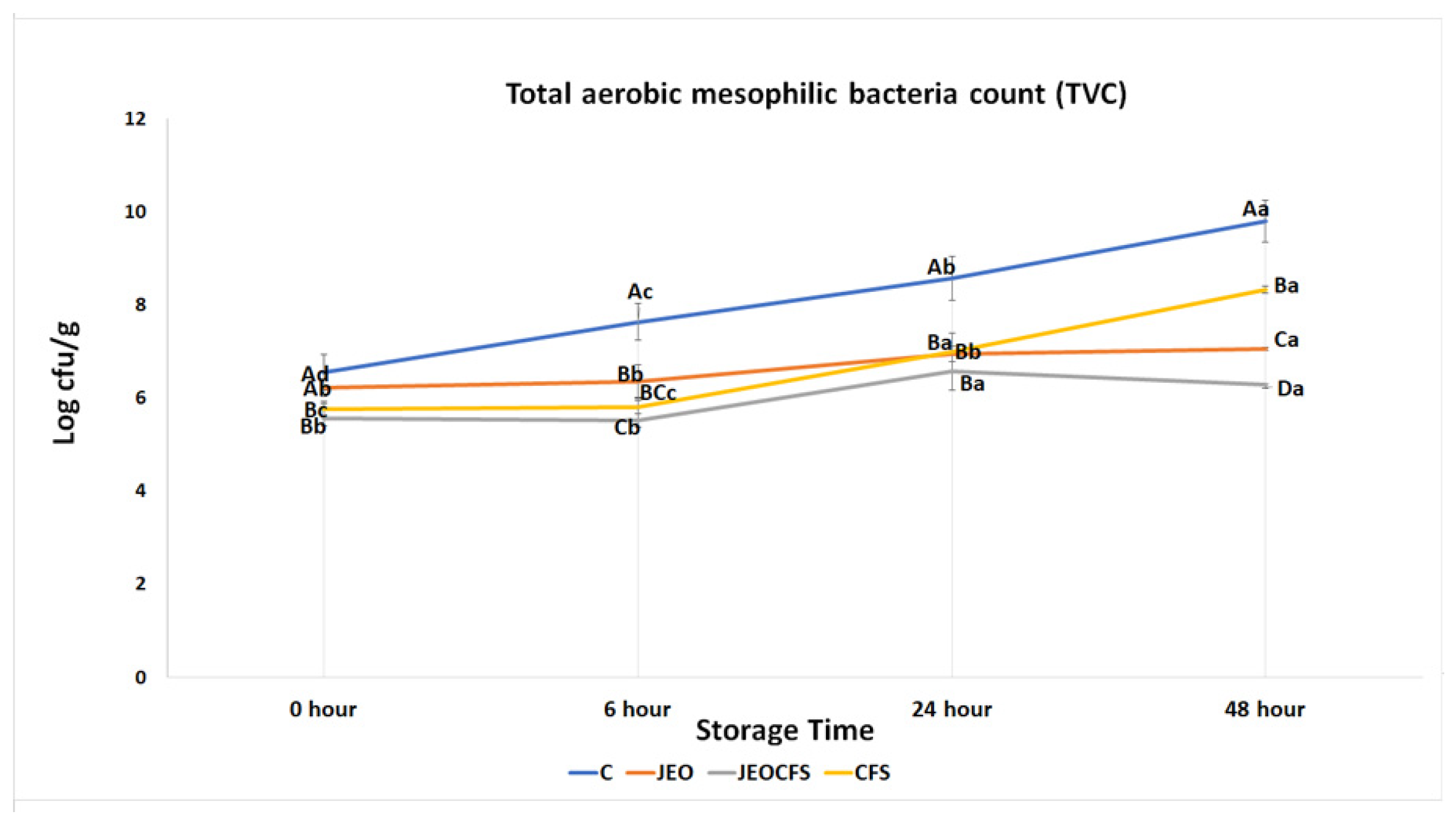
Figure 1. Total aerobic mesophilic bacterial count in chicken meat stored at 4 °C for 48 h. Values represent mean ± SD (n = 3). There is a significant difference (p < 0.05) between the groups (A–C) and bacteria (a–c) for the values indicated by different letters in the same row and column.
Microorganisms 14 00399 g001
Figure 2. Total aerobic psychrophilic bacteria count in chicken meat stored at 4 °C for 48 h. Values represent mean ± SD (n = 3). There is a significant difference (p < 0.05) between the groups (A–C) and bacteria (a–c) for the values indicated by different letters in the same row and column.
Microorganisms 14 00399 g002
Figure 3. Changes in the viable count of Staphylococcus aureus during 48 h of storage at 4 °C. Values represent mean ± SD (n = 3). There is a significant difference (p < 0.05) between the groups (A–C) and bacteria (a–c) for the values indicated by different letters in the same row and column.
Microorganisms 14 00399 g003
Table 1. Bioactive compounds of Juniperus berry essential oil (JEO).
Bioactive CompoundsCompound Content (%)
Tricylene 0.24
Alpha-Pinene84.56
Fenchene0.09
Camphene0.32
2-Beta-Pinene1.28
Sabinene0.23
Beta-Myrcene3.20
Alpha-Phellanderene0.05
Alpha-Terpinene0.18
Limonene-D1.00
Beta-Phellanderene0.20
Gamma-Terpinene0.94
P-Cymene0.20
Alpha-Terpinolene1.05
Alpha Cedrol0.68
Table 2. Antimicrobial activity of CFS and JEO against selected foodborne pathogen bacteria.
BacteriaInhibition Zone Diameters (mm)
JEOCFSJEOCFS
Staphylococcus aureus  ATCC 2592335.50 ± 0.28 aA4.00 ± 0.21 cA12.00 ± 0.02 bA
Escherichia coli ATCC 4388815.50 ± 0.14 aB0.00 ± 0.00 bB0.00 ± 0.00 bB
Salmonella enterica serovar Infantis S28.00 ± 0.28 aC0.00 ± 0.00 bB0.00 ± 0.00 bB
Values represent mean ± SD (n = 3). There is a significant difference (p < 0.05) between the groups (a–c) and bacteria (A–C) for the values indicated by different letters in the same row and column. Negative controls did not show any inhibition zone.
Table 3. Minimum inhibition concentration (MIC) and minimum bactericidal concentration (MBC) of CFS and JEO against selected foodborne pathogen bacteria.
BacteriaMIC Values (mg/mL)MBC Values (mg/mL)
JEOJEOCFSCFSJEOJEOCFSCFS
Staphylococcus aureus  ATCC 2592312.5255012.550100
Escherichia coli ATCC 43888100100100100100100
Salmonella enterica serovar Infantis S2100100100100100100
Negative controls did not exhibit any inhibition effect.
Disclaimer/Publisher’s Note: The statements, opinions and data contained in all publications are solely those of the individual author(s) and contributor(s) and not of MDPI and/or the editor(s). MDPI and/or the editor(s) disclaim responsibility for any injury to people or property resulting from any ideas, methods, instructions or products referred to in the content.