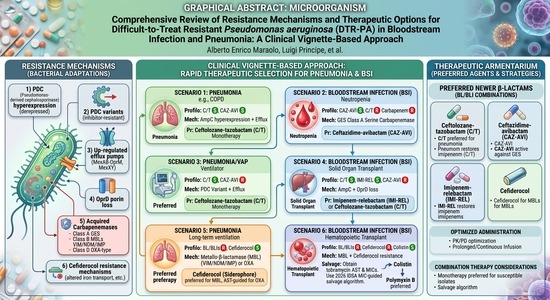
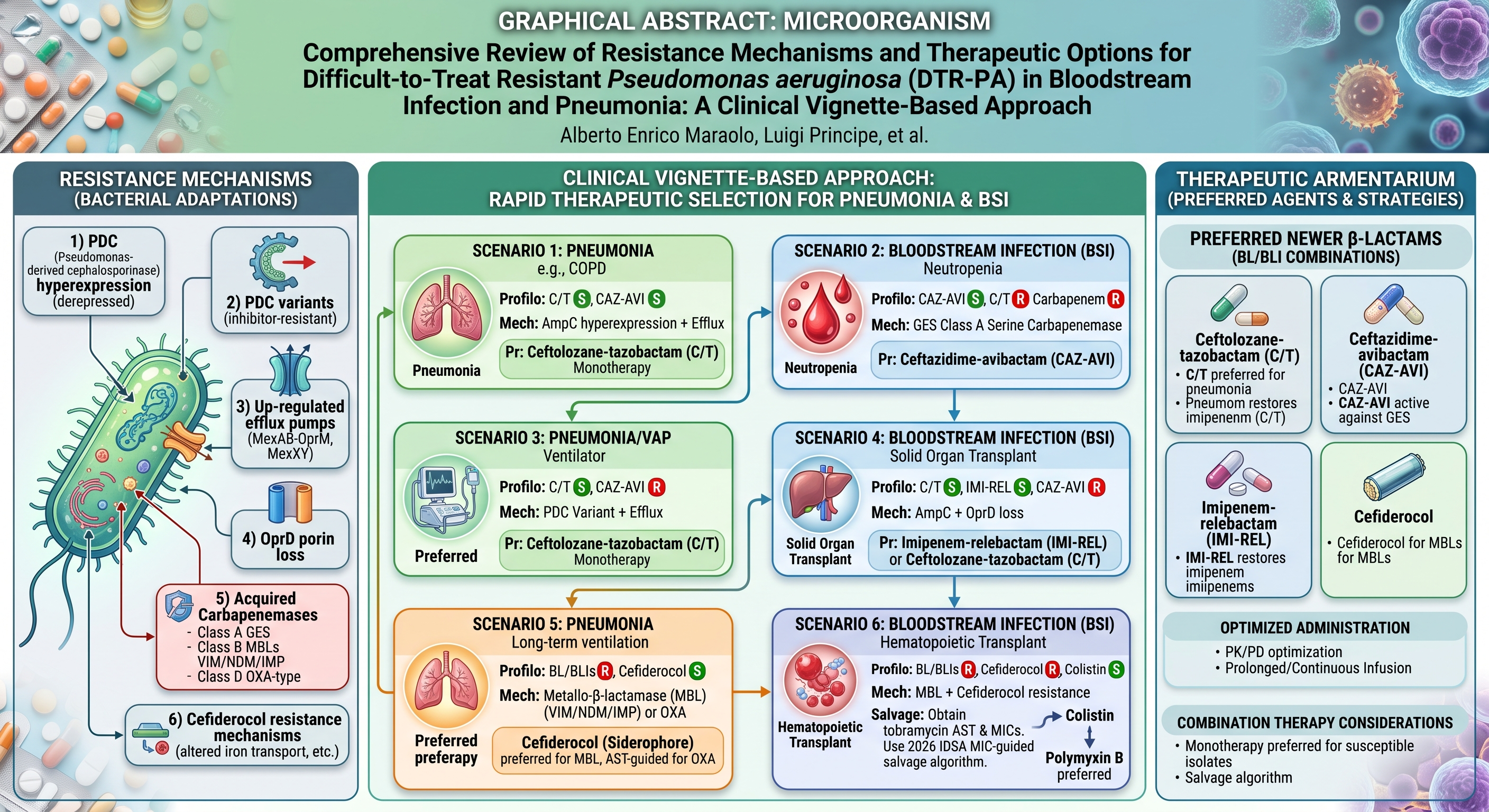
1. Introduction
P. aeruginosa (PA henceforth in combined acronyms) is an aerobic, non-fermenting Gram-negative bacillus with a ubiquitous distribution and a particular affinity for water-rich environments. Its clinical relevance stems from its major role in healthcare-associated infections (HAIs), particularly in critically ill patients, and from its challenging intrinsic and acquired resistance mechanisms, which further complicate treatment in vulnerable hosts [
1]. Importantly,
P. aeruginosa shows a remarkable environmental resistance and a long persistence on surfaces, posing a significant healthcare challenge when medical devices or equipment become contaminated.
P. aeruginosa is among the most frequently isolated Gram-negative pathogens and a leading cause of hospital-acquired pneumonia (HAP). Notably, in the European Centre for Disease Prevention and Control (ECDC) Annual Epidemiological Report for HAIs acquired in intensive care units (ICUs),
P. aeruginosa is confirmed as the most frequently isolated microorganism in ICU-acquired pneumonia in Europe [
2], underscoring its prominent role in respiratory infections. It is also frequently involved in central line-associated bloodstream infections (CLABSIs) and catheter-associated urinary tract infections (CAUTIs) [
2,
3].
While undoubtedly of major importance in HAIs,
P. aeruginosa is also implicated in community-acquired infections, most often involving the skin and skin structures following water exposure, but also accounting for up to 5% of severe community-acquired pneumonia (CAP) and 1% of community-acquired bloodstream infections (BSIs) [
1].
Resistance mechanisms in
P. aeruginosa involve more than 40 chromosomal genes (approximately 8.4% of which are regulatory), supporting remarkable adaptability to environmental and antimicrobial selective pressure, often through combined mechanisms [
4,
5]. Intrinsic resistance includes efflux pump expression, production of inactivating enzymes, and downregulation of outer-membrane porins such as OprD. Inducible expression of the intrinsic chromosomal AmpC enzyme is a major determinant of natural resistance to many penicillins and cephalosporins, whereas MexAB-OprM and MexXY contribute to reduced susceptibility to several β-lactams and aminoglycosides. Acquired resistance may arise through mutation or horizontal transfer of mobile genetic elements, while adaptive resistance, including biofilm formation, can be reversible after removal of the environmental stimulus [
1,
6,
7].
For clarity, the intrinsic chromosomal AmpC enzyme is referred to throughout as Pseudomonas-derived cephalosporinase (PDC). Acquired carbapenemases include serine enzymes and metallo-β-lactamases (MBLs). The MBL families most relevant to
P. aeruginosa include Verona integron-encoded metallo-β-lactamase (VIM), New Delhi metallo-β-lactamase (NDM), and imipenemase (IMP); oxacillinase (OXA)-type enzymes belong to Ambler class D [
6].
P. aeruginosa resistance patterns vary geographically and over time. Multidrug-resistant (MDR), extensively drug-resistant (XDR), and pandrug-resistant (PDR) describe progressively broader resistance across antimicrobial categories in the framework proposed by Magiorakos et al. [
8]. Difficult-to-treat resistance (DTR), introduced by Kadri et al. in 2018, is a separate, treatment-oriented construct reflecting lack of first-line agents with favourable efficacy and toxicity profiles, namely a phenotype featuring intermediate or resistant responses to all reported agents in carbapenem, β-lactam (including aztreonam) and fluoroquinolone categories; it is not a merger of the MDR/XDR/PDR definitions or an additional step after PDR [
9]. The IDSA definition of DTR-PA requires non-susceptibility to piperacillin–tazobactam, ceftazidime, cefepime, aztreonam, meropenem, imipenem–cilastatin, ciprofloxacin, and levofloxacin [
10]. Carbapenem resistance alone does not establish DTR: a carbapenem-resistant (CR) isolate (CR-PA) may retain activity to a traditional non-carbapenem β-lactam or a fluoroquinolone. Conversely, DTR does not imply resistance to every newer β-lactam or to all antimicrobial categories.
The terminology requires particular care when IDSA is read alongside European Committee on Antimicrobial Susceptibility Testing; (EUCAST) interpretative criteria. EUCAST I means susceptible, increased exposure, and belongs with S among susceptible categories; it is not equivalent to the historical intermediate category or to resistance. For the educational antibiograms in this review, DTR status is conservatively demonstrated by R (resistant) results for all eight defining agents, according to the IDSA definition of DTR-PA. A current EUCAST I result for one of those agents would require separate clinical and pharmacological assessment and must not be counted as R to establish DTR-PA [
9,
10,
11].
The present review uses the 2026 IDSA Guidance, which retains the main 2024 framework while preferring ceftolozane–tazobactam (C/T) for DTR-PA pneumonia and expanding carbapenemase-directed advice and evidence on treatment-emergent resistance [
10]. The World Health Organization lists CR-PA as a high-priority research pathogen [
12].
P. aeruginosa behaves as an opportunistic pathogen, generally affecting patients with structural lung disease (especially in the presence of bronchiectasis, as in chronic obstructive pulmonary disease [COPD] and cystic fibrosis [CF]), burns, or immunosuppression (e.g., neutropenia), with a higher risk for those receiving invasive treatments (e.g., mechanical ventilation or renal replacement therapy) or bearing indwelling vascular and urinary catheters, particularly in the context of prolonged hospitalisation with prior broad-spectrum antimicrobial exposure and/or colonisation. Although it is not typically part of the normal human microbiota,
P. aeruginosa can behave as either an indolent or a rapidly aggressive coloniser in critically ill patients, frequently causing severe pneumonia (particularly ventilator-associated pneumonia [VAP]), bacteraemia, and sepsis in the ICU setting [
13,
14].
Therapeutic options for DTR-PA, when supported by antimicrobial susceptibility testing (AST), include the β-lactam/β-lactamase inhibitor (BL/BLI) combinations ceftolozane–tazobactam (C/T), ceftazidime–avibactam (CAZ-AVI), and imipenem–relebactam (IMI-REL), together with cefiderocol; aminoglycosides and polymyxins have more restricted roles [
10]. Intravenous fosfomycin has been considered as a companion agent in selected salvage regimens, with limited clinical evidence [
14]. Meropenem–vaborbactam (MER-VAB) requires a specific caveat: its activity against
P. aeruginosa is generally similar to meropenem alone. In the primary study by Castanheira et al., rare isolates with combined MexXY and PDC upregulation had reproducibly lower MER-VAB minimum inhibitory concentrations (MICs). Such exceptions support direct AST, rather than an assumption that vaborbactam overcomes meropenem resistance [
15].
Emerging compounds include cefepime–taniborbactam, cefepime–zidebactam, and meropenem–nacubactam, whereas aztreonam–avibactam has limited reliability against MBL-producing
P. aeruginosa [
10,
14,
16]. Pharmacokinetic/pharmacodynamic (PK/PD)-optimised dosing and prolonged or continuous infusion remain central. Adjunctive inhaled antibiotics are not routinely suggested when an active systemic β-lactam is available, although the 2026 IDSA Guidance allows selective adjunctive use when no newer β-lactam is active and response to systemic therapy is suboptimal [
10].
The management of suspected or confirmed DTR-PA infections requires optimal treatment timing and duration, together with a prompt, comprehensive clinical evaluation integrating the infection site and severity, patient stratification, and PK/PD considerations, particularly in critically ill patients. Microbiological confirmation and AST remain cornerstones [
10,
17].
For infections outside the urinary tract caused by DTR-PA, the 2026 IDSA Guidance identifies C/T, CAZ-AVI, and IMI-REL as preferred agents, with C/T preferred specifically for pneumonia; cefiderocol is an alternative when a preferred β-lactam is inactive or cannot be used [
10]. Carbapenemase identification further refines selection. Cefiderocol is preferred for NDM-, VIM-, or IMP-producing
P. aeruginosa, whereas cefiderocol, CAZ-AVI, or IMI-REL may be considered for
Klebsiella pneumoniae carbapenemase (KPC)-producing isolates according to AST; C/T is not suggested for KPC producers [
10]. Colistin and polymyxin B are constrained by toxicity and should not displace a fully active newer β-lactam [
10,
18].
The 2026 IDSA Guidance does not suggest routine combination therapy once susceptibility to cefiderocol, CAZ-AVI, C/T, or IMI-REL has been confirmed. Empiric tobramycin plus a newer β-lactam may be reasonable while awaiting AST in patients at high risk of DTR-PA, but the second agent should be discontinued once an active β-lactam is identified. If no β-lactam is active, tobramycin, when susceptible, may be combined with the newer β-lactam whose MIC is closest to its susceptibility breakpoint; if tobramycin susceptibility is not demonstrated, polymyxin B plus a newer β-lactam may be considered. Evidence for these salvage combinations is limited. Treatment-emergent resistance supports repeat AST when infection persists or recurs; the available estimates and their limitations are discussed below [
10]. Future strategies include new BL/BLI combinations, small molecules and peptides, bacteriophages and phage-derived lysins, and immunotherapy [
14,
19].
This manuscript therefore provides a clinically focused synthesis of the mechanisms of resistance and therapeutic options for DTR-PA in BSI and pneumonia through six alternating fictional clinical vignettes.
2. Methods
This narrative review integrates microbiological, mechanistic, pharmacological, and therapeutic evidence relevant to DTR-PA bloodstream infection and pneumonia. A narrative design was selected because the questions span several types of evidence and are not suited to a single comparative-effectiveness question. The methodological approach follows principles for transparent narrative reviews [
20], and the educational organisation draws on vignette methodology [
21] and a published case-based review of antibacterial therapy [
22]. Comprehensive reviews of resistant
P. aeruginosa and current guidance provided the starting framework for the thematic synthesis [
1,
10,
14,
16].
A targeted bibliographic update was performed from 1 January 2018, the year of the original DTR report, up to 31 July 2026 using PubMed/MEDLINE as the reference database, supplemented by checks of publisher records and the IDSA and EUCAST websites. Earlier landmark definitions and mechanistic or pharmacological studies were retained through citation tracing. The core PubMed query combined “Pseudomonas aeruginosa” with “difficult-to-treat”, “carbapenem-resistant”, or “multidrug-resistant”, and with “pneumonia”, “bacteremia”, “bloodstream”, or “treatment”. Targeted searches and reference checks used the names of the newer agents and the terms “PDC”, “AmpC”, “OprD”, “efflux”, “GES”, “metallo-β-lactamase”, “epithelial lining fluid”, and “aztreonam-avibactam”.
Selection was purposive and based on relevance to the six resistance phenotypes and to invasive infection. Guidelines and guidance documents, clinical trials, systematic reviews, and relevant narrative reviews were prioritised for therapeutic context; comparative observational cohorts were included when trial evidence was lacking. Primary microbiological, animal, and PK/PD studies were retained for claims that could not be established from clinical studies alone. Case reports and small series were used selectively to illustrate rare resistance pathways or salvage strategies. Evidence in organisms other than P. aeruginosa was not treated as direct evidence for this species, and mixed MDR/CR/DTR populations were distinguished where relevant. This was a targeted narrative update, without an exhaustive systematic-review search, protocol registration, or formal pooled analysis.
All six patients, isolates, and antibiograms are fictional educational constructs. The categorical results and added MICs illustrate plausible phenotypes; they are not measurements from clinical specimens, estimates of prevalence, or validation of a particular genotype. Moreover, scenario headings are mechanistic teaching labels; unless a molecular result is explicitily reported, they denote hypotheses compatible with the illustrative AST patterns rather than confirmed isolate-level mechanisms. Panels have been aligned to include all eight DTR-defining agents and the four newer β-lactams. EUCAST version 16.1 is the interpretive reference [
11]. MICs for BL/BLI combinations refer to the antibacterial component at the specified fixed inhibitor concentration. Cefiderocol requires iron-depleted broth for reference MIC testing. No result is inferred from another drug, and apparent genotype–phenotype discordance would require confirmatory laboratory investigation in clinical practice.
9. Discussion
Before turning to the therapeutic implications of these cases, it is worth recalling what DTR-PA actually costs patients. The clinical impact of MDR-PA has been debated for years, since impaired fitness and reduced virulence were expected to offset the effect of resistance, but the balance has shifted decisively towards harm: scarcity of therapeutic options, reliance on less effective and more toxic agents, and an almost unavoidable delay in appropriate targeted therapy translate into longer stays, higher costs and excess mortality, especially in the ICU [
75]. Contemporary Italian data quantify this excess. In the prospective nationwide ALARICO cohort of 1276 monomicrobial Gram-negative bloodstream infections, 30-day mortality was 32.8% for CR-PA versus 13.7% in the carbapenem-susceptible Gram-negative BSI comparator group; carbapenem resistance remained independently associated with death after adjustment (adjusted odds ratio 2.99, 95% CI 1.48–5.95), and the mortality attributable to CR-PA was 19% [
76]. A separate cohort illustrates the burden of DTR-PA, although its mortality cannot be directly compared with ALARICO because the populations and definitions differ: in a recent single-centre cohort of 51 patients with DTR-PA infections, 30-day all-cause mortality reached 49%, septic shock was the dominant independent predictor of death (adjusted odds ratio 5.52, 95% CI 1.04–29.27), and targeted therapy with CAZ-AVI or C/T showed a favourable but statistically non-significant association with mortality in the final adjusted model (aOR 0.15, 95% CI 0.02–1.17;
p = 0.070) [
77]. These figures explain why expert panels converge on the same operational message that underpins the vignettes presented here: rapid recognition of the resistance phenotype, immediate availability of the newer β-lactams, and early infectious disease consultation are as important as the choice of molecule itself [
78].
The six vignettes illustrate a central reality of contemporary DTR-PA management: the therapeutic armamentarium has expanded, but remains narrow and vulnerable to resistance. An AmpC/PDC-hyperproducing isolate may retain several active newer β-lactams, whereas the accumulation of acquired enzymes, PDC structural variants, permeability defects, and cefiderocol-resistance mechanisms can eliminate options. The endpoint is not automatically a colistin-based regimen, but an urgent need for agent-specific MICs and the MIC-guided combination strategy described in the 2026 IDSA Guidance [
10]. Emerging BL/BLI combinations and non-traditional approaches such as bacteriophages and phage-derived lysins remain important research priorities. Aztreonam–avibactam, however, should not be portrayed as a dependable future solution for MBL-producing
P. aeruginosa, because its activity is substantially less reliable than in MBL-producing Enterobacterales [
10,
14,
16,
79].
9.1. Monotherapy Versus Combination Therapy: When Is Combination Justified?
The 2026 IDSA position is explicit: once cefiderocol, CAZ-AVI, C/T, or IMI-REL is confirmed susceptible, continued combination therapy is not suggested because clinical benefit has not been demonstrated and aminoglycosides or polymyxins add toxicity [
10]. This is consistent with comparative evidence showing better outcomes with newer β-lactams than with historical aminoglycoside- or polymyxin-based regimens [
39,
40]. Empiric tobramycin plus a newer β-lactam may be reasonable as a time-limited bridge in patients at high risk of DTR-PA, but should be de-escalated after AST. Only when no β-lactam is active does the guidance allow an MIC-directed combination: tobramycin, if susceptible, plus the newer β-lactam closest to its breakpoint; otherwise, polymyxin B plus the closest-MIC newer β-lactam [
10].
A separate question is whether any companion agent other than tobramycin or a polymyxin deserves consideration when β-lactam options are exhausted, and intravenous fosfomycin is the candidate most often proposed. The 2022 Italian guidelines endorsed by multiple Infectious Disease and Clinical Microbiology societies took an explicit position on this point: combination therapy should not be the routine choice for invasive DTR-PA infections, but may be considered case by case, preferably with infectious disease consultation, and regimens including fosfomycin as the companion agent could be considered (conditional recommendation, low certainty of evidence) [
80]. The clinical evidence underpinning that statement comes almost entirely from two Thai retrospective studies. In a 6-year cohort of 136 patients with XDR-PA pneumonia, in which all isolates were susceptible to colistin and/or fosfomycin, active two-drug therapy—most frequently colistin plus fosfomycin (55%) or high-dose 4 h infusion doripenem plus fosfomycin (30%)—was associated with markedly higher 28-day survival and microbiological cure than active monotherapy (90% versus 51% and 90% versus 54%, respectively; both
p < 0.001), and active monotherapy was an independent predictor of 28-day mortality (adjusted odds ratio 6.63, 95% CI 1.99–22.05), as was the absence of infectious disease consultation (adjusted odds ratio 3.64, 95% CI 1.02–13.01) [
81]. The earlier study of 49 patients with CR-PA pneumonia and doripenem MICs of 4–8 mg/L compared two fosfomycin-containing regimens rather than fosfomycin against no fosfomycin, and found essentially superimposable results for high-dose prolonged-infusion doripenem plus fosfomycin and for intravenous colistin plus fosfomycin (clinical cure 60% versus 58%; microbiological cure 72% versus 63%; all-cause mortality 40% versus 42%) [
82].
The arguments in favour of fosfomycin are pharmacological rather than clinical. It is a small, highly diffusible molecule that achieves adequate concentrations in lung, bone, cerebrospinal fluid and biofilm, retains activity in acidic and hypoxic environments, acts on an early and unique step of peptidoglycan synthesis and therefore shows no cross-resistance with β-lactams, and displays synergy with β-lactams, carbapenems, polymyxins, aminoglycosides and fluoroquinolones, including with cefiderocol and CAZ-AVI against carbapenemase-producing strains; AUC/MIC is the PD driver, and a loading dose followed by continuous infusion, with high daily doses and therapeutic drug monitoring in life-threatening infection, is increasingly favoured [
83]. The arguments against are equally concrete. EUCAST provides no
P. aeruginosa-specific clinical breakpoints for intravenous fosfomycin—and discourages routine AST for this species; agar dilution is the reference MIC method, but an epidemiological cut-off must not be substituted for a clinical breakpoint; heteroresistance is extremely common and resistance emerges rapidly under monotherapy through glpT and peptidoglycan-recycling pathways, which is precisely why fosfomycin is never proposed alone; reported resistance rates among MDR-PA are high and highly variable (from about 30% up to 50–90% in some series); and the sodium load and risk of hypokalaemia are non-trivial in critically ill patients [
11,
83]. Above all, the supporting clinical data are retrospective, single-centre, largely predate the newer β-lactams, and are vulnerable to confounding by indication, so that the survival advantage observed for combination therapy may partly reflect the availability of an active agent rather than the act of combining. Fosfomycin is accordingly not part of the MIC-guided algorithm proposed in the 2026 IDSA Guidance, and intravenous formulations are not available in all countries [
10]. A reasonable synthesis is that fosfomycin should not be used to build a combination when an active newer β-lactam is available, but that it remains a defensible companion agent—always in combination, always dose-optimised, and ideally with documented in vitro activity or synergy—when no fully active β-lactam exists and the alternative is a polymyxin- or aminoglycoside-based regimen in a patient at high risk of toxicity.
9.2. Why MER-VAB Is Not an Escalation from Meropenem in DTR-PA
MER-VAB should not be assumed to broaden meropenem activity against
P. aeruginosa. The primary investigation by Castanheira et al. found generally similar activity, with rare reproducible reductions in MER-VAB MICs associated with MexXY and PDC upregulation [
15]. These results do not establish a clinical advantage or support empirical escalation from meropenem. A lower MIC for a combination also requires interpretation against its own breakpoint and dosing regimen. Direct AST is therefore needed before MER-VAB is considered for a meropenem-resistant isolate.
9.3. Is “Shorter” Better for DTR-PA?
The “shorter-is-better” paradigm that has reshaped the duration of therapy for many Gram-negative infections cannot be transposed uncritically to DTR-PA. The pivotal duration trials that underpin short-course recommendations enrolled few, if any, patients with carbapenem-resistant or DTR-PA, and where the relevant subgroup was examined the signal was not reassuring. In the landmark PneumA trial, 8 days of therapy was as effective as 15 days for VAP overall, but recurrence was higher in the subgroup caused by non-fermenting Gram-negative bacilli (40.6% versus 25.4%)—precisely the group to which DTR-PA belongs [
84]. The only randomised trial dedicated to
P. aeruginosa VAP, iDIAPASON, was stopped early for slow accrual and did not establish non-inferiority of 8 versus 15 days: the composite of mortality and recurrence occurred in 35.2% versus 25.5% of patients, with recurrence during the ICU stay at 17% versus 9.2% [
85]. Likewise, BALANCE showed that 7 days is non-inferior to 14 days for BSIs, but it excluded severely immunosuppressed patients as well as subjects with foci requiring prolonged treatment, and outcomes were not reported by resistance phenotype [
86]. These trials do not establish the optimal duration specifically for DTR-PA. Resistance alone is not an indication for a longer course; immune status, source control, infection site, and response remain the relevant determinants [
10].
At the same time, prolonging therapy unnecessarily amplifies both toxicity (notably with polymyxins and aminoglycosides) and selective pressure; in PneumA, multiresistant pathogens emerged less frequently among recurrences in the 8-day arm (42.1% versus 62.0%), a reminder that the trade-off runs in both directions [
84]. Until adequately powered trials specifically address duration in DTR-PA, the pragmatic stance is to individualise duration according to source control, infection site, and clinical response rather than to default to a fixed short course. Exposure and duration should be optimised together. Although BLING III did not demonstrate a reduction in 90-day mortality with continuous compared with intermittent β-lactam infusion in sepsis, the companion systematic review and meta-analysis found prolonged infusion to be associated with lower 90-day mortality [
87,
88]. Because DTR-PA isolates frequently have MICs close to the susceptibility breakpoint even for the agent ultimately selected, prolonged or continuous infusion of the active β-lactam, ideally supported by therapeutic drug monitoring, should be considered within agent-specific dosing recommendations; this does not justify unnecessary prolongation of treatment.
9.4. Cross-Resistance and Its Drivers for the Newer BL/BLI Combinations
Cross-resistance among newer BL/BLI combinations limits the assumption that one can automatically replace another. PDC variants can reduce CAZ-AVI and C/T activity, and CAZ-AVI exposure can select ampC and efflux-regulatory changes [
41,
53,
54,
89]; PBP3 modification may also affect several agents [
42]. In Question 4.5, the 2026 IDSA Guidance summarises treatment-emergent resistance with newer β-lactams at approximately 20%, emergent non-susceptibility during CAZ-AVI or C/T therapy at approximately 24%, and cross-resistance between those two agents above 50% [
10]. These refer to different outcomes and source populations: cross-resistance is not an incidence of new resistance in all treated patients. For IMI-REL, the guidance reports no emergent resistance in two trials including 50 patients with
P. aeruginosa infections, compared with approximately 24% in two observational studies including 46 patients. Differences in case mix, repeat-culture sampling, follow-up, and resistance definitions preclude a direct comparison of drug-specific risks. These estimates support baseline testing of each agent and repeat AST during persistent or recurrent infection, rather than a numerical ranking of agents [
10]. Collateral carbapenem sensitivity may occur with some resistance pathways but is not predictable without AST [
89].
These cross-resistance patterns also affect the empirical window before definitive AST. International and US surveillance cohorts show incomplete and geographically variable reciprocal susceptibility among C/T, CAZ-AVI, and IMI-REL, while MBL producers are usually resistant to all three [
90,
91]. Cefiderocol is not immune: prior resistance to C/T or CAZ-AVI has been associated with reduced cefiderocol susceptibility and heteroresistance [
92]. In septic shock, cultures, rapid carbapenemase testing, and source control should proceed without delaying immediate antimicrobial therapy [
93]. A prior active isolate and local epidemiology should guide the newer β-lactam backbone; when MBL production is strongly suspected, cefiderocol is the most rational empiric β-lactam. A second independently predicted active agent—often tobramycin—may be added briefly, but should be discontinued once identification, carbapenemase results, and agent-specific MICs permit targeted monotherapy [
10,
94,
95].
9.5. The Limited Role of Aztreonam–Avibactam in P. aeruginosa
Aztreonam is stable to zinc-dependent MBL hydrolysis, but in
P. aeruginosa that theoretical advantage is frequently lost because co-produced PDC, ESBLs, or class A/D carbapenemases hydrolyse the monobactam and MexAB-OprM limits intracellular exposure. The 2026 IDSA Guidance therefore does not suggest aztreonam–avibactam for MBL-producing
P. aeruginosa. CAZ-AVI plus aztreonam is suggested only when cefiderocol resistance precludes cefiderocol use, and the supporting clinical data are limited [
10,
73]. Aztreonam-based therapy must consequently be contingent on demonstrated in vitro activity and mechanism-aware interpretation, not assumed from the presence of an MBL.
Mauri et al. synthesised 35 in vitro studies and 18 clinical reports, with in vitro data for 2209 MBL-producing Gram-negative isolates. Where MICs were reported, aztreonam with avibactam or CAZ-AVI reached MICs ≤4 mg/L in 79.6% of Enterobacterales, 85.5% of
S. maltophilia, and 6.2% of
P. aeruginosa isolates. The
S. maltophilia estimate came from one report.
P. aeruginosa accounted for 724 of 808 isolates with low activity or absent synergy (89.6%); this denominator concerns poorly responsive isolates across species, not all
P. aeruginosa [
79]. These are descriptive aggregates from heterogeneous experiments, not a validated
P. aeruginosa susceptibility rate or a clinical effect estimate. Studies differed in susceptibility and synergy methods, inhibitor concentrations, organism and enzyme distributions, and whether avibactam or CAZ-AVI was combined with aztreonam. Publication and selection bias and sparse pseudomonal clinical data further limit generalisability. The findings support caution but do not alone determine treatment: the recommendation against routine aztreonam–avibactam follows current guidance, while CAZ-AVI plus aztreonam remains a conditional option for cefiderocol-resistant MBL-producing
P. aeruginosa when activity is demonstrated [
10,
73,
79].
9.6. Limitations
This review has the limitations of a narrative, purposively selected evidence synthesis, including possible selection and publication bias and the absence of a formal risk-of-bias assessment. The fictional antibiograms simplify resistance biology for teaching, as done elsewhere [
96]. They neither reproduce the full diversity and co-occurrence of mechanisms in clinical isolates nor estimate their real-world frequencies. Phenotypes do not establish genotypes, and the illustrative MICs cannot validate a treatment algorithm. Much of the comparative treatment evidence comes from observational studies with heterogeneous MDR, CR, and DTR definitions, infection sites, dosing, and outcomes. The vignettes therefore cannot substitute for comparative-effectiveness data or for patient-specific microbiology, source control, and PK/PD assessment. Finally, the US IDSA framework and EUCAST interpretive system differ in breakpoints, terminology, and drug availability; these differences must be considered when applying the discussion in other settings.
9.7. Summary: Rapid Therapeutic Selection
Table 7 summarises a pragmatic, phenotype-driven approach to initial targeted therapy for pneumonia or BSI due to DTR-PA. It is a bedside aide-mémoire, not a substitute for current AST, agent-specific MICs, molecular characterisation, source control, and patient-specific PK/PD assessment.
Table 7.
Summary of initial targeted treatment by illustrative phenotype.
Table 7.
Summary of initial targeted treatment by illustrative phenotype.
| Presumed Phenotype | Key Antibiogram Markers | Initial Targeted Approach |
|---|
| PDC hyperexpression with efflux/permeability changes | Traditional β-lactams and carbapenems R; C/T, CAZ-AVI, IMI-REL, cefiderocol S | C/T for pneumonia; CAZ-AVI also active; no routine combination |
| GES class A carbapenemase | C/T, IMI-REL and carbapenems R; CAZ-AVI and cefiderocol S | CAZ-AVI when susceptible; cefiderocol alternative |
| PDC variant/hyperexpression with additional adaptations | CAZ-AVI, IMI-REL and carbapenems R; C/T and cefiderocol S | C/T for pneumonia; repeat AST during persistent or recurrent infection |
| PDC hyperexpression with OprD loss | Carbapenems R; CAZ-AVI, C/T, and IMI-REL S | CAZ-AVI, C/T, or IMI-REL according to AST and patient factors |
| MBL producer with VIM, NDM, or IMP | CAZ-AVI, C/T, and carbapenems R; cefiderocol S | Cefiderocol when susceptible; OXA enzymes require a separate variant-specific assessment |
| Cefiderocol-resistant MBL producer | Tested β-lactams R; colistin MIC below bracketed criterion | Complete AST urgently; consider IDSA salvage options, including CAZ-AVI plus aztreonam only when combination activity supports its use |




 ,
,