Colletotrichum Species Associated with Alfalfa Anthracnose: An Overview and Historical Perspective

 , ,
, ,  , , and
Abstract
1. Introduction
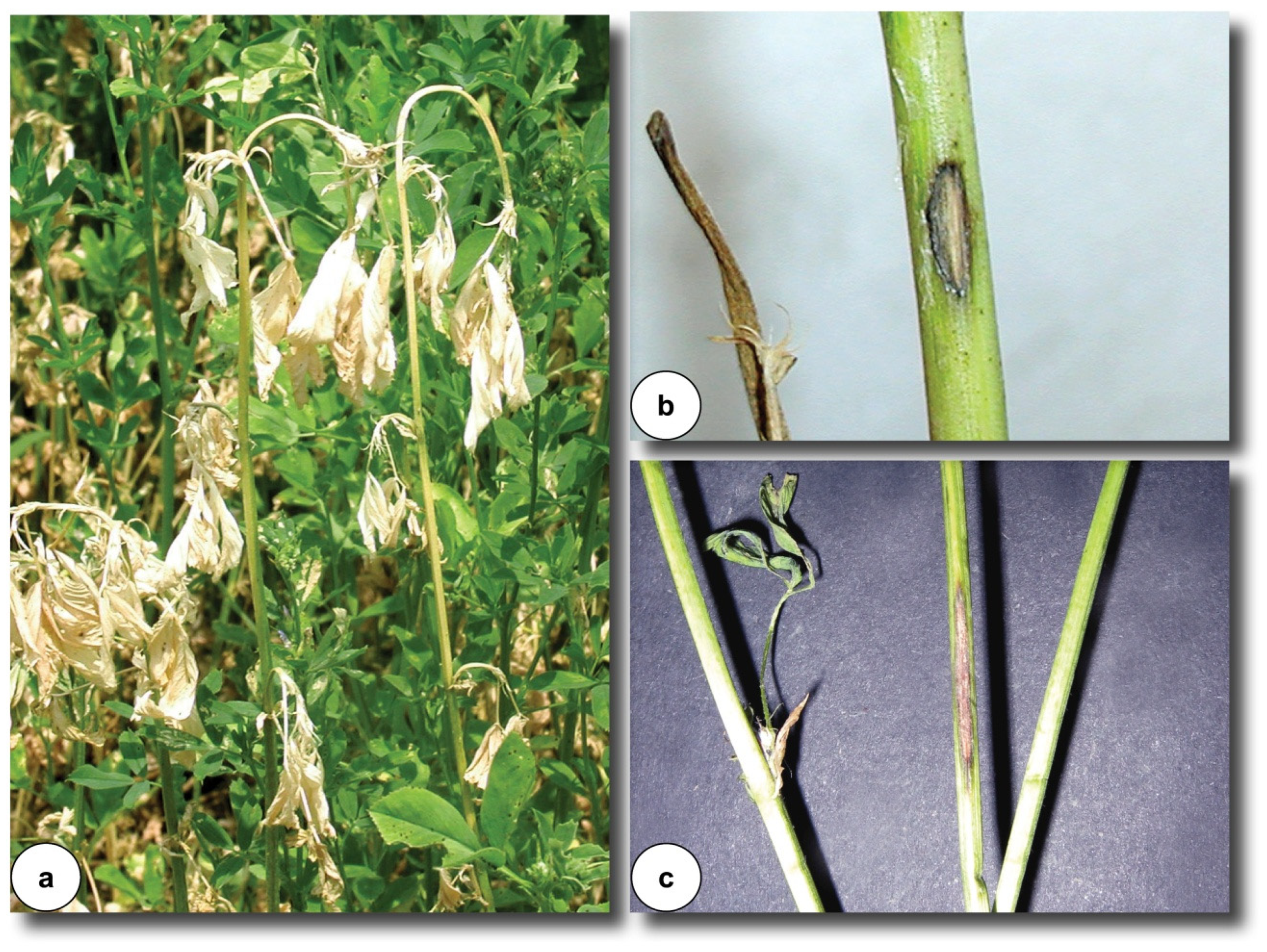
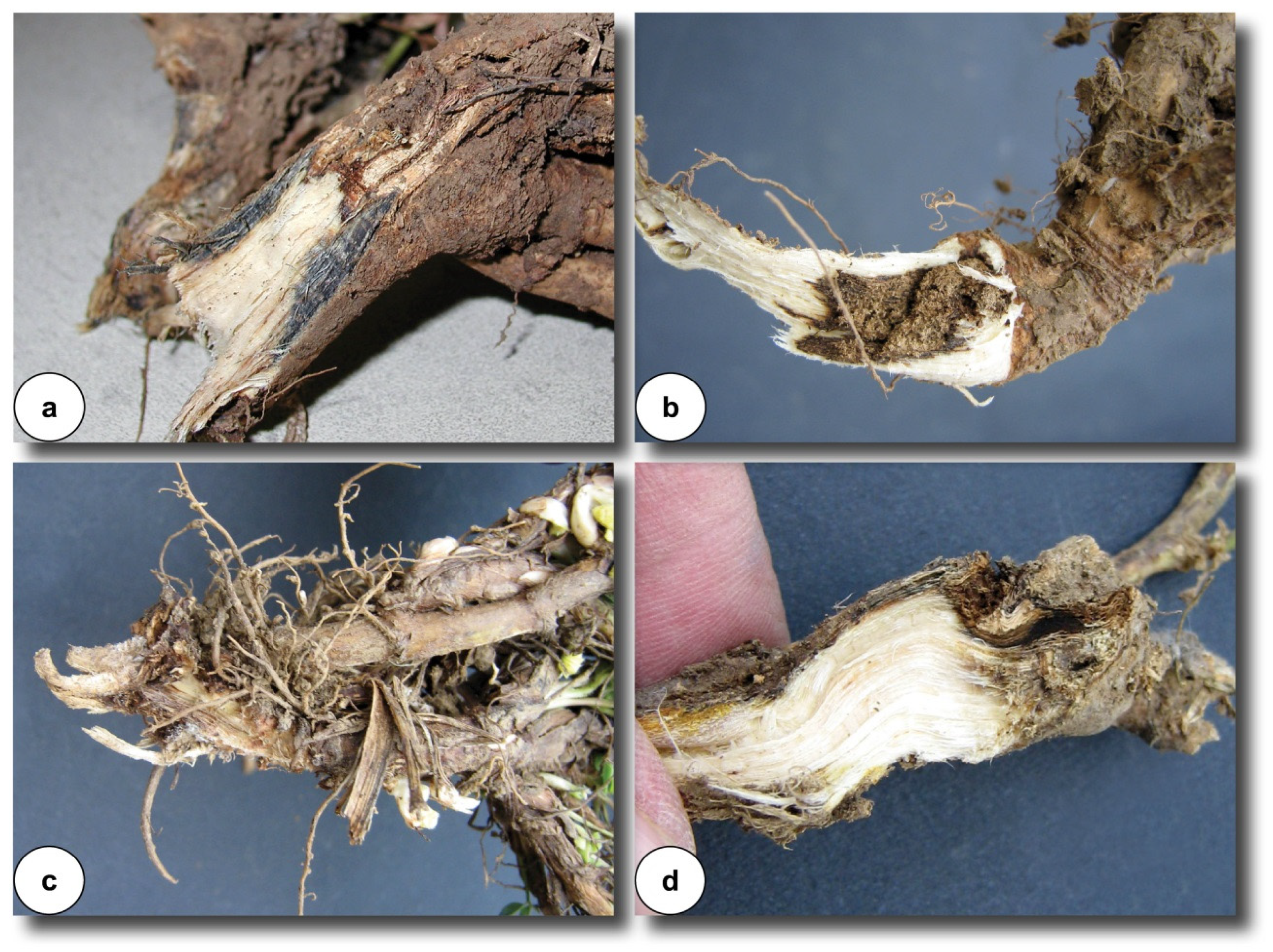
2. Symptoms
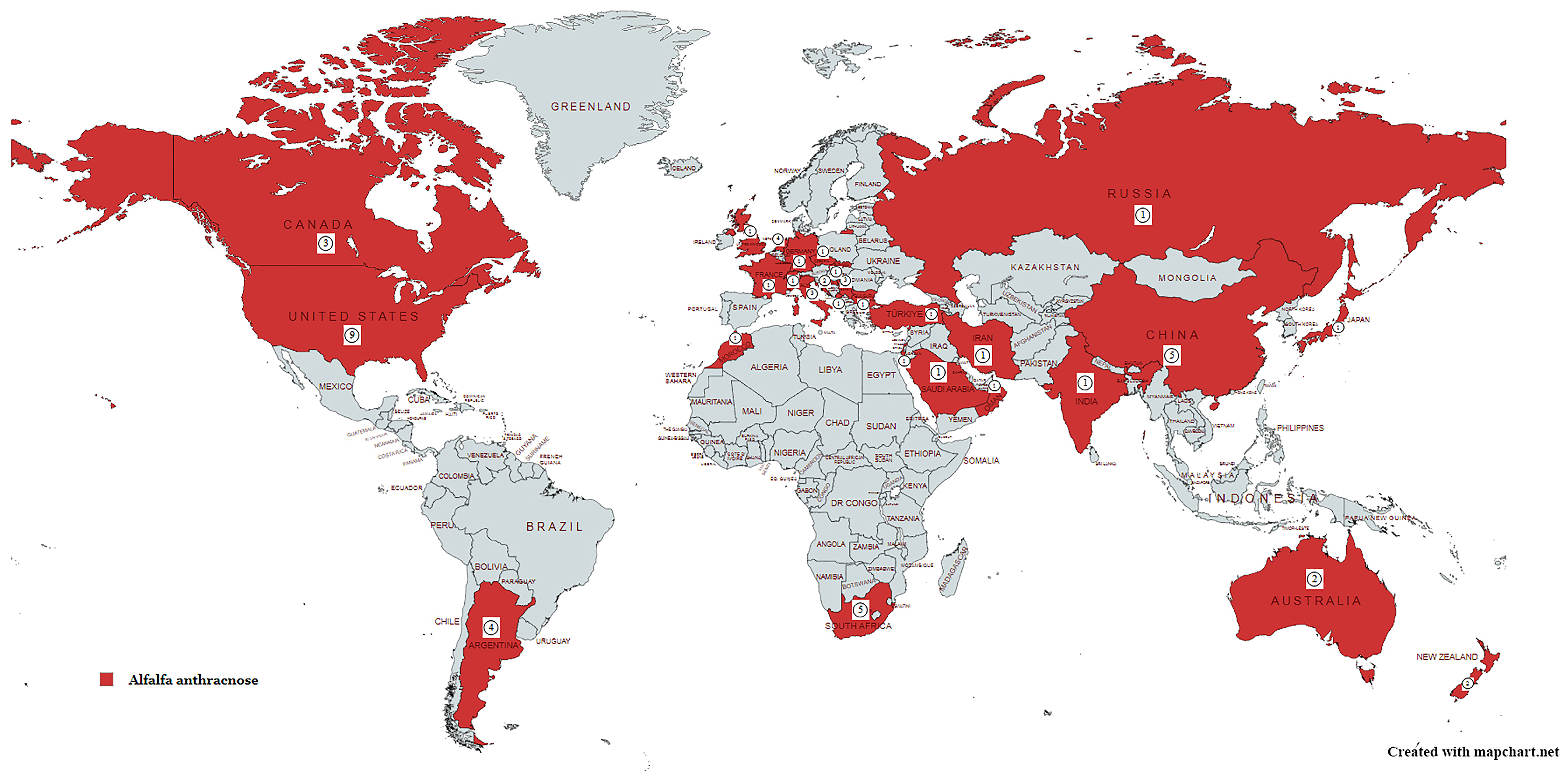
3. Geographical Distribution
4. Economic Impact
5. Colletotrichum Species Causing Alfalfa Anthracnose
- Colletotrichum americae-borealis Damm was initially isolated from alfalfa stems in Utah, USA, and described by Damm et al. [29]. This taxon belongs to the C. destructivum species complex [29]. To date, C. americae-borealis has been confirmed on alfalfa in the USA [29], China [23,57], and Argentina [21].
- Colletotrichum coccodes (Wallr.) S. Hughes was first recognized as a pathogen in rotten potato tubers (Solanum tuberosum) in Germany and described as Chaetomium coccodes by Wallroth [102]. It was later renamed as Colletotrichum coccodes by Hughes [103]. To date, C. coccodes has been confirmed on alfalfa in South Africa [81] and New Zealand [51].
- Colletotrichum dematium (Pers.) Grove was described by Persoon [104] as Sphaeria dematium from dead stems of Urtica dioica (stinging nettle), and it was later described as Colletotrichum dematium by Grove [105]. To date, C. dematium has been confirmed on alfalfa in Italy [27], the USA [61,70], the United Kingdom [34], and South Africa [81].
- Colletotrichum destructivum O’Gara was first documented on clover (Trifolium pratense) and alsike clover (T. hybridum) stems and petioles in clover fields in the Salt Lake Valley, Utah, USA [106]. C. destructivum belongs to the C. destructivum species complex [29]. To date, C. destructivum has been confirmed on alfalfa in the USA [60,61,67], Croatia [31], South Africa [79,80,81], Serbia [29,36,46], Morocco [29,82], Canada [76,78], Saudi Arabia [24,29,53], Argentina [19], and Italy [29].
- Colletotrichum gloeosporioides (Penz.) Penz. & Sacc [107] (teleomorph: Glomerella cingulata (Stoneman) Spauld. & H. Schrenk). C. gloeosporioides has a wide geographic distribution and infects a broad range of host plants [85,108]. To date, C. gloeosporioides has been confirmed on alfalfa in the USA [67,70].
- Colletotrichum graminicola (Ces.) G.W. Wilson was first reported in 1852 as Dicladium graminicolum from infected corn and barnyard grass (Echinochloa crus-galli L.) plants [109]. Between 1852 and 1914, additional grass-infecting Colletotrichum species were proposed; however, Wilson later synonymized these taxa, including C. cereale, under C. graminicola [110] due to their similar morphology and shared grass hosts. To date, C. graminicola has been confirmed on alfalfa in the USA (as ‘graminicolum’) [60,67].
- Colletotrichum lindemuthianum (Sacc. & Magnus) Briosi & Cavara is a species belonging to the C. orbiculare species complex [29]. It was described by Saccardo and Magnus as Gloeosporium lindemuthianum in Phaseolus vulgaris L. [111], and it was later renamed to Colletotrichum lindemuthianum by Briosi and Cavara [112]. To date, C. lindemuthianum has been confirmed on alfalfa in Canada [75] and Oman [51].
- Colletotrichum lini (Westerd.) Tochinai was described by Tochinai [113]. The flax anthracnose pathogen was first described in the Netherlands by van Westerdijk [114] as Gloeosporium lini, referring to the genus as Gloeosporium (currently Colletotrichum). Tochinai [113] later transferred the species to Colletotrichum after studying multiple Japanese collections. No type specimen or precise collection site was reported by van Westerdijk. C. lini belongs to the C. destructivum species complex. According to Damm et al. [29], C. linicola is synonymous with this species. To date, C. lini has been confirmed on alfalfa in New Zealand (as ‘linicola’) [53,83], the USA [29], Serbia (as ‘linicola’) [44], and China (as ‘linicola’) [20].
- Colletotrichum spinaciae Ellis & Halst. was first described on living leaves of spinach (Spinacia oleracea) in the USA, New Jersey [115]. It belongs to the C. dematium species complex [55]. To date, C. spinaciae has been confirmed on alfalfa in the Netherlands [49]. Symptoms developed in hosts aside from spinach are generally weak [116].
- Colletotrichum tofieldiae (Pat.) Damm, P.F. Cannon & Crous, was first identified as Vermicularia tofieldiae [117] from dead leaves of Tofieldia species in the eastern Tibet region, now part of southern Sichuan, China. Based on morphology, the fungus was initially assigned to a variant of C. dematium var. minus [118]. However, in 2009, Damm et al. provided strong evidence from ITS sequence analysis indicating that it belongs to the C. destructivum clade rather than C. dematium and subsequently renamed it C. tofieldiae [49]. Later, it was placed within the C. spaethianum species complex [55]. To date, C. tofieldiae has been confirmed on alfalfa in the Netherlands [49] and China [58].
- Colletotrichum trifolii Bain was first described by Bain and Essary [59] in the USA as a species causing a novel clover anthracnose disease, which resulted in 25–75% yield losses in Tennessee and was also prevalent in Ohio and West Virginia. Described as C. trifolii, the pathogen affected stems, petioles, and rarely leaves of red clover (Trifolium pratense) and alfalfa (M. sativa), with additional occurrences documented in Kentucky and Arkansas [59,119]. Pathogen C. trifolii belongs to the C. orbiculare species complex [29]. To date, C. trifolii has been confirmed on alfalfa in USA [8,14,59,60,61,62,63,64,65,66,67,68,69,71,73], Croatia [30], Australia [13,55,65,120], Czech Republic, France, Italy, and Russia [28], Serbia [10,35,36,37,43,46,84], South Africa [81], Canada [77,78], Montenegro [47], Argentina [65], Japan [54,55], Netherlands [43,84], Switzerland [6], Germany [6] and China [11].
- Colletotrichum truncatum (Schwein.) Andrus & W.D. Moore was first described as Vermicularia truncata by Schweinitz [121] in pods of Phaseolus in Pennsylvania, USA. It was later renamed C. truncatum [122]. It belongs to the C. truncatum species complex [55]. To date, C. truncatum has been confirmed on alfalfa in the USA [60,65,67], South Africa [81], Argentina [65], Australia [65,123], Turkey [22], the Netherlands [48], Israel [49], and China [11].
6. Disease Cycle
- -
- Biotrophic development of the fungus, with formation of an appressorium on the plant surface and primary infection hyphae inside epidermal cells. Secondary conidia are produced directly from the appressoria and serve for further spread of the pathogen in nature. C. trifolii infects alfalfa plants in nature in this way [137].
- -
- Subcuticular necrotrophic parasitism, with formation of an appressorium on the plant surface and development of secondary necrotrophic hyphae immediately beneath the cuticle. As the infection process advances, the secondary hyphae penetrate the intercellular space and cause necrosis. C. trifolii and C. destructivum cause infections in nature in this way [24].
- -
- Hemibiotrophic development, with an appressorium on the surface and the formation of primary infection hyphae and later secondary necrotrophic hyphae inside epidermal cells. This infection type combines biotrophic and necrotrophic infection. C. destructivum infects by first, in the initial biotrophic phase, having intracellular primary hyphae delimiting individual epidermal cells, and in the subsequent necrotrophic phase, secondary hyphae attack neighboring cells—similarly to C. higginsianum (from Brassicaceae hosts) and C. linicola (from flax) [52,143].
- -
7. Epidemiology
8. Molecular Characterization
9. Control
9.1. Cultural and Ecological Management Practices
9.1.1. Resistant Cultivars and Breeding for Resistance
9.1.2. Crop Rotation and Sanitation
9.1.3. Other Ecological Approaches
9.2. Biological Control Strategies
9.3. Physical Management Practices
9.4. Chemical Control
10. Conclusions
Author Contributions
Funding
Institutional Review Board Statement
Informed Consent Statement
Data Availability Statement
Acknowledgments
Conflicts of Interest
References
- Irwin, J.A.G.; Aitken, K.S.; Mackie, J.M.; Musial, J.M. Genetic improvement of lucerne for anthracnose (Colletotrichum trifolii) resistance. Australas. Plant Pathol. 2006, 35, 573–579. [Google Scholar] [CrossRef]
- Vasić, T.; Vojinović, U.; Žujović, S.; Krnjaja, V.; Živković, S.; Marković, J.; Stević, M. In vitro toxicity of fungicides with different modes of action to alfalfa anthracnose fungus, Colletotrichum destructivum. J. Environ. Sci. Health Part B 2019, 54, 964–971. [Google Scholar]
- Hu, J.; Zheng, M.; Dang, S.; Shi, M.; Zhang, J.; Li, Y. Biocontrol potential of Bacillus amyloliquefaciens LYZ69 against anthracnose of alfalfa (Medicago sativa). Phytopathology 2021, 111, 1338–1348. [Google Scholar]
- Mackie, J.M.; Irwin, J.A.G. Genetics and race variability of the lucerne-Colletotrichum trifolii pathosystem in Australia. Aust. J. Agric. Res. 1998, 49, 713–722. [Google Scholar]
- O’Neill, N.R.; Bauchan, G.R. Sources of resistance to anthracnose in the annual Medicago core collection. Plant Dis. 2000, 84, 261–267. [Google Scholar] [CrossRef][Green Version]
- Hartmann, S.; Schubiger, F.X.; Grieder, C.; Wosnitza, A. A decade of variety testing for resistance of red clover to southern anthracnose (Colletotrichum trifolii Bain et Essary) at the Bavarian State Research Center for Agriculture (LfL). Agriculture 2022, 12, 249. [Google Scholar] [CrossRef]
- Singh, R.P.; Dwivedi, A.P.; Prasad, D.; Singh, M.; Singh, A.K.; Singh, R.K.; Singh, K.K.; Singh, S.P. Lucerne Diseases: A Review on Status, Symptomatology and Integrated Management. 2020. Available online: https://doi.org/10.13140/RG.2.2.32473.54882 (accessed on 17 November 2025).
- Watkins, J.E.; Anderson, B. G89-931, Alfalfa Anthracnose; Cooperative Extension IANR University of Nebraska-Lincoln, University of Nebraska: Lincoln, NE, USA, 1989. [Google Scholar]
- Stuteville, D.L.; Erwin, D.C. Compendium of Alfalfa Diseases; The American Phytopathological Society Press: St. Paul, MN, USA, 1990; pp. 1–59. [Google Scholar]
- Vasić, T. Characterization of Colletotrichum Species Causing the Anthracnose of Alfalfa in Serbia and Genotype Susceptibility. Ph.D. Dissertation, University of Belgrade, Belgrade, Serbia, 2013; pp. 1–178. [Google Scholar]
- Zhou, W.; Lan, Y.; Matthew, C.; Nan, Z. A biological comparison of three Colletotrichum species associated with alfalfa anthracnose in Northern China. Plants 2024, 13, 1780. [Google Scholar] [CrossRef]
- Ostazeski, S.A. Anthracnose. In Compendium of Alfalfa Diseases, 2nd ed.; Stuteville, D.L., Erwin, D.C., Eds.; APS Press: St. Paul, MN, USA, 1990; pp. 23–24. [Google Scholar]
- Irwin, J.A.G. Crown rot of lucerne in Queensland caused by Colletotrichum trifolii. Aust. J. Exp. Agric. 1974, 14, 197–200. [Google Scholar]
- Lukezić, F.L. Dissemination and survival of Colletotrichum trifolii under field conditions. Phytopathology 1974, 64, 57–59. [Google Scholar]
- Henderson, R.G.; Smith, T.J. A crown rot of alfalfa caused by Colletotrichum trifolii. Phytopathology 1948, 38, 570. [Google Scholar]
- O’Rourke, C.J.; Millar, R.L. Root rot and root mikroflora of alfalfa as affected by potassium nutrition, frequency of cutting, and leaf infection. Phytopathology 1966, 56, 1040–1046. [Google Scholar]
- Barnes, D.K.; Ostazeski, S.A.; Schillinger, J.A.; Hanson, C.H. Effect of anthracnose (Colletotrichum trifolii) infection on yield, stand and vigor of alfalfa. Crop Sci. 1969, 9, 344–346. [Google Scholar] [CrossRef]
- O’Rourke, C.J. Diseases of Grasses and Forage Legumes in Ireland; An Foras Taluntais: Carlow, Ireland, 1976. [Google Scholar]
- Frayssinet, S. Colletotrichum destructivum: A new lucerne pathogen in Argentina. Australas. Plant Dis. Notes 2008, 3, 68. [Google Scholar] [CrossRef]
- Wang, Y.; Ma, J.Q.; Yuan, Q.H.; Li, X.L.; Miao, L.H. First report of Colletotrichum linicola causing anthracnose on alfalfa in China. Plant Dis. 2018, 102, 1039. [Google Scholar] [CrossRef]
- Lima, N.B.; Conforto, C.; Serri, D.L.; Mancilla, E.J.C.; Stenglein, S.; Vargas-Gil, S. Anthracnose on alfalfa caused by Colletotrichum americae-borealis in Córdoba province, Argentina. Crop Prot. 2021, 148, 105732. [Google Scholar] [CrossRef]
- Eken, C.; Demirci, E. First report of Colletotrichum truncatum on alfalfa in Turkey. Plant Dis. 2000, 84, 100. [Google Scholar] [CrossRef]
- Li, K.M.; Hu, W.J.; Dou, X.L.; Fan, J.X.; Yang, H.L. First report of alfalfa anthracnose caused by Colletotrichum americae-borealis in Xinjiang, China. Plant Dis. 2021, 105, 3307. [Google Scholar] [CrossRef]
- Latunde-Dada, A.O.; Bailey, J.A.; Lucas, J.A. Infection process of Colletotrichum destructivum O’Gara from lucerne (Medicago sativa L.). Eur. J. Plant Pathol. 1997, 103, 35–41. [Google Scholar] [CrossRef]
- Latunde-Dada, A.O.; O’Connell, R.; Bowyer, P.; Lucas, J.A. Cultivar resistance to anthracnose disease of cowpea (Vigna unguiculata (L.) Walp.) caused by Colletotrichum destructivum O’Gara. Eur. J. Plant Pathol. 1999, 105, 445–451. [Google Scholar] [CrossRef]
- Talhinhas, P.; Baroncelli, R. Colletotrichum species and complexes: Geographic distribution, host range and conservation status. Fungal Divers. 2021, 110, 109–198. [Google Scholar] [CrossRef]
- Laviola, C. Osservazioni sull’antracnosi dell’erba medica (Medicago sativa L.) in Puglia. Ann. Fac. Agric. Univ. Bari 1963, 17, 337–345. [Google Scholar]
- Graham, J.H.; Stuteville, D.L.; Frosheiser, F.I.; Erwin, D.C. A Compendium of Alfalfa Diseases; APS Press: St. Paul, MN, USA, 1979. [Google Scholar]
- Damm, U.; O’Connell, R.J.; Groenewald, J.Z.; Crous, P.W. The Colletotrichum destructivum species complex: Hemibiotrophic pathogens of forage and field crops. Stud. Mycol. 2014, 79, 49–84. [Google Scholar] [CrossRef] [PubMed]
- Lušin, V. Izvještajna služba zaštite bilja u SR Hrvatskoj u 1970. godini. Biljna Zašt. 1971, 1, 17–33. [Google Scholar]
- Lušin, V. Pojava i rasprostranjenost bolesti lucerke i crvene djeteline u nekim područjima u SR Hrvatskoj. Glas. Zašt. Bilja 1980, 10, 344–352. [Google Scholar]
- Kungurtseva, O.V. Colletotrichum trifolii Bain et Essary, anthracnose of alfalfa. In Interactive Agricultural Ecological Atlas of Russia and Neighboring Countries: Economic Plants and Their Diseases, Pests and Weeds; All-Russian Institute of Plant Protection: Pushkin, Russia, 2008. [Google Scholar]
- Guy, P. Déterminisme génétique de la résistance à Colletotrichum trifolii chez Medicago sativa L. Ann. Amélior. Plantes 1976, 26, 215–234. [Google Scholar]
- Stovold, G.E. Some crown and root diseases of lucerne. Agric. Gaz. N. S. W. 1981, 92, 17–18. [Google Scholar]
- Robotić, V.; Klokočar-Šmit, Z. Colletotrichum trifolii Bain i Essary prouzrokovač antraknoze lucerke. Zašt. Bilja 1983, 164, 225–229. (In Serbian) [Google Scholar]
- Robotić, V.; Klokočar-Šmit, Z. Uporedna ispitivanja nekih sorti lucerke prema dve vrste roda Colletotrichum. Čovek i Biljka Matica Srp. 1986, 331–337. (In Serbian) [Google Scholar]
- Robotić, V.; Klokočar-Šmit, Z.; Dukić, D. Reakcija nekih sorti lucerke prema Colletotrichum trifolii Bain i Essary. Zb. Simp. o Krmnom Bilju Novi Sad 1983, 378–388. (In Serbian) [Google Scholar]
- Vasić, T. Colletotrichum trifolii (Bain et Essary), Prouzrokovač Antraknoze, u Kompleksu Propadanja Lucerke u Srbiji. Master’s Thesis, University of Belgrade, Belgrade, Serbia, 2007; p. 88. (In Serbian) [Google Scholar]
- Vasić, T.; Ivanović, M.; Trkulja, V.; Radović, J.; Lugić, Z.; Gajić, S. Pojava Colletotrichum trifolii prouzrokovača antraknoze lucerke na teritoriji Srbije. II Simpozijum o zaštiti bilja u Bosni i Hercegovini, Teslić. Zb. Rezim. 2005, 75–76. (In Serbian) [Google Scholar]
- Vasić, T.; Trkulja, V.; Radović, J.; Babić, S.; Gajić, S. Morfološke osobine Colletotrichum trifolii prouzrokovača antraknoze na lucerki. In Proceedings of the VII Savetovanje o Zaštiti Bilja, Soko Banja, Serbia, 15–18 November 2005; p. 163. (In Serbian) [Google Scholar]
- Vasić, T.; Radović, J.; Lugić, Z.; Marković, J.; Jevtić, G.; Gajić, S. Occurrence of Colletotrichum trifolii (Bain et Essary), the inducer of alfalfa anthracnose in Serbia. In Sustainable Use of Genetic Diversity in Forage and Turf Breeding; Springer: Dordrecht, The Netherlands, 2009; pp. 369–374. [Google Scholar]
- Vasić, T.; Trkulja, V.; Rajčević, B.; Živković, S.; Anđelković, S.; Marković, J. Molecular and morphological determination of Colletotrichum trifolii isolates originating from alfalfa. Proc. Nat. Sci. Matica. Srp. Novi Sad 2011, 120, 197–204. [Google Scholar] [CrossRef]
- Vasić, T.; Anđelković, S.; Živković, S.; Anđelković, B.; Terzić, D.; Milenković, J. Appearance and frequency of fungi on alfalfa seed in Serbia. Biotechnol. Anim. Husb. 2011, 27, 1579–1584. [Google Scholar]
- Vasić, T.; Bulajić, A.; Krnjaja, V.; Jevremović, D.; Živković, S.; Andjelković, B. First report of anthracnose on alfalfa caused by Colletotrichum linicola in Serbia. Plant Dis. 2014, 98, 1276. [Google Scholar] [CrossRef]
- Vasić, T.; Trkulja, V.; Anđelković, S.; Terzić, D.; Marković, J.; Milenković, J.; Radović, J. Osjetljivost različitih genotipova lucerke prema Colletotrichum destructivum. In Proceedings of the XII Simpozijum o Zaštiti Bilja u Bosni i Hercegovini, Mostar, Bosnia and Herzegovina, 3–5 November 2015; p. 97. (In Serbian) [Google Scholar]
- Vasić, T.; Andjeloković, S.; Radović, J.; Lugić, Z.; Marković, J.; Petrović, M. Morphological determination of Colletotrichum species causing the anthracnose of alfalfa in Serbia. J. Mount. Agric. Balk. 2016, 19, 53–70. [Google Scholar]
- Mijušković, M. Najčešće mikoze lucerke u Crnoj Gori. Poljopr. I Šumarstvo 1993, 39, 55–64. [Google Scholar]
- Nirenberg, H.I.; Feiler, U.; Hagedorn, G. Description of Colletotrichum lupini comb. nov. in modern terms. Mycologia 2002, 94, 307–320. [Google Scholar] [CrossRef]
- Damm, U.; Woudenberg, J.H.C.; Cannon, P.F.; Crous, P.W. Colletotrichum species with curved conidia from herbaceous hosts. Fungal Divers. 2009, 39, 45–87. [Google Scholar]
- Pavgi, M.S.; Singh, U.P. Parasitic fungi from north India—III. Mycopathol. Mycol. Appl. 1964, 24, 355–361. [Google Scholar]
- Lenné, J.M. Colletotrichum diseases of legumes. In Colletotrichum: Biology, Pathology and Control; Bailey, J.A., Jeger, M.J., Eds.; CAB International: Wallingford, UK, 1992; pp. 134–166. [Google Scholar]
- Latunde-Dada, A.O.; Lucas, J.A. Localized hemibiotrophy in Colletotrichum: Cytological and molecular taxonomic similarities among C. destructivum, C. linicola and C. truncatum. Plant Pathol. 2007, 56, 437–447. [Google Scholar] [CrossRef]
- Shen, S.; Goodwin, P.; Hsiang, T. Hemibiotrophic infection and identity of the fungus, Colletotrichum destructivum, causing anthracnose of tobacco. Mycol. Res. 2001, 105, 1340–1347. [Google Scholar] [CrossRef]
- Moriwaki, J.; Tsukiboshi, T.; Sato, T. Grouping of Colletotrichum species in Japan based on rDNA sequences. J. Gen. Plant Pathol. 2002, 68, 307–320. [Google Scholar] [CrossRef]
- Cannon, P.F.; Damm, U.; Johnston, P.R.; Weir, B.S. Colletotrichum: Current status and future directions. Stud. Mycol. 2012, 73, 181–213. [Google Scholar] [CrossRef] [PubMed]
- Naseri, B.; Marefat, A.R. Seasonal dynamics and prevalence of alfalfa fungal pathogens in Zanjan province, Iran. Int. J. Plant Prod. 2008, 2, 327–340. [Google Scholar]
- Zhang, L.L.; Shi, M.; Li, Y.Z. Effect of anthracnose infection on alfalfa yield and quality in the Shaerqin area. Acta Pratacult. Sin. 2020, 29, 117–126. [Google Scholar]
- Wang, T.T.; Li, H.; Li, Y.Z. The novel disease Vicia unijuga caused by Colletotrichum tofieldiae in China: Implications for host growth, photosynthesis, and nutritional quality. J. Fungi 2025, 11, 567. [Google Scholar] [CrossRef]
- Bain, S.M.; Essary, S.H. A new anthracnose of alfalfa and red clover. J. Mycol. 1906, 12, 192–193. [Google Scholar] [CrossRef]
- Tiffany, L.H.; Gilman, J.C. Species of Colletotrichum from legumes. Mycologia 1954, 46, 52–75. [Google Scholar] [CrossRef]
- Graham, J.H.; Devine, T.E.; Hanson, C.H. Occurrence and interaction of three species of Colletotrichum on alfalfa in the Mid-Atlantic United States. Phytopathology 1976, 66, 538–541. [Google Scholar]
- Jones, E.R.; Carroll, R.B.; Swain, R.H.; Bell, K.W. Role of anthracnose in stand thinning of alfalfa in Delaware. Agron. J. 1978, 70, 351–353. [Google Scholar] [CrossRef]
- Frosheiser, F.I.; Morrison, R.H.; Welty, R.E. Anthracnose of alfalfa observed in Minnesota. Plant Dis. 1981, 65, 844–845. [Google Scholar] [CrossRef]
- Allen, S.J.; Barnes, G.L.; Caddel, J.L. A new race of Colletotrichum trifolii on alfalfa in Oklahoma. Plant Dis. 1982, 66, 922–924. [Google Scholar]
- Allen, D.J.; Lenné, J.M. (Eds.) Diseases as constraints to production of legumes in agriculture. In Pathology of Food and Pasture Legumes; CAB International: Wallingford, UK, 1998; pp. 1–61. [Google Scholar]
- Welty, R.E.; Gurgis, R.Y.; Rowe, D.E. Occurrence of race 2 of Colletotrichum trifolii in North Carolina and resistance of alfalfa cultivars and breeding lines to races 1 and 2. Plant Dis. 1982, 66, 48–51. [Google Scholar] [CrossRef]
- Abdalla, M.Y. Isolation and Characterization of Species and Races of Colletotrichum Occurring on Alfalfa. Ph.D. Thesis, The Ohio State University, Columbus, OH, USA, 1986. [Google Scholar]
- Porto, M.D.; Crau, C.R.; de Zoeten, G.A.; Gaard, G. Histopathology of Colletotrichum trifolii on alfalfa. Phytopathology 1988, 78, 345–349. [Google Scholar] [CrossRef]
- Lenssen, A.W.; Sorensen, E.L.; Posler, G.L.; Stuteville, D.L. Resistance to anthracnose protects forage quality of alfalfa. Crop Sci. 1991, 31, 147–150. [Google Scholar] [CrossRef]
- O’Neill, N.R.; Van Berkum, P.; Lin, J.J.; Kuo, J.; Ude, G.N.; Kenworthy, W.; Saunders, J.A. Application of amplified restriction fragment length polymorphism for genetic characterization of Colletotrichum pathogens of alfalfa. Phytopathology 1997, 87, 745–750. [Google Scholar] [CrossRef]
- Ariss, J.J.; Rhodes, L.H. A new race of Colletotrichum trifolii identified on alfalfa in Ohio. Plant Dis. 2007, 91, 1362. [Google Scholar] [CrossRef]
- Samac, D.A.; Allen, S.; Witte, D.; Miller, D.; Peterson, J. First report of race 2 of Colletotrichum trifolii causing anthracnose on alfalfa (Medicago sativa) in Wisconsin. Plant Dis. 2014, 98, 843. [Google Scholar] [CrossRef]
- Jayawardena, R.S.; Hyde, K.D.; Damm, U.; Cai, L.; Liu, M.; Li, X.H.; Zhang, W.; Zhao, W.S.; Yan, J.Y. Notes on currently accepted species of Colletotrichum. Mycosphere 2016, 7, 1192–1260. [Google Scholar] [CrossRef]
- Damm, U.; Sato, T.; Alizadeh, A.; Groenewald, J.Z.; Crous, P.W. The Colletotrichum dracaenophilum, C. magnum and C. orchidearum species complexes. Stud. Mycol. 2019, 92, 1–46. [Google Scholar] [CrossRef] [PubMed]
- Tu, J.C. Epidemiology of anthracnose caused by Colletotrichum lindemuthianum on white bean (Phaseolus vulgaris) in southern Ontario: Survival of the pathogen. Plant Dis. 1983, 67, 402–404. [Google Scholar] [CrossRef]
- Boland, G.J.; Brochu, L.D. Colletotrichum destructivum on alfalfa in Ontario and cultivar response to anthracnose. Can. J. Plant Pathol. 1989, 11, 303–307. [Google Scholar] [CrossRef]
- Mould, M.J.; Robb, J. The Colletotrichum trifolii–Medicago sativa interface, in culture: A cytological analysis. Can. J. Bot. 1992, 70, 114–124. [Google Scholar] [CrossRef]
- Mould, M.J.R.; Robb, J.; Boland, G.J. Loss of resistance to Colletotrichum trifolii in in vitro regenerated alfalfa. Plant Cell Tissue Organ Cult. 1992, 28, 207–213. [Google Scholar] [CrossRef]
- Baxter, A.P.; van der Westhuizen, G.C.A.; Eicker, A. Morphology and taxonomy of South African isolates of Colletotrichum. S. Afr. J. Bot. 1983, 2, 259–289. [Google Scholar] [CrossRef]
- Thompson, A.H.; van der Westhuizen, G.C.A. A survey of the diseases of the pasture crop lucerne, 1978–1984. Agric. Res. S. Afr. 1985, 28–29. [Google Scholar]
- Koch, S.H.; Baxter, A.P.; Knox-Davies, P.S. Identity and pathogenicity of Colletotrichum species from Medicago sativa in South Africa. Phytophylactica 1989, 21, 65–78. [Google Scholar]
- Troeung, B.M.; Gosset, H. First observation of lucerne anthracnose in Eastern Morocco. Agronomie 1987, 7, 361–363. [Google Scholar]
- Sreenivasaprasad, S.; Mills, P.R.; Meehan, B.M.; Brown, A.E. Phylogeny and systematics of 18 Colletotrichum species based on ribosomal DNA spacer sequences. Genome 1996, 39, 499–512. [Google Scholar] [CrossRef] [PubMed]
- Vasić, T.; Ivanović, M.; Trkulja, V.; Radović, J.; Gajić, S.; Anđelković, B. Morphological and pathogenic characteristics of Colletotrichum trifolii Bain et Essary, the alfalfa anthracnose inducer. Proc. Nat. Sci. Matica Srpska 2009, 116, 159–166. [Google Scholar] [CrossRef]
- Trkulja, V.; Čojić, B.; Trkulja, N.; Tomić, A.; Matić, S.; Ikanović, J.; Popović Milovanović, T. Colletotrichum species associated with apple bitter rot and Glomerella leaf spot: A comprehensive overview. J. Fungi 2024, 10, 660. [Google Scholar] [CrossRef] [PubMed]
- Radović, J.; Lugić, Z.; Ignjatović, S.; Delić, D. Prinos i kvalitet suve materije genotipova lucerke (Medicago sativa L.) različitog porekla. Acta Agric. 2004, 9, 109–115. (In Serbian) [Google Scholar]
- Radović, J.; Sokolović, D.; Marković, J. Alfalfa—Most important perennial forage legume in animal husbandry. Biotechnol. Anim. Husb. 2009, 25, 465–475. [Google Scholar] [CrossRef]
- Nešić, Z.; Tomić, Z.; Žujović, M.; Krnjaja, V. Production characteristics of domestic alfalfa (Medicago sativa L.) cultivars in agroecological conditions of Srem district. Biotechnol. Anim. Husb. 2005, 21, 169–174. [Google Scholar] [CrossRef]
- Dinić, B.; Đorđević, N.; Radović, J.; Ignjatović, S. Modern procedures in technology of conserving lucerne by ensiling. Biotechnol. Anim. Husb. 2005, 21, 297–303. [Google Scholar] [CrossRef]
- Marković, J.; Ignjatović, S.; Radović, J.; Lugić, Z. Uticaj faze razvića na sadržaj makro i mikroelemenata u lucerki i crvenoj detelini. Zb. Rad. Instituta Za Ratar. I Povrt. 2007, 44, 401–406. [Google Scholar]
- Marković, J.; Radović, J.; Lugić, Z.; Sokolović, D. The effect of development stage on chemical composition of alfalfa leaf and stem. Biotechnol. Anim. Husb. 2007, 23, 383–388. [Google Scholar] [CrossRef][Green Version]
- Elliott, F.C.; Johnson, I.J.; Schonhorst, M.H. Breeding for forage yield and quality. In Alfalfa Science and Technology; Hanson, C.H., Ed.; ASA–CSSA–SSSA: Madison, WI, USA, 1972; Volume 15, pp. 319–333. [Google Scholar]
- Duke, J. Handbook of Legumes of World Economic Importance; Springer Science & Business Media: New York, NY, USA, 2012. [Google Scholar]
- Yang, S.; Gao, M.; Xu, C.; Gao, J.; Deshpande, S.; Lin, S.; Roe, B.A.; Zhu, H. Alfalfa benefits from Medicago truncatula: The RCT1 gene from M. truncatula confers broad-spectrum resistance to anthracnose in alfalfa. Proc. Natl. Acad. Sci. USA 2008, 105, 12164–12169. [Google Scholar] [CrossRef]
- Elgin, J.H., Jr.; Barnes, D.K.; Busbice, T.H.; Buss, G.R.; Clark, N.A.; Cleveland, R.W.; Ditterline, R.L.; Evans, D.W.; Fransen, S.C.; Horrocks, R.D.; et al. Anthracnose resistance increases alfalfa yields. Crop Sci. 1981, 21, 457–460. [Google Scholar] [CrossRef]
- Devine, T.E.; Hanson, C.H.; Ostazeski, S.A.; Campbell, T.A. Selection for resistance to anthracnose (Colletotrichum trifolii) in four alfalfa populations. Crop Sci. 1971, 11, 854–855. [Google Scholar] [CrossRef]
- Thal, W.M.; Campbell, C.L. Assessment of resistance to leaf spot diseases among alfalfa cultivars in North Carolina fields. Phytopathology 1987, 77, 964–968. [Google Scholar] [CrossRef]
- Juliatti, F.C.; Pimenta, F.A.; Martins, J.A.S.; Pozza, E.A.; Silva, S.D.A.D.; Rey, M.D.S.; Santos, R.R.D. Resistance of alfalfa cultivars to anthracnose and Leptosphaerulina leaf spot in Uberlândia-MG. Summa Phytopathol. 2011, 37, 169–173. [Google Scholar] [CrossRef]
- O’Neill, N.R. Pathogenic variability and host resistance in the Colletotrichum trifolii/Medicago sativa pathosystem. Plant Dis. 1996, 80, 450–457. [Google Scholar] [CrossRef]
- Sherwood, R.T.; Olah, A.F.; Oleson, W.H.; Jones, E.E. Effect of disease and injury on accumulation of a flavonoid estrogen, coumestrol, in alfalfa. Phytopathology 1970, 60, 684–688. [Google Scholar] [CrossRef]
- Vasić, T.; Lugić, Z.; Anđelković, S.; Štrbanović, R.; Marković, J.; Gajić, S.; Anđelković, B. The impact of Colletotrichum trifolii isolates on resistance in different red clover cultivars. Biotechnol. Anim. Husb. 2010, 26, 51–56. [Google Scholar]
- Wallroth, C.F.W. Flora Cryptogamica Germaniae, 2nd ed.; Nabu Press: Charleston, SC, USA, 1833; pp. 1–923. [Google Scholar]
- Hughes, S.J. Revisiones hyphomycetum aliquot cum appendice de nominibus rejiciendis. Can. J. Bot. 1958, 36, 727–836. [Google Scholar] [CrossRef]
- Persoon, C.H. Synopsis Methodica Fungorum; Apud Henricum Dieterich: Gottingae, Germany, 1801; pp. 1–706. [Google Scholar]
- Grove, W.B. New or noteworthy fungi. VI [Part 3]. J. Bot. Br. For. 1918, 56, 340–346. [Google Scholar]
- O’Gara, P.J. New species of Colletotrichum and Phoma. Mycologia 1915, 7, 38–41. [Google Scholar] [CrossRef]
- Penzig, A.; Saccardo, P.A. Colletotrichum gloeosporioides (Penz.). Atti Inst. Veneto Sci. Lett. 1884, 2, 670. [Google Scholar]
- Weir, B.S.; Johnston, P.R.; Damm, U. The Colletotrichum gloeosporioides species complex. Stud. Mycol. 2012, 73, 115–180. [Google Scholar] [CrossRef]
- Cesati, V.D. Klotzsch, herbarium vivum mycologicum, sistens fungorum per totam Germaniam crescentium collectionem perfectam. Flora 1852, 35, 398. [Google Scholar]
- Wilson, G.W. The identity of the anthracnose of grasses in the United States. Phytopathology 1914, 4, 106–112. [Google Scholar]
- Saccardo, P.A.; Magnus, B. Fungi novi ex herbario Dr. P. Magnus Berolinensis: Gloeosporium lindemuthianum. Michelia 1878, 1, 129. [Google Scholar]
- Briosi, G.; Cavara, F. I Fungi Parassiti Della Piante Coltivate od Utili Essicati, Delineati e Descritti; 1889; Volume 2, pp. 26–50. [Google Scholar]
- Tochinai, Y. Comparative studies on the physiology of Fusarium lini and Colletotrichum lini. J. Fac. Agric. Hokkaido Imp. Univ. 1926, 14, 171–236. [Google Scholar]
- van Westerdijk, J. Anthracnose van het vlas. In Jaarverslag van het Phytopathologisch Laboratorium; Willie Commelin Scholten: Baarn, The Netherlands, 1916; pp. 6–7. [Google Scholar]
- Ellis, J.B.; Halsted, B.D. New fungi. J. Mycol. 1890, 6, 33–35. [Google Scholar] [CrossRef]
- Von Arx, J.A. Die Arten der Gattung Colletotrichum. Phytopathol. Z. 1957, 29, 413–468. [Google Scholar]
- Patouillard, N. Champignons parasites des phanérogames exotiques. Rev. Mycol. 1886, 8, 80–85. [Google Scholar]
- Wollenweber, H.W.; Hochapfel, H. Contributions to the knowledge of parasitic and saprophytic fungi: VI. Vermicularia, Colletotrichum, Gloeosporium, Glomerella and their relationship to fruit rot. J. Parasit. 1949, 14, 181–268. [Google Scholar]
- Damm, U.; Cannon, P.F.; Liu, F.; Barreto, R.W.; Guatimosim, E.; Crous, P.W. The Colletotrichum orbiculare species complex: Important pathogens of field crops and weeds. Fungal Divers. 2013, 61, 29–59. [Google Scholar] [CrossRef]
- Mackie, J.M.; Musial, J.M.; O’Neill, N.R.; Irwin, J.A.G. Pathogenic specialisation within Colletotrichum trifolii in Australia, and lucerne cultivar reactions to all known Australian pathotypes. Aust. J. Agric. Res. 2003, 54, 829–836. [Google Scholar] [CrossRef]
- von Schweinitz, L.D. Synopsis Fungorum in America Boreali media degentium. Trans. Am. Philos. Soc. 1832, 4, 141–316. [Google Scholar] [CrossRef]
- Andrus, C.F.; Moore, W.D. Colletotrichum truncatum (Schw.), n. comb., on garden and lima beans. Phytopathology 1935, 25, 121–125. [Google Scholar]
- Shivas, R.G.; Tan, Y.P.; Edwards, J.; Dinh, Q.; Maxwell, A.; Andjic, V.; Liberato, J.R.; Weir, B.S. Colletotrichum species in Australia. Australas. Plant Pathol. 2016, 45, 447–464. [Google Scholar] [CrossRef]
- Zhang, W.; Fan, X. Diversity and distribution of Colletotrichum species causing anthracnose in China. J. Fungi 2025, 11, 781. [Google Scholar] [CrossRef] [PubMed]
- Freeman, S.; Horowitz-Brown, S.; Afanador-Kafuri, L.; Maymon, M.; Minz, D. Colletotrichum: Host specificity and pathogenicity on selected tropical and subtropical crops. Acta Hortic. 2013, 975, 209–216. [Google Scholar] [CrossRef]
- O’Connell, R.J.; Thon, M.R.; Hacquard, S.; Amyotte, S.G.; Kleemann, J.; Torres, M.F.; Vaillancourt, L.J. Lifestyle transitions in plant pathogenic Colletotrichum fungi deciphered by genome and transcriptome analyses. Nat. Genet. 2012, 44, 1060–1065. [Google Scholar] [CrossRef]
- Hyde, K.D.; Cai, L.; Cannon, P.F.; Crouch, J.A.; Crous, P.W.; Damm, U.; Goodwin, P.H.; Chen, H.; Johnston, P.R.; Jones, E.B.G.; et al. Colletotrichum—Names in current use. Fungal Divers. 2009, 39, 147–182. [Google Scholar]
- Zakaria, L. Diversity of Colletotrichum species associated with anthracnose disease in tropical fruit crops—A review. Agriculture 2021, 11, 297. [Google Scholar] [CrossRef]
- Crouch, J.A.; Clarke, B.B.; Hillman, B.I. What is the value of ITS sequence data in Colletotrichum systematics and species diagnosis? A case study using the falcate-spored graminicolous Colletotrichum group. Mycologia 2009, 101, 648–656. [Google Scholar]
- Baroncelli, R.; Amby, D.B.; Zapparata, A.; Sarrocco, S.; Vannacci, G.; Le Floch, G.; Harrison, R.J.; Holub, E.; Sukno, S.A.; Sreenivasaprasad, S.; et al. Gene family expansions and contractions are associated with host range in plant pathogens of the genus Colletotrichum. BMC Genom. 2016, 17, 555. [Google Scholar] [CrossRef]
- Crouch, J.A.; Beirn, L.A. Anthracnose of cereals and grasses. Fungal Divers. 2009, 39, 19–44. [Google Scholar]
- Ostazeski, S.A.; Campbell, T.A.; Devine, T.E.; Hanson, C.H. Low temperature maintains virulence of dry Colletotrichum trifolii inoculum. Crop Sci. 1971, 11, 935. [Google Scholar] [CrossRef]
- Lopez-Matos, L. Studies on Certain Species of Colletotrichum on Medicago sativa, Trifolium pratense, and Lotus corniculatus in New York State. Ph.D. Thesis, Cornell University, New York, NY, USA, 1962; 84p. [Google Scholar]
- Krnjaja, V.; Ivanović, M.; Lević, J.; Tomić, Z. Bolesti korena lucerke i mere suzbijanja. Biljn. Lek. 2005, 5, 565–576. [Google Scholar]
- Leath, K.T. Diseases and forage stand persistence in the United States. In Persistence of Forage Legumes; Marten, G.C., Matches, A.G., Barnes, R.F., Brougham, R.W., Clements, R.J., Sheath, G.W., Eds.; CSSA Special Publication: Madison, WI, USA, 1989; pp. 465–479. [Google Scholar]
- Perfect, S.E.; Hughes, H.B.; O’Connell, R.J.; Green, J.R. Colletotrichum: A model genus for studies on pathology and fungal–plant interactions. Fungal Genet. Biol. 1999, 27, 186–198. [Google Scholar] [CrossRef]
- Bailey, J.A.; Jeger, M.J. Colletotrichum: Biology, Pathology and Control; CAB International: Wallingford, UK, 1992; pp. 1–388. [Google Scholar]
- Kleemann, J.; Rincon-Rivera, L.J.; Takahara, H.; Neumann, U.; van Themaat, E.V.L.; van der Does, H.C.; Hacquard, S.; Stüber, K.; Will, I.; Schmalenbach, W.; et al. Sequential delivery of host-induced virulence effectors by appressoria and intracellular hyphae of the plant pathogen Colletotrichum higginsianum. PLoS Pathog. 2012, 8, e1002643. [Google Scholar] [CrossRef]
- Gan, P.; Ikeda, K.; Irieda, H.; Narusaka, M.; O’Connell, R.J.; Narusaka, Y.; Takano, Y.; Kubo, Y.; Shirasu, K. Comparative genomic and transcriptomic analyses reveal the hemibiotrophic lifestyle of Colletotrichum species. New Phytol. 2013, 197, 1236–1249. [Google Scholar] [CrossRef]
- Kim, K.H.; Yoon, J.B.; Park, H.G.; Park, E.W.; Kim, Y.H. Structural modifications and programmed cell death of chili pepper fruit related to resistance responses to Colletotrichum gloeosporioides infection. Phytopathology 2004, 94, 1295–1304. [Google Scholar] [CrossRef]
- Schubiger, F.X.; Streckeisen, P.; Boller, B. Resistance to southern anthracnose (Colletotrichum trifolii) in cultivars of red clover (Trifolium pratense). Czech J. Genet. Plant Breed. 2003, 39, 309–312. [Google Scholar]
- Peres, N.A.; Timmer, L.W.; Adaskaveg, J.E.; Correll, J.C. Lifestyles of Colletotrichum acutatum. Plant Dis. 2005, 89, 784–796. [Google Scholar] [CrossRef]
- O’Connell, R.; Herbert, C.; Sreenivasaprasad, S.; Khatib, M.; Esquerré-Tugayé, M.T.; Dumas, B. A novel Arabidopsis-Colletotrichum pathosystem for the molecular dissection of plant-fungal interactions. Mol. Plant-Microbe Interact. 2004, 17, 272–282. [Google Scholar] [CrossRef]
- Sinclair, J.B. Latent infection of soybean plants and seeds by fungi. Plant Dis. 1991, 75, 220–224. [Google Scholar] [CrossRef]
- Prusky, D.; Lichter, A. Activation of quiescent infections by postharvest pathogens during transition from the biotrophic to the necrotrophic stage. FEMS Microbiol. Lett. 2007, 268, 1–8. [Google Scholar] [CrossRef]
- Prusky, D.; Alkan, N.; Mengiste, T.; Fluhr, R. Quiescent and necrotrophic lifestyle choice during postharvest disease development. Annu. Rev. Phytopathol. 2013, 51, 155–176. [Google Scholar] [CrossRef]
- Prusky, D.; McEvoy, J.L.; Leverentz, B.; Conway, W.S. Local modulation of host pH by Colletotrichum species as a mechanism to increase virulence. Mol. Plant-Microbe Interact. 2001, 14, 1105–1113. [Google Scholar] [CrossRef]
- Leandro, L.F.S.; Gleason, M.L.; Nutter, F.W., Jr.; Wegulo, S.N.; Dixon, P.M. Influence of temperature and wetness duration on conidia and appressoria of Colletotrichum acutatum on symptomless strawberry leaves. Phytopathology 2003, 93, 513–520. [Google Scholar] [CrossRef]
- Leandro, L.F.S.; Gleason, M.L.; Nutter, F.W., Jr.; Wegulo, S.N.; Dixon, P.M. Strawberry plant extracts stimulate secondary conidiation by Colletotrichum acutatum on symptomless leaves. Phytopathology 2003, 93, 1285–1291. [Google Scholar] [CrossRef]
- Nicholson, R.L.; Moraes, W.B.C. Survival of Colletotrichum graminicola: Importance of the spore matrix. Phytopathology 1980, 70, 255–261. [Google Scholar] [CrossRef]
- Ntahimpera, N.; Wilson, L.L.; Ellis, M.A.; Madden, L.V. Comparison of rain effects on splash dispersal of three Colletotrichum species infecting strawberry. Phytopathology 1999, 89, 555–563. [Google Scholar] [CrossRef]
- Nicholson, R.L. Colletotrichum graminicola and the anthracnose diseases of maize and sorghum. In Colletotrichum: Biology, Pathology and Control; Bailey, J.A., Jeger, M.J., Eds.; CAB International: Wallingford, UK, 1992; pp. 186–202. [Google Scholar]
- Nicholson, R.L. Adhesion of fungal propagules. In Histology, Ultrastructure and Molecular Cytology of Plant-Microorganism Interactions; Nicole, M., Gianinazzi-Pearson, V., Eds.; Springer: Dordrecht, NL, USA, 1996; pp. 117–134. [Google Scholar]
- Mercure, E.W.; Leite, B.; Nicholson, R.L. Adhesion of ungerminated conidia of Colletotrichum graminicola to artificial hydrophobic surfaces. Physiol. Mol. Plant Pathol. 1994, 45, 421–440. [Google Scholar] [CrossRef]
- Dodd, J.C.; Estrada, A.; Jeger, M.J. Epidemiology of Colletotrichum gloeosporioides in the tropics. In Colletotrichum: Biology, Pathology and Control; Bailey, J.A., Jeger, M.J., Eds.; CAB International: Wallingford, UK, 1992; pp. 308–325. [Google Scholar]
- DeMarsay, A.; Oudemans, P.V. Blueberry anthracnose: From bud infection to fruit rot. Phytopathology 2004, 94, S25. [Google Scholar]
- Norman, D.J.; Strandberg, J.O. Survival of Colletotrichum acutatum in soil and plant debris of leatherleaf fern. Plant Dis. 1997, 81, 1177–1180. [Google Scholar] [CrossRef]
- Annicchiarico, P.; Barrett, B.; Brummer, E.C.; Julier, B.; Marshall, A.H. Achievements and challenges in improving temperate perennial forage legumes. Crit. Rev. Plant Sci. 2015, 34, 327–380. [Google Scholar]
- Cai, L.; Hyde, K.D.; Taylor, P.W.J.; Weir, B.; Waller, J.; Abang, M.M.; Zhang, J.Z.; Yang, Y.L.; Phoulivong, S.; Liu, Z.Y.; et al. A polyphasic approach for studying Colletotrichum. Fungal Divers. 2009, 39, 183–204. [Google Scholar]
- Damm, U.; Cannon, P.F.; Woudenberg, J.H.C.; Johnston, P.R.; Weir, B.S.; Tan, Y.P.; Shivas, R.G.; Crous, P.W. The Colletotrichum boninense species complex. Stud. Mycol. 2012, 59, 75–88. [Google Scholar] [CrossRef]
- Carbone, I.; Kohn, L.M. A method for designing primer sets for speciation studies in filamentous ascomycetes. Mycologia 1999, 91, 553–556. [Google Scholar] [CrossRef]
- O’Donnell, K.; Nirenberg, H.I.; Aoki, T.; Cigelnik, E. A multigene phylogeny of the Gibberella fujikuroi species complex: Detection of additional phylogenetically distinct species. Mycoscience 2000, 41, 61–78. [Google Scholar] [CrossRef]
- Templeton, M.D.; Rikkerink, E.H.; Solon, S.L.; Crowhurst, R.N. Cloning and molecular characterization of the glyceraldehyde-3-phosphate dehydrogenase-encoding gene and cDNA from the plant pathogenic fungus Glomerella cingulata. Gene 1992, 122, 225–230. [Google Scholar] [CrossRef]
- Stephenson, S.A.; Green, J.R.; Manners, J.M.; Maclean, D.J. Cloning and characterisation of glutamine synthetase from Colletotrichum gloeosporioides and demonstration of elevated expression during pathogenesis on Stylosanthes guianensis. Curr. Genet. 1997, 31, 447–454. [Google Scholar] [CrossRef]
- Crous, P.W.; Gams, W.; Stalpers, J.A.; Robert, V.; Stegehuis, G. MycoBank: An online initiative to launch mycology into the 21st century. Stud. Mycol. 2004, 50, 19–22. [Google Scholar]
- White, T.J.; Bruns, T.; Lee, S.J.W.T.; Taylor, J. Amplification and direct sequencing of fungal ribosomal RNA genes for phylogenetics. In PCR Protocols: A Guide to Methods and Applications; Academic Press: Cambridge, MA, USA, 1990; Volume 18, pp. 315–322. [Google Scholar]
- O’Donnell, K.; Cigelnik, E. Two divergent intragenomic rDNA ITS2 types within a monophyletic lineage of the fungus Fusarium are nonorthologous. Mol. Phylogenet. Evol. 1997, 7, 103–116. [Google Scholar] [CrossRef]
- Woudenberg, J.H.C.; Aveskamp, M.M.; de Gruyter, J.; Spiers, A.G.; Crous, P.W. Multiple Didymella teleomorphs are linked to the Phoma clematidina morphotype. Persoonia 2009, 22, 56–62. [Google Scholar] [CrossRef]
- Glass, N.L.; Donaldson, G.C. Development of primer sets designed for use with the PCR to amplify conserved genes from filamentous ascomycetes. Appl. Environ. Microbiol. 1995, 61, 1323–1330. [Google Scholar] [CrossRef]
- Gardes, M.; Bruns, T.D. ITS primers with enhanced specificity for basidiomycetes–Application to the identification of mycorrhizae and rusts. Mol. Ecol. 1993, 2, 113–118. [Google Scholar] [CrossRef]
- Prihastuti, H.; Cai, L.; Chen, H.; McKenzie, E.H.C.; Hyde, K.D. Characterization of Colletotrichum species associated with coffee berries in northern Thailand. Fungal Divers. 2009, 39, 89–109. [Google Scholar]
- Crouch, J.A.; Clarke, B.B.; White, J.F., Jr.; Hillman, B.I. Systematic analysis of the falcate-spored graminicolous Colletotrichum and a description of six new species from warm-season grasses. Mycologia 2009, 101, 717–732. [Google Scholar] [CrossRef]
- Johnston, P.R.; Dodd, S.; Park, D.; Massey, B.; Charuchinda, B.; Waipara, N.; Buckley, T. Are stable, consistent, reliable, and useful species names possible within Colletotrichum? In Colletotrichum Diseases of Fruit Crops; Pre-Congress Workshop, ICPP: Torino, Italy, 2008; pp. 1–9. [Google Scholar]
- Taylor, J.W.; Jacobson, D.J.; Kroken, S.; Kasuga, T.; Geiser, D.M.; Hibbett, D.S.; Fisher, M.C. Phylogenetic species recognition and species concepts in fungi. Fungal Genet. Biol. 2000, 31, 21–32. [Google Scholar] [CrossRef]
- Du, M.; Schardl, C.L.; Vaillancourt, L.J. Using mating-type gene sequences for improved phylogenetic resolution of Colletotrichum species complexes. Mycologia 2005, 97, 641–658. [Google Scholar] [CrossRef]
- Chang, J.; Crous, P.W.; Ades, P.K.; Wang, W.; Liu, F.; Damm, U.; Vaghefi, N.; Taylor, P.W. Potato leaf infection caused by Colletotrichum coccodes and C. nigrum. Eur. J. Plant Pathol. 2024, 170, 163–167. [Google Scholar] [CrossRef]
- Manova, V.; Stoyanova, Z.; Rodeva, R.; Boycheva, I.; Korpelainen, H.; Vesterinen, E.; Wirta, H.; Bonchev, G. Morphological, pathological and genetic diversity of the Colletotrichum species, pathogenic on solanaceous vegetable crops in Bulgaria. J. Fungi 2022, 8, 1123. [Google Scholar] [CrossRef]
- Noireung, P.; Phoulivong, S.; Liu, F.; Cai, L.; Mckenzie, E.H.; Chukeatirote, E.; Jones, E.B.G.; Bahkali, A.H.; Hyde, K.D. Novel species of Colletotrichum revealed by morphology and molecular analysis. Cryptogam. Mycol. 2012, 33, 347–362. [Google Scholar] [CrossRef]
- Trkulja, V. Paraziti uskladištenih plodova jabuke i mogućnosti njihovog suzbijanja. Biljn. Lek. 2000, 6, 467–479. (In Serbian) [Google Scholar]
- Trkulja, V. Vrste roda Colletotrichum prouzrokovači gorke truleži ploda jabuke i mogućnosti njihovog suzbijanja. Biljn. Lek. 2000, 5, 354–362. (In Serbian) [Google Scholar]
- Trkulja, V. Patogene, Morfološke i Odgajivačke Odlike Colletotrichum spp. Prouzrokovača Gorke Truleži Ploda Jabuke. Ph.D. Dissertation, Agricultural Faculty, Belgrade-Zemun, Serbia, 2004. (In Serbian) [Google Scholar]
- Trkulja, V. Zaštita uskladištenog voća od bolesti. In Zaštita Uskladištenih Poljoprivrednih Proizvoda od Štetnih Organizama; Kljajić, P., Ed.; Institut za Pesticide i Zaštitu Životne Sredine: Belgrade, Serbia, 2008; Chapter 8; pp. 193–213. (In Serbian) [Google Scholar]
- Trkulja, V.; Pržulj, N. Strategije i mjere integralne zaštite bilja. In Izazovi i Ograničenja u Biljnoj Proizvodnji; Janjić, V., Pržulj, N., Eds.; Akademija nauka i umjetnosti Republike Srpske: Banja Luka, Bosnia and Herzegovina, 2020; Volume LXII, pp. 135–221. (In Serbian) [Google Scholar]
- Elgin, J.H.; O’Neill, N.R. Comparison of genes controlling race 1 anthracnose resistance in Arc and Saranac AR alfalfa. Crop Sci. 1988, 28, 657–659. [Google Scholar] [CrossRef]
- Ravindran, A.P.; Lajapathy, J.M.; Lalithakumari, S.G.; Mohan, A.K.; Cyriac, T.; Usha, S.S. Efficacy of Bacillus licheniformis as a biocontrol agent against Colletotrichum gloeosporioides Penz. (Penz. & Sacc.) causing anthracnose in greater yam (Dioscorea alata L.). Egypt. J. Biol. Pest Control 2023, 33, 112. [Google Scholar]
- Zhong, J.; Liu, Q.; Li, X.; Zhang, Z.; Zhu, J. Biocontrol ability and possible mechanism of Bacillus velezensis LQ-03 against Colletotrichum scovillei, the pathogen of anthracnose on chili pepper. Pest Manag. Sci. 2025, 81, 6102–6116. [Google Scholar] [CrossRef]
- He, J.; Li, F.; Zheng, R.; Bai, M.; Wang, P.; Duan, T. The co-application of arbuscular mycorrhizal fungus and Trichoderma on anthracnose disease in common vetch. Front. Microbiomes 2025, 4, 1654549. [Google Scholar] [CrossRef]
- Tyagi, A.; Lama Tamang, T.; Kashtoh, H.; Mir, R.A.; Mir, Z.A.; Manzoor, S.; Manzar, N.; Gani, G.; Vishwakarma, S.K.; Almalki, M.A.; et al. A review on biocontrol agents as sustainable approach for crop disease management: Applications, production, and future perspectives. Horticulturae 2024, 10, 805. [Google Scholar] [CrossRef]
- Paul, N.C.; Park, S.-W.; Liu, H.; Choi, S.; Ma, J.; MacCready, J.S.; Chilvers, M.I.; Sang, H. Plant and fungal genome editing to enhance plant disease resistance using the CRISPR/Cas9 system. Front. Plant Sci. 2021, 12, 700925. [Google Scholar] [CrossRef]
- Hu, M.J.; Grabke, A.; Dowling, M.E.; Holstein, H.J.; Schnabel, G. Resistance in Colletotrichum siamense from peach and blueberry to thiophanate-methyl and azoxystrobin. Plant Dis. 2015, 99, 806–814. [Google Scholar] [CrossRef]
- Chung, W.H.; Ishii, H.; Nishimura, K.; Fukaya, M.; Yano, K.; Kajitani, Y. Fungicide sensitivity and phylogenetic relationship of anthracnose fungi isolated from various fruit crops in Japan. Plant Dis. 2006, 90, 506–512. [Google Scholar] [CrossRef]
- Wong, F.P.; Midland, S.L. Sensitivity distributions of California populations of Colletotrichum cereale to the DMI fungicides propiconazole, myclobutanil, tebuconazole, and triadimefon. Plant Dis. 2007, 91, 1547–1555. [Google Scholar] [CrossRef]
- Young, J.R.; Tomaso-Peterson, M.; Tredway, L.P.; de la Cerda, K. Occurrence and molecular identification of azoxystrobin-resistant Colletotrichum cereale isolates from golf course putting greens in the southern United States. Plant Dis. 2010, 94, 751–757. [Google Scholar] [CrossRef]
- Vieira, W.A.D.S.; Lima, W.G.; Nascimento, E.S.; Michereff, S.J.; Reis, A.; Doyle, V.P.; Câmara, M.P.S. Thiophanate-methyl resistance and fitness components of Colletotrichum musae isolates from banana in Brazil. Plant Dis. 2017, 101, 1659–1665. [Google Scholar] [CrossRef]
- FRAC (Fungicide Resistance Action Committee). FRAC Code List 2025: Fungicides Sorted by Mode of Action (Including FRAC Code Numbering); FRAC: Brussels, Belgium, 2025; Available online: https://www.frac.info (accessed on 17 November 2025).
- Undersander, D.; Cosgrove, D.; Cullen, E.; Grau, C.; Rice, M.E.; Renz, M.; Sheaffer, C.; Shewmaker, G.; Sulc, M. Alfalfa Management Guide; American Society of Agronomy; Crop Science Society of America; Soil Science Society of America: Madison, WI, USA, 2011; pp. 1–59. [Google Scholar]

 present;
  number in the circle present established Colletotrichum species per country (photo V. Trkulja).
present; number in the circle present established Colletotrichum species per country (photo V. Trkulja).
number in the circle present established Colletotrichum species per country (photo V. Trkulja).
present; number in the circle present established Colletotrichum species per country (photo V. Trkulja).

| No. | Country | Number of Established Species | Established Species | References |
|---|---|---|---|---|
| 1 | USA | 9 | C. americae-borealis | [29] |
| C. dematium | [61,70] | |||
| C. destructivum | [60,61,67] | |||
| C. gloeosporioides | [67,70] | |||
| C. graminicola | [60,67] | |||
| C. lini | [29] | |||
| C. sojae | [74] | |||
| C. trifolii | [8,14,59,60,61,62,63,64,65,66,67,68,69,71,73] | |||
| C. truncatum | [60,65,67] | |||
| 2 | China | 5 | C. americae-borealis | [23,57] |
| C. lini | [20] | |||
| C. tofieldiae | [58] | |||
| C. trifolii | [11] | |||
| C. truncatum | [11] | |||
| 3 | South Africa | 5 | C. coccodes | [81] |
| C. dematium | [81] | |||
| C. destructivum | [79,80,81] | |||
| C. trifolii | [81] | |||
| C. truncatum | [81] | |||
| 4 | Argentina | 4 | C. americae-borealis | [21] |
| C. destructivum | [19] | |||
| C. trifolii | [65] | |||
| C. truncatum | [65] | |||
| 5 | Netherlands | 4 | C. spinaciae | [49] |
| C. tofieldiae | [49] | |||
| C. trifolii | [84] | |||
| C. truncatum | [48] | |||
| 6 | Canada | 3 | C. destructivum | [76,78] |
| C. lindemuthianum | [75] | |||
| C. trifolii | [77,78] | |||
| 7 | Italy | 3 | C. dematium | [27] |
| C. destructivum | [29] | |||
| C. trifolii | [28] | |||
| 8 | Serbia | 3 | C. destructivum | [29,36,46] |
| C. lini | [44] | |||
| C. trifolii | [10,35,36,37,43,46] | |||
| 9 | Australia | 2 | C. trifolii | [13,55,65] |
| C. truncatum | [65] | |||
| 10 | Croatia | 2 | C. destructivum | [31] |
| C. trifolii | [30] | |||
| 11 | New Zealand | 2 | C. coccodes | [51] |
| C. lini | [53,83] | |||
| 12 | Czech Republic | 1 | C. trifolii | [28] |
| 13 | France | 1 | C. trifolii | [28] |
| 14 | Montenegro | 1 | C. trifolii | [47] |
| 15 | Turkey | 1 | C. truncatum | [22] |
| 16 | Bulgaria | 1 | C. trifolii | [32] |
| 17 | Slovakia | 1 | C. trifolii | [32] |
| 18 | Germany | 1 | C. trifolii | [6] |
| 19 | United Kingdom | 1 | C. dematium | [34] |
| 20 | Russia | 1 | C. trifolii | [28] |
| 21 | Switzerland | 1 | C. trifolii | [6] |
| 22 | India | 1 | C. medicaginis | [50] |
| 23 | Oman | 1 | C. lindemuthianum | [51] |
| 24 | Saudi Arabia | 1 | C. destructivum | [24,29,53] |
| 25 | Japan | 1 | C. trifolii | [54,55] |
| 26 | Iran | 1 | C. truncatum | [56] |
| 27 | Israel | 1 | C. truncatum | [49] |
| 28 | Morocco | 1 | C. destructivum | [29,82] |
| No. | Species | Complex Species | Occurrence |
|---|---|---|---|
| 1 | Colletotrichum americae-borealis | C. destructivum | Localized |
| 2 | Colletotrichum coccodes | Singleton species | Sporadic |
| 3 | Colletotrichum dematium | C. dematium | Dominant |
| 4 | Colletotrichum destructivum | C. destructivum | Dominant |
| 5 | Colletotrichum gloeosporioides | C. gloeosporioides | Localized |
| 6 | Colletotrichum graminicola | C. graminicola | Sporadic |
| 7 | Colletotrichum lindemuthianum | C. orbiculare | Sporadic |
| 8 | Colletotrichum lini | C. destructivum | Localized |
| 9 | Colletotrichum medicaginis | C. orbiculare | Localized |
| 10 | Colletotrichum sojae | C. orchidearum | Sporadic |
| 11 | Colletotrichum spinaciae | C. dematium | Sporadic |
| 12 | Colletotrichum tofieldiae | C. spaethianum | Localized |
| 13 | Colletotrichum trifolii | C. orbiculare | Dominant |
| 14 | Colletotrichum truncatum | C. truncatum | Dominant |
| Gene | Primer Name | Sequence | Reference | Identification |
|---|---|---|---|---|
| ACT (Actin) | ACT-512F ACT-783R | 5′–ATGTGCAAGGCCGGTTTCGC–3′ 5′–TACGAGTCCTTCTGGCCCAT–3′ | [161] | C. gloeosporioides; C. americae-borealis; C. lini; C. destructivum; C. sojae; C. trifolii; C. dematium |
| CAL (Calmodulin) | CL1 CL2A CL1C CL2C | 5′–GARTWCAAGGAGGCCTTCTC–3′ 5′–TTTTTGCATCATGAGTTGGAC–3′ 5′–GAATTCAAGGAGGCCTTCTC–3′ 5′–CTTCTGCATCATGAGCTGGAC–3′ | [162] [108] | C. gloeosporioides |
| CHS-1 (Chitin synthase) | CHS-79F CHS-345R | 5′–TGGGGCAAGGATGCTTGGAAGAAG–3′ 5′–TGGAAGAACCATCTGTGAGAGTTG–3′ | [161] | C. americae-borealis; C. lini; C. dematium |
| GAPDH (Glyceraldehyde-3-phosphate dehydrogenase) | GDF GDR | 5′–GCCGTCAACGACCCCTTCATTGA–3′ 5′–GGGTGGAGTCGTACTTGAGCATGT–3′ | [163] | C. gloeosporioides; C. trifolii; C. dematium |
| GS (Glutamine synthetase) | GSF1 GSR1 GSF3 GSR2 | 5′–ATGGCCGAGTACATCTGG–3′ 5′–GAACCGTCGAAGTTCCAG–3′ 5′–GCCGGTGGAGGAACCGTCG–3′ 5′–GAACCGTCGAAGTTCCAC–3′ | [164] [108] | C. gloeosporioides; C. trifolii; C. orbiculare |
| HIS3 (Histone H3) | CYLH-3F CYLH-3R | 5′–AGGTCCACTGGTGGCAAG–3′ 5′–AGCTGGATGTCCTTGGACTG–3′ | [165] | C. americae-borealis; C. lini; C. destructivum; C. sojae; C. trifolii |
| ITS (Internal transcribed spacer) | ITS1 ITS4 ITS-1F ITS4 | 5′–TCCGTAGGTGAACCTGCGG–3′ 5′–TTCTTTTCCTCCGCTTATTGATATGC–3′ 5′–CTTGGTCATTTAGAGGAAGTAA–3′ 5′–TCCTCCGCTTATTGATATGC–3′ | [166] [166] [170] [166] | C. gloeosporioide; C. destructivum; C. dematium |
| TUB2 (β-Tubulin 2) | T1 Bt-2b T1 BT4R | 5′–AACATGCGTGAGATTGTAAGT–3′ 5′–ACCCTCAGTGTAGTGACCCTTGGC–3′ 5′–AACATGCGTGAGATTGTAAGT–3′ 5′–CCRGAYTGRCCRAARACRAAG–3′ | [167] [169] [167] [168] | C. gloeosporioides; C. americae-borealis; C. lini; C. destructivum; C. sojae; C. graminicola; C. coccodes; C. trifolii; C. dematium |
| No. | Species | Species-Core Identification Genes | Species-Core Identification Primers | References |
|---|---|---|---|---|
| 1 | C. americae-borealis | ITS | ITS1 + ITS4 | [23,29,57] |
| V9G + ITS-4 | [29] | |||
| GAPDH | GDF1 + GDR1 | [21,29,57] | ||
| TUB2 | T1 + Bt-2b | [29] | ||
| CHS-1 | CHS-79F + CHS-354R | [23,29,57] | ||
| HIS 3 | CYLH3F + CYLH3R | [21,23,29] | ||
| ACT | ACT-512F + ACT-783R | [21,23,29] | ||
| 2 | C. coccodes | ITS | ITS-1 + ITS-4 | [29,175] |
| TUB2 | T1 + Bt-2b | [176,177] | ||
| GAPDH | GDF1 + GDR1 | [176,178] | ||
| CHS-1 | CHS-79F + CHS-354R | [176] | ||
| HIS 3 | CYLH3F + CYLH3R | [176] | ||
| ACT | ACT-512F + ACT-783R | [176,177,178] | ||
| 3 | C. dematium | ITS | V9G + ITS-4 | [49,73,178] |
| GAPDHA | GDF1 + GDR1 | [49,73,178] | ||
| CT | ACT-512F + ACT-783R | [49,73,178] | ||
| CHS-1 | CHS-79F + CHS-354R | [49,73] | ||
| TUB2 | BT2Fd + BT4R | [49,73,178] | ||
| T1 + Bt-2b | [49,178] | |||
| HIS3 | CYLH3F + CYLH3R | [49,73] | ||
| 4 | C. destructivum | ITS | ITS1 + ITS4 | [29,73] |
| ITS1F + ITS4 | [29] | |||
| GAPDH | GDF1 + GDR1 | [29,73] | ||
| TUB2 | T1 + Bt-2b | [29,73] | ||
| T1 + BT4R | [29] | |||
| CHS-1 | CHS-79F + CHS-354R | [29,73] | ||
| HIS 3 | CYLH3F + CYLH3R | [29,73] | ||
| ACT | ACT-512F + ACT-783R | [29,73] | ||
| 5 | C. gloeosporioides | ITS | ITS-1F + ITS-4 | [74,118,119] |
| ITS-5 + ITS-4 | [175] | |||
| GAPDH | GDF1 + GDR1 | [74,119,178] | ||
| CHS-1 | CHS-79F + CHS-354R | [74,119] | ||
| HIS3 | CYLH3F + CYLH3R | [74,119] | ||
| ACT | ACT-512F + ACT-783R | [74,119,178] | ||
| TUB2 | BT2Fd+ BT4R | [74,119,178] | ||
| T1 + Bt-2b | [74,119,178] | |||
| GS | GSF1 + GSR1 | [119] | ||
| 6 | C. graminicola | ITS | ITS-1 + ITS-4 | [73,175] |
| CHS-1 | CHS-79F + CHS-354R | [73] | ||
| ACT | ACT-512F + ACT-783R | [73] | ||
| TUB2 | BT2Fd+ BT4R | [73] | ||
| T1 + Bt-2b | [73] | |||
| 7 | C. lindemuthianum | ITS | ITS-1F + ITS-4 | [73,119] |
| GAPDH | GDF1 + GDR1 | [73,119] | ||
| CHS-1 | CHS-79F + CHS-354R | [73,119] | ||
| HIS3 | CYLH3F + CYLH3R | [73,119] | ||
| ACT | ACT-512F + ACT-783R | [73,119] | ||
| TUB2 | BT2Fd+ BT4R | [73,119] | ||
| T1 + Bt-2b | [73,119] | |||
| GS | GSF1 + GSR1 | [73,119] | ||
| 8 | C. lini | ITS | ITS1 + ITS4 | [29,73] |
| ITS1F + ITS4 | [29,73] | |||
| GAPDH | GDF1 + GDR1 | [29,73] | ||
| TUB2 | T1 + Bt-2b | [29,73] | ||
| T1 + BT4R | [29,73] | |||
| CHS-1 | CHS-79F + CHS-354R | [29,73] | ||
| HIS 3 | CYLH3F + CYLH3R | [29,73] | ||
| ACT | ACT-512F + ACT-783R | [29,73] | ||
| 9 | C. medicaginis | ITS | ITS1 + ITS4 | [57,74] |
| ITS-1F + ITS4 | [57,74] | |||
| GAPDH | GDF1 + GDR1 | [57,74] | ||
| 10 | C. sojae | ITS | ITS1 + ITS4 | [57,74] |
| ITS-1F + ITS4 | [57,74] | |||
| GAPDH | GDF1 + GDR1 | [57,74] | ||
| TUB2 | T1 + Bt-2b | [57,74] | ||
| T1 + BT4R | [74] | |||
| HIS 3 | CYLH3F + CYLH3R | [57,74] | ||
| ACT | ACT-512F + ACT-783R | [57,74] | ||
| CHS-1 | CHS-79F + CHS-354R | [74] | ||
| 11 | C. spinaciae | ITS | V9G + ITS-4 | [49,73] |
| GAPDH | GDF1 + GDR1 | [49,73] | ||
| ACT | ACT-512F + ACT-783R | [49,73] | ||
| CHS-1 | CHS-79F + CHS-354R | [49,73] | ||
| TUB2 | BT2Fd + BT4R | [49,73] | ||
| T1 + Bt-2b | [49,73] | |||
| HIS3 | CYLH3F + CYLH3R | [49,73] | ||
| 12 | C. tofieldiae | ITS | V9G + ITS-4 | [49,73] |
| GAPDH | GDF1 + GDR1 | [49,73] | ||
| ACT | ACT-512F + ACT-783R | [49,73] | ||
| CHS-1 | CHS-79F + CHS-354R | [49,73] | ||
| TUB2 | BT2Fd + BT4R | [49,73] | ||
| T1 + Bt-2b | [49,73] | |||
| HIS3 | CYLH3F + CYLH3R | [49] | ||
| 13 | C. trifolii | ITS | ITS-1F + ITS-4 | [73,119] |
| GAPDH | GDF1 + GDR1 | [73,119] | ||
| CHS-1 | CHS-79F + CHS-354R | [73,119] | ||
| HIS3 | CYLH3F + CYLH3R | [73,119] | ||
| ACT | ACT-512F + ACT-783R | [73,119] | ||
| TUB2 | BT2Fd+ BT4R | [73,119] | ||
| T1 + Bt-2b | [73,119] | |||
| GS | GSF1 + GSR1 | [73,119] | ||
| 14 | C. truncatum | ITS | V9G + ITS-4 | [49,73,178] |
| GAPDH | GDF1 + GDR1 | [49,73,178] | ||
| ACT | ACT-512F + ACT-783R | [49,73,178] | ||
| CHS-1 | CHS-79F + CHS-354R | [49,73] | ||
| TUB2 | BT2Fd + BT4R | [49,73,178] | ||
| T1 + Bt-2b | [49,73,178] | |||
| HIS3 | CYLH3F + CYLH3R | [49] |
Disclaimer/Publisher’s Note: The statements, opinions and data contained in all publications are solely those of the individual author(s) and contributor(s) and not of MDPI and/or the editor(s). MDPI and/or the editor(s) disclaim responsibility for any injury to people or property resulting from any ideas, methods, instructions or products referred to in the content. |
© 2026 by the authors. Licensee MDPI, Basel, Switzerland. This article is an open access article distributed under the terms and conditions of the Creative Commons Attribution (CC BY) license.
Share and Cite
Trkulja, V.; Vasić, T.; Milašin, R.; Trkulja, N.; Matić, S.; Stević, M.; Živković, S.; Popović Milovanović, T. Colletotrichum Species Associated with Alfalfa Anthracnose: An Overview and Historical Perspective. Microorganisms 2026, 14, 261. https://doi.org/10.3390/microorganisms14010261
Trkulja V, Vasić T, Milašin R, Trkulja N, Matić S, Stević M, Živković S, Popović Milovanović T. Colletotrichum Species Associated with Alfalfa Anthracnose: An Overview and Historical Perspective. Microorganisms. 2026; 14(1):261. https://doi.org/10.3390/microorganisms14010261
Chicago/Turabian StyleTrkulja, Vojislav, Tanja Vasić, Ranka Milašin, Nenad Trkulja, Slavica Matić, Milan Stević, Sanja Živković, and Tatjana Popović Milovanović. 2026. "Colletotrichum Species Associated with Alfalfa Anthracnose: An Overview and Historical Perspective" Microorganisms 14, no. 1: 261. https://doi.org/10.3390/microorganisms14010261
APA StyleTrkulja, V., Vasić, T., Milašin, R., Trkulja, N., Matić, S., Stević, M., Živković, S., & Popović Milovanović, T. (2026). Colletotrichum Species Associated with Alfalfa Anthracnose: An Overview and Historical Perspective. Microorganisms, 14(1), 261. https://doi.org/10.3390/microorganisms14010261