Next Article in Journal
A Retrospective Study on the Aetiology of Clinical Bovine Mastitis and Its Antibiotic Resistance Profiles in Western Australia Dairy Farms
Previous Article in Journal
Resolving the “Thick-Wall Challenge” in Haematococcus pluvialis: From Metabolic Reprogramming to Clinical Translation
Previous Article in Special Issue
RNA Sequencing of Immune Response-Related Gene Expression Characteristics in Bovine Mammary Glands Infected with Escherichia coli
 
 
Due to scheduled maintenance work on our servers, there may be short service disruptions on this website between 11:00 and 12:00 CEST on March 28th.
Article

Bovine Parainfluenza Virus Type 3 Infection Reprograms the Bovine Serum Lipidome Associated with Phosphatidylinositol Depletion and Sphingolipid Axis Activation


1
College of Animal Science and Technology, Inner Mongolia Minzu University, Tongliao 028000, China
2
Inner Mongolia Autonomous Region Engineering Research Center for Disease Prevention and Control of Beef Cattle, Tongliao 028000, China
*
Author to whom correspondence should be addressed.
These authors contributed equally to this work.
Microorganisms 2026, 14(1), 252; https://doi.org/10.3390/microorganisms14010252
Submission received: 13 October 2025 / Revised: 11 December 2025 / Accepted: 11 January 2026 / Published: 21 January 2026
(This article belongs to the Special Issue Microbial Infections in Ruminants)

Abstract

Bovine Parainfluenza Virus Type 3 (BPIV3) is a critical pathogen in the Bovine Respiratory Disease Complex (BRDC), leading to significant economic losses in the cattle industry. However, the metabolic reprogramming induced by BPIV3 in cattle remains poorly understood. This study aimed to investigate the impact of BPIV3 infection on the serum metabolome of Simmental cattle using untargeted metabolomics and ultra-performance liquid chromatography-quadrupole time-of-flight mass spectrometry (UPLC-QTOF-MS/MS). The results revealed significant alterations in the lipidome, including the upregulation of phosphatidylcholine (PC) and phosphatidylglycerol (PG), and the downregulation of phosphatidylinositol (PI). Sphingolipid metabolism also showed considerable changes, with increased levels of Trihexosylceramide and D-erythro-Sphingosine C-17. Furthermore, metabolic pathway analysis identified enriched pathways related to lipid metabolism, amino acid metabolism, and energy sensing. These findings suggest that BPIV3 infection induces substantial shifts in lipid metabolism, which may facilitate viral replication and immune evasion. Our results provide a deeper understanding of the metabolic changes in BPIV3-infected cattle and propose potential targets for therapeutic intervention.

1. Introduction

Bovine Respiratory Disease Complex (BRDC) poses a critical health threat to the global cattle industry, causing annual economic losses exceeding $1 billion [1]. This complex disease is driven by a combination of viral, bacterial, and environmental factors, with Bovine Parainfluenza Virus 3 (BPIV3) being one of the key viral contributors, detected in 20% of clinical cases [2]. BPIV3 enters respiratory epithelial cells through its hemagglutinin-neuraminidase (HN) protein, which binds to sialic acid receptors on cell surfaces. The virus then exploits cholesterol-rich lipid raft structures for membrane fusion and cellular invasion [3]. BPIV3 infection induces severe immune suppression and respiratory inflammation, which significantly increases the incidence of pneumonia in calves by three-fold and raises mortality rates to as high as 20% [4]. In high-density farming systems, breeds such as Simmental cattle are particularly vulnerable to BPIV3, as transportation stress and mixed-group management practices further facilitate virus transmission.
Despite significant advances in characterizing BPIV3 at the molecular level, the mechanisms by which it hijacks host metabolic networks remain poorly understood. Existing evidence indicates that the virus upregulates autophagy-related gene Beclin1 by activating endoplasmic reticulum stress (ER stress), using autophagosomes to facilitate its replication [5]; Disruption of cholesterol-rich lipid rafts inhibits over 90% of viral invasion, while cholesterol supplementation restores infectivity [3]. This highlights the virus’s reliance on host lipid metabolism. Traditional diagnostic tools, such as nucleic acid testing and serological assays, are limited in detecting only the presence of the pathogen and fail to capture early pathological changes [6]. In contrast, metabolomics offers a powerful approach to profiling dynamic changes in small-molecule metabolites (<1 kDa), providing new insights into pathogen-host interactions [7]. However, specific metabolic changes induced by BPIV3 have yet to be defined.
Simmental cattle hold unique research value due to their distinct metabolic traits. This breed is prone to glycolipid metabolic disorders under transport stress, which may exacerbate BPIV3 pathogenicity [8], Furthermore, the immune-metabolic regulatory networks in Simmental cattle display breed-specific traits [9], underscoring the need for targeted studies. In this study, we aim to integrate ultra-performance liquid chromatography-quadrupole time-of-flight mass spectrometry (UPLC-QTOF-MS/MS) with multivariate statistical analysis to comprehensively explore the impact of BPIV3 infection on the serum metabolome of Simmental cattle.

2. Materials and Methods

2.1. Sample Collection

The experiment was conducted at a large-scale Simmental beef cattle farm in Kulun, Tongliao City, where 200 approximately 10-month-old Simmental heifers were selected for this study. Each animal was assigned a unique identification number, and relevant health information was recorded. Nasal swabs and blood samples were collected from all animals. The nasal swabs were stored in ice boxes, while the blood samples were allowed to stand at room temperature for 30 min before being transported to the Preventive Veterinary Medicine Laboratory at Inner Mongolia Minzu University. Upon arrival, the blood samples were centrifuged at 3000 rpm for 15 min to separate the serum, which was subsequently stored at −80 °C for further analysis.

2.2. PCR Detection for Pathogens in the Nasal Swab Samples

Polymerase chain reaction (PCR) testing was performed on the nasal swab samples of the 200 selected cattle to detect BPIV3, IBRV, BVDV, and BRSV, using primers listed in Table 1. Based on the pathogen infection status of the cattle, 18 heifers were selected for further study. Of these, 9 heifers were classified as healthy, with all pathogen tests being negative (Healthy group, n = 9), while the remaining 9 heifers exhibited coughing symptoms and tested positive for BPIV3, with negative results for BVDV, BRSV, and IBRV (Infected group, n = 9). The corresponding serum samples from these 18 heifers were then sent to BioMarker Technologies Co. (Beijing Biomarker Technologies Co., Ltd., Beijing, China) for untargeted metabolomics analysis.

2.3. Plasma Metabolomics Profiling

The serum samples were initially extracted using the methanol-internal standard method. A 100 μL sample was mixed with 300 μL of methanol and 20 μL of internal standard, followed by sonication for 10 min. The mixture was then incubated at −20 °C for 1 h and centrifuged at 4 °C at high speed. After centrifugation, 200 μL of the supernatant was collected. Some samples were pooled to serve as the 0 °C control, and selected samples were analyzed.
The serum samples were analyzed using an ultra-high-performance liquid chromatography system (Waters Acquity I-Class PLUS UHPLC) coupled with a high-resolution quadrupole time-of-flight mass spectrometer (Xevo G2-XS QToF). Chromatographic separation was carried out on an Acquity UPLC HSS T3 column (1.8 μm, 2.1 × 100 mm), maintained at 40 °C. The mobile phase consisted of (A) water with 0.1% formic acid and (B) acetonitrile. A gradient elution program was employed as follows: initial conditions were set at 98% A, held for 10 min, followed by a linear gradient to 98% B over 5 min, which was then held for 3 min. The system was then returned to the initial conditions and equilibrated for 5 min. The flow rate was set at 0.4 mL/min, and the injection volume was 2 μL.
Mass spectrometric detection was performed in MSe mode with dual-channel data acquisition to facilitate comprehensive metabolite profiling. In positive ion mode, the capillary voltage was set to +2000 V, and in negative ion mode, it was set to −1500 V. The source temperature was maintained at 150 °C, and the desolvation gas temperature was set to 500 °C with a flow rate of 800 L/h. Data acquisition utilized alternating low and high collision energies: low energy was set at 2 V for precursor ion detection, while high energy was ramped from 10 to 40 V to obtain fragment ion information. The scan time was 0.2 s per spectrum, and the mass range was set from 50 to 1200 Da.
Raw data were processed using Progenesis QI 2.0 software, where features from both positive and negative ionization modes were combined, aligned, and de-duplicated to generate a consolidated list of metabolites for subsequent statistical analysis.

2.4. Statistical Analysis

The raw data from LC-MS analysis were imported into the metabolomics data processing software Progenesis QI for subsequent analysis. Orthogonal partial least squares discriminant analysis (OPLS-DA) was performed to identify group differences, and a volcano plot was generated. Differential metabolites were determined based on the variable importance in projection (VIP) values and p-values derived from the OPLS-DA model. The selection criteria for differential metabolites were set as VIP > 1 and p < 0.05. These differential metabolites were then annotated for metabolic pathways using the Kyoto Encyclopedia of Genes and Genomes (KEGG) database to identify the associated metabolic pathways.

3. Results

3.1. Pathogen Confirmation and Cohort Definition

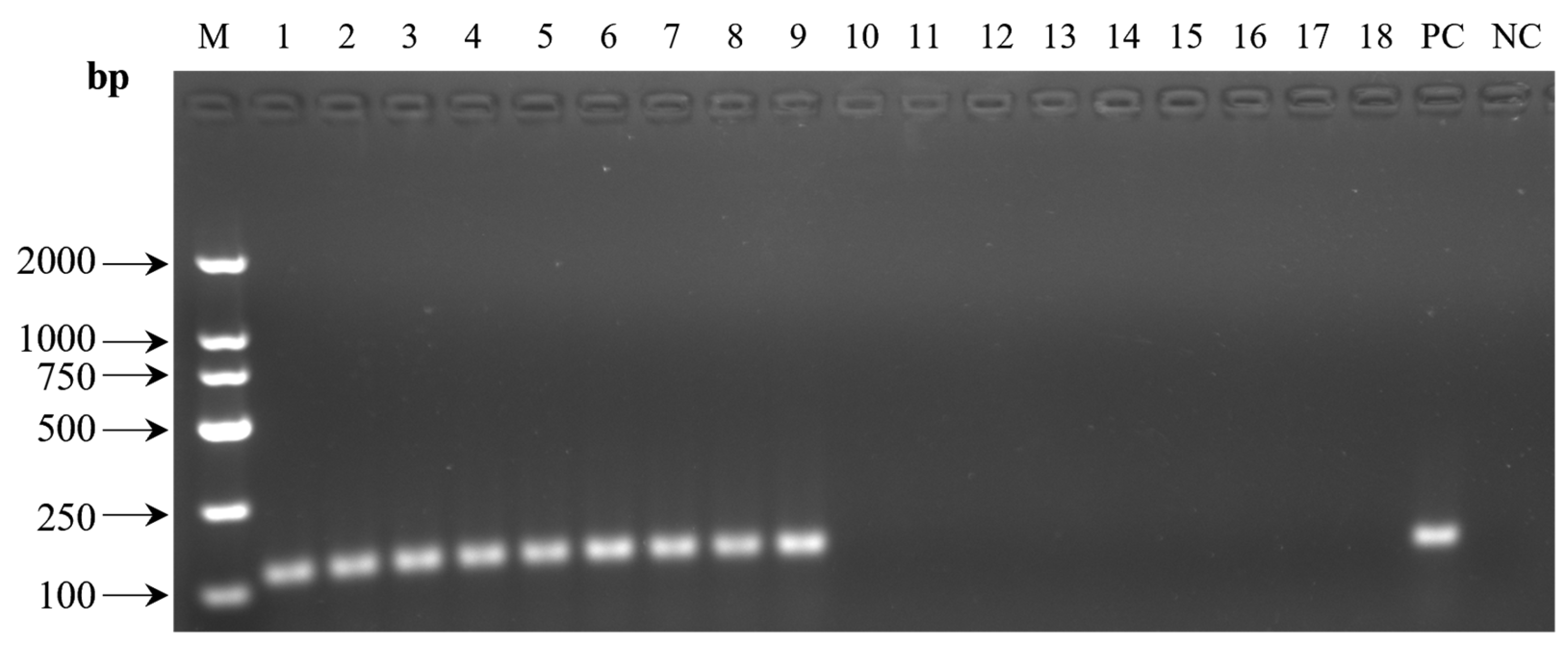
The results of agarose gel electrophoresis showed that the BPIV3 PCR products from the nasal swab cDNA samples of the infected group (lanes 1–9) displayed clear specific bands at the expected molecular weight (122 bp). In contrast, no bands were observed in the target region for the nasal swab cDNA samples from the healthy group (lanes 10–18) and the negative control (NC, lane 19) (Figure 1).

3.2. Global Metabolome Overview and Data Quality

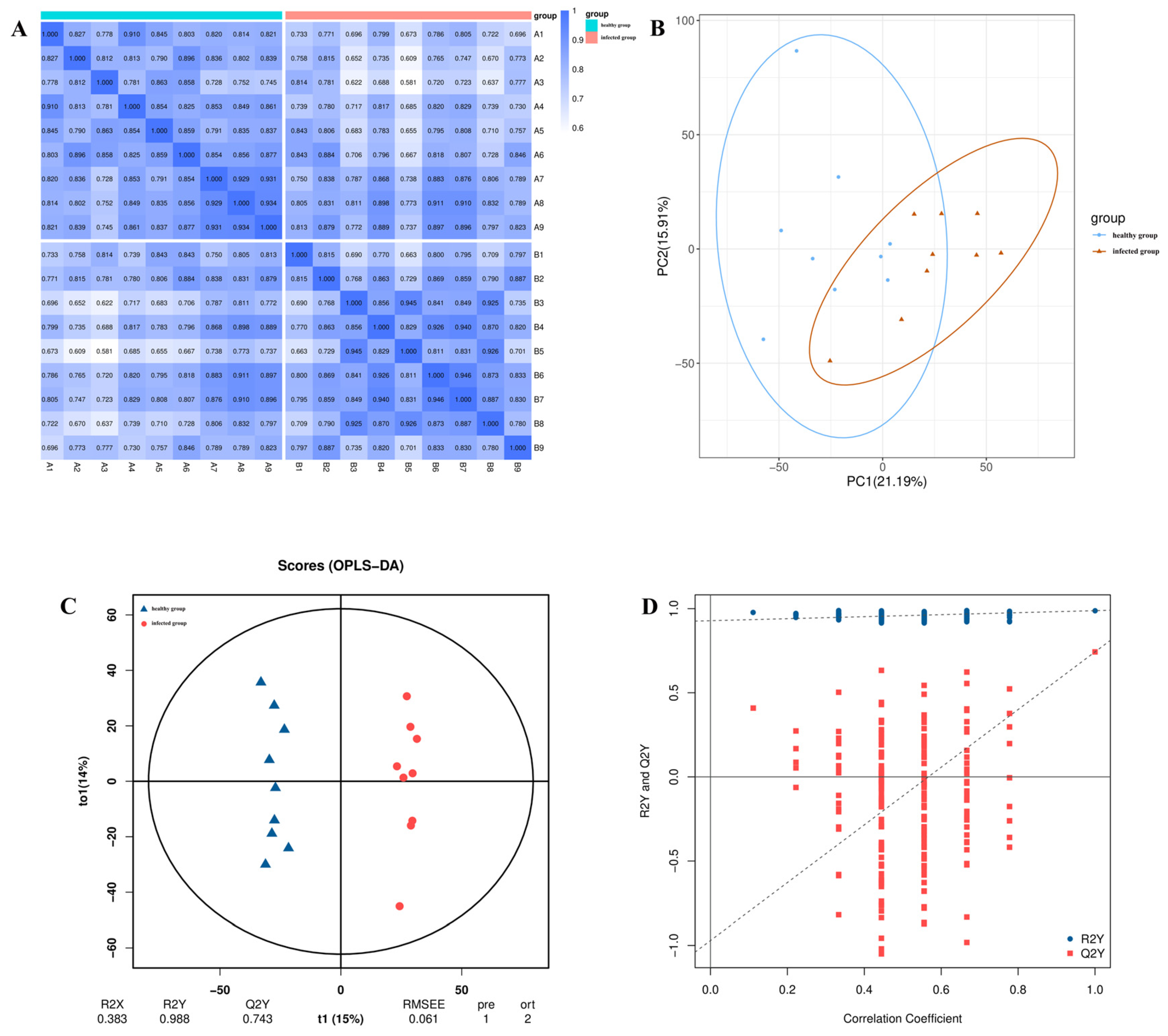
Through untargeted metabolomics analysis, we conducted a comprehensive examination of the serum metabolite profiles of BPIV3-infected and healthy Simmental cattle. To identify differences in metabolite accumulation due to BPIV3 infection, correlation analysis (Figure 2A) and principal component analysis (PCA) (Figure 2B) were performed on the samples. In the correlation analysis, an r value closer to 1 indicates a stronger correlation between duplicate samples. The data reveal that the similarity within the sample group is relatively high, whereas the similarity between groups is lower compared to the intra-group variance. The PCA results show that in the mixed ion mode, PC1 explained 21.19% of the variance, while PC2 explained 15.91%, with the two principal components together accounting for 37.1% of the total variance. Although the cumulative explained variance is moderate, further orthogonal partial least squares discriminant analysis (OPLS-DA) (Figure 2C) and the permutation test (Figure 2D) results clearly demonstrate separation between the healthy and infected groups in both positive and negative ion modes, indicating significant metabolic differences between the two groups.

3.3. Differential Metabolite Identification and Volcano Plot Analysis

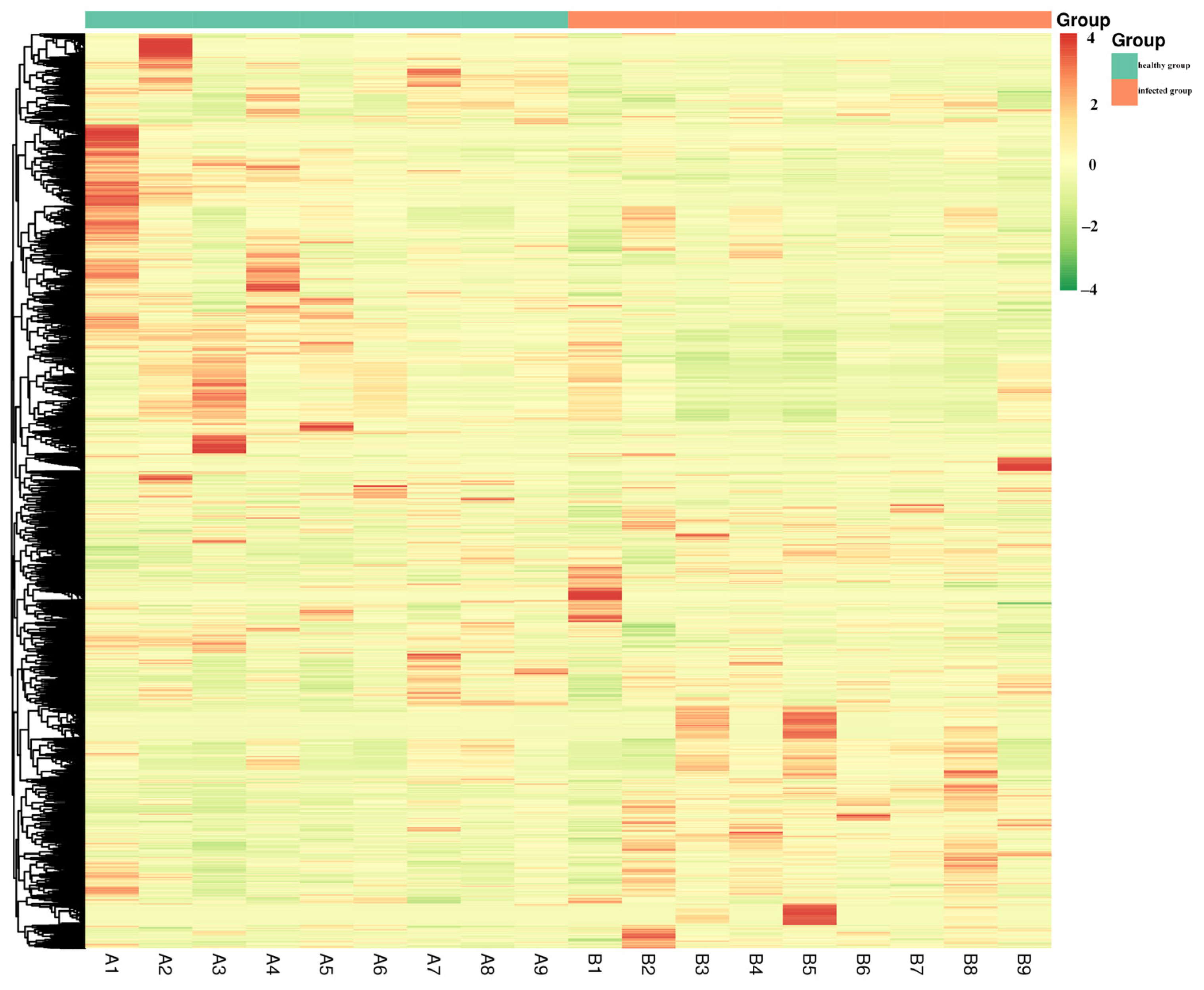
The hierarchical clustering heatmap (Figure 3) presents joint clustering of samples and detected metabolites. The left dendrogram groups metabolites based on similarity, while the top dendrogram clusters samples. Sample annotations indicate group identity: green for healthy and red for infected. The color intensity of each tile reflects the relative abundance, with deeper red indicating stronger upregulation and deeper green representing stronger downregulation. The distinct color patterns observed between the two groups highlight substantial, systematic differences in metabolite levels.
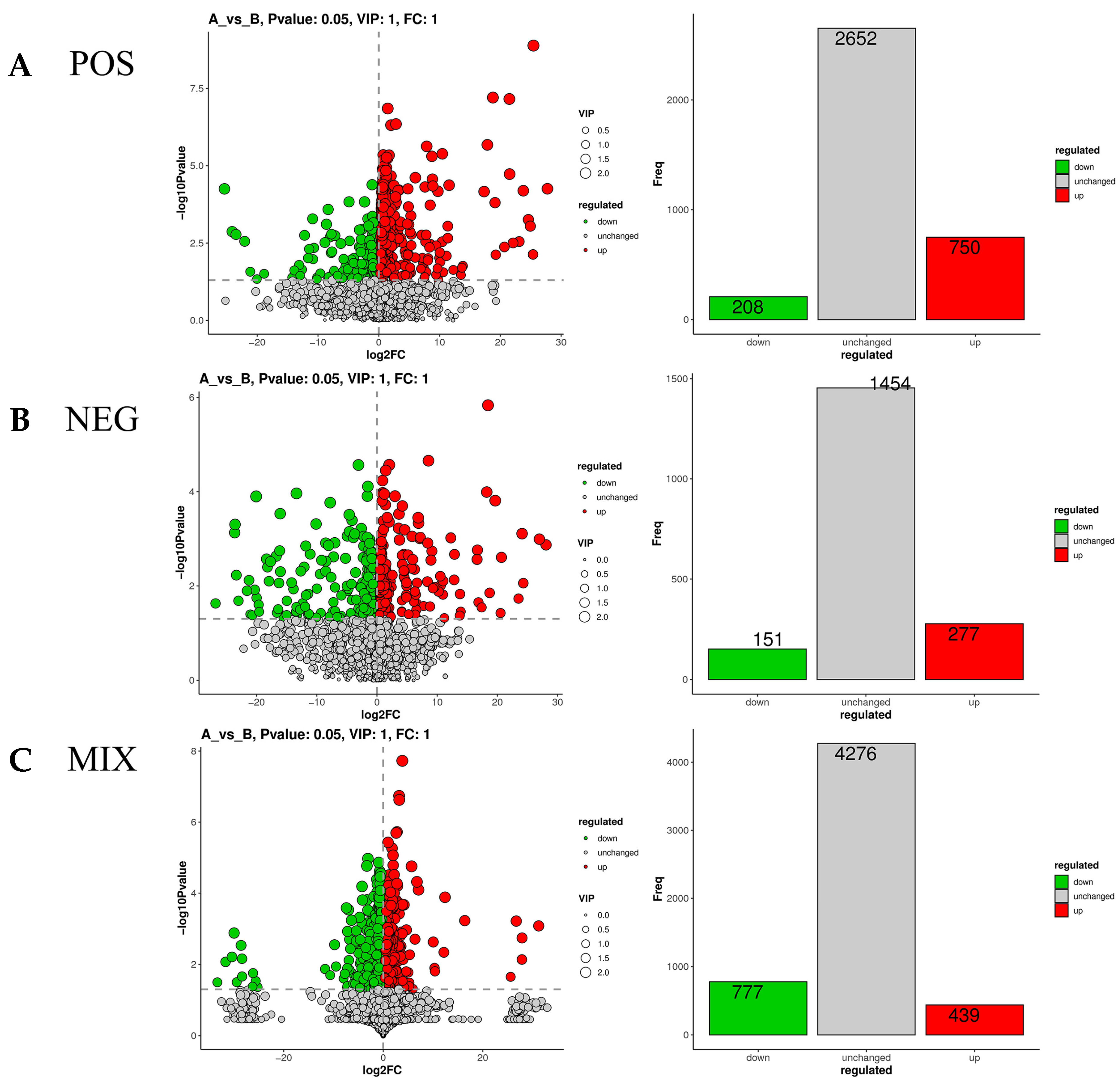
Based on FDR correction (q < 0.05) and VIP > 1 criteria, a total of 1216 significantly different metabolites were identified in the mixed ion mode. Among these, 439 metabolites were significantly upregulated in the infected group, and 777 metabolites were significantly downregulated. A volcano plot (Figure 4) was generated for the selected differential metabolites, with each dot representing a metabolite. The five most significantly upregulated metabolites were Eremosulphoxinolide A, Atrovirinone, Pelargonidin 3-O-[b-D-Glucopyranosyl-(1->2)-[4-hydroxy-3-methoxy-(E)-cinnamoyl-(->6)]-b-D-glucopyranoside]5-O-b-D-glucopyranoside, PC(16:1(9Z)/22:2(13Z,16Z)), and Trihexosylceramide (d18:1/25:0). The five most significantly downregulated metabolites were Mifepristone, Isovalerylglutamic acid, PI(18:0/16:2(9Z,12Z)), Ganolucidic acid D, and Tragopogonsaponin Q.

3.4. Top Differential Metabolites and Their Correlation Patterns

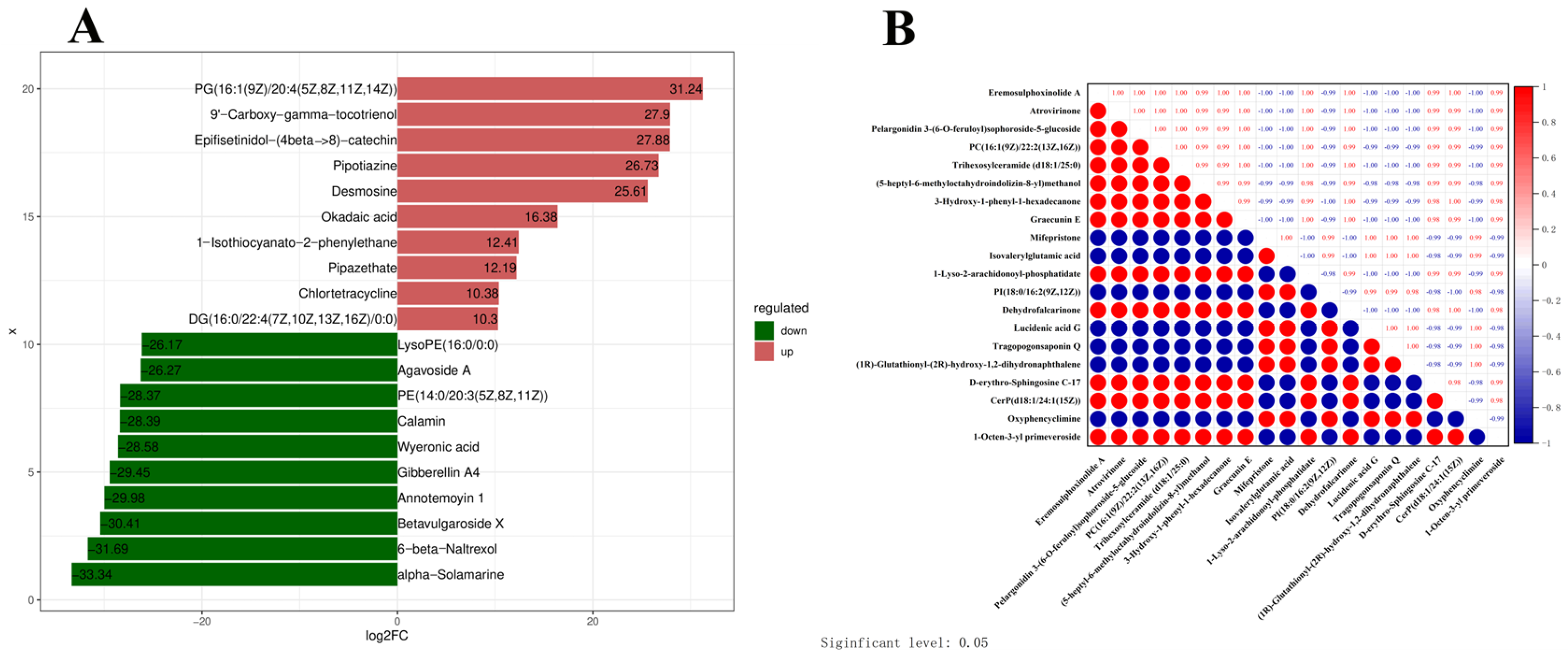
The fold change (FC) in metabolite quantification between the infected and healthy groups, expressed as log2FC, was calculated and compared. The top 10 upregulated and downregulated metabolites in the infected group compared to the healthy group are presented in Figure 5A, with red indicating upregulation (log2FC > 0) and green indicating downregulation (log2FC < 0). The upregulated metabolites include PG (16:1(9Z)/20:4(5Z, 8Z, 11Z, 14Z)), 9′-Carboxy-gamma-tocotrienol, Epifisetinidol-(beta->8)-catechin, Pipolizine, Desmosine, Okadaic acid, 1-Isothiocyanato-2-phenylethane, Pipazethate, Chlortetracycline, and DG (16:0; 22:4(7Z, 10Z, 13Z, 16Z)/0:0). The downregulated metabolites include alpha-Solamarine, 6-beta-Naltrexol, Betavulgaroside X, Anemtomycin 1, Gibberellin A4, Wyeronic acid, Calamin, PE (14:0/20:3(5Z, 8Z, 11Z)), Agavoside A, and LyoPE (16:0/0:0).
The top 20 most significantly different metabolites identified in the mixed-ion mode are listed in Table 2, with notable upregulation of metabolites such as Eremosulphoxinolide A, Atrovirinone, Pelargonidin 3-O-[β-D-Glucopyranosyl-(1->2)-[4-hydroxy-3-methoxy-(E)-cinnamoyl-(->6)]-β-D-glucopyranoside]5-O-β-D-glucopyranoside, PC(16:1(9Z)/22:2 (13Z,16Z)), Trihexosylceramide (d18:1/25:0), and (5-heptyl-6-methyloctahydroindolizin-8-yl)methanol, among others. In contrast, metabolites such as Mifepristone and Isovalerylglutamic acid are significantly downregulated. Of the top 20 differential metabolites, six are lipids, including PC(16:1(9Z)/22:2(13Z,16Z)), Trihexosylceramide (d18:1/25:0), 1-Lyso-2-arachidonoyl-phosphatidate, PI(18:0/16:2(9Z,12Z)), D-erythro-Sphingosine C-17, and CerP(d18:1/24:1(15Z)).
Metabolites may exhibit either synergistic or antagonistic relationships. When metabolites show similar trend changes (i.e., upregulated or downregulated together), they are positively correlated. Conversely, if their trends change in opposite directions, they are negatively correlated. Highly positively correlated metabolite clusters may indicate involvement in shared metabolic pathways or common regulatory mechanisms, while highly negatively correlated clusters may suggest antagonistic or competitive interactions. Figure 5B illustrates the correlation of the top 20 most significantly upregulated differential metabolites. In this figure, a correlation value approaching 1 indicates a strong positive correlation, while a value approaching −1 reflects a strong negative correlation.
Among the differential metabolites, lipids represent a significant category. Notably, PC(16:1(9Z)/22:1(13Z)) is highly positively correlated with Trihexosylceramide (d18:1/25:0), while 1-Lyso-2-arachidonoyl-phosphatidate, PI(18:0/16:2(9Z,12Z)), D-erythro-Sphingosine C-17, and Cer(d18:1/24:1(15Z)) exhibit strong negative correlations. These correlations suggest that, during BPIV3 infection, there are intricate and coordinated changes in these lipid metabolites, potentially linked to the infection’s progression.

3.5. KEGG Enrichment and Directionality Across Ion Modes Reveal Network-Level Metabolic Remodeling in BPIV3-Infected Simmental Cattle

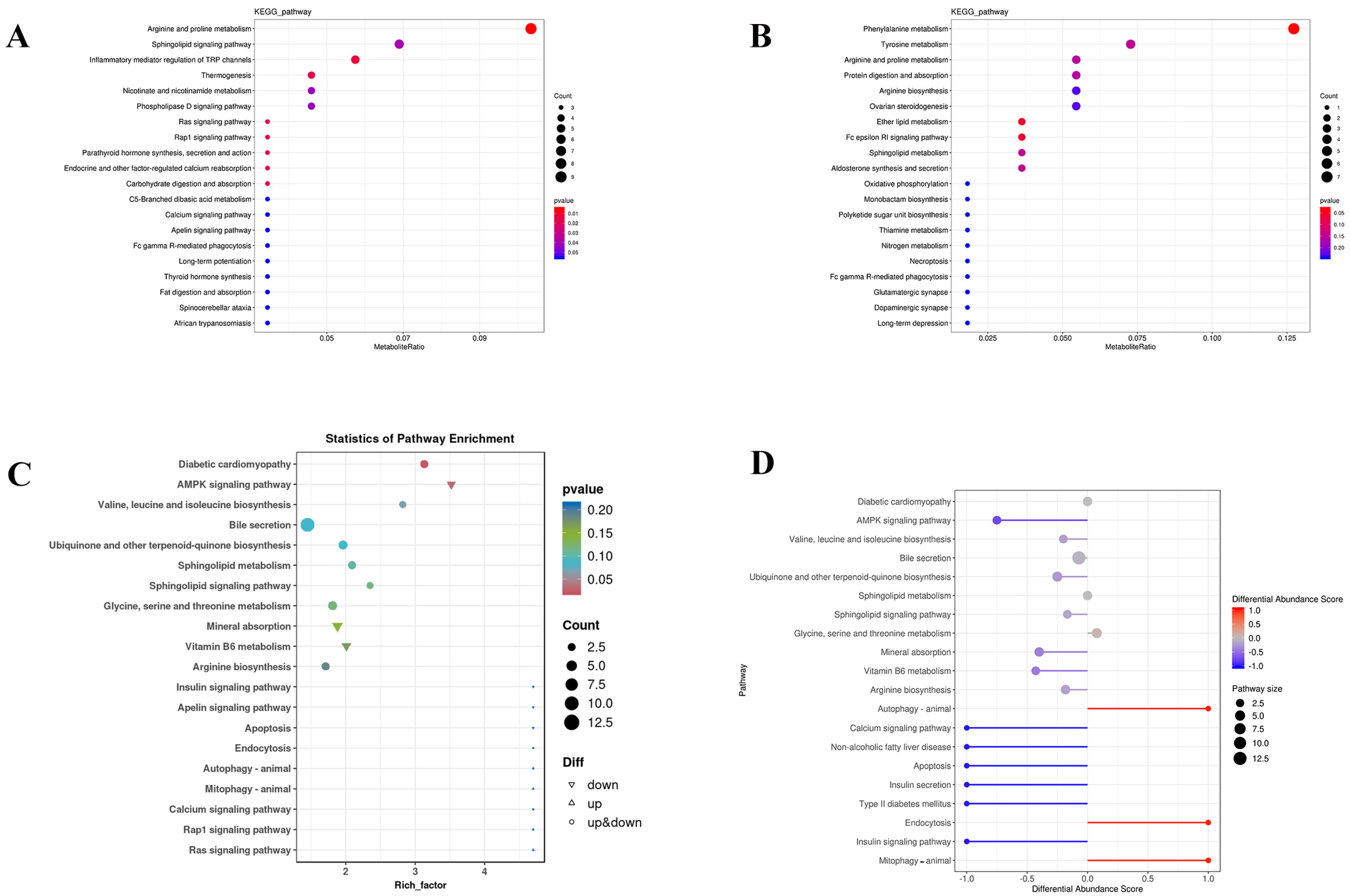
KEGG metabolic pathway enrichment analysis was conducted on the differential metabolites identified in BPIV3-infected Simmental cattle compared to healthy controls. The analysis was based on the list of significantly different metabolites after FDR correction (q < 0.05), with statistical significance set at p < 0.05. Enriched pathways in both positive and negative ion modes are summarized in Figure 6. In the positive ion mode (Figure 6A), the most enriched pathways include parathyroid hormone synthesis, secretion, and action, phospholipase D signaling pathway, and nicotinate and nicotinamide metabolism. In the negative ion mode (Figure 6B), the most enriched pathways include long-term depression, dopaminergic synapse, and ovarian steroidogenesis, among others. Figure 6C shows the enrichment dot plot for the mixed ion mode, where the size of each dot is proportional to the scale of the metabolic pathway. The numbers on the x-axis represent the proportion of differential metabolites relative to the total metabolites within each pathway. The differential pathways between the healthy and infected groups are shown by the differential abundance scores (Figure 6D). The vertical axis lists the names of the top 20 differential metabolic pathways, arranged in descending order based on the differential abundance score. The horizontal axis represents the Differential Abundance Score (DAS), with the size of each dot reflecting the scale of the metabolic pathway. A DAS closer to 1 indicates a higher proportion of upregulated differential metabolites in the pathway, while a DAS closer to −1 indicates a higher proportion of downregulated metabolites. Among the pathways displayed, autophagy, apoptosis, and mitophagy have differential abundance scores approaching 1, suggesting an enrichment of upregulated metabolites in these pathways.
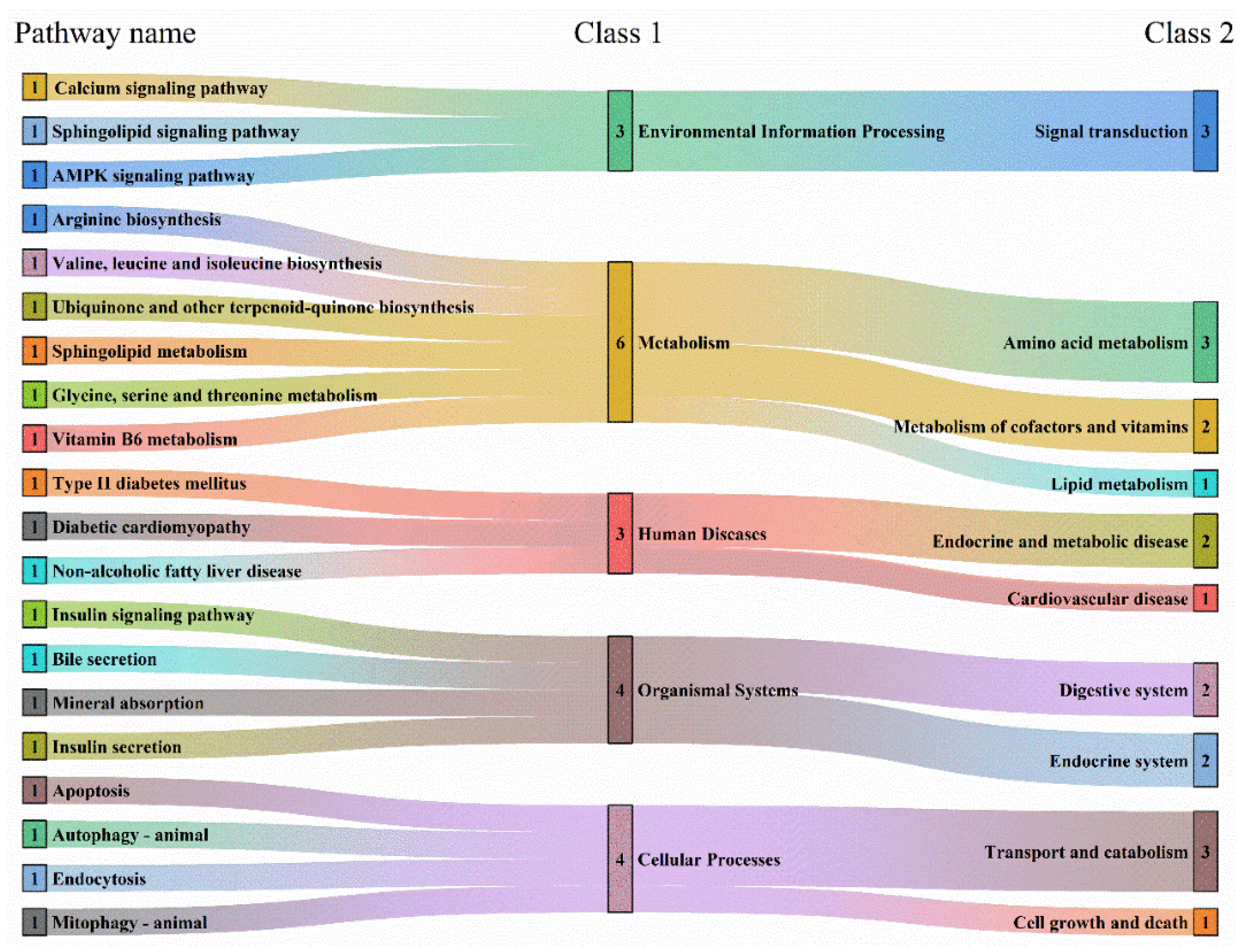
The basic information for the 20 metabolic pathways is summarized in Table 3, while the relationships among the differential metabolic pathways are illustrated more intuitively in a Sankey diagram (Figure 7). Among the top 20 enriched pathways, six belong to the Metabolism category, including Arginine biosynthesis, Valine, leucine, and isoleucine biosynthesis, Ubiquinone and other terpenoid-quinone biosynthesis, Sphingolipid metabolism, Glycine, serine, and threonine metabolism, and Vitamin B6 metabolism.

3.6. Global Behavior of Phosphatidylinositol Species

To determine whether phosphatidylinositol (PI) depletion represents a global feature rather than a single-species effect, we performed targeted univariate analysis of all annotated PI species and related metabolites in the dataset. In total, 19 distinct PI species were identified in serum. Among these, 7 species showed significant decreases in BPIV3-infected animals compared with healthy controls, including PI(16:0/18:0), PI(16:0/18:1), PI(16:0/20:4), PI(18:0/16:2), PI(18:0/20:3), PI(18:2/20:1) and PI(22:3/18:3), with log2 fold changes ranging from −0.57 to −9.79 (P = 0.020 − 1.71 × 10⁻⁵). Nine PI species exhibited no significant change, and three species showed inconsistent trends between groups. Overall, the direction of change across the PI panel was biased toward down-regulation. In contrast, the PI-derived metabolite arachidonic acid did not change significantly (log2FC = 0.034, p = 0.70), and all four annotated lysophosphatidylinositol/phosphatidic acid (LPI/PA) intermediates also remained statistically unchanged (Table 3).

4. Discussion

This study, based on untargeted metabolomics, revealed a systematic remodeling of serum lipid profiles in Simmental cattle infected with BPIV3. PCR was employed to confirm the infection status (Figure 1). The distinction of metabolic profiles between the infected and healthy groups, along with model stability, was supported by correlation analysis, principal component analysis (PCA), orthogonal partial least squares discriminant analysis (OPLS-DA), permutation tests (Figure 2A–D), and clustering heatmaps (Figure 3), providing a reliable foundation for subsequent differential screening and mechanistic interpretation.
Phospholipids, as the primary building blocks of the lipid bilayer in cell mem-branes, play a critical role in maintaining membrane structural integrity, fluidity, and the accessibility of signaling molecules through their metabolic state [10,11,12,13]. In this study, PG(16: 1 (9Z)/20: 4(5Z, 8Z, 11Z, 14Z)) and PC(16:1(9Z)/22:2(13Z,16Z)) were significantly upregulated (log2FC = 2.76, p < 0.001), while phosphatidylinositol PI(18:0/16:2(9Z,12Z)) was markedly downregulated (log2FC = −3.29, p < 0.001) (Figure 4, Table 2), indicating that BPIV3 remodels the host membrane system by differentially regulating phospholipid subclasses.
The targeted analysis of PI species further refines the interpretation of our lipidomic findings. Although not all PI molecules were significantly altered, the fact that 7 of 19 annotated species were decreased, while the remainder were largely unchanged or showed no consistent direction, indicates that PI depletion is not restricted to a single outlier but reflects a broader tendency toward contraction of the circulating PI pool in BPIV3-infected cattle. By contrast, the absence of significant changes in arachidonic acid and LPI/PA intermediates suggests that classical PI breakdown products do not accumulate in serum, which may point to rapid downstream metabolism or to compartmentalized PI turnover at specific membrane sites that is only partially captured systemically. Taken together, these patterns are consistent with a selective reorganization of PI-centered lipid networks, superimposed on increased PG and PC species, and may be relevant to the modulation of membrane-associated signaling and innate antiviral responses during BPIV3 infection.
These phospholipid changes can be viewed in the broader context of viral “membrane hijacking.” Many positive-sense RNA viruses manipulate host phospholipid synthesis to generate viral replication complexes (VRCs) and vesicular transport structures [14,15,16]. For example, hepatitis C virus recruits phosphatidylinositol 4-kinase IIIα (PI4KIIIα) to enrich phosphatidylinositol 4-phosphate (PI4P) at endoplasmic reticulum membranes, promoting the formation of network-like structures that support viral RNA replication [17]. The envelope protein E of dengue virus (DENV) binds negatively charged phospholipids such as phosphatidylserine to facilitate fusion with host cell membranes [18,19], and DENV infection has been shown to induce substantial phospholipid reprogramming in both mosquito vectors and mammalian hosts [20,21,22,23,24]. Modulation of de novo phospholipid synthesis can influence viral yield [25], highlighting the functional relevance of phospholipid metabolism in positive-sense RNA virus replication. In this framework, the increased PG and PC species observed here may increase the availability of lipid substrates compatible with the formation of replication- or budding-related membrane microdomains, whereas decreased PI could, in principle, destabilize PI4P-enriched domains and thereby influence lipid raft organization and BPIV3 HN protein–mediated membrane fusion [3]. These mechanistic links remain hypothetical and require direct experimental validation.
Negative-sense RNA viruses also rely on host membranes, but the magnitude and pattern of lipid remodeling appear more restrained than in many positive-sense RNA virus models. Respiratory syncytial virus (RSV), influenza virus, and Ebola virus assemble progeny virions at the plasma membrane [10,11,12,13,14,15,16,17]. In influenza virus infection, host lipid metabolism is markedly perturbed [18,19], and particle assembly occurs at cholesterol- and sphingolipid-rich regions of the plasma membrane (budozones) that share key features with lipid rafts and support interactions between viral and host proteins [12,20,21]. In addition, acidic phospholipids are important determinants of influenza virus assembly and budding, and their abundance can be modulated during infection [22,23]. Newcastle disease virus (NDV) infection has been reported to deplete cellular lipids and activate genes related to the sphingolipid “rheostat,” with upregulation of sphingomyelin synthase promoting ceramide accumulation and supporting viral assembly and replication [24]. Experimental BPIV3 inoculation in calves was previously shown to decrease the proportion of phosphatidylcholine in lung lavage fluid [25], further indicating that negative-sense RNA viruses can selectively reshape surfactant and membrane-associated lipid pools, even though the overall extent of lipidome remodeling is often less dramatic than that described for many positive-sense RNA viruses. Importantly, our data are derived from serum lipids rather than direct membrane extracts, and therefore should be interpreted as reflecting systemic lipid reprogramming associated with BPIV3 infection rather than direct proof of extensive cellular membrane remodeling.
In vivo lipidomic studies further indicate that systemic phospholipid remodeling is a recurrent feature of RNA virus infection. In chickens, Dai et al. combined targeted metabolomics with single-cell transcriptomics and showed that Newcastle disease virus (NDV) infection was accompanied by broad changes in plasma phospholipid metabolism, with the velogenic Herts/33 strain associated with global decreases in ceramide, diacylglycerol, triglycerides, sphingomyelin, phosphatidylcholine (PC), phosphatidylethanolamine (PE), phosphatidylinositol (PI), phosphatidylserine (PS) and phosphatidic acid (PA), whereas the lentogenic LaSota strain tended to induce opposite trends; moreover, plasma diacylglycerol levels correlated with the expression of metabolic enzymes in pulmonary endothelial and interstitial cells, linking circulating lipids to tissue-level metabolic reprogramming [24]. In adult patients with laboratory-confirmed influenza A(H1N1), Li et al. reported pronounced disturbances of plasma glycerophospholipid metabolism, in which more than 80% of differential glycerophospholipids—including several PC and LysoPC species—were down-regulated relative to healthy controls and showed graded changes across severity strata, with LysoPC(20:0/0:0) negatively associated with inflammatory markers and positively associated with lymphocyte counts [26]. Together with earlier work highlighting the contribution of phospholipid and sphingolipid remodeling to influenza pathogenesis and host responses [19,27,28,29], these findings suggest that the alterations in circulating PC, PI and related subclasses observed in BPIV3-infected cattle are part of a broader pattern of virus-associated perturbations in host lipid homeostasis, and may reflect a combination of local membrane remodeling in target tissues and systemic inflammatory or immune status rather than a BPIV3-specific phenomenon.
Phosphatidylinositol itself has been identified as an anionic pulmonary surfactant lipid with strong antiviral activity against RSV. Numata et al. demonstrated that PI liposomes bind RSV with high affinity, reduce IL-8 production, and decrease RSV infection by more than 103-fold in BEAS-2B cells; in mice, co-administration or prophylactic administration of PI markedly lowered viral load, inflammatory cell recruitment and tissue damage [30]. Together with phosphatidylglycerol, PI thus functions as a component of innate immune defense in the lung. In this light, the depletion of multiple PI species and the simultaneous activation of the sphingolipid axis observed in our study may indicate that BPIV3 infection engages lipid pathways that are also implicated in other negative-sense RNA virus infections and in surfactant-mediated antiviral protection. However, further work using cell-based infection models and compartment-specific lipidomics will be necessary to clarify how serum PI changes relate to local lipid dynamics at the respiratory epithelium and immune effector sites.
Beyond glycerophospholipids, we also observed a characteristic pattern within the sphingolipid axis. The increase in trihexosylceramide, sphingosine and several ceramide species, together with changes in sphingomyelin, is compatible with activation of a ceramide-centered “rheostat” similar to that described for NDV [24]. Ceramides and complex glycosphingolipids are known to participate in raft organization, receptor clustering, and apoptotic or stress signaling, and have been implicated in the life cycles of multiple respiratory viruses. In our data, the relative enrichment of ceramide and sphingosine, accompanied by altered sphingomyelin and trihexosylceramide, may reflect a shift toward a pro-fusion and pro-assembly lipid environment, as well as modulation of inflammatory signaling in BPIV3-infected cattle. From a translational perspective, these observations raise the possibility that targeting sphingolipid synthesis (for example, by inhibiting specific sphingomyelin synthase isoforms) or ceramide trafficking could modulate BPIV3 assembly and budding, although this notion remains to be tested experimentally.
In addition to lipid changes, the downregulation of branched-chain amino acid (BCAA)-related metabolites, such as isovaleric acid and 3-methyl-2-oxovaleric acid, suggests that BPIV3 infection is associated with altered amino acid and energy metabolism. BCAAs are important substrates for the tricarboxylic acid (TCA) cycle and can influence cellular redox balance, mTOR/AMPK signaling, and autophagy. The decreased levels of BCAA catabolites in infected animals may indicate increased utilization of these substrates for energy production or stress adaptation, or a shift in hepatic and muscular amino acid handling during infection. Previous studies have shown that activation of AMPK and autophagy can either support or restrict viral replication depending on the virus and cellular context. In BPIV3 infection, it will be important to determine whether changes in BCAA metabolism are linked to AMPK signaling and autophagic flux in respiratory epithelial cells and immune cells, and whether these pathways influence viral replication efficiency. Our metabolomic data provide a rationale for such mechanistic studies but do not yet allow for definitive conclusions about causal relationships.
We acknowledge several limitations of this study. First, serum lipids mainly reflect lipoprotein-associated pools and systemic metabolic responses rather than direct extracts from specific cellular membranes. As a result, the observed alterations in PC, PG, PI and sphingolipids should be interpreted as evidence of systemic lipid reprogramming associated with BPIV3 infection, not as direct proof of localized membrane remodeling. Second, because the animals included in this study were naturally infected and exhibited clinical signs, it is difficult to fully disentangle the effects of viral replication from those of reduced feed intake, fever, inflammation and other stressors that can independently influence host metabolism, particularly lipid and energy pathways. Finally, our analyses were performed at a single time point, which precludes assessment of the temporal dynamics of metabolic changes during the course of infection and recovery.
While we cannot completely separate the contributions of BPIV3 infection and illness-related metabolic stress, the resemblance of our lipidomic findings to patterns reported in other viral infections is compatible with a role for direct viral reprogramming of host lipid metabolism, in addition to generalized responses to disease. In conclusion, despite these limitations, our study provides an initial system-level view of serum lipid and metabolite perturbations in BPIV3-infected cattle, highlighting coordinated alterations in PI, PG, PC and sphingolipid pathways, as well as changes in BCAA-related metabolites. These results generate testable hypotheses regarding the involvement of specific lipid and amino acid networks in BPIV3 pathogenesis and may help guide future work aimed at identifying biomarkers of infection and potential metabolic intervention targets.

Author Contributions

Methodology: S.W. and Y.S. Writing—Original draft: S.W. and J.Z. Writing—Review and editing: S.W., J.Z., N.L., D.T., L.M., Z.G. and Y.S. All authors have read and agreed to the published version of the manuscript.

Funding

This research was funded by the Young Scientific and Technological Talents in Inner Mongolia (No. NJYT23095, NJYT22053), the National Natural Science Foundation of China (No. 32260848), the Natural Science Foundation of Inner Mongolia (No. 2022LHQN03009, 2024MS03002), the Innovation and Entrepreneurship Program for Returned Overseas Scholars in Inner Mongolia (No. 2024LXCX002), the 2024 Horqin Talent Program (No. KEQYC240108), the Inner Mongolia Science and Technology Tackling Project (No. 2025YFDZ0129), and the Central Guidance for Local Science and Technology Development Funds Project (No. 2025ZY0045).

Institutional Review Board Statement

The animal study protocol was approved by the Institutional Review Board of the Institutional Animal Care and Use Committee of Inner Mongolia Minzu University, Tongliao, China (NMD-DW-2024-12-33, Approval Date: 30 December 2024).

Informed Consent Statement

Informed consent was obtained from all owners involved in the study.

Data Availability Statement

The original contributions presented in this study are included in the article. Further inquiries can be directed to the corresponding author.

Conflicts of Interest

The authors declare no conflicts of interest.

Abbreviations

The following abbreviations are used in this manuscript:
BPIV3Bovine Parainfluenza Virus Type 3
BRDCBovine Respiratory Disease Complex
UPLC-QTOF-MS/MSultra-performance liquid chromatography-quadrupole time-of-flight mass spectrometry
PCphosphatidylcholine
PGphosphatidylglycerol
PIphosphatidylinositol
HNhemagglutinin-neuraminidase
ERendoplasmic reticulum
PCRpolymerase chain reaction
IBRVinfectious bovine rhinotracheitis virus
BVDVbovine viral diarrhea virus
BRSVbovine respiratory syncytial virus
OPLS-DAorthogonal partial least squares discriminant analysis
PCAprincipal component analysis
VIPvariable importance in projection
KEGGKyoto Encyclopedia of Genes and Genomes
FCfold change
FDRfalse discovery rate
DEMdifferential metabolites
LPAlysophosphatidic acid
PRRSVporcine reproductive and respiratory syndrome virus
RIG-Iretinoic acid-inducible gene I
SMS2sphingomyelin synthase 2
BCAAbranched-chain amino acids
AMPKAMP-activated protein kinase

References

  1. Makoschey, B.; Berge, A.C. Review on bovine respiratory syncytial virus and bovine parainfluenza—Usual suspects in bovine respiratory disease—A narrative review. BMC Vet. Res. 2021, 17, 261. [Google Scholar] [CrossRef]
  2. Werid, G.M.; Van, T.D.; Miller, D.; Hemmatzadeh, F.; Fulton, R.W.; Kirkwood, R.; Petrovski, K. Bovine Parainfluenza-3 Virus Detection Methods and Prevalence in Cattle: A Systematic Review and Meta-Analysis. Animals 2024, 14, 494. [Google Scholar] [CrossRef] [PubMed]
  3. Li, L.; Yu, L.; Hou, X. Cholesterol-rich lipid rafts play a critical role in bovine parainfluenza virus type 3 (BPIV3) infection. Res. Vet. Sci. 2017, 114, 341–347. [Google Scholar] [CrossRef] [PubMed]
  4. Blodörn, K.; Hägglund, S.; Gavier-Widen, D.; Eléouët, J.-F.; Riffault, S.; Pringle, J.; Taylor, G.; Valarcher, J.F. A bovine respiratory syncytial virus model with high clinical expression in calves with specific passive immunity. BMC Vet. Res. 2015, 11, 76. [Google Scholar] [CrossRef] [PubMed]
  5. Han, Y.; Wang, C.; Bai, C.; Diao, E.; Yuan, B.; Lu, K.; Dong, X.; Zhang, R.; Han, B.; Liu, H.; et al. Bovine parainfluenza virus type 3 infections induce ER stress-mediated autophagy to facilitate virus replication. Vet. Microbiol. 2024, 292, 110051. [Google Scholar] [CrossRef]
  6. Yang, S.; Wang, Q.Y.; Tan, B.; Shi, P.-F.; Qiao, L.-J.; Li, Z.-J.; Liu, K.-X.; Cao, Z.-G.; Zhang, S.-Q.; Sun, F.-Y. A lateral flow dipstick combined with reverse transcription recombinase polymerase amplification for rapid and visual detection of the BVDV and BPIV3. J. Virol. Methods 2022, 299, 114343. [Google Scholar] [CrossRef]
  7. Rivera-Velez, S.M.; Navas, J.; Villarino, N.F. Applying metabolomics to veterinary pharmacology and therapeutics. J. Vet. Pharmacol. Ther. 2021, 44, 855–869. [Google Scholar] [CrossRef]
  8. Qi, J.; Huang, F.; Gan, L.; Zhou, X.; Gou, L.; Xie, Y.; Guo, H.; Fang, J.; Zuo, Z. Multi-omics investigation into long-distance road transportation effects on respiratory health and immunometabolic responses in calves. Microbiome 2024, 12, 242. [Google Scholar] [CrossRef]
  9. Zhao, P.; Wu, Y.; Li, X.; Huangfu, M.; Chen, Z.; Chen, H.; Simujide; Wang, C.; Li, C.; Bao, H.; et al. Differences in Protein Metabolism, Immune Function and Antioxidant Capacity of Chinese Simmental Cattle and Their Hybrid Cattle. Chin. J. Anim. Nutr. 2023, 35, 3061–3068. [Google Scholar] [CrossRef]
  10. Roberts, S.R.; Compans, R.W.; Wertz, G.W. Respiratory syncytial virus matures at the apical surfaces of polarized epithelial cells. J. Virol. 1995, 69, 2667–2673. [Google Scholar] [CrossRef]
  11. Cardoso, R.S.; Tavares, L.A.; Jesus, B.L.S.; Criado, M.F.; de Carvalho, A.N.; Souza, J.d.P.; Bedi, S.; de Souza, M.M.; Silva, M.L.; Lanfredi, G.P.; et al. Host Retromer Protein Sorting Nexin 2 Interacts with Human Respiratory Syncytial Virus Structural Proteins and is Required for Efficient Viral Production. mBio 2020, 11, e01869-20. [Google Scholar] [CrossRef] [PubMed]
  12. Rossman, J.S.; Lamb, R.A. Influenza virus assembly and budding. Virology 2011, 411, 229–236. [Google Scholar] [CrossRef] [PubMed]
  13. Bedi, S.; Noda, T.; Kawaoka, Y.; Ono, A. A Defect in Influenza A Virus Particle Assembly Specific to Primary Human Macrophages. mBio 2018, 9, e01916-18. [Google Scholar] [CrossRef] [PubMed]
  14. Nayak, D.P.; Balogun, R.A.; Yamada, H.; Zhou, Z.H.; Barman, S. Influenza virus morphogenesis and budding. Virus Res. 2009, 143, 147–161. [Google Scholar] [CrossRef]
  15. Geisbert, T.W.; Jahrling, P.B. Differentiation of filoviruses by electron microscopy. Virus Res. 1995, 39, 129–150. [Google Scholar] [CrossRef]
  16. Noda, T.; Ebihara, H.; Muramoto, Y.; Fujii, K.; Takada, A.; Sagara, H.; Kim, J.H.; Kida, H.; Feldmann, H.; Kawaoka, Y. Assembly and budding of Ebolavirus. PLoS Pathog. 2006, 2, e99. [Google Scholar] [CrossRef]
  17. Dolnik, O.; Becker, S. Assembly and transport of filovirus nucleocapsids. PLoS Pathog. 2022, 18, e1010616. [Google Scholar] [CrossRef]
  18. Tam, V.C.; Quehenberger, O.; Oshansky, C.M.; Suen, R.; Armando, A.M.; Treuting, P.M.; Thomas, P.G.; Dennis, E.A.; Aderem, A. Lipidomic profiling of influenza infection identifies mediators that induce and resolve inflammation. Cell 2013, 154, 213–227. [Google Scholar] [CrossRef]
  19. Tisoncik-Go, J.; Gasper, D.J.; Kyle, J.E.; Eisfeld, A.J.; Selinger, C.; Hatta, M.; Morrison, J.; Korth, M.J.; Zink, E.M.; Kim, Y.-M.; et al. Integrated Omics Analysis of Pathogenic Host Responses during Pandemic H1N1 Influenza Virus Infection: The Crucial Role of Lipid Metabolism. Cell Host Microbe 2016, 19, 254–266. [Google Scholar] [CrossRef]
  20. Veit, M.; Engel, S.; Thaa, B.; Scolari, S.; Herrmann, A. Lipid domain association of influenza virus proteins detected by dynamic fluorescence microscopy techniques. Cell Microbiol. 2013, 15, 179–189. [Google Scholar] [CrossRef]
  21. Zhang, J.; Pekosz, A.; Lamb, R.A. Influenza virus assembly and lipid raft microdomains: A role for the cytoplasmic tails of the spike glycoproteins. J. Virol. 2000, 74, 4634–4644. [Google Scholar] [CrossRef]
  22. Petrich, A.; Chiantia, S. Influenza A Virus Infection Alters Lipid Packing and Surface Electrostatic Potential of the Host Plasma Membrane. Viruses 2023, 15, 1830. [Google Scholar] [CrossRef] [PubMed]
  23. Raut, P.; Weller, S.R.; Obeng, B.; Soos, B.L.; West, B.E.; Potts, C.M.; Sangroula, S.; Kinney, M.S.; Burnell, J.E.; King, B.L.; et al. Cetylpyridinium chloride (CPC) reduces zebrafish mortality from influenza infection: Super-resolution microscopy reveals CPC interference with multiple protein interactions with phosphatidylinositol 4,5-bisphosphate in immune function. Toxicol. Appl. Pharmacol. 2022, 440, 115913. [Google Scholar] [CrossRef] [PubMed]
  24. Dai, J.; Qiu, X.; Cui, X.; Feng, Y.; Hou, Y.; Sun, Y.; Liao, Y.; Tan, L.; Song, C.; Liu, W.; et al. Newcastle disease virus infection remodels plasma phospholipid metabolism in chickens. iScience 2024, 27, 108962. [Google Scholar] [CrossRef] [PubMed]
  25. Engen, R.L.; Brown, T.T., Jr. Changes in phospholipids of alveolar lining material in calves after aerosol exposure to bovine herpesvirus-1 or parainfluenza-3 virus. Am. J. Vet. Res. 1991, 52, 675–677. [Google Scholar] [CrossRef]
  26. Li, Y.; Li, T.; Liu, M.; Wang, X.; Zhai, S.; Qin, R.; Liu, C.; Chen, Y.; Zhang, M.; Jia, X. Metabolomic and clinical feature analyses of plasma from influenza A patients. Sci. Rep. 2025, 15, 42616. [Google Scholar] [CrossRef]
  27. Tanner, L.B.; Chng, C.; Guan, X.L.; Lei, Z.; Rozen, S.G.; Wenk, M.R. Lipidomics identifies a requirement for peroxisomal function during influenza virus replication. J. Lipid Res. 2014, 55, 1357–1365. [Google Scholar] [CrossRef]
  28. Banoei, M.M.; Vogel, H.J.; Weljie, A.M.; Kumar, A.; Yende, S.; Angus, D.C.; Winston, B.W.; Canadian Critical Care Translational Biology Group (CCCTBG). Plasma metabolomics for the diagnosis and prognosis of H1N1 influenza pneumonia. Crit. Care 2017, 21, 97. [Google Scholar] [CrossRef]
  29. Wu, D.; Shu, T.; Yang, X.; Song, J.X.; Zhang, M.; Yao, C.; Liu, W.; Huang, M.; Yu, Y.; Yang, Q.; et al. Plasma metabolomic and lipidomic alterations associated with COVID-19. Natl. Sci. Rev. 2020, 7, 1157–1168. [Google Scholar] [CrossRef]
  30. Numata, M.; Kandasamy, P.; Nagashima, Y.; Fickes, R.; Murphy, R.C.; Voelker, D.R. Phosphatidylinositol inhibits respiratory syncytial virus infection. J. Lipid Res. 2015, 56, 578–587. [Google Scholar] [CrossRef]
Figure 1. Result of PCR detection for BPIV3. M DL2000 marker; 1–18 the nasal swab samples of Simmental heifers; PC the positive control; NC the negative control.
Microorganisms 14 00252 g001
Figure 2. Sample Grouping and Model Validation Based on PCA and OPLS-DA Analysis. (A) Correlation heatmap between samples under mixed ion mode. Both axes represent sample names, colored by group. The color intensity in each cell indicates the Pearson correlation coefficient (r). Bold numbers denote correlations that are statistically significant (p < 0.05). (B) Principal component analysis (PCA) score plot. The X-axis (PC1) and Y-axis (PC2) explain 21.19% and 15.91% of the variance, respectively. Each point represents an individual sample, colored by group. Dashed ellipses outline the 95% confidence interval for each group, showing a clear separation trend. (C) Orthogonal partial least squares-discriminant analysis (OPLS-DA) score plot (R2X = 0.383, R2Y = 0.988, Q2Y = 0.743, RMSEP = 0.061), demonstrating clear inter-group discrimination. The dashed ellipse represents the 95% confidence interval for the modeled groups. (D) Permutation test plot (n = 200) for validating the OPLS-DA model. The horizontal dashed line indicates the threshold for a significant model (Q2 > 0.5). The results confirm the robustness of the model, as most permuted Q2 values (red squares) are below the original R2Y (blue square).
Microorganisms 14 00252 g002
Figure 3. Heat map of DEM. The horizontal axis represents individual samples, labeled A1 to A9 (healthy group, blue-green bar) and B1 to B9 (infected group, red bar). The vertical axis represents differentially abundant metabolites identified by multivariate statistical analysis. “Group” refers to the sample grouping. Different colors represent the values obtained after normalization of relative content, with red indicating high content and green indicating low content. The selection criteria for differential metabolites were VIP > 1 and p < 0.05.
Microorganisms 14 00252 g003
Figure 4. Volcano plot of metabolites. (A) Volcano plot of metabolites in positive-ion mode. (B) Volcano plot of metabolites in negative-ion mode. (C) Volcano plot of metabolites in mixed-ion mode. Significant DEM (VIP > 1 and p < 0.05) are in red (upregulated) and green (downregulated), whereas other metabolites are colored in gray.
Microorganisms 14 00252 g004
Figure 5. Analysis of metabolomic signatures and correlations of the 20 most significant differential metabolites (DEMs) in cattle during BPIV3 infection. (A) Twenty most significant DEM at day 10 during BPIV3 infection. The horizontal axis represents the log2FC of DEM, red represents an increase in metabolite content, and green represents a decrease in metabolite content. (B) the correlation among the top 20 significantly upregulated differential metabolites during BPIV3 infection. When two metabolites are positively correlated, their correlation coefficient approaches 1, indicating that their trends change in the same direction. When negatively correlated, the coefficient approaches −1, indicating that their trends change in opposite directions.
Microorganisms 14 00252 g005
Figure 6. Enriched metabolic pathways. (A) Enriched metabolic pathways in positive-e-ion modes and (B) negative-ion modes; (C) The vertical axis displays the names of the differential pathways, ranked by p-value, while the horizontal axis shows the differential rich factor. This score indicates the overall trend of metabolic changes within each pathway; (D) Differential abundance scores of different metabolic pathways under mixed ion mode. The vertical axis displays the names of the differential pathways, ranked by p-value, while the horizontal axis shows the differential abundance score. This score indicates the overall trend of metabolic changes within each pathway. A score of 1 signifies an upregulation of all identified metabolites in the pathway, whereas a score of −1 indicates a downregulation of all identified metabolites.
Microorganisms 14 00252 g006
Figure 7. Sankey diagram. Pathways are listed on the left. The colored streams link each pathway to its primary KEGG class (Class 1, middle) and then to a more specific subclass (Class 2, right). The color of each stream represents its associated KEGG Class 1 category (e.g., blue-green for Environmental Information Processing, yellow-orange for Metabolism, and pink-red for Human Diseases), providing a visual grouping of the functional modules. The width of a stream corresponds to the number or strength of associations within that category.
Microorganisms 14 00252 g007
Table 1. Detection primers used in this study.
PrimersSequenceTarget GeneProduct Size
BVDV-FATGCCCWTAGTAGGACTAGCA5′UTR288 bp
BVDV-RTCAACTCCATGTGCCATGTAC
BRSV-FGGCAACAGAGTTATTCCAF418 bp
BRSV-RTTTGTCTTCCCATAGCAT
BoHV1-FCGACGAGGAGACGCAGTTGGgE225 bp
BoHV1-RCGCACCGATAGCAGAAAGGAAT
BPIV3-FCCGGGGATTTATTATAAAGGTHN122 bp
BPIV3-RCTCTCTGTGTTTTGCCTG
Table 2. The top 20 most significantly differential metabolites based on p-value in mixed-ion mode.
Namelog2FCp ValueVIPRegulate
Eremosulphoxinolide A3.8387403891.87 × 10−82.438413625up
Atrovirinone3.1868710591.82 × 10−72.3819343up
Pelargonidin 3-O-[b-D-Glucopyranosyl-(1->2)-[4-hydroxy-3-methoxy-(E)-cinnamoyl-(->6)]-b-D-glucopyranoside] 5-O-b-D-glucopyranoside3.2169804662.37 × 10−72.369863889up
PC(16:1(9Z)/22:2(13Z,16Z))2.7604745911.89 × 10−62.246792773up
Trihexosylceramide (d18:1/25:0)2.5912601642.01 × 10−62.290914319up
(5-heptyl-6-methyloctahydroindolizin-8-yl)methanol0.9629483713.72 × 10−62.24294215up
3-Hydroxy-1-phenyl-1-hexadecanone1.7725567585.44 × 10−62.260481151up
Graecunin E1.9622764368.58 × 10−62.241946324up
Mifepristone−3.0851374391.07 × 10−52.252322884down
Isovalerylglutamic acid−0.9221297511.36 × 10−52.178265457down
1-Lyso-2-arachidonoyl-phosphatidate1.9915762231.64 × 10−52.197673812up
PI(18:0/16:2(9Z,12Z))−3.2860980141.71 × 10−52.274602619down
Dehydrofalcarinone5.6964070621.76 × 10−52.37277912up
Lucidenic acid G−0.7149550692.40 × 10−52.185338404down
Tragopogonsaponin Q−0.4709677942.80 × 10−52.16494858down
(1R)-Glutathionyl-(2R)-hydroxy-1,2-dihydronaphthalene−0.7141533792.98 × 10−52.162099199down
D-erythro-Sphingosine C-172.1809288163.03 × 10−52.194792841up
CerP(d18:1/24:1(15Z))1.0991363113.09 × 10−52.210163025up
Oxyphencyclimine−0.5929090623.46 × 10−52.123981337down
1-Octen-3-yl primeveroside1.2983693983.58 × 10−52.147241875up
Table 3. Enrichment analysis of KEGG Pathway.
Pathway NameKEGG IDClass 1Class 2
Diabetic cardiomyopathymap05415Human DiseasesCardiovascular disease
AMPK signaling pathwaymap04152Environmental Information ProcessingSignal transduction
Valine, leucine and isoleucine biosynthesismap00290MetabolismAmino acid metabolism
Bile secretionmap04976Organismal SystemsDigestive system
Ubiquinone and other terpenoid-quinone biosynthesismap00130MetabolismMetabolism of cofactors and vitamins
Sphingolipid metabolismmap00600MetabolismLipid metabolism
Sphingolipid signaling pathwaymap04071Environmental Information ProcessingSignal transduction
Glycine, serine and threonine metabolismmap00260MetabolismAmino acid metabolism
Mineral absorptionmap04978Organismal SystemsDigestive system
Vitamin B6 metabolismmap00750MetabolismMetabolism of cofactors and vitamins
Arginine biosynthesismap00220MetabolismAmino acid metabolism
Autophagy–animalmap04140Cellular ProcessesTransport and catabolism
Calcium signaling pathwaymap04020Environmental Information ProcessingSignal transduction
Non-alcoholic fatty liver diseasemap04932Human DiseasesEndocrine and metabolic disease
Apoptosismap04210Cellular ProcessesCell growth and death
Insulin secretionmap04911Organismal SystemsEndocrine system
Type II diabetes mellitusmap04930Human DiseasesEndocrine and metabolic disease
Endocytosismap04144Cellular ProcessesTransport and catabolism
Insulin signaling pathwaymap04910Organismal SystemsEndocrine system
Mitophagy–animalmap04137Cellular ProcessesTransport and catabolism
Disclaimer/Publisher’s Note: The statements, opinions and data contained in all publications are solely those of the individual author(s) and contributor(s) and not of MDPI and/or the editor(s). MDPI and/or the editor(s) disclaim responsibility for any injury to people or property resulting from any ideas, methods, instructions or products referred to in the content.