Article

The Restorative Effects of Electron Mediators on the Formation of Electroactive Biofilms in Geobacter sulfurreducens


1
School of Geography, Geomatics and Planning, Jiangsu Normal University, Xuzhou 221116, China
2
Guangdong Key Laboratory of Environmental Pollution and Health, School of Environment, Jinan University, Guangzhou 511443, China
*
Author to whom correspondence should be addressed.
Microorganisms 2026, 14(1), 214; https://doi.org/10.3390/microorganisms14010214

Submission received: 22 December 2025 / Revised: 10 January 2026 / Accepted: 15 January 2026 / Published: 17 January 2026
(This article belongs to the Section Biofilm)

Abstract

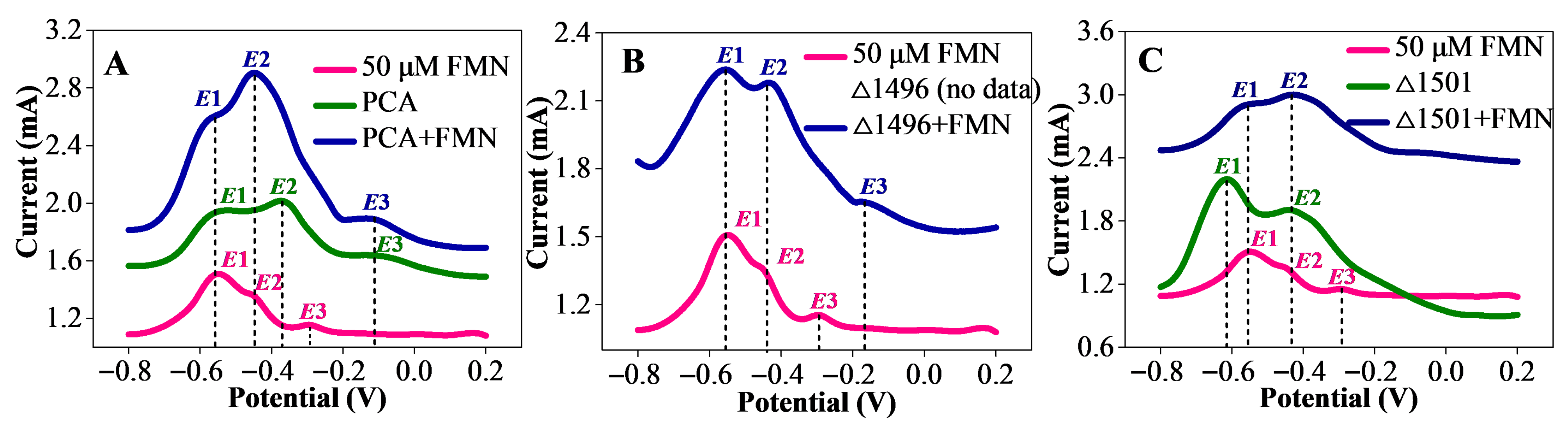
Electroactive biofilms (EABs) are essential for the performance of bioelectrochemical systems (BESs), but their formation in Geobacter, critically on conductive pili and exopolysaccharides, limits application under conditions where these components are deficient. Herein, we investigated the restorative effects of exogenous flavin mononucleotide (FMN) on EAB formation and extracellular electron transfer (EET) in two defective mutants of Geobacter sulfurreducens: the pili-deficient PCAΔ1496 and exopolysaccharides-deficient PCAΔ1501. Results show that FMN significantly promoted biofilm thickness in PCAΔ1496 (250%) and PCAΔ1501 (33%), while boosting maximum current outputs by 175-fold and 317.7%, respectively. Spectroscopic and electrochemical analyses revealed that FMN incorporates into biofilms, binds to outer membrane c-type cytochromes (c-Cyts), and enhances electron exchange capacity. Differential pulse voltammetry further confirmed that FMN did not exist independently in the biofilm but bound to outer membrane c-Cyts as a cofactor. Collectively, exogenous FMN plays dual roles (electron shuttle and cytochrome-bound cofactor) in defective Geobacter EABs, effectively restoring biofilm formation and enhancing EET efficiency. This study expands the understanding of the formation mechanism of Geobacter EABs and provides a novel strategy for optimizing BES performance.
Keywords: Geobacter sulfurreducens; electroactive biofilm; bioelectrochemical systems; electron mediator; extracellular electron transfer Geobacter sulfurreducens; electroactive biofilm; bioelectrochemical systems; electron mediator; extracellular electron transfer