Article

Comparison of Gut Microbiome Profile of Chickens Infected with Three Eimeria Species Reveals New Insights on Pathogenicity of Avian Coccidia

1
College of Veterinary Medicine, Yangzhou University, Yangzhou 225009, China
2
Jiangsu Co-Innovation Center for Prevention and Control of Important Animal Infectious Diseases and Zoonoses, Yangzhou University, Yangzhou 225009, China
*
Author to whom correspondence should be addressed.
Microorganisms 2025, 13(12), 2752; https://doi.org/10.3390/microorganisms13122752

Submission received: 21 October 2025 / Revised: 28 November 2025 / Accepted: 1 December 2025 / Published: 3 December 2025
(This article belongs to the Special Issue Avian Pathogens: Importance in Animal Health and Zoonotic Risks)

Abstract

Avian coccidiosis is an intestinal disease caused by Eimeria spp. infection. A deeper understanding of the interaction between host gut microbiota and the Eimeria parasite is crucial for developing alternative therapies to control avian coccidiosis. Here, we used full-length sequencing of 16S ribosomal RNA amplicons to compare changes in the gut microbiota of chickens infected with Eimeria tenella, Eimeria maxima, and Eimeria necatrix, aiming to identify both species-specific and common alterations in gut microbiota at 4 and 10 days post-infection. The result revealed that infection with all three Eimeria species led to a decrease in the abundance of the microbial genera Limosilactobacillus, Streptococcus, Alistipes, Lactobacillus and Phocaeicola, while the abundance of Bacteroides, Escherichia and Ligilactobacillus increased. Escherichia and Enterococcus were most abundant in the jejunum of the E. necatrix-infected group and in the cecum of the E. tenella-infected group, whereas Megamonas abundance was highest in the E. maxima-infected group. LEfSe analysis showed that infection with all three Eimeria species significantly reduced the abundance of 13 bacterial species, including Acetilactobacillus jinshanensis, Bacteroides ndongoniae, Barnesiella viscericola, Christensenella minuta, Enterocloster clostridioformis, Gemella haemolysans_A, Granulicatella adiacens, Lawsonibacter sp000177015, Limosilactobacillus reuteri, Limosilactobacillus reuteri_D, Limosilactobacillus vaginalis_A, Limosilactobacillus caviae, Limosilactobacillus vaginalis. Infection with E. tenella significantly increased the abundance of five bacterial species, including Bacteroides fragilis, Enterococcus cecorum, Helicobacter pylori, Methylovirgula ligni, and Phocaeicola sp900066445. Infection with E. maxima significantly increased the abundance of seven bacterial species, including Clostridioides difficile, Faecalibacterium prausnitzii, Mediterraneibacter torques, Muribaculum intestinale, Mediterraneibacter massiliensis, Phascolarctobacterium faecium, and Phocaeicola plebeius. Infection with E. necatrix significantly increased the abundance of seven bacterial species, including Alistipes sp900290115, Anaerotignum faecicola, Bacteroides fragilis_A, Escherichia coli, Harryflintia acetispora, Pseudoclostridium thermosuccinogenes, and Tidjanibacter inops_A. The results showed that Eimeria infection causes significant species- and time-dependent changes in the gut microbiota of chickens. These findings enhance our understanding of coccidiosis pathogenesis and offer potential targets for developing probiotics.

1. Introduction

Coccidiosis, caused by Eimeria species of the apicomplexan parasite, is a significant disease in chickens, impacting poultry production and resulting in approximately USD 10.36 billion in global losses annually [1]. Currently, coccidiosis control strategies rely heavily on chemoprophylaxis and, to a certain extent, live vaccines [2]. Unfortunately, the extensive use of drugs has inevitably led to the emergence of drug resistance, as well as the drug residues in the food chain and environment [3]. Therefore, it is necessary to adopt control strategies that replace antibiotics.
The gastrointestinal tract (GIT) in poultry harbors a diverse microbial community that serves a crucial role in digestion and protection [4]. Microbes located in the GIT mainly maintain homeostasis of the intestinal mucosa by digestion of food sources, providing the energy needed to induce the intestinal immune system to fight against aggressions of other microorganisms [5,6]. A standard or balanced gut microbiota reduces host susceptibility to pathogenic parasites like Eimeria spp. [7,8]. Studies have shown that the intestinal damage caused by Eimeria parasite colonization not only affects epithelial cells, but causes great disruption of gut microbial communities of chicken, promoting colonization and proliferation of other pathogens such as Clostridium perfringens, causing susceptibility of infected chickens to secondary diseases, thus increasing chicken mortality [9,10,11]. In addition, modulation of gut microbiota by probiotics protected early chicks against Eimeria infection [12,13,14]. Therefore, microbiota plays an important role in chickens’ resistance to coccidiosis and maintaining healthy growth and development.
Among the seven recognized species infecting chickens, E. tenella, E. maxima, and E. necatrix are frequently reported as economically important species, with their relative prevalence and significance varying according to production system (broilers, layers, or breeders), bird age, and geographic region [15,16,17]. E. tenella mainly infects the cecum of the host chicken, and E. maxima targets the jejunum of the small intestine, whereas E. necatrix is somewhat different from E. tenella and E. maxima, namely its first- and second-generation meronts located in the mid-intestinal area, and third-generation meronts and later gametogony only in the caecum [18,19,20,21]. Infection with these three Eimeria species disrupts intestinal integrity and microbiota balance, leading to impaired nutrient absorption, poor growth performance, increased mortality, and heightened vulnerability to secondary infections in chickens [22,23,24,25,26,27]. However, there are no reports on the similarities and differences in the impact of these three Eimeria species infections on the intestinal microbiota of chickens.
In this study, we used PacBio SMRT sequencing of full-length 16S rRNA amplicon to investigate infected chicken intestinal bacterial microbiota with E. tenella, E. maxima, and E. necatrix, respectively, to explore the effect of coccidia infection on gut microbiome diversity and composition in chickens, attempting to unveil the coccidian species-specific and common characteristics of changes in gut microbiota caused by different Eimeria spp. infection. The findings of this study may assist in selecting probiotics for the prevention and control of all three Eimeria species infections, as well as in understanding the correlation between microbiota changes and Eimeria infection, and in elucidating the pathogenicity of chicken coccidia.

2. Materials and Methods

2.1. Chickens and Parasites

One-day-old specific pathogen-free (SPF) White Leghorn chickens were obtained from Lihua Agricultural Technology Co., Ltd. (Yuyao, China) and raised under coccidia-free conditions in wire cages. Each cage housed 20 chickens, with each bird provided an individual floor area of 0.075 m2, ensuring adequate space for normal activity. The housing system was equipped with appropriate ventilation, temperature regulation, and sanitary management. Feed and water were supplied ad libitum. The chickens were provided a standard corn- and soybean-based diet purchased from Jiangsu Xietong Pharmaceutical Bio-Engineering Co., Ltd. (Nanjing, China). No antibiotics or anticoccidial agents were administered throughout the experiment. The Yangzhou strains of E. tenella, E. maxima, and E. necatrix used in this study were isolated by the Parasitology Research Laboratory at Yangzhou University, China, and confirmed through microscopic examination and sequence analysis of the internal transcribed spacer region of genomic DNA. These strains have been preserved in our laboratory [28,29,30].

2.2. Experimental Design

A total of 80 one-day-old SPF chickens were randomly divided into 4 groups (n = 20): the group infected with E. tenella (Et), the group infected with E. maxima (Em), the group infected with E. necatrix (En), and the unchallenged control group (Uc). At 21 days of age, the Et group was infected with 5 × 10⁴ E. tenella sporulated oocysts per chicken, the Em group with 5 × 10⁴ E. maxima sporulated oocysts per chicken, and the En group with 1.5 × 10⁴ E. necatrix sporulated oocysts per chicken. At 4 days post-infection (dpi) during the acute phase and at 10 dpi during the convalescent period, five chickens from each group were euthanized using CO2 inhalation followed by cervical dislocation. The intestines were dissected and visually inspected to identify the presence of any gross lesions. Following this, the intestinal mucosa was scraped, mounted on a microscope slide, and examined microscopically for parasites. Then the entire gastrointestinal tract was dissected from the chickens, and 200 mg of jejunum (the middle segment between the duodenal loop and Meckel’s diverticulum) and cecum contents were collected, respectively. The samples were stored at −80 °C. The sample information is shown in Table S1.

2.3. DNA Extraction, Library Construction, and Sequencing

Microbial DNA was extracted from the jejunum and cecum content of chickens using the E.Z.N.A.® Soil DNA Kit (Omega Bio-tek, Norcross, GA, USA) according to manufacturer’s protocols, respectively. The V1–V9 region of the bacteria 16S ribosomal RNA gene were amplified by PCR (95 °C for 2 min, followed by 27 cycles at 95 °C for 30 s, 55 °C for 30 s, and 72 °C for 60 s and a final extension at 72 °C for 5 min) using primers 27F 5′-AGRGTTYGATYMTGGCTCAG-3′ and 1492R 5′-RGYTACCTTGTTACGACTT-3′. Amplicons were extracted from 2% agarose gels and purified using the AxyPrep DNA Gel Extraction Kit (Axygen Biosciences, Union City, CA, USA). The purified amplicon pool PCR products were used to construct PacBio SMRT sequencing libraries (Shanghai Biozeron Biotechnology Co., Ltd., Shanghai, China).

2.4. Bioinformatics and Data Analysis

PacBio raw reads were processed using the SMRT Link Analysis software version 9.0 to obtain demultiplexed circular consensus sequence (CCS) reads with the following settings: minimum number of passes = 3, minimum predicted accuracy = 0.99. Raw reads were processed through SMRT Portal to filter sequences for length (<800 or >2500 bp) and quality. Sequences were further filtered by removing barcode, primer sequences, chimeras and sequences if they contained 10 consecutive identical bases. OTUs were clustered with 98.65% similarity cutoff using UPARSE (version 7.1, http://drive5.com/uparse/, accessed on 30 November 2025) and chimeric sequences were identified and removed using UCHIME. The phylogenetic affiliation of each 16S rRNA gene sequence was analyzed by RDP Classifier (https://sourceforge.net/projects/rdp-classifier/, accessed on 30 November 2025) against the silva (SSU138)16S rRNA database using confidence threshold of 70% [31].

2.5. Statistical Analyses

Rarefaction analysis was performed using Mothur v.1.21.1 to calculate diversity indices, including Chao1 and Shannon indices [32]. Beta diversity was assessed using UniFrac, and principal component analysis (PCoA) results were generated using the community ecology package R-forge. The PCoA figure was produced using the Vegan package (version 2.6-2), and one-way permutational analysis of variance (PERMANOVA) was conducted [33,34]. Venn diagrams were generated using the online tool “Draw Venn Diagram” (http://bioinformatics.psb.ugent.be/webtools/Venn, accessed on 30 November 2025) to visualize overlapping and unique OTUs during the treatment process. The OTU data was filtered using the following steps: firstly, excluding “unclassified” and “norank” entries; secondly, removing OTUs with an abundance of less than one; finally, selecting core OTUs for plotting. The pheatmap package (version 1.0.12) was used to visualize the relationships through a correlation heatmap. All statistical analyses were conducted using the R stats package (version 4.0.2). Differences in species’ relative abundances were analyzed using the LEfSe (Linear Discriminant Analysis Effect Size) method [35]. The Phylogenetic Investigation of Communities by Reconstruction of Unobserved States (PICRUSt2), developed by [36] (available at http://picrust.github.io/picrust/tutorials/genome_prediction.html, accessed on 30 November 2025), was employed to predict changes in microbiota function across different samples using the Kyoto Encyclopedia of Genes and Genomes (KEGG) database. Comparisons between experimental groups were carried out using ANOVA followed by Tukey’s honest significant differences (HSD) post hoc test. p-values of <0.05 were considered significant.

3. Results

3.1. Clinical and Pathological Findings

Four days after infection with E. tenella, the chickens appeared depressed and exhibited diarrhea with a small amount of bright red blood. Necropsy of chickens showed that the cecum pouch became slightly enlarged, and some bleeding foci presented on the mucosal surface. Except for the presence of some blood, the cecal contents were normal. Microscopic examination of jejunal mucosal scrapings revealed no parasites (Figure S1A). In contrast, examination of scrapings from the lesioned areas of the cecum revealed numerous large second-generation schizonts (Figure S1B). At 10 dpi with E. tenella, the chickens appeared normal with no signs of diarrhea. The appearance of the cecum had returned to normal, but the cecal wall was thickened. Microscopic examination of jejunal mucosal scrapings revealed no parasites or oocysts (Figure S1C), whereas a large number of oocysts were observed in cecal mucosal scrapings (Figure S1D). No obvious lesions were observed in the jejunum at 4 and 10 dpi, respectively.
Four days after infection with E. maxima, the chickens exhibited ruffled feathers, depressed, and cotton thread-like feces. Necropsy revealed mild swelling of the small intestine and the presence of orange mucus in the intestinal lumen. Microscopic examination of the jejunal mucosal scrapings from areas with lesions revealed the presence of developing gametocytes (Figure S1E). In contrast, no parasites were found in the microscopic examination of cecal mucosal scrapings (Figure S1F). Ten days after infection with E. maxima, the chickens appeared normal, with no diarrhea. Necropsy revealed mild swelling of the jejunum, with scar tissue observed in the mucosa and a small amount of orange mucus in the intestinal lumen. Microscopic examination of jejunal mucosal scrapings revealed the presence of oocysts (Figure S1G), whereas no parasites or oocysts were found in the cecal mucosal scrapings (Figure S1H). No obvious lesions were observed in the cecum at 4 and 10 dpi, respectively.
Four days after infection with E. necatrix, the chickens appeared depressed and exhibited diarrhea with blood. The necropsy of chickens showed that mild swelling of the small intestine, and its serosal surface presented some small white plaques and red petechiae; the mucosa thickened; and the lumen filled with fluid, blood, and tissue debris. Microscopic examination of the jejunal scrapings from areas with lesions revealed the presence of large schizonts (Figure S1I). In contrast, no parasites were found in the cecal mucosal scrapings (Figure S1J). At 10 dpi with E. necatrix, the chickens appeared normal, with no diarrhea. Scar tissue was observed in the mucosa of the small intestine. Microscopic examination of the scrapings of the areas with lesion appeared a large number of large schizonts (Figure S1K). In addition, microscopic examination of cecal mucosal scrapings appeared the presence of oocysts (Figure S1L). No obvious lesions were observed in the cecum at 4 and 10 dpi, respectively.

3.2. Jejunum and Cecum 16S rRNA Sequences

After quality filtering and assembly, we obtained a total of 2,639,344 sequences, with an average sequence number of 32,775 and 33,208 sequences per sample for the jejunum and cecum, respectively. The average sequence lengths for jejunum and cecum were 1480 bp and 1461 bp, respectively (Table S2). Sequencing depth was sufficient for all samples, as confirmed by rarefaction and Shannon-Wiener curves (Figure S2).

3.3. Shared and Unique Core Microbial Populations

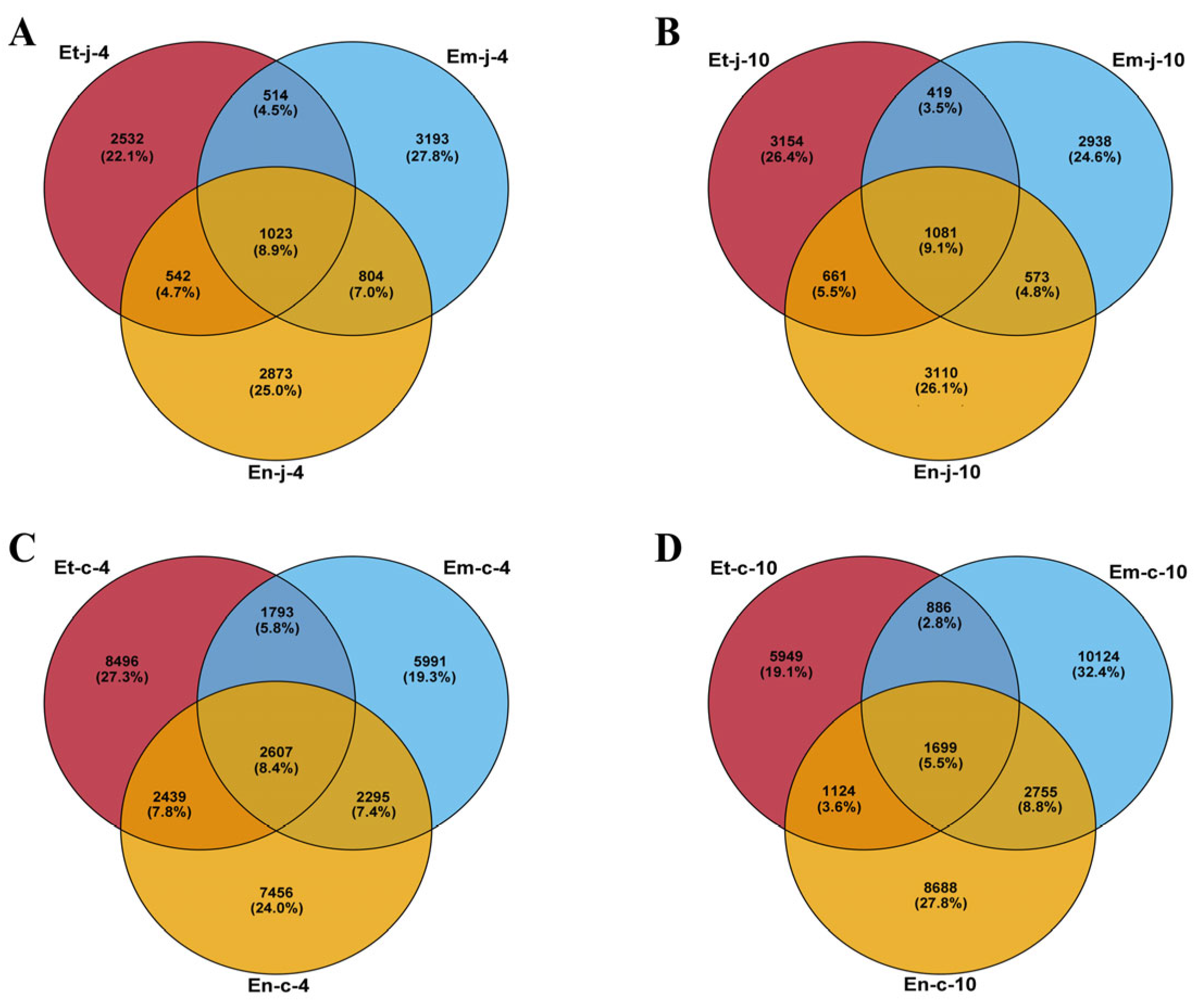
To investigate the microbial changes in the jejunum and cecum following infection with E. tenella, E. maxima and E. necatrix, we identified the unique and shared unique operational taxonomic units (OTUs) in the infected and control groups, with a total of 130,962 OTUs detected in 80 samples (Table S3), only the core OTUs were selected for visualization and further analysis.
In the jejunum: Four days after infection with E. tenella, E. maxima and E. necatrix, a total of 2532, 3193 and 2873 unique OTUs were detected, respectively, with 1023 OTUs shared among the three infected groups (Figure 1A). Ten days after infection, 3154, 2938 and 3110 unique OTUs were detected for E. tenella, E. maxima and E. necatrix, respectively, with 1081 OTUs shared among the three infected groups (Figure 1B).
In the cecum: Four days after infection with E. tenella, E. maxima and E. necatrix, a total of 8496, 5991 and 7456 unique OTUs were detected, respectively, with 2607 OTUs shared among the three infected groups (Figure 1C). Ten days after infection with E. tenella, E. maxima and E. necatrix, a total of 5949, 10124 and 8688 unique OTUs were detected, respectively, with 1699 OTUs shared among the three infected groups (Figure 1D).

3.4. Alpha and Beta Diversity of Jejunal and Cecal Microbial Constitution After E. tenella, E. maxima and E. necatrix Infection

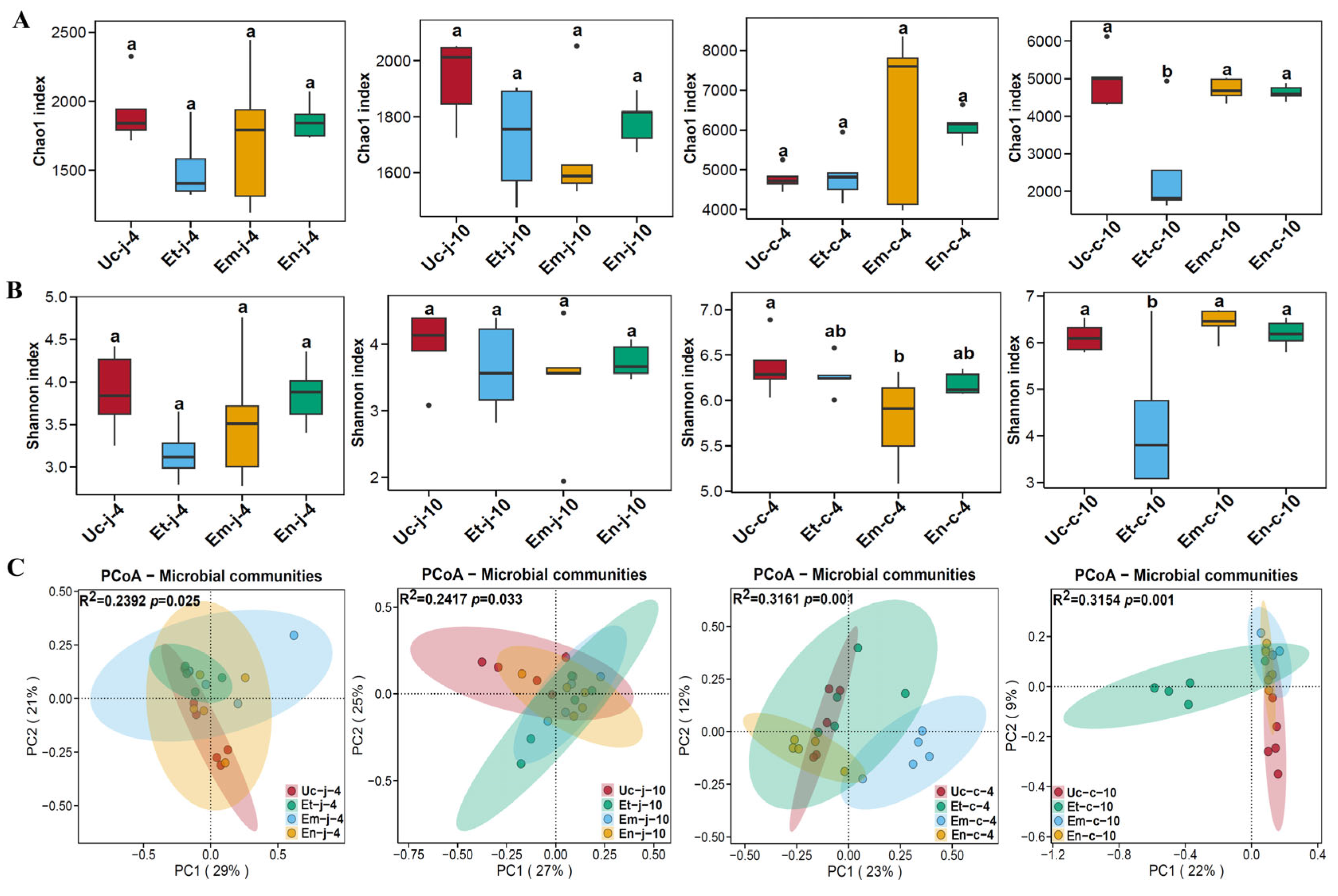
Alpha diversity was assessed using the Chao 1 index for microbial richness and the Shannon index for species diversity (Table S4). The Chao 1 index indicated that infections with these three Eimeria species at 4 and 10 dpi led to a decrease in jejunal microbial species richness (p > 0.05, Figure 2A). In the cecum, E. tenella infection at 10 dpi resulted in a significant decrease in species richness, while the groups infected with E. maxima or E. necatrix only showed a slight decrease (p < 0.05, Figure 2A). The Shannon index showed that species diversity in the jejunum decreased in all infected groups at 4 and 10 dpi, respectively (p > 0.05, Figure 2B). In the cecum, the species diversity significantly decreased after 4 days of infection with E. maxima, while a significant decrease was observed after 10 days of infection with E. tenella (p < 0.05, Figure 2B).
Principal Coordinate Analysis (PCoA) using the Bray–Curtis distance metric was conducted to explore differences in gut microbiota between groups. In the jejunum, at 4 dpi with E. tenella, E. maxima, and E. necatrix infection, the microbial structures changed significantly, and the communities separated between groups. PC1 and PC2 explained variances of 29% and 21%, respectively. PERMANOVA analysis revealed significant differences (R2 = 0.2392, p = 0.025). After 10 days of infection, the microbial communities remained distinct among groups, with PC1 and PC2 explaining variances of 27% and 25%, respectively. PERMANOVA analysis again showed significant differences (R2 = 0.2417, p = 0.033) (Figure 2C).
In the cecum, at 4 dpi with E. maxima infection, the microbial community was significantly distinct from those infected with E. tenella and E. necatrix, with PC1 and PC2 explaining 23% and 12% of the variance, respectively. PERMANOVA analysis revealed significant differences between the groups (R2 = 0.3161, p = 0.001). At 10 dpi with E. tenella infection, the microbial community was significantly different from those infected with E. maxima and E. necatrix, with PC1 and PC2 explaining 22% and 9% of the variance, respectively. PERMANOVA analysis again showed significant differences between the groups (R2 = 0.3154, p = 0.001) (Figure 2C).

3.5. Bacterial Taxa in the Jejunum and Cecum After E. tenella, E. maxima and E. necatrix Infection

The taxonomic richness of 80 samples varied across different taxonomic levels, leading to the identification of 31 phyla, 60 classes, 123 orders, 260 families, 756 genera, and 1918 species (Table S5).

3.5.1. At the Phylum Level

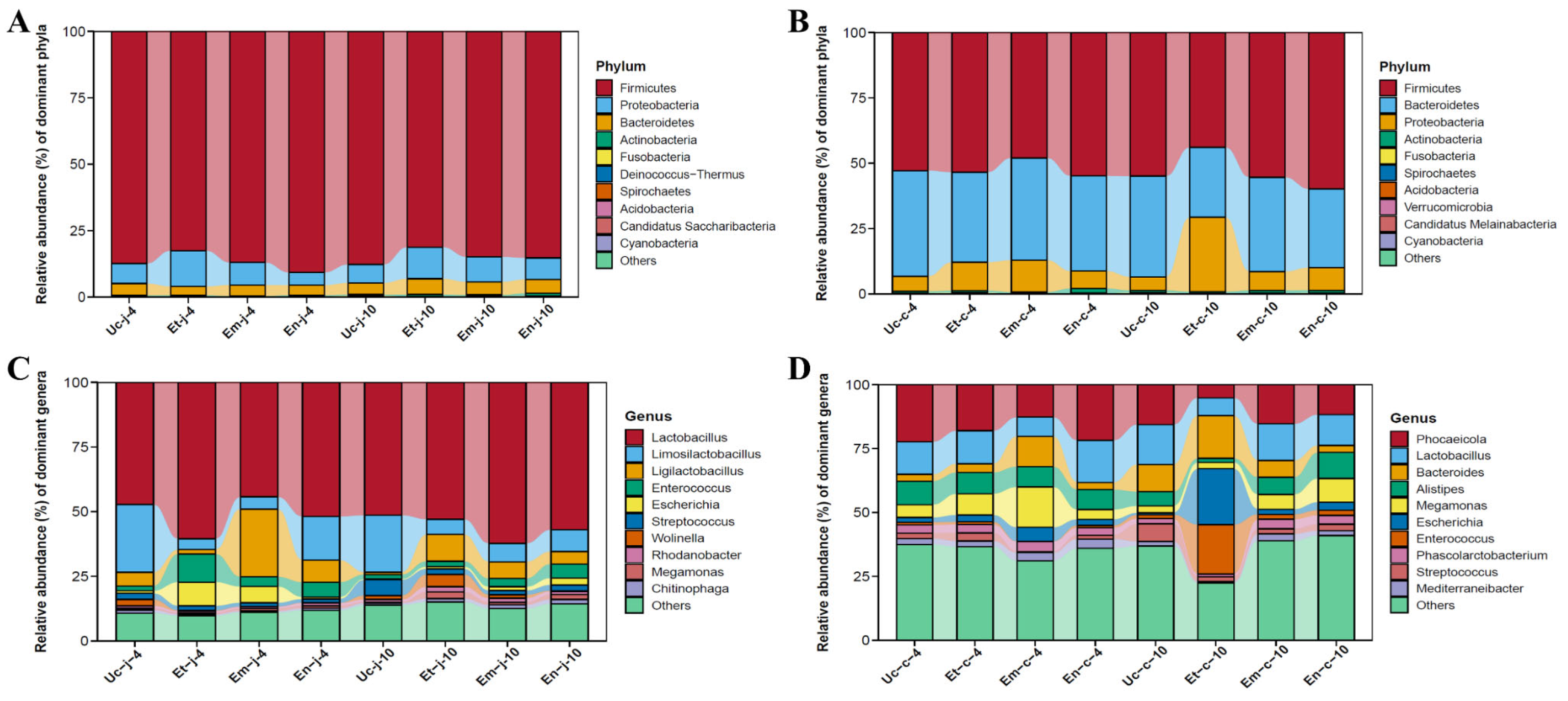
In the jejunum: Firmicutes, Proteobacteria, and Bacteroidetes were the most abundant phyla among the top ten at both 4-day and 10-day post-infection groups, as well as the control group (Figure 3A). At 4 dpi with all three Eimeria species, the abundance of Bacteroidetes decreased. The abundance of Firmicutes decreased after infection with E. tenella and E. maxima, respectively, but increased after infection with E. necatrix. The abundance of Proteobacteria increased after infection with E. tenella and E. maxima but decreased after infection with E. necatrix. At 10 dpi with all three Eimeria species, the abundance of Firmicutes decreased, while the abundance of Proteobacteria and Bacteroidetes increased (Figure 3A).
In the cecum: Firmicutes, Bacteroidetes, and Proteobacteria were the most abundant phyla among the top ten at both 4-day and 10-day post-infection groups, as well as the control group (Figure 3B). At 4 dpi with all three Eimeria species, the Bacteroidetes abundance decreased, while the Proteobacteria abundance increased. The Firmicutes abundance increased after infection with E. tenella and E. necatrix but decreased after infection with E. maxima. At 10 dpi with all three Eimeria species, the Bacteroidetes abundance continued to decrease, while that of Proteobacteria increased. The abundance of Firmicutes increased following infection with E. maxima and E. necatrix but decreased after infection with E. tenella (Figure 3B).

3.5.2. At the Genus Level

In the jejunum: At 4 dpi with all three Eimeria species, the Limosilactobacillus abundance decreased (Figure 3C). At 10 dpi with all three Eimeria species, the abundance of Limosilactobacillus and Streptococcus decreased, while the Ligilactobacillus abundance increased. The abundance of Escherichia and Enterococcus were higher in the group infected with E. necatrix compared to the other two infected groups (Figure 3C).
In the cecum: At 4 dpi with all three Eimeria species, the Alistipes abundance decreased, while the abundance of Bacteroides and Escherichia increased. The Megamonas abundance was higher in the group infected with E. maxima than in the other two infected groups (Figure 3D). At 10 dpi with all three Eimeria species, the abundance of Lactobacillus and Phocaeicola decreased. The abundance of Escherichia and Enterococcus were higher in the group infected with E. tenella compared to the other two Eimeria infected groups. In contrast, the abundance of Alistipes and Megamonas increased in the groups infected with E. maxima and E. necatrix (Figure 3D).

3.5.3. At the Species Level

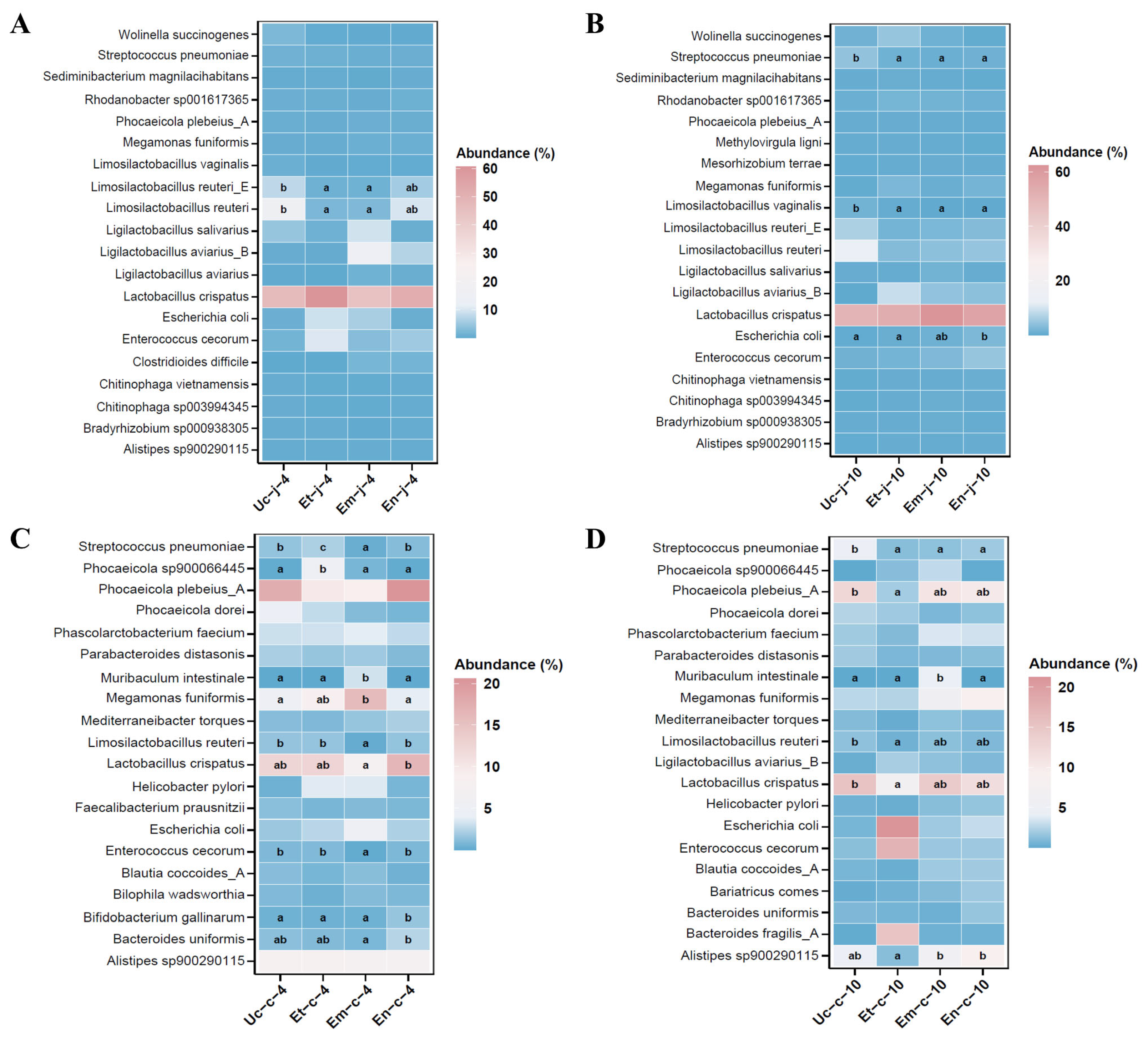
To identify the key microbiota involved in the process of E. tenella, E. maxima and E. necatrix infection in chickens, we performed differential abundance analysis of the jejunal and cecal microbiota between the different groups. The results for the top 20 species with significant differences are shown in Figure 4.
In the jejunum: At 4 dpi with all three Eimeria species, the abundance of Limosilactobacillus vaginalis, Streptococcus pneumoniae, Limosilactobacillus reuteri and Limosilactobacillus reuteri_E decreased, with the latter two bacteria showing a significant reduction in the groups infected with E. tenella and E. maxima (p < 0.05; Figure 4A). In contrast, the abundance of Enterococcus cecorum increased. The abundance of Megamonas funiformis and Ligilactobacillus aviarius_B decreased in the group infected with E. tenella but increased in the groups infected with E. maxima and E. necatrix. At 10 dpi with all three Eimeria species, the abundance of Limosilactobacillus reuteri, Limosilactobacillus reuteri_E, Limosilactobacillus vaginalis and Streptococcus pneumoniae decreased, with the latter two bacteria showing a significant reduction. The abundance of Escherichia coli significantly increased in the group infected with E. necatrix and was higher than that in the other two infected groups (p < 0.05; Figure 4B).
In the cecum: At 4 dpi, the abundance of Streptococcus pneumoniae, Phocaeicola sp900066445, and Megamonas funiformis significantly increased in the group infected with E. tenella. In contrast, in the group infected with E. maxima, the abundance of Limosilactobacillus reuteri and Lactobacillus crispatus significantly decreased, while that of Muribaculum intestinale significantly increased (p < 0.05; Figure 4C). At 10 dpi, the abundance of Muribaculum intestinale still significantly increased in the group infected with E. maxima. Conversely, Limosilactobacillus reuteri and Lactobacillus crispatus significantly decreased in the group infected with E. tenella (p < 0.05; Figure 4D).

3.6. LEfSe Analysis of Differences in the Microbiota of the Jejunum and Cecum After E. tenella, E. maxima and E. necatrix Infection

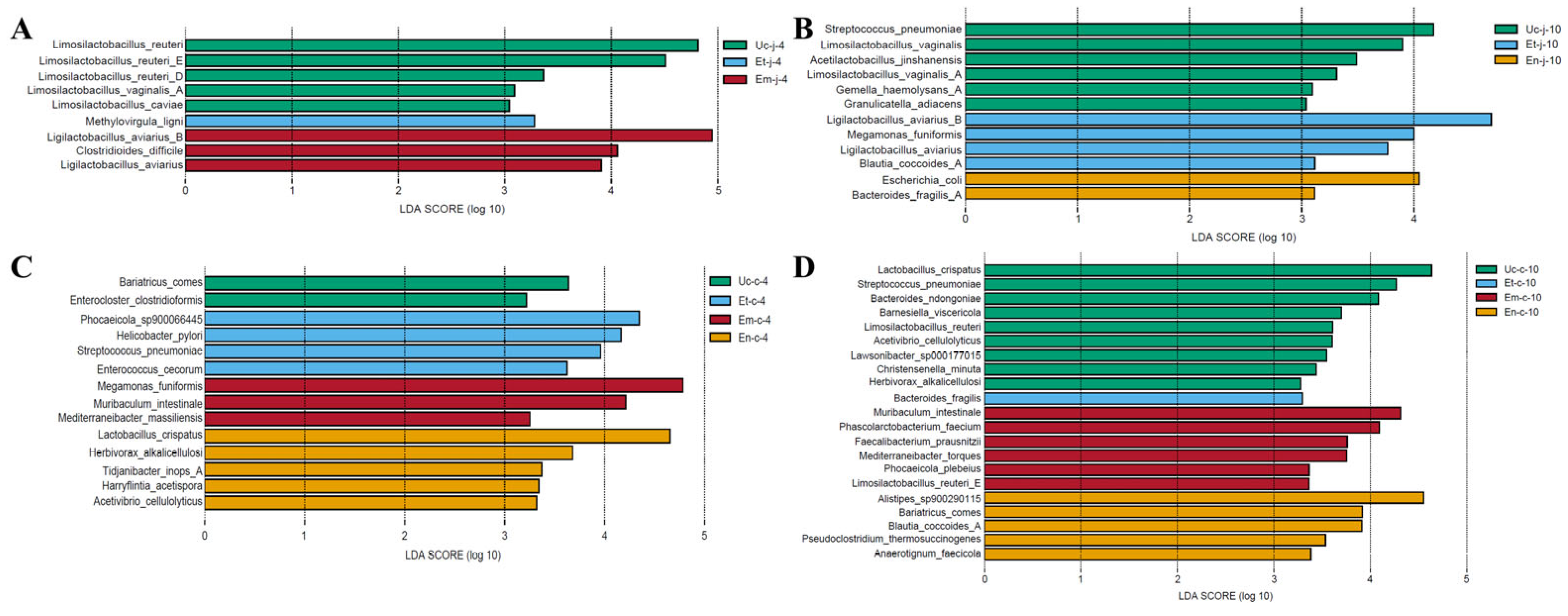
To identify groups exhibiting significant differences in bacteria species, we performed LEfSe analysis on the top 50 species in both the jejunum and cecum at the same timepoint among the three infection groups and the control group, with an LDA threshold set to ≥3.0. A total of 42 bacteria species showed significant differences in abundance among groups (Figure 5). Among these 42 bacteria species, the abundance of 13 species decreased across all three infection groups, while five species increased exclusively in the E. tenella-infected group, seven species in the E. maxima-infected group, and another seven species in the E. necatrix-infected group. Additionally, the abundance of four bacteria species increased in infection group. The details of the results were summarized as follows.
In the jejunum: At 4 dpi with all three Eimeria species, the abundance of Limosilactobacillus reuteri, Limosilactobacillus reuteri_D, Limosilactobacillus vaginalis_A, and Limosilactobacillus caviae decreased significantly (Figure 5A). The abundance of Methylovirgula ligni increased in the E. tenella-infected group, whereas Clostridioides difficile increased significantly in the E. maxima-infected group (Figure 5A). At 10 dpi with all three Eimeria species, the abundance of Limosilactobacillus vaginalis, Acetilactobacillus jinshanensis, Limosilactobacillus vaginalis_A, Gemella haemolysans_A, and Granulicatella adiacens decreased significantly (Figure 5B). Although Megamonas funiformis, Ligilactobacillus aviarius, Ligilactobacillus aviarius_B and Blautia coccoides_A increased in the E. tenella-infected group, none of them belong to species-dependent changes. Escherichia coli and Bacteroides fragilis_A increased in the E. necatrix-infected group (Figure 5B).
In the cecum: At 4 dpi with all three Eimeria species, the abundance of Enterocloster clostridioformis decreased significantly. Phocaeicola sp900066445, Helicobacter pylori, and Enterococcus cecorum increased significantly in the E. tenella-infected group, Muribaculum intestinale and Mediterraneibacter massiliensis in the E. maxima-infected group, and Tidjanibacter inpos_A and Harryflintia acetispora in the E. necatrix-infected group (Figure 5C). At 10 dpi with all three Eimeria species, the abundance of Bacteroides ndongoniae, Barnesiella viscericola, Limosilactobacillus reuteri, Lawsonibacter sp000177015, Christensenella minuta, Acetivibrio cellulolyticus, Lactobacillus crispatus, Streptococcus pneumoniae, and Herbivorax alkalicellulosi decreased significantly, but the last four species belong to no common changes caused by Eimeria infection. Bacteroides fragilis increased significantly in the E. tenella-infected group, Muribaculum intestinale, Phascolarctobacterium faecium, Faecalibacterium prausnitzii, Mediterraneibacter torques, Phocaeicola plebeius, and Limosilactobacillus reuteri_E in the E. maxima-infected group, and Alistipes sp900290115, Pseudoclostridium thermosuccinogenes, and Anaerotignum faecicola in the E. necatrix-infected group (Figure 5D).

3.7. Functional Prediction of Microbiota

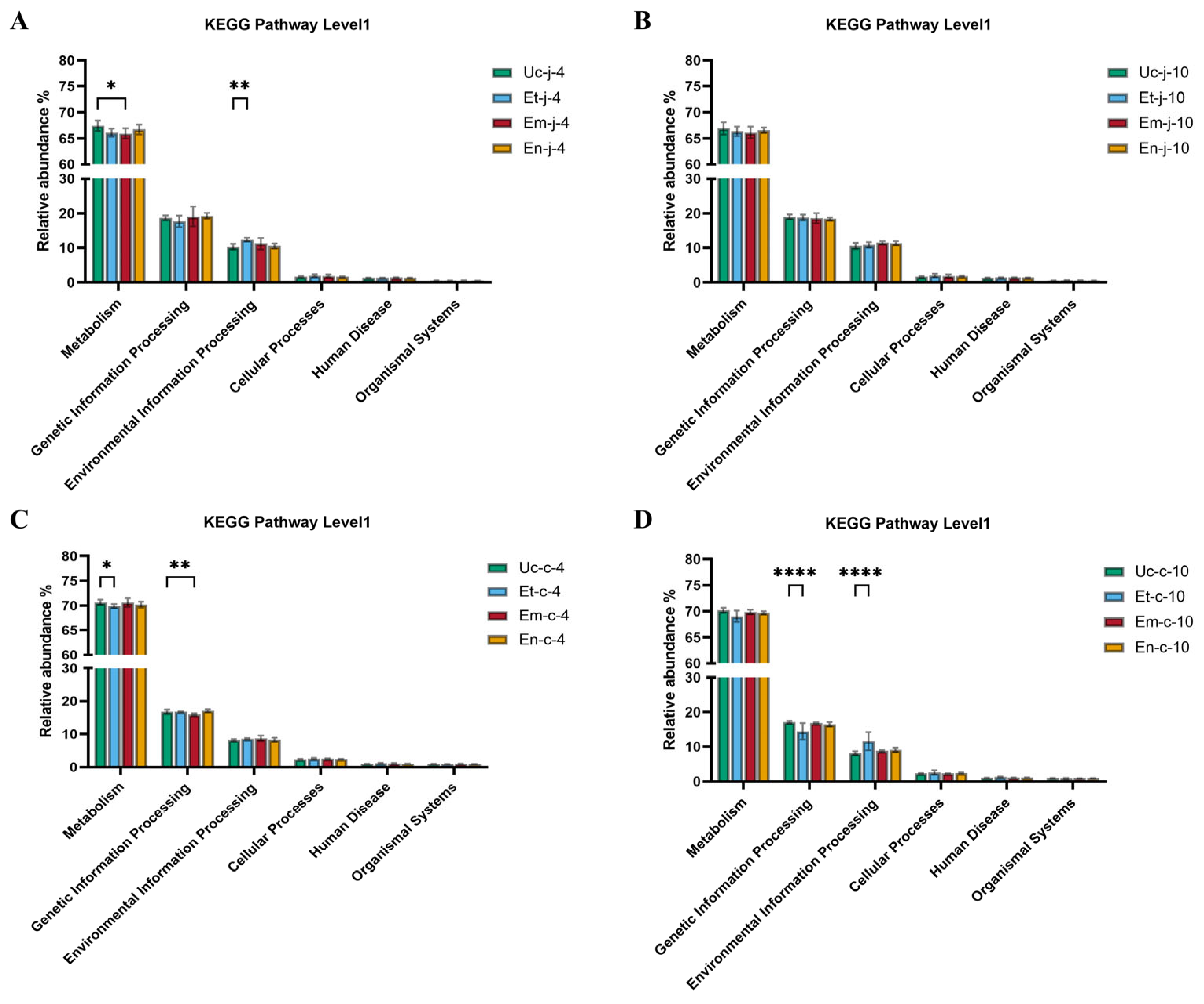
Change in microbial composition and structure are closely related to functional alteration of microbes. Thus, KEGG analysis was further used to predict the altered pathways in our study. At 4 dpi in the jejunum, distinct microbial functional changes were observed between species: metabolism-related functions were significantly reduced in the E. maxima-infected group compared to the control (p < 0.05), while the E. tenella-infected group showed a significant increase in environmental information processing functions (p < 0.01; Figure 6A). By 10 dpi, no significant differences in predicted jejunal microbial functions were found between infected groups and the control (p > 0.05; Figure 6B).
Cecal microbial functional analysis further confirmed the differential impact patterns of different Eimeria species on microbial community functions. At 4 dpi, the E. tenella-infected group hand a significantly lower relative abundance of predicted metabolic pathways compared to the control group (p < 0.05). In contrast, the E. maxima-infected group showed a significant reduction in genetic information processing functions (p < 0.01; Figure 6C). By 10 dpi, the E. tenella-infected group continued to exhibit low levels of genetic information processing functions, while environmental information processing functions increased significantly compared to the control group (p < 0.0001; Figure 6D).

4. Discussion

The enteric microflora plays a crucial role in the health, welfare, and productivity of commercially reared chickens. A balanced microbial community is essential for chickens to effectively utilize end-products of metabolic processes and to facilitate interactions between the host and diet [37]. However, this balance can be easily affected by various factors, such as Eimeria parasite infection [8,38]. Each Eimeria species presents a distinct pathognomonic profile and affects different sections of the intestine [39,40]. Consequently, the impact of Eimeria infection on the gut microbiota of chickens may vary depending on the specific Eimeria species. In addition, the gut microbiota of chickens is influenced by various factors, including age, sex, breed, diet, litter type and conditions, and the use of antimicrobials [41,42,43]. In this study, therefore, chickens were infected with E. tenella, E. maxima, and E. necatrix under identical experimental conditions to examine the composition and integrity of their gut microbiota.
In a well-balanced chicken gastrointestinal tract, the predominant bacterial groups are Firmicutes, Tenericutes, Bacteroidetes, Proteobacteria, and Actinobacteria [42,43,44]. In this study, at two timepoints, the predominant bacteria in the jejunum of both the Eimeria-infected and control groups were Firmicutes, Proteobacteria, and Bacteroidetes, whereas in the cecum, the predominant bacteria were Firmicutes, Bacteroidetes, and Proteobacteria. Compared to the control group, the abundance changes in Bacteroidetes and Proteobacteria showed a consistent pattern across the three Eimeria species. The abundance of Bacteroidetes decreased in both the jejunum and cecum, except for an increase in the jejunum at 4 dpi. Conversely, the abundance of Proteobacteria increased in both the jejunum and cecum, except for a decrease in the jejunum at 4 dpi with E. necatrix. However, the changes in Firmicutes abundance due to infections with the three species were inconsistent. Infections with E. tenella and E. maxima resulted in a reduction in Firmicutes abundance, except for an increase in the cecum at 4 dpi with E. tenella and at 10 dpi with E. maxima. Conversely, infection with E. necatrix led to an increase in Firmicutes abundance, except for a reduction in the jejunum at 10 dpi. Bacteroidetes are Gram-negative bacteria that inhabit various regions of the intestinal tract [42,45]. Fan et al. demonstrated that one week-old broiler chickens with high Bacteroides abundance exhibited significantly increased concentrations of short-chain fatty acids, particularly acetate, propionate, butyrate, and valerate in the cecum, which was associated with enhanced polysaccharide degradation capacity. Furthermore, these chickens showed increased expression of the tight-junction protein claudin-1, decreased expression of the pro-inflammatory cytokine IL-1β, and elevated expression of the anti-inflammatory cytokine IL-10 in cecal tissues, indicating improved intestinal barrier function and reduced gut inflammation [46]. Proteobacteria contain a wide variety of remarkable conditional pathogens, such as some species of these genera (Comamonas, Acinetobacter, Brucella, Shigella, and Escherichia) [47]. The abundance of Proteobacteria has been regarded as a signature of dysbiosis and disease in humans [48]. The increased relative abundance of Proteobacteria leads to disease development and reduces chicken growth performance [49]. The increase in Proteobacteria has been widely documented across multiple Eimeria infection studies [50,51], suggesting this represents a common host response to enteric coccidiosis, although the magnitude and timing of changes may vary depending on the specific Eimeria species and intestinal segment examined. Firmicutes are mainly represented by the genera Enterococcus, Ruminococcus, Clostridium, Lactobacillus, Faecalibacterium, Roseburia, and Eubacterium. Members of Firmicutes can inhibit the growth of opportunistic pathogens and degrade complex carbohydrates. Other members, such as Enterococcus spp. and Streptococcus spp., typically occur in low abundance but may become pathogenic during intestinal dysbiosis [47,52]. The results suggest that Eimeria infection disrupts the gut microbial communities of chicken and increases the risk of secondary infections from opportunistic pathogens. Variations in the abundance of Firmicutes among the three Eimeria species may reflect differences in their colonization sites and pathogenic characteristics.
The chicken gastrointestinal tract harbor diverse communities of commensal, symbiotic and pathogenic microorganisms [6,8,53]. Eimeria infection can reduce the abundance of commensal and symbiotic bacteria while increasing the abundance of pathogenic bacteria [13,22,54,55,56,57]. In the current study, we observed similar results. Our results showed that the abundance changes in Limosilactobacillus, Enterococcus, Streptococcus, Escherichia, and Ligilactobacillus due to Eimeria parasite infection were consistent across E. tenella, E. maxima, and E. necatrix. Specifically, Limosilactobacillus abundance decreased in both the jejunum and cecum of chickens at 4 and 10 dpi. Consistent with previous studies, a similar decrease in Limosilactobacillus abundance was reported in the ileum of chickens following E. maxima infection [52], indicating that this response may occur consistently across different Eimeria species and intestinal locations. Enterococcus abundance increased while Streptococcus abundance decreased, except in the cecum at 4 dpi, where both abundances were extremely low. Escherichia abundance increased, except for a decrease in the jejunum at 4 dpi with E. necatrix. Ligilactobacillus abundance was extremely low in the cecum but increased in the jejunum, except for a decrease at 4 dpi with E. tenella. Limosilactobacillus and Ligilactobacillus are two newly recognized genera that originated from Lactobacillus and belong to the Lactobacillaceae family [58,59]. Nii et al. reported that Limosilactobacillus reuteri treatment increased ileal villus height and enhanced mucosal barrier function against Salmonella Typhimurium challenge in broiler chicks [60]. Additionally, dietary supplementation with Limosilactobacillus reuteri significantly improved body weight, average daily gain, and feed conversion ratio in broiler chickens [61]. He et al. demonstrated that Ligilactobacillus salivarius XP132 significantly reduced Salmonella Pullorum in liver, spleen, intestinal contents, and eggs, effectively preventing both horizontal and vertical transmission. This protective effect was associated with enhanced immune responses, including upregulated IFN-γ and downregulated pro-inflammatory (IL-1β, IL-6, IL-8, and TNF-α) [62]. Some Streptococcus species are commensal. Certain strains isolated from chicken ceca in previous studies have demonstrated either butyrate production [63] or probiotic potential [64]. Enterococcus and Escherichia include opportunistic pathogens, and their elevation suggests that Eimeria infection may promote the proliferation of potentially harmful bacteria in the jejunum, increasing the risk of secondary infections or intestinal inflammation [47,52,65].
Furthermore, our results revealed no consistent pattern in the abundance changes in Alistipes, Phocaeicola, Bacteroides, and Megamonas due to infection with the three Eimeria species in the cecum. In the jejunum, their abundance was very low, except for an increase in Megamonas at 10 dpi. Additionally, infections with E. tenella and E. necatrix resulted in an increase in Lactobacillus, except for a reduction in the cecum at 10 dpi. In contrast, infection with E. maxima led to a reduction in Lactobacillus abundance, except for an increase in the jejunum at 10 dpi. Alistipes is a genus member of the family Rikenellaceae. Alistipes dysbiosis can be either beneficial, or harmful [66]. Bacteroides and Phocaeicola, members of the family Bacteroidaceae, are of clinical importance in human or veterinary medicine due to their presence in gut microbiota [67]. Members of both genera are significant gut commensals that can degrade and ferment mucin or complex polysaccharides from plants. Outside the intestinal tract, however, Bacteroides spp. and Phocaeicola spp. may participate in various pathogenic processes [45,68]. Megamonas, a genus within the Firmicutes, was previously regarded as a ‘biomarker’ of diet and lifestyle in humans [69]. Previous research showed that Megamonas functions as a hydrogen sink in the cecum of broiler chickens by enhancing the production of short-chain fatty acids [70]. Additionally, Niu et al. found that Megamonas is positively correlated with reproductive performance of hens and has lower abundance in Salmonella pullorum-positive hens [71]. Together, these results indicate that Eimeria infection causes distinct microbial changes at 4 dpi during the acute phase and at 10 dpi during the convalescent period. Beneficial bacteria, such as Limosilactobacillus and Lactobacillus, are generally suppressed, whereas opportunistic pathogens like Escherichia and Enterococcus, or compensatory genera like Ligilactobacillus and Megamonas, exhibit species- or site-specific alterations. Specifically, E. tenella in the cecum and E. necatrix in the jejunum more strongly promote pathogenic bacterial overgrowth within their respective intestinal sections. In contrast, E. maxima may induce unique metabolic adaptations, such as an increase in Megamonas. These differences are likely related to the distinct pathogenic mechanisms and tissue-specific effects of each Eimeria species.
LEfSe analysis revealed that infection with all three Eimeria species significantly decreased the abundance of 13 bacterial species. Out of 13 bacterial species, Acetilactobacillus jinshanensis, Limosilactobacillus reuteri, Limosilactobacillus reuteri_D, Limosilactobacillus vaginalis, Limosilactobacillus vaginalis_A, and Limosilactobacillus caviae are lactic acid bacteria crucial for the gut microbiota [58,59]. These bacteria help maintain an acidic intestinal environment, inhibit pathogen colonization, and regulate immunity [72,73,74]. A decrease in their abundance may weaken the intestinal barrier function [75]. The remaining seven bacterial species, including Bacteroides ndongoniae, Barnesiella viscericola, Christensenella minuta, Enterocloster clostridioformis, Gemella haemolysans_A, Granulicatella adiacens, and Lawsonibacter sp000177015, are either symbiotic or opportunistic pathogens [42,45,68,76,77]. Christensenella minuta was designated as the first member of the new Christensenellaceae family in the Firmicutes phylum [78]. Previous research showed that Christensenellaceae and Christensenella munita specifically can play a crucial role in maintaining a healthy gut microbiome [79]. Gemella haemolysans and Granulicatella adiacens are opportunistic pathogens [80,81]. Some Gemella species are known to infrequently cause systemic illnesses and are a component of the oral microbiome in humans [82]. Granulicatella adiacens is part of the normal commensal flora of human mouth, genital, and intestinal tracts, and rarely causes disease [81]. Previous research found that Granulicatella is significantly enriched in chickens with bacterial chondronecrosis and osteomyelitis as compared to healthy chickens [83]. Enterocloster clostridioformis is the reclassified name for Clostridium clostridioforme [84]. A study revealed that Enterocloster clostridioformis increases regulatory T cells in the mucosal immune system, which helps reduce the pathological damage caused by Salmonella Typhimurium infection [85]. However, clinical reports also documented cases of bacteremia caused by Enterocloster clostridioformis [86]. Bacteroides ndongoniae is a Gram-negative, non-spore-forming and non-motile bacillus [87]. Barnesiella viscericola is a member of the family Porphyromonadaceae isolated from chicken caecum [88]. Lawsonibacter sp000177015, belonging to the family Ruminococcaceae, is a bacterial species identified in the human gut, particularly in the context of knee synovitis [77]. The reduction in these symbiotic bacterial species may disrupt the intestinal microbiome balance and increase the risk of infection by other pathogens.
LEfSe analysis reveals that changes in bacterial species caused by different Eimeria species also exhibit species-specific characteristics. E. tenella infection significantly increased the abundance of Bacteroides fragilis, Enterococcus cecorum, Phocaeicola sp900066445, Helicobacter pylori, and Methylovirgula ligni. E. maxima infection significantly increased the abundance of Clostridioides difficile, Faecalibacterium prausnitzii, Mediterraneibacter torques, Mediterraneibacter massiliensis, Muribaculum intestinale, Phascolarctobacterium faecium, and Phocaeicola plebeius. E. necatrix infection significantly increased the abundance of Escherichia coli, Alistipes sp900290115, Bacteroides fragilis_A, Anaerotignum faecicola, Harryflintia acetispora, Pseudoclostridium thermosuccinogenes, and Tidjanibacter inops_A. Among these bacterial species, some species (such as Enterococcus cecorum and Bacteroides fragilis) are typically found in chickens as part of normal flora, whereas another species (such as Mediterraneibacter massiliensis and Methylovirgula ligni) were originally isolated from human samples or environmental sources.
Among five bacterial species associated with E. tenella infection, Enterococcus cecorum is a commensal bacteria and opportunistic pathogen that can cause outbreaks of Enterococcal spondylitis, commonly known as ‘kinky back’, in poultry [89]. A previous study reported that Enterococcus abundance increased over time in response to E. tenella infection [13]. Bacteroides fragilis is the most common opportunistic anaerobic pathogen [90]. It also is short-chain fatty acids (SCFAs)-producing bacteria [91]. Studies showed that high levels of Bacteroides fragilis in young chickens are associated with a more beneficial gut microbiome composition, potentially reducing inflammation [92,93]. Phocaeicola sp900066445 is a bacterial strain belonging to the Bacteroidaceae family. Previous research revealed that certain Phocaeicola species, like Phocaeicola barnesiae, may play a role in maintaining a healthy gut environment in chickens [67]. Helicobacter pylori is a flagellated pathogen that colonizes the human gastroduodenal mucosa and produces inflammation [94] and can be present in raw chicken meat. Additionally, studies have shown that this bacterium can survive in the gastrointestinal tract of chickens and can be present in their feces [95]. Methylovirgula ligni is an environmental bacterium [96]. Taken together, E. tenella infection promoted the proliferation of opportunistic pathogens and inflammation-associated bacteria, which exacerbated intestinal inflammation and damage.
Among seven bacterial species associated with E. maxima infection, Clostridioides difficile is a major opportunistic pathogen capable of producing potent cytotoxins (TcdA and TcdB) that can cause severe colitis [97]. Clostridioides difficile is associated with antibiotic-associated diarrhea and pseudomembranous colitis in humans [98], although there is no evidence that Clostridioides difficile is a relevant pathogen in poultry [99]. Sokol et al. demonstrated that secreted metabolites of Faecalibacterium prausnitzii blocked NF-κB activation and IL-8 secretion in intestinal epithelial cells, reduced pro-inflammatory cytokine production, and promoted IL-10 secretion [100]. Lenoir et al. further confirmed that butyrate was the key mediator of these anti-inflammatory effects [101]. These immunomodulatory properties contribute to improved intestinal barrier function and reduced inflammation. Mediterraneibacter torque and Mediterraneibacter massiliensis belong to the genus Mediterraneibacter within the family Lachnospiraceae, primarily found in the cecal microbiota of chickens [102]. Mediterraneibacter torque, previously classified under Ruminococcus species in Clostridium cluster XIVa [102], is known for its ability to degrade gastrointestinal mucin [103]. Studies have found that the Ruminococcus_torques_group may be the key gut microbiota contributing to the alterations of tracheal microbiota composition [104]. Muribaculum intestinale, a Gram-negative obligate anaerobe from the Muribaculaceae family, was first identified in the mouse gut microbiome. It has been linked to inflammatory bowel disease in both mice and human studies by several research groups [105]. A currently research revealed that Muribaculum intestinale limits Salmonella Typhimurium colonization by converting succinate to propionate in mice [106]. Therefore, following E. maxima infection, the increase in Muribaculum intestinale abundance in the cecum may trigger the production of pro-inflammatory factors and induce local inflammation. Phascolarctobacterium faecium, a bacterium commonly found in the human gastrointestinal tract within the family Acidaminococcaceae, is known for its ability to metabolize succinate and produce acetate and propionate. Research has indicated that Phascolarctobacterium faecium can help reverse the inflammatory phenotype associated with obesity [107]. Phocaeicola plebeius, formerly Bacteroides plebeius, is strictly anaerobic, Gram-negative, and non-spore forming bacterium [108]. Previous research has found that Bacteroides (Phocaeicola) plebeius can restructure the gut microbial community and produce beneficial metabolites, which inhibit the development of colitis-associated colon cancer [109]. Additionally, this species was identified as a potential host immunomodulator during Salmonella infection in chickens, playing a protective role [110]. In summary, E. maxima infection resulted in an imbalance between pathogenic and symbiotic bacteria, potentially leading to pseudomembranous enteritis and mucus layer loss, as well as triggering compensatory proliferation of anti-inflammatory bacteria.
Among seven bacterial species associated with E. necatrix, Escherichia coli is a bacterium crucial for maintaining intestinal health in both humans and animals. While most Escherichia coli strains are non-pathogenic, about 10–15% of intestinal coliforms consist of opportunistic and pathogenic serotypes that can cause infections in immunocompromised hosts, such as poultry [111]. Chen et al. [51] found that high-dose E. necatrix in chickens leads to increased abundance of Escherichia coli. Alistipes sp900290115 is isolated from various abscesses and may play an opportunistic pathogenic role in human diseases [112]. Bacteroides fragilis_A, a subtype of Bacteroides fragilis, may play a role in intestinal inflammation. Anaerotignum faecicola is a newly identified species within the genus Anaerotignum, isolated from human feces and belonging to the family Lachnospiraceae [113]. Studies have shown that Anaerotignum can produce acetate, propionate, and butyrate to provide energy to the host [114], and the abundance of Anaerotignum significantly increases in diarrhea mice with deficiency kidney-yang syndrome [115]. Harryflintia acetispora, isolated from chicken’s caecum, is characterized as a Gram-negative, curved rod-shaped bacterium capable of forming endospores [116]. Its exact role in the chicken gut and its potential impact on chicken health are still under investigation. Pseudoclostridium thermosuccinogenes, formerly Clostridium thermosuccinogenes [117], is a thermotolerant succinic acid-producing bacterium [118]. Tidjanibacter is a new genus derived from the Alistipes genus [119]. A recent study found that the abundance of Tidjanibacter inops_A has a positive correlation with the average daily weight gain of chickens and a negative correlation with serum IL-6 levels [120]. Collectively, E. necatrix infection triggered the activation of opportunistic pathogens, and led to metabolic bacterial disorders and proliferation, which may potentially exacerbate intestinal inflammation and metabolic imbalance.
Furthermore, the functional prediction analysis indicated that infection with three Eimeria species significantly altered the host’s intestinal microbial community functions. These changes exhibited both species-specific and time-dependent characteristics. E. tenella infection led to a significant increase in the abundance of environmental information processing pathways in the jejunum and a significant decrease in metabolism-related pathways in the cecum at 4 dpi, indicating a disruption of normal intestinal ecological balance and significant inhibition of basic metabolic activities in cecal microbiota. By 10 dpi, the abundance of genetic information processing in the cecum significantly decreased, while the abundance of environmental information processing pathways significantly increased. This indicated that cecal microbial communities had adapted functionally, shifting from typical genetic information processing and metabolic activities to a stress response mode, thereby actively perceiving and responding to intestinal disturbances caused by parasites. E. maxima infection caused a significant decrease in the abundance of metabolism-related pathway in the jejunum and genetic information processing-related pathway in the cecum. This is consistent with the findings reported by Su et al. [121], who demonstrated that E. maxima infection disrupts metabolic functions in chickens, particularly affecting nutrient absorption and energy metabolism pathways. E. necatrix infection also affected the intestinal microbial community functions of chickens, although these changes were not significantly different from those observed in the control group. This result might be related to the change in parasitic sites during the development of E. necatrix and the extent of intestinal damage. Resent research revealed that the severity of intestinal dysfunction caused by E. necatrix infection is dose-dependent [51].

5. Conclusions

This study demonstrates both coccidian species-specific and common changes in the gut microbiota of chickens infected with E. tenella, E. maxima, and E. necatrix. Specifically, all three Eimeria infections lead to a reduction in gut commensal bacteria, especially lactic acid bacteria. Limosilactobacillus reuteri consistently shows the greatest decline across all infections, suggesting its significance in maintaining intestinal microbiome balance and warranting further investigation into its potential anticoccidial properties. E. tenella infection causes an imbalance in the core microbiota characterized by the proliferation of opportunistic pathogens and invasion by exogenous bacteria, leading to acute inflammation and barrier disruption. E. maxima infection causes an imbalance in the core microbiota characterized by the proliferation of pathogenic bacteria and compensatory growth of anti-inflammatory bacteria, leading to pseudomembranous colitis and mucus layer loss. E. necatrix infection causes an imbalance in the core microbiota characterized by the activation of opportunistic pathogens and metabolic bacterial disorders, leading to infectious diarrhea and metabolic imbalance. These structural changes in microbiota were accompanied by corresponding functional alterations, with each Eimeria species causing unique disruptions in metabolic pathways. These findings provide crucial theoretical basis for understanding the pathogenic mechanisms of Eimeria and developing strategies for controlling coccidiosis through microecological regulation.

Supplementary Materials

The following supporting information can be downloaded at https://www.mdpi.com/article/10.3390/microorganisms13122752/s1: Figure S1: The results of microscopic examination for parasites in intestinal mucosa at 4 and 10 days post-infection (dpi) with E. tenella (A–D), E. maxima (E–H), and E. necatrix (I–L) (400x magnification). (A) E. tenella, 4 dpi, jejunum—no parasites observed. (B) E. tenella, 4 dpi, cecum—numerous second-generation schizonts observed (50.1 µm × 43.4 µm). (C) E. tenella, 10 dpi, jejunum—no parasites observed. (D) E. tenella, 10 dpi, cecum—oocysts observed (22.3 µm × 19.5 µm). (E) E. maxima, 4 dpi, jejunum—developing gametocytes observed (12.4 µm × 11.5 µm). (F) E. maxima, 4 dpi, cecum—no parasites observed. (G) E. maxima, 10 dpi, jejunum—oocysts observed (28.0 µm × 19.8 µm). (H) E. maxima, 10 dpi, cecum—no parasites observed. (I) E. necatrix, 4 dpi, jejunum—second-generation schizonts observed (73.4 µm × 70.9 µm). (J) E. necatrix, 4 dpi, cecum—no parasites observed. (K) E. necatrix, 10 dpi, jejunum—numerous second-generation schizonts observed (54.2 µm × 41.2 µm). (L) E. necatrix, 10 dpi, cecum—oocysts observed (20.5 µm × 16.6 µm). Red arrows indicate parasites at different developmental stages and oocysts. Red arrows indicate the parasites; Figure S2: Curves of OTUs obtained from 80 samples. (A) Rarefaction curves. (B) Shannon-Wiener curves; Table S1: Group information of 80 fecal samples in this study; Table S2: Summary of sequenced samples; Table S3: Abundance of 130,962 bacterial OTUs after flattening and species annotation; Table S4: Alpha index statistics; Table S5: The number of samples at various taxonomic levels.

Author Contributions

N.X.: methodology, writing—review and editing. D.L.: supervision. Q.F.: methodology. Y.Z.: methodology. C.C.: methodology. F.W.: methodology. S.S.: methodology. J.X.: review. J.T.: conceptualization, funding acquisition, review and editing. All authors have read and agreed to the published version of the manuscript.

Funding

This work was supported by the National Natural Science Foundation of China (No. 31972698 to JT), the 111 Project D18007, and the Priority Academic Program Development of Jiangsu Higher Education Institutions (PAPD). The funders had no role in the study design, data collection and analysis, the decision to publish, or the preparation of the manuscript.

Institutional Review Board Statement

This study was approved by the Animal Ethics Committee of Yangzhou University (Protocol No. 202203043, Date: 3 March 2022). All chickens were handled in accordance with good animal practices as required by the Animal Ethics Procedures and Guidelines of the People’s Republic of China. The study was conducted in full compliance with local legislation and institutional requirements.

Informed Consent Statement

Not applicable.

Data Availability Statement

The 16S rDNA sequencing raw data have been saved in the China National Center for Bioinformation, with the accession codes PRJCA030959 and PRJCA037815. All data and additional files are available from the corresponding author on reasonable request.

Conflicts of Interest

The authors declare no conflict of interest.

References

  1. Blake, D.P.; Knox, J.; Dehaeck, B.; Huntington, B.; Rathinam, T.; Ravipati, V.; Ayoade, S.; Gilbert, W.; Adebambo, A.O.; Jatau, I.D.; et al. Re-calculating the cost of coccidiosis in chickens. Vet. Res. 2020, 51, 115. [Google Scholar] [CrossRef] [PubMed]
  2. Lee, Y.; Lu, M.; Lillehoj, H.S. Coccidiosis: Recent Progress in Host Immunity and Alternatives to Antibiotic Strategies. Vaccines 2022, 10, 215. [Google Scholar] [CrossRef]
  3. Peek, H.W.; Landman, W.J.M. Coccidiosis in poultry: Anticoccidial products, vaccines and other prevention strategies. Vet. Q. 2011, 31, 143–161. [Google Scholar] [CrossRef] [PubMed]
  4. Shang, Y.; Kumar, S.; Oakley, B.; Kim, W.K. Chicken Gut Microbiota: Importance and Detection Technology. Front. Vet. Sci. 2018, 5, 254. [Google Scholar] [CrossRef]
  5. Stanley, D.; Hughes, R.J.; Moore, R.J. Microbiota of the chicken gastrointestinal tract: Influence on health, productivity and disease. Appl. Microbiol. Biotechnol. 2014, 98, 4301–4310. [Google Scholar] [CrossRef]
  6. Clavijo, V.; Flórez, M.J.V. The gastrointestinal microbiome and its association with the control of pathogens in broiler chicken production: A review. Poult. Sci. 2018, 97, 1006–1021. [Google Scholar] [CrossRef]
  7. Huang, G.; Zhang, S.; Zhou, C.; Tang, X.; Li, C.; Wang, C.; Tang, X.; Suo, J.; Jia, Y.; El-Ashram, S.; et al. Influence of Eimeria falciformis Infection on Gut Microbiota and Metabolic Pathways in Mice. Infect. Immun. 2018, 86, 48. [Google Scholar] [CrossRef]
  8. Madlala, T.; Okpeku, M.; Adeleke, M.A. Understanding the interactions between Eimeria infection and gut microbiota, towards the control of chicken coccidiosis: A review. Parasite 2021, 28, 48. [Google Scholar] [CrossRef]
  9. Antonissen, G.; Eeckhaut, V.; Van Driessche, K.; Onrust, L.; Haesebrouck, F.; Ducatelle, R.; Moore, R.J.; Van Immerseel, F. Microbial shifts associated with necrotic enteritis. Avian Pathol. J. WVPA 2016, 45, 308–312. [Google Scholar] [CrossRef]
  10. Hauck, R. Interactions Between Parasites and the Bacterial Microbiota of Chickens. Avian Dis. 2017, 61, 428–436. [Google Scholar] [CrossRef]
  11. Macdonald, S.E.; van Diemen, P.M.; Martineau, H.; Stevens, M.P.; Tomley, F.M.; Stabler, R.A.; Blake, D.P. Impact of Eimeria tenella Coinfection on Campylobacter jejuni Colonization of the Chicken. Infect. Immun. 2019, 87, e00772-18. [Google Scholar] [CrossRef]
  12. Gadde, U.; Kim, W.H.; Oh, S.T.; Lillehoj, H.S. Alternatives to antibiotics for maximizing growth performance and feed efficiency in poultry: A review. Anim. Health Res. Rev. 2017, 18, 26–45. [Google Scholar] [CrossRef]
  13. Chen, H.-L.; Zhao, X.-Y.; Zhao, G.-X.; Huang, H.-B.; Li, H.-R.; Shi, C.-W.; Yang, W.-T.; Jiang, Y.-L.; Wang, J.-Z.; Ye, L.-P.; et al. Dissection of the cecal microbial community in chickens after Eimeria tenella infection. Parasites Vectors 2020, 13, 56. [Google Scholar] [CrossRef]
  14. Sun, L.; Liu, Y.; Xiao, P.; Zhang, K.; Bai, S.; Wang, J.; Zeng, Q.; Peng, H.; Mu, Y.; Xuan, Y.; et al. Probiotic Bacillus subtilis QST713 improved growth performance and enhanced the intestinal health of yellow-feather broilers challenged with coccidia and Clostridium perfringens. Poult. Sci. 2024, 103, 104319. [Google Scholar] [CrossRef]
  15. Song, X.; Gao, Y.; Xu, L.; Yan, R.; Li, X. Partial protection against four species of chicken coccidia induced by multivalent subunit vaccine. Vet. Parasitol. 2015, 212, 80–85. [Google Scholar] [CrossRef] [PubMed]
  16. Lan, L.H.; Sun, B.B.; Zuo, B.X.Z.; Chen, X.Q.; Du, A.F. Prevalence and drug resistance of avian Eimeria species in broiler chicken farms of Zhejiang province, China. Poult. Sci. 2017, 96, 2104–2109. [Google Scholar] [CrossRef]
  17. Chengat Prakashbabu, B.; Thenmozhi, V.; Limon, G.; Kundu, K.; Kumar, S.; Garg, R.; Clark, E.; Rao, A.S.; Raj, D.; Raman, M.; et al. Eimeria species occurrence varies between geographic regions and poultry production systems and may influence parasite genetic diversity. Vet. Parasitol. 2016, 233, 62–72. [Google Scholar] [CrossRef]
  18. Rose, M.E.; Hesketh, P. Immunity to coccidiosis: Stages of the life-cycle of Eimeria maxima which induce, and are affected by, the response of the host. Parasitology 1976, 73, 25–57. [Google Scholar] [CrossRef]
  19. McDougald, L.R.; Cervantes, H.M.; Jenkins, M.C.; Hess, M.; Beckstead, R. Protozoal Infections. In Diseases of Poultry; John Wiley & Sons: Hoboken, NJ, USA, 2020; pp. 1192–1254. [Google Scholar]
  20. Huang, G.; Tang, X.; Bi, F.; Hao, Z.; Han, Z.; Suo, J.; Zhang, S.; Wang, S.; Duan, C.; Yu, Z.; et al. Eimeria tenella infection perturbs the chicken gut microbiota from the onset of oocyst shedding. Vet. Parasitol. 2018, 258, 30–37. [Google Scholar] [CrossRef]
  21. McDonald, V.; Shirley, M.W. The endogenous development of virulent strains and attenuated precocious lines of Eimeria tenella and E. necatrix. J. Parasitol. 1987, 73, 993–997. [Google Scholar] [CrossRef]
  22. Zhou, B.H.; Jia, L.S.; Wei, S.S.; Ding, H.Y.; Yang, J.Y.; Wang, H.W. Effects of Eimeria tenella infection on the barrier damage and microbiota diversity of chicken cecum. Poult. Sci. 2020, 99, 1297–1305. [Google Scholar] [CrossRef] [PubMed]
  23. Choi, J.; Kim, W. Interactions of Microbiota and Mucosal Immunity in the Ceca of Broiler Chickens Infected with Eimeria tenella. Vaccines 2022, 10, 1941. [Google Scholar] [CrossRef] [PubMed]
  24. Lu, M.; Li, R.W.; Zhao, H.; Yan, X.; Lillehoj, H.S.; Sun, Z.; Oh, S.; Wang, Y.; Li, C. Effects of Eimeria maxima and Clostridium perfringens infections on cecal microbial composition and the possible correlation with body weight gain in broiler chickens. Res. Vet. Sci. 2020, 132, 142–149. [Google Scholar] [CrossRef]
  25. Gao, Y.; Suding, Z.; Wang, L.; Liu, D.; Su, S.; Xu, J.; Hu, J.; Tao, J. Full-length transcriptome analysis and identification of transcript structures in Eimeria necatrix from different developmental stages by single-molecule real-time sequencing. Parasites Vectors 2021, 14, 502. [Google Scholar] [CrossRef] [PubMed]
  26. Liu, D.; Wang, F.; Cao, L.; Wang, L.; Su, S.; Hou, Z.; Xu, J.; Hu, J.; Tao, J. Identification and characterization of a cDNA encoding a gametocyte-specific protein of the avian coccidial parasite Eimeria necatrix. Mol. Biochem. Parasitol. 2020, 240, 111318. [Google Scholar] [CrossRef]
  27. Xue, N.; Feng, Q.; Zhu, Y.; Cheng, C.; Wang, F.; Liu, D.; Su, S.; Xu, J.; Hu, J.; Tao, J. Full-length 16S rRNA sequencing revealed an altered microbiome diversity and composition of the jejunum and cecum in chicken infected with Eimeria necatrix. Vet. Parasitol. 2025, 336, 110458. [Google Scholar] [CrossRef]
  28. Kaingu, F.; Liu, D.; Wang, L.; Tao, J.; Waihenya, R.; Kutima, H. Anticoccidial effects of Aloe secundiflora leaf extract against Eimeria tenella in broiler chicken. Trop. Anim. Health Prod. 2017, 49, 823–828. [Google Scholar] [CrossRef]
  29. Liu, D.; Cao, L.; Zhu, Y.; Deng, C.; Su, S.; Xu, J.; Jin, W.; Li, J.; Wu, L.; Tao, J. Cloning and characterization of an Eimeria necatrix gene encoding a gametocyte protein and associated with oocyst wall formation. Parasites Vectors 2014, 7, 27. [Google Scholar] [CrossRef]
  30. Liu, D.; Li, J.; Cao, L.; Wang, S.; Han, H.; Wu, Y.; Tao, J. Analysis of differentially expressed genes in two immunologically distinct strains of Eimeria maxima using suppression subtractive hybridization and dot-blot hybridization. Parasites Vectors 2014, 7, 259. [Google Scholar] [CrossRef]
  31. Quast, C.; Pruesse, E.; Yilmaz, P.; Gerken, J.; Schweer, T.; Yarza, P.; Peplies, J.; Glöckner, F.O. The SILVA ribosomal RNA gene database project: Improved data processing and web-based tools. Nucleic Acids Res. 2013, 41, D590–D596. [Google Scholar] [CrossRef]
  32. Schloss, P.D.; Westcott, S.L.; Ryabin, T.; Hall, J.R.; Hartmann, M.; Hollister, E.B.; Lesniewski, R.A.; Oakley, B.B.; Parks, D.H.; Robinson, C.J.; et al. Introducing mothur: Open-source, platform-independent, community-supported software for describing and comparing microbial communities. Appl. Environ. Microbiol. 2009, 75, 7537–7541. [Google Scholar] [CrossRef]
  33. Oksanen, J.; Simpson, G.; Blanchet, F.G.; Kindt, R.; Legendre, P.; Minchin, P.; O’hara, R.B.; Solymos, P.; Stevens, M.H.H.; Szoecs, E.; et al. Vegan Community Ecology Package. Version 2.6-2. 2022. Available online: https://CRAN.R-project.org/package=vegan (accessed on 30 November 2025).
  34. Lozupone, C.; Lladser, M.E.; Knights, D.; Stombaugh, J.; Knight, R. UniFrac: An effective distance metric for microbial community comparison. ISME J. 2011, 5, 169–172. [Google Scholar] [CrossRef]
  35. Segata, N.; Izard, J.; Waldron, L.; Gevers, D.; Miropolsky, L.; Garrett, W.S.; Huttenhower, C. Metagenomic biomarker discovery and explanation. Genome Biol. 2011, 12, R60. [Google Scholar] [CrossRef] [PubMed]
  36. Langille, M.G.I.; Zaneveld, J.; Caporaso, J.G.; McDonald, D.; Knights, D.; Reyes, J.A.; Clemente, J.C.; Burkepile, D.E.; Vega Thurber, R.L.; Knight, R.; et al. Predictive functional profiling of microbial communities using 16S rRNA marker gene sequences. Nat. Biotechnol. 2013, 31, 814–821. [Google Scholar] [CrossRef] [PubMed]
  37. Dittoe, D.K.; Olson, E.G.; Ricke, S.C. Impact of the gastrointestinal microbiome and fermentation metabolites on broiler performance. Poult. Sci. 2022, 101, 101786. [Google Scholar] [CrossRef] [PubMed]
  38. Ncho, C.M. Heat stress and the chicken gastrointestinal microbiota: A systematic review. J. Anim. Sci. Biotechnol. 2025, 16, 85. [Google Scholar] [CrossRef]
  39. Mesa-Pineda, C.; Navarro-Ruíz, J.L.; López-Osorio, S.; Chaparro-Gutiérrez, J.J.; Gómez-Osorio, L.M. Chicken Coccidiosis: From the Parasite Lifecycle to Control of the Disease. Front. Vet. Sci. 2021, 8, 787653. [Google Scholar] [CrossRef]
  40. Mathis, G.F.; Lumpkins, B.; Cervantes, H.M.; Fitz-Coy, S.H.; Jenkins, M.C.; Jones, M.K.; Price, K.R.; Dalloul, R.A. Coccidiosis in poultry: Disease mechanisms, control strategies, and future directions. Poult. Sci. 2025, 104, 104663. [Google Scholar] [CrossRef]
  41. Qiu, M.; Hu, J.; Peng, H.; Li, B.; Xu, J.; Song, X.; Yu, C.; Zhang, Z.; Du, X.; Bu, G.; et al. Research Note: The gut microbiota varies with dietary fiber levels in broilers. Poult. Sci. 2022, 101, 101922. [Google Scholar] [CrossRef]
  42. Bindari, Y.R.; Gerber, P.F. Centennial Review: Factors affecting the chicken gastrointestinal microbial composition and their association with gut health and productive performance. Poult. Sci. 2022, 101, 101612. [Google Scholar] [CrossRef]
  43. Burrows, P.B.; Godoy-Santos, F.; Lawther, K.; Richmond, A.; Corcionivoschi, N.; Huws, S.A. Decoding the chicken gastrointestinal microbiome. BMC Microbiol. 2025, 25, 35. [Google Scholar] [CrossRef]
  44. Chica Cardenas, L.A.; Clavijo, V.; Vives, M.; Reyes, A. Bacterial meta-analysis of chicken cecal microbiota. PeerJ 2021, 9, e10571. [Google Scholar] [CrossRef] [PubMed]
  45. Wexler, H.M. Bacteroides: The good, the bad, and the nitty-gritty. Clin. Microbiol. Rev. 2007, 20, 593–621. [Google Scholar] [CrossRef] [PubMed]
  46. Fan, Y.; Ju, T.; Bhardwaj, T.; Korver, D.R.; Willing, B.P. Week-Old Chicks with High Bacteroides Abundance Have Increased Short-Chain Fatty Acids and Reduced Markers of Gut Inflammation. Microbiol. Spectr. 2023, 11, e0361622. [Google Scholar] [CrossRef]
  47. Mamieva, Z.; Poluektova, E.; Svistushkin, V.; Sobolev, V.; Shifrin, O.; Guarner, F.; Ivashkin, V. Antibiotics, gut microbiota, and irritable bowel syndrome: What are the relations? World J. Gastroenterol. 2022, 28, 1204–1219. [Google Scholar] [CrossRef]
  48. Rizzatti, G.; Lopetuso, L.R.; Gibiino, G.; Binda, C.; Gasbarrini, A. Proteobacteria: A Common Factor in Human Diseases. BioMed Res. Int. 2017, 2017, 9351507. [Google Scholar] [CrossRef]
  49. Yu, X.; Niu, S.; Tie, K.; Zhang, Q.; Deng, H.; Gao, C.; Yu, T.; Lei, L.; Feng, X. Characteristics of the intestinal flora of specific pathogen free chickens with age. Microb. Pathog. 2019, 132, 325–334. [Google Scholar] [CrossRef]
  50. Du, S.; Song, Z.; Cen, Y.; Fan, J.; Li, P.; Si, H.; Hu, D. Susceptibility and cecal microbiota alteration to Eimeria-infection in Yellow-feathered broilers, Arbor Acres broilers and Lohmann pink layers. Poult. Sci. 2024, 103, 103824. [Google Scholar] [CrossRef]
  51. Chen, Y.M.; Wei, P.; Liao, H.Y.; Tsai, Y.W.; Cheng, M.C.; Lien, Y.Y. Comprehensive analysis of Eimeria necatrix infection: From intestinal lesions to gut microbiota and metabolic disturbances. Poult. Sci. 2025, 104, 105412. [Google Scholar] [CrossRef]
  52. Liu, J.; Guo, J.; Whitmore, M.A.; Tobin, I.; Kim, D.M.; Zhao, Z.; Zhang, G. Dynamic response of the intestinal microbiome to Eimeria maxima-induced coccidiosis in chickens. Microbiol. Spectr. 2024, 12, e0082324. [Google Scholar] [CrossRef]
  53. Kim, S.; Covington, A.; Pamer, E.G. The intestinal microbiota: Antibiotics, colonization resistance, and enteric pathogens. Immunol. Rev. 2017, 279, 90–105. [Google Scholar] [CrossRef] [PubMed]
  54. Macdonald, S.E.; Nolan, M.J.; Harman, K.; Boulton, K.; Hume, D.A.; Tomley, F.M.; Stabler, R.A.; Blake, D.P. Effects of Eimeria tenella infection on chicken caecal microbiome diversity, exploring variation associated with severity of pathology. PLoS ONE 2017, 12, e0184890. [Google Scholar] [CrossRef] [PubMed]
  55. Zhou, Z.; Nie, K.; Huang, Q.; Li, K.; Sun, Y.; Zhou, R.; Wang, Z.; Hu, S. Changes of cecal microflora in chickens following Eimeria tenella challenge and regulating effect of coated sodium butyrate. Exp. Parasitol. 2017, 177, 73–81. [Google Scholar] [CrossRef]
  56. Jebessa, E.; Guo, L.; Chen, X.; Bello, S.F.; Cai, B.; Girma, M.; Hanotte, O.; Nie, Q. Influence of Eimeria maxima coccidia infection on gut microbiome diversity and composition of the jejunum and cecum of indigenous chicken. Front. Immunol. 2022, 13, 994224. [Google Scholar] [CrossRef]
  57. Yu, H.; Wang, Q.; Tang, J.; Dong, L.; Dai, G.; Zhang, T.; Zhang, G.; Xie, K.; Wang, H.; Zhao, Z. Comprehensive analysis of gut microbiome and host transcriptome in chickens after Eimeria tenella infection. Front. Cell. Infect. Microbiol. 2023, 13, 1191939. [Google Scholar] [CrossRef]
  58. Zheng, J.; Wittouck, S.; Salvetti, E.; Franz, C.M.A.P.; Harris, H.M.B.; Mattarelli, P.; O’Toole, P.W.; Pot, B.; Vandamme, P.; Walter, J.; et al. A taxonomic note on the genus Lactobacillus: Description of 23 novel genera, emended description of the genus Lactobacillus Beijerinck 1901, and union of Lactobacillaceae and Leuconostocaceae. Int. J. Syst. Evol. Microbiol. 2020, 70, 2782–2858. [Google Scholar] [CrossRef]
  59. Li, F.; Cheng, C.C.; Zheng, J.; Liu, J.; Quevedo, R.M.; Li, J.; Roos, S.; Gänzle, M.G.; Walter, J. Limosilactobacillus balticus sp. nov., Limosilactobacillus agrestis sp. nov., Limosilactobacillus albertensis sp. nov., Limosilactobacillus rudii sp. nov. and Limosilactobacillus fastidiosus sp. nov., five novel Limosilactobacillus species isolated from the vertebrate gastrointestinal tract, and proposal of six subspecies of Limosilactobacillus reuteri adapted to the gastrointestinal tract of specific vertebrate hosts. Int. J. Syst. Evol. Microbiol. 2021, 71, 004644. [Google Scholar] [CrossRef]
  60. Nii, T.; Kakuya, H.; Isobe, N.; Yoshimura, Y. Lactobacillus reuteri Enhances the Mucosal Barrier Function Against Heat-killed Salmonella Typhimurium in the Intestine of Broiler Chicks. J. Poult. Sci. 2020, 57, 148–159. [Google Scholar] [CrossRef]
  61. Chai, C.; Guo, Y.; Mohamed, T.; Bumbie, G.Z.; Wang, Y.; Zeng, X.; Zhao, J.; Du, H.; Tang, Z.; Xu, Y.; et al. Dietary Lactobacillus reuteri SL001 Improves Growth Performance, Health-Related Parameters, Intestinal Morphology and Microbiota of Broiler Chickens. Animals 2023, 13, 1690. [Google Scholar] [CrossRef]
  62. He, T.; Hu, X.; Mi, J.; Hu, H.; Wang, H.; Qi, X.; Gao, L.; Zhang, Y.; Liu, C.; Wang, S.; et al. Ligilactobacillus salivarius XP132 with antibacterial and immunomodulatory activities inhibits horizontal and vertical transmission of Salmonella Pullorum in chickens. Poult. Sci. 2024, 103, 104086. [Google Scholar] [CrossRef]
  63. Eeckhaut, V.; Van Immerseel, F.; Croubels, S.; De Baere, S.; Haesebrouck, F.; Ducatelle, R.; Louis, P.; Vandamme, P. Butyrate production in phylogenetically diverse Firmicutes isolated from the chicken caecum. Microb. Biotechnol. 2011, 4, 503–512. [Google Scholar] [CrossRef]
  64. Zhang, J.; Zhang, H.; Wang, L.; Zhang, K.; Qiu, Z.; Zhang, K.; Yue, C.; Zhang, Y.; Zhao, X.; Li, J. The safety and potential probiotic properties analysis of Streptococcus alactolyticus strain FGM isolated from the chicken cecum. Ann. Microbiol. 2021, 71, 19, Erratum in Ann. Microbiol. 2021, 71, 39.. [Google Scholar]
  65. Ribeiro, J.; Silva, V.; Monteiro, A.; Vieira-Pinto, M.; Igrejas, G.; Reis, F.S.; Barros, L.; Poeta, P. Antibiotic Resistance among Gastrointestinal Bacteria in Broilers: A Review Focused on Enterococcus spp. and Escherichia coli. Animals 2023, 13, 1362. [Google Scholar] [CrossRef]
  66. Parker, B.J.; Wearsch, P.A.; Veloo, A.C.M.; Rodriguez-Palacios, A. The Genus Alistipes: Gut Bacteria with Emerging Implications to Inflammation, Cancer, and Mental Health. Front. Immunol. 2020, 11, 906. [Google Scholar] [CrossRef]
  67. Kralova, S.; Davidova-Gerzova, L.; Valcek, A.; Bezdicek, M.; Rychlik, I.; Rezacova, V.; Cizek, A. Paraphocaeicola brunensis gen. nov., sp. nov., Carrying Two Variants of nimB Resistance Gene from Bacteroides fragilis, and Caecibacteroides pullorum gen. nov., sp. nov., Two Novel Genera Isolated from Chicken Caeca. Microbiol. Spectr. 2022, 10, e0195421. [Google Scholar] [CrossRef] [PubMed]
  68. Wexler, A.G.; Goodman, A.L. An insider’s perspective: Bacteroides as a window into the microbiome. Nat. Microbiol. 2017, 2, 17026. [Google Scholar] [CrossRef] [PubMed]
  69. Mai, X.; Yang, S.; Chen, Q.; Chen, K. Gut microbial composition is altered in sarcopenia: A systematic review and meta-analysis of clinical studies. PLoS ONE 2024, 19, e0308360. [Google Scholar] [CrossRef]
  70. Di Marcantonio, L.; Marotta, F.; Vulpiani, M.P.; Sonntag, Q.; Iannetti, L.; Janowicz, A.; Di Serafino, G.; Di Giannatale, E.; Garofolo, G. Investigating the cecal microbiota in broiler poultry farms and its potential relationships with animal welfare. Res. Vet. Sci. 2022, 144, 115–125. [Google Scholar] [CrossRef]
  71. Niu, Q.; Wang, X.; Qi, X.; Cao, C.; Yang, K.; Gu, C.; Zhou, Z.; Huang, Q. Identification of the gut microbiota affecting Salmonella pullorum and their relationship with reproductive performance in hens. Front. Microbiol. 2023, 14, 1216542. [Google Scholar] [CrossRef]
  72. Xiao, X.; Cui, T.; Qin, S.; Wang, T.; Liu, J.; Sa, L.; Wu, Y.; Zhong, Y.; Yang, C. Beneficial effects of Lactobacillus plantarum on growth performance, immune status, antioxidant function and intestinal microbiota in broilers. Poult. Sci. 2024, 103, 104280. [Google Scholar] [CrossRef]
  73. Chen, X.; Bai, H.; Mo, W.; Zheng, X.; Chen, H.; Yin, Y.; Liao, Y.; Chen, Z.; Shi, Q.; Zuo, Z.; et al. Lactic Acid Bacteria Bacteriocins: Safe and Effective Antimicrobial Agents. Int. J. Mol. Sci. 2025, 26, 4124. [Google Scholar] [CrossRef] [PubMed]
  74. Lee, A.H.; Rodriguez Jimenez, D.M.; Meisel, M. Limosilactobacillus reuteri—A probiotic gut commensal with contextual impact on immunity. Gut Microbes 2025, 17, 2451088. [Google Scholar] [CrossRef] [PubMed]
  75. Hou, K.; Wu, Z.X.; Chen, X.Y.; Wang, J.Q.; Zhang, D.; Xiao, C.; Zhu, D.; Koya, J.B.; Wei, L.; Li, J.; et al. Microbiota in health and diseases. Signal Transduct. Target. Ther. 2022, 7, 135. [Google Scholar] [CrossRef]
  76. Mohd Shaufi, M.A.; Sieo, C.C.; Chong, C.W.; Gan, H.M.; Ho, Y.W. Deciphering chicken gut microbial dynamics based on high-throughput 16S rRNA metagenomics analyses. Gut Pathog. 2015, 7, 4. [Google Scholar] [CrossRef]
  77. Jiang, T.; Liu, K.; Zhang, Y.; Zhang, W.; Doherty, M.; Yang, T.; Li, J.; Weng, Q.; Wei, J.; Zeng, C.; et al. Gut Fungal Dysbiosis and Altered Fungi-Bacteria Correlation Network Were Associated with Knee Synovitis in a Middle-Aged and Older General Population in China. Osteoarthr. Cartil. 2023, 31, S361–S362. [Google Scholar] [CrossRef]
  78. Morotomi, M.; Nagai, F.; Watanabe, Y. Description of Christensenella minuta gen. nov., sp. nov., isolated from human faeces, which forms a distinct branch in the order Clostridiales, and proposal of Christensenellaceae fam. nov. Int. J. Syst. Evol. Microbiol. 2012, 62, 144–149. [Google Scholar] [CrossRef]
  79. Ignatyeva, O.; Tolyneva, D.; Kovalyov, A.; Matkava, L.; Terekhov, M.; Kashtanova, D.; Zagainova, A.; Ivanov, M.; Yudin, V.; Makarov, V.; et al. Christensenella minuta, a new candidate next-generation probiotic: Current evidence and future trajectories. Front. Microbiol. 2023, 14, 1241259. [Google Scholar] [CrossRef]
  80. Kassab, N.S.; Alsammarraie, N.; Sarsam, T.; Al-Sammarraie, M.; Watt, J. A Rare Case of Gemella haemolysans Endocarditis: A Challenging Diagnosis. Cureus 2024, 16, e52030. [Google Scholar] [CrossRef]
  81. Purohit, G.; Mishra, B.; Sahoo, S.; Mahapatra, A. Granulicatella adiacens as an Unusual Cause of Empyema: A Case Report and Review of Literature. J. Lab. Physicians 2022, 14, 343–347. [Google Scholar] [CrossRef]
  82. Kodaka, S.; Uchida, T.; Gomi, H. Gemella haemolysans as an emerging pathogen for bacteremia among the elderly. J. Gen. Fam. Med. 2022, 23, 110–112. [Google Scholar] [CrossRef]
  83. Mandal, R.K.; Jiang, T.; Al-Rubaye, A.A.; Rhoads, D.D.; Wideman, R.F.; Zhao, J.; Pevzner, I.; Kwon, Y.M. An investigation into blood microbiota and its potential association with Bacterial Chondronecrosis with Osteomyelitis (BCO) in Broilers. Sci. Rep. 2016, 6, 25882. [Google Scholar] [CrossRef]
  84. Haas, K.N.; Blanchard, J.L. Reclassification of the Clostridium clostridioforme and Clostridium sphenoides clades as Enterocloster gen. nov. and Lacrimispora gen. nov., including reclassification of 15 taxa. Int. J. Syst. Evol. Microbiol. 2020, 70, 23–34. [Google Scholar] [CrossRef]
  85. Beresford-Jones, B.S.; Suyama, S.; Clare, S.; Soderholm, A.; Xia, W.; Sardar, P.; Lee, J.; Harcourt, K.; Lawley, T.D.; Pedicord, V.A. Enterocloster clostridioformis protects against Salmonella pathogenesis and modulates epithelial and mucosal immune function. Microbiome 2025, 13, 61. [Google Scholar] [CrossRef] [PubMed]
  86. Cobo, F.; Rodríguez-Granger, J.; Navarro-Mari, J.M.; Ceballos-Atienza, R.; Sampedro-Martínez, A.; Reguera-Márquez, J.A. Four cases of bacteremia caused by Enterocloster clostridioformis. Rev. Esp. Quimioter. Publ. Of. Soc. Esp. Quimioter. 2025, 38, 255–257. [Google Scholar] [CrossRef] [PubMed]
  87. Andrieu, C.; Mailhe, M.; Ricaboni, D.; Fonkou, M.D.M.; Bilen, M.; Cadoret, F.; Tomei, E.; Armstrong, N.; Vitton, V.; Benezech, A.; et al. Noncontiguous finished genome sequences and description of Bacteroides mediterraneensis sp. nov., Bacteroides ihuae sp. nov., Bacteroides togonis sp. nov., Bacteroides ndongoniae sp. nov., Bacteroides ilei sp. nov. and Bacteroides Congonensis sp. nov. Identified by culturomics. New Microbes New Infect. 2018, 26, 73–88. [Google Scholar] [CrossRef]
  88. Sakamoto, M.; Lan, P.T.N.; Benno, Y. Barnesiella viscericola gen. nov., sp. nov., a novel member of the family Porphyromonadaceae isolated from chicken caecum. Int. J. Syst. Evol. Microbiol. 2007, 57, 342–346. [Google Scholar] [CrossRef]
  89. Medina Fernández, S.; Cretenet, M.; Bernardeau, M. In vitro inhibition of avian pathogenic Enterococcus cecorum isolates by probiotic Bacillus strains. Poult. Sci. 2019, 98, 2338–2346. [Google Scholar] [CrossRef]
  90. Kim, B.; Kim, M.; Lee, K.; Lee, Y. Clinical Outcomes and Molecular Characteristics of Bacteroides fragilis Infections. Ann. Lab. Med. 2025, 45, 223–227. [Google Scholar] [CrossRef]
  91. Wrigley, D.M. Inhibition of Clostridium perfringens sporulation by Bacteroides fragilis and short-chain fatty acids. Anaerobe 2004, 10, 295–300. [Google Scholar] [CrossRef]
  92. Chen, L.; Yang, M.; Zhu, W.; Su, Y.; Li, D.; Wang, T. Multi-Omics Analysis After Vaginal Administration of Bacteroides fragilis in Chickens. Front. Microbiol. 2022, 13, 846011. [Google Scholar] [CrossRef]
  93. Zhang, S.; You, M.; Shen, Y.; Zhao, X.; He, X.; Liu, J.; Ma, N. Improving fatty liver hemorrhagic syndrome in laying hens through gut microbiota and oxylipin metabolism by Bacteroides fragilis: A potential involvement of arachidonic acid. Anim. Nutr. (Zhongguo Xu Mu Shou Yi Xue Hui) 2025, 20, 182–199. [Google Scholar] [CrossRef] [PubMed]
  94. Gu, H. Role of Flagella in the Pathogenesis of Helicobacter pylori. Curr. Microbiol. 2017, 74, 863–869. [Google Scholar] [CrossRef] [PubMed]
  95. Hamada, M.; Elbehiry, A.; Marzouk, E.; Moussa, I.M.; Hessain, A.M.; Alhaji, J.H.; Heme, H.A.; Zahran, R.; Abdeen, E. Helicobacter pylori in a poultry slaughterhouse: Prevalence, genotyping and antibiotic resistance pattern. Saudi J. Biol. Sci. 2018, 25, 1072–1078. [Google Scholar] [CrossRef]
  96. Vorob’ev, A.V.; de Boer, W.; Folman, L.B.; Bodelier, P.L.E.; Doronina, N.V.; Suzina, N.E.; Trotsenko, Y.A.; Dedysh, S.N. Methylovirgula ligni gen. nov., sp. nov., an obligately acidophilic, facultatively methylotrophic bacterium with a highly divergent mxaF gene. Int. J. Syst. Evol. Microbiol. 2009, 59, 2538–2545. [Google Scholar] [CrossRef] [PubMed]
  97. Kuehne, S.A.; Cartman, S.T.; Heap, J.T.; Kelly, M.L.; Cockayne, A.; Minton, N.P. The role of toxin A and toxin B in Clostridium difficile infection. Nature 2010, 467, 711–713. [Google Scholar] [CrossRef]
  98. Salas-Treviño, D.; Flores-Treviño, S.; Cisneros-Rendón, C.; Domínguez-Rivera, C.V.; Camacho-Ortiz, A. Co-Colonization of Non-difficile Clostridial Species in Antibiotic-Associated Diarrhea Caused by Clostridioides difficile. Antibiotics 2025, 14, 397. [Google Scholar] [CrossRef]
  99. Weese, J.S. Clostridium (Clostridioides) difficile in animals. J. Vet. Diagn. Investig. 2020, 32, 213–221. [Google Scholar] [CrossRef]
  100. Sokol, H.; Pigneur, B.; Watterlot, L.; Lakhdari, O.; Bermúdez-Humarán, L.G.; Gratadoux, J.-J.; Blugeon, S.; Bridonneau, C.; Furet, J.-P.; Corthier, G.; et al. Faecalibacterium prausnitzii is an anti-inflammatory commensal bacterium identified by gut microbiota analysis of Crohn disease patients. Proc. Natl. Acad. Sci. USA 2008, 105, 16731–16736. [Google Scholar] [CrossRef]
  101. Lenoir, M.; Martín, R.; Torres-Maravilla, E.; Chadi, S.; González-Dávila, P.; Sokol, H.; Langella, P.; Chain, F.; Bermúdez-Humarán, L.G. Butyrate mediates anti-inflammatory effects of Faecalibacterium prausnitzii in intestinal epithelial cells through Dact3. Gut Microbes 2020, 12, 1–16. [Google Scholar] [CrossRef]
  102. Wongkuna, S.; Ghimire, S.; Chankhamhaengdecha, S.; Janvilisri, T.; Scaria, J. Mediterraneibacter catenae SW178 sp. nov., an intestinal bacterium of feral chicken. PeerJ 2021, 9, e11050. [Google Scholar] [CrossRef]
  103. Glover, J.S.; Ticer, T.D.; Engevik, M.A. Characterizing the mucin-degrading capacity of the human gut microbiota. Sci. Rep. 2022, 12, 8456. [Google Scholar] [CrossRef]
  104. Zhou, Y.; Zhao, X.; Zhang, M.; Feng, J. Gut microbiota dysbiosis exaggerates ammonia-induced tracheal injury Via TLR4 signaling pathway. Ecotoxicol. Environ. Saf. 2022, 246, 114206. [Google Scholar] [CrossRef] [PubMed]
  105. Bang, S.; Shin, Y.H.; Ma, X.; Park, S.M.; Graham, D.B.; Xavier, R.J.; Clardy, J. A Cardiolipin from Muribaculum intestinale Induces Antigen-Specific Cytokine Responses. J. Am. Chem. Soc. 2023, 145, 23422–23426. [Google Scholar] [CrossRef] [PubMed]
  106. Wang, Z.; Kang, S.; Wu, Z.; Liu, X.; Zhang, X.; Wu, Y.; Wen, Y.; Zhou, X.; Zhang, G.; Wang, J.; et al. Muribaculum intestinale restricts Salmonella Typhimurium colonization by converting succinate to propionate. ISME J. 2025, 19, wraf069. [Google Scholar] [CrossRef]
  107. Liébana-García, R.; López-Almela, I.; Olivares, M.; Romaní-Pérez, M.; Manghi, P.; Torres-Mayo, A.; Tolosa-Enguís, V.; Flor-Duro, A.; Bullich-Vilarrubias, C.; Rubio, T.; et al. Gut commensal Phascolarctobacterium faecium retunes innate immunity to mitigate obesity and metabolic disease in mice. Nat. Microbiol. 2025, 10, 1310–1322. [Google Scholar] [CrossRef]
  108. García-López, M.; Meier-Kolthoff, J.P.; Tindall, B.J.; Gronow, S.; Woyke, T.; Kyrpides, N.C.; Hahnke, R.L.; Göker, M. Analysis of 1000 Type-Strain Genomes Improves Taxonomic Classification of Bacteroidetes. Front. Microbiol. 2019, 10, 2083. [Google Scholar] [CrossRef]
  109. Chen, H.L.; Hu, P.Y.; Chen, C.S.; Lin, W.H.; Hsu, D.K.; Liu, F.T.; Meng, T.-C. Gut colonization of Bacteroides plebeius suppresses colitis-associated colon cancer development. Microbiol. Spectr. 2025, 13, e0259924. [Google Scholar] [CrossRef]
  110. Thiam, M.; Wang, Q.; Barreto Sánchez, A.L.; Zhang, J.; Ding, J.; Wang, H.; Zhang, Q.; Zhang, N.; Wang, J.; Li, Q.; et al. Heterophil/Lymphocyte Ratio Level Modulates Salmonella Resistance, Cecal Microbiota Composition and Functional Capacity in Infected Chicken. Front. Immunol. 2022, 13, 816689. [Google Scholar] [CrossRef]
  111. Khanom, H.; Nath, C.; Mshelbwala, P.P.; Pasha, M.R.; Magalhaes, R.S.; Alawneh, J.I.; Hassan, M.M. Epidemiology and molecular characterisation of multidrug-resistant Escherichia coli isolated from chicken meat. PLoS ONE 2025, 20, e0323909. [Google Scholar] [CrossRef]
  112. Schwarzerova, J.; Zeman, M.; Babak, V.; Jureckova, K.; Nykrynova, M.; Varga, M.; Weckwerth, W.; Dolejska, M.; Provaznik, V.; Rychlik, I.; et al. Detecting horizontal gene transfer among microbiota: An innovative pipeline for identifying co-shared genes within the mobilome through advanced comparative analysis. Microbiol. Spectr. 2024, 12, e0196423. [Google Scholar] [CrossRef]
  113. Choi, S.H.; Kim, J.S.; Park, J.E.; Lee, K.C.; Eom, M.K.; Oh, B.S.; Yu, S.Y.; Kang, S.W.; Han, K.-I.; Suh, M.K.; et al. Anaerotignum faecicola sp. nov., isolated from human faeces. J. Microbiol. 2019, 57, 1073–1078. [Google Scholar] [CrossRef]
  114. Ueki, A.; Goto, K.; Ohtaki, Y.; Kaku, N.; Ueki, K. Description of Anaerotignum aminivorans gen. nov., sp. nov., a strictly anaerobic, amino-acid-decomposing bacterium isolated from a methanogenic reactor, and reclassification of Clostridium propionicum, Clostridium neopropionicum and Clostridium lactatifermentans as species of the genus Anaerotignum. Int. J. Syst. Evol. Microbiol. 2017, 67, 4146–4153. [Google Scholar]
  115. Zhu, J.; Li, X.; Deng, N.; Peng, X.; Tan, Z. Diarrhea with deficiency kidney-yang syndrome caused by adenine combined with Folium senna was associated with gut mucosal microbiota. Front. Microbiol. 2022, 13, 1007609. [Google Scholar] [CrossRef] [PubMed]
  116. Petzoldt, D.; Breves, G.; Rautenschlein, S.; Taras, D. Harryflintia acetispora gen. nov., sp. nov., isolated from chicken caecum. Int. J. Syst. Evol. Microbiol. 2016, 66, 4099–4104. [Google Scholar] [CrossRef] [PubMed]
  117. Drent, W.J.; Lahpor, G.A.; Wiegant, W.M.; Gottschal, J.C. Fermentation of Inulin by Clostridium thermosuccinogenes sp. nov., a Thermophilic Anaerobic Bacterium Isolated from Various Habitats. Appl. Environ. Microbiol. 1991, 57, 455–462. [Google Scholar] [CrossRef]
  118. Koendjbiharie, J.G.; Wiersma, K.; van Kranenburg, R. Investigating the Central Metabolism of Clostridium thermosuccinogenes. Appl. Environ. Microbiol. 2018, 84, e00363-18. [Google Scholar] [CrossRef]
  119. Mailhe, M.; Ricaboni, D.; Benezech, A.; Lagier, J.C.; Fournier, P.E.; Raoult, D. ‘Tidjanibacter massiliensis’ gen. nov., sp. nov., a new bacterial species isolated from human colon. New Microbes New Infect. 2017, 17, 21–22. [Google Scholar] [CrossRef]
  120. Du, L.; Chen, W.; Wang, J.; Huang, L.; Zheng, Q.; Chen, J.; Wang, L.; Cai, C.; Zhang, X.; Wang, L.; et al. Beneficial Effects of Bacillus amyloliquefaciens D1 Soy Milk Supplementation on Serum Biochemical Indexes and Intestinal Health of Bearded Chickens. Microorganisms 2023, 11, 1660. [Google Scholar] [CrossRef]
  121. Su, S.; Yang, J.; Xu, L.; Su, D.; Liu, D.; Xu, J.; Tao, J. Combined serum lipid levels and lipidomic analysis reveals effects of Eimeria maxima and Eimeria tenella infection on lipid metabolism in chicken. Vet. Parasitol. 2025, 337, 110505. [Google Scholar] [CrossRef]
Figure 1. Venn diagram showing the number of unique and shared core OTUs in the microbial content of jejunum and cecum. Core OTUs of jejunum (A,B) at 4 and 10 dpi with E. tenella, E. maxima, E. necatrix group and control group. Core OTUs of cecum (C,D) at 4 and 10 dpi with E. tenella, E. maxima, E. necatrix group and control group.
Microorganisms 13 02752 g001
Figure 2. Alpha diversity and Principal coordinate analysis between different groups. (A) Chao1 index, (B) Shannon index. (C) Principal coordinate analysis between 4 groups. Different letters on the bar graph represent significant differences between groups (p < 0.05).
Microorganisms 13 02752 g002
Figure 3. The gut microbiota structure of the jejunum and cecum at the phylum (A,B) and Genus (C,D) level of at 4 and 10 dpi with E. tenella, E. maxima and E. necatrix and control groups.
Microorganisms 13 02752 g003
Figure 4. Significant differences in the abundance of the top 20 species in the jejunum (A,B) and cecum (C,D) microbiota at 4 and 10 dpi with E. tenella, E. maxima, and E. necatrix. Different letters on the bar graph represent significant differences between groups (p < 0.05).
Microorganisms 13 02752 g004
Figure 5. Differential enrichment of jejunal and cecal bacteria in response to E. tenella, E. maxima, and E. necatrix infections was assessed using LEfSe analysis. The top 50 jejunal (A,B) and cecal (C,D) species were compared between the three infected groups and the control group at 4 and 10 dpi. A significance threshold of p < 0.05 and an LDA score ≥ 3.0 were applied.
Microorganisms 13 02752 g005
Figure 6. Functional prediction analysis of microbiota in jejunal (A,B) and cecal (C,D) contents of chickens. *, p < 0.05, **, p < 0.01, and ****, p < 0.0001.
Microorganisms 13 02752 g006
Disclaimer/Publisher’s Note: The statements, opinions and data contained in all publications are solely those of the individual author(s) and contributor(s) and not of MDPI and/or the editor(s). MDPI and/or the editor(s) disclaim responsibility for any injury to people or property resulting from any ideas, methods, instructions or products referred to in the content.