1. Introduction
In the intricate landscape of ruminant nutrition, optimizing growth performance is a complex challenge that hinges on the delicate balance between feed intake, nutrient absorption, and metabolic efficiency [
1]. Feed additives have emerged as essential tools for modulating these processes with precision [
2]. A wide array of compounds are employed to enhance rumen fermentation, improve feed digestibility, and bolster overall animal health [
3]. Against this backdrop, D-ribose has gathered considerable attention as a potential growth promoter. As a pentose sugar, D-ribose occupies a central role in the pentose phosphate pathway, catalyzing rapid nucleotide synthesis and energy generation [
4]. However, its importance transcends these well-documented metabolic roles. Recent microbiological research has unveiled that D-ribose can function as a quorum sensing inhibitor [
5]. Quorum sensing (QS) is a sophisticated communication system among rumen microbes that orchestrates their collective behavior, including biofilm formation and fermentation pathways [
6]. By interfering with these signaling pathways, D-ribose has the potential to reshape the microbial community structure and function, redirecting fermentation processes toward more host-beneficial outcomes [
5]. This dual capacity of D-ribose, serving both as a metabolic precursor and a microbial modulator, makes it a promising candidate for enhancing growth performance in ruminants. A comprehensive elucidation of the synergistic interplay between its biochemical and microbiological effects is imperative for maximizing its potential application in ruminant nutrition.
The rumen microbiome stands as a fundamental pillar of ruminant nutrition, driving the fermentation processes that transform fibrous plant materials into bioavailable nutrients [
7]. This intricate microbial ecosystem, encompassing bacteria, protozoa, fungi, archaea, and phages, is indispensable for efficient feed utilization and overall animal health. Its ability to degrade cellulose and hemicellulose into volatile fatty acids (VFA) and microbial protein endows ruminants with a distinct nutritional advantage [
8]. Given its central role, a comprehensive understanding of the rumen microbiome is essential for assessing the effectiveness of feed additives. D-ribose has been shown to impact the composition and metabolism of gut microbiota, as demonstrated in studies involving non-ruminant models [
9]. These investigations have revealed that D-ribose can modify microbial communities and influence metabolic pathways, particularly those associated with lipid metabolism and gut barrier function [
10]. Our prior research has demonstrated that D-ribose holds potential for enhancing growth performance and overall health in ruminants [
11]. However, the mechanisms through which D-ribose influences the rumen microbial community remain to be elucidated. Therefore, it is imperative to investigate how D-ribose modulates the rumen microbiome, potentially uncovering its role as a microbial modulator. Elucidating these interactions will provide critical insights into optimizing feed additives, thereby improving ruminant nutrition and performance.
In ruminants, the hindgut microbiota plays a vital role in fermenting fibrous materials that evade rumen digestion and synthesizing essential nutrients, such as vitamins and short-chain fatty acids [
12]. Moreover, the fecal microbiota is crucial for maintaining gut health by supporting a balanced immune response and preventing pathogen colonization [
13]. As a result, the fecal microbiota serves as a key indicator of overall gastrointestinal health and digestive efficiency. While feed additives are primarily designed to enhance rumen fermentation and improve feed digestibility, their impact on the fecal microbiota can offer further insights into their efficacy [
14]. Previous studies have shown that incorporating feed additives, such as rumen-protected glucose and yeast culture, into the diet can notably reshape the fecal microbial profile [
15,
16]. These changes involve increasing populations of beneficial bacteria, particularly those within the phylum Firmicutes, while reducing potentially detrimental taxa. Additionally, these additives can influence metabolic pathways associated with carbohydrate and amino acid metabolism. Moreover, the rumen microbiota and fecal microbiota exhibit significant overlap and interconnection, suggesting that fecal samples may occasionally be used as surrogates for rumen microbial communities [
17]. Dietary D-ribose supplementation has been shown to enhance growth performance and overall health in ruminants [
11], but its effects on the rumen and fecal microbiota remain largely unknown. By examining the combined dynamics of rumen and fecal microbial diversity and community structure, we can better understand how D-ribose supplementation affects nutrient utilization and overall health from a microbial perspective. This approach will help elucidate how D-ribose interacts with the gut microbiota and identify its potential role as a microbial modulator.
Therefore, an 80-day feeding trial was conducted to investigate the effects of dietary D-ribose supplementation on the microbial diversity, community composition, and metabolic function of rumen and fecal microbiota in Hu sheep. The hypothesis was that incorporating D-ribose into the diet would alter specific community composition in both the rumen and feces. The findings of this study provide crucial insights into the intestinal microbiota, thereby facilitating a comprehensive evaluation of the potential applications of D-ribose in ruminant production.
2. Materials and Methods
2.1. Animal Ethics
In this study, all experimental procedures involving animals were rigorously conducted in strict accordance with the guidelines and regulations established by the Institutional Animal Care and Use Committee at Jiangxi Agricultural University (protocol number: JXAULL-20240416).
2.2. Experimental Design
A total of 18 female Hu sheep with similar body weights (20.47 ± 0.58 kg) and ages (90.0 ± 0.28 days) were randomly allocated to two groups, each comprising nine animals. One group was fed a standard basal diet (Control), while the other group received the basal diet supplemented with D-ribose at a concentration of 300 mg kg
−1 of feed on a dry matter basis (D-Ribose). The D-ribose had a purity level of 99% and was supplied by Jiangxi Chengzhi Bioengineering Co., Ltd. (Yingtan, China). Each sheep was housed individually. To ensure uniform distribution, D-ribose was first blended with finely ground corn (1:20,
w/
w) to prepare a premix, which was then incorporated into the total mixed ration and mixed for 20 min. The composition and chemical makeup of the basal diet are detailed in
Table 1. The trial lasted 80 days, consisting of an initial 20-day adaptation period during which all sheep were fed the basal diet, followed by a 60-day experimental period where the sheep were fed according to their assigned treatments. Throughout the trial, sheep were fed twice daily at 8:00 a.m. and 6:00 p.m., with feed amounts adjusted to ensure 5–10% feed refusal for the subsequent day. Clean drinking water was available to the animals at all times.
2.3. Sample Collection and Feed Analysis
Feed samples were collected on three randomly selected days each week, and they were analyzed for crude protein (CP; method 2001.11), ether extract (EE; method 945.16), calcium (method 935.14), and phosphorus (method 942.23) using AOAC International methods [
18]. Additionally, neutral detergent fiber (NDF) and acid detergent fiber (ADF) were determined following the procedures of Van Soest et al. [
19], which included the use of thermostable
α-amylase. For seven consecutive days prior to the end of the trial, fecal samples were collected from each sheep at 6-h intervals, resulting in a total of 28 samples per sheep. These samples were subsequently pooled in equal proportions to generate a composite fecal sample representative of each individual sheep. On two days preceding the trial’s conclusion, rumen contents were collected using the oral esophageal tubing method described by Paz et al. [
20], prior to the morning feeding. The initial 100 mL of the rumen contents was discarded to minimize salivary contamination. The remaining rumen content was then filtered through four layers of cheesecloth to obtain the rumen fluid samples. Both the fecal and rumen fluid samples were stored at −80 °C for subsequent DNA extraction and sequencing analysis.
2.4. DNA Extraction, Sequencing, and Data Analysis
A total of 36 samples, comprising 18 rumen fluid samples and 18 fecal samples, were utilized for total DNA extraction, which was conducted in strict adherence to the manufacturer’s instructions using the specified kits (Omega Bio-tek, Norcross, GA, USA). The V1–V9 regions of the 16S rRNA gene were amplified using primers 27F (5′-AGRGTTYGATYMTGGCTCAG-3′) and 1492R (5′-RGYTACCTTGTTACGACTT-3′). Each sample’s amplification primers incorporated an 8-base tag sequence (Pacific Biosciences, Menlo Park, CA, USA, PN: 102-135-500) for sample differentiation. The PCR reaction mixture consisted of 4 μL of 5x FastPfu Buffer, 2 μL of 2.5 mM dNTPs, 0.8 μL of each primer (5 μM), 0.4 μL of FastPfu Polymerase, 2 μL of template DNA (10 ng), and 10 μL of H2O. The PCR program was set as follows: initial denaturation at 95 °C for 5 min; followed by 30 cycles of denaturation at 95 °C for 30 s, annealing at 55 °C for 30 s, and extension at 72 °C for 45 s; with a final extension at 72 °C for 10 min. The amplified products were purified using the AxyPrep DNA Gel Extraction Kit (Axygen Biosciences, Union City, CA, USA) following 2% agarose gel electrophoresis. SMRTbell libraries were prepared from the purified DNA via blunt-end ligation, following the manufacturer’s protocol (Pacific Biosciences). The amplicons were quantified using a Qubit fluorometer (Qubit 4, Thermo Fisher Scientific, Waltham, MA, USA) and pooled in equimolar amounts. The pooled amplicon mixture was used to construct the sequencing library with the SMRTbell Template Prep Kit 3.0 (Pacific Biosciences, Menlo Park, CA, USA, PN: 102-182-700), following the manufacturer’s protocol. The library was sequenced on the PacBio Sequel II platform. All amplicon sequencing was performed by Shanghai Biozeron Biotechnology Co., Ltd. (Shanghai, China). The raw sequencing data have been deposited in the NCBI SRA database under the accession numbers of PRJNA1300601.
PacBio raw reads were processed using SMRT Link v13.0 (≥3 passes, accuracy ≥0.99) and size-filtered (1000–1800 bp). Barcodes/primers were removed with lima v2.9.0, followed by cutadapt v4.0 (trim-left = 19 nt). ASVs were inferred using the q2-pacbio plugin (DADA2 PacBio-mode) in QIIME 2 2023.7 with maxEE = 12, truncQ = 20, and consensus chimera removal. Full-length ASVs were classified with a Naïve Bayes classifier trained on SILVA 138.2 SSURef NR99 (27F–1492R extract) at 70% confidence. The evaluation of alpha diversity encompassed an array of metrics, including richness as gauged by the Chao1 and ACE indices, diversity as determined by the Shannon and Simpson indices, evenness as assessed with Pielou’s evenness index, and phylogenetic diversity as measured by Faith’s phylogenetic diversity (PD) index. The computations for these indices were conducted using R (version 4.3.3). Non-metric multidimensional scaling (NMDS), utilizing the Bray–Curtis distance as a dissimilarity measure, was selected to characterize beta diversity. This analysis was conducted using the vegan package, a community ecology tool available on R-Forge (
https://r-forge.r-project.org/, accessed on 5 August 2025). To further assess the similarity in microbial composition between the control and D-ribose groups, analysis of similarities (ANOSIM) was applied, facilitated by the vegan package in R. Linear discriminant analysis effect size (LEfSe) was employed to identify differentially abundant species between the two groups across various taxonomic levels. The analysis began with a non-parametric factorial Kruskal–Wallis sum-rank test to discern features with significant abundance variations and to identify taxa with substantial differences in abundance. Subsequently, LEfSe utilized linear discriminant analysis (LDA) to quantify the influence of each taxonomic group’s abundance on the observed differentiation, with an LDA score threshold of 5.0 indicating significant discrimination between groups. The Phylogenetic Investigation of Communities by Reconstruction of Unobserved States (PICRUSt2, version 2.5.2) program, which utilizes the Kyoto Encyclopedia of Genes and Genomes (KEGG) database, was employed to predict functional shifts within microbial communities across various samples, revealing the impact of D-ribose supplementation on rumen and fecal metabolic pathways.
2.5. Statistical Analysis
To evaluate the normality and homoscedasticity of the dataset, the Shapiro–Wilk and Levene tests were employed, respectively. Variables that satisfying both assumptions (p > 0.05) were analyzed using an independent-samples t-test analysis to examine differences between the CON and DR groups. In contrast, for variables that failed to meet either assumption (p ≤ 0.05) were analyzed using the non-parametric Mann–Whitney U test. The above statistical analyses were performed using SPSS software (version 20, IBM, Chicago, IL, USA), with a significance threshold of 0.05. Effect size was quantified with Cliff’s delta (δ), computed in R (effsize v0.8.1) using 10,000 bias-corrected and accelerated bootstrap iterations.
4. Discussion
This study revealed that incorporating D-ribose into sheep feed had no effect on the richness, evenness, or diversity of the rumen microbiota, with comparable outcomes observed in fecal microbiota. This lack of impact on microbial diversity may be attributed to the fact that D-ribose, as an energy supplement, primarily influences the host’s metabolic profile [
21]. Previous studies in Angus steers have indicated that feed restriction can disrupt nucleotide metabolism and its associated metabolites, which in turn can affect gut barrier function [
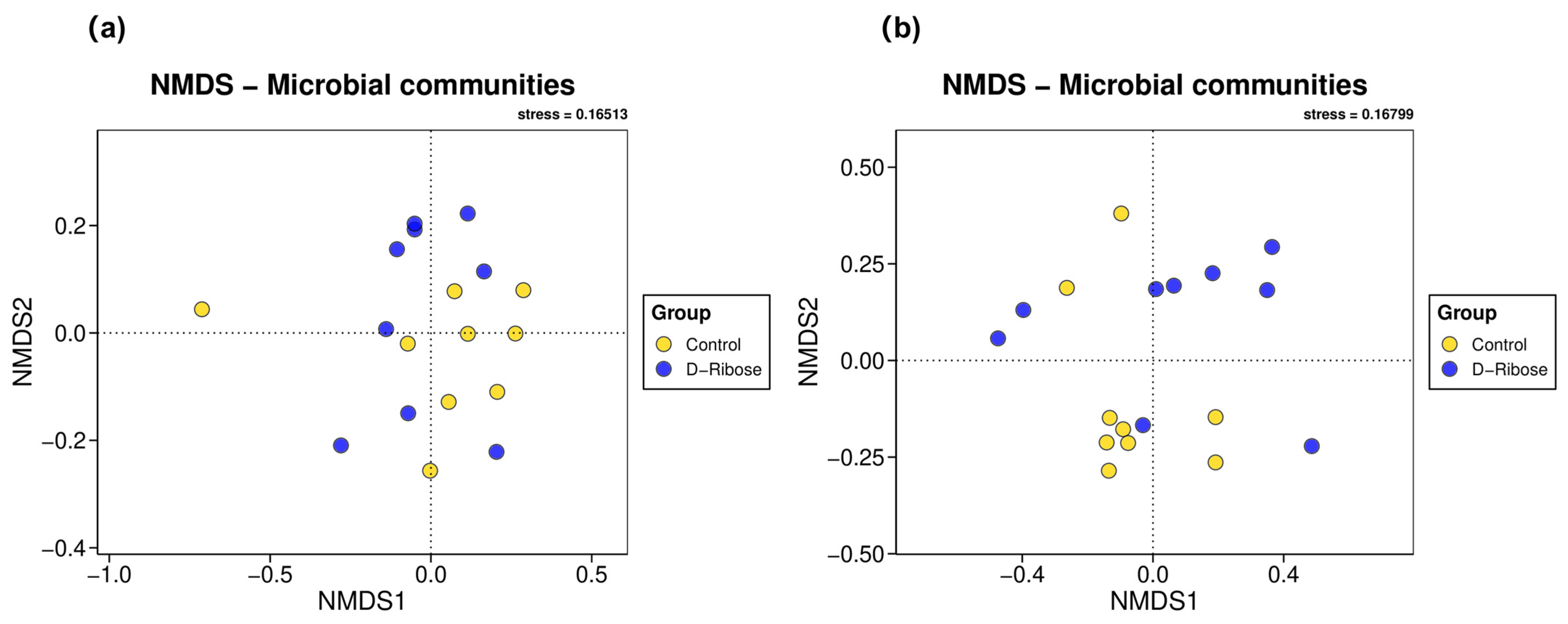
22]. Beta-diversity analysis further revealed that supplementing the diet with D-ribose had no significant impact on the community structure of the rumen microbiota. This stability of the rumen microbiota might be attributed to the inherent robustness and adaptability of rumen microbial niches. For instance, quorum sensing (QS), a prevalent interspecies communication mechanism within the rumen microbiota, enables microbial communities to collectively respond to adverse environmental shifts [
23]. A prime example is the improved concentration of AI-2 signaling molecule and enhanced biofilm formation within the LuxS/AI-2 QS system, which serves as a defense mechanism against the stress induced by cold drinking water during winter [
24]. In contrast, the addition of dietary D-ribose did elicit discernible differences in the beta-diversity of fecal microbiota. This discrepancy could stem from the fact that the rumen microbiota is more complex in terms of diversity, composition, and functionality [
25], thereby endowing it with superior adaptability to dietary changes than fecal microbiota. Nevertheless, this hypothesis warrants validation through more comprehensive and in-depth comparative investigations.
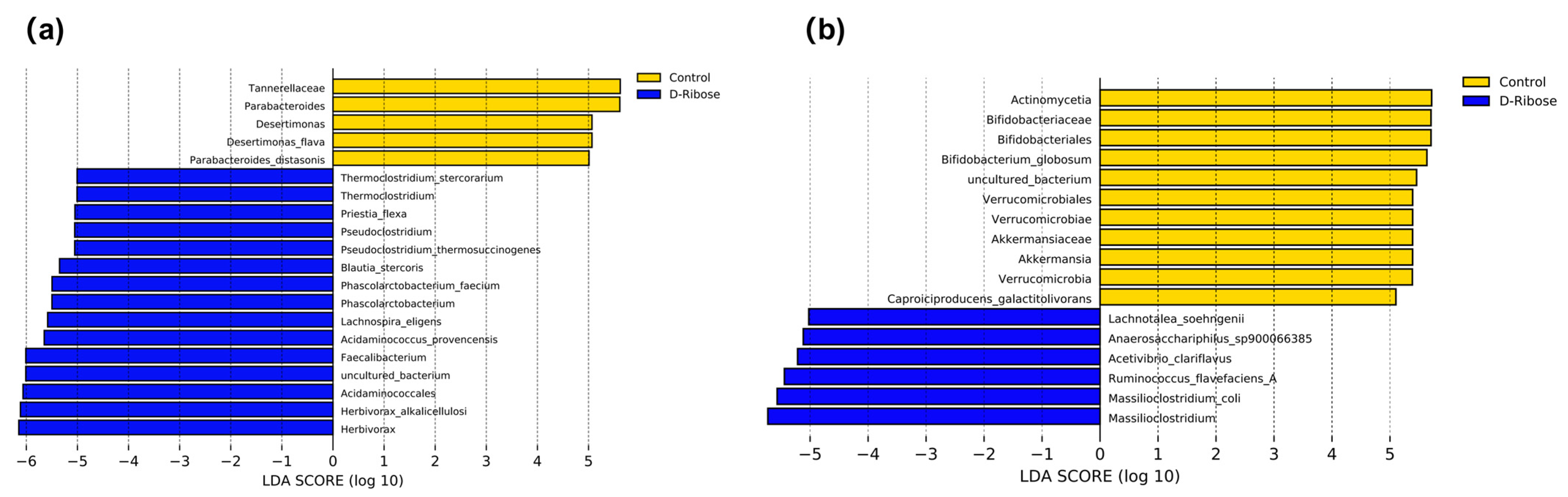
Species abundance analysis elucidated the effects of dietary D-ribose supplementation on particular microbial taxa in the rumen. The bacteria
Herbivorax,
Herbivorax alkalicellulosi,
Thermoclostridium,
Thermoclostridium stercorarium,
Priestia flexa,
Pseudoclostridium, and
Pseudoclostridium thermosuccinogenes are all anaerobic and thermophilic, with the ability to break down cellulose [
26,
27]. The relative abundances of these bacteria in the D-ribose group increased significantly. This implies that incorporating D-ribose into the diet could potentially enhance the rumen’s ability to utilize fiber more effectively, which corresponds well to the higher values of the apparent digestibility of NDF and ADF observed after the addition of D-ribose [
11].
Faecalibacterium,
Blautia stercoris,
Phascolarctobacterium,
Phascolarctobacterium faecium, and
Lachnospira elegans, as well as
Lawsonibacter, Lachnotalea soehngenii, Anaerocharis sp900066385,
Acetivibrio clariflavus,
Ruminococcus flavefaciens A,
Massiliclostridium, and
Massiliclostridium coli are all strongly associated with gut health. These microorganisms can ferment carbohydrates to generate short-chain fatty acids (SCFA), including acetate, propionate, and butyrate, which are vital for maintaining the integrity of the intestinal barrier and modulating the host’s immune responses [
28,
29,
30]. Meanwhile, Acidaminococcales and
Acidaminococcus provencensis possess the capability to degrade amino acids and contribute to protein catabolism and metabolism, thus aiding in the maintenance of gut homeostasis [
31]. The elevated relative abundance of these microorganisms in the D-ribose group suggests that incorporating D-ribose into the diet enhances the utilization of energy and protein, as evidenced by higher numerical values of EE and CP digestibility [
11], which in turn positively impacts rumen and hindgut health. The family Tannerellaceae, as well as the genera
Parabacteroides and
Desetimonas, and the species
Parabacteroides distasonis and
Desertimonas flava, are associated with various intestinal diseases and inflammatory responses [
32,
33]. For instance, succinate, a metabolite produced by
Parabacteroides distasonis, can act as an inflammatory signal. It induces the production of IL-1
β via the HIF-1
α pathway, thereby triggering an inflammatory response. This, in turn, disrupts the delicate balance of the gut microbiota and negatively impacts nutrient absorption and metabolism [
32]. In this study, an increased relative abundance of these microorganisms in the control group indirectly suggests that the addition of D-ribose can enhance the overall health status of the host. These differences observed in the rumen microbial composition further indicate that incorporating D-ribose into the diet can improve the utilization efficiency of energy, protein, and fiber, as well as positively impact the host’s overall health, which is in line with our previous research findings that dietary D-ribose supplementation improves nutrient digestion and reduces stress responses [
11].
The analysis of fecal differential microbiota more deeply assessed the impact of dietary D-ribose supplementation on both the composition and the dominant communities of the fecal microbiota.
Candidatus Saccharibacteria remains an elusive microorganism, yet to be successfully cultured in laboratory settings. Its elevated abundance has been linked to gut microbiota dysbiosis in individuals suffering from inflammatory bowel diseases, such as Crohn’s disease [
34]. Similarly, an increase in the prevalence of Verrucomicrobia, along with its associated classes Verrucomicrobiae and orders Verrucomicrobiales, may serve as a telltale sign of gut microbiota imbalance, potentially foreshadowing the onset of disease [
35]. The lower abundances of these fecal microorganisms observed in the D-ribose group suggest that the incorporation of D-ribose into the diet may play a pivotal role in preserving the stability of the gut microbiota, thereby fostering a healthier gastrointestinal environment. Bifidobacteriales, along with Bifidobacteriaceae,
Bifidobacterium, and
Bifidobacterium globosum, are generally recognized as beneficial bacteria. They modulate the host immune system and boost the activity of regulatory T cells. These bacteria also enhance the barrier function of intestinal epithelial cells, thereby reducing intestinal permeability [
36]. The metabolites they produce, such as acetate and butyrate, help maintain the balance of the gut microbiota [
36]. Actinomycetia are prevalent in soil, water, and living organisms. They are significant producers of secondary metabolites, including antibiotics and bioactive substances, which play a crucial role in inhibiting pathogenic bacteria and maintaining ecological balance [
37]. Surprisingly, in this study, the abundance of these microorganisms in the feces of the control group was significantly higher. One possible explanation is that both the control and D-ribose groups remained healthy throughout the experiment, with no abnormalities in fecal status. The fecal microbiota may exhibit functional redundancy, where other microorganisms can compensate for the reduced abundance of certain species, thereby maintaining overall health [
38]. Alternatively, in the D-ribose group, these microorganisms may have been outcompeted by other beneficial microorganisms, leading to a more stable microbial ecological balance. This finding underscores the need for absolute quantification of microbial composition to determine absolute abundance, rather than relying solely on relative abundance data from conventional techniques.
Caproiciproducens and
Caproiciproducens galactitolivorans are recognized for their ability to ferment substrates such as fructose, lactate, galactose, and xylose, resulting in the production of SCFA [
39]. Similarly, Akkermansiaceae and
Akkermansia are known for degrading mucin in the gut, which also leads to the generation of SCFA [
40]. While these metabolic activities are typically linked to gut health, emerging research indicates that an increased abundance of these microorganisms can be observed in the context of gut dysbiosis, particularly during
Salmonella infections [
41]. The differential fecal microbial results suggest that dietary D-ribose supplementation specifically boosts the abundance of beneficial microorganisms associated with immune metabolism. This effect contrasts sharply with the impact on the rumen microbiota, where the primary microorganisms drive nutrient digestion and utilization.
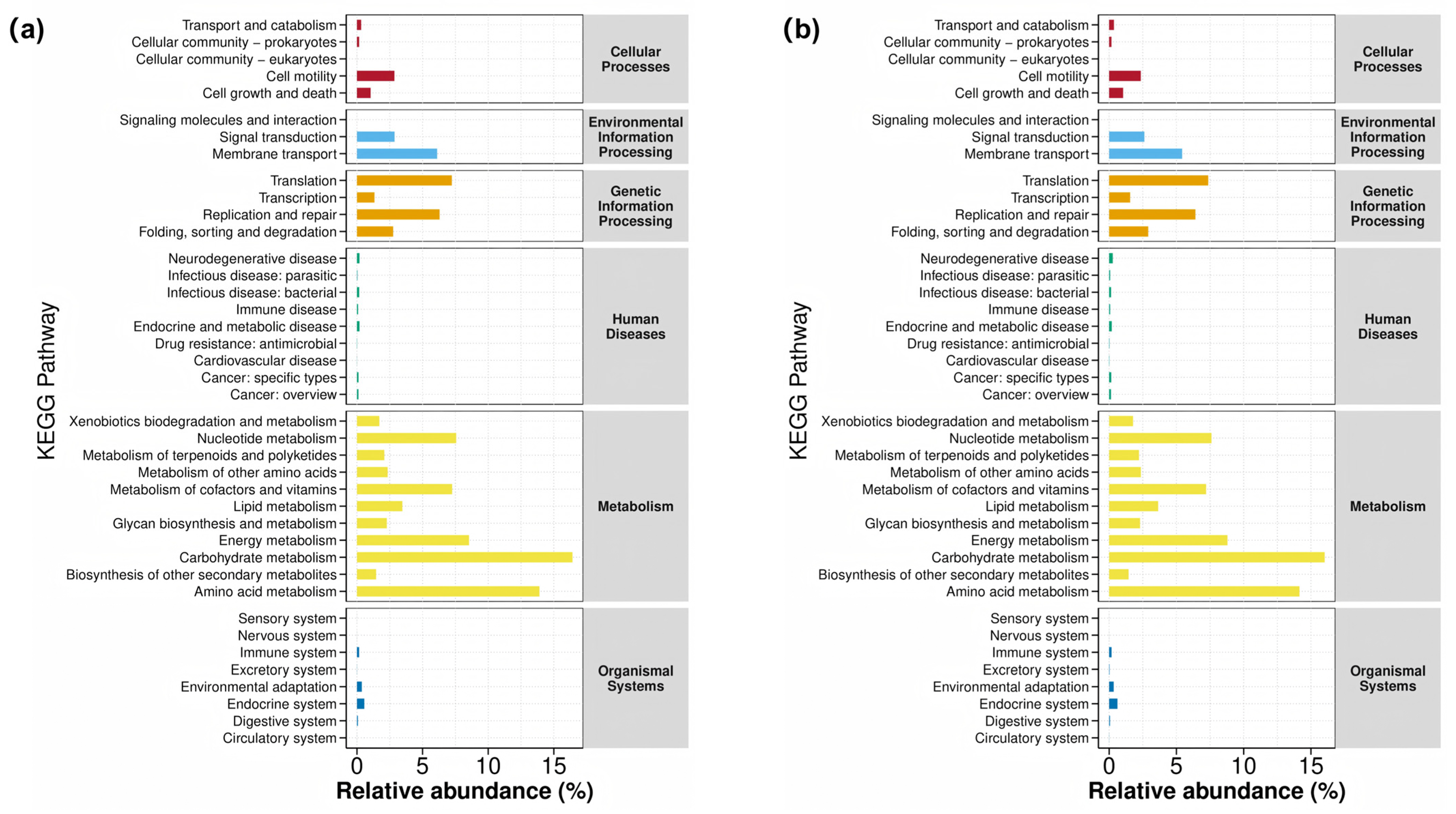
D-ribose is a fundamental component in nucleotide metabolism, playing a crucial role in various biological processes, including nucleotide synthesis, energy metabolism, signal transduction, antioxidant defense, DNA repair, and metabolic regulation. However, the predicted metabolic pathways in this study did not reveal any differences in the aforementioned metabolic pathways between the CON and D-ribose groups. Measuring the nucleotide content in blood and rumen fluid could better reveal the relationship between nucleotide metabolism and microbial responses. Moreover, integrating host data with microbial data could provide a more comprehensive explanation for the dynamics of rumen and fecal microbiota due to dietary D-ribose supplementation.
It should be acknowledged that the present investigation exclusively evaluated the impact of dietary D-ribose supplementation at 300 mg kg−1 on ruminal and fecal microbial communities under non-stress conditions. Consequently, whether lower or otherwise alternative doses elicit comparable responses remains to be established. Under environmental challenges such as heat stress, cold stress, or transportation stress, the ruminal microbiota of ruminants undergoes marked compositional and functional shifts; accordingly, the optimal supplemental level of D-ribose and its resultant efficacy under such circumstances awaits systematic clarification in future research. Furthermore, the functional predictions presented here were generated with PICRUSt2, which was trained primarily on human-microbiome data; therefore, the absence of significant differences should be interpreted cautiously and verified in future studies using rumen-specific tools such as CowPI or direct metagenomics.