Article

Linking Soil Microbial Diversity to Nitrogen and Phosphorus Dynamics

by
Bruna Arruda
1,*,
Eduardo Mariano
2,
Wilfrand Ferney Bejarano-Herrera
3,
Fábio Prataviera
4,
Elizabeth Mie Hashimoto
5,
Fernando Ferrari Putti
6,
Jéssica Pigatto de Queiroz Barcelos
7,
Paulo Sergio Pavinato
4,
Fernando Dini Andreote
4 and
Davey L. Jones
8
1
Agronomy Engineering Program, University of Applied and Environmental Sciences (U.D.C.A), Bogotá 111166, Colombia
2
Center for Nuclear Energy in Agriculture (CENA), University of São Paulo (USP), Piracicaba 13416-000, Brazil
3
Colombian Corporation for Agricultural Research (AGROSAVIA), Pasto 520038, Colombia
4
“Luiz de Queiroz” College of Agriculture (Esalq), University of São Paulo (USP), Piracicaba 13418-900, Brazil
5
Academic Department of Mathematics, Federal University of Technology, Londrina 86036-700, Brazil
6
Biosystems Engineering Department, São Paulo State University (UNESP), Tupã 17602-496, Brazil
7
Department of Agronomy, University of Western São Paulo (UNOESTE), Presidente Prudente 19067-175, Brazil
8
Environment Centre Wales, Bangor University, Bangor LL57 2UW, UK
*
Author to whom correspondence should be addressed.
Microorganisms 2025, 13(10), 2401; https://doi.org/10.3390/microorganisms13102401

Submission received: 16 August 2025 / Revised: 30 September 2025 / Accepted: 8 October 2025 / Published: 21 October 2025
(This article belongs to the Special Issue Diversity, Function, and Ecology of Soil Microbial Communities)

Abstract

Changes in the soil microbial community for studies of different novel communities can be promoted by different methodologies, among which soil autoclaving stands out as a quick and readily available tool. However, this procedure may also directly or indirectly alter nitrogen (N) and phosphorus (P) dynamics. The purposes of this study were as follows: (i) to characterize microbial activity after soil autoclaving through microbial 14CO2-respiration; and (ii) to evaluate the effect of microbial manipulation and autoclaving on soil N and 33P dynamics. For this, two sets of soil samples from two areas (forest and cultivated area) were used in the laboratory. Firstly, 14C-glucose was added to the soils and after 24 h five soil microbiomes were generated: AS (autoclaved soil), and AS re-inoculated with serial dilutions (w/v) prepared by successive mixing of soil suspensions in sterile deionized water obtaining 10−1, 10−3, and 10−6, which generated the treatments AS + 10−1, AS + 10−3, and AS + 10−6; and the treatment NS (non-autoclaved control), all incubated for 28 d. 14CO2 emission was used to characterize microbial activity; additionally, N dynamics were assessed at the end of incubation. In a second assay, 33P was applied to the soil before autoclaving and re-inoculation. Following further incubation (14 d), a 33P chemical fractionation was performed. The following are based on the results: (i) 14CO2 emission: microbial activity in the autoclaved soil is null, but after a reinoculation of AS + 10−1 and AS + 10−3 soil dilution suspension, the 14CO2-respiration is higher than in an NS. (ii) regarding the N dynamics, in autoclaved soils, the microbial levels increased N-NH4+ concentration, with an evident increase in the AS + 10−3 and AS + 10−1, and a reduction in the N-NO3 concentration in comparison to the NS. For 33P, the autoclaving procedure itself reduced the 33P lability, regardless of the levels of microbial community reinoculated.

1. Introduction

Soil micro-organisms play essential roles in carbon (C), nitrogen (N), and phosphorus (P) biogeochemical cycling. For C, cellulose represents the most abundant biopolymer in the plant–soil system [1], and its extracellular breakdown produces soluble products, such as cellobiose and glucose, which then become available for microbial uptake. In the N cycle, micro-organisms perform roles in biological N fixation, mineralization, nitrification, and denitrification [2]. The biodynamics of P include the immobilization and mineralization of organic P [3,4].
The distinct functions performed by the soil microbiota will depend on the diversity, abundance, and activity of the present organisms; hence, the soil microbial composition strongly depends on the plant effect, shaped by the rhizosphere [5]. Less-disturbed systems, such as natural forests, with high plant diversity and a high level of spatial heterogeneity, tend to have an equilibrium status and microbial stability [6]. On the other hand, climate change and anthropogenic activities such as agriculture (e.g., fertilization, tillage, and monocropping) induce shifts in the microbial community and trend to a reduction in biodiversity, mainly under monocultures, leading to a restriction in biodiversity [7]. Furthermore, management practices will affect the level of alterations in microbial community composition, which can either maintain biodiversity or strictly eliminate microbial communities, thereby altering the functioning of the soil system. In this sense, regenerative agriculture has been promoted as an ecological strategy to minimize the adverse effects of agriculture on the soil microbial diversity [8].
To explore the effects of different novel communities under controlled conditions, various methodologies, such as selective heat, specific biocides, dilution-to-extinction, and genome editing, can be employed, involving the loss of organisms and the subsequent reconstruction of the microbial community. These approaches simulate various levels of biodiversity, reflecting scenarios caused by management practices that can lead to biodiversity loss, and resulting in treatments that vary in community composition and function. Autoclaving is an option, as this process is rapid, low-cost, the equipment is usually part of the facilities in most microbiology laboratories, and no chemical pollution is generated [9]. This technique, which combines elevated temperature and pressure, causes the death of most of the organisms. From this sterile community, the recreation of the microbial community is possible by reincorporating diverse levels of biodiversity, reshaping the microbial community, and creating niches [10].
Once the soil microbial community is set, techniques to characterize the soil microbial changes and activity are required. Arruda et al. [11] used the autoclaving procedure to manipulate the soil micro-organisms and to identify the autoclaving effect on microbial community; the DNA sequencing procedure was used. These authors reported that both non-autoclaved and autoclaved soil had similar microbial diversity, for both fungi and bacteria, and attributed this result to the relic DNA. Therefore, DNA sequencing did not prove to be enough to identify changes in microbial activity after soil autoclaving. So, studies that aim to identify the changes in microbial activity caused by the autoclaving procedures are required. An alternative procedure for evaluating the soil microbial activity after autoclaving is to use labeled elements, such as C. As glucose is the most abundant and easily broken down in the soil system, 14C-glucose is highly recommended to track the C cycling, through the 14CO2 evolution from the soil, which reflects microbial respiration as a model substrate for understanding the priming effect in the soil and allows a correspondence of this process with the microbial activity [12].
However, the use of the autoclaving procedure has been questioned when the purpose of the study is to evaluate nutrient dynamics, as the autoclaving may affect the availability of some nutrients, such as N and P, either directly through the autoclaving conditions or indirectly through the loss of micro-organisms that participate in the nutrient cycling and availability. Therefore, the use of labeled elements, such as 33P, is an alternative to track the element in the soil and its dynamics and availability due to the autoclaving procedure.
The aims of this study were as follows: (i) to characterize microbial activity through microbial 14CO2-respiration after soil autoclaving; and (ii) to evaluate the effect of microbial manipulation and of the autoclaving procedure itself on soil N and 33P dynamics.

2. Materials and Methods

2.1. Soil Description

The soil, Eutric Cambisol, classified in previous studies [13] (Table 1), was sampled (0–10 cm depth and 1 m2—1 m × 1 m area) in the University of Wales Henfaes Experimental Station, Abergwyngregyn, Gwynedd, Wales, UK, during Autumn season, from a 24-year-old undisturbed Sycamore (Acer pseudoplatanus) plantation (53°14′22.70″ N, 4°0′54.81″ W) (named the forest area) and an adjacent cultivated area growing maize (Zea mays L.) (53°14′19.94″ N, 4°0′53.71″ W) (named the cultivated area). After sampling, the soil samples were homogenized individually and sieved (5 mm) to remove visible roots and stones, but we maintained the aggregates’ structure to keep the representativeness of the field conditions. The soil samples were stored in plastic bags and transported to the Bangor University facilities in a cooler to maintain the soil biological activity, and they were stored (4 °C) until the laboratory experiments were set up.
Additionally, four replicates of each soil (forest and cultivated) were sampled for chemical characterization. Soil samples were analyzed for chemical parameters such as pH and cation exchange capacity, macronutrients (N, P, K, Ca, Mg, and S) and micronutrients (Mn, Cu, B, Zn, Mo, and Fe) for the plant requirements using the following methodologies: pH was determined by water extraction and measured with a pH electrode/meter; P was measured by the Olsen method (sodium hydrogen carbonate extraction) and determined by solution spectrophotometry after complexing with ammonium molybdate; K by 1 M ammonium nitrate extraction and flame emission spectrometry (or Inductively Coupled Plasma—ICP) determination. Mg and Ca were extracted using 1 M ammonium nitrate, followed by atomic absorption spectrometry (or ICP). S was measured after calcium tetrahydrogen extraction and solution spectrophotometry of diorthophosphate-precipitated barium sulfate (or ICP). Mn was extracted with 1 M ammonium acetate containing 2 g L−1 quinol and analyzed by atomic absorption spectrometry (or ICP). Cu, Zn, and Fe were extracted with 0.05 M EDTA disodium salt and analyzed by atomic absorption spectrometry (or ICP). B was extracted by hot water extraction (80 °C) and determined by solution spectrophotometry after complexing with azomethine (or ICP). Mo was extracted with ammonium acetate (24.9 g L−1) and oxalic acid (12.6 g L−1) and analyzed by atomic absorption spectrometry with nitrous oxide (or ICP). Cation exchange capacity (CEC) was leached with 1 M ammonium acetate following a water rinse and determined by atomic absorption (or ICP).

2.2. Laboratory Assays—14C and N

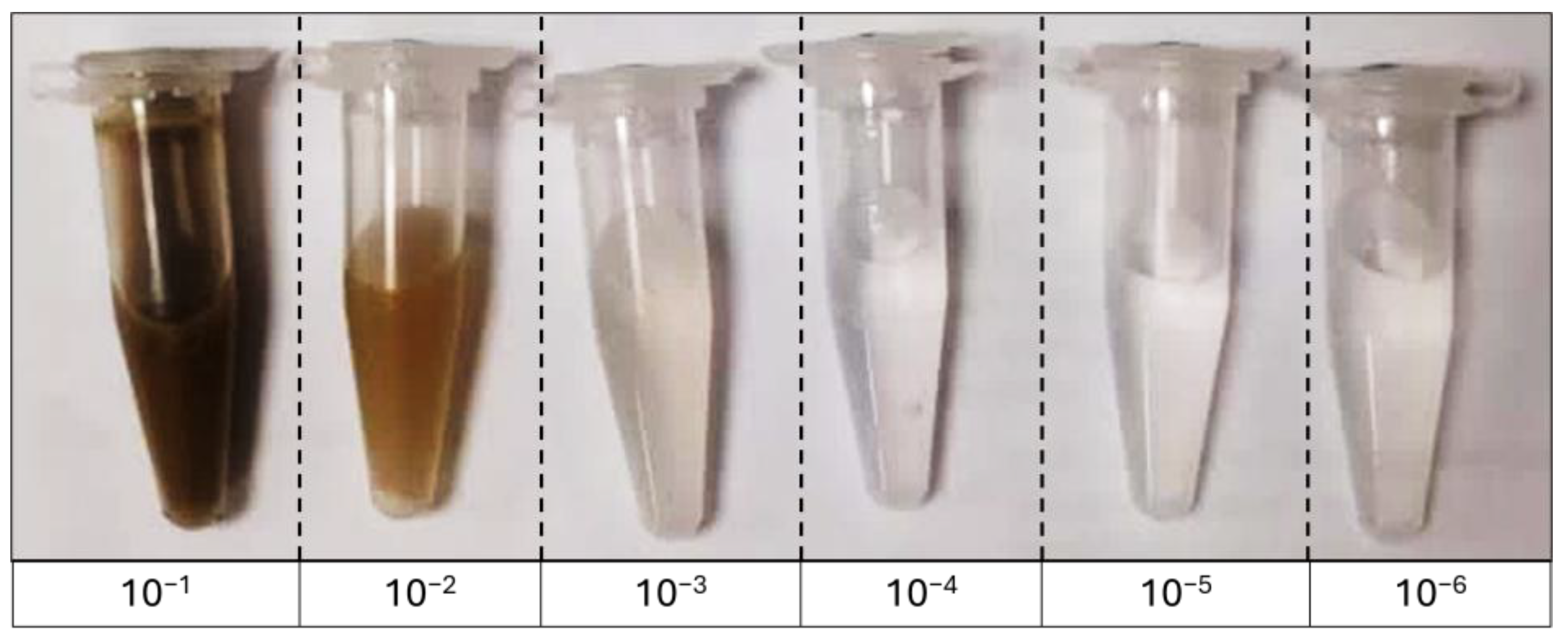
Firstly, for the 14C and N assay, 20 replicates of soil samples (5 g) were placed in individual sterile 50 mL polypropylene centrifuge tubes. Subsequently, 20 µM D-[U-14C]-glucose (Perkin Elmer Inc., Beaconsfield, UK, 250 µL; 6.8 kBq mL−1) was applied to the soil, and a trap with 1 M NaOH (1 mL) was placed above the soil surface [14]. The traps were sampled and replaced 2, 4, 8, and 24 h after 14C-glucose application. After 24 h, the 14C-treated soil replicates were used to generate five soil microbiomes with four replicates each. For this, 16 replicates were submitted to autoclaving (121 °C; 103 kPa; 1 h) to obtain the treatments: autoclaved soil (AS), as negative control (4 replicates), and AS re-inoculated with the treatments: (i) AS + 10−1 (4 replicates); (ii) AS + 10−3 (4 replicates); and (iii) AS + 10−6 (4 replicates). To obtain the serial dilutions, an undisturbed (4 °C) soil sample from each soil (forest or cultivated) was progressively reduced to the concentration of micro-organisms through successive mixing steps, respectively. For this, initially 100 mg of soil was taken and transferred to a 1.5 mL tube containing 900 µL of sterile deionized water, thus obtaining the 10−1 dilution (Figure 1). Subsequently, in the same way, 100 µL of this dilution was taken and transferred to another tube containing 900 µL of sterile deionized water, producing the 10−2 dilution, and so on until the serial dilution was reached (10−6). All the dilutions were homogenized (200 rpm, 1 h). Once we obtained the dilutions, 250 µL of soil suspension from the dilutions 10−1, 10−3, and 10−6 were obtained from NS and sterile deionized water in the AS. The positive control consisted of non-autoclaved soil (NS) (4 replicates). The treatments were incubated (room temperature at 20 ± 5 °C) [15].
Subsequently, 14CO2 emissions from the soil were monitored again by sampling the traps after 0.08, 0.17, 0.33, 1, 2, 3, 4, 5, 7, 10, 14, 18, 23, and 28 d after soil microbiome manipulation. The amount of 14CO2 trapped in the NaOH solution was determined by using 4 mL of Optiphase HiSafe 3 scintillation cocktail (PerkinElmer Inc., Waltham, MA, USA) in a Wallac 1404 liquid scintillation counter with automated quench correction (Wallac EG&G, Milton Keynes, UK). At the end, the soil was shaken with 0.5 M K2SO4 (25 mL; 200 rpm; 15 min). The extract was then centrifuged (18,000× g; 15 min), and the amount of N-NO3 and N-NH4 in the supernatant was determined colorimetrically using the methods of Miranda et al. [16] and Mulvaney [17], respectively. Also, 14C in the supernatant was determined using Optiphase HiSafe 3 scintillation cocktail (PerkinElmer Inc., Waltham, MA, USA) and a Wallac 1404 liquid scintillation counter with automated quench correction (Wallac EG&G, Milton Keynes, UK). The amount of 14C immobilized in the microbial biomass (14Ci) (kBq) was estimated by using Equation (1):
C 14 i = C 14 a C 14 O 2 + C 14 s
where 14Ca is the total 14C applied at the beginning of the experiment (kBq); 14CO2 is the total amount of 14C recovered in the NaOH traps (kBq); and 14Cs is the 14C recovered in the 0.5 M K2SO4 soil extract (kBq).
Microbial carbon use efficiency (14CUE) was calculated using Equation (2):
C 14 U E = C 14 i C 14 i + C 14 O 2

2.3. Laboratory Assay—33P

Secondly, for the 33P assay, 20 replicates of soil samples (1 g) were placed in individual sterile 50 mL polypropylene centrifuge tubes. Subsequently, 33P-H2O (25 µL; 289.2 kBq mL−1) was applied to the soil. After 24 h 33P-equilibrating, the soil was submitted to the dilution-to-extinction methodology to generate the same five soil microbiomes, as described above, using 50 µL of soil suspension. Subsequently, the treatments were incubated [room temperature (20 ± 5 °C), 14 d] and then subjected to a sequential 33P chemical fractionation [18], as briefly described. The soil was first shaken (200 rpm; 16 h) with deionized water (30 mL) in the presence of a capsule containing a mixed cation–anion exchange resin (Unibest International, Kennewick, WA, Australia). Afterward, 33P was desorbed from the resin by placing the capsule in 30 mL of 0.5 M HCl for 16 h (33PAER). The soil was then centrifuged (3850× g; 30 min), and the water was discarded. The remaining soil was sequentially extracted with 0.5 M NaHCO3 (30 mL; 200 rpm; 16 h), centrifuged (3850× g; 30 min), and the supernatant recovered (33PNaHCO3). This process was repeated with the following extractants: 0.1 M NaOH, 1 M HCl, and 0.5 M NaOH, for 33P0.1NaOH, 33PHCl, and 33P0.5NaOH, respectively. After all the extractions, the remaining soil was dried (40 °C, 48 h), ground, and digested (0.1 g) with perchloric acid (10 mL, 200 °C, 4 h), which represented the residual P (33PRes). 33P activity for each fraction was determined by using the extractant (1 mL) and Optiphase HiSafe 3 scintillation cocktail (4 mL) in a liquid scintillation counter. Afterward, 33P-data were corrected according to 33P-decay (ca. 25 d) [19] back to the point at which the tracer was added to the soil by using Equation (3):
P o = P e λ t
where Po is the 33P-activity decay corrected to the point when the tracer was added to the soil (kBq); P is the 33P-activity at time of counting (kBq); t is the time between tracer addition and measurement (d); e = 2.71828; and λ is the 33P-decay constant (λ = 0.0273539).
Then, the 33P fractions were grouped according to the lability as follows: (i) labile 33P (33PAER and 33PNaHCO3); (ii) moderately labile (33P0.1NaOH and 33PHCl); and (iii) non-labile (33P0.5NaOH and 33PRes).

2.4. Statistical Analysis

Data were separated into two data sets according to the land use (forest and cultivated area). For 14CO2 modeling, Equation (4) was used:
y = K 1   +   e r t b
where K represents the cumulative frequency at the upper limit (maximum value that the function can reach as time increases; r controls the speed at which the curve grows (higher values indicate a more abrupt transition between the initial and final states, making the curve steeper); t represents the time at which the fastest transition occurs between the accelerated and decelerated growth states (t → ∞; however, in this study, t is limited by the maximum respiration rate that the environment can sustain); b determines the location of the peak on the x-axis (in this case, t).
Parameter estimation was performed using a Bayesian approach, considering non-informative prior distributions, through Hamiltonian Monte Carlo (HMC) sampling. The results of the estimation of the nonlinear model parameters (Equation (4)) were obtained for each soil type and their respective microbial manipulations. To support the analyses, the Bayesian regression models—brms package—were implemented in the R software (version 4.5.1). Informative priors were specified to reflect the response scale: K∼Normal (100, 10), r∼Normal (1, 0.5), and b∼Normal (5, 1). Sampling was performed using four chains (iter = 4000, warmup = 1000, chains = 4). Convergence was evaluated through the Gelman–Rubin potential scale reduction factor R ^ , effective sample sizes, and visual inspection of trace plots. All R ^ values were ≤1.001, and no divergent transitions were detected.
Additionally, one-way analysis of variance (ANOVA) was performed considering microbiome manipulation as a fixed factor within the generalized linear model (GLM). Data distribution of all variables was also checked. Tukey’s post hoc test at the 5% level of significance was used to perform comparisons of the means. The one-way analysis was performed using SAS 9.4 software.

3. Results

3.1. Microbial Activity Characterization—14C Approach

Based on the parameters analyzed (Equation (4)), the maximum 14CO2-respiration capacity (K), growth rate (r), and transition time (b) were estimated for each soil type and their respective microbial manipulations (Table 2 and Table 3).
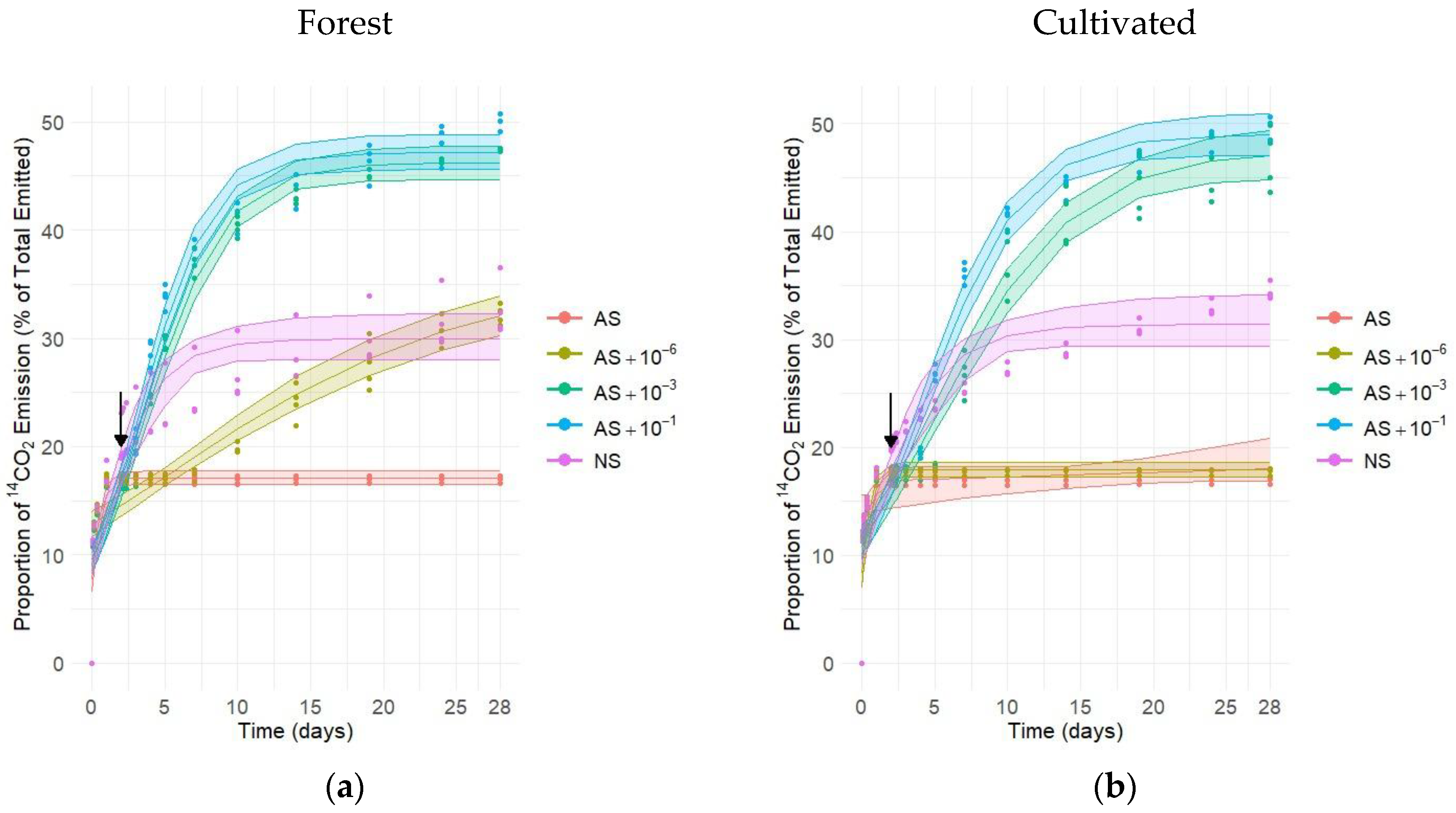
Regarding the maximum respiration (K), for both soil types, there was no difference between AS + 10−1 and AS + 10−3. In forest soil, AS + 10−1 and AS + 10−3 reached 14C-respiration capacity (K) of 49.01% and 47.49%, respectively (Figure 2a). For this soil, no significant differences were observed between the AS + 10−6, AS, and NS treatments, and all treatments presented maximum 14CO2 emissions (K) below 35%. For respiration growth rate (b), for forest soil, AS + 10−6 and AS treatments presented high standard errors, resulting in wide credibility intervals, which makes it difficult to interpret the differences between treatments regarding growth rate. For logistic curve transition time (b), for forest soil, no significant differences were observed between the AS + 10−1 and AS + 10−3 treatments, both presenting the longest transition times, with values of 4.37 and 5.42, respectively. On the other hand, NS treatment showed a transition time of 1.41. Again, in the forest soil, the AS + 10−6 and AS treatments presented high standard errors regarding transition time, resulting in wide credibility intervals, which makes it difficult to interpret the differences between treatments.
For cultivated soil, the AS + 10−1 and AS + 10−3 treatments presented maximum CO2 emissions (K) of 47.11% and 46.19%, respectively (Figure 2b). AS treatment showed the highest microbial growth rate (r) (2.56), while the AS + 10−6 treatment exhibited the lowest rate (r) (0.101). No significant differences were observed between the AS + 10−1 (0.41), AS + 10−3 (0.36), and NS (0.55) treatments regarding growth rate (r). Significant differences were observed in the transition time (b) between treatments. AS + 10−6 treatment presented the longest transition time (b) (5.65), while the lowest value was observed in the AS treatment (0.08).
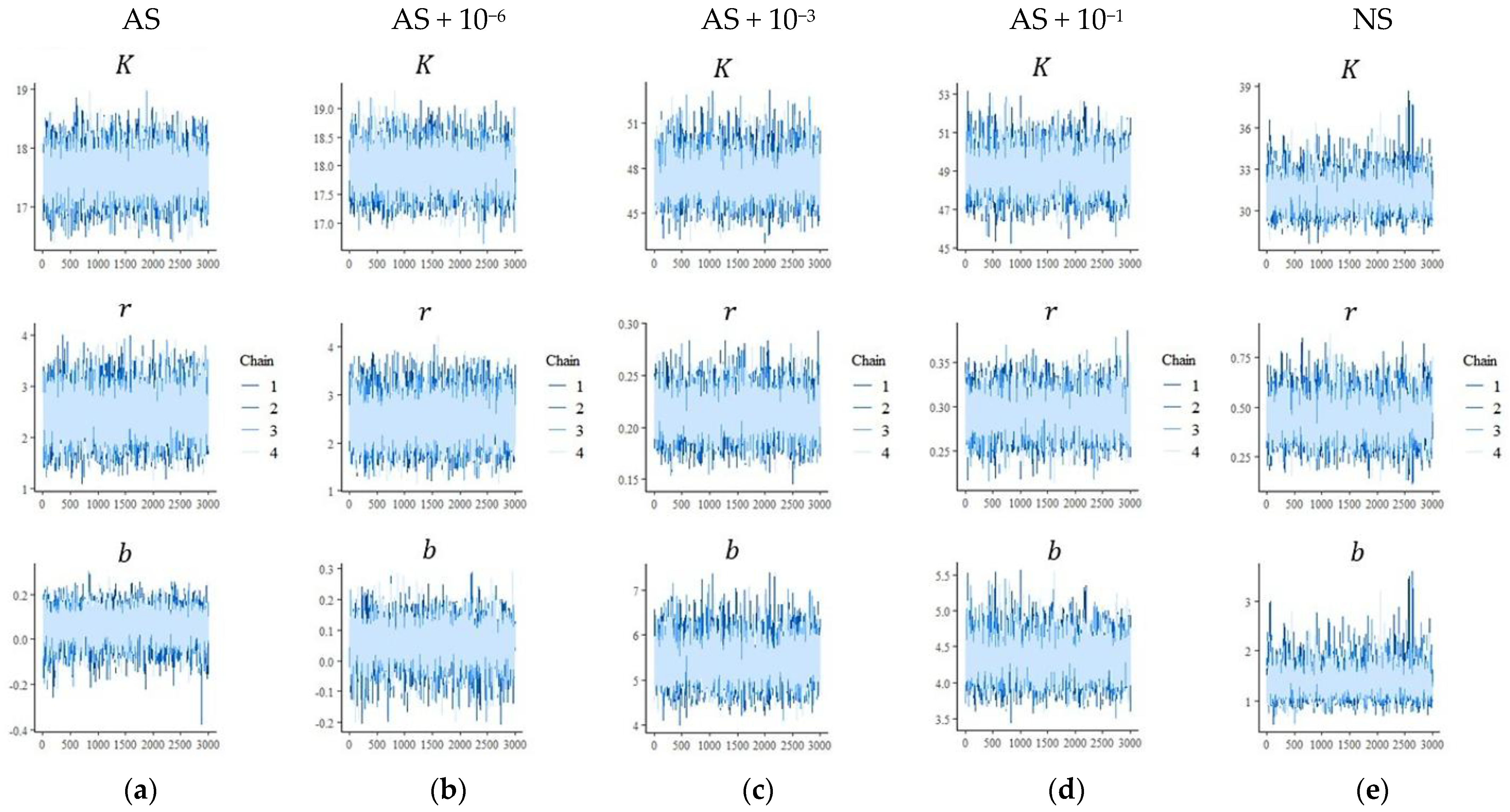
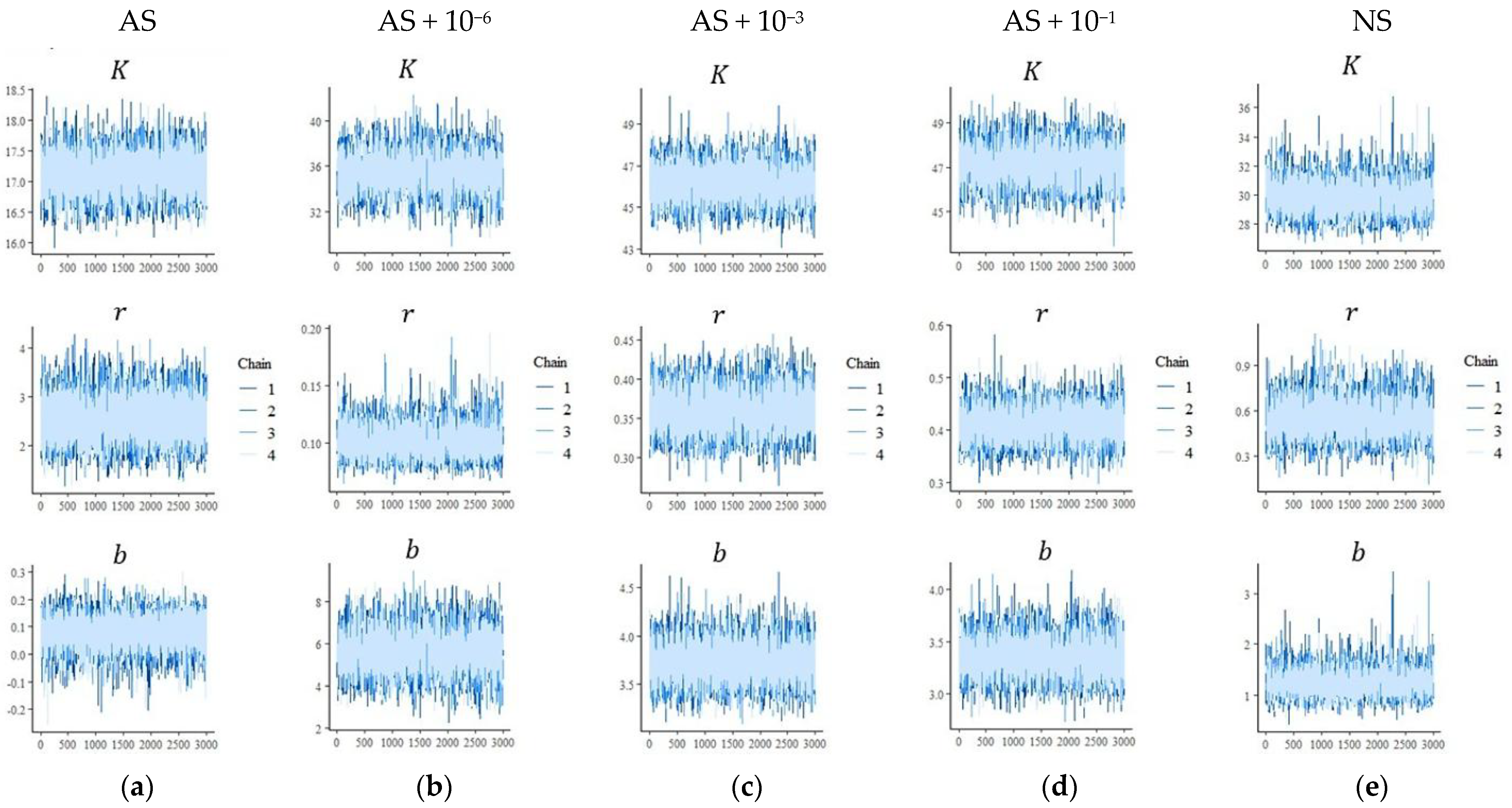
The MCMC chains show stable behavior and clear signs of convergence for the parameters K, r, and b (Figure 3 and Figure 4). These results correspond to the parameters presented in Table 2 and Table 3.
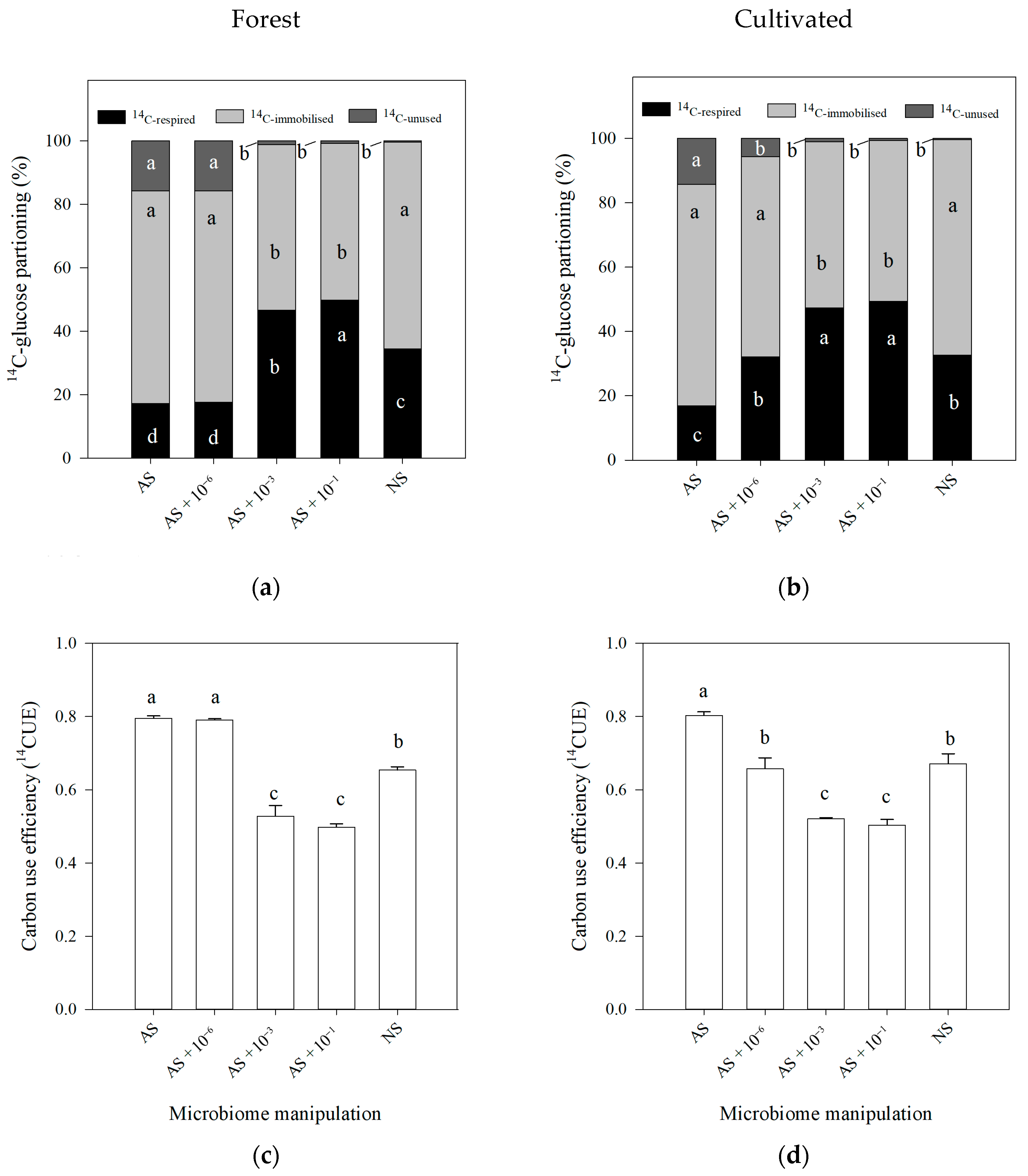
Considering the 14CO2 evolved during the micro-organism’s respiration, immobilized in the micro-organism’s biomass, and the unused 14C, in general, the tendency according to the manipulated microbial community in the distribution was similar for both forest and cultivated soils (Figure 5a,b). According to the 14C partition, under AS, the lowest release of 14CO2-respirated was observed among the treatments, with high immobilization in the microbial biomass (i.e., anabolism) and the highest 14C-unused. When a low number of cells was reincorporated into the sterile soil (AS + 10−6), for forest soil, a very similar trend was observed in comparison to AS; for cultivated soil, under AS + 10−6, an increase in the 14C-respirated was observed, with a reduction in the 14C-unused. When a high number of cells were reincorporated in the sterile soil (AS + 10−3 and AS + 10−1), regardless of the land use, the highest 14C-respirated was observed, with intermediate content of 14C-immobilized and low 14C-unused. For NS treatment, intermediary emissions of 14CO2, with high 14C-immobilization and low 14C-unused, were observed.
In terms of C use efficiency (CUE), for both forest and cultivated soils, the highest values were observed in the AS (Figure 5c,d). For the forest soil, the treatment AS + 10−6 also presented high values of 14CUE. For both forest and cultivated soil, the lowest 14CUE was observed under AS + 10−1 and AS + 10−3, and intermediate values of 14CUE were observed under NS.

3.2. N Dynamics in Autoclaved Soil with the Levels of Microbial Reinoculation

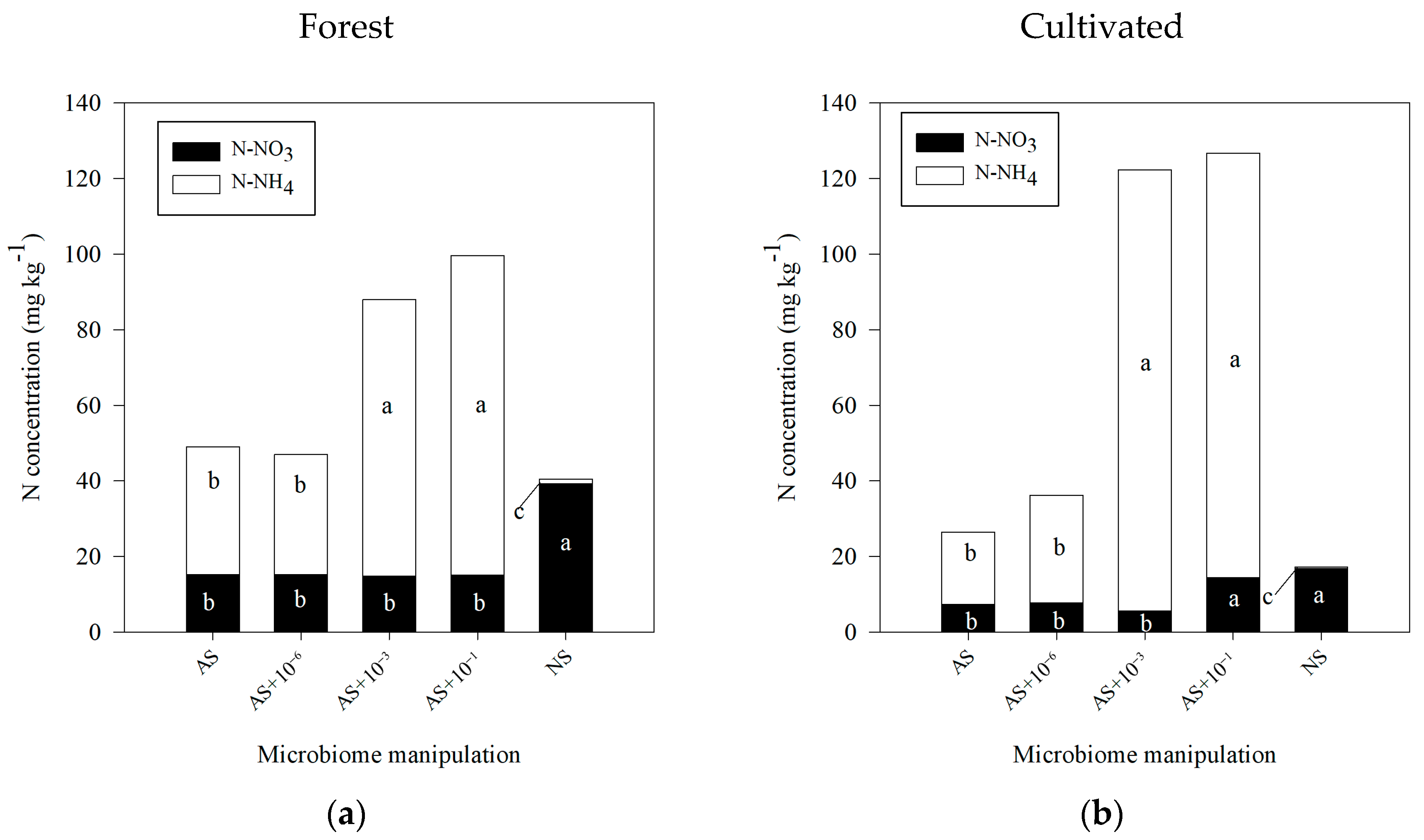
Regarding the N-inorganic forms, in general, for both forest and cultivated soils, the autoclaving procedure, either with or without reinoculation, promoted considerable changes in the nitrate (N-NO3) and ammonium (N-NH4) proportions in the soil (Figure 6).
In forest soil, under the NS condition (without microbial manipulation), nitrate (N-NO3) and ammonium (N-NH4+) contents were 39.23 mg kg−1 and 1.26 mg kg−1, respectively (Figure 6a). Autoclaving reduced N-NO3 by about half (average ≈ 15 mg kg−1) and increased N-NH4+ across all manipulated conditions compared to NS. In sterile soil (AS) and AS + 10−6 (low cell reinoculation), intermediate N-NH4+ values were observed, with ~30-fold increases (AS = 33.77 mg kg−1; AS + 10−6 = 31.76 mg kg−1). In contrast, reinoculation with higher cell numbers (AS + 10−3 and AS + 10−1) resulted in the highest N-NH4+ concentrations (AS + 10−3 = 73.06 mg kg−1; AS + 10−1 = 84.50 mg kg−1).
In cultivated soil, the NS condition showed 16.82 mg kg−1 of N-NO3 and 0.45 mg kg−1 of N-NH4+. Autoclaving and reinoculation with low or intermediate cell numbers (AS, AS + 10−6, and AS + 10−3) reduced N-NO3 by ~5-fold (AS = 7.28 mg kg−1; AS + 10−6 = 7.67 mg kg−1; AS + 10−3 = 5.56 mg kg−1), whereas AS + 10−1 showed no difference compared to NS (14.34 mg kg−1). For N-NH4+, cultivated soil exhibited ~20-fold increases in AS and AS + 10−6 (AS = 19.18 mg kg−1; AS + 10−6 = 28.45 mg kg−1) compared to NS. Reinoculation with high cell numbers produced the largest increases, with N-NH4+ concentrations exceeding 100-fold (AS + 10−3 = 116.83 mg kg−1; AS + 10−1 = 112.40 mg kg−1).

3.3. P Dynamics in Autoclaved Soil with Levels of Microbial Reinoculation

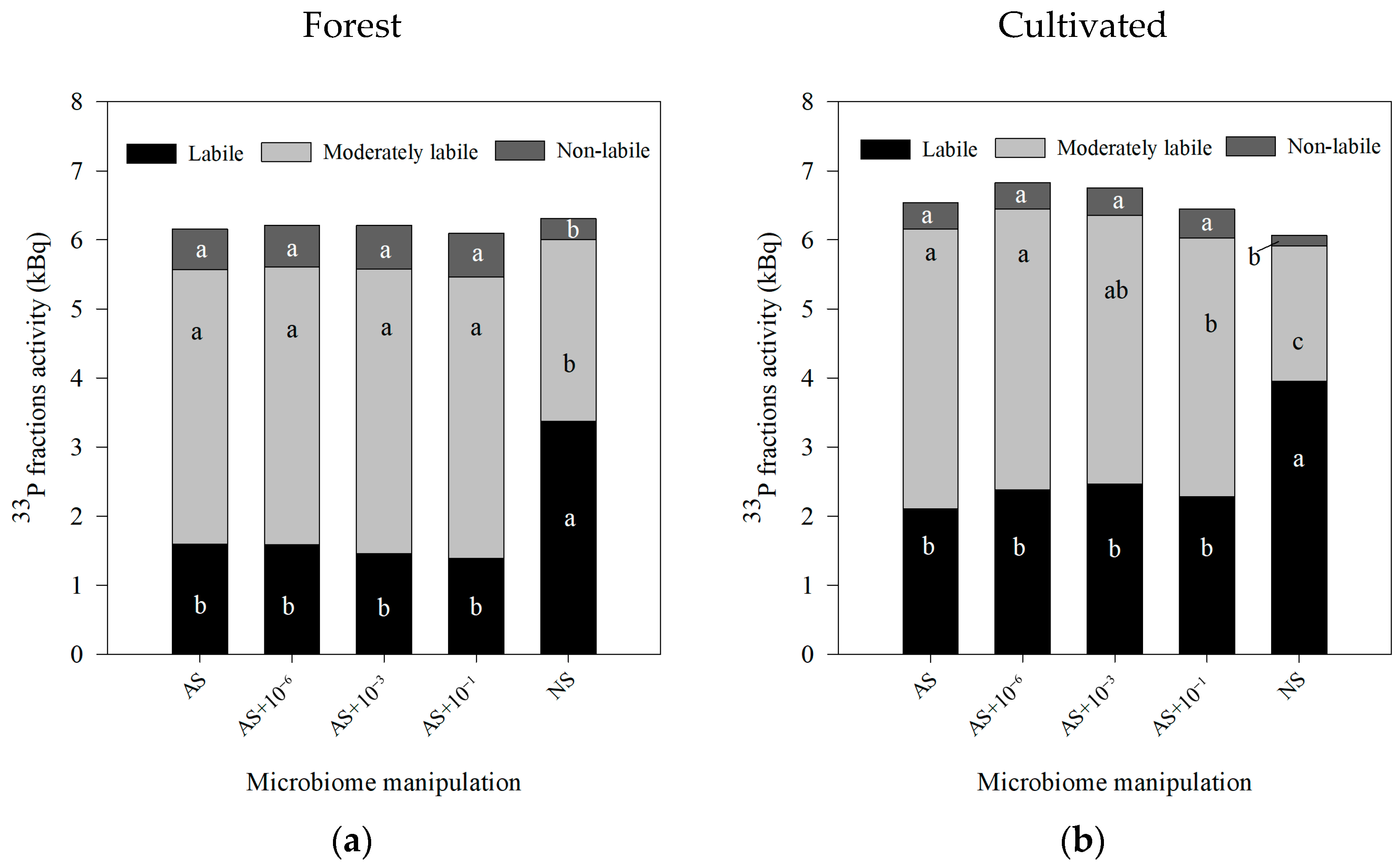
Regardless of the land use, for both forest and cultivated soil, 33P activity showed the same trend for the P lability (Figure 7). Higher 33P-labile was observed in NS, and a reduction in the autoclaved soil (AS), either with or without dilution inoculations. Hence, an increase in the 33P-moderately labile and 33P-non labile activity was observed (Figure 7).
For forest, natural soil (NS) without autoclaving showed the highest labile fractions 33P-activity (33PAER and 33PNaHCO3; Table 4). Considering only the 33PAER, the treatments AS, without reinoculation, and AS + 10−6, with the smallest reinoculation, showed intermediate 33P activity, and when the sterile soil was reinoculated with a higher number of cells (AS + 10−3 and AS + 10−1), the lowest activity was observed (Table 4). Considering the 33P-moderate labile fractions (33P0.1NaOH and 33PHCl), an increment in the 33P activity was observed for the autoclaved soils, regardless of the reinoculation level. For non-labile fractions, the lowest 33P activity was observed in the 33P0.5NaOH fraction in NS, and no difference was observed in 33PRes.
For the cultivated area, for labile 33P fractions, the highest 33PAER was observed in the NS, but no differences for the sterile soil, regardless of the reinoculation, were observed (Table 5), and no effect on the 33PNaHCO3 activity was observed among all the treatments. For the 33P-moderated labile and 33P-non labile fractions, NS showed lower activity in comparison to the sterile autoclaved soil (AS).

4. Discussion

In general, the results from both forest and cultivated soils presented the same trend after autoclaving treatment for 14C, N, and 33P dynamics, with particularities for 14CO2 and N-NO3.

4.1. 14C and N Findings According to the Soil Manipulation Using Autoclaving

Regarding microbial activity as a response to microbial respiration (14CO2 emission), for both forest and cultivated soils, the non-autoclaved soil (NS) showed a constant increment in the 14CO2 emission over time, and no abrupt changes in the respiration. However, after the autoclaving procedure in the labeled soil (14C-glucose application), a reduction in the microbial activity was observed. For both soils, the treatments using autoclaved soil (AS), without inoculation, did not show emission of 14CO2 compared to the NS, indicating a lack of microbial activity, even after the application of a 14C easily degradable source, such as glucose, which is the most common and abundant product released in the rhizosphere [20]. Thus, unlike the molecular analysis, DNA sequencing was used by Arruda et al. [11] to characterize the microbial community after autoclaving, and they found no differences between non-autoclaved and autoclaved soil, but had an opposite response in 14CO2 respiration between such treatments for microbial activity.
After autoclaving, the reinoculation, with a small number of cells (AS + 10−6), had notable differences between the soils from the forest and cultivated areas. In the forest soil, the AS + 10−6 treatment followed the same trend as AS, with very low respiration. This may indicate that the organisms reintroduced into the AS were not able to promote changes in the 14CO2-respiration. In contrast, in the cultivated soil, an increase in 14CO2-respiration was observed under AS + 10−6, reaching values close to those of NS. This may be because agricultural practices have selected organisms that, even when reintroduced into the AS in low amounts, were able to sustain high respiration rates.
When both tested soils were autoclaved and inoculated with a high number of cells (AS + 10−1 and AS + 10−3), an abrupt 14CO2 emission was observed the following day after autoclaving and reinoculation, corroborating the beneficial effect of reinoculation with high concentrations of micro-organisms. In cultivated soil, the other treatments showed significant differences, although all exhibited maximum CO2 emissions below 40%. The inoculation after 14C-glucose application found an environment very rich in 14C-glucose, which triggered the apparent priming effect in micro-organisms during the first two weeks, corroborating Pascault et al. [21]. These authors stimulated the soil priming effect of different functional groups of bacteria by using various plant residues. They attributed this rapid initial consumption in the first two weeks to the presence of easily degradable compounds. This rapid usage of 14C is performed by the r-strategist, or copiotrophs. Once the labile C source is over, these organisms die or become dormant [22,23], and the establishment of the basal activity occurs, and then we see a stabilization in 14CO2 emission.
To compare the decomposers’ C metabolism among treatments, the C use efficiency (14CUE) [24] was used. For the forest, the highest values of 14CUE were observed under AS and AS + 10−6 due to the low release of 14CO2, indicating that the C is not being lost to the atmosphere by respiration, as no microbial activity is observed in these treatments. For cultivated soil, this effect was observed only in AS. The opposite was observed under AS + 10−1 and AS + 10−3, where high 14CO2 was lost to the atmosphere and less 14C was immobilized in biomass from the easily degradable 14C-glucose.
Soil autoclaving typically causes a shift from NO3 to NH4+ by disrupting microbial N processes. Steam sterilization at high temperatures eliminates nitrifying bacteria, which normally oxidize NH4+ to NO3, halting nitrification and causing NH4+ to accumulate while NO3 declines [25,26]. The death of microbes also releases organic N as NH4+ via thermal mineralization, further raising NH4+-N concentration [26,27]. In addition, any residual NO3 can be converted to NH4+ via dissimilatory nitrate reduction to ammonium by surviving or reintroduced microbes [28], thereby retaining N as NH4+ rather than losing it as leachable NO3. These mechanisms explain why AS became NH4+-rich and NO3-poor after autoclaving.
The comparison between forest and cultivated soils demonstrates how microbial diversity and land use history modulate the shift from NO3 to NH4+. Forest soil initially contained more NO3-N (and less NH4+-N), owing to abundant and diverse nitrifiers, whereas agricultural disturbance lowers microbial diversity and nitrifier abundance, yielding reduced baseline NO3 [25,29]. Thus, autoclaving forest soil causes a larger absolute drop in NO3-N than an already NO3-poor cultivated soil. Accordingly, in a recent study, all autoclaved forest soil treatments remained much lower in NO3-N than the native control, whereas in cultivated soil, the highest reinoculation restored NO3-N levels to control levels [30]. Both soil types showed sharp rises in NH4+ after sterilization, but the low initial NH4+-N concentration in forest soil meant a proportionally greater increase. Overall, nitrification in the forest soil was harder to revive, perhaps due to reliance on specialized nitrifiers that were eliminated.
Microbial diversity and functional redundancy are critical in recovery. Nitrification is carried out by a few specialized taxa that are highly sensitive to perturbation [25]; notably, nitrifiers often form only a minor fraction (~104–106 cells g−1) of the community, making them easily lost [30]. Their removal severely inhibits NO3 production. However, if a sufficiently diverse community is reintroduced, nitrification can rebound due to functional redundancy (i.e., the presence of multiple species capable of performing the same process) [30]. Experiments confirm that strong reinoculation (high biomass and diversity inoculate) can rescue nitrification in AS, whereas low diversity inoculate often fails to restore this function [30]. Therefore, reinoculation in AS intensity governs N-cycle recovery: minimal inoculate leaves NH4+-N concentration elevated and NO3-N depressed, while rich inoculate re-establishes nitrification, especially in cultivated soil.

4.2. 33P Findings According to the Soil Manipulation Using Autoclaving

Regarding 33P dynamics, the 33P fractionation indicated that the autoclaving reduced the labile 33P compared to the NS, for both soils. This was related to the biological effect on the soil P availability, reducing the processes such as mineralization of the soil organic matter through the exudation of enzymes, such as phytases and phosphatases, acid, and alkaline. After the autoclaving procedure, the biodiversity is reduced, and due to the lack of biological processes, the P availability is reduced. Our results indicated that the reinoculation in the sterile soil did not result in changes in the P lability. Additionally, a massive increase in 33PHCl after autoclaving was observed in comparison to the NS. This 33PHCl fraction corresponds to minerals of the soil containing P-Ca, such as apatite. These results may indicate that autoclaving, combining high temperature and pressure, was able to promote rearrangements in the P forms, favoring the link between P-Ca. Together, those results indicate that the changes observed in the 33P fraction distribution after autoclaving were due to the procedure itself, but the reinoculation of the micro-organisms did not contribute to any change.
Unlike the N cycle, which is very dynamic with rapid transformation processes, the P biodynamics in the soil are very slow. Therefore, the autoclaving strongly harmed the biological process, affecting the P dynamics, and even after reinoculation of organisms in the system, no recovery response was observed.

4.3. Limitations and Outlooks

To investigate soil microbial manipulation, experiments under controlled conditions were required. However, this represents a limitation for the representativeness of field conditions. To ensure control, 5 g of soil was used in the laboratory assays with 14C and N, and 1 g of soil for the 33P assays. To preserve field representativity, soil samples were sieved at 5 mm to maintain aggregates and structure without compromising experimental control.
To prevent contamination by airborne micro-organisms, incubation tubes were kept closed, which may have created a microclimate inside. Nevertheless, 50 mL tubes were used to allow a micro-atmosphere more representative of field conditions. Considering these aspects, the incubation period was relatively short. However, in the 14C and N assays, CO2 respiration reached stability across treatments, indicating that the period was sufficient. In the 33P assays, the isotope half-life limits longer experiments; yet the high recovery of 33P across treatments confirmed that the timeframe was also adequate.
Another limitation concerns the autoclaving procedure itself. Because sterilization involves high temperature and pressure, chemical changes in the soil may occur. To account for this, negative (AS) and positive (NS) controls were included for comparison with reinoculated treatments. The AS control reflects the autoclaving effect without a microbial community, whereas NS represents the undisturbed community without autoclaving. By comparing these with reinoculated soils, it was possible to assess how different levels of micro-organisms recolonize sterile soil.

4.4. Highlighting the Broader Implications of Microbial Manipulation Experiments

The first step is to recognize the limitations of the different methods available to promote changes in soil microbial communities, as the choice of method is critical. Once the method is selected, reliable indicators of microbial activity are needed. Arruda et al. [11] showed that sequencing data did not provide consistent evidence of microbial change after autoclaving, whereas in the present study, 14CO2 respiration proved to be a robust indicator of microbial activity after the autoclaving procedure. Results showed that reinoculation of autoclaved soil with high microbial richness increased activity to levels even higher than those of non-autoclaved soil (NS), while microbial activity in autoclaved soil without reinoculation (AS) was null. These findings highlight the potential of this approach to reproduce outcomes under contrasting soil-management scenarios, with extreme degradation and biodiversity levels. Thus, this methodology represents a relevant advance in soil ecology.
Beyond microbial activity measurements, it is also important to assess changes in nutrient dynamics, as the loss of biodiversity may affect key soil functions such as N and P dynamics. In this study, high reinoculation levels (AS + 10−3 and AS + 10−1) decreased N-NO3 and increased N-NH4+ compared with undisturbed soil (NS), whereas no reinoculation or low reinoculation (AS + 10−6) also increased N-NH4+ values, but in a lower range. These patterns suggest that microbial activity, rather than the autoclaving procedure itself, was the main driver of N transformations. In contrast, autoclaving strongly reduced the size of labile 33P fractions, and reinoculation did not alter 33P lability during the 14-day incubation, indicating that for P, chemical changes caused by autoclaving had a greater influence than microbial activity.
Overall, the laboratory results demonstrated that autoclaving effectively generated a gradient of microbial activity. For future experiments involving plants, the AS treatment may be unnecessary, as its effects are already well characterized in this study. Among the reinoculation levels tested (10−1, 10−3, and 10−6), the results suggest that 10−3 may be the most informative. Treatments at 10−1 produced responses similar to undisturbed soil (NS), while 10−6 mimicked near-sterile conditions, which are unrealistic for sustainable land management. Therefore, the 10−3 level may serve as a proxy for regenerative agriculture, representing an intermediate state between highly degraded and undisturbed soils.

5. Conclusions

In conclusion, (i) the 14CO2 emission from rich microbial reinoculation in autoclaved soil increased microbial activity to levels higher than in non-autoclaved soil (NS). In contrast, microbial activity in autoclaved soil without reinoculation (AS) was null; and (ii) regarding the N dynamics, in autoclaved soils, the microbial levels increased N-NH4+, with an evident increase in the AS + 10−3 and AS + 10−1, and reduced N-NO3 contents in comparison to the NS. For P, the autoclaving procedure itself reduced the 33P lability, regardless of the levels of microbial community reinoculated.

Author Contributions

Conceptualization, B.A., W.F.B.-H., P.S.P., F.D.A. and D.L.J.; methodology, B.A., E.M., W.F.B.-H. and J.P.d.Q.B.; formal analysis, B.A., E.M., W.F.B.-H. and J.P.d.Q.B.; investigation, B.A., E.M., W.F.B.-H. and J.P.d.Q.B.; resources, B.A. and D.L.J.; data curation, B.A., F.P. and E.M.H.; writing—original draft preparation, B.A.; writing—review and editing, B.A., E.M., W.F.B.-H., F.P., E.M.H., F.F.P., J.P.d.Q.B., P.S.P., F.D.A. and D.L.J.; supervision, P.S.P., F.D.A. and D.L.J.; project administration, B.A. and D.L.J.; funding acquisition, B.A., F.F.P. and D.L.J. All authors have read and agreed to the published version of the manuscript.

Funding

The B.A. was funded by The São Paulo Research Foundation, FAPESP, grant number 2018/14373-7. The F.D.A. was funded by the National Council for Scientific and Technological Development, CNPq, grant number 308611/2021-7. The publication fee was funded by the São Paulo State University (Unesp) through the PROPE/Unesp program (01/2025), and the University of São Paulo (USP) through the Luiz de Queiroz Agricultural Studies Foundation (Fealq).

Institutional Review Board Statement

Not applicable.

Informed Consent Statement

Not applicable.

Data Availability Statement

The original contributions presented in this study are included in the article. Further inquiries can be directed to the corresponding author.

Acknowledgments

The authors thank Bangor University for providing laboratory infrastructure, and Joseph Cotton, Jonathan Roberts, and Sarah Chesworth for their technical support.

Conflicts of Interest

Author Wilfrand Ferney Bejarano-Herrera was employed by the company Colombian Corporation for Agricultural Research (AGROSAVIA). The remaining authors declare that the research was conducted in the absence of any commercial or financial relationships that could be construed as a potential conflict of interest.

Abbreviations

The following abbreviations are used in this manuscript:
NSNon-autoclaved soil
ASAutoclaved soil
AS + 10−1Autoclaved soil + wv−1 of NS added to the AS
AS + 10−3Autoclaved soil + wv−1 of NS added to the AS
AS + 10−6Autoclaved soil + wv−1 of NS added to the AS

References

  1. Wu, H.; Cui, H.; Fu, C.; Li, R.; Qi, F.; Liu, Z.; Yang, G.; Xiao, K.; Qiao, M. Unveiling the crucial role of soil microorganisms in carbon cycling: A review. Sci. Total Environ. 2024, 909, 168627. [Google Scholar] [CrossRef]
  2. Fahad, S.M.; Fazila, Y.; Rahman, F.Z.U.; Yanli, L. Soil nitrogen dynamics in natural forest ecosystems: A review. Front. For. Glob. Change 2023, 6, 1144930. [Google Scholar] [CrossRef]
  3. Tian, J.; Ge, F.; Zhang, D.; Deng, S.; Liu, X. Roles of phosphate solubilizing microorganisms from managing soil phosphorus deficiency to mediating biogeochemical P cycle. Biology 2021, 10, 158. [Google Scholar] [CrossRef] [PubMed]
  4. Li, J.-T.; Lu, J.-L.; Wang, H.-Y.; Fang, Z.; Wang, X.-J.; Feng, S.-W.; Wang, Z.; Yuan, T.; Zhang, S.-C.; Ou, S.-N.; et al. A comprehensive synthesis unveils the mysteries of phosphate-solubilizing microbes. Biol. Rev. 2021, 96, 2771–2793. [Google Scholar] [CrossRef] [PubMed]
  5. Bi, B.; Wang, K.; Zhang, H.; Wang, Y.; Fei, H.; Pan, R.; Han, F. Plants use rhizosphere metabolites to regulate soil microbial diversity. Land Degrad. Dev. 2021, 32, 5267–5280. [Google Scholar] [CrossRef]
  6. Baldrian, P. Forest microbiome: Diversity, complexity and dynamics. FEMS Microbiol. Rev. 2017, 41, 109–130. [Google Scholar] [CrossRef]
  7. Barros-Rodríguez, A.; Rangseekaew, P.; Lasudee, K.; Pathom-Aree, W.; Manzanera, M. Impacts of agriculture on the environment and soil microbial biodiversity. Plants 2021, 10, 2325. [Google Scholar] [CrossRef]
  8. McLennon, E.; Dari, B.; Jha, G.; Sihi, D.; Karnakala, V. Regenerative agriculture and integrative permaculture for sustainable and technology-driven global food production and security. Agron. J. 2021, 113, 4541–4559. [Google Scholar] [CrossRef]
  9. Ossowicki, A.; Raaijmakers, J.M.; Garbeva, P. Disentangling soil microbiome functions by perturbation. Environ. Microbiol. Rep. 2021, 13, 582–590. [Google Scholar] [CrossRef]
  10. DiLegge, M.J.; Manter, D.K.; Vivanco, J. Soil microbiome disruption used as a method to investigate specific and general plant–bacterial relationships in three agroecosystem soils. Res. Sq. 2021. [Google Scholar] [CrossRef]
  11. Arruda, B.; George, P.B.L.; Robin, A.; Mescolotti, D.L.C.; Herrera, W.F.B.; Jones, D.L.; Andreote, F.D. Manipulation of the soil microbiome regulates the colonization of plants by arbuscular mycorrhizal fungi. Mycorrhiza 2021, 31, 545–558. [Google Scholar] [CrossRef] [PubMed]
  12. Feng, J.; Zhu, B. Global patterns and associated drivers of priming effect in response to nutrient addition. Soil Biol. Biochem. 2021, 153, 108118. [Google Scholar] [CrossRef]
  13. Shaw, R.; Williams, A.P.; Miller, A.; Jones, D.L. Assessing the potential for ion selective electrodes and dual wavelength UV spectroscopy as a rapid on-farm measurement of soil nitrate concentration. Agriculture 2013, 3, 327–341. [Google Scholar] [CrossRef]
  14. Glanville, H.C.; Hill, P.W.; Schnepf, A.; Oburger, E.; Jones, D.L. Combined use of empirical data and mathematical modelling to better estimate the microbial turnover of isotopically labelled carbon substrates in soil. Soil Biol. Biochem. 2016, 94, 154–168. [Google Scholar] [CrossRef]
  15. Van Elsas, J.D.; Chiurazzi, M.; Mallon, C.A.; Elhottová, D.; Krištůfek, V.; Salles, J.F. Microbial diversity determines the invasion of soil by a bacterial pathogen. Proc. Natl. Acad. Sci. USA 2012, 109, 1159–1164. [Google Scholar] [CrossRef]
  16. Miranda, K.M.; Espey, M.G.; Wink, D.A. A rapid, simple spectrophotometric method for simultaneous detection of nitrate and nitrite. Nitric Oxide 2001, 5, 62–71. [Google Scholar] [CrossRef]
  17. Mulvaney, R.L. Nitrogen-inorganic forms. In Methods of Soil Analysis. Part 3. Chemical Methods, 3rd ed.; Sparks, D.L., Page, A.L., Helmke, P.A., Loeppert, R.H., Soltanpour, P.N., Tabatabai, M.A., Johnston, C.T., Sumner, M.E., Eds.; Soil Science Society of America: Madison, WI, USA, 1996; pp. 1123–1184. [Google Scholar]
  18. Hedley, M.J.; Stewart, J.W.B.; Chauhan, B.S. Changes in inorganic and organic soil phosphorus fractions induced by cultivation practices and by laboratory incubations. Soil Sci. Soc. Am. J. 1982, 46, 970–976. [Google Scholar] [CrossRef]
  19. Audi, G.; Bersillon, O.; Blachot, J.; Wapstra, A.H. The NUBASE evaluation of nuclear and decay properties. Nucl. Phys. A 2003, 729, 3–128. [Google Scholar] [CrossRef]
  20. Derrien, D.; Marol, C.; Balesdent, J. The dynamics of neutral sugars in the rhizosphere of wheat: An approach by 13C pulse-labelling and GC/C/IRMS. Plant Soil 2004, 267, 243–253. [Google Scholar] [CrossRef]
  21. Pascault, N.; Ranjard, L.; Kaisermann, A.; Bachar, D.; Christen, R.; Terrat, S.; Mathieu, O.; Lévêque, J.; Mougel, C.; Henault, C.; et al. Stimulation of different functional groups of bacteria by various plant residues as a driver of soil priming effect. Ecosystems 2013, 16, 810–822. [Google Scholar] [CrossRef]
  22. Bernard, L.; Mougel, C.; Maron, P.; Nowak, V.; Lévêque, J.; Henault, C.; Haichar, F.e.Z.; Berge, O.; Marol, C.; Balesdent, J.; et al. Dynamics and identification of soil microbial populations actively assimilating carbon from 13C-labelled wheat residue as estimated by DNA- and RNA-SIP techniques. Environ. Microbiol. 2007, 9, 752–764. [Google Scholar] [CrossRef]
  23. Fontaine, S.; Mariotti, A.; Abbadie, L. The priming effect of organic matter: A question of microbial competition? Soil Biol. Biochem. 2003, 35, 837–843. [Google Scholar] [CrossRef]
  24. Manzoni, S.; Taylor, P.; Richter, A.; Porporato, A.; Ågren, G.I. Environmental and stoichiometric controls on microbial carbon-use efficiency in soils. New Phytol. 2012, 196, 79–91. [Google Scholar] [CrossRef] [PubMed]
  25. Domsch, K.H.; Jagnow, G.; Anderson, T.H. An ecological concept for the assessment of side-effects of agrochemicals on soil microorganisms. In Residue Reviews: Residues of Pesticides and Other Contaminants in the Total Environment; Gunther, F.A., Ed.; Springer: New York, NY, USA, 1983; pp. 65–105. [Google Scholar]
  26. Serrasolsas, I.; Khanna, P.K. Changes in heated and autoclaved forest soils of SE Australia. II. Phosphorus and phosphatase activity. Biogeochemistry 1995, 29, 25–41. [Google Scholar] [CrossRef]
  27. Giovannini, G.; Lucchesi, L.; Giachetti, M. Beneficial and detrimental Effects of Heating on soil Quality. In Fire in Ecosystem Dynamics: Mediterranean and Northern Perspectives; Goldammer, J.G., Jenkins, M.J., Eds.; SPB Academic Publishing: The Hague, The Netherlands, 1990; pp. 95–102. [Google Scholar]
  28. Silver, W.L.; Herman, D.J.; Firestone, M.K. Dissimilatory nitrate reduction to ammonium in upland tropical forest soils. Ecology 2001, 82, 2410–2416. [Google Scholar] [CrossRef]
  29. Muñoz-Arenas, L.C.; Fusaro, C.; Hernández-Guzmán, M.; Dendooven, L.; Estrada-Torres, A.; Navarro-Noya, Y.E. Soil microbial diversity drops with land-use change in a high mountain temperate forest: A metagenomics survey. Environ. Microbiol. Rep. 2020, 12, 185–194. [Google Scholar] [CrossRef]
  30. King, W.L.; Richards, S.C.; Kaminsky, L.M.; Bradley, B.A.; Kaye, J.P.; Bell, T.H. Leveraging microbiome rediversification for the ecological rescue of soil function. Environ. Microbiome 2023, 18, 7. [Google Scholar] [CrossRef] [PubMed]
Figure 1. Scheme of dilution inoculum to be used in the diversity extinction method. Source: the authors (B.A. and W.F.B.H).
Microorganisms 13 02401 g001
Figure 2. 14CO2 emission over 28 days of incubation and after application of 14C-labeled glucose to soil, followed by soil microbiome manipulation (↓ arrow indicates the manipulation event). Treatments included the following: AS (autoclaved soil, 121 °C, 103 kPa, 1 h); AS with microbial inoculation at dilutions of 10−6, 10−3, and 10−1; and NS (non-autoclaved soil, no manipulation for soils sampled under (a) forest and (b) cultivated soil).
Microorganisms 13 02401 g002
Figure 3. Trace plots of the Markov Chain Monte Carlo (MCMC) chains for the Bayesian parameters K, r, and b describing 14C dynamics after the application of 14C-labeled glucose to soil. Five manipulated microbial soil communities were obtained: (a) AS, autoclaved soil (121 °C, 103 kPa, 1 h) followed by microbial inoculation of dilutions; (b) AS + 10−6; (c) AS + 10−3; (d) AS + 10−1; and (e) NS, non-autoclaved soil without manipulation, soil sampled under a forest area.
Microorganisms 13 02401 g003
Figure 4. Trace plots of the Markov Chain Monte Carlo (MCMC) chains for the Bayesian parameters K, r, and b describing 14C dynamics after the application of 14C-labeled glucose to soil. Five manipulated microbial soil communities were obtained: (a) AS, autoclaved soil (121 °C, 103 kPa, 1 h) followed by microbial inoculation of dilutions; (b) AS + 10−6; (c) AS + 10−3; (d) AS + 10−1; and (e) NS, non-autoclaved soil without manipulation, soil sampled under a cultivated area.
Microorganisms 13 02401 g004
Figure 5. (a,b) 14C partitioning into respired, immobilized, and unused fractions; (c,d) 14C use efficiency after 28 days of incubation and after application of 14C-labeled glucose to soil, followed by soil microbiome manipulation. Treatments included the following: AS (autoclaved soil, 121 °C, 103 kPa, 1 h); AS with microbial inoculation at dilutions of 10−6, 10−3, and 10−1; and NS (non-autoclaved soil, no manipulation for soils sampled under (ac) forest and (bd) cultivated soil). Common letters indicate no significant differences according to Tukey’s post hoc test (p ≤ 0.05). Error bars represent 95% confidence intervals.
Microorganisms 13 02401 g005
Figure 6. Nitrogen (N-NO3 and N-NH4 concentrations) after 28 days of incubation and after application of 14C-labeled glucose to soil, followed by soil microbiome manipulation. Treatments included the following: AS (autoclaved soil, 121 °C, 103 kPa, 1 h); AS with microbial inoculation at dilutions of 10−6, 10−3, and 10−1; and NS (non-autoclaved soil, no manipulation for soils sampled under (a) forest and (b) cultivated soil). Common letters indicate no significant differences according to Tukey’s post hoc test (p ≤ 0.05).
Microorganisms 13 02401 g006
Figure 7. 33P soil fractionation * after 14 days of incubation and after application of 33P labilled to soil, followed by soil microbiome manipulation. Treatments included the following: AS (autoclaved soil, 121 °C, 103 kPa, 1 h); AS with microbial inoculation at dilutions of 10−1, 10−3, and 10−6; and NS (non-autoclaved soil, no manipulation for soils sampled under (a) forest and (b) cultivated soil). Common letters indicate no significant differences according to Tukey’s post hoc test (p ≤ 0.05). * 33P soil fractionation: labile 33P (33P-AER and 33PNaHCO3); moderately labile (33P0.1_NaOH and 33PHCl); and non-labile (33P0.5_NaOH and 33PRes), according to Hedley et al. [18].
Microorganisms 13 02401 g007
Table 1. Chemical analysis of Eutric Cambisol [13] sampled in Wales (UK), 0–10 cm depth, under forest and cultivated area (maize), before the onset of the laboratory experiment. Values represent means (n = 4) of four replicates; ± represents the standard error of the mean (n = 4) of four replicates.
Land UsepHPKMgCaSMnCuBZnMoFeCEC *
ppmmeq/100 g
Forest5.4 ± 0.117 ± 187 ± 2133 ± 21149 ± 275.0 ± 0.087 ± 87.2 ± 0.10.74 ± 0.047.2 ± 0.20.08 ± 0.02784 ± 4611.0 ± 0.5
Cultivated6.4 ± 0.136 ± 174 ± 370 ± 21851 ± 964.0 ± 0.094 ± 69.6 ± 0.50.97 ± 0.057.2 ± 0.20.08 ± 0.01854 ± 2111.3 ± 0.5
* CEC: cation exchange capacity.
Table 2. Estimation of the K, r, and b parameters and the corresponding lower (LL) and upper (UL) limits of the 95% credible interval and potential scale reduction R ^ of 28 days incubation and after application of 14C-labeled glucose to soil, followed by soil microbiome manipulation. Treatments included the following: AS (autoclaved soil, 121 °C, 103 kPa, 1 h); AS with microbial inoculation at dilutions of 10−6, 10−3, and 10−1; and NS (non-autoclaved soil, no manipulation for soils sampled under forest soil).
Microbiome ManipulationEstimateLL 2.50%UL 97.50% R ^
K parameter
AS17.57 b16.9218.241.00
AS + 10−621.41 b17.3333.231.00
AS + 10−347.49 a45.1150.101.00
AS + 10−149.01 a47.1751.001.00
NS31.35 b29.3133.981.00
r parameter
AS2.45a1.653.241.00
AS + 10−61.88 ab0.013.291.00
AS + 10−30.21 b0.180.251.00
AS + 10−10.29 ab0.250.341.00
NS0.45 a0.260.651.00
b parameter
AS0.06 ab−0.070.171.00
AS + 10−61.33 ab−0.066.411.00
AS + 10−35.42 a4.656.331.00
AS + 10−14.37 a3.884.911.00
NS1.41 b0.952.081.00
Common letters do not indicate differences by credible interval.
Table 3. Estimate of the K, r, and b parameters and the corresponding lower (LL) and upper (UL) limits of the 95% credible interval and potential scale reduction R ^ of 28 days incubation and after application of 14C-labeled glucose to soil, followed by soil microbiome manipulation. Treatments included the following: AS (autoclaved soil, 121 °C, 103 kPa, 1 h); AS with microbial inoculation at dilutions of 10−6, 10−3, and 10−1; and NS (non-autoclaved soil, no manipulation for soils sampled under cultivated soil).
Microbiome ManipulationEstimateLL 2.50%UL 97.50% R ^
K parameter
AS17.12 d16.5317.741.00
AS + 10−635.52 b32.3838.661.00
AS + 10−346.19 a44.6747.831.00
AS + 10−147.11 a45.5048.771.00
NS29.90 c27.9632.301.00
r parameter
AS2.56 a1.763.421.00
AS + 10−60.10 c0.080.131.00
AS + 10−30.36 b0.310.411.00
AS + 10−10.41 b0.350.481.00
NS0.55 b0.330.801.00
b parameter
AS0.08 d−0.040.181.00
AS + 10−65.65 a3.827.511.00
AS + 10−33.73 ab3.384.141.00
AS + 10−13.35 b3.023.721.00
NS1.25 c0.831.781.00
Common letters do not indicate differences by credible interval.
Table 4. 33P soil fractionation * after 14 days of incubation and after application of 33P labilled to soil, followed by soil microbiome manipulation. Treatments included the following: AS (autoclaved soil, 121 °C, 103 kPa, 1 h); AS with microbial inoculation at dilutions of 10−1, 10−3, and 10−6; and NS (non-autoclaved soil, no manipulation for soils sampled under forest soil). Values represent mean ± represent the standard error of the mean (n = 4).
Soil Microbiome
Manipulation
33PAER33PNaHCO333P0.1NaOH33PHCl33P0.5NaOH33PRes33PTotal
kBq
AS0.98 ± 0.04 b0.61 ± 0.03 b2.97 ± 0.04 a1.01 ± 0.05 a0.51 ± 0.02 a0.08 ± 0.00 ns6.16 ± 0.08
AS + 10−61.00 ± 0.06 b0.59 ± 0.02 b3.02 ± 0.06 a1.01 ± 0.03 a0.52 ± 0.02 a0.09 ± 0.006.21 ± 0.16
AS + 10−30.85 ± 0.06 c0.61 ± 0.02 b3.08 ± 0.06 a1.05 ± 0.05 a0.55 ± 0.02 a0.08 ± 0.016.21 ± 0.07
AS + 10−10.80 ± 0.03 c0.59 ± 0.04 b 3.03 ± 0.19 a1.04 ± 0.04 a0.55 ± 0.01 a0.09 ± 0.016.10 ± 0.25
NS2.14 ± 0.13 a 1.23 ± 0.13 a2.34 ± 0.14 b0.30 ± 0.02 b0.26 ± 0.03 b0.03 ± 0.006.31 ± 0.41
Microorganisms 13 02401 i001 Means followed by the same letter are not significantly different according to Tukey’s test (p < 0.05). Different letters indicate significant differences among treatments. ns means not significant. Color scale was used for all sets of data for each variable. * 33P soil fractionation was determined according to Hedley et al. [18].
Table 5. 33P soil fractionation * after 14 days of incubation and after application of 33P labilled to soil, followed by soil microbiome manipulation. Treatments included the following: AS (autoclaved soil, 121 °C, 103 kPa, 1 h); AS with microbial inoculation at dilutions of 10−1, 10−3, and 10−6; and NS (non-autoclaved soil, no manipulation for soils sampled under cultivated soil). Values represent mean ± represent the standard error of the mean (n = 4).
Soil Microbiome
Manipulation
33PAER33PNaHCO333P0.1NaOH33PHCl33P0.5NaOH33PRes33PTotal
kBq
AS1.51 ± 0.05 b0.59 ± 0.02 ns 3.23 ± 0.10 a0.82 ± 0.03 ab0.34 ± 0.02 a0.05 ± 0.01 ns6.54 ± 0.15
AS + 10−61.57 ± 0.12 b0.81 ± 0.273.23 ± 0.11 a 0.84 ± 0.07 a0.34 ± 0.03 a0.05 ± 0.006.83 ± 0.23
AS + 10−31.66 ± 0.07 b0.80 ± 0.293.15 ± 0.13 ab 0.74 ± 0.02 b0.34 ± 0.02 a0.05 ± 0.016.75 ± 0.33
AS + 10−11.70 ± 0.23 b0.58 ± 0.022.98 ± 0.16 b0.77 ± 0.04 ab0.37 ± 0.04 a0.05 ± 0.016.45 ± 0.04
NS3.37 ± 0.13 a0.58 ± 0.031.79 ± 0.04 c0.18 ± 0.01 c0.12 ± 0.01 b0.02 ± 0.006.06 ± 0.11
Microorganisms 13 02401 i001 Means followed by the same letter are not significantly different according to Tukey’s test (p < 0.05). Different letters indicate significant differences among treatments. ns means not significant. Color scale was used for all sets of data for each variable. * 33P soil fractionation was determined according to Hedley et al. [18].
Disclaimer/Publisher’s Note: The statements, opinions and data contained in all publications are solely those of the individual author(s) and contributor(s) and not of MDPI and/or the editor(s). MDPI and/or the editor(s) disclaim responsibility for any injury to people or property resulting from any ideas, methods, instructions or products referred to in the content.