Article

Interdigital and Plantar Foot Infections: A Retrospective Analysis of Molecularly Diagnosed Specimens in the United States and a Literature Review


1
Division of Dermatology, Department of Medicine, Temerty Faculty of Medicine, University of Toronto, Toronto, ON M5S 3H2, Canada
2
Mediprobe Research Inc., London, ON N5X 2P1, Canada
3
Bako Diagnostics, Alpharetta, GA 30005, USA
*
Author to whom correspondence should be addressed.
Microorganisms 2025, 13(1), 184; https://doi.org/10.3390/microorganisms13010184

Submission received: 10 December 2024 / Revised: 3 January 2025 / Accepted: 13 January 2025 / Published: 16 January 2025
(This article belongs to the Special Issue Human Skin Microbiota, 2nd Edition)

Abstract

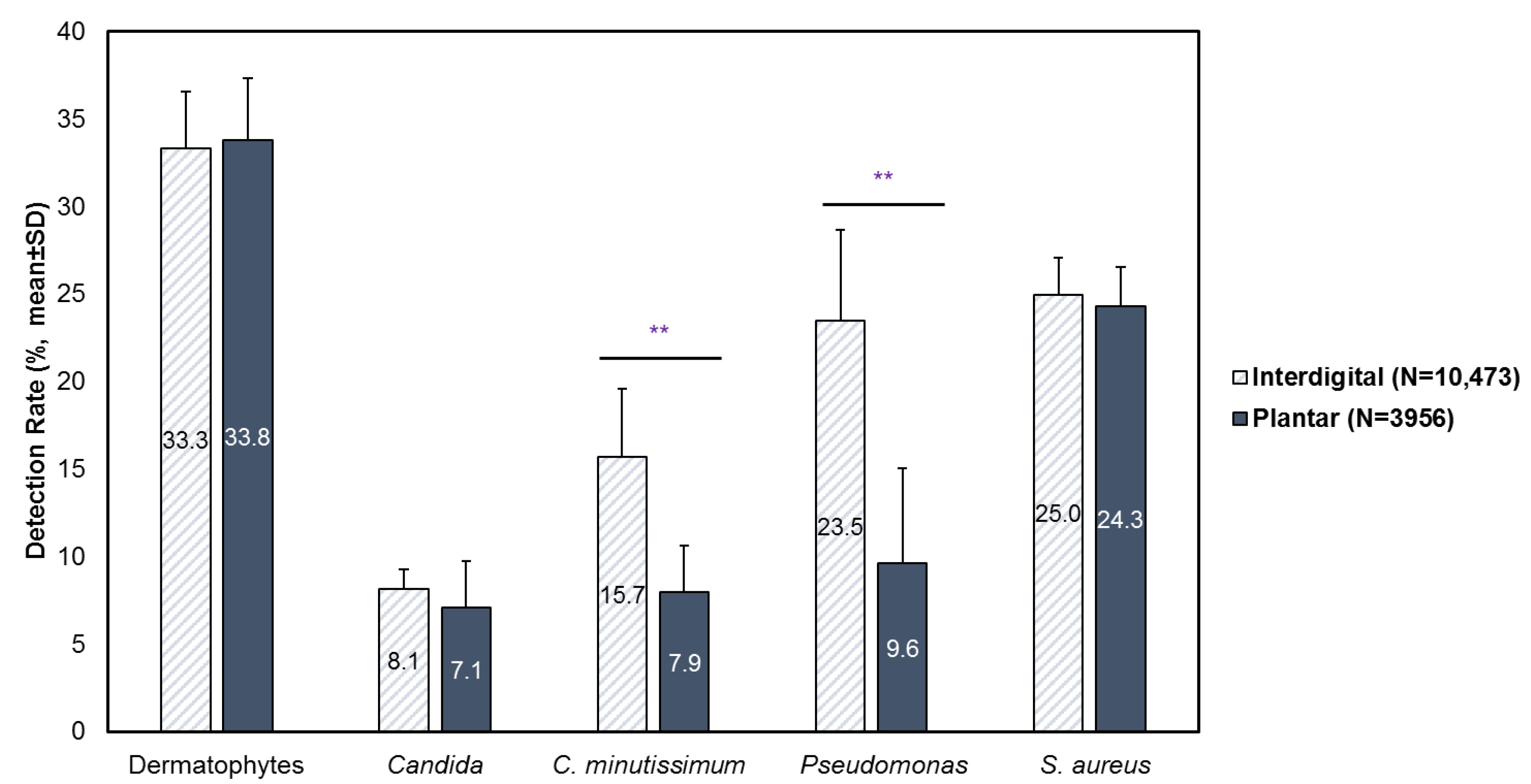
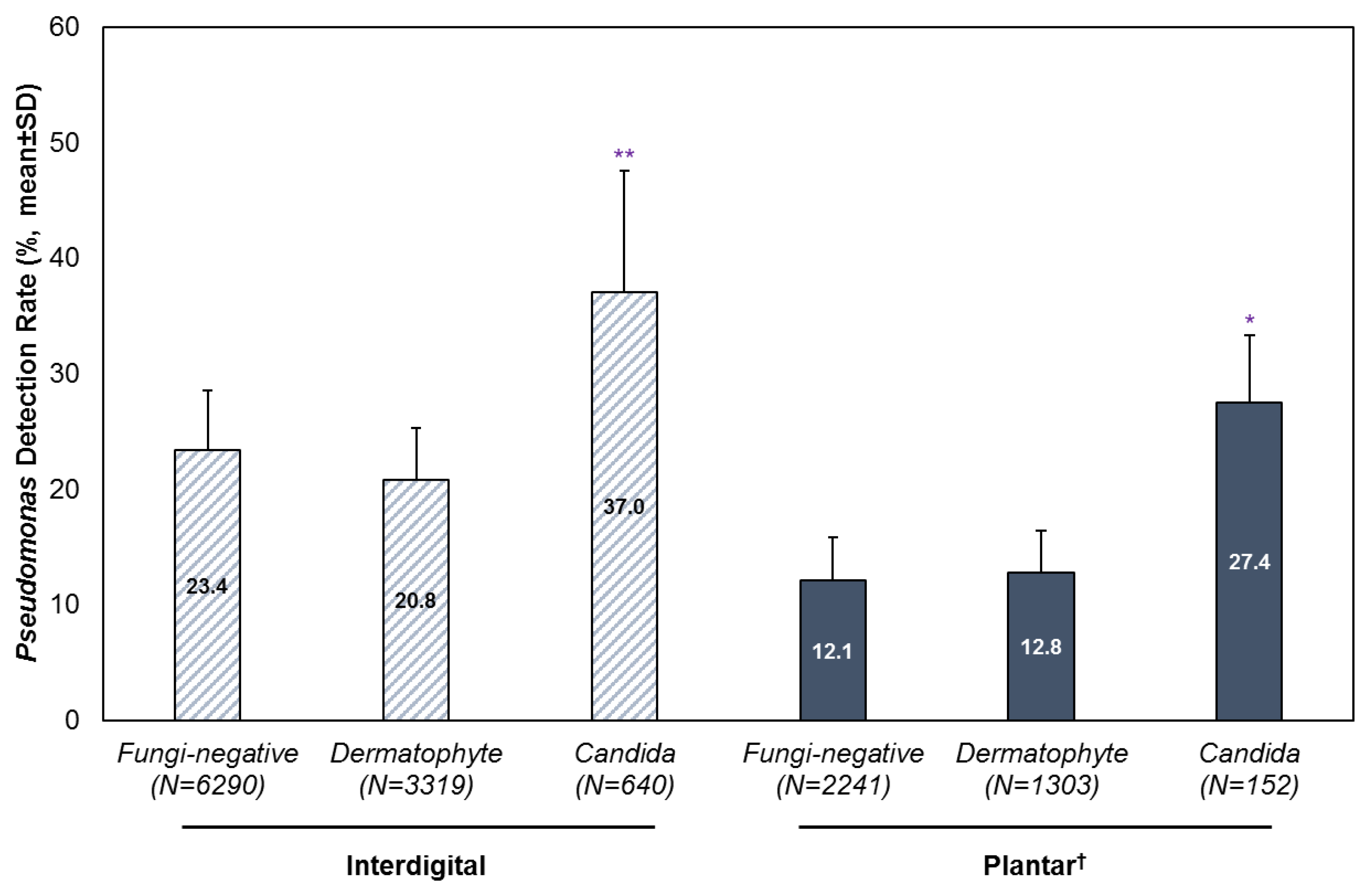
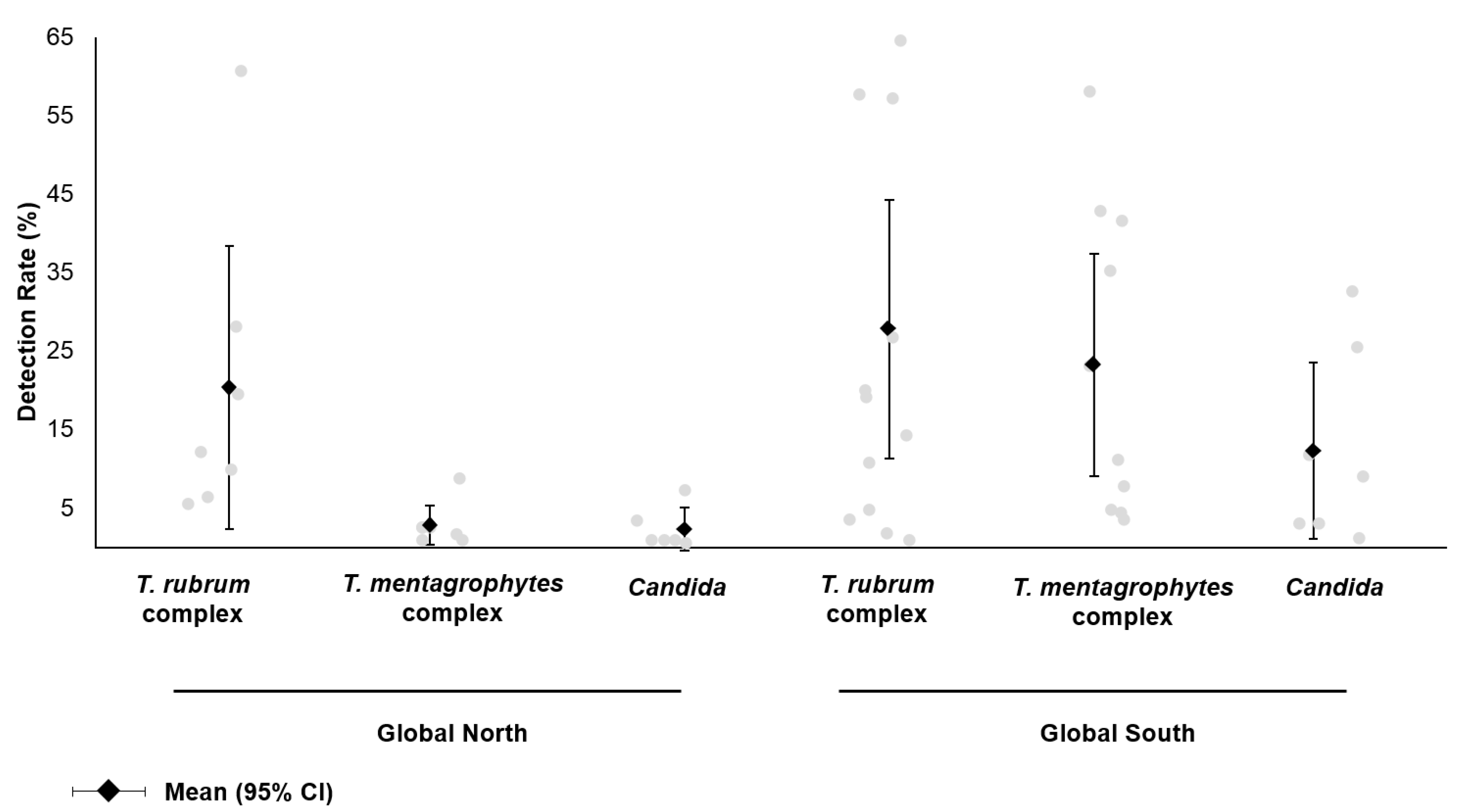
Up to one-quarter of the United States population is affected by tinea pedis (athlete’s foot). Tinea pedis of the web space (interdigital tinea pedis) is a common clinical presentation causing skin macerations and fissures. A “dermatophytosis complex” (i.e., concomitant bacterial colonization) further complicates treatment. Here, we examined records of 14,429 skin specimens taken from the feet of dermatology and podiatry outpatients over a 4.6-year period; all specimens were subjected to multiplex qPCR diagnosis for the detection of dermatophytes, Candida, Corynebacterium minutissimum, Pseudomonas and Staphylococcus aureus. A literature search was conducted to review the reported prevalence of fungal and bacterial agents. In both interdigital and plantar foot specimens, dermatophytes (33.3–33.8%) and S. aureus (24.3–25%) were found to be the predominate pathogens. In the interdigital space, a higher prevalence of C. minutissimum (15.7% vs. 7.9%) and Pseudomonas (23.5% vs. 9.6%) was found. The detection of Pseudomonas was more likely to be observed in the presence of Candida, reflecting a higher risk of mixed infection. In dermatophyte-positive specimens, the “dermatophytosis complex” variant was observed at 45.5% (SD: 2.3). An analysis of patient characteristics showed male patients exhibiting higher likelihoods for dermatophyte, C. minutissimum, Pseudomonas and S. aureus detections. The elderly were disproportionately infected with Candida. In children, an S. aureus detection was more common, which could be attributed to impetigo. The recent literature lacks reporting on concomitant bacterial colonization in tinea pedis patients, likely due to the reliance on fungal culture supplemented with antibiotics. Geographical variation has been identified in the detection of the Trichophyton mentagrophytes complex. In conclusion, PCR diagnosis serves as a valuable tool for the management of tinea pedis. An accurate and timely detection of fungal pathogens and concomitant bacterial colonization can better inform healthcare providers of appropriate treatment selection.
Keywords: erythrasma; intertrigo; tinea pedis; interdigital tinea pedis erythrasma; intertrigo; tinea pedis; interdigital tinea pedis