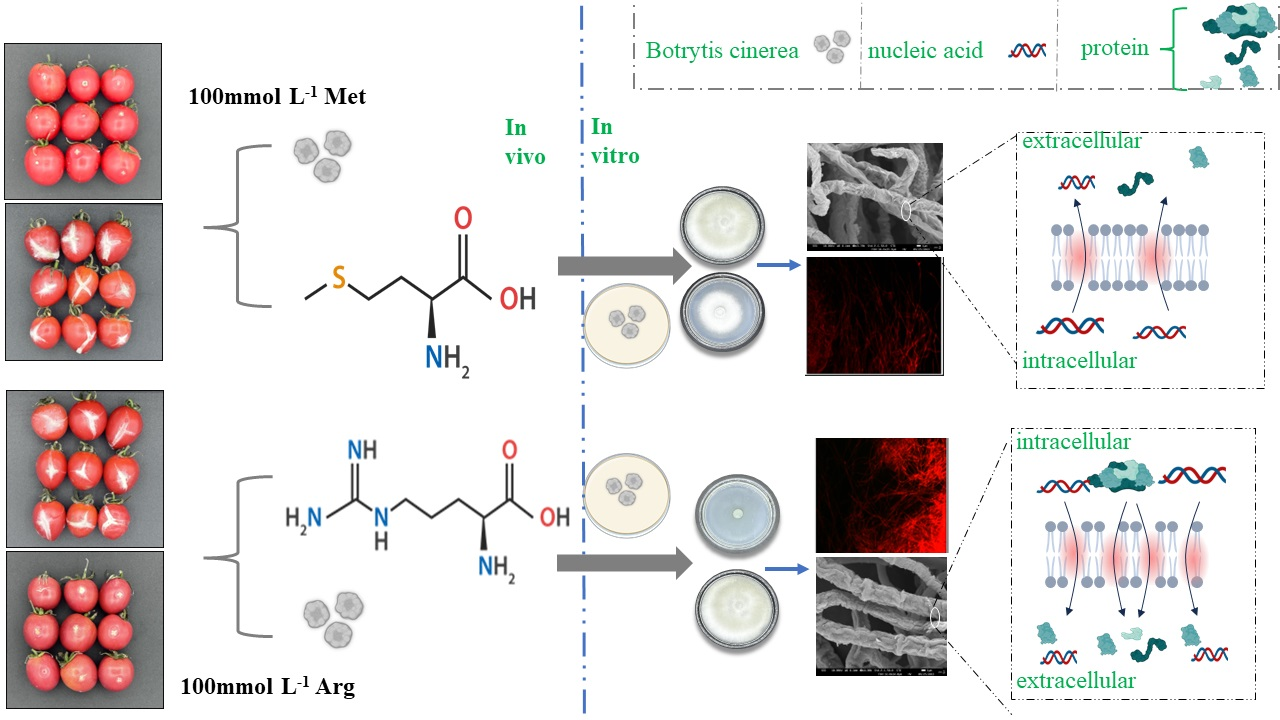
Antifungal Activities of L-Methionine and L-Arginine Treatment In Vitro and In Vivo against Botrytis cinerea

Abstract
Share and Cite
Li, S.; Yu, Y.; Xie, P.; Zhu, X.; Yang, C.; Wang, L.; Zhang, S. Antifungal Activities of L-Methionine and L-Arginine Treatment In Vitro and In Vivo against Botrytis cinerea. Microorganisms 2024, 12, 360. https://doi.org/10.3390/microorganisms12020360
Li S, Yu Y, Xie P, Zhu X, Yang C, Wang L, Zhang S. Antifungal Activities of L-Methionine and L-Arginine Treatment In Vitro and In Vivo against Botrytis cinerea. Microorganisms. 2024; 12(2):360. https://doi.org/10.3390/microorganisms12020360
Chicago/Turabian StyleLi, Shengwang, Youwei Yu, Peng Xie, Xianran Zhu, Chao Yang, Linjing Wang, and Shaoying Zhang. 2024. "Antifungal Activities of L-Methionine and L-Arginine Treatment In Vitro and In Vivo against Botrytis cinerea" Microorganisms 12, no. 2: 360. https://doi.org/10.3390/microorganisms12020360
APA StyleLi, S., Yu, Y., Xie, P., Zhu, X., Yang, C., Wang, L., & Zhang, S. (2024). Antifungal Activities of L-Methionine and L-Arginine Treatment In Vitro and In Vivo against Botrytis cinerea. Microorganisms, 12(2), 360. https://doi.org/10.3390/microorganisms12020360