Article

Effects of Inosine-5′-monophosphate Dehydrogenase (IMPDH/GuaB) Inhibitors on Borrelia burgdorferi Growth in Standard and Modified Culture Conditions

1
Laboratory of Medical Zoology, Department of Microbiology, University of Massachusetts, Amherst, MA 01003, USA
2
New England Center of Excellence in Vector-Borne Disease, Amherst, MA 01003, USA
*
Author to whom correspondence should be addressed.
Microorganisms 2024, 12(10), 2064; https://doi.org/10.3390/microorganisms12102064

Submission received: 20 September 2024 / Revised: 5 October 2024 / Accepted: 10 October 2024 / Published: 15 October 2024

Abstract

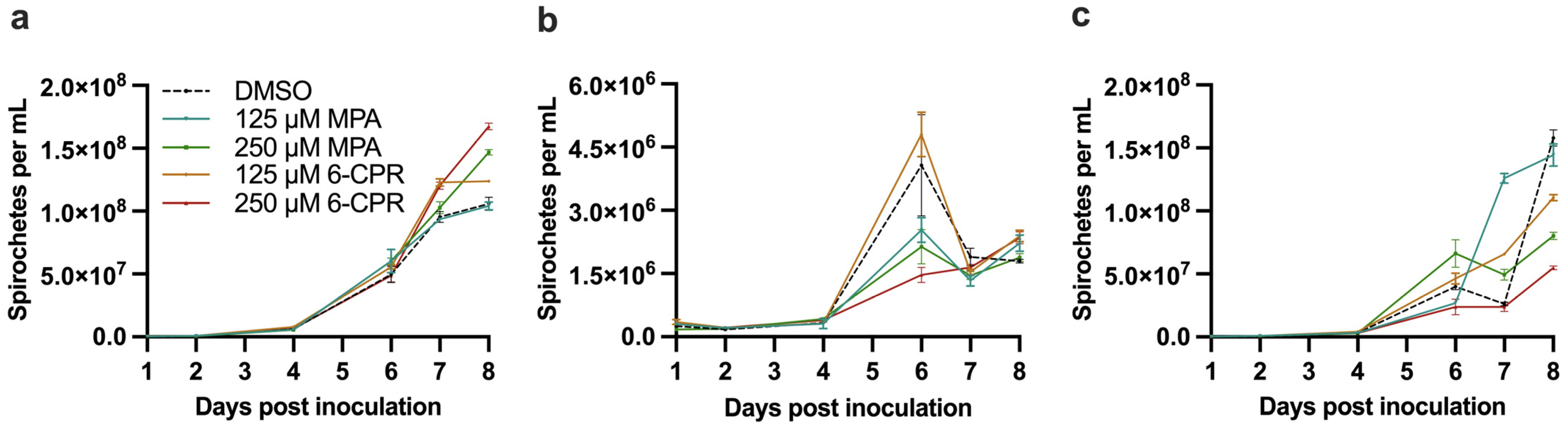
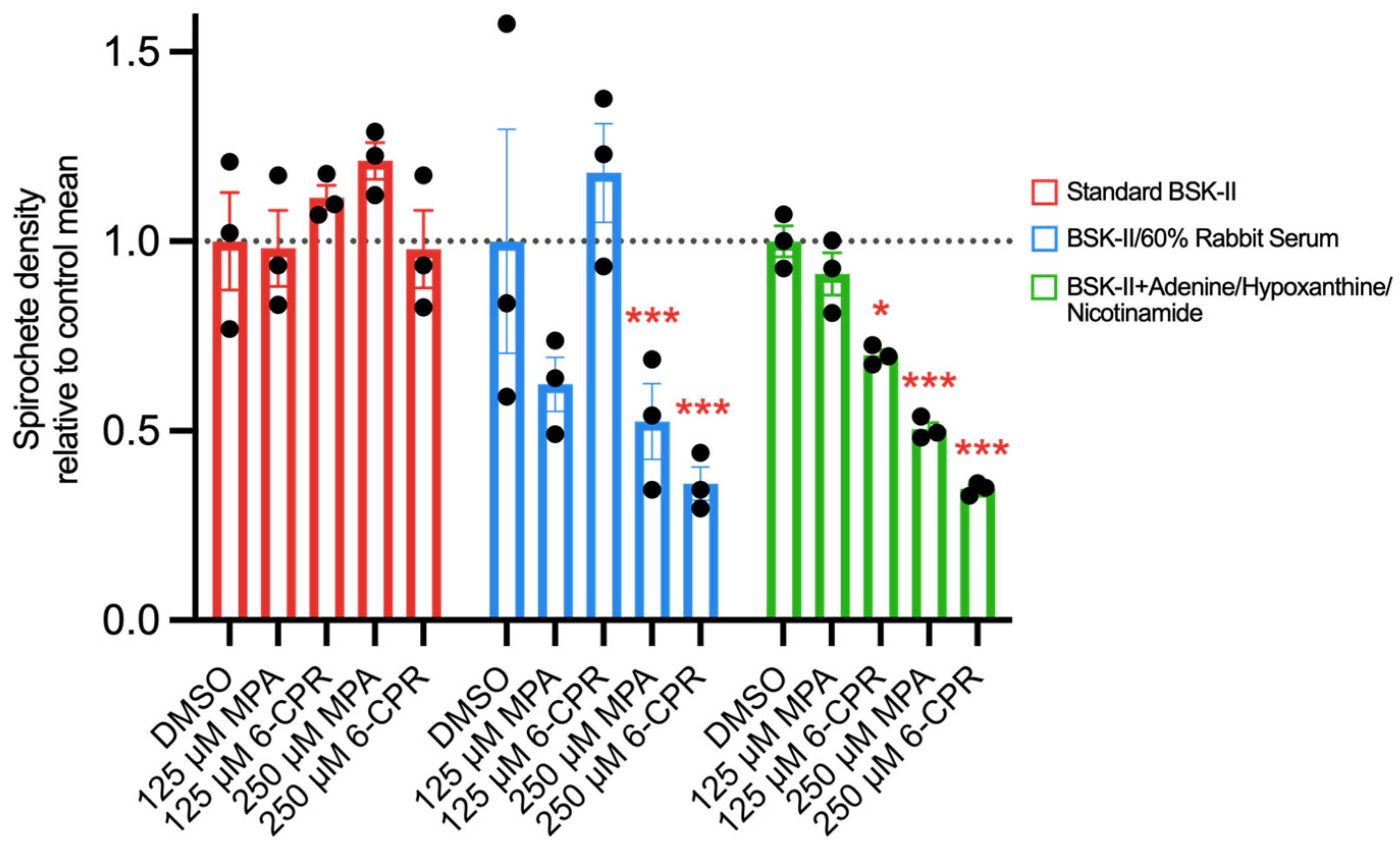
Borrelia burgdorferi’s inosine-5′-monophosphate dehydrogenase (IMPDH, GuaB encoded by the guaB gene) is a potential therapeutic target. GuaB is necessary for B. burgdorferi replication in mammalian hosts but not in standard laboratory culture conditions. Therefore, we cannot test novel GuaB inhibitors against B. burgdorferi without utilizing mammalian infection models. This study aimed to evaluate modifications to a standard growth medium that may mimic mammalian conditions and induce the requirement of GuaB usage for replication. The effects of two GuaB inhibitors (mycophenolic acid, 6-chloropurine riboside at 125 μM and 250 μM) were assessed against B. burgdorferi (guaB+) grown in standard Barbour–Stoenner–Kelly-II (BSK-II) medium (6% rabbit serum) and BSK-II modified to 60% concentration rabbit serum (BSK-II/60% serum). BSK-II directly supplemented with adenine, hypoxanthine, and nicotinamide (75 μM each, BSK-II/AHN) was also considered as a comparison group. In standard BSK-II, neither mycophenolic acid nor 6-chloropurine riboside affected B. burgdorferi growth. Based on an ANOVA, a dose-dependent increase in drug effects was observed in the modified growth conditions (F = 4.471, p = 0.001). Considering higher drug concentrations at exponential growth, mycophenolic acid at 250 μM reduced spirochete replication by 48% in BSK-II/60% serum and by 50% in BSK-II/AHN (p < 0.001 each). 6-chloropurine riboside was more effective in both mediums than mycophenolic acid, reducing replication by 64% in BSK-II/60% serum and 65% in BSK-II/AHN (p < 0.001 each). These results demonstrate that modifying BSK-II medium with physiologically relevant levels of mammalian serum supports replication and induces the effects of GuaB inhibitors. This represents the first use of GuaB inhibitors against Borrelia burgdorferi, building on tests against purified B. burgdorferi GuaB. The strong effects of 6-chloropurine riboside indicate that B. burgdorferi can salvage and phosphorylate these purine derivative analogs. Therefore, this type of molecule may be considered for future drug development. Optimization of this culture system will allow for better assessment of novel Borrelia-specific GuaB inhibitor molecules for Lyme disease interventions. The use of GuaB inhibitors as broadcast sprays or feed baits should also be evaluated to reduce spirochete load in competent reservoir hosts.
Keywords: Borrelia burgdorferi; inosine-5′-monophosphate dehydrogenase; GuaB; Lyme disease Borrelia burgdorferi; inosine-5′-monophosphate dehydrogenase; GuaB; Lyme disease