Article

pH-Related Changes in Soil Bacterial Communities in the Sanjiang Plain, Northeast China

1
Engineering Research Center of Agricultural Microbiology Technology, Ministry of Education & Heilongjiang Provincial Key Laboratory of Ecological Restoration and Resource Utilization for Cold Region & Key Laboratory of Microbiology, College of Heilongjiang Province & School of Life Sciences, Heilongjiang University, Harbin 150080, China
2
Institute of Crop Cultivation and Tillage, Heilongjiang Academy of Agricultural Sciences, Harbin 150088, China
*
Authors to whom correspondence should be addressed.
Microorganisms 2023, 11(12), 2950; https://doi.org/10.3390/microorganisms11122950

Submission received: 25 October 2023 / Revised: 16 November 2023 / Accepted: 28 November 2023 / Published: 9 December 2023
(This article belongs to the Special Issue Restoring the Integrated Behaviour of the Soil-Plant-Microbe System)

Abstract

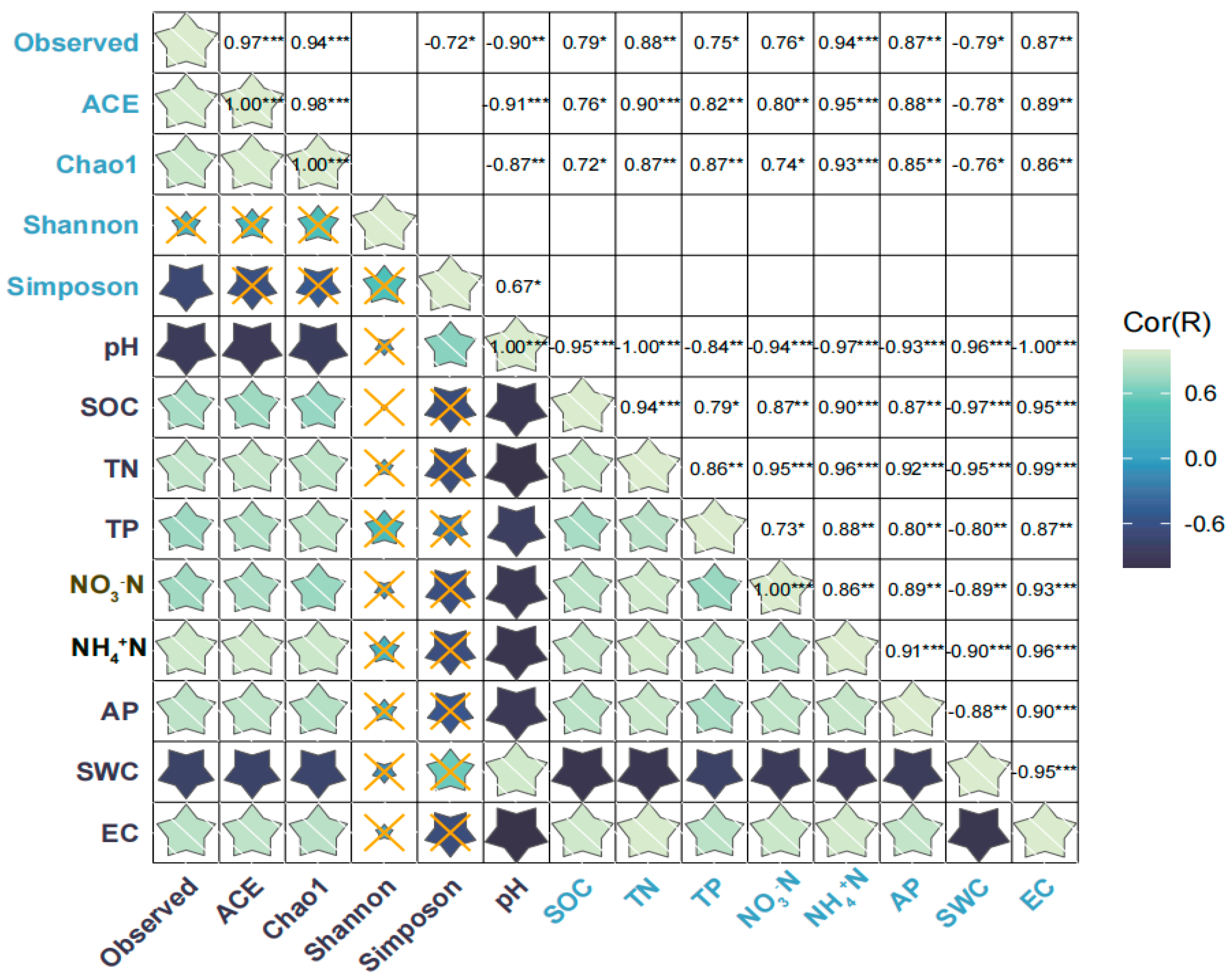
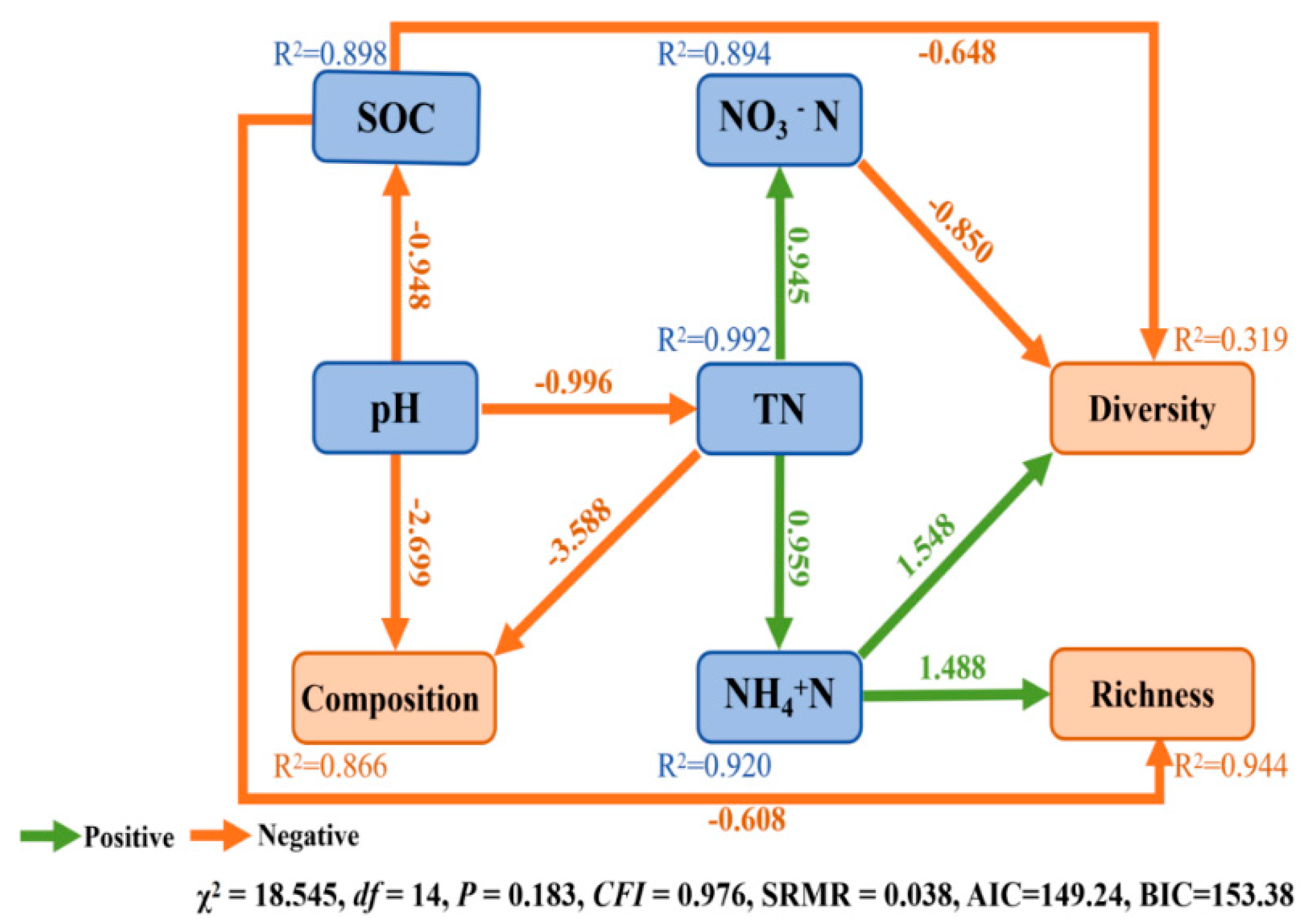
Soil bacteria are crucial components of terrestrial ecosystems, playing an important role in soil biogeochemical cycles. Although bacterial community diversity and composition are regulated by many abiotic and biotic factors, how soil physiochemical properties impact the soil bacteria community diversity and composition in wetland ecosystems remains largely unknown. In this study, we used high-throughput sequencing technology to investigate the diversity and composition of a soil bacterial community, as well as used the structural equation modeling (SEM) method to investigate the relationships of the soil’s physicochemical properties (i.e., soil pH, soil organic carbon (SOC), total nitrogen (TN), ammonium nitrogen (NH4+N), electrical conductivity (EC) and nitrate nitrogen (NO3N)), and soil bacterial community structures in three typical wetland sites in the Sanjiang Plain wetland. Our results showed that the soil physicochemical properties significantly changed the α and β-diversity of the soil bacteria communities, e.g., soil TN, NH4+N, NO3N, and SOC were the main soil factors affecting the soil bacterial α-diversity. The soil TN and pH were the key soil factors affecting the soil bacterial community. Our results suggest that changes in soil pH indirectly affect soil bacterial communities by altering the soil nitrogenous nutrient content.
Keywords: soil bacteria; alpha diversity; soil pH; nitrogen; organic matter soil bacteria; alpha diversity; soil pH; nitrogen; organic matter