Article

Antibiotic Resistance of Bacillus cereus in Plant Foods and Edible Wild Mushrooms in a Province
1
Faculty of Food Science and Engineering, Kunming University of Science and Technology, Kunming 650500, China
2
School of Science, Royal Melbourne Institute of Technology University, Melbourne 3000, Australia
*
Authors to whom correspondence should be addressed.
Microorganisms 2023, 11(12), 2948; https://doi.org/10.3390/microorganisms11122948

Submission received: 30 October 2023 / Revised: 1 December 2023 / Accepted: 4 December 2023 / Published: 9 December 2023
(This article belongs to the Special Issue Antibiotic Resistance in Foodborne Bacteria)

Abstract

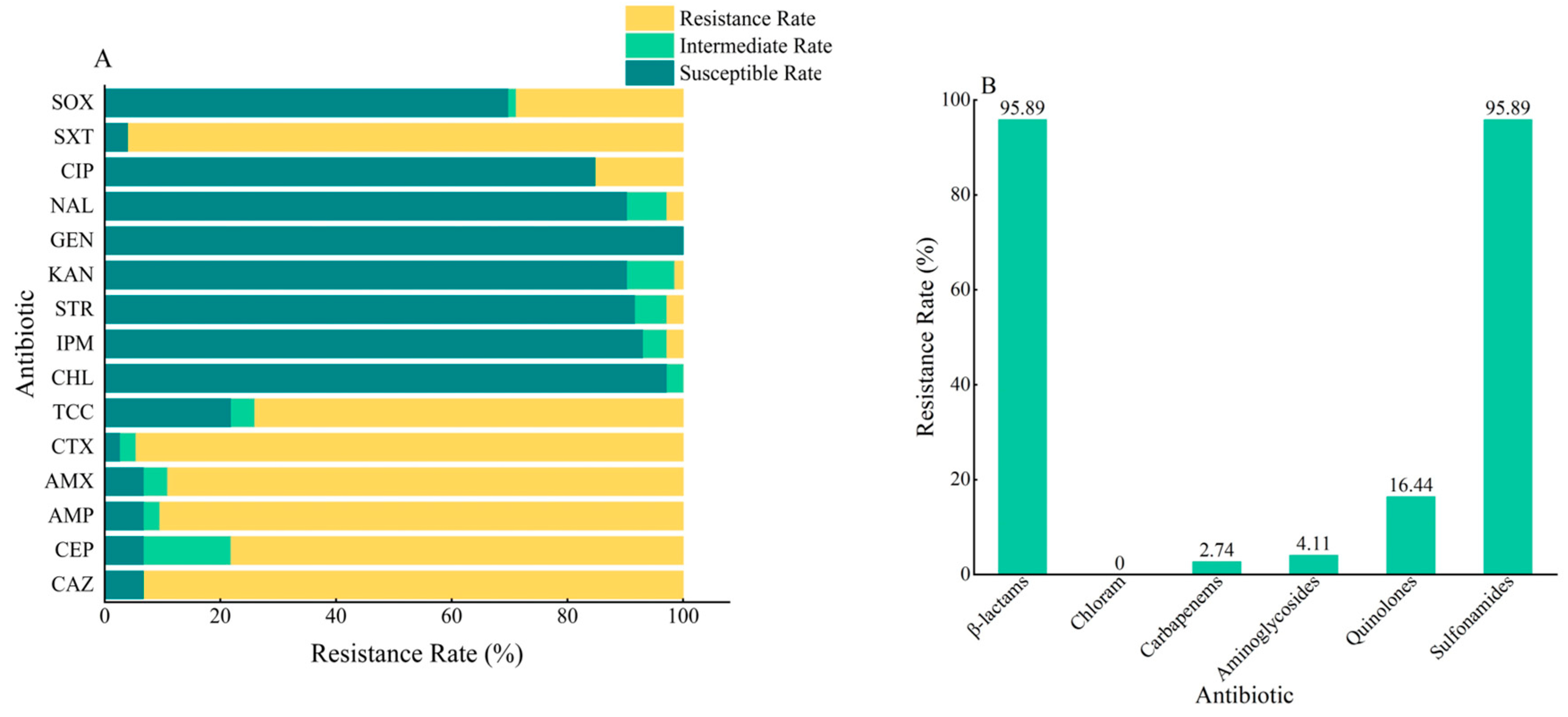
Bacillus cereus is a common pathogen causing foodborne diseases, secreting and producing a large number of toxins that can cause a variety of diseases and pose many threats to human health. In this study, 73 strains of Bacillus cereus were isolated and identified from six types of foods from seven different cities in a province, and the antibiotic-resistant phenotype was detected by using the Bauer–Kirby method. Results showed that the 73 isolates were completely sensitive to gentamicin and 100% resistant to chloramphenicol, in addition to which all strains showed varying degrees of resistance to 13 other common antibiotics, and a large number of strains resistant to multiple antibiotics were found. A bioinformatic analysis of the expression of resistance genes in Bacillus cereus showed three classes of antibiotic-resistant genes, which were three of the six classes of antibiotics identified according to the resistance phenotype. The presence of other classes of antibiotic-resistant genes was identified from genome-wide information. Antibiotic-resistant phenotypes were analyzed for correlations with genotype, and remarkable differences were found among the phenotypes. The spread of antibiotic-resistant strains is a serious public health problem that requires the long-term monitoring of antimicrobial resistance in Bacillus cereus, and the present study provides important information for monitoring antibiotic resistance in bacteria from different types of food.
Keywords: Bacillus cereus; antibiotics; antibiotic resistant; phenotype; genotype Bacillus cereus; antibiotics; antibiotic resistant; phenotype; genotype