


Oral Bacteria and Their Antibiotic Susceptibilities in Taiwanese Venomous Snakes
 , ,
, ,
Abstract
1. Introduction
2. Materials and Methods
2.1. Sample Collection
2.2. Bacterial Isolation, Identification, and Antibiotics Susceptibilities
2.3. Statistics
3. Results
3.1. Percentages and Numbers of the Isolated Bacteria
3.2. Comparisons of the Bacteria from Different Snake Species
3.3. Antibiotic Susceptibility of Isolated Bacteria
4. Discussion
5. Conclusions
Author Contributions
Funding
Institutional Review Board Statement
Informed Consent Statement
Data Availability Statement
Acknowledgments
Conflicts of Interest
References
- Gutierrez, J.M.; Calvete, J.J.; Habib, A.G.; Harrison, R.A.; Williams, D.J.; Warrell, D.A. Snakebite envenoming. Nat. Rev. Dis. Prim. 2017, 3, 17063. [Google Scholar] [CrossRef] [Scilit] [PubMed]
- Chuang, P.C.; Chang, K.W.; Cheng, F.J.; Wu, M.H.; Tsai, M.T.; Li, C.J. Risk factors associated with snake antivenom reaction and the role of skin test. Acta Trop. 2020, 203, 105293. [Google Scholar] [CrossRef] [Scilit] [PubMed]
- Chippaux, J.P. Snake-bites: Appraisal of the global situation. Bull. World Health Organ. 1998, 76, 515–524. [Google Scholar] [PubMed]
- Williams, D.J.; Faiz, M.A.; Abela-Ridder, B.; Ainsworth, S.; Bulfone, T.C.; Nickerson, A.D.; Habib, A.G.; Junghanss, T.; Fan, H.W.; Turner, M.; et al. Strategy for a globally coordinated response to a priority neglected tropical disease: Snakebite envenoming. PLoS Negl. Trop. Dis. 2019, 13, e0007059. [Google Scholar] [CrossRef] [Scilit] [PubMed]
- Panda, S.K.; Padhi, L.; Sahoo, G. Oral bacterial flora of Indian cobra (Naja naja) and their antibiotic susceptibilities. Heliyon 2018, 4, e01008. [Google Scholar] [CrossRef] [Scilit]
- Kasturiratne, A.; Wickremasinghe, A.R.; de Silva, N.; Gunawardena, N.K.; Pathmeswaran, A.; Premaratna, R.; Savioli, L.; Lalloo, D.G.; de Silva, H.J. The global burden of snakebite: A literature analysis and modelling based on regional estimates of envenoming and deaths. PLoS Med. 2008, 5, e218. [Google Scholar] [CrossRef] [Scilit]
- Mao, Y.C.; Liu, P.Y.; Chiang, L.C.; Lai, C.S.; Lai, K.L.; Ho, C.H.; Wang, T.H.; Yang, C.C. Naja atra snakebite in Taiwan. Clin. Toxicol. Phila 2018, 56, 273–280. [Google Scholar] [CrossRef] [Scilit]
- Mao, Y.C.; Liu, P.Y.; Chiang, L.C.; Liao, S.C.; Su, H.Y.; Hsieh, S.Y.; Yang, C.C. Bungarus multicinctus multicinctus snakebite in Taiwan. Am. J. Trop. Med. Hyg. 2017, 96, 1497–1504. [Google Scholar] [CrossRef] [Scilit]
- Chuang, P.C.; Chang, K.W.; Cheng, S.Y.; Pan, H.Y.; Huang, K.C.; Huang, Y.T.; Li, C.J. Benefits of early in-hospital antivenom administration to patients with Protobothrops mucrosquamatus envenomation. Am. J. Trop. Med. Hyg. 2021, 104, 323–328. [Google Scholar] [CrossRef] [Scilit]
- Lin, C.C.; Chaou, C.H.; Tseng, C.Y. An investigation of snakebite antivenom usage in Taiwan. J. Med. Assoc. 2016, 115, 672–677. [Google Scholar] [CrossRef] [Scilit]
- Garg, A.; Sujatha, S.; Garg, J.; Acharya, N.S.; Chandra Parija, S. Wound infections secondary to snakebite. J. Infect. Dev. Ctries. 2009, 3, 221–223. [Google Scholar] [CrossRef] [Scilit] [PubMed]
- Krishnankutty, S.P.; Muraleedharan, M.; Perumal, R.C.; Michael, S.; Benny, J.; Balan, B.; Kumar, P.; Manazhi, J.; Kumar, B.D.; Santhosh, S.; et al. Next-generation sequencing analysis reveals high bacterial diversity in wild venomous and non-venomous snakes from India. J. Venom. Anim. Toxins Incl. Trop. Dis. 2018, 24, 41. [Google Scholar] [CrossRef] [Scilit] [PubMed]
- Shaikh, I.K.; Dixit, P.P.; Pawade, B.S.; Potnis-Lele, M.; Kurhe, B.P. Assessment of cultivable oral bacterial flora from important venomous snakes of India and their antibiotic susceptibilities. Curr. Microbiol. 2017, 74, 1278–1286. [Google Scholar] [CrossRef] [Scilit] [PubMed]
- Bowler, P.G.; Duerden, B.I.; Armstrong, D.G. Wound microbiology and associated approaches to wound management. Clin. Microbiol. Rev. 2001, 14, 244–269. [Google Scholar] [CrossRef] [Scilit] [PubMed]
- Kerrigan, K.R. Bacteriology of snakebite abscess. Trop. Doct. 1992, 22, 158–160. [Google Scholar] [CrossRef] [Scilit]
- Panda, S.K.; Padhi, L.; Sahoo, G. Evaluation of cultivable aerobic bacterial flora from Russell’s viper (Daboia russelii) oral cavity. Microb. Pathog. 2019, 134, 103573. [Google Scholar] [CrossRef] [Scilit]
- Huang, L.W.; Wang, J.D.; Huang, J.A.; Hu, S.Y.; Wang, L.M.; Tsan, Y.T. Wound infections secondary to snakebite in central Taiwan. J. Venom. Anim. Toxins 2012, 18, 272–276. [Google Scholar] [CrossRef] [Scilit]
- Mao, Y.C.; Liu, P.Y.; Hung, D.Z.; Lai, W.C.; Huang, S.T.; Hung, Y.M.; Yang, C.C. Bacteriology of Naja atra snakebite wound and its implications for antibiotic therapy. Am. J. Trop. Med. Hyg. 2016, 94, 1129–1135. [Google Scholar] [CrossRef] [Scilit]
- Lam, K.K.; Crow, P.; Ng, K.H.; Shek, K.C.; Fung, H.T.; Ades, G.; Grioni, A.; Tan, K.S.; Yip, K.T.; Lung, D.C.; et al. A cross-sectional survey of snake oral bacterial flora from Hong Kong, SAR, China. Emerg. Med. J. 2011, 28, 107–114. [Google Scholar] [CrossRef] [Scilit]
- Costello, E.K.; Gordon, J.I.; Secor, S.M.; Knight, R. Postprandial remodeling of the gut microbiota in Burmese pythons. ISME J. 2010, 4, 1375–1385. [Google Scholar] [CrossRef] [Scilit]
- Artavia-Leon, A.; Romero-Guerrero, A.; Sancho-Blanco, C.; Rojas, N.; Umana-Castro, R. Diversity of aerobic bacteria isolated from oral and cloacal cavities from free-living snakes species in Costa Rica rainforest. Int. Sch. Res. Not. 2017, 2017, 8934285. [Google Scholar] [CrossRef] [Scilit] [PubMed]
- Regional Office for South-East Asia, W.H.O. Guidelines for the Management of Snakebites, 2nd ed.; WHO Regional Office for South-East Asia: New Delhi, India, 2016; p. 201. [Google Scholar]
- Wagener, M.; Naidoo, M.; Aldous, C. Wound infection secondary to snakebite. S. Afr. Med. J. 2017, 107, 315–319. [Google Scholar] [CrossRef] [Scilit] [PubMed]
- Lin, C.C.; Chen, Y.C.; Goh, Z.N.L.; Seak, C.K.; Seak, J.C.; Shi-Ying, G.; Seak, C.J.; Spot, I. Wound infections of snakebites from the venomous Protobothrops mucrosquamatus and Viridovipera stejnegeri in Taiwan: Bacteriology, antibiotic susceptibility, and predicting the need for antibiotics-a bite study. Toxins Basel 2020, 12, 575. [Google Scholar] [CrossRef] [Scilit] [PubMed]
- Su, H.Y.; Huang, S.W.; Mao, Y.C.; Liu, M.W.; Lee, K.H.; Lai, P.F.; Tsai, M.J. Clinical and laboratory features distinguishing between Deinagkistrodon acutus and Daboia siamensis envenomation. J. Venom. Anim. Toxins 2018, 24, 43. [Google Scholar] [CrossRef] [Scilit]
- Seng, P.; Rolain, J.M.; Fournier, P.E.; La Scola, B.; Drancourt, M.; Raoult, D. MALDI-TOF-mass spectrometry applications in clinical microbiology. Future Microbiol. 2010, 5, 1733–1754. [Google Scholar] [CrossRef] [Scilit]
- CLSI. M11-A8: Methods for Antimicrobial Susceptibility Testing of Anaerobic Bacteria; Approved Standard, 8th ed.; Clinical and Laboratory Standards Institute: Wayne, PA, USA, 2012; p. 47. [Google Scholar]
- CLSI. M02-A11: Performance Standards for Antimicrobial Disk Susceptibility Tests; Approved Standard, 11th ed.; Clinical and Laboratory Standards Institute: Wayne, PA, USA, 2012; p. 53. [Google Scholar]
- Resiere, D.; Olive, C.; Kallel, H.; Cabie, A.; Neviere, R.; Megarbane, B.; Gutierrez, J.M.; Mehdaoui, H. Oral microbiota of the snake Bothrops lanceolatus in Martinique. Int. J. Env. Res. Public Health 2018, 15, 2122. [Google Scholar] [CrossRef] [Scilit]
- Goldstein, E.J.; Citron, D.M.; Gonzalez, H.; Russell, F.E.; Finegold, S.M. Bacteriology of rattlesnake venom and implications for therapy. J. Infect. Dis. 1979, 140, 818–821. [Google Scholar] [CrossRef] [Scilit]
- Zancolli, G.; Mahsberg, D.; Sickel, W.; Keller, A. Reptiles as reservoirs of bacterial infections: Real threat or methodological bias? Microb. Ecol. 2015, 70, 579–584. [Google Scholar] [CrossRef] [Scilit]
- Mao, Y.C.; Chuang, H.N.; Shih, C.H.; Hsieh, H.H.; Jiang, Y.H.; Chiang, L.C.; Lin, W.L.; Hsiao, T.H.; Liu, P.Y. An investigation of conventional microbial culture for the Naja atra bite wound, and the comparison between culture-based 16s sanger sequencing and 16s metagenomics of the snake oropharyngeal bacterial microbiota. PLoS Negl. Trop. Dis. 2021, 15, e0009331. [Google Scholar] [CrossRef] [Scilit]
- Mao, Y.C.; Liu, P.Y.; Chiang, L.C.; Lee, C.H.; Lai, C.S.; Lai, K.L.; Lin, W.L.; Su, H.Y.; Ho, C.H.; Doan, U.V.; et al. Clinical manifestations and treatments of Protobothrops mucrosquamatus bite and associated factors for wound necrosis and subsequent debridement and finger or toe amputation surgery. Clin. Toxicol. Phila 2021, 59, 28–37. [Google Scholar] [CrossRef] [Scilit]
- Chiang, L.C.; Tsai, W.J.; Liu, P.Y.; Ho, C.H.; Su, H.Y.; Lai, C.S.; Lai, K.L.; Lin, W.L.; Lee, C.H.; Yang, Y.Y.; et al. Envenomation by Trimeresurus stejnegeri stejnegeri: Clinical manifestations, treatment and associated factors for wound necrosis. J. Venom. Anim. Toxins Incl. Trop. Dis. 2020, 26, e20200043. [Google Scholar] [CrossRef] [Scilit] [PubMed]
- Tsai, T.S.; Liu, C.C.; Chuang, P.C. Personal experience of Daboia siamensis envenomation. Case Rep. Med. 2021, 2021, 3396373. [Google Scholar] [CrossRef] [Scilit]
- Tsai, T.S.; Chan, Y.Y.; Huang, S.M.; Chuang, P.C. Case report: Symptoms and prognosis of Trimeresurus gracilis envenomation. Am. J. Trop. Med. Hyg. 2022, 106, 1281–1284. [Google Scholar] [CrossRef] [Scilit] [PubMed]
- Chen, M.H.; Wu, S.H.; Chen, Y.W.; Lee, Y.L.; Chen, Y.C. A case report of Ovophis makazayazaya envenoming. Clin. Toxicol. Phila 2021, 59, 679–680. [Google Scholar] [CrossRef] [Scilit] [PubMed]

| Aerobic Bacteria | Anaerobic Bacteria | |
|---|---|---|
| Gram-Positive | Gram-Negative | |
| Bacillus spp. | Acinetobacter spp. | Bacteroides fragilis |
| Enterococcus spp. | Aeromonas hydrophila | Bacteroides spp. |
| Staphylococcus spp. | Citrobacter spp. | Clostridium spp. |
| Streptococcus spp. | Enterobacter spp. | Peptostreptococcus spp. |
| Escherichia coli | ||
| Klebsiella pneumoniae | ||
| Morganella morganii | ||
| Proteus spp. | ||
| Providencia spp. | ||
| Pseudomonas aeruginosa | ||
| Salmonella arizonae | ||
| Serratia liquefaciens | ||
| Serratia spp. | ||
| Shewanella putrefaciens | ||
| Yersinia enterocolitica | ||
| BM (n = 30) | DA (n = 3) | DS (n = 4) | NA (n = 30) | PM (n = 30) | TS (n = 30) | p-Value | |
|---|---|---|---|---|---|---|---|
| Anaerobic organisms | |||||||
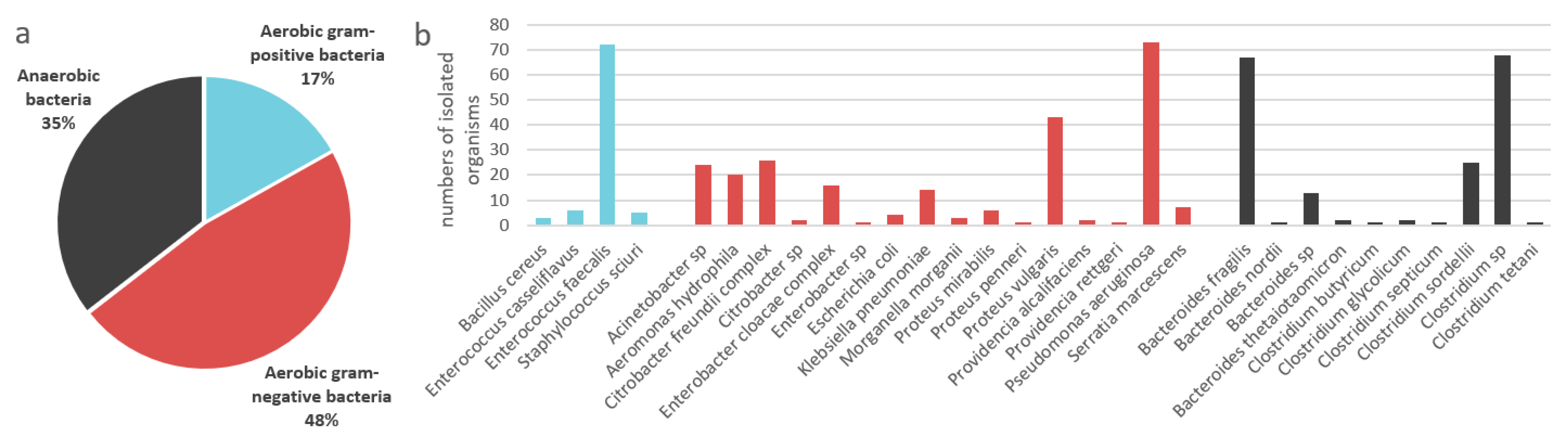
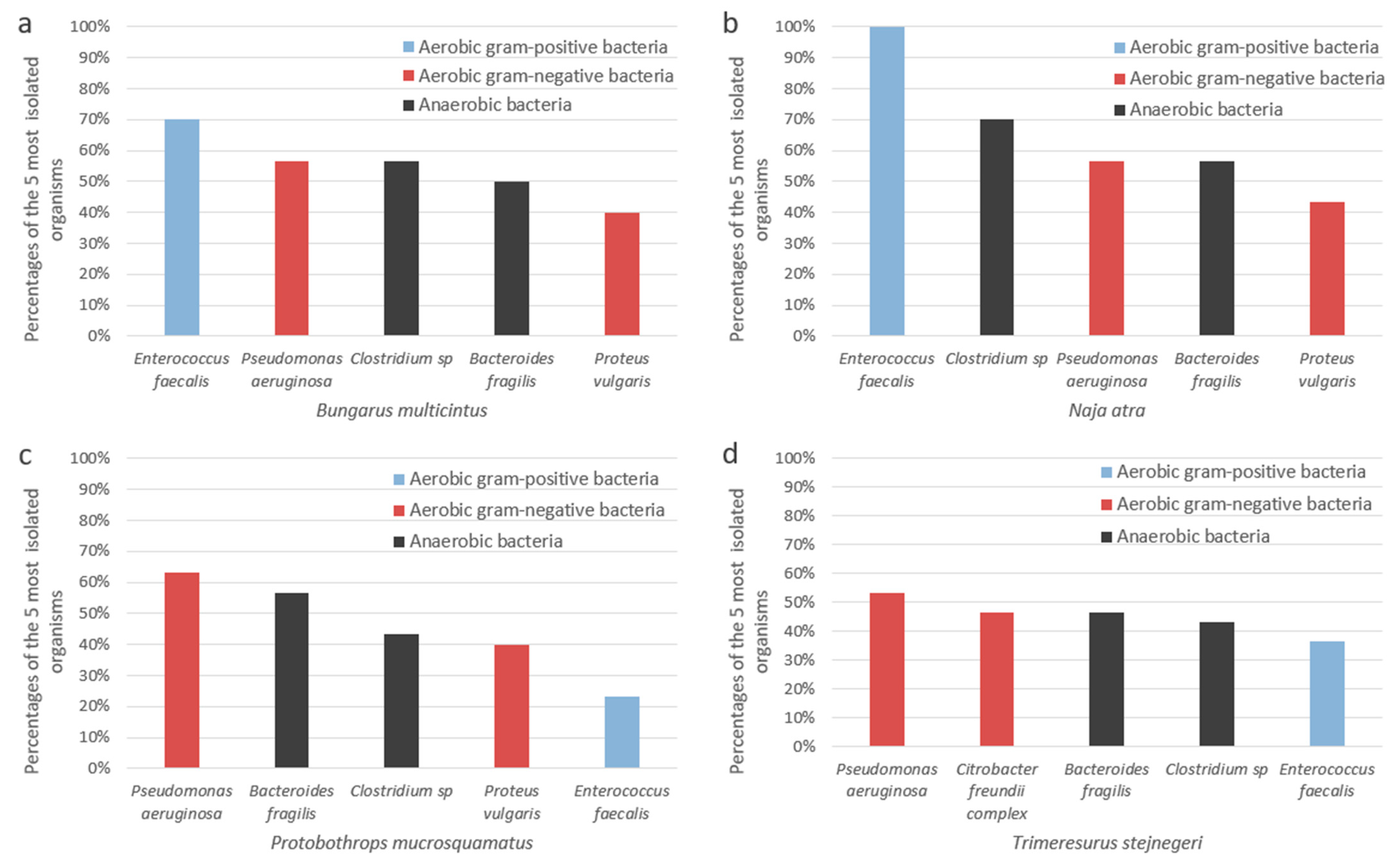
| Bacteroides fragilis, n = 67 | 15 (50%) | 2 (66.7%) | 2 (50%) | 17 (56.7%) | 17 (56.7%) | 14 (46.7%) | 0.963 |
| Bacteroides nordii, n = 1 | 0 (0%) | 0 (0%) | 0 (0%) | 1 (3.3%) | 0 (0%) | 0 (0%) | 1.000 |
| Bacteroides spp., n = 13 | 3 (10%) | 0 (0%) | 0 (0%) | 7 (23.3%) | 2 (6.7%) | 1 (3.3%) | 0.228 |
| Bacteroides thetaiotaomicron, n = 2 | 0 (0%) | 0 (0%) | 1 (25%) | 0 (0%) | 1 (3.3%) | 0 (0%) | 0.108 |
| Clostridium butyricum, n = 1 | 0 (0%) | 0 (0%) | 0 (0%) | 0 (0%) | 1 (3.3%) | 0 (0%) | 1.000 |
| Clostridium glycolicum, n = 2 | 1 (3.3%) | 0 (0%) | 0 (0%) | 0 (0%) | 1 (3.3%) | 0 (0%) | 1.000 |
| Clostridium septicum, n = 1 | 0 (0%) | 0 (0%) | 0 (0%) | 0 (0%) | 1 (3.3%) | 0 (0%) | 1.000 |
| Clostridium sordellii, n = 25 | 7 (23.3%) | 0 (0%) | 1 (25%) | 5 (16.7%) | 7 (23.3%) | 5 (16.7%) | 0.935 |
| Clostridium spp., n = 68 | 17 (56.7%) | 1 (33.3%) | 3 (75%) | 21 (70%) | 13 (43.3%) | 13 (43.3%) | 0.195 |
| Clostridium tetani, n = 1 | 0 (0%) | 0 (0%) | 0 (0%) | 0 (0%) | 1 (3.3%) | 0 (0%) | 1.000 |
| Aerobic gram-positive organisms | |||||||
| Bacillus cereus, n = 3 | 0 (0%) | 0 (0%) | 1 (25%) | 0 (0%) | 1 (3.3%) | 1 (3.3%) | 0.158 |
| Enterococcus casseliflavus, n = 6 | 1 (3.3%) | 1 (33.3%) | 0 (0%) | 0 (0%) | 0 (0%) | 4 (13.3%) | 0.029 |
| Enterococcus faecalis, n = 72 | 21 (70%) | 1 (33.3%) | 2 (50%) | 30 (100%) | 7 (23.3%) | 11 (36.7%) | <0.001 |
| Staphylococcus sciuri, n = 3 | 0 (0%) | 0 (0%) | 1 (25%) | 0 (0%) | 4 (13.3%) | 0 (0%) | 0.012 |
| Aerobic gram-negative organisms | |||||||
| Acinetobacter sp., n = 24 | 5 (16.7%) | 0 (0%) | 0 (0%) | 7 (23.3%) | 5 (16.7%) | 5 (16.7%) | 0.972 |
| Aeromonas hydrophila, n = 20 | 8 (26.7%) | 1 (33.3%) | 1 (25%) | 1 (3.3%) | 3 (10%) | 6 (20%) | 0.067 |
| Citrobacter freundii complex, n = 26 | 3 (10%) | 0 (0%) | 0 (0%) | 6 (20%) | 3 (10%) | 14 (46.7%) | 0.006 |
| Citrobacter spp., n = 2 | 0 (0%) | 0 (0%) | 0 (0%) | 0 (0%) | 1 (3.3%) | 1 (3.3%) | 1.000 |
| Enterobacter cloacae complex, n = 16 | 1 (3.3%) | 1 (33.3%) | 0 (0%) | 1 (3.3%) | 6 (20%) | 7 (23.3%) | 0.035 |
| Enterobacter spp., n = 1 | 0 (0%) | 0 (0%) | 0 (0%) | 0 (0%) | 0 (0%) | 1 (3.3%) | 1.000 |
| Escherichia coli, n = 4 | 1 (3.3%) | 0 (0%) | 0 (0%) | 2 (6.7%) | 0 (0%) | 1 (3.3%) | 0.922 |
| Klebsiella pneumoniae, n = 14 | 6 (20%) | 1 (33.3%) | 0 (0%) | 1 (3.3%) | 5 (16.7%) | 1 (3.3%) | 0.086 |
| Morganella morganii, n = 3 | 0 (0%) | 0 (0%) | 1 (25%) | 1 (3.3%) | 1 (3.3%) | 0 (0%) | 0.158 |
| Proteus mirabilis, n = 6 | 1 (3.3%) | 0 (0%) | 1 (25%) | 2 (6.7%) | 2 (6.7%) | 0 (0%) | 0.287 |
| Proteus penneri, n = 1 | 0 (0%) | 0 (0%) | 0 (0%) | 1 (3.3%) | 0 (0%) | 0 (0%) | 1.000 |
| Proteus vulgaris, n = 43 | 12 (40%) | 2 (66.7%) | 0 (0%) | 13 (43.3%) | 12 (40%) | 4 (13.3%) | 0.029 |
| Providencia alcalifaciens, n = 2 | 1 (3.3%) | 0 (0%) | 1 (25%) | 0 (0%) | 0 (0%) | 0 (0%) | 0.108 |
| Providencia rettgeri, n = 1 | 0 (0%) | 0 (0%) | 0 (0%) | 0 (0%) | 1 (3.3%) | 0 (0%) | 1.000 |
| Pseudomonas aeruginosa, n = 73 | 17 (56.7%) | 2 (66.7%) | 2 (50%) | 17 (56.7%) | 19 (63.3%) | 16 (53.3%) | 0.999 |
| Serratia marcescens, n = 7 | 1 (3.3%) | 0 (0%) | 0 (0%) | 4 (13.3%) | 2 (6.7%) | 0 (0%) | 0.374 |
| Antibiotics (MIC, mcg/mL) | CLI (2) | MTZ (8) | PEN (10 units) | PIP (100) | SAM (10/10) | ||||
|---|---|---|---|---|---|---|---|---|---|
| Anaerobic organisms | n (% of indicated susceptible) | ||||||||
| Bacteroides fragilis, n = 67 | 63 (94%) | 67 (100%) | 1 (1.5%) | 62 (92.5%) | 24 (35.8%) | ||||
| Bacteroides nordii, n = 1 | 0 (0%) | 1 (100%) | 0 (0%) | 1 (100%) | 1 (100%) | ||||
| Bacteroides sp., n = 13 | 12 (92.3%) | 13 (100%) | 0 (0%) | 13 (100%) | 12 (92.3%) | ||||
| Bacteroides thetaiotaomicron, n = 2 | 1 (50%) | 2 (100%) | 0 (0%) | 2 (100%) | 2 (100%) | ||||
| Clostridium butyricum, n = 1 | 1 (100%) | 1 (100%) | 1 (100%) | 1 (100%) | 1 (100%) | ||||
| Clostridium glycolicum, n = 2 | 2 (100%) | 2 (100%) | 2 (100%) | 2 (100%) | 2 (100%) | ||||
| Clostridium septicum, n = 1 | 1 (100%) | 1 (100%) | 1 (100%) | 1 (100%) | 1 (100%) | ||||
| Clostridium sordellii, n = 25 | 24 (96%) | 25 (100%) | 25 (100%) | 25 (100%) | 25 (100%) | ||||
| Clostridium sp., n = 68 | 68 (100%) | 68 (100%) | 66 (97.1%) | 68 (100%) | 67 (98.5%) | ||||
| Clostridium tetani, n = 1 | 1 (100%) | 1 (100%) | 1 (100%) | 1 (100%) | 1 (100%) | ||||
| Antibiotics (MIC, mcg/mL) | AMP (10) | CLI (2) | ERY (15) | GEN (120) | OXA (1) | PEN (10 units) | SXT (23.75/1.25) | TEC (30) | VAN (30) |
| Aerobic gram-positive organisms | n (% of indicated susceptible) | ||||||||
| Bacillus cereus, n = 3 | 3 (100%) | 3 (100%) | 2 (66.7%) | 3 (100%) | 3 (100%) | 3 (100%) | 3 (100%) | ||
| Enterococcus casseliflavus, n = 6 | 6 (100%) | 6 (100%) | 6 (100%) | 6 (100%) | 1 (16.7%) | ||||
| Enterococcus faecalis, n = 72 | 72 (100%) | 72 (100%) | 72 (100%) | 72 (100%) | 72 (100%) | ||||
| Staphylococcus sciuri, n = 3 | 3 (60%) | 3 (60%) | 3 (60%) | 3 (60%) | 5 (100%) | 5 (100%) | 5 (100%) | ||
| Antibiotics (MIC, mcg/mL) | AMK (30) | CIP (5) | CFZ (30) | CXM (30) | CRO (30) | CAZ (30) | FEP (30) | SCF (75/30) | |
| Aerobic gram-negative organisms | n (% of indicated susceptible) | ||||||||
| Acinetobacter spp., n = 24 | 23 (95.8%) | 24 (100%) | 24 (100%) | 24 (100%) | 24 (100%) | ||||
| Aeromonas hydrophila, n = 20 | 20 (100%) | 18 (90%) | 19 (95%) | 16 (80%) | 20 (100%) | ||||
| Citrobacter freundii complex, n = 26 | 26 (100%) | 26 (100%) | 2 (7.7%) | 26 (100%) | 26 (100%) | 26 (100%) | |||
| Citrobacter sp., n = 2 | 2 (100%) | 2 (100%) | 1 (50%) | 1 (50%) | 2 (100%) | 2 (100%) | 2 (100%) | ||
| Enterobacter cloacae complex, n = 16 | 16 (100%) | 15 (93.8%) | 15 (93.8%) | 15 (93.8%) | 15 (93.8%) | 16 (100%) | |||
| Enterobacter spp., n = 1 | 1 (100%) | 1 (100%) | 1 (100%) | 1 (100%) | 1 (100%) | 1 (100%) | |||
| Escherichia coli, n = 4 | 4 (100%) | 4 (100%) | 1 (25%) | 3 (75%) | 4 (100%) | 4 (100%) | 4 (100%) | ||
| Klebsiella pneumoniae, n = 14 | 14 (100%) | 11 (78.6%) | 7 (50%) | 13 (92.9%) | 13 (92.9%) | 14 (100%) | 14 (100%) | ||
| Morganella morganii, n = 3 | 3 (100%) | 3 (100%) | 3 (100%) | 3 (100%) | 3 (100%) | ||||
| Proteus mirabilis, n = 6 | 6 (100%) | 6 (100%) | 2 (33.3%) | 5 (83.3%) | 6 (100%) | 5 (83.3%) | 6 (100%) | ||
| Proteus penneri, n = 1 | 1 (100%) | 1 (100%) | 1 (100%) | 1 (100%) | 1 (100%) | 1 (100%) | |||
| Proteus vulgaris, n = 43 | 43 (100%) | 43 (100%) | 1 (2.3%) | 3 (7%) | 42 (97.7%) | 42 (97.7%) | 43 (100%) | ||
| Providencia alcalifaciens, n = 2 | 2 (100%) | 1 (50%) | 1 (50%) | 2 (100%) | 2 (100%) | 2 (100%) | 2 (100%) | ||
| Providencia rettgeri, n = 1 | 1 (100%) | 1 (100%) | 1 (100%) | 1 (100%) | 1 (100%) | 1 (100%) | |||
| Pseudomonas aeruginosa, n = 73 | 73 (100%) | 73 (100%) | 73 (100%) | 73 (100%) | 73 (100%) | ||||
| Serratia marcescens, n = 7 | 7 (100%) | 7 (100%) | 6 (85.7%) | 6 (85.7%) | 6 (85.7%) | ||||
| Antibiotics (MIC, mcg/mL) | CST (10) | ETP (10) | GEN (10) | IPM (10) | LVX (10) | MEM (10) | SAM (10/10) | TZP (100/10) | |
| Acinetobacter sp., n = 24 | 21 (87.5%) | 22 (91.7%) | 23 (95.8%) | 24 (100%) | 24 (100%) | ||||
| Aeromonas hydrophila, n = 20 | 4 (20%) | 20 (100%) | 20 (100%) | ||||||
| Citrobacter freundii complex, n = 26 | 26 (100%) | 26 (100%) | 25 (96.2%) | 5 (19.2%) | 26 (100%) | ||||
| Citrobacter sp., n = 2 | 2 (100%) | 2 (100%) | 2 (100%) | 1 (50%) | 2 (100%) | ||||
| Enterobacter cloacae complex, n = 16 | 16 (100%) | 16 (100%) | 15 (93.8%) | 5 (31.3%) | 16 (100%) | ||||
| Enterobacter sp., n = 1 | 1 (100%) | 1 (100%) | 1 (100%) | 1 (100%) | 1 (100%) | ||||
| Escherichia coli, n = 4 | 4 (100%) | 4 (100%) | 4 (100%) | 3 (75%) | 4 (100%) | ||||
| Klebsiella pneumoniae, n = 14 | 14 (100%) | 13 (92.9%) | 14 (100%) | 14 (100%) | 13 (92.9%) | ||||
| Morganella morganii, n = 3 | 3 (100%) | 3 (100%) | 3 (100%) | 1 (33.3%) | 3 (100%) | ||||
| Proteus mirabilis, n = 6 | 6 (100%) | 6 (100%) | 6 (100%) | 5 (83.3%) | 6 (100%) | ||||
| Proteus penneri, n = 1 | 1 (100%) | 1 (100%) | 1 (100%) | 1 (100%) | 1 (100%) | ||||
| Proteus vulgaris, n = 43 | 43 (100%) | 43 (100%) | 43 (100%) | 43 (100%) | 43 (100%) | ||||
| Providencia alcalifaciens, n = 2 | 2 (100%) | 2 (100%) | 1 (50%) | 2 (100%) | 2 (100%) | ||||
| Providencia rettgeri, n = 1 | 1 (100%) | 1 (100%) | 1 (100%) | 1 (100%) | |||||
| Pseudomonas aeruginosa, n = 73 | 73 (100%) | 73 (100%) | 73 (100%) | 73 (100%) | 71 (97.3%) | 73 (100%) | |||
| Serratia marcescens, n = 7 | 7 (100%) | 7 (100%) | 7 (100%) | 6 (85.7%) | |||||
Publisher’s Note: MDPI stays neutral with regard to jurisdictional claims in published maps and institutional affiliations. |
© 2022 by the authors. Licensee MDPI, Basel, Switzerland. This article is an open access article distributed under the terms and conditions of the Creative Commons Attribution (CC BY) license (https://creativecommons.org/licenses/by/4.0/).
Share and Cite
Chuang, P.-C.; Lin, W.-H.; Chen, Y.-C.; Chien, C.-C.; Chiu, I.-M.; Tsai, T.-S. Oral Bacteria and Their Antibiotic Susceptibilities in Taiwanese Venomous Snakes. Microorganisms 2022, 10, 951. https://doi.org/10.3390/microorganisms10050951
Chuang P-C, Lin W-H, Chen Y-C, Chien C-C, Chiu I-M, Tsai T-S. Oral Bacteria and Their Antibiotic Susceptibilities in Taiwanese Venomous Snakes. Microorganisms. 2022; 10(5):951. https://doi.org/10.3390/microorganisms10050951
Chicago/Turabian StyleChuang, Po-Chun, Wen-Hao Lin, Yi-Chun Chen, Chun-Chih Chien, I-Min Chiu, and Tein-Shun Tsai. 2022. "Oral Bacteria and Their Antibiotic Susceptibilities in Taiwanese Venomous Snakes" Microorganisms 10, no. 5: 951. https://doi.org/10.3390/microorganisms10050951
APA StyleChuang, P.-C., Lin, W.-H., Chen, Y.-C., Chien, C.-C., Chiu, I.-M., & Tsai, T.-S. (2022). Oral Bacteria and Their Antibiotic Susceptibilities in Taiwanese Venomous Snakes. Microorganisms, 10(5), 951. https://doi.org/10.3390/microorganisms10050951

