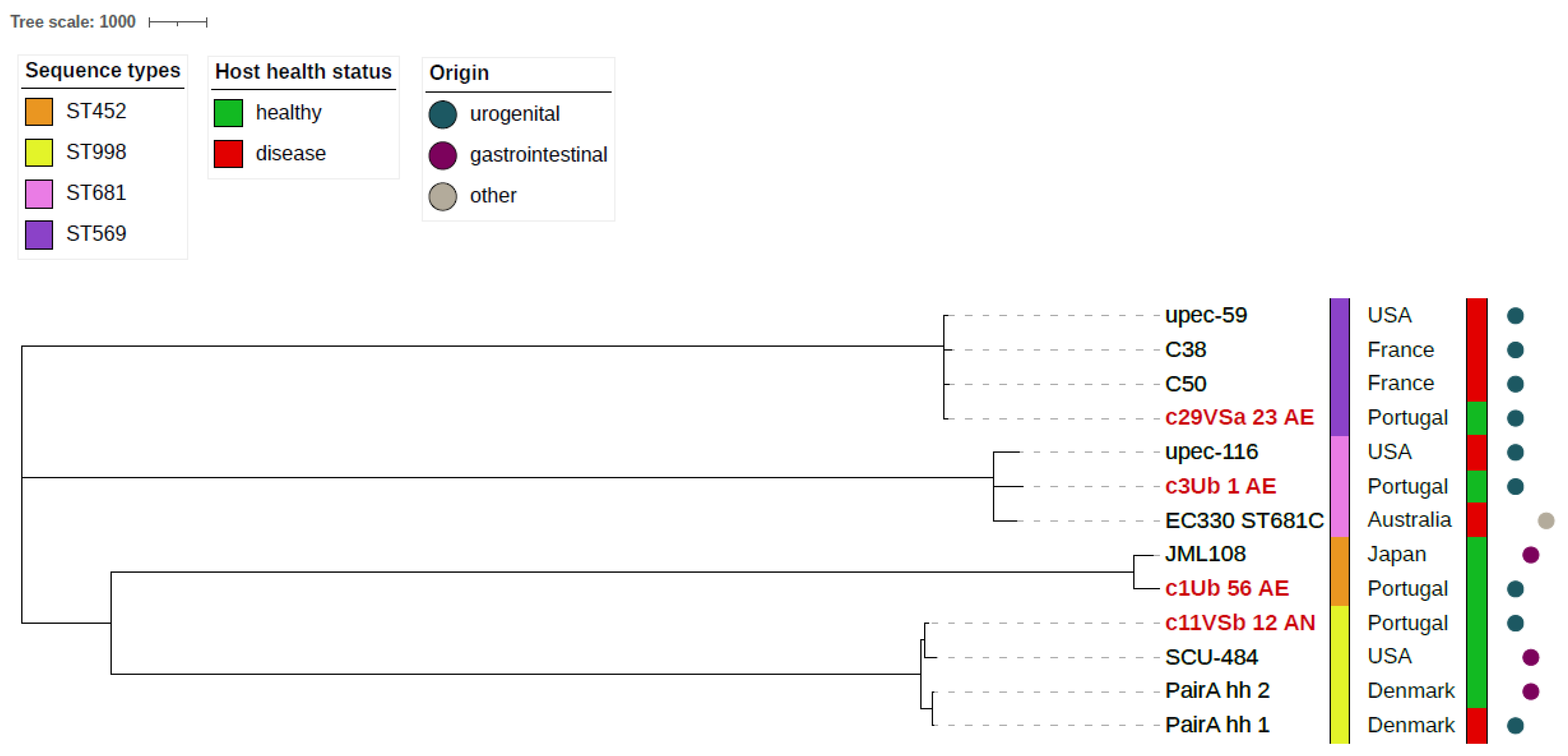
The Darkest Place Is under the Candlestick-Healthy Urogenital Tract as a Source of Worldwide Disseminated Extraintestinal Pathogenic Escherichia coli Lineages


Abstract
Share and Cite
Ksiezarek, M.; Novais, Â.; Peixe, L. The Darkest Place Is under the Candlestick-Healthy Urogenital Tract as a Source of Worldwide Disseminated Extraintestinal Pathogenic Escherichia coli Lineages. Microorganisms 2022, 10, 27. https://doi.org/10.3390/microorganisms10010027
Ksiezarek M, Novais Â, Peixe L. The Darkest Place Is under the Candlestick-Healthy Urogenital Tract as a Source of Worldwide Disseminated Extraintestinal Pathogenic Escherichia coli Lineages. Microorganisms. 2022; 10(1):27. https://doi.org/10.3390/microorganisms10010027
Chicago/Turabian StyleKsiezarek, Magdalena, Ângela Novais, and Luísa Peixe. 2022. "The Darkest Place Is under the Candlestick-Healthy Urogenital Tract as a Source of Worldwide Disseminated Extraintestinal Pathogenic Escherichia coli Lineages" Microorganisms 10, no. 1: 27. https://doi.org/10.3390/microorganisms10010027
APA StyleKsiezarek, M., Novais, Â., & Peixe, L. (2022). The Darkest Place Is under the Candlestick-Healthy Urogenital Tract as a Source of Worldwide Disseminated Extraintestinal Pathogenic Escherichia coli Lineages. Microorganisms, 10(1), 27. https://doi.org/10.3390/microorganisms10010027